
Showing 4 items matching "wendish"
-
 Whitehorse Historical Society Inc.
Document, Schwerkolt Family names, 1/08/2003 12:00:00 AM
... Wendish...An extract from 'Wendish newsletter' (Aug 2003) on 19th Century naming procedures and notes showing application to the Schwerkolt Family....Wendish Schwerkolt Family An extract from 'Wendish newsletter' (Aug 2003) on 19th Century naming procedures and notes showing application to the Schwerkolt Family. ...An extract from 'Wendish newsletter' (Aug 2003) on 19th Century naming procedures and notes showing application to the Schwerkolt Family.An extract from 'Wendish newsletter' (Aug 2003) on 19th Century naming procedures and notes showing application to the Schwerkolt Family.An extract from 'Wendish newsletter' (Aug 2003) on 19th Century naming procedures and notes showing application to the Schwerkolt Family.wendish, schwerkolt family -
 Bendigo Historical Society Inc.
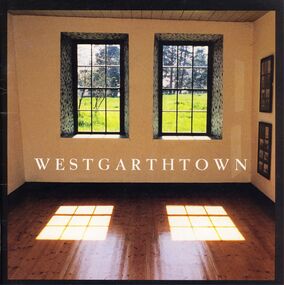
Book - STRAUCH COLLECTION: WESTGARTHTOWN
... A history of Westgarthtown, German and Wendish immigrants first settled at Westgarthtown in March 1850, situated 16 Kilometres north of Melbourne this land now forms part of the suburbs of Thomastown and Lalor. ...VICTORIA History german Victoria-history-German-Westgarthtown A history of Westgarthtown, German and Wendish immigrants first settled at Westgarthtown in March 1850, situated 16 Kilometres north of Melbourne this land now forms part of the suburbs of Thomastown and Lalor. ...A history of Westgarthtown, German and Wendish immigrants first settled at Westgarthtown in March 1850, situated 16 Kilometres north of Melbourne this land now forms part of the suburbs of Thomastown and Lalor. Soft cover 36 pages with black & white and coloured photographs,maps & illustrations. Published by the Heritage Council Victoria and the City of Whittlesea.victoria, history, german, victoria-history-german-westgarthtown -
 Friends of Westgarthtown
Functional object - Trunk/ Koffer, c. 1840s
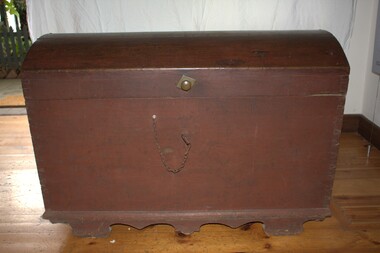
... It is a tangible link between the family’s Mecklenburg origins and their new life at Westgarthtown, offering powerful interpretive value for understanding early German-Wendish migration and daily life at sea. Built to specifications for sea voyaging it is also a reminder of the planning required prior to considered migration. ...The chest was constructed to allowable dimensions for storage in the ship's hold. The sturdy watertight construction afforded protection for the chests contents. It can be imagined that these would be household utensils, items of clothing and the most treasured ornaments as space permitted. It is likely that the contents included some building tools and as well, implements which Christian Ziebell used in his trade as a butcher in Bruel, thereby enabling him to undertake profitable work on his arrival in Australia.This object is of primary significance. The Koffer was constructed to allowable dimensions for storage in the ship’s hold. The sturdy watertight construction afforded protection for the Koffer’s contents on the voyage aboard the Privislaw from Hamburg, Germany to Hobsons Bay, Australia in 1850. The Koffer held the precious necessities for life for Christian Ziebell's family at their new destination. It is likely that the contents included some building tools as well, implements that Christian used in his trade as a butcher in Bruel, thereby enabling him to undertake profitable work on arrival in Australia. The wooden Koffer was airtight, so if lost overboard it would be retrievable. Some were fixed to the ship’s deck. After they settled at Westgarthtown the Koffer continued to contain the precious documents through each generation. Only the current owners saw the contents in each generation, and the children always regarded it as a “treasure chest”, which was always locked and out of bounds for them. This German-made sea chest, dating from the late 1840s, holds exceptional historical, cultural, and interpretive significance as an original migration object belonging to Christian and Sophia Ziebell during their maiden voyage to Australia. Serving as the family’s personal storage trunk aboard the Pribislaw in 1849, the chest would have functioned as a container for clothing, tools, and essential belongings. Later it served as storage for family archives and Lutheran church committee papers. Constructed in the robust mid-19th-century German style, the chest likely features oak timbers, dovetail joinery, and iron fittings typical of sea-going koffers of the period. Its painted decoration, including the name “C. Ziebell” in large black charcoal script, provides strong, direct provenance and reflects both ownership and pride in family identity. Such personalised embellishment was common among German migrants who decorated their chests during periods of spare time aboard the ship. As one of the rare surviving objects directly associated with the Ziebell family’s migration story, this chest embodies themes of aspiration, hardship, cultural continuity, and settlement. It is a tangible link between the family’s Mecklenburg origins and their new life at Westgarthtown, offering powerful interpretive value for understanding early German-Wendish migration and daily life at sea. Built to specifications for sea voyaging it is also a reminder of the planning required prior to considered migration. Its survival enriches the museum’s capacity to convey the lived experience of Christian and Sophia Ziebell and the foundational story of the community they helped to establish. Large wooden trunk/koffer. Base is rectangular, and lid is rectancular to fit the base but curves between the front and back. Morticed corners; protruding base with beveled edge. Supported by profiled runners with four built-in feet. Handle for carrying on each end, and locking mechanism on front.'C. Ziebell' written in large font on back of chestpersonal effects, travel goods, pribislaw, johann christian ziebell, german migration, luggage -
 Friends of Westgarthtown
Furniture - Bed, double, Late 1800s
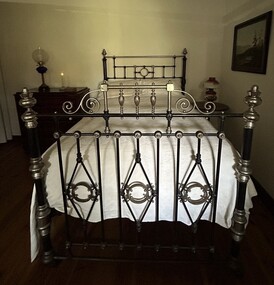
... This ornate iron bed holds strong historical and cultural significance as a rare surviving example of craftsmanship by Carl Heinrich Alfred “Carl Alfred” Ziebell (1867–1940), grandson of Christian and Sophia Ziebell, early German-Wendish settlers of Westgarthtown. A skilled wheelwright by trade, Carl Alfred possessed deep technical knowledge of metalworking, timber precision, and traditional fabrication techniques required for constructing and repairing wagon wheels. ...This object is of primary significance. The nickel plated brass bedstead was made by Carl Alfred Ziebell for his wife Dorothea. Carl Alfred Ziebell ( 23.08.1867 - 26.10. 1940) was the third generation grandson of Christian Ziebell. Dorothea remained proud of her bed throughout her long life. (14.7.1873 - 14.12.1969) The bed linen and quilts remain traditionally dressed as they were in 1850. This ornate iron bed holds strong historical and cultural significance as a rare surviving example of craftsmanship by Carl Heinrich Alfred “Carl Alfred” Ziebell (1867–1940), grandson of Christian and Sophia Ziebell, early German-Wendish settlers of Westgarthtown. A skilled wheelwright by trade, Carl Alfred possessed deep technical knowledge of metalworking, timber precision, and traditional fabrication techniques required for constructing and repairing wagon wheels. These same skills are reflected in the bed’s carefully forged ironwork and its distinctive circular decorative motifs. Carl Alfred crafted this bed for his wife, Dorothea, who, as family accounts recall, “remained proud of her bed throughout her long life.” The linens displayed on the bed are traditional cotton fabrics with intricate lace detailing, donated to the museum by Sylvia Ziebell. These textiles closely resemble the types of linens that would originally have dressed the bed, helping to evoke its historic domestic context. The bed represents both the material resourcefulness and artisanal expertise present within the second generation of the Ziebell family. Its construction demonstrates a blending of practical skill with aesthetic ambition, illustrating how tradespeople adapted their craft to create durable and decorative domestic furnishings. As Carl Alfred and Dorothea are buried in the Lutheran Cemetery adjacent to Ziebell’s Farmhouse, the bed also strengthens the site’s tangible connection to the family’s multi-generational presence in Westgarthtown. The piece is significant for its rarity, its association with an identified maker within the Ziebell lineage, and its ability to illuminate the lived experience, creativity, and craftsmanship of the early community. Nickel plated and painted tubular steel bedstead with double bed mattress and spreads. On four castor wheels, ornate decoration on both ends. Turned sections on each corner post, four on the bottom ends, only caps on the top ends. Spring wire mattress base.furniture, domestic, double bed, bedstead, nickel-plated, steel, turned
