
Showing 8 items matching "werribee railway station"
-
 Narre Warren and District Family History Group
Newspaper, Four killed at crossing: train strikes motor car
... ...Werribee Railway Station...Mrs Marie Ferguson, together with her daughter Vivian Warner and Vivian's two children Jean Warner aged 5 and Cranleigh Warner aged 3 were all killed when a car driven by Edward Crowley crashed into a train at a level crossing near Werribee Railway Station in 1930. ...Mrs Marie Ferguson, together with her daughter Vivian Warner and Vivian's two children Jean Warner aged 5 and Cranleigh Warner aged 3 were all killed when a car driven by Edward Crowley crashed into a train at a level crossing near Werribee Railway Station in 1930. Marie Ferguson Vivian Warner Jean Warner Cranleigh Warner Edith Crowley Edward Crowley Lois Crowley Joan Crowley Stuart Crowley James Ferguson Werribee Railway Station Packer Street Murrumbeena Written in blue ink at the top of the article is Feb 17 1930. ...Mrs Marie Ferguson, together with her daughter Vivian Warner and Vivian's two children Jean Warner aged 5 and Cranleigh Warner aged 3 were all killed when a car driven by Edward Crowley crashed into a train at a level crossing near Werribee Railway Station in 1930. Original newspaper clipping of an article from The Argus 17 Februaryy 1930. Describes a level crossing accident that occurred near Werribee when a car carrying ten people was hit by a train travelling to Melbourne. Four people were killed and five injured in the accident.Written in blue ink at the top of the article is Feb 17 1930.marie ferguson, vivian warner, jean warner, cranleigh warner, edith crowley, edward crowley, lois crowley, joan crowley, stuart crowley, james ferguson, werribee railway station, packer street murrumbeena, -
 Uniting Church Archives - Synod of Victoria
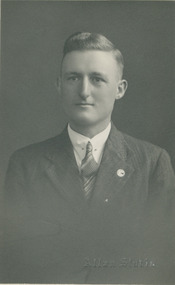
Photograph, C. 1937
... Werribee. Converted at age 15. Entered the Home Missionary Training College in 1936. Spent 29 years in many appointments including 3 years 1950 - 1952 in Inland Mission in the Murchison area, Western Australia. Enlisted as an army medical orderly in 1940. Served in the medical service in Palestine and was transferred to a forward casualty station, then taken prisoner by the Japanese in 1942. On the Death Railway...Werribee. Converted at age 15. Entered the Home Missionary Training College in 1936. Spent 29 years in many appointments including 3 years 1950 - 1952 in Inland Mission in the Murchison area, Western Australia. Enlisted as an army medical orderly in 1940. Served in the medical service in Palestine and was transferred to a forward casualty station, then taken prisoner by the Japanese in 1942. On the Death Railway ...Rev. Desmond Tarran (1916 - 1992). Born at Werribee. Converted at age 15. Entered the Home Missionary Training College in 1936. Spent 29 years in many appointments including 3 years 1950 - 1952 in Inland Mission in the Murchison area, Western Australia. Enlisted as an army medical orderly in 1940. Served in the medical service in Palestine and was transferred to a forward casualty station, then taken prisoner by the Japanese in 1942. On the Death Railway in Thailand worked closely with Dr E. (Weary) Dunlop and Dr Albert Coates in caring for starving and maltreated prisoners. Returned to home mission service in 1947. In 1966 was selected for special ordination as a Methodist minister. Served 11 years in country and city churches before retiring in 1978.Satin, black and white, head and shoulders, studio portrait of Rev. Desmond Tarran, as a post card.desmond tarran, home missionary, methodist minister, prisoner of war -
 Ballarat Tramway Museum
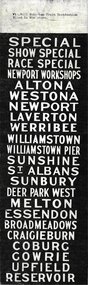
Sign - Sign - Destination Blinds, Trains, Victorian Rail Suburban Train Destination Blind in Miniature: Williamstown and areas north, south etc
... Place names listed are Altona, Westona, Newport, Laverton, Werribee, Williamstown, Williamstown Pier, Sunshine, St Albans, Sunbury, Deer Park West, Melton, Essendon, Broadmeadows, Craigieburn, Coburg, Cowrie, Upfield, Reservoir. Blind also indicates Show Special and Race Special. train destination blinds miniature railway stations reservoir upfield cowrie coburgcraigieburn broadmeadows essendon melton deer park west sunbury st albans sunshine williamstown pier werribee laverton williamstown newpoort westona altona newport workshops race special show special special ron bridger collection Place names - stations `List of names on black paper with white print. ...Ron Bridger was an avid collector of items related to transport, predominately Trams. These items include newspaper cuttings, pamphlets, reports, timetables, fares prices plus special items relating to events. Items from Melbourne and regional Victoria, interstate - Adelaide and Sydney, plus overseas, make up this collection. A suburban train destination blind in miniature. Place names indicate the western and northern suburbs that the train travels to. Place names listed are Altona, Westona, Newport, Laverton, Werribee, Williamstown, Williamstown Pier, Sunshine, St Albans, Sunbury, Deer Park West, Melton, Essendon, Broadmeadows, Craigieburn, Coburg, Cowrie, Upfield, Reservoir. Blind also indicates Show Special and Race Special.`List of names on black paper with white print.Place names - stationstrain destination blinds, miniature, railway stations, reservoir, upfield, cowrie, coburgcraigieburn, broadmeadows, essendon, melton, deer park west, sunbury, st albans, sunshine, williamstown pier, werribee, laverton, williamstown, newpoort, westona, altona, newport workshops, race special, show special, special, ron bridger collection -
 Melton City Libraries
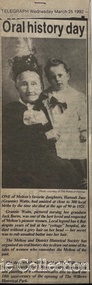
Newspaper, Oral History Day, 1992
... Railway Station. If it had of got over the railway they said it would have gone into Werribee. ...Railway Station. If it had of got over the railway they said it would have gone into Werribee. ...Mary Tolhurst M&DHS - March 29th Dunvegan Willows Park Melton 1992 Ladies Oral History Day Graham Minns President Ray Radford MC Sound recording transfer to CD 2011 by Tom Wood Edited typescript by Wendy Barrie 2013 I was born in Rockbank, and when I was five years old moved to Toolern Vale and started and finished school there. Toolern Vale only consisted of the Store, Post Office and shop, where you could buy your fodder, and pollard supplies, the Hall, the little Church and the bluestone School. The School changed shape three times from the 1800s[1869] til the time I went there. There was four generations of my family that went there and it was destroyed by fire in 1965. Marjorie nee Myers Butler. Yes, I remember along with it your lovely Ronisch piano. Mary, quite true! Marj what you say about the Ronisch piano. When I came the age to learn music my mum and dad couldn’t really afford it, but still what parents do for their children. They had Marj go along with them and pick this lovely Ronisch piano. It was known round the district. Everyone commented about the loss that lovely piano. After leaving school it was war time, 1939, then it was work, When I was 7 year old I was put out into the cow yard. In 1940 when the soldiers were going away our milk was confiscated it had to go to Bacchus Marsh. It used to go the Sunbury to be brine cooled and then go to Melbourne. Then they took it then to the Lifeguard Milk Factory at Bacchus Marsh. It had to go as condensed milk to the soldiers. This year is 50 years of the Land Army. I was an unofficial Land Army but they still kept check on me. I went onto married life and I followed the cows right through [howls of laughter] and we went on until the 1965 fire. That’s when we got out of the cows. Marjorie asks, was Granny Watts your grandmother or great grandmother? Mary: She was my great grandmother, the midwife of Melton. The 1965 fire started ¾ of a mile above our place, Frank Ryan’s sheds were burnt and his house was saved, then it wiped the School out, the Hall, the Church the Post Office and Store and little house that was Charlie Charlton’s in the early days. Mrs Wilson’s place was saved by the Fire Brigade by pulling boards off the side, and from there it went over the hill and it was stopped at the Rockbank Railway Station. If it had of got over the railway they said it would have gone into Werribee. A lot was burnt out in that strip. Mary nee Nixon Collins: 18 houses burnt that day. Audience question, did Melton get burnt that day? Ray: No. It came down through the Toolern Vale road and cut across about a mile and a half from the cross roads at Toolern Vale from north westerly to the south east and cut through over the Keilor road. Mary: It came in across the creek at Funstons in Toolern, then through Jim Minns. Dorothy was it your place then [nee Knox Beaty] to Ken Beatty’s and from there it went through to Doug McIntosh’s and to Cockbills and the wind changed and it came across to the railway line, and that is where they stopped it. [the cause of the fire was controversial, they had been burning off the night before and there was some talk of someone starting it. It was very hot and very strong wind, it was a terrible day] Ray: When the fire went through McIntosh’s they had a haystack on the north side of their house and the haystack got caught and the fire burnt a hole through the side of the house and the boys pyjamas on the bed. The house was saved. It came through like and express train roaring at you, I was at McIntosh’s when it went roaring past. You couldn’t see, dust and ash and tremendous heat. The fire started about 12 o’clock Jack [husband] said to me, fire, I said where, where? Just up the road, what have I got to do? and he went out and he had gone to the fire and left me. I tried to get the animals and I put out buckets of water, putting the buckets of water out saved my life. Chas Jones and another friend of his came in and they picked up the buckets of water, I thought I had better get out because the fire was on the haystack up the paddock and when I went to go out through the north side of the house and couldn’t get out, I’ll go through the front gate so I went around the other side of the house. I got caught there and Chassy Jones and his friend came round carrying the bucket of water and I panicked. He threw the bucket of water over me. Well that is what saved my life because I was damp, whenever we tried to leave the ball of fire came over me and over my shoulder and my hair was scorched. Chassy Jones lost his truck and Keith Watt his big truck because he had the water tank on it and they couldn’t get out of the yard. Granny Watt’s house, the first private hospital had condemned and Jack and I pulled it down and had it moved up to Toolern and had it in the yard a fortnight and it was all burnt and we didn’t get the shed we wanted. Every 13 years right up until Ash Wednesday fires, there has always been fire close at hand. The 1952 fire went down the back of the house, the 1965 fire took the house, and the house that I live in now, it is the third house that has been on that spot. When the Hunters owned it, Mrs Hunter was nearly burnt in her bed. They had a 13 roomed house. In 1924 the house burnt down, and there was another house was built there and that was the one that burnt down. Edna: So Mary built a brick veneer house. Marjorie: like the three little pigs [laughter] Collins - Mary M &DHS - March 29th 1992 Ladies oral history day at Dunvegan, Willows Park Melton. Graham Minns President Ray Radford MC Sound recording transferred to CD 2011 Edited typescript by Wendy Barrie 2013 Mary Collins nee Nixon born in Terang 1907 down in the Western District and we shifted to Melton when I was 5 and a half then I started school here in Melton, and spent all my school life at Melton State School, next to the Church of England, it’s called the Primary School now. I got my Qualifying and Merit Certificate then I left School because there wasn’t a High School. When I was 16 I got and job in the Melton Post Office and I worked there, I was the first girl in Melton to deliver the mail, and worked on the telephone and the Bank business. Mrs Ross and myself behind the counter, there were about 500 – 600 people in the Shire at that time and now when I go into the new Post Office there is 36,000 here there’s still 2 people behind the counter [laughter from the audience] and wait in a queue right out to the door. Times haven’t changed much have they! There was a manual telephone and you had to ring the handle, and there were eight subscribers when I went there and when I left there were 46 I had coaxed that number to join the telephone, even the police station didn’t have the phone on. The two Hotels and the two Chaff mills and Mr Ernie Barrie, Parkers the butcher, the Shire Office was No 8, and the Police house was next to the Courthouse on the corner. They were number 9. I can remember a lot of the numbers still. The Post Office was the Agency for the Commonwealth Bank [comment from audience member] I used to do the Bank business too, I left after four years there, mother wasn’t very well. The Inspector who used to come up to the Post Office asked me if I would take up casual Post Mistress and to go around the different districts but I refused and when Mrs Ross’s holidays were due I was the replacement. I wasn’t 21. I loved my work meeting everybody and most people had horse and jinkers and when the elderly would come in there would be Mr Tom Morrow, he only had one arm and Mrs Dunn came from Bulman’s road in their horse and jinker. They were elderly I would see them pull up out the front and quickly get their mail and run out to them because they didn’t have to get out of the jinker to tie up their horse. If someone had a baby in arms I would tear out and hold the baby while they got down. Mrs Ross was very very strict. I had to sweep the Post Office, she had a couple of mats and there would be a threepence or a sixpence under the mats show she knew whether I lifted the mat, I was whether I was honest or not. Graham: How much were your wages? I got 27/7 pence a week for a 52 hour week. I had to work every holiday except Good Friday and Christmas Day and even when it was Monday holiday I always had to go to work from 9am - !0 am, the Post Office was always open. In the winter I had to wait until twenty past six in case there were any telegrams to deliver. I delivered them on a push bike. One time Tom Barrie told me this years afterwards. I used to go home for lunch. We lived on the Keilor road and I used to ride my bike home. On the hot days the boys used to go and swim in the swimming pool down near a turn in the creek there was a hole where the boys would swim in the nude, they didn’t have any bathers and they didn’t have any watches in those days. Tom Barrie said they always used to watched for me as I was always about 3 minutes past 1, my lunch hour was from 1-2. One particular day they missed seeing me and swam on, and of course they were all late for school when they got back and were all kept in a night. I did get a fortnight holiday. I loved my work and I knew everyone in the district right from Toolern Vale to the Marsh and everybody at Melton South. Did you listen into conversations on the Switchboard? Oh no. [laughter] Melton did not have electricity then. I had to fill the lamps everyday with kerosene. The Staughton Memorial was outside the Post Office. It had four posts with the chain looped around it, and that’s where the people used to tie up their horses. Marjorie nee Myers Butler comments about sitting and swinging on the chains. Mr Fred Coburn lit the acetylene gas light in the Memorial. It was the only streetlight in Melton. There was no electricity until 1939. Ray Radford comments about another gas street light which was on the corner of Station road. [later] Mary passes around her school photos. Mary mentions the names of those who have passed away, Maisie McDonald, ,Marian Wraith, Hilda McCreey, and Valda McDonald. I have written the names on the back. Marjorie comments about Marie Jongebloed and Greta are the only two girls left out of big family of ten I think there were [hesitates] 4 or 5 girls and the rest were boys. Mary. Flora Woodley, Dorrie Flynn and Margaret McDonald are still alive. They are my age we were all born about 1907. Marjorie points out herself in a later photo [1921 and 1922 School ] Mary mentions the name Walsh and identyfies following names, the Parker boys, Ken Beaty, Malc and Linda Cameron, Maisie Mc Donald, Ted Radford, George Nixon, Norman Minns, he was later the Shire Secretary of Werribee. One of the Woodley girls. [Maisie Arthur] Marjorie: Rosie Shearwood, June Whiting Mary. Lily Mc Donald, she has passed away. Isabel Harrison nee Tinkler, she lives at Werribee, Doreen Rogers, Marjorie Walker, Jess McIntosh, Mary Gillespie. Mr Malone was the Junior teacher Mr Roe and Miss Cooke. Fred Myers, my sister [Elizabeth] and the year was 1921. Myers (Barrie) School Photo Collection. Many of the names were identified at the 1970 Centenary of Melton State School No. 430. Edna Barrie organised, compiled and typed the lists to accompany these photos for the year 1921. The 1922 photo shows the higher grades. Ladies Oral History Day event held by Melton and District Historical Society, article featured in the Telegraphlocal identities, local special interest groups -
 Melton City Libraries
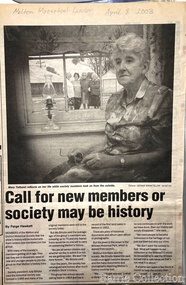
Newspaper, 'Call for new members or society maybe be history, 2003
... Railway Station. If it had of got over the railway they said it would have gone into Werribee. ...Railway Station. If it had of got over the railway they said it would have gone into Werribee. ...Mary Tolhurst M&DHS - March 29th Dunvegan Willows Park Melton 1992 Ladies Oral History Day Graham Minns President Ray Radford MC Sound recording transfer to CD 2011 by Tom Wood Edited typescript by Wendy Barrie 2013 I was born in Rockbank, and when I was five years old moved to Toolern Vale and started and finished school there. Toolern Vale only consisted of the Store, Post Office and shop, where you could buy your fodder, and pollard supplies, the Hall, the little Church and the bluestone School. The School changed shape three times from the 1800s[1869] til the time I went there. There was four generations of my family that went there and it was destroyed by fire in 1965. Marjorie nee Myers Butler. Yes, I remember along with it your lovely Ronisch piano. Mary, quite true! Marj what you say about the Ronisch piano. When I came the age to learn music my mum and dad couldn’t really afford it, but still what parents do for their children. They had Marj go along with them and pick this lovely Ronisch piano. It was known round the district. Everyone commented about the loss that lovely piano. After leaving school it was war time, 1939, then it was work, When I was 7 year old I was put out into the cow yard. In 1940 when the soldiers were going away our milk was confiscated it had to go to Bacchus Marsh. It used to go the Sunbury to be brine cooled and then go to Melbourne. Then they took it then to the Lifeguard Milk Factory at Bacchus Marsh. It had to go as condensed milk to the soldiers. This year is 50 years of the Land Army. I was an unofficial Land Army but they still kept check on me. I went onto married life and I followed the cows right through [howls of laughter] and we went on until the 1965 fire. That’s when we got out of the cows. Marjorie asks, was Granny Watts your grandmother or great grandmother? Mary: She was my great grandmother, the midwife of Melton. The 1965 fire started ¾ of a mile above our place, Frank Ryan’s sheds were burnt and his house was saved, then it wiped the School out, the Hall, the Church the Post Office and Store and little house that was Charlie Charlton’s in the early days. Mrs Wilson’s place was saved by the Fire Brigade by pulling boards off the side, and from there it went over the hill and it was stopped at the Rockbank Railway Station. If it had of got over the railway they said it would have gone into Werribee. A lot was burnt out in that strip. Mary nee Nixon Collins: 18 houses burnt that day. Audience question, did Melton get burnt that day? Ray: No. It came down through the Toolern Vale road and cut across about a mile and a half from the cross roads at Toolern Vale from north westerly to the south east and cut through over the Keilor road. Mary: It came in across the creek at Funstons in Toolern, then through Jim Minns. Dorothy was it your place then [nee Knox Beaty] to Ken Beatty’s and from there it went through to Doug McIntosh’s and to Cockbills and the wind changed and it came across to the railway line, and that is where they stopped it. [the cause of the fire was controversial, they had been burning off the night before and there was some talk of someone starting it. It was very hot and very strong wind, it was a terrible day] Ray: When the fire went through McIntosh’s they had a haystack on the north side of their house and the haystack got caught and the fire burnt a hole through the side of the house and the boys pyjamas on the bed. The house was saved. It came through like and express train roaring at you, I was at McIntosh’s when it went roaring past. You couldn’t see, dust and ash and tremendous heat. The fire started about 12 o’clock Jack [husband] said to me, fire, I said where, where? Just up the road, what have I got to do? and he went out and he had gone to the fire and left me. I tried to get the animals and I put out buckets of water, putting the buckets of water out saved my life. Chas Jones and another friend of his came in and they picked up the buckets of water, I thought I had better get out because the fire was on the haystack up the paddock and when I went to go out through the north side of the house and couldn’t get out, I’ll go through the front gate so I went around the other side of the house. I got caught there and Chassy Jones and his friend came round carrying the bucket of water and I panicked. He threw the bucket of water over me. Well that is what saved my life because I was damp, whenever we tried to leave the ball of fire came over me and over my shoulder and my hair was scorched. Chassy Jones lost his truck and Keith Watt his big truck because he had the water tank on it and they couldn’t get out of the yard. Granny Watt’s house, the first private hospital had condemned and Jack and I pulled it down and had it moved up to Toolern and had it in the yard a fortnight and it was all burnt and we didn’t get the shed we wanted. Every 13 years right up until Ash Wednesday fires, there has always been fire close at hand. The 1952 fire went down the back of the house, the 1965 fire took the house, and the house that I live in now, it is the third house that has been on that spot. When the Hunters owned it, Mrs Hunter was nearly burnt in her bed. They had a 13 roomed house. In 1924 the house burnt down, and there was another house was built there and that was the one that burnt down. Edna: So Mary built a brick veneer house. Marjorie: like the three little pigs [laughter] Mary Tolhurst member of the Melton & District Historical Society in the Melton and Moorabool Leader local identities, local special interest groups -
 Melton City Libraries
Photograph, 'Melton South Chaff Mill employees, Unknown
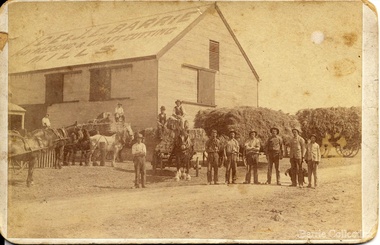
... Station road in 1900. It soon became a thriving business and was ideally located close to the railway line. Ernie and his father William and other Barrie brothers had been operated travelling chaff cutters in the district of Melton and Werribee. ...Station road in 1900. It soon became a thriving business and was ideally located close to the railway line. Ernie and his father William and other Barrie brothers had been operated travelling chaff cutters in the district of Melton and Werribee. ...Charles E “Ernie” Barrie started constructing a Chaff mill on the corner of Brooklyn and Station road in 1900. It soon became a thriving business and was ideally located close to the railway line. Ernie and his father William and other Barrie brothers had been operated travelling chaff cutters in the district of Melton and Werribee. Within a short time the mill expanded into two big sheds in partnership with his brother James E known as “Ted”. The eldest brother William was in the Manager living in Melton South. In 1906 Ernie applied for a railway crossing on Brooklyn Road to have direct access for railway trucks to be shunted to the mill to be loaded. The Mill was also had the first phone to be connected, No 1, and No’s 2, 3 were the Golden Fleece and Macs Hotels. In 1906 Ernie married Jessie Lang daughter of the Head Teacher at Melton State School No 430 (1896 –1917). The Barrie house on the north side of the mill was completed in August 1906. It survived for almost 60 years until demolition. Chaff mills were very susceptible to fires and often burnt down and would be rebuilt again ready for the peak of the harvesting season. The final demise of the Mill occurred in a spectacular blaze on the night of Friday 2nd December 1977, just before the earth tremor as reported in the local paper. Brian Dobson the local photographer lived close by and captured the night blaze. A video was also taken of the action by the fire brigade. My parents Bon and Edna Barrie were living at 19 First Avenue, and took colour slides of the smouldering ruins in the half -light. Ironically Bon had spent the first year of his life (born in April 1909 and sister Mary born October 1907) at the house beside the mill. Trethowan’s Chaff mill in Brooklyn road was also destroyed by fire, which stated in the evening on Tuesday April 28th 1987. It was established in 1910 by Dixon Brothers, followed by, Ebbot & Kebby, Robinson, Trethowan and Butler and was with the Trethowan family when it burnt down. Melton South was small a community referred to as Melton Railway Station. Member of the community raised the idea to have a public hall. In 1909 Cr Barrie, Mr Nesbitt and Delany formed a committee to build a community hall. Cr Barrie donated the land and The Exford Hall was completed in September 1910 later to be named Victoria Hall. It was demolished in 1992. Colour slide in Barrie archive. In April 1910 the Ernie sold the Mill to Glover Onians (HSK Ward) family moved away to a property in Trundle NSW. Ernie had acquired 640 acres (a square mile) and leased a further 1920 acres of adjoining land. It was the practise of the farmers in the area at the time to buy up or lease the surrounding land from the 640 acre crown land blocks to make up acerage for a viable wheat farm. His wife Jessie found the climate to be very hot and when the Darlingsford property at Melton was put up for sale in the latter part of 1910 and was passed in at the auction. My grandfather saw this an opportunity to return to Melton. The negotiations to Darlingsford were finalised on May 11th 1911. Barrie bothers with connections to Chaff mills and farming in Melton from the 1900s William Henry, Charles Ernest, James Edwin, Samuel John, Robert, Arthur Roger, Albert Walter. Three grandsons and a great-grandson are in business earthmoving and farming in Melton today. (2013) Memoirs by Wendy BarrieEmployees at Chaff Mill, it was located on the corner of Brooklyn and Station Road, Melton South. local identities, agriculture -
 Bacchus Marsh & District Historical Society
Map, Bacchus Marsh Urban District
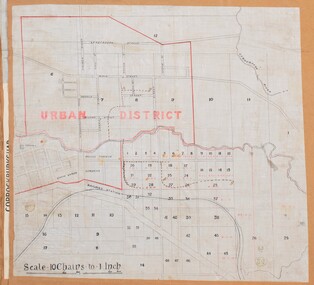
... Railway Station, which opened in 1887, is shown on the map. Bacchus Marsh Victoria Maps Maddingley Victoria Maps A single page paper map showing blocks of land in the urban district of Bacchus Marsh. The 'urban district' is indicated by red drawn lines on the map and includes streets and blocks on the northern side of the Werribee River in Bacchus Marsh, and streets and blocks south of the Werribee in Maddingley. ...The date of this map has not been established but the date would be sometime after 1887 as the Bacchus Marsh Railway Station, which opened in 1887, is shown on the map. A single page paper map showing blocks of land in the urban district of Bacchus Marsh. The 'urban district' is indicated by red drawn lines on the map and includes streets and blocks on the northern side of the Werribee River in Bacchus Marsh, and streets and blocks south of the Werribee in Maddingley. Scale 10 chains to 1 inch. The map is pasted into a bound volume containing 76 maps or plans in total. High resolution digital image stored on BMDHS computer network. bacchus marsh victoria maps, maddingley victoria maps -
 Sunshine and District Historical Society Incorporated
Administrative record - City of Sunshine - Commissioner Mr Alexander Alex George Gillon Collection 1976 - 1982 - Notice of ordinary meeting of the council 4th April 1978, City of Sunshine, 23rd March 1978
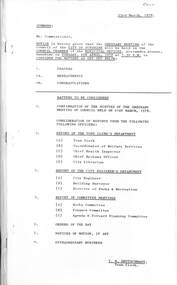
... Albans Road Sydney Street Robinsons Road Neale Road Sunshine Tip Navigator Street Sunshine Post Office Dempster Street Tottenham Railway Station Duke Street Wright Street Bell Street Riverview Court Lindenow Street Maidstone Glengala Road Syon Close United Social Cricket Club Scovell Reserve Scovell Crescent Notice of Ordinary Meeting of the Council 4th April 1978 Report of the Town Clerk's Department Report of the Town Clerk Metropolitan Fire Brigades Board Report of Council Representative Proposed Abattoir Shire of Werribee Proposal to Vary Municipal Officers' (City of Sunshine) Award Report of the Co-Ordinator of Welfare Services Information & Co-Ordination Grant Family & Community Services Programme Proposal for Unemployment Relief Report of the Chief Health Inspector Health Act Registrations Prosecution Proceedings Sunshine Magistrate Court Noise By-Law Weights & Measures Report for the Tow Months Ending 28th February 1978 Sale of Liquor Metric Conversion Infant Welfare Sisters in Service Training Lectures Report of the City Engineer Land Use Permit Application Flats Dalton Street Land Use Permit Application Flats Rita Street & Vule Street Land Use Permit Application Scrap Metal Processing & Recycling Lot 3 Somerville Road Land Use Permit Application Flats Killara Street & Mernda Street Proposed Amendmet No 81 to the Melbourne Metropolitan Planning Scheme Land Acquisition Maribyrnong Valley Land Use Permit Application Tennis Pavilion Selwyn Park for Albion Tennis Club Land Use Permit Application Car Sales Yard & Office 236 Ballarat Road Braybrook Land Use Permit Application Service Premises Lots 347 & 349 Tamar Drive Land Use Permit Application Bulk Meat Warehouse, Sales & Service Rosamond Road Proposed Rezoning Bounded by Durham Road, Hampshire Road, Corio Street & Watt Street Land Use Permit Application Sign Lot 119 Station Road Land Use Permit Application Oakwood Road Subdivision and Detached Houses Land Use Permit Application Factory 172 McIntyre Road Plans of Transfer and Consolidation St. ...Notice of Ordinary Meeting of the Council 4th April 1978 Report of the Town Clerk's Department Report of the Town Clerk Metropolitan Fire Brigades Board Report of Council Representative Proposed Abattoir Shire of Werribee Proposal to Vary Municipal Officers' (City of Sunshine) Award Report of the Co-Ordinator of Welfare Services Information & Co-Ordination Grant Family & Community Services Programme Proposal for Unemployment Relief Report of the Chief Health Inspector Health Act Registrations Prosecution Proceedings Sunshine Magistrate Court Noise By-Law Weights & Measures Report for the Tow Months Ending 28th February 1978 Sale of Liquor Metric Conversion Infant Welfare Sisters in Service Training Lectures Report of the City Engineer Land Use Permit Application Flats Dalton Street Land Use Permit Application Flats Rita Street & Vule Street Land Use Permit Application Scrap Metal Processing & Recycling Lot 3 Somerville Road Land Use Permit Application Flats Killara Street & Mernda Street Proposed Amendmet No 81 to the Melbourne Metropolitan Planning Scheme Land Acquisition Maribyrnong Valley Land Use Permit Application Tennis Pavilion Selwyn Park for Albion Tennis Club Land Use Permit Application Car Sales Yard & Office 236 Ballarat Road Braybrook Land Use Permit Application Service Premises Lots 347 & 349 Tamar Drive Land Use Permit Application Bulk Meat Warehouse, Sales & Service Rosamond Road Proposed Rezoning Bounded by Durham Road, Hampshire Road, Corio Street & Watt Street Land Use Permit Application Sign Lot 119 Station Road Land Use Permit Application Oakwood Road Subdivision and Detached Houses Land Use Permit Application Factory 172 McIntyre Road Plans of Transfer and Consolidation St. Albans Road Vinidex Tubemakers Variations to Contract Sunshine View Estate Private Street Scheme Contract Reconstruction of Sydney Street Robinsons Road Subdivision Contract Neale Road Restoration of Sunshine Tip Site Albion Navigator Street Private Street Scheme Sale of Former Post Office Site Sunshine Traffic Circuit Dempster Street & Tottenham Railway Station Bank Guarantee for Drainage Report of the Building Surveyor Building Over Easements Installation of Underground Tank 359 Ballarat Road Corner Duke Street Braybrook Fence 170 Wright Street Sunshine Siting of House Lot 4 Bell Street Sunshine West Siting of House Lot 18 Riverview Court Maribyrnong Siting of Open Garage 29 Lindenow Street Maidstone Installation of Underground Tank 58 Glengala Road Sunshine West Siting of House Lot 260 Syon Close Deer Park Additions to Club Premises Scovell Reserve by the United Social Cricket Club Orders of the Day Accounts Submitted for Payment as at 15th March 1978 Proposal to Close Part of Selwyn Street Under the Provisions of Section 528 of the Local Government Act 1958 city of sunshine, alexander "alex" george gillon, dalton street, sunshine west, rita street, vule street, st. albans, somerville road, tottenham, killara street, mernda street, maribyrnong valley, albion tennis club, selwyn park, selwyn street, albion, ballarat road, braybrook, tamar drive, deer park, rosamond road, maribyrnong, durham road, hampshire road, corio street, watt street, sunshine, station road, oakwood road, albanvale, mcintyre road, sunshine north, vinidex tubemakers, st. albans road, sydney street, robinsons road, neale road, sunshine tip, navigator street, sunshine post office, dempster street, tottenham railway station, duke street, wright street, bell street, riverview court, lindenow street, maidstone, glengala road, syon close, united social cricket club, scovell reserve, scovell crescent
