
Showing 8 items matching "western medicine"
-
 Federation University Historical Collection
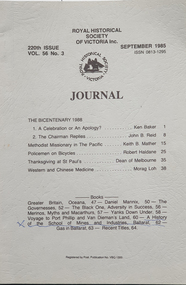
Journal - Booklet, Royal Historical Society of Victoria Journal, Volume 56, No 3, 1985, 1985
... ...western medicine...Mather) * Policemen on Bucycles (Robert Haldine) * Thanksgiving at St Paul's (James Grant) * Western and Chinese Medicine (Morag Loh)...Warren Perry Ballarat School of Mines history Ballarat School of Mines Methodist Misionaries police St Paul's medicine isaac rooney western medicine chinese medicine louis roller ah sue lo Kwoi Sang yee quock ping william ah ket Journal of the Royal Historical Association of Victoria Incorporated. ...Journal of the Royal Historical Association of Victoria Incorporated.Grey covered journal including a review on the book "The History of the School of Mines and Industries, Ballarat". Contents * The Bicentenary 1988: A Celebration or An Apology (Ken Baker and John B. Reid) * Methodist Missionary in the Pacifice (Keith B. Mather) * Policemen on Bucycles (Robert Haldine) * Thanksgiving at St Paul's (James Grant) * Western and Chinese Medicine (Morag Loh)non-fictionJournal of the Royal Historical Association of Victoria Incorporated. warren perry, ballarat school of mines history, ballarat school of mines, methodist misionaries, police, st paul's, medicine, isaac rooney, western medicine, chinese medicine, louis roller, ah sue, lo kwoi sang, yee quock ping, william ah ket -
 Marysville & District Historical Society
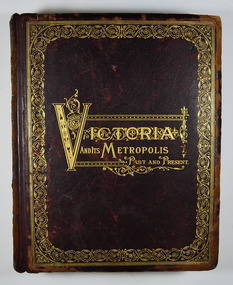
Book - Hardcover book, McCarron, Bird & Co, Victoria and its Metropolis-Past and Present-Volume 2, 1888
... ...medicine...western...A history of the various colonies and districts of Victoria from the time of the discovery of Australia through until 1888. melbourne victoria pioneers colonisation history fauna flora banking finance medicine western district south-western district wimmera district geelong district ballarat district avoca district coliban district campase district loddon district lower goulburn district upper goulburn district ovens district north-east district gippsland district mornington district westernport district upper yarra district evelyn district bourke district A history of the various colonies and districts of Victoria from the time of the discovery of Australia through until 1888. ...A history of the various colonies and districts of Victoria from the time of the discovery of Australia through until 1888.Hardback. Dark brown cover with the title in gold lettering. There is also a border in gold decorating the outer edge of the front cover. The spine is also decorated in gold along with the title and the volume number.non-fictionA history of the various colonies and districts of Victoria from the time of the discovery of Australia through until 1888.melbourne, victoria, pioneers, colonisation, history, fauna, flora, banking, finance, medicine, western district, south-western district, wimmera district, geelong district, ballarat district, avoca district, coliban district, campase district, loddon district, lower goulburn district, upper goulburn district, ovens district, north-east district, gippsland district, mornington district, westernport district, upper yarra district, evelyn district, bourke district -
 Flagstaff Hill Maritime Museum and Village
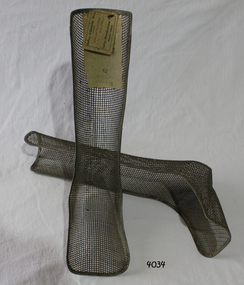
Splint, c. 1910-1920
... Western Victoria in the late 19th and early 20th century. The W.R. Angus Collection is significant for still being located at the site it is connected with, Doctor Angus being the last Port Medical Officer in Warrnambool. The collection of medical instruments and other equipment is culturally significant, being an historical example of medicine ...This is a pair of vintage DePuy wire mesh splints made to support a broken leg while the bone mended. The design was in use before and during WWI. It replaced the wooden splints previously used to reset bones in the late nineteenth to early 20th century. This new splint was invented by a traveling pharmaceutical salesman, Revra DePuy. He began manufacturing in his Warsaw, Indiana in 1895; the first commercial manufacture of orthopaedic equipment in the world . The company eventually became Johnson & Johnson. This pair of splints was donated to Flagstaff Hill Maritime Village by the family of Doctor William Roy Angus, Surgeon and Oculist. It is part of the “W.R. Angus Collection” that includes historical medical equipment, surgical instruments and material once belonging to Dr Edward Ryan and Dr Thomas Francis Ryan, (both of Nhill, Victoria) as well as Dr Angus’ own belongings. The Collection’s history spans the medical practices of the two Doctors Ryan, from 1885-1926 plus that of Dr Angus, up until 1969. These splints would have belonged to Dr Tom Ryan before being passed onto Dr. W.R. Angus. ABOUT THE “W.R.ANGUS COLLECTION” Doctor William Roy Angus M.B., B.S., Adel., 1923, F.R.C.S. Edin.,1928 (also known as Dr Roy Angus) was born in Murrumbeena, Victoria in 1901 and lived until 1970. He qualified as a doctor in 1923 at University of Adelaide, was Resident Medical Officer at the Royal Adelaide Hospital in 1924 and for a period was house surgeon to Sir (then Mr.) Henry Simpson Newland. Dr Angus was briefly an Assistant to Dr Riddell of Kapunda, then commenced private practice at Curramulka, Yorke Peninsula, SA, where he was physician, surgeon and chemist. In 1926, he was appointed as new Medical Assistant to Dr Thomas Francis Ryan (T.F. Ryan, or Tom), in Nhill, Victoria, where his experiences included radiology and pharmacy. In 1927 he was Acting House Surgeon in Dr Tom Ryan’s absence. Dr Angus had become engaged to Gladys Forsyth and they decided he would take time to further his studies overseas in the UK in 1927. He studied at London University College Hospital and at Edinburgh Royal Infirmary and in 1928, was awarded FRCS (Fellow from the Royal College of Surgeons), Edinburgh. He worked his passage back to Australia as a Ship’s Surgeon on the on the Australian Commonwealth Line’s T.S.S. Largs Bay. Dr Angus married Gladys in 1929, in Ballarat. (They went on to have one son (Graham 1932, born in SA) and two daughters (Helen (died 12/07/1996) and Berenice (Berry), both born at Mira, Nhill ) Dr Angus was a ‘flying doctor’ for the A.I.M. (Australian Inland Ministry) Aerial Medical Service in 1928 . The organisation began in South Australia through the Presbyterian Church in that year, with its first station being in the remote town of Oodnadatta, where Dr Angus was stationed. He was locum tenens there on North-South Railway at 21 Mile Camp. He took up this ‘flying doctor’ position in response to a call from Dr John Flynn; the organisation was later known as the Flying Doctor Service, then the Royal Flying Doctor Service. A lot of his work during this time involved dental surgery also. Between 1928-1932 he was surgeon at the Curramulka Hospital, Yorke Peninsula, South Australia. In 1933 Dr Angus returned to Nhill where he’d previously worked as Medical Assistant and purchased a share of the Nelson Street practice and Mira hospital from Dr Les Middleton one of the Middleton Brothers, the current owners of what was once Dr Tom Ryan’s practice. Dr L Middleton was House Surgeon to the Nhill Hospital 1926-1933, when he resigned. [Dr Tom Ryan’s practice had originally belonged to his older brother Dr Edward Ryan, who came to Nhill in 1885. Dr Edward saw patients at his rooms, firstly in Victoria Street and in 1886 in Nelson Street, until 1901. The Nelson Street practice also had a 2 bed ward, called Mira Private Hospital ). Dr Edward Ryan was House Surgeon at the Nhill Hospital 1884-1902 . He also had occasions where he successfully performed veterinary surgery for the local farmers too. Dr Tom Ryan then purchased the practice from his brother in 1901. Both Dr Edward and Dr Tom Ryan work as surgeons included eye surgery. Dr Tom Ryan performed many of his operations in the Mira private hospital on his premises. He too was House Surgeon at the Nhill Hospital 1902-1926. Dr Tom Ryan had one of the only two pieces of radiology equipment in Victoria during his practicing years – The Royal Melbourne Hospital had the other one. Over the years Dr Tom Ryan gradually set up what was effectively a training school for country general-practitioner-surgeons. Each patient was carefully examined, including using the X-ray machine, and any surgery was discussed and planned with Dr Ryan’s assistants several days in advance. Dr Angus gained experience in using the X-ray machine there during his time as assistant to Dr Ryan. Dr Tom Ryan moved from Nhill in 1926. He became a Fellow of the Royal Australasian College of Surgeons in 1927, soon after its formation, a rare accolade for a doctor outside any of the major cities. He remained a bachelor and died suddenly on 7th Dec 1955, aged 91, at his home in Ararat. Scholarships and prizes are still awarded to medical students in the honour of Dr T.F. Ryan and his father, Dr Michael Ryan, and brother, John Patrick Ryan. ] When Dr Angus bought into the Nelson Street premises in Nhill he was also appointed as the Nhill Hospital’s Honorary House Surgeon 1933-1938. His practitioner’s plate from his Nhill surgery states “HOURS Daily, except Tuesdays, Fridays and Saturday afternoons, 9-10am, 2-4pm, 7-8pm. Sundays by appointment”. This plate is now mounted on the doorway to the Port Medical Office at Flagstaff Hill Maritime Village, Warrnambool. Dr Edward Ryan and Dr Tom Ryan had an extensive collection of historical medical equipment and materials spanning 1884-1926 and when Dr Angus took up practice in their old premises he obtained this collection, a large part of which is now on display at the Port Medical Office at Flagstaff Hill Maritime Village in Warrnambool. During his time in Nhill Dr Angus was involved in the merging of the Mira Hospital and Nhill Public Hospital into one public hospital and the property titles passed on to Nhill Hospital in 1939. In 1939 Dr Angus and his family moved to Warrnambool where he purchased “Birchwood,” the 1852 home and medical practice of Dr John Hunter Henderson, at 214 Koroit Street. (This property was sold in1965 to the State Government and is now the site of the Warrnambool Police Station. ). The Angus family was able to afford gardeners, cooks and maids; their home was a popular place for visiting dignitaries to stay whilst visiting Warrnambool. Dr Angus had his own silk worm farm at home in a Mulberry tree. His young daughter used his centrifuge for spinning the silk. Dr Angus was appointed on a part-time basis as Port Medical Officer (Health Officer) in Warrnambool and held this position until the 1940’s when the government no longer required the service of a Port Medical Officer in Warrnambool; he was thus Warrnambool’s last serving Port Medical Officer. (The duties of a Port Medical Officer were outlined by the Colonial Secretary on 21st June, 1839 under the terms of the Quarantine Act. Masters of immigrant ships arriving in port reported incidents of diseases, illness and death and the Port Medical Officer made a decision on whether the ship required Quarantine and for how long, in this way preventing contagious illness from spreading from new immigrants to the residents already in the colony.) Dr Angus was a member of the Australian Medical Association, for 35 years and surgeon at the Warrnambool Base Hospital 1939-1942, He served as a Surgeon Captain during WWII1942-45, in Ballarat, Victoria, and in Bonegilla, N.S.W., completing his service just before the end of the war due to suffering from a heart attack. During his convalescence he carved an intricate and ‘most artistic’ chess set from the material that dentures were made from. He then studied ophthalmology at the Royal Melbourne Eye and Ear Hospital and created cosmetically superior artificial eyes by pioneering using the intrascleral cartilage. Angus received accolades from the Ophthalmological Society of Australasia for this work. He returned to Warrnambool to commence practice as an ophthalmologist, pioneering in artificial eye improvements. He was Honorary Consultant Ophthalmologist to Warrnambool Base Hospital for 31 years. He made monthly visits to Portland as a visiting surgeon, to perform eye surgery. He represented the Victorian South-West subdivision of the Australian Medical Association as its secretary between 1949 and 1956 and as chairman from 1956 to 1958. In 1968 Dr Angus was elected member of Spain’s Barraquer Institute of Barcelona after his research work in Intrasclearal cartilage grafting, becoming one of the few Australian ophthalmologists to receive this honour, and in the following year presented his final paper on Living Intrasclearal Cartilage Implants at the Inaugural Meeting of the Australian College of Ophthalmologists in Melbourne In his personal life Dr Angus was a Presbyterian and treated Sunday as a Sabbath, a day of rest. He would visit 3 or 4 country patients on a Sunday, taking his children along ‘for the ride’ and to visit with him. Sunday evenings he would play the pianola and sing Scottish songs to his family. One of Dr Angus’ patients was Margaret MacKenzie, author of a book on local shipwrecks that she’d seen as an eye witness from the late 1880’s in Peterborough, Victoria. In the early 1950’s Dr Angus, painted a picture of a shipwreck for the cover jacket of Margaret’s book, Shipwrecks and More Shipwrecks. She was blind in later life and her daughter wrote the actual book for her. Dr Angus and his wife Gladys were very involved in Warrnambool’s society with a strong interest in civic affairs. Their interests included organisations such as Red Cross, Rostrum, Warrnambool and District Historical Society (founding members), Wine and Food Society, Steering Committee for Tertiary Education in Warrnambool, Local National Trust, Good Neighbour Council, Housing Commission Advisory Board, United Services Institute, Legion of Ex-Servicemen, Olympic Pool Committee, Food for Britain Organisation, Warrnambool Hospital, Anti-Cancer Council, Boys’ Club, Charitable Council, National Fitness Council and Air Raid Precautions Group. He was also a member of the Steam Preservation Society and derived much pleasure from a steam traction engine on his farm. He had an interest in people and the community He and his wife Gladys were both involved in the creation of Flagstaff Hill, including the layout of the gardens. After his death (28th March 1970) his family requested his practitioner’s plate, medical instruments and some personal belongings be displayed in the Port Medical Office surgery at Flagstaff Hill Maritime Village, and be called the “W. R. Angus Collection”. The pair of splints was made by the world’s oldest orthopedic company, founded in 1895. The splint was a part of Dr. Tom Ryan’s equipment that was passed onto Dr W.R. Angus. It is part of the collection of historical medical equipment used in Western Victoria in the late 19th and early 20th century. The W.R. Angus Collection is significant for still being located at the site it is connected with, Doctor Angus being the last Port Medical Officer in Warrnambool. The collection of medical instruments and other equipment is culturally significant, being an historical example of medicine from late 19th to mid-20th century. Dr Angus assisted Dr Tom Ryan, a pioneer in the use of X-rays and in ocular surgery. Splint, (pair of 2) from the W.R. Angus Collection. Stiff wire mesh with a hard metal border around the edges, shaped as a food and half leg, with printed paper labels attached to the top. Labels show manufacturer and instructions. Made for supporting Tibia and Fibula bones. Label attached to one split reads "DePuy Adjustable Wire / PATENTED / Tibia and Fibula Splint / No. 32 Medium Posterior / DePuy Manufacturing Co. / Warsaw, Indiana""DePuy Adjustable Wire / PATENTED / Tibia and Fibula Splint / No. 32 Medium Posterior / DePuy Manufacturing Co. / Warsaw, Indiana"flagstaff hill, warrnambool, shipwrecked coast, flagstaff hill maritime museum, maritime museum, shipwreck coast, flagstaff hill maritime village, great ocean road, dr w r angus, dr ryan, surgical instrument, t.s.s. largs bay, warrnambool base hospital, nhill base hospital, mira hospital, flying doctor, medical treatment, medical history, medical education, medical text book, wire mesh splint, wire mesh cast, orthopaedic medical equipment, bone setting equipment, 1910’s medical equipment, medical artefact -
 Phillip Island and District Historical Society Inc.
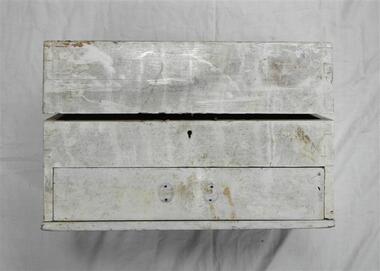
Medicine chest, 1887
... From the passenger ferry Alvina which worked on Western Port from 1925 to 1938. Built as a yacht in England. Wooden medicine chest with small compartments for medicines and drawer beneath. ...From the passenger ferry Alvina which worked on Western Port from 1925 to 1938. Built as a yacht in England.Wooden medicine chest with small compartments for medicines and drawer beneath. -
 Warrnambool and District Historical Society Inc.
Book, Exercise book P Le Couteur, 1898
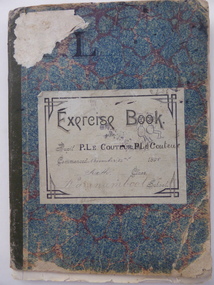
... medicine. At the university he excelled in sport – cricket, football and tennis. In 1908 he won the Rhodes Scholarship for Victoria and studied classics, classical history and philosophy at Oxford University. In 1913 he was appointed the foundation lecturer in Mental and Moral Philosophy at the University of Western...medicine. At the university he excelled in sport – cricket, football and tennis. In 1908 he won the Rhodes Scholarship for Victoria and studied classics, classical history and philosophy at Oxford University. In 1913 he was appointed the foundation lecturer in Mental and Moral Philosophy at the University of Western ...This school exercise book belonged to Philip Ridgway Le Couteur, Warrnambool’s first Rhodes Scholar. Philip Le Couteur (1885-1958), the son of George Le Couteur, a Warrnambool chemist and Fanny Byron (nee Maling), began his schooling at Middle Park State School and continued it in Warrnambool at the Warrnambool Academy run by Richard Lawson and William Oakley. He matriculated at the age of 14 and completed an Arts degree at Melbourne University before studying first year medicine. At the university he excelled in sport – cricket, football and tennis. In 1908 he won the Rhodes Scholarship for Victoria and studied classics, classical history and philosophy at Oxford University. In 1913 he was appointed the foundation lecturer in Mental and Moral Philosophy at the University of Western Australia. Following this he was the Head Master at various secondary schools, including Methodist Ladies’ College for 11 years. This book is of great interest because it contains examples of the schoolwork of Warrnambool’s first Rhodes Scholar, Philip Le Couteur.This is a school exercise book of 40 pages. The cardboard cover is a mottled blue and red colour with brown binding. All the pages have handwritten school work including dictation, arithmetic, spelling, map work, grammar and composition. The pages are detached from the cover and the cover is partly torn away and bent. The cover has some sketches drawn presumably by the owner of the book Philip Le Couteur. ‘P. Le Couteur, commenced 22nd November 1898, Sixth Class, Warrnambool School.’rhodes scholars, philip le couteur -
 Warrnambool and District Historical Society Inc.
Document, Docket Dr Bright's Phosphodyne, Mid 19th century
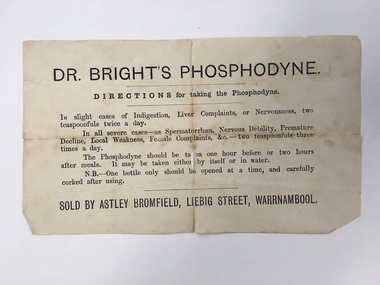
... medicine that today would be labelled ‘quack’. It is of particular interest as it was supplied by James Astley Bromfield’s chemist shop and he is an important early identity in Warrnambool, involved in many activities in the town. He was a Justice of the Peace, a Trustee of the Savings Bank, Chairman of the Western ...This label accompanied a bottle of Dr Bright’s Phosphodyne. It was a form of medicine also known as ozonic oxygen which was developed and patented in 1869 by Dr Charles Bright, a 19th century Resident Surgeon at St Mary’s Hospital London, The medicine claimed to ease ‘indigestion, liver complaints, nervous debility, female complaints, premature decline, local weakness and spermatorrhea’. It was widely sold by chemists throughout Australia in the 19th century and in this case was supplied by the Warrnambool chemist, James Astley Bromfield. He was a significant person in Warrnambool’s history as he produced the 1856 map of the Warrnambool district showing all the original landholders, a seminal resource for historians today. Bromfield had a chemist shop in Warrnambool from 1854 to the late 1880s, initially in Timor Street and then in Liebig Street (number 80 and later number 78). Bromfield was very active in local community affairs. This label is of considerable interest as it shows the use in the 19th century of medicine that today would be labelled ‘quack’. It is of particular interest as it was supplied by James Astley Bromfield’s chemist shop and he is an important early identity in Warrnambool, involved in many activities in the town. He was a Justice of the Peace, a Trustee of the Savings Bank, Chairman of the Western Steam Navigation Company, a Director of the Gasworks and on the committees of the Harbour Committee, the Fire Brigade and the Anglers Protection Society. He was a Warrnambool Councillor (1858-60; 1865-1870) and a Shire Councillor (1875-1883). This is a sheet of paper that accompanied a bottle of Dr Brights’ Phosphodyne medicine. It is buff-coloured with black printed material. It is in two pieces and dog-eared at the edges.warrnambool, dr bright's phosphodyne, james bromfield chemist, warrnambool chemists -
 Linton Mechanics Institute and Free Library Collection
Book - Novel, MacDonald, William Colt, Dead man's gold, 1951
... Fiction Western William Colt MacDonald Seven years had passed since the stolen gold was first buried, and now Sandy Ridge had a clue to its whereabouts, a clue which he had found concealed in a shipment of cigars earmarked for Town Marshal Dick Comitu. A lot of things, including the town itself, were earmarked for Comitu, and anyone who interfered was asking for trouble. When Sandy moved in, the word went out to "Stop Ridge!" and lead began to fly as Sandy proved that his gun meant bad medicine ...Seven years had passed since the stolen gold was first buried, and now Sandy Ridge had a clue to its whereabouts, a clue which he had found concealed in a shipment of cigars earmarked for Town Marshal Dick Comitu. A lot of things, including the town itself, were earmarked for Comitu, and anyone who interfered was asking for trouble. When Sandy moved in, the word went out to "Stop Ridge!" and lead began to fly as Sandy proved that his gun meant bad medicine for bad men.222p. ; blue cover ; sketch of two men with guns from original dust jacket cut and pasted onto front coverfictionSeven years had passed since the stolen gold was first buried, and now Sandy Ridge had a clue to its whereabouts, a clue which he had found concealed in a shipment of cigars earmarked for Town Marshal Dick Comitu. A lot of things, including the town itself, were earmarked for Comitu, and anyone who interfered was asking for trouble. When Sandy moved in, the word went out to "Stop Ridge!" and lead began to fly as Sandy proved that his gun meant bad medicine for bad men.fiction, western, william colt macdonald -
 Returned Nurses RSL Sub-branch
Book - Paperback book, Thomas Keneally, The daughhters of Mars, 2012
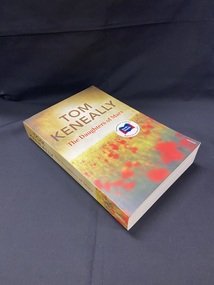
... Their education in medicine, valour and human degradation continues on the Greek island of Lemnos, then on the Western Front. ...In 1915 sisters Naomi and Sally Durance answer a call for nurses to join the war effort. They are escaping the family dairy farm in the Macleay Valley, and they carry a secret with them. Soon they are in Egypt, where they are put to work on the Red Cross hospital ship Archimedes as it patrols the Dardanelles. On Archimedes they witness Mars in all his ferocity, as he pummels soldiers in the massive, brutal metal brawl that is Gallipoli. Yet the sisters and their newfound nursing friends, with whom they will witness undreamt-of carnage and take care of unspeakably blighted men, find themselves courageous in the face of the horror. Naomi, Sally and their gang are then sent to northern Europe, where Naomi nurses in the visionary Australian Voluntary Hospital run by the committed and eccentric Lady Tarlton, and Sally in a casualty clearing station next to the Western Front. Here, again, they must face the inhumanity of war in its many terrible guises - where trench warfare and gas abound. But it is here, too, that the sisters meet the remarkable men with whom they wish to spend the rest of their lives. Inspired by journals of Australian nursing sisters who gave their all to the Great War effort and the men they nursed, The Daughters Of Mars is vast in scope yet extraordinarily intimate. This is Keneally at the height of his storytelling powers; a stunning tour de force to join the best of First World War literature, and one that casts a fresh light on the challenges faced by the Australian men and women who voluntarily risked their lives for peace. Naomi and Sally Durance are daughters of a dairy farmer from the Macleay Valley. Bound together in complicity by what they consider a crime, when the Great War begins in 1914 they hope to submerge their guilt by leaving for Europe to nurse the tides of young wounded. They head for the Dardanelles on the hospital ship Archimedes. Their education in medicine, valour and human degradation continues on the Greek island of Lemnos, then on the Western Front. Everywhere they are confronted by new outrages - gas, shellshock and broken men. Naomi encounters the wonderful, eccentric Lady Tarlton, who is founding a voluntary hospital near Boulogne; Sally serves in a casualty clearing station close to the front. They meet the men with whom they would wish to spend the rest of their lives. An extraordinary portrait of two ordinary young women[From Trove]Paperback book with a light olive cover and an image of a poppy field under the title and the author's name.fictionIn 1915 sisters Naomi and Sally Durance answer a call for nurses to join the war effort. They are escaping the family dairy farm in the Macleay Valley, and they carry a secret with them. Soon they are in Egypt, where they are put to work on the Red Cross hospital ship Archimedes as it patrols the Dardanelles. On Archimedes they witness Mars in all his ferocity, as he pummels soldiers in the massive, brutal metal brawl that is Gallipoli. Yet the sisters and their newfound nursing friends, with whom they will witness undreamt-of carnage and take care of unspeakably blighted men, find themselves courageous in the face of the horror. Naomi, Sally and their gang are then sent to northern Europe, where Naomi nurses in the visionary Australian Voluntary Hospital run by the committed and eccentric Lady Tarlton, and Sally in a casualty clearing station next to the Western Front. Here, again, they must face the inhumanity of war in its many terrible guises - where trench warfare and gas abound. But it is here, too, that the sisters meet the remarkable men with whom they wish to spend the rest of their lives. Inspired by journals of Australian nursing sisters who gave their all to the Great War effort and the men they nursed, The Daughters Of Mars is vast in scope yet extraordinarily intimate. This is Keneally at the height of his storytelling powers; a stunning tour de force to join the best of First World War literature, and one that casts a fresh light on the challenges faced by the Australian men and women who voluntarily risked their lives for peace. Naomi and Sally Durance are daughters of a dairy farmer from the Macleay Valley. Bound together in complicity by what they consider a crime, when the Great War begins in 1914 they hope to submerge their guilt by leaving for Europe to nurse the tides of young wounded. They head for the Dardanelles on the hospital ship Archimedes. Their education in medicine, valour and human degradation continues on the Greek island of Lemnos, then on the Western Front. Everywhere they are confronted by new outrages - gas, shellshock and broken men. Naomi encounters the wonderful, eccentric Lady Tarlton, who is founding a voluntary hospital near Boulogne; Sally serves in a casualty clearing station close to the front. They meet the men with whom they would wish to spend the rest of their lives. An extraordinary portrait of two ordinary young women[From Trove]wwi, ww1, world war one, world war 1, nurses, miles franklin award nominations, military nursing -- fiction, 1914-1918 -- australia -- fiction, historical fiction
