
Showing 59 items matching "wheat flour"
-
 City of Moorabbin Historical Society (Operating the Box Cottage Museum)
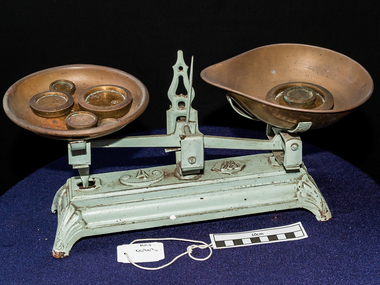
Scales, Imperial weights & brass bowls, c1900
... ...wheat flour...Its parts include a fulcrum, a beam that balances on it, two pans at the ends of the beam to hold the materials to be weighed, and counter-balancing weights. market gardeners early settlers fruit vegetables farmers cooking recipes scales weights measures brass balance beam moorabbin cheltenham bentleigh kitchen scales dairy products cereals wheat flour scales 4 lbs ( 4 Pounds ) each weight is marked with its weight in Imperial Measure 1 0z = 1 ounce to 4lb Its parts include a fulcrum, a beam that balances on it, two pans at the ends of the beam to hold the materials to be weighed, and counter-balancing weights.. ...A pair of scales or dishes in which objects to be weighed and the weights / masses against which to weigh them are placed is an "Apparatus for weighing. The pan, or each of the pans, of a balance." These common kitchen / dairy scales would be used by the householder to weigh flour, sugar, cereal, vegetables, fruit, meats, butter, cheese etc. prior to cooking or storing . Its parts include a fulcrum, a beam that balances on it, two pans at the ends of the beam to hold the materials to be weighed, and counter-balancing weights.Its parts include a fulcrum, a beam that balances on it, two pans at the ends of the beam to hold the materials to be weighed, and counter-balancing weights.. A set of steel weighing scales with a balance beam that holds 2 brass dishes in which are 7 brass weights. The object/ substance to be weighed is placed in 1 dish and the weights are added to the other dish until the two dishes balance equally on the beam. The base is engraved with '4 lbs' thus indicating that this set will balance up to that weight.scales 4 lbs ( 4 Pounds ) each weight is marked with its weight in Imperial Measure 1 0z = 1 ounce to 4lbmarket gardeners, early settlers, fruit vegetables, farmers, cooking, recipes, scales, weights, measures, brass, balance beam, moorabbin, cheltenham, bentleigh, kitchen scales, dairy products, cereals, wheat flour -
 City of Moorabbin Historical Society (Operating the Box Cottage Museum)
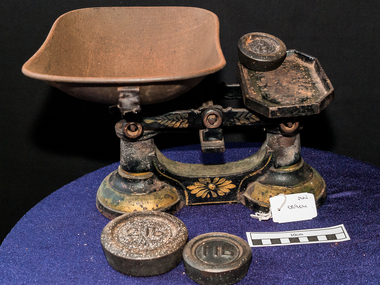
Scales, Imperial weights & large bowl, c1900
... ...wheat flour...These common kitchen / dairy scales would be used by the householder to weigh flour, sugar, cereal, vegetables, fruit, meats, butter, cheese etc. prior to cooking or storing . market gardeners early settlers fruit vegetables farmers cooking recipes scales weights measures brass balance beam moorabbin cheltenham bentleigh kitchen scales dairy products cereals wheat flour . Each weight is engraved with Imperial Measure = 2lb, 1lb, 6oz c1900 A set of steel weighing scales with a balance beam that holds 1 large metal dish for the item to be weighed and a smaller tray holding the weights. ...A pair of scales or dishes in which objects to be weighed and the weights / masses against which to weigh them are placed is an "Apparatus for weighing. The pan, or each of the pans, of a balance." These common kitchen / dairy scales would be used by the householder to weigh flour, sugar, cereal, vegetables, fruit, meats, butter, cheese etc. prior to cooking or storing . c1900 A set of steel weighing scales with a balance beam that holds 1 large metal dish for the item to be weighed and a smaller tray holding the weights. The object/ substance to be weighed is placed in 1 dish and the weights are added to the other dish until the two dishes balance equally on the beam. The base , balance beam and tray are decorated with a floral pattern Its parts include a fulcrum, a beam that balances on it, two pans at the ends of the beam to hold the materials to be weighed, and counter-balancing weights.Each weight is engraved with Imperial Measure = 2lb, 1lb, 6ozmarket gardeners, early settlers, fruit vegetables, farmers, cooking, recipes, scales, weights, measures, brass, balance beam, moorabbin, cheltenham, bentleigh, kitchen scales, dairy products, cereals, wheat flour, . -
 City of Moorabbin Historical Society (Operating the Box Cottage Museum)
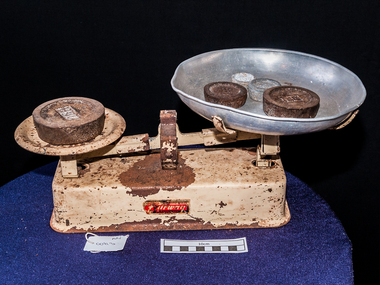
Scales, Domestic Imperial, ‘Fairway Melbourne’, c1930
... ...wheat flour...Its parts include a fulcrum, a beam that balances on it, two pans at the ends of the beam to hold the materials to be weighed, and counter-balancing weights. market gardeners early settlers fruit vegetables farmers cooking recipes scales weights measures brass balance beam moorabbin cheltenham bentleigh kitchen scales dairy products cereals wheat flour Scales ; MADE BY / DOMESTIC SCALES / FAIRWAY / MELBOURNE AUST. ...Fairway Company Melbourne manufactured this pair of domestic scales with a dish / pan in which objects to be weighed and the weights / masses against which to weigh them are placed. These common kitchen / dairy scales would be used by the householder to weigh flour, sugar, cereal, vegetables, fruit, meats, butter, cheese etc. prior to cooking or storing . Its parts include a fulcrum, a beam that balances on it, two pans at the ends of the beam to hold the materials to be weighed, and counter-balancing weights. A set of domestic scales made by ‘Fairway’ Melbourne c1930. Painted cream steel with 1 metal bowl / pan and Imperial measure weights 2LB, 1LB, 4OZ, 2OZ, 1OZScales ; MADE BY / DOMESTIC SCALES / FAIRWAY / MELBOURNE AUST. Weights ; 2LB, 1LB, 4OZ, 2OZ, 1OZ market gardeners, early settlers, fruit vegetables, farmers, cooking, recipes, scales, weights, measures, brass, balance beam, moorabbin, cheltenham, bentleigh, kitchen scales, dairy products, cereals, wheat flour -
 City of Moorabbin Historical Society (Operating the Box Cottage Museum)
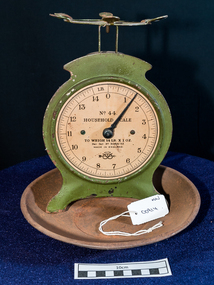
Scales,Spring Balnce Imperial ‘Household’ Salter, 20thC
... ...wheat flour...In 2004 was sold to the US-based HoMedics company, and in 2006, Salter Housewares USA and Taylor Precision Products Inc (also owned by HoMedics) merged. market gardeners early settlers fruit vegetables farmers cooking recipes scales weights measures brass balance beam moorabbin cheltenham bentleigh kitchen scales dairy products cereals wheat flour salter housewares pty ltd west bromwich england On Clock face ; NO. 44 / HOUSEHOLD SCALE / TO WEIGH 14LB X 1OZ / Pro. ...In the 18th century, spring scales appeared. To produce these scales, a manufacturer would use the resistance of a spring to calculate weights, which could be read automatically on the scale’s face. The ease of use of spring scales over balance scales is what led most post offices to outfit their clerks with spring postal scales. One of the most common types of spring scales was the kitchen scale—also known as a family or dial scale. Designed for horizontal surfaces, these scales used the weight of goods in a pan at the top of the scale to force the spring down. Such scales were common in early-20th-century households and were sold by Sears and Montgomery Ward. Many had flat weighing surfaces but some were topped by shallow pans. Companies such as Salters, Chatillon, and Fairbanks made both. SALTER HOUSEWARES began in the late 1760 in the village of Bilston, England. At this time Richard Salter, a spring maker, began making 'pocket steelyards', a scale similar to the fisherman's scale of today. By 1825 his nephew George had taken over the company, which became known as George Salter & Co. and later established a large, well equipped manufacturing site in the town of West Bromwich. The business thrived throughout the 1900s, and in 1972 the company was purchased by Staveley Industries Plc. In 2002, the management team at Salter Housewares Ltd, backed by Barclays Private Equity, bought the company out from the group, to concentrate on its consumer businesses. In 2004 was sold to the US-based HoMedics company, and in 2006, Salter Housewares USA and Taylor Precision Products Inc (also owned by HoMedics) merged. Salter Brand No. 44 Household Spring Balance Kitchen Scales made of green painted metal with a large clock face dial marked in 1oz graduations and with a shallow metal bowl placed on the flat top connected to the mechanism. An adjustable screw tightened or loosened the spring to bring the pointer to zero, prior to adding the material to be weighed.. A common piece of kitchen equipment as most families used this type of scale when measuring goods for cooking or storing.On Clock face ; NO. 44 / HOUSEHOLD SCALE / TO WEIGH 14LB X 1OZ / Pro. Pat. No. 30819 / 32 / MADE IN ENGLAND / SALTER / S in trademark rope with arrow market gardeners, early settlers, fruit, vegetables, farmers, cooking, recipes, scales, weights, measures, brass, balance beam, moorabbin, cheltenham, bentleigh, kitchen scales, dairy products, cereals, wheat flour, salter housewares pty ltd, west bromwich england -
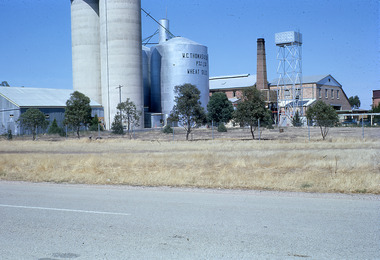 Bendigo Historical Society Inc.
Slide - Mouat Crawford Collection: Farming Life in the Wimmera, 1960s
... ...wheat...flour...BHS Collection farming wimmera wheat flour mill warracknabeal mouat crawford collection Flour Mill Warracknabeal Slide Mouat Crawford Collection: Farming Life in the Wimmera ...BHS CollectionFlour Mill Warracknabealfarming, wimmera, wheat, flour mill, warracknabeal, mouat crawford collection -
 Tatura Irrigation & Wartime Camps Museum
Photograph - copy, Tatura Flour Mill, 1947
... Copy of very old photograph of men working on wheat stacks at Reillys Flour Mill, Tatura, 1947. During whole of its working life (1880-1965) it was managed by members of one family....Black and white photograph of Wheat stacks at Reillys Flour Mill, Tatura, 1880 - 1965. ....Copy of very old photograph of men working on wheat stacks at Reillys Flour Mill, Tatura, 1947. During whole of its working life (1880-1965) it was managed by members of one family. reillys flour mill tatura james reilly Stacked wheat at Reilly's Mill Tatura Black and white photograph of Wheat stacks at Reillys Flour Mill, Tatura, 1880 - 1965. . ...Copy of very old photograph of men working on wheat stacks at Reillys Flour Mill, Tatura, 1947. During whole of its working life (1880-1965) it was managed by members of one family.Black and white photograph of Wheat stacks at Reillys Flour Mill, Tatura, 1880 - 1965. .Stacked wheat at Reilly's Mill Taturareillys flour mill tatura, james reilly -
Surrey Hills Historical Society Collection
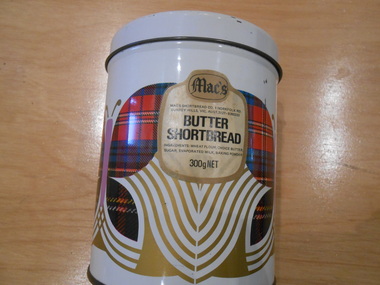
Domestic object - Biscuit tin, Mac's Butter Shortbread tin
... AUST 3127. 836 0333 BUTTER SHORTBREAD INGREDIENTS WHEAT FLOUR, CHOICE BUTTER, SUGAR< EVAPORATED MILK, BAKING POWDER 300g NET...AUST 3127. 836 0333 BUTTER SHORTBREAD INGREDIENTS WHEAT FLOUR, CHOICE BUTTER, SUGAR< EVAPORATED MILK, BAKING POWDER 300g NET A cylindrical tin with a silvered interior and the outside finished in a white enamel paint, on which are a pattern with 3 butterflies with tartan wings. there is a small printed paper label Mac's Butter Shortbread tin Domestic object Biscuit tin ...Mac's Shortbread Co dates its history back to a family bakery in Abbotsford opened in the 1860's producing bread for the goldfields. This eventually became McAlpine's Flour. This business was sold in 1960 and the family then purchased a cake shop, leading to building a biscuit factory. (This is thought to have been the Surrey Hills site). The company outgrew this and moved to Kerang. (Further research required.)This tin is material evidence of the small area of industrial activities that once existed in Surrey Hills.A cylindrical tin with a silvered interior and the outside finished in a white enamel paint, on which are a pattern with 3 butterflies with tartan wings. there is a small printed paper label1. Mac's / MAC'S SHORTBREAD CO. 1 NORFOLK ROAD, SURREY HILLS, VIC. AUST 3127. 836 0333 BUTTER SHORTBREAD INGREDIENTS WHEAT FLOUR, CHOICE BUTTER, SUGAR< EVAPORATED MILK, BAKING POWDER 300g NETbakeries, surrey hills, mac's shortbread, norfolk road -
 Surrey Hills Historical Society Collection
Container - Biscuit tin, Mac's Butter Shortbread tin
... AUST. 3127 - 8360333 / BUTTER / SHORTBREAD / INGREDIENTS: WHEAT FLOUR, CHOICE BUTTER, / SUGAR, EVAPORATED MILK, BAKING POWDER / 300 g NET"...AUST. 3127 - 8360333 / BUTTER / SHORTBREAD / INGREDIENTS: WHEAT FLOUR, CHOICE BUTTER, / SUGAR, EVAPORATED MILK, BAKING POWDER / 300 g NET" A cylindrical tin with a silvered interior and the outside finished in a white enamel paint, on which there is a geometric design incorporating a butterfly. ...Mac's Shortbread Co dates its history back to a family bakery in Abbotsford opened in the 1860's producing bread for the goldfields. This eventually became McAlpine's Flour. This business was sold in 1960 and the family then purchased a cake shop, leading to building a biscuit factory. (This is thought to have been the Surrey Hills site). The company outgrew this and moved to 5 Tate Drive, Kerang. (Further research required.) Australia adopted metric units of measurement in July 1974, so this object was manufactured after 1974.This tin is material evidence of the small area of industrial activities that once existed in Surrey Hills.A cylindrical tin with a silvered interior and the outside finished in a white enamel paint, on which there is a geometric design incorporating a butterfly.On a label incorporated in the design: "Mac's / MAC'S SHORTBREAD CO. 1 NORFOLK RD./ SURREY HILLS, VIC. AUST. 3127 - 8360333 / BUTTER / SHORTBREAD / INGREDIENTS: WHEAT FLOUR, CHOICE BUTTER, / SUGAR, EVAPORATED MILK, BAKING POWDER / 300 g NET"bakeries, surrey hills, mac's shortbread, norfolk road -
Surrey Hills Historical Society Collection
Container - Biscuit tin, Mac's Butter Shortbread tin
... ./ PRODUCT OF AUSTRALIA MADE BY MAC'S SHORTBREAD CO., 1 NORFOLK ROAD, SURREY HILLS, VICTORA INGREDIENTS WHEAT FLOUR, CHOICE BUTTER, SUGAR, LEAVENING, YOLKINE / Bar code 9 310034 305318..../ PRODUCT OF AUSTRALIA MADE BY MAC'S SHORTBREAD CO., 1 NORFOLK ROAD, SURREY HILLS, VICTORA INGREDIENTS WHEAT FLOUR, CHOICE BUTTER, SUGAR, LEAVENING, YOLKINE / Bar code 9 310034 305318 A cylindrical tin with a silvered interior and the outside finished in a white enamel paint, on which are a pattern of gold lions and tartan structures Mac's Butter Shortbread tin Container Biscuit tin ...Mac's Shortbread Co dates its history back to a family bakery in Abbotsford opened in the 1860's producing bread for the goldfields. This eventually became McAlpine's Flour. This business was sold in 1960 and the family then purchased a cake shop, leading to building a biscuit factory. (This is thought to have been the Surrey Hills site). The company outgrew this and moved to Kerang. (Further research required.)This tin is material evidence of the small area of industrial activities that once existed in Surrey Hills.A cylindrical tin with a silvered interior and the outside finished in a white enamel paint, on which are a pattern of gold lions and tartan structures1. Mac's / BUTTER SHORTBREAD 300g NET./ PRODUCT OF AUSTRALIA MADE BY MAC'S SHORTBREAD CO., 1 NORFOLK ROAD, SURREY HILLS, VICTORA INGREDIENTS WHEAT FLOUR, CHOICE BUTTER, SUGAR, LEAVENING, YOLKINE / Bar code 9 310034 305318bakeries, surrey hills, mac's shortbread, norfolk road -
 Surrey Hills Historical Society Collection
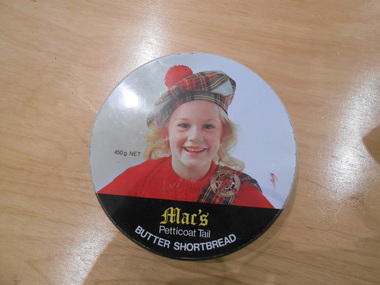
Container - Biscuit tin, Mac's Petticoat Tail Butter Shortbread tin
... ./ BAKED IN AUSTRALIA BY MAC"S SHORTBREAD CO., 1 NORFOLK ROAD, SURREY HILLS, VICTORA AUSTRALIA PHONE 8360333 INGREDIENTS WHEAT FLOUR, CHOICE BUTTER, SUGAR, EVAPORATED MILK BAKING POWDER..../ BAKED IN AUSTRALIA BY MAC"S SHORTBREAD CO., 1 NORFOLK ROAD, SURREY HILLS, VICTORA AUSTRALIA PHONE 8360333 INGREDIENTS WHEAT FLOUR, CHOICE BUTTER, SUGAR, EVAPORATED MILK BAKING POWDER A round tin with a silvered interior and the outside finished in a white enamel paint with the head and shoulders of a blond girl in red jumper, tartan sash and brooch and a tartan tam o'shanter hat. ...Mac's Shortbread Co dates its history back to a family bakery in Abbotsford opened in the 1860's producing bread for the goldfields. This eventually became McAlpine's Flour. This business was sold in 1960 and the family then purchased a cake shop, leading to building a biscuit factory. (This is thought to have been the Surrey Hills site). The company outgrew this and moved to Kerang. (Further research required.)This tin is material evidence of the small area of industrial activities that once existed in Surrey Hills.A round tin with a silvered interior and the outside finished in a white enamel paint with the head and shoulders of a blond girl in red jumper, tartan sash and brooch and a tartan tam o'shanter hat.1. Mac's / Petticoat Tail BUTTER SHORTBREAD 450g NET./ BAKED IN AUSTRALIA BY MAC"S SHORTBREAD CO., 1 NORFOLK ROAD, SURREY HILLS, VICTORA AUSTRALIA PHONE 8360333 INGREDIENTS WHEAT FLOUR, CHOICE BUTTER, SUGAR, EVAPORATED MILK BAKING POWDERbakeries, surrey hills, mac's shortbread, norfolk road -
 Tatura Irrigation & Wartime Camps Museum
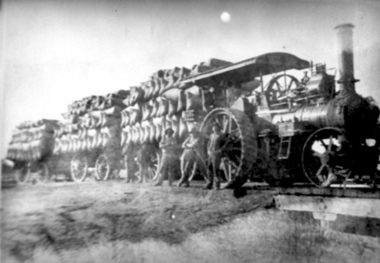
Photograph, Wheat Delivery
... Bags of wheat delivered to Tatura Flour Mill (Reilly's Flour Mill) by train, with workers posing....tatura Bags of wheat delivered to Tatura Flour Mill (Reilly's Flour Mill) by train, with workers posing. ...Bags of wheat delivered to Tatura Flour Mill (Reilly's Flour Mill) by train, with workers posing.tatura -
 Sunbury Family History and Heritage Society Inc.
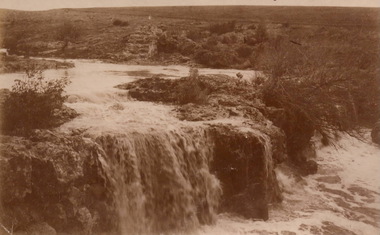
Postcard, Mill Falls
... The stairs on the RHS of the photo are the remains of Eadie's Mill which was constructed in the 1860s and run by the Eadie family to grind wheat into flour....The stairs on the RHS of the photo are the remains of Eadie's Mill which was constructed in the 1860s and run by the Eadie family to grind wheat into flour. John Eadie Eadie Family Mill Falls Jackson Creek Flour production Sunbury flour mill. ...These falls are known as Mill Falls and are situated on the Jackson Creek downstream from the Macedon Road bridge in Sunbury and Craiglie Winery. The stairs on the RHS of the photo are the remains of Eadie's Mill which was constructed in the 1860s and run by the Eadie family to grind wheat into flour.A non-digital sepia photograph in postcard format of a water flowing over rocks with ruins of some stone stairs on the RHS. john eadie, eadie family, mill falls, jackson creek, flour production, sunbury flour mill. -
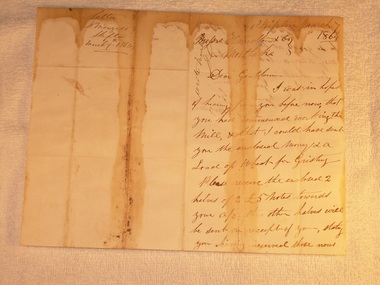 Mortlake and District Historical Society
Letter for payment of account Mortlake Mill, March 7 1864
... Menzies at Skipton to the Mortlake Mill, detailing an unusual payment method for the processing of his wheat into flour. David Menzies was a Scots farmer who lived in Skipton c. 1860's on a bend in the Mount Emu Creek. ...wheat for Gristing. Please receive the enclosed 2 halves of 2 [two] 5 [pound sign] notes forwarded to your account. the other halves will be sent on receipt of your stating you having received those notes sent. As I am out of flour...Menzies at Skipton to the Mortlake Mill, detailing an unusual payment method for the processing of his wheat into flour. David Menzies was a Scots farmer who lived in Skipton c. 1860's on a bend in the Mount Emu Creek. ...This letter was sent by a customer D. Menzies at Skipton to the Mortlake Mill, detailing an unusual payment method for the processing of his wheat into flour. David Menzies was a Scots farmer who lived in Skipton c. 1860's on a bend in the Mount Emu Creek. He helped establish the local school and a lane in the township bears his name. The letter illustrates the nature of commerce and the difficulties of communication and life generally in the country at the time. The bluestone Mortlake Mill built in 1856, has been a prominent landmark in Mortlake for over 150 years. It played a significant role in the commercial life of the town and was initially a wind-mill to process district grain for sale. The goldrush at Ararat 100 km. away led to a temporarily increased population and demand for foodstuffs. In 1857 the Mill was sold to Aikman, Hamilton and Geddes who converted it to steampower and later built the prominent chimney, which is on the Heritage Register as part of the National Estate. D. Menzies at Skipton lived at least 85 km away - his wheat which urgently needed milling, faced a slow and arduous journey by bullock dray. After the demise of the Ararat goldfields and the decline in population (as well as the district soils proving unsuitable for sustained wheat cultivation), the operation of the Mill declined too and the proprietors increased their involvement in other activities - supply of building materials, timber felling and sawmills. Despite the apparent difficulties of conducting business in the 1850's, it is notable that commerce thrived at that time in country districts, as an examination of Mill accounts and records show.Handwritten letter dated 1864 (water-stained)Skipton March 7 1864 [to] Messrs. Hamilton & Co. Mortlake. Dear Gentlemen, I was in hope of hearing from you before now that you had commenced working the Mill, & that I could have sent you the enclosed money [for a] load of wheat for Gristing. Please receive the enclosed 2 halves of 2 [two] 5 [pound sign] notes forwarded to your account. the other halves will be sent on receipt of your stating you having received those notes sent. As I am out of flour be so good as say how soon I may send a load of wheat. In haste I am Gentlemen Yours truly D. Menziesmortlake mill grain wheat hamilton geddes aikman laang dixie menzies skipton -
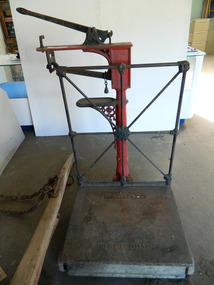 Kiewa Valley Historical Society
Scales - Tawonga Store
... They were used to weigh produce e.g.. flour & wheat that the farmers used on their farms and in their homes. ...They were used to weigh produce e.g.. flour & wheat that the farmers used on their farms and in their homes. ...These scales were used in the Tawonga Store which opened c1920. They were used to weigh produce e.g.. flour & wheat that the farmers used on their farms and in their homes. These scales pre date packaging. Ref. Weights KVHS 0800 (A)The Tawonga Store opened c1920 and sold goods and produce to the farmers of the Kiewa Valley. The scales were a necessary item for a store as goods were sold in bulk. Large steel dirty black platform attached at the middle of the back to a red cylinder which has 2 smaller platforms coming out to the side. The top platform has a black steel lever attached and a hook to hold it down. Below this platform is a measuring rod marked 2,4 etc up to 14 on which hangs a eight. The bottom platform is to rest the unused weights. Weights ref. KVHS 0800 (A)W. & T. Avery Birminghamscales. weights. tawonga store. farm produce. -
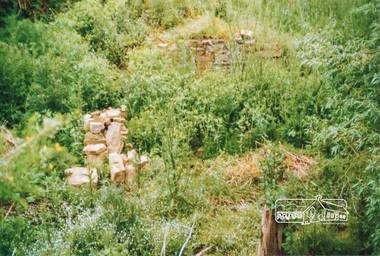 Eltham District Historical Society Inc
Photograph, Ruins of Coulstocks Mill, Janefield, South Morang
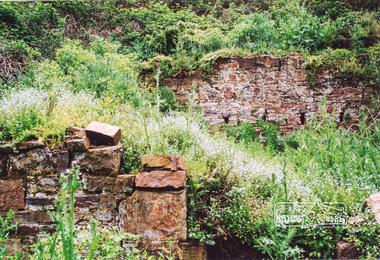
... Mill Park Farm at Janefield on the Plenty River was established around 1840 by George Coulstock where he grew wheat. His flour mill was one of the first in Victoria, under construction as early as 1841. ...Mill Park Farm at Janefield on the Plenty River was established around 1840 by George Coulstock where he grew wheat. His flour mill was one of the first in Victoria, under construction as early as 1841. ...Mill Park Farm at Janefield on the Plenty River was established around 1840 by George Coulstock where he grew wheat. His flour mill was one of the first in Victoria, under construction as early as 1841. After bushfires and Coulstock's early death in 1842, the farm and its mill were taken over by local landowners Henry Miller and John Brock. Peter Hurlestone took charge of the mill. With water diverted from the Plenty River to fill the newly built Yan Yean Reservoir which opened in 1857, the Hurlestone family quit and that was the demise of the mill.Four colour photographs showing the ruins of Coulstocks Flour Mill (Janefield Mill), Janefield. 1. Stone wall 2. Old mill 3. Stone remains of old mill 4. Tree near old mill sitemills, flour mills, coulstock, janefield, plenty river, ruins, stone walls, plenty gorge, bundoora -
 Eltham District Historical Society Inc
Photograph, Ruins of Coulstocks Mill, Janefield, South Morang
... Mill Park Farm at Janefield on the Plenty River was established around 1840 by George Coulstock where he grew wheat. His flour mill was one of the first in Victoria, under construction as early as 1841. ...Mill Park Farm at Janefield on the Plenty River was established around 1840 by George Coulstock where he grew wheat. His flour mill was one of the first in Victoria, under construction as early as 1841. ...Mill Park Farm at Janefield on the Plenty River was established around 1840 by George Coulstock where he grew wheat. His flour mill was one of the first in Victoria, under construction as early as 1841. After bushfires and Coulstock's early death in 1842, the farm and its mill were taken over by local landowners Henry Miller and John Brock. Peter Hurlestone took charge of the mill. With water diverted from the Plenty River to fill the newly built Yan Yean Reservoir which opened in 1857, the Hurlestone family quit and that was the demise of the mill.Five colour photographs of ruins of Coulstocks Mill, Janefield (Mill Park - Bundoora)mills, flour mills, coulstock, janefield, plenty river, ruins, stone walls, bundoora, plenty gorge -
 Flagstaff Hill Maritime Museum and Village
Container - Glass Jar, Nestle, 1920s
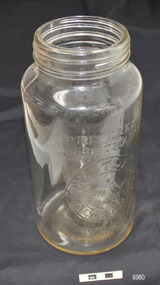
... The powder is a combination of evaporated whole milk powder, malted barley and wheat flour. Nestle began in 1867 and its products were available in Australia since the 1880s. ...The powder is a combination of evaporated whole milk powder, malted barley and wheat flour. Nestle began in 1867 and its products were available in Australia since the 1880s. ...This glass jar once contained Australian-made Nestle’s Malted Milk. The jar carries the company’s familiar logo. This jar would have originally had a screw-top metal lid. The large jar may have been used in a canteen, hospitality business or hospital due to its capacity. The jar was owned by Dr W.R. Angus, surgeon and oculist, who lived in Warrnambool with his wife and growing family for over thirty years. It may have been purchased from the Nestle factory in nearby Dennington. The jar was donated by his family and is part of the W.R Angus Collection. Nestles Malted Milk powder is usually added to either hot or cold milk as a nutritious drink supplement. The powder is a combination of evaporated whole milk powder, malted barley and wheat flour. Nestle began in 1867 and its products were available in Australia since the 1880s. Australia had become Nestle’s second-largest export market by 1906 and by 1908 Nestle had set up business in Australia. The Nestle factory in Dennington, Warrnambool, opened in 1911 and was the world’s largest condensed milk plant. For over 100 years the factory produced dried milk powder from the produce of local dairy farmers. It was a major employer for the district until an announcement was made on May 2019 by its recent owner Fonterra that it was closing its Dennington site for financial reasons. This Nestle Malted Milk jar is connected to the history of Warrnambool, as it was owned by the daughter of Dr W. R. Angus and his wife Gladys. It is part of the W.R. Angus Collection, which is notable for still being located at the site connected to Doctor Angus, Warrnambool’s last Port Medical Officer. It is also connected through its manufacturer Nestle. which had a branch in Warrnambool from 1911 to 2019, overlapping the time when the Angus family resided there, from 1939 to the 1970s. The jar is also significant as an example of the early-20th-century food found in local households and businesses, and could have been purchased from the local Nestle factory.Round tall clear glass jar with a wide mouth, short neck and straight sides on a cylindrical body. The jar has been blow-moulded in two pieces with a side seam running from the base to the top of the lip. There are air bubbles in the glass, and the base has been ground flat. The outside of the mouth is threaded. Inscriptions are moulded on one side and there is a round logo with text around an image of a mother bird with three young birds in a nest. The jar once contained Nestles Malted Milk and was made in Australia around the 1920s. The jar is part of the W.R. Angus Collection.Inscription: “PREPARED / IN AUSTRALIA” and “TRADE MARK / REGISTERED” Logo; “NESTLES MALTED MILK” around image [bird feeding young in next]flagstaff hill, warrnambool, maritime village, maritime museum, shipwreck coast, great ocean road, nestle, malted milk, glass jar, nestle jar, nestle malted milk, dennington, nestle australia, w.r. angus collection -
 Harcourt Valley Heritage & Tourist Centre
Quern, Between 1880-1920
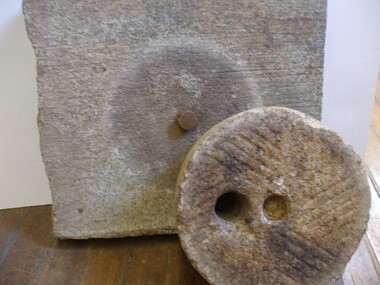
... Querns were used for grinding wheat into flour. (Wooden handles missing from this catalogued object).It was most likely made on Mount Alexander, in spare time, by a quarry worker using his employer’s gang saw and other tools. ...Querns were used for grinding wheat into flour. (Wooden handles missing from this catalogued object).It was most likely made on Mount Alexander, in spare time, by a quarry worker using his employer’s gang saw and other tools. ...This quern was made from Harcourt granite. Querns were used for grinding wheat into flour. (Wooden handles missing from this catalogued object).It was most likely made on Mount Alexander, in spare time, by a quarry worker using his employer’s gang saw and other tools. Wheat is not now grown in Harcourt district . Early settlers engaged in cropping until they exhausted the fertility of the soil. This quern was utilized by a local pioneer who intended to be self-sufficient to the extent of grinding his own grain into flour.. Many local farmers sowed wheat immediately after clearing the land: raising of a wheat crop was evidence of use and improvement which, along with fencing and erecting other structures, was part of the mandatory steps to prove occupancy as a prelude to obtaining a Crown Grant for what had previously been deemed ‘crown land'The quern is of interest as a symbol of the desire for self-sufficiency and as a demonstration of the extent to which granite could be worked and shaped by masonry tools. Quern, granite, square slab with raised metal centre shaft and one rounded piece of granite with off-centre hole and side ridges. -
 Flagstaff Hill Maritime Museum and Village
Domestic object - Pudding Mould
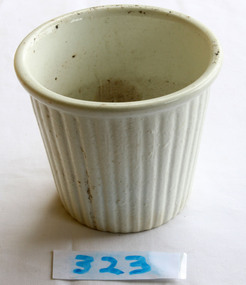
... In the 13th and 14th centuries, in the mountainous region of the Rif along the Mediterranean coast of Morocco, flour made from lightly grilled barley was used in place of wheat flour. A recipe for asida that adds argan seed oil was documented by Leo Africanus (c. 1465–1550), the Arab explorer known as Hasan al-Wazan in the Arab world. ...In the 13th and 14th centuries, in the mountainous region of the Rif along the Mediterranean coast of Morocco, flour made from lightly grilled barley was used in place of wheat flour. A recipe for asida that adds argan seed oil was documented by Leo Africanus (c. 1465–1550), the Arab explorer known as Hasan al-Wazan in the Arab world. ...One of the first documented mentions of pudding can be found in Homer's Odyssey where a blood pudding roasted in a pig's stomach is described. This original meaning of a pudding as a sausage is retained in black pudding, which is a blood sausage originating in the United Kingdom and Ireland made from pork or beef blood, with pork fat or beef suet, and a cereal. Another early documented recipe for pudding is a reference to asida, found in a tenth century Arabic cookbook by Ibn Sayyar al-Warraq called Kitab al-Ṭabīḫ (Arabic: كتاب الطبيخ, The Book of Dishes). It was described as a thick pudding of dates cooked with clarified butter (samn). A recipe for asida was also mentioned in an anonymous Hispano-Muslim cookbook dating to the 13th century. In the 13th and 14th centuries, in the mountainous region of the Rif along the Mediterranean coast of Morocco, flour made from lightly grilled barley was used in place of wheat flour. A recipe for asida that adds argan seed oil was documented by Leo Africanus (c. 1465–1550), the Arab explorer known as Hasan al-Wazan in the Arab world. According to the French scholar Maxime Rodinson, asida were typical foods among the Bedouin of pre-Islamic and, probably, later times. In the United Kingdom and some of the Commonwealth countries, the word pudding can be used to describe both sweet and savoury dishes. Unless qualified, however, the term in everyday usage typically denotes a dessert; in the United Kingdom, pudding is used as a synonym for a dessert course. Puddings had their 'real heyday...', according to food historian Annie Gray, '...from the seventeenth century onward'. It is argued that 'the future of the boiled suet pudding as one of England's national dishes was assured only when the pudding cloth came into use' and although puddings boiled in cloths may have been mentioned in the medieval era, one of the earliest mentions is in 1617 in a recipe for Cambridge pudding, a pudding cloth is indicated; 'throw your pudding in, being tied in a fair cloth; when it is boiled enough, cut it in the midst, and so serve it in'. The pudding cloth is said, according to food historian C. Anne Wilson, to have revolutionised puddings. 'The invention of the pudding-cloth or bag finally severed the link between puddings and animal guts. Puddings could now be made at any time, and they became a regular part of the daily fare of almost all classes. Recipes for them proliferated.' https://en.wikipedia.org/wiki/PuddingPuddings and pudding making have evolved over the years, and continue to do so. White ceramic pudding bowl with fluted decoration on the outside.flagstaff hill, warrnambool, shipwrecked-coast, flagstaff-hill, flagstaff-hill-maritime-museum, maritime-museum, shipwreck-coast, flagstaff-hill-maritime-village, puddings, ceramics -
![[1] Three Bears Porridge Flaked Oatmeal Bag (Front)](/media/collectors/510b3f7f023fd725b4cd51fe/items/683baf6c69688f11138d56ba/item-media/683bf711460ecdfee7105b40/item-fit-380x285.jpg?cb=6) Arapiles Historical Society
Arapiles Historical SocietyContainer - Roy SCHMIDT Collection - Cotton Flour Bags (3)
... flour was common prior to the widespread adoption of paper and plastic packaging. These bags were often reused domestically for household textiles, clothing patterns, or storage. The export reference (Bandung) underscores Australia's historical agricultural trade ties with Southeast Asia, especially in wheat and flour exports. – Roy SCHMIDT resided with his siblings Mabel and Jack at ‘Parklands’ 85 Lake Avenue Natimuk home of Heinrich Friederick ‘Heiny’ & Minna Christina SUDHOLZ nee LANGE and their children Louis, Sophie, Alma, Lena (Roy's Mother), Florence 'Florrie' and Edward ‘Ted’....flour was common prior to the widespread adoption of paper and plastic packaging. These bags were often reused domestically for household textiles, clothing patterns, or storage. The export reference (Bandung) underscores Australia's historical agricultural trade ties with Southeast Asia, especially in wheat and flour exports. – Roy SCHMIDT resided with his siblings Mabel and Jack at ‘Parklands’ 85 Lake Avenue Natimuk home of Heinrich Friederick ‘Heiny’ & Minna Christina SUDHOLZ nee LANGE and their children Louis, Sophie, Alma, Lena (Roy's Mother), Florence 'Florrie' and Edward ‘Ted’. ...[1] Three Bears Porridge Flaked Oatmeal Bag: This textile bag originates from Canadian Cereal Mills Ltd., which marketed "Three Bears" flaked oatmeal. Popular in the early 1900s to mid-century, this product combined functional packaging with a child-friendly incentive — a cut-out cloth doll. The practice of printing toys, games, or clothing patterns on flour or oat sacks was a common marketing strategy, encouraging reuse and appealing to families during times when thrift and creativity were essential, especially during the Depression and wartime years. The Three Bears brand played off the enduring popularity of children’s nursery tales, while the doll encouraged children (and parents) to reuse packaging creatively. This object captures a unique intersection of food marketing, household resourcefulness, and early 20th-century domestic life. [2] Mammy Self-Raising Flour Bag: This item is a mid-20th-century Australian flour bag, branded “Mammy Oven Puff”, produced by A. Mammy Products Pty Ltd in West Footscray, Victoria. The use of the name "Mammy" and the caricatured illustration draws on a now widely recognised and offensive racial stereotype originating from American minstrel culture, commonly used in product branding in the early-to-mid 20th century. While the bag reflects a specific period in Australian domestic and commercial packaging history, it also exemplifies racially insensitive advertising that would be considered inappropriate and harmful by today’s standards. Such items are preserved today in museum collections to help document past social attitudes, consumer culture, and the evolution of racial representation in advertising. [3] Bandung Blue Triangle Brand Flour Bag: This bag represents a mid-20th-century Australian flour export product, particularly aimed at international markets such as Indonesia (as indicated by "Bandung"). The “Blue Triangle Brand” was likely a registered trademark used by a Melbourne-based flour mill engaged in both local and overseas trade. The use of durable cloth bags for bulk flour was common prior to the widespread adoption of paper and plastic packaging. These bags were often reused domestically for household textiles, clothing patterns, or storage. The export reference (Bandung) underscores Australia's historical agricultural trade ties with Southeast Asia, especially in wheat and flour exports. – Roy SCHMIDT resided with his siblings Mabel and Jack at ‘Parklands’ 85 Lake Avenue Natimuk home of Heinrich Friederick ‘Heiny’ & Minna Christina SUDHOLZ nee LANGE and their children Louis, Sophie, Alma, Lena (Roy's Mother), Florence 'Florrie' and Edward ‘Ted’.[1] Three Bears Porridge Flaked Oatmeal Bag: A vintage cloth oatmeal bag printed with black ink on both sides. One side is branded with "Three Bears Porridge – Flaked Oatmeal", showing an image of three bears behind a gate, referencing the well-known “Goldilocks and the Three Bears” fairytale. The opposite side features a printed cut-out doll design, showing a young girl with curly hair holding a bouquet of flowers, intended to be sewn into a stuffed toy. Instructions note that the reverse side (the doll’s back) could be obtained from a second bag. The design combines product branding with a promotional activity for children, typical of early- to mid-20th-century grocery packaging aimed at reuse. [2] Mammy Self-Raising Flour Bag: A small vintage cloth flour bag with printed branding in faded red, blue, and black inks. The front of the bag features a central image of a caricatured smiling African American woman wearing a headscarf. The text is unevenly faded but legible in parts. The bag has a rectangular shape with an open top edge and signs of previous use, including creasing and some fraying at the corners. [3] Bandung Blue Triangle Brand Flour Bag: A large, rectangular vintage cloth flour bag made of cream-coloured calico or cotton. The front of the bag is printed in bold blue ink with branding and export information. It prominently features a large triangular logo reading “Blue Triangle Brand” and numerous lines of text in block and stylised fonts. The bag is open at the top with frayed edges, suggesting it was once machine-stitched shut and later opened.[1] Three Bears Porridge Flaked Oatmeal Bag: Front side (branding side): "THREE BEARS Porridge – FLAKED OATMEAL" "7 Lbs. Net." “Packed and guaranteed by Canadian Cereal Mills Ltd., Toronto” Reverse side (doll pattern): "This is the Front for Three Bears Cut-out Doll" "In order to complete this Doll it will be necessary to obtain the Back Design from another Bag of Three Bears Rolled Oats or Oatmeal." [2] Mammy Self-Raising Flour Bag: Main product name: “MAMMY OVEN PUFF SELF-RAISING FLOUR” Additional text: “The Only Creamed Flour” “Prepared with phosphate aerator” “A. MAMMY PRODUCTS PTY. LTD., Sunshine Rd., West Footscray. Phone: FW 7321” “7 LBS. NET” (near top edge, very faded) [3] Bandung Blue Triangle Brand Flour Bag: The bag is printed with the following: “10270” “G.W.C | H.L” “BANDUNG” “BEST AUSTRALIAN” “BLUE TRIANGLE BRAND” (inside the triangle logo) “GROWER & GRINDERS” (curved around the logo) “Patent Roller” “MELBOURNE” “FLOUR” “50 LBS. GROSS WHEN PACKED” These inscriptions indicate that this flour bag was manufactured in Melbourne, Australia, and was likely exported to Bandung, Indonesia.farm equipment, flour, milling, oats, mammy, bandung blue, schmidt, sudholz, parklands -
 Nhill and District Historical Society Inc.
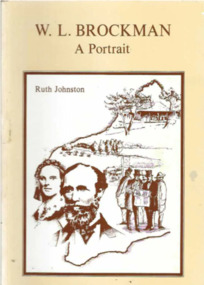
Book - W. L. Brockman, A Portrait
... A water-powered mill was built over the Gingin Brook by Alfred Carson, and wheat was milled into flour, helping relieve the colony’s dependence on imported flour. ...A water-powered mill was built over the Gingin Brook by Alfred Carson, and wheat was milled into flour, helping relieve the colony’s dependence on imported flour. ...Biography / memoir of William Locke Brockman came to the Swan River Colony in the early 1830's with his wife and son. A successful farmer and businessman, his greatest achievements were in the political sphere, where he worked to bring representative government to Western Australia.faun coloured cover with a white panel with brown border with sketched image of Western Australia containing images of a homestead and pioneers.non-fictionBiography / memoir of William Locke Brockman came to the Swan River Colony in the early 1830's with his wife and son. A successful farmer and businessman, his greatest achievements were in the political sphere, where he worked to bring representative government to Western Australia.william locke brockman, swan river colony, 1830's - history, western australia - history, farming - history, political- history, west australiana -
 City of Melbourne Libraries
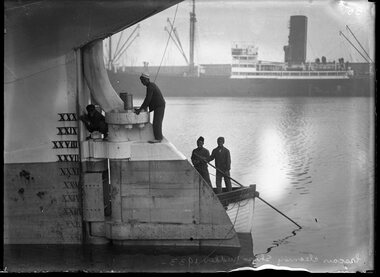
Photograph, Bull, Hugh Jones, 1897-1993, Lascars cleaning ship's rudder
... With the success of the wheat harvests, flour mills began to spring up around the country. ...With the success of the wheat harvests, flour mills began to spring up around the country. ...Published: unknown, however, on 26 June 1935 a similar, but not the exact photo in the McKenzie Collection, was published in The Age: Published title: Shipping Victorian Flour to the East Published Caption: Flour and wheat figure prominently in all cargoes carried by ships trading to Chinese, Japanese and Eastern ports. Victorian millers are eager to extend lids outlet for their produce, and every opportunity is grasped. The pictures show Australian labourers unloading from railway trucks some of the 2300 tons of flour which will go into the hold of the Burns, Philp motor ship Neptuna for shipment to Hong Kong, while Chinese seamen are busy cleaning and painting the rudder post of the ship. Hard by the Neptuna, other ships are taking on flour for the East. Research by Project Volunteer, Louise McKenzie: The image was described by Hugh Bull on the rear of the glass plate as – “Lascars cleaning ships rudder 1933”. Basically, a “lascar” is a seaman. Image No. 032 in the McKenzie Collection shows two lascars perched on the rudder of a ship, with two others standing in a rowboat along side. They are dressed in baggy trousers and jackets and wearing caps. Across a very calm dock area is a single funnel ship with on-deck derricks. The rudder of the ship being cleaned is white, with large black roman numbering denoting the depth at which the ship is sitting, depending on whether it is loaded or empty. Whilst the exact photo in the McKenzie Collection has yet to be located in The Age in 1933, the date when it was taken, there is a photo published in The Age on 25 June 1935 which appears to be one of a series of photos taken on the same day, featuring lascars cleaning a ship’s rudder. It bears a striking resemblance to MCK 032, but it is taken from a slightly different angle. The 1935 published photo is a close up of a ship’s rudder being cleaned, with same style of roman numerals in black on the white of the rudder. One lascar is standing on the rudder, one is standing in a small clinker style rowboat, with its characteristic wooden overlapping hull planks, holding a broom; two more lascars are sitting in the bow and stern of the rowboat. The ship being cleaned is in a dock, as a wharf and warehouses can be seen in the background, the water is very calm, and there are two other ships moored nearby – one across the other side of the dock with a black and white hull and derricks on its deck, and one adjacent, with its mooring lines clearly visible. The lascars are wearing caps, baggy trousers and jackets. Compelling similarities therefore exist between the two images. Whilst it is difficult to positively identify the cultural background of these particular lascars in either photo, the newspaper article dated June 1935 advises they are “Chinese”. This is possibly because the ship they are associated with, the Neptuna, is reported to have sailed from Melbourne on this date, bound for Hong Kong. However, the men are probably from South East Asia. Wikipedia describes the term “Southeast Asia” as covering ” … the people of Southeast Asia from prehistory to the present in two distinct sub-regions: Mainland Southeast Asia (or Indochina) and Maritime Southeast Asia (or Insular Southeast Asia). Mainland Southeast Asia comprises Cambodia, Laos, Myanmar (or Burma), Peninsular Malaysia, Thailand and Vietnam whereas Maritime Southeast Asia comprises Brunei, Cocos (Keeling) Islands, Christmas Island, East Malaysia, East Timor, Indonesia, Philippines and Singapore. Additionally, Wikipedia “Lascars” states that “Lascars were sailors from the Indian subcontinent, South East Asia, the Arab world, British Somaliland and lands east of the Cape of Good Hope, who were employed to work on colonial merchant ships. The practice ran from the 16th century to the mid 20th century”. Indian seamen were used as early as the 16th century by Portuguese explorer Vasgo da Gama in his successful voyage to India, and subsequently by Portuguese ships in the 16th and 17th centuries. “Through the Portuguese and Spanish maritime world empires, some Indian lascars found their way onto English merchant ships, and were among the sailors on the first English East India Company (EIC) ships to sail to India.” In the 17th Century “When the English adopted the term "lascar", they initially used it for all Asian sailors on English-flagged ships, but after 1661 and the Portuguese ceded Bombay to England, the term was used mainly to describe Indian sailors specifically. The term "topaze" was used to describe Indo-Portuguese personnel, especially those from Bombay, Thana, Diu, Dammam and Cochin. The term "sepoy" was used to describe Indian soldiers in European service. The number of lascars employed on EIC East Indiamen was so great that the Parliament of England restricted their employment via the Navigation Acts (in force from 1660 onwards) which required that 75% of the crew onboard English-flagged ships importing goods from Asia be English subjects. The restriction arose due to the high rates of illnesses and death among European sailors on East Indiamen, and their frequent desertions in Asia, which left such ships short of crew for the return voyage. Another reason was the frequent impressment of European sailors from EIC East Indiamen by the Royal Navy in times of war“. The term “impressment” colloquially refers to “the “press gang” …”a type of conscription of people into a military force, especially a naval force, via intimidation and physical coercion, conducted by an organized group (hence “gang”). .. The large size of the British Royal Navy in the Age of Sail meant impressment was most commonly associated with Great Britain.”. (Wikipedia – Impressment). By the 20th century these sailors served on British ships under "lascar agreements", which allowed shipowners more control than was the case in ordinary articles of agreement. The sailors could be transferred from one ship to another and retained in service for up to three years at one time. “Lascars served all over the world in the period leading up to the First World War. Lascars were barred from landing at some ports, such as in British Columbia. At the beginning of World War I, there were 51,616 lascars working on British merchant ships in and around the British Empire. In World War II thousands of lascars served in the war and died on vessels throughout the world, especially those of the British India Steam Navigation Company, P&O and other British shipping companies. The lack of Canadian naval manpower led to the employment of a total of 121 Catholic Goans and 530 Muslim British Indians on the Empress vessels of the Canadian Pacific Railway, such as the Empress of Asia and Empress of Japan. These ships served in the Indian Ocean both as ANZAC convoy ships and in actions at Aden. The ships were placed under the British Admiralty as part of Canada's contribution to the war effort and all of the Indian men were awarded medals by the Admiralty, though none of them were delivered. In the 1950s the use of the term "lascar" declined with the ending of the British Empire. The Indian “Lascar Act” of 1832 was finally repealed in 1963. However, "traditional" Indian deck and Pakistani engine crews continued to be used in Australia until 1986 when the last crew was discharged from the P&O and replaced by a general-purpose crew of Pakistanis. The term lascar has been widely used to engender an element of exoticism in literature eg “Sir Arthur Conan Doyle created a Lascar foil to Sherlock Holmes in "The Man with the Twisted Lip" in 1891. Lascars aboard the ship Patna figure prominently in the early chapters of Joseph Conrad's novel Lord Jim. Frances Hodgson Burnett's novel A Little Princess features a lascar named Ram Dass. Also, Caleb Carr portrays two lascars as bodyguards for a Spanish diplomat near the end of The Angel of Darkness. In Wuthering Heights, it is speculated that Heathcliff, the main character, may be of lascar origin." (Wikipedia – Lascar) And what has become of these “forgotten heroes of the World Wars”? The South Asian Heritage Trust, which seeks to commemorate, mark and celebrate South Asian cultures, stories, and communities, published an article in July 2025 entitled – The Lascars: Seafaring Roots of Modern Britain. It particularly honours the role of the 80,000 lascars who served Britain in WWI, and the over 100,000 who served in the British Merchant Navy in WWII, and concludes: “The hardships faced by Lascars were profound. They were often assigned the most dangerous tasks, lived in substandard conditions aboard ships and, even after their immense contributions to the war efforts, many veterans found it difficult to secure the recognition, pensions and rights afforded to other veterans. Many were employed under ‘Asiatic Articles’, which offered less protection and lower pay than their European counterparts. Yet, their legacy endures. The multicultural fabric of areas like East London owes much to these early seafarers and settlers. The East London Mosque, established in 1910, became an important spiritual and community hub. Today, efforts to bring their stories out of the shadows are growing. The Museum of London Docklands features exhibits on their history. Memorials, such as the P&O headstone in Dover for the 22 Lascar crew members of the SS Maloja sunk in 1916 and the careful restoration of the Lascar War Memorial in Kolkata, serve as important reminders of the sacrifices. The journey of the Lascars – from their homelands, along dangerous wartime shipping routes, to the docklands of Britain – is a story of personal courage and of a rich contribution to Britain’s history and identity.” The ship MV Neptuna, mentioned in the 1935 article, had that year been purchased from a German company by Australian-owned Burns Philp, with Australian Government assistance, and it was instrumental in ensuring the shipment of rice from Vietnam to Papua New Guinea. Rice is still a household staple in PNG. Despite it being introduced into PNG more than 100 years ago, the crop has not been sufficiently integrated into the country’s traditional agricultural production system, and today PNG imports still account for nearly 98% of rice. (Spotlight Magazine Sept. 2016) The 1935 newspaper article states that the Neptuna is involved in moving flour for the East. Australian wheat exports began in 1845, but were not regular until the 1870s. New land clearing methods in Australia allowed large tracts of land to be cleared more efficiently – this included the invention of the iconic ‘stump jump’ plough. With the success of the wheat harvests, flour mills began to spring up around the country. By the 1870s, many large country towns had their own mills, with around 500 mills producing flour across the country. Flour exports were an important part of the wheat industry until around the 1930s. After the Second World War, many of Australia’s export partners (which were mainly in the developing nations of Asia) began setting up their own flour industries and the Australian product was no longer in demand. In 1942 MV Neptuna was being utilised for the war effort, and carrying depth charges and other armaments for Australia, when on 19 February it was sunk in a bombing raid on Darwin, and where part of her hull still lies. References: SHIPPING VICTORIAN FLOUR TO THE EAST. (1935, June 25). The Age (Melbourne, Vic. : 1854 - 1954), p. 11. Retrieved July 23, 2025, from http://nla.gov.au/nla.news-article204357218 Age (Melbourne, Vic. : 1854 - 1954), Tuesday 25 June 1935, page 11 Wikipedia, Clinker (boat building), https://en.wikipedia.org/wiki/Clinker_(boat_building) Wikipedia, Lascar, https://en.wikipedia.org/wiki/Lascar Wikipedia, History of Southeast Asia, https://en.wikipedia.org/wiki/History_of_Southeast_Asia Wikipedia, Impressment, https://en.wikipedia.org/wiki/Impressment NEPTUNA LEAVES FOR CHINA WITH TOURISTS (1935, June 25). The Herald (Melbourne, Vic. : 1861 - 1954), p. 5. Retrieved July 23, 2025, from http://nla.gov.au/nla.news-article244841163 National Research Institute SPOTLIGHT paper Vol 9, Issue 7, https://pngnri.org/images/Publications/Spotlight_No_9_Vol_7_-_201609_-_Sofe__Odhuno_-_Rice_Import_Quota1.pdf South Asian Heritage Trust, The Lascars: Seafaring Roots of Modern Britain, July 11,2025 : Royal British Legion. https://southasianheritage.org.uk/royal-british-legion/the-lascars-seafaring-roots-of-modern-britain/ Photographer notations on slide: "Lascars cleaning ships rudder 1933".lascars, ships, 1930-1939, employment, ethnic communities -
 Flagstaff Hill Maritime Museum and Village
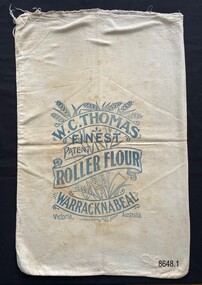
Textile - Flour bag - W.C.Thomas, Warracknabeal
... Thomas ran a number of flour mills throughout the Victorian wheat belt, with the Warracknabeal Mill operating from 1884 to 1964. ...Calico flour bag for 'Roller Flour' from the flour mill of W.C. Thomas in Warracknabeal, a large wheat growing area in Victoria. ...Thomas, Finest, Patent, Roller Flour, Warracknabeal, Victoria, Australia. Wheat image....Thomas, Finest, Patent, Roller Flour, Warracknabeal, Victoria, Australia. Wheat image. Calico flour bag for 'Roller Flour' from the flour mill of W.C. ...This flour bag came from the W.C. Thomas Flour Mill at Warracknabeal, Victoria. W.C. Thomas ran a number of flour mills throughout the Victorian wheat belt, with the Warracknabeal Mill operating from 1884 to 1964. After their use for flour storage, flour bags were able to be reused for bulk storage of other dry goods or sewn into domestic objects such as tea towels, pillowcases or waggas.This is a good example of a flour bag from a prominent Victorian flourmill, operating from the late 19th century to the mid-20th century.Calico flour bag for 'Roller Flour' from the flour mill of W.C. Thomas in Warracknabeal, a large wheat growing area in Victoria. The stencil on the front of the bag includes an image of wheat overlaid with the written information in scroll format.W.C. Thomas, Finest, Patent, Roller Flour, Warracknabeal, Victoria, Australia. Wheat image.flagstaff hill maritime museum and village, great ocean road, shipwreck coast, flour bags, calico, domestic object, textile, food storage, w.c. thomas, warracknabeal, flour mill -
 Flagstaff Hill Maritime Museum and Village
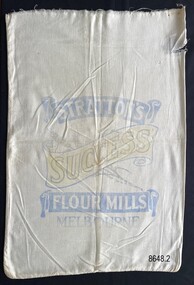
Textile - Flour bag - Stratton's, Melbourne
... flour mill in Melbourne. The stencil on the front of the bag includes the image of a wheat stalk overlaid with the written information in scroll format....flour mill in Melbourne. The stencil on the front of the bag includes the image of a wheat stalk overlaid with the written information in scroll format. ...Flour bags were used when purchasing flour from the late 19th century to the mid 20th century. They were able to be reused for bulk storage of dry goods or sewn into domestic objects such as tea towels, pillowcases or waggas.The flour bag provides an example of a useful domestic packaging product, from the early 20th century.Calico flour bag for 'Success Flour' from Stratton’s flour mill in Melbourne. The stencil on the front of the bag includes the image of a wheat stalk overlaid with the written information in scroll format.Stratton's, Success, Flour Mills, Melbourneflagstaff hill maritime museum and village, great ocean road, shipwreck coast, calico, domestic object, textile, food storage, stratton's, flour bag -
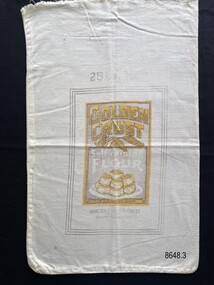 Flagstaff Hill Maritime Museum and Village
Textile - Flour bag - Golden Crust
... flour, 25lb. The stencil on the bag includes the manufacturer’s address and images of heads of wheat and a plate of scones. ...flour, 25lb. The stencil on the bag includes the manufacturer’s address and images of heads of wheat and a plate of scones. ...Flour bags were used when purchasing flour from the late 19th century to the mid 20th century. They were able to be reused for bulk storage of dry goods or sewn into domestic objects such as tea towels, pillowcases or waggas.The flour bag provides an example of a useful domestic packaging product, from the early 20th century.Calico flour bag for Golden Crust Self-raising flour, 25lb. The stencil on the bag includes the manufacturer’s address and images of heads of wheat and a plate of scones. 25lbs, Golden Crust, Self-raising Flour, Blended with Phosphate Aerator, Hancock’s Golden Crust Pty.Ltd. South Yarra, Vicflagstaff hill maritime museum and village, great ocean road, shipwreck coast, calico, domestic object, textile, food storage, flour bag, golden crust -
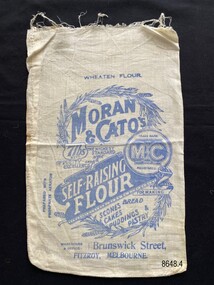 Flagstaff Hill Maritime Museum and Village
Textile - Flour bag - Moran & Cato's
... Small calico flour bag for self-raising flour (7lb) supplied from Moran & Cato's in Brunswick Street, Fitzroy, Melbourne. The front of the bag includes not only the detail of the business but ideas for baking, images of wheat and claims as to its excellence. ...Small calico flour bag for self-raising flour (7lb) supplied from Moran & Cato's in Brunswick Street, Fitzroy, Melbourne. The front of the bag includes not only the detail of the business but ideas for baking, images of wheat and claims as to its excellence. ...The flour bag is an example of packaging from the grocery store, Moran & Cato's. Moran & Cato's were a large chain of grocery stores operating from the late nineteenth century to the mid twentieth century across Victoria, Tasmania and New South Wales. The address on the flour bag is for the warehouse (wholesale depot) of the business which was a significant building in Brunswick St, Fitzroy.The flour bag provides a snapshot of packaging for a well known grocery store of the early twentieth century. The advertisement on the back for 'Cleaned Fruits' is an example of advertising that highlighted important facts relevant to that time (e.g. "latest Special Machinery" and "with running water").Small calico flour bag for self-raising flour (7lb) supplied from Moran & Cato's in Brunswick Street, Fitzroy, Melbourne. The front of the bag includes not only the detail of the business but ideas for baking, images of wheat and claims as to its excellence. The back of the bag has a written advertisement for 'Cleaned Fruits' another product of the company.Front - Wheaten Flour, Moran & Cato's, Trade mark The M & C Brand Registered, 7lbs Nett, The Highest Standard of Purity and Excellence, prepared with phosphate aerator, Self-raising Flour, For making scones bread cakes puddings & pastry, Warehouse & Office- Brunswick Street, Fitzroy, Melbourne Back - Moran & Cato's, Cleaned Fruits are Perfection, (advertising text), The Same High Quality, The Same Prices at all our Branches.flagstaff hill maritime museum and village, great ocean road, shipwreck coast, calico, domestic object, textile, food storage, moran & cato's, flour bag, self-raising flour -
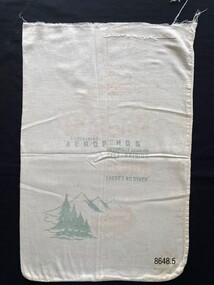 Flagstaff Hill Maritime Museum and Village
Textile - Flour bag - McAlpin's Flour containing Aerophos'
... flour. The stencil on the bag is very faded especially where red ink has been used. It includes an image of mountains and fir trees in green ink and a stalk of wheat sweeping up from bottom right to top / middle left in red ink....flour. The stencil on the bag is very faded especially where red ink has been used. It includes an image of mountains and fir trees in green ink and a stalk of wheat sweeping up from bottom right to top / middle left in red ink. ...Flour bags were used when purchasing flour from the late 19th century to the mid 20th century. In Melbourne, McAlpin's were one of the best known suppliers of self-raising flour. The business first began as a bakery in 1879 and was taken over in 1959. This is a good example of a flour bag from a well know Victorian supplier prominent in the early twentieth century.Calico flour bag for McAlpin’s self-raising flour. The stencil on the bag is very faded especially where red ink has been used. It includes an image of mountains and fir trees in green ink and a stalk of wheat sweeping up from bottom right to top / middle left in red ink.McAlpin’s (faded red) CONTAINING AEROPHOS’, PHOSPHATE AERATOR, SELF-RAISING, FLOUR (faded red), “THERE’S NO OTHER” Faded red square with writing …. CALCIUM …. Faded red triangle with T inside it to the far right of the trees Faded red writing at the bottom of the bag: PREPARED WITH PHOSPHATE AERATOR, AEROPHOS 25 LBS NET flagstaff hill maritime museum and village, great ocean road, shipwreck coast, calico, domestic object, textile, food storage, flour bag, mcalpin's, self-raising flour -
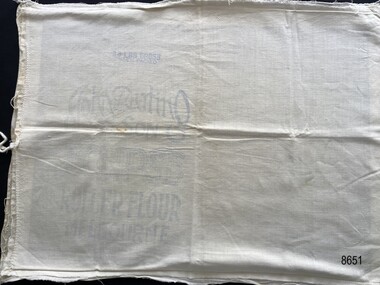 Flagstaff Hill Maritime Museum and Village
Textile - Flour Bag Pillowcase
... Side 1 25LBS GROSS WHEN PACKED, John Darling & Son, ECLIPSE, ROLLER FLOUR, MELBOURNE Side 2 O-SO-LITE, Self-raising, FLOUR, Creamy & Delicious, O-SO-LITE PRODUCTS, 412 COLLINS ST MELBOURNE, C.I. Decoration of wheat stalks surround the inscription....Flagstaff Hill Maritime Museum and Village Great Ocean Road Shipwreck Coast Warrnambool Calico Domestic object textile food storage John Darling & Son Eclipse Roller Flour O-SO-LITE Flour pillowcase flour bag Side 1 25LBS GROSS WHEN PACKED, John Darling & Son, ECLIPSE, ROLLER FLOUR, MELBOURNE Side 2 O-SO-LITE, Self-raising, FLOUR, Creamy & Delicious, O-SO-LITE PRODUCTS, 412 COLLINS ST MELBOURNE, C.I. Decoration of wheat stalks surround the inscription. ...Flour bags were a useful source of material to be repurposed into domestic objects in the early 20th century. This object, fashioned from two well-known brands of flour bag, was most likely used as a pillowcase.The pillowcase provides an example of how flour bags were recycled and repurposed into useful domestic objects in the early 20th century.Two flour bags opened out and sewn together to create a possible pillowcase. The open end has a tie sewn to each side to enable the pillowcase to be closed. The bags have been sewn with the inscriptions on the inside of the pillowcase.Side 1 25LBS GROSS WHEN PACKED, John Darling & Son, ECLIPSE, ROLLER FLOUR, MELBOURNE Side 2 O-SO-LITE, Self-raising, FLOUR, Creamy & Delicious, O-SO-LITE PRODUCTS, 412 COLLINS ST MELBOURNE, C.I. Decoration of wheat stalks surround the inscription.flagstaff hill maritime museum and village, great ocean road, shipwreck coast, warrnambool, calico, domestic object, textile, food storage, john darling & son, eclipse roller flour, o-so-lite flour, pillowcase, flour bag -
 Mortlake and District Historical Society
Painting, William Alen, The Old Windmill, 1916
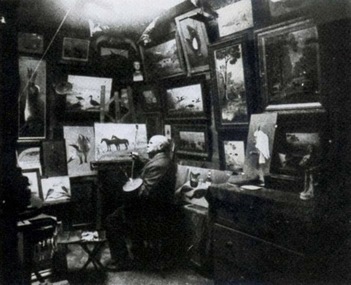
... flour. It was painted in 1916 by W.Alen a local artist, who did not have first-hand knowledge of the old Mill, but would have relied on descriptions from those living in the district who did, as well as possibly recollections of windmills in Europe and Britain. The Mill has been a prominent landmark in Mortlake for over 150 years. It was converted to steam after it was sold in 1857 to Hamilton, Aikman and Geddes. Its use declined after the Ararat goldfields petered out, the diggers moved on and local soils proved unsuited to the sustained cultivation of wheat ...The Old Wind Mill in Mill Street Mortlake was constructed in 1856 by Thos. Bostock. It was erected to process locally-grown grain to supply the increased population of the Ararat goldfields with flour. It was painted in 1916 by W.Alen a local artist, who did not have first-hand knowledge of the old Mill, but would have relied on descriptions from those living in the district who did, as well as possibly recollections of windmills in Europe and Britain. The Mill has been a prominent landmark in Mortlake for over 150 years. It was converted to steam after it was sold in 1857 to Hamilton, Aikman and Geddes. Its use declined after the Ararat goldfields petered out, the diggers moved on and local soils proved unsuited to the sustained cultivation of wheat. The existing Mill Chimney is Heritage listed and is part of the National Estate.1 paintingSigned W.Alenmill windmill mortlake national estate hamilton bostock aikman geddes -
 Orbost & District Historical Society
flour bags, mid 20th century
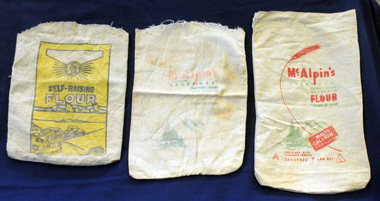
... Three rectangular, open calico flour bags. 2491.1 is faded and has red and green print sketch of a fir tree with mountains in the background- "McAlpin's, Containing "Aerophos", Self-Raising Flour; "There's No Other". 2491.2 has similar print with a red stalk of wheat and "7lbs Net" and a C inside a triangle. 2491.3 has yellow background inside a rectangular frame with black print - "Tested ; Self-Raising Flour"; a drawing of a wheat field; "Medallion Brand ; Groves McVitty & Co Pty Ltd' 8 Market Street Melbourne....The flour bags are good examples of packaging and design for Australian produce which sold across Australia and overseas in the mid 20th century. flour-bags warren-helena mcalpin mcvitty food-storage Three rectangular, open calico flour bags. 2491.1 is faded and has red and green print sketch of a fir tree with mountains in the background- "McAlpin's, Containing "Aerophos", Self-Raising Flour; "There's No Other". 2491.2 has similar print with a red stalk of wheat and "7lbs Net" and a C inside a triangle. 2491.3 has yellow background inside a rectangular frame with black print - "Tested ; Self-Raising Flour"; a drawing of a wheat field; "Medallion Brand ; Groves McVitty & Co Pty Ltd' 8 Market Street Melbourne. flour bags J.McAlpin & Sons, ...These three flour bags belonged to Helena Warren (nee McKeown) who was a self-taught photographer who became the local press correspondent and producer of postcard images. She was married to William John warren and lived in Newmerella. Flour bags were used for bulk purchases of flour in early to mid 20th century. They would have been laundered and re-used for storage. In earlier times empty flour bags were washed and boiled and then made into tea towels or children’s bloomers, or underwear. The flour bags are good examples of packaging and design for Australian produce which sold across Australia and overseas in the mid 20th century. Three rectangular, open calico flour bags. 2491.1 is faded and has red and green print sketch of a fir tree with mountains in the background- "McAlpin's, Containing "Aerophos", Self-Raising Flour; "There's No Other". 2491.2 has similar print with a red stalk of wheat and "7lbs Net" and a C inside a triangle. 2491.3 has yellow background inside a rectangular frame with black print - "Tested ; Self-Raising Flour"; a drawing of a wheat field; "Medallion Brand ; Groves McVitty & Co Pty Ltd' 8 Market Street Melbourne.flour-bags warren-helena mcalpin mcvitty food-storage
