
Showing 149 items matching "white with blue rim"
-
 Flagstaff Hill Maritime Museum and Village
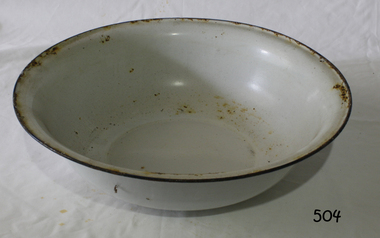
Domestic object - Enamel basin
... ...white with blue rim...Wash basin: white enamel bowl with blue rim. ...Flagstaff Hill Flagstaff Hill Maritime Museum and Village Warrnambool Maritime Museum Maritime Village Great Ocean Road Shipwreck Coast enamel bowl enamel dish white enamel white with blue rim kitchenware household object 19th century 20th century cooking cleaning personal care basin enamel basin wash basin metal craft tinware Wash basin: white enamel bowl with blue rim. ...A mass-produced domestic item. The design was popular in the early to mid-20th century.The basin is an example of early to mid-20th-century kitchenware.Wash basin: white enamel bowl with blue rim. flagstaff hill, flagstaff hill maritime museum and village, warrnambool, maritime museum, maritime village, great ocean road, shipwreck coast, enamel bowl, enamel dish, white enamel, white with blue rim, kitchenware, household object, 19th century, 20th century, cooking, cleaning, personal care, basin, enamel basin, wash basin, metal craft, tinware -
 Flagstaff Hill Maritime Museum and Village
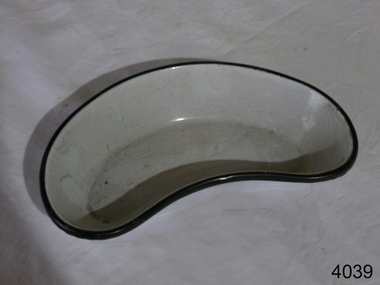
Dish
... Kidney Dish, enamel , white with blue rim. ...flagstaff hill warrnambool shipwrecked-coast flagstaff-hill flagstaff-hill-maritime-museum maritime-museum shipwreck-coast flagstaff-hill-maritime-village Kidney Dish, enamel , white with blue rim. Dish ...Kidney Dish, enamel , white with blue rim. flagstaff hill, warrnambool, shipwrecked-coast, flagstaff-hill, flagstaff-hill-maritime-museum, maritime-museum, shipwreck-coast, flagstaff-hill-maritime-village -
 Flagstaff Hill Maritime Museum and Village
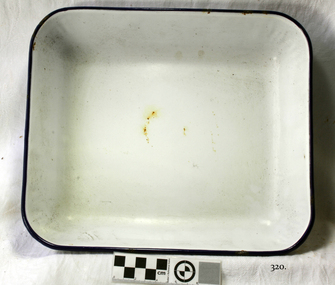
Domestic object - Dish
... Square shaped enamel dish, white and blue rim. ...flagstaff hill warrnambool shipwrecked-coast flagstaff-hill flagstaff-hill-maritime-museum maritime-museum shipwreck-coast flagstaff-hill-maritime-village Square shaped enamel dish, white and blue rim. Domestic object Dish ...Square shaped enamel dish, white and blue rim. flagstaff hill, warrnambool, shipwrecked-coast, flagstaff-hill, flagstaff-hill-maritime-museum, maritime-museum, shipwreck-coast, flagstaff-hill-maritime-village -
 Flagstaff Hill Maritime Museum and Village
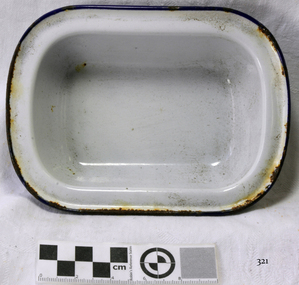
Decorative object - Dish
... Square shaped enamel dish, white with blue rim. Quite small. ...flagstaff hill warrnambool shipwrecked-coast flagstaff-hill flagstaff-hill-maritime-museum maritime-museum shipwreck-coast flagstaff-hill-maritime-village Square shaped enamel dish, white with blue rim. Quite small. Decorative object Dish ...Square shaped enamel dish, white with blue rim. Quite small. flagstaff hill, warrnambool, shipwrecked-coast, flagstaff-hill, flagstaff-hill-maritime-museum, maritime-museum, shipwreck-coast, flagstaff-hill-maritime-village -
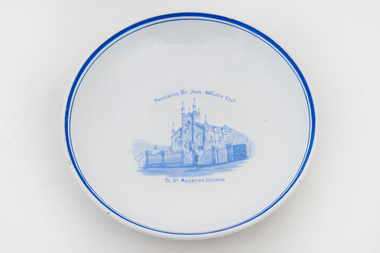 Uniting Church Archives - Synod of Victoria
Ceramic - Commemorative plate, St Andrew's Church
... CH008.1 and CH008.2 white plate with blue rim and blue image of church in centre. ...(Pat) Wood "PRESENTED BY JOHN WALKER ESQ TO ST ANDREWS CHURCH" CH008.1 and CH008.2 white plate with blue rim and blue image of church in centre. ...The tea service originally consisted of cups, saucers, plates, teapots, basins and milk jugs. John Walker arrived in Hobart Town in 1822. Within a month he was appointed superintendent of the government flour-mill on the Hobart Town Rivulet. Next year he received a grant of 200 acres (81 ha) and in 1824 built a mill at Richmond. [Australian Dictionary of Biography] CH008.2 was a gift from the Right Reverend Gillam Albert McConnell (Pat) Wood to Jenny and John Preston while on their honeymoon. March 1967 Pat Wood was selling the very large dinner set to raise money for the restoration of the interior of the church. CH008.1 and CH008.2 white plate with blue rim and blue image of church in centre. "PRESENTED BY JOHN WALKER ESQ TO ST ANDREWS CHURCH"scots memorial church hobart, john walker, st andrew's presbyterian church hobart, rev g.a. (pat) wood -
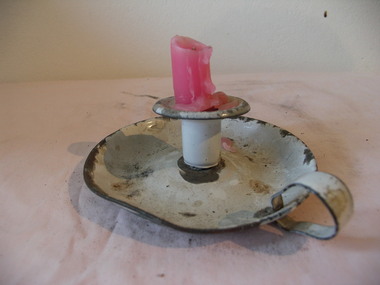 Friends of Westgarthtown
Domestic object - Candle holder
... Sheet metal vitreous enamel candle holder, of similar style to others. White with blue rim, shallow curved base with raised, flanged holder. ...lighting accessories candle holder enamel No visible markings Sheet metal vitreous enamel candle holder, of similar style to others. White with blue rim, shallow curved base with raised, flanged holder. ...Sheet metal vitreous enamel candle holder, of similar style to others. White with blue rim, shallow curved base with raised, flanged holder. Handle rounded and attached to both sides of base. Currently holding pink candle.No visible markingslighting, accessories, candle, holder, enamel -
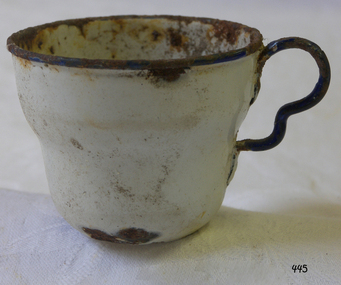 Flagstaff Hill Maritime Museum and Village
Cup
... White enamel cup with blue rim and handle...Flagstaff Hill Warrnambool Shipwrecked-coast Flagstaff-Hill Flagstaff-Hill-Maritime-Museum Maritime-Museum Shipwreck-coast Flagstaff-Hill-Maritime-Village White enamel cup with blue rim and handle Cup ...White enamel cup with blue rim and handleflagstaff hill, warrnambool, shipwrecked-coast, flagstaff-hill, flagstaff-hill-maritime-museum, maritime-museum, shipwreck-coast, flagstaff-hill-maritime-village -
 Lakes Entrance Historical Society
Domestic object - Candle holder
... Enamelled candle holder, saucer is white, handle is blue, rim of saucer is blue, candle socket is white...Very similar to a French Vintage Candle Holder, handle is welded to outside of saucer, candle socket is welded to centre of saucer, socket diameter 4.5 cm, candle socket height is 3 cm CERAMICS Porcelain Enamelled candle holder, saucer is white, handle is blue, rim of saucer is blue, candle socket is white Domestic object Candle holder ...Very similar to a French Vintage Candle Holder, handle is welded to outside of saucer, candle socket is welded to centre of saucer, socket diameter 4.5 cm, candle socket height is 3 cmEnamelled candle holder, saucer is white, handle is blue, rim of saucer is blue, candle socket is whiteceramics, porcelain -
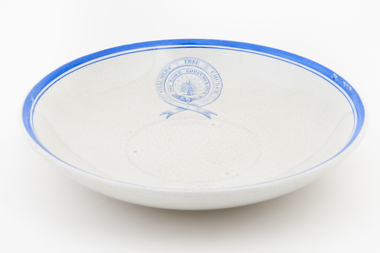 Uniting Church Archives - Synod of Victoria
Saucer
... White china saucer with blue rim and burning bush transfer print....Nec Tamen Consumebatur White china saucer with blue rim and burning bush transfer print. ...Chalmers Free Church was in Harrington Street, Hobart and was demolished in 1955. The burning bush is the emblem of the Church of Scotland. Nec Tamen Consumebatur translates to 'it was not however consumed'.White china saucer with blue rim and burning bush transfer print.Chalmers Free Church. Nec Tamen Consumebaturpresbyterian, chalmers' free church, burning bush -
 Flagstaff Hill Maritime Museum and Village
Tray
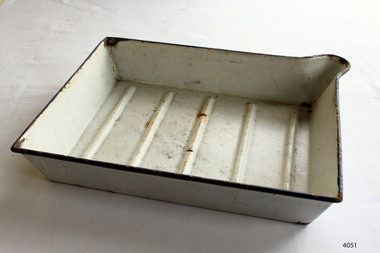
... White enamel tray, blue rim, with pouring lip on one corner, ribbed on bottom (5), L 11?" ...flagstaff hill warrnambool shipwrecked-coast flagstaff-hill flagstaff-hill-maritime-museum maritime-museum shipwreck-coast flagstaff-hill-maritime-village White enamel tray, blue rim, with pouring lip on one corner, ribbed on bottom (5), L 11?" ...White enamel tray, blue rim, with pouring lip on one corner, ribbed on bottom (5), L 11?" x W 9".flagstaff hill, warrnambool, shipwrecked-coast, flagstaff-hill, flagstaff-hill-maritime-museum, maritime-museum, shipwreck-coast, flagstaff-hill-maritime-village -
 Flagstaff Hill Maritime Museum and Village
Bowl
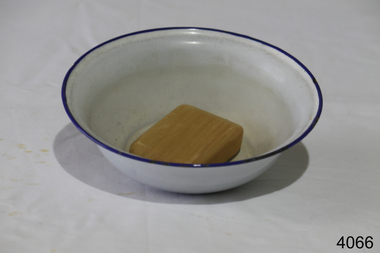
... Bowl white enamel small with blue rim around top-in good condition...flagstaff hill warrnambool shipwrecked-coast flagstaff-hill flagstaff-hill-maritime-museum maritime-museum shipwreck-coast flagstaff-hill-maritime-village Bowl white enamel small with blue rim around top-in good condition Bowl ...Bowl white enamel small with blue rim around top-in good conditionflagstaff hill, warrnambool, shipwrecked-coast, flagstaff-hill, flagstaff-hill-maritime-museum, maritime-museum, shipwreck-coast, flagstaff-hill-maritime-village -
Tatura Irrigation & Wartime Camps Museum
Domestic object - Plate
... Recessed white enamel dinner plate. Blue rim around edge. Small hole in rim...Used at meal time by Internee plate frank mrs beilharz camp 3 tatura war camps domestic utensils Recessed white enamel dinner plate. Blue rim around edge. Small hole in rim Domestic object Plate ...Used at meal time by InterneeRecessed white enamel dinner plate. Blue rim around edge. Small hole in rimplate, frank, mrs, beilharz, camp 3, tatura, war camps, domestic, utensils -
 Flagstaff Hill Maritime Museum and Village
Ceramic - Serving Plate, Edward Challinor, Circa1862-1891
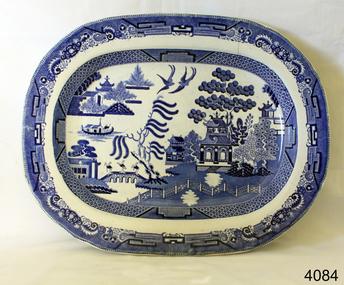
... Serving plate white body, smooth rim, and blue oriental design...An early piece of earthenware pottery made in England for the Australian colonial market around the mid to late 19th century. warrnambool shipwrecked-coast flagstaff-hill flagstaff-hill-maritime-museum shipwreck-coast flagstaff-hill-maritime-village Earthenware Ceramic Willow Pattern Serving Plate E & C Challinor Potteries Rope knot motif printed on back in blue with letters EC Serving plate white body, smooth rim, and blue oriental design Ceramic Serving Plate Edward Challinor ...The pottery was at Fenton, Stoke on Trent, Staffordshire UK and was established in 1825, by C J & GM Mason, they were succeeded by Mr. Samuel Boyle from whom the works passed into the hands of E & C Challinor, formally E Challinor & Co. Of Sandyford and Tunstall. The partners in Sandyford and Tunstall works are recorded as Edward Challinor Jnr and Charles Challinor Jnr and is presumably they are the sons of the partners of the Fenton pottery business. They produced china of white granite, printed sponged common earthenware for the American, Australian, and other foreign and colonial markets. The main goods produced were tea, coffee, breakfast, dinner, and toilet ceramic sets as well as other earthenware goods. Their pottery marks were the Staffordshire rope knot with or without E & C Challinor or just E C. An early piece of earthenware pottery made in England for the Australian colonial market around the mid to late 19th century.Serving plate white body, smooth rim, and blue oriental designRope knot motif printed on back in blue with letters EC warrnambool, shipwrecked-coast, flagstaff-hill, flagstaff-hill-maritime-museum, shipwreck-coast, flagstaff-hill-maritime-village, earthenware, ceramic, willow pattern, serving plate, e & c challinor, potteries -
 Bendigo Military Museum
Equipment - MESS KIT, c1935 - 1940
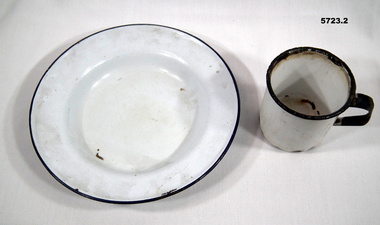
... Mug - standard issue white enamel mug with handle. It originally had a black rim. 2. Plate - White enamel with dark blue rim....Mug - standard issue white enamel mug with handle. It originally had a black rim. 2. Plate - White enamel with dark blue rim. ...These were bought at "A. Jolly's" store, Darwin on 4 Aug 1939 by Cpl Truscott. Advance party No.12 G.P. Squadron Darwin. They were bought for personal use. A note was attached to this item which mentions two of his friends killed in aircraft crashes. CPL Harold William Johnson 1727 RAAF and SGT Walter James Cox 2403 RAAF. Refer to service of Lyle Truscott NR 1842 RAAF WW2. Cat 4040.8P.1. Mug - standard issue white enamel mug with handle. It originally had a black rim. 2. Plate - White enamel with dark blue rim.2. Stamped on back was makers name I. Feng Enamelling Co. Ltd 24 (?) Made in Hong Kong.ww2, raaf, no.12 sqn, mess kit -
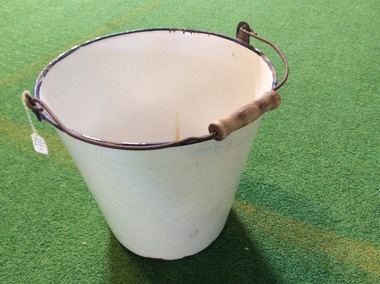 Yarrawonga and Mulwala Pioneer Museum
Enamel bucket
... Large white enamel bucket with blue rim. Metal rusted handle with wooden grip attached . ...None Large white enamel bucket with blue rim. Metal rusted handle with wooden grip attached . ...Large white enamel bucket with blue rim. Metal rusted handle with wooden grip attached . Spots on base and inside where enamel has wornNone -
Clunes Museum
Domestic object - COLANDER
... 1. White enamel with dark blue rim and handles .2 Cream enamel with cream painted handles. ...Colander Domestic item Strainer Nil 1. White enamel with dark blue rim and handles .2 Cream enamel with cream painted handles. ...1. White enamel with dark blue rim and handles .2 Cream enamel with cream painted handles. Rust areas have been painted over.Nilcolander, domestic item, strainer -
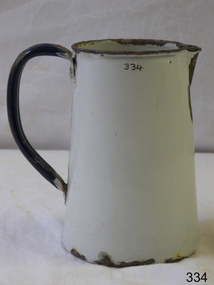 Flagstaff Hill Maritime Museum and Village
Domestic object - Jug, Late 19th or early 20th Century
... White metal enamel jug, white with navy blue handle and rim. Tapered cylindrical shape, with a pouring lip....White metal enamel jug, white with navy blue handle and rim. Tapered cylindrical shape, with a pouring lip. ...This enamel jug is a basic design that was common to households in the 19th and early 20th centuries. Enamelware dates back to 1760 in Germany.This object is significant as an example of an item in common use in the 19th and early 20th centuries.White metal enamel jug, white with navy blue handle and rim. Tapered cylindrical shape, with a pouring lip.None.flagstaff hill, flagstaff hill maritime museum and village, warrnambool, maritime museum, maritime village, great ocean road, shipwreck coast, jug, enamel jug, kitchen equipment, liquid storage, beverage preparation -
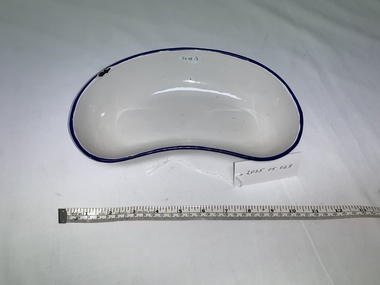 Alfred Hospital Nurses League - Nursing History Collection
Equipment - enamel kidney dish, 20250529
... white enamel kidney dish, blue rim, some minimal damage to base, white rectangular sticker central to base black ink stamp ALFRED NURSES ARCHIVE...medical equipment used commonly in most departments for collection of body fluids, transport of sharps, specimen receptacle a common piece of equipment across the hospital used in all departments AHNL kidney dish medical equipment patient care black ink on tipex to interior surface 39.01.3 white rectangular sticker black ink stamp ALFRED NURSES ARCHIVE white enamel kidney dish, blue rim, some minimal damage to base, white rectangular sticker central to base black ink stamp ALFRED NURSES ARCHIVE enamel kidney dish Equipment enamel kidney dish ...medical equipment used commonly in most departments for collection of body fluids, transport of sharps, specimen receptaclea common piece of equipment across the hospital used in all departmentswhite enamel kidney dish, blue rim, some minimal damage to base, white rectangular sticker central to base black ink stamp ALFRED NURSES ARCHIVEblack ink on tipex to interior surface 39.01.3 white rectangular sticker black ink stamp ALFRED NURSES ARCHIVEahnl, kidney dish, medical equipment, patient care -
Coal Creek Community Park & Museum
Domestic object - Jug
... White enamelled metal jug with blue rim and handle, liquid quantities marked inside for 2 pints and 40 ounces....Marked inside: volume quantities for pints and ounces. White enamelled metal jug with blue rim and handle, liquid quantities marked inside for 2 pints and 40 ounces. ...White enamelled metal jug with blue rim and handle, liquid quantities marked inside for 2 pints and 40 ounces.Marked inside: volume quantities for pints and ounces. -
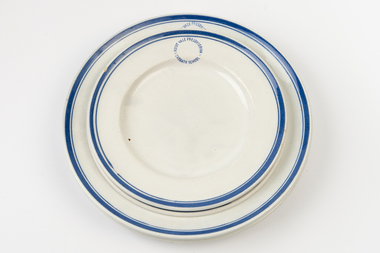 Uniting Church Archives - Synod of Victoria
Plates
... White china plates with royal blue rim and text. 2 x dinner plates (18.1 & 18.2); 2 x bread and butter plates (18.3 & 18.4)...ascot vale prebyterian sabbath school 'Ascot Vale Presbyterian Sabbath School' White china plates with royal blue rim and text. 2 x dinner plates (18.1 & 18.2); 2 x bread and butter plates (18.3 & 18.4) Plates ...White china plates with royal blue rim and text. 2 x dinner plates (18.1 & 18.2); 2 x bread and butter plates (18.3 & 18.4)'Ascot Vale Presbyterian Sabbath School'ascot vale prebyterian sabbath school -
 Flagstaff Hill Maritime Museum and Village
Domestic object - Plate, W. H. GRINDLEY & Co. Ltd, 1914-1925
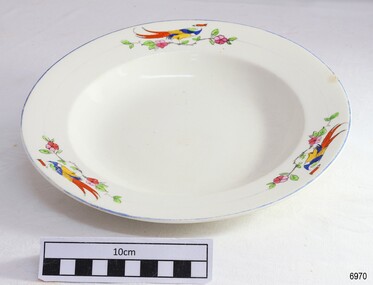
... China plate, earthenware, round, off-white colour with fine blue rim and three transfer decals spaced around the rim. ...ENGLAND" China plate, earthenware, round, off-white colour with fine blue rim and three transfer decals spaced around the rim. ...The Maker’s Mark stamped on the back of this plate, a green laurel wreath with “W. H. Gringley & Co. Ltd, England” below, was used by the company between 1914-1925, according to Kroker and Goundry, authors of a paper “ARCHAEOLOGICAL MONITORING AND MITIGATION OF THE ASSINIBOINE RIVERFRONT QUAY”. The company used different Marks at other times during their operation. The design on this plate is transferware. The company used this more economical process of adding a transfer rather than employing artists to handprint them onto their dinnerware. William Henry Grindley and Alfred Meakin established the company at Tunstall, Stoke-on-Trent, in 1880. The company produced their wares for export to countries that included Australia.This ceramic plate is an example of dinnerware imported from England. The plate was made between 1914 and 1925 . The popular 'bird of paradise' design on the plate is an example of transferware, which made decorative dinnerware more affordable. China plate, earthenware, round, off-white colour with fine blue rim and three transfer decals spaced around the rim. Decals each have a bird of paradise on a flowering branch. The centre of the plate is plain. The maker’s stamp is an open green laurel wreath enclosing a decorative horizontal line, above the name. Made by W H Grindley & Co. Ltd of England.On underside; logo "[green wreath] above W. H. GRINDLEY & Co. Ltd. ENGLAND"flagstaff hill, warrnambool, shipwrecked coast, flagstaff hill maritime museum, maritime museum, shipwreck coast, flagstaff hill maritime village, great ocean road, plate, dinnerware, w. h. grindley, english, plateware, bird of paradise, transferware -
 Flagstaff Hill Maritime Museum and Village
Instrument Container, early 1900's
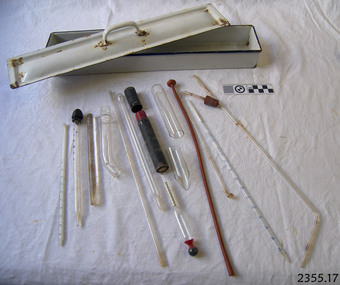
... White enamel oblong container with blue edge arount rim Lid has rounded handle attached to centre by 2 rivets. ...White enamel oblong container with blue edge arount rim Lid has rounded handle attached to centre by 2 rivets. ...Instrument container, part of the W.R.Angus Collection. White enamel oblong container with blue edge arount rim Lid has rounded handle attached to centre by 2 rivets. Has "Made in England" stamped on lid and bottom of container. Container used for sterilising instruments and currently holds instruments related to urinary tract treatment. "Made in England" stamped on lid and bottom of containerflagstaff hill, warrnambool, shipwrecked-coast, flagstaff-hill, flagstaff-hill-maritime-museum, maritime-museum, shipwreck-coast, flagstaff-hill-maritime-village, instrument container, mira hospital, flying doctor, medical treatment -
 Flagstaff Hill Maritime Museum and Village
Domestic object - Dinner plate, William Adams, before 1863-1875
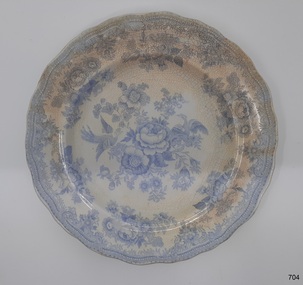
... Earthenware dinner plate with blue and white transfer design (Asiatic Pheasant) with a clear over-glaze. The outer rim is scalloped. ...Earthenware dinner plate with blue and white transfer design (Asiatic Pheasant) with a clear over-glaze. The outer rim is scalloped. ...The Asiatic Pheasant pattern is a transfer design and was the most popular design of the 18th & 19th centuries and is still being produced today. The design was produced as high quality, decorative dinnerware by the potters in the Staffordshire area of England, from the late 1830’s, but no-one is sure exactly who the original designer was. This particular example was made by William Adams of Tunstall, Stoke-on-Trent, Staffordshire at the Greengates Potteries probably after or around 1863 and is believed to have been part of a passengers goods. The Adams family have a long line of making pottery since 1584 until 1966 when they were acquired by the Wedgewood group of companies. But this items pattern is attributed to the Adams potteries. History of the Loch Ard: The Loch Ard got its name from ”Loch Ard” a loch which lies to the west of Aberfoyle, and the east of Loch Lomond. It means "high lake" in Scottish Gaelic. The vessel belonged to the famous Loch Line which sailed many vessels from England to Australia. The Loch Ard was built in Glasgow by Barclay, Curle & Co. in 1873, the vessel was a three-masted square-rigged iron sailing ship that measured 79.87 meters in length, 11.58 m in width, and 7 m in depth with a gross tonnage of 1693 tons with a mainmast that measured a massive 45.7 m in height. Loch Ard made three trips to Australia and one trip to Calcutta before its fateful voyage. Loch Ard left England on March 2, 1878, under the command of 29-year-old Captain Gibbs, who was newly married. The ship was bound for Melbourne with a crew of 37, plus 17 passengers. The general cargo reflected the affluence of Melbourne at the time. Onboard were straw hats, umbrella, perfumes, clay pipes, pianos, clocks, confectionery, linen and candles, as well as a heavier load of railway irons, cement, lead and copper. There were other items included that were intended for display in the Melbourne International Exhibition of 1880. The voyage to Port Phillip was long but uneventful. Then at 3 am on June 1, 1878, Captain Gibbs was expecting to see land. But the Loch Ard was running into a fog which greatly reduced visibility. Captain Gibbs was becoming anxious as there was no sign of land or the Cape Otway lighthouse. At 4 am the fog lifted and a lookout aloft announced that he could see breakers. The sheer cliffs of Victoria's west coast came into view, and Captain Gibbs realised that the ship was much closer to them than expected. He ordered as much sail to be set as time would permit and then attempted to steer the vessel out to sea. On coming head-on into the wind, the ship lost momentum, the sails fell limp and Loch Ard's bow swung back towards land. Gibbs then ordered the anchors to be released in an attempt to hold its position. The anchors sank some 50 fathoms - but did not hold. By this time the ship was among the breakers and the tall cliffs of Mutton Bird Island rose behind. Just half a mile from the coast, the ship's bow was suddenly pulled around by the anchor. The captain tried to tack out to sea, but the ship struck a reef at the base of Mutton Bird Island, near Port Campbell. Waves subsequently broke over the ship and the top deck became loosened from the hull. The masts and rigging came crashing down knocking passengers and crew overboard. When a lifeboat was finally launched, it crashed into the side of Loch Ard and capsized. Tom Pearce, who had launched the boat, managed to cling to its overturned hull and shelter beneath it. He drifted out to sea and then on the flood tide came into what is now known as Lochard Gorge. He swam to shore, bruised and dazed, and found a cave in which to shelter. Some of the crew stayed below deck to shelter from the falling rigging but drowned when the ship slipped off the reef into deeper water. Eva Carmichael a passenger had raced onto the deck to find out what was happening only to be confronted by towering cliffs looming above the stricken ship. In all the chaos, Captain Gibbs grabbed Eva and said, "If you are saved Eva, let my dear wife know that I died like a sailor". That was the last Eva Carmichael saw of the captain. She was swept off the ship by a huge wave. Eva saw Tom Pearce on a small rocky beach and yelled to attract his attention. He dived in and swam to the exhausted woman and dragged her to shore. He took her to the cave and broke the open case of brandy which had washed up on the beach. He opened a bottle to revive the unconscious woman. A few hours later Tom scaled a cliff in search of help. He followed hoof prints and came by chance upon two men from nearby Glenample Station three and a half miles away. In a complete state of exhaustion, he told the men of the tragedy. Tom then returned to the gorge while the two men rode back to the station to get help. By the time they reached Loch Ard Gorge, it was cold and dark. The two shipwreck survivors were taken to Glenample Station to recover. Eva stayed at the station for six weeks before returning to Ireland by steamship. In Melbourne, Tom Pearce received a hero's welcome. He was presented with the first gold medal of the Royal Humane Society of Victoria and a £1000 cheque from the Victorian Government. Concerts were performed to honour the young man's bravery and to raise money for those who lost family in the disaster. Of the 54 crew members and passengers on board, only two survived: the apprentice, Tom Pearce and the young woman passenger, Eva Carmichael, who lost her family in the tragedy. Ten days after the Lochard tragedy, salvage rights to the wreck were sold at auction for £2,120. Cargo valued at £3,000 was salvaged and placed on the beach, but most washed back into the sea when another storm developed. The wreck of Lochard still lies at the base of Mutton Bird Island. Much of the cargo has now been salvaged and some items were washed up into Lochard Gorge. Cargo and artefacts have also been illegally salvaged over many years before protective legislation was introduced in March 1982. One of the most unlikely pieces of cargo to have survived the shipwreck was a Minton majolica peacock- one of only nine in the world. The peacock was destined for the Melbourne 1880 International Exhibition in. It had been well packed, which gave it adequate protection during the violent storm. Today the Minton peacock can be seen at the Flagstaff Hill Maritime Museum in Warrnambool. From Australia's most dramatic shipwreck it has now become Australia's most valuable shipwreck artifact and is one of very few 'objects' on the Victorian State Heritage Register. The shipwreck of the Loch Ard is of significance for Victoria and is registered on the Victorian Heritage Register ( S 417). Flagstaff Hill has a varied collection of artefacts from Loch Ard and its collection is significant for being one of the largest accumulation of artefacts from this notable Victorian shipwreck of which the subject items are a small part. The collections objects give us a snapshot of how we can interpret the story of this tragic event. The collection is also archaeologically significant as it represents aspects of Victoria's shipping history that allows us to interpret Victoria's social and historical themes of the time. Through is associated with the worst and best-known shipwreck in Victoria's history. Plate recovered from the wreck of the Loch Ard. Earthenware dinner plate with blue and white transfer design (Asiatic Pheasant) with a clear over-glaze. The outer rim is scalloped. Stickers with inscriptions "Rec 373 A" "L 102" "From Loch Ard Wreck (1878) - - -" Design logo [Floral wreath with ribbon and text "Asiatic Pheasant" and text below "- - - -"}flagstaff hill, warrnambool, flagstaff hill maritime museum, shipwreck coast, flagstaff hill maritime village, great ocean road, loch line, loch ard, captain gibbs, eva carmichael, tom pearce, glenample station, mutton bird island, loch ard gorge, asiatic pheasant, china dinner plate, earthenware plate, w adams potteries -
 Flagstaff Hill Maritime Museum and Village
Domestic object - Dish, Late 19th or early 20th Century
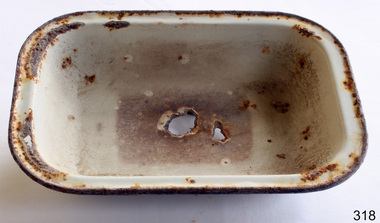
... The white enamel has been discoloured on the inside and much rust has occurred. The remains of a blue enamel line around rim.Two large rust holes in base, and a small rust hole near rim. ...The white enamel has been discoloured on the inside and much rust has occurred. The remains of a blue enamel line around rim.Two large rust holes in base, and a small rust hole near rim. ...Enamel cookware became very popular because people wanted a way of coating iron to stop metallic tastes or rust getting into food: something acid-resistant and easy to clean without laborious scouring, something more durable than the tin linings used inside copper. Enamelware dates back to 1760 in Germany.This object is significant as an example of an item in common use in the 19th and early 20th centuries.Oblong shaped enamel dish. The white enamel has been discoloured on the inside and much rust has occurred. The remains of a blue enamel line around rim.Two large rust holes in base, and a small rust hole near rim. None.flagstaff hill, warrnambool, shipwrecked-coast, flagstaff-hill, flagstaff-hill-maritime-museum, maritime-museum, shipwreck-coast, flagstaff-hill-maritime-village, enamel, kitchenware, baking -
 Flagstaff Hill Maritime Museum and Village
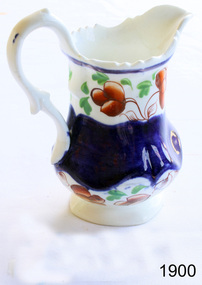
Jug
... rim of red flowers on red stems including green leaves. Has a wide border of navy blue. Above it has the same decoration as described for lower rim. Above it has a narrow rim of navy blue. Jug has a narrow spit and a thin decorative handle in white...rim of red flowers on red stems including green leaves. Has a wide border of navy blue. Above it has the same decoration as described for lower rim. Above it has a narrow rim of navy blue. Jug has a narrow spit and a thin decorative handle in white ...Decorative ceramic cream jug. Border on lower rim of red flowers on red stems including green leaves. Has a wide border of navy blue. Above it has the same decoration as described for lower rim. Above it has a narrow rim of navy blue. Jug has a narrow spit and a thin decorative handle in white. The base and interior of the jug are also white.flagstaff hill, warrnambool, shipwrecked-coast, flagstaff-hill, flagstaff-hill-maritime-museum, maritime-museum, shipwreck-coast, flagstaff-hill-maritime-village, jug -
 Flagstaff Hill Maritime Museum and Village
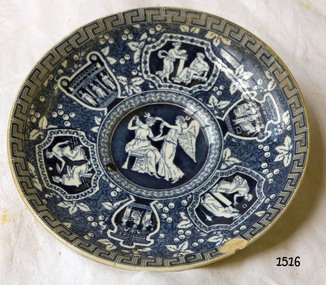
Saucer
... Style Greek, blue and white decorative rim. Figures around curve, angel figures in the middle. ...Style Greek, blue and white decorative rim. Figures around curve, angel figures in the middle. ...Saucer porcelain made by Copeland formerly "Spode". Style Greek, blue and white decorative rim. Figures around curve, angel figures in the middle. Chip on rim.flagstaff hill, warrnambool, shipwrecked-coast, flagstaff-hill, flagstaff-hill-maritime-museum, maritime-museum, shipwreck-coast, flagstaff-hill-maritime-village -
 Flagstaff Hill Maritime Museum and Village
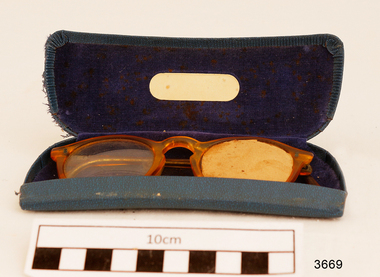
Functional object - Spectacles and Case, Mid 20th Century
... blue velvet lining. Orange/yellow rimmed spectacles, one lens covered with cardboard. White...blue velvet lining. Orange/yellow rimmed spectacles, one lens covered with cardboard. White ...The history of spectacles The earliest form of spectacles are generally agreed to have been invented in Northern Italy in the thirteenth century. Over hundreds of years of innovation and refinement, they have been perfected into the stylish and functional designs you see today worn by millions of people to correct their eyesight. Here's a look at the key moments that defined the history of spectacles. Thirteenth century - Rivet spectacles The earliest form of spectacles was simply two mounted lenses riveted together at the handle ends. They had no sides and were secured to the face by clamping the nose between the rims, some of which had notches which may have been intended to improve the grip. Even then the wearer could only keep them in place by remaining relatively still and would normally support them with the hand. These spectacles contained convex lenses for the correction of presbyopic long-sightedness and were generally suited only to those few who lived beyond their forties and had the ability to read. Sixteenth century - Nose spectacles Nose spectacles were in more common use by the early sixteenth century. These often had a bow-shaped continuous bridge, almost of a modern appearance, that was sometimes flexible depending upon the material, for example leather or whalebone. The bridge was as much an area to be gripped as to rest on the nose. Spectacles were still usually held in place with the hand whilst being used temporarily for a brief period of reading or close inspection. By now the lenses could be used to correct both long and short sight. The general design changed little through the seventeenth century, though certain refinements increased the flexibility and comfort for some wearers. In some localised areas, notably in Spain, people experimented with ear loops made of string. This allowed them to walk around with their spectacles on. Eighteenth century - Temple glasses Only in the eighteenth century did the first modern eyewear, or ‘glasses’ as we would understand them, start to appear. The lenses might be glass, rock crystal or any other transparent mineral substance and were prone to smashing if the spectacles fell off, so there was an impetus to develop frames that could be worn continuously and would stay in place. London optician Edward Scarlett is credited with developing the modern style of spectacles which were kept in place with arms, known as ‘temples’. These were made of iron or steel and gripped the side of the head but did not yet hook over the ears because often the ears were concealed beneath a powdered wig, such as was fashionable at the time. As temples developed they were made with wide ring ends through which the wearer could pass a ribbon, thus tying the spectacles securely to the head. As spectacles were no longer primarily for use in sedentary activities, people began to be noticed out and about in their spectacles and might come to be identified as a ‘spectacle wearer’. By the end of the eighteenth century, people who needed correction for both distance and near could choose bifocals. Nineteenth century - Pince-nez Pince-nez were a nineteenth century innovation that literally translates as ‘pinching the nose’. They had a spring clip to retain the item in place under its own tension. Sometimes this clip was too tight and the wearer struggled to breathe. If it was too loose the pince-nez could fall off so, for safety and security, they were often connected to the wearer's clothing by a cord or a chain to avoid them being dropped or lost. Pince-nez were sometimes chosen by people who felt that large spectacles were too prominent and drew attention to a physical defect. They were also suitable for mounting lenses that could correct astigmatism. Twentieth century spectacles Spectacle wearing continued to become more widespread, key developments being the supply of spectacles to troops in the First World War, cheaper spectacles being subsidised through insurance schemes arranged by friendly societies, and the beginning of the National Health Service in 1948, when free spectacles were made available to all who might benefit from them. This normalised spectacle wearing and led to a significant increase in the scale of production. Entirely separate categories of women’s spectacles and sports eyewear both emerged in the 1930s. The latter half of the twentieth century saw spectacles become more fashionable and stylish as frames with different shapes, materials, and colours became available. Plastics frames, in particular, allowed a greater choice of colours and textured finishes. Plastic lenses were more durable and could be made lighter and thinner than glass, spurring a renewed interest in rimless designs. Designer eyewear bearing popular high-street brand names encouraged patients to regard spectacles as a desirable commodity, even as a fashion accessory, not just a disability aid. https://www.college-optometrists.org/the-british-optical-association-museum/the-history-of-spectacles These spectacles and case from F.G. and R.G. Bennett of Warrnambool were used by Dr. Angus to test his patients' eye sight. They were donated to Flagstaff Hill Maritime Village by the family of Doctor William Roy Angus, Surgeon and Oculist. It is part of the “W.R. Angus Collection” that includes historical medical equipment, surgical instruments and material once belonging to Dr Edward Ryan and Dr Thomas Francis Ryan, (both of Nhill, Victoria) as well as Dr Angus’ own belongings. The Collection’s history spans the medical practices of the two Doctors Ryan, from 1885-1926 plus that of Dr Angus, up until 1969. ABOUT THE “W.R.ANGUS COLLECTION” Doctor William Roy Angus M.B., B.S., Adel., 1923, F.R.C.S. Edin.,1928 (also known as Dr Roy Angus) was born in Murrumbeena, Victoria in 1901 and lived until 1970. He qualified as a doctor in 1923 at University of Adelaide, was Resident Medical Officer at the Royal Adelaide Hospital in 1924 and for a period was house surgeon to Sir (then Mr.) Henry Simpson Newland. Dr Angus was briefly an Assistant to Dr Riddell of Kapunda, then commenced private practice at Curramulka, Yorke Peninsula, SA, where he was physician, surgeon and chemist. In 1926, he was appointed as new Medical Assistant to Dr Thomas Francis Ryan (T.F. Ryan, or Tom), in Nhill, Victoria, where his experiences included radiology and pharmacy. In 1927 he was Acting House Surgeon in Dr Tom Ryan’s absence. Dr Angus had become engaged to Gladys Forsyth and they decided he would take time to further his studies overseas in the UK in 1927. He studied at London University College Hospital and at Edinburgh Royal Infirmary and in 1928, was awarded FRCS (Fellow from the Royal College of Surgeons), Edinburgh. He worked his passage back to Australia as a Ship’s Surgeon on the on the Australian Commonwealth Line’s T.S.S. Largs Bay. Dr Angus married Gladys in 1929, in Ballarat. (They went on to have one son (Graham 1932, born in SA) and two daughters (Helen (died 12/07/1996) and Berenice (Berry), both born at Mira, Nhill ) Dr Angus was a ‘flying doctor’ for the A.I.M. (Australian Inland Ministry) Aerial Medical Service in 1928 . The organisation began in South Australia through the Presbyterian Church in that year, with its first station being in the remote town of Oodnadatta, where Dr Angus was stationed. He was locum tenens there on North-South Railway at 21 Mile Camp. He took up this ‘flying doctor’ position in response to a call from Dr John Flynn; the organisation was later known as the Flying Doctor Service, then the Royal Flying Doctor Service. A lot of his work during this time involved dental surgery also. Between 1928-1932 he was surgeon at the Curramulka Hospital, Yorke Peninsula, South Australia. In 1933 Dr Angus returned to Nhill where he’d previously worked as Medical Assistant and purchased a share of the Nelson Street practice and Mira hospital from Dr Les Middleton one of the Middleton Brothers, the current owners of what was once Dr Tom Ryan’s practice. Dr L Middleton was House Surgeon to the Nhill Hospital 1926-1933, when he resigned. [Dr Tom Ryan’s practice had originally belonged to his older brother Dr Edward Ryan, who came to Nhill in 1885. Dr Edward saw patients at his rooms, firstly in Victoria Street and in 1886 in Nelson Street, until 1901. The Nelson Street practice also had a 2 bed ward, called Mira Private Hospital ). Dr Edward Ryan was House Surgeon at the Nhill Hospital 1884-1902 . He also had occasions where he successfully performed veterinary surgery for the local farmers too. Dr Tom Ryan then purchased the practice from his brother in 1901. Both Dr Edward and Dr Tom Ryan work as surgeons included eye surgery. Dr Tom Ryan performed many of his operations in the Mira private hospital on his premises. He too was House Surgeon at the Nhill Hospital 1902-1926. Dr Tom Ryan had one of the only two pieces of radiology equipment in Victoria during his practicing years – The Royal Melbourne Hospital had the other one. Over the years Dr Tom Ryan gradually set up what was effectively a training school for country general-practitioner-surgeons. Each patient was carefully examined, including using the X-ray machine, and any surgery was discussed and planned with Dr Ryan’s assistants several days in advance. Dr Angus gained experience in using the X-ray machine there during his time as assistant to Dr Ryan. Dr Tom Ryan moved from Nhill in 1926. He became a Fellow of the Royal Australasian College of Surgeons in 1927, soon after its formation, a rare accolade for a doctor outside any of the major cities. He remained a bachelor and died suddenly on 7th Dec 1955, aged 91, at his home in Ararat. Scholarships and prizes are still awarded to medical students in the honour of Dr T.F. Ryan and his father, Dr Michael Ryan, and brother, John Patrick Ryan. ] When Dr Angus bought into the Nelson Street premises in Nhill he was also appointed as the Nhill Hospital’s Honorary House Surgeon 1933-1938. His practitioner’s plate from his Nhill surgery states “HOURS Daily, except Tuesdays, Fridays and Saturday afternoons, 9-10am, 2-4pm, 7-8pm. Sundays by appointment”. This plate is now mounted on the doorway to the Port Medical Office at Flagstaff Hill Maritime Village, Warrnambool. Dr Edward Ryan and Dr Tom Ryan had an extensive collection of historical medical equipment and materials spanning 1884-1926 and when Dr Angus took up practice in their old premises he obtained this collection, a large part of which is now on display at the Port Medical Office at Flagstaff Hill Maritime Village in Warrnambool. During his time in Nhill Dr Angus was involved in the merging of the Mira Hospital and Nhill Public Hospital into one public hospital and the property titles passed on to Nhill Hospital in 1939. In 1939 Dr Angus and his family moved to Warrnambool where he purchased “Birchwood,” the 1852 home and medical practice of Dr John Hunter Henderson, at 214 Koroit Street. (This property was sold in1965 to the State Government and is now the site of the Warrnambool Police Station. ). The Angus family was able to afford gardeners, cooks and maids; their home was a popular place for visiting dignitaries to stay whilst visiting Warrnambool. Dr Angus had his own silk worm farm at home in a Mulberry tree. His young daughter used his centrifuge for spinning the silk. Dr Angus was appointed on a part-time basis as Port Medical Officer (Health Officer) in Warrnambool and held this position until the 1940’s when the government no longer required the service of a Port Medical Officer in Warrnambool; he was thus Warrnambool’s last serving Port Medical Officer. (The duties of a Port Medical Officer were outlined by the Colonial Secretary on 21st June, 1839 under the terms of the Quarantine Act. Masters of immigrant ships arriving in port reported incidents of diseases, illness and death and the Port Medical Officer made a decision on whether the ship required Quarantine and for how long, in this way preventing contagious illness from spreading from new immigrants to the residents already in the colony.) Dr Angus was a member of the Australian Medical Association, for 35 years and surgeon at the Warrnambool Base Hospital 1939-1942, He served as a Surgeon Captain during WWII 1941-45, in Ballarat, Victoria, and in Bonegilla, N.S.W., completing his service just before the end of the war due to suffering from a heart attack. During his convalescence he carved an intricate and ‘most artistic’ chess set from the material that dentures were made from. He then studied ophthalmology at the Royal Melbourne Eye and Ear Hospital and created cosmetically superior artificial eyes by pioneering using the intrascleral cartilage. Angus received accolades from the Ophthalmological Society of Australasia for this work. He returned to Warrnambool to commence practice as an ophthalmologist, pioneering in artificial eye improvements. He was Honorary Consultant Ophthalmologist to Warrnambool Base Hospital for 31 years. He made monthly visits to Portland as a visiting surgeon, to perform eye surgery. He represented the Victorian South-West subdivision of the Australian Medical Association as its secretary between 1949 and 1956 and as chairman from 1956 to 1958. In 1968 Dr Angus was elected member of Spain’s Barraquer Institute of Barcelona after his research work in Intrasclearal cartilage grafting, becoming one of the few Australian ophthalmologists to receive this honour, and in the following year presented his final paper on Living Intrasclearal Cartilage Implants at the Inaugural Meeting of the Australian College of Ophthalmologists in Melbourne In his personal life Dr Angus was a Presbyterian and treated Sunday as a Sabbath, a day of rest. He would visit 3 or 4 country patients on a Sunday, taking his children along ‘for the ride’ and to visit with him. Sunday evenings he would play the pianola and sing Scottish songs to his family. One of Dr Angus’ patients was Margaret MacKenzie, author of a book on local shipwrecks that she’d seen as an eye witness from the late 1880’s in Peterborough, Victoria. In the early 1950’s Dr Angus, painted a picture of a shipwreck for the cover jacket of Margaret’s book, Shipwrecks and More Shipwrecks. She was blind in later life and her daughter wrote the actual book for her. Dr Angus and his wife Gladys were very involved in Warrnambool’s society with a strong interest in civic affairs. Their interests included organisations such as Red Cross, Rostrum, Warrnambool and District Historical Society (founding members), Wine and Food Society, Steering Committee for Tertiary Education in Warrnambool, Local National Trust, Good Neighbour Council, Housing Commission Advisory Board, United Services Institute, Legion of Ex-Servicemen, Olympic Pool Committee, Food for Britain Organisation, Warrnambool Hospital, Anti-Cancer Council, Boys’ Club, Charitable Council, National Fitness Council and Air Raid Precautions Group. He was also a member of the Steam Preservation Society and derived much pleasure from a steam traction engine on his farm. He had an interest in people and the community He and his wife Gladys were both involved in the creation of Flagstaff Hill, including the layout of the gardens. After his death (28th March 1970) his family requested his practitioner’s plate, medical instruments and some personal belongings be displayed in the Port Medical Office surgery at Flagstaff Hill Maritime Village, and be called the “W. R. Angus Collection”. The W.R. Angus Collection is significant for still being located at the site it is connected with, Doctor Angus being the last Port Medical Officer in Warrnambool. The collection of medical instruments and other equipment is culturally significant, being an historical example of medicine from late 19th to mid-20th century. Dr Angus assisted Dr Tom Ryan, a pioneer in the use of X-rays and in ocular surgery. Spectacles and case, from the W.R. Angus Collection and used by Dr. Angus testing the sight of his patients. Metal case covered in blue leather, blue velvet lining. Orange/yellow rimmed spectacles, one lens covered with cardboard. White oval label inside case. Inscription on case with maker’s details in gold print.Inscription on case reads “F. G. & R. G. BENNETT / WARRNAMBOOL”. flagstaff hill, warrnambool, shipwrecked coast, flagstaff hill maritime museum, maritime museum, shipwreck coast, flagstaff hill maritime village, great ocean road, dr w r angus, spectacles and case, optical testing, optometrist examination, f.g. and r.g. bennett of warrnambool -
 Flagstaff Hill Maritime Museum and Village
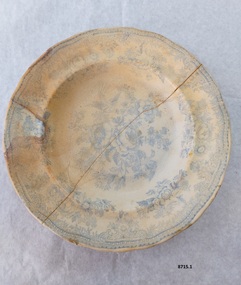
Domestic object - Dinner plate, circa 1878
... Earthenware dinner plates with blue and white transfer design (Asiatic Pheasant) with a clear over-glaze. The outer rim is scalloped. ...Earthenware dinner plates with blue and white transfer design (Asiatic Pheasant) with a clear over-glaze. The outer rim is scalloped. ...These earthenware dinner plates were recovered from the wreck of the Loch Ard, on the southwest coast of Victoria and donated by a friend of the diver. The plates are very similar to other plates recovered from the wreck of the Loch Ard - some of which are already on display at Flagstaff Hill Museum and Village in Warrnambool. It is uncertain whether the plates were personal belongings or part of the cargo. The Asiatic Pheasant pattern is a transfer design and was the most popular design of the 19th-century Victorian era. It is still being produced today. The design was produced as high-quality, decorative dinnerware by the potters in the Staffordshire, England, area from the late 1830s, but no one is sure exactly who the original designer was. The industrial age made the production of this design more affordable to the ordinary person who purchased and proudly displayed settings in their homes. The high demand for production resulted in the loss of quality in both potting and design, particularly between 1860-1914 when the design reached its height of popularity, and the results were often a poor match for the earlier pieces’ quality and detail. Some engravers would make copies of the Asiatic Pheasant design (and other designs) onto copper plates and sell them to more than one pottery producer (the Copyright Act of 1842 was intended to control this very thing). Consequently, the list of Makers’ Marks associated with the Asiatic Pheasant is well over 100. A single pottery factory could have several owners, all with their own Marks. The makers mark on these two plates are also difficult to read but appear to include the letters "O H E ?' over "L". These factors all make the dating of pieces difficult. Also, after 1891, pieces produced for export were required to be stamped with “ENGLAND”, but pieces produced for the domestic market in England did not need this stamp, so early pieces and pieces produced for the domestic market would all be without the “ENGLAND” stamp, confusing the matter. Over time the body shape of the pieces changed, the feathered, curved and fluted edges giving way to simpler, cheaper oblong shapes The ship Loch Ard was built on the River Clyde in Scotland in 1873 for the prestigious Loch Line of colonial clipper ships, designed for the Australian run. It sailed from England on 1st March 1878 carrying 37 crew, 17 passengers and a load of cargo. The general cargo reflected the affluence of Melbourne at the time. On board were straw hats, umbrellas, perfumes, clay pipes, pianos, clocks, confectionary, linen and candles, as well as a heavier load of railway irons, cement, lead and copper. There were items included that were intended for display in the Melbourne International Exhibition in 1880 - a diverse general cargo ranging from luxury items to bulk railway iron. On 1 June 1878, emerging from fog and hearing too late the sound of breakers against the tall limestone cliffs, the vessel struck the southern foot of Mutton Bird Island and sank in 23 metres of water. Of the fifty-four people on board only two survived, one young male crewman, Tom Pearce, and one young female passenger, Eva Carmichael. Ten days after the Loch Ard tragedy, salvage rights to the wreck were sold at auction for £2,120. Cargo valued at £3,000 was salvaged and placed on the beach, but most washed back into the sea when another storm developed. The wreck of Loch Ard still lies at the base of Mutton Bird Island. Much of the cargo has now been salvaged and some was washed up into what is now known as Loch Ard Gorge. Cargo and artefacts have also been illegally salvaged over many years before protective legislation was introduced. One of the most unlikely pieces of cargo to have survived the shipwreck was a Minton porcelain peacock - one of only seven in the world. The peacock was destined for the Melbourne International Exhibition in 1880. It had been well packed, which gave it adequate protection during the violent storm. Today, the Minton peacock can be seen at the Flagstaff Hill Maritime Museum in Warrnambool. From Australia's most dramatic shipwreck it has now become Australia's most valuable shipwreck artefact and is one of very few 'objects' on the Victorian State Heritage Register.Flagstaff Hill’s collection of artefacts from LOCH ARD is significant for being one of the largest collections of artefacts from this shipwreck in Victoria. It is significant for its association with the shipwreck, which is on the Victorian Heritage Register (VHR S417). The collection is significant because of the relationship between the objects, as together they have a high potential to interpret the story of the LOCH ARD. The LOCH ARD collection is archaeologically significant as the remains of a large international passenger and cargo ship. The LOCH ARD collection is historically significant for representing aspects of Victoria’s shipping history and its potential to interpret sub-theme 1.5 of Victoria’s Framework of Historical Themes (living with natural processes). The collection is also historically significant for its association with the LOCH ARD, which was one of the worst and best known shipwrecks in Victoria’s history.Two plates recovered from the wreck of the Loch Ard. Earthenware dinner plates with blue and white transfer design (Asiatic Pheasant) with a clear over-glaze. The outer rim is scalloped. Plate 8715.1 has substantial brown stain over a large part of it and a large crack across the plate from rim to rim. The back of the plate shows evidence of the glue used to repair it. Plate 8715.2 has minor brown staining and is in better condition.Floral makers mark on the back featuring a scroll inscribed with "Asiatic Pheasant" and underneath the letters "O H E ?" over "L".flagstaff hill maritime museum and village, great ocean road, shipwreck coast, warrnambool, loch ard, lock ard wreck, plates, crockery, asiatic pheasant design, salvage, loch ard gorge, dinner plates -
 City of Moorabbin Historical Society (Operating the Box Cottage Museum)
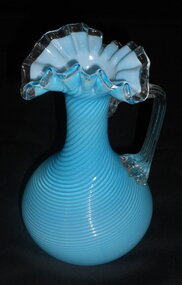
Domestic object - Ornaments, Fenton's Blue vase, Circa 1906 to 1940s
... Hand-blown outer aqua blue glass over base of white milk glass. Heavily ruffled and crimped rim, with clear glass edging. ...Hand-blown outer aqua blue glass over base of white milk glass. Heavily ruffled and crimped rim, with clear glass edging. ...The Fenton Art Glass Company was founded in 1905 by brothers Frank L. Fenton and John W. Fenton in an old glass factory in Martins Ferry, Ohio. Originally, they painted glass blanks from other glass makers, but started making their own glass when they became able to buy the materials they needed. They moved across the Ohio river to Williamstown, West Virginia, and built a factory in 1906. The first year for glass production was 1907. Frank Fenton was the designer and decorator. Jacob Rosenthal, a famous glass chemist is known for developing chocolate and golden agate glass. Perfume bottles for the Wrisley Company in 1938 were made in French opalescent glass with the hobnail pattern In 1939, Fenton started selling Hobnail items in milk glass. During the Great Depression and World War II, Fenton produced practical items such as mixing bowls and tableware. Fenton ceased "traditional" glassmaking at the Williamstown, West Virginia factory in July of 2011. However, the factory remains open as a jewellery making operation, producing handcrafted glass beads and Teardrop earrings.Late early to mid 20th century Jack-in the- Pulpet style Fenton vase. Hand-blown outer aqua blue glass over base of white milk glass. Heavily ruffled and crimped rim, with clear glass edging. The narrow neck joins to larger circular base. The body of the vase is also decorated with swirling ridges. Clear glass handle. Pont mark on base, but no Makers Mark. Fenton's glassware bore no Makers Mark until the 1950s.glassware, lights, fenton art glass company, ohio, west virginia, usa, fenton frank l., fenton john w., rosenthal jacob, early settlers, pioneers, market gardeners, moorabbin, bentleigh, ormond, cheltenham -
 Glenelg Shire Council Cultural Collection
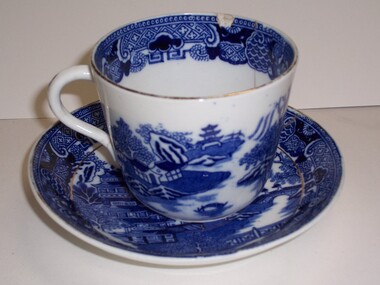
Functional object - Cup and saucer, n.d
... 378.1 Large teacup with a "willow pattern" style design around outside edge and at base of cup. Blue and white. Worn gold rim around edge and on handle. 378.2 "Willow pattern" style design in blue and white on saucer, with decorative gold line on edge and set 2cms within edge....Displayed at History House. 378.1 Large teacup with a "willow pattern" style design around outside edge and at base of cup. Blue and white. Worn gold rim around edge and on handle. 378.2 "Willow pattern" style design in blue and white on saucer, with decorative gold line on edge and set 2cms within edge. ...Displayed at History House.378.1 Large teacup with a "willow pattern" style design around outside edge and at base of cup. Blue and white. Worn gold rim around edge and on handle. 378.2 "Willow pattern" style design in blue and white on saucer, with decorative gold line on edge and set 2cms within edge.
