
Showing 12 items matching "wicking place"
-
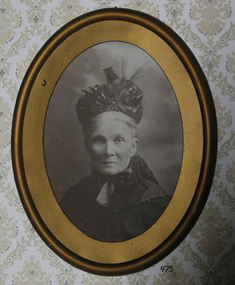 Flagstaff Hill Maritime Museum and Village
Photograph - Portrait, late 19th - early 20th century
... ...Wicking Place...He was given a Citizenship Award in 1981 and had a Street named “Wicking Place” in his honour in 1992 by the Warrnambool City Council. ...He was given a Citizenship Award in 1981 and had a Street named “Wicking Place” in his honour in 1992 by the Warrnambool City Council. ...The photograph depicts Mrs Elizabeth Holland, nee Brewer, who was born in Durham, England, in 1846, and died in Australia in 1923. Elizabeth had married Thomas Holland in Australia in 1864; his first wife died at sea, along with his eldest son, on their way to Australia. At the time, he had two other living children. Thomas and Elizabeth had thirteen children, all born in the Warrnambool district. Their seventh child, Mary Ann, married Frank Wicking; one of their children was Tom Wicking, who donated this photograph. Tom Wicking (1907-1995): Tom was the son of Frank Wicking and the grandson of Elizabeth Holland. He was one of the founders of Flagstaff Hill and became a life member in 1987. He donated many items of memorabilia and all of his historical papers to Flagstaff Hill after his death. A local historian, he published four books on Warrnambool History. He was given a Citizenship Award in 1981 and had a Street named “Wicking Place” in his honour in 1992 by the Warrnambool City Council. Tom was a Tour Guide for Flagstaff Hill for many years.The photograph is a record of Elizabeth Hiolland and connects her with Warrnambool's Wicking family. One of her grandsons, Tom Wicking, was a well-known local historian. He was also instrumental in the formation of Warrnambool's Flagstaff Hill Maritime Museum and Village, where his historical research records are held.Photograph of a female adult wearing a decorative hat and shawl. The black and white portrait is mounted behind glass, in a gilt wooden frame. It depicts Mrs Elizabeth Holland, mother of Frank Wicking, and grandmother of local historian, Tom Wicking.flagstaff hill, flagstaff hill maritime museum and village, warrnambool, maritime museum, maritime village, great ocean road, shipwreck coast, historic photograph, elizabeth holland, frank wicking, tom wicking, local pioneer, wicking place, elizabeth brewer, mary ann wicking, thomas holland, mary ann holland -
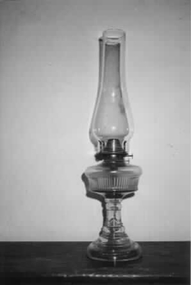 Whitehorse Historical Society Inc.
Functional object - Lamp
... Tall, slender glass kerosene lamp with wick in place. Simple vertical line decoration around oil reservoir and base. ...Mass produce in America lighting kerosene & oil Tall, slender glass kerosene lamp with wick in place. Simple vertical line decoration around oil reservoir and base. ...Mass produce in AmericaTall, slender glass kerosene lamp with wick in place. Simple vertical line decoration around oil reservoir and base. Period 1880 - 1900.lighting, kerosene & oil -
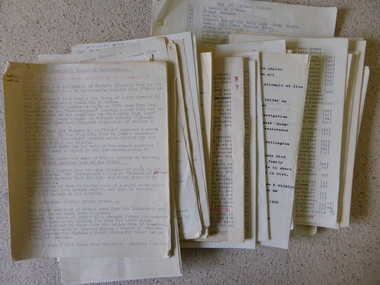 Warrnambool and District Historical Society Inc.
Notes, Lecture Notes - type written
... He also produced a revised edition of the booklet containing notes on the origin of street names in Warrnambool. Wicking Place in Warrnambool is named after him.He died in the late 1990s. ...He also produced a revised edition of the booklet containing notes on the origin of street names in Warrnambool. Wicking Place in Warrnambool is named after him.He died in the late 1990s. ...These typed notes have been prepared by Tom Wicking to be used in conjunction with his collection of slides on local history. Tom Wicking was a noted local historian, particularly well-known in the 1970s and 80s. He was an early active member of the Warrnambool and District Historical Society and was involved in the establishment of Flagstaff Hill Maritime Museum in the mid 1970s. He also produced a revised edition of the booklet containing notes on the origin of street names in Warrnambool. Wicking Place in Warrnambool is named after him.He died in the late 1990s. These notes and slides were part of Wicking’s deceased estate and have been de-acquisitioned from the Flagstaff Hill collection and passed to the Warrrnambool and District Historical Society through the estate of Les O’Callaghan.These notes were for use in slide shows etc and have a limited use today as the historical information contained therein is continually being revised and technology has changed The slide material has been scanned and will be better utilized this way in a power point presentation etc. Typed sheets on aspects of Warrnambool and district history – note-book size (13 packs); quarto size (1 pack). warrnambool, tom wicking -
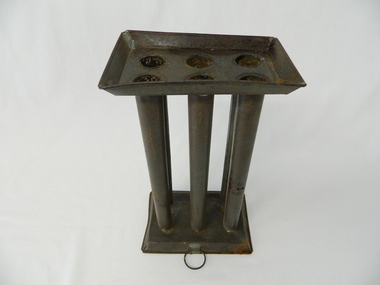 Kiewa Valley Historical Society
Mould Candle Making, Circa mid 1900's
... The bottom of each cylinder has an opening for the candle wick. The wick is positioned in place before the molten wax is poured into the cylinders. ...The bottom of each cylinder has an opening for the candle wick. The wick is positioned in place before the molten wax is poured into the cylinders. ...Candle stick manufacturing moulds were extensively used throughout the Kiewa Valley and its regions to provide rural homes and businesses with illumination during times of limited light e.g. night time. These candles were used before the Kiewa Valley was placed of the electrical grid. The candles were made from parrafin wax. Before the 1920"s electricity was in limited supply due to the inability of the private electricity suppliers to service isolated rural regions. It was not until the Victorian State Government passed legislation (1920) to improve electricity supplies by forming the State Electricity Commission of Victoria (S.E.C.V.) Isolated rural communities could not meet the higher costs to have electricity supplies connected and therefore it was not until the 1950's that adequate domestic electrical power could be supplied.The isolation that the Kiewa Valley provided was of a greater hindrance to any utility (power,roads & telephone) where the cost per instillation was beyond the rural population's ability to pay either directly or indirectly. One of the benefits that the "closed" community of Mount Beauty had, when it was administered by the SECV was that some utility costs were a lot lower than that of the other settlements in the Kiewa Valley. This disparity led to a conference in 1928 of the rural and regional councils to demand from the Government an equality of electricity tariffs. This equality did not take place until 1965. The demand and usage of cheaper and affordable lighting that wax candles provided was for some rural families a way of life until the mid 1900's.This candle making mould is made from mild rolled sheet steel(tin). The top basin is rectangular in shape with beveled edges(facing in on all sides. There are six holes in the top basin for vertical hollow tubes to feed off. The six tapered cyclindrical tubes running from the top basin to the bottom raised platform base. All connections are welded together. The bottom of each cylinder has an opening for the candle wick. The wick is positioned in place before the molten wax is poured into the cylinders. A positioning ring has been welded to one bottom ring for stability.parrafin wax, candles, domestic household ighting -
 Flagstaff Hill Maritime Museum and Village
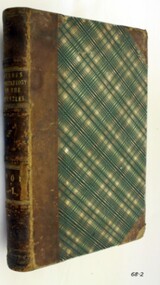
Literary work - Religious Book, C. & J. Revington, Annotations on the Epistles, Volume 1, 1824 (Second Edition)
... Rivington, St Paul’s church-yard, and Waterloo-place, Pall Mall, London . The pair of books is part of the Tom Wicking Collection....Rivington, St Paul’s church-yard, and Waterloo-place, Pall Mall, London . The pair of books is part of the Tom Wicking Collection. ...An epistle from the Greek (epistolē, meaning "letter") is a writing directed or sent to a person or group of people, usually an elegant and formal didactic letter. The epistle genre of letter-writing was common in ancient Egypt as part of the scribal schools writing curriculum. The letters in the New Testament from Apostles to Christians are usually referred to as epistles. Those traditionally attributed to Paul are known as Pauline epistles and the others as catholic or "general" epistles. The subject volume is titled "Annotations on the Apocalypse" and was intended as a sequel to those originally written by Mr. Elsley on the Gospels and of Mr. Prebendary Slade on the Epistles, and thus aimed to complete a series of comments on the whole of the New Testament, for the use of students in prophetical scrip this book, "Annotations on the Apocalypse was intended as a sequel to those of Mr. Elsley on the Gospels and of Mr. Prebendary Slade on the Epistles", by John Chappel Woodhouse, is a second edition of the book originally published before 1824. These pair of books were part of Tom Wicking's collection and represent the type of literature published and read in the early 1800s and up to the present day for the religious instruction of priests. Spine has “Slades Annotations on the Epistles, Vol I”. Covers have green and cream diagonal tartan with brown binding decorated with gold. Annotations on the Epistles, being a continuation of Mr. Elsley’s Annotations and Principally Designed for the use of Candidates for the Holy Orders, by the Rev. James Slade, M.A., vicar of Bolton, and Prebendary of Chester; late Fellow and Tutor of Emmanuel College, Cambridge; and Examining Chaplain to the Lord Bishop of Chester. In two volumes, Vol. I, second edition. Printed in 1824 for C. & J. Rivington, St Paul’s church-yard, and Waterloo-place, Pall Mall, London . The pair of books is part of the Tom Wicking Collection.Marked inside cover "J. Lewis Glenview to Mrs MacLean S. Broadwater" Marked (illegible) "Maclean "Roger" Poet Diary (misspelt dairy)"flagstaff hill, warrnambool, shipwrecked coast, flagstaff hill maritime museum, maritime museum, flagstaff hill maritime village, great ocean road, book, annotations on the epistles vol 2, rev. james slade, c. & j. revington, religious book, mrs maclean, j lewis of glenview, tom wicking collection -
 Orbost & District Historical Society
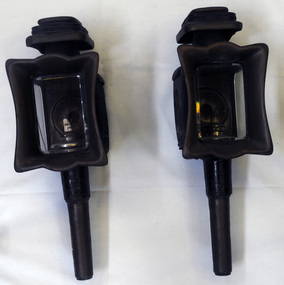
buggy lamps, 1880's -1910
... Lamps are placed at different places on the carriage sides: 1 lamp on each side placed close to box seat These lanterns are examples of lighting devices used in the time of horse and carriage transport. lighting kerosene-lights buggy-lamps transport lanterns On ceramic wick holder - B in the middle of BARTONS B Underneath is TRADE MARK Two kerosene lanterns - buggy lamps.They are rectangular in shape and have a chimney on top. ...In the beginning of the19th century, the main mode of transportation was the horse and carriage. Even after the advent of the railway, remote areas still relied on the horse for local transport.Until Australian coachbuilders began making buggies from the 1860s, most were made in America Buggies with four wheels were light but comfortable. Many had hoods to keep the sun and rain off passengers. They were generally owned by doctors, ‘squatters’ and business people. Some had small turn-out seats at the back for children. Lamps are placed at different places on the carriage sides: 1 lamp on each side placed close to box seatThese lanterns are examples of lighting devices used in the time of horse and carriage transport.Two kerosene lanterns - buggy lamps.They are rectangular in shape and have a chimney on top. Both have carrying handles.There are 3 glass windows having two clear white lights and one small red round light on the back. The ceramic burner is made by Barton's.On ceramic wick holder - B in the middle of BARTONS B Underneath is TRADE MARK lighting kerosene-lights buggy-lamps transport lanterns -
 Flagstaff Hill Maritime Museum and Village
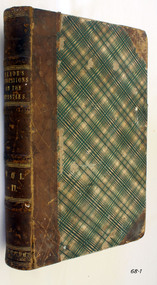
Literary work - Religious Book, C. & J. Revington, Annotations on the Epistles, Volume 2, 1824 (Second Edition)
... Rivington, St Paul’s church-yard, and Waterloo-place, Pall Mall, London . The pair of books is part of the Tom Wicking Collection....Rivington, St Paul’s church-yard, and Waterloo-place, Pall Mall, London . The pair of books is part of the Tom Wicking Collection. ...An epistle from the Greek (epistolē, meaning "letter") is a writing directed or sent to a person or group of people, usually an elegant and formal didactic letter. The epistle genre of letter-writing was common in ancient Egypt as part of the scribal schools writing curriculum. The letters in the New Testament from Apostles to Christians are usually referred to as epistles. Those traditionally attributed to Paul are known as Pauline epistles and the others as catholic or "general" epistles. The subject volume is titled "Annotations on the Apocalypse" and was intended as a sequel to those originally written by Mr. Elsley on the Gospels and of Mr. Prebendary Slade on the Epistles, and thus aimed to complete a series of comments on the whole of the New Testament, for the use of students in prophetical scrip this book, "Annotations on the Apocalypse was intended as a sequel to those of Mr. Elsley on the Gospels and of Mr. Prebendary Slade on the Epistles", by John Chappel Woodhouse, is a second edition of the book originally published before 1824. These pair of books were part of Tom Wicking's collection and represent the type of literature published and read in the early 1800s and up to the present day for the religious instruction of priests. Spine has “Slades Annotations on the Epistles, Vol II”. Covers have green and cream diagonal tartan with brown binding decorated with gold. Annotations on the Epistles, being a continuation of Mr. Elsley’s Annotations and Principally Designed for the use of Candidates for the Holy Orders, by the Rev. James Slade, M.A., vicar of Bolton, and Prebendary of Chester; late Fellow and Tutor of Emmanuel College, Cambridge; and Examining Chaplain to the Lord Bishop of Chester. In two volumes, Vol. II, second edition. Printed in 1824 for C. & J. Rivington, St Paul’s church-yard, and Waterloo-place, Pall Mall, London . The pair of books is part of the Tom Wicking Collection.Marked inside cover "J. Lewis Glenview to Mrs MacLean S. Broadwater" Marked (illegible) "Maclean "Roger" Poet Diary (misspelt dairy)"flagstaff hill, warrnambool, shipwrecked coast, flagstaff hill maritime museum, maritime museum, shipwreck coast, flagstaff hill maritime village, great ocean road, book, annotations on the epistles vol 2, rev. james slade, c. & j. revington, religious book, mrs maclean, j lewis of glenview, tom wicking collection -
 Warrnambool and District Historical Society Inc.
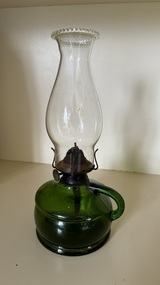
Domestic object - Lantern - household
... The metal burner and wick holder has four metal prongs to hold the glass chimney in place. The round metal wick winder is functioning. ...The metal burner and wick holder has four metal prongs to hold the glass chimney in place. The round metal wick winder is functioning. ...This is a typical example of a flat wick domestic paraffin lamp used in households prior to the introduction of electricity.A flat-wick lamp is a simple type of paraffin lamp, which burns paraffin drawn up through a wick by capillary action. A flat-wick lamp has a fuel tank (fount), with the lamp burner attached. Attached to the fuel tank, four prongs hold the glass chimney, which acts to prevent the flame from being blown out and enhances a thermally induced draft. The glass chimney needs a "throat", or slight constriction, to create the proper draft for complete combustion of the fuel; the draft carries more air (oxygen) past the flame, helping to produce a smokeless light, which is brighter than an open flame would produce. The wick holder has holes around the outer edges. When the lantern is lit and a chimney is attached, the thermally induced draft draws air through these holes and passes over the top of the wick. This has a cooling effect and keeps the wick from over heating. The lamp burner has a flat wick, made of cotton. The lower part of the wick dips into the fount and absorbs the paraffin; the top part of the wick extends out of the wick tube of the lamp burner, which includes a wick-adjustment mechanism. Adjusting how much of the wick extends above the wick tube controls the flame. The wick tube surrounds the wick and ensures that the correct amount of air reaches the lamp burner. Adjustment is usually done by means of a small knob operating a cric, which is a toothed metal sprocket bearing against the wick. If the wick is too high, and extends beyond the burner cone at the top of the wick tube, the lamp will produce smoke and soot (unburned carbon). When the lamp is lit, the paraffin that the wick has absorbed burns and produces a clear, bright, yellow flame. As the paraffin burns, capillary action in the wick draws more kerosene up from the fuel tank. All paraffin flat-wick lamps use the dead-flame burner design, where the flame is fed cold air from below, and hot air exits above. (Source: Wikipedia accessed 24 Nov 2023) This lantern has a circular heavy green glass base for holding the paraffin. The base has a 12mm green glass handle. There is a small clear glass chimney with a fluted upper edge and some bubbles in the glass. The metal burner and wick holder has four metal prongs to hold the glass chimney in place. The round metal wick winder is functioning. There is a small amount of residual paraffin in the base. The flat wick is made of cotton.There are no markings to indicate the manufacturer.paraffin lamp, flat wick lamp, domestic lantern -
 Warrnambool and District Historical Society Inc.
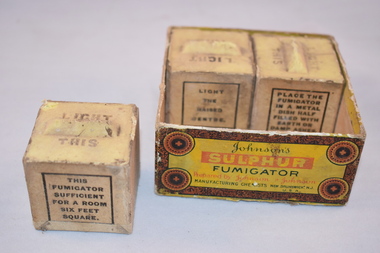
Household item, Sulphur Fumigator Cubes (boxed), Early 20th century
... These sulphur fumigator cubes were used in the past to fumigate areas in such places as hospitals, plant nurseries, farms and homes. The cube was placed in a tin containing soil and the top wick was set alight and the cube would burn overnight and kill off insects, mites and germs. ...These sulphur fumigator cubes were used in the past to fumigate areas in such places as hospitals, plant nurseries, farms and homes. The cube was placed in a tin containing soil and the top wick was set alight and the cube would burn overnight and kill off insects, mites and germs. ...These sulphur fumigator cubes were used in the past to fumigate areas in such places as hospitals, plant nurseries, farms and homes. The cube was placed in a tin containing soil and the top wick was set alight and the cube would burn overnight and kill off insects, mites and germs. One cube was sufficient for a room six feet square. This is a square cardboard box with no lid. The box is brown with orange, red and black printing. The box contains three cubes of sulphur fumigators. There should be four but one cube is missing. The cubes are square-shaped with beige-coloured sides and yellow tops. The tops have raised sections which serve as wicks. ‘Light This’ ‘Johnson’s Sulphur Fumigator prepared by Johnson & Johnson, Manufacturing Chemists’ household items, history of warrnambool -
 Warrnambool and District Historical Society Inc.
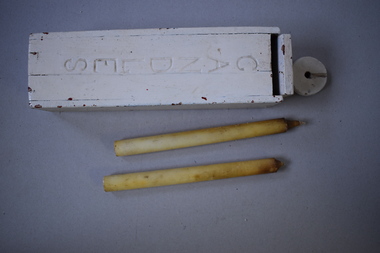
Functional object - Candle stick container, Early 20th century
... places. The top of the container has an extra wooden piece at the top with a hole in the middle for attaching a cord or string to hang the item on a door or wall. The word ‘candles’ is incised into the side of the container. Inside the container (originally space for six candles) are the remains of three candles with one other candle almost intact and another one intact with a wick. ...places. The top of the container has an extra wooden piece at the top with a hole in the middle for attaching a cord or string to hang the item on a door or wall. The word ‘candles’ is incised into the side of the container. Inside the container (originally space for six candles) are the remains of three candles with one other candle almost intact and another one intact with a wick. ...This candle holder was probably home made and hung in a kitchen where the candles would be accessible and lit from the wood stove or a fireplace. Candles for lighting would have been in widespread use in Warrnambool until the mid 1920s when electric lighting was introduced and would have been used for a couple of decades after this in areas out of towns and cities where there was no electric lighting. This item is retained as an example of a household item from the early 20th century. It will be useful for display and school visits.This is a rectangular-shaped wooden container with a fitted lid. The container has been painted white but is now peeling in places. The top of the container has an extra wooden piece at the top with a hole in the middle for attaching a cord or string to hang the item on a door or wall. The word ‘candles’ is incised into the side of the container. Inside the container (originally space for six candles) are the remains of three candles with one other candle almost intact and another one intact with a wick. CANDLESvintage household goods, history of warrnambool, candles -
 Warrnambool Art Gallery
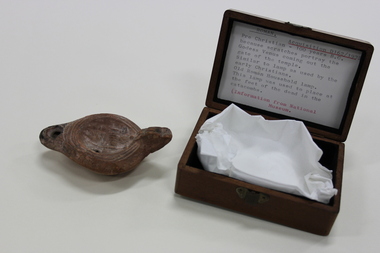
Oil lamp, c. 100BC
... The top of the oil lamp has a hole in which to place a cloth wick and a spout from which the smoke would have come out. ...The top of the oil lamp has a hole in which to place a cloth wick and a spout from which the smoke would have come out. ...It is unknown how this came into the collection at the Warrnambool Museum. However, during the 18th and 19th centuries it was fashionable for young men of means to undertake a 'grand tour'. During their travels they would often pick up souvenirs with these sometimes being ancient artefacts from classical Greece or Rome. It is thought that the item most probable came to the museum in this manner.From discussion with specialists at the British Museum and the University of Reading it was ascertained that the oil lamp is indeed ancient Roman and over 2000 years old. The marking on the top could be Venus although it is quite worn away so it is difficult to tell for sure.A terracotta oil lamp housed in a wooden box. On the top of the lamp are 3 circle incisions and in the centre of the circles is a depiction of a figure. There is a small finger sized handle on the side of the lamp. The handle has 2 incised lines leaving 3 raised ridges. It is squared off at the top. The top of the oil lamp has a hole in which to place a cloth wick and a spout from which the smoke would have come out. The spout is blackened from smoke. The container box is guessed to be from the time of acquisition which would be around the early 1900s and is made from a polished wood. Light in colour.In the box was a label saying, 'Venus coming out of the gate of the temple'. It also stated that the lamp may have been placed at the feet of the dead in the catacombs.oil lamp, roman, terracotta, classical, archaeology, victorian, grand tour -
 Parks Victoria - Wilsons Promontory Lightstation
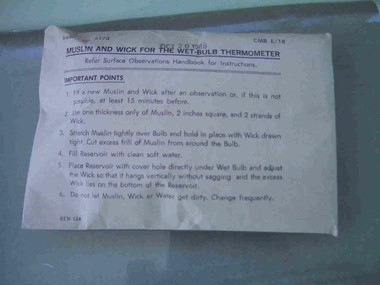
Muslin & Wick
... It was commonly used by lightkeepers for both wet and dry bulb thermometers, with the muslin going into the bottom of the dry bulb where it was held in place by the wick and ‘end of the wick was then placed in a jar of deep water to keep the bulb cool’. ...It was commonly used by lightkeepers for both wet and dry bulb thermometers, with the muslin going into the bottom of the dry bulb where it was held in place by the wick and ‘end of the wick was then placed in a jar of deep water to keep the bulb cool’. ...This item, which dates to 1988, is contained in the original supply packet and survives in good condition. It was commonly used by lightkeepers for both wet and dry bulb thermometers, with the muslin going into the bottom of the dry bulb where it was held in place by the wick and ‘end of the wick was then placed in a jar of deep water to keep the bulb cool’. The difference in temperatures between the dry and wet bulb thermometers could then be worked out to establish the dew point in the air.They were common in lightstations, but this intact item remains in the original packaging and is a fine representative example of its kind. It was acquired from the Bureau of Meteorology. Recording and communicating weather readings was an important facet of lightstation work and a number of different but related items of meteorological equipment survive at the six lightstations managed by parks Victoria. The Cape Nelson collection includes a pair of Australian-made thermometers in their original box, both in Fahrenheit, with one recording the minimum, the other the maximum temperature and a barometer table with instructions for correcting readings. Cape Otway has a Beaufort Scale, a table of wind forces which lists 12 types on a scale of 1 to 12, and provides associated speed in knots and travel time per minute or hour. Gabo Island has an anemometer, wind speed indicator and a wind speed recorder.Muslin and wick for a wet bulb thermomenter in unopened white paper packaging with directions for use printed on the package on the front.On front of package,"MUSLIN AND WICK FOR WET BULB THERMOMETER......."
