
Showing 8 items matching "william 'tulip'"
-
 Hume City Civic Collection
Photograph, c late 1980s
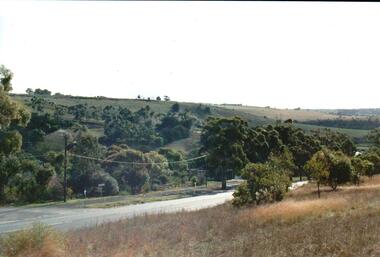
... ...william 'tulip'...The cutting on the hillside is significant as it is the remains of one of the original stream crossings in Victoria. bulla township deep creek wright william 'tulip' sunbury road george evans collection A coloured photograph of the Bulla Hill along Sunbury Road with a view of the cutting on the distant hillside. ...The photograph shows a section of the original settlement of the Bulla township. The cutting on the hillside is significant as it is the remains of one of the original stream crossings in Victoria.A coloured photograph of the Bulla Hill along Sunbury Road with a view of the cutting on the distant hillside. The photograph is a view of the old Bulla township looking to the NW. There is a wide grassy verge in the foreground.bulla township, deep creek, wright, william 'tulip', sunbury road, george evans collection -
 Emerald Museum & Nobelius Heritage Park
Slide - Colour photographic slide, Olive Hamilton, Circa 1960s
... William...Olive...hamilton...tulip...The transparency is historically significant as it was taken by Olive Hamilton Transparency slide William Olive hamilton tulip farm Written “ Tulip Farm” stamped “30” Colour photographic mounted transparency (slide) depicting person in Holland national dress in fron of “The Tulip Farm” sign (possible at Sylvan). ...The transparency was taken by Olive Hamilton who was a prominent local figure during the 1940s and 1950s. Olive was also president of the Victorian Amateur Cine Society Ladies Auxiliary. Most notably Olive and her husband William documented the 1954 Royal Visit.The transparency is historically significant as it was taken by Olive HamiltonColour photographic mounted transparency (slide) depicting person in Holland national dress in fron of “The Tulip Farm” sign (possible at Sylvan). Kodachrome transparency.Written “ Tulip Farm” stamped “30”transparency, slide, william, olive, hamilton, tulip, farm -
 Sunbury Family History and Heritage Society Inc.
Photograph, Sir John Franklin Hotel
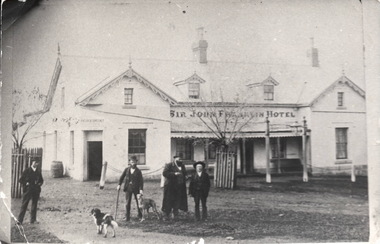
... The Sir John Franklin Hotel was built by William 'Tulip' Wright in 1854. It stood on the NE corner of Vaughan and Macedon Streets in Sunbury and initially it was a hotel patronised by the middle classes. ...The Sir John Franklin Hotel was built by William 'Tulip' Wright in 1854. It stood on the NE corner of Vaughan and Macedon Streets in Sunbury and initially it was a hotel patronised by the middle classes. ...The Sir John Franklin Hotel was built by William 'Tulip' Wright in 1854. It stood on the NE corner of Vaughan and Macedon Streets in Sunbury and initially it was a hotel patronised by the middle classes. The manager at the time this photograph was taken was Pat. Sweeney. During the Second World War, in the 1940s a small number of Italian POWs were housed in the Sir John Franklin Hotel. By the 1960s the only evidence of the hotel being on that site were a few bluestone pitchers. Some private houses have been built on the site.In the 1850s five hotels were built along Macedon Street in Sunbury, between Jacksons Creek and Evans Street. The Sir John Franklin Hotel was one of the them. Today the Ballcourt Hotel is the only remaining hotel ion that area.An old black and white photograph with a narrow cream border, of a four men standing outside a single storey hotel building which has a verandah across the front. One of the men has two dogs on leads.sir john franklin hotel, macedon street, vaughan street -
 Flagstaff Hill Maritime Museum and Village
Furniture - Desk, Foy & Gibson, Circa 1880s
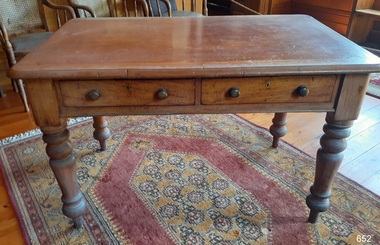
... This locks on this desk are significant for their connection with their manufacturer, Hobbs & Co, who invented a lock that surpassed the security of any other locks produced in the mid-19th century. flagstaff hill warrnambool shipwrecked coast flagstaff hill maritime museum maritime museum shipwreck coast flagstaff hill maritime village great ocean road desk cedar desk colonial desk 1880s desk australian colonial furniture furniture office furniture office equipment australian made furniture colonial furniture colonial hardware foy & gibson alfred charles hobbs hobbs & co london hobs & co lever lock cabinetry lock machine made lever lock p.w.d. public works department victoria day & newell great exhibition of 1851 bramah lock chubb lock telford medal 1854 cheapside london mark foy mark foy – bendigo draper smith street collingwood william gibson foy & gibson emporium foy & gibson complex cox brothers Impressed into timber frame of one drawer “FOY & GIBSON” Impressed into lock “HOBBS & CO / LONDON”, “MACHINE MADE”, “LEVER” Impressed along the front edge of the desktop [indecipherable] text. Impressed into the timber of right front leg “P. W. D.” below a ‘crown’ symbol Handwritten in white chalk under a drawer “206” Desk; Australian Colonial cedar desk, honey coloured. Desktop has a wooden border with a rolled edge and a fitted timber centrepiece. The four tapered legs are tulip ...The design of this small disc is from the Australian Colonial period. The cedar wood desk was made in Australian by Foy & Gibson in the 1880s, most probably in the business’s works in Collingwood, Victoria. The heavy brass locks fitted into the desk drawers were made by the famous Hobbs & Co of London, mid-late 19th century. In 1860 the business changed hands but the locks were still branded Hobbs & Co. The desk is branded with the symbol of Victoria’s Public Works Department. There is currently no information on when, where and by whom this desk was used. However, a very similar desk with Hobbs & Co. locks is on site at the Point Hicks Lightstation in Victoria and was formerly used by the Point Hicks head light keeper there. Other light stations also have similar desks from the P.W.D. (see also ‘Desk, Parks Victoria – Point Hicks Lightstation, Victorian Collections’.) HOBBS & CO., LONDON Alfred Charles Hobbs, 1812-1891, was American born. He became an executive salesman in 1840 for renowned lock manufacturer Day & Newell. His technique of exposing the weaknesses of people’s current locks was very successful in generating sales. He represented Day & Newell at London’s Great Exhibition of 1851, competing with other lock makers. Through the Exhibition he became famous for picking the best trusted Bramah and Chubb locks. Hobbs’ fame led him to found his own company in 1851 then register it in 1852 as Hobbs & Co., London. Hobbs was awarded the Telford Medal by the British Institution of Civil Engineers in 1854 for his paper 'On the Principles and Construction of Locks'. In 1855 the very successful company added partners and became Hobbs, Ashley and Co. In 1860, it traded under the name of Hobbs, Hart & Co. and was based in Cheapside London, where the business remained. Hobbs then returned to America, having sold the complete company to John Mathias Hart. He briefly returned to attend the 21st anniversary celebrations of the successful business in 1872. Hobbs kept himself busy in America, inventing and manufacturing firearm ammunition, for which he held several patents. He passed away there in 1891, a month after his 70th birthday. FOY & GIBSON Mark Foy wan an Irish draper who migrated to Bendigo, Victoria in 1858, attracted by the gold rush. He lived and worked in the area, establishing a drapery business. In the 1870s he moved to Melbourne where there were better prospects for expansion. He chose a place in Smith Street, Collingwood, a suburb of Melbourne, and started his business at the rear. In 1883 Foy retired, bringing in William Gibson as a partner, and then transferred his own share of the company to his son Francis Foy. Not long afterwards Francis sold his half share to Gibson, and the business continued under the name of Foy & Gibson. Francis Foy and he and his brother Mark Foy (junior) moved to Sydney. They established a business there in 1885, named after their father, Mark Foy. Gibson added to his business by starting his own manufacturing works from 1887, producing clothing, millinery, furniture, bedding and hardware for his stores. The factories, warehouses and stores complex became one of Victoria’s largest employers. He set up branches of his stores in Perth, Brisbane and Adelaide and two more branches in Melbourne. Foy & Gibson (usually referred to as Foys) became one of Australia’s largest retail department stores. In 1931 Foy’s little house in Collingwood was still part of the entrance to Foy & Gibson Emporium. In 1955 the company was bought out by Cox Brothers. Later on the stores were sold to various businesses such as David Jones, Woolworths and Harris Scarfe. In 1968 Cox Brothers went into receivership, ending almost 100 years of the business known as Foy’s. The former Foy & Gibson Complex is registered by Heritage Council Victoria. “Designed by William Pitt, this magnificent 19th and early 20th century complex of factories, warehouses and showrooms saw the production of a remarkable range of goods for Foy & Gibson, Melbourne’s earliest department store chain”. (Quoted from the Plaque erected by the Collingwood Historical Society 2007) P.W.D. – Public Works Department, Victoria The desk is stamped “P.W.D,” signifying that it is from the Public Works Department in Victoria, which operated from 1855-1987. The department was responsible for, among other things, the design and supply of office furniture and equipment for public buildings and organisations. This desk is significant historically as it originated from Foy & Gibson, a colonial Australian company that had a positive and strong impact on employment, manufacturing and retailing in Melbourne, Victoria and Australia. The significance of Foy & Gibson to Victoria’s and Australia’s history is marked by the Collingwood Complex being registered in both Heritage Victoria Register (H0755, H0897 and H0896) and National Trust Register (B2668). This locks on this desk are significant for their connection with their manufacturer, Hobbs & Co, who invented a lock that surpassed the security of any other locks produced in the mid-19th century. Desk; Australian Colonial cedar desk, honey coloured. Desktop has a wooden border with a rolled edge and a fitted timber centrepiece. The four tapered legs are tulip turned. Two half-width drawers fit side by side and extend the full depth of the desk. The drawers have dovetail joints. Each drawer has two round wooden knob handles, a keyhole and a fitted, heavy brass lever lock. Inscriptions are on the desktop, drawers, desk leg and lock. Made in Australia circa 1880 by Foy & Gibson, lock made by Hobbs & Co, London.Impressed into timber frame of one drawer “FOY & GIBSON” Impressed into lock “HOBBS & CO / LONDON”, “MACHINE MADE”, “LEVER” Impressed along the front edge of the desktop [indecipherable] text. Impressed into the timber of right front leg “P. W. D.” below a ‘crown’ symbol Handwritten in white chalk under a drawer “206” flagstaff hill, warrnambool, shipwrecked coast, flagstaff hill maritime museum, maritime museum, shipwreck coast, flagstaff hill maritime village, great ocean road, desk, cedar desk, colonial desk, 1880s desk, australian colonial furniture, furniture, office furniture, office equipment, australian made furniture, colonial furniture, colonial hardware, foy & gibson, alfred charles hobbs, hobbs & co london, hobs & co lever lock, cabinetry lock, machine made lever lock, p.w.d., public works department victoria, day & newell, great exhibition of 1851, bramah lock, chubb lock, telford medal 1854, cheapside london, mark foy, mark foy – bendigo draper, smith street collingwood, william gibson, foy & gibson emporium, foy & gibson complex, cox brothers -
 Marysville & District Historical Society
Ephemera (item) - Dinner menu, Tulips Restaurant, Unknown
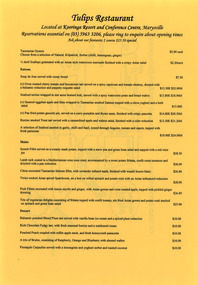
... A dinner menu from Tulips Restaurant which was located in Kooringa Resort and Conference Centre in Marysville. marysville victoria australia kooringa frederick webb cuzens brothers betha wilhelmina christina unmack minnie webb t.e. foster edgar charles webb clarence thomas pitman jacob pitman sir isaac pitman caroline anna blood newenham henry newenham pitman carrie rosalind persse pitman reginald william stringer alice burton pitman clarence edward pitman newenham mueller pitman olive birch constance may pitman olive dora blakeney pitman gwendoline de Burch Pitman kooringa guesthouse lilian may shelton thomas henry branchflower wilbur anderson peter mackey caroline anna pitman joyce anderson barry brenton kathy brenton kooringa tourist house photograph kooringa conference centre kooringa resort and conference centre A dinner menu from Tulips Restaurant which was located in Kooringa Resort and Conference Centre in Marysville. ...A dinner menu from Tulips Restaurant which was located in Kooringa Resort and Conference Centre in Marysville. On the reverse of the menu is a small town map showing the location of the restaurant.A dinner menu from Tulips Restaurant which was located in Kooringa Resort and Conference Centre in Marysville.marysville, victoria, australia, kooringa, frederick webb, cuzens brothers, betha wilhelmina christina unmack, minnie webb, t.e. foster, edgar charles webb, clarence thomas pitman, jacob pitman, sir isaac pitman, caroline anna blood newenham, henry newenham pitman, carrie rosalind persse pitman, reginald william stringer, alice burton pitman, clarence edward pitman, newenham mueller pitman, olive birch, constance may pitman, olive dora blakeney pitman, gwendoline de burch pitman, kooringa guesthouse, lilian may shelton, thomas henry branchflower, wilbur anderson, peter mackey, caroline anna pitman, joyce anderson, barry brenton, kathy brenton, kooringa tourist house, photograph, kooringa conference centre, kooringa resort and conference centre -
 City of Kingston
Photograph - Black and white, 20 December 1945
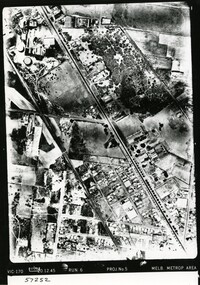
... William Fry Reserve at the intersection of Bay Road and Nepean Highway. A visible large parcel of land on the corner of Bay Road and Nepean Highway was developed in the 1990s as the west side addition to Southland. The densely vegetated area in the upper right sector of the image is now dense with housing. Tulip...William Fry Reserve at the intersection of Bay Road and Nepean Highway. A visible large parcel of land on the corner of Bay Road and Nepean Highway was developed in the 1990s as the west side addition to Southland. The densely vegetated area in the upper right sector of the image is now dense with housing. Tulip ...This aerial photograph depicts the changing landscape of Cheltenham and Highett since WWII. Photographed in 1945, there is a mix of urban dwellings and industrial development and precedes the major transformation of Cheltenham with the development of the Southland shopping centre in the 1960s and expansion in the 1990s.A large part of Cheltenham was originally established as a rural market gardening community. The railway line and station brought urban development to the area and in the north, the Highett area was dominated by the Highett Gas Works. Cheltenham became a major destination for shopping in the 1960s with the opening of Southland.Aerial photograph taken in 1945 of Cheltenham and Highett within the City of Kingston. The image includes the Highett Reserve, (top right), the Methodist Children Homes (now Southland), Nepean Highway and Jamieson Street. Highett Gas Works is visible in the top left and the land now named William Fry Reserve at the intersection of Bay Road and Nepean Highway. A visible large parcel of land on the corner of Bay Road and Nepean Highway was developed in the 1990s as the west side addition to Southland. The densely vegetated area in the upper right sector of the image is now dense with housing. Tulip Grove, Heather Grove and Gilford Street are visible bottom left. This image is possibly from the collection of aerial photographs commissioned by the Department of Crown Lands and Survey and taken by Adastra Airways.Black ink: 57252 White lettering: VIC-10 57252 20.12.45 [lens information indecipherable] PROJ. No.5 MELB. METROP AREA Black pencil: 80highett, cheltenham, highett gas works, urbanisation -
 City of Kingston
Photograph - Black and white, 20 December 1945
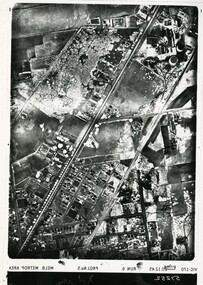
... William Fry Reserve at the intersection of Bay Road and Nepean Highway. A visible large parcel of land on the corner of Bay Road and Nepean Highway was developed in the 1990s as the west side addition to Southland. The densely vegetated area in the upper right sector of the image is now dense with housing. Tulip...William Fry Reserve at the intersection of Bay Road and Nepean Highway. A visible large parcel of land on the corner of Bay Road and Nepean Highway was developed in the 1990s as the west side addition to Southland. The densely vegetated area in the upper right sector of the image is now dense with housing. Tulip ...This aerial photograph depicts the changing landscape of Cheltenham and Highett since WWII. Photographed in 1945, there is a mix of urban dwellings and industrial development and precedes the major transformation of Cheltenham with the development of the Southland shopping centre in the 1960s and expansion in the 1990s.A large part of Cheltenham was originally established as a rural market gardening community. The railway line and station brought urban development to the area and in the north, the Highett area was dominated by the Highett Gas Works. Cheltenham became a major destination for shopping in the 1960s with the opening of Southland.Aerial photograph taken in 1945 of Cheltenham and Highett within the City of Kingston. The image includes the Highett Reserve, (top right), the Methodist Children Homes (now Southland), Nepean Highway and Jamieson Street. Highett Gas Works is visible in the top left and the land now named William Fry Reserve at the intersection of Bay Road and Nepean Highway. A visible large parcel of land on the corner of Bay Road and Nepean Highway was developed in the 1990s as the west side addition to Southland. The densely vegetated area in the upper right sector of the image is now dense with housing. Tulip Grove, Heather Grove and Gilford Street are visible bottom left. This image is possibly from the collection of aerial photographs commissioned by the Department of Crown Lands and Survey and taken by Adastra Airways.Black type: Reverse lettering VIC-10 57252 20.12.45 [lens information indecipherable] PROJ. No.5 MELB. METROP AREA White lettering: Reverse writing 57252cheltenham, highett, highett gas works, urbanisation -
Emerald Museum & Nobelius Heritage Park
Slide - Colour photographic slide, Olive Hamilton, Circa 1960s
... The transparency is historically significant as it was taken by Olive Hamilton Transparency slide William Olive hamilton Silvan tulips Written “Tulips Silvan” Colour photographic mounted transparency (slide) depicting planting of Tulips in Silvan. ...The transparency was taken by Olive Hamilton who was a prominent local figure during the 1940s and 1950s. Olive was also president of the Victorian Amateur Cine Society Ladies Auxiliary. Most notably Olive and her husband William documented the 1954 Royal Visit.The transparency is historically significant as it was taken by Olive HamiltonColour photographic mounted transparency (slide) depicting planting of Tulips in Silvan. Kodachrome transparency.Written “Tulips Silvan”transparency, slide, william, olive, hamilton, silvan, tulips
