
Showing 4 items matching "william beebe stonemason bendigo"
-
 Bendigo Historical Society Inc.
Photograph - Rocky Vale Villa photographs, April 2016
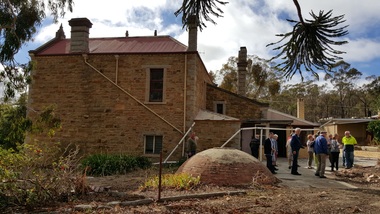
... ...william beebe stonemason bendigo...Bendigo in the last quarter of the 19th and the early part of the 20th centuries. From 1875, William Beebe senior, monumental mason, occupied a site in the centre on the city, in Mitchell Street opposite King Street. Death was more part of life in those days, and the Beebes were there to provide the burial monuments. Later, he took his sons into the business, which grew as Beebe and Son. Many examples of their work can be found in the local cemeteries. William Beebe senior (1830-1891) was born in Rutland, the smallest English county in 1830, to stonemason...Bendigo Advertiser 28/9/1891). Granite from Harcourt was used for lintels and quoins. Not long before he died, William was still adding to the house. In the Codicil to his will, he states that "I have just built and completed two additional rooms to my Dwelling house situe at Inglewood Road aforesaid" (dated 19/9/1891). William died one week later on the 26th September 1891. history bendigo rocky vale villa maiden gully william beebe stonemason ...The Beebe name was well-known in Bendigo in the last quarter of the 19th and the early part of the 20th centuries. From 1875, William Beebe senior, monumental mason, occupied a site in the centre on the city, in Mitchell Street opposite King Street. Death was more part of life in those days, and the Beebes were there to provide the burial monuments. Later, he took his sons into the business, which grew as Beebe and Son. Many examples of their work can be found in the local cemeteries. William Beebe senior (1830-1891) was born in Rutland, the smallest English county in 1830, to stonemason Chamberlain Beebe and Susannah Clements. William emigrated to Victoria in 1854 and after engaging on unknown works in Port Fairy, Dunkeld, and Melbourne arrived in Bendigo. His obituary records that he commenced work here on the site of the Bank of Australasia (opposite the Shamrock Hotel), which would have been no later than 1856. He took up a 13 acre selection on the site of Rocky Vale Villa in 1864 and continued to select or purchase further parcels of adjoining land until he owned some 150 acres, much of it unfit for cultivation. He was a keen gardener and had a garden and orchard around the house. William took over 20 years to build the two-story sandstone and granite house "Rocky Vale Villa". The house was constructed from sandstone sourced "from an adjacent ridge of rocks" (Bendigo Advertiser 28/9/1891). Granite from Harcourt was used for lintels and quoins. Not long before he died, William was still adding to the house. In the Codicil to his will, he states that "I have just built and completed two additional rooms to my Dwelling house situe at Inglewood Road aforesaid" (dated 19/9/1891). William died one week later on the 26th September 1891.One hundred and fourteen photographs of a field trip to Rocky Vale Villa, 7 Wicks Road, Maiden Gully, Bendigo by the Bendigo Historical Society. Includes images inside the house, outside the house and surrounding spaces.history, bendigo, rocky vale villa maiden gully, william beebe stonemason bendigo -
 Bendigo Historical Society Inc.
Document - Rocky Vale Beebe House, 2010 to 2015
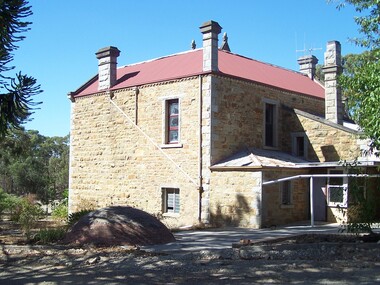
... ...william beebe stonemason bendigo...Bendigo in the last quarter of the 19th and the early part of the 20th centuries. From 1875, William Beebe senior, monumental mason, occupied a site in the centre on the city, in Mitchell Street opposite King Street. Death was more part of life in those days, and the Beebes were there to provide the burial monuments. Later, he took his sons into the business, which grew as Beebe and Son. Many examples of their work can be found in the local cemeteries. William Beebe senior (1830-1891) was born in Rutland, the smallest English county in 1830, to stonemason...Bendigo Advertiser 28/9/1891). Granite from Harcourt was used for lintels and quoins. Not long before he died, William was still adding to the house. In the Codicil to his will, he states that "I have just built and completed two additional rooms to my Dwelling house situe at Inglewood Road aforesaid" (dated 19/9/1891). William died one week later on the 26th September 1891. history bendigo rocky vale villa maiden gully william beebe stonemason ...The Beebe name was well-known in Bendigo in the last quarter of the 19th and the early part of the 20th centuries. From 1875, William Beebe senior, monumental mason, occupied a site in the centre on the city, in Mitchell Street opposite King Street. Death was more part of life in those days, and the Beebes were there to provide the burial monuments. Later, he took his sons into the business, which grew as Beebe and Son. Many examples of their work can be found in the local cemeteries. William Beebe senior (1830-1891) was born in Rutland, the smallest English county in 1830, to stonemason Chamberlain Beebe and Susannah Clements. William emigrated to Victoria in 1854 and after engaging on unknown works in Port Fairy, Dunkeld, and Melbourne arrived in Bendigo. His obituary records that he commenced work here on the site of the Bank of Australasia (opposite the Shamrock Hotel), which would have been no later than 1856. He took up a 13 acre selection on the site of Rocky Vale Villa in 1864 and continued to select or purchase further parcels of adjoining land until he owned some 150 acres, much of it unfit for cultivation. He was a keen gardener and had a garden and orchard around the house. William took over 20 years to build the two-story sandstone and granite house "Rocky Vale Villa". The house was constructed from sandstone sourced "from an adjacent ridge of rocks" (Bendigo Advertiser 28/9/1891). Granite from Harcourt was used for lintels and quoins. Not long before he died, William was still adding to the house. In the Codicil to his will, he states that "I have just built and completed two additional rooms to my Dwelling house situe at Inglewood Road aforesaid" (dated 19/9/1891). William died one week later on the 26th September 1891.Photographs and Historical Documents relating to Rocky Vale Villa, 7 Wicks Road, Maiden Gully, Bendigo by the Bendigo Historical Society. This item contains the following 34 documents and photos: 8677a Colour Photo - Side and rear view of Rocky Vale 8677b Colour Photo - Side and rear view of Rocky Vale 8677c Colour Photo - Front view of Rocky Vale 8677d Colour Photo - Front view of Rocky Vale 8677e Colour Photo - Front view of Rocky Vale from a distance 8677f Colour photo of the doomed cover on the well 8677g Colour photo of shed and storage area 8677h Colour photo of shed and storage area 8677i Colour photo of a dam, a windmill, and possibly an old mining boiler 8677j Colour photo of and out-building (Shed, storage area) 8677k Colour photo of and out-building (Shed, storage area) 8677l Colour photo of and out-building (Shed, storage area) inside ceiling 8677m Black and white photo of the Villa and front garden - not long after building 8677n Black and white photo of a wedding group at the front of the house 8677o Black and white photo of the rear of the wedding photo showing names of people 8677p Colour photo of the inside showing damage around the top of a window and ceiling 8677q Colour photo of the inside showing damage around the ceiling plaster decoration 8677r Colour photo of the inside showing damage around the ceiling plaster decoration 8677s Colour photo of an outside window with a granite frame and the Stone walls 8677t Colour photo of an outside window with a granite frame and the Stone walls 8677u Architects Creating a Landscape by Ray Tonkin. The article is derived from a research project designed to establish a better understanding of the nature of professional architectural activity in the State of Victoria, Australia, in the second half of the 19th century. 8677v Official Rocky Vale Villa Significant Assessment by City of Greater Bendigo, Heritage Policy Citations Project Lovell Chen, 2010. 8677w Rocky Vale Villa Significance Assessment 8677x William Beebe Death Notice 8677y The Beebes of Bendigo Family History Notes (Contact the BHS for details) 8677z Newspaper Article Bendigo Advertiser 14 April 1900 - Bon Voyage to Mr Beebe 8677aa Death Notices 1891 of Mr W Beebe 8677bb Election Announcement The Argus 18 Mar 1913 8677cc Mr Beebe Newspaper mention of Influenza - The Bendigo Independant 18 Oct 1899 8677dd Historical Notes for Bendigo Advertiser on Bendigo by Carol Holdsworth (Contact the BHS for Details) 8677ee Mayoral Elections - The Bendigonian 2nd Sept 1915 8677ff The names of the Bendigo Cemetery 8677gg William Vahland and John Beebe 1904 Notes 8677hh City of Greater Bendigo, heritage Policy Citations Project Name Rocky Vale Villa Reference in 1998 studyhistory, bendigo, rocky vale villa maiden gully, william beebe stonemason bendigo -
 Bendigo Historical Society Inc.
Document - John Beebe's Observatory Bendigo, Peter Anderson's article 2020
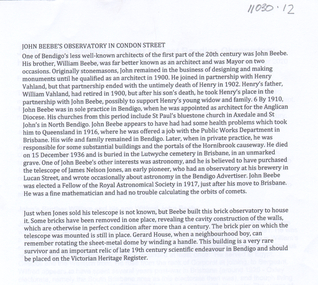
... William Beebe...observatory...55 Condon Street Kennington...Stonemason...Architect...St. Pauls Axedale...St. John's North Bendigo... John Beebe was born in Sandhurst (Bendigo) in 1866. In his earlier years, John and his brother William operated a stonemason's business in Bendigo, designing and making monuments. ...John Beebe was born in Sandhurst (Bendigo) in 1866. In his earlier years, John and his brother William operated a stonemason's business in Bendigo, designing and making monuments. ...John Beebe was born in Sandhurst (Bendigo) in 1866. In his earlier years, John and his brother William operated a stonemason's business in Bendigo, designing and making monuments. John graduated as an architect in 1900 . By 1910, John was in sole practice in Bendigo, when he was appointed as architect for the Anglican Diocese. His churches from this period include St. Paul's bluestone church in Axedale and St. John's in North Bendigo. He moved to Brisbane in 1916, possibly for health reasons. He died on 15 December 1936 and is buried in the Lutwyche cemetery in Brisbane in an unmarked grave. Four page collection of research on the observatory built by John Beebe at his residence at 55 Condon Street, Kennington. Articles are: one page brief biography "John Beebe's Observatory in Condon Street'; includes mention of how he acquired the telescope that was built into the brick observatory at Condon Street. "the building is a very rare survivor and an important relic of late 19 century scientific endeavour in Bendigo and should be placed on the Victorian Heritage Register'. Second article: two pages 'John Beebe, Architect, owner of East Bendigo Observatory. His later life in Queensland 1916 - 1936, by Peter Anderson April 2020. Article includes family history; John Beebe earlier life' John's brother William and his son Wilfred John Beebe; John's career in Bendigo; Astronomy in Bendigo; Fellowship of the Royal Astronomical Society and the move to Brisbane, Queensland and speculation upon the reasons. Third article: 'Our heritage in danger - amazing observatory comes to light' by Mike Butcher. Article addresses the significance of Beebe's observatory building ' and is representative of the city's early endeavours into scientific research'. At end of article a colour photo of the observatory with the heading 'John Beebe's observatory in Condon Street under threat of demolition'. john beebe, william beebe, observatory, 55 condon street kennington, stonemason, architect, st. pauls axedale, st. john's north bendigo, heritage significance -
 Bendigo Historical Society Inc.
Document - ARTICLE: BENDIGO MONUMENT AND HORSE TROUGHS (''FEW LEFT'')
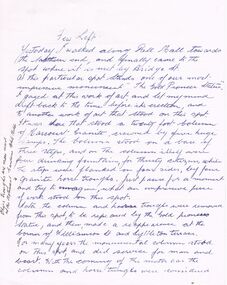
... Probably Vahland designed fountain, William Beebe stonemason. Document ARTICLE: BENDIGO MONUMENT AND HORSE TROUGHS (''FEW LEFT'') ...Handwritten 2-paged article about a monumental column and horse trough's (''Few Left'') - no author. Originally a 20 foot column of Harcourt granite crowned with five lamps and four drinking fountains at the base along with four horse troughs - at the intersection of Bridge St and Pall Mall. (site of present Gold Pioneers statue). Column moved to corner of Williamson and Lyttleton Terrace,initially with troughs and fountain. Position of four troughs is given by author but this has been crossed out subsequently with the note that the troughs are at the Botanical Gardens, White Hills. Probably Vahland designed fountain, William Beebe stonemason.bendigo, history, city history, monumental column, horse troughs, bridge street, pall mall, botanical gardens white hills, vahland, william beebe.
