
Showing 9 items matching "winching gear"
-
 Marysville & District Historical Society
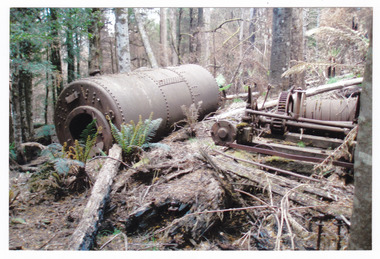
Photograph (item) - Colour photographs, Ron Nutt, The photographs were taken in November 2009
... ...winching gear...A series of ten colour photographs showing an abandoned donkey engine and its winching gear in the forest. The donkey engine and winching gear were used to haul logs from the forest. ...A series of ten colour photographs showing an abandoned donkey engine and its winching gear in the forest. The donkey engine and winching gear were used to haul logs from the forest. ...A series of ten colour photographs showing an abandoned donkey engine and its winching gear in the forest. The donkey engine and winching gear were used to haul logs from the forest. ...A series of ten colour photographs showing an abandoned donkey engine and its winching gear in the forest. The donkey engine and winching gear were used to haul logs from the forest. The photographs were taken in November 2009.A series of ten colour photographs showing an abandoned donkey engine and its winching gear in the forest. The donkey engine and winching gear were used to haul logs from the forest.Photos taken by Ron Nutt, November 2009. This steam powered winching point lies 30 meters south/ off the Marysville Woods Point road halfway between Lake/ Mountain and the Cumberland Reserve. There is a log/ landing nearby with a side cut leading to the Woods Point/ road. Prior to the Black Saturday bushfire there was a tree/ with a winch block attached, through which passed a cable/ to enable the winching of logs from a great distance.marysville, victoria, australia, donkey engine, winching gear, marysville-wood's point road, cumberland reserve, lake mountain, 2009 black saturday bushfires, photograph -
 Marysville & District Historical Society
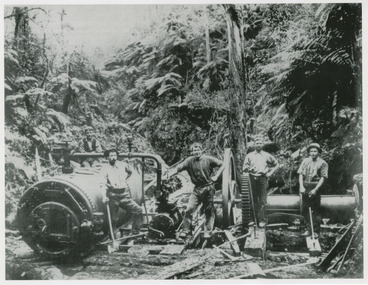
Photograph (item) - Black and white photograph, Unknown
... ...winching gear...A copy of a black and white photograph of a group of men standing with a donkey engine and winching gear used to haul logs from the forest....A copy of a black and white photograph of a group of men standing with a donkey engine and winching gear used to haul logs from the forest....A copy of a black and white photograph of a group of men standing with a donkey engine and winching gear used to haul logs from the forest. marysville victoria australia donkey engine winching gear photograph A copy of a black and white photograph of a group of men standing with a donkey engine and winching gear used to haul logs from the forest. ...A copy of a black and white photograph of a group of men standing with a donkey engine and winching gear used to haul logs from the forest.A copy of a black and white photograph of a group of men standing with a donkey engine and winching gear used to haul logs from the forest.marysville, victoria, australia, donkey engine, winching gear, photograph -
 Flagstaff Hill Maritime Museum and Village
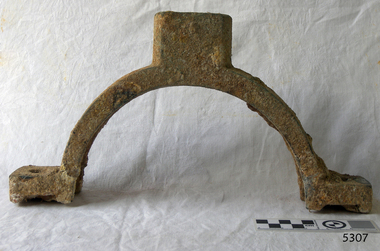
Bearing cap, (estimated); Before The Newfield completion in 1889
... The bearing cap could have been used on the donkey engine to hold the rod of the winch gear wheel in place, or bolted to another bearing cap around the neck on the top of the boiler’s cylinder, connecting it to the flue. ...The bearing cap could have been used on the donkey engine to hold the rod of the winch gear wheel in place, or bolted to another bearing cap around the neck on the top of the boiler’s cylinder, connecting it to the flue. ...This bearing cap is thought to be from a donkey winch engine, (or steam donkey, or donkey winch), which is a small secondary steam engine with a cylindrical shaped boiler. In 19th century merchant sailing a steam donkey was often used in marine applications such as to help raise and lower larger sails, load and unload cargo or to power pumps. The bearing cap could have been used on the donkey engine to hold the rod of the winch gear wheel in place, or bolted to another bearing cap around the neck on the top of the boiler’s cylinder, connecting it to the flue. The Newfield was a three-masted iron and steel barque, built in Dundee, Scotland, in 1889 by Alexander Stephen and Sons. It was owned by the Newfield Ship Company in 1890 and later that year It was registered in Liverpool to owners Brownells and Co. The Newfield left Sharpness, Scotland, on 28th May 1892 with a crew of 25 under the command of Captain George Scott and on 1st June left Liverpool. She was bound for Brisbane, Australia, with a cargo of 1850 tons of fine rock salt, the main export product of Sharpness. At about 9pm on 28th August 1892, in heavy weather, Captain Scott sighted, between heavy squalls, the Cape Otway light on the mainland of Victoria but, due to a navigational error (the ship’s chronometers were wrong), he assumed it to be the Cape Wickham light on King Island, some 40 miles south. He altered his course to the north, expecting to enter Bass Strait. The ship was now heading straight for the south west Victorian coast. At about 1:30am the Newfield ran aground on a reef about 100 yards from shore and one mile east of Curdie’s Inlet, Peterborough. The ship struck heavily three times before grounding on an inner shoal with 6 feet of water in the holds. Rough sea made the job of launching lifeboats very difficult. The first two lifeboats launched by the crew were smashed against the side of the ship and some men were crushed or swept away. The third lifeboat brought eight men to shore. It capsized when the crew tried to return it to the ship for further rescue The rescue was a difficult operation. The Port Campbell Rocket Crew arrived and fired four rocket lines, none of which connected with the ship. Peter Carmody, a local man, volunteered to swim about one mile off shore to the ship with a line to guide the fourth and final lifeboat safely to shore. He was assisted by James McKenzie and Gerard Irvine. Seventeen men survived the shipwreck but the captain and eight of his crew perished. The Newfield remained upright on the reef with sails set for a considerable time as the wind slowly ripped the canvas to shreds and the sea battered the hull to pieces. The Marine Board inquiry found the wreck was caused by a "one man style of navigation" and that the Captain had not heeded the advice of his crew. According to Jack Loney ‘… when the drama was over . . the Newfield was deserted except for the Captain’s dog and two pigs.’ Peter Carmody was awarded the Bramley-Moore medal by the Liverpool Shipwreck and Humane Society for Saving Life at Ssea, which he received by mail on January 21st 1893. The medal and a letter of congratulations were donated to Flagstaff Hill Maritime Museum by Peter Carmody’s grand-daughter Norma Bracken and her son Stuart Bracken on 25th May 2006. The Bearing Cap joins other items in the Newfield collection.Flagstaff Hill’s collection of artefacts from the Newfield is significant for its association with the shipwreck Newfield, which is listed on the Victorian Heritage Registry. The collection is significant because of the relationship between the objects. The Newfield collection is archaeologically significant as the remains of an international cargo ship. The Newfield collection is historically significant for representing aspects of Victoria’s shipping history and its association with the shipwreck.Brass bearing cap from the wreck of the sailing ship “Newfield” is possibly from a donkey winch engine. The half-circle shaped cuff with a rectangular brass block attached to the outside of each end of the half-circle. Both blocks have a round hole in their centre and are approximately the same depth and width as the cuff. Midway around the half-circle cuff is another brass block that is about twice the depth of the cuff. It appears to have been a circular shape that has been modified to match the width of the collar, having had the sides of the circle cut off to leave straights edge parallel to the edges of the cuff. In the centre of this block is another hole, and there appears to be the head of a bolt inside this hole. The bearing cap is lightly encrusted.1893, flagstaff hill, flagstaff hill maritime museum, maritime museum, warrnambool, newfield, 1892, 28 august 1892, port campbell, shipwreck, nineteenth century, ship, curdie s river, victorian shipwrecks, barque, ship wreck, 29 august 1892, 19th century, bearing cap, donkey engine, donkey winch, steam donkey -
 Flagstaff Hill Maritime Museum and Village
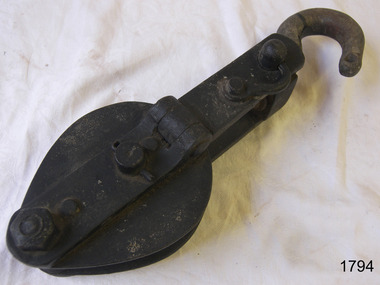
Equipment - Snatch Block, First quarter of the 20th century
... winches. There is no history or manufacturing provenance currently available. The subject item at this time cannot be associated with an historical event, person or place, provenance is unknown, item is believed to have been produced in the first quarter of the 20th century. flagstaff hill warrnambool flagstaff-hill-maritime-museum maritime-museum shipwreck-coast flagstaff-hill-maritime-village snatch block Metal Snatch Block Lifting Gear Rope Pully marine technology ship rigging Snatch block, metal, one sheave, with a large hook that has a hole drilled through its tip. ...A snatch block is a heavy-duty pulley inside a metal casing. It is primarily designed for handling heavy goods, working as a pulley point that can redirect the course of a winch line. Snatch blocks are also used to increase the lifting or pulling capacity of wire hoists and winches. There is no history or manufacturing provenance currently available.The subject item at this time cannot be associated with an historical event, person or place, provenance is unknown, item is believed to have been produced in the first quarter of the 20th century.Snatch block, metal, one sheave, with a large hook that has a hole drilled through its tip.flagstaff hill, warrnambool, flagstaff-hill-maritime-museum, maritime-museum, shipwreck-coast, flagstaff-hill-maritime-village, snatch block, metal snatch block, lifting gear, rope pully, marine technology, ship rigging -
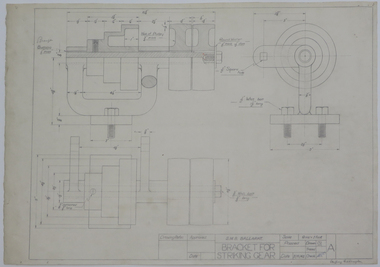 Federation University Historical Collection
Student's Technical Drawing, Technical drawing, 1942 -44
... pencil on paper student's technical drawings .1) Bracket for striking gear .2) Lever safety valve .3) belt driven hoisting winch, 500 lb capacity ...technical drawing mechanical engineering geoff biddington pencil on paper student's technical drawings .1) Bracket for striking gear .2) Lever safety valve .3) belt driven hoisting winch, 500 lb capacity Technical drawing Student's Technical Drawing ...pencil on paper student's technical drawings .1) Bracket for striking gear .2) Lever safety valve .3) belt driven hoisting winch, 500 lb capacity technical drawing, mechanical engineering, geoff biddington -
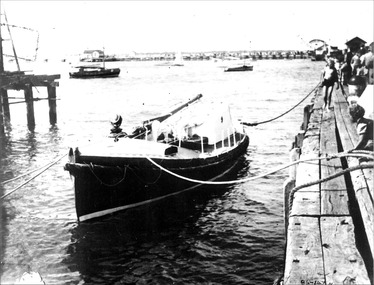 Queenscliffe Maritime Museum
Photograph - Lifeboat QUEENSCLIFFE - tied up to pier, Lifeboat QUEENSCLIFFE, 1949
... Reverse - " lifeboat tied up pier to transfer to new location of shed on new pier / L to R sheds in background / Zanoni shed in front, rope & gear shed behind (now at QMC), winch shed [Ports & Harbour] / rear Lifeboat Shed on old Fisherman's Pier (now demolished) / front winch Shed inside of Fisherman's Pier, slipway for winching boats up / far right - Coal Shed / ask Frank Ferrier for details "...Lifeboat QUEENSCLIFFE Lifeboat QUEENSCLIFFE historical references lifeboat QUEENSCLIFFE LB Reverse - " lifeboat tied up pier to transfer to new location of shed on new pier / L to R sheds in background / Zanoni shed in front, rope & gear shed behind (now at QMC), winch shed [Ports & Harbour] / rear Lifeboat Shed on old Fisherman's Pier (now demolished) / front winch Shed inside of Fisherman's Pier, slipway for winching boats up / far right - Coal Shed / ask Frank Ferrier for details " Lifeboat QUEENSCLIFFE - tied up to pier post 1935 Lifeboat QUEENSCLIFFE Photograph Lifeboat QUEENSCLIFFE - tied up to pier ...Lifeboat QUEENSCLIFFELifeboat QUEENSCLIFFELifeboat QUEENSCLIFFE - tied up to pier post 1935Reverse - " lifeboat tied up pier to transfer to new location of shed on new pier / L to R sheds in background / Zanoni shed in front, rope & gear shed behind (now at QMC), winch shed [Ports & Harbour] / rear Lifeboat Shed on old Fisherman's Pier (now demolished) / front winch Shed inside of Fisherman's Pier, slipway for winching boats up / far right - Coal Shed / ask Frank Ferrier for details "historical references, lifeboat, queenscliffe lb -
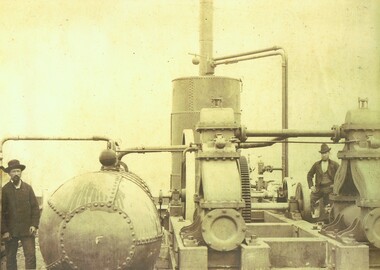 Bendigo Historical Society Inc.
Photograph - MINING EQUIPMENT
... The winch has wrought iron cheeks, is fitted with reversing gear and manufactured to operate on both steam and air....The winch has wrought iron cheeks, is fitted with reversing gear and manufactured to operate on both steam and air. ...Photograph - black and white. A photo of 2 men standing next to a machine. Written on a sheet attached to photo reads. R.G. Ford's Steam Winch, cylinders 150mm. In diameter and 255mm. Stroke. The winch has wrought iron cheeks, is fitted with reversing gear and manufactured to operate on both steam and air.organization, business, mining equipment, steam winch. mining equipment. r.g.ford. -
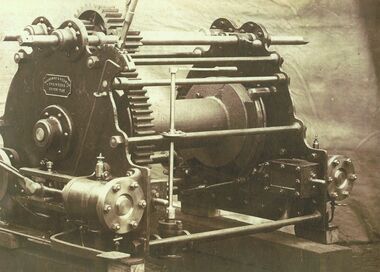 Bendigo Historical Society Inc.
Photograph - MINING EQUIPMENT
... gears to a motor of sorts. Information from Ralph Birrell - This is a photo of a steam driven winch. ...winch. Photograph - black and white - large. A photo of a large looking cog/gears to a motor of sorts. ...Photograph - black and white - large. A photo of a large looking cog/gears to a motor of sorts. Information from Ralph Birrell - This is a photo of a steam driven winch. Written on front of winch. 'Buchanan & Noorum, Engineers, Sandridge (now known as Port Melbourne)organization, business, mining equipment, steam driven winch. -
 Friends of Kurth Kiln
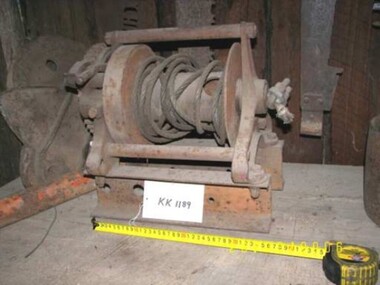
Winch
... Lettering on Gear Wheel - DAWN MFG CO - 2 TON AUSTRALIA Steel Rope Winch with Ratchet wheel. ...Steel Rope Winch with Ratchet wheel. Cable Drum contains ~6m of 10mm dia wire rope.Lettering on Gear Wheel - DAWN MFG CO - 2 TON AUSTRALIA
