
Showing 4 items matching "wodonga customs office"
-
 Wodonga & District Historical Society Inc
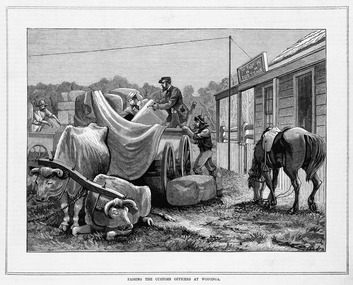
Work on paper - Passing the Customs Officers at Wodonga, Australasian Sketcher, 1881
... ...Wodonga Customs Office...It features a scene at the customs office in Wodonga. ...Passengers doing this journey must now be present on the platform at the Wodonga terminus three-quarters of an hour before the train leaves for Melbourne; and the Customs authorities have intimated that unless passengers attend as indicated, with the keys of their portmanteaus ready to open them for the inspection of the officers, the luggage will be detained until the next train, when it will be forwarded under bond, the owners having to pay the carriage." Tariffs were one of the most contentious issues which influenced discussions surrounding Federation. They were abolished when Federation was achieved in 1901. This item is significant because it depicts an early view of Wodonga when it was still an important customs post. Early Wodonga Wodonga Customs Office ...This image appeared in the Australasian Sketcher on 13th August 1881. The initials in the corner indicate the artist may have been J D Cooper who worked with the Australasian Sketcher at that time. The Australia Customs Service played an important role in the history of Wodonga and a major part in the federation of the colonies of Australia. In 1852 the colonies were given the right to collect import duties on items such as coffee, tea, tobacco, chocolate and spirits. NSW was first to impose collection of duties in 1853. At that time Wodonga was not an official port of entry and was not allowed to collect duties. This regulation made it illegal for people to transport dutiable goods across the Murray River from NSW which provided an incentive for smuggling, while at the same time strangling the legitimate trade. Belvoir (later to become Wodonga) was a made a port of entry with its own Customs House gazetted on 22nd December 1854. The Government set aside 500 Pounds in 1859 to build Belvoir's own Customs House. After the arrival of the Railways to Wodonga in 1873, Customs Officers also checked travellers on the trains. The Sydney Morning Herald on 31st March 1881 reported:- "Luggage Scrutinised: The discomfort attending travellers proceeding overland from Sydney having to submit to their luggage being scrutinised by the Custom House officials at Wodonga is about to be increased. Passengers doing this journey must now be present on the platform at the Wodonga terminus three-quarters of an hour before the train leaves for Melbourne; and the Customs authorities have intimated that unless passengers attend as indicated, with the keys of their portmanteaus ready to open them for the inspection of the officers, the luggage will be detained until the next train, when it will be forwarded under bond, the owners having to pay the carriage." Tariffs were one of the most contentious issues which influenced discussions surrounding Federation. They were abolished when Federation was achieved in 1901. This item is significant because it depicts an early view of Wodonga when it was still an important customs post.A print from a pencil sketch which was published in the Australasian Sketcher 1881. It features a scene at the customs office in Wodonga. Initials JD in bottom right cornerearly wodonga, wodonga customs office -
 Wodonga & District Historical Society Inc
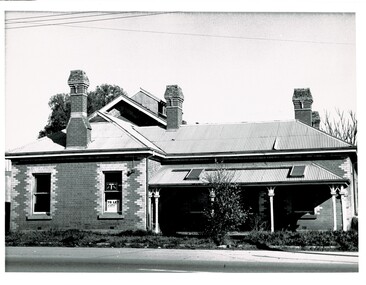
Photograph - Codling Collection 01 - Wodonga's Second Police Station
... WODONGA'S SECOND POLICE STATION - This building was located on the west side of High Street near the railway line at the corner of High Street and Bond Street. The building in the background was the Bond Store which was later repurposed to become the Court House. This Police Station, which began operation on this site c1905, had originally been the house of the customs officer. It had a front office...WODONGA'S SECOND POLICE STATION - This building was located on the west side of High Street near the railway line at the corner of High Street and Bond Street. The building in the background was the Bond Store which was later repurposed to become the Court House. This Police Station, which began operation on this site c1905, had originally been the house of the customs officer. It had a front office ...Miss Olive Codling was a Foundation Member and a Life Member of the Wodonga Historical Society. Many of her prize-winning photos are held in the Society Collection. She also held a range of roles and committee positions in a wide range of Wodonga community organisations. WODONGA'S SECOND POLICE STATION - This building was located on the west side of High Street near the railway line at the corner of High Street and Bond Street. The building in the background was the Bond Store which was later repurposed to become the Court House. This Police Station, which began operation on this site c1905, had originally been the house of the customs officer. It had a front office and a Sergeant's and an Inspector's office as well as 2 barrack rooms and a laundry at the rear. In the backyard was a blue stone cell block and a night soil toilet, as well as a stable used previously for horse and carriage. Opposite the police station was a boarding house which supplied meals to prisoners. This police station was in use until its move to Elgin Street, Wodonga in December 1967.This photo collection is significant as it documents how the businesses and buildings in Wodonga have evolved and contributed to community throughout the 20th century.Two black and white photos of the 2nd Police Station built in Wodonga with the former Bond Store in the background.high st wodonga, police stations wodonga -
 Wodonga & District Historical Society Inc
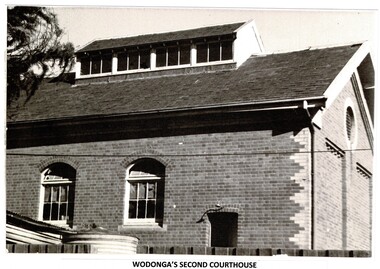
Photograph - Codling Collection 01 - Wodonga's Second Court House
... Customs or Bond Store building alongside the Wodonga Police Station in 93 High Street. This was on the west side of High Street at its intersection with Bond Street. The building was converted to the courthouse in 1920. In early 1964, the courthouse building was burnt beyond repair and furniture and other property destroyed. The cause of the fire was never found. The Police Station was lucky to survive but only because of the efforts of the local Fire Brigade. After the fire, the court was held first at the old Fire Station premises near where the present Wodonga Post Office...Customs or Bond Store building alongside the Wodonga Police Station in 93 High Street. This was on the west side of High Street at its intersection with Bond Street. The building was converted to the courthouse in 1920. In early 1964, the courthouse building was burnt beyond repair and furniture and other property destroyed. The cause of the fire was never found. The Police Station was lucky to survive but only because of the efforts of the local Fire Brigade. After the fire, the court was held first at the old Fire Station premises near where the present Wodonga Post Office ...Miss Olive Codling was a Foundation Member and a Life Member of the Wodonga Historical Society. Many of her prize-winning photos are held in the Society Collection. She also held a range of roles and committee positions in a wide range of Wodonga community organisations. WODONGA'S SECOND COURTHOUSE The Court House was situated in the Customs or Bond Store building alongside the Wodonga Police Station in 93 High Street. This was on the west side of High Street at its intersection with Bond Street. The building was converted to the courthouse in 1920. In early 1964, the courthouse building was burnt beyond repair and furniture and other property destroyed. The cause of the fire was never found. The Police Station was lucky to survive but only because of the efforts of the local Fire Brigade. After the fire, the court was held first at the old Fire Station premises near where the present Wodonga Post Office, then it moved to a vacant building in Mitchell Street which was later turned into a Child Care Centre. Foundations for the new courthouse in Elgin Street were laid in October 1965.This photo collection is significant as it documents how the businesses and buildings in Wodonga have evolved and contributed to community throughout the 20th century.2 black and white photos of the Court House, formerly used as a Bond Store for collection of customs.high st wodonga, wodonga court house -
 Wodonga & District Historical Society Inc
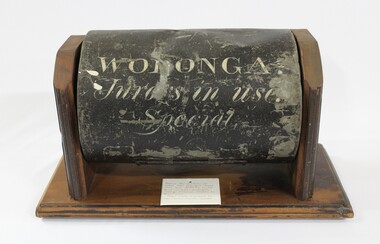
Functional object - Jurors' Selection Barrel, Wodonga Court House
... Wodonga Historical Society member, The Court House was situated in the Customs Store building alongside the Wodonga Police Station in 93 High Street. (The house where the Police Station was had originally been the home of the Customs Officer). In early 1964, the court house building was burnt beyond repair and furniture and other property destroyed. The cause of the fire was never found. The Police Station was lucky to survive but only because of the efforts of the local Fire Brigade. After the fire, the court was held first at the old Fire Station premises near where the Wodonga Post Office...Wodonga Historical Society member, The Court House was situated in the Customs Store building alongside the Wodonga Police Station in 93 High Street. (The house where the Police Station was had originally been the home of the Customs Officer). In early 1964, the court house building was burnt beyond repair and furniture and other property destroyed. The cause of the fire was never found. The Police Station was lucky to survive but only because of the efforts of the local Fire Brigade. After the fire, the court was held first at the old Fire Station premises near where the Wodonga Post Office ...The barrel was used in the Wodonga Court House as part of the selection process for jurors. It was a standard issue barrel used throughout Victoria. It was retrieved from the ruins of the court house which was destroyed by fire. It was then donated to the Wodonga Historical Society. The timber display stand was made and donated by Jake Tooley, a Wodonga Historical Society member, The Court House was situated in the Customs Store building alongside the Wodonga Police Station in 93 High Street. (The house where the Police Station was had originally been the home of the Customs Officer). In early 1964, the court house building was burnt beyond repair and furniture and other property destroyed. The cause of the fire was never found. The Police Station was lucky to survive but only because of the efforts of the local Fire Brigade. After the fire, the court was held first at the old Fire Station premises near where the Wodonga Post Office is near Woodland Grove, then it moved to a vacant building in Mitchell Street which was later turned into a Child Care Centre. Foundations for the new court house in Elgin Street were laid in October 1965 Local significance due to its use in the Wodonga Court House and its survival of a major fire. State significance as it documents a procedure used in the Victorian Court and Legal system Cylindrical metal-iron barrel painted black with writing stenciled on the front in white The timber mount was made for storage and display is not part of the original object,Inscription on Barrel "WODONGA./ Jurors in use./ Special"wodonga court, jurors, selection, legal system, fire
