
Showing 4 items matching "wodonga town 1883"
-
 Wodonga & District Historical Society Inc
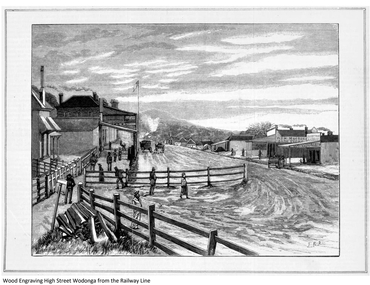
Work on paper - Wodonga From the Railway Line, John Rossi Ashton, 1883
... Wodonga Town 1883...Julian Rossi Ashton died on 27th April 1942 This item is significant because it depicts an early view of Wodonga and was created by a future prominent artist and influential patron and supporter of Australian Art . Wodonga Town 1883 Early Wodonga A print from a Wood Engraving which was published in the Australasian Sketcher 1883. ...This image appeared in the Australasian Sketcher on 2nd July 1883. This issue had several illustrations relating to the meeting of the railways at Albury and Wodonga. The item was accompanied by the following text:- Wodonga consists of two principal streets lying parallel to each other seemingly desirous of outstripping the other in length and the straggling character of its buildings. After carrying on this contest for the length of three quarters of High Street, of which we give a view, bears off the palm. Between the township and Albury there is a distance of three miles, which in summer has the reputation of being the dustiest three miles in Australia. This distance is traversed by omnibuses and cabs, which ply between the two towns, and until the junction of the railways did a good business in carrying all travellers from station to station. The dwellers in Wodonga, who are Victorians to the backbone, complain severely of the disadvantages under which they labour, owing to the border duties, in comparison with their more fortunate neighbours in Albury, but though they grumble they have no intention of giving in, and confidently look forward to the brighter days which they say are in store for Wodonga. In the lower right hand corner are the initials J. R. A. These are the initials of Julian Rossi Ashton (1851-1942). Ashton was born in England and emigrated to Melbourne in 1878 to work as an artist for the Illustrated Australian News. In 1881 he worked at the Australasian Sketcher and in 1883 moved to Sydney to work on the Picturesque Atlas of Australasia and the Bulletin. He became an influential patron and supporter of Australian Art through his roles as trustee of the National Art Gallery of New South Wales. He was awarded the Society of Artists’ medal for distinguished services to Australian art in 1924, appointed as Commander of the Order of the British Empire in 1930, and won the Sydney Sesquicentennial Prize for a watercolour in 1938. Ashton dominated artistic circles in Sydney for over 50 years. He established his own Art School in Sydney and became a teacher and mentor to many now prominent Australian artists. Julian Rossi Ashton died on 27th April 1942 This item is significant because it depicts an early view of Wodonga and was created by a future prominent artist and influential patron and supporter of Australian Art .A print from a Wood Engraving which was published in the Australasian Sketcher 1883. It features a street scene in Wodonga.wodonga town 1883, early wodonga -
 Wodonga & District Historical Society Inc
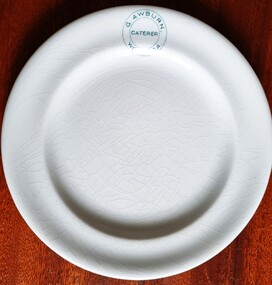
Functional object - G. Awburn Caterer Wodonga Plate
... Wodonga which he conducted up till the time of his death in 1946. He was active in community affairs in roles including being a foundation member of the Library Committee, a committeeman of the Town Band and football club, a member of the Hibernian Lodge and an ardent worker for the Roman Catholic Church. Johnson Bros. was founded by two brothers named Alfred and Frederick who purchased a pottery factory in Hanley, England, in 1883...Wodonga which he conducted up till the time of his death in 1946. He was active in community affairs in roles including being a foundation member of the Library Committee, a committeeman of the Town Band and football club, a member of the Hibernian Lodge and an ardent worker for the Roman Catholic Church. Johnson Bros. was founded by two brothers named Alfred and Frederick who purchased a pottery factory in Hanley, England, in 1883 ...Mr George Awburn Jr. arrived in Wodonga West with his parents by bullock dray when he was aged six years old. As a young man he went to Melbourne where he worked with the Melbourne Tramway and Omnibus Company. He drove the first through tram from Abbotsford to Balaclava. On he return to Wodonga, Mr. Awburn opened a bakery and grocery business in Sydney St., Wodonga which he conducted up till the time of his death in 1946. He was active in community affairs in roles including being a foundation member of the Library Committee, a committeeman of the Town Band and football club, a member of the Hibernian Lodge and an ardent worker for the Roman Catholic Church. Johnson Bros. was founded by two brothers named Alfred and Frederick who purchased a pottery factory in Hanley, England, in 1883. They were grandsons of a renowned English potter, Alfred Meakin. They were later joined in the business by their brothers Henry and Robert. Their business grew rapidly, as they were one of the world's largest pottery factories by the turn of the 20th century. By 1970, Johnson Bros. obtained the Royal Charter to become the official provider of china for Her Majesty Queen Elizabeth II. More than 1,300 patterns have been created throughout Johnson Brothers' history. Due to their growing success, manufacturing plants were established overseas including the establishment of a tableware factory, Johnson Brothers Australia in 1957 in Croydon, Victoria operated through a company known as Sovereign Pottery Ltd. Due to rising competition, Johnson Brothers became part of the Wedgewood Group in 1968. In 2015, following the acquisition of Wedgewood by Finnish company Fiskars, the Johnson Brothers branding was discontinued. The trademark on this bowl was used by Johnson Brothers between 1913 and 1942.This item originates from a well-known and respected Wodonga business.A round china plate imprinted with business name of G. Awburn Wodonga and Johnson Brothers on the back of the plate.On front: G. Awburn Caterer Wodonga On back: Hotelware / Johnson Bros/ Englandawburn family, wodonga businesses -
 Wodonga & District Historical Society Inc
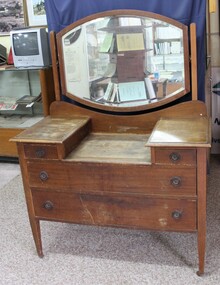
Furniture - Wooden dresser with a mirror from the Terminus Hotel, Wodonga
... Wodonga. In 1873, James Thompson Hatch built the two-storeyed Terminus Hotel at 79 Sydney Road (later known at High Street), then sold it to George Day and Kenneth McLennan for £1,230. It was first licensed to J. G. Morton in January 1874. In 1879, Annie Allen, from Ireland, took over as licensee of the hotel containing 14 rooms, after she and her husband, George James Allen, purchased it. He became licensee in 1883. Under the Allens, the Terminus became, ‘a principal rendezvous for visitors to the town...Wodonga. In 1873, James Thompson Hatch built the two-storeyed Terminus Hotel at 79 Sydney Road (later known at High Street), then sold it to George Day and Kenneth McLennan for £1,230. It was first licensed to J. G. Morton in January 1874. In 1879, Annie Allen, from Ireland, took over as licensee of the hotel containing 14 rooms, after she and her husband, George James Allen, purchased it. He became licensee in 1883. Under the Allens, the Terminus became, ‘a principal rendezvous for visitors to the town ...The wooden dresser came from the Terminus Hotel in High St., Wodonga. In 1873, James Thompson Hatch built the two-storeyed Terminus Hotel at 79 Sydney Road (later known at High Street), then sold it to George Day and Kenneth McLennan for £1,230. It was first licensed to J. G. Morton in January 1874. In 1879, Annie Allen, from Ireland, took over as licensee of the hotel containing 14 rooms, after she and her husband, George James Allen, purchased it. He became licensee in 1883. Under the Allens, the Terminus became, ‘a principal rendezvous for visitors to the town.’ September 1888 saw additions to the building that included a billiard room, a dining room, and 18 other rooms. Following the death of her husband in 1889, Annie Allen continued to run the Terminus Hotel. She later married John Haldon and was licensee of the hotel until 1893 when the licence was transferred to William Carkeek. In the early 1900s the Hotel was thoroughly renovated. The Terminus Hotel was for sale by auction on 5th March 1909. It comprised about 50 rooms, a two-storey building built of brick and iron with hot and cold water service and acetylene gas throughout. The principal hotel in Wodonga, was let from 1st January 1909 on a seven years’ lease at a rental of £9 per week. 1935 saw extensive improvements by proprietor W. P. Kinney, while in 1941 further extensive improvements were carried out to make a good hotel better. A pall of shock and disbelief descended over Wodonga’s historic Terminus Hotel on 1st June 1998 when it was destroyed by fire then demolished in 1999. The site was sold for almost $1 million and redeveloped for a medical clinic. The wooden dresser has local significance as it came from the Terminus Hotel in High St., Wodonga.Wooden dresser with a mirror, two small side drawers and two large drawers with circular recessed metal handles and metal castors.dressers, dressers with mirrors, wooden dressers -
 Wodonga & District Historical Society Inc
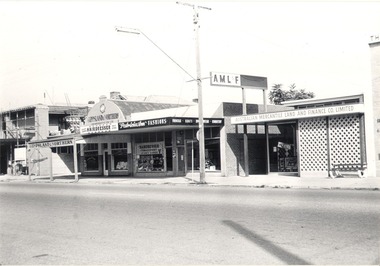
Photograph - Mann Collection Album - Terminus Hotel; Gippsland & Northern
... Wodonga for many years and an active member of the community. The Terminus Hotel In 1873, James Thompson Hatch built the two-storeyed Terminus Hotel at 79 Sydney Road (later known as High Street), then sold it to George Day and Kenneth McLennan for £1,230. It was first licensed to J. G. Morton in January 1874. In 1879, Annie Allen, from Ireland, took over as licensee of the hotel containing 14 rooms, after she and her husband, George James Allen, purchased it. He became licensee in 1883. Under the Allens, the Terminus became, ‘a principal rendezvous for visitors to the town...Wodonga for many years and an active member of the community. The Terminus Hotel In 1873, James Thompson Hatch built the two-storeyed Terminus Hotel at 79 Sydney Road (later known as High Street), then sold it to George Day and Kenneth McLennan for £1,230. It was first licensed to J. G. Morton in January 1874. In 1879, Annie Allen, from Ireland, took over as licensee of the hotel containing 14 rooms, after she and her husband, George James Allen, purchased it. He became licensee in 1883. Under the Allens, the Terminus became, ‘a principal rendezvous for visitors to the town ...This photo is part of a collection of Wodonga Town Photos donated by Elaine Mann. Elaine was married to David Mann, a successful Wodonga businessman and community leader who passed away in Wodonga in June 2012. David was a member of the Mann family who began their business in Wodonga in 1920. Elaine was a teacher in Wodonga for many years and an active member of the community. The Terminus Hotel In 1873, James Thompson Hatch built the two-storeyed Terminus Hotel at 79 Sydney Road (later known as High Street), then sold it to George Day and Kenneth McLennan for £1,230. It was first licensed to J. G. Morton in January 1874. In 1879, Annie Allen, from Ireland, took over as licensee of the hotel containing 14 rooms, after she and her husband, George James Allen, purchased it. He became licensee in 1883. Under the Allens, the Terminus became, ‘a principal rendezvous for visitors to the town.’ September 1888 saw additions to the building that included a billiard room, a dining room, and 18 other rooms. Following the death of her husband in 1889, Annie Allen continued to run the Terminus Hotel. She later married John Haldon and was licensee of the hotel until 1893 when the licence was transferred to William Carkeek. In the early 1900s the Hotel was thoroughly renovated. The Terminus Hotel was for sale by auction on 5th March 1909. It comprised about 50 rooms, a two-storey building built of brick and iron with hot and cold water service and acetylene gas throughout. The principal hotel in Wodonga, was let from 1st January 1909 on a seven years’ lease at a rental of £9 per week. 1935 saw extensive improvements by proprietor W. P. Kinney, while in 1941 further extensive improvements were carried out to make a good hotel better. A pall of shock and disbelief descended over Wodonga’s historic Terminus Hotel on 1st June 1998 when it was destroyed by fire then demolished in 1999. The site was sold for almost $1 million and redeveloped for a medical clinic.This photo collection is of significance as it documents how the businesses and buildings in Wodonga have evolved and contributed to community throughout the late 20th century.Terminus Hotel; Gippsland & Northern Co-operative Pty. Ltd.; Graham Bradbury Men's Hairdresser; Patricia Anne Fashions; Australian Mercantile Land and Finance Company (A.M.L. & F). on the west side of High Street. The Terminus Hotel was built C. 1873. and was destroyed by fire in 1998, The Gippsland and Northern Co-operative Co. Ltd was formed in 1905, but the date of its establishment in Wodonga is not confirmed, but they were holding fortnightly sales at the Wodonga sale yards by early 1919.wodonga businesses, high st wodonga, terminus hotel, gippsland & northern
