
Showing 7 items matching "wodonga town planning"
-
 Wodonga & District Historical Society Inc
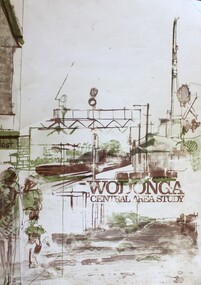
Book - Wodonga Central Area Study, Loder and Bayly, Planning & Engineering Consultants, March 1975
... Wodonga Town planning...Wodonga Town planning Albury-Wodonga development Rural City of Wodonga This report was the result of an investigation into the potential future development and town planning for the central area of Wodonga. ...This report was the result of an investigation into the potential future development and town planning for the central area of Wodonga. Chapters of the final report are:- Chapter 1: Summary: Conclusions and Recommendations, Chapter 2: Setting the scene, Chapter 3: Possible futures, Chapter 4: Objectives, Chapter 5: Growth Options, Chapter 6: Recommended approaches, Chapter 7: Plan elements and Chapter 8: Ways and Means.A report of 134 pages, including illustrations and maps. The report was presented to the Albury-Wodonga Development Corporation and the Rural City of Wodonga.This report was the result of an investigation into the potential future development and town planning for the central area of Wodonga. Chapters of the final report are:- Chapter 1: Summary: Conclusions and Recommendations, Chapter 2: Setting the scene, Chapter 3: Possible futures, Chapter 4: Objectives, Chapter 5: Growth Options, Chapter 6: Recommended approaches, Chapter 7: Plan elements and Chapter 8: Ways and Means.wodonga town planning, albury-wodonga development, rural city of wodonga -
 Wodonga & District Historical Society Inc
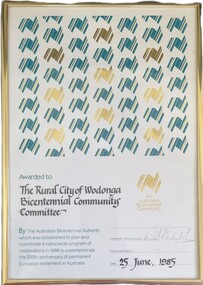
Certificate - Bicentennial Community Committee
... Wodonga the Exhibition travelled to 34 Australian cities and towns across all States and Territories. It featured a range of displays which travelled the entire journey of more than 30,000 kilometres on land as well as sea travel to Tasmania. This certificate was awarded in to the Wodonga Community Committee. This item is significant because it acknowledges the role played by the Wodonga Bicentennial Committee in the Australian Bicentennial celebrations. Australian Bicentennial Wodonga Bicentennial Committee Awarded to The Rural City of Wodonga Bicentennial Community Committee By the Australian Bicentennial Authority which was established to plan ...Bicentennial celebrations were held throughout Australian in 1988. The Australian Bicentennial Authority was established in 1979, and the Victorian Council was appointed in 1986. Its role was to plan and coordinate state-based activities for Australia's 1988 Bicentenary. The Council was jointly funded by the State and Commonwealth governments and was responsible for developing programs that celebrated the nation's cultural heritage and addressed community needs. A major part of the celebrations was the Bicentennial Travelling Exhibition which was launched on 1st January 1988 at Wodonga Racecourse . The Exhibition focused on the concept "Living Together" through different modules based on themes of Journeys, Environment, Together, Identity, Today and Futures. The Travelling Exhibition was hauled by 29 pantechnicons specially designed for the task by Daryl Jackson Pty Ltd of Melbourne. These vehicles also acted as large tent pegs, holding the large display tents in position. The Exhibition in Wodonga ran for five days and was forecast to attract a crowd of 18,000 per day. Two days were required to set the Exhibition up and another two days were needed to dismantle it. The dominating feature of the Exhibition was a 600-seat Bicentennial Theatre. Other displays were set up in each area to reflect the local community. From Wodonga the Exhibition travelled to 34 Australian cities and towns across all States and Territories. It featured a range of displays which travelled the entire journey of more than 30,000 kilometres on land as well as sea travel to Tasmania. This certificate was awarded in to the Wodonga Community Committee.This item is significant because it acknowledges the role played by the Wodonga Bicentennial Committee in the Australian Bicentennial celebrations.A framed certificate bearing green and gold stylised maps of Australia which featured in the Bicentennial Logo. This certificate was awarded to the Wodonga Bicentennial Community Committee.Awarded to The Rural City of Wodonga Bicentennial Community Committee By the Australian Bicentennial Authority which was established to plan and coordinate a nationwide program of celebrations in 1988 to commemorate the 200th anniversary of permanent European settlement in Australia.australian bicentennial, wodonga bicentennial committee -
 Wodonga & District Historical Society Inc
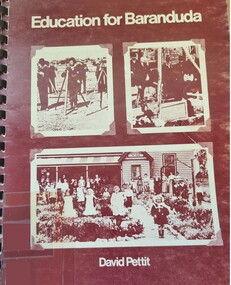
Book - Education for Baranduda, David Pettit, 1976
... planning carried out by the Albury-Wodonga Development Corporation. Baranduda Albury-Wodonga Development Corporation Education North East Victoria This book is the result of research commissioned by the Albury-Wodonga Development Corporation in 1976 to investigate future educational needs for the Baranduda community, Baranduda was established as a pastoral run around 1846. It developed as a rural community in the late 19th century—with a school opening in 1880. In 1974 The Albury-Wodonga Development Corporation was established to transform the twin-town ...This book is the result of research commissioned by the Albury-Wodonga Development Corporation in 1976 to investigate future educational needs for the Baranduda community, Baranduda was established as a pastoral run around 1846. It developed as a rural community in the late 19th century—with a school opening in 1880. In 1974 The Albury-Wodonga Development Corporation was established to transform the twin-town border region into a major inland city, aiming for a population of 300,000 by 2000. It was created by federal and state governments to decentralise population from capital cities, manage regional land development, and boost local industry. As part of its recommendations Baranduda was designated for development as a modern satellite township. This report was commissioned as part of the planning for the future development of the Baranduda community.A spiral bound publication of 110 pages investigating potential plans and developments of education in Baranduda, Victoria. Cover features 3 photographs and diagrams are included.This book is the result of research commissioned by the Albury-Wodonga Development Corporation in 1976 to investigate future educational needs for the Baranduda community, Baranduda was established as a pastoral run around 1846. It developed as a rural community in the late 19th century—with a school opening in 1880. In 1974 The Albury-Wodonga Development Corporation was established to transform the twin-town border region into a major inland city, aiming for a population of 300,000 by 2000. It was created by federal and state governments to decentralise population from capital cities, manage regional land development, and boost local industry. As part of its recommendations Baranduda was designated for development as a modern satellite township. This report was commissioned as part of the planning for the future development of the Baranduda community.baranduda, albury-wodonga development corporation, education north east victoria -
 Wodonga & District Historical Society Inc
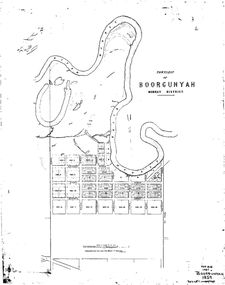
Map - Boorgunyah - "The Town that never was"
... town that never was.” A lone gum tree stands on the site today. This item is significant because it documents plans which were made for the early development of Wodonga. ...At the height of the river trade, there was a town surveyed and laid out, and streets were named. This town was to house the workers at the river port of Red Bank when the paddle steamers plied the Murray River as far as Albury, carrying produce such as wool and wheat to the various towns along the river in the 1800s. As the river trade died away, this town never went ahead – one might say, “The town that never was.” A lone gum tree stands on the site today.This item is significant because it documents plans which were made for the early development of Wodonga.A black an white map depicting the proposed location of the township. The map is based on a sketch and is not to scale,early wodonga, boorgunyah - "the town that never was", wodonga heritage -
 Wodonga & District Historical Society Inc
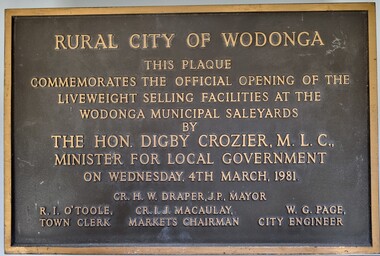
Plaque - Commemoration of the Opening of Liveweight Sales Wodonga Municipal Saleyards 1981
... In 1966 Wodonga was selected as a city for special growth assistance. In 1972 Bill Page presented a new Town Plan to the Wodonga Council. ...In 1966 Wodonga was selected as a city for special growth assistance. In 1972 Bill Page presented a new Town Plan to the Wodonga Council. ...This plaque commemorates the official opening of the liveweight selling facilities at the Wodonga Municipal Saleyards, named the W. G. Page Saleyards, in 1980. Liveweight selling usually involves a curfew where cattle have to be at the saleyard by a specific time before the sale in order for them to be weighed prior to auction. Cattle that do not make the curfew time are sold on a $/head basis. The last sales at this facility took place in February 2015 before being replaced by the privately-run Barnawartha North's Northern Victoria Livestock Exchange. William George Page was Shire and City Engineer in Wodonga from 1965 until 1989. When he arrived the Shire of Wodonga had a population of 17,000 people. In 1966 Wodonga was selected as a city for special growth assistance. In 1972 Bill Page presented a new Town Plan to the Wodonga Council. Over the ensuing years he dedicated himself to bring this plan to fruition. He often had to argue and campaign with the Albury-Wodonga Corporation to push for the interests of development in Wodonga. This included winning a planning appeal to allow the saleyards to be relocated to Bandiana on the outskirts of Wodonga. Bill Page retired on health grounds in July 1989. The Council honoured him with a farewell dinner and renamed the saleyards at Bandiana the W.G. Page Saleyards in his honour.The Mayor , Cr Valentina Gillard, said "Every development in Wodonga in the past 24 years has a bit of Bill Page in it". William Page died 3 months later at 58 years old.A bronze forged metal plaque with detailed inscription. Bolts to fix plaque to the wall are still attached.RURAL CITY OF WODONGA / THIS PLAQUE/ COMMEMORATES THE OFFICIAL OPENING OF THE/ LIVEWEIGHT SELLING FACILITIES AT / THE WODONGA MUNICIPAL SALEYARDS /BY/THE HON. DIGBY CROZIER, M.L.C., / MINISTER FOR LOCAL GOVERNMENT/ ON WEDNESDAY, 4TH MARCH, 1981 CR. H. W, DRAPER, J.P. MAYOR R. I. O'TOOLE TOWN CLERK , CR. I. J. MACAULAY MARKETS CHAIRMAN W. G. PAGE CITY ENGINEERlivestock sales wodonga, liveweight cattle sales, municipal saleyards wondonga -
 Wodonga & District Historical Society Inc
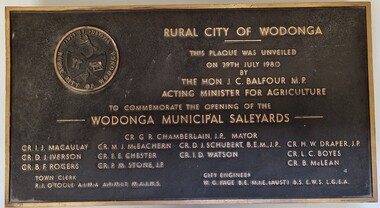
Plaque - Opening of Wodonga Municipal Saleyards 1980
... In 1966 Wodonga was selected as a city for special growth assistance. In 1972 Bill Page presented a new Town Plan to the Wodonga Council. ...In 1966 Wodonga was selected as a city for special growth assistance. In 1972 Bill Page presented a new Town Plan to the Wodonga Council. ...This plaque commemorates the opening of the Wodonga Municipal Saleyards, named the W. G. Page Saleyards, in 1980. The last sales at this facility took place in February 2015 before being replaced by the privately-run Barnawartha North's Northern Victoria Livestock Exchange. William George Page was Shire and City Engineer in Wodonga from 1965 until 1989. When he arrived the Shire of Wodonga had a population of 17,000 people. In 1966 Wodonga was selected as a city for special growth assistance. In 1972 Bill Page presented a new Town Plan to the Wodonga Council. Over the ensuing years he dedicated himself to bring this plan to fruition. He often had to argue and campaign with the Albury-Wodonga Corporation to push for the interests of development in Wodonga. This included winning a planning appeal to allow the saleyards to be relocated to Bandiana on the outskirts of Wodonga. Bill Page retired on health grounds in July 1989. The Council honoured him with a farewell dinner and renamed the saleyards at Bandiana the W.G. Page Saleyards in his honour.The Mayor , Cr Valentina Gillard, said "Every development in Wodonga in the past 24 years has a bit of Bill Page in it". William Page died 3 months later at 58 years old.This plaque commemorates an important centre in the development and support of the livestock industry around Wodonga.A bronze plaque bearing the symbol of the Rural City of Wodonga in the upper left corner and an inscription to commemorate the opening of the Wodonga Municipal Saleyards. It includes a detailed inscription.RURAL CITY OF WODONGA / THIS PLAQUE WAS UNVEILED / ON 29TH JULY 1980 / BY /THE HON. J. C. BALFOUR M.P. / ACTING MINISTER FOR AGRICULTURE /TO COMMEMORATE THE OPENING OF THE / WODONGA MUNICIPAL SALEYARDS CR. G. R. CHAMBERLAIN, J.P. MAYOR CR. I . J. MACAULAY CR. M. J. McEACHERN CR. D. I. SCHUBERT, B'E'N', J.P CR. H. W. DRAPER, J.P. CR. D.J .IVERSON CR. E. E. CHESTER CR I. D. WATSON CR. L. C. BOYES CR. B. F. ROGERS CR. P. M. STONE. J.P CR. B. McLEAN TOWN CLERK R. I. O"TOOLE A.I.M.A., A.R.M.I.T, M.A.I.H.S CITY ENGINEER W. G. PAGE, B.E, M.I.E (AUST) B.S .E.W.S L. G. E. A saleyards wodonga, w. g. page saleyards, livestock sales wodonga -
 Wodonga & District Historical Society Inc
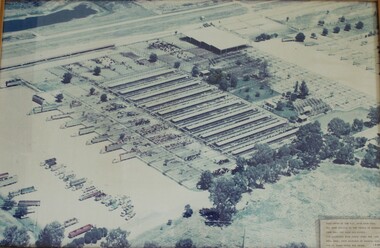
Photograph - W. G. Page Saleyards, Wodonga, c1980
... In 1966 Wodonga was selected as a city for special growth assistance. In 1972 Bill Page presented a new Town Plan to the Wodonga Council. ...In 1966 Wodonga was selected as a city for special growth assistance. In 1972 Bill Page presented a new Town Plan to the Wodonga Council. ...William George Page was Shire and City Engineer in Wodonga from 1965 until 1989. When he arrived the Shire of Wodonga had a population of 17,000 people. In 1966 Wodonga was selected as a city for special growth assistance. In 1972 Bill Page presented a new Town Plan to the Wodonga Council. Over the ensuing years he dedicated himself to bring this plan to fruition. He often had to argue and campaign with the Albury-Wodonga Corporation to push for the interests of development in Wodonga. This included winning a planning appeal to allow the saleyards to be relocated to Bandiana on the outskirts of Wodonga. Bill Page retired on health grounds in July 1989. The Council honoured him with a farewell dinner and renamed the saleyards at Bandiana the W.G. Page Saleyards in his honour.The Mayor , Cr Valentina Gillard, said "Every development in Wodonga in the past 24 years has a bit of Bill Page in it". William Page died 3 months later at 58 years old.This image depicts an important centre in the development and support of the livestock industry around Wodonga.An aerial photograph of the W. G. Page Saleyards in Wodonga. It has been mounted in a wooden frame.On a sign attached to the photo frame: "This photo of the W.G. Page Saleyards has been donated to the people of Wodonga from Mrs Pat Page and Family. The saleyards were named after the late Bill Page, City Engineer of Wodonga Council for 25 years until his death".w. g. page saleyards, wodonga saleyards, william george page
