
Showing 6 items matching "women's black satin skirt"
-
 Bendigo Historical Society Inc.
Clothing - GRAYDON COLLECTION: WOMEN'S BLACK SATIN SKIRT, 1870 - 1890
... GRAYDON COLLECTION: WOMEN'S BLACK SATIN SKIRT......women's black satin skirt...Clothing. Women's black satin skirt - unfinished. Calf length with raw edges at waist and hem. side opening with five metal hooks and cotton loops....COSTUME Female women's black satin skirt Clothing. Women's black satin skirt - unfinished. ...Clothing. Women's black satin skirt - unfinished. Calf length with raw edges at waist and hem. side opening with five metal hooks and cotton loops.costume, female, women's black satin skirt -
 Bendigo Historical Society Inc.
Clothing - GRAYDON COLLECTION: WOMEN'S BLACK LACE AND SATIN SKIRT, 1870 -1890
... GRAYDON COLLECTION: WOMEN'S BLACK LACE AND SATIN SKIRT......women's black lace and satin skirt...Women's black lace and satin layered skirt. Straight calf length skirt with outer layer of embroidered fine net and an inner layer of black satin. ...COSTUME Female women's black lace and satin skirt Clothing. Women's black lace and satin layered skirt. ...Clothing. Women's black lace and satin layered skirt. Straight calf length skirt with outer layer of embroidered fine net and an inner layer of black satin. Embroidered layer has pattern of scattered flowers with lower 30 cm of dense embroidered flowers. At centre front is a vertical strip of embroidered flowers (5 cm wide). Hemline has a zig zag pattern. Foldover satin waist band (1.5 cm) with two X .8 cm satin loops attached at front and back. Side seam below waistband has 24 cm opening but there is no opening in the waist band.costume, female, women's black lace and satin skirt -
 Bendigo Historical Society Inc.
Clothing - GRAYDON COLLECTION: WOMEN'S BLACK EMBOSSED SILK SKIRT, 1870-1890
... Women's black embossed silk skirt. Part of two piece set(bodice 11410.1). A shaped skirt with 2.5 cm cotton fabric waistband with three hanging loops attached. Centre back opening (20cm) fastened at waist with two metal hooks and eyes. Two metal eyes on waistband for attaching to the bodice. The front of the skirt has two vertical sections of appliquéd decorative beading (38 cm X 5 cm). The hem of the skirt is edged with black satin...Women's black embossed silk skirt. Part of two piece set(bodice 11410.1). A shaped skirt with 2.5 cm cotton fabric waistband with three hanging loops attached. Centre back opening (20cm) fastened at waist with two metal hooks and eyes. Two metal eyes on waistband for attaching to the bodice. The front of the skirt has two vertical sections of appliquéd decorative beading (38 cm X 5 cm). The hem of the skirt is edged with black satin ...Clothing. Women's black embossed silk skirt. Part of two piece set(bodice 11410.1). A shaped skirt with 2.5 cm cotton fabric waistband with three hanging loops attached. Centre back opening (20cm) fastened at waist with two metal hooks and eyes. Two metal eyes on waistband for attaching to the bodice. The front of the skirt has two vertical sections of appliquéd decorative beading (38 cm X 5 cm). The hem of the skirt is edged with black satin binding. The skirt is fully lined with brown cotton fabric. At centre back below the opening is an internal pocket (40 cm X 8 cm) of lining fabric. Historical Notes: This bodice and skirt belonged to Elizabeth Graydon (nee Richardson). Photograph of Elizabeth wearing this outfit (11410.3). -
 Brighton Historical Society
Suit, 1940s
... Two-piece women's suit made of maroon corded silk; comprising fitted jacket (.1) and straight skirt (.2). Jacket fastens with one large black faceted glass button. Jacket lined with pink satin...Interviewed in the 'ABC Weekly' in 1957, Vetra described her taste in clothing as minimalist, saying she preferred to own as few clothes as possible to save the trouble of deciding what to wear: "And no bows or extravagances, but always a simple line." vija vetra migration brighton refugee dancer 1940s Two-piece women's suit made of maroon corded silk; comprising fitted jacket (.1) and straight skirt (.2). Jacket fastens with one large black faceted glass button. Jacket lined with pink satin ...This suit was tailor-made for Latvian dancer, choreographer and dance teacher Vija Vetra, who lived at the Old Hall, 93-95 Bay Street, Brighton and ran a dance academy at 97 Bay Street during the late 1950s and early 1960s. Born in Riga, Latvia in 1923, at the age of sixteen Vija ran away from home in order to study classical, character and modern dance at the Vienna Academy of Music and Performing Arts. She spent several years performing on European stages. When Latvia was annexed by the Soviet Union in 1944, more than 100,000 Latvians fled, seeking refuge in neighbouring countries. Vija's sister, mother and aunt were among them, managing to join her in Vienna. The following year, all four had to flee again when the Soviets moved into Austria. Escaping to Bavaria, they spent three years in displaced person camps before emigrating to Sydney as refugees in 1948. Vija found success as a dancer in Sydney. She toured Australia and New Zealand with the Bodenwieser Ballet, formed a Latvian folk dancing group and established a dancing school. By the mid-1950s she had gained recognition as a recitalist in her own right. She developed a passion for Indian classical dance. In the late 1950s she moved to Victoria. She opened a dance school in Bay Street, Brighton, while continuing to perform on stage in productions such as the musical 'Kismet' and the ballet 'Corroboree'. In 1959 she starred in the four-part live ABC television program 'Music and Dance'. She left Australia in 1964 for a tour of the United States and Canada, ultimately settling in New York City. Interviewed in the 'ABC Weekly' in 1957, Vetra described her taste in clothing as minimalist, saying she preferred to own as few clothes as possible to save the trouble of deciding what to wear: "And no bows or extravagances, but always a simple line."Two-piece women's suit made of maroon corded silk; comprising fitted jacket (.1) and straight skirt (.2). Jacket fastens with one large black faceted glass button. Jacket lined with pink satin; skirt unlined. vija vetra, migration, brighton, refugee, dancer, 1940s -
 Kew Historical Society Inc
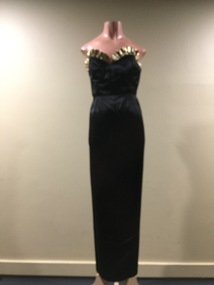
Evening Dress & Jacket, Smaragd of Melbourne, 1965-75
... women's clothing evening dresses fashion design clothing -- 1970s Label: SMARAGD EXCLUSIVE OF MELBOURNE. SIZE 12 Two-piece evening ensemble comprising a strapless column gown and a coordinating cropped evening jacket. The floor-length gown features a highly structured, fitted bodice with internal boning and a classic sweetheart neckline. The skirt is tailored into a sleek, narrow column silhouette. The accompanying long-sleeved satin jacket is cropped to fit precisely over the gown’s waistline, featuring a rounded neckline, a concealed front closure, and tailored sleeves. Crafted from a heavy, high-sheen black ...Operating heavily in the late mid-century, Smaragd of Melbourne was a premium boutique Australian label that catered to high-end social calendars, formal galas, and evening wear markets. During this era, Melbourne was firmly established as Australia’s fashion manufacturing capital. Labels like Smaragd competed directly with high-end European and American imports by offering local consumers equivalent luxury, using specialized, imported embellishments and meticulous, small-batch boutique construction. This ensemble is typical of mid-to-late 20th-century Australian fashion design, showcasing the exceptional structural tailoring and high-glamour aesthetic of the period. The inclusion of the matching cropped jacket reflects the transitional styling of late-1960s to 1970s evening wear, designed for formal modesty that could be removed for evening events. The use of heavy bullion embroidery or relief passamanerie highlights the reliance of local couture houses on advanced, labor-intensive hand-finishing techniques. This level of craftsmanship stands in stark contrast to the mass-manufacturing shift that would dominate the global fashion industry in the decades to follow. As an "Exclusive of Melbourne" garment, the piece holds strong regional significance to the history of the Australian textile trade. The preserved, illustrated "mod-style" label serves as an excellent artifact of graphic design history, capturing the youthful, playful marketing shift that defined the post-war youth culture boom in Australia.Two-piece evening ensemble comprising a strapless column gown and a coordinating cropped evening jacket. The floor-length gown features a highly structured, fitted bodice with internal boning and a classic sweetheart neckline. The skirt is tailored into a sleek, narrow column silhouette. The accompanying long-sleeved satin jacket is cropped to fit precisely over the gown’s waistline, featuring a rounded neckline, a concealed front closure, and tailored sleeves. Crafted from a heavy, high-sheen black evening fabric (consistent with silk or premium synthetic satin/mikado blend of the era). he neckline of the jacket (and the underlying gown) features a heavy, raised, three-dimensional metallic embellishment. The textured gold work is indicative of heavy bullion embroidery—a technique utilizing twisted, coiled metallic wire threads couched into dense, sculptural relief patterns to catch light. The garment contains a woven fabric manufacturer's label reading "Smaragd Exclusive of Melbourne / Size 12". The label is distinguished by a blue, stylized graphic illustration of a wide-eyed, curly-haired "mod doll," characteristic of commercial art from the late 1960s to mid-1970s.Label: SMARAGD EXCLUSIVE OF MELBOURNE. SIZE 12fashion - australia - melbourne, smaragd of melbourne, women's clothing, evening dresses, fashion design, clothing -- 1970s -
 Embroiderers Guild, Victoria
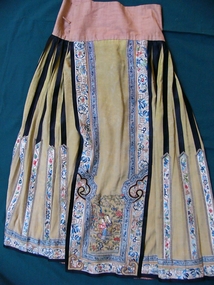
Clothing - Chinese Embroidered Skirt, 19th century
... skirt. The reason for the cotton at the top was so that it didn't slip, as silk would have done. There is a central front panel bordered in black satin. within this is an embroidered floral and 'meander' or Greek key pattern. The 'meander' pattern is done in couched goldwork. Within this is another border of embroidered, machine made braid. The central motif of two women...skirt. The reason for the cotton at the top was so that it didn't slip, as silk would have done. There is a central front panel bordered in black satin. within this is an embroidered floral and 'meander' or Greek key pattern. The 'meander' pattern is done in couched goldwork. Within this is another border of embroidered, machine made braid. The central motif of two women ...Symbolism: Woman with a fan (shan) - a symbol of longevity and a pun for goodness. Gourds: fertility and good fortune. Peony: wealth and honour (fugui). Blossoms: bring forth fruit and therefore bring forth prosperity. Meander pattern: represents longevity.Lemon silk skirt lined with coral coloured silk. There is a broad cotton waist band with loops at each end, through which a tie would have been used to fasten the skirt. The reason for the cotton at the top was so that it didn't slip, as silk would have done. There is a central front panel bordered in black satin. within this is an embroidered floral and 'meander' or Greek key pattern. The 'meander' pattern is done in couched goldwork. Within this is another border of embroidered, machine made braid. The central motif of two women in a garden setting is embroidered on silk mesh and appliqued onto the background fabric. One of the women holds a fan, the other has her arms raised up and she bends slightly forward. Behind the woman with the fan there a is a little fence/bridge. To the left of the other woman is what appears to be a vase with a flower, next to what may be a gourd shaped vase. Worked in Pekin knot stitch and couched gold.embroidery, garment, silk embroidery, oriental, 19th century, china
