
Showing 22 items matching "women's leather gloves"
-
 Bendigo Historical Society Inc.
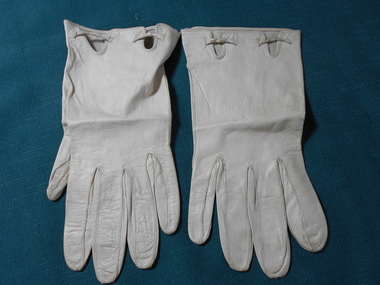
Clothing - GRAYDON COLLECTION: WOMEN'S LEATHER GLOVES, 1870-1890
... GRAYDON COLLECTION: WOMEN'S LEATHER GLOVES......women's leather gloves...Women's wrist length cream coloured leather gloves. Two decorative U-shaped cut outs at wrist on back of glove (1.5 cm X 2.5 cm) with a decorative band of knotted leather across the gaps....COSTUME ACCESSORIES Female women's leather gloves Clothing. Women's wrist length cream coloured leather gloves. ...Clothing. Women's wrist length cream coloured leather gloves. Two decorative U-shaped cut outs at wrist on back of glove (1.5 cm X 2.5 cm) with a decorative band of knotted leather across the gaps.costume accessories, female, women's leather gloves -
 Bendigo Historical Society Inc.
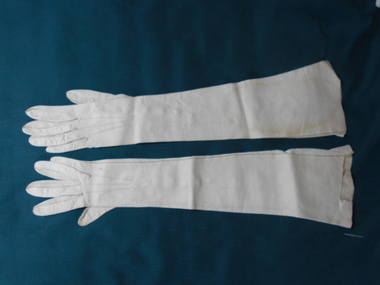
Clothing - GRAYDON COLLECTION: WOMEN'S WHITE LEATHER GLOVES, 1870-1890
... GRAYDON COLLECTION: WOMEN'S WHITE LEATHER GLOVES......women's white leather gloves...Women's white above the elbow leather gloves. Slit inside the wrist (12 cm) fastened with three X .6 cm spherical pearl buttons and button holes. ...COSTUME ACCESSORIES Female women's white leather gloves Clothing. Women's white above the elbow leather gloves. ...Clothing. Women's white above the elbow leather gloves. Slit inside the wrist (12 cm) fastened with three X .6 cm spherical pearl buttons and button holes. Visible external seams.costume accessories, female, women's white leather gloves -
 Bendigo Historical Society Inc.
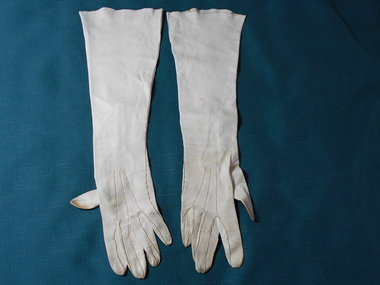
Clothing - GRAYDON COLLECTION: WOMEN'S ELBOW LENGTH LEATHER GLOVES, 1870-1890
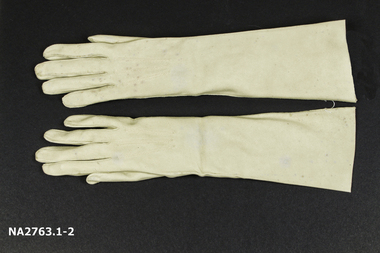
... GRAYDON COLLECTION: WOMEN'S ELBOW LENGTH LEATHER GLOVES......women's cream coloured leather gloves...Women's cream coloured elbow length leather gloves. Key hole slit (12 cm X 1-3 cm) inside wrist with three button holes. ...COSTUME ACCESSORIES Female women's cream coloured leather gloves Clothing. Women's cream coloured elbow length leather gloves. ...Clothing. Women's cream coloured elbow length leather gloves. Key hole slit (12 cm X 1-3 cm) inside wrist with three button holes. Left glove has one X.7 cm spherical button. Right glove has two .8 cm flat pearl buttons. Visible external seams. Three pin tucks on back of glove.costume accessories, female, women's cream coloured leather gloves -
 Bendigo Historical Society Inc.
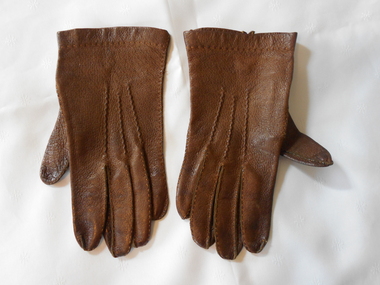
Clothing - GRAYDON COLLECTION: WOMEN'S BROWN LEATHER GLOVES, 1870-1890
... GRAYDON COLLECTION: WOMEN'S BROWN LEATHER GLOVES...Women's brown wrist length leather gloves. Decorative stitching around seams on fingers. ...COSTUME ACCESSORIES Female women's brown wrist length leather glove Clothing. Women's brown wrist length leather gloves. ...Clothing. Women's brown wrist length leather gloves. Decorative stitching around seams on fingers. Three pin tucks on back of gloves. U-shaped cut out at centre front at wrist (3 cms X 1 cm).costume accessories, female, women's brown wrist length leather glove -
 Bendigo Historical Society Inc.
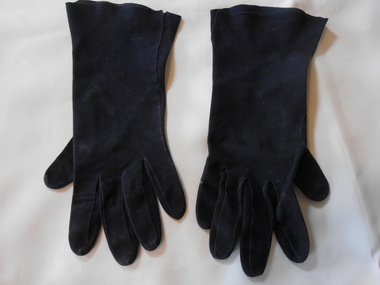
Clothing - GRAYDON COLLECTION: WOMEN'S NAVY BLUE GLOVES, 1870-1890
... ...women's navy blue leather gloves...Women's navy blue above the wrist leather gloves....COSTUME ACCESSORIES Female women's navy blue leather gloves Clothing. Women's navy blue above the wrist leather gloves. ...Clothing. Women's navy blue above the wrist leather gloves.costume accessories, female, women's navy blue leather gloves -
 Bendigo Military Museum
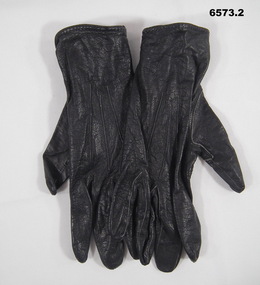
Uniform - GLOVES, WRAAC, Australian Army, Womens Royal Australian Army Corps (WRAAC) Uniform Gloves, 1976
... Leather Gloves formed part of the WRAAC Uniform. When WRAAC disbanded on 1 September 1983, the gloves continued to form part of the women's uniform. ...A pair of black kid leather women's military uniform gloves with a metal stud clip...Leather Gloves formed part of the WRAAC Uniform. When WRAAC disbanded on 1 September 1983, the gloves continued to form part of the women's uniform. ...Black Leather Gloves formed part of the WRAAC Uniform. When WRAAC disbanded on 1 September 1983, the gloves continued to form part of the women's uniform. This was the case for those serving in the Royal Australian Survey Corps.A pair of black kid leather women's military uniform gloves with a metal stud clipDated 1976royal australian survey corps, rasvy, fortuna, army survey regiment, army svy regt, gloves -
 Mont De Lancey
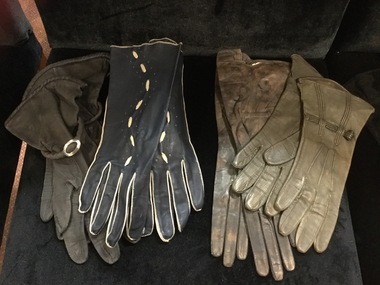
Gloves
... Total of seven pairs of gloves. 1 pair black leather men's gloves. 5 pairs of leather women's gloves - 1 x navy, 1 x cream, 2 x brown, 1 long peach with pearl buttons. 1 pair of black lace women's evening gloves....gloves Total of seven pairs of gloves. 1 pair black leather men's gloves. 5 pairs of leather women's gloves - 1 x navy, 1 x cream, 2 x brown, 1 long peach with pearl buttons. 1 pair of black lace women's evening gloves. ...Total of seven pairs of gloves. 1 pair black leather men's gloves. 5 pairs of leather women's gloves - 1 x navy, 1 x cream, 2 x brown, 1 long peach with pearl buttons. 1 pair of black lace women's evening gloves.gloves -
 City of Moorabbin Historical Society (Operating the Box Cottage Museum)
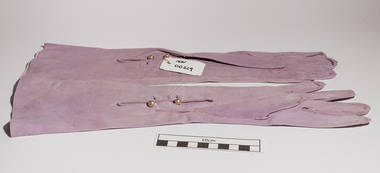
Clothing - Clothing, lady's lilac kid gloves, 20thC
... Ladies' gloves for formal and semi-formal wear come in three lengths for women: wrist, elbow, and opera or full-length (over the elbow, usually reaching to the biceps but sometimes to the full length of the arm). In the late 19thC and early 20thC Gloves were expected to be worn for both daytime and evening wear with most types of outfits. The most expensive gloves are custom-made of kid leather...Ladies' gloves for formal and semi-formal wear come in three lengths for women: wrist, elbow, and opera or full-length (over the elbow, usually reaching to the biceps but sometimes to the full length of the arm). In the late 19thC and early 20thC Gloves were expected to be worn for both daytime and evening wear with most types of outfits. The most expensive gloves are custom-made of kid leather ...Ladies' gloves for formal and semi-formal wear come in three lengths for women: wrist, elbow, and opera or full-length (over the elbow, usually reaching to the biceps but sometimes to the full length of the arm). In the late 19thC and early 20thC Gloves were expected to be worn for both daytime and evening wear with most types of outfits. The most expensive gloves are custom-made of kid leather. Mousquetaire gloves have buttons at the wrist so the wearer could open the buttons and slip her hand out without taking the whole glove off. The finger section would be folded in and kept away tidily. This is how ladies wore gloves while dining. After the meal they would put their hands back into the gloves, usually for the rest of the evening. William and Elizabeth Box were early settlers in Moorabbin Shire and resided in 'Box Cottage' 1865 -1913. John Box 1841-1913 was William's brother. Carole Eldridge was a descendant of John Box who with his first wife Martha Sheldrake were the parents of Alonzo Box.A pair of lady's 3/4 length, lilac, kid leather gloves with 2 pearl buttons at wrist opening.clothing, gloves, leather work, mousquetaire gloves, moorabbin, bentleigh, brighton, box elizabeth, box william, box avis, eldridge carol, early settlers, pioneers, market gardeners, box john, sheldrake martha, box alonzo -
 City of Moorabbin Historical Society (Operating the Box Cottage Museum)
Clothing - Clothing, lady's white kid gloves, 20thC
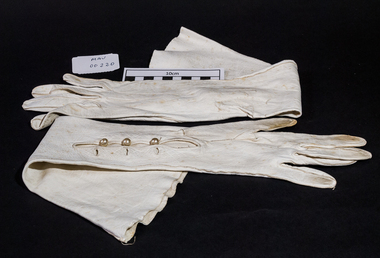
... Ladies' gloves for formal and semi-formal wear come in three lengths for women: wrist, elbow, and opera or full-length (over the elbow, usually reaching to the biceps but sometimes to the full length of the arm). In the late 19thC and early 20thC Gloves were expected to be worn for both daytime and evening wear with most types of outfits. The most expensive gloves are custom-made of kid leather...Ladies' gloves for formal and semi-formal wear come in three lengths for women: wrist, elbow, and opera or full-length (over the elbow, usually reaching to the biceps but sometimes to the full length of the arm). In the late 19thC and early 20thC Gloves were expected to be worn for both daytime and evening wear with most types of outfits. The most expensive gloves are custom-made of kid leather ...Ladies' gloves for formal and semi-formal wear come in three lengths for women: wrist, elbow, and opera or full-length (over the elbow, usually reaching to the biceps but sometimes to the full length of the arm). In the late 19thC and early 20thC Gloves were expected to be worn for both daytime and evening wear with most types of outfits. The most expensive gloves are custom-made of kid leather. Mousquetaire gloves have buttons at the wrist so the wearer could open the buttons and slip her hand out without taking the whole glove off. The finger section would be folded in and kept away tidily. This is how ladies wore gloves while dining. After the meal they would put their hands back into the gloves, usually for the rest of the evening. The Eldridge family were early settlers in Moorabbin Shire and relatives of William and Elizabeth Box. A pair of lady's white, 'Opera length', kid leather gloves with 3 pearl buttons at wrist opening, or 'Mousquetaire'clothing, gloves, kid leather, leather work, moorabbin, bentleigh, brighton, early settlers, pioneers, market gardeners, box elizabeth, box william, box avis, eldridge carol, box john, sheldrake martha, box alonzo -
 City of Moorabbin Historical Society (Operating the Box Cottage Museum)
Accessory - Clothing, lady's nylon short gloves, c1950
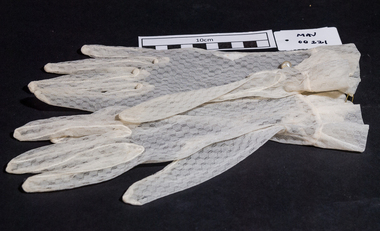
... Ladies' gloves for formal and semi-formal wear come in three lengths for women: wrist, elbow, and opera or full-length (over the elbow, usually reaching to the biceps but sometimes to the full length of the arm). In the late 19thC and early 20thC Gloves were expected to be worn for both daytime and evening wear with most types of outfits. The most expensive gloves are custom-made of kid leather...Ladies' gloves for formal and semi-formal wear come in three lengths for women: wrist, elbow, and opera or full-length (over the elbow, usually reaching to the biceps but sometimes to the full length of the arm). In the late 19thC and early 20thC Gloves were expected to be worn for both daytime and evening wear with most types of outfits. The most expensive gloves are custom-made of kid leather ...Ladies' gloves for formal and semi-formal wear come in three lengths for women: wrist, elbow, and opera or full-length (over the elbow, usually reaching to the biceps but sometimes to the full length of the arm). In the late 19thC and early 20thC Gloves were expected to be worn for both daytime and evening wear with most types of outfits. The most expensive gloves are custom-made of kid leather.The Box family were early settlers in Moorabbin Shire and resided in 'Box Cottage' 1865 -1913 The Eldridge family were early settlers in Moorabbin Shire Carol Eldridge was the Daughter in law of Alf and Avis Box, descendants of John Box 1841-1913 A pair of lady's cream, nylon, wrist length gloves with a pearl buttonALL NYLON / MADE IN ENGLAND / 7clothing, gloves, nylon, england, moorabbin, bentleigh, brighton, box elizabeth, box william, box avis, eldridge carol, early settlers, pioneers, market gardeners, box john, sheldrake martha, box alonzo -
 City of Moorabbin Historical Society (Operating the Box Cottage Museum)
Accessory - Clothing, Lady's cream nylon gloves, c1950
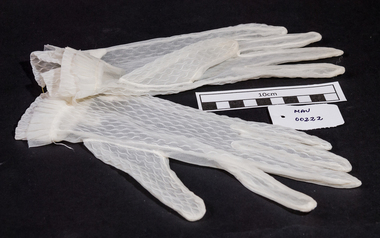
... Ladies' gloves for formal and semi-formal wear come in three lengths for women: wrist, elbow, and opera or full-length (over the elbow, usually reaching to the biceps but sometimes to the full length of the arm). In the late 19thC and early 20thC Gloves were expected to be worn for both daytime and evening wear with most types of outfits. The most expensive gloves are custom-made of kid leather...Ladies' gloves for formal and semi-formal wear come in three lengths for women: wrist, elbow, and opera or full-length (over the elbow, usually reaching to the biceps but sometimes to the full length of the arm). In the late 19thC and early 20thC Gloves were expected to be worn for both daytime and evening wear with most types of outfits. The most expensive gloves are custom-made of kid leather ...Ladies' gloves for formal and semi-formal wear come in three lengths for women: wrist, elbow, and opera or full-length (over the elbow, usually reaching to the biceps but sometimes to the full length of the arm). In the late 19thC and early 20thC Gloves were expected to be worn for both daytime and evening wear with most types of outfits. The most expensive gloves are custom-made of kid leather. The gloves were probably made in Hong Kong, then as now, a place where fashions can be made cheaply because the cost of labour is inexpensive.The family of Carole Pedersen-Green were early settlers in Moorabbin Shire. Carole was a founding member of CMHSA pair of lady's cream, nylon, wrist length gloves with a frilled edgeclothing, gloves, nylon, hong kong, moorabbin, bentleigh, brighton, early settlers, pioneers, market gardeners, pedersen-green carole, green carole, denmark -
 City of Moorabbin Historical Society (Operating the Box Cottage Museum)
Accessory - Clothing, lady's cream nylon gloves, c1950
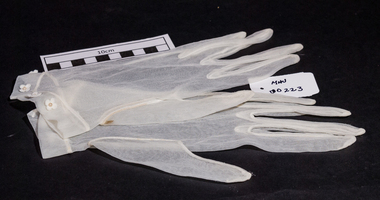
... Ladies' gloves for formal and semi-formal wear come in three lengths for women: wrist, elbow, and opera or full-length (over the elbow, usually reaching to the biceps but sometimes to the full length of the arm). In the late 19thC and early 20thC Gloves were expected to be worn for both daytime and evening wear with most types of outfits. The most expensive gloves are custom-made of kid leather...Ladies' gloves for formal and semi-formal wear come in three lengths for women: wrist, elbow, and opera or full-length (over the elbow, usually reaching to the biceps but sometimes to the full length of the arm). In the late 19thC and early 20thC Gloves were expected to be worn for both daytime and evening wear with most types of outfits. The most expensive gloves are custom-made of kid leather ...Ladies' gloves for formal and semi-formal wear come in three lengths for women: wrist, elbow, and opera or full-length (over the elbow, usually reaching to the biceps but sometimes to the full length of the arm). In the late 19thC and early 20thC Gloves were expected to be worn for both daytime and evening wear with most types of outfits. The most expensive gloves are custom-made of kid leather. These gloves were probably made in Hong Kong, then as now, a place where fashions can be made cheaply because the cost of labour is inexpensiveThe family of Carole Pedersen-Green were early settlers in Moorabbin Shire. Carole was a founding member of CMHSA pair of cream, nylon, lady's wrist length gloves There are 4 cotton flower shapes at centre back of wrist with a tiny pearl in each centreclothing, gloves, nylon, moorabbin, bentleigh, brighton, early settlers, market gardeners, hong kong, pedersen-green carole, green carole, denmark -
 Orbost & District Historical Society
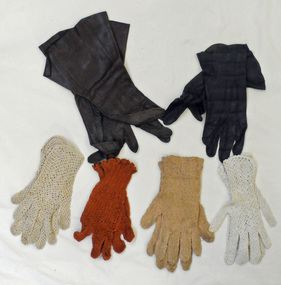
six pairs of gloves, Burton, Marjorie, 1940's -1950's
... Clothes rationing ended on 15 March 1949. women's-accessories gloves crochet knitting burton-marjorie Six pairs of ladies' gloves. 2483.16 is a white crocheted cotton pair. 2483.17 is a light tan knitted woolen pair. 2483.18 is a brown crocheted cotton pair. 2483.19 is an ecru crocheted cotton pair. 2483.20 is a black leather pair and 2483.21 is a brown leather pair. six pairs of gloves Burton, Marjorie ...Marjorie Burton ( nee Whiteman), born 12 June, in Birmingham, England came to Orbost in 1995. In England she did office work – typing, shorthand and secretarial work - in accountants’ offices and also trained as a comptometrist with Burroughs in London. She came from middle-class working church-going family. Her mother was a milliner who made all of Marjorie’s clothes, hats and outfits. Marjorie married in 1938 to a salesman who later became a mechanic in the R.A.F. during WW11. Her father served in Civil Defence during the war. Marjorie was in Birmingham during the war and remembered sheltering with her young daughter, Anne (Quaadgras) in the air raid shelter during bombing. These items are examples of handcrafted items and reflect the handcraft skills of women necessary during WW11 when clothing became scarce. Clothes rationing began on June 1, 1941, two years after food rationing started. Clothes rationing ended on 15 March 1949.Six pairs of ladies' gloves. 2483.16 is a white crocheted cotton pair. 2483.17 is a light tan knitted woolen pair. 2483.18 is a brown crocheted cotton pair. 2483.19 is an ecru crocheted cotton pair. 2483.20 is a black leather pair and 2483.21 is a brown leather pair. women's-accessories gloves crochet knitting burton-marjorie -
 City of Moorabbin Historical Society (Operating the Box Cottage Museum)
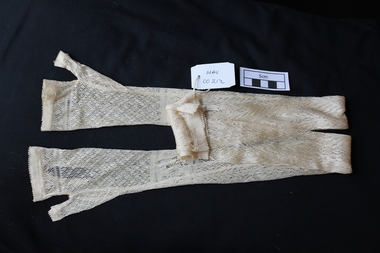
Clothing - Clothing, lady's long cream silk gloves, c1930
... Ladies' gloves for formal and semi-formal wear come in three lengths for women: wrist, elbow, and opera or full-length (over the elbow, usually reaching to the biceps but sometimes to the full length of the arm). In the late 19thC and early 20thC Gloves were expected to be worn for both daytime and evening wear with most types of outfits. The most expensive full-length gloves are custom-made of kid leather...Ladies' gloves for formal and semi-formal wear come in three lengths for women: wrist, elbow, and opera or full-length (over the elbow, usually reaching to the biceps but sometimes to the full length of the arm). In the late 19thC and early 20thC Gloves were expected to be worn for both daytime and evening wear with most types of outfits. The most expensive full-length gloves are custom-made of kid leather ...Ladies' evening gloves or opera gloves are a type of formal glove that reaches beyond the elbow. Ladies' gloves for formal and semi-formal wear come in three lengths for women: wrist, elbow, and opera or full-length (over the elbow, usually reaching to the biceps but sometimes to the full length of the arm). In the late 19thC and early 20thC Gloves were expected to be worn for both daytime and evening wear with most types of outfits. The most expensive full-length gloves are custom-made of kid leather. Many other types of leather, most usually soft varieties of cowhide, are used in making full-length gloves; patent leather and suede are especially popular as alternatives to kidskin. Satin materials were extremely popular, and there are mass-produced varieties as well. Carole Pedersen-Green was a founding member of CMHS. Her family were early settlers in Moorabbin ShireA pair of lady's long cream silk machine lace gloves with open fingers and thumb piece C 1930 They are the classic OPERA length, with the mousquetaire wrist openingclothing, gloves, formal wear, craftwork, lace making, dress etiquette, satin, silk, moorabbin, bentleigh, cheltenham, fashion, evening gloves., lace -
 Warrnambool RSL Sub Branch
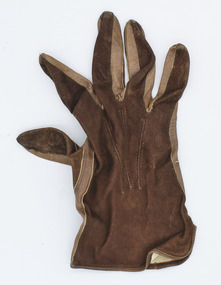
Glove; Army Nurses Uniform, 1940-1942
... glove is one of a pair and is part of the uniform worn by Sister Winifred Ride during World War 2. Nurses played a key role in the conflict through their care and compassion to the servicemen who were wounded and sick. The nurses uniform is symbolic of the sacrifice and service of the many women who served their country in WW2. inside mark "Size 7" Brown leather and suede glove. ...This glove is one of a pair and is part of the uniform worn by Sister Winifred Ride during World War 2. Nurses played a key role in the conflict through their care and compassion to the servicemen who were wounded and sick.The nurses uniform is symbolic of the sacrifice and service of the many women who served their country in WW2. Brown leather and suede glove. One of a pair, leather palm with suede top.inside mark "Size 7" -
 Warrnambool RSL Sub Branch
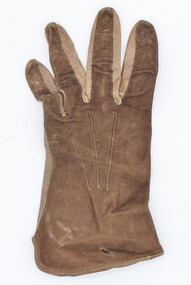
Glove; Army Nurses Uniform, 1940-1942
... glove is one of a pair and is part of the uniform worn by Sister Winifred Ride during World War 2. Nurses played a key role in the conflict through their care and compassion to the servicemen who were wounded and sick. The nurses uniform is symbolic of the sacrifice and service of the many women who served their country in WW2. inside mark "Size 7" Brown leather and suede glove. ...This glove is one of a pair and is part of the uniform worn by Sister Winifred Ride during World War 2. Nurses played a key role in the conflict through their care and compassion to the servicemen who were wounded and sick.The nurses uniform is symbolic of the sacrifice and service of the many women who served their country in WW2. Brown leather and suede glove. One of a pair, leather palm with suede top.inside mark "Size 7" -
 Warrnambool and District Historical Society Inc.
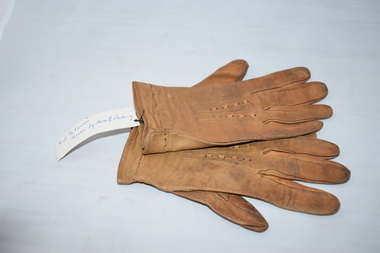
Gloves, Kid gloves Mrs Ponting, Early to mid 20th century
... gloves were donated by Miss E. Kerr of Warrnambool and were probably worn by her. The Ponting family has been prominent in the timber and building business in Warrnambool since the 1920s and still operate today. Miss Kerr was a member of the Warrnambool and District Historical Society in the 1970s and donated many items, especially household goods. Many women in the early to mid 20th century owned leather...gloves worn by women in the 20th century. They will be useful for display. women’s accessories history of warrnambool These gloves are made of a light brown leather. ...These gloves were donated by Miss E. Kerr of Warrnambool and were probably worn by her. The Ponting family has been prominent in the timber and building business in Warrnambool since the 1920s and still operate today. Miss Kerr was a member of the Warrnambool and District Historical Society in the 1970s and donated many items, especially household goods. Many women in the early to mid 20th century owned leather gloves which they wore mostly with suits and coats in the winter time. They can still be purchased today. These gloves are of interest as an example of the type of gloves worn by women in the 20th century. They will be useful for display.These gloves are made of a light brown leather. They have a leather string lace inserted as a decorative pattern on the wrist openings and the same lacing on the upper sides of the gloves but in this area the leather string is missing. The gloves have been much worn and are stained. women’s accessories, history of warrnambool -
 National Wool Museum
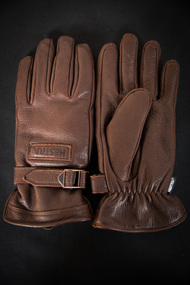
Gloves, Leather gloves
... Pair of leather gloves worn by both men and women. This'pair' is two left gloves....Part of the uniform for the Winter Olympic Games, 2002 worn by men and women. fashion gloves leather costume sport salt lake city HESTRA HESTRA SHELL; ELK lEATHER LINING: 100% POLYESTER 8 Pair of leather gloves worn by both men and women. ...Part of the uniform for the Winter Olympic Games, 2002 worn by men and women.Pair of leather gloves worn by both men and women. This'pair' is two left gloves.HESTRA HESTRA SHELL; ELK lEATHER LINING: 100% POLYESTER 8fashion, gloves, leather, costume, sport, salt lake city -
 National Wool Museum
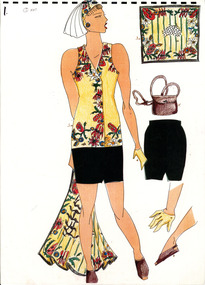
Work on paper - Women's Opening/Closing Ceremony Uniform Design Drawings, Wendy Powitt, c. 1992
... Women's Opening/Closing Ceremony Uniform. The main drawing shows the design for a dark green skirt, a yellow printed sleeveless button up shirt, a matching headband and scarf, yellow gloves and brown leather shoes. ...Women's Opening/Closing Ceremony Uniform. The main drawing shows the design for a dark green skirt, a yellow printed sleeveless button up shirt, a matching headband and scarf, yellow gloves and brown leather shoes. ...A set of laminated A3 sketchbook pages depicting designs for the 1992 Barcelona Olympic Women's Opening/Closing Ceremony Uniform designed by Wendy Powitt. On the 1992 Barcelona Olympic Games donor Doug Pleasance wrote- The 1992 Barcelona Olympic Games saw an evolutionary change in designer selection. A Declaration of Interest Form was communicated to over forty potential designers. The task and especially tight timelines that were involved deterred many aspirants, however, there remained eight designers with the potential we were seeking. These eight designers were paid $3,000 per submission and the winning designer, Wendy Powitt, was paid $15,000. For the first time the judging panel included two athletes, one male swimmer and one female basketballer, their influence was pivotal. Opening Ceremony Uniform included a lightweight wool fabric printed with floral designs that had been inspired by the work of Australian artist Margaret Preston. This included: Lightweight W/PE shorts by Fletcher Jones in Foster Valley Fabric, socks by Holeproof and footwear by Hush Puppy.8120.1 - A laminated A3 sketchbook page depicting a design for the 1992 Barcelona Olympic Women's Opening/Closing Ceremony Uniform. The main drawing shows the design for a dark green skirt, a yellow printed sleeveless button up shirt, a matching headband and scarf, yellow gloves and brown leather shoes. To the right of the main image are five detail drawings of the skirt, gloves, shoes and scarf as well as a depiction of a brown leather bag. 8120.2 - unnumbered- mounted on green card this sketchbook page depicts a design for the 1992 Barcelona Olympic Women's Opening/Closing Ceremony Uniform. The main drawing shows the design for a dark green skirt, a yellow printed sleeveless button up shirt and yellow gloves. 8120.3 - unnumbered- A laminated A3 sketchbook page depicting a design for the 1992 Barcelona Olympic Women's Opening/Closing Ceremony Uniform. The main drawing shows the design for a dark green skirt, a yellow printed sleeveless button up shirt, a matching headband and scarf, yellow gloves and brown leather shoes. To the right of the main image are five detail drawings of the skirt, gloves, shoes and scarf as well as a depiction of a brown leather bag.1992 barcelona olympics, sport, athletes, fashion, design, artwork, drawing, uniform -
 Whitehorse Historical Society Inc.
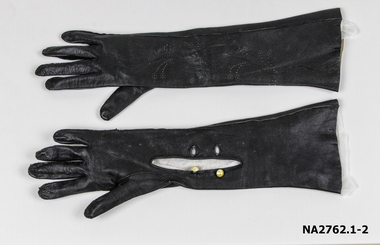
Clothing - Gloves
... Pair of women's mid length pull on black leather evening gloves. Tendril-style stitched detail along length of gloves accented with pierced leaf design. ...costume accessories female Indecipherable Pair of women's mid length pull on black leather evening gloves. Tendril-style stitched detail along length of gloves accented with pierced leaf design. ...Pair of women's mid length pull on black leather evening gloves. Tendril-style stitched detail along length of gloves accented with pierced leaf design. Open wrist fastenings with two pearl bead buttons. Green makers mark stamped inside both glovesIndecipherablecostume accessories, female -
 Whitehorse Historical Society Inc.
Clothing - Gloves
... costume accessories female Inside right hand glove : 'Made in France / 6 3/4 / (in cursive) Suedelav' Inside left hand glove : 'Leather / Made in France' '207' on paper label : 'V4/86L/ipx/39/6' Pair of suede mid-length beige or fawn women's size 6 3/4 gloves with 3 stitched darts along back of hands. ...Pair of suede mid-length beige or fawn women's size 6 3/4 gloves with 3 stitched darts along back of hands. Gloves are joined near openings with length of white cotton. Labels and printed markings inside both gloves.Inside right hand glove : 'Made in France / 6 3/4 / (in cursive) Suedelav' Inside left hand glove : 'Leather / Made in France' '207' on paper label : 'V4/86L/ipx/39/6'costume accessories, female -
 City of Melbourne Libraries
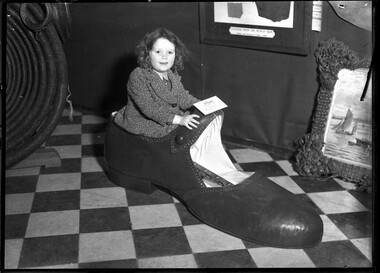
Photograph, Bull, Hugh Jones, 1897-1993, Leather Exhibition, Melbourne Town Hall
... Women's Association of Victoria is a notable one. In all there are about 130 entries which are in four classifications, viz., hand-tooled or embossed leathers, suede, hand-made gloves and undecorated leather. ...Women's Association of Victoria is a notable one. In all there are about 130 entries which are in four classifications, viz., hand-tooled or embossed leathers, suede, hand-made gloves and undecorated leather. ...Photographer notations on slide: At the Leather Exhib. at T. Hall Melb 1933 Age Published: Age (Melbourne, Vic.: 1854- ), 1933 THE EXHIBITS. (1933, September 20). The Age (Melbourne, Vic. : 1854 - 1954), p. 16. Retrieved January 25, 2026, from http://nla.gov.au/nla.news-article205109730 Published title: THE EXHIBITS. A COMPREHENSIVE RANGE. Curios, Novelties, Working Displays Published Caption: ONE OF THE NOVELTIES – AN OUTSIZE IN SHOES Research by Project Volunteer, Louise McKenzie: Our photo is dated 20 September 1933, and shows a happy, chubby-faced young girl sitting in a very over-sized girl’s shoe. It is labelled – “Shoe, An Out Size, loaned by Messrs Blackman & Rose”. (1) It is an effective way to capture the attention of the readership and alert them to the Melbourne Leather Show 1933. This show was designed to be a drawcard of extraordinary proportion, and there is no doubt that this leather exhibition was a really big deal for Melbourne. It completely took over the Melbourne Town Hall, and was open from 10.30 am until 10.30 pm. It seemed to contain something for everyone – the military, the man about town, the home handyman, the housewife, the child, the sporting types, the domestic workers, the outdoor enthusiasts, the horseracing fans, car enthusiasts, those wishing to show off the latest fashion – both men and women - and those just intrigued by a lot of fascinating and wide ranging exhibits. One of the most comprehensive descriptions of the Exhibition accompanies the photograph, and is worth quoting in full: “PROMINENT among exhibits which first attract attention in the foyer of the Town Hall is a comprehensive display of leather articles used by the defence forces. A conspicuous legend states that leather plays an important part in national defence, being used for saddlery, tool containers, holdalls, range-finding, surveying and signalling equipment, explosives factories, harness accoutrement, bandsmen's equipment and clothing. Three models of horses and several figures of soldiers wearing leather equipment illustrate the lesson, and a great range of leather goods used in military training and work variegate the display. Nearby are Texas cowboy, buckjumping and breaking-in saddles; whips, a walking stick, made of leather and numerous other curios. The general exhibition occupies the whole floor space of the main Town Hall, and is subdivided by partitions running most of the length of the hall. A bewildering variety, of leather goods presses for close and leisured inspection. Here and there operatives in charge of working machinery give practical demonstrations of factory processes in the production of footwear. Polishing materials are well represented. One attractive exhibit includes two bush huts constructed of leather, with wattle bark for roofing. Opossums, rosellas and a kookaburra add touches of bush realism. Adjacent exhibits include bags, fishing boots, leggings, leather covers in all colours. Factory Processes. One exhibitor has installed an automatic cinema apparatus and screen, which projects various factory processes in making a shoe, the operator being shown at work. Elsewhere an interesting exhibit depicts the five stages in the manufacture of sole leather, and the tanning materials employed. "Very handsome effects are achieved in the interior appointments of motor cars, which are attended by figures of smart chauffeurs in leather coats. Motor-trimming leather is said to be more durable and hygienic than fabric materials, and cheaper. The neat finish of the material, its excellent appearance, certainly make a very favourable impression. It takes the hides of three beasts to cover the cushions, squabs and door panels of a full-sized sedan, while to finish the entire interior, including quarter-panels and head linings would take four or even five. Special Exhibits. Amongst the special sections the display arranged by the handicrafts and home industries- committee of the Country Women's Association of Victoria is a notable one. In all there are about 130 entries which are in four classifications, viz., hand-tooled or embossed leathers, suede, hand-made gloves and undecorated leather. The glove section attracted the most numerous entries, a number being the work of members and craft subscribers of the Country Women's Association. In the leathercraft competition, organised by the Country Women's Association, the judges yesterday awarded the first prize for bookbinding (the only prize given in this division) to Miss M. Alston, of South Yarra. There is also a creditable display of exhibits submitted by boys of the orthopaedic section of the Children's Hospital at Frankston. Amongst the novelties on view in other portions of the exhibition were the following: — Leather coats worn by Sir C. Kingsford Smith on his Atlantic flight. Model Wellington boot, Phar Lap's saddle. Melbourne Cup winner's saddle. Longest whip in world, 108 feet long. (33 metres) [See our photo, to left of Girl in Shoe] Diminutive shoes. Pair of shoes 65 years old. Pair of men's working boots 75 years old. Larwood's, Tate’s and Pataudi’s cricket boots. [Three internationally revered cricketers of the day] (2) Picture frame made of leather bought 63 years ago. [See our photo, to right of Girl in Shoe] Leather frame, powder bowl, &c. Saddle used by world's champion buckjumper in U.S.A. Mexican cowboy outfit. Miniature saddle and bridle. A fireman's helmet made of sole leather. (3) Sample of the leather hat worn by porters at the Billingsgate Fish Market, London. (4) From South Australia there have been obtained sets of harness for donkeys, goats and camels, the equipment being displayed to good advantage on stuffed representations of the animals mentioned. Close to the platform is a glass case containing snow shoes and coats which have been used in Antarctic exploration work. Trade Display. Amongst the trade exhibits may be seen in operation a slipper turn shoe sewing machine, with heeling and channelling facilities, and the various stages in the production of ladies' sandals are shown. There is a wide contrast between sole leather of varying degrees of thickness on view in one stall and the choice samples of ladies' footwear in another — footwear, by the way, which could almost be used as ornaments, so dainty in colour and production are they. Again, there are displays of upholstering leathers of such soft texture that they could he readily mistaken for some of the finest cloth. Those who may be particularly interested in the production of chamois leather may gain an insight into the materials and chemicals used in the "working up” of this variety of leather. Supplies of glace kid (5) are tastefully arranged, and there may also be seen bags of all shapes and sizes, including satchels, suit cases and "sporting" cases, and bags for tennis players and golfers. Further variety is given to the exhibition by the display of antique hides, brightly coloured, with punching balls, boxing gloves and batsman's pads. There are crocodile skins and snake skins so cleverly "Worked up" that one could be almost pardoned for betraying an affection for such unpopular creatures.” “ Another wonderful article on this Exhibition, published the same day in one of the opposition daily newspapers, The Argus, is in the weekly article “Women to Women”, entitled “A Great Victorian Industry: Many Uses for Leather”. This weekly column was penned by Vesta, and she writes, with much purpose: “Yesterday afternoon I paid a hurried visit to the Leather Exhibition now being held in the Melbourne Town Hall and I was disappointed to find that the early visitors to the main exhibition were almost all men. Women, I think, should make a point of seeing every exhibition of our great industries, for women are the buyers of household requisites and goods for their own use and their tastes, and opinion influence also, to a large extent, the purchases of men. So, the welfare of industries is more or less in their hands and it becomes a duty for them to inform themselves fully of the extent and the quality of the manufacturing that is done here. The value of the output of the Australian boot and shoe factories alone was in 1930-31, the latest year for which the figures are given, Stg 3,750,000. Fully two thirds of that amount must have been spent by women on boots and shoes for themselves and their children. In a host of other directions, in the purchase of handbags, travelling bags, belts and straps, cushions, furniture coverings, purses, notebooks, spectacle cases, their annual expenditure must be very high. Their interest, therefore, in this industry is practical, and their support of it should be governed by knowledge of comparable values and qualities of the goods they buy. From the point of view of women, however, the exhibition itself is rather disappointing. There is an amazing collection of good stuff on show, but most of it is not displayed in a fashion that attracts attention. I was surprised, for example, at the range and quality of the leathers displayed, the suppleness of the finer qualities, and the varied range of colours and designs. But they are shown in such a fashion that if one set out deliberately to look for them it would be quite easy to miss most of them.” …It was surprising, too, that no one seemed to have taken advantage of the present fashion of wearing coloured gloves, or the cult of glove making, which the Country Women’s Association has fostered so successfully. Outside the collection of chamois leathers I saw no skins which were suitable to glove making. (6) However, it is perhaps a little unfair to be highly critical of the exhibition, inasmuch as it is the first of its kind. The material is there, undoubtedly, for a splendid show of every phase of this enterprising industry, and I am confident that experience will prove to those concerned that it will be worth while next time to devote a great deal of attention of the method of display.” With further research, it transpires that “Vera” is in fact NZ born Stella May Allen (nee Henderson) (1871-1962), a journalist, the first woman in NZ to begin a law course, in 1890-91). She later worked at a law firm while she completed her degree. Study of the law had always been open to women in NZ, but its practice was still barred to them. Her case “…led to amending legislation in 1896 allowing women to practise as barristers or solicitors. However, on gaining her LL.B. in November 1897 she did not apply for admission to the Bar. Instead, she became the Wellington-based correspondent and leader-writer for the Lyttelton Times. Her appointment, the first for a woman, was not welcomed by the all-male Press Gallery, and special permission had to be obtained from a subcommittee of the House before her presence was accepted. In 1900 she married Edwin Allen, a senior leader-writer for the Wellington Evening Post, and they moved to Australia in 1903 when Edwin Allen took up the post of foreign affairs leader-writer and parliamentary man for the Melbourne Argus. As Patricia Keep notes in her excellent entry of Stella Allan in the Australian Dictionary of Biography: “In 1907 The Argus commissioned her to write a series of articles on the first Australian Women's Work Exhibition held in October. They aroused much interest and next year The Argus invited her to join its full-time staff and begin a weekly section on the particular interests of women. She adopted the nom de plume 'Vesta' and called the column 'Women to Women'. Her work was unique in an Australian daily paper at that time. Her pages extended to cover every aspect of women's affairs, children's interests and community welfare, and 'Vesta' became a household word for authoritative information and advice on such matters. An excellent needlewoman and first-rate cook herself, she thoroughly tutored her staff in the work and needs of women in both country and city, as well as providing the usual training for cadet journalists. She conducted interviews and also visited the country to see at first hand the results of bushfires, mouse plagues, droughts and floods. In 1910 she was one of three women foundation members of the Australian Journalists' Association. “…she found time to become deeply involved in community affairs. She was an original committee-member of the Victorian Association of Crèches and of the Free Kindergarten Union of Victoria, and had much to do with the early days of the Victorian Bush Nursing Association, the Baby Health Centres Association and the Queen Victoria Hospital. She was a member of the National Council of Women, first in New Zealand and then in Melbourne, and of the Country Women's Association from its inception. … in 1924 she was appointed substitute delegate for Australia to the fifth assembly of the League of Nations at Geneva and was a delegate to the second Pan Pacific Women's Conference in Hawaii in 1930. A meeting held in the Melbourne Town Hall in 1938 by representatives of all the main Victorian women's organizations paid special tribute to her work and influence. She retired next year to England where she continued to write for the Argus, contributing articles on the experiences of women and children in wartime.” It is little wonder that “Vesta” was unafraid to take to task both the women of Victoria, and those who created the exhibition! One item which appears to have gone unnoticed, or at least unreported, is a framed article in the background of the photo of the chubby girl in the shoe. The display frame is labelled “Leather from the Human Skin, Tanned and Dressed by French artists.” The exhibition was certainly a cabinet of curiosities! A charming article in The Argus is a nice note on which to end. It gives a quick history and overview of the Australian leather industry and its unprecedented, and possibly unexpected, development and success, and states with pride: “Though Victoria is the largest leather producer in the Commonwealth all tanners in the Commonwealth can look back with pride on the long march of progress.” Footnotes: (1) “Blackman and Rose”. Messrs Blackman and Rose were shoe manufacturers, from 1927 located at 200 Noone Street, Clifton Hill. The Melbourne Circle describes their building as a “fine-looking building in the Federation ‘blood and bandage’ style.” It was built around 1912 for Puttifoot and Bloom, boot manufacturers, and today the building is apartments. (2) These cricketers were household names in the day: Tate: Maurice Tate, “English cricketer of the 1920s and 1930s, and leader of England’s Test bowling attack for a long time during this period. The founder of modern seam bowling. “ Larwood: Harold Larwood, “English right-arm fast bowler and the main exponent of the bowling style known as “bodyline”. Used to considerable effect in the 1932-33 Test series in Australia. Pataudi: Iftikhar A K Pataudi, “an Indian prince who in the 1930s played Test cricket for England, and in the 1940s played Test cricket for India (as Captain) – the only test cricketer to have played for both India and England. (3) “sole” leather “… is the thickest and most resistant material existing in the tanning industry … made from vegetable tanned leathers, usually bovine butts, processed in a special way to make them the hardest type of leather in existence.” (4) The hats worn by porters at Billingsgate Fish Market were also known as a “Bobbin” and look quite squat and rather unsophisticated. They were made of wood and tarred leather, with a “flat, hardened top designed to support large rectangular boxes of fish. The upturned brim protected the porter’s head against fish juice draining from the boxes of fish which would be carried on top of the hat. Some hats featured a small drain hole at the rear to allow this collected juice to drain down the back of the carrier. The hats were made using the ‘cuir bouilli’ technique. The leather was immersed in water which was heated until the leather began to shrink. It was then removed and put on a wooden former. The leather was stitched together to make the hat while still wet, and then held in place until dry.” (See article and photo on the London Museum website) (5) Glace kid – described on the Boston Museum of Fine Arts’ Cameo database as “A smooth glossy leather originally prepared from goat or sheepskin. Early glace kid had a shiny surface that was originally prepared by tawing the skin in a mixture of alum, table salt, flour, and egg yolk. Today, glace kid is prepared from many types of vegetable or chrome tanned leathers. The smooth polished surface is obtained mechanically by shaving, glazing, ironing, and/or rolling the dry leather.” (6) In the 1930s, Melbourne’s glovemaking industry was characterised by local manufacturing, with key producers like Simpson’s Gloves Pty Ltd in Richmond and the Stagg Glove Company in Clifton Hill leading the market. These factories produced high-quality leather gloves, handbags, and specialty gear, often employing a clear gendered division of labour and training young, local women. Museum Victoria holds the Simpson’s Gloves Collection, comprising over 1200 items, and the University of Melbourne Archives holds the company’s business records. References: THE EXHIBITS. (1933, September 20). The Age (Melbourne, Vic. : 1854 - 1954), p. 16. Retrieved January 25, 2026, from http://nla.gov.au/nla.news-article205109730 EXPORT LEATHER. (1929, September 17). The Argus (Melbourne, Vic. : 1848 - 1957), p. 17. Retrieved January 19, 2026, from http://nla.gov.au/nla.news-article4037647 LEATHER EXHIBITION (1933, September 18). The Argus (Melbourne, Vic. : 1848 - 1957), p. 10. Retrieved January 19, 2026, from http://nla.gov.au/nla.news-article11693362 (1933, September 23). The Argus (Melbourne, Vic. : 1848 - 1957), p. 21. Retrieved January 19, 2026, from http://nla.gov.au/nla.news-page522766 WOMEN TO WOMEN (1933, September 20). The Argus (Melbourne, Vic. : 1848 - 1957), p. 13. Retrieved January 19, 2026, from http://nla.gov.au/nla.news-article11694034 Australian Dictionary of Biography, Stella May Allan (1871–1962) https://adb.anu.edu.au/biography/allan-stella-may-4998 WOMEN TO WOMEN (1930, January 22). The Argus (Melbourne, Vic. : 1848 - 1957), p. 13. Retrieved January 19, 2026, from http://nla.gov.au/nla.news-article4063888 Museums Victoria, Simpson’s Gloves, 486-496 Victoria Street, North Richmond, VIC, Australia https://collections.museumsvictoria.com.au/articles/2702 The Argus. (1927, October 31). The Argus (Melbourne, Vic. : 1848 - 1957), p. 20. Retrieved February 7, 2026, from http://nla.gov.au/nla.news-article3888451 Melbourne Circle: stories from the suburbs: “Boots and all in Clifton Hill” https://melbournecircle.net/2015/11/20/bootmakers-of-clifton-hill/ Wikipedia, Maurice Tate, https://en.wikipedia.org/wiki/Maurice_Tate Wikipedia, Harold Larwood, https://en.wikipedia.org/wiki/Harold_Larwood Wikipedia, Iftikhar Ali Khan Pataudi, https://en.wikipedia.org/wiki/Iftikhar_Ali_Khan_Pataudi Buy Leather Online Italy, Sole leather: https://buyleatheronline.com/en/blog/outsole-and-insole-leather-n7 London Museum, Porters hats, https://www.londonmuseum.org.uk/collections/v/object-731122/hat-porters-hat/ Cameo Database, Museum of Fine Arts, Boston, Glace Kid, https://cameo.mfa.org/wiki/Glac%C3%A9_kid VICTORIAN LEATHER HAS WON RENOWN (1937, September 22). The Argus (Melbourne, Vic. : 1848 - 1957), p. 31 (March of Progress Supplement). Retrieved February 7, 2026, from http://nla.gov.au/nla.news-article1108704 Photographer notations on slide: "At the Leather Exhib. at T. Hall Melb 1933 Age B5".displays, melbourne town hall, leather, children, shoes, 1930-1939, industry, hats, gloves
