
Showing 10 items matching "woodblock printing"
-
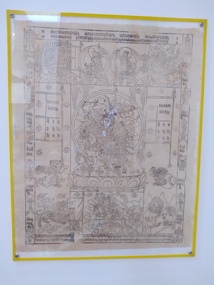 Great Stupa of Universal Compassion
Print - Woodblock print featuring Gesar, Unknown
... ...Woodblock printing...Woodblock printing in Tibet began to flourish from the 10th century onwards, driven by the high demand for Buddhist scriptures and images. ...Woodblock printing in Tibet began to flourish from the 10th century onwards, driven by the high demand for Buddhist scriptures and images. ...Woodblock printing in Tibet began to flourish from the 10th century onwards, driven by the high demand for Buddhist scriptures and images. Monasteries saw woodblock printing as a means to preserve and propagate authentic Buddhist teachings. The durability of woodblocks made them ideal for creating lasting impressions of sacred texts, enabling mass production and wide dissemination.This woodblock print on hand-made paper depicts Gesar, a legendary Tibetan warrior king who is invoked as a protector of the Buddha's teachings and emanation of Padmasambhava. Gesar's image is surrounded by four magical animals - garuda (top left), makara (top right), tiger (bottom left) and snow lion (bottom right). The print is framed using acrylic sheets. padmasambhava, tibetan buddhism, woodblock printing -
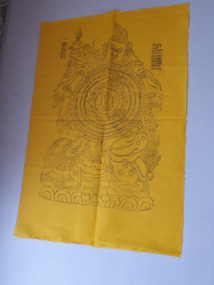 Great Stupa of Universal Compassion
Print - Woodblock print of Jambhala, Tashilhunpo Monastery
... Woodblock printing...Woodblock printing in Tibet began to flourish from the 10th century onwards, driven by the high demand for Buddhist scriptures and images. ...Woodblock print of Jambhala on yellow cloth, created using an old wooden handcrafted printing board from Tashilhunpo Monastery in Tibet. ...Woodblock printing in Tibet began to flourish from the 10th century onwards, driven by the high demand for Buddhist scriptures and images. ...Woodblock printing in Tibet began to flourish from the 10th century onwards, driven by the high demand for Buddhist scriptures and images. Monasteries saw woodblock printing as a means to preserve and propagate authentic Buddhist teachings. The durability of woodblocks made them ideal for creating lasting impressions of sacred texts, enabling mass production and wide dissemination. Jambhala is a Bodhisattva of material and spiritual wealth often invoked by practitioners seeking to eliminate poverty and remove obstacles and misfortunes.Woodblock print of Jambhala on yellow cloth, created using an old wooden handcrafted printing board from Tashilhunpo Monastery in Tibet. woodblock printing, buddhist art -
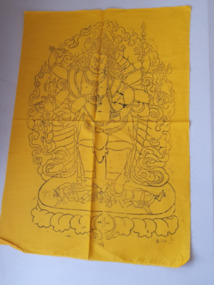 Great Stupa of Universal Compassion
Print - Woodblock print of Vajrayogini, Tashilhunpo Monastery
... Woodblock printing...Woodblock printing in Tibet began to flourish from the 10th century onwards, driven by the high demand for Buddhist scriptures and images. ...Woodblock print of Vajrayogini on yellow cloth, created using an old wooden handcrafted printing board from Tashilhunpo Monastery in Tibet....Woodblock printing in Tibet began to flourish from the 10th century onwards, driven by the high demand for Buddhist scriptures and images. ...Woodblock printing in Tibet began to flourish from the 10th century onwards, driven by the high demand for Buddhist scriptures and images. Monasteries saw woodblock printing as a means to preserve and propagate authentic Buddhist teachings. The durability of woodblocks made them ideal for creating lasting impressions of sacred texts, enabling mass production and wide dissemination.Vajrayogini is considered a female Buddha, embodying the ultimate state of enlightenment. She represents the union of wisdom and compassion and is known for her ability to transform strong passions into enlightened virtues.Woodblock print of Vajrayogini on yellow cloth, created using an old wooden handcrafted printing board from Tashilhunpo Monastery in Tibet.woodblock printing, buddhist art -
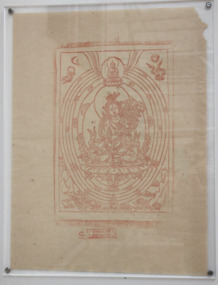 Great Stupa of Universal Compassion
Print - White Tara print from a woodblock, Derge Sutra Printing House (Derge Parkhang)
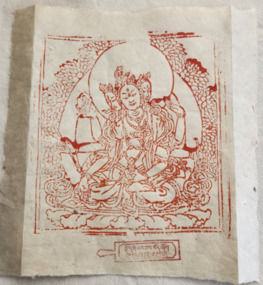
... Woodblock printing...Woodblock printing in Tibet began to flourish from the 10th century onwards, driven by the high demand for Buddhist scriptures and images. ...White Tara woodblock print on paper in red ink, created using an old wooden handcrafted printing board from the Derge Sutra Printing House. ...Woodblock printing in Tibet began to flourish from the 10th century onwards, driven by the high demand for Buddhist scriptures and images. ...Woodblock printing in Tibet began to flourish from the 10th century onwards, driven by the high demand for Buddhist scriptures and images. Monasteries saw woodblock printing as a means to preserve and propagate authentic Buddhist teachings. The durability of woodblocks made them ideal for creating lasting impressions of sacred texts, enabling mass production and wide dissemination. Those involved in the printing process consider their work an offering to the Buddha.White Tara, revered as a compassionate and healing deity, is considered to provide protection, health, and longevity. She embodies the transcendent wisdom that helps practitioners overcome physical and mental suffering. White Tara woodblock print on paper in red ink, created using an old wooden handcrafted printing board from the Derge Sutra Printing House. Framed, sandwiched between acrylic sheets.woodblock printing, buddhist art -
 Flagstaff Hill Maritime Museum and Village
Document - Poster, Warrnambool Steam Navigation Co, ca.1938
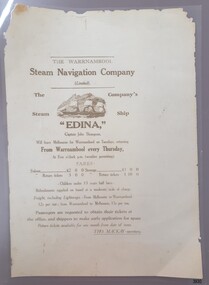
... ...woodblock printing...The Edina is listed on the Victorian Heritage Database VHR S199. warrnambool shipwreck coast flagstaff hill flagstaff hill maritime museum maritime museum fair maid of judea steam navigation pleasure steamer ss Edina a trade 19th century travel 19th century Warrnambool to Melbourne Warrnambool to Geelong Warrnambool to Port Fairy Warrnambool to Portland screw steamer coastal trader Crimean war American civil war gold export h r h duke of Edinburgh Warrnambool steam packet company stephen henty captain john Thompson chief engineer John Davies lady bay lighter Edina port phillip bay steamers vhr s199 dinah warrnambool steam navigation company advertising poster shipping agent flier Maritime Village Flagstaff Hill Maritime Museum & Village Great Ocean Road block printing woodblock printing relief printing Moorabool St Wharf western steam navigation company Tho. ...This poster is typical of posters displayed by steam packet companies of the mid-19th to early 20th centuries. It advertises the passage and freight available on a local coastal trader. The steamships operated between the major ports along the western coast of Victoria between Melbourne and Portland. The traveller was not guaranteed the passage times due to possible weather changes. Discounts were offered for return trips within a month of the ticket's issue. The price of freight included 'lighterage', which was the service of a smaller vessel called a 'lighter' expressly designed to transport goods between ship and shore. This particular poster has been recreated; it advertises the services of the screw steamer SS Edina. The information on the poster applies to the years between 1871 and 1873. During that period the Master of the Edina was Captain John Thompson, the Edina was owned by the Warrnambool Steam Navigation Company and the secretary of the firm was Thos. Mackay. The passenger fares are in line with fares from that period, as seen in a display advertisement published in the Hamilton Spectator on January 17th, 1872. The 1853 Glasgow-built Screw Ship Edina had a long life. The ship served in both the Crimean War and the American Civil War. The Edina also traded in UK and European waters. The Henty family of Portland, Victoria, purchased Edina in 1863 for use as a coastal trader. The Edina had several owners and spent many years of service along the South West Coast of Victoria between Melbourne and Portland. The vessel transported passengers and freight in Port Phillip Bay, between Melbourne and Geelong, between 1880 and 1938. After 84 years of service, the Edina was renamed ‘Dinah’ and was stripped down for use as a lighter. The vessel was broken up in 1957 at Footscray, Melbourne. The remains of Edina’s hull can be found in the Maribyrnong River, Port Phillip Bay. The poster was owned by the donor's grandfather, Bruce Duff (1922-2003) who was an avid sailor and a lover of nautical history. He and his wife Mona (1924-2014) were buried in Portarlington Cemetery, Victoria. Duff would have been about 13 years old when the Edina was finally retired from service in 1938. His interest in the Edina could have come from a trip on the vessel or from watching it in operation in the ports along the coast. Duff has collected this poster as a memento of the Edina and is likely to have preserved it at a much later date when the lamination process was readily available. [Flagstaff Hill's collection includes a photograph of the Edina at the Moorabool Street Wharf, Geelong, which was in Duff's locality. The References for this poster include a link to Museum Victoria's photograph of two boys watching the Edina from a jetty.] Flagstaff Hill's Village has its own 'Examiner' Office where volunteers demonstrate the historic printing press in that building. They use original letter-type to create posters, print labels onto lolly bags and designs on fabrics. One of the volunteer printers has produced a poster closely resembling the donated poster. His replication includes a woodcut of the ship, which he skilfully crafted himself.This poster advertises the sailing of the steamer SS Edina and the information has local and State significance for its association with the trading ports of the Edina, and the associated names on the poster; Warrnambool Steam Navigation Company, Captain John Thompson and Thos. Mackay. This poster's message has a strong connection to the history of the businesses and community of Warrnambool and the people of Port Phillip Bay, where it was a passenger ferry for many years. The poster is an example of advertising used by shipping agents in the mid-19th to early 20th centuries. Its information includes the accurate costs to passengers and freighters and the type of timetable the vessels were likely to follow. The poster's connection with the Screw Steamship Edina is historically significant, as the vessel was the longest serving screw steamer in the world. The ship spent its first nine years overseas then arrived in Melbourne. The vessel's work included running the essential service of transporting cargo and passengers between Melbourne and the western Victoria ports of Warrnambool, Port Fairy and Portland. The Edina is listed on the Victorian Heritage Database VHR S199. Poster, A3 size, brown text on cream paper, laminated. Re-created poster of the Warrnambool Steam Navigation Company (Limited) advertising passage and freight on its Screw Steamship, SS Edina. It states days, times and fees for passage and freight from Warrnambool to Melbourne, and return. It names the ship's Master, Captain John Thompson and the Company's Secretary, Tho. Mackay. It displays a line drawing of a 3-masted ship with full sails.Printed image [side profile of a 3 masted vessel, bow facing left] Printed text includes "The Warrnambool Steam Navigation Company (Limited). The Company's Steam Ship "EDINA", Captain John Thompson, Will leave Melbourne for Warrnambool on Tuesdays, returning from Warrnambool every Thursday, At Five o'clock p.m. (weather permitting). FARES: Saloon £2 0 0 Steerage £1 0 0 Saloon return £3 0 0 Saloon return £1 10 00 - Children under 13 years half fares - Refreshments supplied onboard at a moderate scale of charge. Freight, including lighterage, - From Melbourne to Warrnambool - 12s per ton; from Warrnambool to Melbourne, 15s per ton. Passengers are requested to obtain their tickets at the offers, and shippers to make early application for space. Return tickets available for one month from date of issue. - THO. MACKAY, secretary. "warrnambool, shipwreck coast, flagstaff hill, flagstaff hill maritime museum, maritime museum, fair maid of judea, steam navigation, pleasure steamer, ss edina a, trade 19th century, travel 19th century, warrnambool to melbourne, warrnambool to geelong, warrnambool to port fairy, warrnambool to portland, screw steamer, coastal trader, crimean war, american civil war, gold export, h r h duke of edinburgh, warrnambool steam packet company, stephen henty, captain john thompson, chief engineer john davies, lady bay, lighter edina, port phillip bay steamers, vhr s199, dinah, warrnambool steam navigation company, advertising poster, shipping agent, flier, maritime village, flagstaff hill maritime museum & village, great ocean road, block printing, woodblock printing, relief printing, moorabool st wharf, western steam navigation company, tho. mackay, re-created poster -
 Great Stupa of Universal Compassion
Print - Woodblock print of Namgyalma, Derge Sutra Printing House (Derge Parkhang)
... Woodblock printing...This block print was made from one of those historic woodblocks that are now designated as protected treasure of Derge Printing Press and therefore not allowed to be used anymore. ...Reciting her mantra can help purify negative karma, heal diseases, and ensure a favorable rebirth. Woodblock printing Buddhist art Woodblock print of Namgyalma printed in red on parchment paper Print Woodblock print of Namgyalma Derge Sutra Printing House (Derge Parkhang) ...Woodblock print of Namgyalma, a deity associated with long life and purification. The engraver of the woodblock was the historically famous artist called Tsangpo. This block print was made from one of those historic woodblocks that are now designated as protected treasure of Derge Printing Press and therefore not allowed to be used anymore. Those involved in the printing process consider their work an offering to the Buddha.Namgyalma, often depicted in female form, is believed to remove obstacles that shorten one's lifespan. Reciting her mantra can help purify negative karma, heal diseases, and ensure a favorable rebirth.Woodblock print of Namgyalma printed in red on parchment paper woodblock printing, buddhist art -
 Ballarat Heritage Services
Work on paper, Bede TANGUTALUM, Yam, 1991
... Tungutalum learned carving from his father, the well-known sculptor Gabriel Tungutalum, and was taught how to cut woodblocks for printing while attending Xavier Boys School at Nguiu. ...Tungutalum learned carving from his father, the well-known sculptor Gabriel Tungutalum, and was taught how to cut woodblocks for printing while attending Xavier Boys School at Nguiu. ...Bede TANGUTALUM (1952- ) Wurrumiyanga (Nguiu), Bathurst Island Tiwi People Bede Tungutalum works across a range of media, including carved and painted wooden sculpture,printmaking and painting. Tungutalum learned carving from his father, the well-known sculptor Gabriel Tungutalum, and was taught how to cut woodblocks for printing while attending Xavier Boys School at Nguiu. He refined and developed these techniques in the late 1960s and early 1970s. His earliest prints date from the late 1960s. In 1969, with fellow Tiwi artist Giovanni Tipungwuti, Bede Tungutalum established Tiwi Design, an art centre dedicated to the production of hand-printed fabrics featuring traditional Indigenous designs.Framed lithograph depicting yams, printed in colour inks, from multiple stonesbede tangutalum, tiwi, wurrumiyanga, bathurst island, tiwi design, yam, aboriginal -
 City of Melbourne Libraries
Photograph, Bull, Hugh Jones, 1897-1993, Japanese woodblock prints
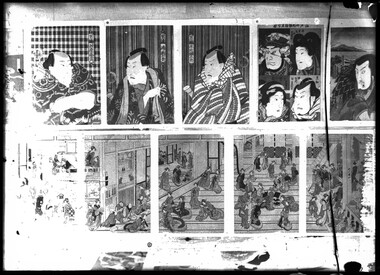
... In the 18th century, Suzuki Harunobu established the technique of multicolor woodblock printing called nishiki-e and greatly developed Japanese woodblock printing culture such as ukiyo-e. ...In the 18th century, Suzuki Harunobu established the technique of multicolor woodblock printing called nishiki-e and greatly developed Japanese woodblock printing culture such as ukiyo-e. ...A DECK GALLERY FOR JAPANESE PRINTS. A unique exhibition of Japanese Prints was opened yesterday on Japanese ship Kamo Maru.These pictures are the property of the captain of the Kamo Maru Captain T. Takahata, and are displayed in a specially arranged gallery on the deck of the ship now berthed at No. 13 Victoria Dock. A picture on board yesterday after noon. (Inset) - One of many fine works by Utaguard Toyokuni who died in 1825. Photographer notations on slide: "B21" Published: 23 February 1934 Published title: A DECK GALLERY FOR JAPANESE PRINTS. Published caption: A unique exhibition of Japanese Prints was opened yesterday on Japanese ship Kamo Maru.These pictures are the property of the captain of the Kamo Maru Captain T. Takahata, and are displayed in a specially arranged gallery on the deck of the ship now berthed at No. 13 Victoria Dock. A picture on board yesterday after noon. (Inset) - One of many fine works by Utaguard Toyokuni who died in 1825. Trove article identifier: http://nla.gov.au/nla.news-article203376863 Description: Japanese woodblock prints, probably belonging to Captain Takahata of the Japanese passenger and cargo ship Kamo Maru, who displayed his Japanese Woodblock prints in a special on-board gallery when it visited Melbourne during 1933 and 1934. Research by project volunteer, Louise McKenzie: Plate MCK025 shows a number of Japanese woodblock prints. Three are of traditional “samurai” or Kabuki-style Japanese men in traditional dress and hairstyle; one is a composite of four different prints: two men and two women (samurai/geisha) in traditional dress. There are also several prints appearing to depict traditional scenes of indoor and outdoor life in Japan in the Edo period. An article appeared in The Age in February 1934, covering the visit to Melbourne of Captain T Takahata on the Japanese ship the Kamo Maru. An accompanying photo shows several women, in coats and hats, and a man, closely inspecting a gallery hang of Japanese woodblocks. Inset is a single image of a Kabuki theatre performer, a detail from the full photograph as shown in our slide. This work is attributed to Utagawa Toyokuni (1769-1823), who was mostly known for his prints relating to kabuki theatre and the actors’ dramatic postures. Japanese Kabuki theatre features heavily stylised performances, glamorous, highly decorated costumes and elaborate make-up worn by its performers. It was particularly popular in the Edo period (1615-1868), as was woodblock printing, after its earlier introduction from China around 150 years earlier. Woodblock printing in Japan is a technique best known for its use in the ukiyo-e artistic genre of single sheet images (although books were also created) which flourished from the 17th through 19th centuries. Its artists produced woodblock prints and paintings of such subjects as female beauties; kabuki actors and sumo wrestlers; scenes from history and folk tales; travel scenes and landscapes; flora and fauna, and erotica. The term ukiyo-e translates as 'picture[s] of the floating world'. This expression could be confusingly translated as meaning ‘a world of sorrow and grief’, 'erotic’ or ‘stylish’, and later came to describe the hedonistic spirit of the lower classes of the 17th century. Asai Ryōi celebrated this spirit in the novel Ukiyo Monogatari (Tales of the Floating World), c. 1661: “[L]iving only for the moment, savouring the moon, the snow, the cherry blossoms, and the maple leaves, singing songs, drinking sake, and diverting oneself just in floating, unconcerned by the prospect of imminent poverty, buoyant and carefree, like a gourd carried along with the river current: this is what we call ukiyo.” (Wikipedia: 'Ukiyo-e') Mass production of woodblocks during the Edo period was due to high literacy rates: 100% for samurai and 50-60% for farmers. Consequently, cheaper books were produced in large numbers. In the 18th century, Suzuki Harunobu established the technique of multicolor woodblock printing called nishiki-e and greatly developed Japanese woodblock printing culture such as ukiyo-e. Ukiyo-e influenced European Japonisme and Impressionism. Yoshitoshi was called the last great ukiyo-e master, and his cruel depictions and fantastic expressions influenced later Japanese literature and anime. However today the best known exponents from the period are probably Hokusai and Hiroshige.The price of one ukiyo-e at that time was about 20 mon, and the price of a bowl of soba noodles was 16 mon, so the price of one ukiyo-e was several hundred yen to 1000 yen in today's currency. 'Wikipedia: Ukiyo-e' states: “Japanese art, and particularly ukiyo-e prints, came to influence Western art from the time of the early Impressionists. Early painter-collectors incorporated Japanese themes and compositional techniques into their works as early as the 1860s: the patterned wallpapers and rugs in Manet's paintings were inspired by the patterned kimono found in ukiyo-e pictures, and Whistler focused his attention on ephemeral elements of nature as in ukiyo-e landscapes. Van Gogh was an avid collector, and painted copies in oil of prints by Hiroshige and Eisen. Degas and Cassatt depicted fleeting, everyday moments in Japanese-influenced compositions and perspectives. ukiyo-e's flat perspective and unmodulated colours were a particular influence on graphic designers and poster makers. Toulouse-Lautrec's lithographs displayed his interest not only in ukiyo-e's flat colours and outlined forms, but also in their subject matter: performers and prostitutes. He signed much of this work with his initials in a circle, imitating the seals on Japanese prints. Other artists of the time who drew influence from ukiyo-e include Monet, La Farge, Gauguin, and Les Nabis members such as Bonnard and Vuillard. French composer Claude Debussy drew inspiration for his music from the prints of Hokusai and Hiroshige, most prominently in La mer (1905). Imagist poets such as Amy Lowell and Ezra Pound found inspiration in ukiyo-e prints; Lowell published a book of poetry called Pictures of the Floating World (1919) on oriental themes or in an oriental style.” An awareness of and interest in this style of art seems to have been well established by the time Captain Takahata brought his sailing gallery to Australia in the 1930s. The Age article “Colour Prints from Japan” on 22 February 1934 p. 13, consists predominantly of a sophisticated curatorial assessment of the woodblock style and detailed artist and style information, which is remarkable for its in-depth analysis. The writer even draws attention to the existence of female woodprint artists. It has been difficult to verify those noted in this article, but worth drawing attention to the work produced by the daughter of Hokusai, Katsushika Oi, which is documented and has gained attention within Japan and elsewhere. Captain Takahata may have been quite the ambassador: adverts in Australian quarterly magazine, The Home, promoted regular cruises out of Melbourne and Sydney via Queensland, Thursday Island, Phillippines and Hong Kong to Japan at a cost of £90 for a round trip via Yokohama.(The Home, 1 August 1936, pages 76 and 79). It is reported in one of the many newspapers articles printed during 1933/1934 about Captain Takahata and his collection, that he inherited it, and it was not for sale even at an offered £10,000. However, one article makes mention of him scouring antique shops in rural Japan to add to the collection! And even enlisting the help of his children in the hunt. The collection totalled 11,000 prints and apparently 1,500 travelled with him when he sailed. These numbers do differ between reports, but his collection was undoubtedly large, and Captain Takahata enjoyed lecturing on the subject, explaining that each print was handmade. It took painstaking work over months to create the delicate colour tones, with a block being created for each colour used, and transferred onto specially prepared paper. Many of the designs are symbolic, and even those representing figures and scenes have a narrative basis, or represent traditional incidents in the life and history of Japan. (See Japanese Prints, The Sydney Morning Herald, 14 July 1934). In Brisbane in October 1934, The Courier Mail noted that Captain Takahata, now on the Yusen Kaisha steamer ‘Atsuta Mam’ (a sister ship to Kamo Maru) arrived with another 100 prints in his possession, and that he spent his spare time mounting and cataloguing his treasures. One of his new additions dated from 1787 and Captain Takahata “said that it was the only woodcut to depict eyelashes, and with the aid of a magnifying glass, he showed the extremely fine lines around the eyes of the three Japanese ladies on the print.” References: COLOR PRINTS FROM JAPAN. (1934, February 22). The Age (Melbourne, Vic. : 1854 - 1954), p. 13. Retrieved February 29, 2024, from http://nla.gov.au/nla.news-article20338088 A DECK GALLERY FOR JAPANESE PRINTS. (1934, February 23). The Age (Melbourne, Vic. : 1854 - 1954), p. 11. Retrieved February 29, 2024, from http://nla.gov.au/nla.news-article203376863 JAPANESE WOOD-CUTS. (1934, July 14). Daily Commercial News and Shipping List (Sydney, NSW : 1891 - 1954), p. 4. Retrieved February 29, 2024, from http://nla.gov.au/nla.news-article161150580 JAPANESE PRINTS. (1934, July 14). The Sydney Morning Herald (NSW : 1842 - 1954), p. 12. Retrieved February 29, 2024, from http://nla.gov.au/nla.news-article28024038 RARE WOOD-PRINTS FROM JAPAN (1934, July 16). The Herald (Melbourne, Vic. : 1861 - 1954), p. 20. Retrieved March 2, 2024, from http://nla.gov.au/nla.news-article243171208 JAPANESE WOODPRINTS. (1934, July 14). The Sydney Morning Herald (NSW : 1842 - 1954), p. 16. Retrieved March 2, 2024, from http://nla.gov.au/nla.news-article28023902 11,000 RARE WOODCUTS (1934, October 11). The Courier-Mail (Brisbane, Qld. : 1933 - 1954), p. 18. Retrieved March 2, 2024, from http://nla.gov.au/nla.news-article35647690 A DECK GALLERY FOR JAPANESE PRINTS. (1934, February 23). The Age (Melbourne, Vic. : 1854 - 1954), p. 11. Retrieved March 2, 2024, from http://nla.gov.au/nla.news-article203376863 RARE JAPANESE PRINTS (1934, July 11). The Courier-Mail (Brisbane, Qld. : 1933 - 1954), p. 10. Retrieved March 2, 2024, from http://nla.gov.au/nla.news-article36723139 Wikipedia: 'Ukiyo-e', https://en.wikipedia.org/wiki/Ukiyo-e Wikipedia: 'Woodblock printing in Japan', https://en.wikipedia.org/wiki/Woodblock_printing_in_Japan Wikipedia: 'Utagawa Toyokuni', https://en.wikipedia.org/wiki/Utagawa_Toyokuni Wikipedia: 'Kabuki', https://en.wikipedia.org/wiki/Kabuki 'Digital Humanities and Japanese History',https://dh.japanese-history.org/2020-spring-women-in-japanese-history/japanese-women-artists-of-the-edo-period/ '25 Famous Painters in Japanese Art', https://dh.japanese-history.org/2020-spring-women-in-japanese-history/japanese-women-artists-of-the-edo-period/ 'Nyk Kamo Maru', https://blog.shipwatcher.com/index.php/nyk-kamo-maru/ The Home : an Australian quarterly Retrieved March 4, 2024, from http://nla.gov.au/nla.obj-386036987 : Volume 17, No. 8, 1 August 1936.Photographer notations on slide: "B21".japan, prints, ships, art -
 Great Stupa of Universal Compassion
Work on paper - Buddhist scripture in Tibetan script
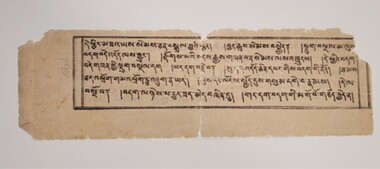
... The ancient Tibetan art of printing was developed to reproduce Buddhist scriptures and images of the Buddha. Monasteries or wealthy laypersons often commissioned books to gain spiritual merit. Books were printed using woodblock ...This page is from a Tibetan prayer book. Such books are long, narrow, and printed horizontally. The pages are unbound and stored with wooden covers with silk brocade wrapped around them. The ancient Tibetan art of printing was developed to reproduce Buddhist scriptures and images of the Buddha. Monasteries or wealthy laypersons often commissioned books to gain spiritual merit. Books were printed using woodblock technique, still utilised today, on handmade paper. Scripture books are venerated by both monks and general population. A double-sided sheet of Buddhist scripture written in Tibetan script on hand-made paper. The sheet is torn in half and frying at the edges due to old age.Includes a Bodhicitta prayer and some dedication prayers.tibetan buddhism -
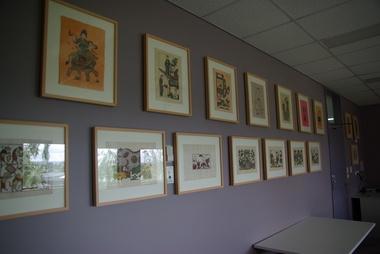 Federation University Art Collection
Print - Printmaking, Artwork from Dong Ho Village, c1970-2010
... As a village specialized in making woodcuts and paintings, almost all Đông Hồ villagers were involved in the manufacturing of paintings from carving the woodblocks, producing điệp papers, obtaining natural colours to creating new themes, and printing....As a village specialized in making woodcuts and paintings, almost all Đông Hồ villagers were involved in the manufacturing of paintings from carving the woodblocks, producing điệp papers, obtaining natural colours to creating new themes, and printing. ...Dong Ho is on the Duong River in Bắc Ninh Province, Vietnam. The woodcut painting (Tranh khắc gỗ dân gian Dong Ho is a line of Vietnamese folk painting originating in Dong Ho village. The traditional themes of Dong Ho painting are good luck signs, historical figures, folk allegories, popular stories, and social commentaries. Elements of everyday life are well integrated in Dong Ho paintings to express the thoughts and wishes of people. (Wikipedia - https://en.wikipedia.org/wiki/%C4%90%C3%B4ng_H%E1%BB%93_painting, accessed 11 April 2017.) Craftsmen in Dong Ho use a special type of paper named giấy điệp. The bark of dó tree, which normally is grown in Tuyên Quang Province, is soaked in water for months, then mixed with powders of seashells (sò điệp), which is the origin of the paper's name, and glutinous rice to make sheets of paper. The s seashell and glutinous rice results in paper with an exotic sparkling hard background which is able to conserve the durability of colours. The colours are refined from natural materials which are easily found in Vietnam. For instance, the red colour is taken from red gravel in Thiên Thai Mountain, while the black comes from charcoal of burned bamboo leaves. The hand carved woodblock is applied with paint and pressed on a sheet of paper like a stamp. The process is repeated with different colours until the craftsman is satisfied with the outcome. One woodcut is for outline and several others are for each colour printed. The finished picture is covered with a layer of rice paste (hồ nếp) to strengthen the durability of its illustration and colours and afterwards dried under the sun. From beginning to end the process takes six to seven months. (Wikipedia - https://en.wikipedia.org/wiki/%C4%90%C3%B4ng_H%E1%BB%93_painting, accessed 11 April 2017.) The tradition of Đông Hồ painting dates back to the 11th century during the reign of the Lý Dynasty. Originally, Đông Hồ paintings were made with black-and-white prints of woodcuts, but from the 15th century, different colours were introduced by craftsmen in the village. As a village specialized in making woodcuts and paintings, almost all Đông Hồ villagers were involved in the manufacturing of paintings from carving the woodblocks, producing điệp papers, obtaining natural colours to creating new themes, and printing.(Wikipedia - https://en.wikipedia.org/wiki/%C4%90%C3%B4ng_H%E1%BB%93_painting, accessed 11 April 2017.) Before 1945 over 150 families in Đông Hồ village were making pictures, but the tradition has rapidly faded. Villagers can no longer make a living based on this production so only a few households in the village still make pictures, while many others have switched to producing joss paper and votive paper object.(Wikipedia - https://en.wikipedia.org/wiki/%C4%90%C3%B4ng_H%E1%BB%93_painting, accessed 11 April 2017.)Asian ArtA framed collection of work by children from Dong Ho Village, Vietnam.dong ho, vietnam, woodcut, printmaking, dong ho art, dong ho painting, dong ho village, vietnam.
