
Showing 11 items matching "wooden money box"
-
 Flagstaff Hill Maritime Museum and Village
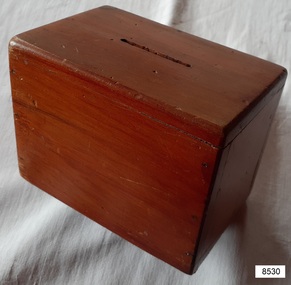
Container - Money box
... money box...money safe...Vintage money box...wooden...money box was possibly used in an organisation such as the Missions to Seamen as a donation box, particularly as there is no means of easily opening the box or tampering with it. The money box is an example of a way of collecting money as a donation or contribution for an organisation or charity. Flagstaff Hill Flagstaff Hill Maritime Museum and Village Warrnambool Maritime Museum Maritime Village Great Ocean Road Shipwreck Coast money box money safe Vintage money box wooden ...Metal money boxes shaped like common familiar objects became a popular from the 18th century. In the 20th century they were used to promote and advertise events and businesses. In the 1950s money boxes shaped like a bank building were given away to children by their parents' bank to encourage them to save money. This money box was possibly used in an organisation such as the Missions to Seamen as a donation box, particularly as there is no means of easily opening the box or tampering with it.The money box is an example of a way of collecting money as a donation or contribution for an organisation or charity.Money box, rectangular polished wood money box with coin slot in the top and a blue felt fabric pad on the base. The base has a purple stamped inscription which is indecipherable. There is no obvious means of opening the box. The box has contents.Stamp (indecipherable)flagstaff hill, flagstaff hill maritime museum and village, warrnambool, maritime museum, maritime village, great ocean road, shipwreck coast, money box, money safe, vintage money box, wooden money box, savings, donations, collection, contribution -
 Whitehorse Historical Society Inc.
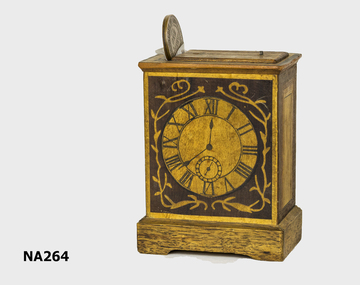
Container - Money Box
... Wooden child's money box with Roman numeral clock face on one side....toys general Wooden child's money box with Roman numeral clock face on one side. ...Wooden child's money box with Roman numeral clock face on one side.toys, general -
 Whitehorse Historical Society Inc.
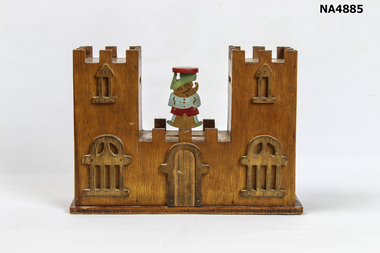
Container - Money box
... Wooden handmade childs money box. Castle shape twin towers. ...Handmade childs saving toy HANDCRAFTS Woodwork Wooden handmade childs money box. Castle shape twin towers. ...Handmade childs saving toyWooden handmade childs money box. Castle shape twin towers. Coin depositor 'child' pivot between towers with very quick coin depositor. Plywood varnished and painted with hand fret workhandcrafts, woodwork -
 Orbost & District Historical Society
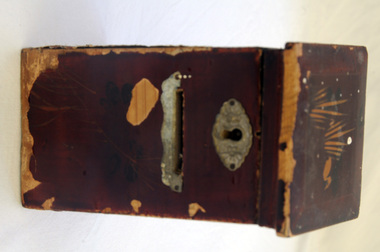
money box, Early 20th century
... container box money-box A light wooden box container covered with shiny brown paper. ...A light wooden box container covered with shiny brown paper. At the front is a keyhole and slot for coins. The hinged lid has detached. The outside lid is decorated with pictures of egrets and reeds. The side have pictures of ferns. It appears to be Chinese made. container box money-box -
 Orbost & District Historical Society
Lipton's Tea tin, 1900 - 1920
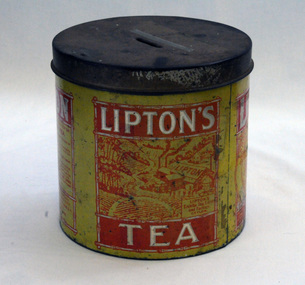
... wooden crates. Pewter (widely used in England) was used one of the earliest metals used to fashion oriental style tea containers. Tin plated iron was made into tea canisters as early as 1790, often hand painted with places of the tea's origin. This tin has been adapted for use as a money box...wooden crates. Pewter (widely used in England) was used one of the earliest metals used to fashion oriental style tea containers. Tin plated iron was made into tea canisters as early as 1790, often hand painted with places of the tea's origin. This tin has been adapted for use as a money box ...Tea was one of the first goods to be packaged in metal containers. Early import/export companies shipped it in metal-lined wooden crates. Pewter (widely used in England) was used one of the earliest metals used to fashion oriental style tea containers. Tin plated iron was made into tea canisters as early as 1790, often hand painted with places of the tea's origin. This tin has been adapted for use as a money box.In the mid-nineteenth century custom branded tins developed as a tasteful form of advertising. They were often cheap and decorative and found their way into households as gifts, often being kept as ornaments and storage boxes.They have survived well in many homes. A cylindrical metal Lipton's tin. The lid has a slot cut into it. The front panel has "LIPTON'S" above a red drawing of a tea factory and plantation with" TEA" below it. The print is white. There are panels framed in bamboo around the tin."Lipton tea, coffee and cocoa planter: Tea merchant by special appointment to his majesty King George V"tea-caddy lipton's container -
 Uniting Church Archives - Synod of Victoria
Giving Box, Australasian Home & Foreign Missionary Society giving box, ? Late 19th Century
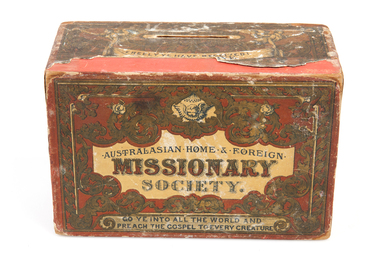
... Box should be opened and the Money sent to Rev. B. Danks, Glenferrie Road, Kew, not later than the end of January in each year B.D." Wooden ...Wooden giving box with paper labelsTop: "freely Ye Have Received! xxx [illegible] Give". Front: "Australasian Home & Foreign Missionary Society : Go ye into all the world and preach the Gospel to every creature". Side 1: "He shall speak peace unto the Heathen". Side 2: "The Idols he shall utterly Abolish". Back: " This Box should be opened and the Money sent to Rev. B. Danks, Glenferrie Road, Kew, not later than the end of January in each year B.D."australasian home & foreign missionary -
 Vision Australia
Functional object - Object, Wooden donation boxes, 1970-1990
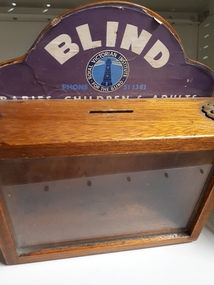
... boxes were placed in a semi-permanent location, such as a shop counter or bar, for people to donate money. Periodically it would be emptied by a collector, who either unlocked the padlock that was usually attached or replaced it with a new box. royal victorian institute for the blind fundraising Blind Babies, Children & Adults Royal Victorian Institute for the Blind Phone 51 1381 All services provided by the RVIB are free - thanks to your help 2 wooden boxes with paper label, perspex or glass,metal hinges and locking mechanism. ...Coin collections have a long and varied history. Coins were often collected in churches in a box located near the entrance/exit, and later via a collection plate that was passed amongst the congregation Funds were used to repair the church or feed the poorest of the parish. The donation of coins is and was considered part of religious life and mentioned in Christian, Jewish and Islamic texts. With the need and expansion of charitable works occurring outside religious life, charity boxes began to spread into hospitals, orphanages and asylums. The need for non-fixed boxes grew with the rise in charities and their activities outside a fixed building. Collection boxes could be large (and therefore hard to move) or could be held by individuals acting as collection agents, working at a specific location, moving between dwellings or at events. In this example, the boxes were placed in a semi-permanent location, such as a shop counter or bar, for people to donate money. Periodically it would be emptied by a collector, who either unlocked the padlock that was usually attached or replaced it with a new box.2 wooden boxes with paper label, perspex or glass,metal hinges and locking mechanism.Blind Babies, Children & Adults Royal Victorian Institute for the Blind Phone 51 1381 All services provided by the RVIB are free - thanks to your helproyal victorian institute for the blind, fundraising -
 Vision Australia
Machine - Object, Lucky Envelopes Instant Bingo dispenser, 1970s
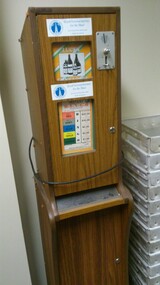
... Wooden box with brown veneer and metal shutes for money inserted and tickets dispensed, with separate locks for doors in top for envelope restocking and base for money collection. ...Royal Victorian Institute for the Blind Fundraising Wooden box with brown veneer and metal shutes for money inserted and tickets dispensed, with separate locks for doors in top for envelope restocking and base for money collection. ...During the 1970's RVIB conducted fund raising through the use of Instant Bingo machines in Melbourne's pubs and clubs. For 20 cents per card, a Lucky Envelope would be provided and amounts from $1 (if all the numbers were green), $2 (gold), $5 (blue), $10 (grey) or $25 (red) could be won. Machines were emptied/refilled by RVIB volunteers and the profits gained were expended by the Institute for services to the blind. Wooden box with brown veneer and metal shutes for money inserted and tickets dispensed, with separate locks for doors in top for envelope restocking and base for money collection. royal victorian institute for the blind, fundraising -
 Vision Australia
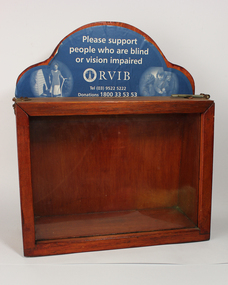
Functional object - Object, RVIB Wooden donation boxes, 1970-1990
... boxes were placed in a semi-permanent location, such as a shop counter or bar, for people to donate money. Periodically it would be emptied by a collector, who either unlocked the padlock that was usually attached or replaced it with a new box. royal victorian institute for the blind fundraising Blind Babies, Children & Adults Royal Victorian Institute for the Blind Phone 51 1381 All services provided by the RVIB are free - thanks to your help 2 wooden boxes with paper label, perspex or glass,metal hinges and locking mechanism. ...Coin collections have a long and varied history. Coins were often collected in churches in a box located near the entrance/exit, and later via a collection plate that was passed amongst the congregation Funds were used to repair the church or feed the poorest of the parish. The donation of coins is and was considered part of religious life and mentioned in Christian, Jewish and Islamic texts. With the need and expansion of charitable works occurring outside religious life, charity boxes began to spread into hospitals, orphanages and asylums. The need for non-fixed boxes grew with the rise in charities and their activities outside a fixed building. Collection boxes could be large (and therefore hard to move) or could be held by individuals acting as collection agents, working at a specific location, moving between dwellings or at events. In this example, the boxes were placed in a semi-permanent location, such as a shop counter or bar, for people to donate money. Periodically it would be emptied by a collector, who either unlocked the padlock that was usually attached or replaced it with a new box.2 wooden boxes with paper label, perspex or glass,metal hinges and locking mechanism.Blind Babies, Children & Adults Royal Victorian Institute for the Blind Phone 51 1381 All services provided by the RVIB are free - thanks to your helproyal victorian institute for the blind, fundraising -
 Trafalgar Holden Museum
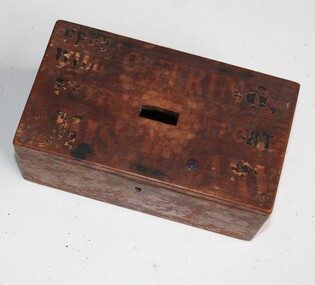
Container - Collection box, Ca1900
... Used ca1900 at church meetings for donations of money for missionary activities As sold by Holden and Frost Ca1900 Wooden Box Offering for support missionary Brown wooden collection box. ...Used ca1900 at church meetings for donations of money for missionary activitiesAs sold by Holden and Frost Ca1900Brown wooden collection box. Slot on top with inscriptionOffering for support missionarywooden, box -
 St Kilda Historical Society
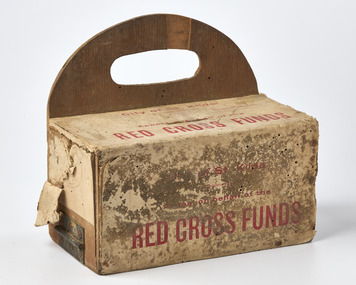
Container - Collection box, Red Cross collection box, c1900s
... There was also a St Kilda Patriotic Carnival at Luna Park in 1917 to raise money for the Australian Comforts Fund and the Red Cross Fund. The typography, the relatively utilitarian wooden construction of the box and its poor condition indicate that it is likely to have been associated with that time. ...There was also a St Kilda Patriotic Carnival at Luna Park in 1917 to raise money for the Australian Comforts Fund and the Red Cross Fund. The typography, the relatively utilitarian wooden construction of the box and its poor condition indicate that it is likely to have been associated with that time. ...The City of St Kilda was directly involved in fundraising for the Red Cross in both WWI and WWII. There was, for example, a Grand Patriotic and Red Cross Festival in October 1916, with proceeds going to the Patriotic and Red Cross funds. There was also a St Kilda Patriotic Carnival at Luna Park in 1917 to raise money for the Australian Comforts Fund and the Red Cross Fund. The typography, the relatively utilitarian wooden construction of the box and its poor condition indicate that it is likely to have been associated with that time. However, it may be connected with WWII. Shortly after the outbreak of WWII the City of St Kilda convened a meeting at St Kilda Town Hall concerning local patriotic activities and the formation of a St Kilda Branch of the Red Cross, and had an active Red Cross fundraising network throughout the war.Wooden box, plywood construction with paper label on top and front, printed in red. One side is hinged to allow opening. Back of box extends up to form a handle. On the top is a slot for coins. On the top, and on the front: City of St. Kilda. Appeal on behalf of the RED CROSS FUNDScity of st kilda, wwi fund-raising, st kilda red cross
