
Showing 16 items matching "wooden pavilion"
-
 University of Melbourne, Burnley Campus Archives
Newspaper, The Argus, Tenders for Wooden Pavilion, 19.03.1883-18.04.1884
... Tenders for Wooden Pavilion......wooden pavilion...Copies of advertisements. 1. Tenders for Wooden Pavilion and Annexes for Horticultural Society, Hawthorn. ...Tenders for Wooden Pavilion and Annexes for Horticultural Society, Hawthorn. ...tenders, wooden pavilion, pavilion, horticultural society, royal horticultural society of victoria, alfred kursteiner, architect, roofing -
 Kew Historical Society Inc
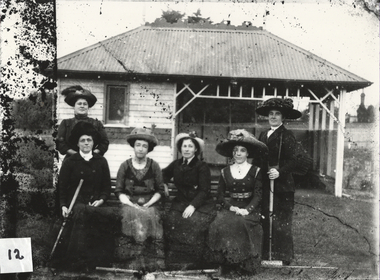
Photograph, Croquet Players, 1900-1920
... Six croquet players pose for a group photograph outside a wooden pavilion. Two of the women hold their sticks whereas the two central figures rest their sticks at their feet....Six croquet players pose for a group photograph outside a wooden pavilion. Two of the women hold their sticks whereas the two central figures rest their sticks at their feet. ...This photograph was printed from a glass negative held in the Society's picture collection. The original glass negative is part of a set donated to the Society by Ian McKenzie, a professional photographer in Kew. The croquet players, ca. 1900-ca. 1920. Six croquet players pose for a group photograph outside a wooden pavilion. Two of the women hold their sticks whereas the two central figures rest their sticks at their feet.croquet, sports -- women, glass negatives -
 Broadmeadows Historical Society & Museum
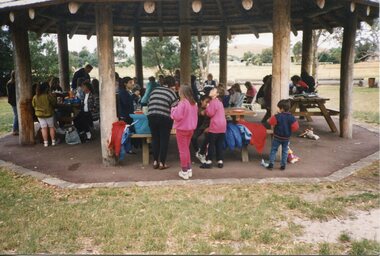
Photograph - Group Photograph, Picnic Under the Pavilion, 1990
... The image shows students, families, and staff gathered under a wooden pavilion, engaging in festive activities that marked the end of the school year. ...The image shows students, families, and staff gathered under a wooden pavilion, engaging in festive activities that marked the end of the school year. ...This photograph documents a moment from the 1990 Jacana Primary School Christmas picnic, likely held at Greenvale Reservoir Park, a popular recreational area in Melbourne’s northern suburbs. The image shows students, families, and staff gathered under a wooden pavilion, engaging in festive activities that marked the end of the school year. Jacana Primary School was established in 1959 to serve the growing suburban community of Jacana, part of Melbourne’s post-war urban expansion. The school became a central institution in the area, not only for education but also for fostering social bonds among families from diverse backgrounds. Annual events like the Christmas picnic were key to the school’s ethos, promoting inclusivity, celebration, and connection to nature. Greenvale Reservoir Park, where the picnic was likely held, offered a scenic and accessible venue for such gatherings. Its open spaces and family-friendly amenities made it an ideal location for school events, reinforcing the school’s commitment to outdoor learning and community engagement. The photograph is historically significant as it reflects broader trends in public education during the late 20th century in Melbourne’s outer suburbs—particularly the role of schools in building community identity and supporting intergenerational relationships. It also captures the spirit of Jacana Primary School before its closure in the early 2000s, preserving a visual memory of its contribution to local life.This photograph, taken during the 1990 Jacana Primary School Christmas picnic at Greenvale Reservoir Park, holds cultural and historical significance as a visual record of community life and educational values in Melbourne’s northern suburbs during the late 20th century. It captures a moment of joyful gathering under a wooden pavilion, where students, families, and staff came together to celebrate the end of the school year. Jacana Primary School, established in 1959, served as a cornerstone of the Jacana community until its closure in the early 2000s. Events such as the annual Christmas picnic were central to the school’s identity, fostering inclusiveness, friendship, and a strong sense of belonging. The choice of Greenvale Reservoir Park reflects the school’s connection to local landscapes and its commitment to accessible, outdoor learning experiences. The image is significant not only for its depiction of school traditions but also for its broader representation of how public education in Melbourne’s outer suburbs supported social cohesion, local identity, and intergenerational connection. It stands as a testament to the enduring values of joy, community, and inclusivity that defined Jacana Primary School and its legacy within the region.Photograph on glossy paper of a group children in the park.PH18289 (crossed out) PH-4209 (crossed out) PH-4868jacana primary school, christmas picnic, 1990, jacana, christmas party -
 Ringwood and District Historical Society
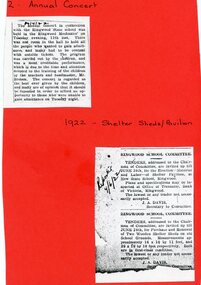
Newspaper - Newspaper cuttings, Ringwood State School- Annual Concert, 1922. Shelter Sheds and Pavilion, 1922
... Pavilion at New State School. 1922. - Tenders invited for the Purchase and Removal of two Wooden Shelter Sheds on old School Grounds. 1922. ... - Tenders invited for erection of Pavilion at New State School. 1922. - Tenders invited for the Purchase and Removal of two Wooden Shelter Sheds on old School Grounds. 1922. ...Copy of cuttings from The Mail, 1922.Ringwood State School - Annual Concert held in the Ringwood Mechanics. 1922. - Tenders invited for erection of Pavilion at New State School. 1922. - Tenders invited for the Purchase and Removal of two Wooden Shelter Sheds on old School Grounds. 1922. -
 Flagstaff Hill Maritime Museum and Village
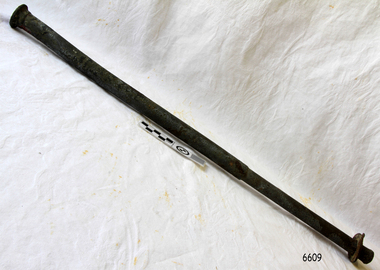
Functional object - Rod, Approx. 1871
... wooden clipper ship, Eric the Red, named after the Viking discoverer, Eric the Red. The ship first traded in coal between America and Britain and later traded in guano nitrates from South America. In 1879 its hull was re-metalled and the vessel was in first class condition. On 10th June 1880 Eric the Red departed New York under the command of Captain Z Allen, with 24 crew plus two passengers. It was heading for Melbourne and then Sydney. The ship was commissioned by American trade representatives to carry a special cargo of 500 American exhibits for the U.S.A. pavilion...wooden clipper ship, Eric the Red, named after the Viking discoverer, Eric the Red. The ship first traded in coal between America and Britain and later traded in guano nitrates from South America. In 1879 its hull was re-metalled and the vessel was in first class condition. On 10th June 1880 Eric the Red departed New York under the command of Captain Z Allen, with 24 crew plus two passengers. It was heading for Melbourne and then Sydney. The ship was commissioned by American trade representatives to carry a special cargo of 500 American exhibits for the U.S.A. pavilion ...This rod was salvaged from the American three-masted wooden clipper ship, Eric the Red, named after the Viking discoverer, Eric the Red. The ship first traded in coal between America and Britain and later traded in guano nitrates from South America. In 1879 its hull was re-metalled and the vessel was in first class condition. On 10th June 1880 Eric the Red departed New York under the command of Captain Z Allen, with 24 crew plus two passengers. It was heading for Melbourne and then Sydney. The ship was commissioned by American trade representatives to carry a special cargo of 500 American exhibits for the U.S.A. pavilion at Melbourne’s first International Exhibition. The items included furniture, ironmongery, wines, chemicals, dental and surgical instruments, paper, cages, bronze lamp trimmings, axles, stamped ware, astronomical and time globes, and samples of corn and the choicest of leaf tobacco. Also on board was general merchandise such as cases of kerosene and turpentine, brooms, Bristol's Sarsaparilla, Wheeler and Wilson sewing machines, Wheeler’s thresher machine, axe handles and tools, cases of silver plate, toys, pianos and organs, carriages and Yankee notions. The ship had been at sea for 85 days when, on 4th September 1880, it hit the Otway Reef on the southwest coast of Victoria and was quickly wrecked. Captain and crew ended up on floating parts, or in the long boat or the sea. He was amongst the 23 battered and injured men who were rescued by the steamer Dawn and later taken to Warrnambool, where they received great hospitality and care. Four men lost their lives; three crew and one passenger. Captain Allen took the train back to Melbourne and then returned to America. The captain and crew of the Dawn were recognised by the United States Government in July 1881 for their humane efforts, being thanked and presented with substantial monetary rewards, medals and gifts. The salvaging ship Pharos collected Wheeler and Wilson sewing machines, nests of boxes, bottles of Bristol’s sarsaparilla, pieces of common American chairs, axe handles, a Wheelers’ Patent thresher and a sailor’s trunk with the words “A. James” on the front. A ship’s flag board bearing the words “Eric the Red” was found on the deckhouse; finally, those on board the Pharos had found the name of the wrecked vessel. The government steamer Victoria and a steamer S.S. Otway picked up flotsam and wreckage. A whole side of the hull and three large pieces of the other side of the hull, with some of the copper sheathing stripped off, had floated onto Point Franklin. Some of the vessel's yards and portions of its masts were on shore with pieces of canvas attached, confirming that the vessel had been under sail. On shore were many cases of Diamond Oil kerosene labelled R. W. Cameron and Company, New York. large planks of red pine, portions of a small white boat and a large, well-used oar. There were sewing machines, some consigned to ‘Long and Co.”, and notions, axe and scythe handles, hay forks, wooden pegs, rolls of wire, some branded “T.S” and Co, Melbourne”, and kegs of nails branded “A.T. and Co.” from the factory of A. Field and Son, Taunton, Massachusetts. Other cargo remains included croquet balls and mallets, buggy fittings, rat traps, perfumery, cutlery and Douay Bibles, clocks, bicycles, chairs, a flywheel, a cooking stove, timber, boxes, pianos, organs, wooden clothes pegs and a ladder. There were three cases of goods meant for the Exhibition Other items salvaged from amongst the debris floating in the sea were chairs, doors, musical instruments, washing boards, nests of trunks and flycatchers. Most of the goods were saturated and smelt of kerosene. A section of the hull lies buried in the sand at Parker River Beach. An anchor with a chain is embedded in the rocks east of Point Franklin and a second anchor, thought to be from Eric the Red, is on display at the Cape Otway light station. A life belt was once on the veranda of Rivernook Guest House in Princetown with the words “ERIC THE RED / BOSTON”. Parts of the ship are on display at Bimbi Park Caravan Park and Apollo Bay Museum. Flagstaff Hill Maritime Village also has several artefacts from the wreck. There seemed to be no personal luggage or clothing. “The Eric the Red is historically significant as one of Victoria's major 19th century shipwrecks. (Heritage Victoria Eric the Red; HV ID 239) The wreck led to the provision of an additional warning light placed below the Cape Otway lighthouse to alert mariners to the location of Otway Reef. The site is archaeologically significant for its remains of a large and varied cargo and ship's fittings being scattered over a wide area. The site is recreationally and aesthetically significant as it is one of the few sites along this coast where tourists can visit identifiable remains of a large wooden shipwreck, and for its location set against the background of Cape Otway, Bass Strait, and the Cape Otway lighthouse.“ (Victorian Heritage Database Registration Number S239, Official Number 8745 USA)Iron rod with flat lugged washer. The rod is made of a heavy metal with encrustations and signs of rusting on the surface. It is stepped down in diameter mid-shaft and is slightly bowed on the narrower end. The narrow end flares out slightly in the last few centimetres with a burred foot and has a circular head on the wider end. The washer on the narrower end cannot move past the centre or the narrow end of the rod. The washer is a different metal from the rod and has a small lug jutting out along the circumference in one position. The rod was recovered from the wreck of the ship the Eric the Red.flagstaff hill, warrnambool, shipwrecked-coast, flagstaff-hill, flagstaff-hill-maritime-museum, maritime-museum, shipwreck-coast, flagstaff-hill-maritime-village, rod, iron-rod, eric the red, steamer dawn, cape otway reef, 1880, captain allen, usa pavillion, melbourne exhibition, melbourne international exhibition, captain jones, medal, united states government, pharos, a. james, flag board, steamer victoria, steamer otway, diamond oil, r w cameron and company, long and co., t s and co melbourne, a. field and son, taunton, massachusetts, ketch apollo, ship nail -
 Embroiderers Guild, Victoria
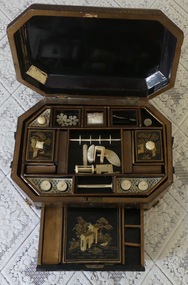
Container - Chinese Lacquer Work and writing box with ivory contents and fittings, Chinese Lacquer Work Box
... pavilion scenes and motifs with butterflies. Two inner compartments, upper one fitted with bone/ivory lids to compartments for needlework. Lower compartment is a drawer with missing contents. Two metal carrying handles, two metal key holes (no keys). Front feet gilded wood, back feet wooden...pavilion scenes and motifs with butterflies. Two inner compartments, upper one fitted with bone/ivory lids to compartments for needlework. Lower compartment is a drawer with missing contents. Two metal carrying handles, two metal key holes (no keys). Front feet gilded wood, back feet wooden ...Typical of work boxes made in China for sale to visiting Europeans 1840'sBlack lacquerware work box, hexagonal, with bone or ivory fittints. Black all-over lacquered surfaces decorated with Chinese pavilion scenes and motifs with butterflies. Two inner compartments, upper one fitted with bone/ivory lids to compartments for needlework. Lower compartment is a drawer with missing contents. Two metal carrying handles, two metal key holes (no keys). Front feet gilded wood, back feet wooden blocks. Interior has one removable fitted tray with eleven compartments. Two compartment lids match gold and green lacquerware of exterior. Two have removvable inserts. Third compartment has removable pincushion insert. Four narrow compartments fitted with wooden blocks to contain tools. Lower drawer has folding writing slope decorated and five compartments for writing toolsExterior: Black lacquer with gold and pale green inlaychinese lacquerware, workbox, ivory needlework accessories -
 Uniting Church Archives - Synod of Victoria
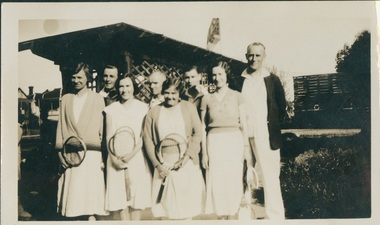
Photograph, Undated c.1930s
... wooden vestry was placed to the rear. The building and the organ were seriously damaged by fire on 1 April 1970, started by a painter's blowtorch. The church was not rebuilt. denham street methodist church, organ, hall tennis B & W photograph of a group of 8 tennis players standing in front of a tennis pavilion. ...The Wesleyan Church, Denham Street in Lower Hawthorn, as the area was then called, was opened on 2 May 1886. The building was designed by Geelong architect William Henry Cleverdon and was built of brick in the Gothic style. Its dimensions were 55 x 33 ft and the façade incorporated a rose window and spire 50 ft high. A wooden vestry was placed to the rear. The building and the organ were seriously damaged by fire on 1 April 1970, started by a painter's blowtorch. The church was not rebuilt.B & W photograph of a group of 8 tennis players standing in front of a tennis pavilion. denham street methodist church, organ, hall, tennis -
 Lakes Entrance Historical Society
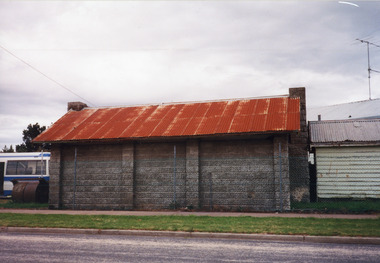
Photograph - Afternoon-tea pavilion built c1946 for Lakes Entrance Cricket Club, 1999
... pavilion built 1946c for Lakes Entrance Cricket Club. Building has a chimney at each end and corrugated iron roof, sited flush of south fence of Recreation Reserve. Also in image small wooden...pavilion built 1946c for Lakes Entrance Cricket Club. Building has a chimney at each end and corrugated iron roof, sited flush of south fence of Recreation Reserve. Also in image small wooden ...Concrete bricks formed pattern mould, made in shed at Kimmell's farm by Clyde Worseldine, WW2 returned service man, in employ of Tambo Shire.Colour photograph of a concrete brick afternoon-tea pavilion built 1946c for Lakes Entrance Cricket Club. Building has a chimney at each end and corrugated iron roof, sited flush of south fence of Recreation Reserve. Also in image small wooden shed which was moved from Post Office residence 1960c when Post Office was extended. Lakes Entrance Victoriasports, cricket, buildings -
 University of Melbourne, Burnley Campus Archives
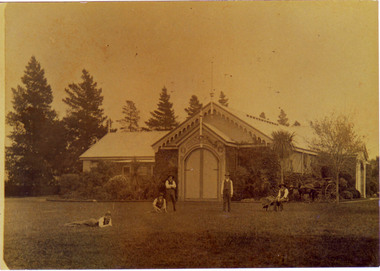
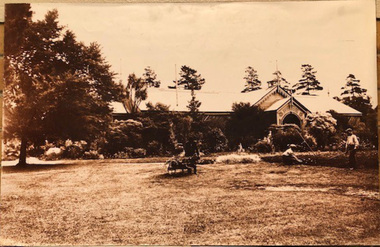
Photograph - Sepia print, A.P. Winzenried, Pavilion, c. 1890
... Horse and cart and five students, 1 with a wooden wheelbarrow, standing and reclining on the lawn in front of the Pavilion....The photo was adapted for use on the Diploma Certificate of the Royal Horticultural School, Burnley, Department of Agriculture. a.p. winzenried green grows our garden pavilion horse and cart east entrance diploma certificate students students working outside lawn Copy of sepia photograph made by A.P. Winzenried for possible use in, "Green Grows Our Garden. Horse and cart and five students, 1 with a wooden ...Notes by E.B. Littlejohn, "Note that the early Pavilion was built with 2 large entrances to allow horse drawn carriages to drive through. Entrance at centre of picture is on eastern side, not the front entrance which can be seen at extreme right and is well established." Note by T.H. Kneen, "The Pavilion early 1890's." The photo was adapted for use on the Diploma Certificate of the Royal Horticultural School, Burnley, Department of Agriculture.Copy of sepia photograph made by A.P. Winzenried for possible use in, "Green Grows Our Garden. Horse and cart and five students, 1 with a wooden wheelbarrow, standing and reclining on the lawn in front of the Pavilion.a.p. winzenried, green grows our garden, pavilion, horse and cart, east entrance, diploma certificate, students, students working outside, lawn -
 University of Melbourne, Burnley Campus Archives
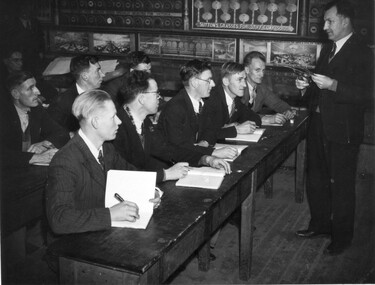
Photograph - Black and white print, The Age, Youth Employment Scheme Students in the Pavilion, 1939
... Black and white photograph. 9 male students sitting at wooden desks in a class in the Pavilion. A. W. Jessep, Principal, is standing in front of the group holding secateurs and a few pieces of scion wood. ...Jessep, Principal, demonstrating use of secateurs in preparing cuttings." students sutton's seeds display joseph bosisto m.p. rhsv burnley college youth employment scheme 1939 a.w. jessep principal royal horticultural society of victoria secateurs cuttings pavilion publicity On reverse, " 'The Age' and 'The Leader' 233 Collins Street, Melbourne." Black and white photograph. 9 male students sitting at wooden desks in a class in the Pavilion. ...In 1888 Joseph Bosisto, M.P. was presented with this collection of seeds by the English firm, Sutton's. He, in turn, presented the collection to the R.H.S.V. for permanent display. It remained on display at Burnley College until 1951. Note by E.B. Littlejohn 25.6.1992, This is part of the Youth Employment Scheme class 1939 with A.W. Jessep, Principal, demonstrating use of secateurs in preparing cuttings."Black and white photograph. 9 male students sitting at wooden desks in a class in the Pavilion. A. W. Jessep, Principal, is standing in front of the group holding secateurs and a few pieces of scion wood. The wall of the classroom is covered with a display of Sutton's Seeds.On reverse, " 'The Age' and 'The Leader' 233 Collins Street, Melbourne."students, sutton's seeds display, joseph bosisto, m.p., rhsv, burnley college, youth employment scheme, 1939, a.w. jessep, principal, royal horticultural society of victoria, secateurs, cuttings, pavilion, publicity -
Surrey Hills Historical Society Collection
Photograph, Holy Trinity Tennis Club, 1941, 1941
... wooden church was erected and opened in 1907 on lot 4. It became known as Holy Trinity Surrey Hills. In November 1939 two tennis courts and a pavilion were erected on land acquired by the parish in a lane off Balmoral Crescent. ...wooden church was erected and opened in 1907 on lot 4. It became known as Holy Trinity Surrey Hills. In November 1939 two tennis courts and a pavilion were erected on land acquired by the parish in a lane off Balmoral Crescent. ...Holy Trinity originally held their first organised services during 1885 in the recreation hall in Albany Crescent, Surrey Hills with the Reverend H E Taylor, then Vicar of St Barnabas, Balwyn, conducting the services. Mr E D Dyer donated the land for a church on the corner of Mont Albert Road and St George's Road, Mont Albert with the foundation stone being laid on 17 July 1886. The first church service was held on Sunday, January 30, 1887 with eighty people present. A new site on Union Road, Surrey Hills was acquired (lots 3 & 4) and a wooden church was erected and opened in 1907 on lot 4. It became known as Holy Trinity Surrey Hills. In November 1939 two tennis courts and a pavilion were erected on land acquired by the parish in a lane off Balmoral Crescent. The Holy Trinity Tennis Club had 80 years of distinguished success in match play until it closed in 2014. That land was sold in 2015 and the parish's real estate holdings diversified.Black and white photo of 9 ladies, in tennis dresses and shoes, and 8 men, also in tennis attire. They are posed next to a light coloured building on the right and a paling fence along the back left side. There are 5 men standing at back, 6 ladies and 1 man standing in the next row, 4 ladies sitting in front and 2 men sitting on the ground. Three ladies sitting are holding tennis racquets. There are trees behind the paling fence. Black and white photo mounted on card; photo measures W 11.1 cm x H 6.7 cm.sporting clubs, sports people, tennis, holy trinity anglican church, 1940 - 1949, mrs mary clucas -
 University of Melbourne, Burnley Campus Archives
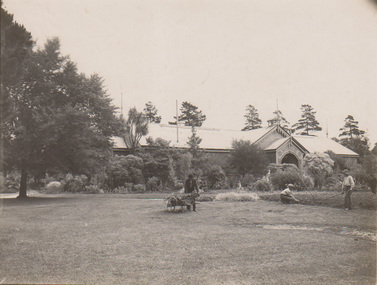
Photograph - Sepia print, A.E. Bennett, Pavilion, 1894
... pavilion Sepia photograph. Enlargement of illustration in, "Prize Essays," Alfred E. Bennett. On display board. 3 people working in the garden in the foreground. 2 men are planting seedlings, 1 man is removing a box of seedlings from a wooden wheelbarrow.. ...Used as an illustration in, "Green Grows Our Garden," A.P. Winzenried p 14. Other black and white copies see B98.1035Sepia photograph. Enlargement of illustration in, "Prize Essays," Alfred E. Bennett. On display board. 3 people working in the garden in the foreground. 2 men are planting seedlings, 1 man is removing a box of seedlings from a wooden wheelbarrow..prize essays, alfred e. bennett, green grows our garden, a.p. winzenried, pavilion -
 University of Melbourne, Burnley Campus Archives
Photograph - Black and white print, Information Branch Victorian Department of Agriculture, Pavilion, c. 1900
... pavilion publicity a e bennett On reverse, "Photograph by Information Branch Victorian Department of Agriculture Ref. No.1981(889-3). Earlier copy, handwritten on reverse, "Exhibition Building later to become the Lecture Theatre." 3 copies of black and white photographs, not originals. Original photograph in A. E. Bennett's book, "Prize Essays." 3 people working in the garden in the foreground. 2 men are planting seedlings, 1 man is removing a box of seedlings from a wooden ...3 copies of black and white photographs, not originals. Original photograph in A. E. Bennett's book, "Prize Essays." 3 people working in the garden in the foreground. 2 men are planting seedlings, 1 man is removing a box of seedlings from a wooden wheelbarrow. T.H. Kneen suggested early 1900's as ponds not yet constructed.On reverse, "Photograph by Information Branch Victorian Department of Agriculture Ref. No.1981(889-3). Earlier copy, handwritten on reverse, "Exhibition Building later to become the Lecture Theatre."students working outside, pavilion, publicity, a e bennett -
 Kew Historical Society Inc
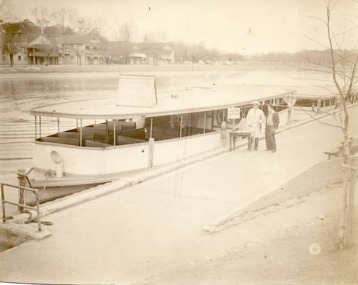
Photograph - Hicks Bros Launch at Princess Walk, circa 1953
... Two employees stand beside the first of a number of wooden ferries. On the south side of the river, there are the pavilions of a number of boat clubs....Two employees stand beside the first of a number of wooden ferries. On the south side of the river, there are the pavilions of a number of boat clubs. ...Commercially-operated boat tours on the Maribyrnong and Yarra Rivers in Melbourne were a major tourist attraction, especially in the first half of the twentieth century. A number of companies ran ferries and motor-launches to locations such as the Riverview Tea Gardens (1909-1947) at Ascot Vale, and the Hawthorn Tea Gardens on the corner of Power Street and Riversdale Road. One of the families which ran these services was Hicks Bros, which from circa 1921 operated a ferry service from Princess Walk (Melbourne) to Studley Park. This is one of a series of 17 black and white undated photographic proofs donated to the Kew Historical Society in 2013 by the Queenscliffe Historical Museum. The series includes images of individuals, tea rooms, ferries, motor launches, ocean liners and tugs. In 1953, the owner of Hicks Bros was involved in an inquest into the drowning of a Ukrainian tourist on a ferry operated by Melbourne Ferries, a rival firm. In published reports of the inquest, reference is made to a number of photographs taken by Robert Irvine Atchison, part-owner of Hicks Bros. As the reverse of the photographs indicates copyright is held by the State of Victoria, the collection may have derived from that year.Historically significant and rare image of one of the major tour boat services which operated on the Yarra River.Faded black and white photographic proof of a ferry owned by Hicks Bros on the River Yarra at Princess Walk. Two employees stand beside the first of a number of wooden ferries. On the south side of the river, there are the pavilions of a number of boat clubs.ferries, motor launches, yarra river, maribyrnong river, studley park, princess walk, riverview tea gardens, hawthorn tea gardens, tourism - melbourne (vic.), hicks bros, hicks bros launches -
 Ringwood and District Historical Society
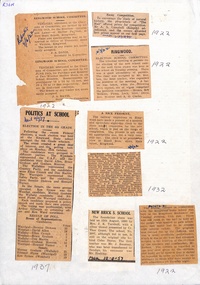
Newspaper, Clippings of Newspaper Articles about RIngwood State School 1922
... Ringwood School Committee – Shelter Pavilion Tender (1922) A notice inviting tenders to build a shelter pavilion for the new Ringwood State School, outlining requirements and where plans could be inspected. 2. Ringwood School Committee – Removal of Wooden Shelters (1922) A second tender notice seeking buyers to purchase and remove two wooden shelter buildings from the school grounds. 3. ...Ringwood School Committee – Shelter Pavilion Tender (1922) A notice inviting tenders to build a shelter pavilion for the new Ringwood State School, outlining requirements and where plans could be inspected. 2. Ringwood School Committee – Removal of Wooden Shelters (1922) A second tender notice seeking buyers to purchase and remove two wooden shelter buildings from the school grounds. 3. ...One page collection of newspaper clippings from 1922 relating to Ringwood Primary School. (Also some from 1933, 1937 and 1959 which are catalogued separately). Topics include: 1. Ringwood School Committee – Shelter Pavilion Tender (1922) A notice inviting tenders to build a shelter pavilion for the new Ringwood State School, outlining requirements and where plans could be inspected. 2. Ringwood School Committee – Removal of Wooden Shelters (1922) A second tender notice seeking buyers to purchase and remove two wooden shelter buildings from the school grounds. 3. Essay Competition (1922) A brief announcement about a natural history essay competition run by The Mail, noting that winning essays were published. 4. A Nice Present (1922) A short piece noting that Ringwood railway employees donated an eight day clock to the new school as it neared completion. 5. Annual Ringwood School Concert (1922) A report on a highly attended school concert, praising the children’s performances and noting that proceeds supported the school building fund. (Co-Pilot summary 5/9/2026) -
 Emerald Museum & Nobelius Heritage Park
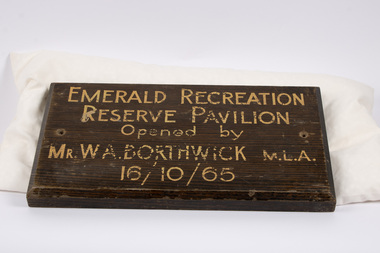
Plaque - Opening Plaque of Emerald Recreation Reserve Pavilion, 1965
... Emerald Cricket Club Worrell Reserve Painted on wood: "EMERALD RECREATION / RESERVE PAVILION / Opened by / MR. W A. BORTHWICK M.L.A. / 16/10/65" A rectangular wooden plaque, with partially faded text painted on one side in a landscape orientation. ...This plaque commemorated the October 16th, 1965 opening of a new pavilion at Emerald Recreation Reserve (now known as Worrell Reserve). The pavilion was opened by Mr William Archibald Borthwick, at that time a member of the Victorian Legislative Assembly representing the electorate of Scoresby. It was built to serve the needs of local sports teams including the Emerald Cricket Club. The 1965 pavilion was replaced in 2021.This plaque commemorates a now-renovated building playing an important role in facilitating sporting and recreation in the local community over more than five decades.A rectangular wooden plaque, with partially faded text painted on one side in a landscape orientation. There are two holes through the display side of the plaque near the middle of each short edge, previously used to affix the plaque to a surface. There is a small taper between the rear side and display side such that the display side is slightly smaller.Painted on wood: "EMERALD RECREATION / RESERVE PAVILION / Opened by / MR. W A. BORTHWICK M.L.A. / 16/10/65"emerald cricket club, worrell reserve
