
Showing 144 items matching "wooden platform"
-
 Ballarat Tramway Museum
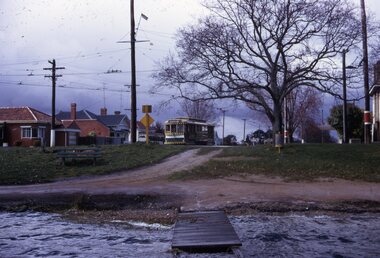
Photograph - Ballarat Tram, Special tram turning from Wendouree Parade into Macarthur Street - View Point, 11 August 1971
... ...wooden platform... The photograph shows a tram turning from Wendouree Parade into Macarthur Street at the section known as View Point in 1971. A wooden platform at the edge of the lake possibly for canoes or small boats. ...The photograph shows a tram turning from Wendouree Parade into Macarthur Street at the section known as View Point in 1971. A wooden platform at the edge of the lake possibly for canoes or small boats. ...The photograph shows a tram turning from Wendouree Parade into Macarthur Street at the section known as View Point in 1971. A wooden platform at the edge of the lake possibly for canoes or small boats. Tram possibly a special run - many children visible inside.Colour image in cardboard Kodak mount. 35mm slideHandwritten notation in ink on mount.macarthur street, view point, wendouree parade, wooden platform, special tram -
 Robin Boyd Foundation
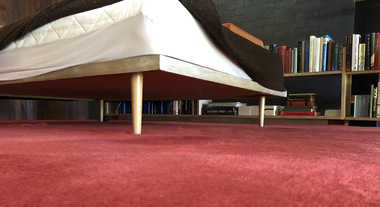
Furniture - Bed
... Robin Boyd designed this wooden platform bed specifically for the Walsh St house. ...Wooden platform bed with solid base and 4 cigar shaped legs with round flat brass metal feet....Robin Boyd designed this wooden platform bed specifically for the Walsh St house. ...Robin Boyd designed this wooden platform bed specifically for the Walsh St house. It is in keeping with the space's dual purpose as a sitting room and master bedroom.Wooden platform bed with solid base and 4 cigar shaped legs with round flat brass metal feet.walsh st furnishings, robin boyd -
 The Beechworth Burke Museum
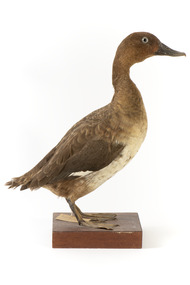
Animal specimen - Hardhead, Trustees of the Australian Museum, 1860-1880
... The bird has large webbed feet which are attached to the wooden platform it stands upon. The platform is inscribed on the left with the number 138..... / 138 on the wooden platform.... / 138 on the wooden platform This Hardhead specimen is a stocky medium-sized duck with chocolate brown colouring. ...Interestingly, the name "Hardhead" does not refer to the density of this species skull. Instead, it refers to the difficulty encountered by early taxidermies in styling the bird's head. This particular breed of Duck is smaller than average and are often found in the coastal regions of Australia. They are also known to reside in New Guinea, New Zealand and the Pacific Islands. This species was formerly known as the 'White-eyed Duck"; however, since the female Hardhead have dark eyes, this species was renamed the "Hardhead" Duck. This specimen is part of a collection of almost 200 animal specimens that were originally acquired as skins from various institutions across Australia, including the Australian Museum in Sydney and the National Museum of Victoria (known as Museums Victoria since 1983), as well as individuals such as amateur anthropologist Reynell Eveleigh Johns between 1860-1880. These skins were then mounted by members of the Burke Museum Committee and put-on display in the formal space of the Museum’s original exhibition hall where they continue to be on display. This display of taxidermy mounts initially served to instruct visitors to the Burke Museum of the natural world around them, today it serves as an insight into the collecting habits of the 19th century.This specimen is part of a significant and rare taxidermy mount collection in the Burke Museum. This collection is scientifically and culturally important for reminding us of how science continues to shape our understanding of the modern world. They demonstrate a capacity to hold evidence of how Australia’s fauna history existed in the past and are potentially important for future environmental research. This collection continues to be on display in the Museum and has become a key part to interpreting the collecting habits of the 19th century.This Hardhead specimen is a stocky medium-sized duck with chocolate brown colouring. The bird has paler white/ cream coloured plumage on the stomach and neck. The bill is a grey black colour and the eyes are made of a grey glass with a black pupil. The lighter brown colour of this specimen's head could refer to its identification as female or could be due to the taxidermy process or the impact of age on the colouring of the specimen. Female Hardheads have brown eyes, while the male have strikingly pale white/grey eyes. The bird has large webbed feet which are attached to the wooden platform it stands upon. The platform is inscribed on the left with the number 138.7a. / White-eyed Duck / See Catalogue, Page 39. / 138 on the wooden platformtaxidermy mount, taxidermy, animalia, burke museum, beechworth, australian museum, skin, reynell eveleigh johns, bird, australian birds, heron, duck, australaisian shovelor, shovelor -
 Clunes Museum
Functional object - RUBBER STAMP, UNKNOWN
... RUBBER STAMP ATTACHED TO WOODEN PLATFORM WITH HANDLE ...TREFOIL GUILD GIRL GUIDES CLUNES REFOIL GUILD RUBBER STAMP ATTACHED TO WOODEN PLATFORM WITH HANDLE Functional object RUBBER STAMP ...RUBBER STAMP ATTACHED TO WOODEN PLATFORM WITH HANDLE CLUNES REFOIL GUILD trefoil guild, girl guides -
Tatura Irrigation & Wartime Camps Museum
Sandals - female, 1940's
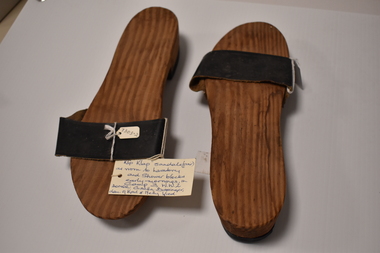
... Pair of carved wooden platform heel sandals. Synthetic covering on heel and sole. ...Known as "Klip Klop" sandals, worn to lavatory and shower blocks early mornings sandals wood bissinger g wied k and n camp 3 tatura ww2 costume female foorwear handcrafts woodwork Pair of carved wooden platform heel sandals. Synthetic covering on heel and sole. ...Used by internees at Camp 3. Known as "Klip Klop" sandals, worn to lavatory and shower blocks early morningsPair of carved wooden platform heel sandals. Synthetic covering on heel and sole. Leather strap nailed in position to cover toessandals, wood, bissinger g, wied k and n, camp 3, tatura, ww2, costume, female, foorwear, handcrafts, woodwork -
 Ballarat Clarendon College
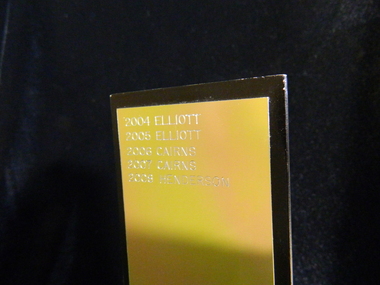
Trophy, House Performing Arts
... Wooden platform with tall rectangular wooden back to gold coloured plate and gold coloured cast image of two harlequin face masks. ...Superseded by plaque from 2010. house-performing-arts trophy elliot house cairns house henderson house Inscribed on tall rectangular plate: 2004 ELLIOTT / 2005 ELLIOTT / 2006 CAIRNS / 2007 CAIRNS / 2008 HENDERSON / 2009 CAIRNS Wooden platform with tall rectangular wooden back to gold coloured plate and gold coloured cast image of two harlequin face masks. ...Trophy awarded to winning house at the House Perfoming Arts festival 2004-2009. Superseded by plaque from 2010.Wooden platform with tall rectangular wooden back to gold coloured plate and gold coloured cast image of two harlequin face masks. Inscribed on tall rectangular plate: 2004 ELLIOTT / 2005 ELLIOTT / 2006 CAIRNS / 2007 CAIRNS / 2008 HENDERSON / 2009 CAIRNShouse-performing-arts, trophy, elliot house, cairns house, henderson house -
 Tatura Irrigation & Wartime Camps Museum
Sandals - female, 1940's
... Pair of carved wooden platform heel sandals. Rubber like covering on heel and sole. ...Worn to lavatory and shower blocks early mornings. sandals bissinger g wied k and n camp 3 tatura ww2 costume female footwear handcrafts woodwork Pair of carved wooden platform heel sandals. Rubber like covering on heel and sole. ...Used by internees at Camp 3. Known as "Klip Klop" sandals. Worn to lavatory and shower blocks early mornings.Pair of carved wooden platform heel sandals. Rubber like covering on heel and sole. Leather strap nailed in position to cover toessandals, bissinger g, wied k and n, camp 3, tatura, ww2, costume, female, footwear, handcrafts, woodwork -
 The Beechworth Burke Museum
Animal specimen - Buff-Banded Rail, 1860-1880
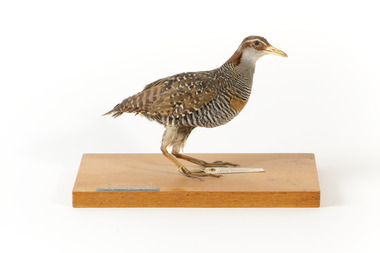
... This specimen has a paper tag tied to its right leg and a grey/back label on the wooden platform....This specimen has a paper tag tied to its right leg and a grey/back label on the wooden platform. Animal specimen Buff-Banded Rail ...The Buff-banded Rail is located on mainland Australia. It can also be found in south-east Asia, New Guinea and New Zealand. These birds are often seen individually or in pairs walking through the dense reeds and vegetations of wetlands or crops. This rail has a slow walk and often flicks its tail, which is raised, as they move. They are omnivore scavengers who feed on a large variety of invertebrates, fruit, seeds and vegetables. This specimen is part of a collection of almost 200 animal specimens that were originally acquired as skins from various institutions across Australia, including the Australian Museum and the National Museum of Victoria, as well as individuals such amateur anthropologist Reynell Eveleigh Johns between 1860-1880. These skins were then mounted by members of the Burke Museum Committee and put-on display in the formal space of the Museum’s original exhibition hall where they continue to be on display. This display of taxidermy mounts initially served to instruct visitors to the Burke Museum of the natural world around them, today it serves as an insight into the collecting habits of the 19th century. This specimen is part of a significant and rare taxidermy mount collection in the Burke Museum. This collection is scientifically and culturally important for reminding us of how science continues to shape our understanding of the modern world. They demonstrate a capacity to hold evidence of how Australia’s fauna history existed in the past and are potentially important for future environmental research. This collection continues to be on display in the Museum and has become a key part to interpreting the collecting habits of the 19th century.This specimen is in a standing position on a wooden platform. The Buff-Branded Rail has a pale grey/yellow eyebrow over the black glass eyes and a pale yellow bill. It also has an orange and brown coloured band on its breast. This bird is multicoloured with streaks of chestnut brown, black, white and a faint orange-brown. This specimen has a paper tag tied to its right leg and a grey/back label on the wooden platform.Platform: "Banded Landrail" Paper tag: "National Museum Victoria. Banded Landrail Hypotoenidia w8 427 Philippensis (L)"taxidermy mount, taxidermy, animalia, burke museum, beechworth, australian museum, skin, reynell eveleigh johns, bird, landrail, buff-banded rail -
 The Beechworth Burke Museum
Animal specimen - Australasian Wood Duck (male), Trustees of the Australian Museum, 1860-1880
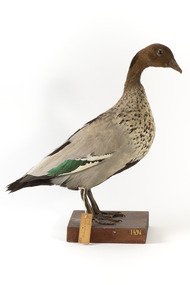
... The legs are a pale grey and stand upon a wooden platform. There is a paper tag tied to the upper part of the Wood Duck's right leg, a white label attached to the front right of the wooden platform and a grey label on the left beside the white label. ...The legs are a pale grey and stand upon a wooden platform. There is a paper tag tied to the upper part of the Wood Duck's right leg, a white label attached to the front right of the wooden platform and a grey label on the left beside the white label. ...The Australasian Wood Duck is commonly described as 'goose-like' in appearance. They reside throughout Australia and Tasmania in regions including grasslands, open woodlands, wetlands, flooded pastures and along the coast and bays. Unlike some breeds of ducks, this species can walk on land with ease and can often be seen perched on logs and in trees. The Wood Duck eat grass, clover and other herbs. On occasion they eat insects. This specimen is part of a collection of almost 200 animal specimens that were originally acquired as skins from various institutions across Australia, including the Australian Museum in Sydney and the National Museum of Victoria (known as Museums Victoria since 1983), as well as individuals such as amateur anthropologist Reynell Eveleigh Johns between 1860-1880. These skins were then mounted by members of the Burke Museum Committee and put-on display in the formal space of the Museum’s original exhibition hall where they continue to be on display. This display of taxidermy mounts initially served to instruct visitors to the Burke Museum of the natural world around them, today it serves as an insight into the collecting habits of the 19th century.This specimen is part of a significant and rare taxidermy mount collection in the Burke Museum. This collection is scientifically and culturally important for reminding us of how science continues to shape our understanding of the modern world. They demonstrate a capacity to hold evidence of how Australia’s fauna history existed in the past and are potentially important for future environmental research. This collection continues to be on display in the Museum and has become a key part to interpreting the collecting habits of the 19th century.This male Australian Wood Duck has a dark brown head with a pale brown-grey speckled body. The lower belly of this specimen is dark brown and the bill is a pale grey-yellow. The legs are a pale grey and stand upon a wooden platform. There is a paper tag tied to the upper part of the Wood Duck's right leg, a white label attached to the front right of the wooden platform and a grey label on the left beside the white label. 132. / Maned Goose / Male / 132taxidermy mount, taxidermy, animalia, burke museum, beechworth, australian museum, skin, reynell eveleigh johns, bird, australian birds, australaisian shovelor, shovelor, wood duck, male, male duck, australian wood duck -
 Maldon Vintage Machinery Museum Inc
Treadle Lathe, Post 1875
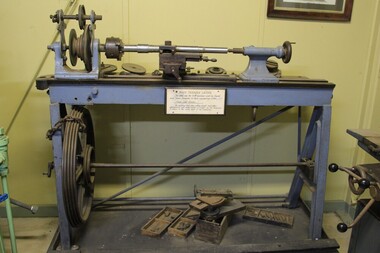
... Painted gunmetal grey and mounted on a black wooden platform for display purposes....Painted gunmetal grey and mounted on a black wooden platform for display purposes. Treadle Lathe ...The first metal working machine used by David & James Thompson in 1878. Brought by ship by David Thompson who used it on the journey to make working models.The first machine used by David & James Thompson in their engineering section.Treadle lath for metal turning. Some brass accessories for metal working are laid out on a timber bench attached to the back of the lathe. Painted gunmetal grey and mounted on a black wooden platform for display purposes.Nonemachinery; tools; metalwork -
 Federation University Historical Collection
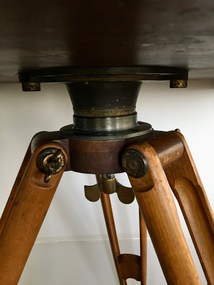
Instrument - Scientific Instrument, W.&L.E. Gurley, Plane Table
... A wooden platform used in surveying equipped with a 2.7 cm diameter dowel at each end that would hold the charts/papers in position. .... & l.e. gurley scientific instrument ballarat school of mines tripod location chains Manufacturer's stamp underneath. A wooden platform used in surveying equipped with a 2.7 cm diameter dowel at each end that would hold the charts/papers in position. ...Used at the Ballarat School of Mines in Surveying classes. It was used in conjunction with Item 04129 - Collapsible leg surveying instrument, tripod, and at times with Item 4127 - Tripod location chains.A wooden platform used in surveying equipped with a 2.7 cm diameter dowel at each end that would hold the charts/papers in position. A spherical mount on the underside, designed to match the receptacle on top of the tripod - Item 04129.Manufacturer's stamp underneath.plane table, surveying, w. & l.e. gurley, scientific instrument, ballarat school of mines, tripod, location chains -
 The Beechworth Burke Museum
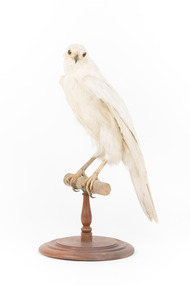
Animal specimen - Grey Goshawk, Trustees of the Australian Museum, 1860-1880
... This specimen stands on a perch, mounted upon a wooden platform....This specimen stands on a perch, mounted upon a wooden platform. Animal specimen Grey Goshawk Trustees of the Australian Museum Burke Museum Committee ...This White Goshawk is the white colour morph of the Grey Goshawk. Is a moderate-sized hawk that measures 38 - 55 cm in length, and has a wingspan of 70 - 110 cm. It is native to Australia, and found in rainforest, forests, open forest and thickly-wooded watercourses. It mostly occurs in southeastern and northwestern Australia, and in Tasmania, all Grey Goshawks are white-phase. This specimen is part of a collection of almost 200 animal specimens that were originally acquired as skins from various institutions across Australia, including the Australian Museum in Sydney and the National Museum of Victoria (known as Museums Victoria since 1983), as well as individuals such as amateur anthropologist Reynell Eveleigh Johns between 1860-1880. These skins were then mounted by members of the Burke Museum Committee and put-on display in the formal space of the Museum’s original exhibition hall where they continue to be on display. This display of taxidermy mounts initially served to instruct visitors to the Burke Museum of the natural world around them, today it serves as an insight into the collecting habits of the 19th century.This specimen is part of a significant and rare taxidermy mount collection in the Burke Museum. This collection is scientifically and culturally important for reminding us of how science continues to shape our understanding of the modern world. They demonstrate a capacity to hold evidence of how Australia’s fauna history existed in the past and are potentially important for future environmental research. This collection continues to be on display in the Museum and has become a key part to interpreting the collecting habits of the 19th century.This White Goshawk is white all over, with hints of beige around its eyes. The bird's legs are a yellow-beige colour, and its beak grey and white. This specimen stands on a perch, mounted upon a wooden platform.taxidermy mount, taxidermy, animalia, burke museum, beechworth, australian museum, skin, reynell eveleigh johns, bird, hawk, white goshawk, accipitridae -
 The Beechworth Burke Museum
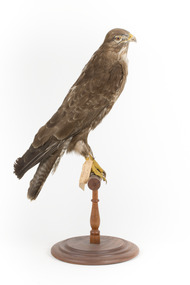
Animal specimen - Common Buzzard, Trustees of the Australian Museum, 1860- 1880
... This specimen stands upon a wooden platform and has an identification tag tied around its leg....This specimen stands upon a wooden platform and has an identification tag tied around its leg. ...The Common buzzard, a medium-sized raptor, is found across Europe and Asia, and in Africa in the winter months. It is the UK’s commonest bird of prey, found in nearly every county. Due to their large size and their brown color, they are often confused with other species, especially the Red kite and the Golden eagle. They may look the same from a distance, but the Common buzzard has a very distinctive call, like a cat’s mew, and a distinctive flying shape. When soaring and gliding, the tail is fanned and its wings are often held in a shallow 'V'. The colour of individuals varies from dark brown to much lighter, though they all have a finely barred tail and dark wingtips. This species occurs across Europe and Russia, and parts of Northern Africa and Asia in the cooler winter months. It lives in a range of habitats, especially woodland, moorland, pasture, scrub, arable land, marsh bog, villages, and sometimes towns and cities. This particular specimen has been mounted in a correct stylised fashion. This specimen is part of a collection of almost 200 animal specimens that were originally acquired as skins from various institutions across Australia, including the Australian Museum in Sydney and the National Museum of Victoria (known as Museums Victoria since 1983), as well as individuals such as amateur anthropologist Reynell Eveleigh Johns between 1860-1880. These skins were then mounted by members of the Burke Museum Committee and put-on display in the formal space of the Museum’s original exhibition hall where they continue to be on display. This display of taxidermy mounts initially served to instruct visitors to the Burke Museum of the natural world around them, today it serves as an insight into the collecting habits of the 19th century.This specimen is part of a significant and rare taxidermy mount collection in the Burke Museum. This collection is scientifically and culturally important for reminding us of how science continues to shape our understanding of the modern world. They demonstrate a capacity to hold evidence of how Australia’s fauna history existed in the past and are potentially important for future environmental research. This collection continues to be on display in the Museum and has become a key part to interpreting the collecting habits of the 19th century.This Common Buzzard is brown in colour with lighter markings on the chest. It has a white patch of feathers on the back of its head and it has darker wingtips and yellow feet. This specimen stands upon a wooden platform and has an identification tag tied around its leg.Swing tag: 30 / Buzzard / Catalogue page 52. / Metal tag: 4043 /taxidermy mount, taxidermy, animalia, burke museum, beechworth, australian museum, skin, reynell eveleigh johns, bird, common buzzard, bird of prey -
 The Beechworth Burke Museum
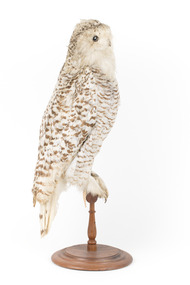
Animal specimen - Snowy Owl, Trustees of the Australian Museum, 1860- 1880
... This specimen stands upon a wooden platform and has an identification tag tied around its leg....This specimen stands upon a wooden platform and has an identification tag tied around its leg. ...The Snowy owl is a large and powerful bird. It is one of the largest species of owl, and in North America, it is on average the heaviest owl species. The adult male is virtually pure white, but females and young birds have some dark spots; the young are heavily barred, and dark spotting may even predominate. Thick plumage, heavily feathered taloned feet, and coloration render the Snowy owl well-adapted for life north of the Arctic Circle. This Snowy Owl example is slightly discoloured and in real life the Snowy Owl displays much more brilliant white feathers. This specimen is part of a collection of almost 200 animal specimens that were originally acquired as skins from various institutions across Australia, including the Australian Museum in Sydney and the National Museum of Victoria (known as Museums Victoria since 1983), as well as individuals such as amateur anthropologist Reynell Eveleigh Johns between 1860-1880. These skins were then mounted by members of the Burke Museum Committee and put-on display in the formal space of the Museum’s original exhibition hall where they continue to be on display. This display of taxidermy mounts initially served to instruct visitors to the Burke Museum of the natural world around them, today it serves as an insight into the collecting habits of the 19th century.This specimen is part of a significant and rare taxidermy mount collection in the Burke Museum. This collection is scientifically and culturally important for reminding us of how science continues to shape our understanding of the modern world. They demonstrate a capacity to hold evidence of how Australia’s fauna history existed in the past and are potentially important for future environmental research. This collection continues to be on display in the Museum and has become a key part to interpreting the collecting habits of the 19th century.This Snowy Owl adult male is virtually pure white with brown spot markings and a pale brownish wash. It has thick plumage and heavily feathered taloned feet. This specimen stands upon a wooden platform and has an identification tag tied around its leg.Swing tag: [torn] snowy owl / See catalogue, page 54 / Metal tag: 4054 /taxidermy mount, taxidermy, animalia, burke museum, beechworth, australian museum, skin, reynell eveleigh johns, bird, owl, snowy owl, arctic circle -
 The Beechworth Burke Museum
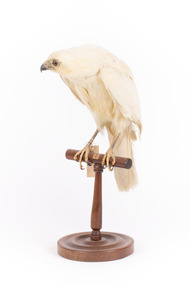
Animal specimen - Grey Goshawk, Trustees of the Australian Museum, 1860-1880
... This specimen stands on a perch, mounted upon a wooden platform, and has an identification tag tied around its leg....This specimen stands on a perch, mounted upon a wooden platform, and has an identification tag tied around its leg. ...This White Goshawk is the white colour morph of the Grey Goshawk. Is a moderate-sized hawk that measures 38 - 55 cm in length, and has a wingspan of 70 - 110 cm. It is native to Australia, and found in rainforest, forests, open forest and thickly-wooded watercourses. It mostly occurs in southeastern and northwestern Australia, and in Tasmania, all Grey Goshawks are white-phase. This specimen is part of a collection of almost 200 animal specimens that were originally acquired as skins from various institutions across Australia, including the Australian Museum in Sydney and the National Museum of Victoria (known as Museums Victoria since 1983), as well as individuals such as amateur anthropologist Reynell Eveleigh Johns between 1860-1880. These skins were then mounted by members of the Burke Museum Committee and put-on display in the formal space of the Museum’s original exhibition hall where they continue to be on display. This display of taxidermy mounts initially served to instruct visitors to the Burke Museum of the natural world around them, today it serves as an insight into the collecting habits of the 19th century.This specimen is part of a significant and rare taxidermy mount collection in the Burke Museum. This collection is scientifically and culturally important for reminding us of how science continues to shape our understanding of the modern world. They demonstrate a capacity to hold evidence of how Australia’s fauna history existed in the past and are potentially important for future environmental research. This collection continues to be on display in the Museum and has become a key part to interpreting the collecting habits of the 19th century.This White Goshawk is white all over, with hints of beige around its eyes. The bird's legs are a yellow-beige colour, and its beak grey and white. This specimen stands on a perch, mounted upon a wooden platform, and has an identification tag tied around its leg.Swing tag: 5. / White Goshawk / See Catalogue, page 2 / Mount: 5 / taxidermy mount, taxidermy, animalia, burke museum, beechworth, australian museum, skin, reynell eveleigh johns, bird, hawk, white goshawk, accipitridae -
 The Beechworth Burke Museum
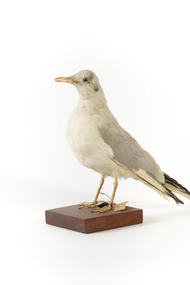
Animal specimen - Common Gull, Trustees of the Australian Museum, 1860-1880
... A pale grey and white coloured Gull standing on a wooden platform. The bill and legs are a pale yellow colour and the toes are webbed. ...Paper tag 2: Larus Ridibundus A pale grey and white coloured Gull standing on a wooden platform. The bill and legs are a pale yellow colour and the toes are webbed. ...This specimen is a Common Gull, or Black-Headed Gull, in the adult winter plumage. This plumage is mostly white and grey with a small dark mark on the sides of the head. During the summer months, the plumage on the head of the bird turns a black colour which is called a hood. This species can be found over much of Europe, except Spain, Italy and Greece. It also resides in northeastern Canada, Northeast America and in some of the Caribbean Islands. This specimen is part of a collection of almost 200 animal specimens that were originally acquired as skins from various institutions across Australia, including the Australian Museum and the National Museum of Victoria, as well as individuals such amateur anthropologist Reynell Eveleigh Johns between 1860-1880. These skins were then mounted by members of the Burke Museum Committee and put-on display in the formal space of the Museum’s original exhibition hall where they continue to be on display. This display of taxidermy mounts initially served to instruct visitors to the Burke Museum of the natural world around them, today it serves as an insight into the collecting habits of the 19th century. This specimen is part of a significant and rare taxidermy mount collection in the Burke Museum. This collection is scientifically and culturally important for reminding us of how science continues to shape our understanding of the modern world. They demonstrate a capacity to hold evidence of how Australia’s fauna history existed in the past and are potentially important for future environmental research. This collection continues to be on display in the Museum and has become a key part to interpreting the collecting habits of the 19th century.A pale grey and white coloured Gull standing on a wooden platform. The bill and legs are a pale yellow colour and the toes are webbed. The small eyes are made from glass and black in colour. The specimen has a darker spot of plumage behind the eyes and darker feathers in its tail. Paper tag 1: "28a Black-headed Gull- Catalogue, Page, 43." Paper tag 2: Larus Ridibundustaxidermy mount, taxidermy, animalia, burke museum, beechworth, australian museum, skin, reynell eveleigh johns, bird, gull, black-headed gull, common gull -
 Geoffrey Kaye Museum of Anaesthetic History
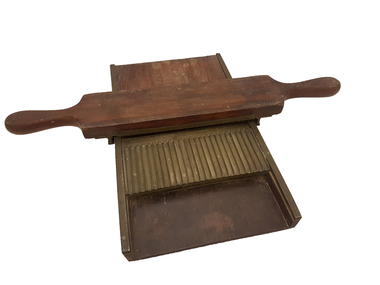
Machine - Press, Pill, S Mawson & Thompson
... Rectangular wooden platform with a metal (brass) plate divided into 24 (twenty-four) grooves with a catchment area. ...MAW SON / & / THOMPSON / LONDON Rectangular wooden platform with a metal (brass) plate divided into 24 (twenty-four) grooves with a catchment area. ...Before mechanisation, pills were rolled by hand using equipment such as this pill press. Powders ingredients were blended together to form a resin, rolled and laid across the width of the platform. The paddle was then used to push the "sausage" shape through the grooves, creating a small, consistently sized and shaped, pill. The pill was then allowed to dry for later sale. This pill press is of uncertain origins but is representative of the type of equipment used to create pills in the 19th Century. It has the capacity to make 24 pills at once, and markings on the metal plate indicate each pill would have been the equivalent of "5 grains" (approx 0.3 grams).Rectangular wooden platform with a metal (brass) plate divided into 24 (twenty-four) grooves with a catchment area. The wooden paddle has two handles, one on each end, with a matching metal plate and grooves, as well as metal (brass) guide bars to help the paddle align with the platform.Handwritten on base of platform in black ink over white background: C11087 Handwritten on inside of guide bar on paddle in black ink over white background: C11087 Manufacturer's detail stamped into metal groove on platform: S. MAW SON / & / THOMPSON / LONDONpill press, pharmaceuticals, apothecary, pharmacy -
Glenelg Shire Council Cultural Collection
Photograph - Photograph - Machinery, n.d
... Black and white photo. Wooden raised platform over large boulder, machinery, 2 rainwater tanks on stand....Sourced from Casterton Town Hall (Former Shire of Glenelg) Back: Round, purple, photographer's stamp Black and white photo. Wooden raised platform over large boulder, machinery, 2 rainwater tanks on stand. ...Sourced from Casterton Town Hall (Former Shire of Glenelg)Black and white photo. Wooden raised platform over large boulder, machinery, 2 rainwater tanks on stand.Back: Round, purple, photographer's stamp -
 The Beechworth Burke Museum
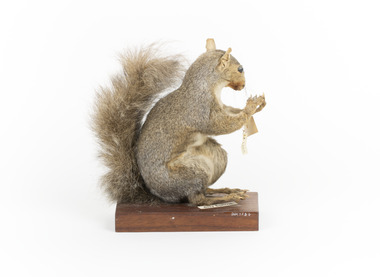
Animal specimen - Grey Squirrel, Trustees of the Australian Museum, 1860-1880
... It stands on a wooden platform and has two paper tags tied to its hands....It stands on a wooden platform and has two paper tags tied to its hands. ...The Grey Squirrel is a small to medium sized member of the rodent family Sciuridae. This species is commonly located in England, Wales and central Scotland. They are known for their agility and ability to climb trees. Interestingly, the tail of the Squirrel serves the purpose of keeping the rain, wind or cold off the body of the animal, to help it cool off in hot weather, to counterbalance when moving and can be utilized as a parachute when jumping from one location to the next. Squirrels consume foods that are rich in protein, carbohydrates and fats. They eat nuts, seeds. fruits and vegetation. This specimen is part of a collection of almost 200 animal specimens that were originally acquired as skins from various institutions across Australia, including the Australian Museum and the National Museum of Victoria, as well as individuals such amateur anthropologist Reynell Eveleigh Johns between 1860-1880. These skins were then mounted by members of the Burke Museum Committee and put-on display in the formal space of the Museum’s original exhibition hall where they continue to be on display. This display of taxidermy mounts initially served to instruct visitors to the Burke Museum of the natural world around them, today it serves as an insight into the collecting habits of the 19th century.This specimen is part of a significant and rare taxidermy mount collection in the Burke Museum. This collection is scientifically and culturally important for reminding us of how science continues to shape our understanding of the modern world. They demonstrate a capacity to hold evidence of how Australia’s fauna history existed in the past and are potentially important for future environmental research. This collection continues to be on display in the Museum and has become a key part to interpreting the collecting habits of the 19th century.This specimen has silver-grey fur with a brown colouring located on the face and a pale underside. The tale stands tall along the back of the specimen and is bushy. The specimen is of a smaller size and has no tuffs on its ears. It stands on a wooden platform and has two paper tags tied to its hands.Grey Squirrel / BMM 7534 / A.4485/ 41. Squirrel Sp / Catalogue Page, 49 /taxidermy mount, taxidermy, animalia, burke museum, beechworth, australian museum, skin, reynell eveleigh johns, squirrel -
 The Beechworth Burke Museum
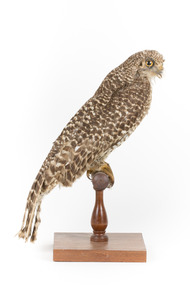
Animal specimen - Powerful Owl, Trustees of the Australian Museum, 1860- 1880
... The specimen stands upon a wooden platform and has no identification tags attached. ...The specimen stands upon a wooden platform and has no identification tags attached. ...The Powerful owl is native to south-eastern and eastern Australia and is the largest owl on the continent. It is found in coastal areas and in the Great Dividing Range rarely more than 200 km (120 mi) inland. An apex predator in its narrow distribution, the Powerful owl is often an opportunist like most predators, but generally hunts arboreal mammals, in particular small to medium-sized marsupials. It is a typically territorial raptorial bird that maintains a large home range and has long intervals between egg-laying and hatching of clutches. Unlike most raptorial birds, male Powerful owls are larger and stronger than females and so the male takes the dominant position in the mating pair, which extends to food distribution. This example of a Powerful Owl show lighter brown coloured feathers and slight discolouration. The Powerful Owl has darker colourings and whiter feathers in real life. This example also show discolouration in the feet and they are brighter yellow in colour in real life. This specimen is part of a collection of almost 200 animal specimens that were originally acquired as skins from various institutions across Australia, including the Australian Museum in Sydney and the National Museum of Victoria (known as Museums Victoria since 1983), as well as individuals such as amateur anthropologist Reynell Eveleigh Johns between 1860-1880. These skins were then mounted by members of the Burke Museum Committee and put-on display in the formal space of the Museum’s original exhibition hall where they continue to be on display. This display of taxidermy mounts initially served to instruct visitors to the Burke Museum of the natural world around them, today it serves as an insight into the collecting habits of the 19th century.This specimen is part of a significant and rare taxidermy mount collection in the Burke Museum. This collection is scientifically and culturally important for reminding us of how science continues to shape our understanding of the modern world. They demonstrate a capacity to hold evidence of how Australia’s fauna history existed in the past and are potentially important for future environmental research. This collection continues to be on display in the Museum and has become a key part to interpreting the collecting habits of the 19th centuryThis Powerful Owl has medium brown to dark grey-brown above, with white barring, and off-white front. The glass eyes are yellow, set in a dark grey/brown facial mask. The legs are feathered with yellow feet and talons. The specimen stands upon a wooden platform and has no identification tags attached. Swing-tag: n/a Metal tag: n/a Mount: no markings taxidermy mount, taxidermy, animalia, burke museum, beechworth, australian museum, skin, reynell eveleigh johns, bird, owl, powerful owl -
 The Beechworth Burke Museum
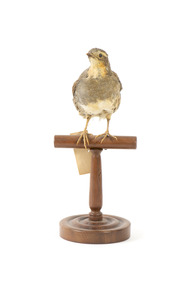
Animal specimen - Spotted Quail Thrush, 1860-1880
... This specimen stands upon a wooden platform and has an identification tag tied around its leg....This specimen stands upon a wooden platform and has an identification tag tied around its leg. ...The spotted quail thrust is a heavily patterned bird native to Australia. It expresses many calls, including a long, very high-pitched "seeeeeep” and a long sequence of doubled whistles, but the main call in inaudible to humans. Due to their heavy camoflague pattern, they are often very difficult to observe. They are often found on the forest floor. This specimen is part of a collection of almost 200 animal specimens that were originally acquired as skins from various institutions across Australia, including the Australian Museum in Sydney and the National Museum of Victoria (known as Museums Victoria since 1983), as well as individuals such as amateur anthropologist Reynell Eveleigh Johns between 1860-1880. These skins were then mounted by members of the Burke Museum Committee and put-on display in the formal space of the Museum’s original exhibition hall where they continue to be on display. This display of taxidermy mounts initially served to instruct visitors to the Burke Museum of the natural world around them, today it serves as an insight into the collecting habits of the 19th century. This specimen is part of a significant and rare taxidermy mount collection in the Burke Museum. This collection is scientifically and culturally important for reminding us of how science continues to shape our understanding of the modern world. They demonstrate a capacity to hold evidence of how Australia’s fauna history existed in the past and are potentially important for future environmental research. This collection continues to be on display in the Museum and has become a key part to interpreting the collecting habits of the 19th century. The spotted quail thrush is characterised by yellow and brown tones with black spots on the flanks. The females (10056) have a yellow ochre-coloured throat patch. This particular quail has lost its tail feathers. This specimen stands upon a wooden platform and has an identification tag tied around its leg.Label: 43a. / Spotted Ground Thrush / See Catalogue, page 15. /taxidermy mount, taxidermy, burke museum, beechworth, australian museum, spotted quail thrust, quail -
 The Beechworth Burke Museum
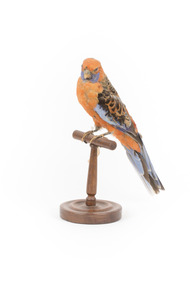
Animal specimen - Crimson Rosella
... This specimen stands upon a wooden platform and has an identification tag tied around its leg....This specimen stands upon a wooden platform and has an identification tag tied around its leg. ...The Crimson Rosella is native to Australia and located in Queensland and South Australia. Australia has a diverse range of rosellas, but the crimson rosella is easily recognised by the red body and blue cheeks. These birds are friendly to humans and consume seeds, insects and some blossoms. They nest in high trees, preferably eucalyptus. Typically, a crimson rosella should have far brighter colours than the specimen collected. This specimen has also been documented as having a light blue or black beak. This specimen is part of a collection of almost 200 animal specimens that were originally acquired as skins from various institutions across Australia, including the Australian Museum in Sydney and the National Museum of Victoria (known as Museums Victoria since 1983), as well as individuals such as amateur anthropologist Reynell Eveleigh Johns between 1860-1880. These skins were then mounted by members of the Burke Museum Committee and put-on display in the formal space of the Museum’s original exhibition hall where they continue to be on display. This display of taxidermy mounts initially served to instruct visitors to the Burke Museum of the natural world around them, today it serves as an insight into the collecting habits of the 19th century.This specimen is part of a significant and rare taxidermy mount collection in the Burke Museum. This collection is scientifically and culturally important for reminding us of how science continues to shape our understanding of the modern world. They demonstrate a capacity to hold evidence of how Australia’s fauna history existed in the past and are potentially important for future environmental research. This collection continues to be on display in the Museum and has become a key part to interpreting the collecting habits of the 19th century.This Crimson Rosella has a red feathered chest and cape across the head and blue cheeks besides the bill. The tail and wing feathers are mostly black with blue around the edges. The head is angled slightly to the specimen's left. This specimen stands upon a wooden platform and has an identification tag tied around its leg.78a. / Rennauts Parakeet / See Catalogue, page 22 /taxidermy mount, taxidermy, animalia, burke museum, beechworth, australian museum, skin, bird, california, australian native bird, crimson rosella, rosella, reynell eveleigh johns, platycercus elegans -
 The Beechworth Burke Museum
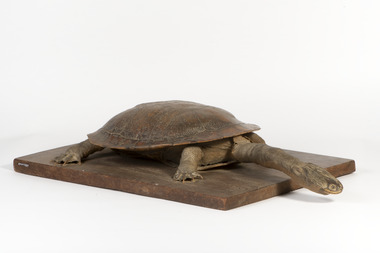
Animal specimen - Broad-shelled turtle, Trustees of the Australian Museum, 1860-1880
... This specimen is stylised standing on a wooden platform. It has a long, narrow neck and a large and relatively flat shell. ...This collection continues to be on display in the Museum and has become a key part to interpreting the collecting habits of the 19th century. taxidermy mount taxidermy animalia burke museum beechworth australian museum skin reynell eveleigh johns turtle australian turtle australian animal snake-necked turtle chelidae Broad-shelled turtle BMM5891 This specimen is stylised standing on a wooden platform. It has a long, narrow neck and a large and relatively flat shell. ...The family Chelidae is endemic to Australia, New Guinea, and South America and consists of some 40 species of freshwater turtle. Twenty-four described species are found in Australia and three of these occur in the Murray Darling Basin. Turtles of the genus Chelodina are distinguished by their exceptionally long necks. These turles are also referred to as side-necked turtles, so named because the neck and head, when not extended, fold under the leading edge of the carapace. They are further characterised by their relatively flattened shells and their clawed webbed feet. This specimen is part of a collection of almost 200 animal specimens that were originally acquired as skins from various institutions across Australia, including the Australian Museum in Sydney and the National Museum of Victoria (known as Museums Victoria since 1983), as well as individuals such as amateur anthropologist Reynell Eveleigh Johns between 1860-1880. These skins were then mounted by members of the Burke Museum Committee and put-on display in the formal space of the Museum’s original exhibition hall where they continue to be on display. This display of taxidermy mounts initially served to instruct visitors to the Burke Museum of the natural world around them, today it serves as an insight into the collecting habits of the 19th century.This specimen is part of a significant and rare taxidermy mount collection in the Burke Museum. This collection is scientifically and culturally important for reminding us of how science continues to shape our understanding of the modern world. They demonstrate a capacity to hold evidence of how Australia’s fauna history existed in the past and are potentially important for future environmental research. This collection continues to be on display in the Museum and has become a key part to interpreting the collecting habits of the 19th century.This specimen is stylised standing on a wooden platform. It has a long, narrow neck and a large and relatively flat shell. The head, neck and limbs are all dark grey or brown in colour and the underside is a pale brown. The feet are webbed and have long claws. The eyes are made from pale glass and the specimen has a short tale.BMM5891taxidermy mount, taxidermy, animalia, burke museum, beechworth, australian museum, skin, reynell eveleigh johns, turtle, australian turtle, australian animal, snake-necked turtle, chelidae, broad-shelled turtle -
 The Beechworth Burke Museum
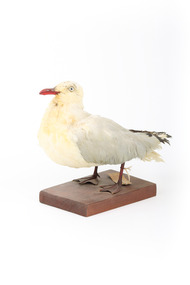
Animal specimen - Silver Gull, Trustees of the Australian Museum, 1860-1880
... This specimen stands upon a wooden platform and has an identification tag tied around its leg....This specimen stands upon a wooden platform and has an identification tag tied around its leg. ...The Silver Gull is more commonly referred to as the 'Seagull'. Found all along the coast of mainland Australia and Tasmania, it can also be found in New Caledonia and New Zealand. These birds are a common nuisance at beaches and urban areas, such as shopping centres. Since the 1950s, humans have become increasingly wasteful, leading to an explosion of the Silver Gull population due to the availability of rubbish to scavenge. They feed mainly on small marine life, but they are a versatile scavenger. The population increase has impacted the breeding of other bird species, as Silver Gulls have dominated offshore island breeding grounds. Their breeding season is from August to December, when they nest on the ground, however mating can occur year-round. This species has a harsh, high-pitched call 'kwarwh', well known to all Australians. Although protected under Australian Environmental Law, there are many strategies in place to discourage increasing the numbers of Seagulls. This specimen is an inaccurate example of a Silver Gull, which although is in good condition and intact, does not look like an accurate representation of this species. The legs have been mounted too far towards the tail on this specimen, giving it an unbalanced appearance. This specimen is part of a collection of almost 200 animal specimens that were originally acquired as skins from various institutions across Australia, including the Australian Museum in Sydney and the National Museum of Victoria (known as Museums Victoria since 1983), as well as individuals such as amateur anthropologist Reynell Eveleigh Johns between 1860-1880. These skins were then mounted by members of the Burke Museum Committee and put-on display in the formal space of the Museum’s original exhibition hall where they continue to be on display. This display of taxidermy mounts initially served to instruct visitors to the Burke Museum of the natural world around them, today it serves as an insight into the collecting habits of the 19th century.This specimen is part of a significant and rare taxidermy mount collection in the Burke Museum. This collection is scientifically and culturally important for reminding us of how science continues to shape our understanding of the modern world. They demonstrate a capacity to hold evidence of how Australia’s fauna history existed in the past and are potentially important for future environmental research. This collection continues to be on display in the Museum and has become a key part to interpreting the collecting habits of the 19th century.This adult Silver Gull has a white head, body, underpart and tail. Its wings are silver-grey, with black and white tips. It has an orange-red bill, feet and beak, indicative of its maturity. The irises are white. This specimen stands upon a wooden platform and has an identification tag tied around its leg.Swing-tag: 11a / Silver Gull / See catalogue, page, 40. taxidermy mount, taxidermy, animalia, burke museum, beechworth, australian museum, skin, reynell eveleigh johns, bird, seagull, silver gull, australian bird, nuisance -
 The Beechworth Burke Museum
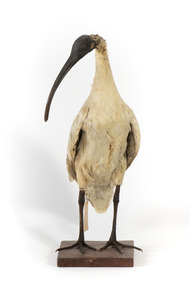
Animal specimen - Australian White Ibis, Trustees of the Australian Museum, 1860-1880
... This specimen has been stylised in a standing position and is positioned on a wooden platform. ...This specimen has been stylised in a standing position and is positioned on a wooden platform. Animal specimen Australian White Ibis Trustees of the Australian Museum Burke Museum Committee ...The Australian White Ibis is commonly known by the colloquial names "bin chicken" and "tip turkey" in Australian culture. These nicknames have arisen based on the presence of this bird at garbage locations where it is often seen rummaging through the waste. The Yindjibarndi people of the central and western Pilbara call this species mardungurra. This bird is located throughout the wetlands of eastern, northern and south-western Australia. Initially, it was not seen in urban areas, however, the species has been able to adapt and reduce fear of humans due to the lure of food found in human garbage. They commonly feed on terrestrial and aquatic invertebrates alongside human scraps. This specimen is part of a collection of almost 200 animal specimens that were originally acquired as skins from various institutions across Australia, including the Australian Museum in Sydney and the National Museum of Victoria (known as Museums Victoria since 1983), as well as individuals such as amateur anthropologist Reynell Eveleigh Johns between 1860-1880. These skins were then mounted by members of the Burke Museum Committee and put-on display in the formal space of the Museum’s original exhibition hall where they continue to be on display. This display of taxidermy mounts initially served to instruct visitors to the Burke Museum of the natural world around them, today it serves as an insight into the collecting habits of the 19th century.This specimen is part of a significant and rare taxidermy mount collection in the Burke Museum. This collection is scientifically and culturally important for reminding us of how science continues to shape our understanding of the modern world. They demonstrate a capacity to hold evidence of how Australia’s fauna history existed in the past and are potentially important for future environmental research. This collection continues to be on display in the Museum and has become a key part to interpreting the collecting habits of the 19th century.This Australian White Ibis has white and cream plumage on its body and a black neck, head, bill and legs/feet. The bill on this particular species has a distinctive long shape which is down-curved. It is a fairly large variety of the Ibis species. This specimen has been stylised in a standing position and is positioned on a wooden platform. 5 C. / White Ibis / See catalogue / Page 32 /taxidermy mount, taxidermy, animalia, burke museum, beechworth, australian museum, skin, reynell eveleigh johns, bird, ibis, bin chicken, white ibis, australian birds, australian white ibis -
 The Beechworth Burke Museum
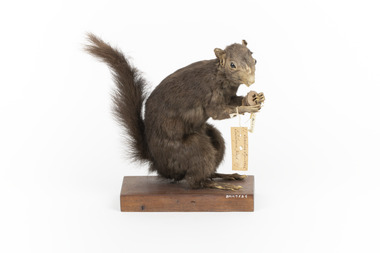
Animal specimen - Carolina Squirrel, Trustees of the Australian Museum, 1860-1880
... It grasps a nut between its hands and stands on a wooden platform. A paper tag hangs from the right arm with a smaller tag attached to the left. ...It grasps a nut between its hands and stands on a wooden platform. A paper tag hangs from the right arm with a smaller tag attached to the left. ...The Squirrel is a small to medium sized member of the rodent family Sciuridae. They are commonly located in America, Eurasia and Africa. The Squirrel was introduced to Australia by humans. Interestingly, the tail of the Squirrel serves the purpose of keeping the rain, wind or cold off the body of the animal, to help it cool off in hot weather, to counterbalance when moving and can be utilized as a parachute when jumping from one location to the next. Squirrels consume foods that are rich in protein, carbohydrates and fats. They eat nuts, seeds. fruits and vegetation. This specimen is part of a collection of almost 200 animal specimens that were originally acquired as skins from various institutions across Australia, including the Australian Museum and the National Museum of Victoria, as well as individuals such amateur anthropologist Reynell Eveleigh Johns between 1860-1880. These skins were then mounted by members of the Burke Museum Committee and put-on display in the formal space of the Museum’s original exhibition hall where they continue to be on display. This display of taxidermy mounts initially served to instruct visitors to the Burke Museum of the natural world around them, today it serves as an insight into the collecting habits of the 19th century.This specimen is part of a significant and rare taxidermy mount collection in the Burke Museum. This collection is scientifically and culturally important for reminding us of how science continues to shape our understanding of the modern world. They demonstrate a capacity to hold evidence of how Australia’s fauna history existed in the past and are potentially important for future environmental research. This collection continues to be on display in the Museum and has become a key part to interpreting the collecting habits of the 19th century.The Carolina Squirrel specimen has dark coloured fur with paler colouring on the face and hands. It grasps a nut between its hands and stands on a wooden platform. A paper tag hangs from the right arm with a smaller tag attached to the left. The squirrel has dark black glass eyes and sharp claws on the hands and feet. A.4481 BMM7535 35. Carolina Squirrel / Catalogue, Page, 49 /taxidermy mount, taxidermy, animalia, burke museum, beechworth, australian museum, skin, reynell eveleigh johns, squirrel -
 The Beechworth Burke Museum
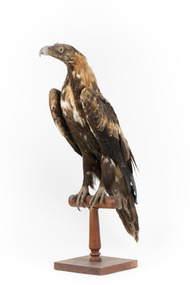
Animal specimen - Wedgetail Eagle
... This specimen stands upon a wooden platform. The bill is light grey and long legs dark brown. ...This specimen stands upon a wooden platform. The bill is light grey and long legs dark brown. ...The Wedgetail Eagle (aquila audax) is one of the largest birds of prey located in Australia, Indonesia and Papa New Guinea. It feasts mostly on rabbits but can target mammals as large as koalas, wombats, possums and small kangaroos. The darker the colouring, the older the bird is. A mostly dark brown feathering can suggest over 10 years old, though females are usually paler. This species mates monogamously for life. They circle high in the sky to avoid temperatures close to the ground and to assert their dominance over their territory. This specimen is lighter than many documented photographs of the species. They're usually less patchy / speckled with lighter colours on the chest and back. Documenting the wingspan of this specimen would be of interest because some have been measured up to 230cm. This specimen is part of a collection of almost 200 animal specimens that were originally acquired as skins from various institutions across Australia, including the Australian Museum in Sydney and the National Museum of Victoria (known as Museums Victoria since 1983), as well as individuals such as amateur anthropologist Reynell Eveleigh Johns between 1860-1880. These skins were then mounted by members of the Burke Museum Committee and put-on display in the formal space of the Museum’s original exhibition hall where they continue to be on display. This display of taxidermy mounts initially served to instruct visitors to the Burke Museum of the natural world around them, today it serves as an insight into the collecting habits of the 19th century.This specimen is part of a significant and rare taxidermy mount collection in the Burke Museum. This collection is scientifically and culturally important for reminding us of how science continues to shape our understanding of the modern world. They demonstrate a capacity to hold evidence of how Australia’s fauna history existed in the past and are potentially important for future environmental research. This collection continues to be on display in the Museum and has become a key part to interpreting the collecting habits of the 19th century.This wedgetail eagle is posed with the head turned to the left. It has mostly dark brown feathers which is common for older birds in this species. Speckled light brown and white feathers cover it's neck, chest and a middle strip across the wings. This specimen stands upon a wooden platform. The bill is light grey and long legs dark brown. taxidermy mount, taxidermy, animalia, burke museum, beechworth, australian museum, skin, reynell eveleigh johns, bird, wedgetail eagle, aquila audax, birds of prey, australian bird, eagle -
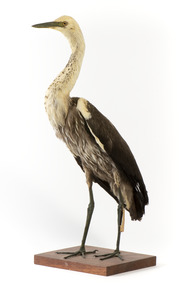 The Beechworth Burke Museum
Animal specimen - White-Necked Heron, Trustees of the Australian Museum, 1860-1880
... The White-Necked Heron has been stylised in a standing position on a wooden platform. The bird has long black legs and a long white neck with black spots decorating the front of the neck. .... / The White-Necked Heron has been stylised in a standing position on a wooden platform. The bird has long black legs and a long white neck with black spots decorating the front of the neck. ...The White-necked Heron (also known as the Pacific Heron) is commonly found throughout mainland Australia. It resides mainly in locations with freshwater and in tidal areas. These birds are carnivores and mainly eat fish, crustaceans, amphibians and insects. They are also known to feed on young freshwater rats, young ducklings and lizards. This specimen is part of a collection of almost 200 animal specimens that were originally acquired as skins from various institutions across Australia, including the Australian Museum in Sydney and the National Museum of Victoria (known as Museums Victoria since 1983), as well as individuals such as amateur anthropologist Reynell Eveleigh Johns between 1860-1880. These skins were then mounted by members of the Burke Museum Committee and put-on display in the formal space of the Museum’s original exhibition hall where they continue to be on display. This display of taxidermy mounts initially served to instruct visitors to the Burke Museum of the natural world around them, today it serves as an insight into the collecting habits of the 19th century.This specimen is part of a significant and rare taxidermy mount collection in the Burke Museum. This collection is scientifically and culturally important for reminding us of how science continues to shape our understanding of the modern world. They demonstrate a capacity to hold evidence of how Australia’s fauna history existed in the past and are potentially important for future environmental research. This collection continues to be on display in the Museum and has become a key part to interpreting the collecting habits of the 19th century.The White-Necked Heron has been stylised in a standing position on a wooden platform. The bird has long black legs and a long white neck with black spots decorating the front of the neck. The head is also white and the bill black. The front torso of the bird is cream mixed with brown plumage and the back. The rear and wings are a dark brown. [illegible] Heron / See Catalogue, page 33. /taxidermy mount, taxidermy, animalia, burke museum, beechworth, australian museum, skin, reynell eveleigh johns, bird, australian birds, white-necked heron, heron, pacific heron -
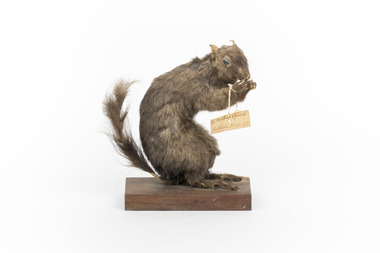 The Beechworth Burke Museum
Animal specimen - Carolina Squirrel, Trustees of the Australian Museum, 1860-1880
... This specimen stands on a wooden platform and its arms are stylized in a raised position next to its face. ...This specimen stands on a wooden platform and its arms are stylized in a raised position next to its face. ...The Squirrel is a small to medium sized member of the rodent family Sciuridae. They are commonly located in America, Eurasia and Africa. The Squirrel was introduced to Australia by humans. Interestingly, the tail of the Squirrel serves the purpose of keeping the rain, wind or cold off the body of the animal, to help it cool off in hot weather, to counterbalance when moving and can be utilized as a parachute when jumping from one location to the next. Squirrels consume foods that are rich in protein, carbohydrates and fats. They eat nuts, seeds. fruits and vegetation. This specimen is part of a collection of almost 200 animal specimens that were originally acquired as skins from various institutions across Australia, including the Australian Museum and the National Museum of Victoria, as well as individuals such amateur anthropologist Reynell Eveleigh Johns between 1860-1880. These skins were then mounted by members of the Burke Museum Committee and put-on display in the formal space of the Museum’s original exhibition hall where they continue to be on display. This display of taxidermy mounts initially served to instruct visitors to the Burke Museum of the natural world around them, today it serves as an insight into the collecting habits of the 19th century.This specimen is part of a significant and rare taxidermy mount collection in the Burke Museum. This collection is scientifically and culturally important for reminding us of how science continues to shape our understanding of the modern world. They demonstrate a capacity to hold evidence of how Australia’s fauna history existed in the past and are potentially important for future environmental research. This collection continues to be on display in the Museum and has become a key part to interpreting the collecting habits of the 19th century.The Carolina Squirrel specimen has dark grey coloured fur. This specimen stands on a wooden platform and its arms are stylized in a raised position next to its face. A paper tag hangs from the right arm with a smaller tag attached to the left. The squirrel has dark black glass eyes and sharp claws on the hands and feet.A.4480 36. Carolina Squirrel / Catalogue, page, 49 /taxidermy mount, taxidermy, animalia, burke museum, beechworth, australian museum, skin, reynell eveleigh johns, squirrel -
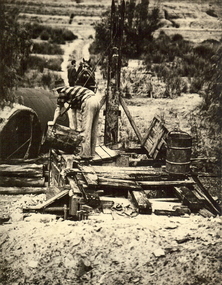 Bendigo Historical Society Inc.
Photograph - MINING WHIP BENDIGO
... Black and white photograph. Dilapidated wooden platform with vertical post with wheel at top. ...MINING Surface equipment mining whip bendigo Bendigo mines and mining mine mines miner male Black and white photograph. Dilapidated wooden platform with vertical post with wheel at top. ...Black and white photograph. Dilapidated wooden platform with vertical post with wheel at top. Wire attached to bucket and pulled by horse. Two males, one with horse, other emptying bucket. Inscriptions: on back - hand written in ball point pen 'Mining Whip Bendigo', 'A Richardson, 29 Harrison Street, Bendigo', 'Rec'd photo, 21.4.67'.mining, surface equipment, mining whip bendigo, bendigo, mines and mining, mine, mines, miner, male
