
Showing 27 items matching "wooden sleepers"
-
 Melbourne Tram Museum
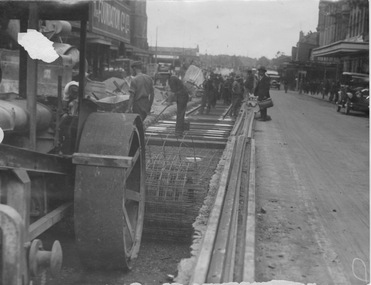
Photograph - Track laying Swanston St, 1/1926
... ...wooden sleepers...Wire mesh is being laid on the road base with some wooden sleepers and rails in place. A large steam powered roller is partially shown at left carrying the name of a popular construction company, The Foundation Coy. ...Wire mesh is being laid on the road base with some wooden sleepers and rails in place. A large steam powered roller is partially shown at left carrying the name of a popular construction company, The Foundation Coy. ...The photograph shows part of the track laying process in Swanston Street between Collins Street. and Flinders Lane with pedestrians, onlookers and motor cars. Wire mesh is being laid on the road base with some wooden sleepers and rails in place. A large steam powered roller is partially shown at left carrying the name of a popular construction company, The Foundation Coy. Ltd., that was contracted for many of the cable-to-electric tram conversions in the 1920s. Note that the rails being positioned are railway rails that required a check plate to be bolted to each rail to create a flangeway in the road surface. These plates can be seen stacked at the right of the track bed with pre-drilled holes. Work commenced on the conversion of the cable tram track in Swanston Street in December 1925 and proceed in a northerly direction towards Lonsdale Street. Yields information about the cable tram conversions in 1925-26 in Swanston Street.Sepia toned photograph with note on rear. Written in ink on rear of photograph is "Red Frame 10 of 10" wire mesh, wooden sleepers, rails, steam powered roller, tramways, swanston street, cable tram conversion, railway rail, check plate, flangeway, collins street, flinders lane, tha foundation coy. ltd. -
 Glenelg Shire Council Cultural Collection
Photograph - Photograph - Portland Harbou, n.d
... Black and white photo of a pile of concrete reinforced slabs, sitting on wooden sleepers...Port of Portland Authority Archives Port of Portland Archives Black and white photo of a pile of concrete reinforced slabs, sitting on wooden sleepers Photograph Photograph - Portland Harbou ...Port of Portland Authority Archivesport of portland archives -
 Anglesea and District Historical Society
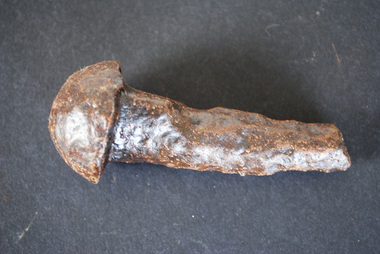
Railway Bolt, Estimated 1890-1948
... Cast iron railway bolt used to fasten the railway track to the wooden sleepers below....railway bolt wensleydale railway sleeper bolt rail track fastener None Cast iron railway bolt used to fasten the railway track to the wooden sleepers below. Railway Bolt ...Cast iron railway bolt used to fasten the railway track to the wooden sleepers below.Nonerailway bolt, wensleydale railway, sleeper bolt, rail track fastener -
Glenelg Shire Council Cultural Collection
Photograph - Photograph - Group of Men, n.d
... Group of men sitting/standing on wooden sleeper outdoors. Some of them have firearms....Group of men sitting/standing on wooden sleeper outdoors. Some of them have firearms. ...Black and white photo. Group of men sitting/standing on wooden sleeper outdoors. Some of them have firearms.firearms, hunting, shooting, recreation, sport -
Glenelg Shire Council Cultural Collection
Photograph - Photograph - Group of Men, Portland, n.d
... Group of men sitting in an outdoor setting. Some on wooden sleepers. Some of the group have firearms....Group of men sitting in an outdoor setting. Some on wooden sleepers. Some of the group have firearms. ...Black and white photo. Group of men sitting in an outdoor setting. Some on wooden sleepers. Some of the group have firearms.sport, recreation, outdoors, hunting, shooting -
Glenelg Shire Council Cultural Collection
Photograph - Photograph - Portland Rifle Club, n.d
... Group of men sittings and standing on wooden sleeper outdoors. Most of them are holding firearms. ...Group of men sittings and standing on wooden sleeper outdoors. Most of them are holding firearms. ...Black and white photo. Group of men sittings and standing on wooden sleeper outdoors. Most of them are holding firearms. Members of shooting club.sporting, recreation, sport, hunting -
Glenelg Shire Council Cultural Collection
Photograph, n.d
... Group of men sitting/standing outdoors on wooden sleepers. No firearms, but location same as 7767, 7768. ...Group of men sitting/standing outdoors on wooden sleepers. No firearms, but location same as 7767, 7768. ...Black and white photo. Group of men sitting/standing outdoors on wooden sleepers. No firearms, but location same as 7767, 7768. Same club -
 Wodonga & District Historical Society Inc
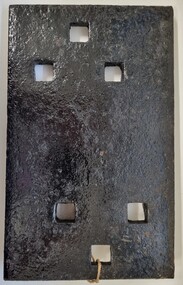
Functional object - Rail tie plate from Cudgewa Line, 1930 - 1960s
... These plates were secured to the wooden sleepers. This system played a vital role in maintaining the stability and safety of the railway track structure....These plates were secured to the wooden sleepers. This system played a vital role in maintaining the stability and safety of the railway track structure. ...Cudgewa Line -The Cudgewa railway line opened in stages between 1889 and 1921. The first section from Wodonga to Huon opened on 10 September 1889. It was extended to Bolga on 18 July 1890, Tallangatta on 24 July 1891, Shelley on 13 June 1916 (the highest station in Victoria), Beetomba on 10 April 1919 and Cudgewa on 5 May 1921. The line had 1 in 30 grades and trestle bridges that have been heritage listed. In 1919, the line was used to carry materials for the construction of Hume Weir, and three years later a spur line connecting Ebden to the weir was opened. In the 1960s, Cudgewa became the railhead of materials for the Snowy Mountains Scheme. The last passenger service from Wodonga to Tallangatta ran on 30 September 1961. The turntable and passenger platform at Cudgewa were abolished in 1976. This tie plate came from the rails of the Cudgewa Line at Gordon Roy's hut which was situated behind Perry's Stump Hotel outside Wodonga. The hut was used as an office with the points lever outside to switch trucks to different tracks on the Bandiana and Cudgewa lines.This item is significant as it was part of the railway line to Cudgewa which played an important role in North east Victoria carrying freight during the construction of the Hume Weir and the Snowy Mountains Scheme.A section of flat metal plate. These plates were secured to the wooden sleepers. This system played a vital role in maintaining the stability and safety of the railway track structure.victorian railways, cudgewa rail line, railway components -
 Nillumbik Historical Society Incorporated
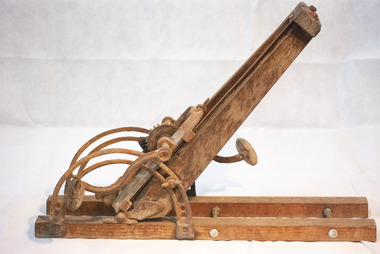
Tool - Portable Sleeper Drill, Early 20th century
... The device was placed over the wooden sleeper to drill holes for the iron spikes which held the rail down. ...The device was placed over the wooden sleeper to drill holes for the iron spikes which held the rail down. ...This drill was used in the construction of the Eltham-Hurstbridge Railway extension in 1911. The device was placed over the wooden sleeper to drill holes for the iron spikes which held the rail down. Example of tools needed to build railway in early 20th Century in the Diamond Valley.Drill mechanism mounted on wooden frame. Mechanism tilts to enable holes to be drilled vertically (normal) or at angles up to 45 degrees using double hand cranks and gears. A rack can be engaged to raise and lower the mechanism and drill bit. Mechanism appears original. Base frame replaced recently. #drill, #railwayconstruction, #sleepers, #tilting, #handoperated -
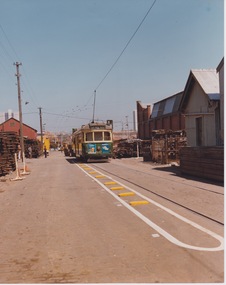 Melbourne Tram Museum
Photograph - W7 class tram 1002 at South Melbourne Depot, c1980s
... The yard features stacks of wooden sleepers and rails with one wall of the car shed seen at right....The yard features stacks of wooden sleepers and rails with one wall of the car shed seen at right. ...Photograph shows W7 class 1002 in South Melbourne Depot yard with trolley pole raised, showing destination 'South Melbourne Depot 4' but without Run Number. At the rear of the tram, a low loader is working with several bystanders watching. The yard features stacks of wooden sleepers and rails with one wall of the car shed seen at right.Yields information about South Melbourne Depot Colour photographsouth melbourne depot, tram 1002, w7 class, depot yard, car shed -
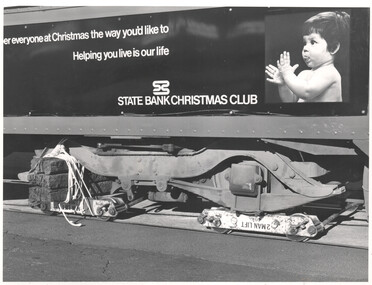 Melbourne Tram Museum
Photograph - Tram on "dolly" bogies, c1980
... This photo shows a tram fitted with a No. 15 truck on transporter bogies or dollies, possibly after the failure of an axle. Wooden sleepers have been placed on top of the transport dollies to enable it to be moved back to a depot or to the workshops. ...This photo shows a tram fitted with a No. 15 truck on transporter bogies or dollies, possibly after the failure of an axle. Wooden sleepers have been placed on top of the transport dollies to enable it to be moved back to a depot or to the workshops. ...This photo shows a tram fitted with a No. 15 truck on transporter bogies or dollies, possibly after the failure of an axle. Wooden sleepers have been placed on top of the transport dollies to enable it to be moved back to a depot or to the workshops. The tram has an advert for the State Savings Bank of Victoria Christmas Club. The logo is known as the "hamburger logo", which was used in the late 1970s to the early 1980s.Yields information on the use of transporter dollies for moving a tram that has suffered a wheel or axle failure.Black and white photograph with a planing back.tramways, accidents, dollies, state savings bank -
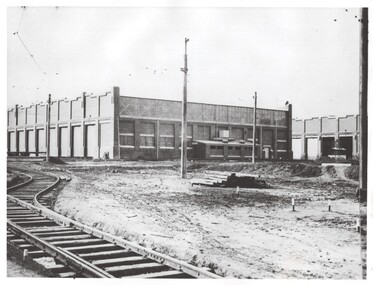 Melbourne Tram Museum
Photograph - Black & White Photograph/s, 1926
... The overhead has been put up, tracks laid using wooden sleepers. The traverser between the Paint shop and the body shop can be seen. ...The overhead has been put up, tracks laid using wooden sleepers. The traverser between the Paint shop and the body shop can be seen. ...Black and white photograph of Preston Workshops, possibly soon after construction or during construction. Looking from the St Georges Road gate,. or North East. The overhead has been put up, tracks laid using wooden sleepers. The traverser between the Paint shop and the body shop can be seen. Prior to the timber store being constructed. C1926trams, tramways, preston workshops, construction, trackwork -
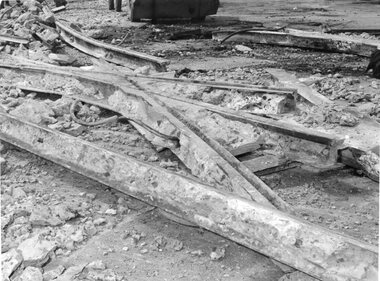 Melbourne Tram Museum
Photograph - Set of 12 Black & White Photograph/s, Melbourne & Metropolitan Tramways Board (MMTB), 1966
... Series of 12 black and white photographs of the trackwork on the MMTB system. .1 - demolished track at a junction .2 - section of rail showing the flangeway missing .3 - junction plates between different weight railway . .4 - wood blocked track showing broken joint and failure .5 - ditto .6 - V crossing ,7 - ditto at a wooden sleepered crossing with puppy dog spikes. .8 - crossing possibly between tram and rail .9 - H crossing rail showing broken joints and wear .10 - ditto .11 - section of rail pumping - waterlogged .12 - damaged joint, pumping, broken joint plate....Trams tramways Trackwork Rails Points Crossover Track Materials Track Repairs Series of 12 black and white photographs of the trackwork on the MMTB system. .1 - demolished track at a junction .2 - section of rail showing the flangeway missing .3 - junction plates between different weight railway . .4 - wood blocked track showing broken joint and failure .5 - ditto .6 - V crossing ,7 - ditto at a wooden sleepered crossing with puppy dog spikes. .8 - crossing possibly between tram and rail .9 - H crossing rail showing broken joints and wear .10 - ditto .11 - section of rail pumping - waterlogged .12 - damaged joint, pumping, broken joint plate. ...Series of 12 black and white photographs of the trackwork on the MMTB system. .1 - demolished track at a junction .2 - section of rail showing the flangeway missing .3 - junction plates between different weight railway . .4 - wood blocked track showing broken joint and failure .5 - ditto .6 - V crossing ,7 - ditto at a wooden sleepered crossing with puppy dog spikes. .8 - crossing possibly between tram and rail .9 - H crossing rail showing broken joints and wear .10 - ditto .11 - section of rail pumping - waterlogged .12 - damaged joint, pumping, broken joint plate.trams, tramways, trackwork, rails, points, crossover, track materials, track repairs -
 Melbourne Tram Museum
Photograph - Set of 8 Black & White Photograph/s, Melbourne & Metropolitan Tramways Board (MMTB), 1966
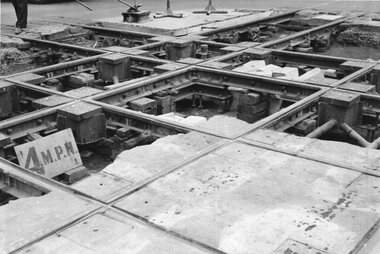
... Series of 8 black and white photographs of the trackwork used at H crossings (where two tracks cross another two tracks at right angles.) .1 - H crossing being renewed. .2 - New H crossing laide out in a yard .3 - H crossing being completed at Queensway / Chapel and Dandenong Road, early 1968 with the All Saints church in the background. .4 - being renewed .5 - ditto .6 - ditto with a tram crossing. .7 - as for .4 .8 - showing extensive fish plating on a wooden longitudinal sleepers, plates bolted to the wood or timbers....Trams tramways Trackwork Rails Track Materials Track Repairs Sleepers Equipment Queensway Chapel St Dandenong Road Series of 8 black and white photographs of the trackwork used at H crossings (where two tracks cross another two tracks at right angles.) .1 - H crossing being renewed. .2 - New H crossing laide out in a yard .3 - H crossing being completed at Queensway / Chapel and Dandenong Road, early 1968 with the All Saints church in the background. .4 - being renewed .5 - ditto .6 - ditto with a tram crossing. .7 - as for .4 .8 - showing extensive fish plating on a wooden longitudinal sleepers, plates bolted to the wood or timbers. ...Series of 8 black and white photographs of the trackwork used at H crossings (where two tracks cross another two tracks at right angles.) .1 - H crossing being renewed. .2 - New H crossing laide out in a yard .3 - H crossing being completed at Queensway / Chapel and Dandenong Road, early 1968 with the All Saints church in the background. .4 - being renewed .5 - ditto .6 - ditto with a tram crossing. .7 - as for .4 .8 - showing extensive fish plating on a wooden longitudinal sleepers, plates bolted to the wood or timbers.trams, tramways, trackwork, rails, track materials, track repairs, sleepers, equipment, queensway, chapel st, dandenong road -
 Melbourne Tram Museum
Photograph - Set of 15 Black & White Photograph/s, Melbourne & Metropolitan Tramways Board (MMTB), 1950's
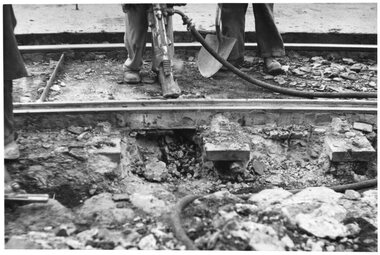
... Series of 15 black and white photographs of the track works to reconstruct tram lines showing various methods and works during the 1960's. .1 - Jackhammers concrete out around wooden sleepers - the rails have been bolted to them. .2 - Excavated track or temporary track next to newly relaid track - Hawthorn Road by Caulfield Park? ...Series of 15 black and white photographs of the track works to reconstruct tram lines showing various methods and works during the 1960's. .1 - Jackhammers concrete out around wooden sleepers - the rails have been bolted to them. .2 - Excavated track or temporary track next to newly relaid track - Hawthorn Road by Caulfield Park? ...Series of 15 black and white photographs of the track works to reconstruct tram lines showing various methods and works during the 1960's. .1 - Jackhammers concrete out around wooden sleepers - the rails have been bolted to them. .2 - Excavated track or temporary track next to newly relaid track - Hawthorn Road by Caulfield Park? .3 - Partly completed work - nearest track relaid, second track still has wood blocks? and then a temporary track. .4 - Excavated previously concreted and bolted track. Appears to be new rail. .5 - Compacting a new track bed with work laying track in the background. .6 - Rail being craned into position onto small concrete blocks - Nicholson St North Fitzroy at Church St - the church is now Melbourne City Mission Palliative care centre. 1955/56 - construction of the replacement track. Note the Hail bus stop sign on the corner. .7 - Thermite welding being set up. .8 - after a Thermite welding joint completed. .9 - track reading for pouting concrete, with a rebuilt track alongside and temporary track on the other side. .10 - ditto .11 - Concrete being poured .12 - ditto - could be Maribyrnong Road bridge replacement. .13 - Screeding off the concrete - possibly Nicholson St North Fitzroy .14 - completed surface - location as above .15 - completed surface with cloth covers to assist the concrete being cured. Has a MMTB hut and two worker amenity buses alongside. - location as above.Some photos have pencil marks on rear.trams, tramways, trackwork, rails, track materials, track repairs, sleepers, equipment, concrete, welding, nicholson st, new tramway, buses -
 Puffing Billy Railway
Double Headed Rail, circa 1872 - 1883
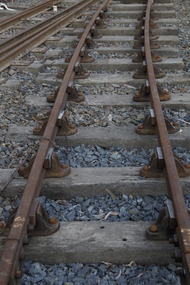
... D 38 (2.9 MB) http://www.parliament.vic.gov.au/papers/govpub/VPARL1859-60NoD38.pdf Ravenswood Siding When the Victorian Railways were established in 1856 they adopted one of the popular British permanent way standards - heavy 80lb (36.3kg) double-headed rail held up right in cast iron chairs attached to transverse timber sleepers by wooden pegs called trenails. The Ravenswood Railway siding was constructed in 1862 with 12 feet wrought iron double-head rail held in cast iron chairs with Ransom and May patent compressed keys. ...D 38 (2.9 MB) http://www.parliament.vic.gov.au/papers/govpub/VPARL1859-60NoD38.pdf Ravenswood Siding When the Victorian Railways were established in 1856 they adopted one of the popular British permanent way standards - heavy 80lb (36.3kg) double-headed rail held up right in cast iron chairs attached to transverse timber sleepers by wooden pegs called trenails. The Ravenswood Railway siding was constructed in 1862 with 12 feet wrought iron double-head rail held in cast iron chairs with Ransom and May patent compressed keys. ...Double Headed Rail from Ravenswood Station Siding which was dismantled circa 1987 the two rails were stored for a time at Maldon before being donated to Puffing Billy Museum Bearing makers marks of Wilson & Cammell - Dronfield- Steel works Wilson & Cammell made Steel rails at their Dronfield Steel Works, in Dronfield, North East Derbyshire, England from 1872 - 1883 Double-headed rail In late 1830s Britain, railway lines had a vast range of different patterns. One of the earliest lines to use double-headed rail was the London and Birmingham Railway, which had offered a prize for the best design. This rail was supported by chairs and the head and foot of the rail had the same profile. The supposed advantage was that, when the head became worn, the rail could be turned over and re-used. In practice, this form of recycling was not very successful as the chair caused dents in the lower surface, and double-headed rail evolved into bullhead rail in which the head was more substantial than the foot. Info from Wikipedia - Rail Profile https://en.wikipedia.org/wiki/Rail_profile The first records of double headed rail being used In Victoria by Victorian Railways was in 1859, the rails, chairs, oak and trenails were imported from UK. After the 1870’s the Victorian Railways went over to using flat bottom rails, but they still needed replacement double headed rail for lines already laid and this continued up to at least 1883 Wilson & Cammell - Dronfield- Steel works Wilson & Cammell made Steel rails at their Dronfield Steel Works, in Dronfield England from 1872 - 1883 Mount Alexander & Murray River Railway The Melbourne, Mount Alexander & Murray River Railway Company received parliamentary assent in February 1853 to build Victoria's first inland railway from Melbourne to Williamstown, and Melbourne to Bendigo and Echuca. Construction commenced in January 1854 with work on a pier at Williamstown but lack of funds slowed progress, eventually prompting the company to sell out to the government. The 100-mile (162 km) section to Bendigo opened in October 1862. Its cost of £35,000 per mile made it the most expensive railway ever built in Australia. In 1864, the line was extended to Echuca, tapping into the booming Murray-Darling paddlesteamer trade. info from Museums Victoria - Victorian Railways https://museumsvictoria.com.au/railways/theme.aspx?lvl=3&IRN=450&gall=456 1863 Ravenswood Station open on the 1st Feb 1863 Victorian Railways - purchased and imported the Rail and Chairs from Raleigh, Dalgleish, White and Co. London Importation of railway plant : abstract of a return to an order of the Legislative Assembly dated 27th June 1860 for - Copies of the advertisements calling for tenders, the names of the tenderers and the accounts and correspondence with Mr Brunel relating thereto GP V 1859/60 no. C 15 http://www.parliament.vic.gov.au/papers/govpub/VPARL1859-60NoC15.pdf Report from the Select Committee upon the Importation of Railway Plant : together with proceedings of the Committee, minutes of evidence and appendix GP V 1859/60 no. D 38 (2.9 MB) http://www.parliament.vic.gov.au/papers/govpub/VPARL1859-60NoD38.pdf Ravenswood Siding When the Victorian Railways were established in 1856 they adopted one of the popular British permanent way standards - heavy 80lb (36.3kg) double-headed rail held up right in cast iron chairs attached to transverse timber sleepers by wooden pegs called trenails. The Ravenswood Railway siding was constructed in 1862 with 12 feet wrought iron double-head rail held in cast iron chairs with Ransom and May patent compressed keys. Trenails held the chairs to the sleepers and the joints were secured in joint chairs. Joints were subsequently joined using fish plates. It formed part of the Melbourne to Echuca rail line, initially known as the Melbourne, Mt Alexander and Murray River Railway. George Christian Derbyshire, the first Engineer-in-Chair of the Victorian Railways was responsible for the design and construction of the works. No new lines were built in Victoria using double-headed rail after 1870. The siding was disconnected from the main line in 1988. The Ravenswood Railway Siding demonstrates the original 1856 philosophy of the Victorian Railways to adopt British permanent way technology. The siding demonstrates significant aspects in the development of permanent way technology in England and Victoria over the period from the 1830's to the 1880's. The chairs in the Ravenswood siding are physical evidence of early railway technology rendered obsolete 120 years ago, namely joint chairs at rail joints and trenails to secure the chairs to the sleepers. The double-headed rail demonstrates an important stage in the evolution of British rail technology in the 1830s. The old fish plates, square headed bolts and square nuts demonstrate the success of fishing the rail joins. The Ravenswood siding demonstrates the earliest form of rail joint technology developed in England, and existing in Australia, the joint chair. In part of the siding the sequence of joint and intermediate chairs is consistent with the 1856 specifications, that sequence is rare with the joints secured in joint chairs. The survival of chairs in this sequence is rare and almost certainly demonstrates that they remained in continuous use at the same location from 1862 to 1988. This remnant of the Ravenswood siding has survived 126 years. The siding has proved to be the most significant of extant remnant double-headed sidings in Victoria, containing a rare combination of early permanent way technologies. Construction dates 1862, Info from Ravenswood Railway Siding Victorian Heritage Database Report http://vhd.heritagecouncil.vic.gov.au/places/4693/download-report The remaining section of this siding is significant at the State and National levels in that it demonstrates the use of chaired rail by the Victorian Railways Department for the Trunk Lines and, more particularly, the following stages in the evolution of this long obsolete method of permanent way construction: a) The use of joint chairs and intermediate chairs at regular intervals inferring that the original wrought iron rail lengths were 12 feet, as is known through documentary sources to have been the case. The survival of chairs in this sequence is unique and almost certainly demonstrates that they have remained in continuous use at the same location and in the same sequence from 1862 to 1988 . b) The use of joint chairs and intermediate chairs designed for use with trenails. c) The use of later intermediate chairs designed for use with steel pins and the use of fished joints with steel double head chaired rail, representing a second method of constructing the permanent way using chaired rail technology. info from Ravenswood Siding - Melbourne/Echuca Railway Line - Victorian Heritage Database Report http://vhd.heritagecouncil.vic.gov.au/places/70103/download-report Addition to Citation for Melbourne to EchucaRailway Line 1/10/1990 Double Head Rail The surviving lengths of double head rail with chairs on this railway compare with one surviving similar remnant on the Geelong to Ballarat railway and are representative of permanent way construction techniques applied exclusively to the two trunk railways of the 1860's. In this respect they are rare survivors and may be unique at the national level and of technical importance at the international level to the extent that they enhance contemporary understanding of early railway building technology. Surviving lengths of chaired double head rail survive at Kyneton, Ravenswood and Bendigo on this railway and include a number of different types of cast iron intermediate and joint chairs with hardwood keys and metal pins. The Ravenswood siding is of special significance for the diversity of chair types and for the sequence of chairs recalling rail lengths known to be associated with construction of the line in 1862. Construction of the Railway Tenders closed on 24 March 1858 with no less than 133 tenders being received. A contract was let to Cornish and Bruce for £3,356,937 to commence work on 1 June 1858 and complete the line by 31 July 1861. Cornish and Bruce made quick early progress with the Melbourne to Sunbury section being officially opened on 13 January 1859. The line was officially opened to Bendigo (Sandhurst) on 20 October 1862 by the Governor of Victoria, Sir Henry Barkly. A great banquet was held for 800 guests and this was followed by a grand ball. The extension of the line to Echuca was a relatively simple matter as that part of the line was across plain country without any significant engineering challenges. Tenders were called for the work in 1863 and the work was completed in 1864 by contractors Collier and Barry Apart from the line contractors, other firms directly involved were J Shire law and Co (sleepers), R Fulton, Langlands Brothers and Co, William Crossley (water supply), B Moreland, Langlands Brothers and Co (platelayers lorries), E Chambers (iron pins, traversers), Miller and McQuinstan (luggage vans and steam engines) and various contractors for building works. Info from Engineers Australia Engineering Heritage Victoria Nomination for Recognition under the Engineering Heritage Australia Heritage Recognition Program for the Goldfields Railways - Melbourne , Bendigo & Echuca Railway Page 25 - .2.9.2 Statement from National Trust of Australia (Victoria) Listing number B5323 for Mt Alexander/Murray Valley Rail Line: Page 69 - Theme 3 https://www.engineersaustralia.org.au/portal/system/files/engineering-heritage-australia/nomination-title/Melbourne_%20Bendigo_Echuca%20Railway%20Nomination.pdf The Melbourne, Mount Alexander and Murray River Railway Company was a railway company in Victoria, Australia. It was established on 8 February 1853 to build a railway from Melbourne to Echuca on the Victorian-NSW border and a branch railway to Williamstown. The company struggled to make any progress and on 23 May 1856, the colonial Government took over the Company and it became part of the newly established Department of Railways, part of the Board of Land and Works. The Department of Railways became Victorian Railways in 1859. Construction of the Bendigo line commenced in 1858, but this private consortium also met with financial difficulties when it was unable to raise sufficient funds, and was bought out by the Victorian colonial government. The design work was then taken over by Captain Andrew Clarke, R. E., Surveyor-General of Victoria, with bridge designs completed by Bryson and O'Hara The contract for the first stage of the line from Footscray to Sandhurst (now Bendigo), was let to Cornish and Bruce for £3,356,937.2s.2d ($6.714 million) with work commencing on 1 June 1858. Completion of the permanent way was to be by 31 July 1861 https://en.wikipedia.org/wiki/Melbourne,_Mount_Alexander_and_Murray_River_Railway_Company Victorian Railways - purchased and imported the Rail and Chairs from Raleigh, Dalgleish, White and Co. London Importation of railway plant : abstract of a return to an order of the Legislative Assembly dated 27th June 1860 for - Copies of the advertisements calling for tenders, the names of the tenderers and the accounts and correspondence with Mr Brunel relating thereto GP V 1859/60 no. C 15 http://www.parliament.vic.gov.au/papers/govpub/VPARL1859-60NoC15.pdf Report from the Select Committee upon the Importation of Railway Plant : together with proceedings of the Committee, minutes of evidence and appendix GP V 1859/60 no. D 38 (2.9 MB) http://www.parliament.vic.gov.au/papers/govpub/VPARL1859-60NoD38.pdf Victorian Railways : report of the Board of Land and Works November 1862 GP V 1862/63 no. 21 (2.8 MB) https://www.parliament.vic.gov.au/papers/govpub/VPARL1862-63No21.pdfHistoric - Victorian Railways - Double Headed rail Ravenswood Railway Station and Siding Victorian Heritage Database Reports Victorian Heritage Register VHR H1100 Victorian Heritage Register VHR H1786 National Trust VHR H1100 Mount Alexander and Murray River Rail way Line National Trust2 rail lengths of Double Headed Rail made of Iron makers marks : Wilson & Cammell - Dronfield - Steel and 20 joint chairs with metal rail pins Makers mark Wilson & Cammell - Dronfield - Steel (possible date 187? very hard to read ) puffing billy, double headed rail, wilson & cammell - dronfield - steel works, ravenswood station siding, melbourne to echuca rail line, initially known as the melbourne, mt alexander and murray river railway. -
 Federation University Historical Collection
Map, Matthew Cibson, University of Ballarat Centre for Environmental Management, Ballarat Technology Park Conservation Plan, 1997, 02/1997
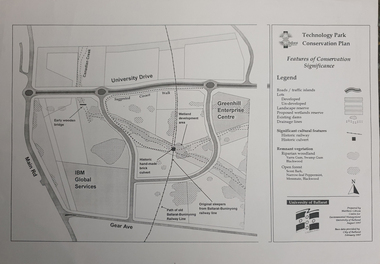
... Map showing the Ballarat Technlogy Camp, Greenhill Enterprise Centre, Canadian Wetlands. hand-made brick culvert sleepers, Ballarat-Buninyong Railway Line, IBM Global Services, early wooden bridge, Canadian Creek, Gear Avenue. ...The Ballarat Technology Park is on the Federation University Mount Helen Campus ballarat technology park canadian wetlands greenhill enterprise centre brick cultert railway ballarat-buninyong railway Map showing the Ballarat Technlogy Camp, Greenhill Enterprise Centre, Canadian Wetlands. hand-made brick culvert sleepers, Ballarat-Buninyong Railway Line, IBM Global Services, early wooden bridge, Canadian Creek, Gear Avenue. ...The Ballarat Technology Park is on the Federation University Mount Helen CampusMap showing the Ballarat Technlogy Camp, Greenhill Enterprise Centre, Canadian Wetlands. hand-made brick culvert sleepers, Ballarat-Buninyong Railway Line, IBM Global Services, early wooden bridge, Canadian Creek, Gear Avenue. ballarat technology park, canadian wetlands, greenhill enterprise centre, brick cultert, railway, ballarat-buninyong railway -
Glenelg Shire Council Cultural Collection
Photograph - Photograph - Main Breakwater Construction, Jan-60
... Stacks of concrete and wooden piles. Rain track and sleepers from foreground....Stacks of concrete and wooden piles. Rain track and sleepers from foreground. Photograph Photograph - Main Breakwater Construction ...Port of Portland Authority ArchivesFront: 'Wharf Area: View N.5. showing transit shed under erection and rail tracks being laid. Note spray wall in background. Jan '60 - Typed on bottom of photoport of portland archives, portland harbour, transit shed -
 Orbost & District Historical Society
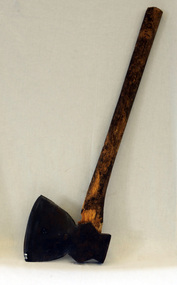
broad axe, c. early to mid 20th century
... Timber sleepers were superceded by concrete sleepers in c. 1970s. broad-axe sleeper-cutting timber-industry An iron axe with a long cutting edge. The neck of the wooden handle is chipped. broad axe ...Used in the timber industry for trimming sleepers or shaping timber.This item is associated with the timber and sleeper-cutting industry in the Orbost Region. Timber sleepers were superceded by concrete sleepers in c. 1970s.An iron axe with a long cutting edge. The neck of the wooden handle is chipped.broad-axe sleeper-cutting timber-industry -
 Orbost & District Historical Society
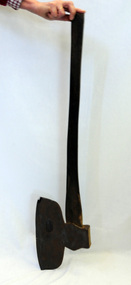
broad axe, c. 1900 to 1970s
... broad-axe sleeper-cutting timber-industry broad-axe sleeper-cutting timber-industry An iron axe head with a very long cutting blade and a long wooden handle. broad axe ...Used in the timber and sleeper-cutting industry. Used to square sleepers. This axe was possibly used by the donor John McMahon.Used in the timber and sleeper-cutting industry in the Orbost region.Timber sleepers were superceded by concrete sleepers in c. 1970s. broad-axe sleeper-cutting timber-industry An iron axe head with a very long cutting blade and a long wooden handle. broad-axe sleeper-cutting timber-industry -
 Kiewa Valley Historical Society
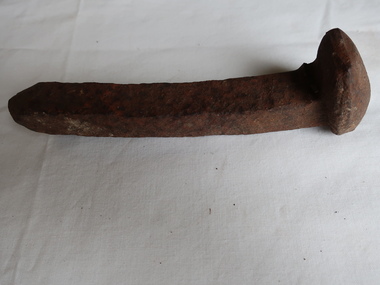
Bridge Spike
... This spike was used to secure wooden railway sleepers on the railways created for the Kiewa Hydro Electric Scheme. ...This spike is designed for the purpose of securing wooden planks, beams, or railroad ties to create sturdy and durable bridges.This spike was used to secure wooden railway sleepers on the railways created for the Kiewa Hydro Electric Scheme.15cm steel bolt-like with a square shaft. Sharp at one end and enlarged steel head at the other end.railway sleeper spike, spike, bridge spike -
 Chiltern Athenaeum Trust
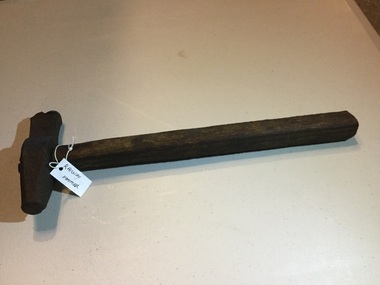
Railway Hammer, Circa 1920
... Sleeper Hammer Marker has steel head with flat nose and wooden handle...This Sleeper Marker Hammer was donated by Noel Eames and was owned by his Grandfather sleeper hammer railways Initials of owner operator at top of head Sleeper Hammer Marker has steel head with flat nose and wooden handle Railway Hammer ...This Sleeper Marker Hammer was donated by Noel Eames and was owned by his GrandfatherSleeper Hammer Marker has steel head with flat nose and wooden handleInitials of owner operator at top of headsleeper, hammer, railways -
 Ballarat Tramway Museum
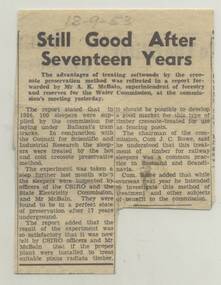
Newspaper, The Courier Ballarat, "Still good after Seventeen Years", 18/09/1953 12:00:00 AM
... Yields information about a provision of treated wooden pine sleepers to tramways in Ballarat. Trams tramways Sleepers Tram Track Trackwork Pencil date of "18-9-53" Newspaper clipping from The Courier, Ballarat, dated 18-9-53 regarding treated softwood sleepers, 100 installed in 1936 from Ballarat Water Commission, creosote treatment CSIRO. ...Yields information about a provision of treated wooden pine sleepers to tramways in Ballarat.Newspaper clipping from The Courier, Ballarat, dated 18-9-53 regarding treated softwood sleepers, 100 installed in 1936 from Ballarat Water Commission, creosote treatment CSIRO. Titled "Still good after Seventeen Years" Record updated and images added 20/8/2013.Pencil date of "18-9-53"trams, tramways, sleepers, tram track, trackwork -
 Dandenong/Cranbourne RSL Sub Branch
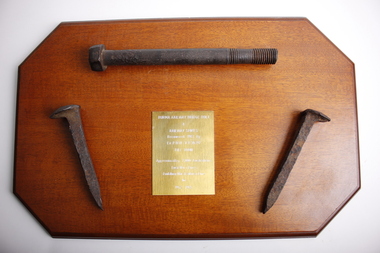
Souvenir - Burma Rail Bridge Bolt & Railway Spikes.On wooden plaque
... Metal bolt used to hold railway sleepers to bridges Souvenir Burma Rail Bridge Bolt & Railway Spikes.On wooden plaque. ...Plaque with metal railway bridge bolt and 2 metal railway line spikes. Spikes have lip on top to hold rail lines down with chisel shaped ends to be driven into sleepers. Metal bolt used to hold railway sleepers to bridgesNo markings on spikes or bolt. Plaque brass plate engraved-: BURMA RAILWAY BRIDGE BOLT & RAILWAY SPIKES Recovered 1987 By Ex P.O.W V.X. 30397 BILL TOON Approximatly 7,000 Australians Lost Their Lives Building This Railway Line 1942-1945. -
 Parks Victoria - Gabo Island Lightstation
Nails
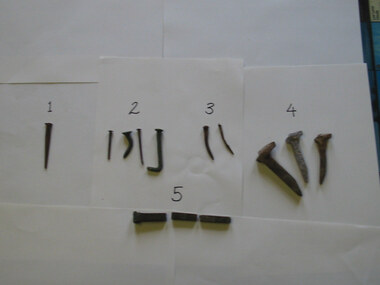
... The five types of nails include a stamped steel nail made for wooden flooring; four copper nails used for boat building found at various locations on the island; two steel nails removed from the lantern room door during restoration in 2002 which possibly came with the Chance Bros. lantern room kit delivered in 1862; three galvanised steel nails used to pin the railway track to sleepers and decking on the jetty (the rail track carried a small trolley for unloading stores from supply ships); and a square copper nail found on the rocky shore on Tullaberga Island close to the location of the Monumental City wreck of 1853. ...The five types of nails include a stamped steel nail made for wooden flooring; four copper nails used for boat building found at various locations on the island; two steel nails removed from the lantern room door during restoration in 2002 which possibly came with the Chance Bros. lantern room kit delivered in 1862; three galvanised steel nails used to pin the railway track to sleepers and decking on the jetty (the rail track carried a small trolley for unloading stores from supply ships); and a square copper nail found on the rocky shore on Tullaberga Island close to the location of the Monumental City wreck of 1853. ...The five types of nails include a stamped steel nail made for wooden flooring; four copper nails used for boat building found at various locations on the island; two steel nails removed from the lantern room door during restoration in 2002 which possibly came with the Chance Bros. lantern room kit delivered in 1862; three galvanised steel nails used to pin the railway track to sleepers and decking on the jetty (the rail track carried a small trolley for unloading stores from supply ships); and a square copper nail found on the rocky shore on Tullaberga Island close to the location of the Monumental City wreck of 1853. The huge American steamer, Monumental City, was wrecked on 15 May 1853. Built in 1850, the ship was the first screw-propulsion steamer to cross the Pacific and was heading back to Sydney after dropping off Californians heading for the Victorian goldfields. Thirty-seven lives were lost, including the owner of the ship, Peter Strobel. A medal was awarded by Sydney residents to Charles Plummer who swam ashore with a line from the wreck. The tragedy renewed the urgency for a lighthouse on Gabo Island, and in 1862 when this was achieved an obelisk was erected as a memorial to those who perished. That year, Victorian PWD architect and designer of the lightstation buildings, Charles Maplestone, gave the following instructions: ‘You may remove the remains of the poor unfortunate shipwrecked of the Monumental City to the site on Gabo you propose but take scrupulous care to collect all the remains and inter them decently under the monument. Pray save any relics’.246 Heritage Victoria has 39 artefacts listed under the Historic Shipwrecks Act (S473) with a clear provenance to the Monumental City. While the copper nail has no documented provenance, it still has contributory significance as part of a diverse assemblage of relics that help to interpret the history of the Gabo Island Lightstation and the numerous shipwrecks that have occurred in its vicinity since the mid nineteenth century..1 Steel nail - flat. Stamped. This type of nail was used for secret nailing of flooring. Source of this nail is unknown. .2 Copper nails. This type of nail was used for boat building. Found at various locations around island. .3 Steel nails. Extracted from lantern room door during restoration 2002. .4 Galvanised steel nails. Used to pin railway track to timber sleepers and decking on jetty. Rail track carried a small trolley used during the unloading of stores from supply ships. .5. Copper nail square. This nail was found on the rocky shore line on Tullaberga Island close to the location of the wreck of the "Monumental City" wrecked May 1853. Nail found in June 2000. -
 Department of Energy, Environment and Climate Action
Adze - small
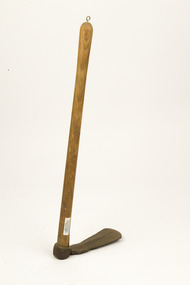
... The wooden handle is straight and the blade has a slight curve. They are used for smoothing or carving wood such as sleepers An adze, with its long handle, cuts with the grain, and the nature of the chips is different from an axe. ...The wooden handle is straight and the blade has a slight curve. They are used for smoothing or carving wood such as sleepers An adze, with its long handle, cuts with the grain, and the nature of the chips is different from an axe. ...An Adze is versatile cutting tool similar to an axe but with the sharp cutting edge perpendicular to the handle rather than parallel. The wooden handle is straight and the blade has a slight curve. They are used for smoothing or carving wood such as sleepers An adze, with its long handle, cuts with the grain, and the nature of the chips is different from an axe. While they have a similar shape, they should never be confused with a hoe or mattock used for agriculture and horticulture. This adze was purchased in about 1919 and used on the Ritchie family farm at Glen Park. Adze - smalltimber tools -
 Department of Energy, Environment and Climate Action
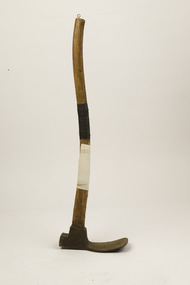
Adze
... The wooden handle of this adze is shaped like an axe handle and the blade also has a slight curve. They are used for smoothing or carving wood such as sleepers An adze, with its long handle, cuts with the grain, and the nature of the chips is different from an axe. ...The wooden handle of this adze is shaped like an axe handle and the blade also has a slight curve. They are used for smoothing or carving wood such as sleepers An adze, with its long handle, cuts with the grain, and the nature of the chips is different from an axe. ...An Adze is versatile cutting tool similar to an axe but with the sharp cutting edge perpendicular to the handle rather than parallel. The wooden handle of this adze is shaped like an axe handle and the blade also has a slight curve. They are used for smoothing or carving wood such as sleepers An adze, with its long handle, cuts with the grain, and the nature of the chips is different from an axe. While they have a similar shape, they should never be confused with a hoe or mattock used for agriculture and horticulture. This adze was originally purchased in about 1919 and used on the Ritchie family farm at Glen Park.Carpenter's adze or cutting adze The tapered eye in the adze and tapered handle end forces the head to tighten when swung; but enables removal of the head for sharpening timber tools
