
Showing 2 items matching "woodswallow"
-
 The Beechworth Burke Museum
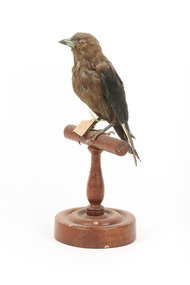
Animal specimen - Dusky Woodswallow, Trustees of the Australian Museum, 1860-1880
... ...woodswallow...The Dusky Woodswallow is often found in flocks which can be located in two separate populations. ...The Dusky Woodswallow has largely deep brown colouring with some areas of grey on the head, neck and chest. ...The Dusky Woodswallow is often found in flocks which can be located in two separate populations. ...The Dusky Woodswallow is often found in flocks which can be located in two separate populations. The Eastern population if located in Atherton Tableland in Queensland south to Tasmania and west to Eyre Peninsula in South Australia. The other population is found in south-west Western Australia. They reside in open forests and woodlands. This species is surprisingly aggressive and may fight with other Woodswallows for territory and nest sights. They will even chase raptors away from their homes. This species flies in flocks of around 10 to 30 birds which cluster together. In terms of diet, these birds eat insects and nectar from flowers. This specimen is part of a collection of almost 200 animal specimens that were originally acquired as skins from various institutions across Australia, including the Australian Museum in Sydney and the National Museum of Victoria (known as Museums Victoria since 1983), as well as individuals such as amateur anthropologist Reynell Eveleigh Johns between 1860-1880. These skins were then mounted by members of the Burke Museum Committee and put-on display in the formal space of the Museum’s original exhibition hall where they continue to be on display. This display of taxidermy mounts initially served to instruct visitors to the Burke Museum of the natural world around them, today it serves as an insight into the collecting habits of the 19th century.This specimen is part of a significant and rare taxidermy mount collection in the Burke Museum. This collection is scientifically and culturally important for reminding us of how science continues to shape our understanding of the modern world. They demonstrate a capacity to hold evidence of how Australia’s fauna history existed in the past and are potentially important for future environmental research. This collection continues to be on display in the Museum and has become a key part to interpreting the collecting habits of the 19th century.The Dusky Woodswallow has largely deep brown colouring with some areas of grey on the head, neck and chest. There is a deeper brown colouring between the wings on the back of the specimen and the wings are black. This bird has a small curved bill which is grey and white. The legs are dark grey and the bird has long talons with an extra long toe in the centre. The eyes are made of brown glass with a back pupil. The bird is styalised standing on a wooden mount and has a paper identification tag attached to its right leg.[torn] / 9 /taxidermy mount, taxidermy, animalia, burke museum, beechworth, australian museum, skin, reynell eveleigh johns, bird, australian birds, swallow, woodswallow, dusky woodswallow -
 Bendigo Historical Society Inc.
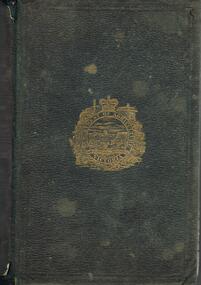
Book - DEPARTMENT OF AGRICULTURE SECOND ANNUAL REPORT 1874
... Smith, Strathfieldsaye' Includes information on agricultural education, Australian grasses, diseases among stock, orange culture, wood boring beetles, apples meteorology of Victoria, worm diseased in sheep, sericulture, white eyebrowed woodswallow, flax, vines and wine industry, fencing and impounding. ...Smith, Strathfieldsaye' Includes information on agricultural education, Australian grasses, diseases among stock, orange culture, wood boring beetles, apples meteorology of Victoria, worm diseased in sheep, sericulture, white eyebrowed woodswallow, flax, vines and wine industry, fencing and impounding. ...Dark green cover, embossed on front 'Department of Agriculture Victoria' enclosed in circular design. Report to the Minister of Lands and Agriculture, 1874 on the proceedings of the Department, 363 pages. Written on front page in black ink "Mr. H.P. Smith, Strathfieldsaye' Includes information on agricultural education, Australian grasses, diseases among stock, orange culture, wood boring beetles, apples meteorology of Victoria, worm diseased in sheep, sericulture, white eyebrowed woodswallow, flax, vines and wine industry, fencing and impounding. Contains information about Strathfieldsaye vigneron Messrs Bruhn and T Strachan of Axedale. Extensive meteorological data for 1873 included; Sandhurst data described in depth.Mr. H. P. Smith Strathfieldsaye in pen on the first three pagesgovernment, state, department of agriculture
