
Showing 6 items matching "wool - history export - wool"
-
 National Wool Museum
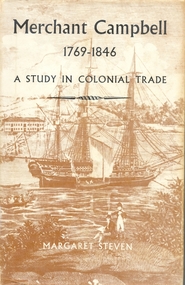
Book, Merchant Campbell 1749-1846: a study in colonial trade
... Wool - history Export - wool..."Merchant Campbell 1749-1846: a study in colonial trade" - Margaret Steven, 1965. Wool - history Export - wool Wool - history Export - wool Merchant Campbell 1749-1846: a study in colonial trade Book ..."Merchant Campbell 1749-1846: a study in colonial trade" - Margaret Steven, 1965.wool - history export - wool, wool - history, export - wool -
 National Wool Museum
Book, An economic history of Australia
... Wool - history Export...Wool..."An economic history of Australia by Edward Shann, 1948" Wool - history Export Wool - history Export An economic history of Australia Book ..."An economic history of Australia by Edward Shann, 1948"wool - history export, wool - history, export -
 Flagstaff Hill Maritime Museum and Village
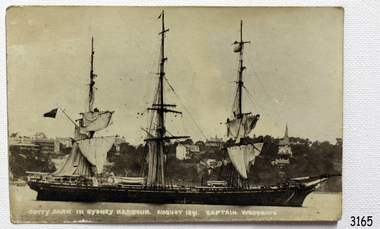
Postcard - Vessel, Sailing Ship, Cutty Sark in Sydney Harbour, After August 1891
... history, as it shows the Cutty Sark at Sydney on one of its voyages, in the command of Captain Richard Woodget, a respected mariner and master of sailing ships. Flagstaff Hill Warrnambool Flagstaff Hill Maritime Museum Shipwreck Coast Flagstaff Hill Maritime Village Maritime Museum Great Ocean Road Cutty sark historic sailing ship tea clipper sail training vessel cadet training ship commercial trading vessel cargo sail vessel clipper races Scott and Linton of Dunbarton Scottland race record transportation Ferreria 1869 tea cargo tea trade China tea wool export Australian export Australian wool export China tea trade Cornwall training ship Greenwich British Museum Captain Richard Woodget Captain Woodget "CUTTY SARK IN SYDNEY HARBOUR. ...Captain Richard Woodget (1845-1928) was renowned for his successful command of the Cutty Sark. He began his maritime career in 1861 as an apprentice seaman at almost 15 years old and received his Master Certificate in 1871. In 1881, aged 35, he took his first command on the vessel Coldstream. His sailing skill and careful financial management earned him the command of the Cutty Sark for ten of its voyages. For another year, he commanded the Coldingham, then retired from life as a mariner in 1896. The Cutty Sark was built in Britain in 1869 and was one of the last great sailing ships. At first, it carried tea from China. Later, it was used to transport wool from Australia. It became famous for its speed and held the record for the fastest voyage from Australia to Britain for ten years. Later, a Portuguese company bought the ship and renamed it Ferreira. After that, a retired sea captain purchased it to use as a training ship in Cornwall. When the captain died, the ship was given to a training college in Greenwich in 1938. In 1954, it was placed in dry dock at Greenwich, where it remains on display. The postcard is important for is connection with the vessel, Cutty Sark, a special ship because it carried wool from Australia to other parts of the world. Postcards like this one help us imagine what sea travel was like before steam-powered ships were common, and they show us how trade, travel and migration changed over time. The Cutty Sark is also famous for being very fast. It set a record for the journey from Australia to Britain and kept that title for ten years. Today, people still recognise its importance because it has been carefully preserved and is on display at the British Maritime Museum in Greenwich. Its story has also made it a favourite subject for people who enjoy building ship models. The postcard is important to Australian history, as it shows the Cutty Sark at Sydney on one of its voyages, in the command of Captain Richard Woodget, a respected mariner and master of sailing ships.Postcard: Black and white postcard of a photographed image of a 3-masted sailing ship, sails half-lowered. Behind the vessel is a hill with buildings on it. A white handwritten inscription is along the base of the postcard. The vessel is the Cutty Sark in Sydney Harbour in August 1891. Its master was Captain Woodget."CUTTY SARK IN SYDNEY HARBOUR. AUGUST 1891. CAPTAIN WOODGATE."flagstaff hill, warrnambool, flagstaff hill maritime museum, shipwreck coast, flagstaff hill maritime village, maritime museum, great ocean road, cutty sark, historic sailing ship, tea clipper, sail training vessel, cadet training ship, commercial trading vessel, cargo sail vessel, clipper races, scott and linton of dunbarton scottland, race record, transportation, ferreria, 1869, tea cargo, tea trade, china tea, wool export, australian export, australian wool export, china tea trade, cornwall, training ship, greenwich, british museum, captain richard woodget, captain woodget -
 Flagstaff Hill Maritime Museum and Village
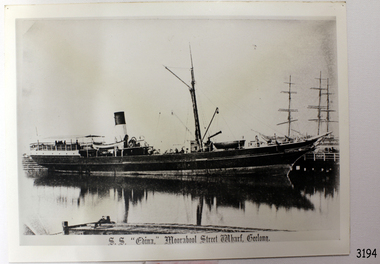
Photograph - Vessel, Steam Ship, S.S. "EDINA," Moorabool Street Wharf, Geelong, c. 1870's - 1930's
... wool sheds alongside the wharf - wool was a major export product. ABOUT THE SS EDINA The three masted iron screw steamer SS Edina was built in Glasgow, Scotland, in 1854 by Barclay and Curle. She was adorned with the figurehead of ‘fair maid of Judea’. The many years of service made SS Edina famous world-wide as the longest serving screw steamer. (The term screw steamer comes from being driven by a single propeller, sometimes called a screw, driven by a steam engine.) SS Edina’s interesting history includes English Chanel runs, serving in the Crimean Ware carrying ammunition, horses and stores to the Black Sea, and further service in the American Civil War and later, serving in the western district of Victoria as well as in Queensland and carried gold, currency and gold prospectors Australia to New Zealand. SS Edina had the privilege of being an escort vessel to H.R.H. the Duke of Edinburgh during his visit to Australia in 1867. In March 1863 SS Edina arrived in Port Phillip Bay, Melbourne and was bought by Stephen Henty, of Portland fame, to work the cargo and passenger run from Melbourne – Warrnambool – Port Fairy - Portland. After a short time of working the run from Australia to New Zealand, with passengers and cargo that included gold and currency, she returned to her Melbourne - Warrnambool – Port Fairy run, with cargo including bales of wool...wool sheds alongside the wharf - wool was a major export product. ABOUT THE SS EDINA The three masted iron screw steamer SS Edina was built in Glasgow, Scotland, in 1854 by Barclay and Curle. She was adorned with the figurehead of ‘fair maid of Judea’. The many years of service made SS Edina famous world-wide as the longest serving screw steamer. (The term screw steamer comes from being driven by a single propeller, sometimes called a screw, driven by a steam engine.) SS Edina’s interesting history includes English Chanel runs, serving in the Crimean Ware carrying ammunition, horses and stores to the Black Sea, and further service in the American Civil War and later, serving in the western district of Victoria as well as in Queensland and carried gold, currency and gold prospectors Australia to New Zealand. SS Edina had the privilege of being an escort vessel to H.R.H. the Duke of Edinburgh during his visit to Australia in 1867. In March 1863 SS Edina arrived in Port Phillip Bay, Melbourne and was bought by Stephen Henty, of Portland fame, to work the cargo and passenger run from Melbourne – Warrnambool – Port Fairy - Portland. After a short time of working the run from Australia to New Zealand, with passengers and cargo that included gold and currency, she returned to her Melbourne - Warrnambool – Port Fairy run, with cargo including bales of wool ...This black and white photograph was taken when the SS Edina was as port at the Geelong Wharf in Moorabool Street. The Port of Geelong had many wool sheds alongside the wharf - wool was a major export product. ABOUT THE SS EDINA The three masted iron screw steamer SS Edina was built in Glasgow, Scotland, in 1854 by Barclay and Curle. She was adorned with the figurehead of ‘fair maid of Judea’. The many years of service made SS Edina famous world-wide as the longest serving screw steamer. (The term screw steamer comes from being driven by a single propeller, sometimes called a screw, driven by a steam engine.) SS Edina’s interesting history includes English Chanel runs, serving in the Crimean Ware carrying ammunition, horses and stores to the Black Sea, and further service in the American Civil War and later, serving in the western district of Victoria as well as in Queensland and carried gold, currency and gold prospectors Australia to New Zealand. SS Edina had the privilege of being an escort vessel to H.R.H. the Duke of Edinburgh during his visit to Australia in 1867. In March 1863 SS Edina arrived in Port Phillip Bay, Melbourne and was bought by Stephen Henty, of Portland fame, to work the cargo and passenger run from Melbourne – Warrnambool – Port Fairy - Portland. After a short time of working the run from Australia to New Zealand, with passengers and cargo that included gold and currency, she returned to her Melbourne - Warrnambool – Port Fairy run, with cargo including bales of wool produced in the western district of Victoria. The Warrnambool Steam Packet Company purchased SS Edina in 1867; she was now commanded by Captain John Thompson and Chief Engineer John Davies. She survived several mishaps at sea, had a complete service and overhaul and several changes of commanders. In 1870 SS Edina was in Lady Bay, Warrnambool, when a gale sprung up and caused a collision with the iron screw steamer SS Dandenong. SS Edina’s figurehead was broken into pieces and it was not ever replaced. SS Edina was re-fitted in 1870 then was used as a coastal trader in Queensland for a period. She was then brought to Melbourne to carry cargo and passengers between Melbourne and Geelong and performed this service 1880-1938. During this time (1917) she was again refitted with a new mast, funnel, bridge and promenade deck, altering her appearance. In 1938, after more collisions, SS Edina was taken out of service. However she was later renamed Dinah and used as a ‘lighter’ (a vessel without engine or superstructure) to be towed and carry wool and general cargo between Melbourne and Geelong. In 1957, after 104 years, the SS Edina was broken up at Footscray, Melbourne. Remains of SS Edina’s hull can be found in the Maribyrnong River, Port Phillip Bay. This postcard of the SS Edina is significant for its association with the screw steamer SS Edina and shows her at one of her trading ports on the Melbourne - Warrnambool - Port Fairy - Portland run. The SS Edina is heritage listed on the Victorian Heritage Database VHR S199. She had endeared herself to the people of Port Phillip Bay as a passenger ferry, part of their history and culture. She played a significant role in the Crimean War, the American Civil War and the gold rush in New Zealand. She also served western Victoria for many years in her cargo and passenger runs. The SS Edina is famous for being the longest serving screw steamer in the world. After spending her first nine years overseas she arrived in Melbourne and her work included running the essential service of transporting cargo and passengers between Melbourne and the western Victoria ports of Warrnambool, Port Fairy and Portland. The SS Edina was purchased in the late 1860’s by local Warrnambool business, the Warrnambool Steam Packet Co. and continued trading from there as part of the local business community. The SS Edina’s original ‘fair maid of Judea’ figurehead was broken to pieces in a collision with another vessel (the SS Dandenong) in a gale off Warrnambool, Victoria, in 1870.Black and White photograph of S.S Edina at the Moorabool Street Wharf, Geelong in calm water that shows the reflection of the steamer. Ship has no sails raised. The funnel has a light coloured base with a dark coloured top. There are people on board the steamer. Other ship masts and people are in the background. In the foreground is a jetty with a small boat beside it and a person inside the boat. There is a title printed along the base of the photograph. c. 1870's to 1930'sPrinted at base of photograph "S.S. "EDINA," Moorabool Street Wharf, Geelong"warrnambool, shipwrecked coast, flagstaff hill, flagstaff hill maritime museum, maritime museum, shipwreck coast, flagstaff hill maritime village, shipwrecked artefact, barclay & curle, figurehead 'fair maid of judea', centenary maritime exhibition 1934, a brief review of steam navigation in victoria, pleasure steamer edina, trade and travel late 19th and early 20th century, trade melbourne to geelong, screw steamer edina, coastal trader edina, lighter dinah, cargo carrying for cremean war, cargo carrying for american civil war, passenger and trade in western district of victoria, export gold and currency and gold diggers to new zealand, export vessel to h r h the duke of edinburgh, melbourne - warrnambool - port fairy - portland cargo run, warrnambool steam packet company, stephen henty, captain john thompson, chief engineer john davies, lady bay warrnambool, lighter edina, shipping victoria, port phillip bay steamers, steamship great britain, edina, vhr s199 victorian heritage database, postcard of ss edina 1870's - 1930's -
 National Wool Museum
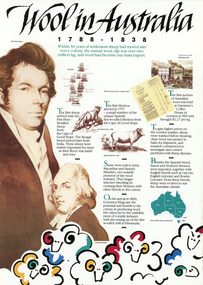
Archive - Wool in Australia, 1990s
... wool. Our economy's / strength depended on the wool clip. page 3: Wool in Australia / 1 8 8 8 - 1 9 3 8 / By the late 1930's, wool represented over 62% of / the total export value of primary products. Australia's / fine wool was in great demand worldwide. page 4: Wool in Australia / 1 9 3 8 - 1 9 8 8 / In the 50 years leading up to our Bicentenary, / many developments in the sheep and wool / industry have maintained Australia's place / as the leading producer of wool. Concertina A4 sized leaflet outlining the history ...Part of a collection of books, manuals, photographs, letters and clothing relating to the working life of Stuart Ascough. Stuart's career in the wool industry spanned over 43 years from 1960 to 2003 in various roles including Topmaking Plant Manager at Courtaulds Ltd. in Spennymore, U.K., Operations Manager at Port Phillip Mills in Williamstown Victoria, Marketing Executive, Early Stage Wool Processing at the International Wool Secretariat Melbourne, Australia and General Manager of Victoria Wool Processors Pty. Ltd. in Laverton North, Victoria. Throughout his career Stuart travelled extensively, and in the 1990s worked at many topmaking mills in China on quality improvement projects. He also provided technical advice and training at mills in India, Ukraine, Lithuania, Kyrgyzstan, Russia, Latvia, Byelorussia and other parts of Europe and Asia.Concertina A4 sized leaflet outlining the history of wool in Australia from 1788 to 1988 in four pages with colour graphics and black text.page 1: Wool in Australia / 1 7 8 8 - 1 8 3 8 / Within 50 years of settlement sheep had moved into / every colony, the annual wool clip was over two / million kg, and wool had become our main export page 2: Wool in Australia / 1 8 3 8 - 1 8 8 8 / The first 100 years saw Australia become the / world's leading producer of wool. Our economy's / strength depended on the wool clip. page 3: Wool in Australia / 1 8 8 8 - 1 9 3 8 / By the late 1930's, wool represented over 62% of / the total export value of primary products. Australia's / fine wool was in great demand worldwide. page 4: Wool in Australia / 1 9 3 8 - 1 9 8 8 / In the 50 years leading up to our Bicentenary, / many developments in the sheep and wool / industry have maintained Australia's place / as the leading producer of wool.stuart ascough, international wool secretariat, victoria wool processors, port phillip mills pty ltd, topmaking, career, wool industry, mills, leaflet -
 Port Fairy Historical Society Museum and Archives
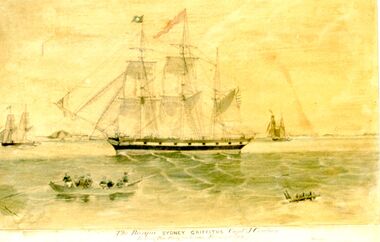
Painting - painting, Watercolour, Elsbee?, The Barque Sydney Griffiths, c.1850
... export of wool from Belfast to England. Depicts a significant moment in time when the first shipment of wool from the port was being loaded for London. local history illustrations powlings watercolours exports essington sydney griffiths shipping the brothers wool export capt cowtan The Barque "Sydney Griffiths" Capt. ...This painting of the barque Sydney Griffiths and two smaller ships, ‘the brothers’ and Essington’ graced the offices of Powling solicitors for 3 generations. This painting illustrates the scene of the first export of wool from Belfast to England.Depicts a significant moment in time when the first shipment of wool from the port was being loaded for London.A watercolour painting on paper and linen in a gold and Black frame showing the Barque "Sydney Griffiths" sailing before Griffith island, also shown "Essington" and "The Brothers" John Griffiths House and other buildings on shoreThe Barque "Sydney Griffiths" Capt. Cowtan leaving Port Fairy for London, February 8th 1851. "Essington" "Brothers"local history, illustrations, powlings, watercolours, exports, essington, sydney griffiths, shipping, the brothers, wool export, capt cowtan
