
Showing 409 items matching "wool processing"
-
 National Wool Museum
Folder, Wool processing - training
... Wool processing - training......Wool Processing...Part of Ken Galloways research material associated with his career as a woolclasser. "Wool processing - training"...Wool processing - training 16...Part of Ken Galloways research material associated with his career as a woolclasser. "Wool processing - training" Woolclassing Sheep breeding Education Wool - research Wool Processing Wool industry National Wool Museum Wesfarmers Dalgety Limited Geelong Galloway Mr Ken Woolclassing Sheep breeding Education Wool - research Wool Processing Wool industry Wool processing - training 16 Wool processing - training Folder ...Part of Ken Galloways research material associated with his career as a woolclasser. "Wool processing - training"Wool processing - training 16woolclassing sheep breeding education wool - research wool processing wool industry, national wool museum wesfarmers dalgety limited, geelong, galloway, mr ken, woolclassing, sheep breeding, education, wool - research, wool processing, wool industry -
 National Wool Museum
Archive - Wool Processing, c.1990s
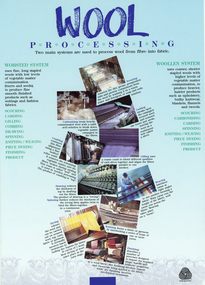
... Wool Processing...Stuart's career in the wool industry spanned over 43 years from 1960 to 2003 in various roles including Topmaking Plant Manager at Courtaulds Ltd. in Spennymore, U.K., Operations Manager at Port Phillip Mills in Williamstown Victoria, Marketing Executive, Early Stage Wool Processing at the International Wool Secretariat Melbourne, Australia and General Manager of Victoria Wool Processors Pty. ...One sided A4 sized leaflet showing images and text relating to the processing of wool from fibre into fabric....front: WOOL / PROCESSING / Two main systems are used to process wool from fibre into fabric....Stuart Ascough International Wool Secretariat Victoria Wool Processors Port Phillip Mills Pty Ltd Topmaking career wool industry mills leaflet front: WOOL / PROCESSING / Two main systems are used to process wool from fibre into fabric. ...Part of a collection of books, manuals, photographs, letters and clothing relating to the working life of Stuart Ascough. Stuart's career in the wool industry spanned over 43 years from 1960 to 2003 in various roles including Topmaking Plant Manager at Courtaulds Ltd. in Spennymore, U.K., Operations Manager at Port Phillip Mills in Williamstown Victoria, Marketing Executive, Early Stage Wool Processing at the International Wool Secretariat Melbourne, Australia and General Manager of Victoria Wool Processors Pty. Ltd. in Laverton North, Victoria. Throughout his career Stuart travelled extensively, and in the 1990s worked at many topmaking mills in China on quality improvement projects. He also provided technical advice and training at mills in India, Ukraine, Lithuania, Kyrgyzstan, Russia, Latvia, Byelorussia and other parts of Europe and Asia.One sided A4 sized leaflet showing images and text relating to the processing of wool from fibre into fabric.front: WOOL / PROCESSING / Two main systems are used to process wool from fibre into fabric.stuart ascough, international wool secretariat, victoria wool processors, port phillip mills pty ltd, topmaking, career, wool industry, mills, leaflet -
National Wool Museum
Book, Woollen or Worsted? An introduction to wool processing
... An introduction to wool processing...Wool Processing Woollen Mills - history...An introduction to wool processing" Bradford Art Galleries and Museums, 1983....An introduction to wool processing Book ..."Woollen or Worsted? An introduction to wool processing" Bradford Art Galleries and Museums, 1983.wool processing woollen mills - history, bradford art galleries and museums, cloth - woollen, cloth - worsted, wool processing, woollen mills - history -
National Wool Museum
Book, Recent Developments in Wool and Wool Blend Processing
... Recent Developments in Wool and Wool Blend Processing...Textile Finishing Wool Processing..."Recent Developments in Wool and Wool Blend Processing" CSIRO Division of Textile Industry, 1983....Textile Finishing Wool Processing CSIRO Division of Textile Industry Dyeing Spinning Textile Finishing Wool Processing Recent Developments in Wool and Wool Blend Processing Book ..."Recent Developments in Wool and Wool Blend Processing" CSIRO Division of Textile Industry, 1983.textile finishing wool processing, csiro division of textile industry, dyeing, spinning, textile finishing, wool processing -
 National Wool Museum
Photograph - Wool Processing, Returned Sailors and Soldiers Mill, Norm Holroyd, 1960's - 1970's
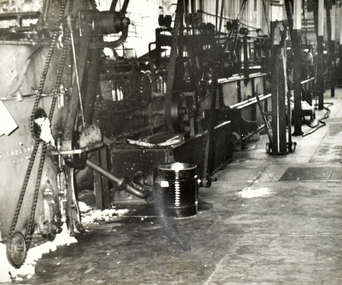
... Wool Processing, Returned Sailors and Soldiers Mill...Black and white photograph attached to cardboard backing with sticky tape. Image shows wool processing machinery. Backing card has four holes in left side....Photograph Wool Processing, Returned Sailors and Soldiers Mill Norm Holroyd ...One of thirty eight photographs from a photo album featuring images of the Returned Sailors and Soldiers Woollen Mill in Newtown, Geelong. The images were taken between the 1960's-1970's by Norm Holroyd who worked at the mills. They were developed in his own private dark room and kept at his home for private viewing. The Returned Sailors and Soldiers Woollen Mill operated as a self-sufficient co-operative, funded and run by World War I veterans using their War Gratuity Bonds. The facility functioned as a complete raw-to-finished assembly line where raw fleece was brought on-site to be scoured, carded, dyed, spun into yarn and woven. It specialised in heavy worsted cloths, high-quality tweed, and its signature "Retsol" and "Monarch" pure-wool travelling rugs, later adapting its machinery to blend natural wool with artificial fibres as mid-century market demands shifted.Black and white photograph attached to cardboard backing with sticky tape. Image shows wool processing machinery. Backing card has four holes in left side.back: [handwritten] 4r. s. & s mill, returned sailors and soldiers mill, newtown, geelong, world war i, soldiers, veterans, co-operative, textile industry, woollen mills, wool, worsted cloth, tweed, retsol, monarch, travel rugs, machinery, factory, working life, norm holroyd, photo album, photography, design, fabric -
 National Wool Museum
Photograph - Wool Processing, Returned Sailors and Soldiers Mill, Norm Holroyd, 1960's - 1970's
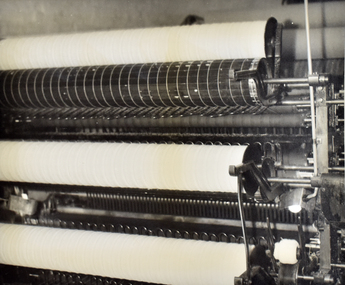
... Wool Processing, Returned Sailors and Soldiers Mill...Image shows detail of wool processing machinery. Backing card has four holes in left side....Photograph Wool Processing, Returned Sailors and Soldiers Mill Norm Holroyd ...One of thirty eight photographs from a photo album featuring images of the Returned Sailors and Soldiers Woollen Mill in Newtown, Geelong. The images were taken between the 1960's-1970's by Norm Holroyd who worked at the mills. They were developed in his own private dark room and kept at his home for private viewing. The Returned Sailors and Soldiers Woollen Mill operated as a self-sufficient co-operative, funded and run by World War I veterans using their War Gratuity Bonds. The facility functioned as a complete raw-to-finished assembly line where raw fleece was brought on-site to be scoured, carded, dyed, spun into yarn and woven. It specialised in heavy worsted cloths, high-quality tweed, and its signature "Retsol" and "Monarch" pure-wool travelling rugs, later adapting its machinery to blend natural wool with artificial fibres as mid-century market demands shifted.Black and white photograph attached to cardboard backing with sticky tape. Image shows detail of wool processing machinery. Backing card has four holes in left side.back: [handwritten] 12r. s. & s mill, returned sailors and soldiers mill, newtown, geelong, world war i, soldiers, veterans, co-operative, textile industry, woollen mills, wool, worsted cloth, tweed, retsol, monarch, travel rugs, machinery, factory, working life, norm holroyd, photo album, photography, design, fabric -
 National Wool Museum
Photograph - Wool Processing, Returned Sailors and Soldiers Mill, Norm Holroyd, 1960's - 1970's
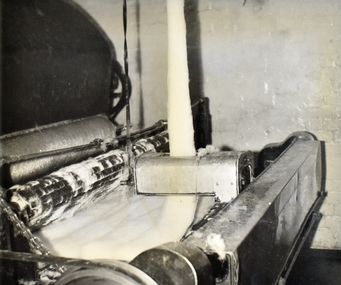
... Wool Processing, Returned Sailors and Soldiers Mill...Image shows detail of wool processing machinery. Backing card has four holes in left side....Photograph Wool Processing, Returned Sailors and Soldiers Mill Norm Holroyd ...One of thirty eight photographs from a photo album featuring images of the Returned Sailors and Soldiers Woollen Mill in Newtown, Geelong. The images were taken between the 1960's-1970's by Norm Holroyd who worked at the mills. They were developed in his own private dark room and kept at his home for private viewing. The Returned Sailors and Soldiers Woollen Mill operated as a self-sufficient co-operative, funded and run by World War I veterans using their War Gratuity Bonds. The facility functioned as a complete raw-to-finished assembly line where raw fleece was brought on-site to be scoured, carded, dyed, spun into yarn and woven. It specialised in heavy worsted cloths, high-quality tweed, and its signature "Retsol" and "Monarch" pure-wool travelling rugs, later adapting its machinery to blend natural wool with artificial fibres as mid-century market demands shifted.Black and white photograph attached to cardboard backing with sticky tape. Image shows detail of wool processing machinery. Backing card has four holes in left side.back: [handwritten] 11r. s. & s mill, returned sailors and soldiers mill, newtown, geelong, world war i, soldiers, veterans, co-operative, textile industry, woollen mills, wool, worsted cloth, tweed, retsol, monarch, travel rugs, machinery, factory, working life, norm holroyd, photo album, photography, design, fabric -
 National Wool Museum
Photograph - Wool Processing, Returned Sailors and Soldiers Mill, Norm Holroyd, 1960's - 1970's
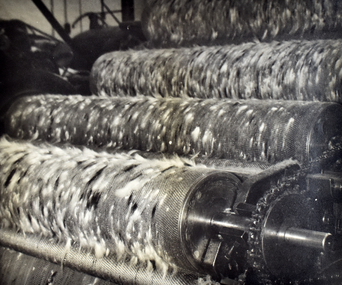
... Wool Processing, Returned Sailors and Soldiers Mill...Image shows detail of wool processing machinery. Backing card has four holes in left side....Photograph Wool Processing, Returned Sailors and Soldiers Mill Norm Holroyd ...One of thirty eight photographs from a photo album featuring images of the Returned Sailors and Soldiers Woollen Mill in Newtown, Geelong. The images were taken between the 1960's-1970's by Norm Holroyd who worked at the mills. They were developed in his own private dark room and kept at his home for private viewing. The Returned Sailors and Soldiers Woollen Mill operated as a self-sufficient co-operative, funded and run by World War I veterans using their War Gratuity Bonds. The facility functioned as a complete raw-to-finished assembly line where raw fleece was brought on-site to be scoured, carded, dyed, spun into yarn and woven. It specialised in heavy worsted cloths, high-quality tweed, and its signature "Retsol" and "Monarch" pure-wool travelling rugs, later adapting its machinery to blend natural wool with artificial fibres as mid-century market demands shifted.Black and white photograph attached to cardboard backing with sticky tape. Image shows detail of wool processing machinery. Backing card has four holes in left side.back: [handwritten] 10r. s. & s mill, returned sailors and soldiers mill, newtown, geelong, world war i, soldiers, veterans, co-operative, textile industry, woollen mills, wool, worsted cloth, tweed, retsol, monarch, travel rugs, machinery, factory, working life, norm holroyd, photo album, photography, design, fabric -
 National Wool Museum
Photograph - Wool Processing, Returned Sailors and Soldiers Mill, Norm Holroyd, 1960's - 1970's
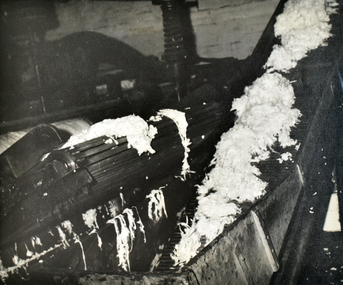
... Wool Processing, Returned Sailors and Soldiers Mill...Image shows a close up of wool processing machinery. Backing card has four holes in left side....Photograph Wool Processing, Returned Sailors and Soldiers Mill Norm Holroyd ...One of thirty eight photographs from a photo album featuring images of the Returned Sailors and Soldiers Woollen Mill in Newtown, Geelong. The images were taken between the 1960's-1970's by Norm Holroyd who worked at the mills. They were developed in his own private dark room and kept at his home for private viewing. The Returned Sailors and Soldiers Woollen Mill operated as a self-sufficient co-operative, funded and run by World War I veterans using their War Gratuity Bonds. The facility functioned as a complete raw-to-finished assembly line where raw fleece was brought on-site to be scoured, carded, dyed, spun into yarn and woven. It specialised in heavy worsted cloths, high-quality tweed, and its signature "Retsol" and "Monarch" pure-wool travelling rugs, later adapting its machinery to blend natural wool with artificial fibres as mid-century market demands shifted.Black and white photograph attached to cardboard backing with sticky tape. Image shows a close up of wool processing machinery. Backing card has four holes in left side.back: [handwritten] 6r. s. & s mill, returned sailors and soldiers mill, newtown, geelong, world war i, soldiers, veterans, co-operative, textile industry, woollen mills, wool, worsted cloth, tweed, retsol, monarch, travel rugs, machinery, factory, working life, norm holroyd, photo album, photography, design, fabric -
 Greensborough Historical Society
Card - Advertising Card, Yarra Falls Liminted, Yarra Falls Limited: (wool processing): set of 14 cards, 1960s
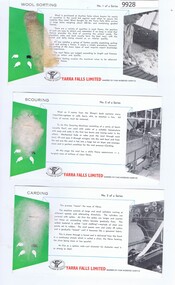
... Yarra Falls Limited: (wool processing): set of 14 cards...Yarra Falls Limited: (wool processing): set of 14 cards each describing a process in turning fleeces into woolen cloth. ...Yarra Falls Limited: (wool processing): set of 14 cards each describing a process in turning fleeces into woolen cloth. ...Yarra Falls Limited: (wool processing): set of 14 cards each describing a process in turning fleeces into woolen cloth. These information packs were available to school students for project work from the 1960sSet of 14, 2 sided Cards with sample, description and photoswool, manufacturing -
 National Wool Museum
Photograph - Combing, Port Phillip Topmaking, 1990
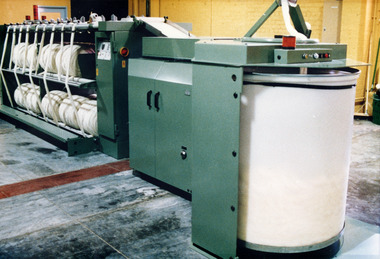
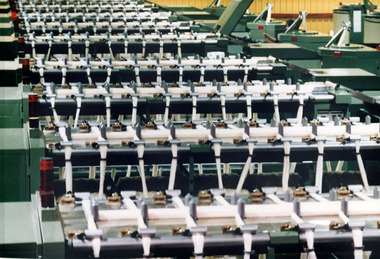
... ...Early Wool Processing...Part of a collection of photographs previously housed at Victorian Wool Processors (VWP), who were the last early stage wool processing company in Melbourne, and the second last in Victoria. ...Colour photograph showing industrial wool processing machinery during the combing process....Part of a collection of photographs previously housed at Victorian Wool Processors (VWP), who were the last early stage wool processing company in Melbourne, and the second last in Victoria. ...Part of a collection of photographs previously housed at Victorian Wool Processors (VWP), who were the last early stage wool processing company in Melbourne, and the second last in Victoria. The photographs were collected from other companies as they closed, and were donated to the museum by David Ritchie who was the General Manager at VWP. Victoria Wool Processors (Aust) Pty Ltd was founded by Jim Kim in 1983 as a dedicated international wool trading firm. Seeking greater quality control, the company opened its first physical processing plant in Melbourne in 1990 before scaling up to a state-of-the-art, 24-hour carbonising and scouring facility at Laverton North in 2002. For decades, it stood as one of the largest early-stage wool processing operations in the Southern Hemisphere, known for incorporating modern water-recycling and waste-management infrastructure. However, a severe domestic energy crisis and soaring natural gas prices forced the permanent closure of its manufacturing plant in December 2024, culminating in the company's official corporate liquidation in April 2026. This photo was previously in a frame with three others taken in 1990 at the modernised facility in Williamstown operated by Port Phillip Topmaking Pty Ltd. This image shows the combing process.Colour photograph showing industrial wool processing machinery during the combing process.victorian wool processors, early wool processing, textile industry, jim kim, topmaking, port phillip topmaking pty ltd, williamstown, combing -
 National Wool Museum
Photograph - Combing, Port Phillip Topmaking, 1990
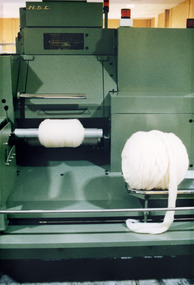
... ...Early Wool Processing...Part of a collection of photographs previously housed at Victorian Wool Processors (VWP), who were the last early stage wool processing company in Melbourne, and the second last in Victoria. ...Colour photograph showing industrial wool processing machinery during the combing process....Part of a collection of photographs previously housed at Victorian Wool Processors (VWP), who were the last early stage wool processing company in Melbourne, and the second last in Victoria. ...Part of a collection of photographs previously housed at Victorian Wool Processors (VWP), who were the last early stage wool processing company in Melbourne, and the second last in Victoria. The photographs were collected from other companies as they closed, and were donated to the museum by David Ritchie who was the General Manager at VWP. Victoria Wool Processors (Aust) Pty Ltd was founded by Jim Kim in 1983 as a dedicated international wool trading firm. Seeking greater quality control, the company opened its first physical processing plant in Melbourne in 1990 before scaling up to a state-of-the-art, 24-hour carbonising and scouring facility at Laverton North in 2002. For decades, it stood as one of the largest early-stage wool processing operations in the Southern Hemisphere, known for incorporating modern water-recycling and waste-management infrastructure. However, a severe domestic energy crisis and soaring natural gas prices forced the permanent closure of its manufacturing plant in December 2024, culminating in the company's official corporate liquidation in April 2026. This photo was previously in a frame with three others taken in 1990 at the modernised facility in Williamstown operated by Port Phillip Topmaking Pty Ltd. This image shows the combing process.Colour photograph showing industrial wool processing machinery during the combing process.victorian wool processors, early wool processing, textile industry, jim kim, topmaking, port phillip topmaking pty ltd, williamstown, combing -
 National Wool Museum
Photograph - Finishing, Port Phillip Topmaking, 1990
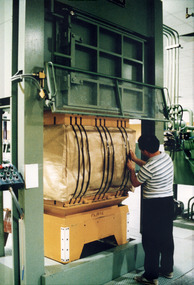
... ...Early Wool Processing...Part of a collection of photographs previously housed at Victorian Wool Processors (VWP), who were the last early stage wool processing company in Melbourne, and the second last in Victoria. ...Colour photograph showing industrial wool processing machinery during the finishing process...Part of a collection of photographs previously housed at Victorian Wool Processors (VWP), who were the last early stage wool processing company in Melbourne, and the second last in Victoria. ...Part of a collection of photographs previously housed at Victorian Wool Processors (VWP), who were the last early stage wool processing company in Melbourne, and the second last in Victoria. The photographs were collected from other companies as they closed, and were donated to the museum by David Ritchie who was the General Manager at VWP. Victoria Wool Processors (Aust) Pty Ltd was founded by Jim Kim in 1983 as a dedicated international wool trading firm. Seeking greater quality control, the company opened its first physical processing plant in Melbourne in 1990 before scaling up to a state-of-the-art, 24-hour carbonising and scouring facility at Laverton North in 2002. For decades, it stood as one of the largest early-stage wool processing operations in the Southern Hemisphere, known for incorporating modern water-recycling and waste-management infrastructure. However, a severe domestic energy crisis and soaring natural gas prices forced the permanent closure of its manufacturing plant in December 2024, culminating in the company's official corporate liquidation in April 2026. This photo was previously in a frame with three others taken in 1990 at the modernised facility in Williamstown operated by Port Phillip Topmaking Pty Ltd. This image shows the finishing process.Colour photograph showing industrial wool processing machinery during the finishing processvictorian wool processors, early wool processing, textile industry, jim kim, topmaking, port phillip topmaking pty ltd, williamstown, finishing -
 National Wool Museum
Photograph - Pressing, Port Phillip Topmaking, 1990
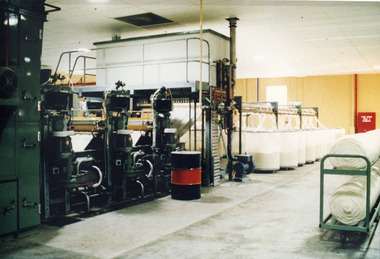
... ...Early Wool Processing...Part of a collection of photographs previously housed at Victorian Wool Processors (VWP), who were the last early stage wool processing company in Melbourne, and the second last in Victoria. ...Colour photograph showing industrial wool processing machinery during the pressing process....Part of a collection of photographs previously housed at Victorian Wool Processors (VWP), who were the last early stage wool processing company in Melbourne, and the second last in Victoria. ...Part of a collection of photographs previously housed at Victorian Wool Processors (VWP), who were the last early stage wool processing company in Melbourne, and the second last in Victoria. The photographs were collected from other companies as they closed, and were donated to the museum by David Ritchie who was the General Manager at VWP. Victoria Wool Processors (Aust) Pty Ltd was founded by Jim Kim in 1983 as a dedicated international wool trading firm. Seeking greater quality control, the company opened its first physical processing plant in Melbourne in 1990 before scaling up to a state-of-the-art, 24-hour carbonising and scouring facility at Laverton North in 2002. For decades, it stood as one of the largest early-stage wool processing operations in the Southern Hemisphere, known for incorporating modern water-recycling and waste-management infrastructure. However, a severe domestic energy crisis and soaring natural gas prices forced the permanent closure of its manufacturing plant in December 2024, culminating in the company's official corporate liquidation in April 2026. This photo was previously in a frame with three others taken in 1990 at the modernised facility in Williamstown operated by Port Phillip Topmaking Pty Ltd. This image shows the pressing process.Colour photograph showing industrial wool processing machinery during the pressing process.victorian wool processors, early wool processing, textile industry, jim kim, topmaking, port phillip topmaking pty ltd, williamstown, pressing -
 National Wool Museum
Photograph - Backwashing, Port Phillip Topmaking, 1990
... ...Early Wool Processing...Part of a collection of photographs previously housed at Victorian Wool Processors (VWP), who were the last early stage wool processing company in Melbourne, and the second last in Victoria. ...Colour photograph showing industrial wool processing machinery during the backwashing process....Part of a collection of photographs previously housed at Victorian Wool Processors (VWP), who were the last early stage wool processing company in Melbourne, and the second last in Victoria. ...Part of a collection of photographs previously housed at Victorian Wool Processors (VWP), who were the last early stage wool processing company in Melbourne, and the second last in Victoria. The photographs were collected from other companies as they closed, and were donated to the museum by David Ritchie who was the General Manager at VWP. Victoria Wool Processors (Aust) Pty Ltd was founded by Jim Kim in 1983 as a dedicated international wool trading firm. Seeking greater quality control, the company opened its first physical processing plant in Melbourne in 1990 before scaling up to a state-of-the-art, 24-hour carbonising and scouring facility at Laverton North in 2002. For decades, it stood as one of the largest early-stage wool processing operations in the Southern Hemisphere, known for incorporating modern water-recycling and waste-management infrastructure. However, a severe domestic energy crisis and soaring natural gas prices forced the permanent closure of its manufacturing plant in December 2024, culminating in the company's official corporate liquidation in April 2026. This photo was previously in a frame with three others taken in 1990 at the modernised facility in Williamstown operated by Port Phillip Topmaking Pty Ltd. This image shows the backwashing process.Colour photograph showing industrial wool processing machinery during the backwashing process.victorian wool processors, early wool processing, textile industry, jim kim, topmaking, port phillip topmaking pty ltd, williamstown, pressing, backwashing -
 National Wool Museum
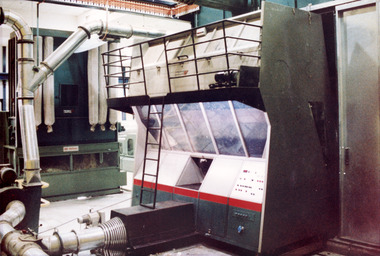
Photograph - Gilling, Port Phillip Topmaking, 1990
... ...Early Wool Processing...Part of a collection of photographs previously housed at Victorian Wool Processors (VWP), who were the last early stage wool processing company in Melbourne, and the second last in Victoria. ...Colour photograph showing industrial wool processing machinery during the gilling process....Part of a collection of photographs previously housed at Victorian Wool Processors (VWP), who were the last early stage wool processing company in Melbourne, and the second last in Victoria. ...Part of a collection of photographs previously housed at Victorian Wool Processors (VWP), who were the last early stage wool processing company in Melbourne, and the second last in Victoria. The photographs were collected from other companies as they closed, and were donated to the museum by David Ritchie who was the General Manager at VWP. Victoria Wool Processors (Aust) Pty Ltd was founded by Jim Kim in 1983 as a dedicated international wool trading firm. Seeking greater quality control, the company opened its first physical processing plant in Melbourne in 1990 before scaling up to a state-of-the-art, 24-hour carbonising and scouring facility at Laverton North in 2002. For decades, it stood as one of the largest early-stage wool processing operations in the Southern Hemisphere, known for incorporating modern water-recycling and waste-management infrastructure. However, a severe domestic energy crisis and soaring natural gas prices forced the permanent closure of its manufacturing plant in December 2024, culminating in the company's official corporate liquidation in April 2026. This photo was previously in a frame with three others taken in 1990 at the modernised facility in Williamstown operated by Port Phillip Topmaking Pty Ltd. This image shows the gilling process.Colour photograph showing industrial wool processing machinery during the gilling process.victorian wool processors, early wool processing, textile industry, jim kim, topmaking, port phillip topmaking pty ltd, williamstown, pressing, gilling -
 National Wool Museum
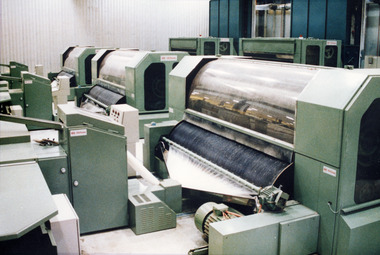
Photograph - Carding, Port Phillip Topmaking, 1990
... ...Early Wool Processing...Part of a collection of photographs previously housed at Victorian Wool Processors (VWP), who were the last early stage wool processing company in Melbourne, and the second last in Victoria. ...Colour photograph showing industrial wool processing machinery during the carding process....Part of a collection of photographs previously housed at Victorian Wool Processors (VWP), who were the last early stage wool processing company in Melbourne, and the second last in Victoria. ...Part of a collection of photographs previously housed at Victorian Wool Processors (VWP), who were the last early stage wool processing company in Melbourne, and the second last in Victoria. The photographs were collected from other companies as they closed, and were donated to the museum by David Ritchie who was the General Manager at VWP. Victoria Wool Processors (Aust) Pty Ltd was founded by Jim Kim in 1983 as a dedicated international wool trading firm. Seeking greater quality control, the company opened its first physical processing plant in Melbourne in 1990 before scaling up to a state-of-the-art, 24-hour carbonising and scouring facility at Laverton North in 2002. For decades, it stood as one of the largest early-stage wool processing operations in the Southern Hemisphere, known for incorporating modern water-recycling and waste-management infrastructure. However, a severe domestic energy crisis and soaring natural gas prices forced the permanent closure of its manufacturing plant in December 2024, culminating in the company's official corporate liquidation in April 2026. This photo was previously in a frame with three others taken in 1990 at the modernised facility in Williamstown operated by Port Phillip Topmaking Pty Ltd. This image shows the carding process.Colour photograph showing industrial wool processing machinery during the carding process.victorian wool processors, early wool processing, textile industry, jim kim, topmaking, port phillip topmaking pty ltd, williamstown, pressing, carding -
 National Wool Museum
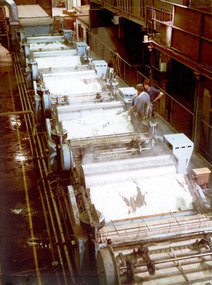
Photograph - Wool Scouring, Port Phillip Mills, Williamstown, 1984
... ...Early Wool Processing...This image shows the wool scouring process....Colour photograph showing industrial wool processing machinery from a high angle during the wool scouring process. ...This image shows the wool scouring process. Victorian Wool Processors Early Wool Processing Textile Industry Jim Kim Topmaking Port Phillip Topmaking Pty Ltd williamstown pressing Carding combing wool scouring Colour photograph showing industrial wool processing machinery from a high angle during the wool scouring process. ...Part of a collection of photographs previously housed at Victorian Wool Processors (VWP), who were the last early stage wool processing company in Melbourne, and the second last in Victoria. The photographs were collected from other companies as they closed, and were donated to the museum by David Ritchie who was the General Manager at VWP. Victoria Wool Processors (Aust) Pty Ltd was founded by Jim Kim in 1983 as a dedicated international wool trading firm. Seeking greater quality control, the company opened its first physical processing plant in Melbourne in 1990 before scaling up to a state-of-the-art, 24-hour carbonising and scouring facility at Laverton North in 2002. For decades, it stood as one of the largest early-stage wool processing operations in the Southern Hemisphere, known for incorporating modern water-recycling and waste-management infrastructure. However, a severe domestic energy crisis and soaring natural gas prices forced the permanent closure of its manufacturing plant in December 2024, culminating in the company's official corporate liquidation in April 2026. This photo was previously in a frame with three others taken in 1984 at the Port Phillip Mills in Williamstown. This image shows the wool scouring process.Colour photograph showing industrial wool processing machinery from a high angle during the wool scouring process. Two men are shown stading beside the machinery.victorian wool processors, early wool processing, textile industry, jim kim, topmaking, port phillip topmaking pty ltd, williamstown, pressing, carding, combing, wool scouring -
 National Wool Museum
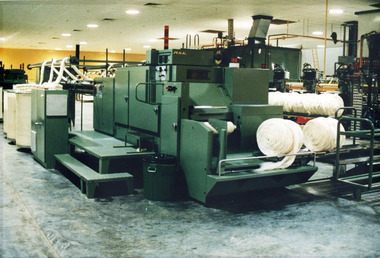
Photograph - Automatic Card Feeding, Port Phillip Topmaking, 1990
... ...Early Wool Processing...Part of a collection of photographs previously housed at Victorian Wool Processors (VWP), who were the last early stage wool processing company in Melbourne, and the second last in Victoria. ...Colour photograph showing industrial wool processing machinery during the automatic card feeding process....Part of a collection of photographs previously housed at Victorian Wool Processors (VWP), who were the last early stage wool processing company in Melbourne, and the second last in Victoria. ...Part of a collection of photographs previously housed at Victorian Wool Processors (VWP), who were the last early stage wool processing company in Melbourne, and the second last in Victoria. The photographs were collected from other companies as they closed, and were donated to the museum by David Ritchie who was the General Manager at VWP. Victoria Wool Processors (Aust) Pty Ltd was founded by Jim Kim in 1983 as a dedicated international wool trading firm. Seeking greater quality control, the company opened its first physical processing plant in Melbourne in 1990 before scaling up to a state-of-the-art, 24-hour carbonising and scouring facility at Laverton North in 2002. For decades, it stood as one of the largest early-stage wool processing operations in the Southern Hemisphere, known for incorporating modern water-recycling and waste-management infrastructure. However, a severe domestic energy crisis and soaring natural gas prices forced the permanent closure of its manufacturing plant in December 2024, culminating in the company's official corporate liquidation in April 2026. This photo was previously in a frame with three others taken in 1990 at the modernised facility in Williamstown operated by Port Phillip Topmaking Pty Ltd. This image shows the automatic card feeding process.Colour photograph showing industrial wool processing machinery during the automatic card feeding process.victorian wool processors, early wool processing, textile industry, jim kim, topmaking, port phillip topmaking pty ltd, williamstown, pressing -
 National Wool Museum
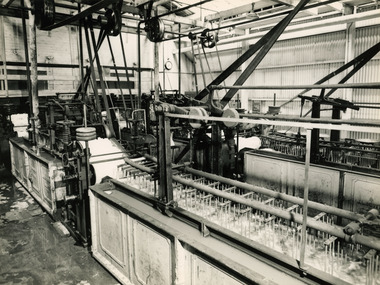
Photograph - Wool Scouring, Williamstown, 1960
... ...Early Wool Processing...Part of a collection of photographs previously housed at Victorian Wool Processors (VWP), who were the last early stage wool processing company in Melbourne, and the second last in Victoria. ...Black and white photograph mounted on backing card, showing interior of a factory with industrial wool processing machinery....Part of a collection of photographs previously housed at Victorian Wool Processors (VWP), who were the last early stage wool processing company in Melbourne, and the second last in Victoria. ...Part of a collection of photographs previously housed at Victorian Wool Processors (VWP), who were the last early stage wool processing company in Melbourne, and the second last in Victoria. The photographs were collected from other companies as they closed, and were donated to the museum by David Ritchie who was the General Manager at VWP. Victoria Wool Processors (Aust) Pty Ltd was founded by Jim Kim in 1983 as a dedicated international wool trading firm. Seeking greater quality control, the company opened its first physical processing plant in Melbourne in 1990 before scaling up to a state-of-the-art, 24-hour carbonising and scouring facility at Laverton North in 2002. For decades, it stood as one of the largest early-stage wool processing operations in the Southern Hemisphere, known for incorporating modern water-recycling and waste-management infrastructure. However, a severe domestic energy crisis and soaring natural gas prices forced the permanent closure of its manufacturing plant in December 2024, culminating in the company's official corporate liquidation in April 2026. This photo was previously in a frame with five other black and white photographs showing interior and exterior views of woollen mills in the 1960's and 1970's. This photo shows the wool scouring process inside the mill in Williamstown in 1960.Black and white photograph mounted on backing card, showing interior of a factory with industrial wool processing machinery.Front: [printed] Wool Scouring Back: [handwritten] 6Avictorian wool processors, early wool processing, textile industry, jim kim, topmaking, port phillip topmaking pty ltd, williamstown, pressing, carding, combing, wool scouring, footscray -
 National Wool Museum
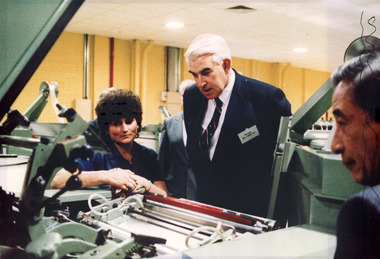
Photograph - Opening Day, Port Phillip Topmaking, 18 June 1990
... ...Early Wool Processing...Part of a collection of photographs previously housed at Victorian Wool Processors (VWP), who were the last early stage wool processing company in Melbourne, and the second last in Victoria. ...Colour photograph featuring two men and a woman standing amongst industrial wool processing machinery....Part of a collection of photographs previously housed at Victorian Wool Processors (VWP), who were the last early stage wool processing company in Melbourne, and the second last in Victoria. ...Part of a collection of photographs previously housed at Victorian Wool Processors (VWP), who were the last early stage wool processing company in Melbourne, and the second last in Victoria. The photographs were collected from other companies as they closed, and were donated to the museum by David Ritchie who was the General Manager at VWP. Victoria Wool Processors (Aust) Pty Ltd was founded by Jim Kim in 1983 as a dedicated international wool trading firm. Seeking greater quality control, the company opened its first physical processing plant in Melbourne in 1990 before scaling up to a state-of-the-art, 24-hour carbonising and scouring facility at Laverton North in 2002. For decades, it stood as one of the largest early-stage wool processing operations in the Southern Hemisphere, known for incorporating modern water-recycling and waste-management infrastructure. However, a severe domestic energy crisis and soaring natural gas prices forced the permanent closure of its manufacturing plant in December 2024, culminating in the company's official corporate liquidation in April 2026. This photo was previously in a frame with four others taken at the opening day of the modernised facility in Williamstown operated by Port Phillip Topmaking Pty Ltd on 18th June, 1990. One of the people depicted is John Kerin, MP.Colour photograph featuring two men and a woman standing amongst industrial wool processing machinery.victorian wool processors, early wool processing, textile industry, jim kim, topmaking, port phillip topmaking pty ltd, john kerin -
 National Wool Museum
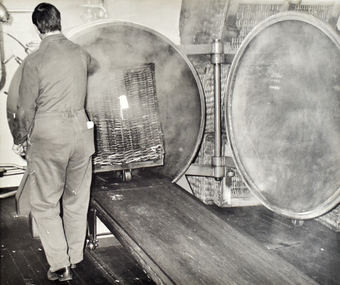
Photograph - Wool Processing, Returned Sailors and Soldiers Mill, Norm Holroyd, 1960's - 1970's
... Wool Processing, Returned Sailors and Soldiers Mill...Backing card has four holes in left side. Photograph Wool Processing, Returned Sailors and Soldiers Mill Norm Holroyd ...One of thirty eight photographs from a photo album featuring images of the Returned Sailors and Soldiers Woollen Mill in Newtown, Geelong. The images were taken between the 1960's-1970's by Norm Holroyd who worked at the mills. They were developed in his own private dark room and kept at his home for private viewing. The Returned Sailors and Soldiers Woollen Mill operated as a self-sufficient co-operative, funded and run by World War I veterans using their War Gratuity Bonds. The facility functioned as a complete raw-to-finished assembly line where raw fleece was brought on-site to be scoured, carded, dyed, spun into yarn and woven. It specialised in heavy worsted cloths, high-quality tweed, and its signature "Retsol" and "Monarch" pure-wool travelling rugs, later adapting its machinery to blend natural wool with artificial fibres as mid-century market demands shifted.Black and white photograph attached to cardboard backing with sticky tape. Image shows a man loading a basket into a steaming chamber. Backing card has four holes in left side.back: [handwritten] 18r. s. & s mill, returned sailors and soldiers mill, newtown, geelong, world war i, soldiers, veterans, co-operative, textile industry, woollen mills, wool, worsted cloth, tweed, retsol, monarch, travel rugs, machinery, factory, working life, norm holroyd, photo album, photography, design, fabric -
 National Wool Museum
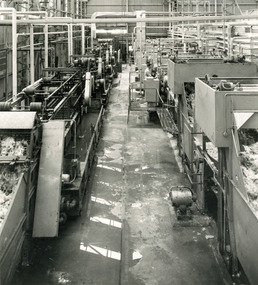
Photograph - Wool Scouring, Williamstown, 1974
... ...Early Wool Processing...Part of a collection of photographs previously housed at Victorian Wool Processors (VWP), who were the last early stage wool processing company in Melbourne, and the second last in Victoria. ...Black and white photograph showing interior of a factory with industrial wool processing machinery. A man is shown standing near machinery....Part of a collection of photographs previously housed at Victorian Wool Processors (VWP), who were the last early stage wool processing company in Melbourne, and the second last in Victoria. ...Part of a collection of photographs previously housed at Victorian Wool Processors (VWP), who were the last early stage wool processing company in Melbourne, and the second last in Victoria. The photographs were collected from other companies as they closed, and were donated to the museum by David Ritchie who was the General Manager at VWP. Victoria Wool Processors (Aust) Pty Ltd was founded by Jim Kim in 1983 as a dedicated international wool trading firm. Seeking greater quality control, the company opened its first physical processing plant in Melbourne in 1990 before scaling up to a state-of-the-art, 24-hour carbonising and scouring facility at Laverton North in 2002. For decades, it stood as one of the largest early-stage wool processing operations in the Southern Hemisphere, known for incorporating modern water-recycling and waste-management infrastructure. However, a severe domestic energy crisis and soaring natural gas prices forced the permanent closure of its manufacturing plant in December 2024, culminating in the company's official corporate liquidation in April 2026. This photo was previously in a frame with five other black and white photographs showing interior and exterior views of woollen mills in the 1960's and 1970's. This photo shows the wool scouring process inside the mill in Williamstown in 1974.Black and white photograph showing interior of a factory with industrial wool processing machinery. A man is shown standing near machinery.Back: [printed] COMMERCIAL PHOTOGRAPHY BY BS / Barry M. Sutton / 80 Ferguson St., Williamstown / Telephone 937-6017 / FOR REPRINT QUOTE NO Back: [handwritten] LW33 / 5A / 22 / SCOURSvictorian wool processors, early wool processing, textile industry, jim kim, topmaking, port phillip topmaking pty ltd, williamstown, pressing, carding, combing, wool scouring, footscray -
 National Wool Museum
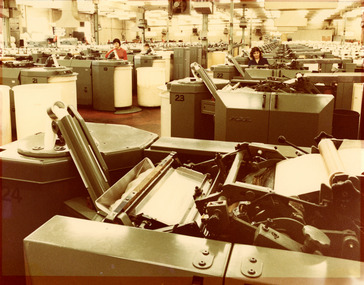
Photograph - Combing, Port Phillip Mills, Williamstown, 1984
... ...Early Wool Processing...Part of a collection of photographs previously housed at Victorian Wool Processors (VWP), who were the last early stage wool processing company in Melbourne, and the second last in Victoria. ...Colour photograph showing industrial wool processing machinery during the combing process. ...Part of a collection of photographs previously housed at Victorian Wool Processors (VWP), who were the last early stage wool processing company in Melbourne, and the second last in Victoria. ...Part of a collection of photographs previously housed at Victorian Wool Processors (VWP), who were the last early stage wool processing company in Melbourne, and the second last in Victoria. The photographs were collected from other companies as they closed, and were donated to the museum by David Ritchie who was the General Manager at VWP. Victoria Wool Processors (Aust) Pty Ltd was founded by Jim Kim in 1983 as a dedicated international wool trading firm. Seeking greater quality control, the company opened its first physical processing plant in Melbourne in 1990 before scaling up to a state-of-the-art, 24-hour carbonising and scouring facility at Laverton North in 2002. For decades, it stood as one of the largest early-stage wool processing operations in the Southern Hemisphere, known for incorporating modern water-recycling and waste-management infrastructure. However, a severe domestic energy crisis and soaring natural gas prices forced the permanent closure of its manufacturing plant in December 2024, culminating in the company's official corporate liquidation in April 2026. This photo was previously in a frame with three others taken in 1984 at the Port Phillip Mills in Williamstown. This image shows the combing process.Colour photograph showing industrial wool processing machinery during the combing process. Two women are shown in the background operating machinery.victorian wool processors, early wool processing, textile industry, jim kim, topmaking, port phillip topmaking pty ltd, williamstown, pressing, carding, combing -
 National Wool Museum
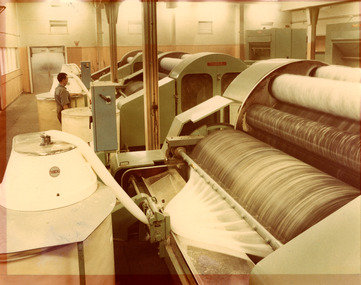
Photograph - Carding, Port Phillip Mills, Williamstown, 1984
... ...Early Wool Processing...Part of a collection of photographs previously housed at Victorian Wool Processors (VWP), who were the last early stage wool processing company in Melbourne, and the second last in Victoria. ...Colour photograph showing industrial wool processing machinery during the carding process. ...Part of a collection of photographs previously housed at Victorian Wool Processors (VWP), who were the last early stage wool processing company in Melbourne, and the second last in Victoria. ...Part of a collection of photographs previously housed at Victorian Wool Processors (VWP), who were the last early stage wool processing company in Melbourne, and the second last in Victoria. The photographs were collected from other companies as they closed, and were donated to the museum by David Ritchie who was the General Manager at VWP. Victoria Wool Processors (Aust) Pty Ltd was founded by Jim Kim in 1983 as a dedicated international wool trading firm. Seeking greater quality control, the company opened its first physical processing plant in Melbourne in 1990 before scaling up to a state-of-the-art, 24-hour carbonising and scouring facility at Laverton North in 2002. For decades, it stood as one of the largest early-stage wool processing operations in the Southern Hemisphere, known for incorporating modern water-recycling and waste-management infrastructure. However, a severe domestic energy crisis and soaring natural gas prices forced the permanent closure of its manufacturing plant in December 2024, culminating in the company's official corporate liquidation in April 2026. This photo was previously in a frame with three others taken in 1984 at the Port Phillip Mills in Williamstown. This image shows the carding process.Colour photograph showing industrial wool processing machinery during the carding process. A man is shown in the background standing near machinery.victorian wool processors, early wool processing, textile industry, jim kim, topmaking, port phillip topmaking pty ltd, williamstown, pressing, carding, combing -
 National Wool Museum
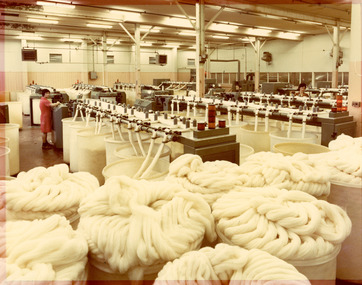
Photograph - Combing and Finishing, Port Phillip Mills, Williamstown, 1984
... ...Early Wool Processing...Part of a collection of photographs previously housed at Victorian Wool Processors (VWP), who were the last early stage wool processing company in Melbourne, and the second last in Victoria. ...Colour photograph showing industrial wool processing machinery during the combing and finishing process, with slivers of wool in the foreground. ...Part of a collection of photographs previously housed at Victorian Wool Processors (VWP), who were the last early stage wool processing company in Melbourne, and the second last in Victoria. ...Part of a collection of photographs previously housed at Victorian Wool Processors (VWP), who were the last early stage wool processing company in Melbourne, and the second last in Victoria. The photographs were collected from other companies as they closed, and were donated to the museum by David Ritchie who was the General Manager at VWP. Victoria Wool Processors (Aust) Pty Ltd was founded by Jim Kim in 1983 as a dedicated international wool trading firm. Seeking greater quality control, the company opened its first physical processing plant in Melbourne in 1990 before scaling up to a state-of-the-art, 24-hour carbonising and scouring facility at Laverton North in 2002. For decades, it stood as one of the largest early-stage wool processing operations in the Southern Hemisphere, known for incorporating modern water-recycling and waste-management infrastructure. However, a severe domestic energy crisis and soaring natural gas prices forced the permanent closure of its manufacturing plant in December 2024, culminating in the company's official corporate liquidation in April 2026. This photo was previously in a frame with three others taken in 1984 at the Port Phillip Mills in Williamstown. This image shows the combing and finishing process.Colour photograph showing industrial wool processing machinery during the combing and finishing process, with slivers of wool in the foreground. Two women are shown in the background operating machinery.victorian wool processors, early wool processing, textile industry, jim kim, topmaking, port phillip topmaking pty ltd, williamstown, pressing, carding, combing, wool scouring -
National Wool Museum
Chart, Australia's Wool Industry Processing chart, 1960
... Australia's Wool Industry Processing chart, 1960..."Australia's Wool Industry Processing chart, 1960"..."Australia's Wool Industry Processing chart, 1960" Education Wool industry Textile Industry - education Australian Wool Board Galloway Mr Ken Education Wool industry Textile Industry - education Australia's Wool Industry Processing chart, 1960 Chart ..."Australia's Wool Industry Processing chart, 1960"education wool industry textile industry - education, australian wool board, galloway, mr ken, education, wool industry, textile industry - education -
National Wool Museum
Book, Michell: 125 years
... Wool Processing Wool Brokering...Pty Ltd, the Australian woolbrokers, wool processors and wool exporters....Pty Ltd, the Australian woolbrokers, wool processors and wool exporters. Wool Processing Wool Brokering G.H. ..."Michell: 125 years; wool and leather for the world" 1997. Overview of the history of G.H. Michell and Sons (Aust.) Pty Ltd, the Australian woolbrokers, wool processors and wool exporters.wool processing wool brokering, g.h. michell and sons (aust.) pty ltd, wool processing, wool brokering -
 National Wool Museum
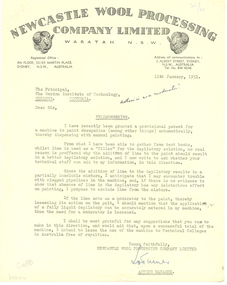
Letter
... Wool - research Wool Processing...Letter, on Newcastle Wool Processing Company Limited letterhead,.dated 11th January 1951, to the Principal, Gordon Institute of Technology requesting information on the use of lime in the fellmongering process...Letter, on Newcastle Wool Processing Company Limited letterhead,.dated 11th January 1951, to the Principal, Gordon Institute of Technology requesting information on the use of lime in the fellmongering process Wool - research Wool Processing Gordon Institute of Technology Newcastle Wool Processing Company Limited Fellmongery Lang Dr W. ...Letter, on Newcastle Wool Processing Company Limited letterhead,.dated 11th January 1951, to the Principal, Gordon Institute of Technology requesting information on the use of lime in the fellmongering processwool - research wool processing, gordon institute of technology newcastle wool processing company limited, fellmongery, lang, dr w. roy, wool - research, wool processing -
National Wool Museum
Book, Woolclassing
... ...Wool Processing...Notes compiled by Ken Galloway, Contains information on wool growing, sheep breeds. especially little known breeds, wool classing, wool processing etc....Notes compiled by Ken Galloway, Contains information on wool growing, sheep breeds. especially little known breeds, wool classing, wool processing etc. Wool Growing Woolclassing Sheep breeding Merino sheep Corriedale sheep Lincoln sheep Border Leicester sheep Cheviot sheep Dorset Horn sheep Sheep breeding Romney Marsh sheep Southdown sheep Shropshire sheep Polwarth sheep Wool Processing Carbonising Galloway Mr Ken Wool Growing Woolclassing Sheep breeding Merino sheep Corriedale sheep Lincoln sheep Border Leicester sheep Cheviot sheep Dorset Horn sheep Romney Marsh sheep Southdown sheep Shropshire sheep Polwarth sheep Wool Processing K Galloway Woolclassing Book ...Notes compiled by Ken Galloway, Contains information on wool growing, sheep breeds. especially little known breeds, wool classing, wool processing etc.K Gallowaywool growing woolclassing sheep breeding merino sheep corriedale sheep lincoln sheep border leicester sheep cheviot sheep dorset horn sheep sheep breeding romney marsh sheep southdown sheep shropshire sheep polwarth sheep wool processing, carbonising, galloway, mr ken, wool growing, woolclassing, sheep breeding, merino sheep, corriedale sheep, lincoln sheep, border leicester sheep, cheviot sheep, dorset horn sheep, romney marsh sheep, southdown sheep, shropshire sheep, polwarth sheep, wool processing
