
Showing 31 items matching "wool spinners"
-
 Wycheproof & District Historical Society Inc.
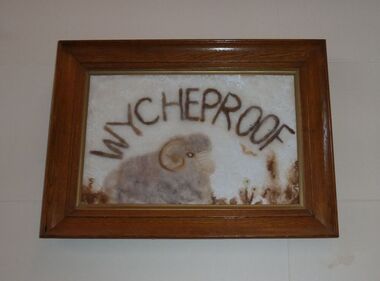
Wool Picture, Wycheproof Craft Group Emblem, 1984 (exact)
... wool...spinners weavers...This item is aesthetically significant as a visually pleasing craft piece that demonstrates the adaptability of skills to raw materials.It is representative of the lifeblood of the town of Wycheproof for 145 years. storey wycheproof craft wycheproof wool spinners weavers elaine Wycheproof Craft Group 1977-2010 A framed wool picture constructed entirely from natural fleece, showing a merino ram in a paddock with natural looking vegetation growth. ...The Wycheproof Craft Group emblem made by Mrs Elaine Storey depicts a large ram and showcases beautifully, wool colours and versatility of creator and medium used. The wool industry, since Wycheproof's settlement days, has greatly supported the town, families and farming in general.The wool picture is the emblem of a local group that met between 1977 and 2010.This item is aesthetically significant as a visually pleasing craft piece that demonstrates the adaptability of skills to raw materials.It is representative of the lifeblood of the town of Wycheproof for 145 years.A framed wool picture constructed entirely from natural fleece, showing a merino ram in a paddock with natural looking vegetation growth. The subject aptly lends itself to a subtle display of various shades of wool colours. It is framed in oak wood.The word WYCHEPROOF is worked in fleece in an arc formation.Wycheproof Craft Group 1977-2010storey, wycheproof craft, wycheproof wool, spinners weavers, elaine -
 Wodonga & District Historical Society Inc
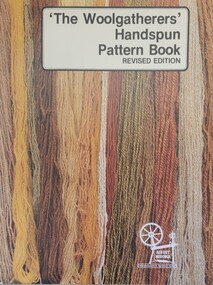
Booklet - "The Woolgatherers" Handspun Pattern Book, Albury Wodonga Handspinners and Weavers Guild, 1983
... ...Wool Spinners...Albury Wodonga Spinners Albury Wodonga Community Groups Knitting Patterns Wool Spinners This book is a collection of favourite handspun patterns and recipes gathered together during the first 10 years of the Albury/Wodonga Hand-weavers and Spinners Guild, 1970 to 1980. ...This book is a collection of favourite handspun patterns and recipes gathered together during the first 10 years of the Albury/Wodonga Hand-weavers and Spinners Guild, 1970 to 1980. Many of the patterns are completely original creations and therefore had never before been published. Other patterns were derived from old commercial patterns, and altered to suit handspun wool or the article being constructed. This book is the culmination of several months of research by a dedicated group of crafts-women within the Guild who have carefully re-checked all the patterns. Some of the garments had been awarded major prizes in the Annual National Woolcraft Festival, which is held mid-year in Albury for many years. The Albury/Wodonga Hand-weavers and Spinners Guild is still in operation in 2026.A book of 64 pages including patterns, diagrams and information. The cover features different colours of spun wool and the organisation's logo.This book is a collection of favourite handspun patterns and recipes gathered together during the first 10 years of the Albury/Wodonga Hand-weavers and Spinners Guild, 1970 to 1980. Many of the patterns are completely original creations and therefore had never before been published. Other patterns were derived from old commercial patterns, and altered to suit handspun wool or the article being constructed. This book is the culmination of several months of research by a dedicated group of crafts-women within the Guild who have carefully re-checked all the patterns. Some of the garments had been awarded major prizes in the Annual National Woolcraft Festival, which is held mid-year in Albury for many years. The Albury/Wodonga Hand-weavers and Spinners Guild is still in operation in 2026.albury wodonga spinners, albury wodonga community groups, knitting patterns, wool spinners -
 National Wool Museum
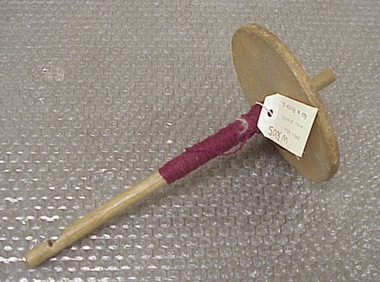
Spinner
... Hand held wool spinner - distaff spinner made by Ted Fairhurst....Hand held wool spinner - distaff spinner made by Ted Fairhurst. ...Hand held wool spinner - distaff spinner made by Ted Fairhurst.handicrafts, spinning - hand, fairhurst, mr ted -
 National Wool Museum
Book, Spinning Wheels: spinners and spinning
... spinners and spinning" - Patricia Baines, B.T. Batsford Limited, London, 1977. Donated as part of the Zakrzewski Collection of spinning wheels which were given to the National Wool Museum by Mr Wlodzimierz Zakrzewski. ...spinners and spinning" - Patricia Baines, B.T. Batsford Limited, London, 1977. Donated as part of the Zakrzewski Collection of spinning wheels which were given to the National Wool Museum by Mr Wlodzimierz Zakrzewski. ..."Spinning Wheels: spinners and spinning" - Patricia Baines, B.T. Batsford Limited, London, 1977. Donated as part of the Zakrzewski Collection of spinning wheels which were given to the National Wool Museum by Mr Wlodzimierz Zakrzewski. For many years, Mr Zakrzewski collected, researched and repaired spinning wheels from all over the world. This book was owned by him.handicrafts - history, spinning, spinning wheels, zakrzewski, mr wlodzimierz -
 National Wool Museum
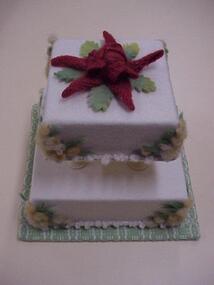
Textile Handcraft, The Afternoon Tea Party: Celebration Cake
... The Geelong Handweavers and Spinners Guild Inc. entered "The Afternoon Tea Party", designed by Val Ingeme, into the "Five Articles" Section of the Melbourne Sheep and Woolcraft Show c.1992. To qualify, the entry needed to form a group and be able to demonstrate a number of wool crafts in at least five different items. ...The Geelong Handweavers and Spinners Guild Inc. entered "The Afternoon Tea Party", designed by Val Ingeme, into the "Five Articles" Section of the Melbourne Sheep and Woolcraft Show c.1992. To qualify, the entry needed to form a group and be able to demonstrate a number of wool crafts in at least five different items. ...The Geelong Handweavers and Spinners Guild Inc. entered "The Afternoon Tea Party", designed by Val Ingeme, into the "Five Articles" Section of the Melbourne Sheep and Woolcraft Show c.1992. To qualify, the entry needed to form a group and be able to demonstrate a number of wool crafts in at least five different items. The covering of the cake was woven by Anneli Rickards, the plate woven by Jean Inglis, Mary Donnan and Val Ingeme made and assembled the floral trimmingsagricultural shows handicrafts textile art knitting weaving, geelong handweavers and spinners guild inc., spinning - hand, felting, weaving, ingeme, mrs val inglis, jean - geelong handweavers and spinners guild inc. rickards, anneli - geelong handweavers and spinners guild inc. donnan, mary - geelong handweavers and spinners guild inc., melbourne, victoria, agricultural shows, handicrafts, textile art, knitting -
 National Wool Museum
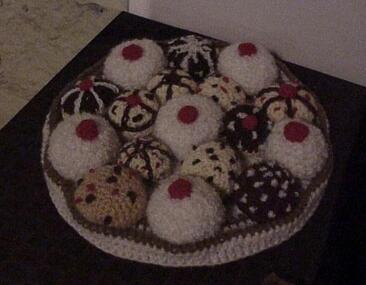
Textile Handcraft, The Afternoon Tea Party: Plate of cakes
... The Geelong Handweavers and Spinners Guild Inc. entered "The Afternoon Tea Party" , designed by Val Ingeme, into the "Five Articles" Section of the Melbourne Sheep and Woolcraft Show c.1992. To qualify, the entry needed to form a group and be able to demonstrate a number of wool crafts in at least five different items. ...The Geelong Handweavers and Spinners Guild Inc. entered "The Afternoon Tea Party" , designed by Val Ingeme, into the "Five Articles" Section of the Melbourne Sheep and Woolcraft Show c.1992. To qualify, the entry needed to form a group and be able to demonstrate a number of wool crafts in at least five different items. ...The Geelong Handweavers and Spinners Guild Inc. entered "The Afternoon Tea Party" , designed by Val Ingeme, into the "Five Articles" Section of the Melbourne Sheep and Woolcraft Show c.1992. To qualify, the entry needed to form a group and be able to demonstrate a number of wool crafts in at least five different items. "The Afternoon Tea Party" was loaned to the NWM for display and was subsequently donated in 2003. This piece was designed and made by Anna Rahoferagricultural shows textile art handicrafts, geelong handweavers and spinners guild inc., crochet, embroidery, ingeme, mrs val rahofer, anna - geelong handweavers and spinners guild inc., agricultural shows, textile art, handicrafts -
 National Wool Museum
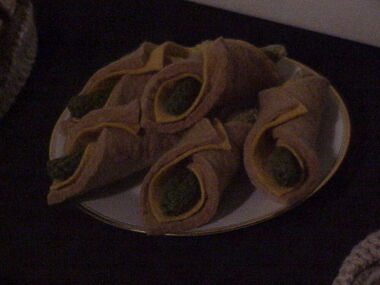
Textile Handcraft, The Afternoon Tea Party: Plate of cheese and asparagus rolls
... The Geelong Handweavers and Spinners Guild Inc. entered "The Afternoon Tea Party" , designed by Val Ingeme, into the "Five Articles" Section of the Melbourne Sheep and Woolcraft Show c.1992. To qualify, the entry needed to by from a group of five people and be able to demonstrate a number of wool crafts in at least five different items. ...wool fleece. Agricultural shows Textile Art Handicrafts Knitting Geelong Handweavers and Spinners Guild Inc. ...The Geelong Handweavers and Spinners Guild Inc. entered "The Afternoon Tea Party" , designed by Val Ingeme, into the "Five Articles" Section of the Melbourne Sheep and Woolcraft Show c.1992. To qualify, the entry needed to by from a group of five people and be able to demonstrate a number of wool crafts in at least five different items. "The Afternoon Tea Party" was loaned to the NWM for display and was subsequently donated in 2003. This piece was designed and made by Val Ingeme from wool fleece.agricultural shows textile art handicrafts knitting, geelong handweavers and spinners guild inc., felting, ingeme, mrs val, agricultural shows, textile art, handicrafts, knitting -
 National Wool Museum
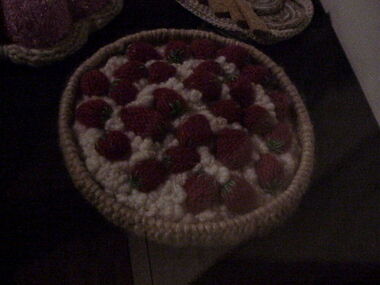
Textile Handcraft, The Afternoon Tea Party: Strawberry Pie
... The Geelong Handweavers and Spinners Guild Inc. entered "The Afternoon Tea Party" , designed by Val Ingeme, into the "Five Articles" Section of the Melbourne Sheep and Woolcraft Show c.1992. To qualify, the entry needed to be from a group of five people and be able to demonstrate a number of wool crafts in at least five different items. ...wool. Agricultural shows Textile Art Handicrafts Knitting Geelong Handweavers and Spinners Guild Inc. ...The Geelong Handweavers and Spinners Guild Inc. entered "The Afternoon Tea Party" , designed by Val Ingeme, into the "Five Articles" Section of the Melbourne Sheep and Woolcraft Show c.1992. To qualify, the entry needed to be from a group of five people and be able to demonstrate a number of wool crafts in at least five different items. "The Afternoon Tea Party" was loaned to the NWM for display and was subsequently donated in 2003. This piece was designed and made by Val Ingeme from commercial wool.agricultural shows textile art handicrafts knitting, geelong handweavers and spinners guild inc., embroidery, ingeme, mrs val, agricultural shows, textile art, handicrafts, knitting -
 National Wool Museum
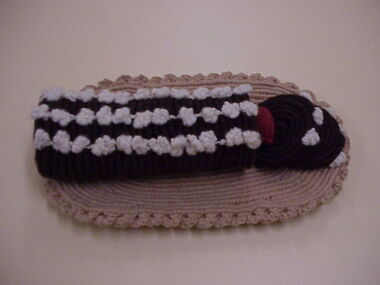
Textile Handcraft, The Afternoon Tea Party: Chocolate Roll
... The Geelong Handweavers and Spinners Guild Inc. entered "The Afternoon Tea Party" , designed by Val Ingeme, into the "Five Articles" Section of the Melbourne Sheep and Woolcraft Show c.1992. To qualify, the entry needed to be from a group of five people and be able to demonstrate a number of wool crafts in at least five different items. ...This piece was designed and made by Val Ingeme from commercial rug wool, the plate by an unknown member. Agricultural shows Textile Art Handicrafts Geelong Handweavers and Spinners Guild Inc. ...The Geelong Handweavers and Spinners Guild Inc. entered "The Afternoon Tea Party" , designed by Val Ingeme, into the "Five Articles" Section of the Melbourne Sheep and Woolcraft Show c.1992. To qualify, the entry needed to be from a group of five people and be able to demonstrate a number of wool crafts in at least five different items. "The Afternoon Tea Party" was loaned to the NWM for display and was subsequently donated in 2003. This piece was designed and made by Val Ingeme from commercial rug wool, the plate by an unknown member.agricultural shows textile art handicrafts, geelong handweavers and spinners guild inc., macrame, embroidery, ingeme, mrs val, agricultural shows, textile art, handicrafts -
 National Wool Museum
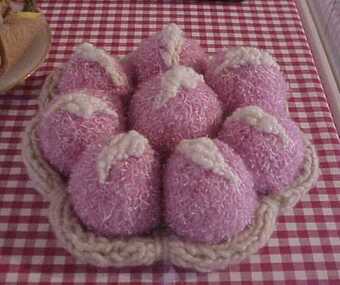
Textile Handcraft, The Afternoon Tea Party: Plate of Jelly Cakes
... The Geelong Handweavers and Spinners Guild Inc. entered "The Afternoon Tea Party" , designed by Val Ingeme, into the "Five Articles" Section of the Melbourne Sheep and Woolcraft Show c.1992. To qualify, the entry needed to be from a group of five people and be able to demonstrate a number of wool crafts in at least five different items. ...wool. Agricultural shows Textile Art Handicrafts Knitting Geelong Handweavers and Spinners Guild Inc. ...The Geelong Handweavers and Spinners Guild Inc. entered "The Afternoon Tea Party" , designed by Val Ingeme, into the "Five Articles" Section of the Melbourne Sheep and Woolcraft Show c.1992. To qualify, the entry needed to be from a group of five people and be able to demonstrate a number of wool crafts in at least five different items. "The Afternoon Tea Party" was loaned to the NWM for display and was subsequently donated in 2003. This piece was designed and made by Val Ingeme from wool blend yarn, the plate mae by Les Clarke from wool.agricultural shows textile art handicrafts knitting, geelong handweavers and spinners guild inc., ingeme, mrs val, agricultural shows, textile art, handicrafts, knitting -
 National Wool Museum
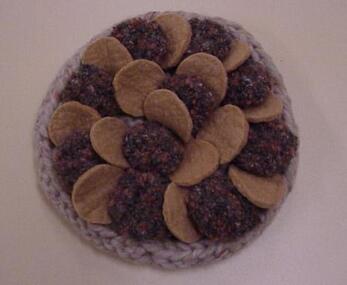
Textile Handcraft, The Afternoon Tea Party: Plate of Biscuits and Cookies
... The Geelong Handweavers and Spinners Guild Inc. entered "The Afternoon Tea Party" , designed by Val Ingeme, into the "Five Articles" Section of the Melbourne Sheep and Woolcraft Show c.1992. To qualify, the entry needed to be from a group of five people and be able to demonstrate a number of wool crafts in at least five different items. ...wool. Agricultural shows Textile Art Handicrafts Knitting Geelong Handweavers and Spinners Guild Inc. ...The Geelong Handweavers and Spinners Guild Inc. entered "The Afternoon Tea Party" , designed by Val Ingeme, into the "Five Articles" Section of the Melbourne Sheep and Woolcraft Show c.1992. To qualify, the entry needed to be from a group of five people and be able to demonstrate a number of wool crafts in at least five different items. "The Afternoon Tea Party" was loaned to the NWM for display and was subsequently donated in 2003. This piece was designed and made by Val Ingeme from wool blend yarn, the plate from wool.agricultural shows textile art handicrafts knitting, geelong handweavers and spinners guild inc., felting, ingeme, mrs val, agricultural shows, textile art, handicrafts, knitting -
 National Wool Museum
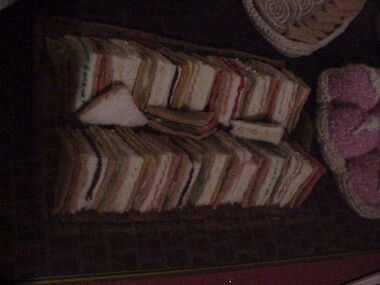
Textile Handcraft, The Afternoon Tea Party: Plate of Sandwiches
... The Geelong Handweavers and Spinners Guild Inc. entered "The Afternoon Tea Party" , designed by Val Ingeme, into the "Five Articles" Section of the Melbourne Sheep and Woolcraft Show c.1992. To qualify, the entry needed to be from a group of five people and be able to demonstrate a number of wool crafts in at least five different items. ...The Geelong Handweavers and Spinners Guild Inc. entered "The Afternoon Tea Party" , designed by Val Ingeme, into the "Five Articles" Section of the Melbourne Sheep and Woolcraft Show c.1992. To qualify, the entry needed to be from a group of five people and be able to demonstrate a number of wool crafts in at least five different items. ...The Geelong Handweavers and Spinners Guild Inc. entered "The Afternoon Tea Party" , designed by Val Ingeme, into the "Five Articles" Section of the Melbourne Sheep and Woolcraft Show c.1992. To qualify, the entry needed to be from a group of five people and be able to demonstrate a number of wool crafts in at least five different items. "The Afternoon Tea Party" was loaned to the NWM for display and was subsequently donated in 2003. This piece was designed by Janette Stonehouse and Val ingeme. the white bread and plate made by Janette Stonehouse and the brown bread by Val Ingeme.agricultural shows textile art handicrafts, geelong handweavers and spinners guild inc., felting, embroidery, ingeme, mrs val stonehouse, janette - geelong handweavers and spinners guild inc., agricultural shows, textile art, handicrafts -
 National Wool Museum
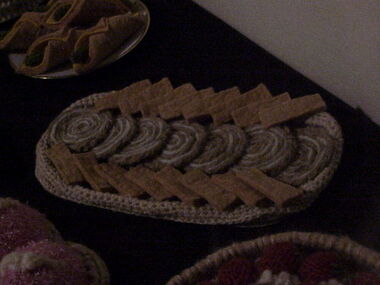
Textile Handcraft, The Afternoon Tea Party: Plate of Slices
... The Geelong Handweavers and Spinners Guild Inc. entered "The Afternoon Tea Party" , designed by Val Ingeme, into the "Five Articles" Section of the Melbourne Sheep and Woolcraft Show c.1992. To qualify, the entry needed to be from a group of five people and be able to demonstrate a number of wool crafts in at least five different items. ...The Geelong Handweavers and Spinners Guild Inc. entered "The Afternoon Tea Party" , designed by Val Ingeme, into the "Five Articles" Section of the Melbourne Sheep and Woolcraft Show c.1992. To qualify, the entry needed to be from a group of five people and be able to demonstrate a number of wool crafts in at least five different items. ...The Geelong Handweavers and Spinners Guild Inc. entered "The Afternoon Tea Party" , designed by Val Ingeme, into the "Five Articles" Section of the Melbourne Sheep and Woolcraft Show c.1992. To qualify, the entry needed to be from a group of five people and be able to demonstrate a number of wool crafts in at least five different items. "The Afternoon Tea Party" was loaned to the NWM for display and was subsequently donated in 2003.agricultural shows textile art handicrafts, geelong handweavers and spinners guild inc., crochet, felting, ingeme, mrs val, agricultural shows, textile art, handicrafts -
 National Wool Museum
Ribbon, Australian Sheep and Wool Show, Woolcraft Competition
... "Federaton Flora" was created by 13 members of the Geelong Handweavers and Spinners Guild Inc for the centenary of Federation in Australia. It won 1st prize in the Australian Sheep and Wool Show, Bendigo, 2000...."Federaton Flora" was created by 13 members of the Geelong Handweavers and Spinners Guild Inc for the centenary of Federation in Australia. It won 1st prize in the Australian Sheep and Wool Show, Bendigo, 2000. ..."Federaton Flora" was created by 13 members of the Geelong Handweavers and Spinners Guild Inc for the centenary of Federation in Australia. It won 1st prize in the Australian Sheep and Wool Show, Bendigo, 2000.Australian Sheep and Wool Show, Woolcraft Competitionhandicrafts, geelong handweavers and spinners guild inc., felting, hand spinning, hand knitting, weaving -
 National Wool Museum
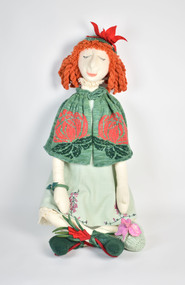
Textile - Doll, Geelong Handweavers and Spinners Guild Inc, Federation Flora, 2000
... "Federaton Flora" was created by thirteen members of the Geelong Handweavers and Spinners Guild Inc for the centenary of Federation in Australia. It won 1st prize in the Australian Sheep and Wool Show, Bendigo, 2000...."Federaton Flora" was created by thirteen members of the Geelong Handweavers and Spinners Guild Inc for the centenary of Federation in Australia. It won 1st prize in the Australian Sheep and Wool Show, Bendigo, 2000. ..."Federaton Flora" was created by thirteen members of the Geelong Handweavers and Spinners Guild Inc for the centenary of Federation in Australia. It won 1st prize in the Australian Sheep and Wool Show, Bendigo, 2000.Large handmade doll featuring white felted wool with wooden disc joints and orange woollen, possibly hand spun, hair. The facial features have been formed with white stitching, eyelashes are embroidered with black cotton, the lips have been painted on. The doll is dressed in a pale green short sleeved dress, of hand spun wool, buttoned at the back and lined with pale green silk. It is embroidered at the lower front with pink heath, the floral emblem of Victoria. She is wearing a cream woollen hand knitted underwear set consisting of singlet and pantaloons. The pantaloons have a fine hand knitted edge. Her shoes are of dark green felt with red kangaroo paw decoration. A green knitted cape with red and dark green waratah decoration is tied around her neck and tied to her left arm is a small pale felted bangle. handicrafts, geelong handweavers and spinners guild inc., felting, hand spinning, hand knitting, weaving, bendigo, australian sheep and wool show, federation, flora, doll -
 National Wool Museum
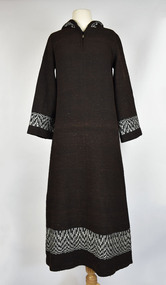
Clothing - Dress, 1979
... Spinners Guild at a ski weekend in 1979. It was entered in the ‘evening wear’ category of hand spun and knitted garments. The Warp was commercially brought 2/24 wool. ...Spinners Guild at a ski weekend in 1979. It was entered in the ‘evening wear’ category of hand spun and knitted garments. The Warp was commercially brought 2/24 wool. ...This dress was created by Jean Inglis for a competition of garments hosted by the Geelong Handweavers and Spinners Guild at a ski weekend in 1979. It was entered in the ‘evening wear’ category of hand spun and knitted garments. The Warp was commercially brought 2/24 wool. The Weft was hand spun black Corriedale wool. This wool was brought at a sale in Geelong and was hand dyed and spun by Jean. The patter is a ‘Ripple’ variation of a ‘Crackle’ weave completed on Jean’s own Dobby Loom (pictured). Long black dress stretching from the feet, reaching up to a hood at the neckline and down to the hands in the sleeve. The dress is black with a glossy silver pattern in the form of a band around the hood, hands and feet of the garment. In these bands is a wavy pattern of silver and black lines. There are multiple thick and thin lines of both the silver and black colours mirroring each other as the pattern stretches around the garment. wool, weaving, hand spun, corriedale -
 National Wool Museum
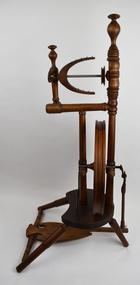
Functional object - Spinning Wheel, Philip Elford, 1976-7
... wool on an Ashford Wheel. By the end of the holidays, I had my own Ashford and it travelled with me back to Sydney. After graduation, I returned to Melbourne and the hippy “back to nature” movement was in full swing; there were many shops and galleries selling handmade woollen items and pottery etc. So I found an outlet for my pieces. Sometime in 1976-77, I met a spinner...wool on an Ashford Wheel. By the end of the holidays, I had my own Ashford and it travelled with me back to Sydney. After graduation, I returned to Melbourne and the hippy “back to nature” movement was in full swing; there were many shops and galleries selling handmade woollen items and pottery etc. So I found an outlet for my pieces. Sometime in 1976-77, I met a spinner ...Jackie Kerin's (donor's) story. In 1973, I was in my late teens and while I’d moved to Sydney from Melbourne, to begin my first year of drama studies at the National Institute of Dramatic Art. My parents had moved to Lake Bunga, a few kilometers north of Lakes Entrance (Victoria). On my first holiday visit to Bunga, I called into the Jolly Jumbuck Country Craft Centre in Bairnsdale http://jumbukwool.com.au/history. I was entranced by the place and spent the following weeks learning to spin lumpy wool on an Ashford Wheel. By the end of the holidays, I had my own Ashford and it travelled with me back to Sydney. After graduation, I returned to Melbourne and the hippy “back to nature” movement was in full swing; there were many shops and galleries selling handmade woollen items and pottery etc. So I found an outlet for my pieces. Sometime in 1976-77, I met a spinner and weaver of Swiss origin (I think) – her name was Ingeborg Guber (not sure of the spelling). She had a small gallery/shop at Brighton Beach where she worked, with her pet duck for company. Ingeborg had an upright Philip Elford wheel; an Australian wheel crafted from Acacia melanoxylon (blackwood). I was smitten and ordered one. I have a memory of Philip driving to Hampton from Ballarat to make the delivery. I used this wheel for years but as time and enthusiasm for spinning waned, the wheel became a decorative item in the house. Then in the 90s, and with my drama training, I set myself up travelling to schools and festivals, museums and galleries as a storyteller. The spinning wheel had a new life accompanying me on my adventures. For many children, familiar with references to spinning in fairy tales, seeing the little Philip Elford upright was magical. The wheel was donated to the National Wool Museum in 2021.Vertical tripod leg spinning wheel. 6 spoke wheel with three bobbins. Inscription “Philip Elford Ballart” can be read in gold text stamped to the base of the wheel. Wording, stamped, gold. Philip / Elford / Ballartspinning wheel, textile production, hobby textiles, aciacia melanoxylon (blackwood) -
 National Wool Museum
Tool - Spinning Wheel, c.1980
... Spinners and Weavers Guild was a great support network for her and with their recommendation, she purchased her own spinning wheel. Her passion was started, and the wheel was to become a treasured item in Gill’s home. She had several spinning wheels within her possession over the years, however, this wheel was her first and always her favourite. When the time came for Gill to downsize, there was simply no longer room for her spinning wheel. This is when she decided to donate the wheel to the National Wool...Spinners and Weavers Guild was a great support network for her and with their recommendation, she purchased her own spinning wheel. Her passion was started, and the wheel was to become a treasured item in Gill’s home. She had several spinning wheels within her possession over the years, however, this wheel was her first and always her favourite. When the time came for Gill to downsize, there was simply no longer room for her spinning wheel. This is when she decided to donate the wheel to the National Wool ...This spinning wheel originates from New Zealand; however, it has no distinguishing features relating to its creator such as an inscription, so its exact maker is not known. Gill Stange remembers buying the wheel on Bridge Road in Richmond, approximately 30 years ago. Gill had joined her local Spinners and Weavers Guild after the Ash Wednesday bushfires of 1983. She was a then resident of Mount Macedon and lost everything in the fires. Moving to Melbourne to get away from the scene of much pain, Gill was also in need of a new hobby to help occupy her mind. That is when spinning and weaving entered her life. The local Spinners and Weavers Guild was a great support network for her and with their recommendation, she purchased her own spinning wheel. Her passion was started, and the wheel was to become a treasured item in Gill’s home. She had several spinning wheels within her possession over the years, however, this wheel was her first and always her favourite. When the time came for Gill to downsize, there was simply no longer room for her spinning wheel. This is when she decided to donate the wheel to the National Wool Museum. Gill remembers one highlight was weaving a tablecloth from a traditional German design. It took her two years to complete, with Gill spinning all the wool herself on this wheel. The tablecloth won the first prize in the Melbourne Show in 1987. Gill also used the wheel to teach programs to school children on how to spin and knit wool. She would take the easily transported little wheel, and its accompanying seat, with her to schools. Its small size enabled her to teach children to knit and spin, bringing others the joy that spinning had brought her. Not just limited to schools, Gill also taught programs with the wheel here at the National Wool Museum. It is a fitting home for the wheel, which Gill donated to the National Wool Museum in 2021.Dark varnished wood in a Castle style spinning wheel. The wheel has 8 small spokes which meet a thick outside rim. The outside rim has four golden disc weights on the bottom edge, to aid in the turning of the wheel. The spinning wheel has four legs of turned wood giving a sculptural form, a design pattern which is continued throughout. The wheel has a single medium sized foot pedal. This pedal is well worn with varnish missing from years of use. The wheel is completed with its accompanying chair. Made of the same dark varnished wood, its legs are also of turned wood, continuing the design pattern and uniting the two objects. The chair is very simple outside of the legs, with a medium size base and a thin backrest ending in a rounded head. The chair’s varnish is also starting to fade from years of use. The chair is small, designed to keep the spinning wheel operator at the appropriate height when spinning on the equally small and compact Castle style spinning wheel. Additional parts were donated with the Spinning Wheel. - 3 x Lazy Kates - Spare Maiden. - 450mm Niddy Noddy - Steel teeth brushspinning wool, spinning wheel, ash wednesday, mount macedon, textile production -
 National Wool Museum
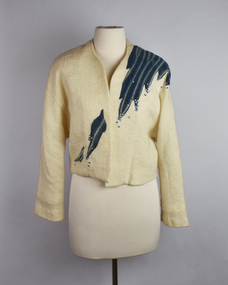
Clothing - Jacket, Mrs Jean Inglis, 1988
... This jacket is by the prolific spinner and weaver Jean Inglis. It has been woven with a warp of commercially brought wool & a weft of hand spun Corriedale. ...This jacket is by the prolific spinner and weaver Jean Inglis. It has been woven with a warp of commercially brought wool & a weft of hand spun Corriedale. ...This jacket is by the prolific spinner and weaver Jean Inglis. It has been woven with a warp of commercially brought wool & a weft of hand spun Corriedale. It is completed in a Swedish lace style of weaving. The highlight of the jacket is the blue section of fabric on the top left shoulder of the wearer, which works down to the bottom right hip. This pattern looks like long thin individual separate sections of fabric stitched to the jacket; however, only one section of fabric has been added. A dying technique has been utilised to give the appearance of multiple sections. This Japanese dyeing technique is called Shibori, “to wring, squeeze or press". It is a manual tie-dyeing technique, which produces several different patterns on fabric. The specific pattern on this fabric is known as Kumo Shibori. It utilises bound resistance. This technique involves folding sections of the cloth very finely and evenly. Then the cloth is bound in very close sections. The result is a very specific spider-like design. This design requires very precise technique. Specific to this jacket, the fabric for the dyed section was made with the same fabric as the rest of the jacket. A section of the excess fabric was concertina wrapped around a 100mm pipe and tied up before dying. This gives the consistent straight blue lines, with no bleed from the dye. The sections were then sewed into the jacket with the occasional sequin added for additional decoration and glamour. The jacket won 1st prize at the 1988 Geelong Show. Jean was assisted by the dress maker Ruth Randell with some of the design and sewing. Jean always found sewing “a bit of a bore”. The jacket also has an attached swing tag. It was added to provide information to the judges at the Melbourne Show on how the jacket was created. It comes complete with Jean’s self-proclaimed terrible handwriting. It was donated to the National Wool Museum in 2021.Cream singled breasted jacket with no overlap. The jacket has no column of buttons for fastening, or lapels. It is designed to be plain, to not draw attention. The jacket is highlighted by the Shibori dyed waves on the top left shoulder of the wearer, which works down to the bottom right hip. This blue dyed section of fabric is dotted with the occasional blue sequin. Internally, the jacket features a white silk lining for comfort. The jacket ends in a straight cut hem, including at the cuffs. The jacket has an attached swing tag. The swing tag is cream with a printed thin black boarder. Within the boarder, handwriting in black ink is found. It has a hole punch in the top left corner of the swing tag for attaching to the jacket.hand spun, hand weaving, textile design, textile production, shibori, kumo shibori -
 National Wool Museum
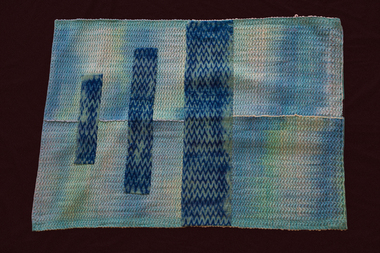
Quilt, Cross Currents
... spinners guild inc. 'Cross Currents', Jean Inglis, 13 Park Street, Geelong, 52295131 Weaving consisting of four panels sewn together to form the quilt. Consists of gradations of green to blue colours containing flecks of multicoloured wool through the weft. ...Expressions 2004 Quilt PrizeWeaving consisting of four panels sewn together to form the quilt. Consists of gradations of green to blue colours containing flecks of multicoloured wool through the weft. Weaving forms raised zigzag pattern running left to right through quilt. Three woven blue panels are sewn to the front of the quilt with dyed dark blue zigzags. The quilt is hung on a cardboard roll at the top. Satin square containing the artist's name and address sewn onto the back of the quilt in the right hand corner.'Cross Currents', Jean Inglis, 13 Park Street, Geelong, 52295131weaving, inglis, jean - geelong handweavers and spinners guild inc. -
 National Wool Museum
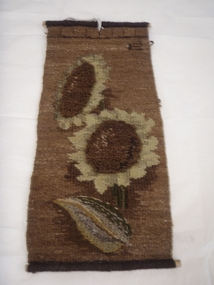
Wall Hanging
... wool. Ms Mann owned a shop in Jacob Street which sold handmade soft toys and hand woven items. She was a founding and life member of the Geelong Handweavers and Spinners Guild. ...wool. Ms Mann owned a shop in Jacob Street which sold handmade soft toys and hand woven items. She was a founding and life member of the Geelong Handweavers and Spinners Guild. ...The wall hanging was handwoven by Lilian Joyce Mann from hand spun fleece, natural coloured wool and vegetable dyed wool. Ms Mann owned a shop in Jacob Street which sold handmade soft toys and hand woven items. She was a founding and life member of the Geelong Handweavers and Spinners Guild. She died on the 17th July 2007 in her 92nd year.W7220 W7220 handwritten labelL.J.Mann Hand spun fleece Natural coloured wool + Vegetable Dyed wool L.J.Mannhandicrafts, geelong handweavers and spinners guild inc., weaving, mann, ms lilian joyce, geelong, victoria -
 National Wool Museum
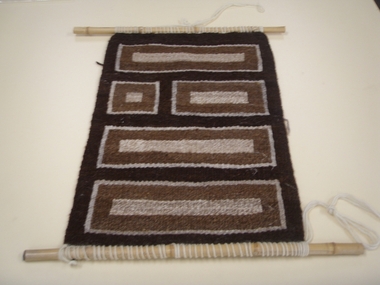
Wall Hanging, Lilian Joyce Mann
... Spinners Guild Inc. Weaving Mann Ms Lilian Joyce Geelong Victoria A tightly woven brown wall handing with a geometric design of rectangles and squares and a bamboo rod at each end. There is a length of undyed wool ...The hanging was handwoven by Lilian Joyce Mann. Ms Mann owned a shop in Jacob Street which sold handmade soft toys and hand woven items. She was a gounding and life member of the Geelong Handweavers and Spinners Guild. She died on the 17th July 2007 in her 92nd year.A tightly woven brown wall handing with a geometric design of rectangles and squares and a bamboo rod at each end. There is a length of undyed wool on each rod to hand the piece, but on one end it had been cut and hangs loose.handicrafts, geelong handweavers and spinners guild inc., weaving, mann, ms lilian joyce, geelong, victoria -
 National Wool Museum
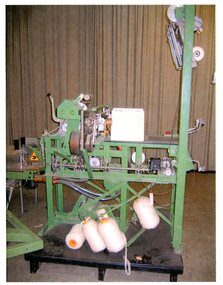
Machine - Spinning Machine Prototype, CSIRO et al, 1960s
... Label with machine: Prototype SELF-TWIST SPINNER / This prototype spinning machine was built / at Division of Wool Technology in the mid 1960's as / part of the program which developed the Self-Twist spinning / process. / Self-Twist was commercially released in / 1970 by The Division in conjunction with the Australian / engineering company Repco, and The International Wool / Secretariat. / Since 1970 more than 3500 Self-Twist / machines have been sold. / The process offers advantages in the / speed of spinning, machine size, maintenance and energy / consumption....Engineering Manufacturing Wool Processing Spinning CSIRO Prototype Invention Wool Technology Self-Twist REPCO International Wool Secretariat Label with machine: Prototype SELF-TWIST SPINNER / This prototype spinning machine was built / at Division of Wool Technology in the mid 1960's as / part of the program which developed the Self-Twist spinning / process. / Self-Twist was commercially released in / 1970 by The Division in conjunction with the Australian / engineering company Repco, and The International Wool / Secretariat. / Since 1970 more than 3500 Self-Twist / machines have been sold. / The process offers advantages in the / speed of spinning, machine size, maintenance and energy / consumption. ...Self-twist spinning machine prototype developed by CSIRO in the 1960's. Made by CSIRO Division of Wool Technology in conjunction with an Australian engineering company REPCO and the International Wool Secretariat. Prototype developed in 1960's and since 1970 over 3500 have been produced and sold.Self-twisting spinning machine (protoype).Label with machine: Prototype SELF-TWIST SPINNER / This prototype spinning machine was built / at Division of Wool Technology in the mid 1960's as / part of the program which developed the Self-Twist spinning / process. / Self-Twist was commercially released in / 1970 by The Division in conjunction with the Australian / engineering company Repco, and The International Wool / Secretariat. / Since 1970 more than 3500 Self-Twist / machines have been sold. / The process offers advantages in the / speed of spinning, machine size, maintenance and energy / consumption.engineering, manufacturing, wool processing, spinning, csiro, prototype, invention, wool technology, self-twist, repco, international wool secretariat -
 National Wool Museum
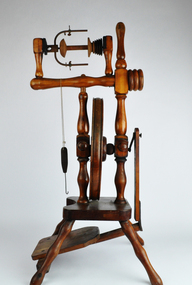
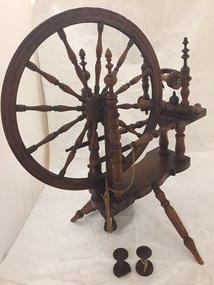
Spinning Wheel, 18th century or early 19th century
... wool worked into yarn and knitted into particularly warm and water-resistant socks for sailors on minesweepers serving during the Second World War. Jan received the wheel in the early 1960s after her mother past away at which time the wheel was no longer operable. When Jan came to live in Melbourne, she sought the assistance of Spinners...wool worked into yarn and knitted into particularly warm and water-resistant socks for sailors on minesweepers serving during the Second World War. Jan received the wheel in the early 1960s after her mother past away at which time the wheel was no longer operable. When Jan came to live in Melbourne, she sought the assistance of Spinners ...The spinning wheel was owned by Amy Penfold (donor Jan Dawson's mother) who presumably purchased the spinning wheel in the 1930s at an antiques auction. Amy lent the spinning wheel to her friends who spun (as Amy could not spin herself) In Yass, New South Wales during the early years of the Second World War. Amy's friends would spin lightly scoured semi greasy wool worked into yarn and knitted into particularly warm and water-resistant socks for sailors on minesweepers serving during the Second World War. Jan received the wheel in the early 1960s after her mother past away at which time the wheel was no longer operable. When Jan came to live in Melbourne, she sought the assistance of Spinners and Handweavers who assisted her in creating a new bobbin and restored the broken pieces of the wheel back into working order which we find it in today. With the loom are three bobbins. One bobbin is attached to the loom while of the two loose bobbins; one is a reproduction and one is an original. From these two the differences in construction can be observed. Large 12 spokes pinning wheel finished in dark tinted varnish on wood. Ornate upright posts.Additional two bobbins. One original and slightly damaged other is a reproduction and in excellent condition. -
 National Wool Museum
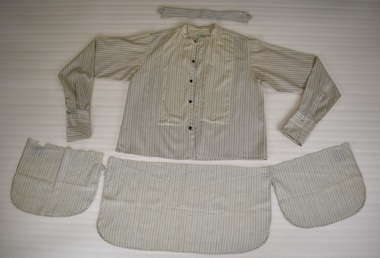
Clothing - Shirt, 1925-1938
... For example, the wool goes from merchants to combers to produce tops, the tops to spinners to produce yarn and then the yarn is sold to manufactures who weave it into cloth. ...For example, the wool goes from merchants to combers to produce tops, the tops to spinners to produce yarn and then the yarn is sold to manufactures who weave it into cloth. ...Male wool shirt made in Bradford, U.K. The shirt is cut from first fabric woven from 100% traceable Australian wool. Bradford Mills differ to Australian mills in that the entire process of producing worsted material does not take place at the one firm/factory. Rather it is split between many firm/factories specialising in their task in the production of worsted material. For example, the wool goes from merchants to combers to produce tops, the tops to spinners to produce yarn and then the yarn is sold to manufactures who weave it into cloth. After the weaving is done the cloth has to be sent to the dryers and finishers, who scour, dye and finish the cloth. Finally, the finished cloth is purchase by a fresh set of merchants, who will later sell the cloth elsewhere in England or abroad. At each these steps a new firm is handling the wool/cloth making it hard to track lineage of wool through this process and hence hard to guarantee 100% Australian wool. This shirt was purchased and worn by the donor’s husband, George H. Gerber, an Australian Wool Buyer. The shirt was purchased on one of George’s trips to Bradford in the U.K. on company business. Gerber was a second-generation Wool Traders in his family. His father, also named George H. Gerber, worked for Kreglinger & Furneau. He worked for them in Boston, U.S.A. before he died from the Spanish Flu in 1918. The company then promised a job to his oldest son (donor’s husband) once he finished school. Thus, George came to be trained as a Fine Wool Classer by Kreglinger & Furneaux (Aust.) Pty Ltd where he was employed as a Wool Buyer all his working life. He retired in 1969 as the head of their Australian office when the company was taken over Also of note, the shirt was sold with 2 add-on collars. Having additional collars was advantageous as changing only the collar increased the number of days the shirt could be worn without washing. Cream coloured shirt with black and red single thread verticle stripes.“Grandpa” collar (with 1 of its 2 supplied add-on collars included). French cuffs. Sold with 2 add-on collars, hence both ends of the collar have buttonholes to take a stud, and a partially-opened button-hole is at the centre of the neck on the outside of the collar for a second stud.Letering label on shirt: GENT’S OUTFITTER Herbert Winfield 23 CHEAPSIDE, BRADFORDbradford, u.k, kreglinger & furneaux (aust.) pty ltd, 100% australian wool -
 National Wool Museum
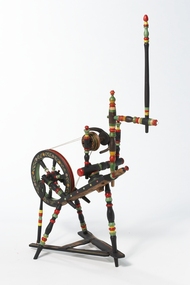
Spinning Wheel
... Wool Museum by Mr Wlodzimierz Zakrzewski. For many years, Mr Zakrzewski collected, researched and repaired spinning wheels from all over the world. This spinning wheel is from Germany / Bavaria and dates from the late 19th - early 20th century and has been restored. It was sold to Mr Zakrzewski by a member of the Handweavers and Spinners...Wool Museum by Mr Wlodzimierz Zakrzewski. For many years, Mr Zakrzewski collected, researched and repaired spinning wheels from all over the world. This spinning wheel is from Germany / Bavaria and dates from the late 19th - early 20th century and has been restored. It was sold to Mr Zakrzewski by a member of the Handweavers and Spinners ...Part of the Zakrzewski Collection of spinning wheels donated to the National Wool Museum by Mr Wlodzimierz Zakrzewski. For many years, Mr Zakrzewski collected, researched and repaired spinning wheels from all over the world. This spinning wheel is from Germany / Bavaria and dates from the late 19th - early 20th century and has been restored. It was sold to Mr Zakrzewski by a member of the Handweavers and Spinners Guild who had hoped to restore it.Part of the Zakrzewski Spinning Wheel collection.handicrafts - history, spinning wheels, highlights of the national wool museum: the zakrzewski spinning wheel collection - exhibition (28/07/2001 - 02/12/2001), zakrzewski, mr wlodzimierz -
 National Wool Museum
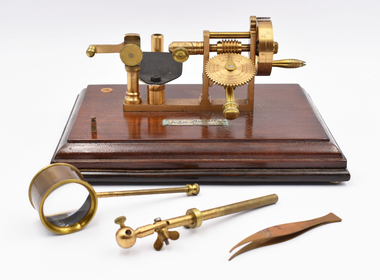
Functional object - Yarn Spinner and Accessories, John Nesbitt, 19th Century
... Wool Museum. His passion for the world of textiles provided energy and knowledge to the visitors and staff of the museum. Although Nino has now retired from his honorary position and has hung up his Australian Tartan vest, these items will continue to serve the community in sharing the stories of Australian Textile design. apparatus textile testing spinning nino corda magnifyer tools brass mahogany tweezers yarn spinner design john nesbitt manchester england 19th Century engineering manufacturing Brass plaque on base of spinner: 42 MARKET St / John Nesbitt / REGd TRADE MARK / LIMd / MANCHESTER Underside of wooden plinth: 4976 Custom made wooden hinged box with a hook latch. ...Nino Corda was a Geelong based textile designer who worked at various textile mills between 1957 & 2003. He travelled the world in search of the latest fashions and techniques and developed timeless designs that were much loved by Australians. These items are on rotational display at the National Wool Museum’s ‘In the Factory’ exhibition. For many years, Nino also worked as part of the Honorary Staff of the National Wool Museum. His passion for the world of textiles provided energy and knowledge to the visitors and staff of the museum. Although Nino has now retired from his honorary position and has hung up his Australian Tartan vest, these items will continue to serve the community in sharing the stories of Australian Textile design.Custom made wooden hinged box with a hook latch. Brass yarn spinner, attached to a mahogany wood plinth base, which spins fibre into cord/yarn/thread. It has dials to set the rate that it spins. Metal plaque with black inlaid enamel lettering. Small cork inlay. Brass rod with hinge and wingnut, and ball at end. Ball at end has an adjustment mechanism. Rod also has an adjustable circular collar. Pair of curved tweezers. Circular magnifying glass on long thin handle. Glass has two concave lenses. Weaving sample in shades of blue, green and brown. Twill weave. Alternate pattern samples separated by red thread.Brass plaque on base of spinner: 42 MARKET St / John Nesbitt / REGd TRADE MARK / LIMd / MANCHESTER Underside of wooden plinth: 4976apparatus, textile, testing, spinning, nino corda, magnifyer, tools, brass, mahogany, tweezers, yarn, spinner, design, john nesbitt, manchester, england, 19th century, engineering, manufacturing -
 Whitehorse Historical Society Inc.
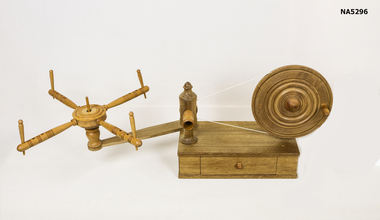
Equipment - Yarn Winder + Swift + spindles
... Spindles Winder Swift Yarn Spinners Hand turned wooden wool winder and swift and spindles. ...The swift winder together with lace pieces was bought in Europe by Nan Warner, who was a retired school teacher and together with her husband Max travelled to Europe and China after they retired. Nan joined a lace making group in the late 1970s who until well into the 1980s and 1990s the group met in each others homes once a month in the eastern suburbs of Melbourne around the Vermont and Ringwood area. The group later became part of the Australian Lace Guild. The donor was also a lacemaker in the group. Hand turned spindle winders and swifts are also used by weavers and spinners.Hand turned wooden wool winder and swift and spindles. It has a wooden base with drawers with a vertical wheel, spindle with winder on an arm with rotating thread holders.spindles, winder, swift, yarn, spinners -
 Wodonga & District Historical Society Inc
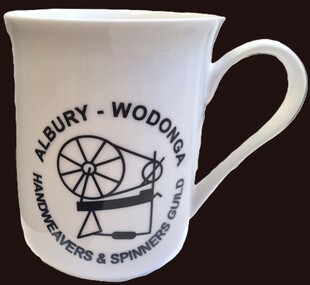
Souvenir - Mug Albury Wodonga Handweavers & Spinners Guild
... Spinners Guild was formed on 15th July 1970 at a meeting calling for interested people to attend a meeting, Mrs Reis had migrated from England bringing her spinning wheel and floor loom with her. The Guild was formed with 23 inaugural members. Guild members conducted workshops and demonstrated their work at the Albury Show and other venues. In 1973 a Woolcraft Festival Committee was formed and in 1974 the Guild was affiliated with the National Woolcraft Festival, which was held for many years at the Wool...Spinners Guild was formed on 15th July 1970 at a meeting calling for interested people to attend a meeting, Mrs Reis had migrated from England bringing her spinning wheel and floor loom with her. The Guild was formed with 23 inaugural members. Guild members conducted workshops and demonstrated their work at the Albury Show and other venues. In 1973 a Woolcraft Festival Committee was formed and in 1974 the Guild was affiliated with the National Woolcraft Festival, which was held for many years at the Wool ...The Albury/Wodonga Handweavers and Spinners Guild was formed on 15th July 1970 at a meeting calling for interested people to attend a meeting, Mrs Reis had migrated from England bringing her spinning wheel and floor loom with her. The Guild was formed with 23 inaugural members. Guild members conducted workshops and demonstrated their work at the Albury Show and other venues. In 1973 a Woolcraft Festival Committee was formed and in 1974 the Guild was affiliated with the National Woolcraft Festival, which was held for many years at the Wool Store (in Albury and later at the Albury Showgrounds. In 1980 the Guild published “The Woolgatherers Handspun Pattern Book” which was very popular and had several reprints. The Albury Wodonga Handweavers and Spinners Guild is still an active organisation in the community more than 50 years after its formation. The Company name Australian Fine China was adopted in 1997. Its products were first produced in 1921 from its factory in Subiaco, Western Australia which opened under the name of Calyx Porcelain and Paint Company. In 1938 it was re-named H. L. Brisbane and Wunderlich Ltd. One of its key brands was Bristile with earthenware items known as Wembley Ware. Bristile was re-introduced in the 1960s with the manufacture of vitrified white crockery. In 1997 the name of Australian Fine China was adopted, and the company made china under this name until the closure of the Subiaco factory in 2006. From this time Australian Fine China has operated its business from its headquarters in Welshpool, Perth in Western Australia, with all the products now being made overseas.This item is significant because it represents a long-standing organisation in the Albury Wodonga Community.A white china mug bearing the outline of a spinning wheel, surrounded by black lettering,Around the spinning wheel ALBURY - Wodonga Handweavers & Spinners Guild Under the base - ARIA Porcelain made in Australia by Australian Fine China DIshwasher & Microwave Safethe albury wodonga handweavers and spinners guild, community groups -
 Whitehorse Historical Society Inc.
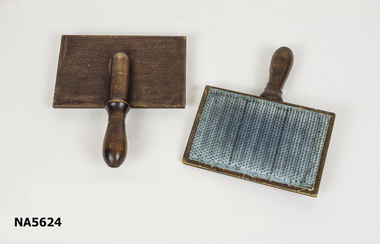
Tool - Wool carding, Unknown
... Wool-knitting Handwork Two wooden paddles with fine mettle pins on one side, wooden handles on each paddle. Tool Wool carding Spinners and Weavers, Box Hill ...Two wooden paddles with fine mettle pins on one side, wooden handles on each paddle.wool-knitting, handwork
