
Showing 251 items matching "wool trading"
-
 National Wool Museum
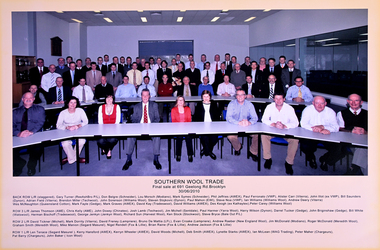
Photograph - Southern Wool Trade, Final Sale, 30 June 2010
... Southern Wool Trade, Final Sale......Wool Trading...Victoria Wool Processors (Aust) Pty Ltd was founded by Jim Kim in 1983 as a dedicated international wool trading firm. Seeking greater quality control, the company opened its first physical processing plant in Melbourne in 1990 before scaling up to a state-of-the-art, 24-hour carbonising and scouring facility at Laverton North in 2002. ...front: [printed] SOUTHERN WOOL TRADE / Final sale at 691 Geelong Rd. Brooklyn / 30/06/2010...Photograph Southern Wool Trade, Final Sale ...Part of a collection of photographs previously housed at Victorian Wool Processors (VWP), who were the last early stage wool processing company in Melbourne, and the second last in Victoria. The photographs were collected from other companies as they closed, and were donated to the museum by David Ritchie who was the General Manager at VWP. Victoria Wool Processors (Aust) Pty Ltd was founded by Jim Kim in 1983 as a dedicated international wool trading firm. Seeking greater quality control, the company opened its first physical processing plant in Melbourne in 1990 before scaling up to a state-of-the-art, 24-hour carbonising and scouring facility at Laverton North in 2002. For decades, it stood as one of the largest early-stage wool processing operations in the Southern Hemisphere, known for incorporating modern water-recycling and waste-management infrastructure. However, a severe domestic energy crisis and soaring natural gas prices forced the permanent closure of its manufacturing plant in December 2024, culminating in the company's official corporate liquidation in April 2026. This photo shows the final sale to take place at the Melbourne Wool Selling Centre located off Geelong Road in Brooklyn, Victoria on 30th June 2010.Colour photograph featuring a group portrait of people seated and standing inside a room.front: [printed] SOUTHERN WOOL TRADE / Final sale at 691 Geelong Rd. Brooklyn / 30/06/2010victorian wool processors, melbourne wool selling centre, early wool processing, textile industry, jim kim, wool trading, trade, sale -
 National Wool Museum
Folder, Wool trade products
... Wool trade products...Part of Ken Galloways research material associated with his career as a woolclasser. "Wool trade products"...Wool trade products 13...Part of Ken Galloways research material associated with his career as a woolclasser. "Wool trade products" Woolclassing Sheep breeding Farming Shearing Wool Marketing Wool industry Wesfarmers Dalgety Limited Geelong Galloway Mr Ken Woolclassing Sheep breeding Farming Shearing Wool Marketing Wool industry Wool trade products 13 Wool trade products Folder ...Part of Ken Galloways research material associated with his career as a woolclasser. "Wool trade products"Wool trade products 13woolclassing sheep breeding farming shearing wool marketing wool industry, wesfarmers dalgety limited, geelong, galloway, mr ken, woolclassing, sheep breeding, farming, shearing, wool marketing, wool industry -
National Wool Museum
Folder, Wool producers, wool trade, general literature
... Wool producers, wool trade, general literature...Part of Ken Galloways research material associated with his career as a woolclasser. "Wool trade, general literature"...Wool trade, general literature 9...Part of Ken Galloways research material associated with his career as a woolclasser. "Wool trade, general literature" Woolclassing Sheep breeding Farming Wesfarmers Dalgety Limited Geelong Galloway Mr Ken Woolclassing Sheep breeding Farming Wool trade, general literature 9 Wool producers, wool trade, general literature Folder ...Part of Ken Galloways research material associated with his career as a woolclasser. "Wool trade, general literature"Wool trade, general literature 9woolclassing sheep breeding farming, wesfarmers dalgety limited, geelong, galloway, mr ken, woolclassing, sheep breeding, farming -
 Flagstaff Hill Maritime Museum and Village
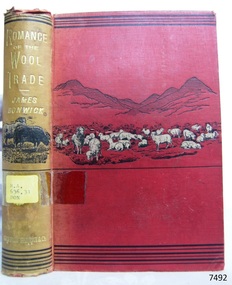
Book, Romance of The Wool Trade
... Romance of The Wool Trade......Romance of The Wool Trade...Romance of The Wool Trade Author: James Bonwick Publisher: Griffith, Farran, Okeden, Welsh Date: 1887...Warrnambool Shipwrecked-coast Flagstaff-Hill Flagstaff-Hill-Maritime-Museum Maritime-Museum Shipwreck-coast Flagstaff-Hill-Maritime-Village Shipwrecked-artefact Book Warrnambool Mechanics’ Institute Romance of The Wool Trade James Bonwick Label on spine cover with typed text RA 636.31 BON Pastedown front end page has sticker from Warrnambool Mechanics Institute and Free Library Romance of The Wool Trade Author: James Bonwick Publisher: Griffith, Farran, Okeden, Welsh Date: 1887 Romance of The Wool Trade Book ...Romance of The Wool Trade Author: James Bonwick Publisher: Griffith, Farran, Okeden, Welsh Date: 1887Label on spine cover with typed text RA 636.31 BON Pastedown front end page has sticker from Warrnambool Mechanics Institute and Free Librarywarrnambool, shipwrecked-coast, flagstaff-hill, flagstaff-hill-maritime-museum, maritime-museum, shipwreck-coast, flagstaff-hill-maritime-village, shipwrecked-artefact, book, warrnambool mechanics’ institute, romance of the wool trade, james bonwick -
 National Wool Museum
Letter
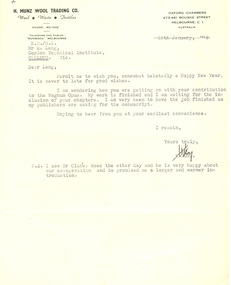
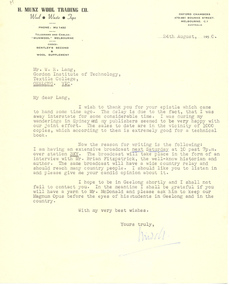
... ...H Munz Wool Trading Co Gordon Institute of Technology...Wool - research Wool Processing H Munz Wool Trading Co Gordon Institute of Technology Lang Dr W. ...Letter from H Munz to W R Lang enquiring about Mr Lang's contribution to his book.wool - research wool processing, h munz wool trading co gordon institute of technology, lang, dr w. roy munz, mr h., wool - research, wool processing -
 National Wool Museum
Letter
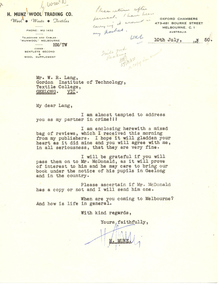
... ...H Munz Wool Trading Co Gordon Institute of Technology...Letter from H Munz to W R Lang contains seven pages of reviews for his book "The Australian Wool Industry" (Angus & Robertson, Sydney) Wool - research Wool Processing H Munz Wool Trading Co Gordon Institute of Technology Lang Dr W. ...Letter from H Munz to W R Lang contains seven pages of reviews for his book "The Australian Wool Industry" (Angus & Robertson, Sydney)Please return after perusal... Quite good/..../27/7/1950 G W McDwool - research wool processing, h munz wool trading co gordon institute of technology, lang, dr w. roy munz, mr h., wool - research, wool processing -
 National Wool Museum
Letter
... ...H Munz Wool Trading Co Gordon Institute of Technology...The Australian Wool Industry" (Angus & Robertson, Sydney,1950) Wool - research Wool Processing Merino sheep - history H Munz Wool Trading Co Gordon Institute of Technology Lang Dr W. ...Letter from H Munz to W R Lang regarding his book."The Australian Wool Industry" (Angus & Robertson, Sydney,1950)wool - research wool processing merino sheep - history, h munz wool trading co gordon institute of technology, lang, dr w. roy munz, mr h., wool - research, wool processing, merino sheep - history -
 National Wool Museum
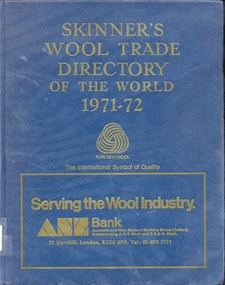
Book, Skinner's Wool Trade Directory of the World 1971-1972
... Skinner's Wool Trade Directory of the World 1971-1972..."Skinner's wool trade directory of the world 1971-1972"..."Skinner's wool trade directory of the world 1971-1972" Wool Brokering Textile Industry Textile Production Wool Processing Wool Brokering Textile Industry Textile Production Wool Processing Skinner's Wool Trade Directory of the World 1971-1972 Book ..."Skinner's wool trade directory of the world 1971-1972"wool brokering textile industry textile production wool processing, wool brokering, textile industry, textile production, wool processing -
 National Wool Museum
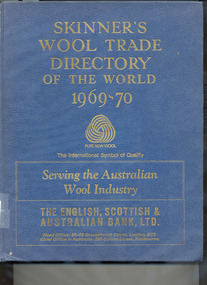
Book, Skinner's Wool Trade Directory of the World 1969-70
... Skinner's Wool Trade Directory of the World 1969-70..."Skinner's Wool Trade Directory of the World 1969-70" - Thomas Skinner & Co. ..."Skinner's Wool Trade Directory of the World 1969-70" - Thomas Skinner & Co. ..."Skinner's Wool Trade Directory of the World 1969-70" - Thomas Skinner & Co. (Publishers) Ltd, England.wool processing textile industry textile production, wool processing, textile industry, textile production -
National Wool Museum
Book, Only wool can do it
... Describes how to care for wool, the various wool trade marks and the advantages of wool....Describes how to care for wool, the various wool trade marks and the advantages of wool. Wool - characteristics Wool Marketing Australian Wool Corporation Laundering Wool - characteristics Wool Marketing Only wool can do it Book ..."Only wool can do it" - Australian Wool Corporation, c.1985. Describes how to care for wool, the various wool trade marks and the advantages of wool.wool - characteristics wool marketing, australian wool corporation, laundering, wool - characteristics, wool marketing -
 Flagstaff Hill Maritime Museum and Village
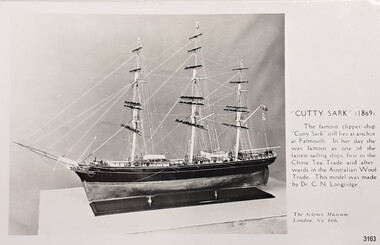
Postcard - Vessel, Sailing Ship, B Matthews (photo printer), Cutty Sark, 20t century
... wool export...China tea trade...In her day, she was famous as one of the fastest sailing ships, first in the China Tea Trade, and afterwards in the Australian Wool Trade. This model was made by Dr C.N. Longridge." ...In her day, she was famous as one of the fastest sailing ships, first in the China Tea Trade, and afterwards in the Australian Wool Trade. This model was made by Dr C.N. Longridge." ...The maker of the ship model on the postcard was Dr C Nelson Longridge (1876–1952), an English surgeon, maritime author, and builder of detailed ship models. Other models include the SS Marioness and the steam yacht Asia. He also wrote the books 'Cutty Sark' and 'The Anatomy of Nelson's Ships'. The postcard was printed by B Matthews, Bradford, England, incorporated in 1970 as B. Matthews (Photo Printers) Limited. Collections of B Matthews' photo prints of famous painted portraits are held at The National Portrait Gallery of London. Copies of B Matthews postcards are today sought after by collectors. THE CUTTY SARK: - The Cutty Sark was built in Britain in 1869 and was one of the last great sailing ships. At first, it carried tea from China. Later, it was used to transport wool from Australia. It became famous for its speed and held the record for the fastest voyage from Australia to Britain for ten years. Later, a Portuguese company bought the ship and renamed it Ferreira. After that, a retired sea captain purchased it to use as a training ship in Cornwall. When the captain died, the ship was given to a training college in Greenwich in 1938. In 1954, it was placed in dry dock at Greenwich, where it remains on display. This postcard features a photograph of a model of the sailing ship Cutty Sark, making it significant because of its connection to this well-known vessel. The famous tea clipper transported wool from Australia to markets around the world. Models such as this one help us understand what sea travel was like before steam-powered ships became widespread, while also illustrating how trade, travel and migration developed over time. Cutty Sark was also celebrated for its speed. It broke records on the voyage from Australia to Britain and held this distinction for ten years. Its importance is still recognised today, as the ship has been carefully preserved and is now displayed at the British Maritime Museum in Greenwich. Its remarkable history has also made it a popular subject for model ship enthusiasts. The postcard is also valuable because it shows a model of Cutty Sark built by the renowned C. N. Longridge, who was not only a respected surgeon but also a skilled model maker and author of detailed maritime works. A further connection is found in the printer, B Matthews, who photographed and printed collections featuring famous people, model ships and maritime scenes, adding another layer of historical interest to the postcard. Postcard, black and white, showing a model of the sailing ship Cutty Sark. Printed details are provided on both the front and back of the postcard. Inscriptions include a brief description of the Cutty Sark, the location and maker of the model, and the printer's contact information. The postcard was printed in Great Britain.FRONT: " "CUTTY SARK" (1869) The famous clipper ship "Cutty Sark" still lies at anchor at Falmouth. In her day, she was famous as one of the fastest sailing ships, first in the China Tea Trade, and afterwards in the Australian Wool Trade. This model was made by Dr C.N. Longridge." "The Science Museum, London. No. 166." REVERSE: "POSTCARD" "COMMUNICATION" "ADDRESS" "Printed by B Matthews, Bradford, England"flagstaff hill, warrnambool, flagstaff hill maritime museum, shipwreck coast, flagstaff hill maritime village, maritime museum, great ocean road, cutty sark, historic sailing ship, tea clipper, sail training vessel, cadet training ship, commercial trading vessel, cargo sail vessel, clipper races, scott and linton of dunbarton scottland, race record, ferreria, 1869, tea cargo, tea trade, china tea, wool export, australian export, australian wool export, china tea trade, cornwall, training ship, greenwich, british museum, ship model, craft, hobby, ship model cutty sark, model making, postcard, c nelson longridge, charles nelson longridge, b matthews, photo printer, b matthews bradford england, b matthews (photo printer ) ltd. -
 Warrnambool Art Gallery
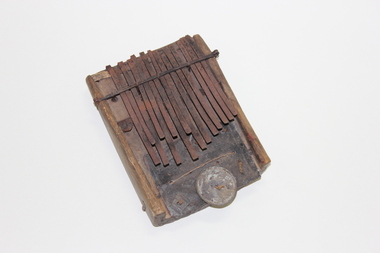
African thumb piano, mid to late 1800s
... Dallimore was brought up at Lake Gillear, and as a young man he left Australia to travel overseas both to help his parent's business in the wool trade and for pleasure. He wrote many letters to his parents keeping them updated with the prices he received from selling wool and on his travels. ...Dallimore was brought up at Lake Gillear, and as a young man he left Australia to travel overseas both to help his parent's business in the wool trade and for pleasure. He wrote many letters to his parents keeping them updated with the prices he received from selling wool and on his travels. ...This item was donated to the museum by Joseph Dallimore. Dallimore was brought up at Lake Gillear, and as a young man he left Australia to travel overseas both to help his parent's business in the wool trade and for pleasure. He wrote many letters to his parents keeping them updated with the prices he received from selling wool and on his travels. Later in life Dallimore enlisted in the Australian Army and went on to have a distinguished career during the Boer War. He would have collected this piano whilst on service in South Africa.South African thumb piano from the Zulu culture. It is a wooden panel board with 15 iron finger keys in it. They are stuck onto the wood at one end with some sort of glue and also held in place by an iron rod passing over the top of them. At the bottom of the board is a metal panel and attached to that is a small circular cymbal. There is a string tying the metal panel to the wooden board.There are no original markings on this although the original museum label is still stuck to the bottom which says, ' Native piano ( Mashona)' on it in script.south africa, joseph dallimore. war, boer war, zulu, finger piano, music -
 Glenelg Shire Council Cultural Collection
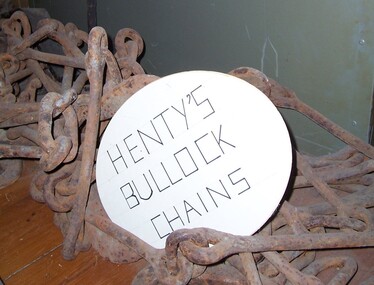
Functional object - Chains - bullock harness, n.d
... The Henty family are known as Victoria's earliest European settlers and pastoralists, emigrant squatters who played a defining role in the establishment of Portland and the development of the region's wool trade. Facing challenges as a farmer in early 19th-century England, West Sussex grazier Thomas Henty (1775–1839) turned his sights south to the colonies, where he believed his seven sons would have a brighter future as sheep breeders and wool producers. ...The Henty family are known as Victoria's earliest European settlers and pastoralists, emigrant squatters who played a defining role in the establishment of Portland and the development of the region's wool trade. Facing challenges as a farmer in early 19th-century England, West Sussex grazier Thomas Henty (1775–1839) turned his sights south to the colonies, where he believed his seven sons would have a brighter future as sheep breeders and wool producers. ...Thought to be the chains used for the Henty's bullock harness. The Henty family are known as Victoria's earliest European settlers and pastoralists, emigrant squatters who played a defining role in the establishment of Portland and the development of the region's wool trade. Facing challenges as a farmer in early 19th-century England, West Sussex grazier Thomas Henty (1775–1839) turned his sights south to the colonies, where he believed his seven sons would have a brighter future as sheep breeders and wool producers. He had been the first to introduce merino to the south of England, and would do so in the colonies also.Thought to be the chains used for the Henty's bullock harness.Iron chains with fittings for bullock harnesses.farming, rural industry, henty, bullock, chains -
 National Wool Museum
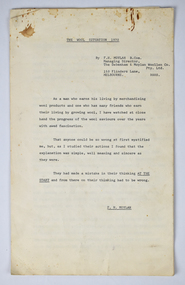
Archive - Report, Fred Moylan, The Wool Situation, 1970
... Moylan Woollens initial main focus was in the wholesale wool trade. In 1958-1959 the business diversified into angora farming and distribution. ...Moylan Woollens initial main focus was in the wholesale wool trade. In 1958-1959 the business diversified into angora farming and distribution. ...Fred Moylan OAM born in Melbourne 1923, founded Moylan Woolen in 1950, at the beginning of an extended period of prosperity for the Australian wool industry. Moylan Woollens initial main focus was in the wholesale wool trade. In 1958-1959 the business diversified into angora farming and distribution. In 1967 the company merged with Debenhams Australia to form Debenham and Moylan Woollen Co Pty Ltd, later in 1980 the company was sold to Richard Allen. Moylan was a key business figure in the formation of the Australian Wool Bureau and Woolmark. He was awared the Member of the Order of Australia in 1997 for his contribution to the Australian and international wool industry. Source: Publication Moylan Woollens produced by the RMIT University Textile Resource Centre. Seven page single sided printed report with black typed text on cream paper.THE WOOL SITUATION 1970 / By F. H. MOYLAN B. Com. / Managing Director, / The Debenham & Moylan Woollen Co. / Pty. Ltd. / 153 Flinders Lane, / MELBOURNE. / 3000.frederick moylan, the debenham & moylan woollen co. pty. ltd, report, wool, industry -
National Wool Museum
Book, World trade in wool and wool textiles 1952-1963
... World trade in wool and wool textiles 1952-1963...Trade - International Textile Industry Wool Sales..."World trade in wool and wool textiles 1952-1963" - Commonwealth Economic Committee....Trade - International Textile Industry Wool Sales Commonwealth Economic Committee Trade - International Textile Industry Wool Sales World trade in wool and wool textiles 1952-1963 Book ..."World trade in wool and wool textiles 1952-1963" - Commonwealth Economic Committee.trade - international textile industry wool sales, commonwealth economic committee, trade - international, textile industry, wool sales -
 National Wool Museum
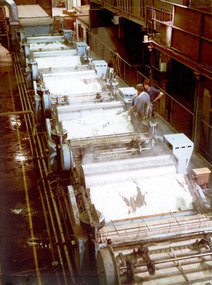
Photograph - Wool Scouring, Port Phillip Mills, Williamstown, 1984
... Victoria Wool Processors (Aust) Pty Ltd was founded by Jim Kim in 1983 as a dedicated international wool trading firm. Seeking greater quality control, the company opened its first physical processing plant in Melbourne in 1990 before scaling up to a state-of-the-art, 24-hour carbonising and scouring facility at Laverton North in 2002. ...Victoria Wool Processors (Aust) Pty Ltd was founded by Jim Kim in 1983 as a dedicated international wool trading firm. Seeking greater quality control, the company opened its first physical processing plant in Melbourne in 1990 before scaling up to a state-of-the-art, 24-hour carbonising and scouring facility at Laverton North in 2002. ...Part of a collection of photographs previously housed at Victorian Wool Processors (VWP), who were the last early stage wool processing company in Melbourne, and the second last in Victoria. The photographs were collected from other companies as they closed, and were donated to the museum by David Ritchie who was the General Manager at VWP. Victoria Wool Processors (Aust) Pty Ltd was founded by Jim Kim in 1983 as a dedicated international wool trading firm. Seeking greater quality control, the company opened its first physical processing plant in Melbourne in 1990 before scaling up to a state-of-the-art, 24-hour carbonising and scouring facility at Laverton North in 2002. For decades, it stood as one of the largest early-stage wool processing operations in the Southern Hemisphere, known for incorporating modern water-recycling and waste-management infrastructure. However, a severe domestic energy crisis and soaring natural gas prices forced the permanent closure of its manufacturing plant in December 2024, culminating in the company's official corporate liquidation in April 2026. This photo was previously in a frame with three others taken in 1984 at the Port Phillip Mills in Williamstown. This image shows the wool scouring process.Colour photograph showing industrial wool processing machinery from a high angle during the wool scouring process. Two men are shown stading beside the machinery.victorian wool processors, early wool processing, textile industry, jim kim, topmaking, port phillip topmaking pty ltd, williamstown, pressing, carding, combing, wool scouring -
 National Wool Museum
Photograph - Combing, Port Phillip Mills, Williamstown, 1984
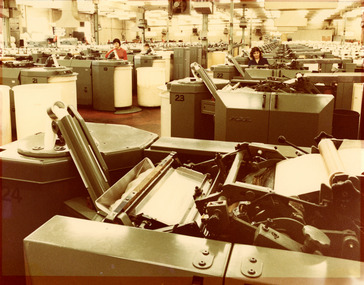
... Victoria Wool Processors (Aust) Pty Ltd was founded by Jim Kim in 1983 as a dedicated international wool trading firm. Seeking greater quality control, the company opened its first physical processing plant in Melbourne in 1990 before scaling up to a state-of-the-art, 24-hour carbonising and scouring facility at Laverton North in 2002. ...Victoria Wool Processors (Aust) Pty Ltd was founded by Jim Kim in 1983 as a dedicated international wool trading firm. Seeking greater quality control, the company opened its first physical processing plant in Melbourne in 1990 before scaling up to a state-of-the-art, 24-hour carbonising and scouring facility at Laverton North in 2002. ...Part of a collection of photographs previously housed at Victorian Wool Processors (VWP), who were the last early stage wool processing company in Melbourne, and the second last in Victoria. The photographs were collected from other companies as they closed, and were donated to the museum by David Ritchie who was the General Manager at VWP. Victoria Wool Processors (Aust) Pty Ltd was founded by Jim Kim in 1983 as a dedicated international wool trading firm. Seeking greater quality control, the company opened its first physical processing plant in Melbourne in 1990 before scaling up to a state-of-the-art, 24-hour carbonising and scouring facility at Laverton North in 2002. For decades, it stood as one of the largest early-stage wool processing operations in the Southern Hemisphere, known for incorporating modern water-recycling and waste-management infrastructure. However, a severe domestic energy crisis and soaring natural gas prices forced the permanent closure of its manufacturing plant in December 2024, culminating in the company's official corporate liquidation in April 2026. This photo was previously in a frame with three others taken in 1984 at the Port Phillip Mills in Williamstown. This image shows the combing process.Colour photograph showing industrial wool processing machinery during the combing process. Two women are shown in the background operating machinery.victorian wool processors, early wool processing, textile industry, jim kim, topmaking, port phillip topmaking pty ltd, williamstown, pressing, carding, combing -
 National Wool Museum
Photograph - Carding, Port Phillip Mills, Williamstown, 1984
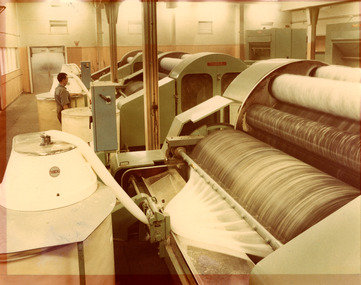
... Victoria Wool Processors (Aust) Pty Ltd was founded by Jim Kim in 1983 as a dedicated international wool trading firm. Seeking greater quality control, the company opened its first physical processing plant in Melbourne in 1990 before scaling up to a state-of-the-art, 24-hour carbonising and scouring facility at Laverton North in 2002. ...Victoria Wool Processors (Aust) Pty Ltd was founded by Jim Kim in 1983 as a dedicated international wool trading firm. Seeking greater quality control, the company opened its first physical processing plant in Melbourne in 1990 before scaling up to a state-of-the-art, 24-hour carbonising and scouring facility at Laverton North in 2002. ...Part of a collection of photographs previously housed at Victorian Wool Processors (VWP), who were the last early stage wool processing company in Melbourne, and the second last in Victoria. The photographs were collected from other companies as they closed, and were donated to the museum by David Ritchie who was the General Manager at VWP. Victoria Wool Processors (Aust) Pty Ltd was founded by Jim Kim in 1983 as a dedicated international wool trading firm. Seeking greater quality control, the company opened its first physical processing plant in Melbourne in 1990 before scaling up to a state-of-the-art, 24-hour carbonising and scouring facility at Laverton North in 2002. For decades, it stood as one of the largest early-stage wool processing operations in the Southern Hemisphere, known for incorporating modern water-recycling and waste-management infrastructure. However, a severe domestic energy crisis and soaring natural gas prices forced the permanent closure of its manufacturing plant in December 2024, culminating in the company's official corporate liquidation in April 2026. This photo was previously in a frame with three others taken in 1984 at the Port Phillip Mills in Williamstown. This image shows the carding process.Colour photograph showing industrial wool processing machinery during the carding process. A man is shown in the background standing near machinery.victorian wool processors, early wool processing, textile industry, jim kim, topmaking, port phillip topmaking pty ltd, williamstown, pressing, carding, combing -
 National Wool Museum
Photograph - Automatic Card Feeding, Port Phillip Topmaking, 1990
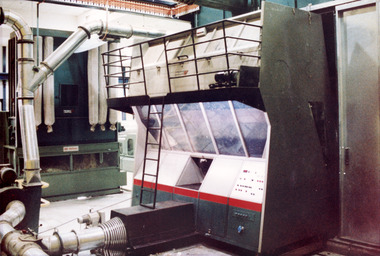
... Victoria Wool Processors (Aust) Pty Ltd was founded by Jim Kim in 1983 as a dedicated international wool trading firm. Seeking greater quality control, the company opened its first physical processing plant in Melbourne in 1990 before scaling up to a state-of-the-art, 24-hour carbonising and scouring facility at Laverton North in 2002. ...Victoria Wool Processors (Aust) Pty Ltd was founded by Jim Kim in 1983 as a dedicated international wool trading firm. Seeking greater quality control, the company opened its first physical processing plant in Melbourne in 1990 before scaling up to a state-of-the-art, 24-hour carbonising and scouring facility at Laverton North in 2002. ...Part of a collection of photographs previously housed at Victorian Wool Processors (VWP), who were the last early stage wool processing company in Melbourne, and the second last in Victoria. The photographs were collected from other companies as they closed, and were donated to the museum by David Ritchie who was the General Manager at VWP. Victoria Wool Processors (Aust) Pty Ltd was founded by Jim Kim in 1983 as a dedicated international wool trading firm. Seeking greater quality control, the company opened its first physical processing plant in Melbourne in 1990 before scaling up to a state-of-the-art, 24-hour carbonising and scouring facility at Laverton North in 2002. For decades, it stood as one of the largest early-stage wool processing operations in the Southern Hemisphere, known for incorporating modern water-recycling and waste-management infrastructure. However, a severe domestic energy crisis and soaring natural gas prices forced the permanent closure of its manufacturing plant in December 2024, culminating in the company's official corporate liquidation in April 2026. This photo was previously in a frame with three others taken in 1990 at the modernised facility in Williamstown operated by Port Phillip Topmaking Pty Ltd. This image shows the automatic card feeding process.Colour photograph showing industrial wool processing machinery during the automatic card feeding process.victorian wool processors, early wool processing, textile industry, jim kim, topmaking, port phillip topmaking pty ltd, williamstown, pressing -
 National Wool Museum
Photograph - Combing, Port Phillip Topmaking, 1990
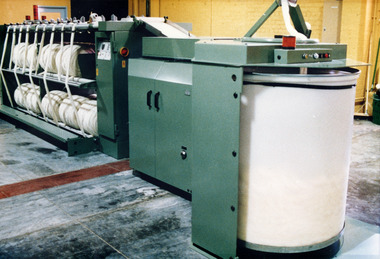
... Victoria Wool Processors (Aust) Pty Ltd was founded by Jim Kim in 1983 as a dedicated international wool trading firm. Seeking greater quality control, the company opened its first physical processing plant in Melbourne in 1990 before scaling up to a state-of-the-art, 24-hour carbonising and scouring facility at Laverton North in 2002. ...Victoria Wool Processors (Aust) Pty Ltd was founded by Jim Kim in 1983 as a dedicated international wool trading firm. Seeking greater quality control, the company opened its first physical processing plant in Melbourne in 1990 before scaling up to a state-of-the-art, 24-hour carbonising and scouring facility at Laverton North in 2002. ...Part of a collection of photographs previously housed at Victorian Wool Processors (VWP), who were the last early stage wool processing company in Melbourne, and the second last in Victoria. The photographs were collected from other companies as they closed, and were donated to the museum by David Ritchie who was the General Manager at VWP. Victoria Wool Processors (Aust) Pty Ltd was founded by Jim Kim in 1983 as a dedicated international wool trading firm. Seeking greater quality control, the company opened its first physical processing plant in Melbourne in 1990 before scaling up to a state-of-the-art, 24-hour carbonising and scouring facility at Laverton North in 2002. For decades, it stood as one of the largest early-stage wool processing operations in the Southern Hemisphere, known for incorporating modern water-recycling and waste-management infrastructure. However, a severe domestic energy crisis and soaring natural gas prices forced the permanent closure of its manufacturing plant in December 2024, culminating in the company's official corporate liquidation in April 2026. This photo was previously in a frame with three others taken in 1990 at the modernised facility in Williamstown operated by Port Phillip Topmaking Pty Ltd. This image shows the combing process.Colour photograph showing industrial wool processing machinery during the combing process.victorian wool processors, early wool processing, textile industry, jim kim, topmaking, port phillip topmaking pty ltd, williamstown, combing -
 National Wool Museum
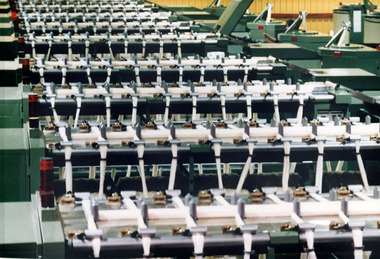
Photograph - Combing, Port Phillip Topmaking, 1990
... Victoria Wool Processors (Aust) Pty Ltd was founded by Jim Kim in 1983 as a dedicated international wool trading firm. Seeking greater quality control, the company opened its first physical processing plant in Melbourne in 1990 before scaling up to a state-of-the-art, 24-hour carbonising and scouring facility at Laverton North in 2002. ...Victoria Wool Processors (Aust) Pty Ltd was founded by Jim Kim in 1983 as a dedicated international wool trading firm. Seeking greater quality control, the company opened its first physical processing plant in Melbourne in 1990 before scaling up to a state-of-the-art, 24-hour carbonising and scouring facility at Laverton North in 2002. ...Part of a collection of photographs previously housed at Victorian Wool Processors (VWP), who were the last early stage wool processing company in Melbourne, and the second last in Victoria. The photographs were collected from other companies as they closed, and were donated to the museum by David Ritchie who was the General Manager at VWP. Victoria Wool Processors (Aust) Pty Ltd was founded by Jim Kim in 1983 as a dedicated international wool trading firm. Seeking greater quality control, the company opened its first physical processing plant in Melbourne in 1990 before scaling up to a state-of-the-art, 24-hour carbonising and scouring facility at Laverton North in 2002. For decades, it stood as one of the largest early-stage wool processing operations in the Southern Hemisphere, known for incorporating modern water-recycling and waste-management infrastructure. However, a severe domestic energy crisis and soaring natural gas prices forced the permanent closure of its manufacturing plant in December 2024, culminating in the company's official corporate liquidation in April 2026. This photo was previously in a frame with three others taken in 1990 at the modernised facility in Williamstown operated by Port Phillip Topmaking Pty Ltd. This image shows the combing process.Colour photograph showing industrial wool processing machinery during the combing process.victorian wool processors, early wool processing, textile industry, jim kim, topmaking, port phillip topmaking pty ltd, williamstown, combing -
 National Wool Museum
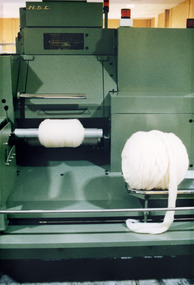
Photograph - Finishing, Port Phillip Topmaking, 1990
... Victoria Wool Processors (Aust) Pty Ltd was founded by Jim Kim in 1983 as a dedicated international wool trading firm. Seeking greater quality control, the company opened its first physical processing plant in Melbourne in 1990 before scaling up to a state-of-the-art, 24-hour carbonising and scouring facility at Laverton North in 2002. ...Victoria Wool Processors (Aust) Pty Ltd was founded by Jim Kim in 1983 as a dedicated international wool trading firm. Seeking greater quality control, the company opened its first physical processing plant in Melbourne in 1990 before scaling up to a state-of-the-art, 24-hour carbonising and scouring facility at Laverton North in 2002. ...Part of a collection of photographs previously housed at Victorian Wool Processors (VWP), who were the last early stage wool processing company in Melbourne, and the second last in Victoria. The photographs were collected from other companies as they closed, and were donated to the museum by David Ritchie who was the General Manager at VWP. Victoria Wool Processors (Aust) Pty Ltd was founded by Jim Kim in 1983 as a dedicated international wool trading firm. Seeking greater quality control, the company opened its first physical processing plant in Melbourne in 1990 before scaling up to a state-of-the-art, 24-hour carbonising and scouring facility at Laverton North in 2002. For decades, it stood as one of the largest early-stage wool processing operations in the Southern Hemisphere, known for incorporating modern water-recycling and waste-management infrastructure. However, a severe domestic energy crisis and soaring natural gas prices forced the permanent closure of its manufacturing plant in December 2024, culminating in the company's official corporate liquidation in April 2026. This photo was previously in a frame with three others taken in 1990 at the modernised facility in Williamstown operated by Port Phillip Topmaking Pty Ltd. This image shows the finishing process.Colour photograph showing industrial wool processing machinery during the finishing processvictorian wool processors, early wool processing, textile industry, jim kim, topmaking, port phillip topmaking pty ltd, williamstown, finishing -
 National Wool Museum
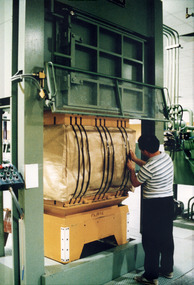
Photograph - Pressing, Port Phillip Topmaking, 1990
... Victoria Wool Processors (Aust) Pty Ltd was founded by Jim Kim in 1983 as a dedicated international wool trading firm. Seeking greater quality control, the company opened its first physical processing plant in Melbourne in 1990 before scaling up to a state-of-the-art, 24-hour carbonising and scouring facility at Laverton North in 2002. ...Victoria Wool Processors (Aust) Pty Ltd was founded by Jim Kim in 1983 as a dedicated international wool trading firm. Seeking greater quality control, the company opened its first physical processing plant in Melbourne in 1990 before scaling up to a state-of-the-art, 24-hour carbonising and scouring facility at Laverton North in 2002. ...Part of a collection of photographs previously housed at Victorian Wool Processors (VWP), who were the last early stage wool processing company in Melbourne, and the second last in Victoria. The photographs were collected from other companies as they closed, and were donated to the museum by David Ritchie who was the General Manager at VWP. Victoria Wool Processors (Aust) Pty Ltd was founded by Jim Kim in 1983 as a dedicated international wool trading firm. Seeking greater quality control, the company opened its first physical processing plant in Melbourne in 1990 before scaling up to a state-of-the-art, 24-hour carbonising and scouring facility at Laverton North in 2002. For decades, it stood as one of the largest early-stage wool processing operations in the Southern Hemisphere, known for incorporating modern water-recycling and waste-management infrastructure. However, a severe domestic energy crisis and soaring natural gas prices forced the permanent closure of its manufacturing plant in December 2024, culminating in the company's official corporate liquidation in April 2026. This photo was previously in a frame with three others taken in 1990 at the modernised facility in Williamstown operated by Port Phillip Topmaking Pty Ltd. This image shows the pressing process.Colour photograph showing industrial wool processing machinery during the pressing process.victorian wool processors, early wool processing, textile industry, jim kim, topmaking, port phillip topmaking pty ltd, williamstown, pressing -
 National Wool Museum
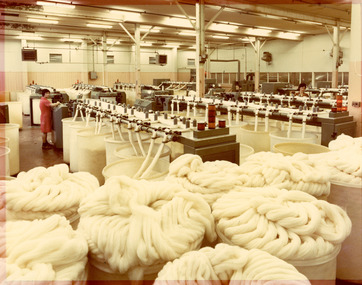
Photograph - Combing and Finishing, Port Phillip Mills, Williamstown, 1984
... Victoria Wool Processors (Aust) Pty Ltd was founded by Jim Kim in 1983 as a dedicated international wool trading firm. Seeking greater quality control, the company opened its first physical processing plant in Melbourne in 1990 before scaling up to a state-of-the-art, 24-hour carbonising and scouring facility at Laverton North in 2002. ...Victoria Wool Processors (Aust) Pty Ltd was founded by Jim Kim in 1983 as a dedicated international wool trading firm. Seeking greater quality control, the company opened its first physical processing plant in Melbourne in 1990 before scaling up to a state-of-the-art, 24-hour carbonising and scouring facility at Laverton North in 2002. ...Part of a collection of photographs previously housed at Victorian Wool Processors (VWP), who were the last early stage wool processing company in Melbourne, and the second last in Victoria. The photographs were collected from other companies as they closed, and were donated to the museum by David Ritchie who was the General Manager at VWP. Victoria Wool Processors (Aust) Pty Ltd was founded by Jim Kim in 1983 as a dedicated international wool trading firm. Seeking greater quality control, the company opened its first physical processing plant in Melbourne in 1990 before scaling up to a state-of-the-art, 24-hour carbonising and scouring facility at Laverton North in 2002. For decades, it stood as one of the largest early-stage wool processing operations in the Southern Hemisphere, known for incorporating modern water-recycling and waste-management infrastructure. However, a severe domestic energy crisis and soaring natural gas prices forced the permanent closure of its manufacturing plant in December 2024, culminating in the company's official corporate liquidation in April 2026. This photo was previously in a frame with three others taken in 1984 at the Port Phillip Mills in Williamstown. This image shows the combing and finishing process.Colour photograph showing industrial wool processing machinery during the combing and finishing process, with slivers of wool in the foreground. Two women are shown in the background operating machinery.victorian wool processors, early wool processing, textile industry, jim kim, topmaking, port phillip topmaking pty ltd, williamstown, pressing, carding, combing, wool scouring -
 National Wool Museum
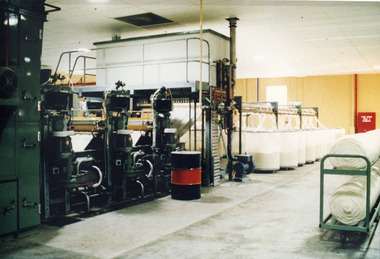
Photograph - Backwashing, Port Phillip Topmaking, 1990
... Victoria Wool Processors (Aust) Pty Ltd was founded by Jim Kim in 1983 as a dedicated international wool trading firm. Seeking greater quality control, the company opened its first physical processing plant in Melbourne in 1990 before scaling up to a state-of-the-art, 24-hour carbonising and scouring facility at Laverton North in 2002. ...Victoria Wool Processors (Aust) Pty Ltd was founded by Jim Kim in 1983 as a dedicated international wool trading firm. Seeking greater quality control, the company opened its first physical processing plant in Melbourne in 1990 before scaling up to a state-of-the-art, 24-hour carbonising and scouring facility at Laverton North in 2002. ...Part of a collection of photographs previously housed at Victorian Wool Processors (VWP), who were the last early stage wool processing company in Melbourne, and the second last in Victoria. The photographs were collected from other companies as they closed, and were donated to the museum by David Ritchie who was the General Manager at VWP. Victoria Wool Processors (Aust) Pty Ltd was founded by Jim Kim in 1983 as a dedicated international wool trading firm. Seeking greater quality control, the company opened its first physical processing plant in Melbourne in 1990 before scaling up to a state-of-the-art, 24-hour carbonising and scouring facility at Laverton North in 2002. For decades, it stood as one of the largest early-stage wool processing operations in the Southern Hemisphere, known for incorporating modern water-recycling and waste-management infrastructure. However, a severe domestic energy crisis and soaring natural gas prices forced the permanent closure of its manufacturing plant in December 2024, culminating in the company's official corporate liquidation in April 2026. This photo was previously in a frame with three others taken in 1990 at the modernised facility in Williamstown operated by Port Phillip Topmaking Pty Ltd. This image shows the backwashing process.Colour photograph showing industrial wool processing machinery during the backwashing process.victorian wool processors, early wool processing, textile industry, jim kim, topmaking, port phillip topmaking pty ltd, williamstown, pressing, backwashing -
 National Wool Museum
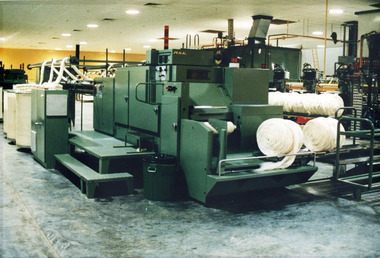
Photograph - Gilling, Port Phillip Topmaking, 1990
... Victoria Wool Processors (Aust) Pty Ltd was founded by Jim Kim in 1983 as a dedicated international wool trading firm. Seeking greater quality control, the company opened its first physical processing plant in Melbourne in 1990 before scaling up to a state-of-the-art, 24-hour carbonising and scouring facility at Laverton North in 2002. ...Victoria Wool Processors (Aust) Pty Ltd was founded by Jim Kim in 1983 as a dedicated international wool trading firm. Seeking greater quality control, the company opened its first physical processing plant in Melbourne in 1990 before scaling up to a state-of-the-art, 24-hour carbonising and scouring facility at Laverton North in 2002. ...Part of a collection of photographs previously housed at Victorian Wool Processors (VWP), who were the last early stage wool processing company in Melbourne, and the second last in Victoria. The photographs were collected from other companies as they closed, and were donated to the museum by David Ritchie who was the General Manager at VWP. Victoria Wool Processors (Aust) Pty Ltd was founded by Jim Kim in 1983 as a dedicated international wool trading firm. Seeking greater quality control, the company opened its first physical processing plant in Melbourne in 1990 before scaling up to a state-of-the-art, 24-hour carbonising and scouring facility at Laverton North in 2002. For decades, it stood as one of the largest early-stage wool processing operations in the Southern Hemisphere, known for incorporating modern water-recycling and waste-management infrastructure. However, a severe domestic energy crisis and soaring natural gas prices forced the permanent closure of its manufacturing plant in December 2024, culminating in the company's official corporate liquidation in April 2026. This photo was previously in a frame with three others taken in 1990 at the modernised facility in Williamstown operated by Port Phillip Topmaking Pty Ltd. This image shows the gilling process.Colour photograph showing industrial wool processing machinery during the gilling process.victorian wool processors, early wool processing, textile industry, jim kim, topmaking, port phillip topmaking pty ltd, williamstown, pressing, gilling -
 National Wool Museum
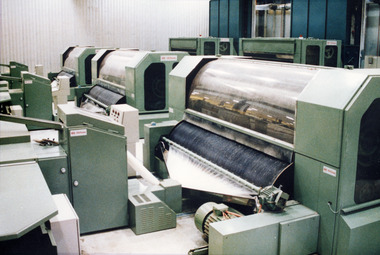
Photograph - Carding, Port Phillip Topmaking, 1990
... Victoria Wool Processors (Aust) Pty Ltd was founded by Jim Kim in 1983 as a dedicated international wool trading firm. Seeking greater quality control, the company opened its first physical processing plant in Melbourne in 1990 before scaling up to a state-of-the-art, 24-hour carbonising and scouring facility at Laverton North in 2002. ...Victoria Wool Processors (Aust) Pty Ltd was founded by Jim Kim in 1983 as a dedicated international wool trading firm. Seeking greater quality control, the company opened its first physical processing plant in Melbourne in 1990 before scaling up to a state-of-the-art, 24-hour carbonising and scouring facility at Laverton North in 2002. ...Part of a collection of photographs previously housed at Victorian Wool Processors (VWP), who were the last early stage wool processing company in Melbourne, and the second last in Victoria. The photographs were collected from other companies as they closed, and were donated to the museum by David Ritchie who was the General Manager at VWP. Victoria Wool Processors (Aust) Pty Ltd was founded by Jim Kim in 1983 as a dedicated international wool trading firm. Seeking greater quality control, the company opened its first physical processing plant in Melbourne in 1990 before scaling up to a state-of-the-art, 24-hour carbonising and scouring facility at Laverton North in 2002. For decades, it stood as one of the largest early-stage wool processing operations in the Southern Hemisphere, known for incorporating modern water-recycling and waste-management infrastructure. However, a severe domestic energy crisis and soaring natural gas prices forced the permanent closure of its manufacturing plant in December 2024, culminating in the company's official corporate liquidation in April 2026. This photo was previously in a frame with three others taken in 1990 at the modernised facility in Williamstown operated by Port Phillip Topmaking Pty Ltd. This image shows the carding process.Colour photograph showing industrial wool processing machinery during the carding process.victorian wool processors, early wool processing, textile industry, jim kim, topmaking, port phillip topmaking pty ltd, williamstown, pressing, carding -
 National Wool Museum
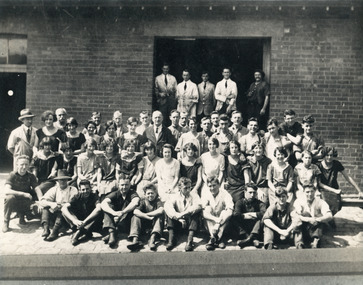
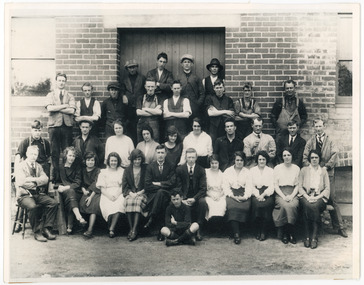
Photograph - Staff Portrait, Port Phillip Mills, 1926
... Victoria Wool Processors (Aust) Pty Ltd was founded by Jim Kim in 1983 as a dedicated international wool trading firm. Seeking greater quality control, the company opened its first physical processing plant in Melbourne in 1990 before scaling up to a state-of-the-art, 24-hour carbonising and scouring facility at Laverton North in 2002. ...Victoria Wool Processors (Aust) Pty Ltd was founded by Jim Kim in 1983 as a dedicated international wool trading firm. Seeking greater quality control, the company opened its first physical processing plant in Melbourne in 1990 before scaling up to a state-of-the-art, 24-hour carbonising and scouring facility at Laverton North in 2002. ...Part of a collection of photographs previously housed at Victorian Wool Processors (VWP), who were the last early stage wool processing company in Melbourne, and the second last in Victoria. The photographs were collected from other companies as they closed, and were donated to the museum by David Ritchie who was the General Manager at VWP. Victoria Wool Processors (Aust) Pty Ltd was founded by Jim Kim in 1983 as a dedicated international wool trading firm. Seeking greater quality control, the company opened its first physical processing plant in Melbourne in 1990 before scaling up to a state-of-the-art, 24-hour carbonising and scouring facility at Laverton North in 2002. For decades, it stood as one of the largest early-stage wool processing operations in the Southern Hemisphere, known for incorporating modern water-recycling and waste-management infrastructure. However, a severe domestic energy crisis and soaring natural gas prices forced the permanent closure of its manufacturing plant in December 2024, culminating in the company's official corporate liquidation in April 2026. This photo was previously in a frame with seven other black and white photographs showing staff associated with the Port Phillip Mills. This photo shows a staff portrait taken in 1926.Black and white photograph showing a group of men and women seated and standing for a staff portrait against a brick wall.Back: [handwritten] 1926 / D5 / Goking(?) / Malcolm (?) / Chas Mills / Smelan(?) Burs(?) / Geoff Smith / Jack Austin / Bob Walker / Jed (?) Van(?) / Hammond (?)victorian wool processors, early wool processing, textile industry, jim kim, topmaking, port phillip topmaking pty ltd, williamstown, pressing, carding, combing, wool scouring, footscray, wool sorting -
 National Wool Museum
Photograph - Staff Portrait, Port Phillip Mills, 1923
... Victoria Wool Processors (Aust) Pty Ltd was founded by Jim Kim in 1983 as a dedicated international wool trading firm. Seeking greater quality control, the company opened its first physical processing plant in Melbourne in 1990 before scaling up to a state-of-the-art, 24-hour carbonising and scouring facility at Laverton North in 2002. ...Victoria Wool Processors (Aust) Pty Ltd was founded by Jim Kim in 1983 as a dedicated international wool trading firm. Seeking greater quality control, the company opened its first physical processing plant in Melbourne in 1990 before scaling up to a state-of-the-art, 24-hour carbonising and scouring facility at Laverton North in 2002. ...Part of a collection of photographs previously housed at Victorian Wool Processors (VWP), who were the last early stage wool processing company in Melbourne, and the second last in Victoria. The photographs were collected from other companies as they closed, and were donated to the museum by David Ritchie who was the General Manager at VWP. Victoria Wool Processors (Aust) Pty Ltd was founded by Jim Kim in 1983 as a dedicated international wool trading firm. Seeking greater quality control, the company opened its first physical processing plant in Melbourne in 1990 before scaling up to a state-of-the-art, 24-hour carbonising and scouring facility at Laverton North in 2002. For decades, it stood as one of the largest early-stage wool processing operations in the Southern Hemisphere, known for incorporating modern water-recycling and waste-management infrastructure. However, a severe domestic energy crisis and soaring natural gas prices forced the permanent closure of its manufacturing plant in December 2024, culminating in the company's official corporate liquidation in April 2026. This photo was previously in a frame with seven other black and white photographs showing staff associated with the Port Phillip Mills. This photo shows a staff portrait taken in 1923.Black and white photograph showing a group of men and women seated and standing for a staff portrait against a brick wall.Back: [handwritten] D4victorian wool processors, early wool processing, textile industry, jim kim, topmaking, port phillip topmaking pty ltd, williamstown, pressing, carding, combing, wool scouring, footscray, wool sorting -
 National Wool Museum
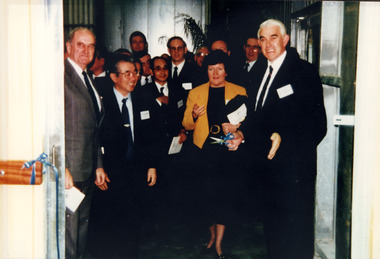
Photograph - Opening Day, Port Phillip Topmaking, 18 June 1990
... Victoria Wool Processors (Aust) Pty Ltd was founded by Jim Kim in 1983 as a dedicated international wool trading firm. Seeking greater quality control, the company opened its first physical processing plant in Melbourne in 1990 before scaling up to a state-of-the-art, 24-hour carbonising and scouring facility at Laverton North in 2002. ...Victoria Wool Processors (Aust) Pty Ltd was founded by Jim Kim in 1983 as a dedicated international wool trading firm. Seeking greater quality control, the company opened its first physical processing plant in Melbourne in 1990 before scaling up to a state-of-the-art, 24-hour carbonising and scouring facility at Laverton North in 2002. ...Part of a collection of photographs previously housed at Victorian Wool Processors (VWP), who were the last early stage wool processing company in Melbourne, and the second last in Victoria. The photographs were collected from other companies as they closed, and were donated to the museum by David Ritchie who was the General Manager at VWP. Victoria Wool Processors (Aust) Pty Ltd was founded by Jim Kim in 1983 as a dedicated international wool trading firm. Seeking greater quality control, the company opened its first physical processing plant in Melbourne in 1990 before scaling up to a state-of-the-art, 24-hour carbonising and scouring facility at Laverton North in 2002. For decades, it stood as one of the largest early-stage wool processing operations in the Southern Hemisphere, known for incorporating modern water-recycling and waste-management infrastructure. However, a severe domestic energy crisis and soaring natural gas prices forced the permanent closure of its manufacturing plant in December 2024, culminating in the company's official corporate liquidation in April 2026. This photo was previously in a frame with four others taken at the opening day of the modernized facility in Williamstown operated by Port Phillip Topmaking Pty Ltd on 18th June, 1990. Two of the people depicted are John Kerin, MP and Joan Kirner.Colour photograph featuring a group of men and one woman, one of the men is holding a pair of scissors.victorian wool processors, early wool processing, textile industry, jim kim, topmaking, port phillip topmaking pty ltd, john kerin
