
Showing 5 items matching "world war 1939-1945 - battleships"
-
 Monbulk RSL Sub Branch
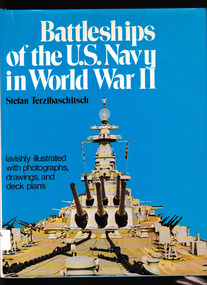
Book, Brassey's, Battleships of the U.S. Navy in World War II, 1977
... ...World War 1939-1945 - Battleships...Battleships - History World War 1939-1945 - Battleships This book details the most powerful weapon of all time - The US battleship of World War Two Ill, index, p.174. ...This book details the most powerful weapon of all time - The US battleship of World War TwoIll, index, p.174.non-fictionThis book details the most powerful weapon of all time - The US battleship of World War Twobattleships - history, world war 1939-1945 - battleships -
 Ringwood and District Historical Society
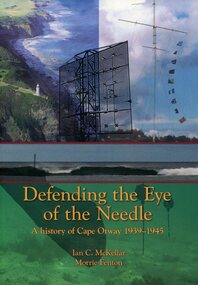
Book, Defending the Eye of the Needle - A History of Cape Otway 1939-1945 - Ian C. McKellar, Morrie Fenton, 2007
... battleships of the American White fleet in 1908 and, from time to time, cruiser squadrons of the Royal Navy, showing the flag at the furthest corner of the Empire. The lighthouse and its associated signal station made no distinction between merchant vessel and warship. In this book Ian McKellar examines a little known aspect of the history of Cape Otway - its role in war, more particularly the Second World War between 1939 and 1945...battleships of the American White fleet in 1908 and, from time to time, cruiser squadrons of the Royal Navy, showing the flag at the furthest corner of the Empire. The lighthouse and its associated signal station made no distinction between merchant vessel and warship. In this book Ian McKellar examines a little known aspect of the history of Cape Otway - its role in war, more particularly the Second World War between 1939 and 1945 ...Soft covered 195-page book with sketches, photographs and charts.Foreword extract: "In 1848 the vital beam of the nobly proportioned Cape Otway lighthouse first shone out over the perilous, previously unlit, waters of Bass Strait. It has now maintained that watch over its narrow western entrance, the aptly named 'Eye of the Needle', for over a century and a half. During that time ships of all shapes and sizes passed below Cape Otway's high cliffs - clipper ships with a hectare of canvas aloft, their masters determined to achieve the fastest passage out to the goldfields, four-masted grain ships and, by the turn of the century, the punctual, comfortable, Orient liners. They were followed by the battleships of the American White fleet in 1908 and, from time to time, cruiser squadrons of the Royal Navy, showing the flag at the furthest corner of the Empire. The lighthouse and its associated signal station made no distinction between merchant vessel and warship. In this book Ian McKellar examines a little known aspect of the history of Cape Otway - its role in war, more particularly the Second World War between 1939 and 1945. It takes the reader back to a time when Australia was ill-prepared for another war so soon after the conclusion of the Great War." -
 Monbulk RSL Sub Branch
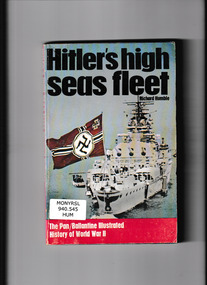
Book, Pan Books, Hitlers high seas fleet, 1971
... World War 1939-1945 - Naval operations - Germany...Battleships...World War 1939-1945 - Naval operations - Germany Battleships - Germany A history of the Kriegsmarine in World War Two Ill, p.159. ...A history of the Kriegsmarine in World War TwoIll, p.159.non-fictionA history of the Kriegsmarine in World War Twoworld war 1939-1945 - naval operations - germany, battleships - germany -
 Monbulk RSL Sub Branch
Book, Faber and Faber, The Bismarck Episode, 1958
... World War 1939-1945 - Naval operations - Britain...Bismarck - Battleship...World War 1939-1945 - Naval operations - Britain Bismarck - Battleship The British Navy's sinking of a notorious symbol of Nazi Germany, the battleship Bismarck, in May 1941 ranks as one of the most significant victories of the Second World War. ...The British Navy's sinking of a notorious symbol of Nazi Germany, the battleship Bismarck, in May 1941 ranks as one of the most significant victories of the Second World War. It was imperative that Britain find and destroy the Bismarck, a true threat to Britains ocean lifeline, before it could escape into the Atlantic. In The Bismarck Episode a veteran naval writer tells the intense and dramatic story of how the battleship was discovered, pursued, and ultimately destroyed.Index, ill, maps, p.219.non-fictionThe British Navy's sinking of a notorious symbol of Nazi Germany, the battleship Bismarck, in May 1941 ranks as one of the most significant victories of the Second World War. It was imperative that Britain find and destroy the Bismarck, a true threat to Britains ocean lifeline, before it could escape into the Atlantic. In The Bismarck Episode a veteran naval writer tells the intense and dramatic story of how the battleship was discovered, pursued, and ultimately destroyed. world war 1939-1945 - naval operations - britain, bismarck - battleship -
 Monbulk RSL Sub Branch
Book, Richard Hough, The hunting of Force Z : the brief, controversial life of the modern battleship, and its tragic close with the destruction of the 'Prince of Wales' and 'Repulse', 1963
... World War 1939-1945 - Naval operations - Britain World war 1939 – 1945 – Campaigns – Malaya This book is a terrific example of popular military history writing, telling in swift prose the story of the sinking of HMS Prince of Wales and HMS Repulse by the Japanese in December 1942, and providing both the longer term context in which Britain had developed its fleet of battleships and battlecruisers, and the shorter term strategic and tactical decisions which led to the fateful decision to dispatch Force Z to Singapore. ...This book is a terrific example of popular military history writing, telling in swift prose the story of the sinking of HMS Prince of Wales and HMS Repulse by the Japanese in December 1942, and providing both the longer term context in which Britain had developed its fleet of battleships and battlecruisers, and the shorter term strategic and tactical decisions which led to the fateful decision to dispatch Force Z to Singapore.Index, ill, maps, p.255.non-fictionThis book is a terrific example of popular military history writing, telling in swift prose the story of the sinking of HMS Prince of Wales and HMS Repulse by the Japanese in December 1942, and providing both the longer term context in which Britain had developed its fleet of battleships and battlecruisers, and the shorter term strategic and tactical decisions which led to the fateful decision to dispatch Force Z to Singapore. world war 1939-1945 - naval operations - britain, world war 1939 – 1945 – campaigns – malaya
