
Showing 16 items matching "world war ii security"
-
 Orbost & District Historical Society
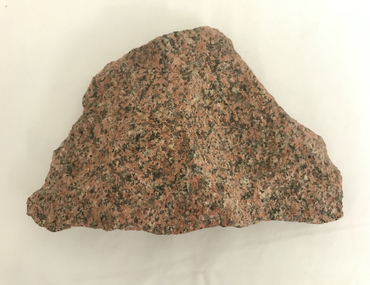
Geological specimen - piece of pink granite rock from Gabo Island, East Gippsland Victoria
... ...World War II security...This item is significant because it is a piece of granite similar to that used in the construction of Gabo Island Lighthouse in 1862. lighthouse Gabo Island lighthouse shipping World War II security Piece of red granite, quite heavy triangular in shape (approx. 2-3 kilos) Geological specimen piece of pink granite rock from Gabo Island, East Gippsland Victoria ...The first Gabo Is. lighthouse was originally a wooden structure built in 1850s, and the replaced in 1862 by a very impressive pink granite lighthouse, with the granite sourced from the island. This lighthouse functioned as a manned light from 1850s to 1893 when it was converted to solar power in 1993. It is the second tallest lighthouse in Australia. This piece of granite is from Gabo Island. Gabo Is. is off the eastern coast of Australia, located near Mallacoota, and was originally 'discovered' by Capt. James Cook in 1770. It is a well-known landmark with a long and significant history for the shipping industry, for the security of Australia, and as a tourist venue in it most recent uses. The Lighthouse is now heritage listed.This item is significant because it is a piece of granite similar to that used in the construction of Gabo Island Lighthouse in 1862.Piece of red granite, quite heavy triangular in shape (approx. 2-3 kilos)lighthouse, gabo island lighthouse, shipping, world war ii security -
 Flagstaff Hill Maritime Museum and Village
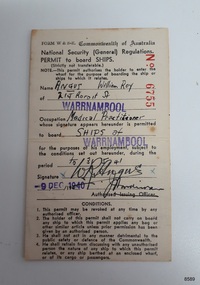
Document - Permit, Commonwealth of Australia, Permit to Board Ships, 1940
... World War II...Permit...Quarantine...Medical...Permit to Board Ships...National Security...Flagstaff Hill Maritime Museum and Village Great Ocean Road Shipwreck Coast World War II Permit Quarantine Medical Permit to Board Ships National Security Port Medical Officer last Port Medical Officer Warrnambool Harbour ship quarrantine 1900s W.R. ...This permit was donated to Flagstaff Hill Maritime Village by the family of Doctor William Roy Angus, Surgeon and Oculist. It is part of the “W.R. Angus Collection” that includes historical medical equipment, surgical instruments and material once belonging to Dr Edward Ryan and Dr Thomas Francis Ryan, (both of Nhill, Victoria) as well as Dr Angus’ own belongings. The Collection’s history spans the medical practices of the two Doctors Ryan, from 1885-1926 plus that of Dr Angus, up until 1969. ABOUT THE “W.R.ANGUS COLLECTION” Doctor William Roy Angus M.B., B.S., Adel., 1923, F.R.C.S. Edin.,1928 (also known as Dr Roy Angus) was born in Murrumbeena, Victoria in 1901 and lived until 1970. He qualified as a doctor in 1923 at University of Adelaide, was Resident Medical Officer at the Royal Adelaide Hospital in 1924 and for a period was house surgeon to Sir (then Mr.) Henry Simpson Newland. Dr Angus was briefly an Assistant to Dr Riddell of Kapunda, then commenced private practice at Curramulka, Yorke Peninsula, SA, where he was physician, surgeon and chemist. In 1926, he was appointed as new Medical Assistant to Dr Thomas Francis Ryan (T.F. Ryan, or Tom), in Nhill, Victoria, where his experiences included radiology and pharmacy. In 1927 he was Acting House Surgeon in Dr Tom Ryan’s absence. Dr Angus had become engaged to Gladys Forsyth and they decided he would take time to further his studies overseas in the UK in 1927. He studied at London University College Hospital and at Edinburgh Royal Infirmary and in 1928, was awarded FRCS (Fellow from the Royal College of Surgeons), Edinburgh. He worked his passage back to Australia as a Ship’s Surgeon on the on the Australian Commonwealth Line’s T.S.S. Largs Bay. Dr Angus married Gladys in 1929, in Ballarat. (They went on to have one son (Graham 1932, born in SA) and two daughters (Helen (died 12/07/1996) and Berenice (Berry), both born at Mira, Nhill ) Dr Angus was a ‘flying doctor’ for the A.I.M. (Australian Inland Ministry) Aerial Medical Service in 1928 . The organisation began in South Australia through the Presbyterian Church in that year, with its first station being in the remote town of Oodnadatta, where Dr Angus was stationed. He was locum tenens there on North-South Railway at 21 Mile Camp. He took up this ‘flying doctor’ position in response to a call from Dr John Flynn; the organisation was later known as the Flying Doctor Service, then the Royal Flying Doctor Service. A lot of his work during this time involved dental surgery also. Between 1928-1932 he was surgeon at the Curramulka Hospital, Yorke Peninsula, South Australia. In 1933 Dr Angus returned to Nhill where he’d previously worked as Medical Assistant and purchased a share of the Nelson Street practice and Mira hospital from Dr Les Middleton one of the Middleton Brothers, the current owners of what was once Dr Tom Ryan’s practice. Dr L Middleton was House Surgeon to the Nhill Hospital 1926-1933, when he resigned. [Dr Tom Ryan’s practice had originally belonged to his older brother Dr Edward Ryan, who came to Nhill in 1885. Dr Edward saw patients at his rooms, firstly in Victoria Street and in 1886 in Nelson Street, until 1901. The Nelson Street practice also had a 2 bed ward, called Mira Private Hospital ). Dr Edward Ryan was House Surgeon at the Nhill Hospital 1884-1902 . He also had occasions where he successfully performed veterinary surgery for the local farmers too. Dr Tom Ryan then purchased the practice from his brother in 1901. Both Dr Edward and Dr Tom Ryan work as surgeons included eye surgery. Dr Tom Ryan performed many of his operations in the Mira private hospital on his premises. He too was House Surgeon at the Nhill Hospital 1902-1926. Dr Tom Ryan had one of the only two pieces of radiology equipment in Victoria during his practicing years – The Royal Melbourne Hospital had the other one. Over the years Dr Tom Ryan gradually set up what was effectively a training school for country general-practitioner-surgeons. Each patient was carefully examined, including using the X-ray machine, and any surgery was discussed and planned with Dr Ryan’s assistants several days in advance. Dr Angus gained experience in using the X-ray machine there during his time as assistant to Dr Ryan. Dr Tom Ryan moved from Nhill in 1926. He became a Fellow of the Royal Australasian College of Surgeons in 1927, soon after its formation, a rare accolade for a doctor outside any of the major cities. He remained a bachelor and died suddenly on 7th Dec 1955, aged 91, at his home in Ararat. Scholarships and prizes are still awarded to medical students in the honour of Dr T.F. Ryan and his father, Dr Michael Ryan, and brother, John Patrick Ryan. ] When Dr Angus bought into the Nelson Street premises in Nhill he was also appointed as the Nhill Hospital’s Honorary House Surgeon 1933-1938. His practitioner’s plate from his Nhill surgery states “HOURS Daily, except Tuesdays, Fridays and Saturday afternoons, 9-10am, 2-4pm, 7-8pm. Sundays by appointment”. This plate is now mounted on the doorway to the Port Medical Office at Flagstaff Hill Maritime Village, Warrnambool. Dr Edward Ryan and Dr Tom Ryan had an extensive collection of historical medical equipment and materials spanning 1884-1926 and when Dr Angus took up practice in their old premises he obtained this collection, a large part of which is now on display at the Port Medical Office at Flagstaff Hill Maritime Village in Warrnambool. During his time in Nhill Dr Angus was involved in the merging of the Mira Hospital and Nhill Public Hospital into one public hospital and the property titles passed on to Nhill Hospital in 1939. In 1939 Dr Angus and his family moved to Warrnambool where he purchased “Birchwood,” the 1852 home and medical practice of Dr John Hunter Henderson, at 214 Koroit Street. (This property was sold in1965 to the State Government and is now the site of the Warrnambool Police Station. ). The Angus family was able to afford gardeners, cooks and maids; their home was a popular place for visiting dignitaries to stay whilst visiting Warrnambool. Dr Angus had his own silk worm farm at home in a Mulberry tree. His young daughter used his centrifuge for spinning the silk. Dr Angus was appointed on a part-time basis as Port Medical Officer (Health Officer) in Warrnambool and held this position until the 1940’s when the government no longer required the service of a Port Medical Officer in Warrnambool; he was thus Warrnambool’s last serving Port Medical Officer. (The duties of a Port Medical Officer were outlined by the Colonial Secretary on 21st June, 1839 under the terms of the Quarantine Act. Masters of immigrant ships arriving in port reported incidents of diseases, illness and death and the Port Medical Officer made a decision on whether the ship required Quarantine and for how long, in this way preventing contagious illness from spreading from new immigrants to the residents already in the colony.) Dr Angus was a member of the Australian Medical Association, for 35 years and surgeon at the Warrnambool Base Hospital 1939-1942, He served as a Surgeon Captain during WWII1942-45, in Ballarat, Victoria, and in Bonegilla, N.S.W., completing his service just before the end of the war due to suffering from a heart attack. During his convalescence he carved an intricate and ‘most artistic’ chess set from the material that dentures were made from. He then studied ophthalmology at the Royal Melbourne Eye and Ear Hospital and created cosmetically superior artificial eyes by pioneering using the intrascleral cartilage. Angus received accolades from the Ophthalmological Society of Australasia for this work. He returned to Warrnambool to commence practice as an ophthalmologist, pioneering in artificial eye improvements. He was Honorary Consultant Ophthalmologist to Warrnambool Base Hospital for 31 years. He made monthly visits to Portland as a visiting surgeon, to perform eye surgery. He represented the Victorian South-West subdivision of the Australian Medical Association as its secretary between 1949 and 1956 and as chairman from 1956 to 1958. In 1968 Dr Angus was elected member of Spain’s Barraquer Institute of Barcelona after his research work in Intrasclearal cartilage grafting, becoming one of the few Australian ophthalmologists to receive this honour, and in the following year presented his final paper on Living Intrasclearal Cartilage Implants at the Inaugural Meeting of the Australian College of Ophthalmologists in Melbourne In his personal life Dr Angus was a Presbyterian and treated Sunday as a Sabbath, a day of rest. He would visit 3 or 4 country patients on a Sunday, taking his children along ‘for the ride’ and to visit with him. Sunday evenings he would play the pianola and sing Scottish songs to his family. One of Dr Angus’ patients was Margaret MacKenzie, author of a book on local shipwrecks that she’d seen as an eye witness from the late 1880’s in Peterborough, Victoria. In the early 1950’s Dr Angus, painted a picture of a shipwreck for the cover jacket of Margaret’s book, Shipwrecks and More Shipwrecks. She was blind in later life and her daughter wrote the actual book for her. Dr Angus and his wife Gladys were very involved in Warrnambool’s society with a strong interest in civic affairs. Their interests included organisations such as Red Cross, Rostrum, Warrnambool and District Historical Society (founding members), Wine and Food Society, Steering Committee for Tertiary Education in Warrnambool, Local National Trust, Good Neighbour Council, Housing Commission Advisory Board, United Services Institute, Legion of Ex-Servicemen, Olympic Pool Committee, Food for Britain Organisation, Warrnambool Hospital, Anti-Cancer Council, Boys’ Club, Charitable Council, National Fitness Council and Air Raid Precautions Group. He was also a member of the Steam Preservation Society and derived much pleasure from a steam traction engine on his farm. He had an interest in people and the community He and his wife Gladys were both involved in the creation of Flagstaff Hill, including the layout of the gardens. After his death (28th March 1970) his family requested his practitioner’s plate, medical instruments and some personal belongings be displayed in the Port Medical Office surgery at Flagstaff Hill Maritime Village, and be called the “W. R. Angus Collection”.This Permit to Board Ships at Warrnambool is significant for connecting Doctor W.R. Angus to the maritime history of Warrnambool in the 1930s and 1940s, as the health and security of those on board arriving vessels and those of the community were his responsibility at that time. The W.R. Angus Collection is significant for still being located at the site it is connected with, Doctor Angus being the last Port Medical Officer in Warrnambool. The collection of medical instruments and other items and equipment is culturally significant, being an historical example of medicine from late 19th to mid-20th century. Dr Angus assisted Dr Tom Ryan, a pioneer in the use of X-rays and in ocular surgery.PERMIT to Board Ships. A thick white card with black print, stamps and signatures. Issued by the Commonwealth of Australia, National Security(General) Regulations. It includes the Conditions of use and is dated 9th December, 1940. The card permits the holder to board ships at Warrnambool and was issued to Dr William Roy Angus in his capacity as Port Medical Officer in Warrnambool. It is part of the W.R. Angus Collection.Various: Stamped 'Warrnambool' in two places; numbered 'No. 6755'. Name etc: 'Angus, William Roy', 214 Koroit St, Warrnambool'. 'Medical Practioner'. Signature of Dr Angus. Signature of the Autorised Issuing Officer (undecipherable). Issue date: '9 Dec 1940'.flagstaff hill maritime museum and village, great ocean road, shipwreck coast, world war ii, permit, quarantine, medical, permit to board ships, national security, port medical officer, last port medical officer, warrnambool harbour, ship quarrantine, 1900s, w.r. angus -
 Australian Commando Association - Victoria
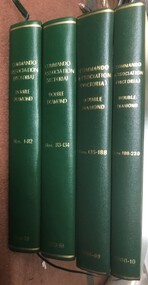
Double Diamonds-Magazine of the M and Z commando Association of Victoria 4 Volumes
... In addition 1- 230 of the post World War II M and Z commando Association quarterly newsletter. World War II operatives were subject to a 30 year security provision this collection includes many personal stories, many of which remain unpublished, which were included in the magazines after the security restrictions were lifted in the mid-1980s....In addition 1- 230 of the post World War II M and Z commando Association quarterly newsletter. World War II operatives were subject to a 30 year security provision this collection includes many personal stories, many of which remain unpublished, which were included in the magazines after the security restrictions were lifted in the mid-1980s. ...In addition 1- 230 of the post World War II M and Z commando Association quarterly newsletter. World War II operatives were subject to a 30 year security provision this collection includes many personal stories, many of which remain unpublished, which were included in the magazines after the security restrictions were lifted in the mid-1980s.Four volumes of bound magazines. In Edition 1-230. -
 Australian Commando Association - Victoria
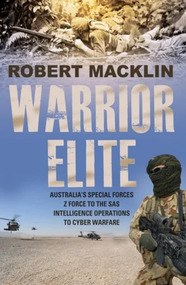
Book, Warrior Elite
... Warrior Elite is a unique and compelling account of Australia's special forces and intelligence operations - ranging from the early special forces of World War II to the establishment and development of the SAS and Commando Regiments as the elite fighters of today, and from the Australian Security Intelligence Service to the Australian Signals Directorate and ASIO. ...Warrior Elite is a unique and compelling account of Australia's special forces and intelligence operations - ranging from the early special forces of World War II to the establishment and development of the SAS and Commando Regiments as the elite fighters of today, and from the Australian Security Intelligence Service to the Australian Signals Directorate and ASIO. ...Warrior Elite is a unique and compelling account of Australia's special forces and intelligence operations - ranging from the early special forces of World War II to the establishment and development of the SAS and Commando Regiments as the elite fighters of today, and from the Australian Security Intelligence Service to the Australian Signals Directorate and ASIO. It is an authoritative, gripping and thoroughly up-to-date account of both the history and current state of our special forces and intelligence bodies - and gives a unique glimpse into the warfare of the future. Our future. Robert Macklin has conducted dozens of exclusive interviews and uncovered incredible, daring and sometimes heartbreaking stories of the elite troops that guard our nation and engage in secret operations around the world. He has had significant cooperation from numerous sources within the special forces and the various intelligence agencies. Both thoroughly researched and colourfully written, Warrior Elite will attract the reader of action memoirs as well as those interested in broader military history and espionage. australian special forces, australian army, commandos, military history -
 Bendigo Historical Society Inc.
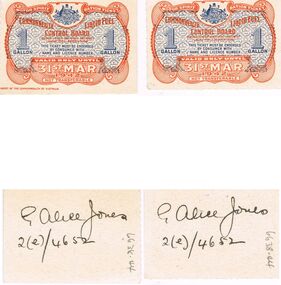
Ephemera - MISS G ALICE JONES COLLECTION: WWII FUEL 1 GALLON RATION TICKETS
... War world II WWII Fuel 1 Gallon Ration Tickets: 2 x tickets rectangular shaped with perforated edges, cream card with red and blue print. Background in blue ink with round shapes printed "Department of Supply and Development". Commonwealth Emblem in the middle at the top is also in blue along with 1 gallon and "This Ticket must be endorsed by consumer with name and licence number". Printed in red at the top is "Motor Spirit Ration Ticket". Commonwealth Control Board Liquid Fuel. Issued under national security ...Petrol rationing was gazetted in May 1941. Australia's lack of fuel storage options and the diversion of tankers bringing fuel here forced the government to begin rationing. Initially it was proposed that consumption should be reduced by 50% but this was modified to 1/3 reduction. People had to apply for a petrol licence and this was then used to obtain ration coupons. Initially coupons were issued on a 6 monthly basis but this was reduced to 2 monthly and allowed people roughly 2000 gallons per year. Coupons allowed for 1, 2, 5, 10, 44 and 100 gallon amounts depending on need. eg. private, commercial, farm use. Rationing was strictly enforced until 1942 but remained in effect until 1950.WWII Fuel 1 Gallon Ration Tickets: 2 x tickets rectangular shaped with perforated edges, cream card with red and blue print. Background in blue ink with round shapes printed "Department of Supply and Development". Commonwealth Emblem in the middle at the top is also in blue along with 1 gallon and "This Ticket must be endorsed by consumer with name and licence number". Printed in red at the top is "Motor Spirit Ration Ticket". Commonwealth Control Board Liquid Fuel. Issued under national security Liquid Fuel Regulations. Valid only until 31st Mar. 1942 Not Transferable. On the back hand written in black ink is "G. Alice Jones 2(e)/4652".petrol rationing, war world ii -
 Bendigo Historical Society Inc.
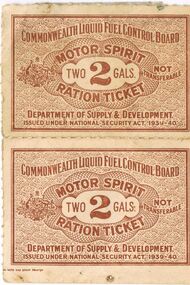
Ephemera - MISS G ALICE JONES COLLECTION: WWII FUEL 2 GALLON RATION TICKETS
... War world II WWII Fuel 2 Gallon Ration Tickets: 2 x rectangular shape with perforated edges, cream card with brown print. Background is a wallpaper of oval shapes with "Motor Spirit Ration" printed. On the face is "Commonwealth Liquid Fuel Control Board, the Commonwealth Emblem Motor Spirit two 2 Gals, Not Transferable Ration Ticket". Department of supply & Development. Issued under national security ...Petrol rationing was gazetted in May 1941. Australia's lack of fuel storage options and the diversion of tankers bringing fuel here forced the government to begin rationing. Initially it was proposed that consumption should be reduced by 50% but this was modified to 1/3 reduction. People had to apply for a petrol licence and this was then used to obtain ration coupons. Initially coupons were issued on a 6 monthly basis but this was reduced to 2 monthly and allowed people roughly 2000 gallons per year. Coupons allowed for 1, 2, 5, 10, 44 and 100 gallon amounts depending on need. eg. private, commercial, farm use. Rationing was strictly enforced until 1942 but remained in effect until 1950.WWII Fuel 2 Gallon Ration Tickets: 2 x rectangular shape with perforated edges, cream card with brown print. Background is a wallpaper of oval shapes with "Motor Spirit Ration" printed. On the face is "Commonwealth Liquid Fuel Control Board, the Commonwealth Emblem Motor Spirit two 2 Gals, Not Transferable Ration Ticket". Department of supply & Development. Issued under national security Act. 1939-40 The back has sticky tape stuck to it.petrol ration tickets, war world ii -
 Bendigo Historical Society Inc.
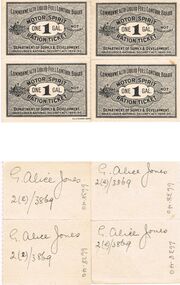
Ephemera - MISS G ALICE JONES COLLECTION: FUEL RATION TICKETS 1 GALLON
... War world II W.C.G. McCracken Australia Fuel Ration Tickets 1 Gallon: rectangle in shape with perforated edges. Printed in black ink the background is a wall paper of small oval shapes with "Motor Spirit Ration". Over printed is "Commonwealth Liquid Fuel Control Board, in the middle is the commonwealth emblem and Motor Spirit, one 1 Gal, not transferable Ration Ticket". Department of supply & Development issued under National Security ...Petrol rationing was gazetted in May 1941. Australia's lack of fuel storage options and the diversion of tankers bringing fuel here forced the government to begin rationing. Initially it was proposed that consumption should be reduced by 50% but this was modified to 1/3 reduction. People had to apply for a petrol licence and this was then used to obtain ration coupons. Initially coupons were issued on a 6 monthly basis but this was reduced to 2 monthly and allowed people roughly 2000 gallons per year. Coupons allowed for 1, 2, 5, 10, 44 and 100 gallon amounts depending on need. eg. private, commercial, farm use. Rationing was strictly enforced until 1942 but remained in effect until 1950.Fuel Ration Tickets 1 Gallon: rectangle in shape with perforated edges. Printed in black ink the background is a wall paper of small oval shapes with "Motor Spirit Ration". Over printed is "Commonwealth Liquid Fuel Control Board, in the middle is the commonwealth emblem and Motor Spirit, one 1 Gal, not transferable Ration Ticket". Department of supply & Development issued under National Security Act 1939-40. On the back of each is printed in black ink and hand written is "G. Alice Jones 2(e)/3869".W.C.G. McCracken Australiapetrol rationing, war world ii -
 RSL Victoria - Anzac House Reference Library and Memorabilia Collection
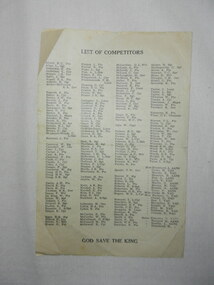
Pamphlet, Amenities (Sports) A.I.F. et al, A. I. F. Combined Athletic Sports Meeting, 1942
... World War II. Lists the names and rank of competitors in the May 1942 A.I.F. Combined Athletic Sports Meeting at Gaza Ridge, Palestine. world war two world war ii wwii gaza ridge palestine a.i.f. combined athletic sports meeting sport Front cover has text and 'Rising Sun' insignia contained within a border. Other pages only contain text. Pamphlet. Rectangular in shape. Made from paper. Printed text is black in colour. A. I. F. Combined Athletic Sports Meeting Pamphlet Amenities (Sports) A.I.F. Security ...The A.I.F. Combined Athletic Sports Meeting was held at Gaza Ridge, Palestine on May 16 1942. The list of competitors contains individuals from many different units and states within Australia. This athletics meeting was held during World War II. Lists the names and rank of competitors in the May 1942 A.I.F. Combined Athletic Sports Meeting at Gaza Ridge, Palestine. Pamphlet. Rectangular in shape. Made from paper. Printed text is black in colour. Front cover has text and 'Rising Sun' insignia contained within a border. Other pages only contain text. world war two, world war ii, wwii, gaza ridge, palestine, a.i.f., combined athletic sports meeting, sport -
 Wangaratta RSL Sub Branch
Badge - Italian Badges
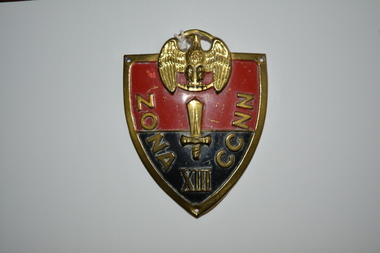
... Security.(MVSN) The Blackshirts (Italian language: camicie nere, CCNN) were fascist paramilitary armed squads in Italy during the period immediately following World War I and until the end of World War II. ...Italian badges - ZONA CCNN known as the Blackshirts were fascist paramilitary squads in Italy during WW2.. Blackshirts were distinguished by their black uniform and loyality to Mussolini and were officially known as the Voluntary Militia for National Security.(MVSN)The Blackshirts (Italian language: camicie nere, CCNN) were fascist paramilitary armed squads in Italy during the period immediately following World War I and until the end of World War II. Blackshirts were officially known as the Voluntary Militia for National Security (MVSN) Two brass badges in the shape of a shield with a sword in the centre below and spread eagle. One has a black background the other red and black. ZONA CCNN XIII on one and XII on the otherZONA CCNN italian, fascist badges, mvsn, blackshirts, ww2 -
 Tatura Irrigation & Wartime Camps Museum
Document and CD - Biography, Mary Henderson Gerstle et al, Bernhard Hermann Gerstle, 2013
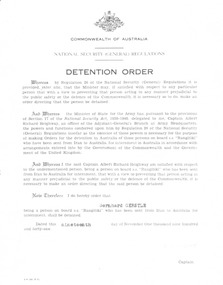
... World War II. In 1941, after the installation of a pro-British ruler to the Persian throne, all German nationals were targeted as threats to national security. ...World War II. In 1941, after the installation of a pro-British ruler to the Persian throne, all German nationals were targeted as threats to national security. ...Bernhard Gerstle & his family (parents & siblings) were German nationals working in Tehran, Iran upon the outbreak of World War II. In 1941, after the installation of a pro-British ruler to the Persian throne, all German nationals were targeted as threats to national security. The women and children evacuated to Stuttgart, Germany via Turkey, while the men were handed over to British forces. Bernhard was taken by ship (the SS Rona) to Bombay & then to Australia (on the SS Rangitiki). He was then marched in to Loveday internment camp 10, South Australia. In January 1945 the German & Italian internees at Loveday were transferred to Tatura Camp 1. Bernhard remained there until after the war & his eventual release, on 29th August 1946. Bernhard chose & was granted permission to remain in Australia post-war, as did many civilian internees, after their examination by a Committee of Inquiry which investigated their political leanings & other criteria for their supposed suitability as Australian residents. The biography also recounts his employment post-war, marriage in 1952 & his later naturalisation as an Australian citizen. Other material includes Gerstle family history from the perspective of Bernhard's sister & family, who remained in Stuttgart; background on the Gerstle family's Russian origins; and a biography of Oskar Speck, famous kayaker, amongst other things, who was interned along with Bernhard & who became good friends with the family; a brief historical background of the Allied forces/Persia invasion; and extracts of Tatura Camp 3 internee Helga Griffin's book, "Sing Me That Lovely Song Again". Black plastic A4 display folder. CD soft case with CD. Folder contains printed biographical information regarding Bernhard Hermann Gerstle. CD contains copies of same documents and also copies of photographs of Bernhard & the Gerstle family. Folder: Bernhard Hermann Gerstle/ Gerstle Family/ Loveday and Tatura Internment Camps 1941-1946/ Sydney 1946-1978/ Compiled by Mary Henderson 2013 CD: BH Gerstle; 1941 - Interned by British/ 1941-1946 - Internee at Loveday SA, Tatura VIC/ Sydney 1946-1978. camp 1, tatura, loveday, world-war-two, internment-camps -
 Tatura Irrigation & Wartime Camps Museum
Brooch, 1940s
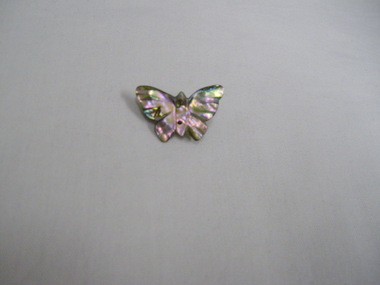
... security by Allied forces & were interned in temporary camps, before being shipped to Australia. In Australia they were interned in Camp 3, Tatura, a family camp for enemy nationals. Many of the internees came with few possessions. This item is just one of the handmade domestic items fashioned in the camp from largely scrap materials to give some home comforts in the initially barren surroundings of the camps, particularly to those interned with families and young children. world war ii camp 3 palestine tatura jewellery internment camps Butterfly shaped brooch made from Paua shell. ...The Wied family were settled in Palestine upon the beginning of WWII. Being of German nationality, they were considered a threat to security by Allied forces & were interned in temporary camps, before being shipped to Australia. In Australia they were interned in Camp 3, Tatura, a family camp for enemy nationals. Many of the internees came with few possessions. This item is just one of the handmade domestic items fashioned in the camp from largely scrap materials to give some home comforts in the initially barren surroundings of the camps, particularly to those interned with families and young children. Butterfly shaped brooch made from Paua shell. Fixed to a brass safety pin. world war ii, camp 3, palestine, tatura, jewellery, internment camps -
 Tatura Irrigation & Wartime Camps Museum
Ring, 1940's
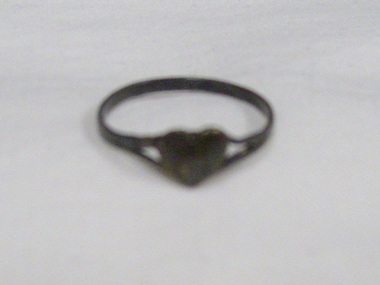
... security by Allied forces & were interned in temporary camps, before being shipped to Australia. In Australia they were interned in Camp 3, Tatura, a family camp for enemy nationals. Many of the internees came with few possessions. This item is just one of the handmade domestic items fashioned in the camp from largely scrap materials to give some home comforts in the initially barren surroundings of the camps, particularly to those interned with families and young children. camp 3 tatura world war ii internment camps Small brown metal ring, with a small heart soldered to the ring. ...The ring was made for the donor by her father in Camp 3, Tatura. The Wied family were settled in Palestine upon the beginning of WWII. Being of German nationality, they were considered a threat to security by Allied forces & were interned in temporary camps, before being shipped to Australia. In Australia they were interned in Camp 3, Tatura, a family camp for enemy nationals. Many of the internees came with few possessions. This item is just one of the handmade domestic items fashioned in the camp from largely scrap materials to give some home comforts in the initially barren surroundings of the camps, particularly to those interned with families and young children. Small brown metal ring, with a small heart soldered to the ring. camp 3, tatura, world war ii, internment camps -
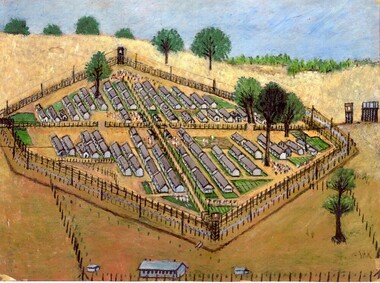 Tatura Irrigation & Wartime Camps Museum
Sketch, Camp 3
... There were 7 camps in the area during World War II which held about 4,000-8,000 people at any one time. 3 camps housed Prisoners Of War who were enemy servicemen captured in various theatres of war around the world and transported to Australia for the duration of the war. The remaining 4 camps held Internees who were civilians living in Australia or other Allied territories and countries at the outbreak of war and were deemed to be a security risk because of their nationality. ...There were 7 camps in the area during World War II which held about 4,000-8,000 people at any one time. 3 camps housed Prisoners Of War who were enemy servicemen captured in various theatres of war around the world and transported to Australia for the duration of the war. The remaining 4 camps held Internees who were civilians living in Australia or other Allied territories and countries at the outbreak of war and were deemed to be a security risk because of their nationality. ...There were 7 camps in the area during World War II which held about 4,000-8,000 people at any one time. 3 camps housed Prisoners Of War who were enemy servicemen captured in various theatres of war around the world and transported to Australia for the duration of the war. The remaining 4 camps held Internees who were civilians living in Australia or other Allied territories and countries at the outbreak of war and were deemed to be a security risk because of their nationality. The camps were situated in the Goulburn Valley as food was plentiful here and there was a good supply of water from the Waranga Basin.A coloured sketch showing all the compounds at Tatura War and Internment Camp.internment, ww2, world war two, tatura, goulburn valley, war camps, prisoner of war, prisoner of war camps -
 Moorabbin Air Museum
Book - RAF in World War II, Years of Command A Personal Story of The Second War in the Air
... RAF in World War II The faces of reality The slow awakening On borrowed time Base security Fighter command From defence to offence Broadening fronts Increasing pressures At low ebb Test of patience Biography of Sholto Douglas , former Commander in Chief of RAF, circa 1966 Years of Command A Personal Story of The Second War in the Air Book RAF in World War II ...Biography of Sholto Douglas , former Commander in Chief of RAF, circa 1966non-fictionBiography of Sholto Douglas , former Commander in Chief of RAF, circa 1966the faces of reality, the slow awakening, on borrowed time, base security, fighter command, from defence to offence, broadening fronts, increasing pressures, at low ebb, test of patience -
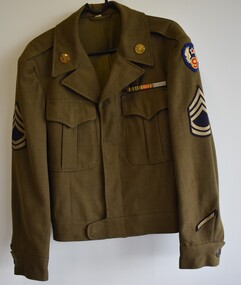 Moorabbin Air Museum
Uniform (item) - US Army Air Forces IKE Jacket
... World War II Victory Ribbon. The ribbon is a multi coloured rainbow on each side, derived from the Allied World War I victory medal. The inner band in red represents the spilled blood of the soldiers. The narrow white bands between the red band and the rainbow symbolize the rays of hope. United Nations Service Medal-Korea. Consists of seventeen alternating, equal-width stripes of UN blue (9 stripes) and white (8 stripes) with blue on the outer edges. It symbolizes the United Nations flag, representing the collective security...World War II Victory Ribbon. The ribbon is a multi coloured rainbow on each side, derived from the Allied World War I victory medal. The inner band in red represents the spilled blood of the soldiers. The narrow white bands between the red band and the rainbow symbolize the rays of hope. United Nations Service Medal-Korea. Consists of seventeen alternating, equal-width stripes of UN blue (9 stripes) and white (8 stripes) with blue on the outer edges. It symbolizes the United Nations flag, representing the collective security ...Label on inside of right hand pocket displays, Jackets Field Wool O.D Stock No. 55-J-384-605 36S Cancelli & Desiderio P.O No. 12280 Dated June 13, 1944 Pattern Dated 5/10/44 Spec. P.O.D No 437 Phila Q.M. Depot -
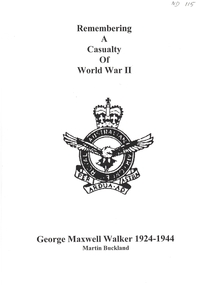 Whitehorse Historical Society Inc.
Document - School Project, Remembering a casualty of World War II, 1/06/1997 12:00:00 AM
... security in and around the Middle East. He was the son of George Walker and grandson of Edgar and Myra Walker, owners of Australia Tesselated Tile Company. The George Walker family lived in Harrison St, Mitcham. The home is on the City of Whitehorse Heritage planning overlay. Remembering a casualty of World War II ...A Luther College Year 10 essayA Luther College Year 10 essay which researches the history of George Maxwell Walker (1924 - 1944). A pilot with the R.A.A.F. who spent much of his flying days with the British R.A.F. At the time of his death his squadron was carrying out anti-submarine patrols and internal security in and around the Middle East. He was the son of George Walker and grandson of Edgar and Myra Walker, owners of Australia Tesselated Tile Company. The George Walker family lived in Harrison St, Mitcham. The home is on the City of Whitehorse Heritage planning overlay.A Luther College Year 10 essay walker, george maxwell, royal australian air force, royal air force, world war, 1939 - 1945, war memorials
