
Showing 103 items matching "worsted cloth"
-
 National Wool Museum
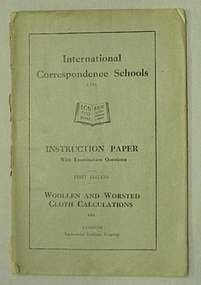
Book, Instruction Paper No.484: Woolen and worsted cloth calculations, 1st Ed
... Instruction Paper No.484: Woolen and worsted cloth calculations, 1st Ed.......Cloth - worsted..."Instruction Paper No.484: Woolen and worsted cloth calculations, 1st Ed." - International Correspondence Schools Ltd...."Instruction Paper No.484: Woolen and worsted cloth calculations, 1st Ed." - International Correspondence Schools Ltd...."Instruction Paper No.484: Woolen and worsted cloth calculations, 1st Ed." - International Correspondence Schools Ltd. ..."Instruction Paper No.484: Woolen and worsted cloth calculations, 1st Ed." - International Correspondence Schools Ltd."Instruction Paper No.484: Woolen and worsted cloth calculations, 1st Ed." - International Correspondence Schools Ltd.weaving textile machinery textile calculations textile industry - education, international correspondence schools ltd, cloth - woollen, cloth - worsted, weaving, textile machinery, textile calculations, textile industry - education -
 National Wool Museum
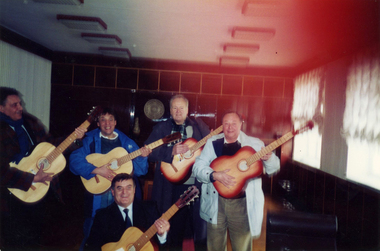
Photograph - Chernihiv Worsted and Cloth Mill, Ukraine, 1990s
... Chernihiv Worsted and Cloth Mill, Ukraine...This image shows members of the International Wool Secretariat, including Stuart Ascough, at the Chernihiv Worsted and Cloth Mill in the Ukraine. Part of a collection of books, manuals, photographs, letters and clothing relating to the working life of Stuart Ascough. ...Photograph Chernihiv Worsted and Cloth Mill, Ukraine ...This image shows members of the International Wool Secretariat, including Stuart Ascough, at the Chernihiv Worsted and Cloth Mill in the Ukraine. Part of a collection of books, manuals, photographs, letters and clothing relating to the working life of Stuart Ascough. Stuart's career in the wool industry spanned over 43 years from 1960 to 2003 in various roles including Topmaking Plant Manager at Courtaulds Ltd. in Spennymore, U.K., Operations Manager at Port Phillip Mills in Williamstown Victoria, Marketing Executive, Early Stage Wool Processing at the International Wool Secretariat Melbourne, Australia and General Manager of Victoria Wool Processors Pty. Ltd. in Laverton North, Victoria. Throughout his career Stuart travelled extensively, and in the 1990s worked at many topmaking mills in China on quality improvement projects. He also provided technical advice and training at mills in India, Ukraine, Lithuania, Kyrgyzstan, Russia, Latvia, Byelorussia and other parts of Europe and Asia.Image depicting five men holding guitars in an indoor setting.stuart ascough, international wool secretariat, topmaking, career, wool industry, training, technical advice, mills, ukraine, textile industry, chernihov, guitars -
 National Wool Museum
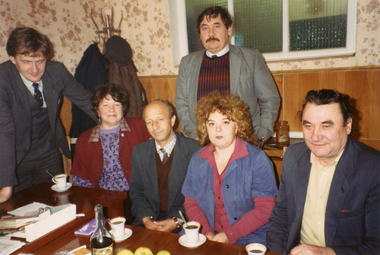
Photograph - Chernihiv Worsted and Cloth Mill, Ukraine, 1990s
... Chernihiv Worsted and Cloth Mill, Ukraine...This image shows the team from the topmaking section at the Chernihiv Worsted and Cloth Mill in the Ukraine. Part of a collection of books, manuals, photographs, letters and clothing relating to the working life of Stuart Ascough. ...Photograph Chernihiv Worsted and Cloth Mill, Ukraine ...This image shows the team from the topmaking section at the Chernihiv Worsted and Cloth Mill in the Ukraine. Part of a collection of books, manuals, photographs, letters and clothing relating to the working life of Stuart Ascough. Stuart's career in the wool industry spanned over 43 years from 1960 to 2003 in various roles including Topmaking Plant Manager at Courtaulds Ltd. in Spennymore, U.K., Operations Manager at Port Phillip Mills in Williamstown Victoria, Marketing Executive, Early Stage Wool Processing at the International Wool Secretariat Melbourne, Australia and General Manager of Victoria Wool Processors Pty. Ltd. in Laverton North, Victoria. Throughout his career Stuart travelled extensively, and in the 1990s worked at many topmaking mills in China on quality improvement projects. He also provided technical advice and training at mills in India, Ukraine, Lithuania, Kyrgyzstan, Russia, Latvia, Byelorussia and other parts of Europe and Asia.Image depicting four men and two women seated and standing around a table with coffee cups.stuart ascough, international wool secretariat, topmaking, career, wool industry, training, technical advice, mills, ukraine, textile industry, chernihov -
 National Wool Museum
Photograph
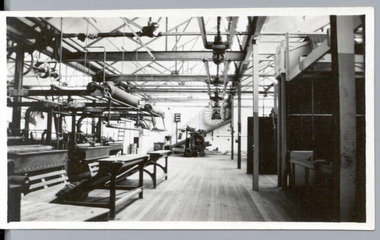
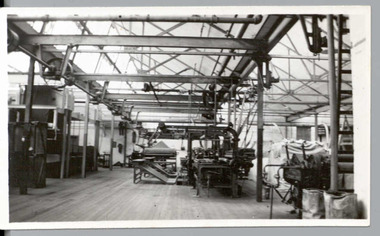
... ...Valley Worsted Mill...Cloth...This photo is one of 31 in total and probably shows the finishing area for worsted cloths. The donor worked at the Valley Mill for many years. ...Textile Finishing Valley Worsted Mill Cloth - worsted Interior of Valley Worsted Mill, c.1923. ...This photograph shows the interior of the Valley Worsted Mill in 1923. The mill was first established at this time, and the photo shows the interior after tooling up but prior to the mill actually commencing operation. This photo is one of 31 in total and probably shows the finishing area for worsted cloths. The donor worked at the Valley Mill for many years. This mill still exists in Swanston Street, Geelong and is now being used by Melba Industries (an Austrim-Nylex company) to produce Jumbuck Nylon wool packs.Interior of Valley Worsted Mill, c.1923.textile finishing, valley worsted mill, cloth - worsted -
 National Wool Museum
Photograph
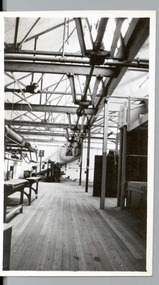
... ...Valley Worsted Mill...Cloth...This photo is one of 31 in total and probably shows the finishing area for worsted cloths. The donor worked at the Valley Mill for many years. ...Textile Finishing Valley Worsted Mill Cloth - worsted Interior of Valley Worsted Mill, c.1923. ...This photograph shows the interior of the Valley Worsted Mill in 1923. The mill was first established at this time, and the photo shows the interior after tooling up but prior to the mill actually commencing operation. This photo is one of 31 in total and probably shows the finishing area for worsted cloths. The donor worked at the Valley Mill for many years. This mill still exists in Swanston Street, Geelong and is now being used by Melba Industries (an Austrim-Nylex company) to produce Jumbuck Nylon wool packs.Interior of Valley Worsted Mill, c.1923.textile finishing, valley worsted mill, cloth - worsted -
 National Wool Museum
Photograph
... ...Valley Worsted Mill...Cloth...This photo is one of 31 in total and probably shows the finishing area for worsted cloths. The donor worked at the Valley Mill for many years. ...Textile Finishing Valley Worsted Mill Cloth - worsted Interior of Valley Worsted Mill, c.1923. ...This photograph shows the interior of the Valley Worsted Mill in 1923. The mill was first established at this time, and the photo shows the interior after tooling up but prior to the mill actually commencing operation. This photo is one of 31 in total and probably shows the finishing area for worsted cloths. The donor worked at the Valley Mill for many years. This mill still exists in Swanston Street, Geelong and is now being used by Melba Industries (an Austrim-Nylex company) to produce Jumbuck Nylon wool packs.Interior of Valley Worsted Mill, c.1923.textile finishing, valley worsted mill, cloth - worsted -
 National Wool Museum
Book, Finishing Machinery
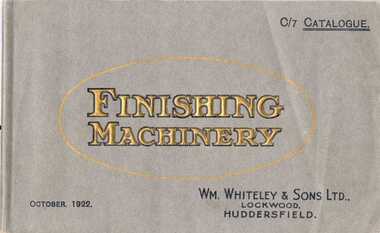
... ...Cloth - worsted...Catalogue of machinery for finishing woollen and worsted cloths....Catalogue of machinery for finishing woollen and worsted cloths. Textile Machinery Textile Finishing Wm. ..."Finishing Machinery" by W.M. Whiteley and Sons Ltd, Oct. 1922. Catalogue of machinery for finishing woollen and worsted cloths.Catalogue of textile finishing machinery produced by William Whiteley and Sons Ltd, Huddersfield, Oct. 1922.textile machinery textile finishing, wm. whiteley and sons limited, cloth - woollen, cloth - worsted, raising machinery, milling, tentering, textile machinery, textile finishing -
 National Wool Museum
Photograph - Returned Sailors and Soldiers Mill, Norm Holroyd, 1960's - 1970's
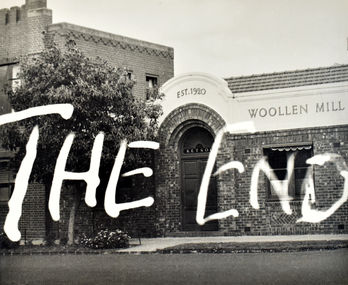
... ...Worsted Cloth...It specialised in heavy worsted cloths, high-quality tweed, and its signature "Retsol" and "Monarch" pure-wool travelling rugs, later adapting its machinery to blend natural wool with artificial fibres as mid-century market demands shifted....It specialised in heavy worsted cloths, high-quality tweed, and its signature "Retsol" and "Monarch" pure-wool travelling rugs, later adapting its machinery to blend natural wool with artificial fibres as mid-century market demands shifted. ...One of thirty eight photographs from a photo album featuring images of the Returned Sailors and Soldiers Woollen Mill in Newtown, Geelong. The images were taken between the 1960's-1970's by Norm Holroyd who worked at the mills. They were developed in his own private dark room and kept at his home for private viewing. The Returned Sailors and Soldiers Woollen Mill operated as a self-sufficient co-operative, funded and run by World War I veterans using their War Gratuity Bonds. The facility functioned as a complete raw-to-finished assembly line where raw fleece was brought on-site to be scoured, carded, dyed, spun into yarn and woven. It specialised in heavy worsted cloths, high-quality tweed, and its signature "Retsol" and "Monarch" pure-wool travelling rugs, later adapting its machinery to blend natural wool with artificial fibres as mid-century market demands shifted.Black and white photograph attached to cardboard backing with sticky tape. Image shows a building exterior with text. Backing card has four holes in left side.back: [handwritten] 45r. s. & s mill, returned sailors and soldiers mill, newtown, geelong, world war i, soldiers, veterans, co-operative, textile industry, woollen mills, wool, worsted cloth, tweed, retsol, monarch, travel rugs, machinery, factory, working life, norm holroyd, photo album, photography, design, fabric -
 National Wool Museum
Photograph - Returned Sailors and Soldiers Mill, Norm Holroyd, 1960's - 1970's
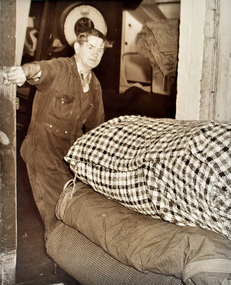
... ...Worsted Cloth...It specialised in heavy worsted cloths, high-quality tweed, and its signature "Retsol" and "Monarch" pure-wool travelling rugs, later adapting its machinery to blend natural wool with artificial fibres as mid-century market demands shifted....It specialised in heavy worsted cloths, high-quality tweed, and its signature "Retsol" and "Monarch" pure-wool travelling rugs, later adapting its machinery to blend natural wool with artificial fibres as mid-century market demands shifted. ...One of thirty eight photographs from a photo album featuring images of the Returned Sailors and Soldiers Woollen Mill in Newtown, Geelong. The images were taken between the 1960's-1970's by Norm Holroyd who worked at the mills. They were developed in his own private dark room and kept at his home for private viewing. The Returned Sailors and Soldiers Woollen Mill operated as a self-sufficient co-operative, funded and run by World War I veterans using their War Gratuity Bonds. The facility functioned as a complete raw-to-finished assembly line where raw fleece was brought on-site to be scoured, carded, dyed, spun into yarn and woven. It specialised in heavy worsted cloths, high-quality tweed, and its signature "Retsol" and "Monarch" pure-wool travelling rugs, later adapting its machinery to blend natural wool with artificial fibres as mid-century market demands shifted.Black and white photograph attached to cardboard backing with sticky tape. Image shows a man moving woollen fabrics on a trolley through a doorway. Backing card has four holes in left side.back: [handwritten] 34r. s. & s mill, returned sailors and soldiers mill, newtown, geelong, world war i, soldiers, veterans, co-operative, textile industry, woollen mills, wool, worsted cloth, tweed, retsol, monarch, travel rugs, machinery, factory, working life, norm holroyd, photo album, photography, design, fabric -
 National Wool Museum
Photograph - Loom, Returned Sailors and Soldiers Mill, Norm Holroyd, 1960's - 1970's
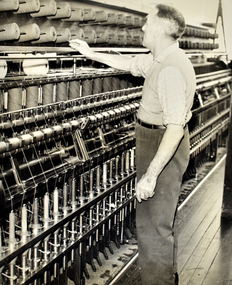
... ...Worsted Cloth...It specialised in heavy worsted cloths, high-quality tweed, and its signature "Retsol" and "Monarch" pure-wool travelling rugs, later adapting its machinery to blend natural wool with artificial fibres as mid-century market demands shifted....It specialised in heavy worsted cloths, high-quality tweed, and its signature "Retsol" and "Monarch" pure-wool travelling rugs, later adapting its machinery to blend natural wool with artificial fibres as mid-century market demands shifted. ...One of thirty eight photographs from a photo album featuring images of the Returned Sailors and Soldiers Woollen Mill in Newtown, Geelong. The images were taken between the 1960's-1970's by Norm Holroyd who worked at the mills. They were developed in his own private dark room and kept at his home for private viewing. The Returned Sailors and Soldiers Woollen Mill operated as a self-sufficient co-operative, funded and run by World War I veterans using their War Gratuity Bonds. The facility functioned as a complete raw-to-finished assembly line where raw fleece was brought on-site to be scoured, carded, dyed, spun into yarn and woven. It specialised in heavy worsted cloths, high-quality tweed, and its signature "Retsol" and "Monarch" pure-wool travelling rugs, later adapting its machinery to blend natural wool with artificial fibres as mid-century market demands shifted.Black and white photograph attached to cardboard backing with sticky tape. Image shows a man standing at a loom. Backing card has four holes in left side.back: [handwritten] 19r. s. & s mill, returned sailors and soldiers mill, newtown, geelong, world war i, soldiers, veterans, co-operative, textile industry, woollen mills, wool, worsted cloth, tweed, retsol, monarch, travel rugs, machinery, factory, working life, norm holroyd, photo album, photography, design, fabric -
 National Wool Museum
Photograph - Returned Sailors and Soldiers Mill, Norm Holroyd, 1960's - 1970's
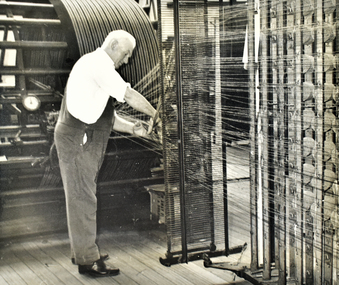
... ...Worsted Cloth...It specialised in heavy worsted cloths, high-quality tweed, and its signature "Retsol" and "Monarch" pure-wool travelling rugs, later adapting its machinery to blend natural wool with artificial fibres as mid-century market demands shifted....It specialised in heavy worsted cloths, high-quality tweed, and its signature "Retsol" and "Monarch" pure-wool travelling rugs, later adapting its machinery to blend natural wool with artificial fibres as mid-century market demands shifted. ...One of thirty eight photographs from a photo album featuring images of the Returned Sailors and Soldiers Woollen Mill in Newtown, Geelong. The images were taken between the 1960's-1970's by Norm Holroyd who worked at the mills. They were developed in his own private dark room and kept at his home for private viewing. The Returned Sailors and Soldiers Woollen Mill operated as a self-sufficient co-operative, funded and run by World War I veterans using their War Gratuity Bonds. The facility functioned as a complete raw-to-finished assembly line where raw fleece was brought on-site to be scoured, carded, dyed, spun into yarn and woven. It specialised in heavy worsted cloths, high-quality tweed, and its signature "Retsol" and "Monarch" pure-wool travelling rugs, later adapting its machinery to blend natural wool with artificial fibres as mid-century market demands shifted.Black and white photograph attached to cardboard backing with sticky tape. Image shows a man operating wool processing machinery. Backing card has four holes in left side.back: [handwritten] 21r. s. & s mill, returned sailors and soldiers mill, newtown, geelong, world war i, soldiers, veterans, co-operative, textile industry, woollen mills, wool, worsted cloth, tweed, retsol, monarch, travel rugs, machinery, factory, working life, norm holroyd, photo album, photography, design, fabric -
 National Wool Museum
Photograph - Returned Sailors and Soldiers Mill, Norm Holroyd, 1960's - 1970's
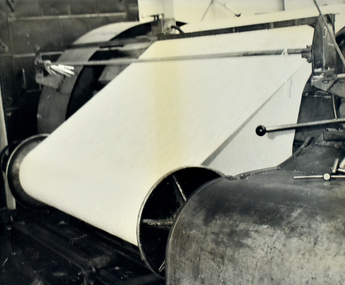
... ...Worsted Cloth...It specialised in heavy worsted cloths, high-quality tweed, and its signature "Retsol" and "Monarch" pure-wool travelling rugs, later adapting its machinery to blend natural wool with artificial fibres as mid-century market demands shifted....It specialised in heavy worsted cloths, high-quality tweed, and its signature "Retsol" and "Monarch" pure-wool travelling rugs, later adapting its machinery to blend natural wool with artificial fibres as mid-century market demands shifted. ...One of thirty eight photographs from a photo album featuring images of the Returned Sailors and Soldiers Woollen Mill in Newtown, Geelong. The images were taken between the 1960's-1970's by Norm Holroyd who worked at the mills. They were developed in his own private dark room and kept at his home for private viewing. The Returned Sailors and Soldiers Woollen Mill operated as a self-sufficient co-operative, funded and run by World War I veterans using their War Gratuity Bonds. The facility functioned as a complete raw-to-finished assembly line where raw fleece was brought on-site to be scoured, carded, dyed, spun into yarn and woven. It specialised in heavy worsted cloths, high-quality tweed, and its signature "Retsol" and "Monarch" pure-wool travelling rugs, later adapting its machinery to blend natural wool with artificial fibres as mid-century market demands shifted.Black and white photograph attached to cardboard backing with sticky tape. Image shows wool processing machinery. Backing card has four holes in left side.back: [handwritten] 22r. s. & s mill, returned sailors and soldiers mill, newtown, geelong, world war i, soldiers, veterans, co-operative, textile industry, woollen mills, wool, worsted cloth, tweed, retsol, monarch, travel rugs, machinery, factory, working life, norm holroyd, photo album, photography, design, fabric -
 National Wool Museum
Photograph - Loom, Returned Sailors and Soldiers Mill, Norm Holroyd, 1960's - 1970's
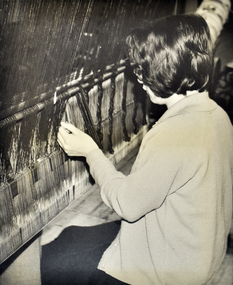
... ...Worsted Cloth...It specialised in heavy worsted cloths, high-quality tweed, and its signature "Retsol" and "Monarch" pure-wool travelling rugs, later adapting its machinery to blend natural wool with artificial fibres as mid-century market demands shifted....It specialised in heavy worsted cloths, high-quality tweed, and its signature "Retsol" and "Monarch" pure-wool travelling rugs, later adapting its machinery to blend natural wool with artificial fibres as mid-century market demands shifted. ...One of thirty eight photographs from a photo album featuring images of the Returned Sailors and Soldiers Woollen Mill in Newtown, Geelong. The images were taken between the 1960's-1970's by Norm Holroyd who worked at the mills. They were developed in his own private dark room and kept at his home for private viewing. The Returned Sailors and Soldiers Woollen Mill operated as a self-sufficient co-operative, funded and run by World War I veterans using their War Gratuity Bonds. The facility functioned as a complete raw-to-finished assembly line where raw fleece was brought on-site to be scoured, carded, dyed, spun into yarn and woven. It specialised in heavy worsted cloths, high-quality tweed, and its signature "Retsol" and "Monarch" pure-wool travelling rugs, later adapting its machinery to blend natural wool with artificial fibres as mid-century market demands shifted.Black and white photograph attached to cardboard backing with sticky tape. Image shows a woman working at a loom. Backing card has four holes in left side.back: [handwritten] 25r. s. & s mill, returned sailors and soldiers mill, newtown, geelong, world war i, soldiers, veterans, co-operative, textile industry, woollen mills, wool, worsted cloth, tweed, retsol, monarch, travel rugs, machinery, factory, working life, norm holroyd, photo album, photography, design, fabric -
 National Wool Museum
Photograph - Returned Sailors and Soldiers Mill, Norm Holroyd, 1960's - 1970's
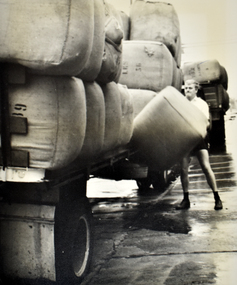
... ...Worsted Cloth...It specialised in heavy worsted cloths, high-quality tweed, and its signature "Retsol" and "Monarch" pure-wool travelling rugs, later adapting its machinery to blend natural wool with artificial fibres as mid-century market demands shifted....It specialised in heavy worsted cloths, high-quality tweed, and its signature "Retsol" and "Monarch" pure-wool travelling rugs, later adapting its machinery to blend natural wool with artificial fibres as mid-century market demands shifted. ...One of thirty eight photographs from a photo album featuring images of the Returned Sailors and Soldiers Woollen Mill in Newtown, Geelong. The images were taken between the 1960's-1970's by Norm Holroyd who worked at the mills. They were developed in his own private dark room and kept at his home for private viewing. The Returned Sailors and Soldiers Woollen Mill operated as a self-sufficient co-operative, funded and run by World War I veterans using their War Gratuity Bonds. The facility functioned as a complete raw-to-finished assembly line where raw fleece was brought on-site to be scoured, carded, dyed, spun into yarn and woven. It specialised in heavy worsted cloths, high-quality tweed, and its signature "Retsol" and "Monarch" pure-wool travelling rugs, later adapting its machinery to blend natural wool with artificial fibres as mid-century market demands shifted.Black and white photograph attached to cardboard backing with sticky tape. Image shows a man loading a wool bale onto a trailer for transport. Backing card has four holes in left side.back: [handwritten] 1r. s. & s mill, returned sailors and soldiers mill, newtown, geelong, world war i, soldiers, veterans, co-operative, textile industry, woollen mills, wool, worsted cloth, tweed, retsol, monarch, travel rugs, machinery, factory, working life, norm holroyd, photo album, photography, design, fabric -
 National Wool Museum
Photograph - Returned Sailors and Soldiers Mill, Norm Holroyd, 1960's - 1970's
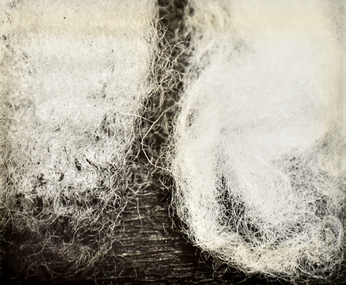
... ...Worsted Cloth...It specialised in heavy worsted cloths, high-quality tweed, and its signature "Retsol" and "Monarch" pure-wool travelling rugs, later adapting its machinery to blend natural wool with artificial fibres as mid-century market demands shifted....It specialised in heavy worsted cloths, high-quality tweed, and its signature "Retsol" and "Monarch" pure-wool travelling rugs, later adapting its machinery to blend natural wool with artificial fibres as mid-century market demands shifted. ...One of thirty eight photographs from a photo album featuring images of the Returned Sailors and Soldiers Woollen Mill in Newtown, Geelong. The images were taken between the 1960's-1970's by Norm Holroyd who worked at the mills. They were developed in his own private dark room and kept at his home for private viewing. The Returned Sailors and Soldiers Woollen Mill operated as a self-sufficient co-operative, funded and run by World War I veterans using their War Gratuity Bonds. The facility functioned as a complete raw-to-finished assembly line where raw fleece was brought on-site to be scoured, carded, dyed, spun into yarn and woven. It specialised in heavy worsted cloths, high-quality tweed, and its signature "Retsol" and "Monarch" pure-wool travelling rugs, later adapting its machinery to blend natural wool with artificial fibres as mid-century market demands shifted.Black and white photograph showing wool fibres in detail.r. s. & s mill, returned sailors and soldiers mill, newtown, geelong, world war i, soldiers, veterans, co-operative, textile industry, woollen mills, wool, worsted cloth, tweed, retsol, monarch, travel rugs, machinery, factory, working life, norm holroyd, photo album, photography, design, fabric -
 National Wool Museum
Photograph - Returned Sailors and Soldiers Mill, Norm Holroyd, 1960's - 1970's
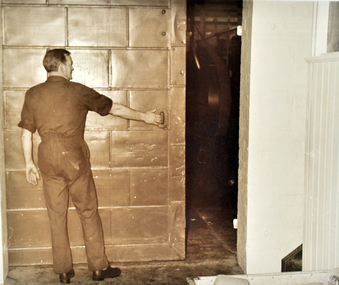
... ...Worsted Cloth...It specialised in heavy worsted cloths, high-quality tweed, and its signature "Retsol" and "Monarch" pure-wool travelling rugs, later adapting its machinery to blend natural wool with artificial fibres as mid-century market demands shifted....It specialised in heavy worsted cloths, high-quality tweed, and its signature "Retsol" and "Monarch" pure-wool travelling rugs, later adapting its machinery to blend natural wool with artificial fibres as mid-century market demands shifted. ...One of thirty eight photographs from a photo album featuring images of the Returned Sailors and Soldiers Woollen Mill in Newtown, Geelong. The images were taken between the 1960's-1970's by Norm Holroyd who worked at the mills. They were developed in his own private dark room and kept at his home for private viewing. The Returned Sailors and Soldiers Woollen Mill operated as a self-sufficient co-operative, funded and run by World War I veterans using their War Gratuity Bonds. The facility functioned as a complete raw-to-finished assembly line where raw fleece was brought on-site to be scoured, carded, dyed, spun into yarn and woven. It specialised in heavy worsted cloths, high-quality tweed, and its signature "Retsol" and "Monarch" pure-wool travelling rugs, later adapting its machinery to blend natural wool with artificial fibres as mid-century market demands shifted.Black and white photograph attached to cardboard backing with sticky tape. Image shows a man opening a sliding door inside a factory. Backing card has four holes in left side.r. s. & s mill, returned sailors and soldiers mill, newtown, geelong, world war i, soldiers, veterans, co-operative, textile industry, woollen mills, wool, worsted cloth, tweed, retsol, monarch, travel rugs, machinery, factory, working life, norm holroyd, photo album, photography, design, fabric -
 National Wool Museum
Photograph - Wool Processing, Returned Sailors and Soldiers Mill, Norm Holroyd, 1960's - 1970's
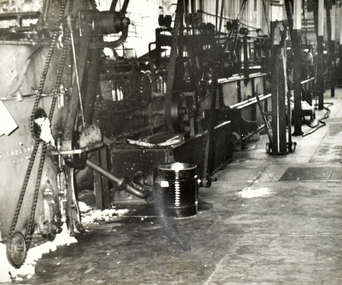
... ...Worsted Cloth...It specialised in heavy worsted cloths, high-quality tweed, and its signature "Retsol" and "Monarch" pure-wool travelling rugs, later adapting its machinery to blend natural wool with artificial fibres as mid-century market demands shifted....It specialised in heavy worsted cloths, high-quality tweed, and its signature "Retsol" and "Monarch" pure-wool travelling rugs, later adapting its machinery to blend natural wool with artificial fibres as mid-century market demands shifted. ...One of thirty eight photographs from a photo album featuring images of the Returned Sailors and Soldiers Woollen Mill in Newtown, Geelong. The images were taken between the 1960's-1970's by Norm Holroyd who worked at the mills. They were developed in his own private dark room and kept at his home for private viewing. The Returned Sailors and Soldiers Woollen Mill operated as a self-sufficient co-operative, funded and run by World War I veterans using their War Gratuity Bonds. The facility functioned as a complete raw-to-finished assembly line where raw fleece was brought on-site to be scoured, carded, dyed, spun into yarn and woven. It specialised in heavy worsted cloths, high-quality tweed, and its signature "Retsol" and "Monarch" pure-wool travelling rugs, later adapting its machinery to blend natural wool with artificial fibres as mid-century market demands shifted.Black and white photograph attached to cardboard backing with sticky tape. Image shows wool processing machinery. Backing card has four holes in left side.back: [handwritten] 4r. s. & s mill, returned sailors and soldiers mill, newtown, geelong, world war i, soldiers, veterans, co-operative, textile industry, woollen mills, wool, worsted cloth, tweed, retsol, monarch, travel rugs, machinery, factory, working life, norm holroyd, photo album, photography, design, fabric -
 National Wool Museum
Photograph - Returned Sailors and Soldiers Mill, Norm Holroyd, 1960's - 1970's
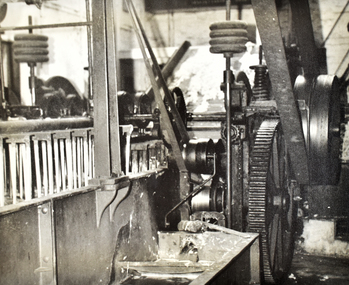
... ...Worsted Cloth...It specialised in heavy worsted cloths, high-quality tweed, and its signature "Retsol" and "Monarch" pure-wool travelling rugs, later adapting its machinery to blend natural wool with artificial fibres as mid-century market demands shifted....It specialised in heavy worsted cloths, high-quality tweed, and its signature "Retsol" and "Monarch" pure-wool travelling rugs, later adapting its machinery to blend natural wool with artificial fibres as mid-century market demands shifted. ...One of thirty eight photographs from a photo album featuring images of the Returned Sailors and Soldiers Woollen Mill in Newtown, Geelong. The images were taken between the 1960's-1970's by Norm Holroyd who worked at the mills. They were developed in his own private dark room and kept at his home for private viewing. The Returned Sailors and Soldiers Woollen Mill operated as a self-sufficient co-operative, funded and run by World War I veterans using their War Gratuity Bonds. The facility functioned as a complete raw-to-finished assembly line where raw fleece was brought on-site to be scoured, carded, dyed, spun into yarn and woven. It specialised in heavy worsted cloths, high-quality tweed, and its signature "Retsol" and "Monarch" pure-wool travelling rugs, later adapting its machinery to blend natural wool with artificial fibres as mid-century market demands shifted.Black and white photograph showing machinery processing wool.r. s. & s mill, returned sailors and soldiers mill, newtown, geelong, world war i, soldiers, veterans, co-operative, textile industry, woollen mills, wool, worsted cloth, tweed, retsol, monarch, travel rugs, machinery, factory, working life, norm holroyd, photo album, photography, design, fabric -
 National Wool Museum
Photograph - Wool Processing, Returned Sailors and Soldiers Mill, Norm Holroyd, 1960's - 1970's
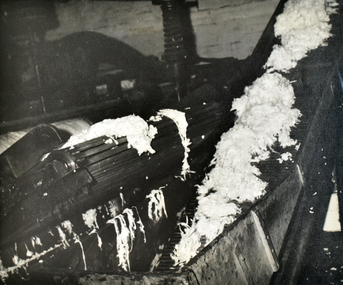
... ...Worsted Cloth...It specialised in heavy worsted cloths, high-quality tweed, and its signature "Retsol" and "Monarch" pure-wool travelling rugs, later adapting its machinery to blend natural wool with artificial fibres as mid-century market demands shifted....It specialised in heavy worsted cloths, high-quality tweed, and its signature "Retsol" and "Monarch" pure-wool travelling rugs, later adapting its machinery to blend natural wool with artificial fibres as mid-century market demands shifted. ...One of thirty eight photographs from a photo album featuring images of the Returned Sailors and Soldiers Woollen Mill in Newtown, Geelong. The images were taken between the 1960's-1970's by Norm Holroyd who worked at the mills. They were developed in his own private dark room and kept at his home for private viewing. The Returned Sailors and Soldiers Woollen Mill operated as a self-sufficient co-operative, funded and run by World War I veterans using their War Gratuity Bonds. The facility functioned as a complete raw-to-finished assembly line where raw fleece was brought on-site to be scoured, carded, dyed, spun into yarn and woven. It specialised in heavy worsted cloths, high-quality tweed, and its signature "Retsol" and "Monarch" pure-wool travelling rugs, later adapting its machinery to blend natural wool with artificial fibres as mid-century market demands shifted.Black and white photograph attached to cardboard backing with sticky tape. Image shows a close up of wool processing machinery. Backing card has four holes in left side.back: [handwritten] 6r. s. & s mill, returned sailors and soldiers mill, newtown, geelong, world war i, soldiers, veterans, co-operative, textile industry, woollen mills, wool, worsted cloth, tweed, retsol, monarch, travel rugs, machinery, factory, working life, norm holroyd, photo album, photography, design, fabric -
 National Wool Museum
Photograph - Returned Sailors and Soldiers Mill, Norm Holroyd, 1960's - 1970's
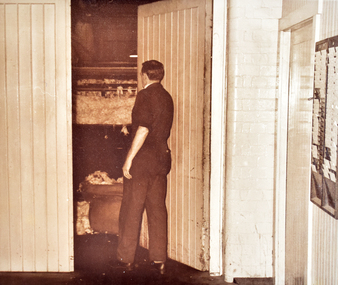
... ...Worsted Cloth...It specialised in heavy worsted cloths, high-quality tweed, and its signature "Retsol" and "Monarch" pure-wool travelling rugs, later adapting its machinery to blend natural wool with artificial fibres as mid-century market demands shifted....It specialised in heavy worsted cloths, high-quality tweed, and its signature "Retsol" and "Monarch" pure-wool travelling rugs, later adapting its machinery to blend natural wool with artificial fibres as mid-century market demands shifted. ...One of thirty eight photographs from a photo album featuring images of the Returned Sailors and Soldiers Woollen Mill in Newtown, Geelong. The images were taken between the 1960's-1970's by Norm Holroyd who worked at the mills. They were developed in his own private dark room and kept at his home for private viewing. The Returned Sailors and Soldiers Woollen Mill operated as a self-sufficient co-operative, funded and run by World War I veterans using their War Gratuity Bonds. The facility functioned as a complete raw-to-finished assembly line where raw fleece was brought on-site to be scoured, carded, dyed, spun into yarn and woven. It specialised in heavy worsted cloths, high-quality tweed, and its signature "Retsol" and "Monarch" pure-wool travelling rugs, later adapting its machinery to blend natural wool with artificial fibres as mid-century market demands shifted.Black and white photograph attached to cardboard backing with sticky tape. Image shows a man walking through a doorway inside a factory with time card racks to the right, and wool processing machinery in the background. Backing card has four holes in left side.back: [handwritten] 7r. s. & s mill, returned sailors and soldiers mill, newtown, geelong, world war i, soldiers, veterans, co-operative, textile industry, woollen mills, wool, worsted cloth, tweed, retsol, monarch, travel rugs, machinery, factory, working life, norm holroyd, photo album, photography, design, fabric -
 National Wool Museum
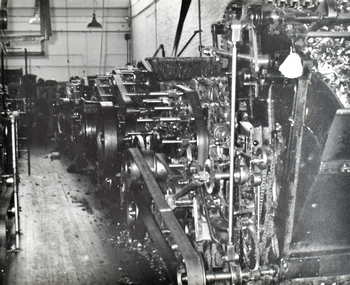
Photograph - Machinery, Returned Sailors and Soldiers Mill, Norm Holroyd, 1960's - 1970's
... ...Worsted Cloth...It specialised in heavy worsted cloths, high-quality tweed, and its signature "Retsol" and "Monarch" pure-wool travelling rugs, later adapting its machinery to blend natural wool with artificial fibres as mid-century market demands shifted....It specialised in heavy worsted cloths, high-quality tweed, and its signature "Retsol" and "Monarch" pure-wool travelling rugs, later adapting its machinery to blend natural wool with artificial fibres as mid-century market demands shifted. ...One of thirty eight photographs from a photo album featuring images of the Returned Sailors and Soldiers Woollen Mill in Newtown, Geelong. The images were taken between the 1960's-1970's by Norm Holroyd who worked at the mills. They were developed in his own private dark room and kept at his home for private viewing. The Returned Sailors and Soldiers Woollen Mill operated as a self-sufficient co-operative, funded and run by World War I veterans using their War Gratuity Bonds. The facility functioned as a complete raw-to-finished assembly line where raw fleece was brought on-site to be scoured, carded, dyed, spun into yarn and woven. It specialised in heavy worsted cloths, high-quality tweed, and its signature "Retsol" and "Monarch" pure-wool travelling rugs, later adapting its machinery to blend natural wool with artificial fibres as mid-century market demands shifted.Black and white photograph attached to cardboard backing with sticky tape. Image shows wool processing machinery inside a factory. Backing card has four holes in left side.back: [handwritten] 8r. s. & s mill, returned sailors and soldiers mill, newtown, geelong, world war i, soldiers, veterans, co-operative, textile industry, woollen mills, wool, worsted cloth, tweed, retsol, monarch, travel rugs, machinery, factory, working life, norm holroyd, photo album, photography, design, fabric -
 National Wool Museum
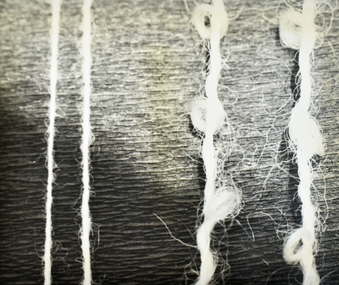
Photograph - Returned Sailors and Soldiers Mill, Norm Holroyd, 1960's - 1970's
... ...Worsted Cloth...It specialised in heavy worsted cloths, high-quality tweed, and its signature "Retsol" and "Monarch" pure-wool travelling rugs, later adapting its machinery to blend natural wool with artificial fibres as mid-century market demands shifted....It specialised in heavy worsted cloths, high-quality tweed, and its signature "Retsol" and "Monarch" pure-wool travelling rugs, later adapting its machinery to blend natural wool with artificial fibres as mid-century market demands shifted. ...One of thirty eight photographs from a photo album featuring images of the Returned Sailors and Soldiers Woollen Mill in Newtown, Geelong. The images were taken between the 1960's-1970's by Norm Holroyd who worked at the mills. They were developed in his own private dark room and kept at his home for private viewing. The Returned Sailors and Soldiers Woollen Mill operated as a self-sufficient co-operative, funded and run by World War I veterans using their War Gratuity Bonds. The facility functioned as a complete raw-to-finished assembly line where raw fleece was brought on-site to be scoured, carded, dyed, spun into yarn and woven. It specialised in heavy worsted cloths, high-quality tweed, and its signature "Retsol" and "Monarch" pure-wool travelling rugs, later adapting its machinery to blend natural wool with artificial fibres as mid-century market demands shifted.Black and white photograph attached to cardboard backing with sticky tape. Image shows detail of woollen thread. Backing card has four holes in left side.back: [handwritten] 17r. s. & s mill, returned sailors and soldiers mill, newtown, geelong, world war i, soldiers, veterans, co-operative, textile industry, woollen mills, wool, worsted cloth, tweed, retsol, monarch, travel rugs, machinery, factory, working life, norm holroyd, photo album, photography, design, fabric -
 National Wool Museum
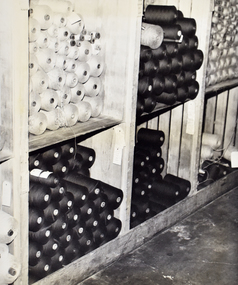
Photograph - Returned Sailors and Soldiers Mill, Norm Holroyd, 1960's - 1970's
... ...Worsted Cloth...It specialised in heavy worsted cloths, high-quality tweed, and its signature "Retsol" and "Monarch" pure-wool travelling rugs, later adapting its machinery to blend natural wool with artificial fibres as mid-century market demands shifted....It specialised in heavy worsted cloths, high-quality tweed, and its signature "Retsol" and "Monarch" pure-wool travelling rugs, later adapting its machinery to blend natural wool with artificial fibres as mid-century market demands shifted. ...One of thirty eight photographs from a photo album featuring images of the Returned Sailors and Soldiers Woollen Mill in Newtown, Geelong. The images were taken between the 1960's-1970's by Norm Holroyd who worked at the mills. They were developed in his own private dark room and kept at his home for private viewing. The Returned Sailors and Soldiers Woollen Mill operated as a self-sufficient co-operative, funded and run by World War I veterans using their War Gratuity Bonds. The facility functioned as a complete raw-to-finished assembly line where raw fleece was brought on-site to be scoured, carded, dyed, spun into yarn and woven. It specialised in heavy worsted cloths, high-quality tweed, and its signature "Retsol" and "Monarch" pure-wool travelling rugs, later adapting its machinery to blend natural wool with artificial fibres as mid-century market demands shifted.Black and white photograph attached to cardboard backing with sticky tape. Image shows wool on spools in storage compartments. Backing card has four holes in left side.back: [handwritten] 16r. s. & s mill, returned sailors and soldiers mill, newtown, geelong, world war i, soldiers, veterans, co-operative, textile industry, woollen mills, wool, worsted cloth, tweed, retsol, monarch, travel rugs, machinery, factory, working life, norm holroyd, photo album, photography, design, fabric -
 National Wool Museum
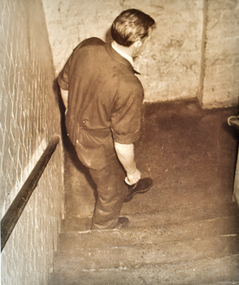
Photograph - Returned Sailors and Soldiers Mill, Norm Holroyd, 1960's - 1970's
... ...Worsted Cloth...It specialised in heavy worsted cloths, high-quality tweed, and its signature "Retsol" and "Monarch" pure-wool travelling rugs, later adapting its machinery to blend natural wool with artificial fibres as mid-century market demands shifted....It specialised in heavy worsted cloths, high-quality tweed, and its signature "Retsol" and "Monarch" pure-wool travelling rugs, later adapting its machinery to blend natural wool with artificial fibres as mid-century market demands shifted. ...One of thirty eight photographs from a photo album featuring images of the Returned Sailors and Soldiers Woollen Mill in Newtown, Geelong. The images were taken between the 1960's-1970's by Norm Holroyd who worked at the mills. They were developed in his own private dark room and kept at his home for private viewing. The Returned Sailors and Soldiers Woollen Mill operated as a self-sufficient co-operative, funded and run by World War I veterans using their War Gratuity Bonds. The facility functioned as a complete raw-to-finished assembly line where raw fleece was brought on-site to be scoured, carded, dyed, spun into yarn and woven. It specialised in heavy worsted cloths, high-quality tweed, and its signature "Retsol" and "Monarch" pure-wool travelling rugs, later adapting its machinery to blend natural wool with artificial fibres as mid-century market demands shifted.Black and white photograph attached to cardboard backing with sticky tape. Image shows a man walking down a stairwell. Backing card has four holes in left side.back: [handwritten] 15r. s. & s mill, returned sailors and soldiers mill, newtown, geelong, world war i, soldiers, veterans, co-operative, textile industry, woollen mills, wool, worsted cloth, tweed, retsol, monarch, travel rugs, machinery, factory, working life, norm holroyd, photo album, photography, design, fabric -
 National Wool Museum
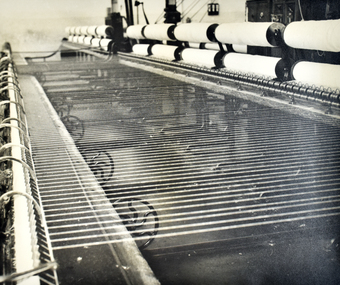
Photograph - Loom, Returned Sailors and Soldiers Mill, Norm Holroyd, 1960's - 1970's
... ...Worsted Cloth...It specialised in heavy worsted cloths, high-quality tweed, and its signature "Retsol" and "Monarch" pure-wool travelling rugs, later adapting its machinery to blend natural wool with artificial fibres as mid-century market demands shifted....It specialised in heavy worsted cloths, high-quality tweed, and its signature "Retsol" and "Monarch" pure-wool travelling rugs, later adapting its machinery to blend natural wool with artificial fibres as mid-century market demands shifted. ...One of thirty eight photographs from a photo album featuring images of the Returned Sailors and Soldiers Woollen Mill in Newtown, Geelong. The images were taken between the 1960's-1970's by Norm Holroyd who worked at the mills. They were developed in his own private dark room and kept at his home for private viewing. The Returned Sailors and Soldiers Woollen Mill operated as a self-sufficient co-operative, funded and run by World War I veterans using their War Gratuity Bonds. The facility functioned as a complete raw-to-finished assembly line where raw fleece was brought on-site to be scoured, carded, dyed, spun into yarn and woven. It specialised in heavy worsted cloths, high-quality tweed, and its signature "Retsol" and "Monarch" pure-wool travelling rugs, later adapting its machinery to blend natural wool with artificial fibres as mid-century market demands shifted.Black and white photograph attached to cardboard backing with sticky tape. Image shows detail of a loom. Backing card has four holes in left side.back: [handwritten] 13r. s. & s mill, returned sailors and soldiers mill, newtown, geelong, world war i, soldiers, veterans, co-operative, textile industry, woollen mills, wool, worsted cloth, tweed, retsol, monarch, travel rugs, machinery, factory, working life, norm holroyd, photo album, photography, design, fabric -
 National Wool Museum
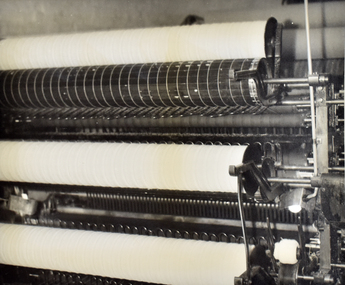
Photograph - Wool Processing, Returned Sailors and Soldiers Mill, Norm Holroyd, 1960's - 1970's
... ...Worsted Cloth...It specialised in heavy worsted cloths, high-quality tweed, and its signature "Retsol" and "Monarch" pure-wool travelling rugs, later adapting its machinery to blend natural wool with artificial fibres as mid-century market demands shifted....It specialised in heavy worsted cloths, high-quality tweed, and its signature "Retsol" and "Monarch" pure-wool travelling rugs, later adapting its machinery to blend natural wool with artificial fibres as mid-century market demands shifted. ...One of thirty eight photographs from a photo album featuring images of the Returned Sailors and Soldiers Woollen Mill in Newtown, Geelong. The images were taken between the 1960's-1970's by Norm Holroyd who worked at the mills. They were developed in his own private dark room and kept at his home for private viewing. The Returned Sailors and Soldiers Woollen Mill operated as a self-sufficient co-operative, funded and run by World War I veterans using their War Gratuity Bonds. The facility functioned as a complete raw-to-finished assembly line where raw fleece was brought on-site to be scoured, carded, dyed, spun into yarn and woven. It specialised in heavy worsted cloths, high-quality tweed, and its signature "Retsol" and "Monarch" pure-wool travelling rugs, later adapting its machinery to blend natural wool with artificial fibres as mid-century market demands shifted.Black and white photograph attached to cardboard backing with sticky tape. Image shows detail of wool processing machinery. Backing card has four holes in left side.back: [handwritten] 12r. s. & s mill, returned sailors and soldiers mill, newtown, geelong, world war i, soldiers, veterans, co-operative, textile industry, woollen mills, wool, worsted cloth, tweed, retsol, monarch, travel rugs, machinery, factory, working life, norm holroyd, photo album, photography, design, fabric -
 National Wool Museum
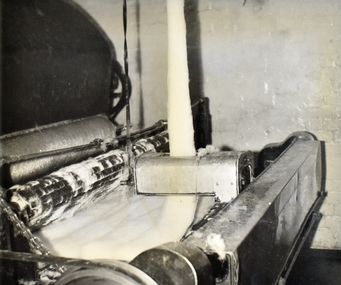
Photograph - Wool Processing, Returned Sailors and Soldiers Mill, Norm Holroyd, 1960's - 1970's
... ...Worsted Cloth...It specialised in heavy worsted cloths, high-quality tweed, and its signature "Retsol" and "Monarch" pure-wool travelling rugs, later adapting its machinery to blend natural wool with artificial fibres as mid-century market demands shifted....It specialised in heavy worsted cloths, high-quality tweed, and its signature "Retsol" and "Monarch" pure-wool travelling rugs, later adapting its machinery to blend natural wool with artificial fibres as mid-century market demands shifted. ...One of thirty eight photographs from a photo album featuring images of the Returned Sailors and Soldiers Woollen Mill in Newtown, Geelong. The images were taken between the 1960's-1970's by Norm Holroyd who worked at the mills. They were developed in his own private dark room and kept at his home for private viewing. The Returned Sailors and Soldiers Woollen Mill operated as a self-sufficient co-operative, funded and run by World War I veterans using their War Gratuity Bonds. The facility functioned as a complete raw-to-finished assembly line where raw fleece was brought on-site to be scoured, carded, dyed, spun into yarn and woven. It specialised in heavy worsted cloths, high-quality tweed, and its signature "Retsol" and "Monarch" pure-wool travelling rugs, later adapting its machinery to blend natural wool with artificial fibres as mid-century market demands shifted.Black and white photograph attached to cardboard backing with sticky tape. Image shows detail of wool processing machinery. Backing card has four holes in left side.back: [handwritten] 11r. s. & s mill, returned sailors and soldiers mill, newtown, geelong, world war i, soldiers, veterans, co-operative, textile industry, woollen mills, wool, worsted cloth, tweed, retsol, monarch, travel rugs, machinery, factory, working life, norm holroyd, photo album, photography, design, fabric -
 National Wool Museum
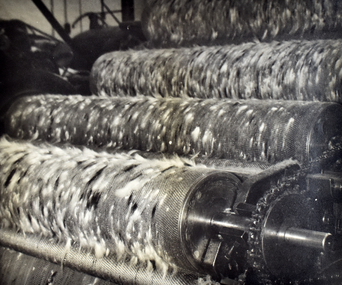
Photograph - Wool Processing, Returned Sailors and Soldiers Mill, Norm Holroyd, 1960's - 1970's
... ...Worsted Cloth...It specialised in heavy worsted cloths, high-quality tweed, and its signature "Retsol" and "Monarch" pure-wool travelling rugs, later adapting its machinery to blend natural wool with artificial fibres as mid-century market demands shifted....It specialised in heavy worsted cloths, high-quality tweed, and its signature "Retsol" and "Monarch" pure-wool travelling rugs, later adapting its machinery to blend natural wool with artificial fibres as mid-century market demands shifted. ...One of thirty eight photographs from a photo album featuring images of the Returned Sailors and Soldiers Woollen Mill in Newtown, Geelong. The images were taken between the 1960's-1970's by Norm Holroyd who worked at the mills. They were developed in his own private dark room and kept at his home for private viewing. The Returned Sailors and Soldiers Woollen Mill operated as a self-sufficient co-operative, funded and run by World War I veterans using their War Gratuity Bonds. The facility functioned as a complete raw-to-finished assembly line where raw fleece was brought on-site to be scoured, carded, dyed, spun into yarn and woven. It specialised in heavy worsted cloths, high-quality tweed, and its signature "Retsol" and "Monarch" pure-wool travelling rugs, later adapting its machinery to blend natural wool with artificial fibres as mid-century market demands shifted.Black and white photograph attached to cardboard backing with sticky tape. Image shows detail of wool processing machinery. Backing card has four holes in left side.back: [handwritten] 10r. s. & s mill, returned sailors and soldiers mill, newtown, geelong, world war i, soldiers, veterans, co-operative, textile industry, woollen mills, wool, worsted cloth, tweed, retsol, monarch, travel rugs, machinery, factory, working life, norm holroyd, photo album, photography, design, fabric -
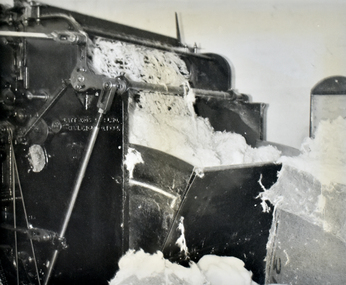 National Wool Museum
Photograph - Returned Sailors and Soldiers Mill, Norm Holroyd, 1960's - 1970's
... ...Worsted Cloth...It specialised in heavy worsted cloths, high-quality tweed, and its signature "Retsol" and "Monarch" pure-wool travelling rugs, later adapting its machinery to blend natural wool with artificial fibres as mid-century market demands shifted....It specialised in heavy worsted cloths, high-quality tweed, and its signature "Retsol" and "Monarch" pure-wool travelling rugs, later adapting its machinery to blend natural wool with artificial fibres as mid-century market demands shifted. ...One of thirty eight photographs from a photo album featuring images of the Returned Sailors and Soldiers Woollen Mill in Newtown, Geelong. The images were taken between the 1960's-1970's by Norm Holroyd who worked at the mills. They were developed in his own private dark room and kept at his home for private viewing. The Returned Sailors and Soldiers Woollen Mill operated as a self-sufficient co-operative, funded and run by World War I veterans using their War Gratuity Bonds. The facility functioned as a complete raw-to-finished assembly line where raw fleece was brought on-site to be scoured, carded, dyed, spun into yarn and woven. It specialised in heavy worsted cloths, high-quality tweed, and its signature "Retsol" and "Monarch" pure-wool travelling rugs, later adapting its machinery to blend natural wool with artificial fibres as mid-century market demands shifted.Black and white photograph showing machinery processing wool.r. s. & s mill, returned sailors and soldiers mill, newtown, geelong, world war i, soldiers, veterans, co-operative, textile industry, woollen mills, wool, worsted cloth, tweed, retsol, monarch, travel rugs, machinery, factory, working life, norm holroyd, photo album, photography, design, fabric -
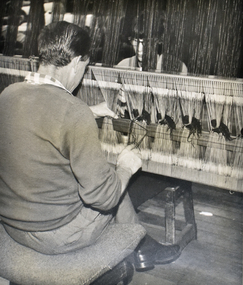 National Wool Museum
Photograph - Loom, Returned Sailors and Soldiers Mill, Norm Holroyd, 1960's - 1970's
... ...Worsted Cloth...It specialised in heavy worsted cloths, high-quality tweed, and its signature "Retsol" and "Monarch" pure-wool travelling rugs, later adapting its machinery to blend natural wool with artificial fibres as mid-century market demands shifted....It specialised in heavy worsted cloths, high-quality tweed, and its signature "Retsol" and "Monarch" pure-wool travelling rugs, later adapting its machinery to blend natural wool with artificial fibres as mid-century market demands shifted. ...One of thirty eight photographs from a photo album featuring images of the Returned Sailors and Soldiers Woollen Mill in Newtown, Geelong. The images were taken between the 1960's-1970's by Norm Holroyd who worked at the mills. They were developed in his own private dark room and kept at his home for private viewing. The Returned Sailors and Soldiers Woollen Mill operated as a self-sufficient co-operative, funded and run by World War I veterans using their War Gratuity Bonds. The facility functioned as a complete raw-to-finished assembly line where raw fleece was brought on-site to be scoured, carded, dyed, spun into yarn and woven. It specialised in heavy worsted cloths, high-quality tweed, and its signature "Retsol" and "Monarch" pure-wool travelling rugs, later adapting its machinery to blend natural wool with artificial fibres as mid-century market demands shifted.Black and white photograph attached to cardboard backing with sticky tape. Image shows a man working at a loom. Backing card has four holes in left side.back: [handwritten] 23r. s. & s mill, returned sailors and soldiers mill, newtown, geelong, world war i, soldiers, veterans, co-operative, textile industry, woollen mills, wool, worsted cloth, tweed, retsol, monarch, travel rugs, machinery, factory, working life, norm holroyd, photo album, photography, design, fabric
