
Showing 10 items matching "ww2 glasses"
-
 Tatura Irrigation & Wartime Camps Museum
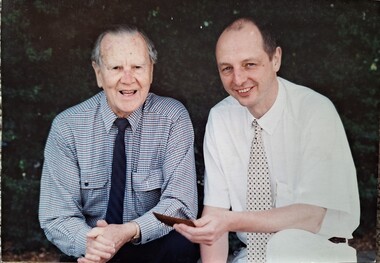
Photograph, Opticians visit
... ...WW2 glasses...Bernd Mildebrath Jack Every Shepparton optician Dhurringile POW Camp WW2 glasses Black and white photograph of 2 men, one in a blue and white check shirt and dark tie and the other in a white shirt with tie. ...Bernd Mildebrath, of Germany, visiting Jack Every, a 84 year old optician from Shepparton, who supplied his father in Dhurringile POW Camp with glasses in 1942. Bernd still uses the glasses case and frames. Photograph taken at Tatura Museum in 1998.Black and white photograph of 2 men, one in a blue and white check shirt and dark tie and the other in a white shirt with tie.bernd mildebrath, jack every, shepparton optician, dhurringile pow camp, ww2 glasses -
 The 5th/6th Battalion Royal Victoria Regiment Historical Collection
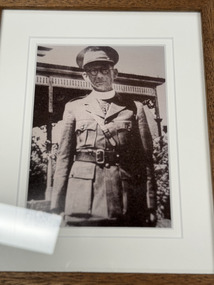
Photograph - Framed Photograph, Rev JJ Tresidder VX117292
... In the photograph, the Reverand is wearing glasses, a WW2 style jacket, sam browne and peak cap as well as a priests collar. ...John Joseph Tressider was a Catholic Chaplain that served in WW2 Chaplain Photograph 5/6RVR WW2 13cm x18cm black and white photograph of Army Catholic Chaplain VX117292 Capt JJ Tresidder. In the photograph, the Reverand is wearing glasses, a WW2 style jacket, sam browne and peak cap as well as a priests collar. ...John Joseph Tressider was a Catholic Chaplain that served in WW213cm x18cm black and white photograph of Army Catholic Chaplain VX117292 Capt JJ Tresidder. In the photograph, the Reverand is wearing glasses, a WW2 style jacket, sam browne and peak cap as well as a priests collar. The photograph is on fujifilm photostock paper. The photo is framed in a hazelnut coloured frame and has a white, stepped card spacer between the photo and the glass.chaplain, photograph, 5/6rvr, ww2 -
 City of Moorabbin Historical Society (Operating the Box Cottage Museum)
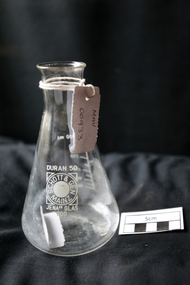
Manufactured Glass, Pharmacy beaker, c1950
... glasses. Soon to be added was fiolax, tube-shaped glass used for vials, ampoules and syringes thus allowing the company to play a significant role in supplying Europe's nascent pharmaceutical industry. Post WW2...glasses. Soon to be added was fiolax, tube-shaped glass used for vials, ampoules and syringes thus allowing the company to play a significant role in supplying Europe's nascent pharmaceutical industry. Post WW2 ...Otto Schott, a chemist and glass engineer, had the vision of uniform production ie making glass items that would resemble one another. At the end of the eighteenth century, with most glass items still created by hand, the quality of output was still a guessing game. Schott was the first to render this an industrial certainty. 1884 Otto Schott, Ernst Abbe and Carl and Roderich Zeiss found the Schott & Associates Glass Technology Laboratory in Jena, Germany. Glastechnisches Laboratorium Schott & Gen was born. Production started in 1886. Original products included optical and thermometer glasses. The following year, a crucial discovery was made: borosilicate, a heat and chemically resistant glass. By it’s 25th year anniversary, the company had grown from an experimental glass factory into an internationally renowned manufacturer of optical and industrial glasses. Soon to be added was fiolax, tube-shaped glass used for vials, ampoules and syringes thus allowing the company to play a significant role in supplying Europe's nascent pharmaceutical industry. Post WW2 USA Army opens new factory in Mainz, West Germany and factory in Jena , East Germany taken over by the DDR State both using same trade name. Legal action for 30 years resolved in 1980 - split name. Berlin Wall 1989, Factories reunited 1991A pharmaceutical clear glass beaker with graduation 100ml -300ml DURAN 50Front : DURAN 50 / SCHOTT & GEN / MAINZ / JENA (ER) GLAS 300 Back : PYREX 300pharmacy, medications, medicines, glass manufacturing, glass works, early settlers, moorabbin, bentleigh, cheltenham, jenaer glaswerk schott & gen company, west germany, east germany, berlin wall, ww2 1939-45, schott otto, zeiss roderich -
 City of Moorabbin Historical Society (Operating the Box Cottage Museum)
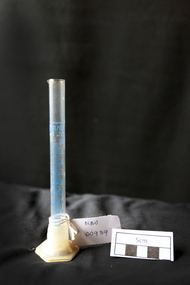
Manufactured glass, graduated cylinder 10ml, c1948 - 1991
... glasses. Soon to be added was fiolax, tube-shaped glass used for vials, ampoules and syringes thus allowing the company to play a significant role in supplying Europe's nascent pharmaceutical industry. During WW2...glasses. Soon to be added was fiolax, tube-shaped glass used for vials, ampoules and syringes thus allowing the company to play a significant role in supplying Europe's nascent pharmaceutical industry. During WW2 ...Otto Schott, a chemist and glass engineer, had the vision of uniform production ie making glass items that would resemble one another. At the end of the eighteenth century, with most glass items still created by hand, the quality of output was still a guessing game. Schott was the first to render this an industrial certainty. 1884 Otto Schott, Ernst Abbe and Carl and Roderich Zeiss found the Schott & Associates Glass Technology Laboratory in Jena, Germany. Glastechnisches Laboratorium Schott & Gen was born. Production started in 1886. The following year, a crucial discovery was made: borosilicate, a heat and chemically resistant glass.By it’s 25th year anniversary, the company had grown from an experimental glass factory into an internationally renowned manufacturer of optical and industrial glasses. Soon to be added was fiolax, tube-shaped glass used for vials, ampoules and syringes thus allowing the company to play a significant role in supplying Europe's nascent pharmaceutical industry. During WW2 Company was taken over for military use, and in 1945 given to the Russians as East Germany - GDR. , US troops transfer the "brain trust" of Jenaer Glas to Mainz in West and In Jena , East Germany, in 1948 the company became a state-owned "property of the people." The West German company becomes Schott Glaswerk, while the people in Jena, GDR, shorten their name to Jenaer Glaswerk. When the Berlin Wall comes down in 1989 Germany is united once again and in 1991 the company is joined and the Jena factory is brought up-to-date by 1994.This 10ml clear glass, graduated cylinder for laboratory tests, set in a plastic pentagonal base, is made of borosilicate glass. It has a pouring lip. The wide pentagonal shaped base provides stability and makes the cylinder roll-resistant. agr / ? TRS 10/0.1 / B Tol + - 0.1 / ml in 20'C / GDR pharmacy, medications, medicines, glass manufacturing, glass works, early settlers, moorabbin, bentleigh, cheltenham, jenaer glaswerk schott & gen company, west germany, east germany, berlin wall, ww2 1939-45, schott otto, zeiss roderich, borosilicate glass, glass cylinders, laboratory glass -
 Bendigo Military Museum
Souvenir - GLASSES, DECORATIVE
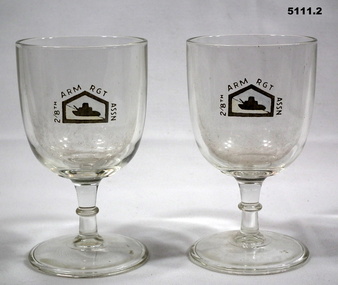
... Glasses given by the 2/8th ARM RGT ASSN. The 2/8th Armoured Regiment was an armoured regiment of the Australian Army. It was raised for service during WW2...Glasses given by the 2/8th ARM RGT ASSN. The 2/8th Armoured Regiment was an armoured regiment of the Australian Army. It was raised for service during WW2 ...Glasses given by the 2/8th ARM RGT ASSN. The 2/8th Armoured Regiment was an armoured regiment of the Australian Army. It was raised for service during WW2, being formed in July 1941. it deployed to New Guinea in 1943 but did not see any action before being disbanded in February 1944.Two clear wine glasses with stems. Engraved writing and picture of a tank.2/8th Arm Rgt Assn.souvenirs, glasses, 2/8 arm rgt assn -
 Bendigo Military Museum
Equipment - GOGGLES WW2, C.1939 - 45
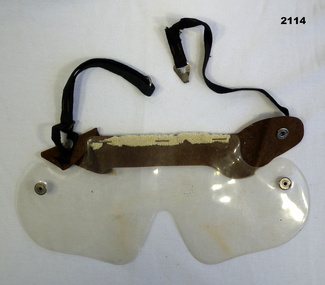
... Glasses eyesheild military equipment Clear celluloid eye shield stapled to cloth forehead band. Press studs on shield & band allows shield to wrap around eyes. Goggles fastened to head with adjustable elastic band. Elastic band joined with metal hook & ring. Equipment GOGGLES WW2 ...Items relate to Clifford Alfred Cairncross RAAF. Refer 2108.7 for his service record.Clear celluloid eye shield stapled to cloth forehead band. Press studs on shield & band allows shield to wrap around eyes. Goggles fastened to head with adjustable elastic band. Elastic band joined with metal hook & ring.glasses, eyesheild, military equipment -
 Returned Nurses RSL Sub-branch
Newspaper - Newspaper clipping, Book by war nurse : White Coolies, 16 March 1954
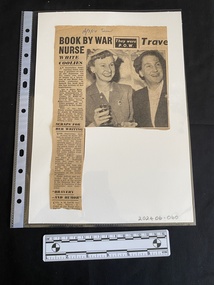
... WW2 POW's. The article details Sister Jefferey starting to write the book while still a POW, and during her two year recuperation in an Australian Army hospital. She is willing to gift the original scraps of paper she used to write the book to the National War Memorial in Canberra. Vivien Bullwinkel Australian Army Nurses WWII Vivian Statham (nee Bullwinkel) '16/3/54 Sun' [blue ink top of page] A newspaper clipping from a larger page of a single column of text and large black and white photo of two women holding glasses and smiling. ...This clipping is announcing the launch of a book written by Betty Jeffrey about her and other Australian Nurses' time as WW2 POW's. The article details Sister Jefferey starting to write the book while still a POW, and during her two year recuperation in an Australian Army hospital. She is willing to gift the original scraps of paper she used to write the book to the National War Memorial in Canberra.A newspaper clipping from a larger page of a single column of text and large black and white photo of two women holding glasses and smiling. The bottom of the article appears to be missing.'16/3/54 Sun' [blue ink top of page]vivien bullwinkel, australian army nurses, wwii, vivian statham (nee bullwinkel) -
 Returned Nurses RSL Sub-branch
Newspaper - Newspaper clipping, The Age, untitled, [9 Apr 96]14 August 1991
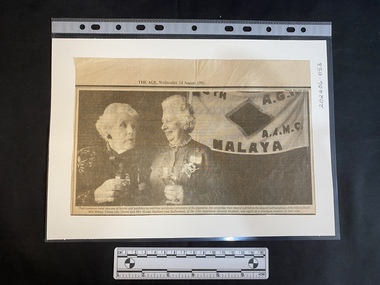
... WW2 WWII Wilma Jones Japanese 13th Australian General Hospital Hilton Hotel A newspaper clipping of a large black and white photo featuring two older women holding wine glasses and standing in front of the 13th Australian General Hosptial's flag untitled Newspaper Newspaper clipping The Age William West ...The caption beneath the photos names Mrs Wilma Young (nee Oram) and Mrs Vivian Statham (nee Bullwinkel) who were at a reunion for their unit where they had a common bond as wartime nurses and POWs.A newspaper clipping of a large black and white photo featuring two older women holding wine glasses and standing in front of the 13th Australian General Hosptial's flagww2, wwii, wilma jones, japanese, 13th australian general hospital, hilton hotel -
 Returned Nurses RSL Sub-branch
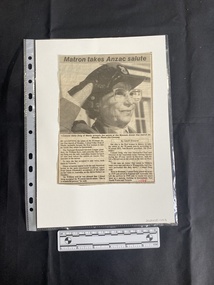
Newspaper - Newspaper clipping, Jim Campey, Matron takes Anzac salute, [1988]
... World War 2 WWII WW2 Edna Nell Doig ANZAC Day march '1988' [red ink, bottom right of page] 'UNIT 36 / 87 SEYMOUR ROAD / ELSTERNWICK, 3185' [stamped in black ink, reverse side, lower left of page] A newspaper clipping featuring a large black and white photo of an older woman in glasses saluting, beneath a title and above two columns of text Matron takes Anzac salute Newspaper Newspaper clipping Jim Campey Geoff Shearer ...Brief article recognising the significance of Edna [Nell] Doig accepting the salute at the Wynnum Anzac Day march.A newspaper clipping featuring a large black and white photo of an older woman in glasses saluting, beneath a title and above two columns of text'1988' [red ink, bottom right of page] 'UNIT 36 / 87 SEYMOUR ROAD / ELSTERNWICK, 3185' [stamped in black ink, reverse side, lower left of page]world war 2, wwii, ww2, edna nell doig, anzac day march -
 Returned Nurses RSL Sub-branch
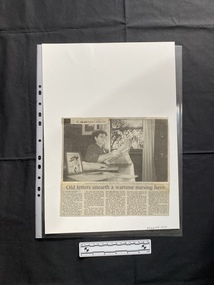
Newspaper - Newspaper clipping, The Age, Old letters unearth a wartime nursing hero, 19960101
... Niece of Elmes, Sally Alsop hopes they are to be collated and published [Published 2023: 'Back to Bangka: searching for the truth about a wartime massacre' by Georgina Banks] Dorothy Gwendoline Howard Elmes Bangka Island WWII WW2 World War Two 'NC9' [blue ink, top left, sticky taped on] A newspaper clipping of a large black and white photo with a title and five columns of text beneath. The photo shows a woman in glasses ...Brief article on wartime letters to family from Dorothy Gwendoline [Howard] Elmes a WWII nurse who was killed on Banka [sic] Island in February 1942. Niece of Elmes, Sally Alsop hopes they are to be collated and published [Published 2023: 'Back to Bangka: searching for the truth about a wartime massacre' by Georgina Banks]A newspaper clipping of a large black and white photo with a title and five columns of text beneath. The photo shows a woman in glasses sitting in front of a window holding several sheets of paper. A smaller clipping containing publication details and date is attached with sticky tape to the top edge.'NC9' [blue ink, top left, sticky taped on]dorothy gwendoline howard elmes, bangka island, wwii, ww2, world war two
