
Showing 14 items matching "wwii rations"
-
 Eltham District Historical Society Inc
Document - Folder, Yonckheere, Rosemany
... ...WWII rations...Rosemary Yonckheere WWII rations Newspaper clippings, A4 photocopies, etc Yonckheere, Rosemany Document Folder ...Rosemary Yonckheere lived in Montmorency. Contents Notes by Rosemary Yonckheere on her life as a child in war time.Newspaper clippings, A4 photocopies, etcrosemary yonckheere, wwii rations -
 Montmorency–Eltham RSL Sub Branch
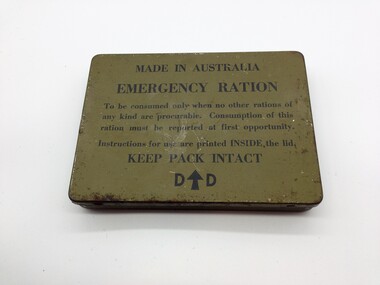
Equipment - Ration Pack Emergency, WWII
... WWII emergency ration pack used by Australian Armed Forces ration pack emergency wwii australian armed forces On front of the lid. MADE IN AUSTRALIA EMERGENCY RATION To be consumed only when no other rations of any kind are procurable. ...WWII emergency ration pack used by Australian Armed Forces.WWII emergency ration pack used by Australian Armed ForcesWWII emergency ration pack used by Australian Armed Forces. Small rectangular shaped khaki green painted tin plate metal container with lid. Black ink printed usage instructions on the front and rear of the lid. Department of Defence logo printed on front cover.On front of the lid. MADE IN AUSTRALIA EMERGENCY RATION To be consumed only when no other rations of any kind are procurable. Consumption of this fation must be reported at first oppurtunity. Instructions for use are printed INSIDE the lid. KEEP PACK INTACT D(up arrow)D On rear of the lid INSTRUCTIONS FOR USE FRUIT RATION & MILK TABLETS: MEAT & VEG. RATION: ration pack, emergency, wwii, australian armed forces -
 Queenscliffe Maritime Museum
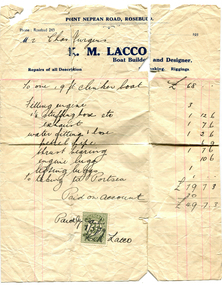
Document - Fishing related forms and documents from the 30s and 40s
... The fishing industry continued to be essential during the late 30s and throughout the war years and local fishermen as in this example continued their efforts while contending with petrol rations and other expenses. Fuel ration tickets WWII Fishing A collection of fishing related documents in the late 1930s and 1940s Document Fishing related forms and documents from the 30s and 40s ...The fishing industry continued to be essential during the late 30s and throughout the war years and local fishermen as in this example continued their efforts while contending with petrol rations and other expenses.A collection of fishing related documents in the late 1930s and 1940sfuel ration tickets, wwii, fishing -
 Queenscliffe Maritime Museum
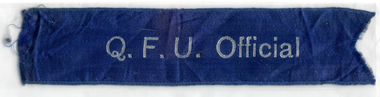
Document - Fishing related forms and documents from the 30s and 40s
... The fishing industry continued to be essential during the late 30s and throughout the war years and local fishermen as in this example continued their efforts while contending with petrol rations and other expenses. Fuel ration tickets WWII Fishing A collection of fishing related memorablia belonging to Charles Jurgens; Permit Document Fishing related forms and documents from the 30s and 40s ...The fishing industry continued to be essential during the late 30s and throughout the war years and local fishermen as in this example continued their efforts while contending with petrol rations and other expenses.A collection of fishing related memorablia belonging to Charles Jurgens; Permitfuel ration tickets, wwii, fishing -
 Queenscliffe Maritime Museum
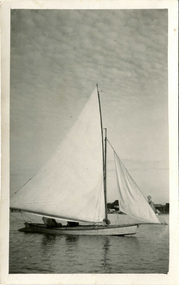
Photograph - Couta and fishing boat photographs
... The fishing industry continued to be essential during the late 30s and throughout the war years and local fishermen as in this example continued their efforts while contending with petrol rations and other expenses. Fuel ration tickets WWII Fishing Couta boats Fishing boats A collection of photographs of fishing and couta boats belonging to Charles Jurgens. ...The fishing industry continued to be essential during the late 30s and throughout the war years and local fishermen as in this example continued their efforts while contending with petrol rations and other expenses.A collection of photographs of fishing and couta boats belonging to Charles Jurgens.fuel ration tickets, wwii, fishing, couta boats, fishing boats -
 Bendigo Historical Society Inc.
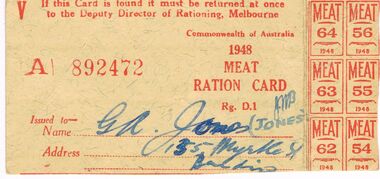
Ephemera - MISS G ALICE JONES COLLECTION: WWII MEAT RATION CARD, 1940's
... rations applied to red meat only. Initially it allowed 21/4 pounds per adult, per week. By the end of the war this had reduced to 2 pounds. GOVERNMENT Federal meat ration card WW11 G. A. Jones WWII ...Meat rations applied to red meat only. Initially it allowed 21/4 pounds per adult, per week. By the end of the war this had reduced to 2 pounds.WWII Meat Ration Card: beige card with blue flecks and red print. "V If this card is found it must be returned at once to the Deputy Director of Rationing Melbourne. Commonwealth of Australia. A. 892472 1948 Meat Ration Card. Rig. D.1. Issued to Name". Hand written in blue ink is "G.A. Jones" (Hones) with signature and Address."135 Myrtle Street Bendigo". To the right of the card is small numbered tickets with "MEAT and 1948" across. Tickets are numbered 62,63,64,54,55,56.government, federal, meat ration card, ww11 g. a. jones -
 Wangaratta RSL Sub Branch
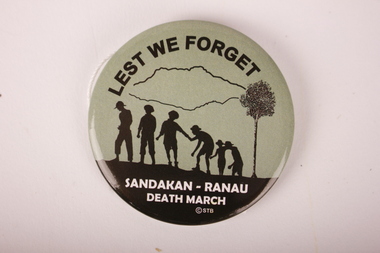
Badge, unknown
... WWII. Australian prisoners were sent to Sandakan in 1942 to build an airstrip. At first they were treated reasonably well. Gradually, however, rations ...Badge commemorating the Sandakan death marches, one of the worst atrocities suffered by Australian troops during WWII.Australian prisoners were sent to Sandakan in 1942 to build an airstrip. At first they were treated reasonably well. Gradually, however, rations were reduced and bashings increased. By late 1944, with Allied forces advancing toward Borneo, the Japanese decided to send about 2,000 Australian and British prisoners westward to Ranau, in Borneo’s rugged interior. Weak and sick prisoners staggered for about 260 kilometres along jungle tracks. Many died on the way, their bodies never recovered. Those unable to continue were killed; those too weak to march had been left behind in Sandakan, where all died or were killed. Only six – all Australians – out of about a thousand sent to Ranau survived the war. The Sandakan “death march” remains the greatest single atrocity committed against Australians in war.Circular badge with green background and black text and figures. Six soldiers are silhouetted next to a tree. Safety pin clasp on back."LEST WE FORGET" "Sandakan Ranau / Death March"pow, world war two, death march, sandakan death marches, borneo -
 Dandenong/Cranbourne RSL Sub Branch
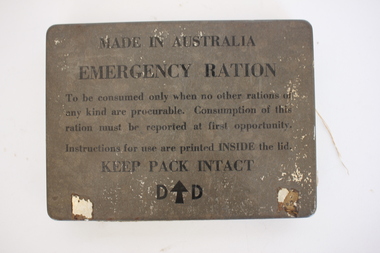
Memorabilia - Emergency Ration Tin, WWII era
... WWII both in Australia and overseas. He was born at Womerah on 9/11/1906 and died at Koo Wee Rup 16/06/1984. He enlisted at Yarram on 1/7/1940 and was discharged at Royal Park on 9/3/1945. ration tin emergency rations rissole fruit ration veg ration milk tablets Lid: "MADE IN AUSTRALIA / EMERGENCY RATION / To be consumed only when no other rations of any kind are procurable. ...VX 27898 Corporal Thomas John Morris Thomas (Tom Thomas) donated several items to Cranbourne RSL. He served in the Australian Corp Signals in WWII both in Australia and overseas. He was born at Womerah on 9/11/1906 and died at Koo Wee Rup 16/06/1984. He enlisted at Yarram on 1/7/1940 and was discharged at Royal Park on 9/3/1945.Rectangular painted metal tin for holding emergency rations. Green paint with canvas tape along sides. Hinged lid. Silver inside.Lid: "MADE IN AUSTRALIA / EMERGENCY RATION / To be consumed only when no other rations of any kind are procurable. Consumption of this ration must be reported at first opportunity. / Instructions for use are printed INSIDE the lid. / KEEP PACK INTACT / D (ARROW) D" Inside lid: ' INSTRUCTIONS FOR USE / FRUIT RATION & MILK TABLETS: / To be consumed as found. / MEAT & VEG. RATION: / 1. May be eaten as packed / 2. A more palatable meal results by cooking in or heating with four times its bulk of boiling water. / 3. Moistened with water it can be fried as a Rissole without added fat."ration tin, emergency rations, rissole, fruit ration, veg ration, milk tablets -
 Dandenong/Cranbourne RSL Sub Branch
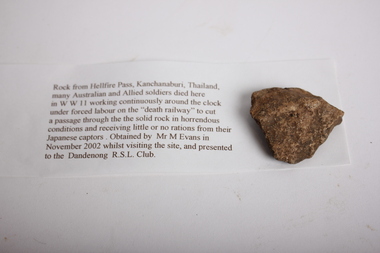
Souvenir - Rock From Hellfire Pass
... A typed note with the rock reads-: Rock from Hellfire Pass, Kanchanaburi,Thailand, manyAustralian and Allied soldiers died here in WWII working continuously around the clock under forced labour on the "death railway" to cut a passage through the solid rock in horrendous conditions and receiving little or no rations from their Japanese captors. ...A typed note with the rock reads-: Rock from Hellfire Pass, Kanchanaburi,Thailand, manyAustralian and Allied soldiers died here in WWII working continuously around the clock under forced labour on the "death railway" to cut a passage through the solid rock in horrendous conditions and receiving little or no rations from their Japanese captors. ...Small rock/stone from Hellfire Pass Kanchanaburi, Thailand. (appears sedimentary rock) Cream coloured.No inscriptions on the Rock.. A typed note with the rock reads-: Rock from Hellfire Pass, Kanchanaburi,Thailand, manyAustralian and Allied soldiers died here in WWII working continuously around the clock under forced labour on the "death railway" to cut a passage through the solid rock in horrendous conditions and receiving little or no rations from their Japanese captors. Obtained by Mr M Evans in November 2002 whilst visiting the site,and presented to the Dandenong RSL Club. -
 Mont De Lancey
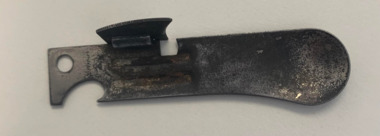
Functional object - Field Rations Eating Device (F.R.E.D), c.1943-1945, 1940's
... Rations...Spoons...WWII...rations that lasted 24 full hours. This F.R.E.D. matches the second iteration of the combination can opener and spoon popularised during the Vietnam War, and belonged to the uncle of Ian Taylor. Ian remembers his uncle telling him about using F.R.E.D. during WWII...Military Equipment Cutlery Rations Military Rations Spoons WWII Bottle openers Pocket knives 'China' A small metal Field Rations Eating Device (F.R.E.D.) with two sides, one side has a shallow spoon and the other a bottle and can opener, with two raised vertical lines on the back. ...The F.R.E.D otherwise known as the “F*cking Ridiculous Eating Device” was introduced in 1943 as part of Sir Stanton Hicks' "Operation Ration Type O2," Australia's first military rations that lasted 24 full hours. This F.R.E.D. matches the second iteration of the combination can opener and spoon popularised during the Vietnam War, and belonged to the uncle of Ian Taylor. Ian remembers his uncle telling him about using F.R.E.D. during WWII, primarily to open baked beans. It is claimed in some military histories that, after the F.R.E.D.’s introduction in 1943, Australian soldiers developed a ‘strange attachment’ to the F.R.E.D., keeping the utensils far after their service was up and, in this case, passing them on to future generations as bean openers. It can be used for camping holidays too.A small metal Field Rations Eating Device (F.R.E.D.) with two sides, one side has a shallow spoon and the other a bottle and can opener, with two raised vertical lines on the back. On the end is a circular hole to attach the tool to a pocket knife. It can be used for camping holidays too.'China'military equipment, cutlery, rations, military rations, spoons, wwii, bottle openers, pocket knives -
 Rutherglen RSL Sub-Branch
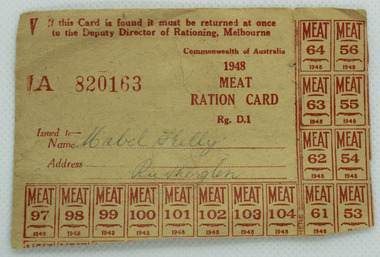
Memorabilia - Meat ration card, Commonwealth of Australia, 1948
... Issued to individuals as part of the war effort in rationing food post WWII. meat ration card mabel kelly wwii homefront shopping world war two If this Card is found it must be returned at once/ to the Deputy Director of Rationing, Melbourne/ A 820163/ Issued to Mabel Kelly/ Address Rutherglen Printed rectangular piece of paper with red text showing squares for 16 rations. ...Issued to individuals as part of the war effort in rationing food post WWII.Printed rectangular piece of paper with red text showing squares for 16 rations. This card issued to a Mabel Kelly of Rutherglen.If this Card is found it must be returned at once/ to the Deputy Director of Rationing, Melbourne/ A 820163/ Issued to Mabel Kelly/ Address Rutherglen meat ration card, mabel kelly, wwii, homefront, shopping, world war two -
 Returned Nurses RSL Sub-branch
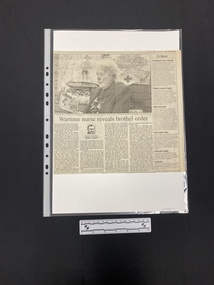
Newspaper - Newspaper clipping, The Age, Wartime nurse reveals brothel order, Saturday 12 August 1995
... rations consisted of a cup of rice, sometimes supplemented palm oil, rotten vegetables or similar. Daily work for the nurses included caring for the sick prisoners, rarely with medicinal aid. In brief stories do not appear relevant WWII ...Main story Mrs Wilma Young (nee Oram) is speaking for the first time publicly about certain happenings during World War Two, when she and other Australian Nurses were held as POWs in Sumatra. Of the 65 nurses who fled from Singapore on the Vyner Brooke in February 1942, 54 made it to Banka Island after the ship was bombed, with 21 being massacred on a beach. Over the next three years the remaining nurses were imprisonesd by the Japanese in a series of camps in Sumatra and on Banka Island, before being liberated. The group of surviving nurses had not spoken of certain events publicly before, but at 78 Mrs Wilma Young has decided to. The Japanese tried to force the nurses into participating in a makeshift brothel, or 'club' as the Japanese called it. The instructions were for four nurses to go to the 'club', but instead 28 went. They made themselves as horrible as they could, and made use of their time there by stealing sugar, toilet paper and anything else they could. Eventually four women were pressured into staying behind, but they were able to hold out against the Japanese. Eventually the Japanese gave up on this idea. The Japanese' treatment of the the nurses, as well as the other women and children in the camp was brutal. Punishments could include being made to stand out in the punishing sun for hours without a hat, or being slapped on each side of the face, hard enough to be knocked over. The daily food rations consisted of a cup of rice, sometimes supplemented palm oil, rotten vegetables or similar. Daily work for the nurses included caring for the sick prisoners, rarely with medicinal aid. In brief stories do not appear relevantA large newspaper clipping consisting of a large black and white photo with a story of four columns of text underneath, with a column of brief stories to the right. The black and photo features an older woman looking at a photo of a young woman in uniform. The story is written by John Lahey.wwii, ww2, 13th australian general hospital, major gideon jacobs, royal marines, indonesians, dutch -
 Returned Nurses RSL Sub-branch
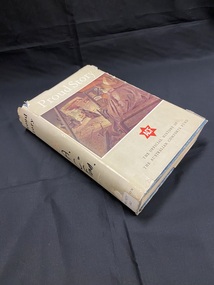
Book - Hardcover book, C.O.Badham Jackson et al, Proud Story: the official history of the Australian Comforst Fund, 1949
... rations and personal kit. The Australian Comforts Fund quickly grew into a fundraising, collecting, sorting and distributing machine which rivalled the scope of the Red Cross. At the conclusion of World War I, the ACF officially dissolved. However it was revived in 1939 with the outbreak of World War II to provide comforts to a new generation of soldiers. It ceased operation again on 27 June 1946.' -from The Australian War Memorial WW2 WWII ...History of the Australian Comforts Fund (ACF). The fund was "a commonwealth-wide voluntary organisation accredited to the Royal Australian Navy, the Australian Military Forces and the Royal Australian Air Force and charged with the duty of caring for all fit and well members of the Australian Forces during the Second World War, 1939-1945" -taken from title page. This volume details the history from each individual state in Australia, as well as the service it provided overseas, and it's partnership with the Salvation Army, Y.M.C.A. and Y.W.C.A.Blue cloth-bound hardcover book with a worn cream coloured dust-jacket. The title is printed in white across the top, beneath which is an illustration of three jeeps driving in a row (from the perspective of someone sitting in the back seat of the third jeep). The bottom of the page displays black text with a red star above it with the letters ACF inside. The spine has the title printed in black across the top, a spine label taped to the bottom, and A.C.Fund handwritten in black marker in the middle.non-fictionHistory of the Australian Comforts Fund (ACF). The fund was "a commonwealth-wide voluntary organisation accredited to the Royal Australian Navy, the Australian Military Forces and the Royal Australian Air Force and charged with the duty of caring for all fit and well members of the Australian Forces during the Second World War, 1939-1945" -taken from title page. This volume details the history from each individual state in Australia, as well as the service it provided overseas, and it's partnership with the Salvation Army, Y.M.C.A. and Y.W.C.A.ww2, wwii, world war 1939-1945, civilian relief, australian comforts fund, acf -
 Returned Nurses RSL Sub-branch
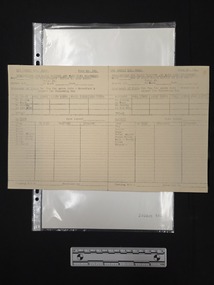
Document - Printed documents - unfilled medical forms, Heidelberg Military Hospital, c. 1943
... Army Nurse Clare Rothwell MacIntire WWII World War Two WW2 Rotyal Australian Air Force Heidelberg Military Hospital "115 (HEID) MEDICAL HOSP." "REQUISITION FOR DAILY RATIONS AND WARD DIET STATEMENT" Form No. 13A" "115 (HEIDELBERG) MILITARY HOSPITAL" "REQUISITION FOR EXPENSE STORES" "Form 122" "115 (HEIDELBERG) MILITARY HOSPITAL" "Ward Statement of DIETS for the day following on which it is rendered" "Form No. 32" "115 (HEIDELBERG) MILITARY HOSPITAL" "No.18" "115 (HEIDELBERG) MILITARY HOSPITAL" "It is requested that the Garrison Engineer provide the following items of maintenance or equipment- & Brand same Type" "Form No.10" "115 (HEIDELBERG) MILITARY HOSPITAL" "REQUISITION ON DRUG STORE" "Form No. 133 200 16-11-43" Six variously sized printed medical forms on cream paper. ...Part of a series of items related to Clare Rothwell Macintire. Clare Rothwell Macintire was born 27 July 1910 in Essendon and enlisted with the Royal Australian Airforce on 3 August 1943. Her service number was 500432. Six variously sized printed medical forms on cream paper. The forms have not been filled out. "115 (HEID) MEDICAL HOSP." "REQUISITION FOR DAILY RATIONS AND WARD DIET STATEMENT" Form No. 13A" "115 (HEIDELBERG) MILITARY HOSPITAL" "REQUISITION FOR EXPENSE STORES" "Form 122" "115 (HEIDELBERG) MILITARY HOSPITAL" "Ward Statement of DIETS for the day following on which it is rendered" "Form No. 32" "115 (HEIDELBERG) MILITARY HOSPITAL" "No.18" "115 (HEIDELBERG) MILITARY HOSPITAL" "It is requested that the Garrison Engineer provide the following items of maintenance or equipment- & Brand same Type" "Form No.10" "115 (HEIDELBERG) MILITARY HOSPITAL" "REQUISITION ON DRUG STORE" "Form No. 133 200 16-11-43"army nurse, clare rothwell macintire, wwii, world war two, ww2, rotyal australian air force, heidelberg military hospital
