
Showing 257 items matching "xavier"
-
 Kew Historical Society Inc
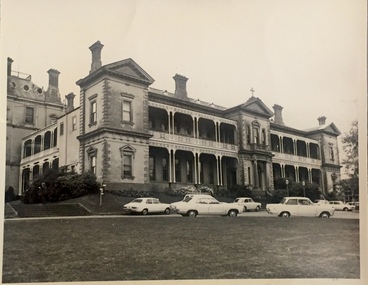
Photograph, J E & B L Rogers, Xavier College, c.1970
... Xavier College...Small, black and white photo of the facade of Xavier College Senior School...."Xavier College / Jim's / 35"...Xavier College Photograph Photograph J E & B L Rogers ...This work forms part of the collection assembled by the historian Dorothy Rogers, that was donated to the Kew Historical Society by her son John Rogers in 2015. The manuscripts, photographs, maps, and documents were sourced by her from both family and local collections or produced as references for her print publications. Many were directly used by Rogers in writing ‘Lovely Old Homes of Kew’ (1961) and 'A History of Kew' (1973), or the numerous articles on local history that she produced for suburban newspapers. Most of the photographs in the collection include detailed annotations in her hand.The Rogers Collection provides a comprehensive insight into the working habits of a historian in the 1960s and 1970s. Together it forms the largest privately-donated collection within the archives of the Kew Historical Society.Small, black and white photo of the facade of Xavier College Senior School."Xavier College / Jim's / 35"xavier college -- kew (vic.), schools -- kew (vic) -
 Kew Historical Society Inc
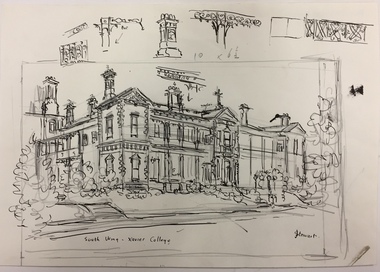
Work on paper, Joy Stewart, South Wing, Xavier College, c. 1978
... South Wing, Xavier College...Pencil, pen & Ink sketch on paper of 'South Wing, Xavier College' by the artist Joy Stewart. ...Inscription: "South Wing, Xavier College". Signed lower right: "JStewart"....Joy Stewart died in Cairns in 2018. joy stewart xavier college (kew) Inscription: "South Wing, Xavier College". ...Sydney Joy (joy) Stewart (1925-2018) was a founding member of the Kew Historical Society, and during the 1970s its secretary. During her residence in Kew, she completed numerous property illustrations on commission. These ranged from preliminary sketches, including architectural details to finished pen & ink and wash illustrations on paper. On moving to Queensland, Joy Stewart donated the remaining property illustrations in her possession to the Kew Historical Society. In 1987-88, she fulfilled a commission by the Society of designs for a series of embroideries completed by residents during the Australian Bicentennial commemorations. Sydney Joy (Joy) Stewart was born in Melbourne 1925. She studied at Swinburne Technical College Art School from 1941-1945, then the National Gallery Art School 1946-1948. Her career included employment positions as a display artist, designer/painter, gallery assistant, and art teacher. Joy relocated to Cairns in 1981. Solo exhibitions in Melbourne and Cairns, including 'Done By Me' at Cairns Regional Gallery in 1999. Group exhibitions at Cairns Regional Gallery, 'The Fish John West Regrets, 1993' and 'Facets of Life' 1994. Joy Stewart died in Cairns in 2018.Pencil, pen & Ink sketch on paper of 'South Wing, Xavier College' by the artist Joy Stewart. Inscription: "South Wing, Xavier College". Signed lower right: "JStewart".joy stewart, xavier college (kew) -
 Kew Historical Society Inc
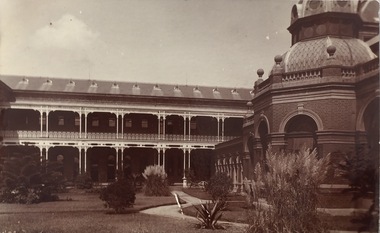
Postcard, Xavier College, 1907-1915
... Xavier College...Sepia photo postcard showing Xavier College quadrangle and side of main hall....KH-395 Opened 1878. Xavier College! Donated by Mr. L. Bennett, 1980". ...Xavier College Postcard Postcard ...The Kew Historical Society's postcard collection includes views of Kew, Melbourne and Greater Melbourne as well as those including overseas scenes sent or received from Europe or the Middle East. They date from the 1890s to the 2000s. These postcards may or may not include the name of the publisher or printer. A number of the cards were published as parts of popular series. A way of dating early postcards is to identify whether the reverse was divided by a central line which became the norm after 1902 in the United Kingdom. However, other postcards produced after this date do not always conform to this print layout.The item forms part of the Laurie Bennett collection of thirty-six postcards and photographs of Kew and early Melbourne, donated to the Kew Historical Society in 1980. The postcards in the Bennett collection, like other images in the Society's holdings date from the 1890s to the present and comprehensively indicate points-of-view or scenes considered historically, aesthetically or socially significant in the period in which they were produced.Sepia photo postcard showing Xavier College quadrangle and side of main hall."Reg. No. KH-395 Opened 1878. Xavier College! Donated by Mr. L. Bennett, 1980". xavier college _ kew, schools - kew, postcards -
 Kew Historical Society Inc
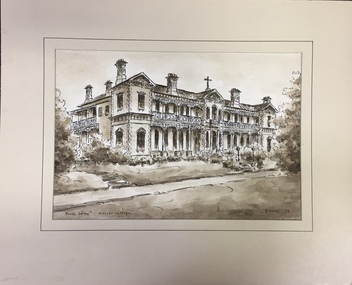
Work on paper, "South Wing" - Xavier College, 1978
... "South Wing" - Xavier College...Pen and wash drawing, set in an external card mount, depicting the south wing of Xavier College, Kew by Joy Stewart....Inscription: "South Wing" - Xavier College." Signed lower right: "JStewart 78"....Joy Stewart died in Cairns in 2018. joy stewart xavier college - kew (vic) schools - kew (vic) Inscription: "South Wing" - Xavier College." ...Sydney Joy (joy) Stewart (1925-2018) was a founding member of the Kew Historical Society, and during the 1970s its secretary. During her residence in Kew, she completed numerous property illustrations on commission. These ranged from preliminary sketches, including architectural details to finished pen & ink and wash illustrations on paper. On moving to Queensland, Joy Stewart donated the remaining property illustrations in her possession to the Kew Historical Society. In 1987-88, she fulfilled a commission by the Society of designs for a series of embroideries completed by residents during the Australian Bicentennial commemorations.Pen and wash drawing, set in an external card mount, depicting the south wing of Xavier College, Kew by Joy Stewart.Inscription: "South Wing" - Xavier College." Signed lower right: "JStewart 78".joy stewart, xavier college - kew (vic), schools - kew (vic) -
 Kew Historical Society Inc
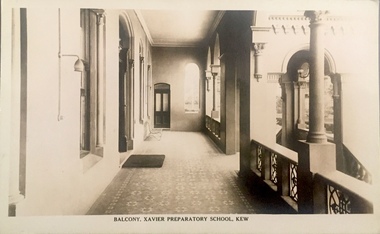
Postcard, Balcony, Xavier Preparatory School, Kew, 1920-1921
... Balcony, Xavier Preparatory School, Kew...Sepia postcard, one of a series of views of Xavier Preparatory School [Burke Hall], located in the house in Nolan Avenue formerly known as Waverley, then Studley Hall...."Balcony, Xavier Preparatory School, Kew / POST CARD / A REAL PHOTOGRAPH / PRODUCED IN AUSTRALIA"...Balcony, Xavier Preparatory School, Kew Postcard Postcard ...This work forms part of the collection assembled by the historian Dorothy Rogers, that was donated to the Kew Historical Society by her son John Rogers in 2015. The manuscripts, photographs, maps, and documents were sourced by her from both family and local collections or produced as references for her print publications. Many were directly used by Rogers in writing ‘Lovely Old Homes of Kew’ (1961) and 'A History of Kew' (1973), or the numerous articles on local history that she produced for suburban newspapers. Most of the photographs in the collection include detailed annotations in her hand.The Rogers Collection provides a comprehensive insight into the working habits of a historian in the 1960s and 1970s. Together it forms the largest privately-donated collection within the archives of the Kew Historical Society.Sepia postcard, one of a series of views of Xavier Preparatory School [Burke Hall], located in the house in Nolan Avenue formerly known as Waverley, then Studley Hall."Balcony, Xavier Preparatory School, Kew / POST CARD / A REAL PHOTOGRAPH / PRODUCED IN AUSTRALIA"burke hall -- kew (vic), xavier preparatory school, postcards -- kew (vic.) -
 Ballarat Heritage Services
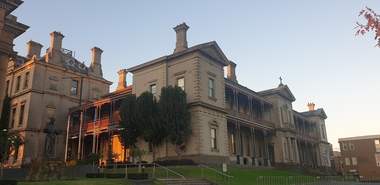
Photograph - Digital photographs, Clare Gervasoni, Exterior Views of Xavier College, 2025, 05/2025
... Exterior Views of Xavier College, 2025...Xavier College was first opened by the Society of Jesus (the Jesuits) in 1878. ...Colour photograph of the buildings and Chapel at Xavier College, Kew, Victoria. ...Xavier College was first opened by the Society of Jesus (the Jesuits) in 1878. ...Xavier College was first opened by the Society of Jesus (the Jesuits) in 1878. It belongs to a worldwide network of over 2,000 Jesuit educational institutions. The original Senior Campus location on Barkers Road, Kew is a culmination of modern innovation and rich historical preservation. The land on which Xavier stands was known as Mornane’s Paddock and was purchased by the Jesuits in 1872 from Patrick Mornane on a 20-year interest-free purchase plan. This enabled the Jesuits to get on with the funding and building of the College buildings almost immediately. Foundations for the South Wing commenced in 1872, with the front of the building completed in time for classes to begin in 1878. Many of the first boarders transferred from St Patrick’s College in East Melbourne. With the closure of St Patrick’s years later, many students, associated lay staff and Jesuits also transferred to Xavier College. Over the following century, Xavier College grew with two junior campuses; Burke Hall Campus and Kostka Hall Campus. In recent years, extensive refurbishments, renovations and improvements have moulded the properties into the beautiful sites they are today. In 2002 at our Burke Hall campus and in 2005 at our Kostka Hall campus, the College expanded its educational program, opening Early Years centres to provide the scope for a Jesuit education from the earliest ages. For the first time in the College’s history, girls were admitted to the Early Years, breaking the long-standing tradition of Xavier being a boys-only school. In 2021, after 85 years of inspiring education experiences, our Kostka Hall campus closed its gates for the final time. In 1920, Archbishop Daniel Mannix donated the house and land known as Studley Hall to Xavier College for use as a preparatory school. The property had been purchased and donated to Mannix by Mr T.M. Burke, a Catholic businessman. In 1921, Xavier Preparatory School opened and was later renamed Burke Hall in 1926 in honour of Mr Burke. The Kostka Hall location was opened in 1937 and was named in honour of St Stanislaus Kostka. To establish the second preparatory school, the Jesuits purchased two Brighton properties in mid-1936. Both were promptly remodelled to provide the facilities required for school life. (https://xavier.vic.edu.au/xavier-history, accessed 15/05/2025) Colour photograph of the buildings and Chapel at Xavier College, Kew, Victoria. heritage, kew, xavier college, chapel, catholic, st francis xavier, xavier chapel -
 Ballarat Heritage Services
Photograph - Digital photographs, L.J. Gervasoni, Xavier College Chapel, c2016, c2016
... Xavier College Chapel, c2016...Xavier College was first opened by the Society of Jesus (the Jesuits) in 1878. ...Colour photograph of the section of the Chapel at Xavier College, Kew, Victoria. ...Xavier College was first opened by the Society of Jesus (the Jesuits) in 1878. ...Xavier College was first opened by the Society of Jesus (the Jesuits) in 1878. It belongs to a worldwide network of over 2,000 Jesuit educational institutions. The original Senior Campus location on Barkers Road, Kew is a culmination of modern innovation and rich historical preservation. The land on which Xavier stands was known as Mornane’s Paddock and was purchased by the Jesuits in 1872 from Patrick Mornane on a 20-year interest-free purchase plan. This enabled the Jesuits to get on with the funding and building of the College buildings almost immediately. Foundations for the South Wing commenced in 1872, with the front of the building completed in time for classes to begin in 1878. Many of the first boarders transferred from St Patrick’s College in East Melbourne. With the closure of St Patrick’s years later, many students, associated lay staff and Jesuits also transferred to Xavier College. Over the following century, Xavier College grew with two junior campuses; Burke Hall Campus and Kostka Hall Campus. In recent years, extensive refurbishments, renovations and improvements have moulded the properties into the beautiful sites they are today. In 2002 at our Burke Hall campus and in 2005 at our Kostka Hall campus, the College expanded its educational program, opening Early Years centres to provide the scope for a Jesuit education from the earliest ages. For the first time in the College’s history, girls were admitted to the Early Years, breaking the long-standing tradition of Xavier being a boys-only school. In 2021, after 85 years of inspiring education experiences, our Kostka Hall campus closed its gates for the final time. In 1920, Archbishop Daniel Mannix donated the house and land known as Studley Hall to Xavier College for use as a preparatory school. The property had been purchased and donated to Mannix by Mr T.M. Burke, a Catholic businessman. In 1921, Xavier Preparatory School opened and was later renamed Burke Hall in 1926 in honour of Mr Burke. The Kostka Hall location was opened in 1937 and was named in honour of St Stanislaus Kostka. To establish the second preparatory school, the Jesuits purchased two Brighton properties in mid-1936. Both were promptly remodelled to provide the facilities required for school life. (https://xavier.vic.edu.au/xavier-history, accessed 15/05/2025) Colour photograph of the section of the Chapel at Xavier College, Kew, Victoria. heritage, kew, xavier college, chapel, catholic, st francis xavier, xavier chapel -
 Kew Historical Society Inc
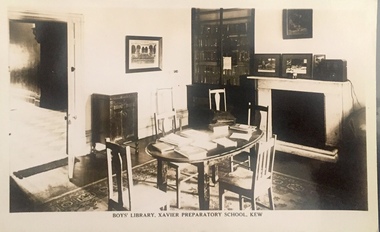
Postcard, Boy's Library, Xavier Preparatory School, Kew, 1920-1921
... Boy's Library, Xavier Preparatory School, Kew...Sepia postcard, one of a series of views of Xavier Preparatory School [Burke Hall], located in the house in Nolan Avenue formerly known as Waverley, then Studley Hall...."Boy's Library, Xavier Preparatory School, Kew / POST CARD / A REAL PHOTOGRAPH / PRODUCED IN AUSTRALIA" / "Office"...Boy's Library, Xavier Preparatory School, Kew Postcard Postcard ...This work forms part of the collection assembled by the historian Dorothy Rogers, that was donated to the Kew Historical Society by her son John Rogers in 2015. The manuscripts, photographs, maps, and documents were sourced by her from both family and local collections or produced as references for her print publications. Many were directly used by Rogers in writing ‘Lovely Old Homes of Kew’ (1961) and 'A History of Kew' (1973), or the numerous articles on local history that she produced for suburban newspapers. Most of the photographs in the collection include detailed annotations in her hand.The Rogers Collection provides a comprehensive insight into the working habits of a historian in the 1960s and 1970s. Together it forms the largest privately-donated collection within the archives of the Kew Historical Society.Sepia postcard, one of a series of views of Xavier Preparatory School [Burke Hall], located in the house in Nolan Avenue formerly known as Waverley, then Studley Hall."Boy's Library, Xavier Preparatory School, Kew / POST CARD / A REAL PHOTOGRAPH / PRODUCED IN AUSTRALIA" / "Office"burke hall -- kew (vic), xavier preparatory school, postcards -- kew (vic.) -
 Kew Historical Society Inc
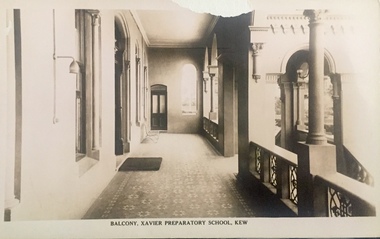
Postcard, Balcony, Xavier Preparatory School, Kew, 1920-1921
... Balcony, Xavier Preparatory School, Kew...Sepia postcard, one of a series of views of Xavier Preparatory School [Burke Hall], located in the house in Nolan Avenue formerly known as Waverley, then Studley Hall...."Balcony, Xavier Preparatory School, Kew / POST CARD / A REAL PHOTOGRAPH / PRODUCED IN AUSTRALIA" / "Burke Hall"...Balcony, Xavier Preparatory School, Kew Postcard Postcard ...This work forms part of the collection assembled by the historian Dorothy Rogers, that was donated to the Kew Historical Society by her son John Rogers in 2015. The manuscripts, photographs, maps, and documents were sourced by her from both family and local collections or produced as references for her print publications. Many were directly used by Rogers in writing ‘Lovely Old Homes of Kew’ (1961) and 'A History of Kew' (1973), or the numerous articles on local history that she produced for suburban newspapers. Most of the photographs in the collection include detailed annotations in her hand.The Rogers Collection provides a comprehensive insight into the working habits of a historian in the 1960s and 1970s. Together it forms the largest privately-donated collection within the archives of the Kew Historical Society.Sepia postcard, one of a series of views of Xavier Preparatory School [Burke Hall], located in the house in Nolan Avenue formerly known as Waverley, then Studley Hall."Balcony, Xavier Preparatory School, Kew / POST CARD / A REAL PHOTOGRAPH / PRODUCED IN AUSTRALIA" / "Burke Hall"burke hall -- kew (vic), xavier preparatory school, postcards -- kew (vic.) -
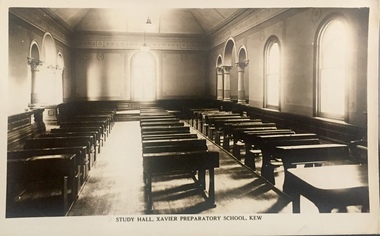 Kew Historical Society Inc
Postcard, Study Hall, Xavier Preparatory School, Kew, 1920-1921
... Study Hall, Xavier Preparatory School, Kew...Sepia postcard, one of a series of views of Xavier Preparatory School [Burke Hall], located in the house in Nolan Avenue formerly known as Waverley, then Studley Hall...."Study Hall, Xavier Preparatory School, Kew / POST CARD / A REAL PHOTOGRAPH / PRODUCED IN AUSTRALIA" / "Ballroom"...Study Hall, Xavier Preparatory School, Kew Postcard Postcard ...This work forms part of the collection assembled by the historian Dorothy Rogers, that was donated to the Kew Historical Society by her son John Rogers in 2015. The manuscripts, photographs, maps, and documents were sourced by her from both family and local collections or produced as references for her print publications. Many were directly used by Rogers in writing ‘Lovely Old Homes of Kew’ (1961) and 'A History of Kew' (1973), or the numerous articles on local history that she produced for suburban newspapers. Most of the photographs in the collection include detailed annotations in her hand.The Rogers Collection provides a comprehensive insight into the working habits of a historian in the 1960s and 1970s. Together it forms the largest privately-donated collection within the archives of the Kew Historical Society.Sepia postcard, one of a series of views of Xavier Preparatory School [Burke Hall], located in the house in Nolan Avenue formerly known as Waverley, then Studley Hall."Study Hall, Xavier Preparatory School, Kew / POST CARD / A REAL PHOTOGRAPH / PRODUCED IN AUSTRALIA" / "Ballroom"burke hall -- kew (vic), xavier preparatory school, postcards -- kew (vic.) -
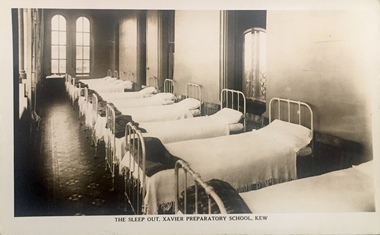 Kew Historical Society Inc
Postcard, The Sleep Out, Xavier Preparatory School, Kew, 1920-1921
... The Sleep Out, Xavier Preparatory School, Kew...Sepia postcard, one of a series of views of Xavier Preparatory School [Burke Hall], located in the house in Nolan Avenue formerly known as Waverley, then Studley Hall...."The Sleep Out, Xavier Preparatory School, Kew / POST CARD / A REAL PHOTOGRAPH / PRODUCED IN AUSTRALIA" / "Top Verandah"...The Sleep Out, Xavier Preparatory School, Kew Postcard Postcard ...This work forms part of the collection assembled by the historian Dorothy Rogers, that was donated to the Kew Historical Society by her son John Rogers in 2015. The manuscripts, photographs, maps, and documents were sourced by her from both family and local collections or produced as references for her print publications. Many were directly used by Rogers in writing ‘Lovely Old Homes of Kew’ (1961) and 'A History of Kew' (1973), or the numerous articles on local history that she produced for suburban newspapers. Most of the photographs in the collection include detailed annotations in her hand.The Rogers Collection provides a comprehensive insight into the working habits of a historian in the 1960s and 1970s. Together it forms the largest privately-donated collection within the archives of the Kew Historical Society.Sepia postcard, one of a series of views of Xavier Preparatory School [Burke Hall], located in the house in Nolan Avenue formerly known as Waverley, then Studley Hall."The Sleep Out, Xavier Preparatory School, Kew / POST CARD / A REAL PHOTOGRAPH / PRODUCED IN AUSTRALIA" / "Top Verandah"burke hall -- kew (vic), xavier preparatory school, postcards -- kew (vic.) -
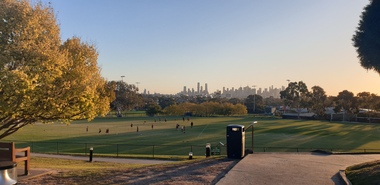 Ballarat Heritage Services
Photograph - Digital photographs, Clare Gervasoni, Melbourne Views from Xavier College Chapel, 2025, 05/2025
... Melbourne Views from Xavier College Chapel, 2025...Xavier College was first opened by the Society of Jesus (the Jesuits) in 1878. ...Colour photograph of the Melbourne highrise from the Chapel at Xavier College, Kew, Victoria. ...Xavier College was first opened by the Society of Jesus (the Jesuits) in 1878. ...Xavier College was first opened by the Society of Jesus (the Jesuits) in 1878. It belongs to a worldwide network of over 2,000 Jesuit educational institutions. The original Senior Campus location on Barkers Road, Kew is a culmination of modern innovation and rich historical preservation. The land on which Xavier stands was known as Mornane’s Paddock and was purchased by the Jesuits in 1872 from Patrick Mornane on a 20-year interest-free purchase plan. This enabled the Jesuits to get on with the funding and building of the College buildings almost immediately. Foundations for the South Wing commenced in 1872, with the front of the building completed in time for classes to begin in 1878. Many of the first boarders transferred from St Patrick’s College in East Melbourne. With the closure of St Patrick’s years later, many students, associated lay staff and Jesuits also transferred to Xavier College. Over the following century, Xavier College grew with two junior campuses; Burke Hall Campus and Kostka Hall Campus. In recent years, extensive refurbishments, renovations and improvements have moulded the properties into the beautiful sites they are today. In 2002 at our Burke Hall campus and in 2005 at our Kostka Hall campus, the College expanded its educational program, opening Early Years centres to provide the scope for a Jesuit education from the earliest ages. For the first time in the College’s history, girls were admitted to the Early Years, breaking the long-standing tradition of Xavier being a boys-only school. In 2021, after 85 years of inspiring education experiences, our Kostka Hall campus closed its gates for the final time. In 1920, Archbishop Daniel Mannix donated the house and land known as Studley Hall to Xavier College for use as a preparatory school. The property had been purchased and donated to Mannix by Mr T.M. Burke, a Catholic businessman. In 1921, Xavier Preparatory School opened and was later renamed Burke Hall in 1926 in honour of Mr Burke. The Kostka Hall location was opened in 1937 and was named in honour of St Stanislaus Kostka. To establish the second preparatory school, the Jesuits purchased two Brighton properties in mid-1936. Both were promptly remodelled to provide the facilities required for school life. (https://xavier.vic.edu.au/xavier-history, accessed 15/05/2025) Colour photograph of the Melbourne highrise from the Chapel at Xavier College, Kew, Victoria. heritage, kew, xavier college, chapel, catholic, st francis xavier, xavier chapel -
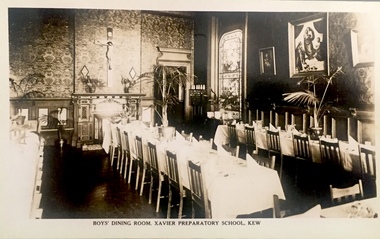 Kew Historical Society Inc
Postcard, Boy's Dining Room, Xavier Preparatory School, Kew, 1920-1921
... Boy's Dining Room, Xavier Preparatory School, Kew...Sepia postcard, one of a series of views of Xavier Preparatory School [Burke Hall], located in the house in Nolan Avenue formerly known as Waverley, then Studley Hall...."Boy's Dining Room, Xavier Preparatory School, Kew / POST CARD / A REAL PHOTOGRAPH / PRODUCED IN AUSTRALIA" / "Burke Hall"...Boy's Dining Room, Xavier Preparatory School, Kew Postcard Postcard ...This work forms part of the collection assembled by the historian Dorothy Rogers, that was donated to the Kew Historical Society by her son John Rogers in 2015. The manuscripts, photographs, maps, and documents were sourced by her from both family and local collections or produced as references for her print publications. Many were directly used by Rogers in writing ‘Lovely Old Homes of Kew’ (1961) and 'A History of Kew' (1973), or the numerous articles on local history that she produced for suburban newspapers. Most of the photographs in the collection include detailed annotations in her hand.The Rogers Collection provides a comprehensive insight into the working habits of a historian in the 1960s and 1970s. Together it forms the largest privately-donated collection within the archives of the Kew Historical Society.Sepia postcard, one of a series of views of Xavier Preparatory School [Burke Hall], located in the house in Nolan Avenue formerly known as Waverley, then Studley Hall."Boy's Dining Room, Xavier Preparatory School, Kew / POST CARD / A REAL PHOTOGRAPH / PRODUCED IN AUSTRALIA" / "Burke Hall"burke hall -- kew (vic), xavier preparatory school, postcards -- kew (vic.) -
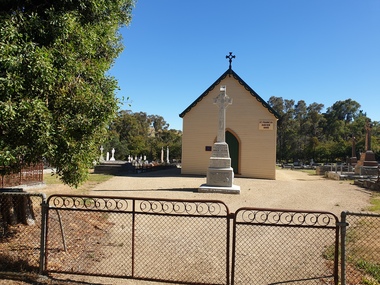 Ballarat Heritage Services
Photograph - Photograph - Colour, Clare Gervasoni, St Francis Xavier Chapel, Eganstown, 2021, 29/1/2021
... St Francis Xavier Chapel, Eganstown, 2021...The St Francis Xavier Chapel and Catholic Cemetery was established on land donated by squatter John Egan....St Francis Xavier Chapel, the chapel in the Eganstown Catholic Cemetery. ...The St Francis Xavier Chapel and Catholic Cemetery was established on land donated by squatter John Egan. st francis xavier chapel, eganstown, 1999 eganstown catholic cemetery eganstown church chapel cemetery John Egan St Francis Xavier Chapel, the chapel in the Eganstown Catholic Cemetery. ...The St Francis Xavier Chapel and Catholic Cemetery was established on land donated by squatter John Egan.St Francis Xavier Chapel, the chapel in the Eganstown Catholic Cemetery. The grave stone at the front of the church is for John Egan. st francis xavier chapel, eganstown, 1999, eganstown catholic cemetery, eganstown, church, chapel, cemetery, john egan -
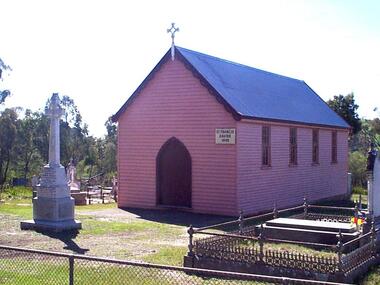 Ballarat Heritage Services
Photograph - Photograph - Colour, Clare Gervasoni, St Francis Xavier Chapel, Eganstown, 1999, 28/09/1999
... St Francis Xavier Chapel, Eganstown, 1999...The St Francis Xavier Chapel and Catholic Cemetery was established on land donated vby squatter John Egan....Three photographs of St Francis Xavier Chapel, the chapel in the Eganstown Catholic Cemetery. ...The St Francis Xavier Chapel and Catholic Cemetery was established on land donated vby squatter John Egan. st francis xavier chapel, eganstown, 1999 eganstown catholic cemetery eganstown church chapel cemetery John Egan Three photographs of St Francis Xavier Chapel, the chapel in the Eganstown Catholic Cemetery. ...The St Francis Xavier Chapel and Catholic Cemetery was established on land donated vby squatter John Egan.Three photographs of St Francis Xavier Chapel, the chapel in the Eganstown Catholic Cemetery. The grave stone at the front of the church is for John Egan. st francis xavier chapel, eganstown, 1999, eganstown catholic cemetery, eganstown, church, chapel, cemetery, john egan -
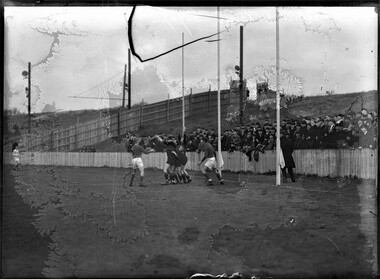 City of Melbourne Libraries
Photograph, Bull, Hugh Jones, 1897-1993, Photograph, Scotch College v. Xavier College football match, 1934
... Photograph, Scotch College v. Xavier College football match, 1934...At the first match of the 1934 Public Schools Premiership and Championships at Olympic Park (where AAMI Park is now) between Scotch College (white shorts) and Xavier College, (black shorts) a mark is missed by Xavier players and then taken by a Scotch player. ...Photographer notations on slide: "Scotch v. Xavier - Olympic Park B42"....At the first match of the 1934 Public Schools Premiership and Championships at Olympic Park (where AAMI Park is now) between Scotch College (white shorts) and Xavier College, (black shorts) a mark is missed by Xavier players and then taken by a Scotch player. ...At the first match of the 1934 Public Schools Premiership and Championships at Olympic Park (where AAMI Park is now) between Scotch College (white shorts) and Xavier College, (black shorts) a mark is missed by Xavier players and then taken by a Scotch player. Research by project volunteer, Fiona Collyer: A crowd of schoolboys standing behind a picket fence, watch with anticipation as two teams contest a football at the goalposts. The Public Schools Premiership and Championship was an Australian Rules football tournament held every winter over five weeks between six schools- Scotch College, Xavier College, Melbourne Grammar, Wesley College and traditional rivals Geelong Grammar and Geelong College. The school that won the most games out of the five played, won the competition. As the 1933 Premiers, Xavier College had the honour of playing the opening match of the season on 28 June against runners-up Scotch College at Olympic Park (where AAMI Park is now). The Public Schools Premiership matches were widely reported in Melbourne’s daily newspapers with photographs and commentary of every game. Weekly society magazine “Table Talk” featured reports and seven photographs of the first games of the season. Australian Broadcasting Commission (ABC) wireless station 3AR interspersed their afternoon program of reproduced music with detailed descriptions of the matches. Also reporting the matches was “Forty-Years-On”, presumably a student in the 1890s, whose regular column in The Herald newspaper “Activities In The Public Schools” published all the latest news on Victoria’s public (private) schools. In his column for The Australasian 7 July 1934, “Old Boy” writes about the Scotch versus Xavier match: “For more than half the game last week, Scotch was outplayed, but took the lead early in the last term and kept it. Scotch surprised even its own supporters by its dash in the last 25 minutes. Xavier, who became over confident by the prospects of victory, could not withstand the final onslaught. In the last quarter Scotch was the better side and won by seven points.” The final score was Scotch 11.11 (77 points) and Xavier 10.10 (70 points). At the end of this exciting match the overjoyed Scotch boys swarmed over the Olympic Park fences to chair their captain, Stanley Steele and carry him shoulder high, to the pavilion. The first documented game of a variation of Australian Rules football was played at Richmond Paddock (now Yarra Park) from 7 August 1858. Australian Rules football writer Hugh Buggy of The Argus 16 April 1952 explains: “It began when boys and masters of Scotch College and Melbourne Grammar School decided to play a 40-a-side game, with the first team to score two goals to be the winner. Goal posts were pitched more than a mile apart, one set on the Jolimont Hill and the other at Punt road Richmond. Nobody defined the boundary, and the play swung over the broad acres of the park and around the gum trees. It went on and on like a Test match, from noon till dusk. After 15 hours of play on three Saturdays the score was one goal all, and the game was abandoned for that season.” Rules of the game hadn’t been decided at this time - the earliest known rules were codified a year later in 1859. A sculpture and plaque located outside the Melbourne Cricket Ground (MCG), created by sculptor Louis Laumen in 2001, commemorates this game. It depicts two school boys chasing a ball along with umpire Tom Wills, a co-writer of the rules and promoter of Australian Rules football. A medley of Gaelic football, an Aboriginal game called marngrook as well as football played in English public (that is private) schools have been cited as inspiration for Australian Rules football. The word “Marngrook” meaning “game ball”, comes from the language of the Gunditjmara, First Nations people of southwestern Victoria. Marngrook was played at gatherings and celebrations and involved players competing to jump and catch the ball after it was kicked high into the air. The player that catches the ball then gets to kick it. The ball was made from possum skin, filled with pounded charcoal and tied with kangaroo sinews. Protector of Aborigines in Victoria, William Thomas (1794-1867) observed in 1841- “The men and boys joyfully assemble when this game is to be played. One makes a ball of possum skin, somewhat elastic, but firm and strong… The players of this game do not throw the ball as a white man might do, but drop it and at the same time kick it with their feet, using the instep for that purpose. The tallest men have the best chances in this game. Some of them will leap as high as five feet from the ground to catch the ball. The person who secures the ball kicks it. This continues for hours and the natives never seem to tire of the exercise.” The Victorian Football League (VFL), was founded in 1897 with eight teams playing Australian Rules football and held its first Grand Final at the MCG in 1902. From the start the games attracted large enthusiastic crowds, which included women. “Viva” writing in the Supplement to The Weekly Times - 3 July 1886 LADIES COLUMN (By Viva) FOOTBALL. A Social Sketch. “…Of the popularity of football and footballers among women, there can be no doubt. Young, soft hearted girls, who would not “tread upon a worm," avow that football matches are "awfully jolly," and seem to regard accidents as a necessary part of the amusement…a great proportion of the spectators were ladies.” “Minetta” writing for Punch Magazine - “Ladies Letter, Holmby House, Toorak” 22 June 1905 “The "Football Girl" is a feminine genus at present much to the fore in Melbourne. Not that she plays football—at least not beyond a kick in the backyard or paddock—oh, dear, no! Her interest in the game is purely from a spectacular point of view. "Football Girls" usually hunt in couples, with two male barrackers attached. They know all about So-and-So's form, and whether he is a trier or has been bought. They go to each match of their particular club, and watch the play intently, their faces wearing a decidedly strained expression when their club is getting the worst of it. They are not ashamed to barrack either, when matters are progressing successfully… Yours ever, MINETTA.” The Herald 2 July 1909 published a cartoon by Ambrose Dyson depicting women football fans, which asked- “THE QUESTION OF THE DAY. Should Girls Go To Football Matches? Should they? The sex made up their mind about the matter very early on.” The resounding answer was- “Well, I’d like to see the man that would stop me!” At the final match of the 1934 tournament on August 2, Melbourne Grammar finished the season unbeaten, winning their tenth Public Schools premiership in 16 years. The Weekly Times 11 August 1934 reported-“Melbourne Grammar…had a rather lucky escape against Xavier…Had a Xavier player not touched a shot, kicked by a team-mate, as it was going through goal Grammar would have been beaten.” Final score - Melbourne Grammar 13.7 (85 points) defeated Xavier College 12.9 (81 points). Ladder for the 1934 Season- Melbourne Grammar-5 wins Wesley College- 4 wins Scotch College- 3 wins Xavier College- 2 wins Geelong Grammar- 1 win Geelong College- 0 wins The Associated Public Schools of Victoria (APS) exists today where eleven member (private) schools, including co-educational schools, participate in 21 sporting competitions throughout the year. (The descriptor “Public School” references the historical usage of the term and the model of the British public). PUBLIC SCHOOLS FOOTBALL BEGINS WITH SCOTCH--XAVIER MATCH. (1934, June 29). The Age (Melbourne, Vic. : 1854 - 1954), p. 11. Retrieved June 23, 2025, from http://nla.gov.au/nla.news-article204824484 PUBLIC SCHOOLS FOOTBALL AT OLYMPIC PARK (1934, July 5). Table Talk (Melbourne, Vic. : 1885 - 1939), p. 5. Retrieved May 30, 2025, from http://nla.gov.au/nla.news-article149682433 PUBLIC SCHOOLS FOOTBALL. (1936, July 3). The Argus (Melbourne, Vic. : 1848 - 1957), p. 18. Retrieved May 30, 2025, from http://nla.gov.au/nla.news-article11888301 PUBLIC SCHOOLS. (1934, June 29). The Age (Melbourne, Vic. : 1854 - 1954), p. 5. Retrieved August 6, 2025, from http://nla.gov.au/nla.news-article204824486 https://en.m.wikipedia.org/wiki/History_of_Australian_rules_football COLLEGE SPORTS (1934, July 7). The Australasian (Melbourne, Vic. : 1864 - 1946), p. 48 (METROPOLITAN EDITION). Retrieved August 6, 2025, from http://nla.gov.au/nla.news-article145238393 GRAMMAR CHAMPIONS (1934, August 11). Weekly Times (Melbourne, Vic. : 1869 - 1954), p. 72. Retrieved August 6, 2025, from http://nla.gov.au/nla.news-article224562842 LETS LOOK AT FOOTBALL with HUGH BUGGY (1952, April 16). The Argus (Melbourne, Vic. : 1848 - 1957), p. 9. Retrieved August 6, 2025, from http://nla.gov.au/nla.news-article23174340 FOR YOUNG PEOPLE AMONG THE SCHOOLS. (1934, August 7). The Age (Melbourne, Vic. : 1854 - 1954), p. 4. Retrieved August 6, 2025, from http://nla.gov.au/nla.news-article205521661 https://www.nma.gov.au/defining-moments/resources/australian-rules-football#:~:text=In%20the%20winter%20of%201858,games%20of%20Australian%20Rules%20football. https://apssport.org.au/about/ http://lindsaymagazine.co/from-marngrook-to-australian-rules-football/ https://collection.australiansportsmuseum.org.au/objects/70993/possum-skin-ball FOOTBALL. (1886, July 3). Weekly Times (Melbourne, Vic. : 1869 - 1954), p. 6 (SUPPLEMENT TO THE STORY TELLER). Retrieved September 7, 2025, from http://nla.gov.au/nla.news-article221741193 Ladies' Letter. (1905, June 22). Punch (Melbourne, Vic. : 1900 - 1918; 1925), p. 28. Retrieved September 22, 2025, from http://nla.gov.au/nla.news-article175410975 THE QUESTION OF THE DAY. (1909, July 2). The Herald (Melbourne, Vic. : 1861 - 1954), p. 9. Retrieved September 22, 2025, from http://nla.gov.au/nla.news-article242062970Photographer notations on slide: "Scotch v. Xavier - Olympic Park B42".football, schools -
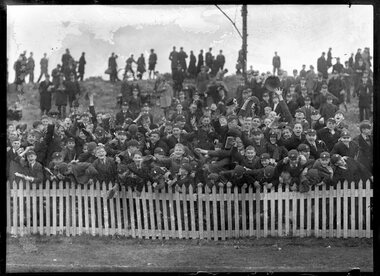 City of Melbourne Libraries
Photograph, Bull, Hugh Jones, 1897-1993, Scotch College v. Xavier College football match
... Scotch College v. Xavier College football match ...Published: 29 June 1934 Published title: PUBLIC SCHOOLS FOOTBALL BEGINS WITH SCOTCH--XAVIER MATCH. Published caption: “The Public Schools 1934 Football season began yesterday when Scotch met Xavier on the Olympic Park ground, and after a wonderful recovery in the third term, Scotch registered a narrow win. ...Photographer notations on slide: "Scotch v Xavier - Olympic Park B42"....Published: 29 June 1934 Published title: PUBLIC SCHOOLS FOOTBALL BEGINS WITH SCOTCH--XAVIER MATCH. Published caption: “The Public Schools 1934 Football season began yesterday when Scotch met Xavier on the Olympic Park ground, and after a wonderful recovery in the third term, Scotch registered a narrow win. ...Published: 29 June 1934 Published title: PUBLIC SCHOOLS FOOTBALL BEGINS WITH SCOTCH--XAVIER MATCH. Published caption: “The Public Schools 1934 Football season began yesterday when Scotch met Xavier on the Olympic Park ground, and after a wonderful recovery in the third term, Scotch registered a narrow win. Pictured above is the crowd of Scotch boys who congregated behind the goal after the addition of another goal to their score.” Description: Scotch College pupils exuberantly cheer their team’s goal at the first football match of the Public Schools Premiership and Championship for 1934 between Scotch College and Xavier College at Olympic Park, Melbourne (where AAMI Park is now). Research by project volunteer, Fiona Collyer: The Public Schools Premiership and Championship was an Australian Rules football tournament held every winter, over five weeks between six schools- Scotch College, Xavier College, Melbourne Grammar, Wesley College and traditional rivals Geelong Grammar and Geelong College. The school that won the most games out of the five played, won the competition. As the 1933 Premiers, Xavier College had the honour of playing the opening match of the season on 28 June against runners-up Scotch College at Olympic Park (where AAMI Park is now). The Public Schools Premiership matches were widely reported in Melbourne’s daily newspapers with photographs and commentary of every game. Weekly society magazine “Table Talk” featured reports and seven photographs of the first games of the season. Australian Broadcasting Commission (ABC) wireless station 3AR interspersed their afternoon program of reproduced music with detailed descriptions of the matches. Also reporting the matches was “Forty-Years-On”, presumably a student in the 1890s, whose regular column in The Herald newspaper “Activities In The Public Schools” published all the latest news on Victoria’s public (private) schools. In his column for The Australasian 7 July 1934, “Old Boy” writes about the Scotch versus Xavier match- “For more than half the game last week, Scotch was outplayed, but took the lead early in the last term and kept it. Scotch surprised even its own supporters by its dash in the last 25 minutes. Xavier, who became over confident by the prospects of victory, could not withstand the final onslaught. In the last quarter Scotch was the better side and won by seven points.” The final score was Scotch 11.11 (77 points) and Xavier 10.10 (70 points). At the end of this exciting match the overjoyed Scotch boys swarmed over the Olympic Park fences to chair their captain, Stanley Steele and carry him shoulder high, to the pavilion. The first documented game of a variation of Australian Rules football was played at Richmond Paddock (now Yarra Park) from 7 August 1858. Australian Rules football writer Hugh Buggy of The Argus 16 April 1952 explains- “It began when boys and masters of Scotch College and Melbourne Grammar School decided to play a 40-a-side game, with the first team to score two goals to be the winner. Goal posts were pitched more than a mile apart, one set on the Jolimont Hill and the other at Punt road Richmond. Nobody defined the boundary, and the play swung over the broad acres of the park and around the gum trees. It went on and on like a Test match, from noon till dusk. After 15 hours of play on three Saturdays the score was one goal all, and the game was abandoned for that season.” Rules of the game hadn’t been decided at this time - the earliest known rules were codified a year later in 1859. A sculpture and plaque located outside the Melbourne Cricket Ground (MCG), created by sculptor Louis Laumen in 2001, commemorates this game. It depicts two school boys chasing a ball along with umpire Tom Wills, a co-writer of the rules and promoter of Australian Rules football. A medley of Gaelic football, an Aboriginal game called marngrook as well as football played in English public (that is private) schools have been cited as inspiration for Australian Rules football. The word “Marngrook” meaning “game ball”, comes from the language of the Gunditjmara, First Nations people of southwestern Victoria. Marngrook was played at gatherings and celebrations and involved players competing to jump and catch the ball after it is kicked high into the air. The player that catches the ball then gets to kick it. The ball was made from possum skin, filled with pounded charcoal and tied with kangaroo sinews. Protector of Aborigines in Victoria, William Thomas (1794-1867) observed in 1841- “The men and boys joyfully assemble when this game is to be played. One makes a ball of possum skin, somewhat elastic, but firm and strong… The players of this game do not throw the ball as a white man might do, but drop it and at the same time kick it with their feet, using the instep for that purpose. The tallest men have the best chances in this game. Some of them will leap as high as five feet from the ground to catch the ball. The person who secures the ball kicks it. This continues for hours and the natives never seem to tire of the exercise.” The Victorian Football League (VFL), was founded in 1897 with eight teams playing Australian Rules football and held its first Grand Final at the MCG in 1902. From the start the games attracted large enthusiastic crowds, which included women. “Viva” writing in the Supplement to The Weekly Times-3 July 1886- LADIES COLUMN (By Viva) FOOTBALL. A Social Sketch. “…Of the popularity of football and footballers among women, there can be no doubt. Young, soft hearted girls, who would not “tread upon a worm," avow that football matches are "awfully jolly," and seem to regard accidents as a necessary part of the amusement…a great proportion of the spectators were ladies.” “Minetta” writing for Punch Magazine - “Ladies Letter, Holmby House, Toorak” 22 June 1905 “The "Football Girl" is a feminine genus at present much to the fore in Melbourne. Not that she plays football—at least not beyond a kick in the backyard or paddock—oh, dear, no! Her interest in the game is purely from a spectacular point of view. "Football Girls" usually hunt in couples, with two male barrackers attached. They know all about So-and-So's form, and whether he is a trier or has been bought. They go to each match of their particular club, and watch the play intently, their faces wearing a decidedly strained expression when their club is getting the worst of it. They are not ashamed to barrack either, when matters are progressing successfully… Yours ever, MINETTA.” The Herald 2 July 1909 published a cartoon by Ambrose Dyson depicting women football fans, which asked- “THE QUESTION OF THE DAY. Should Girls Go To Football Matches? Should they? The sex made up their mind about the matter very early on.” The resounding answer was- “Well, I’d like to see the man that would stop me!” At the final match of the 1934 tournament on August 2, Melbourne Grammar finished the season unbeaten, winning their tenth Public Schools premiership in 16 years. The Weekly Times 11 August 1934 reported-“Melbourne Grammar…had a rather lucky escape against Xavier…Had a Xavier player not touched a shot, kicked by a team-mate, as it was going through goal Grammar would have been beaten.” Final score - Melbourne Grammar 13.7 (85 points) defeated Xavier College 12.9 (81 points). Ladder for the 1934 Season- Melbourne Grammar-5 wins Wesley College- 4 wins Scotch College- 3 wins Xavier College- 2 wins Geelong Grammar- 1 win Geelong College- 0 wins The Associated Public Schools of Victoria (APS) exists today where eleven member (private) schools, including co-educational schools, participate in 21 sporting competitions throughout the year. (The descriptor “Public School” references the historical usage of the term and the model of the British public school). PUBLIC SCHOOLS FOOTBALL BEGINS WITH SCOTCH--XAVIER MATCH. (1934, June 29). The Age (Melbourne, Vic. : 1854 - 1954), p. 11. Retrieved June 18, 2025, from http://nla.gov.au/nla.news-article204824484 PUBLIC SCHOOLS FOOTBALL AT OLYMPIC PARK (1934, July 5). Table Talk (Melbourne, Vic. : 1885 - 1939), p. 5. Retrieved June 18, 2025, from http://nla.gov.au/nla.news-article149682433 PUBLIC SCHOOLS. (1934, June 29). The Age (Melbourne, Vic. : 1854 - 1954), p. 5. Retrieved June 3, 2025, from http://nla.gov.au/nla.news-article204824486 PUBLIC SCHOOLS FOOTBALL. (1936, July 3). The Argus (Melbourne, Vic. : 1848 - 1957), p. 18. Retrieved August 6, 2025, from http://nla.gov.au/nla.news-article11888301 https://en.m.wikipedia.org/wiki/History_of_Australian_rules_football COLLEGE SPORTS (1934, July 7). The Australasian (Melbourne, Vic. : 1864 - 1946), p. 48 (METROPOLITAN EDITION). Retrieved May 30, 2025, from http://nla.gov.au/nla.news-article145238393 GRAMMAR CHAMPIONS (1934, August 11). Weekly Times (Melbourne, Vic. : 1869 - 1954), p. 72. Retrieved June 1, 2025, from http://nla.gov.au/nla.news-article224562842 LETS LOOK AT FOOTBALL with HUGH BUGGY (1952, April 16). The Argus (Melbourne, Vic. : 1848 - 1957), p. 9. Retrieved June 15, 2025, from http://nla.gov.au/nla.news-article23174340 FOR YOUNG PEOPLE AMONG THE SCHOOLS. (1934, August 7). The Age (Melbourne, Vic. : 1854 - 1954), p. 4. Retrieved June 14, 2025, from http://nla.gov.au/nla.news-article205521661 https://www.nma.gov.au/defining-moments/resources/australian-rules-football#:~:text=In%20the%20winter%20of%201858,games%20of%20Australian%20Rules%20football. https://apssport.org.au/about/ http://lindsaymagazine.co/from-marngrook-to-australian-rules-football/ https://collection.australiansportsmuseum.org.au/objects/70993/possum-skin-ball FOOTBALL. (1886, July 3). Weekly Times (Melbourne, Vic. : 1869 - 1954), p. 6 (SUPPLEMENT TO THE STORY TELLER). Retrieved September 7, 2025, from http://nla.gov.au/nla.news-article221741193 Ladies' Letter. (1905, June 22). Punch (Melbourne, Vic. : 1900 - 1918; 1925), p. 28. Retrieved September 11, 2025, from http://nla.gov.au/nla.news-article175410975 THE QUESTION OF THE DAY. (1909, July 2). The Herald (Melbourne, Vic. : 1861 - 1954), p. 9. Retrieved September 17, 2025, from http://nla.gov.au/nla.news-article242062970 Photographer notations on slide: "Scotch v Xavier - Olympic Park B42".schools, football -
 Kew Historical Society Inc
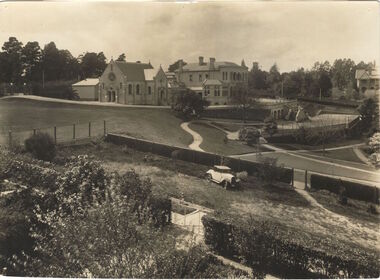
Photograph, Burke Hall, Xavier Preparatory School, circa 1930, c. 1930
... Burke Hall, Xavier Preparatory School, circa 1930...A panoramic photograph of the grounds of Xavier Preparatory School taken from the vicinity of Studley House, looking north east towards Burke Hall (originally Studley Hall). ...Burke Hall (Xavier Preparatory School) formerly Waverley. ...The house to the far right (part view) is "Campion". Burke Hall, Xavier Preparatory School, circa 1930 Photograph Photograph ...This work forms part of the collection assembled by the historian Dorothy Rogers, that was donated to the Kew Historical Society by her son John Rogers in 2015. The manuscripts, photographs, maps, and documents were sourced by her from both family and local collections or produced as references for her print publications. Many were directly used by Rogers in writing ‘Lovely Old Homes of Kew’ (1961) and 'A History of Kew' (1973), or the numerous articles on local history that she produced for suburban newspapers. Most of the photographs in the collection include detailed annotations in her hand. The Rogers Collection provides a comprehensive insight into the working habits of a historian in the 1960s and 1970s. Together it forms the largest privately-donated collection within the archives of the Kew Historical Society.A panoramic photograph of the grounds of Xavier Preparatory School taken from the vicinity of Studley House, looking north east towards Burke Hall (originally Studley Hall). The foreground to the left of the chapel is an oval known as the Chapel Oval (later known as Studley Oval). The ground to the right front is now known as the Jack Gervasoni oval. The house to the far right (part view) is "Campion".Burke Hall (Xavier Preparatory School) formerly Waverley. Built by Charles Griffiths ca. 1869 (Panoramic view from East [sic]) burke hall, studley hall, xavier preparatory school, kew, studley park, dorothy rogers, chapel oval, jack gervasoni oval, burke hall chapel, studley oval, charles griffiths -
 Melbourne Tram Museum
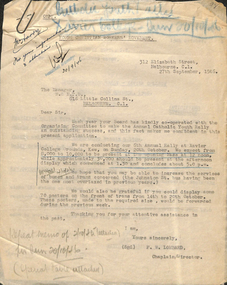
Letter, Youth Christian Workers' Movement, "Catholic Youth Rally - Xavier College - Sunday 20th October 1946", 27 September 1946, 15 October 1946
... "Catholic Youth Rally - Xavier College - Sunday 20th October 1946"...Catholic Youth Rally at Xavier College Sunday 20th October 1946 1 - Letter from FW Lomard to MMTB advising of event and requesting permission to display advertising material on trams. ..."Catholic Youth Rally Xavier College - Sun 20/10/46" written in blue pencil. ..."Catholic Youth Rally Xavier College - Sun 20/10/46" written in blue pencil. ...Catholic Youth Rally at Xavier College Sunday 20th October 1946 1 - Letter from FW Lomard to MMTB advising of event and requesting permission to display advertising material on trams. Letter dated 27 September 1946. 2 - Memo from JM Harry, District Traffic Supt SS, to Mr Kazoletti, Malvern Depot advising of service details and tram requirements. Memo dated 15 October 1946."Mr Harry for information and attention. WR 30/9/46" written in top left corner in black ink. "Catholic Youth Rally Xavier College - Sun 20/10/46" written in blue pencil. Various pencil notations on letter and memo in black pencil.trams, tramways, events, festival, catholic church, cotham rd, malvern depot -
 Kew Historical Society Inc
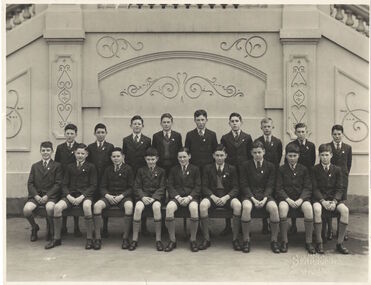
Photograph, Class photograph, Xavier Preparatory School, c. 1965
... Class photograph, Xavier Preparatory School...Group of Boys in front of Burke Hall. Xavier Preparatory School...Group of Boys in front of Burke Hall. Xavier Preparatory School Class photograph, Xavier Preparatory School Photograph Photograph ...This work forms part of the collection assembled by the historian Dorothy Rogers, that was donated to the Kew Historical Society by her son John Rogers in 2015. The manuscripts, photographs, maps, and documents were sourced by her from both family and local collections or produced as references for her print publications. Many were directly used by Rogers in writing ‘Lovely Old Homes of Kew’ (1961) and 'A History of Kew' (1973), or the numerous articles on local history that she produced for suburban newspapers. Most of the photographs in the collection include detailed annotations in her hand. The Rogers Collection provides a comprehensive insight into the working habits of a historian in the 1960s and 1970s. Together it forms the largest privately-donated collection within the archives of the Kew Historical Society.Class photograph. Group of Boys in front of Burke Hall. Xavier Preparatory Schoolburke hall, xavier preparatory school, dorothy rogers -
 Kew Historical Society Inc
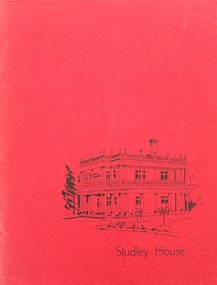
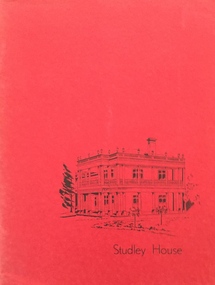
Booklet - Catalogue, Xavier College, Panorama of Australian Painting: 1818-1968, 1968
... A catalogue for an exhibition of Australian Art (1818-1968) at Studley House (Xavier Preparatory School) in 1968. The catalogue includes artist biographies and lists works exhibited. ...Xavier College...Together it forms the largest privately-donated collection within the archives of the Kew Historical Society. xavier college australian art dorothy rogers art catalogues A catalogue for an exhibition of Australian Art (1818-1968) at Studley House (Xavier Preparatory School) in 1968. ...This work forms part of the collection assembled by the historian Dorothy Rogers, that was donated to the Kew Historical Society by her son John Rogers in 2015. The manuscripts, photographs, maps, and documents were sourced by her from both family and local collections or produced as references for her print publications. Many were directly used by Rogers in writing ‘Lovely Old Homes of Kew’ (1961) and 'A History of Kew' (1973), or the numerous articles on local history that she produced for suburban newspapers. Most of the photographs in the collection include detailed annotations in her hand. The Rogers Collection provides a comprehensive insight into the working habits of a historian in the 1960s and 1970s. Together it forms the largest privately-donated collection within the archives of the Kew Historical Society.A catalogue for an exhibition of Australian Art (1818-1968) at Studley House (Xavier Preparatory School) in 1968. The catalogue includes artist biographies and lists works exhibited. The foreword on the history of Studley House is written by Dorothy Rogersxavier college, australian art, dorothy rogers, art catalogues -
 Kew Historical Society Inc
Booklet - Catalogue, Xavier College, Panorama of Australian Painting: 1818-1968, 1968
... A catalogue for an exhibition of Australian Art (1818-1968) at Studley House (Xavier Preparatory School) in 1968. The catalogue includes artist biographies and lists works exhibited. ...Xavier College...Together it forms the largest privately-donated collection within the archives of the Kew Historical Society. australian art xavier college A catalogue for an exhibition of Australian Art (1818-1968) at Studley House (Xavier Preparatory School) in 1968. ...This work forms part of the collection assembled by the historian Dorothy Rogers, that was donated to the Kew Historical Society by her son John Rogers in 2015. The manuscripts, photographs, maps, and documents were sourced by her from both family and local collections or produced as references for her print publications. Many were directly used by Rogers in writing ‘Lovely Old Homes of Kew’ (1961) and 'A History of Kew' (1973), or the numerous articles on local history that she produced for suburban newspapers. Most of the photographs in the collection include detailed annotations in her hand.The Rogers Collection provides a comprehensive insight into the working habits of a historian in the 1960s and 1970s. Together it forms the largest privately-donated collection within the archives of the Kew Historical Society.A catalogue for an exhibition of Australian Art (1818-1968) at Studley House (Xavier Preparatory School) in 1968. The catalogue includes artist biographies and lists works exhibited. The foreword on the history of Studley House is written by Dorothy Rogersaustralian art, xavier college -
 Kew Historical Society Inc
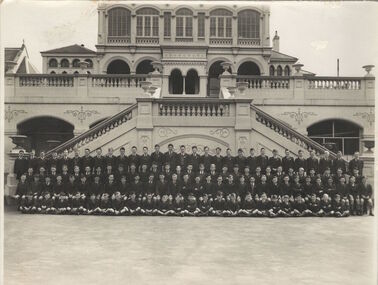
Photograph, Students of Xavier Preparatory School, 1960s
... Students of Xavier Preparatory School...An undated school photograph of the students of Xavier Preparatory School in Nolan Avenue, Kew. ...Together it forms the largest privately-donated collection within the archives of the Kew Historical Society. studley hall burke hall xavier preparatory school dorothy rogers An undated school photograph of the students of Xavier Preparatory School in Nolan Avenue, Kew. ...This work forms part of the collection assembled by the historian Dorothy Rogers, that was donated to the Kew Historical Society by her son John Rogers in 2015. The manuscripts, photographs, maps, and documents were sourced by her from both family and local collections or produced as references for her print publications. Many were directly used by Rogers in writing ‘Lovely Old Homes of Kew’ (1961) and 'A History of Kew' (1973), or the numerous articles on local history that she produced for suburban newspapers. Most of the photographs in the collection include detailed annotations in her hand. The Rogers Collection provides a comprehensive insight into the working habits of a historian in the 1960s and 1970s. Together it forms the largest privately-donated collection within the archives of the Kew Historical Society.An undated school photograph of the students of Xavier Preparatory School in Nolan Avenue, Kew. The photograph is taken outside the entrance to Burke Hall (earlier named Waverley, then Studley Hall).studley hall, burke hall, xavier preparatory school, dorothy rogers -
 Eltham District Historical Society Inc
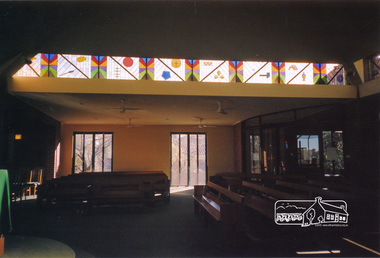
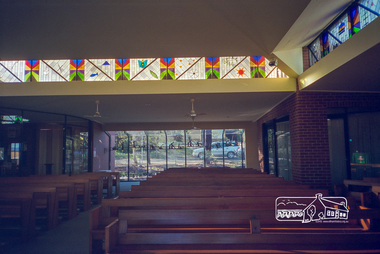
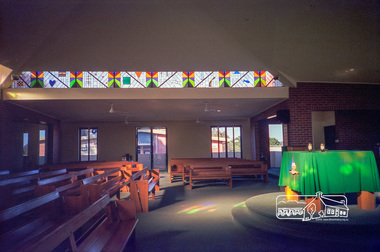
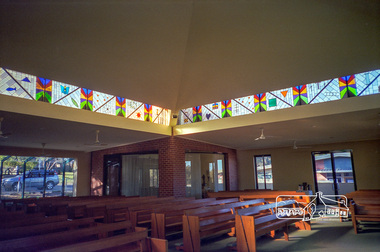
Photograph, Interior, St Francis Xavier Catholic Church, Montmorency
... Interior, St Francis Xavier Catholic Church, Montmorency...Three colour photographs showing the interior of St Francis Xavier Catholic Church and stained glass windows by Marinus 'Rein' Slagmolen (1916-1999), a Dutch-Australian artist and sculptor....montmorency st francis xavier catholic church marinus rein slagmolen Three colour photographs showing the interior of St Francis Xavier Catholic Church and stained glass windows by Marinus 'Rein' Slagmolen (1916-1999), a Dutch-Australian artist and sculptor. ...Three colour photographs showing the interior of St Francis Xavier Catholic Church and stained glass windows by Marinus 'Rein' Slagmolen (1916-1999), a Dutch-Australian artist and sculptor.montmorency, st francis xavier, catholic church, marinus rein slagmolen -
![Newspaper Clipping, Diamond Valley Leader, St Francis Xavier Montmorency Mo1343 [Enrolment Advertisement], 09/03/2016](/media/collectors/4f729f5697f83e03086015b8/items/58661b1bd0ce1a173cfc9a78/item-media/58661b61d0ce1a173cfcae7b/item-fit-380x285.jpg?cb=6) Greensborough Historical Society
Greensborough Historical SocietyNewspaper Clipping, Diamond Valley Leader, St Francis Xavier Montmorency Mo1343 [Enrolment Advertisement], 09/03/2016
... St Francis Xavier Montmorency Mo1343 [Enrolment Advertisement]...Advertisement for Prep enrolment information evening at St Francis Xavier Primary School, Mayona Road Montmorency....Advertisement for Prep enrolment information evening at St Francis Xavier Primary School, Mayona Road Montmorency. st francis xavier primary school News clipping, black text, colour image. ...Advertisement for Prep enrolment information evening at St Francis Xavier Primary School, Mayona Road Montmorency.News clipping, black text, colour image.st francis xavier primary school -
 Eltham District Historical Society Inc
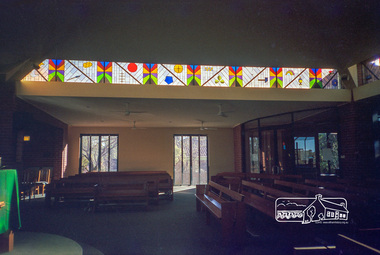
Photograph, Interior, St Francis Xavier Catholic Church, Montmorency, c.1990, 1990
... Interior, St Francis Xavier Catholic Church, Montmorency, c.1990...Interior of St Francis Xavier Catholic Church highlighting stained-glass windows by Marinus 'Rein' Slagmolen (1916-1999), a Dutch-Australian artist and sculptor....Interior of St Francis Xavier Catholic Church highlighting stained-glass windows by Marinus 'Rein' Slagmolen (1916-1999), a Dutch-Australian artist and sculptor. catholic church montmorency marinus rein slagmolen st francis xavier Kodak GC400-8 Roll of 35mm colour negative film, 4 strips Interior, St Francis Xavier Catholic Church, Montmorency, c.1990 Photograph ...Interior of St Francis Xavier Catholic Church highlighting stained-glass windows by Marinus 'Rein' Slagmolen (1916-1999), a Dutch-Australian artist and sculptor.Roll of 35mm colour negative film, 4 stripsKodak GC400-8catholic church, montmorency, marinus rein slagmolen, st francis xavier -
 Eltham District Historical Society Inc
Photograph, Interior, St Francis Xavier Catholic Church, Montmorency, c.1990, 1990
... Interior, St Francis Xavier Catholic Church, Montmorency, c.1990...Interior of St Francis Xavier Catholic Church highlighting stained-glass windows by Marinus 'Rein' Slagmolen (1916-1999), a Dutch-Australian artist and sculptor....Interior of St Francis Xavier Catholic Church highlighting stained-glass windows by Marinus 'Rein' Slagmolen (1916-1999), a Dutch-Australian artist and sculptor. catholic church montmorency marinus rein slagmolen st francis xavier Kodak GC400-8 Roll of 35mm colour negative film, 4 strips Interior, St Francis Xavier Catholic Church, Montmorency, c.1990 Photograph ...Interior of St Francis Xavier Catholic Church highlighting stained-glass windows by Marinus 'Rein' Slagmolen (1916-1999), a Dutch-Australian artist and sculptor.Roll of 35mm colour negative film, 4 stripsKodak GC400-8catholic church, montmorency, marinus rein slagmolen, st francis xavier -
 Eltham District Historical Society Inc
Photograph, Interior, St Francis Xavier Catholic Church, Montmorency, c.1990, 1990
... Interior, St Francis Xavier Catholic Church, Montmorency, c.1990...Interior of St Francis Xavier Catholic Church highlighting stained-glass windows by Marinus 'Rein' Slagmolen (1916-1999), a Dutch-Australian artist and sculptor....Interior of St Francis Xavier Catholic Church highlighting stained-glass windows by Marinus 'Rein' Slagmolen (1916-1999), a Dutch-Australian artist and sculptor. catholic church montmorency marinus rein slagmolen st francis xavier Kodak GC400-8 Roll of 35mm colour negative film, 4 strips Interior, St Francis Xavier Catholic Church, Montmorency, c.1990 Photograph ...Interior of St Francis Xavier Catholic Church highlighting stained-glass windows by Marinus 'Rein' Slagmolen (1916-1999), a Dutch-Australian artist and sculptor.Roll of 35mm colour negative film, 4 stripsKodak GC400-8catholic church, montmorency, marinus rein slagmolen, st francis xavier -
 Eltham District Historical Society Inc
Photograph, Interior, St Francis Xavier Catholic Church, Montmorency, c.1990, 1990
... Interior, St Francis Xavier Catholic Church, Montmorency, c.1990...Interior of St Francis Xavier Catholic Church highlighting stained-glass windows by Marinus 'Rein' Slagmolen (1916-1999), a Dutch-Australian artist and sculptor....Interior of St Francis Xavier Catholic Church highlighting stained-glass windows by Marinus 'Rein' Slagmolen (1916-1999), a Dutch-Australian artist and sculptor. catholic church montmorency marinus rein slagmolen st francis xavier Kodak GC400-8 Roll of 35mm colour negative film, 4 strips Interior, St Francis Xavier Catholic Church, Montmorency, c.1990 Photograph ...Interior of St Francis Xavier Catholic Church highlighting stained-glass windows by Marinus 'Rein' Slagmolen (1916-1999), a Dutch-Australian artist and sculptor.Roll of 35mm colour negative film, 4 stripsKodak GC400-8catholic church, montmorency, marinus rein slagmolen, st francis xavier -
 Damascus College
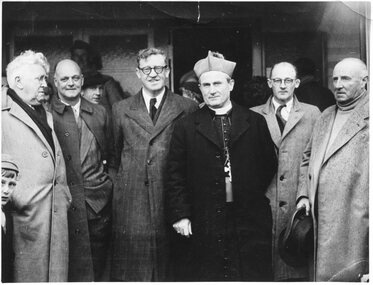
Photograph, Opening of the Mount Xavier Golf Club
... Opening of the Mount Xavier Golf Club...With the junior SHC students educated at the Mount Xavier site since 1906, the land adjacent to 'Villa' as it was known, caught the eye of both keen golfer S. ...Digital Photograph Opening of the Mount Xavier Golf Club Photograph ...From 1949 golf became a regular part of a SHC student's week. With the junior SHC students educated at the Mount Xavier site since 1906, the land adjacent to 'Villa' as it was known, caught the eye of both keen golfer S. J. Weir and Mother Bonaventure Healy. Under their joint direction the golf course took shape, the first to be built and owned by a convent, and on any given Monday of the year could be found teeming with enthusiastic students from Sacred Heart College. Pictured centre left is Australian Minister for Immigration Arthur Calwell, whose daughter Mary attended SHC at that time.Digital Photograph
