
Showing 5 items matching "yonder"
-
 Flagstaff Hill Maritime Museum and Village
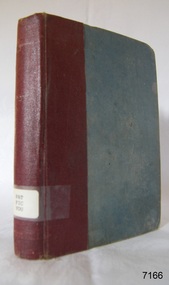
Book, Yonder
... Yonder...yonder...Yonder Author: E H Young Publisher: Jonathan Cape Date: 1931 ...The Warrnambool Mechanics' Institute’s publication collection is of both local and state significance. yonder e h young Shipwrecked-coast Flagstaff-Hill Flagstaff-Hill-Maritime-Museum Warrnambool Maritime-Museum Shipwreck-coast Flagstaff-Hill-Maritime-Village Shipwrecked-artefact Book Pattison Collection Warrnambool Library Warrnambool Mechanics’ Institute Ralph Eric Pattison Corangamite Regional Library Service Warrnambool City Librarian Mechanics’ Institute Library Victorian Library Board Warrnambool books and records Warrnambool Children’s Library Label on spine with typed text PAT FIC YOU Pastedown front endpaper has a sticker from Warrnambool Mechanics Institute and Free Library covered by a sticker from Corangamite Regional Library Service Front loose endpaper has a stamp from Corangamite Regional Library Service Yonder Author: E H Young Publisher: Jonathan Cape Date: 1931 Yonder Book ...Pattison Collection This item is from the ‘Pattison Collection’, a collection of books and records that was originally owned by the Warrnambool Mechanics’ Institute, which was founded in Warrnambool in 1853. By 1886 the Warrnambool Mechanics’ Institute (WMI) had grown to have a Library, Museum and Fine Arts Gallery, with a collection of “… choice productions of art, and valuable specimens in almost every branch and many wonderful national curiosities are now to be seen there, including historic relics of the town and district.” It later included a School of Design. Although it was very well patronised, the lack of financial support led the WMI in 1911 to ask the City Council to take it over. In 1935 Ralph Pattison was appointed as City Librarian to establish and organise the Warrnambool Library as it was then called. When the WMI building was pulled down in 1963 a new civic building was erected on the site and the new Warrnambool Library, on behalf of the City Council, took over all the holdings of the WMI. At this time some of the items were separated and identified as the ‘Pattison Collection’, named after Ralph Pattison. Eventually the components of the WMI were distributed from the Warrnambool Library to various places, including the Art Gallery, Historical Society and Flagstaff Hill. Later some were even distributed to other regional branches of Corangamite Regional Library and passed to and fro. It is difficult now to trace just where all of the items have ended up. The books at Flagstaff Hill Maritime Village generally display stamps and markings from Pattison as well as a variety of other institutions including the Mechanics’ Institute itself. RALPH ERIC PATTISON Ralph Eric Pattison was born in Rockhampton, Queensland, in 1891. He married Maude Swan from Warrnambool in 1920 and they set up home in Warrnambool. In 1935 Pattison accepted a position as City Librarian for the Warrnambool City Council. His huge challenge was to make a functional library within two rooms of the Mechanics’ Institute. He tirelessly cleaned, cleared and sorted a disarrayed collection of old books, jars of preserved specimens and other items reserved for exhibition in the city’s museum. He developed and updated the library with a wide variety of books for all tastes, including reference books for students; a difficult task to fulfil during the years following the Depression. He converted all of the lower area of the building into a library, reference room and reading room for members and the public. The books were sorted and stored using a cataloguing and card index system that he had developed himself. He also prepared the upper floor of the building and established the Art Gallery and later the Museum, a place to exhibit the many old relics that had been stored for years for this purpose. One of the treasures he found was a beautiful ancient clock, which he repaired, restored and enjoyed using in his office during the years of his service there. Ralph Pattison was described as “a meticulous gentleman whose punctuality, floorless courtesy and distinctive neat dress were hallmarks of his character, and ‘his’ clock controlled his daily routine, and his opening and closing of the library’s large heavy doors to the minute.” Pattison took leave during 1942 to 1942 to serve in the Royal Australian Navy, Volunteer Reserve as Lieutenant. A few years later he converted one of the Museum’s rooms into a Children’s Library, stocking it with suitable books for the younger generation. This was an instant success. In the 1950’s he had the honour of being appointed to the Victorian Library Board and received more inspiration from the monthly conferences in Melbourne. He was sadly retired in 1959 after over 23 years of service, due to the fact that he had gone over the working age of council officers. However he continued to take a very keen interest in the continual development of the Library until his death in 1969. The Pattison Collection, along with other items at Flagstaff Hill Maritime Village, was originally part of the Warrnambool Mechanics' Institute’s collection. The Warrnambool Mechanics’ Institute Collection is primarily significant in its totality, rather than for the individual objects it contains. Its contents are highly representative of the development of Mechanics' Institute libraries across Australia, particularly Victoria. A diversity of publications and themes has been amassed, and these provide clues to our understanding of the nature of and changes in the reading habits of Victorians from the 1850s to the middle of the 20th century. The collection also highlights the Warrnambool community’s commitment to the Mechanics’ Institute, reading, literacy and learning in the regions, and proves that access to knowledge was not impeded by distance. These items help to provide a more complete picture of our community’s ideals and aspirations. The Warrnambool Mechanics Institute book collection has historical and social significance for its strong association with the Mechanics Institute movement and the important role it played in the intellectual, cultural and social development of people throughout the latter part of the nineteenth century and the early twentieth century. The collection of books is a rare example of an early lending library and its significance is enhanced by the survival of an original collection of many volumes. The Warrnambool Mechanics' Institute’s publication collection is of both local and state significance. Yonder Author: E H Young Publisher: Jonathan Cape Date: 1931 Label on spine with typed text PAT FIC YOU Pastedown front endpaper has a sticker from Warrnambool Mechanics Institute and Free Library covered by a sticker from Corangamite Regional Library Service Front loose endpaper has a stamp from Corangamite Regional Library Serviceyonder, e h young, shipwrecked-coast, flagstaff-hill, flagstaff-hill-maritime-museum, warrnambool, maritime-museum, shipwreck-coast, flagstaff-hill-maritime-village, shipwrecked-artefact, book, pattison collection, warrnambool library, warrnambool mechanics’ institute, ralph eric pattison, corangamite regional library service, warrnambool city librarian, mechanics’ institute library, victorian library board, warrnambool books and records, warrnambool children’s library -
 Ringwood and District Historical Society
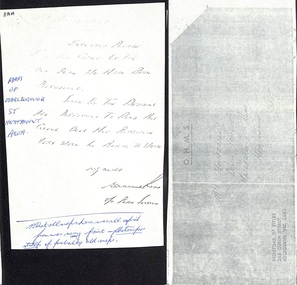
Map, Photocopied Subdivision Sections of Marlborough Street Heathmont Area, Parish of Ringwood, and accompanying Titles Office correspondence - c.1970
... Overlapping taped A4 page sections of low quality photocopied subdivisional map of South-Western area of Heathmont along Dandenong Creek, with handwritten note from Registrar of Titles, Melbourne, to Mrs Hamersley, Down Yonder, Marlborough Road Heathmont 3135....Overlapping taped A4 page sections of low quality photocopied subdivisional map of South-Western area of Heathmont along Dandenong Creek, with handwritten note from Registrar of Titles, Melbourne, to Mrs Hamersley, Down Yonder, Marlborough Road Heathmont 3135. Photocopied Subdivision Sections of Marlborough Street Heathmont Area, Parish of Ringwood, and accompanying Titles Office correspondence - c.1970. ...Overlapping taped A4 page sections of low quality photocopied subdivisional map of South-Western area of Heathmont along Dandenong Creek, with handwritten note from Registrar of Titles, Melbourne, to Mrs Hamersley, Down Yonder, Marlborough Road Heathmont 3135."Enclosed please find two copies of the old plan we have been discussing. Some of the details are difficult to read but colour does not reproduce very well in black and white. Regards, Graeme Ross - Plan Section." Plan reference numbers include 51038, 52189 and owners include Nelson Polak and Robert Dyer. Contour map of Dandenong Creek area includes Bellbird Park, Ringwood South Drain, and notation: "Proposed future flood prone line after July 1970 subject to confirmation." -
 Clunes Museum
Leisure object - GRAMAPHONE RECORDS
... COLUMBIA RECORDS 78RPM .1 THE PIRATES OF PENZANCE .2 FRENCH ARMY ON THE MARNE & LE COQUET MARCH .3 RICHOCHET & WAY DOWN YONDER IN NEW ORLEANS .4 THE DESERT SONG FOX TROT & THE DESTER SONG WALTZ REGAL (MADE BY COLUMBIA .5 CARRY ME BACK TO THE LONE PRAIRIE & THE SUNSET TRAIL (PAPER COVER, DARK GREEN ...78RPM COLUMBIA RECORDS REGAL RECORDS .3 .4 ROUND RED STICKER WITH 1.00 WRITTEN ON IT .5 WHITE STICKER WITH RED PRINTING (1/3 RD MISSING) ALBERT & SON LTD STAMPED ON IT COLUMBIA RECORDS 78RPM .1 THE PIRATES OF PENZANCE .2 FRENCH ARMY ON THE MARNE & LE COQUET MARCH .3 RICHOCHET & WAY DOWN YONDER IN NEW ORLEANS .4 THE DESERT SONG FOX TROT & THE DESTER SONG WALTZ REGAL (MADE BY COLUMBIA .5 CARRY ME BACK TO THE LONE PRAIRIE & THE SUNSET TRAIL (PAPER COVER, DARK GREEN Leisure object GRAMAPHONE RECORDS ...COLUMBIA RECORDS 78RPM .1 THE PIRATES OF PENZANCE .2 FRENCH ARMY ON THE MARNE & LE COQUET MARCH .3 RICHOCHET & WAY DOWN YONDER IN NEW ORLEANS .4 THE DESERT SONG FOX TROT & THE DESTER SONG WALTZ REGAL (MADE BY COLUMBIA .5 CARRY ME BACK TO THE LONE PRAIRIE & THE SUNSET TRAIL (PAPER COVER, DARK GREEN .3 .4 ROUND RED STICKER WITH 1.00 WRITTEN ON IT .5 WHITE STICKER WITH RED PRINTING (1/3 RD MISSING) ALBERT & SON LTD STAMPED ON IT78rpm, columbia records, regal records -
 Melbourne Legacy
Document - Speech, ANZAC Commemoration Ceremony for Students
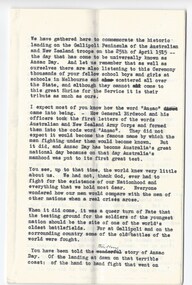
... I hope when you have passed through the Shrine you will go and see a little bronze statue near the road yonder. A statue of a man leading a donkey which carries a wounded comrade. ...I hope when you have passed through the Shrine you will go and see a little bronze statue near the road yonder. A statue of a man leading a donkey which carries a wounded comrade. ...A copy of an Anzac Day Address at the Anzac Commemoration Ceremony for Students, the year is unknown but it is presumably the address given by the President of Legacy. It seems to be one of the earlier ceremonies. It was stored with documents about the building of the Shrine and another speech from the 1939 service. The presenter had probably served in World War 1 so was very close to the events he was talking about. The ceremony provides a valuable opportunity for students to gain an appreciation of the Anzac spirit, the significance of the Shrine and the meaning of Anzac Day. The ceremony is usually attended by representatives from schools throughout the state and the Governor of Victoria. The text says: 'We have gathered here too commemorate the historic landing on the Gallipoli Peninsula of the Australian and New Zealand troops on the 25th of April 1915 - the day that has come to be universally known as Anzac Day. . . I expect most of you know how the word 'Anzac' came into being. How General Birdwood and his officers took the first letters of the words Australian and New Zealand Army Corps and formed them into the code word "Anzac". They did not expect it would become the famous name by which the men fighting under them would become known. But it did, and Anzac Day has become Australia's greatest national day because on that day Australia's manhood was put to its first great test. You see up to that that time, the world knew very little about us. We had not, thank God, ever had to fight for the existence of our Nationhood and everything we hold most dear. Everyone wondered how our men would compare with the men of other nations when a real crises arose. . . . You have been told there thrilling story of Anzac Day. Of the landing at dawn on that terrible coast: the hand to hand fighting that went on continuously all that day and through the days and nights that followed. How the Anzacs - outnumbered, exhausted and tortured by thirst held on, and how during the terrible nine months that ensued all the efforts of a brave enemy to dislodge them failed. Such was their gallantry that a British Officer described the Australian soldier as "The bravest thing God ever made". What a wonderful tribute that was; and how proud we should be of the men who earned it. . . . These men carried on all the traditions of the Anzacs and made a wonderful name for Australia and New Zealand in France, in Belgium, in Egypt and Palestine and in all the theatres of war in which they served. And this great Shrine was build by the people of Victoria, not in any boastful sense of Victory, not in any attempt to glorify war - which is a horrible, dreadful thing, but in memory of those thousands of Victorian sailors and soldiers who so loved their country that they laid down their lives in her service. . . All of them were brave, but do not think that a soldier who is brave need alway be a great warrior. I hope when you have passed through the Shrine you will go and see a little bronze statue near the road yonder. A statue of a man leading a donkey which carries a wounded comrade. You will see the soldier leading the donkey carries no weapons. Yet he was a hero indeed, for he saved the lives of scores of his comrades at Anzac by carrying wounded from the battle to safety and the hospital. And in the end he too gave his life for his friends. . . Let us all try to help each other in peace as they did in war. Instead of divisions, let us have unity. If we think of no one but ourselves we shall not achieve anything nor shall we deserve to. Let those of you who are strong help those who are not so strong - all through life - like John Simpson, the man with the donkey did. Be proud of your country and do nothing to dishonour it. If you get an order from one in authority, obey it, even if you do not understand it.A good solider always obeys his orders. If he did not, he may bring disaster and cause harm to his fellow soldiers. Remember that those thousands of men died so that we could still live here in freedom. A country is judged by its citizens. Let us be worthy of those great citizens who have left us the legacy of their fame and devotion to duty. And when you file through the Shrine and look down on the Rock of Remembrance, read the inscription on it, "Greater Love Hath No Man", remember those wonderful words written in the greatest book in the world nearly two thousand years ago, "Greater love hath no man than this, that a man lay down his life for his friend."A record of a ceremony at the Shrine for school students. The text of the speech is significant in that it was written by a man who had served in World War 1 and knew first hand what it meant to be part of the first Anzacs. White quarto paper x 4 pages with black type of a speech at one of the Annual Anzac Commemoration Service for Students.Handwritten in blue pen 'Shrine, Children's Service'anzac commemoration for students, wreath laying ceremony, speech -
 Melbourne Legacy
Document - Speech, Commemorative Address - Sir Stanley Savige K.B.E. Federal Conference of Legacy Clubs, Canberra, 10/1954
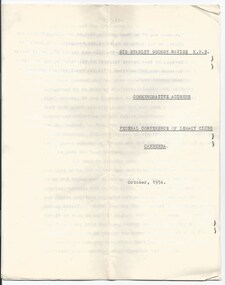
... As he has bequeathed to the National War Memorial yonder his diaries, records and battle plans, so he has bequeathed to us his fellow Legatees his greatest achievement and his trust, Legacy itself. ...As he has bequeathed to the National War Memorial yonder his diaries, records and battle plans, so he has bequeathed to us his fellow Legatees his greatest achievement and his trust, Legacy itself. ...After the death of Stan Savige this address was given at the Canberra Conference in October 1954. It is tribute to his life. Sir Stanley Savige KBE : Commemorative Address Federal Conference of Legacy Clubs, Canberra : October 1954. On the 15th of May this year Legacy learned to its enduring sorrow of the death of its Founder, Lieut. General Stanley George Savige KBE, CB, CBE, DSO, MC, ED, for more than 30 years affectionately known to us all as Legatee Stan Savige. He was the embodiment of all those things for which Legacy stands, and each one of us who knew him and worked with him feels a great and abiding sense of personal loss. It is proper, therefore, that those of us at this Conference, the first after his passing, representative of Legacy throughout the Commonwealth, and comprising so many who were his friends, so many who knew the depth of his love for Legacy, should acknowledge our debt to our Founder and ensure, so far as we may, that the inspiration of his life and work in this Cause shall not be lost to those who follow after. It was not ordained that Stanley George Savige - should enjoy a long life, but it was to prove a life of outstanding service. Born at Morwell in Victoria some 63 years ago, he received with his brothers and sisters such education as was then available to a lad in a mining district. He had no particular opportunities of advancement, but from his early days he cherished a strong ambition to make a success of his life, and with this in view he lost no opportunity of adding to his knowledge. Always a lover of the open country, a good bushman and a fine shot, he became as a young man, a Scoutmaster with a keen following of boys. Even in those early days he attracted youth and showed undoubted promise of the quality of leadership which later was to make him famous. Opportunity came with the first World War, and he took his place as a private soldier in the original 24th Battalion AIF. Followed Gallipoli and Anzac where his marksmanship and bush craft stood him in good stead. Conscious that his early training was not sufficient to secure the promotion he desired, he set himself to enlarge it. Only a man of fine fibre and rare determination could apply himself to study on that war torn Peninsula, where our men, hitherto untested, suffered every known hardship and no man knew, from hour to hour, whether he would survive. But Savige achieved it. Himself then a Corporal he found another Corporal who was a former Schoolmaster and learned from him all that he had to teach. Savige was on his way. He was commissioned on the Field and allotted the heroic task of leading the last party off that desperate coast during the famous evacuation. In France he became the Adjutant of his Battalion and one of the best known officers in the 6th Brigade. He won the Military Cross and was mentioned in despatches. Early in 1918 he received a signal distinction, He was included in a small but distinguished band of Officers and Non-Commissioned Officers from the British and Dominion Forces most carefully selected for individual courage and proved qualities of leadership, and was sent to Persia, under the command of Major-General Dunsterville, Kipling’s famous Stalky, to assist and mobilise the friendly tribes with a view to protecting the road to India, left wide open by the withdrawal of Russia. The story of the Dunsterforce, its suffering and achievements in the face of incredible hardships and difficulties, was later to be told by Savige in his book “Stalky’s Forlorn Hope”. He emerged, finally, unscathed, despite his active participation in several of the bloodiest battles of all time, with the rank of Captain and a DSO and MC to his credit, to say nothing of three mentions in despatches. In later years, further decorations were to be conferred upon him, but I believe he valued none of these so highly as his awards for outstanding personal bravery won in the Field when he was an Officer of comparatively junior rank. Such was the man who in August 1923, at the instance of his former Commander, Major-General Sir John Gellibrand, gathered around him a handful of men who had fought and laughed with him over four well remembered years. This small band adopted the name of “Legacy”, but its purpose then was, in the main, to assist in safeguarding the interests of ex-servicemen in this country. Worthy although the case undoubtedly was, the conception and ideal which was to distinguish Legacy from all kindred post-war movements did not emerge until two years later. The torch had not been lit. Legacy had not yet found its soul. What has been achieved since then is known to you all. The Legacy ideal, unique in its conception, with no known counterpart elsewhere, is now accepted, welcomed and honoured throughout the Commonwealth and abroad. But in those early days the achievements of our Founder in the face of all manner of difficulties and frustrations are worthy of our lasting memory and thankfulness. As the source of every river lies in the hills, so must the inspiration from which stems a great conceptions of service to one’s fellow men be lofty and above reproach. Savige was the embodiment of this new expression of comradeship, as he was the central figure and driving force of the little group that sponsored it. But for his zeal, his faith and determination, it is likely that the flame, newly kindled, might have flickered and died. The idea of men returned from active service pledging for the sake of their former comradeship, their personal assistance to the widows, and above all, to the children of those who had fought beside them and paid the full price of War, was so completely new and unexpected that it was by no means readily accepted. There were no funds, no precedents to guide the new adventurers, only the clear bright flame of an ideal just envisaged, and the conviction that the Cause was unassailable. Nor were there lacking many who said that the community held no place for Legacy, that it was born of sentiment only, and would quickly pass. The scoffers are gone and one since forgotten, but the torch remains and burns brighter than ever. Down the years of Legacy there are many names deserving of honour, men from all States and all stations of life, but no name stands out in such clear and bold relief as does the name of our Founder. By his works you shall know him. He was, in truth, the Soul of Legacy. He sought no office and preferred to work as one of the team. Six years went by before he accepted the Presidency of Melbourne Club, and then only because his fellows would book no further delay. “The Spirit of Legacy is Service” - so runs the Charter, and that was Savige’s Creed. By virtue of his attainments he was called upon to take a leading part in the administration of Legacy, first within his own club and later, as Chairman of the Co-ordinating Council of Legacy in Australia. But always it was the essentially human character of the work which enthralled and upheld him, and the tasks which gave him most joy were those which brought him into close personal contact with the youngsters and their home life. Like their elders they recognised his goodwill and his leadership and responded to it. It was Savige who made possible the first camps held for the boys and girls by Melbourne Club. These were erected on his own seaside property, and were originally conducted under his personal direction and largely with the aid of funds he had collected. There was hardly an important post in his own Club that Savige did not at some time occupy and adorn. He was happiest in the company of those men with whom he had served in the field, and cherished always the comradeship born of active service which is of the essence of Legacy. He was a man of strong convictions but attentive always to another’s point of view. As a Legatee he played a leading part in bringing hope and encouragement to many a mother on whom the whole responsibility of a young family had been suddenly and tragically laid; in the attainment of the ambitions of many an orphan child, which not so long since had seemed to him or her to be mere dreams, impossible of realisation. Comfort for the bereaved, new hope for the children’s physical and educational welfare, assistance with the home, aid for the sick, money for the needy and a new courage to face a future that hitherto had held no promise, all these facets of Legacy endeavour combine to present a living and enduring memorial to the man we honour as our Founder today. Between the two World Wars in addition to establishing himself successfully in civilian life and answering the constant calls of Legacy on his energy and time, Savige maintained an active association with the Army. He was convinced that a Second AIF would one day be urgently called upon, and as a Battalion Commander he spared no effort to train the Officers under his charge during the uneasy years of peace for the trial that he felt must come. These men have all subsequently had distinguished military careers, their names are well known and many of the serve in Legacy today. When the second crisis came, Savige himself was one of the first to offer, and although his youth was spent, he proudly carried the number VX13 throughout the terrible years that followed. This time he was to command, first the 17th Australian Infantry Brigade in the first action of the Second AIF against the enemy at Barida, and subsequently at Tobruk and Derna - all famous names now. It was his patrols which gave the warning - unheeded at the time - that Rommel’s reinforcements were reaching North Africa far earlier than was expected. Then followed the grim days of Greece and Crete when the fine qualities of his leadership were put to the utmost test. I have been told by those who were closest to him it was typical of Savige that when his convoys were on the move back and were being blasted from the air by the unopposed Luftwaffe, he should sit by the side of the open road, wearing his red banded cap, to steady the morale of men who had then no chance of hitting back at the enemy. Unorthodox no doubt, but here was a man indeed. Throughout the whole campaign and later when he commended the 3rd division in New Guinea and later still when with the rank of Lieutenant-General he became a Corps Commander in New Guinea and Bouganville, it was at all times characteristic of him that he should see for himself the situation in the forward areas. He dealt personally with his subordinate commanders whenever it was possible to do so. No one says his G.S.O. 1. understood better than he did the importance of front line troops seeing their G.O.C. frequently, and knowing that he was aware of and prepared to share their hardships and dangers. He took many risks that he should not have taken, exhausted himself physically and mentally times without number, and considered himself not at all in order to secure the success of his operations. Finally, in Bouganville, he brought his campaign to a victorious conclusion and accepted the personal surrender of the Japanese Commander. Savige is known as one of Australia’s most human military leaders, but let no one believe that he did not ask and receive the utmost of his men. He trained them in a hard school but he was ever conscious of their needs and observant and thoughtful of their welfare. Fearless and untiring under conditions which brought younger men down, he asked nothing that he was not himself prepared to give and do. The close of the Second World War left him with the same brave heart; but a vitality greatly impaired. He was called up again and again to perform important national tasks, notably that of Co-ordinator of Demobilisation and Dispersal. But his interest in Legacy never flagged it was in fact more personal than ever, for under his command many junior legatees, sons of former comrades had proved themselves worthy of their Fathers in war and in peace. In the bearing and achievements of the young men of the Second A.I.F. he took a particular and justifiable pride. He applied himself to the Extension of Legacy to areas where it had not previously been practicable to operate. His record of service and close personal contact with the men of both wars made him a most welcome pioneer and many new Clubs and Groups resulted from his efforts. He founded, and I doubt whether any one else could have done so, the Club in the great Capital of our Empire. His reputation and obvious sincerity surmounted obstacles that might well have daunted lesser man. Legacy’s debt to him visibly increased. But he was ever a simple man, with a great love and understanding of his fellow men and a true Legatee at heart. Much that he did will never be known or recognised, save by those who benefitted. His service in Legacy ranged from the humble kitchen of cottage and farm to our representation in Westminster Abbey itself. A knighthood set the seal upon an outstanding career. None the less when upon the death of Field Marshall Sir Thomas Blamey, Lieut. General Sir Stanley Savige became the Patron of the Melbourne Club, he retained at his own express desire, the title of Legatee Savige, and when on that final day we bade him farewell, when the Flags he had served so well were lowered and the guns which had formed a grim final salute, it was apparent to all who had eyes to see that this great and simple man had won such a place in the hearts and affection of his fellow country men as is given to few men indeed. From the packed Cathedral, escorted by his fellow Generals, followed by men of his own Units, by Legatees and a great company of others who had cause to honour and esteem him, he made his last journey. But that is not the end. His voice and presence are lost to us but his memory and inspiration must ever remain. As he has bequeathed to the National War Memorial yonder his diaries, records and battle plans, so he has bequeathed to us his fellow Legatees his greatest achievement and his trust, Legacy itself. Never was the Torch passed by worthier hands. Now it is ours to hold it high. Whatever material memorial the future many hold for him, Legacy owes its Founder a livelier recompense. It is within our power to implement what I believe to be his greatest wish, that Legacy and its ideal of comradeship and service shall flourish and endure. Let each one of us then resolve that we shall, within our Clubs, in all tasks to which we are assigned, both great and small, keep in our minds the life and spirit of Stanley George Savige, so that we may be proud at all times to say of Legacy to those who follow after - “If you would see his memorial - Look around you”.The tribute to Stanley Savige shows how greatly he was regarded by the Legatees.Off white quarto paper with black type, address given about Stan Savige to the Canberra Conference, x 12 pages.savige, speech, obituary
