
Showing 43 items matching "zoo animals"
-
 University of Melbourne, Burnley Campus Archives
Document - Report, Kate Bodley (Melbourne Zoo), Addendum: Drug Formularly for Use With Zoo Animals and Australian Wildlife, 2000
... Addendum: Drug Formularly for Use With Zoo Animals and Australian Wildlife......zoo animals...veterinary science zoo animals australian wildlife Typed document. ...veterinary science, zoo animals, australian wildlife -
University of Melbourne, Burnley Campus Archives
Document - Report, Kate Bodley (Melbourne Zoo), Veterinary care and management of zoo animals and Australian wildlife, 2000
... Veterinary care and management of zoo animals and Australian wildlife......zoo animals...veterinary science masters degree zoo animals australian wildlife Typed document. partial fulfilment for degree of Master of Veterinary Studies Veterinary care and management of zoo animals and Australian wildlife Document Report Kate Bodley (Melbourne Zoo) ...veterinary science, masters degree, zoo animals, australian wildlife -
 Kiewa Valley Historical Society
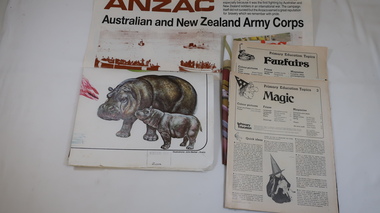
Posters & Booklets - Primary Education Topics, ANZAC, Zoo Animals, Magic, Funfairs
... ANZAC, Zoo Animals, Magic, Funfairs...Reverse is colored with book advertisements. 1987 Eleven colored zoo animal pictures Primary Education Topics Booklets - Magic & Funfairs. ...Reverse is colored with book advertisements. 1987 Eleven colored zoo animal pictures Primary Education Topics Booklets - Magic & Funfairs. ...Primary Schools often use a theme of interest with curriculum based activities.Mt Beauty Primary SchoolANZAC - Sepia pictures, black print. Reverse is colored with book advertisements. 1987 Eleven colored zoo animal pictures Primary Education Topics Booklets - Magic & Funfairs. Magic (1) 1978 - has 8 b & w pages with illustrations Magic (2) Folds out to 4 activity sheets on 1 side & colored picture on reverse Fanfairs Booklet: Colored poster and activity b & w sheets enclosed and held by staples.Zoo poster: 'Vertical File'stamped on and 'Zoos' handwrittenmt beauty primary school aids, education, themes / topics -
 Ballarat Heritage Services
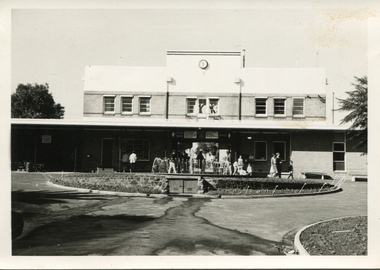
Photograph, Melbourne Zoo, c1971
... melbourne, zoo, animals, giraffe, elephant, zoological gardens... were housed at Melbourne Zoo before innovations in animal welfare. melbourne, zoo, animals, giraffe, elephant, zoological gardens 8 black and white photographs Melbourne Zoo Photograph Dorothy Wickham ...Made on a trip by Clunes State School to Melbourne Zoo. The whole school was transported by buses from Clunes to Melbourne. Dorothy (Dark) was a school teacher at Clunes.These photographs show the way animals were housed at Melbourne Zoo before innovations in animal welfare. 8 black and white photographsmelbourne, zoo, animals, giraffe, elephant, zoological gardens -
University of Melbourne, Burnley Campus Archives
Album - Colour slides, Arboreal Enclosure Royal Melbourne Zoo, 1977-1981
... zoo...animals...zoo. In compartmentalised wooden box. Includes handwritten list of dates, animals, toxic plants, other plants for particular uses, etc. ...arboreal enclosure royal melbourne zoo animals toxic plants plants Approximately 300 slides, mostly labelled. ...Approximately 300 slides, mostly labelled. Show construction of the Arboreal Enclosure at the Royal Melbourne Zoo between 1971 and 1981. Also other views of the zoo. In compartmentalised wooden box. Includes handwritten list of dates, animals, toxic plants, other plants for particular uses, etc. Not scanned.arboreal enclosure, royal melbourne zoo, animals, toxic plants, plants -
 City of Melbourne Libraries
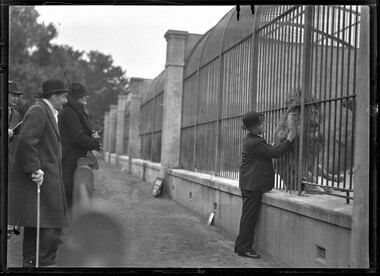
Photograph, Bull, Hugh Jones, 1897-1993, Vice-regal visit to Zoo: Lord Huntingfield greets the King of the Beasts
... zoo...animals...Initially the zoo was used for the acclimatisation of animals recovering from the long voyage to Australia and for breeding them for sport. ...Retrieved September 28, 2024, from http://nla.gov.au/nla.news-article4833244 1930-1939 melbourne zoo animals hunting wildlife royal park gardens Photographer notations on slide: "Vice Regal visit to zoo B42". ...Photographer notations on slide: "Vice Regal visit to zoo B42" Published: The Age, Tuesday 26 June 1934, page 11. Published title: VICE-ROYALTY GREETS THE KING OF THE BEASTS AT THE ZOO. Published caption: “Lord Huntingfield experienced a pleasant “induction ceremony” as Patron of the Royal Zoological and Acclimatisation Society yesterday, when he made a tour of the Zoological Gardens. The picture shows the Governor, accompanied by Lady Huntingfield, inspecting the King of the Beasts, who is submitting to a little playful treatment from the Director of the Gardens, Mr. Wilkie, while the Director whispers in his ear that a distinguished visitor has come to see him.” Trove article identifier: http://nla.gov.au/nla.news-article204818472 Description: A man wearing a hat and suit strokes a caged lion, observed by a man in a hat, scarf and overcoat who is leaning on a walking stick, and a woman in a hat and coat, holding a handbag. They stand behind a protective rail. Research by project volunteer, Fiona Collyer: Andrew Arthur Wellesley Wilkie, 1853-1948, was Director of the Melbourne Zoo from 1923 to 1936 and was associated with the zoo for 70 years. He first worked as a horticultural assistant to Government botanist Baron Ferdinand von Mueller at the Botanical Gardens at the age of 13, along with his older brother David. One of Andrew’s jobs was to capture moths for the National Herbarium. In 1857, a group of prominent Melburnians assembled at St. Patrick’s Hall to form the Zoological Society of Victoria, with the aim of introducing animals and plants from overseas. It was conceived, “For the purposes of science and for that of affording the public the advantages of studying the habits of the animal creation in properly arranged zoological gardens.” The Victorian Government granted 32 acres (13 hectares) of land to the Zoological Society at the southern end of Richmond Paddock on the opposite bank to the Botanical Gardens. (This is where AAMI Stadium and Collingwood Football Club now stand.) In 1861, the Zoological Society of Victoria was renamed The Acclimatisation Society of Victoria. Unfortunately the Yarra River frontage was damp, swampy and subject to flooding, so the animals were briefly housed at the Botanical Gardens until in 1862, the City of Melbourne donated 55 acres (22 hectares) of land at Royal Park for the fledgling zoo. Baron von Mueller secured employment at Royal Park for Andrew and David and they helped to lay out the gardens, plant trees and take care of a collection of deer, pheasants, hares and partridges. Initially the zoo was used for the acclimatisation of animals recovering from the long voyage to Australia and for breeding them for sport. In 1872, the zoo bought two lions, a leopard and a cheetah that had been seized from circus showmen Keith and Phillips when they were unable to pay the bill of butcher Mr T K Bennet of Bourke Street. The first zoo director, Mr. Albert Le Souef, negotiated with captains of ships to buy animals at overseas ports they visited and soon a multitude of exotic species arrived, including a ten-year-old Indian elephant in 1878. In 1923, after being head keeper for some years, Andrew was appointed director of the zoo. By 1933, the zoo had 110 different species of animals, 200 species of birds and 72 species of reptiles under Andrew’s care. He had personally planted all but six trees and laid out the garden beds. As director he lobbied authorities for funds to build more humane enclosures for the animals. In June 1928, Table Talk magazine wrote of Andrew Wilkie: “Up at the Zoo there is a humble gentleman who is a lion among the lions, who knows the proper specific to employ when the boa constrictor has chilblains, and who is a friend and confidant of Queenie the elephant. His fount of zoological lore has never been plumbed. It is bottomless, like his good fellowship and geniality. Every day he may be seen somewhere in the grounds of that growing sanctuary for the strange and arresting fauna and creeping things of the world, and I assure you as one who is privy to his passion that that area and its inhabitants are rarely out of his thoughts.” Andrew retired from the zoo in 1936 at the age of 83 and in 1948 died at his home in Brunswick aged 94. He and his wife Josephine had six children. Roy, aged 28 in 1934, was a former Wirth’s circus lion who had been left at the zoo at 10 years of age. Andrew visited Roy every day on his rounds and the pair formed a close and affectionate bond. Wireless Weekly magazine in February 1933 reported, “Roy was delighted to see Mr Wilkie, and in a docile manner, approached the bars of his cage and had his head vigorously rubbed by the director, who daily carries out this act of kindness.” As reported in The Herald on 27 October 1936, “Mr Wilkie has also found the old lion docile. He has not shown the animal any particular favouritism, but the lion has shown him a faithfulness that none of the keepers can claim. When Mr Wilkie approaches the bars the lion rolls over and lets the director stroke him and pull his tail. He gets very excited if Mr Wilkie passes without climbing over the protecting rail for a little game.” A 1930 newsreel film shows Andrew stroking Roy’s mane through the bars and the blissed out big cat lying on his back while lifting his chin for a rub. Another newsreel film from the time shows Andrew stroking a lioness and playfully pulling her tail. The Victorian Acclimatisation Society was founded in 1861 by Edward Wilson, 1813-1878, then owner and editor of The Argus newspaper. He said that Australian indigenous animals were practically useless, providing only “a little sport and an occasional meal”. The Society believed that Australia’s plants and animals were vastly inferior to those in Europe. They wanted to introduce and acclimatise to Victoria “all innoxious animals, birds, fishes, insects and vegetables, whether useful or ornamental” for sport and for the table, and to spread indigenous animals and plants from the colony around the world. Their motto was “if it lives, we want it”. The Society was primarily responsible for introducing sparrows, starlings, sambar and hog deer, ostriches, brown trout, blackberries, and carp to the Murray River. They released the European songbirds, thrush and blackbird to quell the homesickness of British settlers. The Society also sent Australian animals like platypus, echidnas, kangaroos and koalas to Europe for scientific and novelty purposes. Thomas Austin, a wealthy sheep farmer of Barwon Park, Winchelsea (property now owned by the National Trust) was a member and in 1859 he introduced hares, blackbirds, thrushes and partridges onto his property. He is probably best known for introducing 24 breeding rabbits onto his estate as game for shooting parties. Thomas quipped, “The introduction of a few rabbits could do little harm and might provide a touch of home, in addition to a spot of hunting." In 2022, genomic data confirmed that Australia’s feral rabbit population is entirely descended from these rabbits. Biological control has brought the rabbit population down from an estimated high of 10 billion rabbits in the 1920s to approximately 200 million today, inhabiting 70% of Australian landmass (5.3 million square kilometres). In 1872, the Acclimatisation Society was renamed The Zoological and Acclimatisation Society of Victoria and they focused on importing exotic animals for display purposes to the zoo. In 1937, the Royal Acclimatisation Society of Victoria was recreated as the Zoological Board of Victoria with a focus on research of native animals threatened with extinction. In an editorial for The Argus newspaper, 16 March 1856, Edward Wilson lamented: "…this country has been shamelessly stolen from the blacks. Had they been like the New Zealanders or the North American Indians, we should have bought their land, and supplied them with the means of living when we took it... In less than twenty years we have nearly swept them off the face of the earth. We have shot them down like dogs. In the guise of friendship we have issued corrosion sublimate in their damper, and consigned whole tribes to the agonies of an excruciating death. We have made them drunkards, and infected them with disease which has rotted the bones of their adults, and made such few children as are born amongst them a sorrow and a torture from the very instant of their birth. We have made them outcasts on their own land, and are rapidly consigning them to entire annihilation. There are but a few of them left, comparatively. This is what we would do for that few. We would feed and clothe every one of them.” [Note: this last sentence is italicized in the original newspaper article text]. Lord Huntingfield, (William Charles Arcedeckne Vanneck) 1883-1969, Governor of Victoria 1934-1939, was a British Conservative Party politician and the first ever Australian-born Governor of an Australian state (although he was always considered British). He was patron of the Royal Zoological and Acclimatisation Society of Victoria and was acting Governor-General for six months during the absence of Lord Gowie in 1938. Lady Huntingfield (née Margaret Eleanor Crosby) 1884-1943, his American-born wife showed great interest in social welfare and the advancement of women and children. She was president of the City Newsboys Society and Patroness of the Girls Friendly Society. In 1937, rose breeder Alister Clark named a yellow hybrid tea rose for her. In 1940, the City of Melbourne opened the Lady Huntingfield Free Kindergarten in North Melbourne, now the Lady Huntingfield Early Learning and Family Services Centre. Lady Huntingfield died in London in 1943 after her house was bombed during a German airstrike. The Lady Huntingfield Memorial Scholarship was established after the City of Melbourne raised £1000 in a public appeal conducted in her memory for students undertaking a Social Work degree at the University of Melbourne. It is awarded annually to this day. The Queen Victoria Hospital named a bed in her honour. References: VICE-ROYALTY GREETS THE KING OF BEASTS AT THE ZOO. (1934, June 26). The Age (Melbourne, Vic. : 1854 - 1954), p. 11. Retrieved August 18, 2024, from http://nla.gov.au/nla.news-article204818472 Prominent Personalities ANDREW WILKIE (1928, June 7). Table Talk (Melbourne, Vic. : 1885 - 1939), p. 15. Retrieved August 29, 2024, from http://nla.gov.au/nla.news-article146562949 'Thomas Austin (pastoralist)', Wikipedia, https://en.wikipedia.org/wiki/Thomas_Austin_(pastoralist) 'Edward Wilson (journalist)', Wikipedia, https://en.wikipedia.org/wiki/Edward_Wilson_(journalist) THE WOMAN'S WORLD (1934, June 26). The Herald (Melbourne, Vic. : 1861 - 1954), p. 14. Retrieved August 19, 2024, from http://nla.gov.au/nla.news-article243164806 MR. WILKIE CAN PULL THE OLD LION'S TAIL (1936, October 27). The Herald (Melbourne, Vic. : 1861 - 1954), p. 4. Retrieved August 18, 2024, from http://nla.gov.au/nla.news-article248551307 Director Of Zoo Will Retire Tomorrow--With White Kitten (1936, December 30). The Herald (Melbourne, Vic. : 1861 - 1954), p. 8. Retrieved August 18, 2024, from http://nla.gov.au/nla.news-article244655203 LIGHT CAR CLUB IN CARICATURE (1931, August 25). The Sun News-Pictorial (Melbourne, Vic. : 1922 - 1954; 1956), p. 24. Retrieved August 19, 2024, from http://nla.gov.au/nla.news-article276250310 'The Acclimatisation Society was driven by misguided ideals about 'fixing nature' in Australia', ABC News, https://www.abc.net.au/news/2022-11-04/acclimatisation-society-introduced-species-history-listen/101588262?utm_source=abc_news_app&utm_medium=content_shared&utm_campaign=abc_news_app&utm_content=safari 'Dr Andrew Wilkie Director Of Melbourne Zoo, With Lion (1930) Video', Pond5 Inc., https://www.pond5.com/stock-footage/item/155691351-dr-andrew-wilkie-director-melbourne-zoo-lion-1930 'Kodak Cinegraph Compilation No 12', ACMI Collection, YouTube.com [Zoo footage at 8.33 minutes, Mr Wilkie at 11.04 minutes], https://www.youtube.com/watch?v=OZZqgSNsP0k THE ABORIGINES. (1856, March 16). The Argus (Melbourne, Vic. : 1848 - 1957), p. 4. Retrieved September 28, 2024, from http://nla.gov.au/nla.news-article4833244Photographer notations on slide: "Vice Regal visit to zoo B42".1930-1939, melbourne zoo, animals, hunting, wildlife, royal park, gardens -
 Bendigo Military Museum
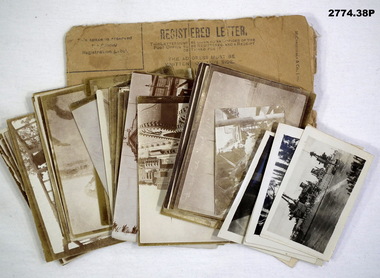
Photograph - PHOTOGRAPHS WW1 & ENVELOPE, C. WW1
... Black & white photos: .33) Warship. .34) - .35) Buildings & people. .36 - .37) Zoo animals. .38) Card, colour picture of soldier & a little girl....Black & white photos: .33) Warship. .34) - .35) Buildings & people. .36 - .37) Zoo animals. .38) Card, colour picture of soldier & a little girl. ....1) Registered letter envelope addressed to Mr Norm Tucker, Bannister St, Bgo. Sepia colour photos located in Egypt & Middle East: .2) - .11) Buildings. .12) - .19) Individual & groups of local people. .20) - .21) Railway buildings. .22) - .27) Ruins & old buildings. .28) - .29) Local people at work. .30) Boat. .31) Yanky boat Suez Canal 1916 when they were neutral. .32) Horses - Reinforcement on board for 6th ALH. Black & white photos: .33) Warship. .34) - .35) Buildings & people. .36 - .37) Zoo animals. .38) Card, colour picture of soldier & a little girl.photography-photographs, documents - envelopes, military history, passchendaele barracks trust -
 Vision Australia
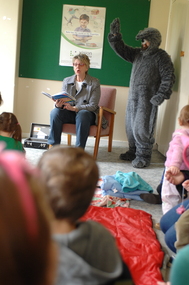
Photograph - Image, 2008 Book Week at Burwood School, 23/8/2008
... As part of the day, a petting zoo with barnyard animals also allowed the opportunity to investigate other animals....As part of the day, a petting zoo with barnyard animals also allowed the opportunity to investigate other animals. ...Based upon the story of 'The Three Little Pigs', children were invited to hear the story and see (and knock down) the house made of straw, the house made of wood and the house made of bricks, before heading back for snacks. As part of the day, a petting zoo with barnyard animals also allowed the opportunity to investigate other animals.107 digital images of attendees at the Book Week celebrationvision australia, feelix, ed gamble, ella edwards, noah o'brien, dominic kennedy, matthew johnson, tommy papoutsidis, louise curtin -
 Kiewa Valley Historical Society
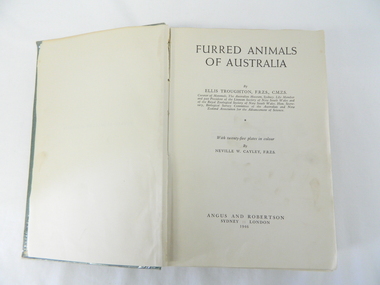
Book - Non Fiction Australian Mammals, Furred Animals of Australia, 1946
... Most "city" born children would have only seen the mammals presented in this book at animal zoos in the larger cities....Most "city" born children would have only seen the mammals presented in this book at animal zoos in the larger cities. This book details the Australian wide range of mammals, and not just those which school children in the Kiewa Valley could meet "face to face". ...This book was written before the "preservation of Australian Flora and Fauna" movement became a household edict. The book covers all the "known" marsupials of the time and coloured prints are provided where required to show physical and other distinguishing features. Time and extensive searches of hard to reach places in Australia has uncovered a greater range of marsupials than presented in this book. Rural Australia (1940s) had not been as developed and altered as the 1980s onward. This book was used in Primary schools as reference material. Although rural school children would have come across many "real life" encounters with some of the mammals referred to, the diversity and range of mammals presented in this book is quite extensive. Most "city" born children would have only seen the mammals presented in this book at animal zoos in the larger cities.This book details the Australian wide range of mammals, and not just those which school children in the Kiewa Valley could meet "face to face". However the rural based pupils would find the chapters and coloured prints more "real" than city located students because they are living day to day in the Australian bush, home to all the various mammals and marsupials presented in this book.This green coloured hard covered book has 178 double sided printed pages and twenty five plate detailing the appearances of native mammals. The first two pages are frayed and all pages show colouration (yellow) of age. The book has a clear plastic cover as protection placed at a later dateOn the spine "FURRED ANIMALS OF AUSTRALIA" and underneath "BROUGHTON" and at the bottom "ANGUS & ROBERTSON"australian mammals and marsupials, nature books, australia wild life -
 Bendigo Historical Society Inc.
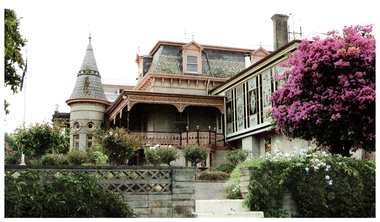
Newspaper - Fortuna Articles - "Steeped in Mystery", Dec 01 2007
... This document explores the myths, legends, and mysterious phenomena of the Goldfields region in Australia, focusing on several recurring themes: Numerous reports of large, exotic cats (such as black panthers and pumas) have been recorded in Victoria, with over 4,500 sightings documented by the Australian Rare Fauna Research Association since 1984.Notable individuals, like John Higgins and Paul Clacher, have provided detailed accounts and physical evidence (e.g., large footprints) supporting the existence of these animals. Theories about their origins include escaped zoo or circus animals, mascots released by American servicemen after WWII, or even the survival of the supposedly extinct Thylacoleo (Marsupial Lion). ...This document explores the myths, legends, and mysterious phenomena of the Goldfields region in Australia, focusing on several recurring themes: Numerous reports of large, exotic cats (such as black panthers and pumas) have been recorded in Victoria, with over 4,500 sightings documented by the Australian Rare Fauna Research Association since 1984.Notable individuals, like John Higgins and Paul Clacher, have provided detailed accounts and physical evidence (e.g., large footprints) supporting the existence of these animals. Theories about their origins include escaped zoo or circus animals, mascots released by American servicemen after WWII, or even the survival of the supposedly extinct Thylacoleo (Marsupial Lion). ...This document explores the myths, legends, and mysterious phenomena of the Goldfields region in Australia, focusing on several recurring themes: Numerous reports of large, exotic cats (such as black panthers and pumas) have been recorded in Victoria, with over 4,500 sightings documented by the Australian Rare Fauna Research Association since 1984.Notable individuals, like John Higgins and Paul Clacher, have provided detailed accounts and physical evidence (e.g., large footprints) supporting the existence of these animals. Theories about their origins include escaped zoo or circus animals, mascots released by American servicemen after WWII, or even the survival of the supposedly extinct Thylacoleo (Marsupial Lion). The Goldfields are reputed to be home to many ghosts, with frequent reports from locations such as Camp Hill Primary School, Castlemaine's Theatre Royal, and especially the historic Fortuna Villa.Accounts from both military personnel and civilians describe unexplained voices, apparitions, and other paranormal events within these historic buildings. Specific stories include encounters with apparitions, mysterious voices, and doors opening on their own, often witnessed by credible sources like army sergeants and captains. The document also references other unexplained phenomena in the region, such as UFO sightings and missing people, contributing to the area's reputation for mystery and intrigue.Fortuna Article - "Steeped in Mystery" Dec 01 2007 by Sarah Harris This item contains the following: 11217.33a Colour Photo of Fortuna, once home to the Lansell family, Fortuna Villa is now occupied by the Department of Imagery and Geospatial Organistion mapping unit, and apparently, some apparitions 11217.33b Colour Photo of Russel Henthorn with his camera and gear he used for a UFO photo in 1983 11217.33c Part of Page 4 - Article "Steeped in Mystery" non-fictionbendigo, fortuna, george lansell, russell henthorn -
 Federation University Historical Collection
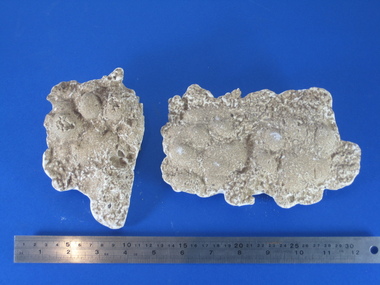
Plaster cast, David Pepper-Edwards, Plaster cast of a Clouded Leopard Footprint, 03/2004
... Zoo, Sydney, NSW. David Pepper-Edwards used a number of plaster cast footprints for comparison of unidentified field casts. australian animal folklore collection david pepper edwards pepper edwards big cat cat clouded leopard plaster cast footprint mythical myth folklore Verso: TZ, 3/04/male/Clouded Leopard Two plaster casts of a male Clouded Leopard. ...The cast of a captive Clouded Leopard was made by David Pepper-Edwards at Taronga Zoo, Sydney, NSW. David Pepper-Edwards used a number of plaster cast footprints for comparison of unidentified field casts.Two plaster casts of a male Clouded Leopard. These casts were used in the identification of photographs and sightings of large cats in the Australian Bush. Australian Animal Folklore CollectionVerso: TZ, 3/04/male/Clouded Leopardaustralian animal folklore collection, david pepper edwards, pepper edwards, big cat, cat, clouded leopard, plaster cast, footprint, mythical, myth, folklore -
 Federation University Historical Collection
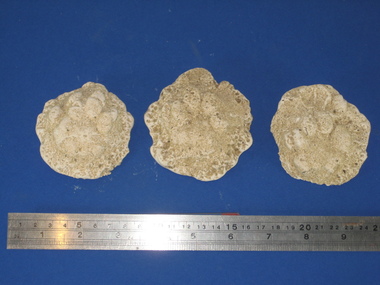
Plaster cast, David Pepper-Edwards, Plaster Cast of a Golden Cat Footprint, 05/2004
... Zoo, Sydney, NSW. David Pepper-Edwards used a number of plaster cast footprints for comparison of unidentified field casts. australian animal folklore collection david pepper edwards pepper edwards big cat cat golden cat plaster cast footprint mythical myth folklore Verso: TZ, Golden Cat, male, 5/04 Three plaster casts of a Golden Cat footprint. ...The cast of a captive Golden Cat was made by David Pepper-Edwards at Taronga Zoo, Sydney, NSW. David Pepper-Edwards used a number of plaster cast footprints for comparison of unidentified field casts.Three plaster casts of a Golden Cat footprint. These casts were used in the identification of photographs and sightings of large cats in the Australian Bush. Australian Animal Folklore CollectionVerso: TZ, Golden Cat, male, 5/04australian animal folklore collection, david pepper edwards, pepper edwards, big cat, cat, golden cat, plaster cast, footprint, mythical, myth, folklore -
 Federation University Historical Collection
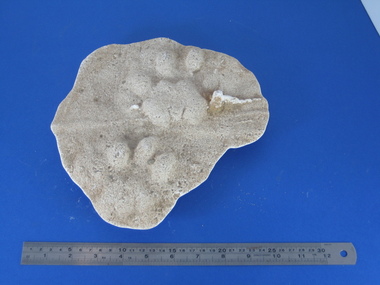
Plaster cast, David Pepper-Edwards, Plaster Cast of a Snow Leopard Footprint, 27/07/2003
... Zoo, Sydney, NSW. David Pepper-Edwards used a number of plaster cast footprints for comparison of unidentified field casts. australian animal folklore david pepper edwards pepper edwards snow leopard big cat cat footprint cast Verso: TZ, Snow leopard, male, 27/7/03, front + rear Plaster casts of a male Snow Leopard showing front and rear footprints. ...The cast of a captive male Golden Cat was made by David Pepper-Edwards at Taronga Zoo, Sydney, NSW. David Pepper-Edwards used a number of plaster cast footprints for comparison of unidentified field casts.Plaster casts of a male Snow Leopard showing front and rear footprints. These casts were used in the identification of photographs and sightings of large cats in the Australian Bush. Australian Animal Folklore CollectionVerso: TZ, Snow leopard, male, 27/7/03, front + rearaustralian animal folklore, david pepper edwards, pepper edwards, snow leopard, big cat, cat, footprint, cast -
 Federation University Historical Collection
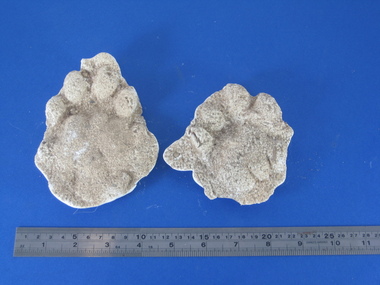
Plaster cast, David Pepper-Edwards (probably), Plaster Cast of a Big Cat Footprint, c 2004
... David Pepper-Edwards used a number of plaster cast footprints made at Taronga Zoo in the identification of Big Cat sightings in the bush. australian animal folklore collection david pepper edwards pepper edwards big cat cat plaster cast footprint mythical myth folklore Plaster casts of big cat footprints. ...David Pepper-Edwards used a number of plaster cast footprints made at Taronga Zoo in the identification of Big Cat sightings in the bush.Plaster casts of big cat footprints. These casts were used in the identification of photographs and sightings of large cats in the Australian Bush. Australian Animal Folklore Collectionaustralian animal folklore collection, david pepper edwards, pepper edwards, big cat, cat, plaster cast, footprint, mythical, myth, folklore -
 Federation University Historical Collection
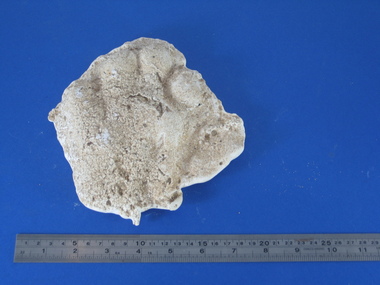
Plaster cast, David Pepper-Edwards (probably), Plaster Cast of a Big Cat Footprint, c 2004
... David Pepper-Edwards used a number of plaster cast footprints made at Taronga Zoo in the identification of Big Cat sightings in the bush. australian animal folklore collection david pepper edwards pepper edwards big cat cat plaster cast footprint David Pepper-Edwards used a number of plaster cast footprints made at Taronga Zoo in the identification of Big Cat sightings in the bush. ...David Pepper-Edwards used a number of plaster cast footprints made at Taronga Zoo in the identification of Big Cat sightings in the bush.David Pepper-Edwards used a number of plaster cast footprints made at Taronga Zoo in the identification of Big Cat sightings in the bush.australian animal folklore collection, david pepper edwards, pepper edwards, big cat, cat, plaster cast, footprint -
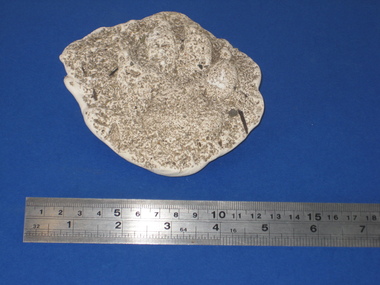 Federation University Historical Collection
Plaster cast, David Pepper-Edwards, Plaster Cast of a Tropical Dingo Footprint, 04/2004
... Zoo, Sydney, NSW. David Pepper-Edwards used a number of plaster cast footprints for comparison of unidentified field casts. australian animal folklore collection david pepper edwards pepper edwards tropical dingo dingo plaster cast footprint mythical myth folklore Verso: TZ, Tropical Dingo, 4/04 Two plaster casts of a Tropical Dingo footprint. ...The cast of a captive Alpine Dingo was made by David Pepper-Edwards at Taronga Zoo, Sydney, NSW. David Pepper-Edwards used a number of plaster cast footprints for comparison of unidentified field casts.Two plaster casts of a Tropical Dingo footprint. These casts were used in the identification of photographs and sightings of large cats in the Australian Bush. Australian Animal Folklore CollectionVerso: TZ, Tropical Dingo, 4/04australian animal folklore collection, david pepper edwards, pepper edwards, tropical dingo, dingo, plaster cast, footprint, mythical, myth, folklore -
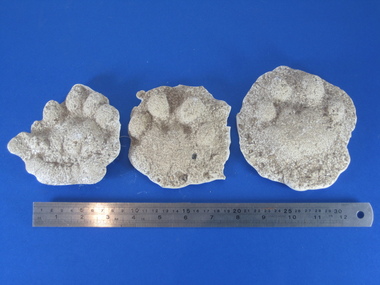 Federation University Historical Collection
Plaster cast, David Pepper-Edward, Plaster Cast of a Snow Leopard Footprint, 03/2004
... Zoo, Sydney, NSW. David Pepper-Edwards used a number of plaster cast footprints for comparison of unidentified field casts. australian animal folklore collection david pepper edwards pepper edwards big cat cat snow leopard plaster cast footprint mythical myth folklore VersoL TZ, Snow Leopard, Male, 3/04 Three plaster casts of a male Snow Leopard footprint. ...The cast of a captive male Snow Leopard was made by David Pepper-Edwards at Taronga Zoo, Sydney, NSW. David Pepper-Edwards used a number of plaster cast footprints for comparison of unidentified field casts.Three plaster casts of a male Snow Leopard footprint. These casts were used in the identification of photographs and sightings of large cats in the Australian Bush. Australian Animal Folklore CollectionVersoL TZ, Snow Leopard, Male, 3/04australian animal folklore collection, david pepper edwards, pepper edwards, big cat, cat, snow leopard, plaster cast, footprint, mythical, myth, folklore -
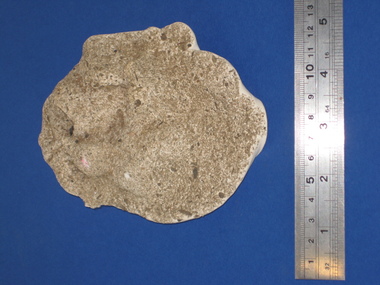 Federation University Historical Collection
Plaster cast, David Pepper-Edwards (probably), Plaster Cast of an Alpine Dingo, 04/2004
... Zoo, Sydney, NSW. David Pepper-Edwards used a number of plaster cast footprints for comparison of unidentified field casts. australian animal folklore collection david pepper edwards pepper edwards alpine dingo dingo plaster cast footprint mythical myth folklore Verso: TZ, Alpine Dingo, 4/04 Plaster casts of an Alpine Dingo Footprint. ...The cast of a captive Alpine Dingo was made by David Pepper-Edwards at Taronga Zoo, Sydney, NSW. David Pepper-Edwards used a number of plaster cast footprints for comparison of unidentified field casts.Plaster casts of an Alpine Dingo Footprint. These casts were used in the identification of photographs and sightings of large cats in the Australian Bush. Australian Animal Folklore CollectionVerso: TZ, Alpine Dingo, 4/04australian animal folklore collection, david pepper edwards, pepper edwards, alpine dingo, dingo, plaster cast, footprint, mythical, myth, folklore -
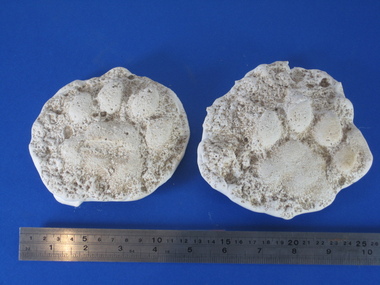 Federation University Historical Collection
Plaster cast, David Pepper-Edwards, Plaster Cast of a Sumatran Tiger Footprint, 03/2004
... Zoo, Sydney, NSW. David Pepper-Edwards used a number of plaster cast footprints for comparison of unidentified field casts. australian animal folklore collection david pepper edwards pepper edwards big cat cat sumatran tiger plaster cast footprint mythical myth folklore verso: TZ, Sumatran Tiger, males, 5 months, 3/04 Two plaster casts of a five month old male Sumatran tTiger footprint. ...The cast of a captive male Sumatran Tiger aged 5 months was made by David Pepper-Edwards at Taronga Zoo, Sydney, NSW. David Pepper-Edwards used a number of plaster cast footprints for comparison of unidentified field casts.Two plaster casts of a five month old male Sumatran tTiger footprint. These casts were used in the identification of photographs and sightings of large cats in the Australian Bush. Australian Animal Folklore Collectionverso: TZ, Sumatran Tiger, males, 5 months, 3/04australian animal folklore collection, david pepper edwards, pepper edwards, big cat, cat, sumatran tiger, plaster cast, footprint, mythical, myth, folklore -
 Federation University Historical Collection
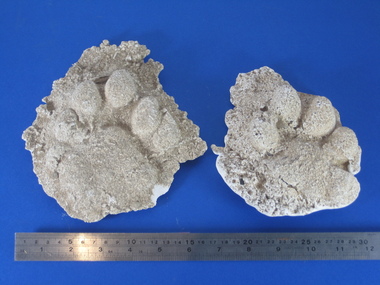
Plaster cast, David Pepper-Edwards, Plaster Cast of a Lion Footprint, 04/2004
... Zoo, Sydney, NSW. David Pepper-Edwards used a number of plaster cast footprints for comparison of unidentified field casts. australian animal folklore collection david pepper edwards pepper edwards big cat cat lion plaster cast footprint mythical myth folklore verso: TZ, lion, male, 04/04 Two plaster casts of a Lion footprint. ...The cast of a captive female African Lion aged 5 months was made by David Pepper-Edwards at Taronga Zoo, Sydney, NSW. David Pepper-Edwards used a number of plaster cast footprints for comparison of unidentified field casts.Two plaster casts of a Lion footprint. These casts were used in the identification of photographs and sightings of large cats in the Australian Bush. Australian Animal Folklore Collectionverso: TZ, lion, male, 04/04australian animal folklore collection, david pepper edwards, pepper edwards, big cat, cat, lion, plaster cast, footprint, mythical, myth, folklore -
 Federation University Historical Collection
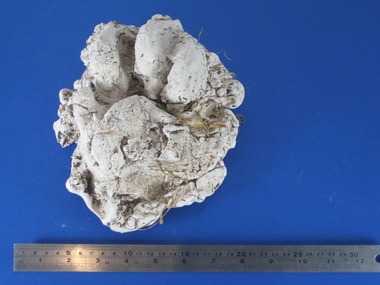
Plaster cast, David Pepper-Edwards, Plaster Cast of a Lion Footprint, 04/2004
... Zoo, Sydney, NSW. This cast was taken in deep mud to demonstrate the abnormal shape of such casts. Sometimes cats claws are clearly visible from such casts and so being confused with that of a large dog. David Pepper-Edwards used a number of plaster cast footprints for comparison of unidentified field casts. australian animal ...The cast of a captive African Lion was made by David Pepper-Edwards at Taronga Zoo, Sydney, NSW. This cast was taken in deep mud to demonstrate the abnormal shape of such casts. Sometimes cats claws are clearly visible from such casts and so being confused with that of a large dog. David Pepper-Edwards used a number of plaster cast footprints for comparison of unidentified field casts.Plaster cast of a Lion footprint. These casts were used in the identification of photographs and sightings of large cats in the Australian Bush. The plaster has remnant straw like material attached. Australian Animal Folklore Collectionaustralian animal folklore collection, pepper edwards, david pepper edwards, big cats, mythical, myth, folklore -
 Orbost & District Historical Society
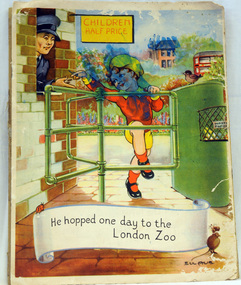
book, First half 20th century
... It is the story of a young boy's visit to London zoo and has illustrations of Australian animals. The cover and first pages are missing....It is the story of a young boy's visit to London zoo and has illustrations of Australian animals. The cover and first pages are missing. book ...The illustrations in this book are attributed to EULALIE. Eulalie ( Eulalie M. (Eulalie Minfred Banks), 1895-1999) was born in London and illustrated more than 50 children's books as well as cards, calendars and even murals. She died at 104 and was still painting into her 90's. This book is a children's story book and has been well used. It seems to be aimed at very young children.This book is a typical example a child's story book of the 1940's.A children's story book with large colourful illustrations. It is the story of a young boy's visit to London zoo and has illustrations of Australian animals. The cover and first pages are missing.book-children's eulalie-banks -
Healesville Sanctuary Heritage Centre
Newspaper - Cutting, The Age, Melbourne, Sanctuary Not to Replace Zoo, 26 March 1949
... animals. A committee to be formed to take charge of the Sanctuary. This item has an inscription and legibility of the text is fair. photocopy Sanctuary Not to Replace Zoo Newspaper Cutting The Age, Melbourne ...The Sanctuary is to be retained exclusively for native birds and animals. A committee to be formed to take charge of the Sanctuary.photocopyThe Sanctuary is to be retained exclusively for native birds and animals. A committee to be formed to take charge of the Sanctuary.1940s -
Healesville Sanctuary Heritage Centre
Newspaper - Cutting, The Sun News-Pictorial, Melbourne, Vandals: Death, Damage at Zoo, 14 January 1955
... 1950s Description of some of the behaviour and subsequent damage done at the Sanctuary to both animals and property. Photocopy Vandals: Death, Damage at Zoo Newspaper Cutting The Sun News-Pictorial, Melbourne ...Description of some of the behaviour and subsequent damage done at the Sanctuary to both animals and property.Photocopynon-fictionDescription of some of the behaviour and subsequent damage done at the Sanctuary to both animals and property.1950s -
Healesville Sanctuary Heritage Centre
Newspaper - Cutting, The Sun News-Pictorial, Melbourne, We're all dangerous animals, 24 March 1971
... Lancaster to members of the Zoo Directors Association meeting at Healesville Sanctuary -man being the most dangerous animal. ...Report of lecture given by Dr W. Lancaster to members of the Zoo Directors Association meeting at Healesville Sanctuary -man being the most dangerous animal.Photocopynon-fictionReport of lecture given by Dr W. Lancaster to members of the Zoo Directors Association meeting at Healesville Sanctuary -man being the most dangerous animal.1970s -
 Sunshine and District Historical Society Incorporated
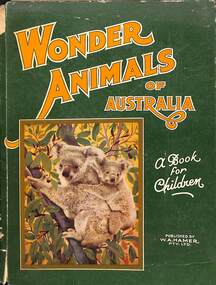
Book - Wonder Animals Of Australia, Edward A. Vidler, 1931
... This book is a sort of Australia Zoo, but it is something better than that, because it not only shows you the wonderful animals that live in and belong to this country but also tells you what's sort of lives they live in their own homes and the many ways in which they are all different from each other. ...This book is a sort of Australia Zoo, but it is something better than that, because it not only shows you the wonderful animals that live in and belong to this country but also tells you what's sort of lives they live in their own homes and the many ways in which they are all different from each other.Green hard covered book with orange and white text and imagenon-fictionThis book is a sort of Australia Zoo, but it is something better than that, because it not only shows you the wonderful animals that live in and belong to this country but also tells you what's sort of lives they live in their own homes and the many ways in which they are all different from each other. -
Federation University Art Collection
Ceramic - Artwork - Ceramics, 'Dragon' by Heather Wilson, c1985
... Animals have always fascinated me and have been a part of my work for the last 30 years. Whether appearing as dragons, exotic birds or bones, most of my images have a basis in nature. Sometimes it is just a characteristic or a quirky gesture that will inspire a piece, sometimes a photograph or a drawing done at the zoo or museum. ...Animals have always fascinated me and have been a part of my work for the last 30 years. Whether appearing as dragons, exotic birds or bones, most of my images have a basis in nature. Sometimes it is just a characteristic or a quirky gesture that will inspire a piece, sometimes a photograph or a drawing done at the zoo or museum. ...Heather WILSON (1961- ) Born Rotherham, England. Arrived Australia 1967. Heather Wilson graduated with a Bachelor of Education (Art & Craft) from Melbourne State College in 1982, majoring in Ceramics. Artist's statement - "All of my work is hand built and explores animal forms in various ways. Animals have always fascinated me and have been a part of my work for the last 30 years. Whether appearing as dragons, exotic birds or bones, most of my images have a basis in nature. Sometimes it is just a characteristic or a quirky gesture that will inspire a piece, sometimes a photograph or a drawing done at the zoo or museum. Dragons have always given me the freedom to explore an emotion or attitude without the restrictions of a form being right, no one can tell you what a dragon should be like as they are an imaginary beast. All of my work is hand built from earthenware or porcelain. Each of them is unique and they may be similar but no two are ever the same. Most of my vessels are coil built and the dragons and birds are constructed on their bases. The pieces are fired to 1080 C in a gas kiln."heather wilson, ceramics, jan feder memorial ceramics collection, gippsland campus -
Federation University Art Collection
Ceramic - Artwork - Ceramics, Lustre Dragon by Heather Wilson, c1985
... Animals have always fascinated me and have been a part of my work for the last 30 years. Whether appearing as dragons, exotic birds or bones, most of my images have a basis in nature. Sometimes it is just a characteristic or a quirky gesture that will inspire a piece, sometimes a photograph or a drawing done at the zoo or museum. ...Animals have always fascinated me and have been a part of my work for the last 30 years. Whether appearing as dragons, exotic birds or bones, most of my images have a basis in nature. Sometimes it is just a characteristic or a quirky gesture that will inspire a piece, sometimes a photograph or a drawing done at the zoo or museum. ...Heather WILSON (1961- ) Born Rotherham, England. Arrived Australia 1967. Heather Wilson graduated with a Bachelor of Education (Art & Craft) from Melbourne State College in 1982, majoring in Ceramics. Artist's statement - "All of my work is hand built and explores animal forms in various ways. Animals have always fascinated me and have been a part of my work for the last 30 years. Whether appearing as dragons, exotic birds or bones, most of my images have a basis in nature. Sometimes it is just a characteristic or a quirky gesture that will inspire a piece, sometimes a photograph or a drawing done at the zoo or museum. Dragons have always given me the freedom to explore an emotion or attitude without the restrictions of a form being right, no one can tell you what a dragon should be like as they are an imaginary beast. All of my work is hand built from earthenware or porcelain. Each of them is unique and they may be similar but no two are ever the same. Most of my vessels are coil built and the dragons and birds are constructed on their bases. The pieces are fired to 1080 C in a gas kiln."heather wilson, ceramics, jan feder memorial ceramics collection, gippsland campus -
Federation University Art Collection
Ceramic - Artwork - Ceramics, 'Dragon' by Heather Wilson, c1985
... Animals have always fascinated me and have been a part of my work for the last 30 years. Whether appearing as dragons, exotic birds or bones, most of my images have a basis in nature. Sometimes it is just a characteristic or a quirky gesture that will inspire a piece, sometimes a photograph or a drawing done at the zoo or museum. ...Animals have always fascinated me and have been a part of my work for the last 30 years. Whether appearing as dragons, exotic birds or bones, most of my images have a basis in nature. Sometimes it is just a characteristic or a quirky gesture that will inspire a piece, sometimes a photograph or a drawing done at the zoo or museum. ...Heather WILSON (1961- ) Born Rotherham, England. Arrived Australia 1967. Heather Wilson graduated with a Bachelor of Education (Art & Craft) from Melbourne State College in 1982, majoring in Ceramics. Artist's statement - "All of my work is hand built and explores animal forms in various ways. Animals have always fascinated me and have been a part of my work for the last 30 years. Whether appearing as dragons, exotic birds or bones, most of my images have a basis in nature. Sometimes it is just a characteristic or a quirky gesture that will inspire a piece, sometimes a photograph or a drawing done at the zoo or museum. Dragons have always given me the freedom to explore an emotion or attitude without the restrictions of a form being right, no one can tell you what a dragon should be like as they are an imaginary beast. All of my work is hand built from earthenware or porcelain. Each of them is unique and they may be similar but no two are ever the same. Most of my vessels are coil built and the dragons and birds are constructed on their bases. The pieces are fired to 1080 C in a gas kiln."heather wilson, ceramics, jan feder memorial ceramics collection, gippsland campus, dragon -
 Kew Historical Society Inc
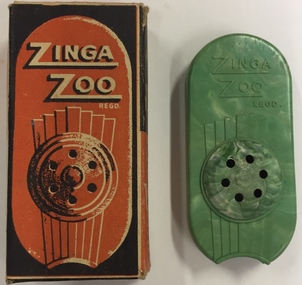
Leisure object - Musical Toy, Rose Morris & Co Pty Ltd, Zinga Zoo, 1930-1950
... The examples of toys in the collection include examples of alphabet toys, arcade toys, baby toys, construction toys, dolls, doll accessories, educational toys, soft toys, tin toys, toy animals, toy blocks, toy machines, toy typewriters, etc. zinga zoo rose morris & co. musical toys Exterior of box - "Zinga Zoo Regd. ...The Kew Historical Society’s collection includes a wide range of leisure objects. Many of the items are European-made, generally of British origin, however there are a number that were made for the Australian market by Australian manufacturers. There were clearly a huge range of toys produced for the Australian and International children’s market in the Nineteenth and Twentieth centuries. The examples of toys in the collection include examples of alphabet toys, arcade toys, baby toys, construction toys, dolls, doll accessories, educational toys, soft toys, tin toys, toy animals, toy blocks, toy machines, toy typewriters, etc. Zinga Zoo - small plastic musical toy in a cardboard box.Exterior of box - "Zinga Zoo Regd. The Packet Band. An R.M. Precision moulded product by Rose Morris & Co.Ltd. London England" Plastic toy - "Zinga Zoo Regd. The "Pocket Band" RM&Co L79 London"zinga zoo, rose morris & co., musical toys
