
Showing 177 items matching "aircraft repair"
-
 Moorabbin Air Museum
Manual (Item) - Nickel cadmium aircraft batteries, Varta Nickel Cadmium Aircraft Batteries Maintenance and Repair
... Varta Nickel Cadmium Aircraft Batteries Maintenance and Repair...Varta Varta Nickel Cadmium Aircraft Batteries Maintenance and Repair Manual Nickel cadmium aircraft batteries ...Varta -
 Bendigo Military Museum
Book - EXERCISE BOOK, c.1935 onwards
... Hand written text re aircraft, repairing & drawings. Half pages unused. first entry is on 19.3 1935....Hand written text re aircraft, repairing & drawings. Half pages unused. first entry is on 19.3 1935. ...Item relates to George William Alfred MARRIOTT RAAF. Refer Cat No 3117 for his service history.Exercise book, blue cardboard cover, pages unknown. Hand written text re aircraft, repairing & drawings. Half pages unused. first entry is on 19.3 1935.Handwritten front cover: "G Marriott"book, exercise -
Moorabbin Air Museum
Manual (Item) - (SP) Technical Manual Structural Repair Manual, Aircraft Emb-110 Bandeirante Embraer T.O. 1C95-3
... (SP) Technical Manual Structural Repair Manual, Aircraft Emb-110 Bandeirante Embraer T.O. 1C95-3...Description: Aircraft Detailed Engineering Production Manufacturing Tools Tooling Technical Papers Level of Importance: World. Authors: 13 contributors Manual (SP) Technical Manual Structural Repair Manual, Aircraft Emb-110 Bandeirante Embraer T.O. 1C95-3 ...Description: Aircraft Detailed Engineering Production Manufacturing Tools Tooling Technical Papers Level of Importance: World. Authors: 13 contributors -
Moorabbin Air Museum
Manual (Item) - (SP) Structural Repair Manual Aircraft: Emb-110 Bandeirante T.O. 1C95-3
... (SP) Structural Repair Manual Aircraft: Emb-110 Bandeirante T.O. 1C95-3...Manual (SP) Structural Repair Manual Aircraft: Emb-110 Bandeirante T.O. 1C95-3 ...Description: Flight Controls Level of Importance: World. -
Moorabbin Air Museum
Document - Capacity for Design for Development Manufacture Overhaul and Repair of Aircraft and Guided Weapons, Government Aircraft Factories
... Capacity for Design for Development Manufacture Overhaul and Repair of Aircraft and Guided Weapons ...Government Aircraft Factories Document Capacity for Design for Development Manufacture Overhaul and Repair of Aircraft and Guided Weapons ... -
Moorabbin Air Museum
Booklet - Capacity for Design for Development Manufacture Overhaul and Repair of Aircraft and Guided Weapon, Government Aircraft Factories Aircraft, Guided Weapons and Electronics Supply Division
... Capacity for Design for Development Manufacture Overhaul and Repair of Aircraft and Guided Weapon...Government Aircraft Factories Aircraft, Guided Weapons and Electronics Supply Division Booklet Capacity for Design for Development Manufacture Overhaul and Repair of Aircraft and Guided Weapon ... -
 Moorabbin Air Museum
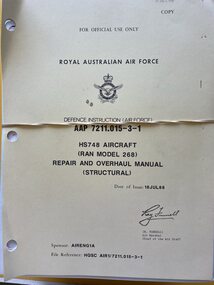
Manual (Item) - (SP) AAP 7211.015-3-1 HS748 Aircraft (RAN Model 268) Repair and Overhaul Manual (Structural)
... (SP) AAP 7211.015-3-1 HS748 Aircraft (RAN Model 268) Repair and Overhaul Manual (Structural)...Manual (SP) AAP 7211.015-3-1 HS748 Aircraft (RAN Model 268) Repair and Overhaul Manual (Structural) ... -
 Moorabbin Air Museum
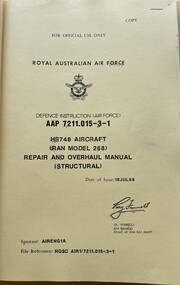
Manual (Item) - (SP) AAP 7211.015-3-1 HS748 Aircraft (RAN Model 268) Repair and Overhaul Manual (Structural)
... (SP) AAP 7211.015-3-1 HS748 Aircraft (RAN Model 268) Repair and Overhaul Manual (Structural)...Manual (SP) AAP 7211.015-3-1 HS748 Aircraft (RAN Model 268) Repair and Overhaul Manual (Structural) ... -
Moorabbin Air Museum
Manual (Item) - NATO Advisory Group for Aerospace Researc;h & Development Proceedings - Repair of aircraft structures involving composite materials
... NATO Advisory Group for Aerospace Researc;h & Development Proceedings - Repair of aircraft structures involving composite materials...Manual NATO Advisory Group for Aerospace Researc;h & Development Proceedings - Repair of aircraft structures involving composite materials ... -
Moorabbin Air Museum
Manual (Item) - Drawing Office Directive - Mirage Aircraft
... Description: Binding: Binder Keywords: RAAF - POWERED AIRCRAFT CONTROL SSYTEM COMPONENTS - MIRAGE AIRCRAFT REPAIR & RECONDINTIONING INSTRUSTIONS Level of Importance: . ...Description: Binding: Binder Keywords: RAAF - POWERED AIRCRAFT CONTROL SSYTEM COMPONENTS - MIRAGE AIRCRAFT REPAIR & RECONDINTIONING INSTRUSTIONS Level of Importance: . ...Description: Binding: Binder Keywords: RAAF - POWERED AIRCRAFT CONTROL SSYTEM COMPONENTS - MIRAGE AIRCRAFT REPAIR & RECONDINTIONING INSTRUSTIONS Level of Importance: . -
Moorabbin Air Museum
Manual (Item) - Porter Aircraft Planned Servicing Schedule R3 Servicing
... Pilatus Porter Aircraft Repair and Overhaul Manual Level of Importance: World. ...Pilatus Porter Aircraft Repair and Overhaul Manual Level of Importance: World. ...Description: AAP 7211.001-3. Published July 1971. Published by RAAF. 200 pages. Pilatus Porter Aircraft Repair and Overhaul Manual Level of Importance: World. Derived from Turana for Target and RPV Applications -
 Wangaratta RSL Sub Branch
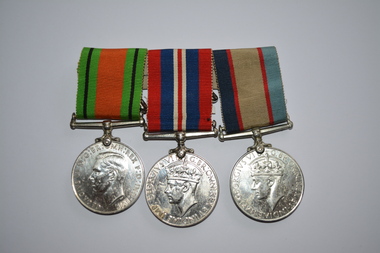
Medal - Medals WW2
... FRENCH served with the RAAF as a Leading Aircraftman and was attached to the 12 Aircraft Repair Depot when discharged on 13.1.1947....FRENCH served with the RAAF as a Leading Aircraftman and was attached to the 12 Aircraft Repair Depot when discharged on 13.1.1947. 1939-1945 War Medal, Australian Service Medal and Defence Medal medal ww2 raaf 51647 C W FRENCH Three found white metal medals attached to multi striped colour ribbons. ...Three original WW2 medals awarded to 51647 Charles William FRENCH born 8.2.1911 at Wahgunyah in Victoria. He enlisted on 2.2.1942. FRENCH served with the RAAF as a Leading Aircraftman and was attached to the 12 Aircraft Repair Depot when discharged on 13.1.1947.1939-1945 War Medal, Australian Service Medal and Defence MedalThree found white metal medals attached to multi striped colour ribbons.51647 C W FRENCHmedal, ww2, raaf -
 National Vietnam Veterans Museum (NVVM)
Photograph - Photograph, Collage
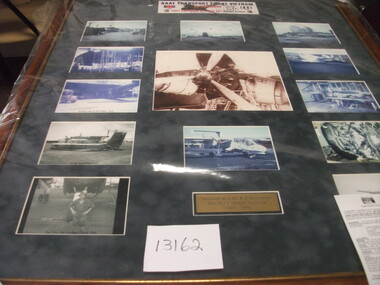
... Thirteen Photograph showing scenes of verious boats, aircraft in stages of repair and assembly. RAAF Transport Flight Vietnam 1964-1972...Thirteen Photograph showing scenes of verious boats, aircraft in stages of repair and assembly. RAAF Transport Flight Vietnam 1964-1972 Photograph Photograph, Collage Creative Framing ...Framed Collage. Thirteen Photograph showing scenes of verious boats, aircraft in stages of repair and assembly. RAAF Transport Flight Vietnam 1964-1972Donated by LAC KR Matthews Engfitt 35 SQN Vietnam 1969-1970photograph, collage, raaf, 35 squadron -
Moorabbin Air Museum
Document (Item) - New Air Combat Capability - Joint Strike Fighter Jsf Project Brief
... Description: Mirage Aircraft hydraulic System Components Repair & Overhaul Instructions Level of Importance: . ...Description: Mirage Aircraft hydraulic System Components Repair & Overhaul Instructions Level of Importance: . ...Description: Mirage Aircraft hydraulic System Components Repair & Overhaul Instructions Level of Importance: . -
Moorabbin Air Museum
Manual (Item) - AVQ-55 Weather Radar
... Northrop Aeronautical Institute Aircraft Maintenance and Repair & General Systems Description Book Level of Importance: World. ...Northrop Aeronautical Institute Aircraft Maintenance and Repair & General Systems Description Book Level of Importance: World. ...Description: 444 pages. Published by Northrop Aeronautics & McGraw-Hill. Published 1955. Northrop Aeronautical Institute Aircraft Maintenance and Repair & General Systems Description Book Level of Importance: World. -
 Stawell Historical Society Inc
Photograph, Stawell People in Horsham Paper Wimmera Advertiser
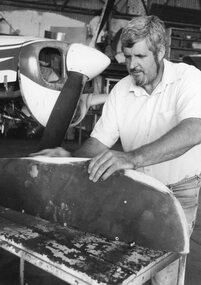
... 7252 Lindsay Seehusen, John Wilson Dec 1985 -1 Don Kennedy repairing an aircraft at Wimmera Air Services Stawell Feb 1985 -2 AG Airworks new pilot Mary Ski Feb 1985 ...7252 Lindsay Seehusen, John Wilson Dec 1985 -1 Don Kennedy repairing an aircraft at Wimmera Air Services Stawell Feb 1985 -2 AG Airworks new pilot Mary Ski Feb 1985 Cropdusting B/W Photographs Stawell People in Horsham Paper Wimmera Advertiser Photograph ...7252 Lindsay Seehusen, John Wilson Dec 1985 -1 Don Kennedy repairing an aircraft at Wimmera Air Services Stawell Feb 1985 -2 AG Airworks new pilot Mary Ski Feb 1985 B/W Photographscropdusting -
 Federation University Historical Collection
Photograph - black and white, Cologne Cathedral from the Rhine, c1950
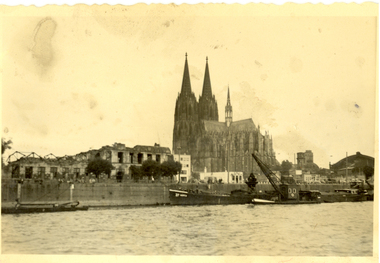
... The twin spires were an easily recognizable navigational landmark for Allied aircraft bombing deeper into Germany, which may explain why the cathedral was spared. Repairs were completed in 1956. ...The twin spires were an easily recognizable navigational landmark for Allied aircraft bombing deeper into Germany, which may explain why the cathedral was spared. Repairs were completed in 1956. ...Cologne Cathedral is a renowned monument of German Catholicism and Gothic architecture and is a World Heritage Site. It is Germany's most visited landmark, attracting an average of 20,000 people a day. (Wikipedia) Though not targeted itself, the cathedral was very near to the central railway station and suffered fourteen hits by aerial bombs during World War II. Badly damaged, it nevertheless remained standing in an otherwise completely flattened city. The twin spires were an easily recognizable navigational landmark for Allied aircraft bombing deeper into Germany, which may explain why the cathedral was spared. Repairs were completed in 1956. An emergency repair on the northwest tower's base carried out in 1944 using poor-quality brick taken from a nearby ruined building remained visible until 2005 as a reminder of the war, when it was decided to restore the section its original appearance. (Wikipedia) Black and white photograph showing a grand cathedral from a waterway. It is Cologne (Koln) Cathedral from the Rhine. To the left of the photo bombed buildings are evident. The photograph is believed to have been taken by Frank Wright.cologne cathedral, koln, germany, rhine, bombing, world war two, frank wright -
 Nhill Aviation Heritage Centre
Memorabilia - Log Book, Aero Engine Log Book, 1942
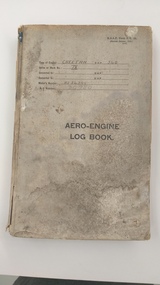
... These log books would have been kept for each aircraft at the air station log book aero engine log repair log anson cheetah Aero Engine Log Book, Type of engine-Cheetah BHP. 340. ...These log books would have been kept for each aircraft at the air stationHard back bound book 305 pages with columns. sections titled Chronological Log, Repair Log, Modification LogAero Engine Log Book, Type of engine-Cheetah BHP. 340. Series or Mk No. IX Makers number AS34299, A Number DG750, A 143950log book, aero engine log, repair log, anson, cheetah -
 Nhill Aviation Heritage Centre
Memorabilia - Iris linen aircraft fabric
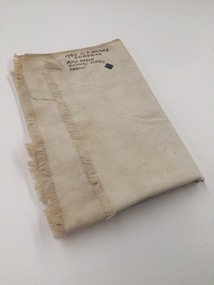
... small quantity of Irish linen fabric from No.2 Air Park Bankstown where many Ansons were repaired and overhauled during the war linen fabric irish linen Dixon Avro Anson aircraft covering fabric, Irish linen Memorabilia Iris linen aircraft fabric ...small quantity of Irish linen fabric from No.2 Air Park Bankstown where many Ansons were repaired and overhauled during the waraircraft covering fabric, Irish linenlinen, fabric, irish linen, dixon, avro anson -
 Federation University Historical Collection
Document - Document - Correspondence, VIOSH: Department of Defence - Air Force Office, Canberra, December 1982
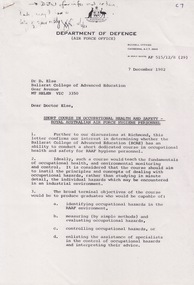
... Industrial chemicals used and hazardous industrial procedures in the repair and maintenance of aircraft are an issue needing resolution. ...Industrial chemicals used and hazardous industrial procedures in the repair and maintenance of aircraft are an issue needing resolution. ...Victorian Institute of Occupational Safety and Health (VIOSH) Australia is the Asia-Pacific centre for teaching and research in occupational health and safety (OHS) and is known as one of Australia's leaders on the field. VIOSH has a global reputation for its innovative approach within the field of OHS management. VIOSH had its first intake of students in 1979. At that time the Institution was known as the Ballarat College of Advanced Education. In 1990 it became known as Ballarat University College, then in 1994 as University of Ballarat. It was 2014 that it became Federation University. VIOSH Australia students are safety managers, senior advisors and experienced OHS professionals. They come from all over Australia and industry. Students are taught active research and enquiry; rather than textbook learning and a one-size fits all approach. VIOSH accepts people into the Graduate Diploma of Occupational Hazard Management who have no undergraduate degree - on the basis of extensive work experience and knowledge Letter from the Department of Defence to Dennis Else looking at the possibility of Ballarat College of Advanced Education conducting a short course in occupational health and safety for RAAF hygiene personnel. It would teach the fundamentals of occupational health and environmental monitoring and control. Better use of the practical time allocated is needed. Noise induced hearing loss is the most widespread occupational health risk in the RAAF. Industrial chemicals used and hazardous industrial procedures in the repair and maintenance of aircraft are an issue needing resolution. Existing terminal objectives for basic hygiene inspectors course in occupational health and safety are provided for comment. Information provided by K R Stone, Flight Lieutenant for Director General of Air Force Health Services. Eight A4 pages,typed. Handwritten note top left cornerLetterhead of Department of Defence - Air Force Office.Signature of K R Stoneviosh, victorian institute of occupational safety and health, department of defence, air force office, raaf, ballarat college of advanced education, dennis else, k r stone, flight lieutenant, director general of air force health services, short course in occupational health and safety, raaf hygiene personnel, hearing loss, industrial chemicals, hazardous industrial procedures -
 Flagstaff Hill Maritime Museum and Village
Booklet - Book and World Chart for Emergency Navigation, George Grady Press, The Raft Book, 1943
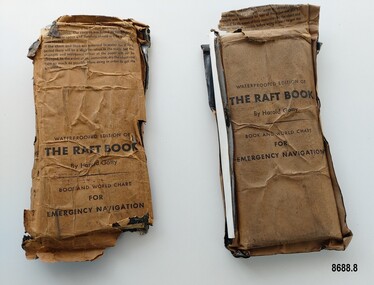
... repairing navigational equipment. At this time he became very interested in air navigation and was aware of the limitations of existing methods and instruments for aerial navigation. He began researching ways of improving aerial navigation. Two early inventions of his were his air sextant and a ground speed and drift indicator which formed the basis of the automatic pilot which later came to be standard equipment on most aircraft. ...repairing navigational equipment. At this time he became very interested in air navigation and was aware of the limitations of existing methods and instruments for aerial navigation. He began researching ways of improving aerial navigation. Two early inventions of his were his air sextant and a ground speed and drift indicator which formed the basis of the automatic pilot which later came to be standard equipment on most aircraft. ...Harold Gatty was born on January 5th, 1903 in Campbell Town, Tasmania. He was a navigator and aviation pioneer. He began his career learning navigation at the age of 14 as a midshipman at the Royal Australian Naval College but withdrew after three years and became an apprenticed ship's officer with the Patrick Steamship Company of Sydney. After W. W. 1 he joined the Australian Merchant Navy where he learned the constellations while standing night watch and became an expert in celestial navigation while serving on many ships sailing between Australia and California. In 1927 he moved to California and opened a navigation school and also a laboratory repairing navigational equipment. At this time he became very interested in air navigation and was aware of the limitations of existing methods and instruments for aerial navigation. He began researching ways of improving aerial navigation. Two early inventions of his were his air sextant and a ground speed and drift indicator which formed the basis of the automatic pilot which later came to be standard equipment on most aircraft. He worked with several record breaking pilots including Ann Morrow Lindbergh (who went on to serve as a navigator for her husband Charles Lindbergh), helped Wiley Post break the world record circumnavigating the Earth, invented a new method of "dead reckoning" that revolutionised the ability to fly safely through cloudy conditions without drifting off course and famously navigated a small plane (whilst trying to cross the Pacific) over 1900 km through fog (with no radio) and using only his dead reckoning techniques, back to their starting point in Japan after they developed fuel problems. In 1932 Gatty received the Distinguished Flying Cross from President Hoover. In 1934 Gatty formed the South Seas Commercial Company with Donald Douglas with the aim to deliver air services to the islands of the South Pacific. The Company was sold to Pan Am but he continued to work for them. In 1935 he went on a sailing expedition investigating several small islands in the South Pacific and was briefly marooned on Baker Island. He was able to use his extensive knowledge of seabird habits to save the crew. He was also very interested in the ability of the Polynesians to navigate using the stars. During the Second World War Gatty was given the honorary rank of Group Captain in the Royal Australian Air Force (RAAF) and worked for the U. S. Army Air Forces (USAAF) in the South Pacific. In 1943 he moved to Washington where he developed a survival book (The Raft Book) specifically for boat crews or air crews flying over the Pacific to help them survive and navigate their life rafts in remote areas of the ocean. The original book was 152 pages long however a condensed version was made which consisted of a 64 page booklet, combined map and star chart and calendar strip enclosed in a waterproof slipcase, to be placed in life rafts for emergency use. The booklet included navigational advice and ideas such as ocean currents, estimation of distance, using a compass, measurement of angles, recognising and steering by the stars, land indications from sea birds, migration of sea birds and insects, sounds from the land, the scent of the land and ocean currents and the colour of the sea etc. After W.W.2 Gatty moved to Fiji and formed Fiji Airways (which later became Air Pacific). Harold Gatty died in August 1957.The two copies of "The Raft Book" are significant as they are a written summary of the many methods of sea navigation (both modern and historical) that existed in the 1940's. They are also a record of Harold Gatty, who played a significant role in the development of modern day aerial navigation using his understanding of different sea navigational techniques.Two rectangular brown packets with waterproof coverings (oiled paper) titled "The Raft Book" by Harold Gatty. Each packet contains a folded 64 page paper booklet with detailed instructions for navigating a small craft in open seas, a folded chart (with a map of the world and oceans, well known constellations, latitude and longitude charts, Greenwich time and a scale for string lengths and Harp scale) and a long folded paper calendar strip.Front of package - "WATERPROOFED EDITION OF/ THE RAFT BOOK / By Harold Gatty / BOOK AND WORLD CHART / FOR / EMERGENCY NAVIGATION / To open envelope tear along above line. If the envelope is used again fold the flap to keep contents dry. 1. This envelope contains a book, chart and tape for emergency navigation. The contents are folded to take up the least possible space and therefore should not be removed until needed. 2. if the chart and tape are immersed in water for a long period, there will be a slight variation in the scale but the strength and resistence to tear of the paper will not be changed. In the event of long immersion, dry the chart and tape as much as possible before using in order to in order to get the greatest accuracy in scale. Front of booklet - THE RAFT BOOK / LORE OF THE SEA AND SKY /By Harold Gatty IMPORTANT FOR YOUR SECURITY/Upon abandoning ship you may have to be your own navigator. Take the following pre/cautions for your own safety:/ Carry a good type of pocket watch / keep it wound and have it running on Greenwich (England) / Time, which you can get from the navigating officer. / Keep track of the date at Greenwich; and on a 24-hour basis, / know whether the time is, say, 6 hours (6 A.M.) showing on / your watch, or 18 hours (6P.M.) Greenwich. / PROECT YOUR WATCH. GET A RUBBER SACK FOR IT (OBTAIN FROM PHARMACIST) AND KEEP IT DRY / KEEP A PENCIL IN YOUR POCKET/ POSITION OF SHIP WHEN ABANDONED PRINTED IN UNITED STATES OF AMERICA GEORGE GRADY PRESS, NEW YORK/COPYRIGHT, 1943, BY HAROLD AND FENNA GATTYflagstaff hill maritime museum and village, shipwreck coast, warrnambool, the raft book, harold gatty, book and world chart for emergency navigation, ww 2, ww ii, navigation, air navigation, aerial navigation, lindbergh, wiley post, dead reckoning, south seas commercial company, u.s. army airforce, usaaf, survival book, life rafts, sea navigation, emergency navigation, fiji airways, harp scale -
 Montmorency–Eltham RSL Sub Branch
Memorabilia - Cup
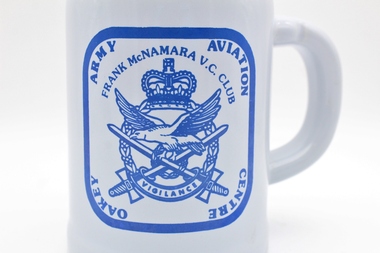
... It was built with the purpose of providing a maintenance facility: the units would erect, repair and insect aircrafts and engines. At the end of the war in 1945, the depot was used to store surplus aircraft. ...It was built with the purpose of providing a maintenance facility: the units would erect, repair and insect aircrafts and engines. At the end of the war in 1945, the depot was used to store surplus aircraft. ...The Oakey Army Aviation Centre is a training facility formed in October 1943 at Oakey, Queensland. It was built with the purpose of providing a maintenance facility: the units would erect, repair and insect aircrafts and engines. At the end of the war in 1945, the depot was used to store surplus aircraft. In early 1946, the RAAF Station Oakey was disbanded and categorised ‘to be retained but not maintained’. Since then, the RAAF Station Oakey facilities have been used few times for some minor activities. Although there are no information relating to the owner or usage of the cup; it holds historic significance for its direct link with the Australian Army Aviation Centre in Oakey and its involvement in World War II; and more generally for its link to the Australian Army.Large white cup with a handle; decorated with a blue ink symbol (displaying a crown and below it, a bird handling two swords) and blue ink inscriptions (from the Army Aviation Centre Oakey). Inscription on top: 'Frank McNamara VC Club' Inscription at the bottom of the symbol: 'Vigilance' Inscription circling the symbol: 'Army Aviation Centre Oakey' -
 Bendigo Military Museum
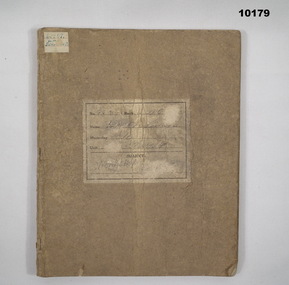
Book - MANUAL, AIR ENGINE REPAIR, c1939-45
... Aircraft Maintenance On front cover is a label with the following; "994 PARK A.G." Name - "L.A.C. SIMONS MUSTERING C/O" Unit - illegible, "Subject - Workshop" On the LHS - stamp size label = "41707 LAC SIMONS F." This is a plain exercise book, Govt issue, quarto size, khaki cover. Inside are ruled pages. On those pages of hand written notes, in pencil, on Aero engine repairs ...Collection re Frederick Simons. Refer to Cat No 10159. This book has personal training notes for working on; Merlin Engines, Bristol Hercules Engines, Workshop practices, Engine components. This is a plain exercise book, Govt issue, quarto size, khaki cover. Inside are ruled pages. On those pages of hand written notes, in pencil, on Aero engine repairs and operating principles. There are also pages devoted to workshop practices.On front cover is a label with the following; "994 PARK A.G." Name - "L.A.C. SIMONS MUSTERING C/O" Unit - illegible, "Subject - Workshop" On the LHS - stamp size label = "41707 LAC SIMONS F."book, training notes, aircraft maintenance -
 Kiewa Valley Historical Society
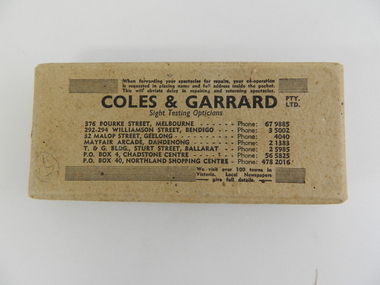
Box Spectacles, Circa 1960
... The expansion of the existing small airfield to one that can accommodate larger aircraft will hasten the expansion of the population in the region, bringing an ever increasing "visiting specialists" covering among other fields, eye and medical practitioners. eye specialist treatments kiewa valley "isolation" cardboard packaging personal eye wear Printed on the top outside lid, in small print "When forwarding your spectacles for repairs, your co-operation is requested in placing name and full address inside the packet. ...This eye wear transportation box was forwarded from and returned to Kiewa Valley in the 1960's. This period in time, the Kiewa Valley was still a semi remote location, and specialist eye facilities were not available in the region. It was not until the Australian Government proceeded with a "regional development Centre" (for relocating some Federal Departments from Canberra) that the Wodonga/Albury townships developed into a medium city, allowing "specialist" facilities to become available and multiply.This item is very significant to the Kiewa Valley as it demonstrates that even in the 1960's early 1970's the Kiewa Valley residents still had to obtain "specialist" services from MELBOURNE. The "isolation" of the Kiewa Valley was still in place due to unreliable transport routes, long distance travel needed to visit cities and a relatively "small" population. The slow but progress marketing of recreational areas in the region and the movement of retirees away from "city violence" and to a quieter location has been on the increase. The expansion of the existing small airfield to one that can accommodate larger aircraft will hasten the expansion of the population in the region, bringing an ever increasing "visiting specialists" covering among other fields, eye and medical practitioners.This brown coloured cardboard box was used by Coles and Garrard (Sight Testing Opticians) to transport spectacles to one of their clients. The box lid has four staples holding the four folded sides in place. The base is of similar proportions and fastened together.Printed on the top outside lid, in small print "When forwarding your spectacles for repairs, your co-operation is requested in placing name and full address inside the packet. This will obviate delay in repairing and returning spectacles", underneath and in bold print "COLES & GARRARD pty ltd", underneath "Sight Testing Optticians" underneath "We visit over 100 towns in Victoria. Local Newspapers give full details"eye specialist treatments, kiewa valley "isolation", cardboard packaging, personal eye wear -
 B-24 Liberator Memorial Restoration Australia Inc
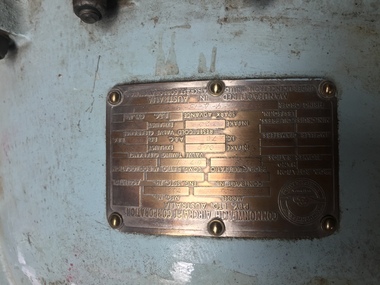
Pratt & Whitney R 1830 Radial Engine, 54828 (CAC)
... Aircraft Corporation (CAC) build, and had been upgraded to 92 specification at some time. This engine as acquired, was completely seized and great difficulty was encountered in dismantling it. The pistons in Nos 1, 13, 3, 2 and 5 had "grown" into the cylinder bores requiring some unorthodox methods to remove them. The cylinder barrels have been brought up to a reasonable standard, those beyond repair...Aircraft Corporation (CAC) build, and had been upgraded to 92 specification at some time. This engine as acquired, was completely seized and great difficulty was encountered in dismantling it. The pistons in Nos 1, 13, 3, 2 and 5 had "grown" into the cylinder bores requiring some unorthodox methods to remove them. The cylinder barrels have been brought up to a reasonable standard, those beyond repair ...This engine was a Commonwealth Aircraft Corporation (CAC) build, and had been upgraded to 92 specification at some time. This engine as acquired, was completely seized and great difficulty was encountered in dismantling it. The pistons in Nos 1, 13, 3, 2 and 5 had "grown" into the cylinder bores requiring some unorthodox methods to remove them. The cylinder barrels have been brought up to a reasonable standard, those beyond repair were replaced from stock. After getting various parts from the US, this engine was eventually brought up to running order.The Pratt & Whitney R 1830 is a double row 14 cylinder air cooled radial engine with a capacity of 1830 cubic inches, (30 litres), developing some 1200 horsepower at a maximum 2700 rpm.Engine Number 54828 -
 B-24 Liberator Memorial Restoration Australia Inc
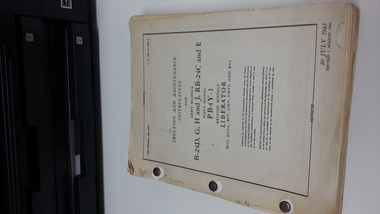
Manual - Maintenance Manual for B-24 Liberator Aircraft, ERECTION AND MAINTENANCE INSTRUCTIONS FOR ARMY MODELS B-24D, G, H AND J, RB-24C AND E NAVY MODEL PB4Y-1 BRITISH MODELS LIBERATOR BIII, BIIIA, BIV, GRV, GRVI, AND BVI
... This Manual was used by maintenance crews to repair American B-24 aircraft, for Army, Navy and British models....This Manual was used by maintenance crews to repair American B-24 aircraft, for Army, Navy and British models. ...This Manual was used by maintenance crews to repair American B-24 aircraft, for Army, Navy and British models.Vital for maintenance crews.Quarto size Paper Manual with cardboard backing held together with metal butterfly studs.Inscriptions as previously stated. RESTRICTED, FOR OFFICIAL USE ONLY, T.O. NO. 01-5EC-2. 2O JULY 1943 , REVISED 5 AUGUST 1944. -
Moorabbin Air Museum
Manual - Aviation Technician Integrated Training Program, Aviation Technician Integrated Training Program Airframe Section Books 1 through 9 EA-ITP-A
... Aviation technical integrated training program Aircraft structures Metal structural repairs Aircraft fabric covering/painting & finishing/welding Aircraft assembly & rigging Electrical systems Hydraulic & pneumatic systems Landing gear systems Cabin atmosphere control systems Fire & rain control systems Technical overview of aircraft structures for training purposes, circa 1981 2 ring folder. ...Technical overview of aircraft structures for training purposes, circa 19812 ring folder. Possible duplicate itemnon-fictionTechnical overview of aircraft structures for training purposes, circa 1981aircraft structures, metal structural repairs, aircraft fabric covering/painting & finishing/welding, aircraft assembly & rigging, electrical systems, hydraulic & pneumatic systems, landing gear systems, cabin atmosphere control systems, fire & rain control systems -
 Moorabbin Air Museum
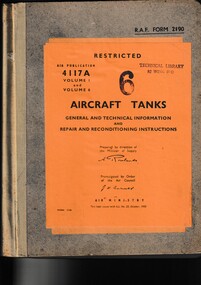
Manual (Item) - AP 4117A Vol 1 and 6 Aircraft Tanks General and Technical Information and Repair and Reconditioning Instructions
... AP 4117A Vol 1 and 6 Aircraft Tanks General and Technical Information and Repair and Reconditioning Instructions...Manual AP 4117A Vol 1 and 6 Aircraft Tanks General and Technical Information and Repair and Reconditioning Instructions ... -
Moorabbin Air Museum
Booklet - CAC Commonwealth Aircraft Corporation gas turbine division
... CAC Commonwealth Aircraft gas turbine division General outline Physical & surface treatment processing Vacuum brazing & heat treatment Component manufacturing Engine assembly/test/repair & overhaul Foundries Overview of CAC gas turbine division 2 copies CAC Commonwealth Aircraft Corporation Gas Turbine Division Booklet CAC Commonwealth Aircraft Corporation gas turbine division ...Overview of CAC gas turbine division2 copiesOverview of CAC gas turbine divisiongeneral outline, physical & surface treatment processing, vacuum brazing & heat treatment, component manufacturing, engine assembly/test/repair & overhaul, foundries -
Moorabbin Air Museum
Document - Lecture Notes for Aircraft Metal Repairs, RAAF School of Technical Training
... RAAF School of Technical Training Document Lecture Notes for Aircraft Metal Repairs ...
