
Showing 336 items matching "flour mill"
-
 Bendigo Historical Society Inc.
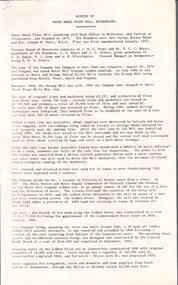
Document - WATER WHEEL FLOUR MILL, BRIDGEWATER
... WATER WHEEL FLOUR MILL, BRIDGEWATER......flour mill...Three typewritten pages on the history of waterwheel flour mill, Bridgewater, author and date unknown. ...BUSINESS Retail flour mill Three typewritten pages on the history of waterwheel flour mill, Bridgewater, author and date unknown. ...Three typewritten pages on the history of waterwheel flour mill, Bridgewater, author and date unknown. Also a small brochure titled ''water wheel flour mills Bridgewater on Loddon''business, retail, flour mill -
 Charlton Golden Grains Museum Inc
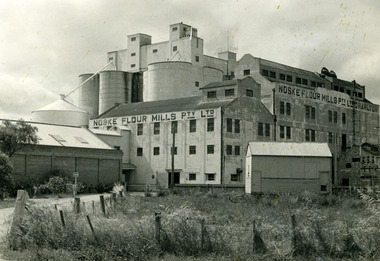
Photograph, Noske's Flour Mill C.1948
... Noske's Flour Mill C.1948...Noske's Flour Mill C...Noske's Flour Mills Pty Ltd Charlton...Noske's Flour Mill C Richards Ernest Manager 1927 - C.1950 Noske's Flour Mills Pty Ltd Charlton Black & White landscape photo Noske's Flour Mill C.1948 Photograph ...Black & White landscape photoNoske's Flour Mills Pty Ltd Charltonnoske's flour mill c, richards ernest manager 1927 - c.1950 -
 Charlton Golden Grains Museum Inc
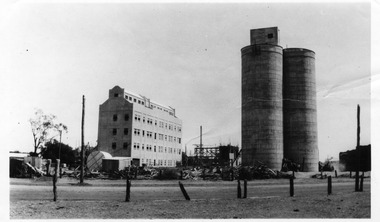
Photograph, Noske's Flour Mill C.1938
... Noske's Flour Mill C.1938...Noske's Flour Mill...Black & White Landscape copied Photo Noske's Flour Mill C.1938...Noske's Flour Mill Black & White Landscape copied Photo Noske's Flour Mill C.1938 Noske's Flour Mill C.1938 Photograph ...Black & White Landscape copied Photo Noske's Flour Mill C.1938noske's flour mill -
 Charlton Golden Grains Museum Inc
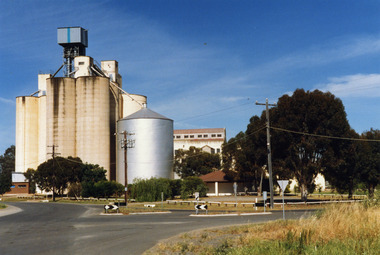
Photograph, Charlton Shire, Charlton Flour Mill, c.1987
... Charlton Flour Mill......Flour Mill Charlton...It was taken over by the Grain Elevator Board in the 1970s. Noske's Flour Mill, with its commanding presence and towering silos, has long **dominated the Charlton skyline** and remains a significant landmark, even though it no longer mills flour. ...Colour photograph of Charlton Flour Mill and silos. Intersection of Kaye & Davies Streets in the foreground. ...It was taken over by the Grain Elevator Board in the 1970s. Noske's Flour Mill, with its commanding presence and towering silos, has long **dominated the Charlton skyline** and remains a significant landmark, even though it no longer mills flour. ...A previous mill had operated in Charlton by Mr. W.E. Foreman on the banks of the Avoca River and was acquired in 1919 by Noske Bros. The present Flour Mill was built by Noske Bros and opened in May 1927. It was taken over by the Grain Elevator Board in the 1970s. Noske's Flour Mill, with its commanding presence and towering silos, has long **dominated the Charlton skyline** and remains a significant landmark, even though it no longer mills flour. The mill's history is deeply intertwined with the development of Charlton and the grain industry of the surrounding district. The foundation for the mill's presence was laid in 1919 when Messrs Noske Bros. Pty. Ltd., already owning mills in Horsham, Nhill, and Murray Bridge, acquired G. H. Foreman’s Mill located by the Avoca River. The founder, **T. J. Noske**, was an early pioneer of flour exporting, expanding his milling business after unexpectedly acquiring the Horsham mill. ### A State-of-the-Art Operation The original mill by the river operated until August 1926 before being closed and dismantled. Plans were well underway for a **new, state-of-the-art mill** to be located at the former Cobb and Co site. In 1927, the new mill began operation. It was one of the largest in the state, boasting a capacity of three tons of flour per hour, a 250 h.p. diesel engine, and three initial silos. The mill quickly gained a reputation for **excellence** for both its design and its flour, which was sold successfully in local and overseas markets. ### Periods of Expansion and Trial The mill continued to grow, reflecting the importance of the local agricultural industry. Between 1940 and 1941, **nine new silos** were built, adding bulk receival points. In the record-breaking 1968 season, the mill received a colossal wheat intake of **695,000 bushels**. However, the mill also faced setbacks. On January 21, 1949, disaster struck when a **large fire** erupted in the storage shed, which contained 500 tons of bagged flour ready for export and new flour bags. The blaze was so intense that smoke was visible as far away as Wycheproof, and it threatened to destroy the entire mill. Thanks to the monumental efforts of the Charlton, St. Arnaud, Wycheproof, and Wedderburn Brigades, who ran the main pump almost continuously for 26 hours, the damage was contained, though the estimated loss was a substantial £60,000. ### Transformation of the Site At its peak, the mill was a major employer, providing work for approximately 65–70 men. But after over 45 years of operation, flour production at the mill ceased on October 25, 1973. Noske Industries Ltd. sought to adapt, converting the operation to a less successful stock feed production centre. In 1977, the **Grain Elevators Board** took over the site as a grain receival depot, building a large elevator tower that surpassed the height of the original buildings. The site eventually returned to private hands and, since 2000, has been owned and operated as a primary grain receival site for **GrainCorp**, cementing its continued, vital role in Charlton's agricultural life. Colour photograph of Charlton Flour Mill and silos. Intersection of Kaye & Davies Streets in the foreground. One large silver silo and three taller greyish concrete silos to the left. Three other cream coloured silos behind. There are pipes and sheds on top of the silos. There is a cream single story building to the right of the silver silo and a multi-storey building behind with eight window in the upper level. There is a small red brick building on the far left of the photo.w.e. foreman, noske bros, flour mill charlton, business, industry -
 Stawell Historical Society Inc
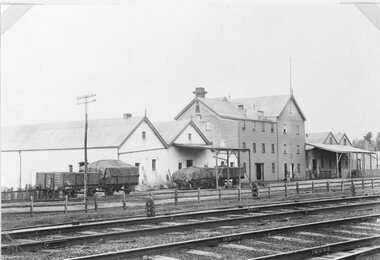
Photograph, Wimmera Flour Mill with adjoining Buildings c1920s -- 2 Photos --1 Coloured
... Wimmera Flour Mill with adjoining Buildings c1920s -- 2 Photos --1 Coloured ...2 photos of three story flour mill and adjoining buildings 1920's....Two photographs of railway tracks in front of the Stawell flour mill and adjoin buildings. Two people are standing in front of the three story flour mill with a timber fence along the railway tracks and a telephone pole in front of two of the four rail wagons. ...2 photos of three story flour mill and adjoining buildings 1920's. stawell industry Two photographs of railway tracks in front of the Stawell flour mill and adjoin buildings. ...2 photos of three story flour mill and adjoining buildings 1920's.Two photographs of railway tracks in front of the Stawell flour mill and adjoin buildings. Two people are standing in front of the three story flour mill with a timber fence along the railway tracks and a telephone pole in front of two of the four rail wagons. stawell industry -
 Tatura Irrigation & Wartime Camps Museum
Photograph - copy, William Day's Flour Mill, 1987 copy
... William Day's Flour Mill...Copy of photograph of flour mill l built by William Day in 1858. The earliest flour mill in the Goulburn Valley. ...Black and white copy of photograph of exterior of William Day's Flour Mill, near Murchison. Built 1858....Copy of photograph of flour mill l built by William Day in 1858. The earliest flour mill in the Goulburn Valley. ...Copy of photograph of flour mill l built by William Day in 1858. The earliest flour mill in the Goulburn Valley. Overlooking the Goulburn River, where a punt carried people, livestock and mill products to and from the mill. Classified by National Trust. Photographs courtesy of R. Day.Black and white copy of photograph of exterior of William Day's Flour Mill, near Murchison. Built 1858.on back: Description taped to back -
Tatura Irrigation & Wartime Camps Museum
Folder, Reilly Family and Flour Mill History, 2012
... Reilly Family and Flour Mill History......Tatura Flour Mill...History of Tatura Flour Mill and rehabilitation of VIctorian Flour Milling Industry....History of Tatura Flour Mill and rehabilitation of VIctorian Flour Milling Industry. ...Compiled for the Museum. History of family of George REILLY and later Samuel, Robert and James. History of Tatura Flour Mill and rehabilitation of VIctorian Flour Milling Industry.Blue cover with metal rings. Plastic sleeves containing printed sheetsreilly family, tatura flour mill -
 Eltham District Historical Society Inc
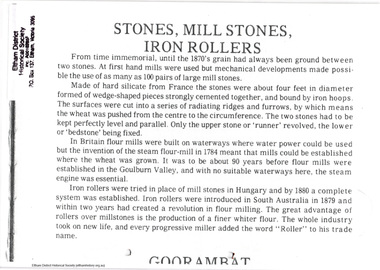
Folder, Eltham Flour Mill
... Eltham Flour Mill......eltham flour mill...Ford (1981) relating to Eltham Flour Mill Proprietor William Ford and his predecessor Henry Dendy and the operation of the Eltham Flour Mill. ...Ford (1981) relating to Eltham Flour Mill Proprietor William Ford and his predecessor Henry Dendy and the operation of the Eltham Flour Mill. ...Photocopied pages probably from "Flour mills and millers of the Goulburn Valley, 1858-1980" by Myrtle L. Ford (1981) relating to Eltham Flour Mill Proprietor William Ford and his predecessor Henry Dendy and the operation of the Eltham Flour Mill. Also includes pages from an unknown source describing the operation of the mill and map with location of mill marked. The Eltham Flour Mill was situated on the Diamond Creek below the location of the Eltham Community and Reception Centre.8 PagesHG Folders 113harry gilham collection, eltham flour mill, henry dendy, william ford -
 Bendigo Historical Society Inc.
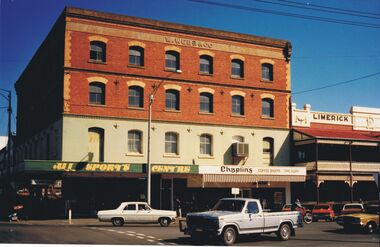
Photograph - WEBB'S FLOUR MILL
... WEBB'S FLOUR MILL......webb's flour mill...Colour photo of Webb's Flour mill, Williamson Street, Bendigo. C 1980 ( J. ...BUILDINGS Commercial webb's flour mill Colour photo of Webb's Flour mill, Williamson Street, Bendigo. ...Colour photo of Webb's Flour mill, Williamson Street, Bendigo. C 1980 ( J. Lerk 28.2.2000 ) Red brick 4 storey building, next to Limerick Hotel with cast iron lace verandah trims. Chaplins coffee shop. All Sports Centre on sign under building.buildings, commercial, webb's flour mill -
 Stawell Historical Society Inc
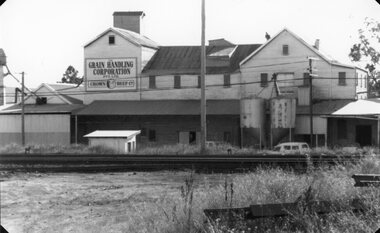
Photograph, Grain Handling Corp -- Old Wimmera Flour Mill 1970 -- Coloured
... Grain Handling Corp -- Old Wimmera Flour Mill 1970 -- Coloured...Colour photo of Grain Handling Corp old Flour Mill 1970's...Coloured photo. Flour Mill is now Grain Handling Corporation. ...Coloured photo. Flour Mill is now Grain Handling Corporation. ...Colour photo of Grain Handling Corp old Flour Mill 1970'sColoured photo. Flour Mill is now Grain Handling Corporation. Two vehicles parked at front of building; small white building nearest railway with 2 solos. Demolition begins roof removed.Grain Handling Corporation Pty. Ltd. Crown Beef Co.stawell industry -
 Bendigo Historical Society Inc.
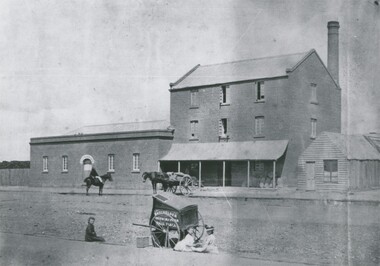
Photograph - BUCKLEY FLOUR MILL, 1861
... BUCKLEY FLOUR MILL......buckley flour mill...black and white photo : streetscape, with single storied building on left adjoining two storied building. Buckley Flour Mill ( on door ) Horse and rider also horse in cart Batchelders cart in foreground with 3 children on footpath near cart. ...On back '36' Photograph BUCKLEY FLOUR MILL ...black and white photo : streetscape, with single storied building on left adjoining two storied building. Buckley Flour Mill ( on door ) Horse and rider also horse in cart Batchelders cart in foreground with 3 children on footpath near cart. Timber building on RH side, chimney to rear. On back '36'batchelderbuildings, commercial, buckley flour mill -
 Bendigo Historical Society Inc.
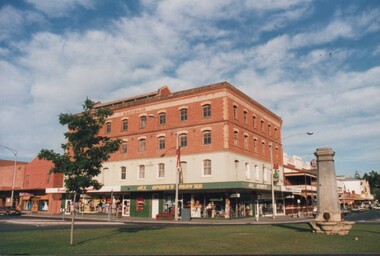
Photograph - National Trust Collection: Webb's Flour Mill, cnr Williamson Str and Queen Street, Bendigo, 23/06/2025
... National Trust Collection: Webb's Flour Mill, cnr Williamson Str and Queen Street, Bendigo...Webb's Flour Mill...National Trust Collection: Webb's Flour Mill on the cnr of Williamson Street (and Lyttleton Terrace) Bendigo Mill constructed of red brick with contrasting brick trim Roundabout stone horse watering trough has been removed, replaced with landscaping Mill later converted to a sewing machine manufacturer, currently upper three stories are residential units...historic building Webb's Flour Mill National Trust Collection: Webb's Flour Mill on the cnr of Williamson Street (and Lyttleton Terrace) Bendigo Mill constructed of red brick with contrasting brick trim Roundabout stone horse watering trough has been removed, replaced with landscaping Mill later converted to a sewing machine manufacturer, currently upper three stories are residential units Photograph National Trust Collection: Webb's Flour Mill, cnr Williamson Str and Queen Street, Bendigo ...historic buildingNational Trust Collection: Webb's Flour Mill on the cnr of Williamson Street (and Lyttleton Terrace) Bendigo Mill constructed of red brick with contrasting brick trim Roundabout stone horse watering trough has been removed, replaced with landscaping Mill later converted to a sewing machine manufacturer, currently upper three stories are residential unitswebb's flour mill -
Tarnagulla History Archive
Photograph - Photograph: Company's Dam and Flour Mill, Tarnagulla, c. 1880 - 1920
... Photograph: Company's Dam and Flour Mill, Tarnagulla...The mill was then known as the Tarnagulla Flour Mill Co., with Thos. Comrie as proprietor, Mr Fitzgerald was still manager, and Mr T. ...Monochrome photograph depicting view of Company's Dam and the flour mill in Tarnagulla. ...Monochrome photograph depicting view of Company's Dam and the flour mill in Tarnagulla. Photograph Photograph: Company's Dam and Flour Mill, Tarnagulla ...Williams Family Collection. On the 20th December 1873 it was reported in the Tarnagulla Courier that arrangements were being made for the erection of a steam flour mill at Tarnagulla. Mr Bristol had purchased the necessary plant which would be erected with as little delay as possible. The site chosen was the premises occupied previously by Mr John Pierce, grocer and wine and spirit merchant, at the corner of King and Commercial Road. These premises were incorporated in the mill building. Suitable buildings for receiving and storing grain and flour had been erected already. On 10th January, 1874 an advertisement in the Courier called for tenders from masons, bricklayers and carpenters for the erection of a flour mill at Tarnagulla for H. C. Bristol, Esq. with all enquiries to be made from G. Minto, Engineer. In December 1881 the proprietors made a request to the Tarnagulla Borough Council for permission to lay pipes to the Municipal Dam, which was generally known as the Company's Dam, and to obtain water from the dam for milling purposes. This was granted. Steam was got up for the first time on 30th of March, 1882. A large quantity of wheat was stored ready for milling. Just prior to 29th of April 1882 the boiler at the mill burst, as the result of which two men, J. H. Smith and W. Hargreaves died and H. Joyce Bousfield, senior and junior, were seriously injured. The mill commenced operations on 13th June, 1882 with Mr W Fitzgerald as manager. The price offered for wheat was thirty-seven pence per bushell. It operated with grinding stones until considerable renovations were done in the early part of 1899 when new rollers and more up to date equipment installed. The mill was then known as the Tarnagulla Flour Mill Co., with Thos. Comrie as proprietor, Mr Fitzgerald was still manager, and Mr T. Leonard was the traveller. Much new equipment was put in and each of the three floors had different processes. The rollers were on the ground floor, the purifiers and elevators reel were on the second floor, plus the clean wheat bin directly over the Ganz rollers. On the top floor was the chop reel, bran reel, inter-elevator reels, brush machine cyclone sack hoist, dirty wheat shaker, clean wheat bin, dust rooms and also double damping rooms. A plant was also erected for the making of an improved quality of wheaten meal, for which purpose special machinery was procured and a pair of stones was left for grinding the meal. A complete plant for the crushing of oats etc was also erected. The driving power of the mill was supplied by a new engine complete with 16 inch cylinder, manufactured and erected by Bousfield & Co. of Eaglehawk. It was fitted with Pickering governors, connected with the cylinder was a super heater. The boiler was tested and all connections etc. overhauled, with much of it being completely renewed. There was a complete network of belts, spouts, elevators etc. all over the building, all conveniently placed. The plans etc for the new plant were drawn up by Mr J. Kilborn, manager of the firm of Bodington & Co., engineers and millwrights of Carlton, which supplied the whole of the machinery, excepting the engine. The work of erection was carried out by Mr Kilborn and his assistants to the entire satisfaction of Mr Comrie, who had gone to considerable expense to bring the mill to a completely up-todate machine, fitted with all of the most modern appliances available. An advertisement on May 6th, 1899 read: "Tarnagulla Flour Mill Co., Patent Roller Flour. Also their Digestive Wheaten Meal specially prepared for Porridge or Bread." In January 1901, 6000 bags of wheat were received weekly at the mill and it was a common sight to see the streets lined with wagons. In May 1902 the mill was lighted by gas and in July 1906 an application was made to the Tarnagulla Borough Council for permission to lay a tram track from the mill to the Railways Station. Council was agreeable to this provided suitable plans were submitted. In 1913, 15,000 bags of wheat were bought at three shillings and four pence per bushell. In January 1914 the mill was renovated. At this time 1500 bags of wheat were coming in daily, with 20,000 bags in storage. On 15th December, 1917 the mill was advertised for sale, to be sold on Friday, 21st December,.1917, on behalf of the Estate of the Late Thomas Comrie, who had died on 4th August, 1910. The Courier at that time recorded him as being responsible for the building of the mill and with being the sole proprietor. The mill was closed, apparently, for a short period. The Courier reported on 13th of September, 1918 that the mill had been sold to Mr O. Albert of Talbot and that it would re-open. An advertisement read: ALBERT. O. & SON, MILLERS. During 1920 the mill was closed and pulled down. It was later re-erected at Mildura where it operated for many years. (by Donald Clark)Monochrome photograph depicting view of Company's Dam and the flour mill in Tarnagulla. Handwritten on reverse: 'J. Caldwell and photographer's stamp 'C. Bock Photo Tarnagulla'.tarnagulla -
 Charlton Golden Grains Museum Inc
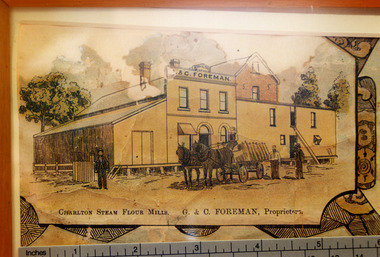
Photograph - Lithograph, Rider & Mercer, Views of Charlton
... ...Flour Mill...Replaced by Noske's Flour Mill on Kays Street in 1927. Noske's Flour Mill, with its commanding presence and towering silos, has long **dominated the Charlton skyline** and remains a significant landmark, even though it no longer mills flour. ...Showing the Charlton Steam Flour Mill of G. C. Foreman....Charlton Steam Flour Mills. G & C Foreman proprietors....Replaced by Noske's Flour Mill on Kays Street in 1927. Noske's Flour Mill, with its commanding presence and towering silos, has long **dominated the Charlton skyline** and remains a significant landmark, even though it no longer mills flour. ...Close up photograph of part of the Charlton Lithograph showing the Charlton Steam Power Flour Mill of G & C Foreman. Located in on the bank of the Avoca river. The mill owners attempted to dam the river during the 1870s. The mill was built in 1876 as recorded by the local traveling correspondent . Foreman's flour mill established 1876 at the west end of High Street. Sold to Norske in 1925. Replaced by Noske's Flour Mill on Kays Street in 1927. Noske's Flour Mill, with its commanding presence and towering silos, has long **dominated the Charlton skyline** and remains a significant landmark, even though it no longer mills flour. The mill's history is deeply intertwined with the development of Charlton and the grain industry of the surrounding district. The foundation for the mill's presence was laid in 1919 when Messrs Noske Bros. Pty. Ltd., already owning mills in Horsham, Nhill, and Murray Bridge, acquired G. H. Foreman’s Mill located by the Avoca River. The founder, **T. J. Noske**, was an early pioneer of flour exporting, expanding his milling business after unexpectedly acquiring the Horsham mill. ### A State-of-the-Art Operation The original mill by the river operated until August 1926 before being closed and dismantled. Plans were well underway for a **new, state-of-the-art mill** to be located at the former Cobb and Co site. In 1927, the new mill began operation. It was one of the largest in the state, boasting a capacity of three tons of flour per hour, a 250 h.p. diesel engine, and three initial silos. The mill quickly gained a reputation for **excellence** for both its design and its flour, which was sold successfully in local and overseas markets. ### Periods of Expansion and Trial The mill continued to grow, reflecting the importance of the local agricultural industry. Between 1940 and 1941, **nine new silos** were built, adding bulk receival points. In the record-breaking 1968 season, the mill received a colossal wheat intake of **695,000 bushels**. However, the mill also faced setbacks. On January 21, 1949, disaster struck when a **large fire** erupted in the storage shed, which contained 500 tons of bagged flour ready for export and new flour bags. The blaze was so intense that smoke was visible as far away as Wycheproof, and it threatened to destroy the entire mill. Thanks to the monumental efforts of the Charlton, St. Arnaud, Wycheproof, and Wedderburn Brigades, who ran the main pump almost continuously for 26 hours, the damage was contained, though the estimated loss was a substantial £60,000. ### Transformation of the Site At its peak, the mill was a major employer, providing work for approximately 65–70 men. But after over 45 years of operation, flour production at the mill ceased on October 25, 1973. Noske Industries Ltd. sought to adapt, converting the operation to a less successful stock feed production centre. In 1977, the **Grain Elevators Board** took over the site as a grain receival depot, building a large elevator tower that surpassed the height of the original buildings. The site eventually returned to private hands and, since 2000, has been owned and operated as a primary grain receival site for **GrainCorp**, cementing its continued, vital role in Charlton's agricultural life.Colour photo taken of a small portion of the Charlton Lithograph. Showing the Charlton Steam Flour Mill of G. C. Foreman.Charlton Steam Flour Mills. G & C Foreman proprietors.lithograph, business, industry, charlton, flour mill, noske bros, foreman -
Tarnagulla History Archive
Postcard - Photographic postcard: Company's Dam and Flour Mill, Tarnagulla, c. 1880 - 1920
... Photographic postcard: Company's Dam and Flour Mill, Tarnagulla...The mill was then known as the Tarnagulla Flour Mill Co., with Thos. Comrie as proprietor, Mr Fitzgerald was still manager, and Mr T. ...Photographic postcard, front image depicting view of Company's Dam and the flour mill in Tarnagulla. ...Photographic postcard, front image depicting view of Company's Dam and the flour mill in Tarnagulla. Postcard Photographic postcard: Company's Dam and Flour Mill, Tarnagulla ...Williams Family Collection. On the 20th December 1873 it was reported in the Tarnagulla Courier that arrangements were being made for the erection of a steam flour mill at Tarnagulla. Mr Bristol had purchased the necessary plant which would be erected with as little delay as possible. The site chosen was the premises occupied previously by Mr John Pierce, grocer and wine and spirit merchant, at the corner of King and Commercial Road. These premises were incorporated in the mill building. Suitable buildings for receiving and storing grain and flour had been erected already. On 10th January, 1874 an advertisement in the Courier called for tenders from masons, bricklayers and carpenters for the erection of a flour mill at Tarnagulla for H. C. Bristol, Esq. with all enquiries to be made from G. Minto, Engineer. In December 1881 the proprietors made a request to the Tarnagulla Borough Council for permission to lay pipes to the Municipal Dam, which was generally known as the Company's Dam, and to obtain water from the dam for milling purposes. This was granted. Steam was got up for the first time on 30th of March, 1882. A large quantity of wheat was stored ready for milling. Just prior to 29th of April 1882 the boiler at the mill burst, as the result of which two men, J. H. Smith and W. Hargreaves died and H. Joyce Bousfield, senior and junior, were seriously injured. The mill commenced operations on 13th June, 1882 with Mr W Fitzgerald as manager. The price offered for wheat was thirty-seven pence per bushell. It operated with grinding stones until considerable renovations were done in the early part of 1899 when new rollers and more up to date equipment installed. The mill was then known as the Tarnagulla Flour Mill Co., with Thos. Comrie as proprietor, Mr Fitzgerald was still manager, and Mr T. Leonard was the traveller. Much new equipment was put in and each of the three floors had different processes. The rollers were on the ground floor, the purifiers and elevators reel were on the second floor, plus the clean wheat bin directly over the Ganz rollers. On the top floor was the chop reel, bran reel, inter-elevator reels, brush machine cyclone sack hoist, dirty wheat shaker, clean wheat bin, dust rooms and also double damping rooms. A plant was also erected for the making of an improved quality of wheaten meal, for which purpose special machinery was procured and a pair of stones was left for grinding the meal. A complete plant for the crushing of oats etc was also erected. The driving power of the mill was supplied by a new engine complete with 16 inch cylinder, manufactured and erected by Bousfield & Co. of Eaglehawk. It was fitted with Pickering governors, connected with the cylinder was a super heater. The boiler was tested and all connections etc. overhauled, with much of it being completely renewed. There was a complete network of belts, spouts, elevators etc. all over the building, all conveniently placed. The plans etc for the new plant were drawn up by Mr J. Kilborn, manager of the firm of Bodington & Co., engineers and millwrights of Carlton, which supplied the whole of the machinery, excepting the engine. The work of erection was carried out by Mr Kilborn and his assistants to the entire satisfaction of Mr Comrie, who had gone to considerable expense to bring the mill to a completely up-todate machine, fitted with all of the most modern appliances available. An advertisement on May 6th, 1899 read: "Tarnagulla Flour Mill Co., Patent Roller Flour. Also their Digestive Wheaten Meal specially prepared for Porridge or Bread." In January 1901, 6000 bags of wheat were received weekly at the mill and it was a common sight to see the streets lined with wagons. In May 1902 the mill was lighted by gas and in July 1906 an application was made to the Tarnagulla Borough Council for permission to lay a tram track from the mill to the Railways Station. Council was agreeable to this provided suitable plans were submitted. In 1913, 15,000 bags of wheat were bought at three shillings and four pence per bushell. In January 1914 the mill was renovated. At this time 1500 bags of wheat were coming in daily, with 20,000 bags in storage. On 15th December, 1917 the mill was advertised for sale, to be sold on Friday, 21st December,.1917, on behalf of the Estate of the Late Thomas Comrie, who had died on 4th August, 1910. The Courier at that time recorded him as being responsible for the building of the mill and with being the sole proprietor. The mill was closed, apparently, for a short period. The Courier reported on 13th of September, 1918 that the mill had been sold to Mr O. Albert of Talbot and that it would re-open. An advertisement read: ALBERT. O. & SON, MILLERS. During 1920 the mill was closed and pulled down. It was later re-erected at Mildura where it operated for many years. (by Donald Clark)Photographic postcard, front image depicting view of Company's Dam and the flour mill in Tarnagulla. Handwritten on reverse: 'A Merry Christmas and a Happy New Year, E. Bool' and photographer's stamp 'C. Bock Photo Tarnagulla'.tarnagulla -
Tatura Irrigation & Wartime Camps Museum
Photograph, Reilly's Flour Mill
... Reilly's Flour Mill...Reilly's Flour Mill, corner Kerferd and Albert Streets....Reilly's Flour Mill Photograph ...Reilly's Flour Mill, corner Kerferd and Albert Streets.tatura, buildings, historic -
 Tarnagulla History Archive
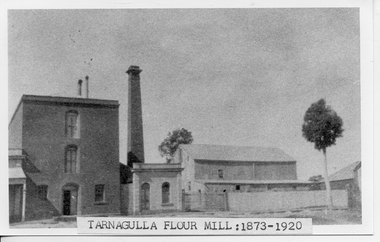
Photograph: Tarnagulla Flour Mill, 1873-1920
... Photograph: Tarnagulla Flour Mill...A monochrome photograph of Tarnagulla Flour Mill. Copy photograph. ...A monochrome photograph of Tarnagulla Flour Mill. Copy photograph. Photograph: Tarnagulla Flour Mill ...Donald Clark Collection. A monochrome photograph of Tarnagulla Flour Mill. Copy photograph. -
Tarnagulla History Archive
Photograph - Photograph: Workers at Tarnagulla Flour Mill, c. 1873-1920, probably around 1900
... Photograph: Workers at Tarnagulla Flour Mill...A meeting was called at the Golden Age Hotel on 11th June 1868 when it was resolved to build a flour mill. Tenders were called by H.C. Bristol, in the Tarnagulla Courier of January 10, 1874, for the erection of the mill. ...Monochrome photograph depicting workers at Tarnagulla Flour Mill, some loading or unloading a horse-drawn cart. ...Photograph Photograph: Workers at Tarnagulla Flour Mill ...Williams Family Collection. A meeting was called at the Golden Age Hotel on 11th June 1868 when it was resolved to build a flour mill. Tenders were called by H.C. Bristol, in the Tarnagulla Courier of January 10, 1874, for the erection of the mill. Building of the Mill commenced in 1874. Pipes were laid to Company's Dam to obtain water for the Mill's boilers. Steam was got up for the first time on 30th March, 1882. A boiler burst about April 29th. Two men (J.H. Smith and W. Hargreaves) died as a result and two others were seriously injured. The mill commenced operations on 13th June 1882 with Mr. W. Fitzgerald as manager. Thomas Comrie was the proprietor and was responsible for the Mill being built. The Mill operated with grinding stones until 1899 when new rollers and a considerable amount of new equipment was installed, including a new, more powerful engine to drive the Mill. In January 1901, 6,000 bags of wheat were received weekly and it was a common sight to see the streets lined with wagons. In 1913, 15,000 bags of wheat were bought at three shillings and four pence per bushell. In January 1914, wheat came in at the rate of 1500 bags a day with 20,000 bags in storage. Thomas Comrie died on 4th August 1910. The Mill was carried on by his executors, then closed for a short period prior to being sold in September 1918 to a Mr. O. Albert of Talbot. Albert operated the Mill for a few years but during the 1920s it was closed down and then pulled down. It was later re-erected at Mildura where it operated for many years.Monochrome photograph depicting workers at Tarnagulla Flour Mill, some loading or unloading a horse-drawn cart. An original photograph, mounted on card. Handwritten on back: 'L.Williams Tarnagulla' and 'Leo Fitzgerald' and full recipe for a red currant dessert.tarnagulla -
Tarnagulla History Archive
Photograph: Company's Dam & Flour Mill, Tarnagulla, c.1895
... Photograph: Company's Dam & Flour Mill, Tarnagulla...A monochrome photograph depicting Company's Dam & Flour Mill, Tarnagulla. Copy photograph. ...A monochrome photograph depicting Company's Dam & Flour Mill, Tarnagulla. Copy photograph. Photograph: Company's Dam & Flour Mill, Tarnagulla ...A monochrome photograph depicting Company's Dam & Flour Mill, Tarnagulla. Copy photograph. -
 Tatura Irrigation & Wartime Camps Museum
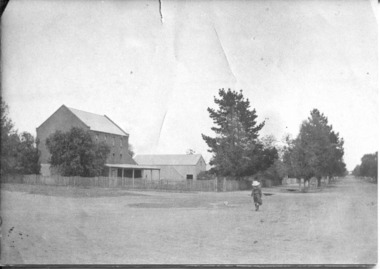
Photograph, Flour Mill, 2002
... Flour Mill...flour mill c1910...flour mill c1910 flour mill c1970 photograph people Flour Mill Photograph ...flour mill c1910, flour mill c1970, photograph, people -
 Tarnagulla History Archive
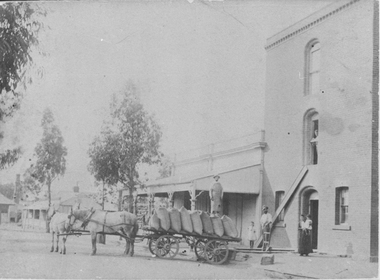
Photograph: Wagon loading outside Tarnagulla Flour Mill, 1873-1920
... Photograph: Wagon loading outside Tarnagulla Flour Mill...A monochrome photograph of men loading a wagon outside the Tarnagulla Flour Mill. Copy photograph. ...A monochrome photograph of men loading a wagon outside the Tarnagulla Flour Mill. Copy photograph. Photograph: Wagon loading outside Tarnagulla Flour Mill ...Donald Clark Collection. A monochrome photograph of men loading a wagon outside the Tarnagulla Flour Mill. Copy photograph. -
Stawell Historical Society Inc
Memorabilia - Realia, Sunlight Flour Bag Wimmera Flour Mill, c1950's
... Sunlight Flour Bag Wimmera Flour Mill...Sunlight Flour (faded) Wimmera Flour Mill Pty Ltd Stawell...Manufacturing Sunlight Flour (faded) Wimmera Flour Mill Pty Ltd Stawell Flour Bag for Flour with Red & Blue Print Sunlight Flour Bag Wimmera Flour Mill Memorabilia Realia ...Flour Bag for Flour with Red & Blue PrintSunlight Flour (faded) Wimmera Flour Mill Pty Ltd Stawellmanufacturing -
 Stawell Historical Society Inc
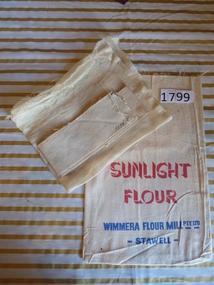
Memorabilia - Realia, Flour Sack from Wimmera Flour Mill, c1950's
... Flour Sack from Wimmera Flour Mill...Length of Cream Cotton Webbing Material Square of Woven Cream Material used for Sieving the Flour at Wimmera Flour Mills....Stawell Length of Cream Cotton Webbing Material Square of Woven Cream Material used for Sieving the Flour at Wimmera Flour Mills. Flour Sack from Wimmera Flour Mill Memorabilia Realia ...Length of Cream Cotton Webbing Material Square of Woven Cream Material used for Sieving the Flour at Wimmera Flour Mills.stawell -
 Stawell Historical Society Inc
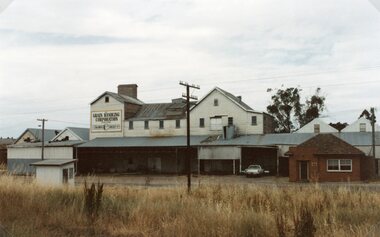
Photograph, Wimmera Flour Mill during Demolition -- Coloured
... Wimmera Flour Mill during Demolition -- Coloured...Various colour photos of Wimmera Flour Mill at time it was being demolished. Note roof being dismantled. ...139-6 a-d & e Coloured photographs showing various views of the Wimmera Flour Mill or Grain Handling Corporation building in progress of being demolished. ...Various colour photos of Wimmera Flour Mill at time it was being demolished. Note roof being dismantled. ...Various colour photos of Wimmera Flour Mill at time it was being demolished. Note roof being dismantled. Rail line in foreground. Willaim Frayne founded the Wimmera Flour Mill on a site in Taylor Street (beside the railway line) Stawell 1876. When Willian Frayne dies 1899 his son George took over the mill. The mill continued to be a propriety company until early 1966, when it was sold to the Victorian Mill Owners. The sale was forced because of the lack of export markets. A factor which affected most country mills. The Victorian Oat Growers Pool took over on July 1st, 1967. Trading under the name of Wimmera Flower Mill as a subsidiary company. Later years it sold clipped and graded seed, oats, stockfeed for poultry, pigs and dairy cattle and all types of crushed grain. The original Frayne homestead still stands behind where the Mill stood facing Frayne Street. In 2007 during our "Collection Review" the four smaller colour photos, which were donated by Mr. Mick Walsh, 52 Patrick St Stawell were very similar to the bigger photo in the file 139.6e.139-6 a-d & e Coloured photographs showing various views of the Wimmera Flour Mill or Grain Handling Corporation building in progress of being demolished. There is a red brick building with a tiled roof in these coloured photos. The rail line is shown in foreground of 139-6 e. Our records on the data base show 139-6e to be a black & white photo but the same photo in the office folder is an enlarged colour photograph. Grain Handing Corporation stawell industry -
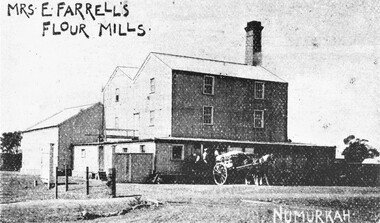 Numurkah & District Historical Society
Photograph - Photo of Farrell Flour Mill
... Photo of Farrell Flour Mill...Black & White Photo of E Farrell's flour mill in Numurkah, at front of mill is a horse and dray with men behind it ...Black & White Photo of E Farrell's flour mill in Numurkah, at front of mill is a horse and dray with men behind it Photograph Photo of Farrell Flour Mill ...Black & White Photo of E Farrell's flour mill in Numurkah, at front of mill is a horse and dray with men behind it -
Tarnagulla History Archive
Photograph - Flour Mill and Pierce's Store, Tarnagulla, late 19th C
... Flour Mill and Pierce's Store, Tarnagulla ...A small monochrome photograph depicting the former Flour Mill and Pierce's Store (on left of mill) in Tarnagulla. ...Copy photograph. Photograph Flour Mill and Pierce's Store, Tarnagulla ...A small monochrome photograph depicting the former Flour Mill and Pierce's Store (on left of mill) in Tarnagulla. Copy photograph. -
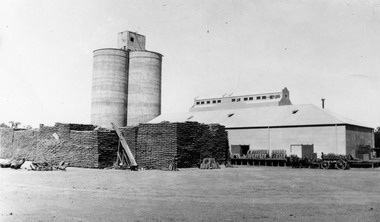 Charlton Golden Grains Museum Inc
Photograph, Noske Flour Mill with sacks of bagged wheat C.1938
... Noske Flour Mill with sacks of bagged wheat C.1938...Noske's Flour Mill...Noske's Flour Mill Noske Flour Mill with sacks of bagged wheat C.1938 Photograph ...noske's flour mill -
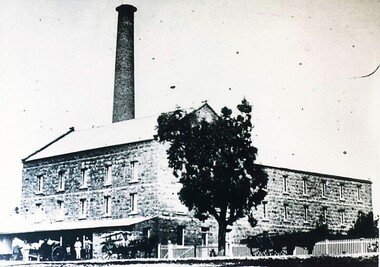 City of Ballarat Libraries
Photograph - Card Box Photographs, Hassell & Monkton's Flour Mill, Ballarat circa 1870
... Hassell & Monkton's Flour Mill, Ballarat circa 1870.......Flour Mill...Hassell & Monkton Flour Mill Building Work Manufacturing Hassell & Monkton's Flour Mill, Ballarat circa 1870. ...hassell & monkton, flour mill, building, work, manufacturing -
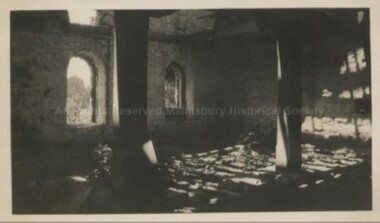 Malmsbury Historical Society
Photograph (Item), Interior View Of Ruins Of Ellis' Coliban Flour Mill, Malmsbury c1930s
... Interior View Of Ruins Of Ellis' Coliban Flour Mill, Malmsbury c1930s... People - Ellis Family Buildings - Coliban Flour Mill Associated with - Ellis' Coliban Flour Mill ...People - Ellis Family Buildings - Coliban Flour Mill Associated with - Ellis' Coliban Flour Mill Interior View Of Ruins Of Ellis' Coliban Flour Mill, Malmsbury c1930s Photograph Photograph ...People - Ellis Family Buildings - Coliban Flour Mill Associated with - Ellis' Coliban Flour Mill -
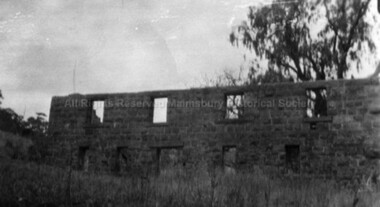 Malmsbury Historical Society
Photograph (Item), B/W Ruins Of Ellis' Coliban Flour Mill, Malmsbury c1934
... B/W Ruins Of Ellis' Coliban Flour Mill, Malmsbury c1934... People - Ellis Family Buildings - Coliban Flour Mill Associated with - Ellis' Coliban Flour Mill ...People - Ellis Family Buildings - Coliban Flour Mill Associated with - Ellis' Coliban Flour Mill B/W Ruins Of Ellis' Coliban Flour Mill, Malmsbury c1934 Photograph Photograph ...People - Ellis Family Buildings - Coliban Flour Mill Associated with - Ellis' Coliban Flour Mill
