
Showing 151 items matching "strikes and lockouts-nursing-victoria"
-
 Australian Nursing & Midwifery Federation
1986 recording of 3CR Community Radio 'Nurses' Update' broadcast featuring nurses discussing 1986 Victorian nurses strike, 1986 Nov 14
... ...strikes...Juliet Fox, 2016, pp. 97-98): "Less than a week after the first hospital went out on strike, 3CR's Monday morning program Smash and Grab ran a special program on the issues surrounding the strike. ...'Every morning, three or four nurses would cram into the 3CR studios and talk about the type of work they did, the pressures they worked under, their passion for nursing, their problems with the new award, why nurses' conditions are a women's issue, problems with understaffing and chronic tiredness, nursing history, relations between nurses and doctors - in fact the endless range of issues were what made the dispute so complex and history, reflects Deb [Welch]." 3cr community radio melbourne history labour history nurses royal australian nursing federation strikes industrial action trade unions 1986 victorian nurses strike nursing strike action unionism strikes and lockouts victoria feminism Audio file (.mp3 multimedia format), transferred from compact disc recording. 1986 recording of 3CR Community Radio 'Nurses' Update' broadcast featuring nurses discussing 1986 Victorian nurses strike 3CR Community Radio 3CR Community Radio ...Broadcast of short-lived 'Nurses' Update' program on 3CR Community Radio. Historical information taken from 'Radical radio: celebrating 40 years of 3CR' (Ed. Juliet Fox, 2016, pp. 97-98): "Less than a week after the first hospital went out on strike, 3CR's Monday morning program Smash and Grab ran a special program on the issues surrounding the strike. Presenters Vig Geddes and Deb Welch recognised the nature of the nurses' struggle - a predominantly female union with a women leader - as a feminist issue, and that in this particular dispute, 3CR's long standing commitment to industrial coverage and its increasingly strong feminism converged. The issues being faced by nurses were being dismissed because nursing was seen as women's work. The response to the initial coverage of the dispute by 3CR was overwhelming. 'When we asked for talkback calls from the public, the lines were jammed, largely with callers wanting to offer their support to the nurses,' explained Deb Welch in the CRAM Guide February 1987. 'Others couldn't work out from the papers and the TV news what the strike was about. Many were outraged by the coverage the nurses had received and were fully aware how overworked and underpaid nurses have been.' In recognition of this outpouring of interest and support, 3CR decided to continue with a daily program - Nurses' Update. The program was presented by Vig and Deb every morning at 10am, and featured a range of nurses voicing their experiences and their concerns. 'Every morning, three or four nurses would cram into the 3CR studios and talk about the type of work they did, the pressures they worked under, their passion for nursing, their problems with the new award, why nurses' conditions are a women's issue, problems with understaffing and chronic tiredness, nursing history, relations between nurses and doctors - in fact the endless range of issues were what made the dispute so complex and history, reflects Deb [Welch]."Audio file (.mp3 multimedia format), transferred from compact disc recording.3cr, community radio, melbourne, history, labour history, nurses, royal australian nursing federation, strikes, industrial action, trade unions, 1986 victorian nurses strike, nursing, strike action, unionism, strikes and lockouts, victoria, feminism -
Australian Nursing & Midwifery Federation
1986 recording of 3CR Community Radio 'Nurses' Update' broadcast featuring nurses discussing 1986 Victorian nurses strike, 1986 Nov 18
... ...strikes...Juliet Fox, 2016, pp. 97-98): "Less than a week after the first hospital went out on strike, 3CR's Monday morning program Smash and Grab ran a special program on the issues surrounding the strike. ...'Every morning, three or four nurses would cram into the 3CR studios and talk about the type of work they did, the pressures they worked under, their passion for nursing, their problems with the new award, why nurses' conditions are a women's issue, problems with understaffing and chronic tiredness, nursing history, relations between nurses and doctors - in fact the endless range of issues were what made the dispute so complex and history, reflects Deb [Welch]." 3cr community radio melbourne history labour history nurses royal australian nursing federation strikes industrial action trade unions 1986 victorian nurses strike nursing strike action unionism strikes and lockouts victoria feminism Audio file (.mp3 multimedia format), transferred from compact disc recording. 1986 recording of 3CR Community Radio 'Nurses' Update' broadcast featuring nurses discussing 1986 Victorian nurses strike 3CR Community Radio 3CR Community Radio ...Broadcast of short-lived 'Nurses' Update' program on 3CR Community Radio. Historical information taken from 'Radical radio: celebrating 40 years of 3CR' (Ed. Juliet Fox, 2016, pp. 97-98): "Less than a week after the first hospital went out on strike, 3CR's Monday morning program Smash and Grab ran a special program on the issues surrounding the strike. Presenters Vig Geddes and Deb Welch recognised the nature of the nurses' struggle - a predominantly female union with a women leader - as a feminist issue, and that in this particular dispute, 3CR's long standing commitment to industrial coverage and its increasingly strong feminism converged. The issues being faced by nurses were being dismissed because nursing was seen as women's work. The response to the initial coverage of the dispute by 3CR was overwhelming. 'When we asked for talkback calls from the public, the lines were jammed, largely with callers wanting to offer their support to the nurses,' explained Deb Welch in the CRAM Guide February 1987. 'Others couldn't work out from the papers and the TV news what the strike was about. Many were outraged by the coverage the nurses had received and were fully aware how overworked and underpaid nurses have been.' In recognition of this outpouring of interest and support, 3CR decided to continue with a daily program - Nurses' Update. The program was presented by Vig and Deb every morning at 10am, and featured a range of nurses voicing their experiences and their concerns. 'Every morning, three or four nurses would cram into the 3CR studios and talk about the type of work they did, the pressures they worked under, their passion for nursing, their problems with the new award, why nurses' conditions are a women's issue, problems with understaffing and chronic tiredness, nursing history, relations between nurses and doctors - in fact the endless range of issues were what made the dispute so complex and history, reflects Deb [Welch]."Audio file (.mp3 multimedia format), transferred from compact disc recording.3cr, community radio, melbourne, history, labour history, nurses, royal australian nursing federation, strikes, industrial action, trade unions, 1986 victorian nurses strike, nursing, strike action, unionism, strikes and lockouts, victoria, feminism -
Australian Nursing & Midwifery Federation
1986 recording of 3CR Community Radio 'Nurses' Update' broadcast featuring nurses discussing 1986 Victorian nurses strike, 1986 Nov 20
... ...strikes...Juliet Fox, 2016, pp. 97-98): "Less than a week after the first hospital went out on strike, 3CR's Monday morning program Smash and Grab ran a special program on the issues surrounding the strike. ...'Every morning, three or four nurses would cram into the 3CR studios and talk about the type of work they did, the pressures they worked under, their passion for nursing, their problems with the new award, why nurses' conditions are a women's issue, problems with understaffing and chronic tiredness, nursing history, relations between nurses and doctors - in fact the endless range of issues were what made the dispute so complex and history, reflects Deb [Welch]." 3cr community radio melbourne history labour history nurses royal australian nursing federation strikes industrial action trade unions 1986 victorian nurses strike nursing strike action unionism strikes and lockouts victoria feminism Audio file (.mp3 multimedia format), transferred from compact disc recording. 1986 recording of 3CR Community Radio 'Nurses' Update' broadcast featuring nurses discussing 1986 Victorian nurses strike 3CR Community Radio 3CR Community Radio ...Broadcast of short-lived 'Nurses' Update' program on 3CR Community Radio. Historical information taken from 'Radical radio: celebrating 40 years of 3CR' (Ed. Juliet Fox, 2016, pp. 97-98): "Less than a week after the first hospital went out on strike, 3CR's Monday morning program Smash and Grab ran a special program on the issues surrounding the strike. Presenters Vig Geddes and Deb Welch recognised the nature of the nurses' struggle - a predominantly female union with a women leader - as a feminist issue, and that in this particular dispute, 3CR's long standing commitment to industrial coverage and its increasingly strong feminism converged. The issues being faced by nurses were being dismissed because nursing was seen as women's work. The response to the initial coverage of the dispute by 3CR was overwhelming. 'When we asked for talkback calls from the public, the lines were jammed, largely with callers wanting to offer their support to the nurses,' explained Deb Welch in the CRAM Guide February 1987. 'Others couldn't work out from the papers and the TV news what the strike was about. Many were outraged by the coverage the nurses had received and were fully aware how overworked and underpaid nurses have been.' In recognition of this outpouring of interest and support, 3CR decided to continue with a daily program - Nurses' Update. The program was presented by Vig and Deb every morning at 10am, and featured a range of nurses voicing their experiences and their concerns. 'Every morning, three or four nurses would cram into the 3CR studios and talk about the type of work they did, the pressures they worked under, their passion for nursing, their problems with the new award, why nurses' conditions are a women's issue, problems with understaffing and chronic tiredness, nursing history, relations between nurses and doctors - in fact the endless range of issues were what made the dispute so complex and history, reflects Deb [Welch]."Audio file (.mp3 multimedia format), transferred from compact disc recording.3cr, community radio, melbourne, history, labour history, nurses, royal australian nursing federation, strikes, industrial action, trade unions, 1986 victorian nurses strike, nursing, strike action, unionism, strikes and lockouts, victoria, feminism -
Australian Nursing & Midwifery Federation
1986 recording of 3CR Community Radio 'Nurses' Update' broadcast featuring nurses discussing 1986 Victorian nurses strike, 1986 Nov 21
... ...strikes...Juliet Fox, 2016, pp. 97-98): "Less than a week after the first hospital went out on strike, 3CR's Monday morning program Smash and Grab ran a special program on the issues surrounding the strike. ...'Every morning, three or four nurses would cram into the 3CR studios and talk about the type of work they did, the pressures they worked under, their passion for nursing, their problems with the new award, why nurses' conditions are a women's issue, problems with understaffing and chronic tiredness, nursing history, relations between nurses and doctors - in fact the endless range of issues were what made the dispute so complex and history, reflects Deb [Welch]." 3cr community radio melbourne history labour history nurses royal australian nursing federation strikes industrial action trade unions 1986 victorian nurses strike nursing strike action unionism strikes and lockouts victoria feminism Audio file (.mp3 multimedia format), transferred from compact disc recording. 1986 recording of 3CR Community Radio 'Nurses' Update' broadcast featuring nurses discussing 1986 Victorian nurses strike 3CR Community Radio 3CR Community Radio ...Broadcast of short-lived 'Nurses' Update' program on 3CR Community Radio. Historical information taken from 'Radical radio: celebrating 40 years of 3CR' (Ed. Juliet Fox, 2016, pp. 97-98): "Less than a week after the first hospital went out on strike, 3CR's Monday morning program Smash and Grab ran a special program on the issues surrounding the strike. Presenters Vig Geddes and Deb Welch recognised the nature of the nurses' struggle - a predominantly female union with a women leader - as a feminist issue, and that in this particular dispute, 3CR's long standing commitment to industrial coverage and its increasingly strong feminism converged. The issues being faced by nurses were being dismissed because nursing was seen as women's work. The response to the initial coverage of the dispute by 3CR was overwhelming. 'When we asked for talkback calls from the public, the lines were jammed, largely with callers wanting to offer their support to the nurses,' explained Deb Welch in the CRAM Guide February 1987. 'Others couldn't work out from the papers and the TV news what the strike was about. Many were outraged by the coverage the nurses had received and were fully aware how overworked and underpaid nurses have been.' In recognition of this outpouring of interest and support, 3CR decided to continue with a daily program - Nurses' Update. The program was presented by Vig and Deb every morning at 10am, and featured a range of nurses voicing their experiences and their concerns. 'Every morning, three or four nurses would cram into the 3CR studios and talk about the type of work they did, the pressures they worked under, their passion for nursing, their problems with the new award, why nurses' conditions are a women's issue, problems with understaffing and chronic tiredness, nursing history, relations between nurses and doctors - in fact the endless range of issues were what made the dispute so complex and history, reflects Deb [Welch]."Audio file (.mp3 multimedia format), transferred from compact disc recording.3cr, community radio, melbourne, history, labour history, nurses, royal australian nursing federation, strikes, industrial action, trade unions, 1986 victorian nurses strike, nursing, strike action, unionism, strikes and lockouts, victoria, feminism -
Australian Nursing & Midwifery Federation
1986 recording of 3CR Community Radio 'Nurses' Update' broadcast featuring nurses discussing 1986 Victorian nurses strike, 1986 Nov 28
... ...strikes...Juliet Fox, 2016, pp. 97-98): "Less than a week after the first hospital went out on strike, 3CR's Monday morning program Smash and Grab ran a special program on the issues surrounding the strike. ...'Every morning, three or four nurses would cram into the 3CR studios and talk about the type of work they did, the pressures they worked under, their passion for nursing, their problems with the new award, why nurses' conditions are a women's issue, problems with understaffing and chronic tiredness, nursing history, relations between nurses and doctors - in fact the endless range of issues were what made the dispute so complex and history, reflects Deb [Welch]." 3cr community radio melbourne history labour history nurses royal australian nursing federation strikes industrial action trade unions 1986 victorian nurses strike nursing strike action unionism strikes and lockouts victoria feminism Audio file (.mp3 multimedia format), transferred from compact disc recording. 1986 recording of 3CR Community Radio 'Nurses' Update' broadcast featuring nurses discussing 1986 Victorian nurses strike 3CR Community Radio 3CR Community Radio ...Broadcast of short-lived 'Nurses' Update' program on 3CR Community Radio. Historical information taken from 'Radical radio: celebrating 40 years of 3CR' (Ed. Juliet Fox, 2016, pp. 97-98): "Less than a week after the first hospital went out on strike, 3CR's Monday morning program Smash and Grab ran a special program on the issues surrounding the strike. Presenters Vig Geddes and Deb Welch recognised the nature of the nurses' struggle - a predominantly female union with a women leader - as a feminist issue, and that in this particular dispute, 3CR's long standing commitment to industrial coverage and its increasingly strong feminism converged. The issues being faced by nurses were being dismissed because nursing was seen as women's work. The response to the initial coverage of the dispute by 3CR was overwhelming. 'When we asked for talkback calls from the public, the lines were jammed, largely with callers wanting to offer their support to the nurses,' explained Deb Welch in the CRAM Guide February 1987. 'Others couldn't work out from the papers and the TV news what the strike was about. Many were outraged by the coverage the nurses had received and were fully aware how overworked and underpaid nurses have been.' In recognition of this outpouring of interest and support, 3CR decided to continue with a daily program - Nurses' Update. The program was presented by Vig and Deb every morning at 10am, and featured a range of nurses voicing their experiences and their concerns. 'Every morning, three or four nurses would cram into the 3CR studios and talk about the type of work they did, the pressures they worked under, their passion for nursing, their problems with the new award, why nurses' conditions are a women's issue, problems with understaffing and chronic tiredness, nursing history, relations between nurses and doctors - in fact the endless range of issues were what made the dispute so complex and history, reflects Deb [Welch]."Audio file (.mp3 multimedia format), transferred from compact disc recording.3cr, community radio, melbourne, history, labour history, nurses, royal australian nursing federation, strikes, industrial action, trade unions, 1986 victorian nurses strike, nursing, strike action, unionism, strikes and lockouts, victoria, feminism -
Australian Nursing & Midwifery Federation
1986 recording of 3CR Community Radio 'Nurses' Update' broadcast featuring nurses discussing 1986 Victorian nurses strike, 1986 Dec 9
... ...strikes...Juliet Fox, 2016, pp. 97-98): "Less than a week after the first hospital went out on strike, 3CR's Monday morning program Smash and Grab ran a special program on the issues surrounding the strike. ...'Every morning, three or four nurses would cram into the 3CR studios and talk about the type of work they did, the pressures they worked under, their passion for nursing, their problems with the new award, why nurses' conditions are a women's issue, problems with understaffing and chronic tiredness, nursing history, relations between nurses and doctors - in fact the endless range of issues were what made the dispute so complex and history, reflects Deb [Welch]." 3cr community radio melbourne history labour history nurses royal australian nursing federation strikes industrial action trade unions 1986 victorian nurses strike nursing strike action unionism strikes and lockouts victoria feminism Audio file (.mp3 multimedia format), transferred from compact disc recording. 1986 recording of 3CR Community Radio 'Nurses' Update' broadcast featuring nurses discussing 1986 Victorian nurses strike 3CR Community Radio 3CR Community Radio ...Broadcast of short-lived 'Nurses' Update' program on 3CR Community Radio. Historical information taken from 'Radical radio: celebrating 40 years of 3CR' (Ed. Juliet Fox, 2016, pp. 97-98): "Less than a week after the first hospital went out on strike, 3CR's Monday morning program Smash and Grab ran a special program on the issues surrounding the strike. Presenters Vig Geddes and Deb Welch recognised the nature of the nurses' struggle - a predominantly female union with a women leader - as a feminist issue, and that in this particular dispute, 3CR's long standing commitment to industrial coverage and its increasingly strong feminism converged. The issues being faced by nurses were being dismissed because nursing was seen as women's work. The response to the initial coverage of the dispute by 3CR was overwhelming. 'When we asked for talkback calls from the public, the lines were jammed, largely with callers wanting to offer their support to the nurses,' explained Deb Welch in the CRAM Guide February 1987. 'Others couldn't work out from the papers and the TV news what the strike was about. Many were outraged by the coverage the nurses had received and were fully aware how overworked and underpaid nurses have been.' In recognition of this outpouring of interest and support, 3CR decided to continue with a daily program - Nurses' Update. The program was presented by Vig and Deb every morning at 10am, and featured a range of nurses voicing their experiences and their concerns. 'Every morning, three or four nurses would cram into the 3CR studios and talk about the type of work they did, the pressures they worked under, their passion for nursing, their problems with the new award, why nurses' conditions are a women's issue, problems with understaffing and chronic tiredness, nursing history, relations between nurses and doctors - in fact the endless range of issues were what made the dispute so complex and history, reflects Deb [Welch]."Audio file (.mp3 multimedia format), transferred from compact disc recording.3cr, community radio, melbourne, history, labour history, nurses, royal australian nursing federation, strikes, industrial action, trade unions, 1986 victorian nurses strike, nursing, strike action, unionism, strikes and lockouts, victoria, feminism -
Australian Nursing & Midwifery Federation
1986 recording of 3CR Community Radio 'Nurses' Update' broadcast featuring nurses discussing 1986 Victorian nurses strike, 1986 Dec 10
... ...strikes...Juliet Fox, 2016, pp. 97-98): "Less than a week after the first hospital went out on strike, 3CR's Monday morning program Smash and Grab ran a special program on the issues surrounding the strike. ...'Every morning, three or four nurses would cram into the 3CR studios and talk about the type of work they did, the pressures they worked under, their passion for nursing, their problems with the new award, why nurses' conditions are a women's issue, problems with understaffing and chronic tiredness, nursing history, relations between nurses and doctors - in fact the endless range of issues were what made the dispute so complex and history, reflects Deb [Welch]." 3cr community radio melbourne history labour history nurses royal australian nursing federation strikes industrial action trade unions 1986 victorian nurses strike nursing strike action unionism strikes and lockouts victoria feminism Audio file (.mp3 multimedia format), transferred from compact disc recording. 1986 recording of 3CR Community Radio 'Nurses' Update' broadcast featuring nurses discussing 1986 Victorian nurses strike 3CR Community Radio 3CR Community Radio ...Broadcast of short-lived 'Nurses' Update' program on 3CR Community Radio. Historical information taken from 'Radical radio: celebrating 40 years of 3CR' (Ed. Juliet Fox, 2016, pp. 97-98): "Less than a week after the first hospital went out on strike, 3CR's Monday morning program Smash and Grab ran a special program on the issues surrounding the strike. Presenters Vig Geddes and Deb Welch recognised the nature of the nurses' struggle - a predominantly female union with a women leader - as a feminist issue, and that in this particular dispute, 3CR's long standing commitment to industrial coverage and its increasingly strong feminism converged. The issues being faced by nurses were being dismissed because nursing was seen as women's work. The response to the initial coverage of the dispute by 3CR was overwhelming. 'When we asked for talkback calls from the public, the lines were jammed, largely with callers wanting to offer their support to the nurses,' explained Deb Welch in the CRAM Guide February 1987. 'Others couldn't work out from the papers and the TV news what the strike was about. Many were outraged by the coverage the nurses had received and were fully aware how overworked and underpaid nurses have been.' In recognition of this outpouring of interest and support, 3CR decided to continue with a daily program - Nurses' Update. The program was presented by Vig and Deb every morning at 10am, and featured a range of nurses voicing their experiences and their concerns. 'Every morning, three or four nurses would cram into the 3CR studios and talk about the type of work they did, the pressures they worked under, their passion for nursing, their problems with the new award, why nurses' conditions are a women's issue, problems with understaffing and chronic tiredness, nursing history, relations between nurses and doctors - in fact the endless range of issues were what made the dispute so complex and history, reflects Deb [Welch]."Audio file (.mp3 multimedia format), transferred from compact disc recording.3cr, community radio, melbourne, history, labour history, nurses, royal australian nursing federation, strikes, industrial action, trade unions, 1986 victorian nurses strike, nursing, strike action, unionism, strikes and lockouts, victoria, feminism -
Australian Nursing & Midwifery Federation
1986 recording of 3CR Community Radio 'Nurses' Update' broadcast featuring nurses discussing 1986 Victorian nurses strike, 1986 Dec 15
... ...strikes...Juliet Fox, 2016, pp. 97-98): "Less than a week after the first hospital went out on strike, 3CR's Monday morning program Smash and Grab ran a special program on the issues surrounding the strike. ...'Every morning, three or four nurses would cram into the 3CR studios and talk about the type of work they did, the pressures they worked under, their passion for nursing, their problems with the new award, why nurses' conditions are a women's issue, problems with understaffing and chronic tiredness, nursing history, relations between nurses and doctors - in fact the endless range of issues were what made the dispute so complex and history, reflects Deb [Welch]." 3cr community radio melbourne history labour history nurses royal australian nursing federation strikes industrial action trade unions 1986 victorian nurses strike nursing strike action unionism strikes and lockouts victoria feminism Audio file (.mp3 multimedia format), transferred from compact disc recording. 1986 recording of 3CR Community Radio 'Nurses' Update' broadcast featuring nurses discussing 1986 Victorian nurses strike 3CR Community Radio 3CR Community Radio ...Broadcast of short-lived 'Nurses' Update' program on 3CR Community Radio. Historical information taken from 'Radical radio: celebrating 40 years of 3CR' (Ed. Juliet Fox, 2016, pp. 97-98): "Less than a week after the first hospital went out on strike, 3CR's Monday morning program Smash and Grab ran a special program on the issues surrounding the strike. Presenters Vig Geddes and Deb Welch recognised the nature of the nurses' struggle - a predominantly female union with a women leader - as a feminist issue, and that in this particular dispute, 3CR's long standing commitment to industrial coverage and its increasingly strong feminism converged. The issues being faced by nurses were being dismissed because nursing was seen as women's work. The response to the initial coverage of the dispute by 3CR was overwhelming. 'When we asked for talkback calls from the public, the lines were jammed, largely with callers wanting to offer their support to the nurses,' explained Deb Welch in the CRAM Guide February 1987. 'Others couldn't work out from the papers and the TV news what the strike was about. Many were outraged by the coverage the nurses had received and were fully aware how overworked and underpaid nurses have been.' In recognition of this outpouring of interest and support, 3CR decided to continue with a daily program - Nurses' Update. The program was presented by Vig and Deb every morning at 10am, and featured a range of nurses voicing their experiences and their concerns. 'Every morning, three or four nurses would cram into the 3CR studios and talk about the type of work they did, the pressures they worked under, their passion for nursing, their problems with the new award, why nurses' conditions are a women's issue, problems with understaffing and chronic tiredness, nursing history, relations between nurses and doctors - in fact the endless range of issues were what made the dispute so complex and history, reflects Deb [Welch]."Audio file (.mp3 multimedia format), transferred from compact disc recording.3cr, community radio, melbourne, history, labour history, nurses, royal australian nursing federation, strikes, industrial action, trade unions, 1986 victorian nurses strike, nursing, strike action, unionism, strikes and lockouts, victoria, feminism -
Australian Nursing & Midwifery Federation
1986 recording of 3CR Community Radio 'Nurses' Update' broadcast featuring nurses discussing 1986 Victorian nurses strike, 1986 Dec 16
... ...strikes...Juliet Fox, 2016, pp. 97-98): "Less than a week after the first hospital went out on strike, 3CR's Monday morning program Smash and Grab ran a special program on the issues surrounding the strike. ...'Every morning, three or four nurses would cram into the 3CR studios and talk about the type of work they did, the pressures they worked under, their passion for nursing, their problems with the new award, why nurses' conditions are a women's issue, problems with understaffing and chronic tiredness, nursing history, relations between nurses and doctors - in fact the endless range of issues were what made the dispute so complex and history, reflects Deb [Welch]." 3cr community radio melbourne history labour history nurses royal australian nursing federation strikes industrial action trade unions 1986 victorian nurses strike nursing strike action unionism strikes and lockouts victoria feminism Audio file (.mp3 multimedia format), transferred from compact disc recording. 1986 recording of 3CR Community Radio 'Nurses' Update' broadcast featuring nurses discussing 1986 Victorian nurses strike 3CR Community Radio 3CR Community Radio ...Broadcast of short-lived 'Nurses' Update' program on 3CR Community Radio. Historical information taken from 'Radical radio: celebrating 40 years of 3CR' (Ed. Juliet Fox, 2016, pp. 97-98): "Less than a week after the first hospital went out on strike, 3CR's Monday morning program Smash and Grab ran a special program on the issues surrounding the strike. Presenters Vig Geddes and Deb Welch recognised the nature of the nurses' struggle - a predominantly female union with a women leader - as a feminist issue, and that in this particular dispute, 3CR's long standing commitment to industrial coverage and its increasingly strong feminism converged. The issues being faced by nurses were being dismissed because nursing was seen as women's work. The response to the initial coverage of the dispute by 3CR was overwhelming. 'When we asked for talkback calls from the public, the lines were jammed, largely with callers wanting to offer their support to the nurses,' explained Deb Welch in the CRAM Guide February 1987. 'Others couldn't work out from the papers and the TV news what the strike was about. Many were outraged by the coverage the nurses had received and were fully aware how overworked and underpaid nurses have been.' In recognition of this outpouring of interest and support, 3CR decided to continue with a daily program - Nurses' Update. The program was presented by Vig and Deb every morning at 10am, and featured a range of nurses voicing their experiences and their concerns. 'Every morning, three or four nurses would cram into the 3CR studios and talk about the type of work they did, the pressures they worked under, their passion for nursing, their problems with the new award, why nurses' conditions are a women's issue, problems with understaffing and chronic tiredness, nursing history, relations between nurses and doctors - in fact the endless range of issues were what made the dispute so complex and history, reflects Deb [Welch]."Audio file (.mp3 multimedia format), transferred from compact disc recording.3cr, community radio, melbourne, history, labour history, nurses, royal australian nursing federation, strikes, industrial action, trade unions, 1986 victorian nurses strike, nursing, strike action, unionism, strikes and lockouts, victoria, feminism -
Australian Nursing & Midwifery Federation
1986 recording of 3CR Community Radio 'Nurses' Update' broadcast featuring nurses discussing 1986 Victorian nurses strike, 1986 Dec 17
... ...strikes...Juliet Fox, 2016, pp. 97-98): "Less than a week after the first hospital went out on strike, 3CR's Monday morning program Smash and Grab ran a special program on the issues surrounding the strike. ...'Every morning, three or four nurses would cram into the 3CR studios and talk about the type of work they did, the pressures they worked under, their passion for nursing, their problems with the new award, why nurses' conditions are a women's issue, problems with understaffing and chronic tiredness, nursing history, relations between nurses and doctors - in fact the endless range of issues were what made the dispute so complex and history, reflects Deb [Welch]." 3cr community radio melbourne history labour history nurses royal australian nursing federation strikes industrial action trade unions 1986 victorian nurses strike nursing strike action unionism strikes and lockouts victoria feminism Audio file (.mp3 multimedia format), transferred from compact disc recording. 1986 recording of 3CR Community Radio 'Nurses' Update' broadcast featuring nurses discussing 1986 Victorian nurses strike 3CR Community Radio 3CR Community Radio ...Broadcast of short-lived 'Nurses' Update' program on 3CR Community Radio. Historical information taken from 'Radical radio: celebrating 40 years of 3CR' (Ed. Juliet Fox, 2016, pp. 97-98): "Less than a week after the first hospital went out on strike, 3CR's Monday morning program Smash and Grab ran a special program on the issues surrounding the strike. Presenters Vig Geddes and Deb Welch recognised the nature of the nurses' struggle - a predominantly female union with a women leader - as a feminist issue, and that in this particular dispute, 3CR's long standing commitment to industrial coverage and its increasingly strong feminism converged. The issues being faced by nurses were being dismissed because nursing was seen as women's work. The response to the initial coverage of the dispute by 3CR was overwhelming. 'When we asked for talkback calls from the public, the lines were jammed, largely with callers wanting to offer their support to the nurses,' explained Deb Welch in the CRAM Guide February 1987. 'Others couldn't work out from the papers and the TV news what the strike was about. Many were outraged by the coverage the nurses had received and were fully aware how overworked and underpaid nurses have been.' In recognition of this outpouring of interest and support, 3CR decided to continue with a daily program - Nurses' Update. The program was presented by Vig and Deb every morning at 10am, and featured a range of nurses voicing their experiences and their concerns. 'Every morning, three or four nurses would cram into the 3CR studios and talk about the type of work they did, the pressures they worked under, their passion for nursing, their problems with the new award, why nurses' conditions are a women's issue, problems with understaffing and chronic tiredness, nursing history, relations between nurses and doctors - in fact the endless range of issues were what made the dispute so complex and history, reflects Deb [Welch]."Audio file (.mp3 multimedia format), transferred from compact disc recording.3cr, community radio, melbourne, history, labour history, nurses, royal australian nursing federation, strikes, industrial action, trade unions, 1986 victorian nurses strike, nursing, strike action, unionism, strikes and lockouts, victoria, feminism -
Australian Nursing & Midwifery Federation
1986 recording of 3CR Community Radio 'Nurses' Update' broadcast featuring nurses discussing 1986 Victorian nurses strike, 1986 Dec 18
... ...strikes...Juliet Fox, 2016, pp. 97-98): "Less than a week after the first hospital went out on strike, 3CR's Monday morning program Smash and Grab ran a special program on the issues surrounding the strike. ...'Every morning, three or four nurses would cram into the 3CR studios and talk about the type of work they did, the pressures they worked under, their passion for nursing, their problems with the new award, why nurses' conditions are a women's issue, problems with understaffing and chronic tiredness, nursing history, relations between nurses and doctors - in fact the endless range of issues were what made the dispute so complex and history, reflects Deb [Welch]." 3cr community radio melbourne history labour history nurses royal australian nursing federation strikes industrial action trade unions 1986 victorian nurses strike nursing strike action unionism strikes and lockouts victoria feminism Audio file (.mp3 multimedia format), transferred from compact disc recording. 1986 recording of 3CR Community Radio 'Nurses' Update' broadcast featuring nurses discussing 1986 Victorian nurses strike 3CR Community Radio 3CR Community Radio ...Broadcast of short-lived 'Nurses' Update' program on 3CR Community Radio. Historical information taken from 'Radical radio: celebrating 40 years of 3CR' (Ed. Juliet Fox, 2016, pp. 97-98): "Less than a week after the first hospital went out on strike, 3CR's Monday morning program Smash and Grab ran a special program on the issues surrounding the strike. Presenters Vig Geddes and Deb Welch recognised the nature of the nurses' struggle - a predominantly female union with a women leader - as a feminist issue, and that in this particular dispute, 3CR's long standing commitment to industrial coverage and its increasingly strong feminism converged. The issues being faced by nurses were being dismissed because nursing was seen as women's work. The response to the initial coverage of the dispute by 3CR was overwhelming. 'When we asked for talkback calls from the public, the lines were jammed, largely with callers wanting to offer their support to the nurses,' explained Deb Welch in the CRAM Guide February 1987. 'Others couldn't work out from the papers and the TV news what the strike was about. Many were outraged by the coverage the nurses had received and were fully aware how overworked and underpaid nurses have been.' In recognition of this outpouring of interest and support, 3CR decided to continue with a daily program - Nurses' Update. The program was presented by Vig and Deb every morning at 10am, and featured a range of nurses voicing their experiences and their concerns. 'Every morning, three or four nurses would cram into the 3CR studios and talk about the type of work they did, the pressures they worked under, their passion for nursing, their problems with the new award, why nurses' conditions are a women's issue, problems with understaffing and chronic tiredness, nursing history, relations between nurses and doctors - in fact the endless range of issues were what made the dispute so complex and history, reflects Deb [Welch]."Audio file (.mp3 multimedia format), transferred from compact disc recording.3cr, community radio, melbourne, history, labour history, nurses, royal australian nursing federation, strikes, industrial action, trade unions, 1986 victorian nurses strike, nursing, strike action, unionism, strikes and lockouts, victoria, feminism -
Australian Nursing & Midwifery Federation
1986 recording of 3CR Community Radio 'Nurses' Update' broadcast featuring nurses discussing 1986 Victorian nurses strike, 1986 Dec 17-18
... ...strikes...Juliet Fox, 2016, pp. 97-98): "Less than a week after the first hospital went out on strike, 3CR's Monday morning program Smash and Grab ran a special program on the issues surrounding the strike. ...'Every morning, three or four nurses would cram into the 3CR studios and talk about the type of work they did, the pressures they worked under, their passion for nursing, their problems with the new award, why nurses' conditions are a women's issue, problems with understaffing and chronic tiredness, nursing history, relations between nurses and doctors - in fact the endless range of issues were what made the dispute so complex and history, reflects Deb [Welch]." 3cr community radio melbourne history labour history nurses royal australian nursing federation strikes industrial action trade unions 1986 victorian nurses strike nursing strike action unionism strikes and lockouts victoria feminism Audio file (.mp3 multimedia format), transferred from compact disc recording. 1986 recording of 3CR Community Radio 'Nurses' Update' broadcast featuring nurses discussing 1986 Victorian nurses strike 3CR Community Radio 3CR Community Radio ...Broadcast of short-lived 'Nurses' Update' program on 3CR Community Radio. Historical information taken from 'Radical radio: celebrating 40 years of 3CR' (Ed. Juliet Fox, 2016, pp. 97-98): "Less than a week after the first hospital went out on strike, 3CR's Monday morning program Smash and Grab ran a special program on the issues surrounding the strike. Presenters Vig Geddes and Deb Welch recognised the nature of the nurses' struggle - a predominantly female union with a women leader - as a feminist issue, and that in this particular dispute, 3CR's long standing commitment to industrial coverage and its increasingly strong feminism converged. The issues being faced by nurses were being dismissed because nursing was seen as women's work. The response to the initial coverage of the dispute by 3CR was overwhelming. 'When we asked for talkback calls from the public, the lines were jammed, largely with callers wanting to offer their support to the nurses,' explained Deb Welch in the CRAM Guide February 1987. 'Others couldn't work out from the papers and the TV news what the strike was about. Many were outraged by the coverage the nurses had received and were fully aware how overworked and underpaid nurses have been.' In recognition of this outpouring of interest and support, 3CR decided to continue with a daily program - Nurses' Update. The program was presented by Vig and Deb every morning at 10am, and featured a range of nurses voicing their experiences and their concerns. 'Every morning, three or four nurses would cram into the 3CR studios and talk about the type of work they did, the pressures they worked under, their passion for nursing, their problems with the new award, why nurses' conditions are a women's issue, problems with understaffing and chronic tiredness, nursing history, relations between nurses and doctors - in fact the endless range of issues were what made the dispute so complex and history, reflects Deb [Welch]."Audio file (.mp3 multimedia format), transferred from compact disc recording.3cr, community radio, melbourne, history, labour history, nurses, royal australian nursing federation, strikes, industrial action, trade unions, 1986 victorian nurses strike, nursing, strike action, unionism, strikes and lockouts, victoria, feminism -
Australian Nursing & Midwifery Federation
1987 recording of 3CR Community Radio 'Nurses' Update' broadcast featuring nurses discussing 1986 Victorian nurses strike, 1987 Jan 27
... ...strikes...Juliet Fox, 2016, pp. 97-98): "Less than a week after the first hospital went out on strike, 3CR's Monday morning program Smash and Grab ran a special program on the issues surrounding the strike. ...'Every morning, three or four nurses would cram into the 3CR studios and talk about the type of work they did, the pressures they worked under, their passion for nursing, their problems with the new award, why nurses' conditions are a women's issue, problems with understaffing and chronic tiredness, nursing history, relations between nurses and doctors - in fact the endless range of issues were what made the dispute so complex and history, reflects Deb [Welch]." 3cr community radio melbourne history labour history nurses royal australian nursing federation strikes industrial action trade unions 1986 victorian nurses strike nursing strike action unionism strikes and lockouts victoria feminism Audio file (.mp3 multimedia format), transferred from compact disc recording. 1987 recording of 3CR Community Radio 'Nurses' Update' broadcast featuring nurses discussing 1986 Victorian nurses strike 3CR Community Radio 3CR Community Radio ...Broadcast of short-lived 'Nurses' Update' program on 3CR Community Radio, featuring audio recording of a members mass meeting at the Melbourne Sports and Entertainment Centre. Historical information on program taken from 'Radical radio: celebrating 40 years of 3CR' (Ed. Juliet Fox, 2016, pp. 97-98): "Less than a week after the first hospital went out on strike, 3CR's Monday morning program Smash and Grab ran a special program on the issues surrounding the strike. Presenters Vig Geddes and Deb Welch recognised the nature of the nurses' struggle - a predominantly female union with a women leader - as a feminist issue, and that in this particular dispute, 3CR's long standing commitment to industrial coverage and its increasingly strong feminism converged. The issues being faced by nurses were being dismissed because nursing was seen as women's work. The response to the initial coverage of the dispute by 3CR was overwhelming. 'When we asked for talkback calls from the public, the lines were jammed, largely with callers wanting to offer their support to the nurses,' explained Deb Welch in the CRAM Guide February 1987. 'Others couldn't work out from the papers and the TV news what the strike was about. Many were outraged by the coverage the nurses had received and were fully aware how overworked and underpaid nurses have been.' In recognition of this outpouring of interest and support, 3CR decided to continue with a daily program - Nurses' Update. The program was presented by Vig and Deb every morning at 10am, and featured a range of nurses voicing their experiences and their concerns. 'Every morning, three or four nurses would cram into the 3CR studios and talk about the type of work they did, the pressures they worked under, their passion for nursing, their problems with the new award, why nurses' conditions are a women's issue, problems with understaffing and chronic tiredness, nursing history, relations between nurses and doctors - in fact the endless range of issues were what made the dispute so complex and history, reflects Deb [Welch]."Audio file (.mp3 multimedia format), transferred from compact disc recording.3cr, community radio, melbourne, history, labour history, nurses, royal australian nursing federation, strikes, industrial action, trade unions, 1986 victorian nurses strike, nursing, strike action, unionism, strikes and lockouts, victoria, feminism -
Unions Ballarat
Reports of committees set up to investigate securing direct Labor representation in Parliament in 1882 (?). Progressive Political League of Victoria, Ballarat West Branch, 1891
... The Progressive Political League was formed in 1891 after the 1890 Maritime Workers Strike; it subsequently became the Australian Labor Party. ...Progressive Political League of Victoria, Ballarat West Branch. ...The Progressive Political League was formed in 1891 after the 1890 Maritime Workers Strike; it subsequently became the Australian Labor Party. The PPL is also contemporaneous with the defeat of the Shearer's Strike (1891). Its platform included "electoral reform, reform of the labour laws, social reform and supported Federation on a ‘democratic basis’." (Anarchist Age 2008). More information about the formation of the Progressive Political League in Victoria can be found at http://anarchistmedia.org/pdf/701-800/AAWR-07768.html More information about the history of the PPL and its political fortunes can be found in Paul Strangio's book, "Neither Power Nor Glory". PPL enjoyed some political success in Victoria around this time, but it was unsustainable due to the loose political allegiances of some of the candidates. (Strangio 2012). Committee reports are part of the history of the PPL and the ALP's early attempts to gain parliamentary representation. Reports held are from the Ballarat West Branch.Paper in folder.ballarat trades hall, ballarat trades and labour council, alp, ppl, progressive political league of victoria, elections, labor, australian labor party, parliament, btlc -
Unions Ballarat
Balance sheet for the Ballarat West Election. Progressive Political League of Victoria, Ballarat West Branch, 20 April 1892
... The Progressive Political League was formed in 1891 after the 1890 Maritime Workers Strike; it subsequently became the Australian Labor Party. ...BTLC Ballarat Trades Hall ballarat trades and labour council Balance sheets Finances Elections Progressive Political League of Victoria PPL Maritime Workers Strike Shearer's Strike ALP Australian Labor Party Reform Federation Paper Balance sheet for the Ballarat West Election. ...The Progressive Political League was formed in 1891 after the 1890 Maritime Workers Strike; it subsequently became the Australian Labor Party. The PPL is also contemporaneous with the defeat of the Shearer's Strike (1891). Its platform included "electoral reform, reform of the labour laws, social reform and supported Federation on a ‘democratic basis’." (Anarchist Age 2008). More information about the formation of the Progressive Political League in Victoria can be found at http://anarchistmedia.org/pdf/701-800/AAWR-07768.html More information about the history of the PPL and its political fortunes can be found in Paul Strangio's book, "Neither Power Nor Glory". PPL enjoyed some political success in Victoria around this time, but it was unsustainable due to the loose political allegiances of some of the candidates. (Strangio 2012). The balance sheets are a financial record of activity around the Ballarat West Election.Paperbtlc, ballarat trades hall, ballarat trades and labour council, balance sheets, finances, elections, progressive political league of victoria, ppl, maritime workers strike, shearer's strike, alp, australian labor party, reform, federation -
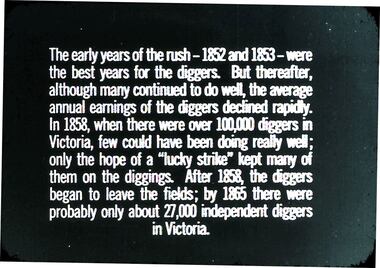 Bendigo Historical Society Inc.
Slide - DIGGERS & MINING. THE DIGGINGS THE DIGGERS, c1852
... In 1858, when there were over 100,000 diggers in Victoria, few could have been doing really well ; only the hope of a ''lucky strike'' kept many of them on the diggings. ...In 1858, when there were over 100,000 diggers in Victoria, few could have been doing really well ; only the hope of a ''lucky strike'' kept many of them on the diggings. ...Diggers & Mining. The Diggings The Diggers. Slide: The early years of the rush-1852 and 1853-were the best years for the diggers. But thereafter, although many continued to do well, the average annual earnings of the diggers declined rapidly. In 1858, when there were over 100,000 diggers in Victoria, few could have been doing really well ; only the hope of a ''lucky strike'' kept many of them on the diggings. After 1858, the diggers began to leave the field; by 1865 there were probably only about 27,000 independent diggers in Victoria. Markings: 81 994.LIF:4. Used as a teaching aid.hanimount -
Melbourne Tram Museum
Film - DVD - Film - Reel 39, Lindsay Walker, "Tram Collection", 1985 to 1988
... Set of two DVD's with digitized film: Each Reel has its own listing of sequences; Reel 39 - Flinders St, Kew, Domain Road, Bourke St, Kew depot, South Melbourne depot, tours, maintenance strike, Malvern Depot, Victoria Parade, Thornbury, South Melbourne, Ballarat, Moomba 1988....Set of two DVD's with digitized film: Each Reel has its own listing of sequences; Reel 39 - Flinders St, Kew, Domain Road, Bourke St, Kew depot, South Melbourne depot, tours, maintenance strike, Malvern Depot, Victoria Parade, Thornbury, South Melbourne, Ballarat, Moomba 1988. ...Set of two DVD's with digitized film: Each Reel has its own listing of sequences; Reel 39 - Flinders St, Kew, Domain Road, Bourke St, Kew depot, South Melbourne depot, tours, maintenance strike, Malvern Depot, Victoria Parade, Thornbury, South Melbourne, Ballarat, Moomba 1988.Yields information about the operation of Melbourne trams in film and has a close association with the donor.Set of two DVD's in plastic cases, marked.In marker pen: 12/2 - "Lindsay Walker, Tram Collection, Movie Reels 28, 29, 39 and super 8melbourne, tramways, films, tours, victoria parade, kew, domain road, depots, thornbury, ballarat, moomba -
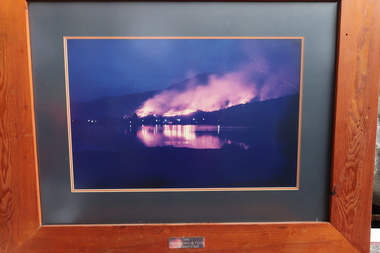 Kiewa Valley Historical Society
Photos: 2003 Fires at Bogong and Scientific Research at Bogong
... The 2003 bushfires caused by a lightning strikes on 8th January 2003. 87 fires were ignited 8 of which would join to form the largest fire in Victoria since the 1939 Black Friday bushfires, burning through 60% of the Alpine National Park. ...The 2003 bushfires caused by a lightning strikes on 8th January 2003. 87 fires were ignited 8 of which would join to form the largest fire in Victoria since the 1939 Black Friday bushfires, burning through 60% of the Alpine National Park. ...The 2003 bushfires caused by a lightning strikes on 8th January 2003. 87 fires were ignited 8 of which would join to form the largest fire in Victoria since the 1939 Black Friday bushfires, burning through 60% of the Alpine National Park. Ref. The Mountain Journal. Scientific research was used to test new methods during construction.These fires were close to Bogong village and Mt Beauty. The photos were displayed in the Mountain Monk Hotel, Mt Beauty which was the original SEC Working Mens Club during the construction of the Kiewa Hydro Electric Scheme. Scientific research was used to create new improved methods during construction. Framed photos (1-3) of the 2003 bushfires at Bogong village and Photos (4-11) with titles involving scientific work by the SECV. 1-3 2003 Bogong Complex Fires at Moncrieffs Gap 4. Phasmid Eggs 5. Insect cages 6. Spraying Bitumen 7. Grass grown after spray 8. "Finn" method 9. Erosion raceline bank 10. "Finn" treatment 11. Machine spraying grass seed2003 bushfires, moncrieffs gap -
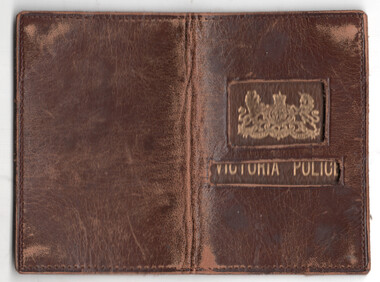 Ballarat Tramway Museum
Ephemera - Victoria Police - ID - issue for tram travel, Victoria Police, 1923
... Victoria Police ID for Constable R D Finch, No. 6779 to enable tram travel for payment of a 1 1/2d fare for each single journey. ...Demonstrates the method that police not wearing a uniform could travel at a lower fare on Melbourne trams and yields information about the Constable who services were terminated for taking part in the 1923 Police Strike. tramways trams police mmtb fares Leather folder with cut outs for the Victorian crown logo and the name Victoria Police. ...Victoria Police ID for Constable R D Finch, No. 6779 to enable tram travel for payment of a 1 1/2d fare for each single journey. Dated 3/10/1923. An extract of the Police Record shows that Constable Finch took part in the 1923 Police strike (see reference) and his employment was terminated. See record of service.Demonstrates the method that police not wearing a uniform could travel at a lower fare on Melbourne trams and yields information about the Constable who services were terminated for taking part in the 1923 Police Strike.Leather folder with cut outs for the Victorian crown logo and the name Victoria Police. On the inside has a certificate of Identity printed on a sheet of card with a rexine finish slipped into the folder.tramways, trams, police, mmtb, fares -
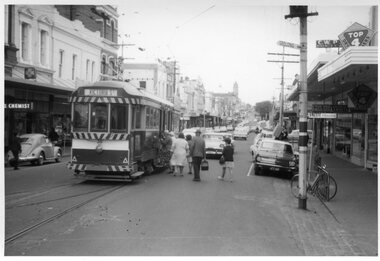 Ballarat Tramway Museum
Photograph - Black and White - tram 36 Bridge St, A T Miles, 27/11/1969
... Black and White - tram 36 (Victoria St), at Stones Corner, picking up 6 passengers. ...Black and White - tram 36 (Victoria St), at Stones Corner, picking up 6 passengers. ...Black and White - tram 36 (Victoria St), at Stones Corner, picking up 6 passengers. The man is carrying a Gladstone bag. The photo is looking west and has a Top 4 dry cleaners shop sign in the background. Taken by A T Miles 27/11/1969. The photo likely to have been taken before a 48-hour strike by SEC workers that commenced on that day. See item 8774. Yields information about services to Victoria St.Photograph - black and white print with notes on rear. A T Miles stamp and location and date notes.tramways, trams, stones corner, victoria st, bridge st, passengers -
 Musculoskeletal Health Australia (now held by the Glen Eira Historical Society)
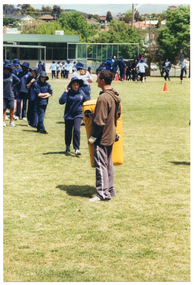
Photograph - Group photo, 2003
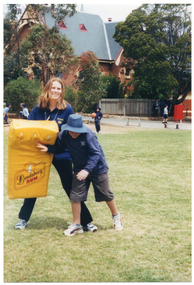
... In 2003, Arthritis Victoria (AV) held an outreach event at a school in Stawell as part of its Rural And Regional Education (RARE) Program. ...This photo depicts a student tackling an adult instructor who is holding a hit/strike/tackle shield. There are other students in the distance. arthritis foundation of victoria afv osteoporosis victoria ov arthritis victoria av rural and regional education rare outreach exercise hit shield strike shield tackle shield bone strength bone health joint health school visit school program 2003 Colour photo of a school student tackling an adult instructor, who is holding a yellow padded shield. ...In 2003, Arthritis Victoria (AV) held an outreach event at a school in Stawell as part of its Rural And Regional Education (RARE) Program. Students were taken through a range of exercises on a sporting field or through a martial arts class indoors. They also attended an education session conducted by AV staff. This photo depicts a student tackling an adult instructor who is holding a hit/strike/tackle shield. There are other students in the distance.Colour photo of a school student tackling an adult instructor, who is holding a yellow padded shield. There are several other students in the background.arthritis foundation of victoria, afv, osteoporosis victoria, ov, arthritis victoria, av, rural and regional education, rare, outreach, exercise, hit shield, strike shield, tackle shield, bone strength, bone health, joint health, school visit, school program, 2003 -
 Ballarat Tramway Museum
Certificate - Framed Certificate, Museums Australia, "Museum Industry Award of Merit", May. 2006
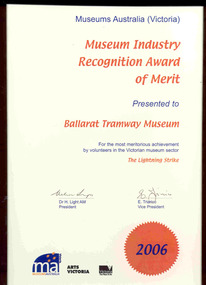
... Sub titled "The Lightning Strike". Award presented by Museums Australia, Vic Div. ...Sub titled "The Lightning Strike". Award presented by Museums Australia, Vic Div. ...Significant for the BTM in winning a Museum Industry Recognition Award, by Museums Australia for its achievements in replacing the sub-station and fundraising. The Certificate of the award.Framed Certificate, black frame, glass front, fibre board back and swing out stand with metal clips, titled "Museum Industry Award of Merit", awarded to the BTM as part of the 2006 MIRA Awards on 25-5-2006. Sub titled "The Lightning Strike". Award presented by Museums Australia, Vic Div. Has logos for Museums Australia, Arts Victoria, Vic. Govt. Logo. Signed by Dr. Helen Light as President and Elizabeth Triarico as Vice President. Refer to June 2006 issue of Fares Please! for ceremony photographs.trams, tramways, btm, substation, awards, museums australia -
 Musculoskeletal Health Australia (now held by the Glen Eira Historical Society)
Photograph - Group photo, 2003
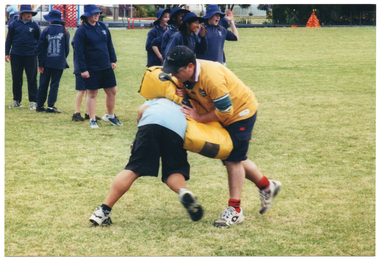
... In 2003, Arthritis Victoria (AV) held an outreach event at a school in Stawell as part of its Rural And Regional Education (RARE) Program. ...A group of other students are standing nearby. arthritis foundation of victoria afv osteoporosis victoria ov arthritis victoria av rural and regional education rare outreach exercise hit shield strike shield tackle shield bone strength bone health joint health school visit school program 2003 Colour photo of a school student tackling an adult instructor, who is holding a yellow padded shield. ...In 2003, Arthritis Victoria (AV) held an outreach event at a school in Stawell as part of its Rural And Regional Education (RARE) Program. Students were taken through a range of exercises on a sporting field or through a martial arts class indoors. They also attended an education session conducted by AV staff. This photo depicts a student who has just lunged into a hit/strike/tackle shield being held by a teacher/instructor. A group of other students are standing nearby.Colour photo of a school student tackling an adult instructor, who is holding a yellow padded shield. The student has lunged into the padded shield, and is now bent forward with the shield across their back.arthritis foundation of victoria, afv, osteoporosis victoria, ov, arthritis victoria, av, rural and regional education, rare, outreach, exercise, hit shield, strike shield, tackle shield, bone strength, bone health, joint health, school visit, school program, 2003 -
 Department of Energy, Environment and Climate Action
Lightning Detector
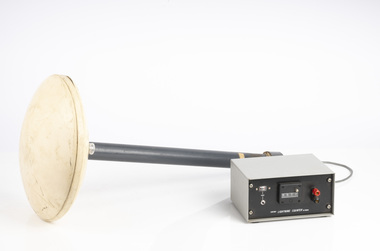
... It's not sure how this particular unit found its way to Victoria. The Bureau of Meteorology's (BOM) current lightning detector network uses radio waves emitted by lightning to pinpoint the location of lightning strikes. ...It's not sure how this particular unit found its way to Victoria. The Bureau of Meteorology's (BOM) current lightning detector network uses radio waves emitted by lightning to pinpoint the location of lightning strikes. ...Lightning is one of the major causes of bushfires, particularly in the remote mountains. This lightning detector system was developed by Dr. Peter Kourtz at Canada’s forest fire research institute. By 1977, some 300 were in use across the country. The small mushroom antenna could detect short-range (20-mile) changes in electrostatic field associated with lightning strikes. It needed to be placed out in the open on a hilltop and away from nearby trees. It simply counted the number of "strikes". The detector doesn't seem to have a direction finding capability or be able to distinguish between cloud-to-cloud or cloud-to-ground lightning. It's not sure how this particular unit found its way to Victoria. The Bureau of Meteorology's (BOM) current lightning detector network uses radio waves emitted by lightning to pinpoint the location of lightning strikes. The network is operated by a private company that sends data to the BOM in real time. Lightning detection systems use sensors like antennas, GPS receivers, and processing systems to detect radio waves, also known as sferics. The systems calculate the lightning's location and speed by measuring how long it takes for the radio signal to reach the different antenna stations. The BOM also has a Thunderstorm Tracker that uses weather radar data to identify areas of potential thunderstorm activity. The tracker updates every six minutes and shows the direction thunderstorms are moving, as well as their expected position in 10, 20, and 30 minutesLightning detector 1970sQ-Techforests commission victoria (fcv), weather, bushfire, bushfire aviation -
 Alfred Hospital Nurses League - Nursing History Collection
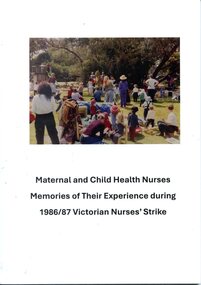
Booklet - Illustrated Booklet, Ruth Fincher, Maternal and Child Health Nurses memories of their experience during the 1986/1987 Victorian Nurses' Strike, 2025
... In the last three months of 1986 nurses in Victoria who were members of the Royal Australian Nurses Federation (RANF), Victorian Branch. ...This document was based on a meeting held in 2004, where 10 former MCH nurses shared their memories of the strike Insight into a significat time in the history of nursing in Victoria Industrial Action Victoria 1986 Victorian Nurses Strike Industrial Action Nurses Maternal and Child health Nurses Infant Welfare Sisters This document was based on a meeting held in 2004, where 10 former Matenal and Child Health (MCH) Nurses shared their experiences of the 1986 Victorian nurses strike Illustrared document with white cover and black print. ...This document was based on a meeting held in 2004, where 10 former Matenal and Child Health (MCH) Nurses shared their experiences of the 1986 Victorian nurses strikeIllustrared document with white cover and black print. On the front cover is a coloured photograph of children and parents at Frankston Maternal & Child Health Childrens Week 'picnic in the park' ar George Pentland Gardens, 1991non-fictionThis document was based on a meeting held in 2004, where 10 former Matenal and Child Health (MCH) Nurses shared their experiences of the 1986 Victorian nurses strikeindustrial action victoria, 1986 victorian nurses strike, industrial action nurses, maternal and child health nurses, infant welfare sisters -
 Musculoskeletal Health Australia (now held by the Glen Eira Historical Society)
Photograph - Group photo, 2003
... In 2003, Arthritis Victoria (AV) held an outreach event at a school in Stawell as part of its Rural And Regional Education (RARE) Program. ...This photo depicts one group of students queueing up while an adult instructor or teacher holds up a large padded rectangular bag (called a hit/strike shield, or a tackle shield in rugby). arthritis foundation of victoria afv osteoporosis victoria ov arthritis victoria av rural and regional education rare outreach exercise hit shield strike shield tackle shield bone strength bone health joint health school visit school program 2003 Colour photo of a group of students being taken through some exercises by an adult instructor using a yellow padded shield. ...In 2003, Arthritis Victoria (AV) held an outreach event at a school in Stawell as part of its Rural And Regional Education (RARE) Program. Students were taken through a range of exercises on a sporting field or through a martial arts class indoors. They also attended an education session conducted by AV staff. This photo depicts one group of students queueing up while an adult instructor or teacher holds up a large padded rectangular bag (called a hit/strike shield, or a tackle shield in rugby).Colour photo of a group of students being taken through some exercises by an adult instructor using a yellow padded shield. They are on a grassy sports field. In the background, there are groups of students doing other exercises.arthritis foundation of victoria, afv, osteoporosis victoria, ov, arthritis victoria, av, rural and regional education, rare, outreach, exercise, hit shield, strike shield, tackle shield, bone strength, bone health, joint health, school visit, school program, 2003 -
 Melbourne Tram Museum
Magazine, National Trust, "Trust News - Vol 18 No 8", March 1990
... Published by the National Trust Victoria features a front cover photo of the interior of an SW5 class car by Brian Gilkes. ...Published by the National Trust Victoria features a front cover photo of the interior of an SW5 class car by Brian Gilkes. ...Published by the National Trust Victoria features a front cover photo of the interior of an SW5 class car by Brian Gilkes. Has an article by Frank Strahan on Melbourne W class trams and puts a case for their classification. Includes a photo of the Great Strike lineup of trams in Bourke St, An article by Celestina Sagazio on Melbourne's cable tram system looks at its history, remaining buildings, and Alf Twentyman's cable cars. Concludes with a note on the impending demolition of the Richmond Power or Engine house on the corner of Bridge Road and Hoddle St. Notes the moves to retain it and includes a photo of the building by Brian Gilkes. There is also an article on the Port Melbourne railway line, its heritage, and demolition.Yields information about the National Trust's proposals for the W class trams, cable trams and the Port Melbourne rail line.Magazine - 32 pages - part colour centre stapled.national trust, cable trams, w class trams, tramways, richmond, engine houses, port melbourne railway -
 Eltham District Historical Society Inc
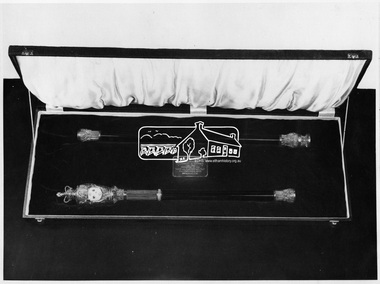
Photograph, Black Rod of Victoria Parliament made for Silver & Electroplate Ware Mfrs. Assoc. by Harold C. Hutchinson of Eltham in 1953
... In 1951 Victoria commemorated 100 years of the Victorian Parliament. ...In 1951 Victoria commemorated 100 years of the Victorian Parliament. ...In 1951 Victoria commemorated 100 years of the Victorian Parliament. A protective lined keepsake box contains a black rod (in two parts) with a small plaque: "Presented by [the] silver and electroplate ware Manufacturers Association. Made by Harold C. Hutchinson, Eltham. It was first used in 1954. Black Rod is best known for their part in the ceremonies surrounding the State Opening of Parliament and the Speech from the throne. They summon the Commons to attend the speech and lead them to the Lords. As part of the ritual, the doors to the chamber of the House of Commons are slammed in the approaching Black Rod's face. This is to symbolise the Commons' independence of the Sovereign. Black Rod then strikes the door three times with the staff, and is then admitted and issues the summons of the monarch to attend. - Wikipedia This photo forms part of a collection of photographs gathered by the Shire of Eltham for their centenary project book,"Pioneers and Painters: 100 years of the Shire of Eltham" by Alan Marshall (1971). The collection of over 500 images is held in partnership between Eltham District Historical Society and Yarra Plenty Regional Library (Eltham Library) and is now formally known as 'The Shire of Eltham Pioneers Photograph Collection.' It is significant in being the first community sourced collection representing the places and people of the Shire's first one hundred years.Digital imagesepp, shire of eltham pioneers photograph collection, eltham, black rod, harold c. hutchinson, victorian parliament, parliament house, ceremonial, ceremony, box -
 City of Moorabbin Historical Society (Operating the Box Cottage Museum)
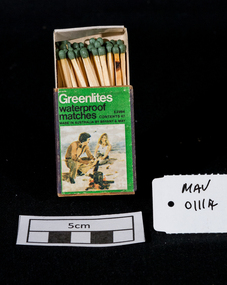
Maufactured Objects, 1 box of Bryant & May waterproof safety matches, 20thC
... On 15th December 1909, Bryant & May, Australia’s first match factory at Church Street, Richmond, Victoria. was opened by The Honorable Alfred Deakin, Prime Minister of Australia, and Mrs. ...On 15th December 1909, Bryant & May, Australia’s first match factory at Church Street, Richmond, Victoria. was opened by The Honorable Alfred Deakin, Prime Minister of Australia, and Mrs. ...‘Strike anywhere’ or ‘Waterproof’ matches are still used today all around the world, including many developing countries and are widely used for camping, outdoor activities, emergency/survival /military situations, and stocking homemade survival kits. Anton Schrötter von Kristelli discovered in 1850 that heating white phosphorus at 250 °C in an inert atmosphere produced a red allotropic form, which did not fume in contact with air. It was suggested that this would make a suitable substitute in match manufacture although it was slightly more expensive. Two French chemists, Henri Savene and Emile David Cahen, proved in 1898 that the addition of phosphorus sesquisulfide meant that the substance was not poisonous, that it could be used in a "strike-anywhere" match, and that the match heads were not explosive. British company Albright and Wilson, was the first company to produce phosphorus sesquisulfide matches commercially. The company developed a safe means of making commercial quantities of phosphorus sesquisulfide in 1899 and started selling it to match manufacturers. Bryant and May was a United Kingdom (UK) company created in the mid-nineteenth century specifically to make matches. Their original Bryant and May Factory was located in Bow, London. They later opened other match factories in the United Kingdom and Australia. On 15th December 1909, Bryant & May, Australia’s first match factory at Church Street, Richmond, Victoria. was opened by The Honorable Alfred Deakin, Prime Minister of Australia, and Mrs. Deakin The Bryant & May Ltd factory in Church St Richmond is a listed building and has been converted to apartments following the closure of the Company 1980. Bryant & May's Ltd were influential in fighting against the dreadful disease known as Phossy jaw which was caused by white phosphorus used in the manufacture of the early matches. They were also the object of the 'Match Girls Strike' in London 1888, which won important improvements in working conditions and pay for the mostly female workforce working with the dangerous white phosphorus. The public were slow to purchase these red phosphorus sesquisulfide safety matches because of the higher price1 box of unused Bryant & May safety matches 'Greenlite' waterproof Greenlites / waterproof / matches / CONTENTS 47 / MADE IN AUSTRALIA BY BRYANT & MAY / E 2994 photograph of a man and woman beside a camp fire on the beachsafety matches, bryant & may pty ltd, phossy jaw disease, early settlers, moorabbin, bentleigh, cheltenham, lights, lamps, tobacco, white phosphorous, red, phosphorus sesquisulfide, swedish match pty ltd, pitt william, savens henri, cahen emile david , richmond victoria, -
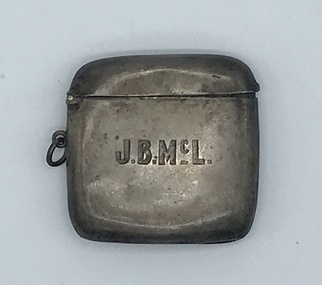 Melbourne Legacy
Functional object - Ephemera, Match cases
... McLean (Service No. 13824) was from near Maffra, Victoria and enlisted on 22 January 1916. He embarked on 16 December 1916 for Europe. ...McLean (Service No. 13824) was from near Maffra, Victoria and enlisted on 22 January 1916. He embarked on 16 December 1916 for Europe. ...Vesta cases were used to hold and strike matches. These were with other World War 1 memorabilia that has come from Private John Basil McLean, 2nd Reinforcements, 37th Battalion, A.I.F. Possibly these were with him during his time in the First World War and he visited Belfast during his time in Europe, and he kept as a mementos. J.B. McLean (Service No. 13824) was from near Maffra, Victoria and enlisted on 22 January 1916. He embarked on 16 December 1916 for Europe. He spent time with the Australian Field Artillery (Pack Section). At the end of the war he worked for a year at the A.I.F. Headquarters in London before returning to Australia on the 'Ceramic', arriving in Portsea in 1920. His full war record is available from the National Archives of Australia (B2455, MCLEAN JBM).Mementos brought back with a soldier after serving in Europe in World War One.Two silver vesta (match) cases, one is monogramed and the other has an enamel plaque of the coat of arms of Belfast on it. Both have a few blue tipped matches in them.01125.1 has monogram 'JBMCL' engraved on it 01125.2 has a coat of arms and 'Belfast' on an enamel discworld war one, souvenir
