
Showing 478 items matching "audio tape"
-
 The Beechworth Burke Museum
Audio - Oral History, Mrs May Harris, July 2000
... The cassette tape is black with a horizontal white strip and is currently stored in a clear flat plastic rectangular container. It holds up 40 minutes of recordings on each side. Mrs May Harris Audio ...This oral history interview was conducted with Mrs May Harris (née Peach), who grew up in the farming town of Stanley, about 9km southeast of Beechworth. Mrs Harris moved to Melbourne and got work cleaning houses before getting married. Her husband worked on farms, and the couple eventually found their way back to Stanley. She describes experiences of illness, particularly her husband and children's experience with asthma and the impact that had on their lives and careers. Mrs Harris talks about local fundraising events in Stanley, particularly what she calls 'Australian Teas', as well as some of the dances and picnics that were major sources of entertainment when she was young. This oral history recording was part of a project conducted by Jennifer Williams in the year 2000 to capture the everyday life and struggles in Beechworth during the twentieth century. This project involved recording seventy oral histories on cassette tapes of local Beechworth residents which were then published in a book titled: Listen to what they say: voices of twentieth century Beechworth. These cassette tapes were digitised in July 2021 with funds made available by the Friends of the Burke.Mrs May Harris' statement explores life in a small farming community alongside some of her life in the city, which might provide an interesting comparison. She discusses the difficulties of facing illnesses in these rural communities, noting the lack of available resources and need to travel to Beechworth. She discusses community events, highlighting both the social aspects and the fundraising aspects.This is a digital copy of a recording that was originally captured on a cassette tape. The cassette tape is black with a horizontal white strip and is currently stored in a clear flat plastic rectangular container. It holds up 40 minutes of recordings on each side.listen to what they say, beechworth, oral history, burke museum, illness, asthma, farming, farm work, rural life, stanley, stanley athenaeum, sinclair's sawmill, sawmill, the great depression, housework, australian tea, fundraising -
The Beechworth Burke Museum
Audio - Oral History, Jennifer Williams, Mr and Mrs Don Hayes, 20th May 2000
... The cassette tape is black with a horizontal white strip and is currently stored in a clear flat plastic rectangular container. It holds up 40 minutes of recordings on each side. Mr and Mrs Don Hayes Audio ...In this interview we hear from Don and Bobbie Hayes who met and were married in Beechworth. Mrs Hayes was born in Beechworth to a blacksmith and a teacher who had moved to the area not long before she was born in 1925. She discusses her family and the struggle her mother had being a city woman relocated to the bush and into a family who didn't accept her for her Methodist religious beliefs as they were a staunch Catholic family. After working in the Tannery when they first moved to Beechworth from Melbourne, Don got a job in the 1950's at the Beechworth Mental hospital known as Mayday Hills (est. 1862) and continued working there for the next thirty six years. Starting as a nurse Don would be one of three or four staff known then as attendants, who would oversee up to forty patients in a ward taking them out to work the land and gardens or chop wood on the grounds. Mrs Hayes also worked in the Hospital and discusses the need at the time to be earning to pay for large medical bills that came from two of their children, one having a congenital heart problem which was not covered by hospital benefits and the other displaced hips that required surgery. By the end of his time working at the hospital, Don was in charge of the patient training centre where those destined for discharge would be trained on how to cope in the world outside of the hospital grounds they were so used to. Both talk openly and with heartfelt candour, recalling their years spent among the patients of the hospital community, their sense of humour and compassion are evident and although the times and the jobs were definitely hard and the wages low, this couple cared deeply about the people they worked with and sit among those people from the local area who established Beechworth as a significant social welfare region. This oral history recording was part of a project conducted by Jennifer Williams in the year 2000 to capture the everyday life and struggles in Beechworth during the twentieth century. This project involved recording seventy oral histories on cassette tapes of local Beechworth residents which were then published in a book titled: Listen to what they say: voices of twentieth century Beechworth. These cassette tapes were digitised in July 2021 with funds made available by the Friends of the Burke.The significance of this oral history lies in the firsthand accounts from two people who were directly involved in the significant nursing work undertaken at Mayday Hills Mental hospital from the 1950's. Hearing the stories from those who were there and had lived experience, adds depth and we gain valuable insight into how and what the asylum was like for those who worked there and colourful details about the kinds of patients they encountered too, it adds human and personal context to what could otherwise become statistic and abstract information about a historic site. This oral history account is socially and historically significant as it is a part of a broader collection of interviews conducted by Jennifer Williams which were published in the book 'Listen to what they say: voices of twentieth-century Beechworth.' While the township of Beechworth is known for its history as a gold rush town, these accounts provide a unique insight into the day-to-day life of the town's residents during the 20th century, many of which will have now been lost if they had not been preserved.This is a digital copy of a recording that was originally captured on a cassette tape. The cassette tape is black with a horizontal white strip and is currently stored in a clear flat plastic rectangular container. It holds up 40 minutes of recordings on each side.listen to what they say, beechworth, oral history, burke museum, mayday hills hospital, may day hills, beechworth mental asylum, mental hospital, asylum, nursing, hospital, patient training centre, patients, social welfare -
 The Beechworth Burke Museum
Audio - Oral History, Jennifer Williams, Evelyn Jensen, 13th April 2000
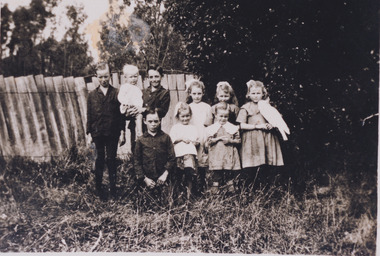
... The cassette tape is black with a horizontal white strip and is currently stored in a clear flat plastic rectangular container. It holds up 40 minutes of recordings on each side Evelyn Jensen Audio Oral History Jennifer Williams Evelyn Jensen ...Miss Evelyn Jensen was born in 1908 near Mytleford Road in Beechworth. Miss Jensen was a twin but she also had twelve brothers and sisters. Miss Jensen went to school when she was nine years old but did not enjoy it. Her father was a nozzleman and had a role in finding and collecting gold. More specifically, a nozzleman operated a steel barrel with an interchangeable brass nozzle that sprayed high pressure water onto rock and similar surfaces. This broke down the surface for gold to be found. Unfortunately, when he began most of the gold was already gone. Miss Jensen's mother died when Miss Jensen was sixteen. As a result, Miss Jensen had to take care of the children and run the house. This included looking after a few months old baby. Her father was away at work most days so all of the responsibility fell on her. Her grandmother was present but she was too old to help Miss Jensen. Miss Jensen and her family lived a very long way from the main town and often had to carry kerosene tins full of water half a mile to their house. This was because they have no access to water at their home. This lack of water also meant they had to either bathe in the creek or carry the water back home for a bath. On wash day, they washed their clothes in the creek too. Miss Jensen never married but continued to provide for her family. She spent her days gardening and cooking. They did not have much money so gardening was a way that they provided food for themselves. This oral history recording was part of a project conducted by Jennifer Williams in the year 2000 to capture the everyday life and struggles in Beechworth during the twentieth century. This project involved recording seventy oral histories on cassette tapes of local Beechworth residents which were then published in a book titled: Listen to what they say: voices of twentieth century Beechworth. These cassette tapes were digitised in July 2021 with funds made available by the Friends of the Burke.Miss Jensen's oral history is significant because it demonstrates the struggles of living remotely during this early part of the twentieth century. When Miss Jensen's mother died, she had to take on a lot of responsibility and did not have much support. This history sheds light on these struggles of being a young caregiver but it also gives details on how large families lived in isolated places. An example of this is the way that Miss Jensen often had to do the washing in the creek because that was the only place there was running water. In addition, Miss Jensen's story is significant because her father was a nozzleman. It indicates one of the processes was used to find gold. This oral history account is socially and historically significant as it is a part of a broader collection of interviews conducted by Jennifer Williams which were published in the book 'Listen to what they say: voices of twentieth-century Beechworth.' While the township of Beechworth is known for its history as a gold rush town, these accounts provide a unique insight into the day-to-day life of the town's residents during the 20th century, many of which will have now been lost if they had not been preserved.This is a digital copy of a recording that was originally captured on a cassette tape. The cassette tape is black with a horizontal white strip and is currently stored in a clear flat plastic rectangular container. It holds up 40 minutes of recordings on each sideEvelyn Jensen /mytleford road, beechworth, three mile creek, three mile beechworth, twin, nozzleman, goldrush, gold rush, work, mother, young mother, children, siblings, baby, grandmother, father, isolation, bush, water, watertanks, kerosene tins, wash day, bath day, creek, gardening, provide, poor, money, oral history, twentieth century, recording, story -
 The Beechworth Burke Museum
Audio - Oral History, Jennifer Williams, Mr. Vincent Makaravicius, July 2000
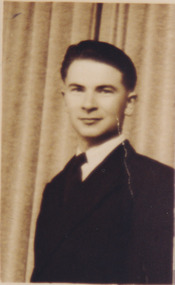
... The cassette tape is black with a horizontal white strip and is currently stored in a clear flat plastic rectangular container. It holds up 40 minutes of recordings on each side. Mr. Vincent Makaravicius Audio ...Vincent Makaravicius was born on the 23rd of January, 1922 in a small Lithuanian village. He was the youngest of six children and after completing his primary education he went on to study horticulture at Kaunas and Vilnius. During WWII, under the threat of Soviet occupation and conscription, Vincent travelled to Germany, before coming to Australia as a refugee after his wife in 1949 on the ship 'Victory.' Vincent eventually settled in Beechworth, working at the local tannery and the Beechworth Asylum, as well as taking on boarders in the tannery boarding house in which his wife and he lived for a number of years. This oral history recording was part of a project conducted by Jennifer Williams in the year 2000 to capture the everyday life and struggles in Beechworth during the twentieth century. This project involved recording seventy oral histories on cassette tapes of local Beechworth residents which were then published in a book titled: Listen to what they say: voices of twentieth-century Beechworth. These cassette tapes were digitised in July 2021 with funds made available by the Friends of the Burke.Vincent Makaravicius' story is historically and socially significant as it provides a unique insight into the trials, tribulations, hopes, and dreams of Australian immigrants during the mid 20th century. Mr Makaravicius references the turbulent political situation and lack of food in Europe as being the reason for the mass exodus from Europe that saw an influx of refugees and migrants to Australia. His personal account highlights the spirit of survival and perseverance that is quintessential of Australian settler history. His contributions to the township of Beechworth gave him a detailed understanding of the social and historical significance of the township and the people, institutions, and local businesses on which it was built, namely the Beechworth Asylum, the local tannery, and relations between migrants and the established community. This oral history account is socially and historically significant as it is a part of a broader collection of interviews conducted by Jennifer Williams which were published in the book 'Listen to what they say: voices of twentieth-century Beechworth.' While the township of Beechworth is known for its history as a gold rush town, these accounts provide a unique insight into the day-to-day life of the town's residents during the 20th century, many of which will have now been lost if they had not been preserved.This is a digital copy of a recording that was originally captured on a cassette tape. The cassette tape is black with a horizontal white strip and is currently stored in a clear flat plastic rectangular container. It holds up 40 minutes of recordings on each side.Mr. Vincent Makaravicius /listen to what they say, beechworth, oral history, burke museum, vincent makaravicius, wwii, lithuania, kaunas, vilnius, soviet, germany, australia, victory, tannery, beechworth asylum, refugee, jennifer williams -
 The Beechworth Burke Museum
Audio - Oral History, Jennifer Williams, Mr Harry Mason, 13th April 2000
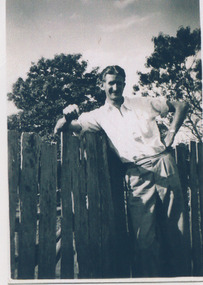
... The cassette tape is black with a horizontal white strip and is currently stored in a clear flat plastic rectangular container. It holds up 40 minutes of recordings on each side. Mr Harry Mason Audio ...Mr Harry Mason was born in Stanley, Victoria, on the 23rd of July 1925, attending the primary school in Stanley and high school in Beechworth on the mail truck. His family initially moved to the area during the initial Gold Rush period. He moved to Beechworth in 1960. For seven years after school, he worked in the local orchard full time before becoming the local gravedigger, responsible for digging the graves of Beechworth residents and Asylum for 23 years. This oral history recording was part of a project conducted by Jennifer Williams in the year 2000 to capture the everyday life and struggles in Beechworth during the twentieth century. This project involved recording seventy oral histories on cassette tapes of local Beechworth residents which were then published in a book titled: Listen to what they say: voices of twentieth-century Beechworth. These cassette tapes were digitised in July 2021 with funds made available by the Friends of the Burke.Mr Harry Mason's account of his life in Beechworth and the local area during the 20th century is historically and socially significant to the cultural heritage of the region. He details important historical events and hardships in the region's history that had a lasting local, regional and national impact, including Australia during war time, economic struggles, and women's societal roles in a rural area. Mr Mason also discusses agricultural and gravedigging practices of the time as well as what it was like growing up in rural Australia. This first-hand account is imperative to our understanding of life during the last century. This oral history account is socially and historically significant as it is a part of a broader collection of interviews conducted by Jennifer Williams which were published in the book 'Listen to what they say: voices of twentieth-century Beechworth.' While the township of Beechworth is known for its history as a gold rush town, these accounts provide a unique insight into the day-to-day life of the town's residents during the 20th century, many of which will have now been lost if they had not been preserved.This is a digital copy of a recording that was originally captured on a cassette tape. The cassette tape is black with a horizontal white strip and is currently stored in a clear flat plastic rectangular container. It holds up 40 minutes of recordings on each side.Mr Harry Madon /listen to what they say, beechworth, oral history, burke museum, harry mason, stanley, orchard, jennifer williams, asylum -
The Beechworth Burke Museum
Audio - Oral History, Jennifer Williams, Mrs Vanessa McDonald, 9 November 2000
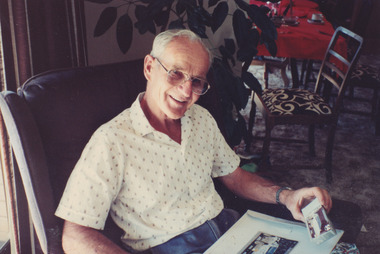
... The cassette tape is black with a horizontal white strip and is currently stored in a clear flat plastic rectangular container. It holds up 40 minutes of recordings on each side. Mrs Vanessa McDonald Audio ...Mrs. Vanessa McDonald was born in Beechworth in 1917. Christened, Agnes Bertha Collins, Vanessa changed her name in 1960. Mrs. McDonald's family's connection with gold mining in the district reach back to the first of Beechworth's gold rushes, when her great grandfather, a Dutchman who adopted the name Charles Collins, arrived in 1851-1852. Mrs. McDonald spent her childhood in the isolated hamlet of Stanley, in the area known as 'Little Scotland', where she recalls helping her mother to raise younger siblings, picking apples and walnuts on the family farm, and roaming the hills for wildflowers. As a young woman Mrs. McDonald attended religious and social gatherings in the local community. In 1940 she went to Melbourne to work as a mothercraft nurse during the Second World War. She met her husband at a Beechworth football match and was married at the Stanley Methodist Church in 1941. The gold diggings known as the 'Nine Mile' became the hamlet of Stanley, after the British Prime Minister, Lord Stanley, in 1858. By the late 1850s, Stanley boasted schools, an athenaeum, a church, a weekly newspaper and several hotels and other civic infrastructure to cater for a growing population. The area attracted large numbers of Chinese miners, whose presence was frequently resisted. Like other early Victorian mining settlements, Stanley was a hotbed of political and racial tensions during the gold rush. One side of the Nine Mile Creek was known as 'Little Scotland’, the other, 'Little Ireland'. A number of Christian denominations built congregations and churches in Stanley, including the Church of England, Methodist Church, the Catholic Church, and Presbyterian Church. Stanley became part of the United Shire of Beechworth in 1871. By 1880 timber was being cut and two sawmills were established by 1887. River-dredged gold mining consumed vast amounts of timber from the forests in the area, and in 1931 the first of several softwood plantations began. This oral history recording was part of a project conducted by Jennifer Williams in the year 2000 to capture the everyday life and struggles in Beechworth during the twentieth century. This project involved recording seventy oral histories on cassette tapes of local Beechworth residents which were then published in a book titled: 'Listen to what they say: voices of twentieth century Beechworth'. These cassette tapes were digitised in July 2021 with funds made available by the Friends of the Burke.Following the decline in the mining and associated industries during the early-mid-twentieth century, the Beechworth district experienced a period of general economic decline. On the east side of the Dingle Range, Mrs. McDonald's father, William Henry Collins, felled timber and the family were pioneer apple orchardists. The establishment of apple orchards in Stanley reflects changes to how land was used and contributes to our understanding of the historical development of rural communities following the gold rush. Mrs. McDonald's recollections are significant for understanding family and social life in a small rural town in years leading up to the Great Depression and prior to the Second World War. This oral history recording may be compared with other oral histories and items in the Burke Museum's collection. This oral history account is socially and historically significant as it is a part of a broader collection of interviews conducted by Jennifer Williams which were published in the book 'Listen to what they say: voices of twentieth-century Beechworth.' While the township of Beechworth is known for its history as a gold rush town, these accounts provide a unique insight into the day-to-day life of the town's residents during the 20th century, many of which will have now been lost if they had not been preserved.This is a digital copy of a recording that was originally captured on a cassette tape. The cassette tape is black with a horizontal white strip and is currently stored in a clear flat plastic rectangular container. It holds up 40 minutes of recordings on each side.Mrs Vanessa McDonald /listen to what they say, beechworth, oral history, burke museum, emigration, gold rush immigration, victorian gold rush, mining families, apple orchard, forestry, forest plantation, little scotland, stanley, twentieth century history, regional australia, rural australia, farming, harvest festival, great depression, dingle range, the nine mile, australian wildflowers, high country wildflowers, mothercraft nurse, rural and regional women, social history, collins, mrs. vanessa mcdonald, building community life, shaping cultural and creative life, fruit growers, family history, changes to land use in regional victoria -
 The Beechworth Burke Museum
Audio - Oral History, Jennifer Williams, Mr Jack Tully, 31 August 2000
... The cassette tape is black with a horizontal white strip and is currently stored in a clear flat plastic rectangular container. It holds up 40 minutes of recordings on each side. Mr Jack Tully Audio ...Mr Jack Tully was born in 1927 in Box Hill Doncaster to Irish decedents. The youngest of three children, one brother and two sisters, Jack and his family took after the family orchard after his father died. After years of running the business side of the orchard Jack moved to Beechworth in 1957 purchasing an orchard and becoming a grower. Jack grew mainly apples in his orchard creating job opportunities for locals and elevating his worth in town. He speaks highly of Beechworth; he is a valued and respected member of society. He enjoyed a round of tennis with his wife. This oral history recording was part of a project conducted by Jennifer Williams in the year 2000 to capture the everyday life and struggles in Beechworth during the twentieth century. This project involved recording seventy oral histories on cassette tapes of local Beechworth residents which were then published in a book titled: Listen to what they say: voices of twentieth century Beechworth. These cassette tapes were digitised in July 2021 with funds made available by the Friends of the Burke. Mr Jack Tully's account of his life in Beechworth and the local area during the 20th century is historically and socially significant to the region's cultural heritage. He provides a unique perspective as an orchard owner within Beechworth but also as an outsider who moved and was welcomed into the town with open arms. This oral history account is socially and historically significant as it is a part of a broader collection of interviews conducted by Jennifer Williams which were published in the book 'Listen to what they say: voices of twentieth-century Beechworth.' While the township of Beechworth is known for its history as a gold rush town, these accounts provide a more mundane insight into day-to-day life of ordinary residents during the 20th century. This is a digital copy of a recording that was originally captured on a cassette tape. The cassette tape is black with a horizontal white strip and is currently stored in a clear flat plastic rectangular container. It holds up 40 minutes of recordings on each side.Mr Jack Tully / beechworth, jennifer williams, jack tully, oral history, burke museum, listen to what they say, recording -
 The Beechworth Burke Museum
Audio - Oral History, Jennifer Williams, Dr Roy Phillips, 8th October 2000 (exact date unclear)
... The cassette tape is black with a horizontal white strip and is currently stored in a clear flat plastic rectangular container. It holds up 40 minutes of recordings on each side. Dr Roy Phillips Audio ...Roy Phillips was born in 1907 in Yackandandah and moved with his family to Beechworth when he was five years old. His father was involved in dredging operations at Lake Sambell but his parents also had other family living in Beechworth, with whom they lived. Dr Phillips tells vivid stories about life in Beechworth in the first half of the Twentieth Century, from the daily lives of young children of the time to the town's relationship to the local Chinese community. He discusses features of the landscape such as 'The Rock' at which community concerts were held and 'The Echo' (an echo-sounding point over a nearby gully) which he states are no longer used in the same way. He also discusses changing community attitudes to various issues, for example, 'not being coddled' as a child but living in a town with very strict rules about people of different religions mingling. This oral history recording was part of a project conducted by Jennifer Williams in the year 2000 to capture the everyday life and struggles in Beechworth during the twentieth century. This project involved recording seventy oral histories on cassette tapes of local Beechworth residents which were then published in a book titled: Listen to what they say: voices of twentieth century Beechworth. These cassette tapes were digitised in July 2021 with funds made available by the Friends of the Burke.Dr Roy Phillips' account of his life in Beechworth in the early part of the 20th Century is historically and socially significant to the cultural heritage of the region. He describes town life from a child's point of view during a time of transition to life after the Gold Rush era, including social tensions existing between cultural groups such as the Chinese community and European-heritage townspeople and between people of different religious groups in Beechworth. This oral history account is socially and historically significant as it is a part of a broader collection of interviews conducted by Jennifer Williams which were published in the book 'Listen to what they say: voices of twentieth-century Beechworth.' While the township of Beechworth is known for its history as a gold rush town, these accounts provide a unique insight into the day-to-day life of the town's residents during the 20th century, many of which will have now been lost if they had not been preserved.This is a digital copy of a recording that was originally captured on a cassette tape. The cassette tape is black with a horizontal white strip and is currently stored in a clear flat plastic rectangular container. It holds up 40 minutes of recordings on each side.Dr Roy Phillips /beechworth, yackandandah, wangaratta, mining, dredging, 1910s, 1920s, 1930s, chinese community, typhoid, lake kerferd, reminiscences, memories, childhood, lake sambell, alcoholism, new year celebrations, transport, horses, foresters lodge, oddfellows lodge, funeral practices, child-rearing practices, star hotel, the rock, racism, chinese dragon, benevolent society, star lane coach building factory, outdoor concerts, gold, jimmy ingram, kelly gang, kelly family, churches, catholic, methodist, protestant, anglican, confuscionist, buddhism, women's christian temperance association, hotels, twentieth century, coronation of king george iv, echo point, the echo, tippany cat, marbles, children's games, cornish, cornwall, listen to what they say, oral history -
The Beechworth Burke Museum
Audio - Oral History, Jennifer Williams, Gwendoline Warden, 1st June 2000
... The cassette tape is black with a horizontal white strip and is currently stored in a clear flat plastic rectangular container. It holds up 40 minutes of recordings on each side. Gwendoline Warden Audio ...Gwendoline Warden was born in Ararat in 1913. When she was 13 years old, she moved to Wangaratta, where her parents owned the “Hibernian Hotel”. Her father`s name was William Lavender. When Gwen was around 16 years old, she moved to Beechworth, where she met her husband and they got married in 1935. They had their wedding reception at Warden`s Hotel and they had two children together, a boy and a girl. She recounts how difficult it was for them during the war to manage their grocery's shop and source the supplies they needed, having coupons for food and the black-market prevailing. They faced financial difficulties and, ultimately, they had to sell the shop. After the war she did a few other jobs and she retired when she was nearly sixty. Gwendoline portrays Beechworth as a quiet place, where people were happy and peaceful, enjoying the many opportunities they had for entertainment, such as dances and balls, or the celebrations for the New Year's Eve. She also witnessed the beginning of the famous wheelbarrow race, which started just outside the post office and a big crowd gathered to farewell the two barrowmen. When comparing the past with the present, she points out how much Beechworth has changed over the last decades, with many new people coming to town, making her feel as “the only one around”. She also remarked that young people have changed as well; in her day they were entertaining themselves but nowadays they want to be entertained. This oral history recording was part of a project conducted by Jennifer Williams in the year 2000 to capture the everyday life and struggles in Beechworth during the twentieth century. This project involved recording seventy oral histories on cassette tapes of local Beechworth residents which were then published in a book titled: Listen to what they say: voices of twentieth century Beechworth. These cassette tapes were digitised in July 2021 with funds made available by the Friends of the Burke.Gwendoline Warden's account of her life in Beechworth and the local area during the 20th century is historically and socially significant as it offers valuable information about the business activity in the region and provides a deeper insight into the way hotels and grocery shops were operating during the first half of the previous century. Additionally, along with all the details provided for many aspects of social life, her personal account of the war period is of great importance, offering vital information to research on the way the Australian society experienced WWII. This is a digital copy of a recording that was originally captured on a cassette tape. The cassette tape is black with a horizontal white strip and is currently stored in a clear flat plastic rectangular container. It holds up 40 minutes of recordings on each side.Mrs Gwendoline Warden/ararat, wangaratta, hibernian hotel, gwendoline warden, william lavender, beechworth, warden`s hotel, grocery`s shop, coupons, black-market, war, dances, new year`s eve, balls, new people, listen to what they say: voices of twentieth century beechworth, jennifer williams, cassette tapes, friends of the burke, oral histories -
The Beechworth Burke Museum
Audio - Oral History, Jennifer Williams, Fred and Bette Wyatt, 27 April 2000
... The cassette tape is black with a horizontal white strip and is currently stored in a clear flat plastic rectangular container. It holds up 40 minutes of recordings on each side. Fred and Bette Wyatt Audio ...Fred was born on the 1st of March 1928 and Bette in 1934, in Beechworth. Both of their families immigrated from England on convict ships in the 1800s. Fred and Bette both had large families of 9 and 5 siblings respectively, with 2 of Fred's siblings suffering from muscular dystrophy both dying at 20 years old which affected the family. Bette originally worked in multiple cafes and kitchens in Beechworth before working in "Ennals Store" which was a grocery store, for over 30 years. Fred worked as a milkman during the war before becoming an engineer at the tannery and the brewery in Beechworth. He rebuilt the factory at the brewery during the 1970s and worked there until he retired. This oral history recording was part of a project conducted by Jennifer Williams in the year 2000 to capture the everyday life and struggles in Beechworth during the twentieth century. This project involved recording seventy oral histories on cassette tapes of local Beechworth residents which were then published in a book titled: Listen to what they say: voices of twentieth century Beechworth. These cassette tapes were digitised in July 2021 with funds made available by the Friends of the Burke.Fred and Bette Wyatt's account of their lives in Beechworth and the local area during the 20th century is historically and socially significant to the cultural heritage of the region. They both mention important historical events and hardships in the region's history that had a lasting local, regional and national impact, including Australia during wartime, economic struggles, and the development of Beechworth town. This oral history account is socially and historically significant as it is a part of a broader collection of interviews conducted by Jennifer Williams which were published in the book 'Listen to what they say: voices of twentieth-century Beechworth.' While the township of Beechworth is known for its history as a gold rush town, these accounts provide a unique insight into the day-to-day life of the town's residents during the 20th century, many of which will have now been lost if they had not been preserved.This is a digital copy of a recording that was originally captured on a cassette tape. The cassette tape is black with a horizontal white strip and is currently stored in a clear flat plastic rectangular container. It holds up 40 minutes of recordings on each side.Fred and Bette Wyattbeechworth, beechworth tannery, beechworth brewery, fred and bette wyatt, wyatt, wyatt beechworth, ennals store, ennals beechworth, listen to what they say, burke museum -
 The Beechworth Burke Museum
Audio - Oral History, Jennifer Williams, Mr Desmond Zwar, 19 October 2000
... The cassette tape is black with a horizontal white strip and is currently stored in a clear flat plastic rectangular container. It holds up 40 minutes of recordings on each side. Mr Desmond Zwar Audio ...Desmond was born in 1931 in Beechworth but left at age 11 (in 1944) to be educated in Melbourne at Scotch College but returned to the town for holidays and when he was finished with school. Desmond is the son of Raymond Zwar who was 1 of the 3 brothers who owned the Tannery in Beechworth. He worked there when he was 19 for a year in 1950, when the first Baltic migrants came to town. In 1951, Desmond left Beechworth to work in Albury for a newspaper called the "Border Mail" before moving to Melbourne to write for the "Melbourne Herald". He was later known for becoming a writer, having produced 17 books under his name at the time of the interview. This oral history recording was part of a project conducted by Jennifer Williams in the year 2000 to capture the everyday life and struggles in Beechworth during the twentieth century. This project involved recording seventy oral histories on cassette tapes of local Beechworth residents which were then published in a book titled: Listen to what they say: voices of twentieth century Beechworth. These cassette tapes were digitised in July 2021 with funds made available by the Friends of the Burke.Mr Desmond Zwar's account of his life in Beechworth during the 20th century is historically and socially significant to the cultural heritage of the region. He details important historical events and hardships in the region's history that had a lasting local, regional and national impact, including Australia during war time, economic struggles, and the relationships of different social groups in the town. This oral history account is socially and historically significant as it is a part of a broader collection of interviews conducted by Jennifer Williams which were published in the book 'Listen to what they say: voices of twentieth-century Beechworth.' While the township of Beechworth is known for its history as a gold rush town, these accounts provide a unique insight into the day-to-day life of the town's residents during the 20th century, many of which will have now been lost if they had not been preserved.This is a digital copy of a recording that was originally captured on a cassette tape. The cassette tape is black with a horizontal white strip and is currently stored in a clear flat plastic rectangular container. It holds up 40 minutes of recordings on each side.Mr Desmond Zwardesmond zwar, zwar, beechworth, burke museum, raymond zwar, zwar tannery, the tannery, zwar brothers tannery, beechworth tannery, listen to what they say, jennifer williams -
 The Beechworth Burke Museum
Audio - Oral History, Jennifer Williams, Mr Horace Monshing, 6th July 2000
... The cassette tape is black with a horizontal white strip and is currently stored in a clear flat plastic rectangular container. It holds up 45 minutes of recordings on each side Mr Horace Monshing Audio Oral History Jennifer Williams Horace Monshing ...Horace Monshing was born in Beechworth in 1935. In this oral history, he relates his understanding of the life of his Grandfather, Peter Monshing (Munshing), as a Chinese immigrant to Australia in the mid-nineteenth century, as well as his life as the last descendent of Chinese goldminers to live in Beechworth. While Peter, who was originally from Hong Kong, was not a particularly successful goldminer, he was a very talented gardener, and made his living growing a market garden and selling the produce. He died in 1947 in his nineties, in the same year that Horace and his parents moved to Myrtleford. Horace relates the discrimination he faced as a child based on his grandfather’s ethnicity, as well as how his grandmother, mother and wife have all faced discrimination for marrying into a family with a Chinese name. This oral history recording was part of a project conducted by Jennifer Williams in the year 2000 to capture the everyday life and struggles in Beechworth during the twentieth century. This project involved recording seventy oral histories on cassette tapes of local Beechworth residents which were then published in a book titled: Listen to what they say: voices of twentieth century Beechworth. These cassette tapes were digitised in July 2021 with funds made available by the Friends of the Burke. Mr Horace Monshing’s account of his life in Beechworth and Myrtleford and the local area during the 20th century, as well as his understanding of his grandfather, Peter Monshing’s life as a Chinese immigrant in the mid-nineteenth century, is historically and socially significant to the cultural heritage of the region, especially as it relates to Chinese settlers in the region. He details the discrimination he and his family have faced as the result of being related to a Chinese immigrant, as well as describing his life in general. This oral history account is socially and historically significant as it is a part of a broader collection of interviews conducted by Jennifer Williams which were published in the book 'Listen to what they say: voices of twentieth-century Beechworth.' While the township of Beechworth is known for its history as a gold rush town, these accounts provide a unique insight into the day-to-day life of the town's residents during the 20th century, many of which will have now been lost if they had not been preserved. This is a digital copy of a recording that was originally captured on a cassette tape. The cassette tape is black with a horizontal white strip and is currently stored in a clear flat plastic rectangular container. It holds up 45 minutes of recordings on each sideMr Horace Monshing / peter monshing, peter munshing, horace monshing, monshing, munshing, beechworth chinese community, chinese immigration, chinese community, chinese miners, immigration, gold rush immigration, beechworth goldfield, marketing and promoting agricultural products, market garden, garden, racism, discrimination, oral history, jennifer williams, myrtleford, eurobin, beechworth primary school, beechworth state school., school, listen to what they say: voices of twentieth century beechworth, listen to what they say, burke museum -
 The Beechworth Burke Museum
Audio - Oral History, Joyce Snow
... The cassette tape is black with a horizontal white strip and is currently stored in a clear flat plastic rectangular container. It holds up 40 minutes of recordings on each side. Joyce Snow Audio ...Joyce Snow was born in Avenel and came to Beechworth at the age of twenty-three. She grew up at Bundarta, a place just out of Shepparton. Her father was a soldier who was part of the 37th Battallion while her mother's family were some of the pioneers of Beechworth--the Duracks. She finished school at about thirteen years old, did a correspondence course, and when she was old enough, she went training for nursing. Joyce was a trained nurse at the old Mooroopna Base, Hospital. She working at a Hospital in Shepparton when Manpower sent her to Beechworth. She arrived at Beechworth in 1943 at a train in Wangaratta. She had been a nurse in Beechworth for more than seven years. She got married in Beechworth and had three children, two girls and one boy. By the time of her third child, she studied a one year supplementary course on Psychy at May Day. Joyce had nursed prisoners of the First World War. She shared about the differences of medical practice back then in comparison to now. This oral history recording was part of a project conducted by Jennifer Williams in the year 2000 to capture the everyday life and struggles in Beechworth during the twentieth century. This project involved recording seventy oral histories on cassette tapes of local Beechworth residents which were then published in a book titled: Listen to what they say: voices of twentieth century Beechworth. These cassette tapes were digitised in July 2021 with funds made available by the Friends of the Burke.Joyce Snow's account of her life in the early 20th century is historically and socially significant to the cultural heritage of the region. She gave information about the settlements and life of the prisoners of First World War, the early forms of entertainment, education system and societal roles. She also mentioned changes in employment and migrant communities. This oral history account is socially and historically significant as these accounts provide a unique insight into the day-to-day life of the town's residents during the 20th century, many of which will have now been lost if they had not been preserved.This is a digital copy of a recording that was originally captured on a cassette tape. The cassette tape is black with a horizontal white strip and is currently stored in a clear flat plastic rectangular container. It holds up 40 minutes of recordings on each side.Joyce Snowburke museum, beechworth, hospital, oral history, nursing, nurse, first world war, prisoners of war, tatatura, moonrapna, peritontitis, doctors, tuck shops, largactil, rock films, victoria park, kings in grass castle, durack, duracks, glory box, d'oylies -
 The Beechworth Burke Museum
Audio - Oral History, Jennifer Williams, John Watson, 22 June 2000
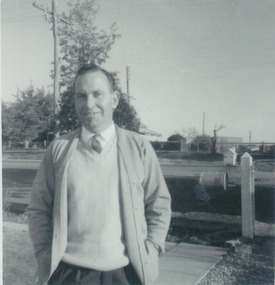
... The cassette tape is black with a horizontal white strip and is currently stored in a clear flat plastic rectangular container. It holds up 40 minutes of recordings on each side. John Watson Audio ...John Watson's story shows insight to the families that moved to Beechworth and the motivation behind this. It showcases the nuances of life in the district and the day to day ways of living. This history speaks of land cultivation and the innovation of industry in the region, in particular cattle farming and butchering. Watson's account speaks of the way that the practice of breeding cattle effects the rural lifestyle, and the hardships that come with working on the land. This oral history recording was part of a project conducted by Jennifer Williams in the year 2000 to capture the everyday life and struggles in Beechworth during the twentieth century. This project involved recording seventy oral histories on cassette tapes of local Beechworth residents which were then published in a book titled: Listen to what they say: voices of twentieth century Beechworth. These cassette tapes were digitised in July 2021 with funds made available by the Friends of the Burke.Watson's account is historically significant due to its ability to illustrate the lifestyle and industry of those in Beechworth during the twentieth century. It is a rare insight into the the practices of residents of this time. This oral history also shows deep insight into the social structure of the community. It describes the family and community dynamics over a long period of time, the motivations behind behaviour, and the greater community fabric. This is a digital copy of a recording that was originally captured on a cassette tape. The cassette tape is black with a horizontal white strip and is currently stored in a clear flat plastic rectangular container. It holds up 40 minutes of recordings on each side.John Watson1800s beechworth, 20th century beechworth, beechworth, farming and agriculture, farm, farm work, farmers, farming, cattle, industry, oral history, john watson -
 The Beechworth Burke Museum
Audio - Oral History, Jennifer Williams, Wilma Wells, 10th February 2000
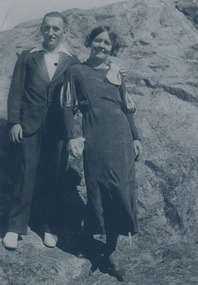
... The cassette tape is black with a horizontal white strip and is currently stored in a clear flat plastic rectangular container. It holds up 40 minutes of recordings on each side. Wilma Wells Audio ...Born on the 24th of December 1912 at the Three Mile was Wilma Wells. Her mother born into English heritage bore four children, one who died shortly after birth, while her father had Irish heritage and worked at May Day Hills as a warden and a nurse. Wilma married Ted Wells when she was 23 and subsequently had two daughters. This oral history recording was part of a project conducted by Jennifer Williams in the year 2000 to capture the everyday life and struggles in Beechworth during the twentieth century. This project involved recording seventy oral histories on cassette tapes of local Beechworth residents which were then published in a book titled: Listen to what they say: voices of twentieth century Beechworth. These cassette tapes were digitised in July 2021 with funds made available by the Friends of the Burke. Wilma Wells account of her life during the 20th century is historically and socially significant to the cultural heritage of Beechworth and the surrounding regions. She details important historical places and hardships within the region that have a lasting impact which includes but is not limited to issues with race, women's societal expectations and economic struggles. This oral history account is socially and historically significant as it is a part of a broader collection of interviews conducted by Jennifer Williams which were published in the book 'Listen to what they say: voices of twentieth-century Beechworth.' While the township of Beechworth is known for its history as a gold rush town, these accounts provide a unique insight into the day-to-day life of the town's residents during the 20th century, many of which will have now been lost if they had not been preserved.This is a digital copy of a recording that was originally captured on a cassette tape. The cassette tape is black with a horizontal white strip and is currently stored in a clear flat plastic rectangular container. It holds up 40 minutes of recordings on each side.Mrs Wilma Wells /beechworth, may day hills, oral history, burke museum, wilma wells, hospital, listen, weddings, three mile, picnic -
 The Beechworth Burke Museum
Audio - Oral History, Jennifer Williams, Isabel Wells, 24th February 2000
... The cassette tape is black with a horizontal white strip and is currently stored in a clear flat plastic rectangular container. It holds up 40 minutes of recordings on each side. Isabel Wells Audio ...Isabel Wells was born in Beechworth in 1914. Her father, Mr. Newey, was a butcher; his shop was in Ford street and he took over from his grandfather. The family business, along with the local residents, was supplying the main government institutions in the region, like Mayday Hills Hospital and The Ovens and Murray Home, making a large percentage of his profit. Mr. Newey was also a captain of the fire brigade and Isabel mentioned that there were more fires happening in those days. The menace of a huge fire was impending in Beechworth for many years, due to the lack of adequate water supply and the absence of trained firefighters. The first fire brigade in the town was voluntary and was formed in 1858 under Superintendent Luke Reilly. A few other schemes deployed the following years, with all failing to sufficiently control the fires that occurred, until the creation of the first reliable fire brigade in the 1870s. The worst fire in the town's history happened on 23rd March 1867; it swept through many shops and the post office, leaving behind a damage cost estimated at £12,000. Isabel's mother was in a wheelchair, suffering from osteoarthritis; thus, Isabel had taken over the responsibility for looking after her mother and assisting her with daily living needs and personal care activities. She used to play golf and tennis and she was a member of the town tennis club. In terms of social life, Boxing Day was a big occasion for the town, with horse-races and games taking place. According to her narration, the use of cars was a turning point in the town's social activities, since people were able to visit nearby places and take day trips, such as having a picnic at Lake Kerferd or Buffalo. This oral history recording was part of a project conducted by Jennifer Williams in the year 2000 to capture the everyday life and struggles in Beechworth during the twentieth century. This project involved recording seventy oral histories on cassette tapes of local Beechworth residents which were then published in a book titled: Listen to what they say: voices of twentieth century Beechworth. These cassette tapes were digitised in July 2021 with funds made available by the Friends of the Burke. Isabel's account of her life in Beechworth and the local area during the 20th century is historically and socially significant as it offers valuable information about the business activity in the region and provides a deeper insight into the operation of butcher shops and meat supply during the first half of the previous century. Additionally, it offers invaluable information about the everyday life of people living in Beechworth, and highlights aspects of the overall social life and activities.This is a digital copy of a recording that was originally captured on a cassette tape. The cassette tape is black with a horizontal white strip and is currently stored in a clear flat plastic rectangular container. It holds up 40 minutes of recordings on each side.Mrs Isabel Wells/ isabel wells, beechworth, mr. newey, ford street, butcher, mayday hills hospital, the ovens and murray home, fire brigade, 23rd march 1867, fire, osteoarthritis, boxing day, horseraces, lake kerferd, buffalo, picnic, cars, firefighters, luke reilly, wheelchair -
Federation University Historical Collection
Audio, Reel of audio
... Audio...Reel...Jack Barker...Magnetophonband BASF...Standard Tape...School of Mines is a predecessor of Federation University School of Mines Audio Reel Jack Barker Magnetophonband BASF Standard Tape list stuck with tape on the front of recordings with Date for B'Cast, Dur, played(removed and placed inside box) Audio reel in red and white box Reel of audio Audio ...School of Mines is a predecessor of Federation UniversityAudio reel in red and white box list stuck with tape on the front of recordings with Date for B'Cast, Dur, played(removed and placed inside box)school of mines, audio, reel, jack barker, magnetophonband basf, standard tape -
Federation University Historical Collection
Audio - Cassete, Music by Kerrin Whiting, 2004
... I believe they will be left to reflect and ponder possible solutions.' lucato peace prize music kerrin whiting Casette tape of music by Keerin Whiting. This work won the 2004 Lucato Peace Prize. Music by Kerrin Whiting Audio Cassete Kerrin Whiting ...The 2004 Lucato Peace Prize was won with a song by musical theatre student Kerrin Whiting who said: 'song has been a vital tool in communicating messages and emotions. In musicals, a song takes the place of a dialogue when the emotion is so intense, it cannot be expressed with just words. With the brief that 'Peace is Always Better Than War', I found the key word was ALWAYS. I used music and lyrics to address a child and the future, while the chorus is thought provoking for a present audience. I believe they will be left to reflect and ponder possible solutions.'Casette tape of music by Keerin Whiting. This work won the 2004 Lucato Peace Prize.lucato peace prize, music, kerrin whiting -
 Flagstaff Hill Maritime Museum and Village
Machine - Voice Recorder, Thomas A. Edison, Edison Laboratory, 1916-1929
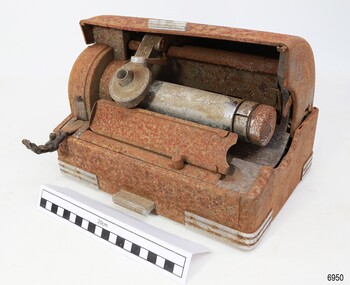
... It was the forerunner of audio tapes and digital technology. The Ediphone enabled letters to be dictated when the time and place suited and reduced the time professionals needed to spend with their secretaries. ...This Edison Ediphone voice recording electronic business machine is manufactured to suit a small office and is light enough to carry between work and home for use outside normal business hours. It is a dictation machine, also called by the competitor’s brand name ‘Dictaphone’, and is used for recording spoken words that would later be transcribed and typewritten. A wax cylinder would be installed onto the machine’s drum and the Reproducer on the machine would be lowered onto the cylinder. The user would speak a message into a microphone and the reproducer would then convert the sounds to scribed marks on the cylinder. Later, the cylinder could be played and the Reproducer would enable the sound to be amplified through an attached speaker. This machine is currently without its power cord, microphone and speaker horn. Thomas A. Edison extended the technology of the telegraph to his phonograph machine, invented in the late 19th century. It could record and play back sounds of music and voice on a manually operated mechanical machine that used wax cylinders to store the sound. He envisaged the way this technology could be an asset in the office, and he was right! However, most of his phonograph machines were used for entertainment, some for playing lessons, and some for-teaching languages. In 1916 Edison introduced the Ediphone, which grew in popularity after the First World War and into the late 1920s until flat round records replaced the wax cylinders. This Edison Ediphone is significant for improving the way business administration was carried out in the early 20th century, freeing up precious time for professionals and administrative personnel. It was the forerunner of audio tapes and digital technology. The Ediphone enabled letters to be dictated when the time and place suited and reduced the time professionals needed to spend with their secretaries. Secretaries were able to type the letters as they played the recording and they could replay the message if necessary.Voice recorder; a dictation machine; desktop model Edison Ediphone. The electronic machine is in a medal case with remnants of the original grey colour. It has a rectangular base with an A4-sized footprint and a domed hood that retracts halfway into the back of the base. The corners of the base have metal reinforcing, and a short metal bar is on the front centre edge of the lid and the base. A long metal drum is mounted inside the machine. A round device called a ‘reproducer’ is mounted above the drum. There is a folding handle on the left front of the machine and an angled stand with paper guides in front of the drum. A rear cover has the maker’s name stamped on it. An electrical socket with eight pins is recessed beside the cover. Made by Edison.In white letters; “EDISON”flagstaff hill, warrnambool, maritime village, maritime museum, shipwreck coast, great ocean road, edison, ediphone, dictating machine, office equipment, voice recorder, usa, dictation, communication, office machine, dictaphone, speaking phonograph, thomas edison, ediphone voicewriter, voice writer -
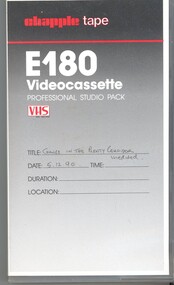 Greensborough Historical Society
Film - Video Cassette, John Ramsdale, Change in the Plenty corridor, 05/12/1990
... Part of the John Ramsdale collection of slides and audio visual material. plenty river plenty gorge "Chapple E180 videocassette" and "Change in the Plenty corridor unedited 5.12.90" VHS video tape, 2 copies. ...Video of a fieldwork for teachers, taken by John Ramsdale in 1990, investigating changes along the Plenty River.Part of the John Ramsdale collection of slides and audio visual material.VHS video tape, 2 copies."Chapple E180 videocassette" and "Change in the Plenty corridor unedited 5.12.90"plenty river, plenty gorge -
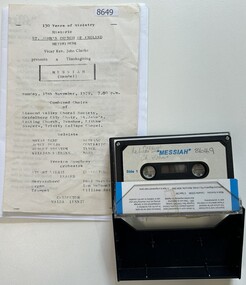 Greensborough Historical Society
Mixed media - Audio Cassette and Program, Diamond Valley Choral Society, Handel's Messiah, performed by Diamond Valley Choral Society 1979, 18/11/1979
... This performance by the Diamond Valley Choral Society and combined choirs was recorded at St John's Church of England, Heidelberg 18/11/1979 to celebrate 150 years of ministry at St John's. diamond valley choral society Messiah (oratorio) st john's church of england heidelberg Handwritten on case: "79 Messiah - St Johns, Commercial tape" 2 audio cassettes in clear plastic case and 3 copies of a printed program Handel's Messiah, performed by Diamond Valley Choral Society 1979 Mixed media Audio Cassette and Program Diamond Valley Choral Society ...A recording of 'Messiah', an English language oratorio by George Frederic Handel, composed in 1741. The text was compiled from the King James Bible; it contains 3 parts and part 2 ends with the 'Hallelujah' chorus. This performance by the Diamond Valley Choral Society and combined choirs was recorded at St John's Church of England, Heidelberg 18/11/1979 to celebrate 150 years of ministry at St John's. 2 audio cassettes in clear plastic case and 3 copies of a printed programHandwritten on case: "79 Messiah - St Johns, Commercial tape"diamond valley choral society, messiah (oratorio), st john's church of england heidelberg -
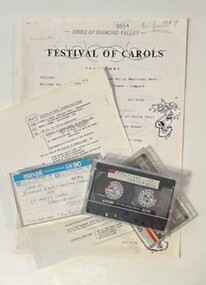 Greensborough Historical Society
Mixed media - Audio Cassette and Program, Diamond Valley Choral Society, Shire of Diamond Valley Festival of Carols, performed by Diamond Valley Choral Society 1989, 10/12/1989
... This performance is by the Diamond Valley Choral Society. diamond valley choral society christmas music diamond valley carols Handwritten on cassette: Tape 1: "DV Shire Carols 1989"; Tape 2: "Festival of carols"; Tape 3: "Dv Christmas carols 10.12.89, taped by Ray Briggs of Watsonia". 3 audio cassettes in clear plastic cases, program and 2 draft programs. ...A recording of Shire of Diamond Valley Carols, December 1989. This performance is by the Diamond Valley Choral Society.3 audio cassettes in clear plastic cases, program and 2 draft programs.Handwritten on cassette: Tape 1: "DV Shire Carols 1989"; Tape 2: "Festival of carols"; Tape 3: "Dv Christmas carols 10.12.89, taped by Ray Briggs of Watsonia".diamond valley choral society, christmas music, diamond valley, carols -
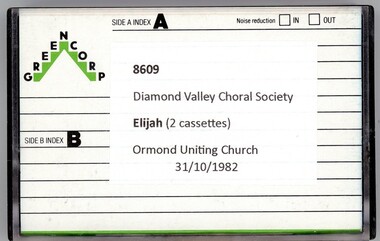 Greensborough Historical Society
Audio - Audio Cassette, Diamond Valley Choral Society, Elijah, performed by Diamond Valley Choral Society, 1982
... Tape 1"; on cassette 2: "Elijah, Ormond Uniting Church. 31-10-82" 2 audio cassettes in clear plastic cases Elijah, performed by Diamond Valley Choral Society Audio Audio Cassette Diamond Valley Choral Society ...A recording of 'Elijah', an oratorio by Felix Mendelssohn, first performed in 1846, depicting events in the life of the Prophet Elijah as told in the Old Testament book of Kings. The work is scored for eight vocal soloists (two each of bass, tenor, alto and soprano). This performance by the Diamond Valley Choral Society was recorded at Ormond Uniting Church in 1982.2 audio cassettes in clear plastic casesHandwritten on cassette 1: "Elijah. Ormond. Tape 1"; on cassette 2: "Elijah, Ormond Uniting Church. 31-10-82"diamond valley choral society, elijah (oratorio), ormond uniting church -
 Greensborough Historical Society
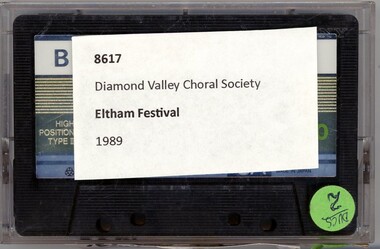
Audio - Audio Cassette, Diamond Valley Choral Society, Eltham Festival, performed by Diamond Valley Choral Society 1989, 1989
... DVCS backing tape". 1 audio cassette in clear plastic case Eltham Festival, performed by Diamond Valley Choral Society 1989 Audio Audio Cassette Diamond Valley Choral Society ...A recording of a backing tape for the Eltham Festival 1989. This performance is by the Diamond Valley Choral Society.1 audio cassette in clear plastic caseHandwritten on cassette: "Tracks 1-4. DVCS backing tape".diamond valley choral society, eltham festival -
 Greensborough Historical Society
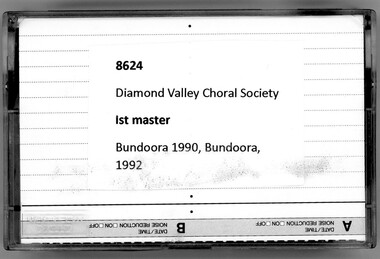
Audio - Audio Cassette, Diamond Valley Choral Society, Concerts, performed by Diamond Valley Choral Society 1990 and 1992, 1990-1992
... tape of songs performed at Bundoora in 1990 and 1992. This performance is by the Diamond Valley Choral Society. diamond valley choral society bundoora Handwritten on cassette: "Tks 1, 2, 3, 4 B'dra. Aug 1992"; on case: "Bundoora 2, 5.6.90 mix". 1 audio ...A master tape of songs performed at Bundoora in 1990 and 1992. This performance is by the Diamond Valley Choral Society. 1 audio cassette in clear plastic caseHandwritten on cassette: "Tks 1, 2, 3, 4 B'dra. Aug 1992"; on case: "Bundoora 2, 5.6.90 mix".diamond valley choral society, bundoora -
 Greensborough Historical Society
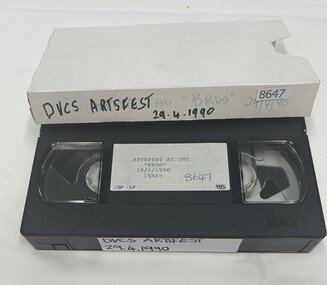
Audio - Video Cassette, Diamond Valley Choral Society, ArtsFest 1990, performed by Diamond Valley Choral Society, 24/09/1990
... This performance by the Diamond Valley Choral Society was recorded on 24/09/1990. diamond valley choral society ARTSFEST 1990 Handwritten on case: "DVCS ArtsFest 29.4.1990"; typed on label affixed to tape; "ARTSFEST at the BRDO 29/04/1990". 1 video cassette (VHS) in cardboard case ArtsFest 1990, performed by Diamond Valley Choral Society Audio Video Cassette Diamond Valley Choral Society ...A video recording of the ArtsFest event. This performance by the Diamond Valley Choral Society was recorded on 24/09/1990.1 video cassette (VHS) in cardboard caseHandwritten on case: "DVCS ArtsFest 29.4.1990"; typed on label affixed to tape; "ARTSFEST at the BRDO 29/04/1990".diamond valley choral society, artsfest 1990 -
 Eltham District Historical Society Inc
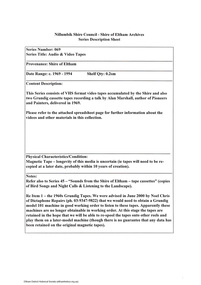
Document - Series Listing, Fraser Faithfull et al, Series 69: Audio & Video Tapes, 2000
... tapes recording a talk by Alan Marshall, author of Pioneers and Painters, delivered in 1969. Please refer to the attached spreadsheet page for further information about the videos and other materials in this collection. shire of eltham archives series listing A4 printout Series 69: Audio & Video Tapes Document Series Listing Fraser Faithfull Chris Marks ...This Series consists of VHS format video tapes accumulated by the Shire and also two Grundig cassette tapes recording a talk by Alan Marshall, author of Pioneers and Painters, delivered in 1969. Please refer to the attached spreadsheet page for further information about the videos and other materials in this collection.shire of eltham archives, series listing -
 Eltham District Historical Society Inc
Film - Video (VHS), Open Day Eltham Living and Learning Centre, 1988
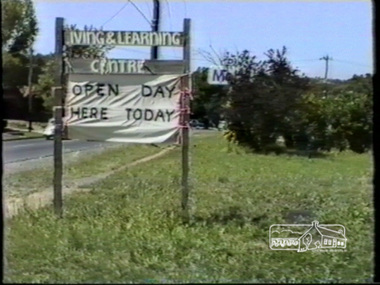
... tape noise/flicker and colour pulsing. Opens with Living & Learning Centre sign on Main Road and “Open Day Here Today” attached to it. Views of entrance into carpark, dog obedience class demonstration near entrance, leadlight construction display in workshop, basket weaving, face painting, exterior garden landscape with herb garden, brick pottery shed, peppercorn tree, children’s activities, interior views showing artworks of life drawings, general engagement with other people (audio), candle room, pottery, children’s entertainer in garden, wool spinning, some attempts at engagement with Claire Fitzpatrick, Thai Chi demonstration, floral presentations, patchwork, needlepoint, knitting, some interior scenes very dark, weaving, cane basket weaving....tape noise/flicker and colour pulsing. Opens with Living & Learning Centre sign on Main Road and “Open Day Here Today” attached to it. Views of entrance into carpark, dog obedience class demonstration near entrance, leadlight construction display in workshop, basket weaving, face painting, exterior garden landscape with herb garden, brick pottery shed, peppercorn tree, children’s activities, interior views showing artworks of life drawings, general engagement with other people (audio), candle room, pottery, children’s entertainer in garden, wool spinning, some attempts at engagement with Claire Fitzpatrick, Thai Chi demonstration, floral presentations, patchwork, needlepoint, knitting, some interior scenes very dark, weaving, cane basket weaving. eltham living and learning centre open day dog obedience class leadlight basket weaving face painting artworks life drawing candle room pottery wool spinning claire fitzpatrick thai chi patchwork needlepoint knitting weaving cane basket weaving main road eltham video recording Shire of Eltham Archives VHS Video cassette (poor quality) Converted to MP4 file format 00:31:39; 746MB Open Day Eltham Living and Learning Centre Film Video (VHS) ...This cottage-like dwelling has changed ownership several times since it was first built in the 1850s by local tanner John Pearson. The Living and Learning Centre as we know it today is the product of the energetic, reforming era of the Whitlam Government. Set up by the local council in 1974. Unedited amateur video (filmed by Vivienne?) with some voiceover and chatting with others. Significant VHS tape noise/flicker and colour pulsing. Opens with Living & Learning Centre sign on Main Road and “Open Day Here Today” attached to it. Views of entrance into carpark, dog obedience class demonstration near entrance, leadlight construction display in workshop, basket weaving, face painting, exterior garden landscape with herb garden, brick pottery shed, peppercorn tree, children’s activities, interior views showing artworks of life drawings, general engagement with other people (audio), candle room, pottery, children’s entertainer in garden, wool spinning, some attempts at engagement with Claire Fitzpatrick, Thai Chi demonstration, floral presentations, patchwork, needlepoint, knitting, some interior scenes very dark, weaving, cane basket weaving.VHS Video cassette (poor quality) Converted to MP4 file format 00:31:39; 746MBeltham living and learning centre, open day, dog obedience class, leadlight, basket weaving, face painting, artworks, life drawing, candle room, pottery, wool spinning, claire fitzpatrick, thai chi, patchwork, needlepoint, knitting, weaving, cane basket weaving, main road, eltham, video recording, shire of eltham archives -
 Kiewa Valley Historical Society
VHS Tape - Kiewa Hydro Electricity Scheme x2, Kiewa, Circa 1990
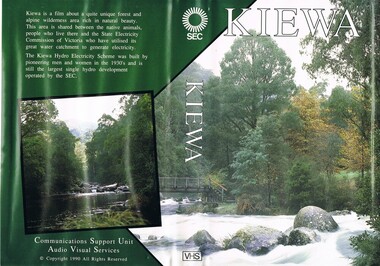
... Kiewa VHS Tape - Kiewa Hydro Electricity Scheme x2 Audio Visual Services The State Electricity Commission of Victoria ...This VHS was produced by the State Electricity Commission of Victoria, to show the pristine state of the Kiewa River and Valley post the completion of the Kiewa Hydro Electricity Scheme (Circa 1950s), The late 1970s on wards was the beginning of deeper social scrutineering by pro environmental groups such as the Australian Wilderness Society (1976) and the Greens (political Party), before, during and after the construction phases of any man made structures in forest/bush areas which may or could damage or adversely affect the natural flora and fauna of sites. This promotional VHS, which was produced in the 1990s, was to project that unlike the Tasmanian State Electricity Commission (Franklin Dam issue), the Victorian State Electricity Commission acted in a way to protect the environment to the maximum level possible. With the passage of time since, and the issue of the global push to minimise carbon pollution, and as an alternative to coal fired power stations, the use of hydro electricity can now be seen as a highly efficient alternative to "coal powered" electricity. This VHS is a snap shot in time (1990) when the Kiewa Valley was still relatively under populated and holiday houses owned by city bound workers was still relatively insignificant. As more and more holiday makers retire to a small but friendly region(Kiewa Valley and Mount Beauty) the increase in visitor numbers will affect the local rural bush scene more and more. The changes that will occur (in time) can be measured against the scenes presented in this video. The additional resources provided by the State Electricity Commission of Victoria of "alpine bush" fire control and management, together with an ongoing educational scheme for school children in learning about what constitutes the Alpine country's unique environment, are a very important offshoot, benefitting to both the communities within the Kiewa Valley and regional Victoria.This VHS tape is stored within its own plastic cover which has a front side covered by a coloured photograph(both front and back cover) of the Kiewa River, just to the north east of the Mount Beauty township. The VHS tape is nestled within a formed inner structure which not only prevents the tape from moving to and fro but also unnecessary intrusion of foreign particles.Front cover "KIEWA" on the spine top circle with lines projecting out and below this "SEC". Middle of spine "KIEWA" and bottom of spine "VHS"secv, kiewa valley, dale-bromley, cy-duff, chris- harding, michael-glucz, forestation education, wilderness photography, nature film. -
4th/19th Prince of Wales's Light Horse Regiment Unit History Room
Audio - Audio Cassette, Army Tracks, abt 1996
... 4/19 PWLH Regiment Band Audio TDK SA90 Philips cassette tape. Side 1: 1. 4/19 PWLH Band (WO2 V Smith) - Australian Light Horse, Lynwood 2. ...Philips cassette tape. Side 1: 1. 4/19 PWLH Band (WO2 V Smith) - Australian Light Horse, Lynwood 2. HQ RAA Band (WO2 G Brown) - Soldiers of the Queen, British Grenadiers 3. 1 Bn RVR (WO2 R Rooth) -The Northumbrian, Our Director Side 2: 5 Bn RVR - Pipe Major D Bail - Medley 1 : Gin I were a Baron's heir, The lady in the bottle, Glasgow Police piper, The Rohan tree, Scotland the brave, Medley 2 - Drummers introduction, Braes of Mar, Braes of Tully Met, Dalnahassaig, Piper of Drummond, High Road to Linton, Jock Wilson's Ball, The mermaid song, Donald, Willy and his dog, Ode to Joy, The Black Bear TDK SA904/19 pwlh regiment band, audio
