
Showing 490 items matching "bottle stopper"
-
 Kiewa Valley Historical Society
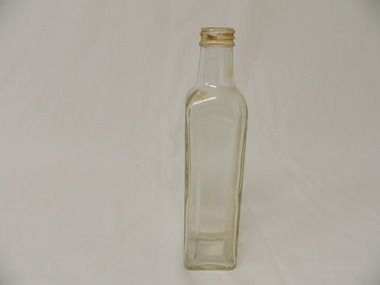
Bottle - Coffee / Chicory, 1950's
... The shape of the bottles changed as did he stopper used to seal it....The shape of the bottles changed as did he stopper used to seal it. Historical: Change of bottles - shape, glass, stopper, embossing, use Aesthetic: Display showing embossing and shape. bottle coffee chicory sauce household Base: Common seal: An 'A' with 'G' in the top half (of the A) and 'M' in the bottom half. ...Coffee / chicory and sauce were stored in bottles bought locally or at a large city store on a shopping expedition. The shape of the bottles changed as did he stopper used to seal it.Historical: Change of bottles - shape, glass, stopper, embossing, use Aesthetic: Display showing embossing and shape.Clear glass bottle used for storing coffee / chicory or sauce. The base is a square. The 4 sides are straight for two thirds of the way up then taper quickly to the neck and then the screw top opening. It is embossed on the base. The base is slightly indented.Base: Common seal: An 'A' with 'G' in the top half (of the A) and 'M' in the bottom half. Below this and across the middle '1129' and 'M' underneath. '807' is in one corner.bottle, coffee, chicory, sauce, household -
 Kiewa Valley Historical Society
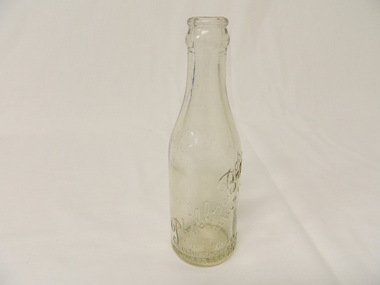
Bottle - Soft Drink, Late 1920's - 1930's
... The shape of the bottles changed as did the stopper used to seal it. Bottles were re-cycled remaining the property of the manufacturer. ...Historical: Change of bottles - shape, glass, stopper, embossing, use. Aesthetic: Display showing embossing, shape and size. bottle ginger beer soft drink phibbs bros albury drink household Side: 'Phibbs Bros / Albury' Side around the bottom: 'This Bottle / Is the Property of / Phibbs Bros Albury' Small clear glass bottle with heavy embossing. ...Soft drink came in bottles bought at the local grocery store or at a large city store on a shopping expedition. The shape of the bottles changed as did the stopper used to seal it. Bottles were re-cycled remaining the property of the manufacturer. History of Phibbs Bros., Albury.Historical: Change of bottles - shape, glass, stopper, embossing, use. Aesthetic: Display showing embossing, shape and size.Small clear glass bottle with heavy embossing. The straight sides go half way up then taper to the opening. The manufacturer's name is written diagonally across one side with 'Albury' printed in capital letters underneath. On the same side three lines of words are printed in capital letters. The base has light embossing.Side: 'Phibbs Bros / Albury' Side around the bottom: 'This Bottle / Is the Property of / Phibbs Bros Albury'bottle, ginger beer, soft drink, phibbs bros albury, drink, household -
 Kiewa Valley Historical Society
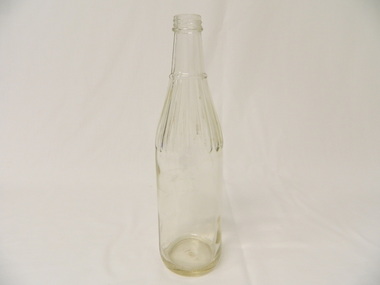
Bottle - Cordial, 1940's
... The shape of the bottles changed as did the stopper used to seal it. Bottles were re cycled remaining the property of the manufacturer. ...Historical: Change of bottles - shape, glass, stopper, embossing, use Aesthetic: Display showing embossing and shape. cordial drink household o.t. ltd. australia Around bottom: 'This Bottle Always (number '2' above Always) Remains the Property of O.T. ...Cordial drinks came in bottles bought at the local grocery store or at a large city store on a shopping expedition. The shape of the bottles changed as did the stopper used to seal it. Bottles were re cycled remaining the property of the manufacturer. History of O. T. Ltd., Australia.Historical: Change of bottles - shape, glass, stopper, embossing, use Aesthetic: Display showing embossing and shape.Clear glass cordial bottle with straight sides half way up. Gently tapered with embossed vertical lines to the neck which continues tapering to the lip and screw top. Heavily embossed with print in capital letters around the circumference at the bottom.Around bottom: 'This Bottle Always (number '2' above Always) Remains the Property of O.T. Limited Australia' Base: Common Seal: 'A' with M in bottom half of A) - at top. Then across the middle - 'F1282' and 'M' underneathcordial, drink, household, o.t. ltd. australia -
 Kiewa Valley Historical Society
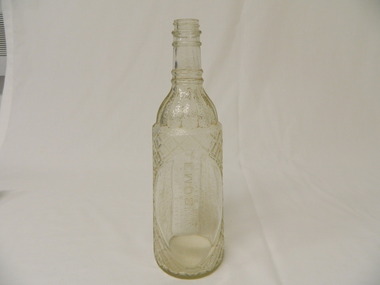
Bottle - Cordial, 1940's
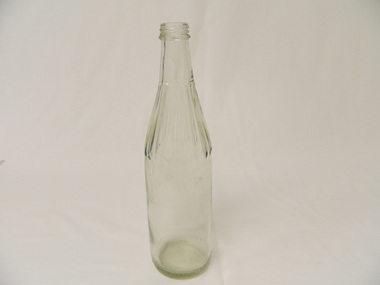
... The shape of the bottles changed as did the stopper used to seal it. Bottles were re cycled remaining the property of the manufacturer. ...Historical: Change of Bottles - shape, glass, stopper, embossing. Bottle collectors. ...Cordial came in bottles bought at the local grocery store or at a large city store on a shopping expedition. The shape of the bottles changed as did the stopper used to seal it. Bottles were re cycled remaining the property of the manufacturer. History of Brookes Lemos ltd.Historical: Change of Bottles - shape, glass, stopper, embossing. Bottle collectors. Aesthetic: Display showing embossing and shape Clear glass bottle curved on 1 side with criss cross pattern two thirds of the way up surrounding a clear oval shape with narrower ends top and bottom. The other side is made up of 3 flat 'pieces' each with print in capital letters, heavily embossed. On 1 of these flat sides below the writing is the 'outline picture' of a 'boy' holding a similar bottle. Above these sides the bottle becomes round and tapers with vertical embossing to a double lip, a neck and then another double lip with a screw for the top.Printed from top to bottom: 1 flat side: 'Regd Design No 9072 Australia No 8449 India / No 689933 Great Britain No / 1926 Union of South Africa / No 57737 U S America No 1921 New Zealand Regd 1925 Canada / Only Contents Sold'. Middle flat side: 'Brookes Lemos Limited / Manufacturers of / Lemos / Registered Trade Mark' Third flat side: 'This Bottle is the Property / Brookes Lemos Limited and / Cannot be Legally Used / By Others For Any Purpose.' Also outline picture of boy Base: 'F380'cordial, drink, bottle, brookes lemos ltd. -
 Kiewa Valley Historical Society
Bottle - Cordial, 1950's - 1960's
... The shape of the bottles changed as did the stopper used to seal it. Bottles were re cycled remaining the property of the manufacturer. ...Historical: Change of bottles - shape, glass, stopper, embossing, use Aesthetic: Display showing embossing and shape. cordial drinks bottle o.t. ltd. australia household Circumference around bottom: 'This Bottle Always (number '2' above Always) Remains The Property of O.T. ...Cordial drinks came in bottles bought at the local grocery store or at a large city store on a shopping expedition. The shape of the bottles changed as did the stopper used to seal it. Bottles were re cycled remaining the property of the manufacturer. History of O. T. Ltd. Australia.Historical: Change of bottles - shape, glass, stopper, embossing, use Aesthetic: Display showing embossing and shape.Clear glass cordial bottle with straight sides half way up. Gently tapered with embossed vertical lines to neck which continues tapering to a lip and then screw top. Heavily embossed with print in capital letters around the circumference at the bottom.Circumference around bottom: 'This Bottle Always (number '2' above Always) Remains The Property of O.T. Limited Australia' Base: Common seal on top 'A' with 'M' in bottom half of the 'A'. Across middle: 'ISM 83' and '2' belowcordial, drinks, bottle, o.t. ltd. australia, household -
 Kiewa Valley Historical Society
Bottle - Preserves, 1920's
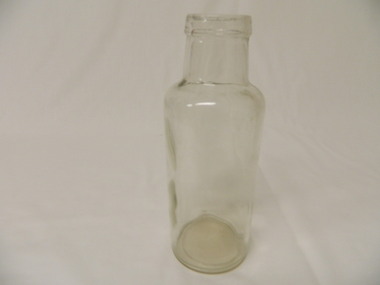
... The shape of the bottles changed as did the stopper used to seal it. This bottle may have been re used for home made preserves....Historical: Change of bottles - shape, glass, stopper, use Aesthetic: Display showing shape and size glass bottle chutney pickles preserves household Clear glass bottle used for storing pickles or chutney and sealed with a cork. ...Chutney and pickles came in bottles at the local grocery store or at a large city store on a shopping expedition. The shape of the bottles changed as did the stopper used to seal it. This bottle may have been re used for home made preserves.Historical: Change of bottles - shape, glass, stopper, use Aesthetic: Display showing shape and sizeClear glass bottle used for storing pickles or chutney and sealed with a cork. Straight sides are 3 quarters of the way up tapering quickly into a neck and then the opening. The bottle has been joined longitudinally in 2 halves. There is no embossing.glass bottle, chutney, pickles, preserves, household -
 Kiewa Valley Historical Society
Bottle - Preserves, 1940's
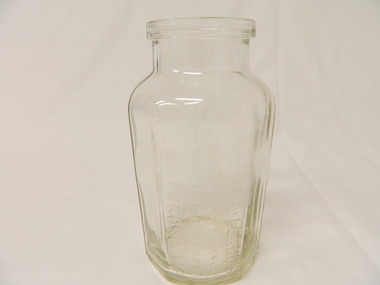
... The shape of the bottles changed as did the stopper used to seal it. Bottles were re cycled remaining the property of the manufacturer. ...Historical: Change of bottles - shape, glass, stopper, embossing, use Aesthetic: Display showing embossing and shape. glass bottle glass jar preserves jams pickles household h.m.leggo & co. ltd. ...Preserves came in glass bottles / jars bought at the local grocery store or at a large city store on a shopping expedition. The shape of the bottles changed as did the stopper used to seal it. Bottles were re cycled remaining the property of the manufacturer. History of H.M.Leggo & Co. Ltd..Historical: Change of bottles - shape, glass, stopper, embossing, use Aesthetic: Display showing embossing and shape.Clear glass bottle or jar used for preserves such as pickles and jams. The base has 10 equal sides and the sides are straight with a slight slant outwards before tapering in to a short neck and lip near the opening. Heavily embossed on 2 side panels with print in capital letters and read from top to bottom.Side: "To Contain Only Leggo's / Jams Pickles & Preserves / This Bottle is the Property / of H.M.Leggo & Co. Ltd." Base: '749' and 'M ...?'glass bottle, glass jar, preserves, jams, pickles, household, h.m.leggo & co. ltd. -
 Kiewa Valley Historical Society
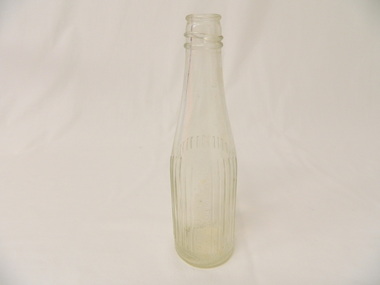
Bottle - Sauce, Late 1930's
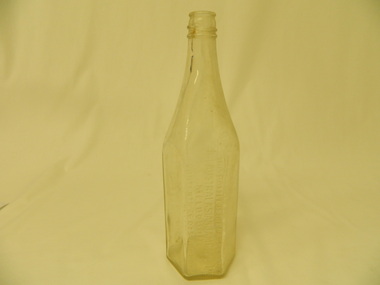
... The shape of the bottles changed as did the stopper used to seal it. Bottles were re cycled remaining the property of the manufacturer. ...The shape of the bottles changed as did the stopper used to seal it. Bottles were re cycled remaining the property of the manufacturer. ...Sauce came in bottles bought at the local grocery store or at a large city store on a shopping expedition. The shape of the bottles changed as did the stopper used to seal it. Bottles were re cycled remaining the property of the manufacturer. History of Australasian Jam Co. Pty Ltd, MelbourneHistorical: Change of bottles - shape, glass, embossing, use Aesthetic: Display showing embossing and shapeClear glass sauce bottle with straight sides a little more than half way up. This bottle is a hexagon at the base and along the straight sides. The bottle then tapers to the opening reaching a lip near the screw top opening. One of the 6 sides is heavily embossed with printed capital letters reading sideways from top to bottom of the bottle. There is embossing on the base.Side: "This Bottle is the Property of / The Australasian Jam Co Pty Ltd / Melbourne / Contents 26 ozs Approx" Base: Common Seal "A" with 'G' inside top of 'A' and 'M' inside bottom half of 'A'. 'M257' is underneath the 'A' and across the middle. 'M' is underneath.glass bottle, sauce, jam, australasian jam co pty ltd melbourne -
 Kiewa Valley Historical Society
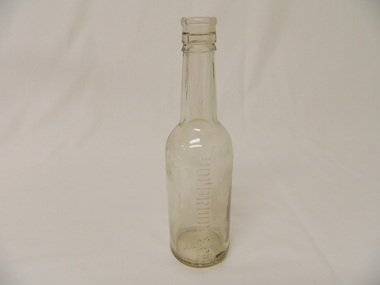
Bottle - Sauce, 1940's
... The shape and embossing of bottles changed as did the stopper used to seal it. Bottles were re cycled remaining the property of the manufacturer. ...Historical: Change of bottles - shape, glass, stopper, embossing Aesthetic: Display showing embossing, size, and shape. glass bottle sauce household fowlers vacola mfg. co. ltd. ...Sauce came in bottles bought at the local grocery store or a large city store on a shopping expedition. The shape and embossing of bottles changed as did the stopper used to seal it. Bottles were re cycled remaining the property of the manufacturer. History of Fowlers Vacola Mfg Co Ltd..Historical: Change of bottles - shape, glass, stopper, embossing Aesthetic: Display showing embossing, size, and shape.Small clear glass bottle with straight sides half way up before tapering to the lip and opening with a screw top. Straight sides have heavily embossed vertical lines. On one side 2 long lines are bordered by short ones along the bottom and have varying lengths (slightly) along the top. On the other side there are 6 long lines slightly different lengths on either side of heavily embossed print in capital letters read from top to bottom of the bottle. Embossed on the base.Side: 'Property of Fowlers / Vacola Mfg Coy Ltd' Base: '169' with 'M' underneathglass bottle, sauce, household, fowlers vacola mfg. co. ltd. -
 Kiewa Valley Historical Society
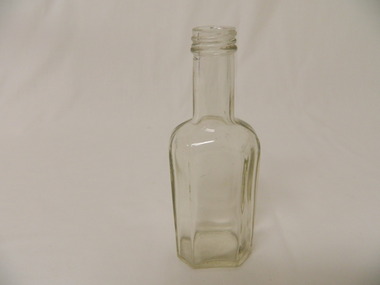
Bottle - Sauce, 1920's
... The shape, size and embossing of bottles changed as did the stopper used to seal it. Bottles were re cycled remaining the property of the manufacturer. ...bottle. Heavily embossed along the circumference at the bottom. Sides taper quickly to a long straight neck to a lip near the opening. On the inside of the opening there is a lip a little way down. Sealed with a glass stopper...History of Holbrook & Co and of Vulcan Historical: Change of bottles - shape, embossing, stopper Aesthetic: Display showing embossing, size and shape glass bottle sauce holbrook & co. vulcan household Side - vertically read from top to bottom: 'Holbrook & Co' Along bottom: 'This Bottle is the Property of Holbrooks A(sia) Ltd' There is a '3' above 'Holbrooks' Base: 'Vulcan' Clear glass bottle with straight sides two thirds of the way up. ...Sauce came in bottles bought at the local grocery store or at a large city store on a shopping expedition. The shape, size and embossing of bottles changed as did the stopper used to seal it. Bottles were re cycled remaining the property of the manufacturer. History of Holbrook & Co and of VulcanHistorical: Change of bottles - shape, embossing, stopper Aesthetic: Display showing embossing, size and shapeClear glass bottle with straight sides two thirds of the way up. Heavily embossed reading from top to bottom down the side of the bottle. Heavily embossed along the circumference at the bottom. Sides taper quickly to a long straight neck to a lip near the opening. On the inside of the opening there is a lip a little way down. Sealed with a glass stopper with cork. Embossed on the base.Side - vertically read from top to bottom: 'Holbrook & Co' Along bottom: 'This Bottle is the Property of Holbrooks A(sia) Ltd' There is a '3' above 'Holbrooks' Base: 'Vulcan'glass bottle, sauce, holbrook & co., vulcan, household -
 Kiewa Valley Historical Society
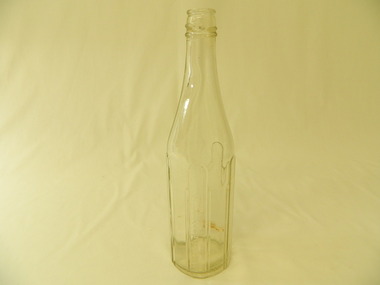
Bottle - Sauce, 1940's
... The shape and size of bottles changed as did the stopper used to seal it....The shape and size of bottles changed as did the stopper used to seal it. Historical: Change of bottles - shape, size,stopper Aesthetic: Display showing embossing, shape, size. glass bottle sauce household Base: '866' with 'M' underneath Clear glass bottle 8 sided - 3 equal sides at each end and sides front and back twice as long as each of the 3 sides. ...Sauce came in bottles bought at the local grocery store or at a large city store on a shopping expedition. The shape and size of bottles changed as did the stopper used to seal it.Historical: Change of bottles - shape, size,stopper Aesthetic: Display showing embossing, shape, size.Clear glass bottle 8 sided - 3 equal sides at each end and sides front and back twice as long as each of the 3 sides. Straight sides two thirds of the way up and one third is a straight neck. Embossing on the base. Screw top. 1860's shape.Base: '866' with 'M' underneathglass bottle, sauce, household -
 Kiewa Valley Historical Society
Bottle - Sauce, Late 1940's
... The shape and embossing on the bottle changed as did the stopper used to seal it. Bottles were re cycled remaining the property of the manufacturer. ...The shape and embossing on the bottle changed as did the stopper used to seal it. Bottles were re cycled remaining the property of the manufacturer. ...Sauce came in bottles bought at the local grocery store or at a large city store on a shopping expedition. The shape and embossing on the bottle changed as did the stopper used to seal it. Bottles were re cycled remaining the property of the manufacturer. History of Groves McVitty & Co. Pty. Ltd. Melbourne.Historical: Change of bottles - shape, glass, embossing, use Aesthetic: Display showing embossing and shape.Clear glass bottle with straight sides a little over half way up. These sides have 4 panels curved at the top equally spaced vertically around the sides with 1 panel seemingly missing. The panels are embossed onto the glass and have accentuated embossed sides. 1 panel is heavily embossed with print in capital letters. It has a screw top. The base is embossed. Side: 'The Property of / Groves McVitty & Co Pty Ltd Melb.' Base: 'The / Property of / Groves McVitty / & Co Pty Ltd / Melb.'sauce, glass bottle, groves mcvitty & co. pty ltd mebourne -
 Kiewa Valley Historical Society
Bottle - Sauce, Early 1930's
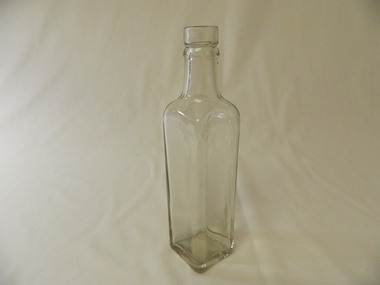
... The shape of the bottles changed as did the stopper used to seal it....bottle used for storing sauce, coffee or chicory. The base is square with a slight indent inwards and has embossing. The straight sides go two thirds of the way up, taper quickly to the neck and then form a lip and opening for a cork stopper....The shape of the bottles changed as did the stopper used to seal it. Historical: Change of bottles - shape, glass, stopper, embossing Aesthetic: Display showing embossing and shape glass bottle sauce coffee chicory household Base: 'M ?? ...Sauce & coffee / chicory was stored in bottles bought at the local grocery store or at a large city store on a shopping expedition. The shape of the bottles changed as did the stopper used to seal it.Historical: Change of bottles - shape, glass, stopper, embossing Aesthetic: Display showing embossing and shapeClear glass bottle used for storing sauce, coffee or chicory. The base is square with a slight indent inwards and has embossing. The straight sides go two thirds of the way up, taper quickly to the neck and then form a lip and opening for a cork stopper.Base: 'M ??6'glass bottle, sauce, coffee, chicory, household -
 Kiewa Valley Historical Society
Bottle - Sauce, 1940's - 1950's
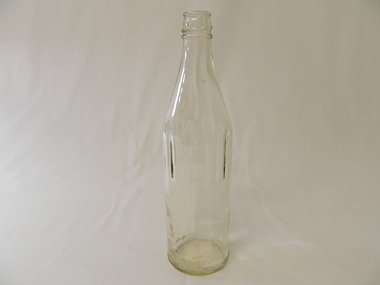
... The shape of the bottles changed as did the stopper used to seal it. Bottles were re cycled remaining the property of the manufacturer. ...Historical: Change of bottles - shape, embossing, stopper Aesthetic: Display showing embossing and shape glass bottle sauce rosella pres. & manuf. co. ltd. household 1 bubble in the glass on the tapered section. ...Sauce came in bottles bought at the local grocery store or at a large city store on a shopping expedition. The shape of the bottles changed as did the stopper used to seal it. Bottles were re cycled remaining the property of the manufacturer. History of Rosella Pres & Manuf. Co. Ltd.Historical: Change of bottles - shape, embossing, stopper Aesthetic: Display showing embossing and shapeClear glass bottle not quite round but oval with straight sides two thirds of the way up. The glass is clear for the first 2 thirds of the straight sides and then is patterned with long vertical ripples before it begins to taper in clear glass to the lip and the opening, which has a screw top. Embossed around the circumference along the bottom in printed capital letters and on the base.1 bubble in the glass on the tapered section. Side: 'Prop. of Rosella Pres. & Manuf. Coy. Ltd R.D.No. 9062' Base: Common seal on top (A with G and M inside) 'J367' across the middle and 'M' underneathglass bottle, sauce, rosella pres. & manuf. co. ltd., household -
 Kiewa Valley Historical Society
Bottle - Sauce, 1935
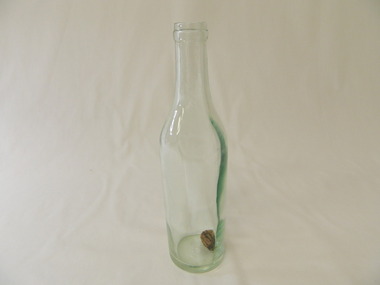
... The shape and size of the bottles changed as did the stopper used to seal it....The shape and size of the bottles changed as did the stopper used to seal it. Historical: Change of bottles - shape, size, stopper, embossing Aesthetic: Display showing shape and embossing. glass bottle sauce household Base: Common Seal 'A' with 'G' at top and 'M' below inside the A. ...Sauce came in bottles bought at the local grocery store or at a large city store on a shopping expedition. The shape and size of the bottles changed as did the stopper used to seal it.Historical: Change of bottles - shape, size, stopper, embossing Aesthetic: Display showing shape and embossing.Medium sized clear glass sauce bottle with straight sides two thirds of the way up then tapering to the neck and opening. Sealed by cork which is loose inside the bottle. Embossed at the base. Base: Common Seal 'A' with 'G' at top and 'M' below inside the A. Underneath and across the middle 'M559' and beneath 'M' '211' on edgeglass bottle, sauce, household -
 Kiewa Valley Historical Society
Bottle - Sauce, 1935
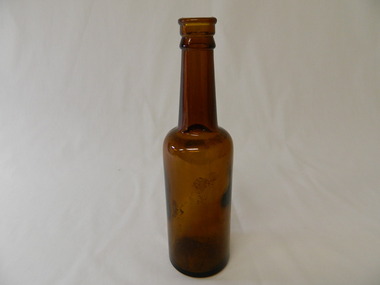
... bottle...household...glass cork stopper...The shape, colour, size of the bottles changed as did the stopper used to seal it....Clear brown glass bottle of medium size used for sauce. Sealed with a glass stopper that has cork on the outside. ...The shape, colour, size of the bottles changed as did the stopper used to seal it. Historical: Change of bottles - shape, glass, stopper, size, embossing Aesthetic: Display shown embossing and shape glass bottle household glass cork stopper sauce Base: across the middle 'M 311' and below that 'M' Clear brown glass bottle of medium size used for sauce. ...Sauce came in bottles bought at the local grocery store or at a large city store on a shopping expedition. The shape, colour, size of the bottles changed as did the stopper used to seal it.Historical: Change of bottles - shape, glass, stopper, size, embossing Aesthetic: Display shown embossing and shapeClear brown glass bottle of medium size used for sauce. Sealed with a glass stopper that has cork on the outside. It has straight sides for nearly two thirds to the top then tapers quickly into a long straight neck with a lip near the opening. Inside the opening is a lip. Embossed on base.Base: across the middle 'M 311' and below that 'M'glass bottle, household, glass cork stopper, sauce -
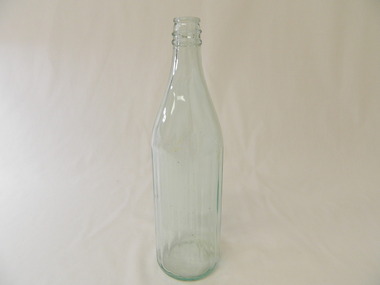 Kiewa Valley Historical Society
Bottle - Sauce, 1950's - 1960's
... The shape and size of the bottles changed as did the stopper used to seal it. The bottles were re cycled remaining the property of the manufacturer. ...The shape and size of the bottles changed as did the stopper used to seal it. The bottles were re cycled remaining the property of the manufacturer. ...Sauce came in bottles bought at the local grocery store or in a large city store on a shopping expedition. The shape and size of the bottles changed as did the stopper used to seal it. The bottles were re cycled remaining the property of the manufacturer. History of Rosella Pres. & Manuf. Co. Ltd.Historical: Change of bottles - shape, glass, embossing, use Aesthetic: Display showing embossing and shape. Clear glass bottle used for sauce. Grooved straight sides two thirds of the way up, tapering to the lip at the top of the neck and screw top. Embossed on base around the circumference and in the middle. The print is in capital letters. A few very small bubbles in the glass. Base: 'The Prop. of Rosella Pres & Manf Coy Ltd' around the circumference. Base: Inside the above inscription: '15' at top, 'Reg. No. 25701'across the middle and below 'ISM - 100'sauce, glass bottle, rosella pres. & manuf. co. ltd, household -
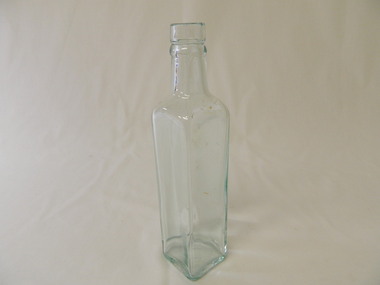 Kiewa Valley Historical Society
Bottle - Sauce, Late 1920's - Early 1930's
... The shape of the bottles changed as did the stopper used to seal it....bottle used for storing sauce, coffee or chicory. The base is square with a slight indent inwards and has embossing. The straight sides go two thirds of the way, taper quickly to the neck and then form a lip and opening for a cork stopper. ...The shape of the bottles changed as did the stopper used to seal it. Historical: Change of bottles - shape, glass, stopper, embossing and use. ...Sauce and coffee / chicory was stored in bottles bought at the local grocery store or at a large city store on a shopping expedition. The shape of the bottles changed as did the stopper used to seal it.Historical: Change of bottles - shape, glass, stopper, embossing and use. Aesthetic: Display showing embossing and shape.Clear slightly green glass bottle used for storing sauce, coffee or chicory. The base is square with a slight indent inwards and has embossing. The straight sides go two thirds of the way, taper quickly to the neck and then form a lip and opening for a cork stopper. Glass badly blown with a defect about one quarter of the way up.Base: Common seal: 'A' with 'G' at top and 'M' below inside the 'A'. 'M711' across the middle and 'M' underneath. 'F18' on edge of one side.glass bottle, sauce, coffee, chicory -
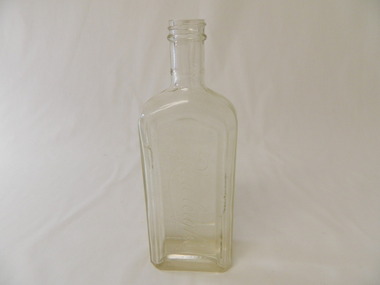 Kiewa Valley Historical Society
Bottle - Chemist, 1930's - 1940's
... The shape of the bottles changed as did the stopper used to seal it. History of Rawleigh's....Historical: Change of bottles - shape, glass, stopper, embossing, use Aesthetic: Display showing embossing and shape. chemist rawleigh's medicine glass bottle Front side: "I Rawleigh's I" Base: Common seal 'A' with 'G' on top and 'M' underneath inside the 'A', 'G437' and an 'O' Clear glass bottle with rectangular base and straight sides three quarters of the way up tapering into the neck and then the screw top opening. ...This bottle was bought at the local chemist or a chemist in a larger city on a shopping expedition. The shape of the bottles changed as did the stopper used to seal it. History of Rawleigh's.Historical: Change of bottles - shape, glass, stopper, embossing, use Aesthetic: Display showing embossing and shape.Clear glass bottle with rectangular base and straight sides three quarters of the way up tapering into the neck and then the screw top opening. The front face is heavily embossed with maker's name signed across the face. The back and side faces are flat while the front is indented and framed with a curved top. The base is embossed and slightly indented.Front side: "I Rawleigh's I" Base: Common seal 'A' with 'G' on top and 'M' underneath inside the 'A', 'G437' and an 'O'chemist, rawleigh's, medicine, glass bottle -
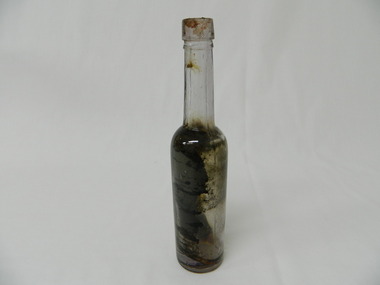 Kiewa Valley Historical Society
Bottle - Chemist, Pre 1915
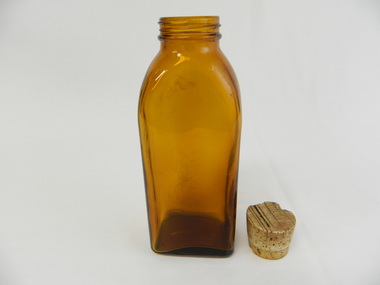
... bottle with manganese/purple tinge caused by sunlight. Hand finished top. Joins in glass on each side but not continuing to opening. Straight sides from the base to a little more than half way up. Sharp taper to neck which is straight and long to lip and opening. Cork stopper...Change of bottles - shape, glass stopper, manufacture and use. Aesthetic: Display showing shape and colour due to the affect of sunlight. chemist castor oil codliver oil tawonga south aurora parmesan Bubbles in glass. ...This bottle contained castor oil or cod-liver oil and has a hand finished top. It would have been bought at a local chemist or in a larger city on a shopping expedition.Historical: Found inside the walls of a Tawonga South farm house having been left there when the house was being built. Change of bottles - shape, glass stopper, manufacture and use. Aesthetic: Display showing shape and colour due to the affect of sunlight.Clear glass bottle with manganese/purple tinge caused by sunlight. Hand finished top. Joins in glass on each side but not continuing to opening. Straight sides from the base to a little more than half way up. Sharp taper to neck which is straight and long to lip and opening. Cork stopper.Bubbles in glass. chemist, castor oil, codliver oil, tawonga south, aurora parmesan -
 Kiewa Valley Historical Society
Bottle - Chemist, 1940's - 1950's
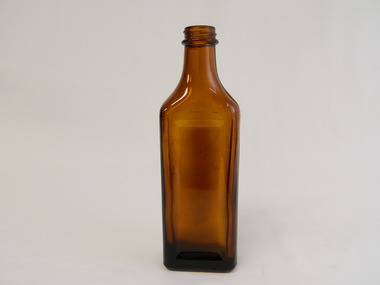
... The shape of the bottles changed as did the stopper used to seal it. Bottles were re cycled remaining the property of the manufacturer. ...Historical: Change of bottles - shape, glass, stopper, embossing, use. Bottle collectors. ...Medicines were stored in bottles and sold by chemists either locally or in big cities that were visited on shopping expeditions. The shape of the bottles changed as did the stopper used to seal it. Bottles were re cycled remaining the property of the manufacturer. History of Wyeth Inc. Sydney.Historical: Change of bottles - shape, glass, stopper, embossing, use. Bottle collectors. Aesthetic: Display showing embossing and shape.Clear brown glass bottle with straight sides three quarters of the way up tapering as shoulders to a wide screw top with a short opening. Base is rectangular slightly indented with faint embossing. heavier embossing on the 2 narrow sides - in print and read from the top of the bottle to the bottom (sideways) of the bottle.Sies: 1. 'This Bottle is the Property of' 2. 'Wyeth Incorporated Sydney' Base: Common Seal - 'A' with G and M inside. Middle 'LS 106'. Underneath '3' glass bottle, chemist, wyeth inc. sydney, medicines -
 Kiewa Valley Historical Society
Bottle - Chemist, 1940's
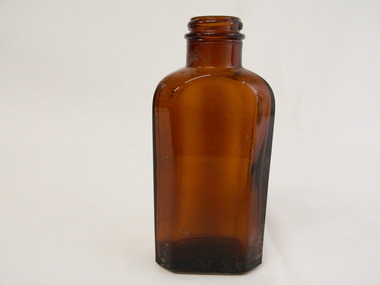
... Medicines came in bottles sold by the chemist locally or at a large city chemist store on a shopping expedition.The shape and colour the the bottles changed as did the stopper used to seal it. Use of linseed oil and milk of magnesia....Historical: Change of bottles - shape, glass, stopper, embossing and use. Aesthetic: Display showing colour and shape. chemist medicines brown glass bottle liniseed oil milk of magnesia Side: '2' Base: 'G 374' followed by the common seal 'A' with 'G' and 'M' inside the 'A' Clear brown glass bottle used for medicine - possibly linseed oil or milk of magnesia. ...Medicines came in bottles sold by the chemist locally or at a large city chemist store on a shopping expedition.The shape and colour the the bottles changed as did the stopper used to seal it. Use of linseed oil and milk of magnesia.Historical: Change of bottles - shape, glass, stopper, embossing and use. Aesthetic: Display showing colour and shape.Clear brown glass bottle used for medicine - possibly linseed oil or milk of magnesia. It has straight sides three quarters of the way up tapering to the neck ending with a lip and a screw top. Rectangular base with embossing. 3 sides and base are slightly indented. The 4th side is flat with an embossed '2' at the bottom in the middle. Side: '2' Base: 'G 374' followed by the common seal 'A' with 'G' and 'M' inside the 'A'chemist, medicines, brown glass bottle, liniseed oil, milk of magnesia -
 Kiewa Valley Historical Society
Bottle - Chemist, 1940's
... The shape of bottles changed as did the stoppers used to seal them....The shape of bottles changed as did the stoppers used to seal them. Historical: Change of bottles - shape, glass, stopper, embossing, use. ...Medicines win the form of pills were stored in bottles sold by the chemist either locally or in larger cities visited during a shopping expedition. The shape of bottles changed as did the stoppers used to seal them.Historical: Change of bottles - shape, glass, stopper, embossing, use. Aesthetic: Display showing embossing and shape especially if in good conditionClear brown glass bottle with base consisting of 2 long sides (front and back) and 2 shorter sides at each end joined by two even shorter sides (as if to cut corners). Tapered sharply to form a neck and lip and then a screw top opening. Embossed on base. Used for pills or reviving salts.Base: Common Seal: 'A' with 'G' and 'M' inside top and bottom respectively. 'F 1101' followed by 'M' On the side of the base at right angles to the above: '947'brown glass bottle, chemist, pills, reviving salts -
 Kiewa Valley Historical Society
Bottle - Chemist, 1940's
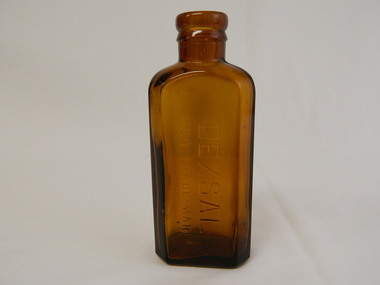
... stopper...brown glass bottle...This bottle is dated earlier than others and had a cork stopper. History of Dexsal....The shoulder of the bottle has a short neck on top and then a cork stopper opening. Heavy embossing on the front and embossing on the base....Historical: Change of bottles - shape, glass, stopper, use and embossing Aesthetic: Display showing embossing and shape. chemist dexsal cork stopper brown glass bottle Front: across bottle: 'Dexsal / Reg. ...Chemists sold bottles of 'Dexsal'. This bottle was bought locally or at a larger store on a shopping expedition. This bottle is dated earlier than others and had a cork stopper. History of Dexsal.Historical: Change of bottles - shape, glass, stopper, use and embossing Aesthetic: Display showing embossing and shape.Clear brown glass 'Dexsal' bottle with straight sides a little more than three quarters of the way up. The base has 2 long sides (front and back) with 3 equal length sides at each end. The shoulder of the bottle has a short neck on top and then a cork stopper opening. Heavy embossing on the front and embossing on the base.Front: across bottle: 'Dexsal / Reg. Trade Mark' Base: 'F 397' and near the edge '627'chemist, dexsal, cork stopper, brown glass bottle -
 Kiewa Valley Historical Society
Bottle - Chemist, 1950's
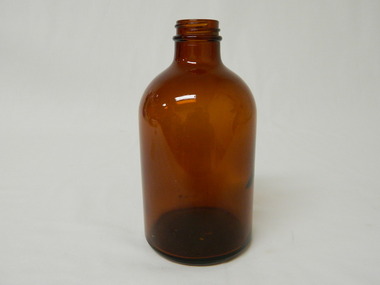
... The shape of bottles changed as did the stopper used to seal it. Bottles were re cycled remaining the property of the manufacturer. ...Historical: Change of bottles - shape, glass, stopper, use and embossing Aesthetic: display showing embossing and shape. chemist medicine s.c. johnson & sons pty ltd. brown glass bottle Side: near base: '3' Base: Around half of the circumference: 'This bottle is the property of' Base: Across the centre: 'S.C.Johnson / & Son Pty Ltd / Sydney' Clear round brown glass bottle with straight sides three quarters of the way up tapering to a short neck and cork screw opening. ...Medicines were sold by chemists locally or in larger cities when visited on a shopping expedition. The shape of bottles changed as did the stopper used to seal it. Bottles were re cycled remaining the property of the manufacturer. History of S.C. Johnson & Son Pty. Ltd.Historical: Change of bottles - shape, glass, stopper, use and embossing Aesthetic: display showing embossing and shape.Clear round brown glass bottle with straight sides three quarters of the way up tapering to a short neck and cork screw opening. Embossed '3' near the bottom and heavy embossing on base in print with capital letters.Side: near base: '3' Base: Around half of the circumference: 'This bottle is the property of' Base: Across the centre: 'S.C.Johnson / & Son Pty Ltd / Sydney'chemist, medicine, s.c. johnson & sons pty ltd., brown glass bottle -
 Kiewa Valley Historical Society
Bottle - Chemist, 1920's
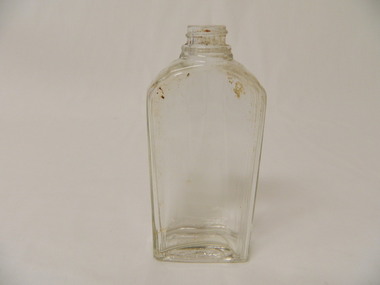
... The shape of the bottles changed as did the stopper used to seal it....The shape of the bottles changed as did the stopper used to seal it. Historical: Change of bottles - shape, glass, stopper, embossing, use Aesthetic: Display showing shape and size of bottle chemist perfume lavendar water bath salts glass bottle Base: '12' within an oval shape Clear glass bottle with rectangular base and straight sides nearly three quarters of the way up tapering in 3 waves to a ridged neck and then a screw top. ...Perfume, lavender water and bath salts were sold by chemists either locally of in larger cities visited on a shopping expedition. The shape of the bottles changed as did the stopper used to seal it.Historical: Change of bottles - shape, glass, stopper, embossing, use Aesthetic: Display showing shape and size of bottleClear glass bottle with rectangular base and straight sides nearly three quarters of the way up tapering in 3 waves to a ridged neck and then a screw top. Visually but inside the glass at the base seems to be indented showing a lopsided hill bearing to one side.Base: '12' within an oval shape chemist, perfume, lavendar water, bath salts, glass bottle -
 Kiewa Valley Historical Society
Bottle - Chemist, 1930's - 1940's
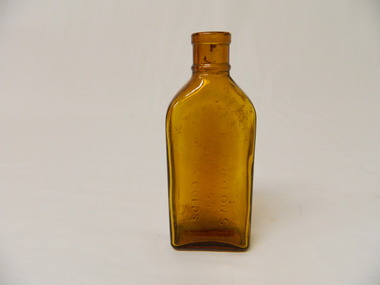
... Medicine came in bottles bought at the local chemist or at a large city chemist on a shopping expedition. The shape and contents changed as did the stopper used to seal it. ...Historical: Change of bottles - shape, glass, stopper, embossing, use. Aesthetic: Display showing embossing and shape chemist medicine glass bottle bonnington's irish moss coughs colds On front side: 'Bonnington's / Irish Moss / Coughs & Colds' Small clear brown glass bottle used for medicine. ...Medicine came in bottles bought at the local chemist or at a large city chemist on a shopping expedition. The shape and contents changed as did the stopper used to seal it. History of Bonnington's Irish Moss.Historical: Change of bottles - shape, glass, stopper, embossing, use. Aesthetic: Display showing embossing and shape Small clear brown glass bottle used for medicine. Rectangular shape with heavy embossing at the front. Narrower sides taper to the lip at the opening. Also has a lip around the opening.On front side: 'Bonnington's / Irish Moss / Coughs & Colds' chemist, medicine, glass bottle, bonnington's, irish moss, coughs, colds -
 Kiewa Valley Historical Society
Bottle - Chemist
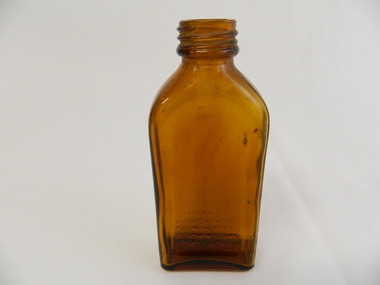
... Historical: Change of bottles - shape, glass, stopper, embossing, use. Aesthetic: Display showing embossing and shape glass bottle clinton williams pty ltd Front: 'This bottle / Always Remains / the Property of / Clinton Williams / Pty Ltd.' ...Bottles were bought locally or at larger cities on a shopping expedition. The shape of bottles changed. Bottles were re cycled remaining the property of the manufacturer. History of Clinton Williams Pty Ltd.Historical: Change of bottles - shape, glass, stopper, embossing, use. Aesthetic: Display showing embossing and shapeClear brown bottle with straight sides three quarters of the way up tapering to the opening screw top. The base is rectangular. The front is embossed horizontally.Front: 'This bottle / Always Remains / the Property of / Clinton Williams / Pty Ltd.'glass bottle, clinton williams pty ltd -
 Kiewa Valley Historical Society
Bottle - Chemist, 1930's - 1940's
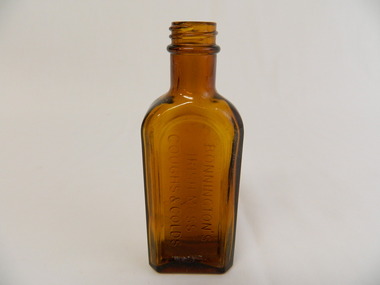
... Medicine came in bottles bought at the local chemist or at a large city chemist on a shopping expedition. The shape and contents changed as did the stopper used to seal it. ...Historical: Change of bottles - shape, glass, stopper, embossing and use. Aesthetic: Display showing embossing and shape. glass bottle chemist medicine irish moss bonnington's coughs colds Front side: 'Bonnington's / Irish Moss / Coughs & Colds' Small clear brown glass bottle used for medicine. ...Medicine came in bottles bought at the local chemist or at a large city chemist on a shopping expedition. The shape and contents changed as did the stopper used to seal it. History of Bonnington's & Irish Moss.Historical: Change of bottles - shape, glass, stopper, embossing and use. Aesthetic: Display showing embossing and shape. Small clear brown glass bottle used for medicine. Rectangular shaped with heavy embossing at front. Narrower sides taper to lip at opening. Also has lip around the opening.Front side: 'Bonnington's / Irish Moss / Coughs & Colds'glass bottle, chemist, medicine, irish moss, bonnington's, coughs, colds -
 Kiewa Valley Historical Society
Bottle - Chemist
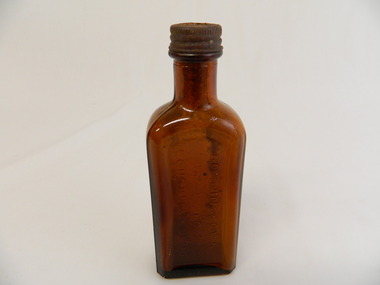
... Medicine came in bottles bought at the local chemist or at a large city chemist on a shopping expedition. The shape and contents changed as did the stopper used to seal it. ...History of Bonnington's and Irish Moss Historical: Change of bottles - shape, glass, stopper, embossing and use Aesthetic: Display showing embossing and shape glass bottle bonnington's medicine chemist irish moss coughs colds Front side: 'Bonnington's / Irish Moss / Coughs & Colds' Small clear brown glass bottle used for medicine. ...Medicine came in bottles bought at the local chemist or at a large city chemist on a shopping expedition. The shape and contents changed as did the stopper used to seal it. History of Bonnington's and Irish MossHistorical: Change of bottles - shape, glass, stopper, embossing and use Aesthetic: Display showing embossing and shapeSmall clear brown glass bottle used for medicine. Rectangular shape with heavy embossing at the front. Narrower sides taper to the lip at the opening. It has a very rusted-on screw lid which is metal.Front side: 'Bonnington's / Irish Moss / Coughs & Colds'glass bottle, bonnington's, medicine, chemist, irish moss, coughs, colds
