
Showing 17026 items matching "objects"
-
 Rutherglen Historical Society
Photograph - Image, 3/04/2006
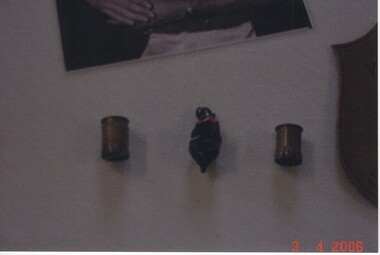
... Colour photograph of some memorabilia of the Stawell Gift 1954. Two of the objects are probably cartridges from a starting pistol....John Hayes, the winner of the Stawell Gift in 1954, was a former Rutherglen boy, who also produced "The Glen Guys", a booklet about Rutherglen personalities. john hayes stawell gift the glen guys common school museum Colour photograph of some memorabilia of the Stawell Gift 1954. Two of the objects are probably cartridges from a starting pistol. ...Photograph is of the some memorabilia of Stawell Gift, taken on a visit by John Hayes to the Common School Museum to give a talk for the Rutherglen Historical Society. John Hayes, the winner of the Stawell Gift in 1954, was a former Rutherglen boy, who also produced "The Glen Guys", a booklet about Rutherglen personalities.Colour photograph of some memorabilia of the Stawell Gift 1954. Two of the objects are probably cartridges from a starting pistol.john hayes, stawell gift, the glen guys, common school museum -
 Kew Historical Society Inc
Photograph - Photographs [Series], Robert Baker, Exhibition: Water H20, Kew Court House, 6 July 2018, 06/07/2018
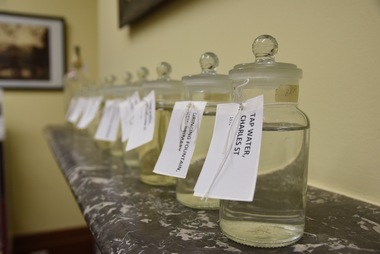
... A series of photographs of objects and pictures of the second exhibition at the Kew Court House for 2018, mounted by the Kew Historical Society....A series of photographs of objects and pictures of the second exhibition at the Kew Court House for 2018, mounted by the Kew Historical Society. ...From its beginnings in 1958, the Society has mounted exhibitions and/or displays, in early days in shop window and in community spaces located in the Kew City Hall (later Kew Library), and since 2010 at the Kew Court House. Exhibitions typically coincided with the annual Kew Community Festival in March, but after 2013 evolved into three new exhibitions yearly at the Kew Court House. Smaller displays continue to be mounted in the Kew Library. A series of photographs of objects and pictures of the second exhibition at the Kew Court House for 2018, mounted by the Kew Historical Society.kew historical society - exhibitions, water -- kew (vic.) -
 Ballarat Tramway Museum
Map, H.P. Noordwal, "Official Route Map of the Los Angeles Railway", Jun. 1938
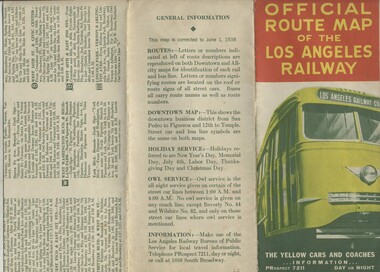
... On rear car, next to object number is a symbol looking like a "H & S" merged together....On rear car, next to object number is a symbol looking like a "H & S" merged together. ...A (12 section) fold out map of street car (tram) and bus services for Los Angeles, dated June 1, 1938, showing all LAR (Los Angeles Railway) streetcar and coach (tram and bus) services, Pacific Electric lines within area, detailed "downtown" map, route descriptions and points of interest. Record images added 20/8/2013.Three terminus have been marked with pencil "X". On rear car, next to object number is a symbol looking like a "H & S" merged together.trams, tramways, los angeles, street cars, map -
 Disability Sport & Recreation Victoria
Patch, TRANZAC patch
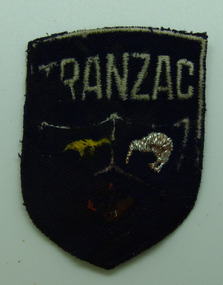
... Underneath, embroidered images of a kangaroo (in gold), a kiwi (in white), and an indistinct object in red....Underneath, embroidered images of a kangaroo (in gold), a kiwi (in white), and an indistinct object in red. Shield shaped clothing patch. ...Shield shaped clothing patch.The word "TRANZAC" in white across the top of the patch, on a navy blue background. Underneath, embroidered images of a kangaroo (in gold), a kiwi (in white), and an indistinct object in red. -
 Flagstaff Hill Maritime Museum and Village
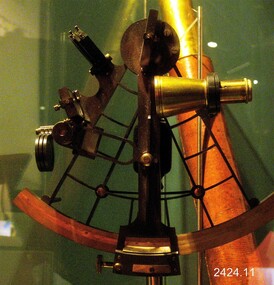
Instrument - Sextant, Late 20th Century
... It is a doubly reflecting navigation instrument that measures the angular distance between two visible objects. The primary use of a sextant is to measure the angle between an astronomical object and the horizon for the purposes of celestial navigation....It is a doubly reflecting navigation instrument that measures the angular distance between two visible objects. The primary use of a sextant is to measure the angle between an astronomical object and the horizon for the purposes of celestial navigation. ...In 1941, the scientific instrument manufacturing firms of Henry Hughes & Son Ltd, London, England, and Kelvin Bottomley & Baird Ltd, Glasgow, Scotland, came together to form Kelvin & Hughes Ltd. Kelvin Company History: The origins of the company lie in the highly successful and strictly informal relationship between William Thomson (1824-1907), Professor of Natural Philosophy at Glasgow University from 1846-1899 and James White, a Glasgow optical maker. James White (1824-1884) founded the firm of James White, an optical instrument maker in Glasgow in 1850 and was involved in supplying and mending apparatus for Thomson university laboratory and working with him on experimental constructions. White was declared bankrupt in August 1861 and released several months later. In 1870, White was largely responsible for equipping William Thomson laboratory in the new University premises at Gilmore hill. From 1876, he was producing accurate compasses for metal ships to Thomson design during this period and this became an important part of his business in the last years of his life. He was also involved in the production of sophisticated-sounding machinery that Thomson had designed to address problems encountered laying cables at sea, helping to make possible the first transatlantic cable connection. At the same time, he continued to make a whole range of more conventional instruments such as telescopes, microscopes and surveying equipment. White's association with Thomson continued until he died. After his death, his business continued under the same name, being administered by Matthew Edwards (until 1891 when he left to set up his own company. Thomson who became Sir William Thomson and then Baron Kelvin of Largs in 1892, continued to maintain his interest in the business after James White's death. In 1884 raising most of the capital needed to construct and equip new workshops in Cambridge Street, Glasgow. At these premises, the company continued to make the compass Thomson had designed during the 1870s and to supply it in some quantity, especially to the Admiralty. At the same time, the firm became increasingly involved in the design, production and sale of electrical apparatus. In 1899, Lord Kelvin resigned from his University chair and became, in 1900, a director in the newly formed limited liability company Kelvin & James White Ltd which had acquired the business of James White. At the same time Kelvin's nephew, James Thomson Bottomley (1845-1926), joined the firm. In 1904, a London branch office was opened which by 1915 had become known as Kelvin, White & Hutton Ltd. Kelvin & James White Ltd underwent a further change of name in 1913, becoming Kelvin Bottomley & Baird Ltd. Hughes Company History: Henry Hughes & Sons were founded in 1838 in London as a maker of chronographic and scientific instruments. The firm was incorporated as “Henry Hughes & Sons Ltd” in 1903. In 1923, the company produced its first recording echo sounder and in 1935 a controlling interest in the company was acquired by S Smith & Son Ltd resulting in the development and production of marine and aircraft instruments. Following the London office's destruction in the Blitz of 1941, a collaboration was entered into with Kelvin, Bottomley & Baird Ltd resulting in the establishing “Marine Instruments Ltd”. Following the formal amalgamation of Kelvin, Bottomley & Baird Ltd and Henry Hughes & Sons Ltd in 1947 to form Kelvin & Hughes Ltd. Marine Instruments Ltd then acted as regional agents in the UK for Kelvin & Hughes Ltd who were essentially now a part of Smith's Industries Ltd founded in 1944 and the successors of S. Smith & Son Ltd. Kelvin & Hughes Ltd went on to develop various marine radar and echo sounders supplying the Ministry of Transport, and later the Ministry of Defence. The firm was liquidated in 1966 but the name was continued as Kelvin Hughes, a division of the Smiths Group. In 2002, Kelvin Hughes continues to produce and develop marine instruments for commercial and military. G. Falconer Company History: G Falconer (Hong Kong Ltd) appear to have had a retail presence in Hong Kong since 1885, according to the company website, and currently have a shop in the Peninsula Hotel. G Falconer was the Hong Kong selling agent for several British companies. Ross Ltd of 111 New Bond St London was one and the other was Kelvins Nautical Instruments. Falconers were primarily watchmakers, jewellers and diamond merchants.They were also agents for Admiralty Charts, Ross binoculars and telescopes, and sold English Silverware and High Class English Jewellery. In 1928 the company was operating from the Union Building opposite the Hong Kong general post office. It is unclear if the item is an original Sextant made by Kelvin prior to his amalgamation with Henry Hughes & Sons in 1941 as Kelvin appears to have only made compasses up to this date. If the Sextant can be established that it was made by Kelvin then it is very significant and a rare item made for and distributed through their Hong Kong selling agents G Falconer Ltd. There are many Sextants advertised for sale stating "Kelvin & Hughes 1917 model sextant". These can be regarded as replicas as the company was not formed until 1941 and production of marine instruments was not fully under way until after the war in 1947. Further investigation needs to be undertaken to accurately determine the provenance of this item. As the writer currently has the impression that the subject object was possibly made by Kelvin and Hughes in the mid to late 20th century or is a replica made by an unknown maker in the late 1970s. Purchased as an exhibition of marine navigational instruments for the Flagstaff Hill museum. The Sextant is a brass apparatus with filters and telescope lens, and comes with a wooden felt lined storage box. It is a doubly reflecting navigation instrument that measures the angular distance between two visible objects. The primary use of a sextant is to measure the angle between an astronomical object and the horizon for the purposes of celestial navigation.G Falconer and Co. Hong Kong (retailers of nautical equipmentflagstaff hill, warrnambool, shipwrecked-coast, flagstaff-hill, flagstaff-hill-maritime-museum, maritime-museum, shipwreck-coast, flagstaff-hill-maritime-village, sextant, kelvin & hughes ltd, hong kong, navigational instrument, g falconer, mariner's quadrants -
 Flagstaff Hill Maritime Museum and Village
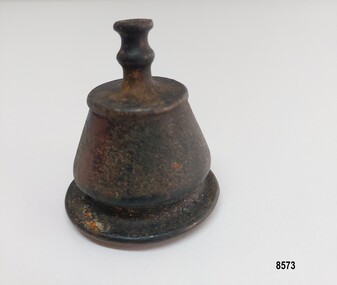
Decorative object - Brass Finial, Russell & Co, circa 1886
... A brass, bell-shaped object with a body approximately 3 cm high. ...The inside of the object is plain with evidence of vertigris. ...In the 19th century, the Industrial Revolution meant that shipbuilders could build ships using iron. These iron ships could be much larger, with more space for cargo, and they didn't need as much work to keep them in good condition. Isambard Kingdom Brunel's "Great Britain" built in 1843, was the first ship to be built entirely of wrought iron. In the 1880's steel began to be used instead of iron. Ships also began to be fitted with steam engines, although a great deal of coal was needed to travel even short distances. For this reason, ships continued to be fitted out with sails even though many came with engines. The iron-hulled, four-masted barque, the Falls of Halladale, was a bulk carrier of general cargo. She left New York in August 1908 on her way to Melbourne and Sydney. In her hold, along with 56,763 tiles of unusual, beautiful green American slates (roofing tiles), 5,673 coils of barbed wire, 600 stoves, 500 sewing machines, 6500 gallons of oil, 14400 gallons of benzene, and many other manufactured items, were 117 cases of crockery and glassware. Three months later and close to her destination, a navigational error caused the Falls of Halladale to be wrecked on a reef off the Peterborough headland at 3 am on the morning of the 15th of November, 1908. The captain and 29 crew members all survived, but her valuable cargo was largely lost, despite two salvage attempts in 1908-09 and 1910. ABOUT THE ‘FALLS OF HALLADALE’ (1886 - 1908): - Built: in1886 by Russell & Co., Greenock shipyards, River Clyde, Scotland, UK. The company was founded in 1870 (or 1873) as a partnership between Joseph Russell (1834-1917), Anderson Rodger and William Todd Lithgow. During the period 1882-92, Russell & Co. standardised designs, which sped up their building process so much that they were able to build 271 ships over that time. In 1886, they introduced a 3000-ton class of sailing vessel with auxiliary engines and brace halyard winches. In 1890, they broke the world output record. Owner: Falls Line, Wright, Breakenridge & Co, 111 Union Street, Glasgow, Scotland. Configuration: Four-masted sailing ship; iron-hulled barque; iron masts, wire rigging, fore & aft lifting bridges. Size: Length 83.87m x Breadth 12.6m x Depth 7.23m, Gross tonnage 2085 ton Wrecked: the night of 14th November 1908, Curdies Inlet, Peterborough, south west Victoria Crew: 29 The Falls of Halladale was a four-masted sailing ship built in 1886 in Glasgow, Scotland, for the long-distance cargo trade and was mostly used for Pacific grain trade. She was owned by Wright, Breakenridge & Co of Glasgow and was one of several Falls Line ships, all of which were named after waterfalls in Scotland. The lines flag was of red, blue and white vertical stripes. The Falls of Halladale had a sturdy construction built to carry maximum cargo and was able to maintain full sail in heavy gales, one of the last of the ‘windjammers’ that sailed the Trade Route. She and her sister ship, the Falls of Garry, were the first ships in the world to include fore and aft lifting bridges. Previous to this, heavily loaded vessels could have heavy seas break along the full length of the deck, causing serious injury or even death to those on deck. The new, raised catwalk-type decking allowed the crew to move above the deck in stormy conditions. This idea is still used today on the most modern tankers and cargo vessels and has proved to be an important step forward in the safety of men at sea. On 4th August 1908, with new sails, 29 crew, and 2800 tons of cargo, the Falls of Halladale left New York, bound for Melbourne and Sydney via the Cape of Good Hope. The cargo on board was valued at £35,000 and included 56,763 tiles of American slate roofing tiles (roof slates), 5,673 coils of barbed wire, 600 stoves, 500 sewing machines, 6,500 gallons of oil, 14,400 gallons of benzene, plumbing iron, 117 cases of crockery and glassware and many other manufactured items. The Falls of Halladale had been at sail for 102 days when, at 3 am on the night of 14th November 1908, under full sail in calm seas with a six knots breeze behind and misleading fog along the coast, the great vessel rose upon an ocean swell and settled on top of a submerged reef near Peterborough on the south-west Victoria’s coast. The ship was jammed on the rocks and began filling with water. The crew launched the two lifeboats and all 29 crew landed safely on the beach over 4 miles away at the Bay of Islands. The postmistress at Peterborough, who kept a watch for vessels in distress, saw the stranding and sent out an alert to the local people. A rescue party went to the aid of the sailors, and the Port Campbell rocket crew was dispatched, but the crew had all managed to reach shore safely by the time help arrived. The ship stayed in full sail on the rocky shelf for nearly two months, attracting hundreds of sightseers who watched her slowly disintegrate until the pounding seas and dynamiting by salvagers finally broke her back, and her remains disappeared back into deeper water. The valuable cargo was largely lost, despite two salvage attempts in 1908-09 and 1910. Further salvage operations were made from 1974-1986, during which time 22,000 slate tiles were recovered with the help of 14 oil drums to float them, plus personal artefacts, ship fittings, reams of paper and other items. The Court of Marine Inquiry in Melbourne ruled that the foundering of the ship was entirely due to Captain David Wood Thomson’s navigational error, not too technical failure of the Clyde-built ship. The shipwreck is a popular site for divers, about 300m offshore and in 3 – 15m of water. Some of the original cargo can be seen at the site, including pieces of roof slate and coils of barbed wire. This particular artefact was one of many found by John Laidlaw (a local Warrnambool diver) when diving on the Falls of Halladale in the 1960's. In August 1973, John Laidlaw and Stan McPhee went on to discover the underwater location of the Schomberg - a passenger ship that ran aground on December 26th 1855 near Peterborough and which now lies in almost 9 metres of water. When John Laidlaw died, his family donated a number of artefacts to Flagstaff Hill. The brass finial may have been part of a larger decorative item such as a lamp or clock bracket.This item is significant as it was taken from the Falls of Halladale shipwreck which is listed on the Victorian Heritage Register (No. S255). She was one of the last ships to sail the Trade Routes. She is one of the first vessels to have fore and aft lifting bridges. She is an example of the remains of an International Cargo Ship and also represents aspects of Victoria’s shipping industry. The wreck is protected as a Historic Shipwreck under the Commonwealth Historic Shipwrecks Act (1976)A brass, bell-shaped object with a body approximately 3 cm high. It has an outer lip, straight sides that taper in and a flat "cap". The inside of the object is plain with evidence of vertigris. It has a decorative topping almost 2 cm high, which has a double concave hollow neck.flagstaff hill, flagstaff hill divers, flagstaff hill maritime museum and village, great ocean road, warrnambool, falls of halladale, falls of halladale wreck, shipwreck artefact, artefact, brass artefact, brass finial, brass fitting, shipwreck coast, diver, john laidlaw, finial, brass decoration, handmade -
 Kiewa Valley Historical Society
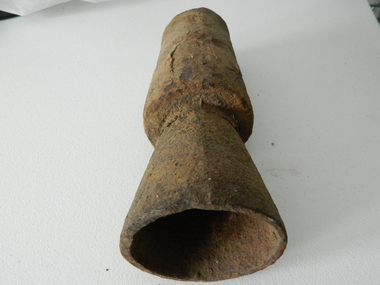
Tuyere Pipe, circa mid to late 1900's
... The "inventiveness" of cattlemen and construction workers to produce metal objects not available "off the shelf" is one of the inherent traits not only of rural self sufficiency but in the "pioneer" days of rural isolation one of survival....This iron cone shaped tuyere has a small hole (diamenter 25mm) starting within an ever enlarging cone (amplification of the air pressure going through) delivering varying hot or extremely hot air into a furnace or hearth which intensifies the heat to allow the "shaping" of metal objects. The larger "flared" cone extension allows for the directed air to be spread and not concentrated....The "inventiveness" of cattlemen and construction workers to produce metal objects not available "off the shelf" is one of the inherent traits not only of rural self sufficiency but in the "pioneer" days of rural isolation one of survival. ...This tuyere (word from French origin) was used by professional blacksmiths and or cattlemen before and during the Kiewa Hydro Electricity Scheme was being constructed. The need to use a furnace or forge in the shaping of metal rods, horse shoes and pipes is both a rural necessity and a construction, on site requirement. The "inventiveness" of cattlemen and construction workers to produce metal objects not available "off the shelf" is one of the inherent traits not only of rural self sufficiency but in the "pioneer" days of rural isolation one of survival.This tuyere is of great significance to the Kiewa Valley and its regions because it highlights one of the greatest strengths of the rural (especially isolated) life and its folk living there, and that is the great human factor of adaptability and survival techniques in sometimes harsh and demanding environmental circumstances. The inventiveness and the attitude, "she'll be right mate", demonstrates life on the land where specialised blacksmith activities can be found in non "professionals" because of the fact that "someone" has to do the job. This is one of the differences between country "rural" life and that found in cities and larger towns.This iron cone shaped tuyere has a small hole (diamenter 25mm) starting within an ever enlarging cone (amplification of the air pressure going through) delivering varying hot or extremely hot air into a furnace or hearth which intensifies the heat to allow the "shaping" of metal objects. The larger "flared" cone extension allows for the directed air to be spread and not concentrated.blacksmith tool, tue, bellows, fashioning metal, forge manufacturing process -
 Bendigo Historical Society Inc.
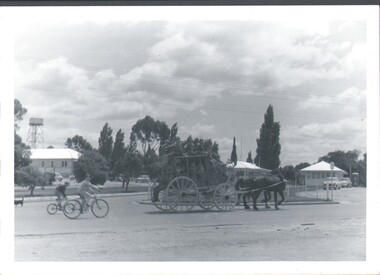
Photograph - HARRY BIGGS COLLECTION: ROYAL MAIL COACH, 1960's
... ...Objects...TOPIC Objects transport Royal Mail Photograph of a Royal mail Coach drawn by two horses, the coach is full of people with many riding on the top. ...Photograph of a Royal mail Coach drawn by two horses, the coach is full of people with many riding on the top. There are two boys riding bicycles behind the coach, there are several small buildings in the background, a water tank on a tall tower is visible behind the left hand building. The words 'Royal mail' are painted on the side of the coachtopic, objects, transport, royal mail -
 Mont De Lancey
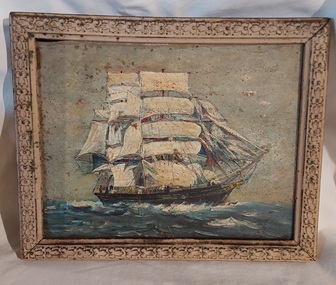
Painting - Sailing Ship Painting, Unknown
... ...Objects...Oil paintings Paintings Artworks Objects A small rectangular badly damaged oil painting of a clipper ship sailing in calm waters with seabirds in the background. ...Used for decoration in the home.A small rectangular badly damaged oil painting of a clipper ship sailing in calm waters with seabirds in the background. It has a decorative leaf patterned cream painted wooden frame with rusted wire at the back for hanging. It is backed by a wooden board secured by four small nails and a layer of paper.oil paintings, paintings, artworks, objects -
 Mont De Lancey
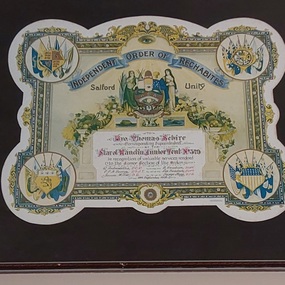
Certificate, Independent Order of Rechabites, 1914
... ...Objects...The certificate is on Loan from Graeme or Alvan Sebire (sons of Reginald) Certificates Documents Objects Membership certificates 'Independent Order of Rechabites: Salford Unity Established Aug 25th 1835. ...This certificate was presented to Reginald Sebire in 1914 and displayed at Mont De Lancey until his death. It is displayed in the House Dining Room above the fireplace. Reginald was the eldest son of Thomas and Linda Sebire, the grandson of William and Martha. He and his wife Gwen (Quale) lived in the home of Mont De Lancey with their children until his death in 1962. The certificate is on Loan from Graeme or Alvan Sebire (sons of Reginald)A scalloped shaped framed certificate presented to Reginald J. Sebire in July 1914. The frame is thin brown wood with a light blue trim and a glass front. A coloured coat of arms appears above the inscription with two female figures standing above and beside the coat of arms. The inscription certificate has a white border and buff coloured background.'Independent Order of Rechabites: Salford Unity Established Aug 25th 1835. Registered March 27 1854 Junior Section. This is to Certify that Reginald J. Sebire was enrolled as a member of the Star of Wandin Tent No. 379 on the 3rd Day of July 1914'certificates, documents, objects, membership certificates -
 Mont De Lancey
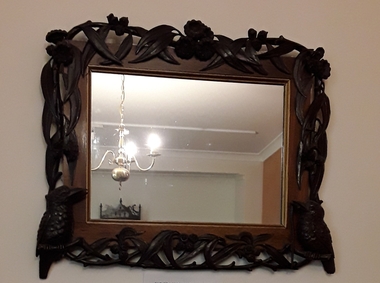
Functional object - Mirror, Franz Streizel, Unknown
... ...Objects...Functional object Mirror Franz Streizel ...This hand carved framed mirror is part of a special bequest to the Mont De Lancey Museum of hand carved furniture and items made by Mr Franz Striezel by his grandaughter Mrs Dorothy Adamson. Dorothy was a friend of Nella Lord (nee Sebire). Dorothy passed away in 2007. It was to be known as The Franz Striezel Collection. Franz Streizel came from Germany in 1886 and was one of the three recognised craftsmen (Art Carvers) in Australia who contributed to the wood carvings in public buildings and honour boards throughout Australia. The National Gallery at their request had two small panels and a tobacco jar (some of his work), donated by Mrs D Adamson. They considered these pieces highly valuable.An elaborately carved wooden framed mirror with two carved kookaburras, one with a lizard in its beak as well as some Australian flora - eucalyptus leaves, flowers and gumnuts around the edges of the frame.mirrors, functional objects, wall mirrors, objects -
 Mont De Lancey
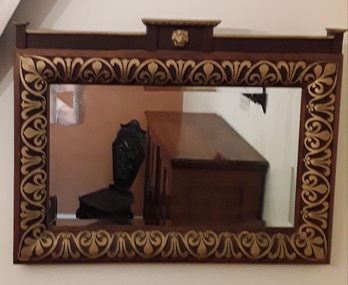
Functional object - Mirror, Franz Streizel, Unknown
... ...Objects...Functional object Mirror Franz Streizel ...This hand carved framed mirror is part of a special bequest to the Mont De Lancey Museum of hand carved furniture and items made by Mr Franz Striezel by his grandaughter Mrs Dorothy Adamson. Dorothy was a friend of Nella Lord (nee Sebire). Dorothy passed away in 2007. It was to be known as The Franz Striezel Collection. Franz Streizel came from Germany in 1886 and was one of the three recognised craftsmen (Art Carvers) in Australia who contributed to the wood carvings in public buildings and honour boards throughout Australia. The National Gallery at their request had two small panels and a tobacco jar (some of his work), donated by Mrs D Adamson. They considered these pieces highly valuable.A rectangular beautifully carved wooden framed mirror featuring a gold painted carved lion head at the top and gold painted crest shaped ornamentation around the edges of the frame.mirrors, functional objects, wall mirrors, objects -
 Mont De Lancey
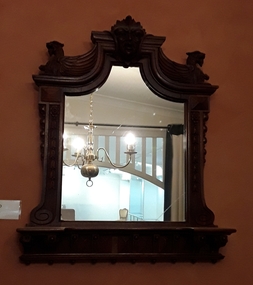
Functional object - Mirror, Franz Streizel, Unknown
... ...Objects...The mirror glass is shaped. Functional object Mirror Franz Streizel ...This hand carved framed mirror is part of a special bequest to the Mont De Lancey Museum of hand carved furniture and items made by Mr Franz Striezel by his grandaughter Mrs Dorothy Adamson. Dorothy was a friend of Nella Lord (nee Sebire). Dorothy passed away in 2007. It was to be known as The Franz Striezel Collection. Franz Streizel came from Germany in 1886 and was one of the three recognised craftsmen (Art Carvers) in Australia who contributed to the wood carvings in public buildings and honour boards throughout Australia. The National Gallery at their request had two small panels and a tobacco jar (some of his work), donated by Mrs D Adamson. They considered these pieces highly valuable.An ornately hand carved rectangular wooden framed mirror with a shelf at the bottom and a carved ancient Egyptian style head in the middle of the frame at the top. There are two carved gargoyles on each top side. The mirror glass is shaped.mirrors, functional objects, wall mirrors, objects -
 Mont De Lancey
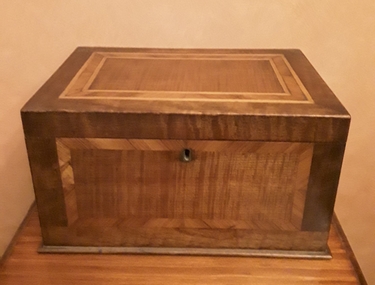
Functional object - Box, Mr Franz Streizel, Unknown
... ...Objects...Keys for the inlaid cabinet in the same room are stored in the tray in this box. Functional object Box Mr Franz Streizel ...This lockable wooden inlaid box is part of a special bequest to the Mont De Lancey Museum of hand carved furniture and items made by Mr Franz Striezel by his grandaughter Mrs Dorothy Hilda Adamson. Dorothy was a friend of Nella Lord (nee Sebire). Dorothy passed away in 2007. It was to be known as The Franz Striezel Collection. Franz Streizel came from Germany in 1886 and was one of the three recognised craftsmen (Art Carvers) in Australia who contributed to the wood carvings in public buildings and honour boards throughout Australia. The National Gallery at their request had two small panels and a tobacco jar (some of his work), donated by Mrs D Adamson. They considered these pieces highly valuable.A lockable rectangular handmade lidded wooden box with inlaid patterned wood panels on each side and the lid. It has red velvet lining inside the lid and inner base. There is a lift our red velvet lined wooden tray. The lid is attached with brass hinges. Keys for the inlaid cabinet in the same room are stored in the tray in this box.L W is written in grey pencil on the base of the box.boxes, objects, containers, storage boxes -
 Mont De Lancey
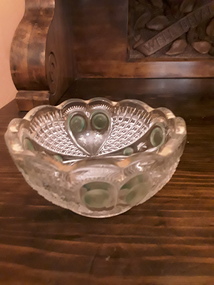
Functional object - Glass Bowl, Unknown
... ...Objects...Functional object Glass Bowl ...A small round cut glass decorative bowl with a green circular pattern and gold trim around the top scalloped edge.bowls, containers, objects, decorative objects -
 Bendigo Historical Society Inc.
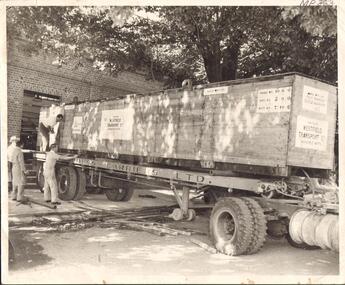
Photograph - 'YELLOW EXPRESS' SEMI TRAILER TRUCK, 1950's
... ...Objects...TOPIC Objects transport See also 2001.156.01 Black and white photograph of 'yellow Express Carriers' vehicle carrying crated machinery. ...Black and white photograph of 'yellow Express Carriers' vehicle carrying crated machinery. Two-storied motor garage in background together with street trees and two-storied dwelling. 'Westfield Transport' signage on crate.topic, objects, transport, see also 2001.156.01 -
 Flagstaff Hill Maritime Museum and Village
Pattern
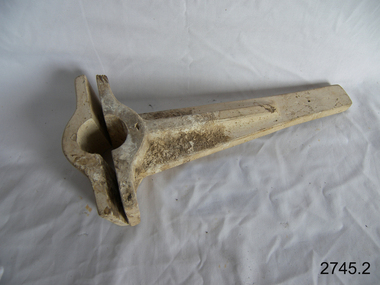
... Pattern-hanging bracket slightly pyramid shaped object with wide base. Has square attachment both painted white. ...flagstaff hill warrnambool shipwrecked-coast flagstaff-hill flagstaff-hill-maritime-museum maritime-museum shipwreck-coast flagstaff-hill-maritime-village Pattern-hanging bracket slightly pyramid shaped object with wide base. Has square attachment both painted white. ...Pattern-hanging bracket slightly pyramid shaped object with wide base. Has square attachment both painted white. flagstaff hill, warrnambool, shipwrecked-coast, flagstaff-hill, flagstaff-hill-maritime-museum, maritime-museum, shipwreck-coast, flagstaff-hill-maritime-village -
 Flagstaff Hill Maritime Museum and Village
Print - Vessels, Sailing Ships and boat, Sands & Kenny, Port of Warrnambool, Unknown
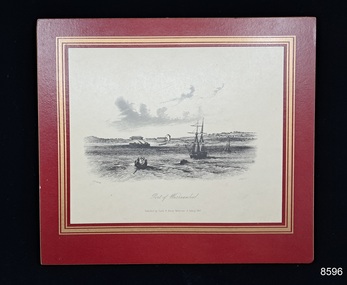
... A black and white print of the Port of Warrnambool surrounded by a maroon and gold printed frame. The object is part of the W.R. Angus Collection. ...A black and white print of the Port of Warrnambool surrounded by a maroon and gold printed frame. The object is part of the W.R. Angus Collection. ...This print belonged to Dr.William Roy Angus, Surgeon and Oculist. It was donated to Flagstaff Hill Maritime Village by his daughter, Bernice McDade. It is part of the “W.R. Angus Collection” that includes historical medical equipment, surgical instruments and material once belonging to Dr Edward Ryan and Dr Thomas Francis Ryan, (both of Nhill, Victoria) as well as Dr Angus’ own belongings. The Collection’s history spans the medical practices of the two Doctors Ryan, from 1885-1926 plus that of Dr Angus, up until 1969. ABOUT THE “W.R.ANGUS COLLECTION” Doctor William Roy Angus M.B., B.S., Adel., 1923, F.R.C.S. Edin.,1928 (also known as Dr Roy Angus) was born in Murrumbeena, Victoria in 1901 and lived until 1970. He qualified as a doctor in 1923 at University of Adelaide, was Resident Medical Officer at the Royal Adelaide Hospital in 1924 and for a period was house surgeon to Sir (then Mr.) Henry Simpson Newland. Dr Angus was briefly an Assistant to Dr Riddell of Kapunda, then commenced private practice at Curramulka, Yorke Peninsula, SA, where he was physician, surgeon and chemist. In 1926, he was appointed as new Medical Assistant to Dr Thomas Francis Ryan (T.F. Ryan, or Tom), in Nhill, Victoria, where his experiences included radiology and pharmacy. In 1927 he was Acting House Surgeon in Dr Tom Ryan’s absence. Dr Angus had become engaged to Gladys Forsyth and they decided he would take time to further his studies overseas in the UK in 1927. He studied at London University College Hospital and at Edinburgh Royal Infirmary and in 1928, was awarded FRCS (Fellow from the Royal College of Surgeons), Edinburgh. He worked his passage back to Australia as a Ship’s Surgeon on the on the Australian Commonwealth Line’s T.S.S. Largs Bay. Dr Angus married Gladys in 1929, in Ballarat. (They went on to have one son (Graham 1932, born in SA) and two daughters (Helen (died 12/07/1996) and Berenice (Berry), both born at Mira, Nhill ) Dr Angus was a ‘flying doctor’ for the A.I.M. (Australian Inland Ministry) Aerial Medical Service in 1928 . The organisation began in South Australia through the Presbyterian Church in that year, with its first station being in the remote town of Oodnadatta, where Dr Angus was stationed. He was locum tenens there on North-South Railway at 21 Mile Camp. He took up this ‘flying doctor’ position in response to a call from Dr John Flynn; the organisation was later known as the Flying Doctor Service, then the Royal Flying Doctor Service. A lot of his work during this time involved dental surgery also. Between 1928-1932 he was surgeon at the Curramulka Hospital, Yorke Peninsula, South Australia. In 1933 Dr Angus returned to Nhill where he’d previously worked as Medical Assistant and purchased a share of the Nelson Street practice and Mira hospital from Dr Les Middleton one of the Middleton Brothers, the current owners of what was once Dr Tom Ryan’s practice. Dr L Middleton was House Surgeon to the Nhill Hospital 1926-1933, when he resigned. [Dr Tom Ryan’s practice had originally belonged to his older brother Dr Edward Ryan, who came to Nhill in 1885. Dr Edward saw patients at his rooms, firstly in Victoria Street and in 1886 in Nelson Street, until 1901. The Nelson Street practice also had a 2 bed ward, called Mira Private Hospital ). Dr Edward Ryan was House Surgeon at the Nhill Hospital 1884-1902 . He also had occasions where he successfully performed veterinary surgery for the local farmers too. Dr Tom Ryan then purchased the practice from his brother in 1901. Both Dr Edward and Dr Tom Ryan work as surgeons included eye surgery. Dr Tom Ryan performed many of his operations in the Mira private hospital on his premises. He too was House Surgeon at the Nhill Hospital 1902-1926. Dr Tom Ryan had one of the only two pieces of radiology equipment in Victoria during his practicing years – The Royal Melbourne Hospital had the other one. Over the years Dr Tom Ryan gradually set up what was effectively a training school for country general-practitioner-surgeons. Each patient was carefully examined, including using the X-ray machine, and any surgery was discussed and planned with Dr Ryan’s assistants several days in advance. Dr Angus gained experience in using the X-ray machine there during his time as assistant to Dr Ryan. Dr Tom Ryan moved from Nhill in 1926. He became a Fellow of the Royal Australasian College of Surgeons in 1927, soon after its formation, a rare accolade for a doctor outside any of the major cities. He remained a bachelor and died suddenly on 7th Dec 1955, aged 91, at his home in Ararat. Scholarships and prizes are still awarded to medical students in the honour of Dr T.F. Ryan and his father, Dr Michael Ryan, and brother, John Patrick Ryan. ] When Dr Angus bought into the Nelson Street premises in Nhill he was also appointed as the Nhill Hospital’s Honorary House Surgeon 1933-1938. His practitioner’s plate from his Nhill surgery states “HOURS Daily, except Tuesdays, Fridays and Saturday afternoons, 9-10am, 2-4pm, 7-8pm. Sundays by appointment”. This plate is now mounted on the doorway to the Port Medical Office at Flagstaff Hill Maritime Village, Warrnambool. Dr Edward Ryan and Dr Tom Ryan had an extensive collection of historical medical equipment and materials spanning 1884-1926 and when Dr Angus took up practice in their old premises he obtained this collection, a large part of which is now on display at the Port Medical Office at Flagstaff Hill Maritime Village in Warrnambool. During his time in Nhill Dr Angus was involved in the merging of the Mira Hospital and Nhill Public Hospital into one public hospital and the property titles passed on to Nhill Hospital in 1939. In 1939 Dr Angus and his family moved to Warrnambool where he purchased “Birchwood,” the 1852 home and medical practice of Dr John Hunter Henderson, at 214 Koroit Street. (This property was sold in1965 to the State Government and is now the site of the Warrnambool Police Station. ). The Angus family was able to afford gardeners, cooks and maids; their home was a popular place for visiting dignitaries to stay whilst visiting Warrnambool. Dr Angus had his own silk worm farm at home in a Mulberry tree. His young daughter used his centrifuge for spinning the silk. Dr Angus was appointed on a part-time basis as Port Medical Officer (Health Officer) in Warrnambool and held this position until the 1940’s when the government no longer required the service of a Port Medical Officer in Warrnambool; he was thus Warrnambool’s last serving Port Medical Officer. (The duties of a Port Medical Officer were outlined by the Colonial Secretary on 21st June, 1839 under the terms of the Quarantine Act. Masters of immigrant ships arriving in port reported incidents of diseases, illness and death and the Port Medical Officer made a decision on whether the ship required Quarantine and for how long, in this way preventing contagious illness from spreading from new immigrants to the residents already in the colony.) Dr Angus was a member of the Australian Medical Association, for 35 years and surgeon at the Warrnambool Base Hospital 1939-1942, He served as a Surgeon Captain during WWII1942-45, in Ballarat, Victoria, and in Bonegilla, N.S.W., completing his service just before the end of the war due to suffering from a heart attack. During his convalescence he carved an intricate and ‘most artistic’ chess set from the material that dentures were made from. He then studied ophthalmology at the Royal Melbourne Eye and Ear Hospital and created cosmetically superior artificial eyes by pioneering using the intrascleral cartilage. Angus received accolades from the Ophthalmological Society of Australasia for this work. He returned to Warrnambool to commence practice as an ophthalmologist, pioneering in artificial eye improvements. He was Honorary Consultant Ophthalmologist to Warrnambool Base Hospital for 31 years. He made monthly visits to Portland as a visiting surgeon, to perform eye surgery. He represented the Victorian South-West subdivision of the Australian Medical Association as its secretary between 1949 and 1956 and as chairman from 1956 to 1958. In 1968 Dr Angus was elected member of Spain’s Barraquer Institute of Barcelona after his research work in Intrasclearal cartilage grafting, becoming one of the few Australian ophthalmologists to receive this honour, and in the following year presented his final paper on Living Intrasclearal Cartilage Implants at the Inaugural Meeting of the Australian College of Ophthalmologists in Melbourne In his personal life Dr Angus was a Presbyterian and treated Sunday as a Sabbath, a day of rest. He would visit 3 or 4 country patients on a Sunday, taking his children along ‘for the ride’ and to visit with him. Sunday evenings he would play the pianola and sing Scottish songs to his family. One of Dr Angus’ patients was Margaret MacKenzie, author of a book on local shipwrecks that she’d seen as an eye witness from the late 1880’s in Peterborough, Victoria. In the early 1950’s Dr Angus, painted a picture of a shipwreck for the cover jacket of Margaret’s book, Shipwrecks and More Shipwrecks. She was blind in later life and her daughter wrote the actual book for her. Dr Angus and his wife Gladys were very involved in Warrnambool’s society with a strong interest in civic affairs. Their interests included organisations such as Red Cross, Rostrum, Warrnambool and District Historical Society (founding members), Wine and Food Society, Steering Committee for Tertiary Education in Warrnambool, Local National Trust, Good Neighbour Council, Housing Commission Advisory Board, United Services Institute, Legion of Ex-Servicemen, Olympic Pool Committee, Food for Britain Organisation, Warrnambool Hospital, Anti-Cancer Council, Boys’ Club, Charitable Council, National Fitness Council and Air Raid Precautions Group. He was also a member of the Steam Preservation Society and derived much pleasure from a steam traction engine on his farm. He had an interest in people and the community He and his wife Gladys were both involved in the creation of Flagstaff Hill, including the layout of the gardens. After his death (28th March 1970) his family requested his practitioner’s plate, medical instruments and some personal belongings be displayed in the Port Medical Office surgery at Flagstaff Hill Maritime Village, and be called the “W. R. Angus Collection”.The W.R. Angus Collection is significant for still being located at the site it is connected with, Doctor Angus being the last Port Medical Officer in Warrnambool. The collection of medical instruments and other items and equipment is culturally significant, being an historical example of medicine from late 19th to mid-20th century. Dr Angus assisted Dr Tom Ryan, a pioneer in the use of X-rays and in ocular surgery.A black and white print of the Port of Warrnambool surrounded by a maroon and gold printed frame. The object is part of the W.R. Angus Collection. 'Published by Sands & Kenny Melbourne & Sydney 1857'. 'J Tingle' ?. 'S T Gill del'.flagstaff hill maritime museum and village, great ocean road, shipwreck coast, port of warrnambool, prints, sands & kenny, w.r. angus -
 Bendigo Military Museum
Equipment - CLIP
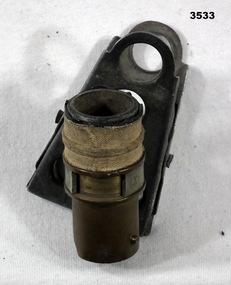
... A brass cylinder is attached. The object is possibly part of a gas mask....A brass cylinder is attached. The object is possibly part of a gas mask. Equipment CLIP ...Item re Frederick Gardner DAVEY DFC No 410533 RAAF. Refer Reg No 3536P for his service details.Grey metal spring loaded clip with serrated jaws. A brass cylinder is attached. The object is possibly part of a gas mask.Stamped on cylinder: A M 6D.526 MKIVgas, masks, military -
 4th/19th Prince of Wales's Light Horse Regiment Unit History Room
Correspondence file, J Williams, Museums Unit 4/19 PWLH, 2002-07
... Registry file dealing with Museum matters, includes policy on indemnification of Museum volunteers, correspondence about weapons, object loans...correspondence files 594-3-1 Part 5, Closed 5 june 2007 Registry file dealing with Museum matters, includes policy on indemnification of Museum volunteers, correspondence about weapons, object loans Museums Unit 4/19 PWLH Correspondence file J Williams ...Registry file dealing with Museum matters, includes policy on indemnification of Museum volunteers, correspondence about weapons, object loans594-3-1 Part 5, Closed 5 june 2007correspondence files -
 Bendigo Historical Society Inc.
Memorabilia - GROWERS MASH
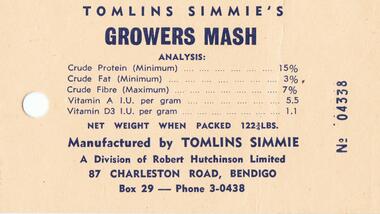
... Object. Tomlins Simmie's Growers Mash analysis tag. ...DOMESTIC EQUIPMENT Clothing Tag Object. Tomlins Simmie's Growers Mash analysis tag. ...Object. Tomlins Simmie's Growers Mash analysis tag. No 04338. Manufactured by Tomlins Simmie, 87 Charleston Road, Bendigo.domestic equipment, clothing tag -
 Bendigo Historical Society Inc.
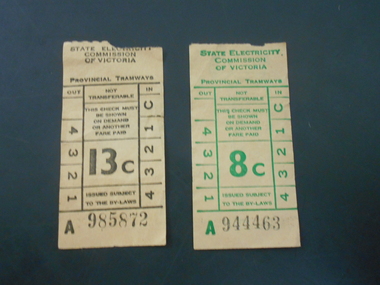
Memorabilia - TRAM TICKETS, Late 1960s
... Objects. Two tram tickets - 8c, 13 c. State Electricity Commission of Victoria. ...Issued subject to the By-Laws , Electricity makes life better. Objects. Two tram tickets - 8c, 13 c. State Electricity Commission of Victoria. ...Objects. Two tram tickets - 8c, 13 c. State Electricity Commission of Victoria. Provincial Tramways, A 944462, A 985872State Electricity Commission of Victoria. Provincial Tramways A 944463, A 985872. Not Transferable. This cheque must shown on demand or another fare paid. Issued subject to the By-Laws , Electricity makes life better.tramways, history, sec tram tickets., refer to 11400.1153 and 11400.1154 -
 Bendigo Historical Society Inc.
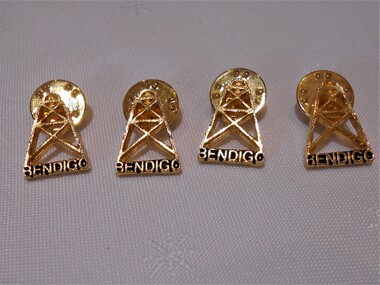
Souvenir - BADGE COLLECTION: CITY OF GREATER BENDIGO LAPEL PINS (4), UK
... Object. Gold coloured lapel pins with a Poppet head with a bar underneath with BENDIGO in gold lettering. ...NUMISMATICS Badges-civil City of Greater Bendigo lapel Pins (4) Object. Gold coloured lapel pins with a Poppet head with a bar underneath with BENDIGO in gold lettering. ...Object. Gold coloured lapel pins with a Poppet head with a bar underneath with BENDIGO in gold lettering. Clip attached at back.numismatics, badges-civil, city of greater bendigo lapel pins (4) -
 Bendigo Historical Society Inc.
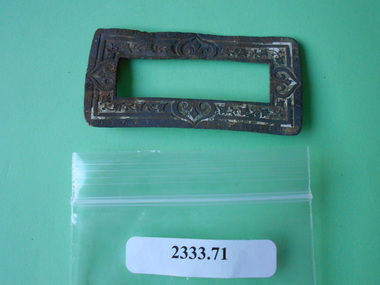
Accessory - QC BINKS COLLECTION: BUCKLE
... Reverse has the remains of clasps. Object is rusted....Reverse has the remains of clasps. Object is rusted. Accessory QC BINKS COLLECTION: BUCKLE ...Metal rectangular buckle.Decorative border of leaves surround a punched out centre. Reverse has the remains of clasps. Object is rusted.bendigo, gold mining, qc binks, qc binks. -
 Bendigo Historical Society Inc.
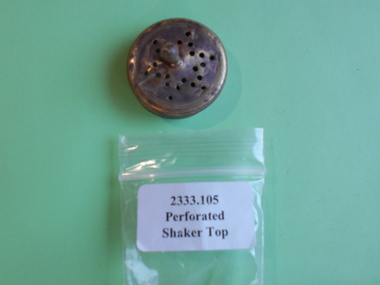
Tool - QC BINKS COLLECTION: SHAKER TOP
... Metal cocktail shaker top. Object is round and perforated with a metal knob in the centre. ...Metal cocktail shaker top. Object is round and perforated with a metal knob in the centre. ...Metal cocktail shaker top. Object is round and perforated with a metal knob in the centre. Knob has been bent over.bendigo, gold mining, qc binks, brooch, qc binks. -
The Ed Muirhead Physics Museum
Vertical Electromagnetic Tuning Fork, between 1928 and 1954
... Triangular, footed base with coiled, coated wire on adjustable stand between side of tuning fork. NOTE: HEAVY OBJECT...Triangular, footed base with coiled, coated wire on adjustable stand between side of tuning fork. NOTE: HEAVY OBJECT Vertical Electromagnetic Tuning Fork ...Triangular, footed base with coiled, coated wire on adjustable stand between side of tuning fork. NOTE: HEAVY OBJECTFront of tuning fork base: '100 / V. D' Sticker on base: '1D4' Stamped on base of fork: 'GRIFFIN & TATLOCK / LONDON' Plaque on base: 'GRIFFIN & TATLOCK LTD / LONDON / GLASGOW / EDINBURGH / [griffin logo] / MANCHESTER / LIVERPOOL' Sticker on side of base: 'NAT. PHIL. LAB / NO / UNIV. OF MELB.'tuning fork, griffin & tatlock, laboratory apparatus, electromagnetic -
 National Vietnam Veterans Museum (NVVM)
Slide - Sims Image Collection
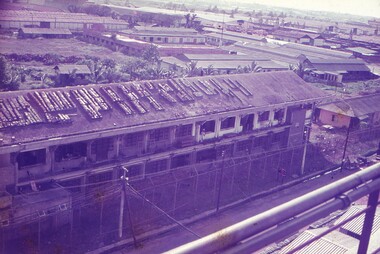
... View of building remaining unfinished due to dangerous objects on roof, next to Headquarters Australian Force Vietnam, Saigon 1970....Peter Stanley Sims 44304 Slides Royal Australian Army Medical Corps Vietnam War Sims Australian Forces Vietnam HQ Australian Forces Vietnam Free World Military Assistance Organisation View of building remaining unfinished due to dangerous objects on roof, next to Headquarters Australian Force Vietnam, Saigon 1970. ...A collection of 253 images on slides taken while on deployment in Vietnam, by Corporal Peter Stanley Sims (44304). He served in the Royal Australian Army Medical Corps, 1969 - 1970.View of building remaining unfinished due to dangerous objects on roof, next to Headquarters Australian Force Vietnam, Saigon 1970.peter stanley sims, 44304, slides, royal australian army medical corps, vietnam war, sims, australian forces vietnam, hq australian forces vietnam, free world military assistance organisation -
 Coal Creek Community Park & Museum
Clothing - Leather Arm Guard
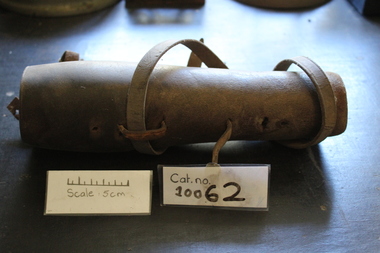
... Long brown leather object approx 30cm with two thin leather straps and buckles, currently rolled and appearing as a tube....arm-guard bracer leather sheath protective clothing early sporting equipment Long brown leather object approx 30cm with two thin leather straps and buckles, currently rolled and appearing as a tube. ...Long brown leather object approx 30cm with two thin leather straps and buckles, currently rolled and appearing as a tube.arm-guard, bracer, leather sheath, protective clothing, early sporting equipment -
 Nillumbik Shire Council
Domenico De CLARIO (b.1947 Trieste, ITA - emigrated AUS 1956), Domenico de Clario, Cenacolo (The Supper Room), 1984-85
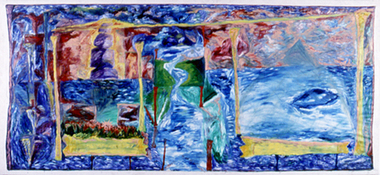
... Semi abstract painting containing out of focus objects within a room....Semi abstract painting containing out of focus objects within a room. Cenacolo (The Supper Room) Domenico De CLARIO (b.1947 Trieste, ITA - emigrated AUS 1956) Domenico de Clario ...This was the first work de Clario painted during his Australia Council residency in Paretaio, Arthur Boyd's studio in Tuscany. It was painted in an old stable with a vaulted ceiling that reminded de Clario of a cenacolo or supper room. Domenico de Clario has an international reputation, gained particularly through his installation work and collaboration with composers and musicians. De Clario made many irregular shaped, un-stretched paintings during this period. He was involved with Arte Povera, a socialist based art movement where the 'poverty' was reflected in the choice and use of materials. This work was entered into the 1986 Shire of Eltham Art Awards. Painting: oil on canvas mounted on stretched canvas. Semi abstract painting containing out of focus objects within a room.de clario, painting, semi abstract, expressive, painterly, personal, arte povera, paretaio -
 Nillumbik Shire Council
Sculpture: Joseph Scott COWCHER, Passionately Packaged, 1987
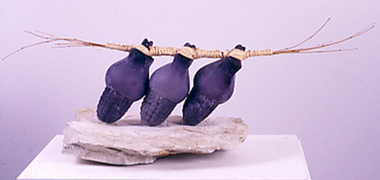
... Three purple glass objects in the form of pine cones, held together by raffia, resting on a large slab of white stone. ...N/A Three purple glass objects in the form of pine cones, held together by raffia, resting on a large slab of white stone. ...This artwork was a finalist in the 1987 Shire of Eltham Art Awards. The materials Cowcher has chosen constitute different transformations of earth - stone, sand (fired into glass), bamboo and dried grass. The work is a sign of the artist's passion in working with these materials and 'packaging' them into an aesthetic composition that connect and dance with one another.Three purple glass objects in the form of pine cones, held together by raffia, resting on a large slab of white stone. N/A
