
Showing 418 items matching "victoria politics"
-
 Kew Historical Society Inc
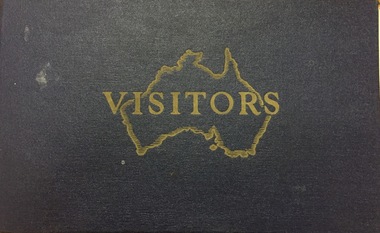
Administrative record, East Kew Women's Club, Visitors Book, East Kew Women's Club, 1945-1973
... Victoria Park, Kew. At the fifth meeting of the group, a committee was formed, and a constitution adopted on 4 December 1945.The Club was aimed to be non-political, non-sectarian and open to women from any locality. ...Victoria Park, Kew. At the fifth meeting of the group, a committee was formed, and a constitution adopted on 4 December 1945.The Club was aimed to be non-political, non-sectarian and open to women from any locality. ...The East Kew Women’s Club was formed on 20 July 1945 as an experiment amongst local women, who felt that there was a need for some organised group to give full scope to their various interests and hobbies. In the beginning, they met at the house of their founder, Mrs Eric Thake, 48 Harp Road, East Kew, but the growth and interest was so rapid that it was soon necessary to find a larger meeting place, so the group moved to the Harrier’s Pavilion in Victoria Park, Kew. At the fifth meeting of the group, a committee was formed, and a constitution adopted on 4 December 1945.The Club was aimed to be non-political, non-sectarian and open to women from any locality. The Club’s motto was “To Help others, Improve Ourselves, and Foster the Community Spirit”. The first twenty years of the Club was recorded in a small, nine-page publication “East Kew Women’s Club : Twenty Years 20-7-1945 - 30-7-1965”. Following the closure of the Club in 1973, after twenty-eight years, its records were deposited with the Kew Historical Society and are thus available for research into the history of women’s groups in the post war period in Australia. The Society holds the Club’s Minute Books of Meetings (1953-73), Attendance Registers (1959-73), Visitors Book, and sundry items of print ephemera published by the Club.Register which visitors signed when attending meetings of the East Kew Women's Club. The register contains names and addresses.east kew women's club, community groups -- kew east (vic.) -
 Kew Historical Society Inc
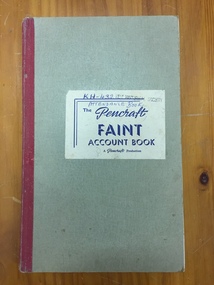
Administrative record, East Kew Women's Club, Attendance Register, East Kew Women’s Club, 1959-1964
... Victoria Park, Kew. At the fifth meeting of the group, a committee was formed, and a constitution adopted on 4 December 1945.The Club was aimed to be non-political, non-sectarian and open to women from any locality. ...Victoria Park, Kew. At the fifth meeting of the group, a committee was formed, and a constitution adopted on 4 December 1945.The Club was aimed to be non-political, non-sectarian and open to women from any locality. ...The East Kew Women’s Club was formed on 20 July 1945 as an experiment amongst local women, who felt that there was a need for some organised group to give full scope to their various interests and hobbies. In the beginning, they met at the house of their founder, Mrs Eric Thake, 48 Harp Road, East Kew, but the growth and interest was so rapid that it was soon necessary to find a larger meeting place, so the group moved to the Harrier’s Pavilion in Victoria Park, Kew. At the fifth meeting of the group, a committee was formed, and a constitution adopted on 4 December 1945.The Club was aimed to be non-political, non-sectarian and open to women from any locality. The Club’s motto was “To Help others, Improve Ourselves, and Foster the Community Spirit”. The first twenty years of the Club was recorded in a small, nine-page publication “East Kew Women’s Club : Twenty Years 20-7-1945 - 30-7-1965”. Following the closure of the Club in 1973, after twenty-eight years, its records were deposited with the Kew Historical Society and are thus available for research into the history of women’s groups in the post war period in Australia. The Society holds the Club’s Minute Books of Meetings (1953-73), Attendance Registers (1959-73), Visitors Book, and sundry items of print ephemera published by the Club.Document: Attendance Register, East Kew Women’s Club, 1959-64east kew women's club, community groups -- kew east (vic) -
 Kew Historical Society Inc
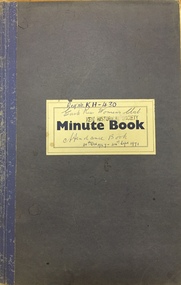
Administrative record, East Kew Women's Club, Attendance Register, East Kew Women’s Club, 1965-1967
... Victoria Park, Kew. At the fifth meeting of the group, a committee was formed, and a constitution adopted on 4 December 1945.The Club was aimed to be non-political, non-sectarian and open to women from any locality. ...Victoria Park, Kew. At the fifth meeting of the group, a committee was formed, and a constitution adopted on 4 December 1945.The Club was aimed to be non-political, non-sectarian and open to women from any locality. ...The East Kew Women’s Club was formed on 20 July 1945 as an experiment amongst local women, who felt that there was a need for some organised group to give full scope to their various interests and hobbies. In the beginning, they met at the house of their founder, Mrs Eric Thake, 48 Harp Road, East Kew, but the growth and interest was so rapid that it was soon necessary to find a larger meeting place, so the group moved to the Harrier’s Pavilion in Victoria Park, Kew. At the fifth meeting of the group, a committee was formed, and a constitution adopted on 4 December 1945.The Club was aimed to be non-political, non-sectarian and open to women from any locality. The Club’s motto was “To Help others, Improve Ourselves, and Foster the Community Spirit”. The first twenty years of the Club was recorded in a small, nine-page publication “East Kew Women’s Club : Twenty Years 20-7-1945 - 30-7-1965”. Following the closure of the Club in 1973, after twenty-eight years, its records were deposited with the Kew Historical Society and are thus available for research into the history of women’s groups in the post war period in Australia. The Society holds the Club’s Minute Books of Meetings (1953-73), Attendance Registers (1959-73), Visitors Book, and sundry items of print ephemera published by the Club.Document: Attendance Register, East Kew Women’s Club, 1965-67east kew women's club, community groups -- kew east (vic) -
 Kew Historical Society Inc
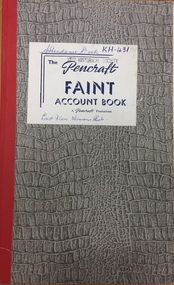
Administrative record, East Kew Women's Club, Attendance Register, 1967-1971
... Victoria Park, Kew. At the fifth meeting of the group, a committee was formed, and a constitution adopted on 4 December 1945.The Club was aimed to be non-political, non-sectarian and open to women from any locality. ...Victoria Park, Kew. At the fifth meeting of the group, a committee was formed, and a constitution adopted on 4 December 1945.The Club was aimed to be non-political, non-sectarian and open to women from any locality. ...The East Kew Women’s Club was formed on 20 July 1945 as an experiment amongst local women, who felt that there was a need for some organised group to give full scope to their various interests and hobbies. In the beginning, they met at the house of their founder, Mrs Eric Thake, 48 Harp Road, East Kew, but the growth and interest was so rapid that it was soon necessary to find a larger meeting place, so the group moved to the Harrier’s Pavilion in Victoria Park, Kew. At the fifth meeting of the group, a committee was formed, and a constitution adopted on 4 December 1945.The Club was aimed to be non-political, non-sectarian and open to women from any locality. The Club’s motto was “To Help others, Improve Ourselves, and Foster the Community Spirit”. The first twenty years of the Club was recorded in a small, nine-page publication “East Kew Women’s Club : Twenty Years 20-7-1945 - 30-7-1965”. Following the closure of the Club in 1973, after twenty-eight years, its records were deposited with the Kew Historical Society and are thus available for research into the history of women’s groups in the post war period in Australia. The Society holds the Club’s Minute Books of Meetings (1953-73), Attendance Registers (1959-73), Visitors Book, and sundry items of print ephemera published by the Club.Register, East Kew Women’s Club, 1967-71east kew women's club, community groups -- kew east (vic.) -
 Kew Historical Society Inc
Administrative record, East Kew Women's Club, Attendance Register, 1971-1973
... Victoria Park, Kew. At the fifth meeting of the group, a committee was formed, and a constitution adopted on 4 December 1945.The Club was aimed to be non-political, non-sectarian and open to women from any locality. ...Victoria Park, Kew. At the fifth meeting of the group, a committee was formed, and a constitution adopted on 4 December 1945.The Club was aimed to be non-political, non-sectarian and open to women from any locality. ...The East Kew Women’s Club was formed on 20 July 1945 as an experiment amongst local women, who felt that there was a need for some organised group to give full scope to their various interests and hobbies. In the beginning, they met at the house of their founder, Mrs Eric Thake, 48 Harp Road, East Kew, but the growth and interest was so rapid that it was soon necessary to find a larger meeting place, so the group moved to the Harrier’s Pavilion in Victoria Park, Kew. At the fifth meeting of the group, a committee was formed, and a constitution adopted on 4 December 1945.The Club was aimed to be non-political, non-sectarian and open to women from any locality. The Club’s motto was “To Help others, Improve Ourselves, and Foster the Community Spirit”. The first twenty years of the Club was recorded in a small, nine-page publication “East Kew Women’s Club : Twenty Years 20-7-1945 - 30-7-1965”. Following the closure of the Club in 1973, after twenty-eight years, its records were deposited with the Kew Historical Society and are thus available for research into the history of women’s groups in the post war period in Australia. The Society holds the Club’s Minute Books of Meetings (1953-73), Attendance Registers (1959-73), Visitors Book, and sundry items of print ephemera published by the Club.Document: Attendance Register, East Kew Women’s Club, 1971-73east kew women's club, community groups -- kew (vic.) -
 Kew Historical Society Inc
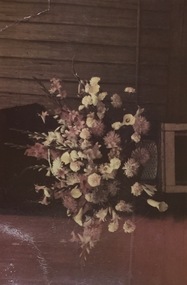
Photograph, East Kew Women's Club, Basket of Flowers sent by Members of the East Kew Women's Club to Queen Elizabeth The Queen Mother, 1958
... Victoria Park, Kew. At the fifth meeting of the group, a committee was formed, and a constitution adopted on 4 December 1945.The Club was aimed to be non-political, non-sectarian and open to women from any locality. ...Victoria Park, Kew. At the fifth meeting of the group, a committee was formed, and a constitution adopted on 4 December 1945.The Club was aimed to be non-political, non-sectarian and open to women from any locality. ...The East Kew Women’s Club was formed on 20 July 1945 as an experiment amongst local women, who felt that there was a need for some organised group to give full scope to their various interests and hobbies. In the beginning, they met at the house of their founder, Mrs Eric Thake, 48 Harp Road, East Kew, but the growth and interest was so rapid that it was soon necessary to find a larger meeting place, so the group moved to the Harrier’s Pavilion in Victoria Park, Kew. At the fifth meeting of the group, a committee was formed, and a constitution adopted on 4 December 1945.The Club was aimed to be non-political, non-sectarian and open to women from any locality. The Club’s motto was “To Help others, Improve Ourselves, and Foster the Community Spirit”. The first twenty years of the Club was recorded in a small, nine-page publication “East Kew Women’s Club : Twenty Years 20-7-1945 - 30-7-1965”.Following the closure of the Club in 1973, after twenty-eight years, its records were deposited with the Kew Historical Society and are thus available for research into the history of women’s groups in the post war period in Australia. The Society holds the Club’s Minute Books of Meetings (1953-73), Attendance Registers (1959-73), Visitors Book, and sundry items of print ephemera published by the Club.Photograph of flowers sent to Queen Elizabeth the Queen Mother in 1958 by the East Kew Women's Club.east kew women's club, queen elizabeth the queen mother, royal visit (victoria) 1958 -
 Kew Historical Society Inc
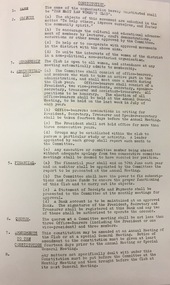
Legal record, East Kew Women's Club, Constitution, East Kew Women's Club, 1945
... Victoria Park, Kew. At the fifth meeting of the group, a committee was formed, and a constitution adopted on 4 December 1945.The Club was aimed to be non-political, non-sectarian and open to women from any locality. ...Victoria Park, Kew. At the fifth meeting of the group, a committee was formed, and a constitution adopted on 4 December 1945.The Club was aimed to be non-political, non-sectarian and open to women from any locality. ...The East Kew Women’s Club was formed on 20 July 1945 as an experiment amongst local women, who felt that there was a need for some organised group to give full scope to their various interests and hobbies. In the beginning, they met at the house of their founder, Mrs Eric Thake, 48 Harp Road, East Kew, but the growth and interest was so rapid that it was soon necessary to find a larger meeting place, so the group moved to the Harrier’s Pavilion in Victoria Park, Kew. At the fifth meeting of the group, a committee was formed, and a constitution adopted on 4 December 1945.The Club was aimed to be non-political, non-sectarian and open to women from any locality. The Club’s motto was “To Help others, Improve Ourselves, and Foster the Community Spirit”. The first twenty years of the Club was recorded in a small, nine-page publication “East Kew Women’s Club : Twenty Years 20-7-1945 - 30-7-1965”. Following the closure of the Club in 1973, after twenty-eight years, its records were deposited with the Kew Historical Society and are thus available for research into the history of women’s groups in the post war period in Australia. The Society holds the Club’s Minute Books of Meetings (1953-73), Attendance Registers (1959-73), Visitors Book, and sundry items of print ephemera published by the Club.1-page typed Constitution of the East Kew Women's Clubeast kew women's club, community groups, women's groups -
 Kew Historical Society Inc
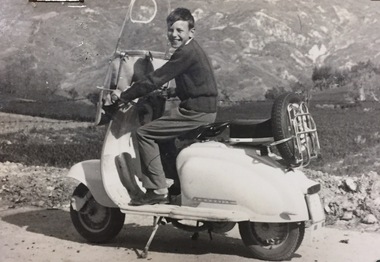
Photograph, East Kew Women's Club, Carlo Giardina, 1950s
... Victoria Park, Kew. At the fifth meeting of the group, a committee was formed, and a constitution adopted on 4 December 1945.The Club was aimed to be non-political, non-sectarian and open to women from any locality. ...Victoria Park, Kew. At the fifth meeting of the group, a committee was formed, and a constitution adopted on 4 December 1945.The Club was aimed to be non-political, non-sectarian and open to women from any locality. ...The East Kew Women’s Club was formed on 20 July 1945 as an experiment amongst local women, who felt that there was a need for some organised group to give full scope to their various interests and hobbies. In the beginning, they met at the house of their founder, Mrs Eric Thake, 48 Harp Road, East Kew, but the growth and interest was so rapid that it was soon necessary to find a larger meeting place, so the group moved to the Harrier’s Pavilion in Victoria Park, Kew. At the fifth meeting of the group, a committee was formed, and a constitution adopted on 4 December 1945.The Club was aimed to be non-political, non-sectarian and open to women from any locality. The Club’s motto was “To Help others, Improve Ourselves, and Foster the Community Spirit”. The first twenty years of the Club was recorded in a small, nine-page publication “East Kew Women’s Club : Twenty Years 20-7-1945 - 30-7-1965”. Following the closure of the Club in 1973, after twenty-eight years, its records were deposited with the Kew Historical Society and are thus available for research into the history of women’s groups in the post war period in Australia. The Society holds the Club’s Minute Books of Meetings (1953-73), Attendance Registers (1959-73), Visitors Book, and sundry items of print ephemera published by the Club.Black and white photograph of Carlo Giardina, an Italian boy who was sponsored by the East Kew Women's Club. The photograph is stuck into one of their registers.east kew women's club, carlo giardina -
 Kew Historical Society Inc
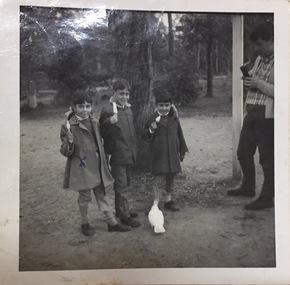
Photograph, East Kew Women's Club, Marlene Higgins, 1950s
... Victoria Park, Kew. At the fifth meeting of the group, a committee was formed, and a constitution adopted on 4 December 1945.The Club was aimed to be non-political, non-sectarian and open to women from any locality. ...Victoria Park, Kew. At the fifth meeting of the group, a committee was formed, and a constitution adopted on 4 December 1945.The Club was aimed to be non-political, non-sectarian and open to women from any locality. ...The East Kew Women’s Club was formed on 20 July 1945 as an experiment amongst local women, who felt that there was a need for some organised group to give full scope to their various interests and hobbies. In the beginning, they met at the house of their founder, Mrs Eric Thake, 48 Harp Road, East Kew, but the growth and interest was so rapid that it was soon necessary to find a larger meeting place, so the group moved to the Harrier’s Pavilion in Victoria Park, Kew. At the fifth meeting of the group, a committee was formed, and a constitution adopted on 4 December 1945.The Club was aimed to be non-political, non-sectarian and open to women from any locality. The Club’s motto was “To Help others, Improve Ourselves, and Foster the Community Spirit”. The first twenty years of the Club was recorded in a small, nine-page publication “East Kew Women’s Club : Twenty Years 20-7-1945 - 30-7-1965”. Following the closure of the Club in 1973, after twenty-eight years, its records were deposited with the Kew Historical Society and are thus available for research into the history of women’s groups in the post war period in Australia. The Society holds the Club’s Minute Books of Meetings (1953-73), Attendance Registers (1959-73), Visitors Book, and sundry items of print ephemera published by the Club.Black and white photograph of Marlene Higgins, an Aboriginal girl who was sponsored by the East Kew Women's Club. The photograph is stuck into one of their registers.east kew women's club, community organisations -- kew east (vic.), aboriginal and torres straight islander -
 Kew Historical Society Inc
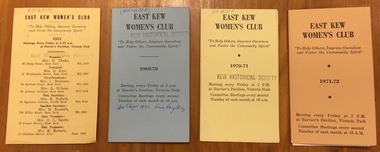
Document, East Kew Women's Club, East Kew Women's Club Yearly Meeting Schedules, 1953-1971
... Victoria Park, Kew. At the fifth meeting of the group, a committee was formed, and a constitution adopted on 4 December 1945.The Club was aimed to be non-political, non-sectarian and open to women from any locality. ...Victoria Park, Kew. At the fifth meeting of the group, a committee was formed, and a constitution adopted on 4 December 1945.The Club was aimed to be non-political, non-sectarian and open to women from any locality. ...The East Kew Women’s Club was formed on 20 July 1945 as an experiment amongst local women, who felt that there was a need for some organised group to give full scope to their various interests and hobbies. In the beginning, they met at the house of their founder, Mrs Eric Thake, 48 Harp Road, East Kew, but the growth and interest was so rapid that it was soon necessary to find a larger meeting place, so the group moved to the Harrier’s Pavilion in Victoria Park, Kew. At the fifth meeting of the group, a committee was formed, and a constitution adopted on 4 December 1945.The Club was aimed to be non-political, non-sectarian and open to women from any locality. The Club’s motto was “To Help others, Improve Ourselves, and Foster the Community Spirit”. The first twenty years of the Club was recorded in a small, nine-page publication “East Kew Women’s Club : Twenty Years 20-7-1945 - 30-7-1965”. Following the closure of the Club in 1973, after twenty-eight years, its records were deposited with the Kew Historical Society and are thus available for research into the history of women’s groups in the post war period in Australia. The Society holds the Club’s Minute Books of Meetings (1953-73), Attendance Registers (1959-73), Visitors Book, and sundry items of print ephemera published by the Club.4 printed programs of meetings and activities of the East Kew Women's Club for the years 1953, 1969-70, 1970-71, 1971-72.clubs -- kew east (vic.), east kew women's club -
Kew Historical Society Inc
Journal, The Kewriosity Sheet Vol.3 No.11 : June 1982
... Political profiles; Kew City Council] / p1. Kew Library [Opening hours] / p1. Institute of Early Childhood Development [community education classes] / p2. What's doing in Kew for June / p2. Scrabble / p2. R.A.A.V. Action Program [Rheumatism and Arthritis Association of Victoria ...Introducing your Prospect Ward Councillors - Cr J. McCue, Cr M.G. Wood, Cr K. Cole [Political profiles; Kew City Council] / p1. Kew Library [Opening hours] / p1. Institute of Early Childhood Development [community education classes] / p2. What's doing in Kew for June / p2. Scrabble / p2. R.A.A.V. Action Program [Rheumatism and Arthritis Association of Victoria] / p3. A gold mine in your backyard [land values] / Barbara Giles p3. Small can be big [East Kew Baptist Church] / p3. Unique community project interchange [I.Y.D.P.; International Year of Disabled Persons] / p4. Host families for disabled children / p4. Hyde Park Fellowship [Hyde Park Uniting Church] / p4. See touch and taste! / p4. Volunteers needed at Kew Cottages / p4.The Kewriosity Sheet (1979-83) was first published in the City of Kew (Victoria) in June 1979 as a two-sided 'community newssheet'. It aimed to: 'share news about Kew happenings and Kew people, and to exchange ideas about living in Kew'. Later issues gradually evolved into a 4-page, quarto sized publication. The Kewriosity Sheet was superseded by the Kew Council publication 'Kewriosity' (1983-1994).non-fictionIntroducing your Prospect Ward Councillors - Cr J. McCue, Cr M.G. Wood, Cr K. Cole [Political profiles; Kew City Council] / p1. Kew Library [Opening hours] / p1. Institute of Early Childhood Development [community education classes] / p2. What's doing in Kew for June / p2. Scrabble / p2. R.A.A.V. Action Program [Rheumatism and Arthritis Association of Victoria] / p3. A gold mine in your backyard [land values] / Barbara Giles p3. Small can be big [East Kew Baptist Church] / p3. Unique community project interchange [I.Y.D.P.; International Year of Disabled Persons] / p4. Host families for disabled children / p4. Hyde Park Fellowship [Hyde Park Uniting Church] / p4. See touch and taste! / p4. Volunteers needed at Kew Cottages / p4. community publications --- kew (vic.), the kewriosity sheet, newsletters - kew (vic.) -
Kew Historical Society Inc
Journal, The Kewriosity Sheet Vol.4 No.2 : September 1982
... Political profiles/ p1. Stolen [instruments; Kew Philharmonic Society] / p1. Deafness Awareness Week / p2. Mediate at home / p2. I.E.C.D. [Short courses; Institute of Early Childhood Development] / p2. What's doing in Kew for September / p2. Native Plant Group / p2. Kew Garden Club / p2. Family & Community Services Programme (F.A.C.S.) [Community Service Grants] / p3. Kew Philharmonic Orchestra / p3. Drop In [Kew Uniting Church] / p3. Come Alive! / p3. Good news for craft workers [Worco Recyclotron] / p3. Caregivers needed [Family Day Care] / p3. Kew Municipal Library / p3. Moderator to visit [Moderator of the Synod of Victoria ...Studley Park Ward Councillors - Cr J. Tutt, Cr R. Sanders, Cr J. O'Brien [City of Kew; Political profiles/ p1. Stolen [instruments; Kew Philharmonic Society] / p1. Deafness Awareness Week / p2. Mediate at home / p2. I.E.C.D. [Short courses; Institute of Early Childhood Development] / p2. What's doing in Kew for September / p2. Native Plant Group / p2. Kew Garden Club / p2. Family & Community Services Programme (F.A.C.S.) [Community Service Grants] / p3. Kew Philharmonic Orchestra / p3. Drop In [Kew Uniting Church] / p3. Come Alive! / p3. Good news for craft workers [Worco Recyclotron] / p3. Caregivers needed [Family Day Care] / p3. Kew Municipal Library / p3. Moderator to visit [Moderator of the Synod of Victoria] / p3. Highbury Grove Kew Uniting Church - History of Church [former Kew Methodist Church] / p4. Centenary concert [Kew Uniting Church] / p4. Mission Spring Fair [Missionary Sisters of St Peter Claver] / p4. Hyde Park Fellowship [Hyde Park Uniting Church] / p4. Uniting Church East Kew / p4.The Kewriosity Sheet (1979-83) was first published in the City of Kew (Victoria) in June 1979 as a two-sided 'community newssheet'. It aimed to: 'share news about Kew happenings and Kew people, and to exchange ideas about living in Kew'. Later issues gradually evolved into a 4-page, quarto sized publication. The Kewriosity Sheet was superseded by the Kew Council publication 'Kewriosity' (1983-1994).non-fictionStudley Park Ward Councillors - Cr J. Tutt, Cr R. Sanders, Cr J. O'Brien [City of Kew; Political profiles/ p1. Stolen [instruments; Kew Philharmonic Society] / p1. Deafness Awareness Week / p2. Mediate at home / p2. I.E.C.D. [Short courses; Institute of Early Childhood Development] / p2. What's doing in Kew for September / p2. Native Plant Group / p2. Kew Garden Club / p2. Family & Community Services Programme (F.A.C.S.) [Community Service Grants] / p3. Kew Philharmonic Orchestra / p3. Drop In [Kew Uniting Church] / p3. Come Alive! / p3. Good news for craft workers [Worco Recyclotron] / p3. Caregivers needed [Family Day Care] / p3. Kew Municipal Library / p3. Moderator to visit [Moderator of the Synod of Victoria] / p3. Highbury Grove Kew Uniting Church - History of Church [former Kew Methodist Church] / p4. Centenary concert [Kew Uniting Church] / p4. Mission Spring Fair [Missionary Sisters of St Peter Claver] / p4. Hyde Park Fellowship [Hyde Park Uniting Church] / p4. Uniting Church East Kew / p4. community publications --- kew (vic.), the kewriosity sheet, newsletters - kew (vic.) -
 Kew Historical Society Inc
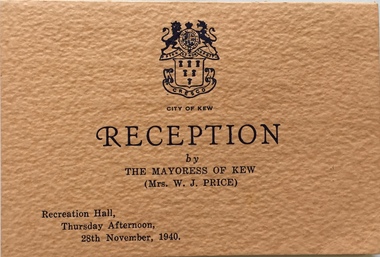
Document (item) - Programme, City of Kew, Reception by the Mayoress of Kew (Mrs W.J. Price), 1940
... political, social and cultural history of the district. As a continuous record, ranging across most decades of the Twentieth Century, they reveal changing tastes in design, values and relationships in the history of local government in Victoria. recreation hall -- kew (vic) civic programmes mrs w.j. price mayoresses of kew Bi-fold programme for a reception in the Kew Recreation Hall on 28 November 1940 Reception by the Mayoress of Kew (Mrs W.J. ...The Municipality of Kew (1860-1863), the Borough of Kew (1863-1910), the Town of Kew (1910-1921) and the City of Kew (1921-1994) were local government instrumentalities in the State of Victoria. In 1994, the City of Kew was amalgamated, together with the former Cities of Camberwell and Hawthorn, into the new City of Boroondara (1994- ). Like other local government entities of the period, Kew was administered by town clerks. The two notable town clerks in Kew's history were H. H. (Henry Hirst) Harrison (1868-1955) and W. D. (William Dickie) Birrell (1899-1974). Harrison was appointed to the position in 1901 and retired in 1938 after 37 years. Birrell, appointed Acting Town Clerk in 1921, became Town Clerk in 1938, following Harrison's retirement. He continued in this role until his retirement in 1966.This card is part of an historically significant civic collection, containing hundreds of separate invitations, documents, greeting cards, programmes and tickets issued and/or collected by successive town clerks. Items in the collection illuminate the political, social and cultural history of the district. As a continuous record, ranging across most decades of the Twentieth Century, they reveal changing tastes in design, values and relationships in the history of local government in Victoria.recreation hall -- kew (vic), civic programmes, mrs w.j. price, mayoresses of kew -
 Kew Historical Society Inc
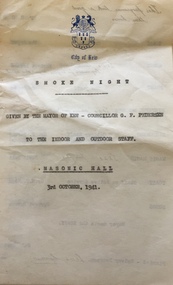
Document (item) - Programme, City of Kew, Smoke Night, 1941
... political, social and cultural history of the district. As a continuous record, ranging across most decades of the Twentieth Century, they reveal changing tastes in design, values and relationships in the history of local government in Victoria. civic programmes masonic hall -- kew (vic.) mayors of kew cr g f pedersen Bi-fold draft programme for a smoke night in the Kew Masonic Hall on 3rd October 1941. ...The Municipality of Kew (1860-1863), the Borough of Kew (1863-1910), the Town of Kew (1910-1921) and the City of Kew (1921-1994) were local government instrumentalities in the State of Victoria. In 1994, the City of Kew was amalgamated, together with the former Cities of Camberwell and Hawthorn, into the new City of Boroondara (1994- ). Like other local government entities of the period, Kew was administered by town clerks. The two notable town clerks in Kew's history were H. H. (Henry Hirst) Harrison (1868-1955) and W. D. (William Dickie) Birrell (1899-1974). Harrison was appointed to the position in 1901 and retired in 1938 after 37 years. Birrell, appointed Acting Town Clerk in 1921, became Town Clerk in 1938, following Harrison's retirement. He continued in this role until his retirement in 1966.This card is part of an historically significant civic collection, containing hundreds of separate invitations, documents, greeting cards, programmes and tickets issued and/or collected by successive town clerks. Items in the collection illuminate the political, social and cultural history of the district. As a continuous record, ranging across most decades of the Twentieth Century, they reveal changing tastes in design, values and relationships in the history of local government in Victoria.civic programmes, masonic hall -- kew (vic.), mayors of kew, cr g f pedersen -
 Kew Historical Society Inc
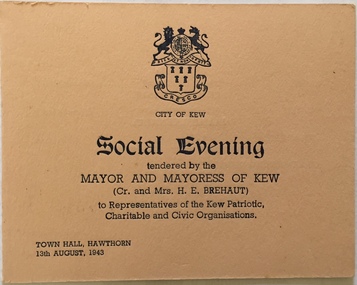
Document (item) - Programme, City of Kew, Social Evening, 1943
... political, social and cultural history of the district. As a continuous record, ranging across most decades of the Twentieth Century, they reveal changing tastes in design, values and relationships in the history of local government in Victoria. civic programmes mayors of kew hawthorn town hall cr h e brehaut world war 2 - home front world war 2 -- kew (vic.) ...The Municipality of Kew (1860-1863), the Borough of Kew (1863-1910), the Town of Kew (1910-1921) and the City of Kew (1921-1994) were local government instrumentalities in the State of Victoria. In 1994, the City of Kew was amalgamated, together with the former Cities of Camberwell and Hawthorn, into the new City of Boroondara (1994- ). Like other local government entities of the period, Kew was administered by town clerks. The two notable town clerks in Kew's history were H. H. (Henry Hirst) Harrison (1868-1955) and W. D. (William Dickie) Birrell (1899-1974). Harrison was appointed to the position in 1901 and retired in 1938 after 37 years. Birrell, appointed Acting Town Clerk in 1921, became Town Clerk in 1938, following Harrison's retirement. He continued in this role until his retirement in 1966.This card is part of an historically significant civic collection, containing hundreds of separate invitations, documents, greeting cards, programmes and tickets issued and/or collected by successive town clerks. Items in the collection illuminate the political, social and cultural history of the district. As a continuous record, ranging across most decades of the Twentieth Century, they reveal changing tastes in design, values and relationships in the history of local government in Victoria.civic programmes, mayors of kew, hawthorn town hall, cr h e brehaut, world war 2 - home front, world war 2 -- kew (vic.) -
 Kew Historical Society Inc
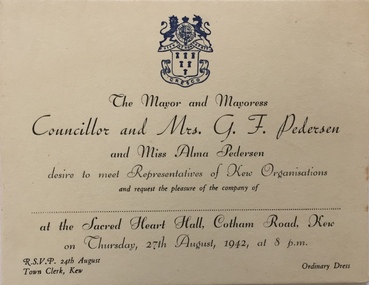
Document (item) - Invitation, City of Kew, Meeting with Representatives of Kew Organisations, 1942
... political, social and cultural history of the district. As a continuous record, ranging across most decades of the Twentieth Century, they reveal changing tastes in design, values and relationships in the history of local government in Victoria. civic programmes mayors of kew world war 2 - home front world war 2 -- kew (vic.) sacred heart hall -- cotham road -- kew (vic.) cr g f pedersen Single sided invitation to an event held by the City of Kew where representatives of Kew Organisations could meet the Mayor and Mayoress of Kew, Cr and Mrs G F Pedersen, at the Sacred Heart Hall on 27 August 1942 Meeting with Representatives of Kew Organisations Document Invitation City of Kew ...The Municipality of Kew (1860-1863), the Borough of Kew (1863-1910), the Town of Kew (1910-1921) and the City of Kew (1921-1994) were local government instrumentalities in the State of Victoria. In 1994, the City of Kew was amalgamated, together with the former Cities of Camberwell and Hawthorn, into the new City of Boroondara (1994- ). Like other local government entities of the period, Kew was administered by town clerks. The two notable town clerks in Kew's history were H. H. (Henry Hirst) Harrison (1868-1955) and W. D. (William Dickie) Birrell (1899-1974). Harrison was appointed to the position in 1901 and retired in 1938 after 37 years. Birrell, appointed Acting Town Clerk in 1921, became Town Clerk in 1938, following Harrison's retirement. He continued in this role until his retirement in 1966.This card is part of an historically significant civic collection, containing hundreds of separate invitations, documents, greeting cards, programmes and tickets issued and/or collected by successive town clerks. Items in the collection illuminate the political, social and cultural history of the district. As a continuous record, ranging across most decades of the Twentieth Century, they reveal changing tastes in design, values and relationships in the history of local government in Victoria.civic programmes, mayors of kew, world war 2 - home front, world war 2 -- kew (vic.), sacred heart hall -- cotham road -- kew (vic.), cr g f pedersen -
 Kew Historical Society Inc
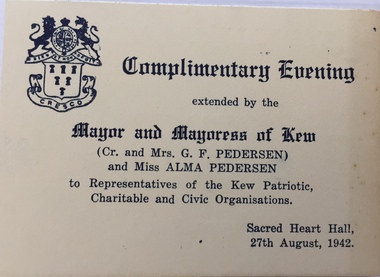
Document (item) - Programme, City of Kew, Complimentary Evening, 1942
... political, social and cultural history of the district. As a continuous record, ranging across most decades of the Twentieth Century, they reveal changing tastes in design, values and relationships in the history of local government in Victoria. civic programmes mayors of kew world war 2 - home front world war 2 -- kew (vic.) sacred heart hall -- cotham road -- kew (vic.) cr g f pedersen Invitation to an event held by the City of Kew where representatives of Kew Patriotic, Charitable and Civic Organisations could meet the Mayor and Mayoress of Kew, Cr and Mrs G F Pedersen, at the Sacred Heart Hall on 27 August 1942. ...The Municipality of Kew (1860-1863), the Borough of Kew (1863-1910), the Town of Kew (1910-1921) and the City of Kew (1921-1994) were local government instrumentalities in the State of Victoria. In 1994, the City of Kew was amalgamated, together with the former Cities of Camberwell and Hawthorn, into the new City of Boroondara (1994- ). Like other local government entities of the period, Kew was administered by town clerks. The two notable town clerks in Kew's history were H. H. (Henry Hirst) Harrison (1868-1955) and W. D. (William Dickie) Birrell (1899-1974). Harrison was appointed to the position in 1901 and retired in 1938 after 37 years. Birrell, appointed Acting Town Clerk in 1921, became Town Clerk in 1938, following Harrison's retirement. He continued in this role until his retirement in 1966.This card is part of an historically significant civic collection, containing hundreds of separate invitations, documents, greeting cards, programmes and tickets issued and/or collected by successive town clerks. Items in the collection illuminate the political, social and cultural history of the district. As a continuous record, ranging across most decades of the Twentieth Century, they reveal changing tastes in design, values and relationships in the history of local government in Victoria.civic programmes, mayors of kew, world war 2 - home front, world war 2 -- kew (vic.), sacred heart hall -- cotham road -- kew (vic.), cr g f pedersen -
 Kew Historical Society Inc
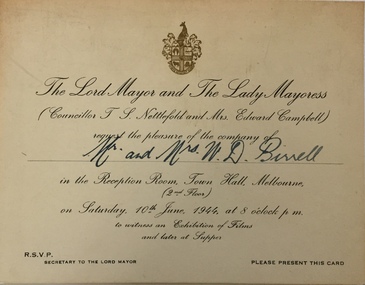
Document (item) - Invitation, City of Melbourne, Exhibition of Films, 1944
... political, social and cultural history of the district. As a continuous record, ranging across most decades of the Twentieth Century, they reveal changing tastes in design, values and relationships in the history of local government in Victoria. w d birrell cr t s nettlefold city of melbourne -- invitations civic invitations Single sided Invitation to Mr and Mrs W D Birrell by the the Mayor and Mayoress of the City of Melbourne (Cr T S Nettlefold and Mrs Edward Campbell) to view an exhibition of films at the Melbourne Town Hall on 10 June 1944. ...The Municipality of Kew (1860-1863), the Borough of Kew (1863-1910), the Town of Kew (1910-1921) and the City of Kew (1921-1994) were local government instrumentalities in the State of Victoria. In 1994, the City of Kew was amalgamated, together with the former Cities of Camberwell and Hawthorn, into the new City of Boroondara (1994- ). Like other local government entities of the period, Kew was administered by town clerks. The two notable town clerks in Kew's history were H. H. (Henry Hirst) Harrison (1868-1955) and W. D. (William Dickie) Birrell (1899-1974). Harrison was appointed to the position in 1901 and retired in 1938 after 37 years. Birrell, appointed Acting Town Clerk in 1921, became Town Clerk in 1938, following Harrison's retirement. He continued in this role until his retirement in 1966.This card is part of an historically significant civic collection, containing hundreds of separate invitations, documents, greeting cards, programmes and tickets issued and/or collected by successive town clerks. Items in the collection illuminate the political, social and cultural history of the district. As a continuous record, ranging across most decades of the Twentieth Century, they reveal changing tastes in design, values and relationships in the history of local government in Victoria.w d birrell, cr t s nettlefold, city of melbourne -- invitations, civic invitations -
 Kew Historical Society Inc
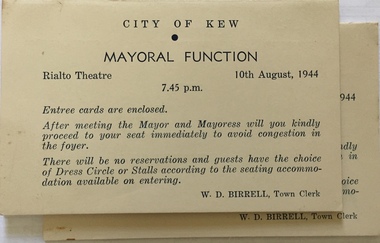
Document (item) - Entrée Card, City of Kew, Mayoral Function, 1944
... political, social and cultural history of the district. As a continuous record, ranging across most decades of the Twentieth Century, they reveal changing tastes in design, values and relationships in the history of local government in Victoria. entree cards city of kew ephemera rialto theatre (kew) kew (vic.) -- 1944 w d birrell Set of bi-fold entree cards to a Mayoral Function of the City of Kew at the Rialto Theatre in High Street on 10 August 1944 Mayoral Function Document Entrée Card City of Kew ...The Municipality of Kew (1860-1863), the Borough of Kew (1863-1910), the Town of Kew (1910-1921) and the City of Kew (1921-1994) were local government instrumentalities in the State of Victoria. In 1994, the City of Kew was amalgamated, together with the former Cities of Camberwell and Hawthorn, into the new City of Boroondara (1994- ). Like other local government entities of the period, Kew was administered by town clerks. The two notable town clerks in Kew's history were H. H. (Henry Hirst) Harrison (1868-1955) and W. D. (William Dickie) Birrell (1899-1974). Harrison was appointed to the position in 1901 and retired in 1938 after 37 years. Birrell, appointed Acting Town Clerk in 1921, became Town Clerk in 1938, following Harrison's retirement. He continued in this role until his retirement in 1966.This is part of an historically significant civic collection, containing hundreds of separate invitations, documents, greeting cards, programmes and tickets issued and/or collected by successive town clerks. Items in the collection illuminate the political, social and cultural history of the district. As a continuous record, ranging across most decades of the Twentieth Century, they reveal changing tastes in design, values and relationships in the history of local government in Victoria.entree cards, city of kew, ephemera, rialto theatre (kew), kew (vic.) -- 1944, w d birrell -
 Kew Historical Society Inc
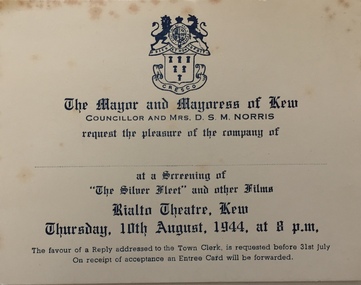
Document (item) - Invitation, City of Kew, Film Evening, 1944
... political, social and cultural history of the district. As a continuous record, ranging across most decades of the Twentieth Century, they reveal changing tastes in design, values and relationships in the history of local government in Victoria. city of kew ephemera rialto theatre (kew) kew (vic.) -- 1944 invitations cr d s m norris Single-sided invitation to a Film Evening held by the Mayor and Mayoress of Kew (Cr and Mrs D S M Norris) at the Rialto Theatre, Kew on 10 August 1944. ...The Municipality of Kew (1860-1863), the Borough of Kew (1863-1910), the Town of Kew (1910-1921) and the City of Kew (1921-1994) were local government instrumentalities in the State of Victoria. In 1994, the City of Kew was amalgamated, together with the former Cities of Camberwell and Hawthorn, into the new City of Boroondara (1994- ). Like other local government entities of the period, Kew was administered by town clerks. The two notable town clerks in Kew's history were H. H. (Henry Hirst) Harrison (1868-1955) and W. D. (William Dickie) Birrell (1899-1974). Harrison was appointed to the position in 1901 and retired in 1938 after 37 years. Birrell, appointed Acting Town Clerk in 1921, became Town Clerk in 1938, following Harrison's retirement. He continued in this role until his retirement in 1966.This is part of an historically significant civic collection, containing hundreds of separate invitations, documents, greeting cards, programmes and tickets issued and/or collected by successive town clerks. Items in the collection illuminate the political, social and cultural history of the district. As a continuous record, ranging across most decades of the Twentieth Century, they reveal changing tastes in design, values and relationships in the history of local government in Victoria.city of kew, ephemera, rialto theatre (kew), kew (vic.) -- 1944, invitations, cr d s m norris -
 Kew Historical Society Inc
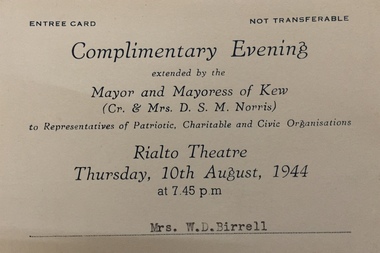
Document (item) - Entrée Card, City of Kew, Complimentary Evening, 1944
... political, social and cultural history of the district. As a continuous record, ranging across most decades of the Twentieth Century, they reveal changing tastes in design, values and relationships in the history of local government in Victoria. city of kew ephemera rialto theatre (kew) kew (vic.) -- 1944 invitations cr d s m norris mrs w d birrell entree cards civic ephemera Single-sided invitation to a Complimentary Evening held by the Mayor and Mayoress of Kew (Cr and Mrs D S M Norris) at the Rialto Theatre, Kew on 10 August 1944 issued to Mrs W D Birrell. ...The Municipality of Kew (1860-1863), the Borough of Kew (1863-1910), the Town of Kew (1910-1921) and the City of Kew (1921-1994) were local government instrumentalities in the State of Victoria. In 1994, the City of Kew was amalgamated, together with the former Cities of Camberwell and Hawthorn, into the new City of Boroondara (1994- ). Like other local government entities of the period, Kew was administered by town clerks. The two notable town clerks in Kew's history were H. H. (Henry Hirst) Harrison (1868-1955) and W. D. (William Dickie) Birrell (1899-1974). Harrison was appointed to the position in 1901 and retired in 1938 after 37 years. Birrell, appointed Acting Town Clerk in 1921, became Town Clerk in 1938, following Harrison's retirement. He continued in this role until his retirement in 1966.This is part of an historically significant civic collection, containing hundreds of separate invitations, documents, greeting cards, programmes and tickets issued and/or collected by successive town clerks. Items in the collection illuminate the political, social and cultural history of the district. As a continuous record, ranging across most decades of the Twentieth Century, they reveal changing tastes in design, values and relationships in the history of local government in Victoria.city of kew, ephemera, rialto theatre (kew), kew (vic.) -- 1944, invitations, cr d s m norris, mrs w d birrell, entree cards, civic ephemera -
 Kew Historical Society Inc
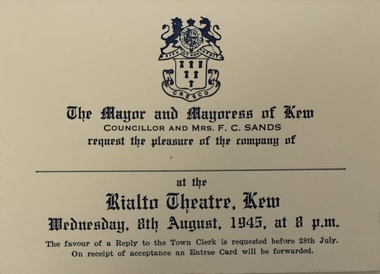
Document (item) - Invitation, City of Kew, Complimentary Evening, 1945
... political, social and cultural history of the district. As a continuous record, ranging across most decades of the Twentieth Century, they reveal changing tastes in design, values and relationships in the history of local government in Victoria. city of kew ephemera rialto theatre (kew) invitations civic ephemera kew (vic.) -- 1945 civic invitations cr f c sands Single-sided invitation by the Mayor and Mayoress of Kew (Cr F.C. ...The Municipality of Kew (1860-1863), the Borough of Kew (1863-1910), the Town of Kew (1910-1921) and the City of Kew (1921-1994) were local government instrumentalities in the State of Victoria. In 1994, the City of Kew was amalgamated, together with the former Cities of Camberwell and Hawthorn, into the new City of Boroondara (1994- ). Like other local government entities of the period, Kew was administered by town clerks. The two notable town clerks in Kew's history were H. H. (Henry Hirst) Harrison (1868-1955) and W. D. (William Dickie) Birrell (1899-1974). Harrison was appointed to the position in 1901 and retired in 1938 after 37 years. Birrell, appointed Acting Town Clerk in 1921, became Town Clerk in 1938, following Harrison's retirement. He continued in this role until his retirement in 1966.This is part of an historically significant civic collection, containing hundreds of separate invitations, documents, greeting cards, programmes and tickets issued and/or collected by successive town clerks. Items in the collection illuminate the political, social and cultural history of the district. As a continuous record, ranging across most decades of the Twentieth Century, they reveal changing tastes in design, values and relationships in the history of local government in Victoria.city of kew, ephemera, rialto theatre (kew), invitations, civic ephemera, kew (vic.) -- 1945, civic invitations, cr f c sands -
 Kew Historical Society Inc
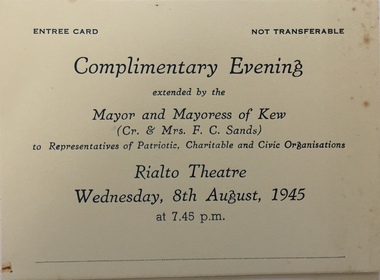
Document (item) - Invitation, City of Kew, Complimentary Evening, 1945
... political, social and cultural history of the district. As a continuous record, ranging across most decades of the Twentieth Century, they reveal changing tastes in design, values and relationships in the history of local government in Victoria. city of kew ephemera rialto theatre (kew) invitations civic ephemera kew (vic.) -- 1945 civic invitations cr f c sands Single-sided invitation from the Mayor and Mayoress of Kew (Cr and Mrs F.C. ...The Municipality of Kew (1860-1863), the Borough of Kew (1863-1910), the Town of Kew (1910-1921) and the City of Kew (1921-1994) were local government instrumentalities in the State of Victoria. In 1994, the City of Kew was amalgamated, together with the former Cities of Camberwell and Hawthorn, into the new City of Boroondara (1994- ). Like other local government entities of the period, Kew was administered by town clerks. The two notable town clerks in Kew's history were H. H. (Henry Hirst) Harrison (1868-1955) and W. D. (William Dickie) Birrell (1899-1974). Harrison was appointed to the position in 1901 and retired in 1938 after 37 years. Birrell, appointed Acting Town Clerk in 1921, became Town Clerk in 1938, following Harrison's retirement. He continued in this role until his retirement in 1966.This is part of an historically significant civic collection, containing hundreds of separate invitations, documents, greeting cards, programmes and tickets issued and/or collected by successive town clerks. Items in the collection illuminate the political, social and cultural history of the district. As a continuous record, ranging across most decades of the Twentieth Century, they reveal changing tastes in design, values and relationships in the history of local government in Victoria.city of kew, ephemera, rialto theatre (kew), invitations, civic ephemera, kew (vic.) -- 1945, civic invitations, cr f c sands -
 Kew Historical Society Inc
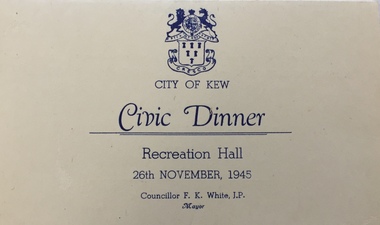
Document (item) - Programme, City of Kew, Civic Dinner, 1945
... political, social and cultural history of the district. As a continuous record, ranging across most decades of the Twentieth Century, they reveal changing tastes in design, values and relationships in the history of local government in Victoria. city of kew ephemera invitations civic ephemera kew (vic.) -- 1945 civic invitations cr f k white kew recreation hall Bi-fold programme provided to invited guests at a civic dinner held in the Kew Recreation Hall, Wellington Street, on 26 November 1945. ...The Municipality of Kew (1860-1863), the Borough of Kew (1863-1910), the Town of Kew (1910-1921) and the City of Kew (1921-1994) were local government instrumentalities in the State of Victoria. In 1994, the City of Kew was amalgamated, together with the former Cities of Camberwell and Hawthorn, into the new City of Boroondara (1994- ). Like other local government entities of the period, Kew was administered by town clerks. The two notable town clerks in Kew's history were H. H. (Henry Hirst) Harrison (1868-1955) and W. D. (William Dickie) Birrell (1899-1974). Harrison was appointed to the position in 1901 and retired in 1938 after 37 years. Birrell, appointed Acting Town Clerk in 1921, became Town Clerk in 1938, following Harrison's retirement. He continued in this role until his retirement in 1966.This is part of an historically significant civic collection, containing hundreds of separate invitations, documents, greeting cards, programmes and tickets issued and/or collected by successive town clerks. Items in the collection illuminate the political, social and cultural history of the district. As a continuous record, ranging across most decades of the Twentieth Century, they reveal changing tastes in design, values and relationships in the history of local government in Victoria.city of kew, ephemera, invitations, civic ephemera, kew (vic.) -- 1945, civic invitations, cr f k white, kew recreation hall -
 Kew Historical Society Inc
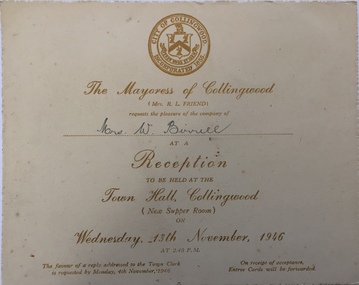
Document (item) - Invitation, City of Collingwood, Reception, 1946
... political, social and cultural history of the district. As a continuous record, ranging across most decades of the Twentieth Century, they reveal changing tastes in design, values and relationships in the history of local government in Victoria. ephemera civic ephemera civic invitations city of collingwood mrs w d birrell mayoresses of collingwood mrs r l friend Single-sided invitation issued to Mrs W Birrell by the Mayoress of Collingwood (Mrs R L Friend) for a Reception in the Collingwood Town Hall on 13th November 1946. ...The Municipality of Kew (1860-1863), the Borough of Kew (1863-1910), the Town of Kew (1910-1921) and the City of Kew (1921-1994) were local government instrumentalities in the State of Victoria. In 1994, the City of Kew was amalgamated, together with the former Cities of Camberwell and Hawthorn, into the new City of Boroondara (1994- ). Like other local government entities of the period, Kew was administered by town clerks. The two notable town clerks in Kew's history were H. H. (Henry Hirst) Harrison (1868-1955) and W. D. (William Dickie) Birrell (1899-1974). Harrison was appointed to the position in 1901 and retired in 1938 after 37 years. Birrell, appointed Acting Town Clerk in 1921, became Town Clerk in 1938, following Harrison's retirement. He continued in this role until his retirement in 1966.This is part of an historically significant civic collection, containing hundreds of separate invitations, documents, greeting cards, programmes and tickets issued and/or collected by successive town clerks. Items in the collection illuminate the political, social and cultural history of the district. As a continuous record, ranging across most decades of the Twentieth Century, they reveal changing tastes in design, values and relationships in the history of local government in Victoria.ephemera, civic ephemera, civic invitations, city of collingwood, mrs w d birrell, mayoresses of collingwood, mrs r l friend -
 Kew Historical Society Inc
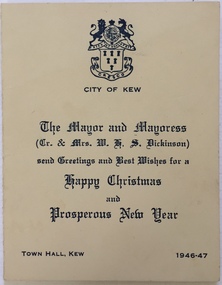
Document (item) - Card, City of Kew, Christmas Card, 1946
... political, social and cultural history of the district. As a continuous record, ranging across most decades of the Twentieth Century, they reveal changing tastes in design, values and relationships in the history of local government in Victoria. ephemera civic ephemera greeting cards city of kew (vic.) -- 1946 cr w h s dickinson christmas cards Bi-fold greeting card from the Mayor and Mayoress of Kew (Cr and Mrs W.H.S. ...The Municipality of Kew (1860-1863), the Borough of Kew (1863-1910), the Town of Kew (1910-1921) and the City of Kew (1921-1994) were local government instrumentalities in the State of Victoria. In 1994, the City of Kew was amalgamated, together with the former Cities of Camberwell and Hawthorn, into the new City of Boroondara (1994- ). Like other local government entities of the period, Kew was administered by town clerks. The two notable town clerks in Kew's history were H. H. (Henry Hirst) Harrison (1868-1955) and W. D. (William Dickie) Birrell (1899-1974). Harrison was appointed to the position in 1901 and retired in 1938 after 37 years. Birrell, appointed Acting Town Clerk in 1921, became Town Clerk in 1938, following Harrison's retirement. He continued in this role until his retirement in 1966.This is part of an historically significant civic collection, containing hundreds of separate invitations, documents, greeting cards, programmes and tickets issued and/or collected by successive town clerks. Items in the collection illuminate the political, social and cultural history of the district. As a continuous record, ranging across most decades of the Twentieth Century, they reveal changing tastes in design, values and relationships in the history of local government in Victoria.ephemera, civic ephemera, greeting cards, city of kew (vic.) -- 1946, cr w h s dickinson, christmas cards -
 Kew Historical Society Inc
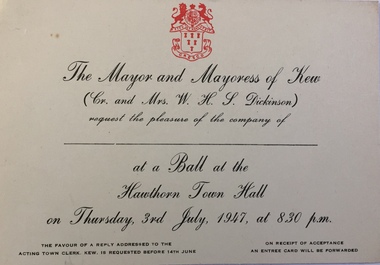
Document (item) - Invitation, City of Kew, Mayoral Ball, 1947
... political, social and cultural history of the district. As a continuous record, ranging across most decades of the Twentieth Century, they reveal changing tastes in design, values and relationships in the history of local government in Victoria. ephemera civic ephemera cr w h s dickinson city of kew -- 1947 mayoral balls civic invitations Invitation to a mayoral ball at the Hawthorn Town Hall issued by the City of Kew in 1947. ...The Municipality of Kew (1860-1863), the Borough of Kew (1863-1910), the Town of Kew (1910-1921) and the City of Kew (1921-1994) were local government instrumentalities in the State of Victoria. In 1994, the City of Kew was amalgamated, together with the former Cities of Camberwell and Hawthorn, into the new City of Boroondara (1994- ). Like other local government entities of the period, Kew was administered by town clerks. The two notable town clerks in Kew's history were H. H. (Henry Hirst) Harrison (1868-1955) and W. D. (William Dickie) Birrell (1899-1974). Harrison was appointed to the position in 1901 and retired in 1938 after 37 years. Birrell, appointed Acting Town Clerk in 1921, became Town Clerk in 1938, following Harrison's retirement. He continued in this role until his retirement in 1966.This is part of an historically significant civic collection, containing hundreds of separate invitations, documents, greeting cards, programmes and tickets issued and/or collected by successive town clerks. Items in the collection illuminate the political, social and cultural history of the district. As a continuous record, ranging across most decades of the Twentieth Century, they reveal changing tastes in design, values and relationships in the history of local government in Victoria.ephemera, civic ephemera, cr w h s dickinson, city of kew -- 1947, mayoral balls, civic invitations -
 Kew Historical Society Inc
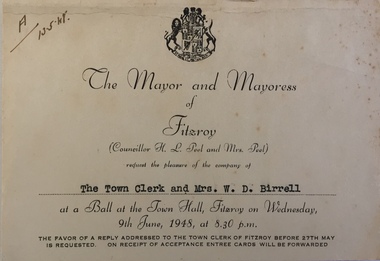
Document (item) - Invitation, City of Fitzroy, Mayoral Ball, 1948
... political, social and cultural history of the district. As a continuous record, ranging across most decades of the Twentieth Century, they reveal changing tastes in design, values and relationships in the history of local government in Victoria. ephemera civic ephemera mayoral balls civic invitations city of fitzroy -- mayoral balls mayors of fitzroy cr h l peel w d birrell Invitation to a mayoral ball at the Fitzroy Town Hall issued by the City of Fitzroy in 1948. ...The Municipality of Kew (1860-1863), the Borough of Kew (1863-1910), the Town of Kew (1910-1921) and the City of Kew (1921-1994) were local government instrumentalities in the State of Victoria. In 1994, the City of Kew was amalgamated, together with the former Cities of Camberwell and Hawthorn, into the new City of Boroondara (1994- ). Like other local government entities of the period, Kew was administered by town clerks. The two notable town clerks in Kew's history were H. H. (Henry Hirst) Harrison (1868-1955) and W. D. (William Dickie) Birrell (1899-1974). Harrison was appointed to the position in 1901 and retired in 1938 after 37 years. Birrell, appointed Acting Town Clerk in 1921, became Town Clerk in 1938, following Harrison's retirement. He continued in this role until his retirement in 1966. A large part of this collection of civic ephemera was assembled by W. D. Birrell. This is part of an historically significant civic collection, containing hundreds of separate invitations, documents, greeting cards, programmes and tickets issued and/or collected by successive town clerks. Items in the collection illuminate the political, social and cultural history of the district. As a continuous record, ranging across most decades of the Twentieth Century, they reveal changing tastes in design, values and relationships in the history of local government in Victoria.ephemera, civic ephemera, mayoral balls, civic invitations, city of fitzroy -- mayoral balls, mayors of fitzroy, cr h l peel, w d birrell -
 Kew Historical Society Inc
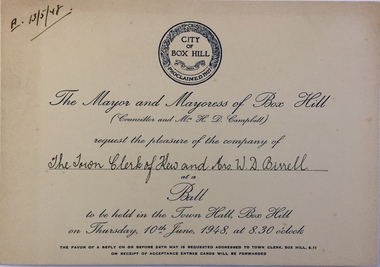
Document (item) - Invitation, City of Box Hill, Mayoral Ball, 1948
... political, social and cultural history of the district. As a continuous record, ranging across most decades of the Twentieth Century, they reveal changing tastes in design, values and relationships in the history of local government in Victoria. civic ephemera mayoral balls civic invitations w d birrell city of box hill cr h d campbell - mayor of box hill Invitation issued to the Town Clerk of Kew (Mr & Mrs W.D. ...The Municipality of Kew (1860-1863), the Borough of Kew (1863-1910), the Town of Kew (1910-1921) and the City of Kew (1921-1994) were local government instrumentalities in the State of Victoria. In 1994, the City of Kew was amalgamated, together with the former Cities of Camberwell and Hawthorn, into the new City of Boroondara (1994- ). Like other local government entities of the period, Kew was administered by town clerks. The two notable town clerks in Kew's history were H. H. (Henry Hirst) Harrison (1868-1955) and W. D. (William Dickie) Birrell (1899-1974). Harrison was appointed to the position in 1901 and retired in 1938 after 37 years. Birrell, appointed Acting Town Clerk in 1921, became Town Clerk in 1938, following Harrison's retirement. He continued in this role until his retirement in 1966. A large part of this collection of civic ephemera was assembled by W. D. Birrell. This is part of an historically significant civic collection, containing hundreds of separate invitations, documents, greeting cards, programmes and tickets issued and/or collected by successive town clerks. Items in the collection illuminate the political, social and cultural history of the district. As a continuous record, ranging across most decades of the Twentieth Century, they reveal changing tastes in design, values and relationships in the history of local government in Victoria.civic ephemera, mayoral balls, civic invitations, w d birrell, city of box hill, cr h d campbell - mayor of box hill -
 Kew Historical Society Inc
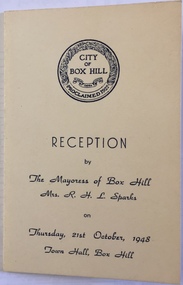
Document (item) - Invitation, City of Box Hill, Reception, 1948
... political, social and cultural history of the district. As a continuous record, ranging across most decades of the Twentieth Century, they reveal changing tastes in design, values and relationships in the history of local government in Victoria. ephemera civic ephemera mayoral balls civic invitations city of box hill box hill (vic.) -- mayoresses mrs r h l sparks Invitation to a Reception in the West Hall, Town Hall, Box Hill in 1948. ...The Municipality of Kew (1860-1863), the Borough of Kew (1863-1910), the Town of Kew (1910-1921) and the City of Kew (1921-1994) were local government instrumentalities in the State of Victoria. In 1994, the City of Kew was amalgamated, together with the former Cities of Camberwell and Hawthorn, into the new City of Boroondara (1994- ). Like other local government entities of the period, Kew was administered by town clerks. The two notable town clerks in Kew's history were H. H. (Henry Hirst) Harrison (1868-1955) and W. D. (William Dickie) Birrell (1899-1974). Harrison was appointed to the position in 1901 and retired in 1938 after 37 years. Birrell, appointed Acting Town Clerk in 1921, became Town Clerk in 1938, following Harrison's retirement. He continued in this role until his retirement in 1966. A large part of this collection of civic ephemera was assembled by W. D. Birrell. This is part of an historically significant civic collection, containing hundreds of separate invitations, documents, greeting cards, programmes and tickets issued and/or collected by successive town clerks. Items in the collection illuminate the political, social and cultural history of the district. As a continuous record, ranging across most decades of the Twentieth Century, they reveal changing tastes in design, values and relationships in the history of local government in Victoria.ephemera, civic ephemera, mayoral balls, civic invitations, city of box hill, box hill (vic.) -- mayoresses, mrs r h l sparks
