
Showing 1068 items matching "weaving"
-
 Eltham District Historical Society Inc
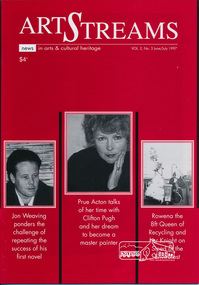
Journal, Peter Doughtery, ArtStreams: News in arts and cultural heritage; Vol. 2, No. 3, Jun-Jul 1997, 1997
... Vol. 2, No. 3, Jun-Jul 1997 CONTENTS WEAVING ON A ROLL Author Jon Weaving talks about the pitfalls of success 3 DON’T PASS THE GUINNESS Poet Patrick McCauley turns over a new leaf 6 AIMING FOR THE TOP Prue Acton chases a dream 9 CULTURAL TOURISM Selling a way of life 12 CONVERSATION WITH BOB SMITH An artist shares some thoughts on the why and how of painting 14 REPRIEVE FOR A GATE Some traditions refuse to die 16 STALKING THE STRANGER Short story by Chris Stonehouse 18 THEATRE IN AUTUMN Melbourne theatre is alive and well 21 TO A WOLF THE KILL Anne Delaney reviews Jon Weaving's first novel 23 EXHIBITION REVIEWS Richard Besley, Neophytes, The Eye of the Storm, Soft But True 24, 26, 27, & 30 CD REVIEWS 28 NEW SOURCE OF POWER Tony Trembath lights up a town hall 29 WHO’S DOING WHAT 32 ...Vol. 2, No. 3, Jun-Jul 1997 CONTENTS WEAVING ON A ROLL Author Jon Weaving talks about the pitfalls of success 3 DON’T PASS THE GUINNESS Poet Patrick McCauley turns over a new leaf 6 AIMING FOR THE TOP Prue Acton chases a dream 9 CULTURAL TOURISM Selling a way of life 12 CONVERSATION WITH BOB SMITH An artist shares some thoughts on the why and how of painting 14 REPRIEVE FOR A GATE Some traditions refuse to die 16 STALKING THE STRANGER Short story by Chris Stonehouse 18 THEATRE IN AUTUMN Melbourne theatre is alive and well 21 TO A WOLF THE KILL Anne Delaney reviews Jon Weaving's first novel 23 EXHIBITION REVIEWS Richard Besley, Neophytes, The Eye of the Storm, Soft But True 24, 26, 27, & 30 CD REVIEWS 28 NEW SOURCE OF POWER Tony Trembath lights up a town hall 29 WHO’S DOING WHAT 32 "Peter Dougherty has been involved in the local art scene for many years. ...Vol. 2, No. 3, Jun-Jul 1997 CONTENTS WEAVING ON A ROLL Author Jon Weaving talks about the pitfalls of success 3 DON’T PASS THE GUINNESS Poet Patrick McCauley turns over a new leaf 6 AIMING FOR THE TOP Prue Acton chases a dream 9 CULTURAL TOURISM Selling a way of life 12 CONVERSATION WITH BOB SMITH An artist shares some thoughts on the why and how of painting 14 REPRIEVE FOR A GATE Some traditions refuse to die 16 STALKING THE STRANGER Short story by Chris Stonehouse 18 THEATRE IN AUTUMN Melbourne theatre is alive and well 21 TO A WOLF THE KILL Anne Delaney reviews Jon Weaving's first novel 23 EXHIBITION REVIEWS Richard Besley, Neophytes, The Eye of the Storm, Soft But True 24, 26, 27, & 30 CD REVIEWS 28 NEW SOURCE OF POWER Tony Trembath lights up a town hall 29 WHO’S DOING WHAT 32 "Peter Dougherty has been involved in the local art scene for many years. As publisher and editor of the arts magazine Artstreams, his comments on the various branches of the arts are widely respected. His "The Arts" column in the Diamond Valley Leader presents a brief summary for a much wider cross section of the local community. Peter also operates his own gallery and the Artstreams Cafe at the St Andrews market. Peter has a wealth of knowledge about present day and historical aspects of local art and artists." - Eltham District Historical Society Newsletter No. 161, March 2005Colour front and back cover with feature articles and literary pieces with photographs and advertisements printed in black and white. 36 pages, 30 cm. Vol. 1, no. 1 (Nov. 1996) - Vol. 10, no. 5 (summer ed. 2005/06) art streams, food for all seasons, prue acton, jon weaving, michelle lonsdale, sandon mcleod, patrickk mccauley, malcolm riddle, cultural tourism, valley of the arts tourism association inc., robert peter smith, danny chable, farm gate, spirit of eltham, chris stonehouse, eltham bookshop, carolyn pickett, anne delaney, richard besley, mike parr, anita furey, aboriginal art, indigenous art, julie le bon, jackie stojanova, ranee lee, daniel chabble, tony trembath, john kauffman, westerfolds park envirofest, were street cafe, helen o'grady children's drama academy, nillumbik art collection -
 National Wool Museum
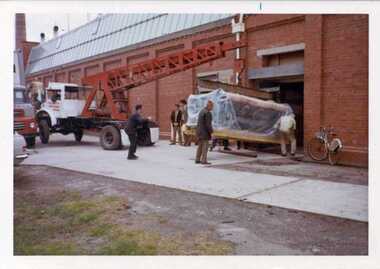
Photograph, Foster Valley Mills, Foster Valley Mills, Geelong, 1970s
... Photograph shows the installation of the new Sulzer weaving looms in the early 1970s, they replaced the old Hattersley looms that were in use at the time. ...Photograph shows the installation of the new Sulzer weaving looms in the early 1970s, they replaced the old Hattersley looms that were in use at the time. ...Photograph shows the installation of the new Sulzer weaving looms in the early 1970s, they replaced the old Hattersley looms that were in use at the time. The gentlemen in the suit overseeing the procedure was Jack St Quentin, maintenance manager at the time. - Greg AldridgeColour photograph of textile machinery being installed at Foster Valley Mills. Image shows Elliots Mobile Cranes, Geelong supporting machinery being guided through mill doorway.woollen mills, textile mills, foster valley mill pty ltd valley worsted mill, sulzer weaving looms -
 Glen Eira Historical Society
Article - MURRUMBEENA SPINNERS
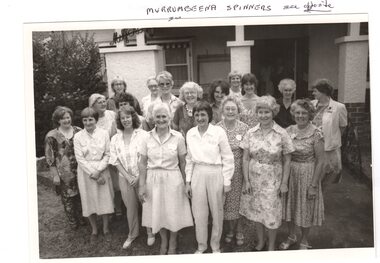
... ... Weaving...Contains three black-and-white photographs: one of five members of the Spinners – Evelyn Townley, Jan Knight, Dot Picot, Joy Barton and Jill Wylie – engaged in weaving; one of another member – Val Woolard – engaged in weaving; and one of members of the Country Women’s Association – Doreen Chapman, Beattie Burns, Nancy Rose and Margaret Mann – displaying their work. 2/A page identifying the persons featured in the first two photographs on the following page, and specifying the photographs’ context. 3/A page to which are attached three black-and-white photographs. ...Contains three black-and-white photographs: one of five members of the Spinners – Evelyn Townley, Jan Knight, Dot Picot, Joy Barton and Jill Wylie – engaged in weaving; one of another member – Val Woolard – engaged in weaving; and one of members of the Country Women’s Association – Doreen Chapman, Beattie Burns, Nancy Rose and Margaret Mann – displaying their work. 2/A page identifying the persons featured in the first two photographs on the following page, and specifying the photographs’ context. 3/A page to which are attached three black-and-white photographs. ...This file contains four items pertaining to the Murrumbeena Spinners: 1/A printout of an article from the Caulfield Contact, dated 12/12/1986, noting the various community groups, such as the Spinners, that participated during the Murrumbeena Day – part of the Caulfield Festival. Contains three black-and-white photographs: one of five members of the Spinners – Evelyn Townley, Jan Knight, Dot Picot, Joy Barton and Jill Wylie – engaged in weaving; one of another member – Val Woolard – engaged in weaving; and one of members of the Country Women’s Association – Doreen Chapman, Beattie Burns, Nancy Rose and Margaret Mann – displaying their work. 2/A page identifying the persons featured in the first two photographs on the following page, and specifying the photographs’ context. 3/A page to which are attached three black-and-white photographs. The first is of members of the Spinners – who are identified in the previous item – standing in front of Murrumbeena House. The second is a printed copy of the first. The third is of Murrumbeena House itself, sans the Spinners. 4/A file note written by Anne Kilpatrick recording source of photographs and information, with contact details for Heather Poppenbeek for any future research.murrumbeena spinners, murrumbeena house, community groups, community houses, picot dot, barton joy, wylie jill, woolard val, warren jeanette, poppenbeek heather, dipnall merle, dynan judy, weaving, weavers, caulfield contact, murrumbeena day, caulfield festival, festival and celebrations, townley evelyn, knight jan, dimock liz, farr beryl, country women’s association, chapman doreen, burns beattie, rose nancy, mann margaret, ryan brenda, sherlock pam, tanner lorna, mansell mary, handweavers and spinners guild, millroy, dunbar margaret, kilpatrick anne -
 Kiewa Valley Historical Society
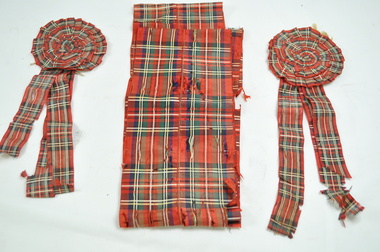
Sash and Rosettes Tartan
... Sash made from fine cotton weave with Scottish highland tartan. Width 12cm and sides fine stitched. ...An integral part of child development and socialising within the formal school environment sash rosettes school foot races Highland clan to be identified Sash made from fine cotton weave with Scottish highland tartan. Width 12cm and sides fine stitched. ...Early athletics year 11 school championships Kiewa Valley School Carnival circa 1920 - 1950s Historical and social significance of school based physical development of children through dedicated sports programs. An integral part of child development and socialising within the formal school environmentSash made from fine cotton weave with Scottish highland tartan. Width 12cm and sides fine stitched. Pattern (Royal Stewart) running length of ribbon.Two rosettes of same material 9cm diameter with three 3cm wide ribbons attached lengths 16cm, 20.5cm and 28cm The "Glen" designHighland clan to be identified sash, rosettes, school foot races -
 Bendigo Historical Society Inc.
Document - MALONE COLLECTION: GREETING CARDS
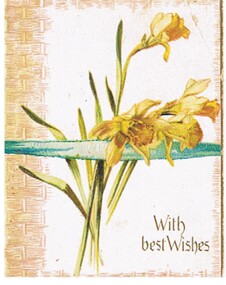
... Beside the white border is a pink/yellow weaved area which extends slightly to the other 3 borders. ...Beside the white border is a pink/yellow weaved area which extends slightly to the other 3 borders. ...White singlw card with Gold border on three sides and a white border. Beside the white border is a pink/yellow weaved area which extends slightly to the other 3 borders. There is abunch of 3 daffodils and leaves leaning on a blue border. In the bottom right corner is 'With best Wishes' printed in gold.person, greeting cards, malone collection, malone collection, greeting cards -
 Embroiderers Guild, Victoria
Textile - Kashmiri Stole, c. 1960-80
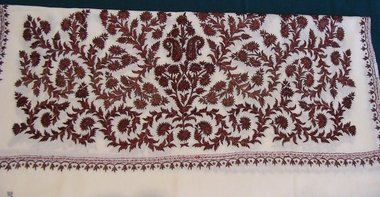
... Cream wool, fine twill weave. Deep embroidered border pattern 320 mms both ends. ...Embroidery Surface stitchery Stole 1960-80 Kashmir Cream wool, fine twill weave. Deep embroidered border pattern 320 mms both ends. ...Purchased by donor for his wife who was a Guild member, now deceased.Cream wool, fine twill weave. Deep embroidered border pattern 320 mms both ends. Floral scrolling design. Silk embroidery in brown silk, Bokhara stitch. Outlined in black wool, cross stitch all around in brown and red silk and black wool blanket stitch.embroidery, surface stitchery, stole, 1960-80, kashmir -
 Embroiderers Guild, Victoria
Textile - Creative Embroidery Panel, Mrs Merle Whittle, 1972
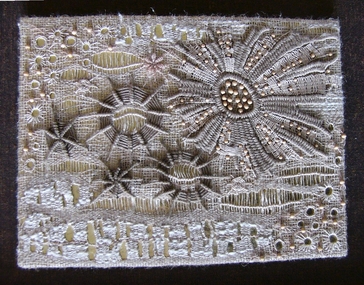
... The flower heads have needle weaving and surface stitches in cream, beige and light brown, including small wooden beads, used in interesting ways....The flower heads have needle weaving and surface stitches in cream, beige and light brown, including small wooden beads, used in interesting ways. ...Designed and worked by Mrs Merle Whittle. Purchased from the 1972 George's Exhibition.Deep wood frame and brown slub silk mount, with a raised panel of a very loosely woven cream and white fabric over a gold mount. The flower heads have needle weaving and surface stitches in cream, beige and light brown, including small wooden beads, used in interesting ways.embroidery, panel, 1960-80, australia, creative embroidery -
 National Wool Museum
Functional object - Yarn Spinner and Accessories, John Nesbitt, 19th Century
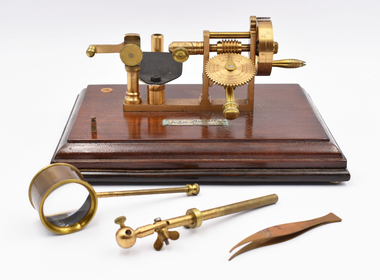
... Twill weave. Alternate pattern samples separated by red thread....Twill weave. Alternate pattern samples separated by red thread. ...Nino Corda was a Geelong based textile designer who worked at various textile mills between 1957 & 2003. He travelled the world in search of the latest fashions and techniques and developed timeless designs that were much loved by Australians. These items are on rotational display at the National Wool Museum’s ‘In the Factory’ exhibition. For many years, Nino also worked as part of the Honorary Staff of the National Wool Museum. His passion for the world of textiles provided energy and knowledge to the visitors and staff of the museum. Although Nino has now retired from his honorary position and has hung up his Australian Tartan vest, these items will continue to serve the community in sharing the stories of Australian Textile design.Custom made wooden hinged box with a hook latch. Brass yarn spinner, attached to a mahogany wood plinth base, which spins fibre into cord/yarn/thread. It has dials to set the rate that it spins. Metal plaque with black inlaid enamel lettering. Small cork inlay. Brass rod with hinge and wingnut, and ball at end. Ball at end has an adjustment mechanism. Rod also has an adjustable circular collar. Pair of curved tweezers. Circular magnifying glass on long thin handle. Glass has two concave lenses. Weaving sample in shades of blue, green and brown. Twill weave. Alternate pattern samples separated by red thread.Brass plaque on base of spinner: 42 MARKET St / John Nesbitt / REGd TRADE MARK / LIMd / MANCHESTER Underside of wooden plinth: 4976apparatus, textile, testing, spinning, nino corda, magnifyer, tools, brass, mahogany, tweezers, yarn, spinner, design, john nesbitt, manchester, england, 19th century, engineering, manufacturing -
 Bright & District Historical Society operating the Bright Museum
Handloom and Bobbin
... ...Weaving...Wooden Handloom Weaving Wooden with metal plates Handloom and Bobbin ...Wooden with metal plateswooden, handloom, weaving -
Bright & District Historical Society operating the Bright Museum
Bobbin (part of Handloom
... ...Weaving...Bobbin Handloom Weaving Bobbin, part of Handloom Bobbin (part of Handloom ...Bobbin, part of Handloombobbin, handloom, weaving -
National Wool Museum
Booklet, Hattersley Hand Loom Spare Part Catalogue; plain and circular box, also dobby
... Weaving...Hattersley & Sons Ltd, Keighley, c.1930. Weaving George Hattersley and Sons Ltd Weaving Machinery Hattersley Hand Loom Spare Part Catalogue; plain and circular box, also dobby Booklet ..."Hattersley Hand Loom Spare Part Catalogue; plain and circular box, also dobby" - Geo. Hattersley & Sons Ltd, Keighley, c.1930.weaving, george hattersley and sons ltd, weaving machinery -
 National Wool Museum
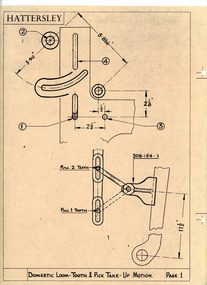
Booklet, Hattersley Domestic Loom: Tooth and Pick Take-Up Motion
... weaving...Instructions: "Hattersley Domestic Loom: Tooth and Pick Take-Up Motion" weaving george hattersley and sons ltd weaving machinery Booklet, 3pp. loose leaf. ...Instructions: "Hattersley Domestic Loom: Tooth and Pick Take-Up Motion"Booklet, 3pp. loose leaf. Printed with text and diagrams on one side only. "Hattersley Domestic Loom: Tooth and Pick Take-Up Motion"weaving, george hattersley and sons ltd, weaving machinery -
 National Wool Museum
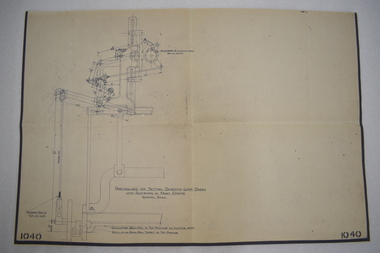
Blueprint, Particulars for Setting Domestic Loom Dobby with Slayboard at Front Centre
... weaving...Blueprint / diagram for a Hattersley loom: "Partculars for Setting Domestic Loom Dobby with Slayboard at Front Centre". weaving george hattersley and sons ltd weaving machinery Blueprint; detailed diagram printed in black on buff coloured paper. ...Blueprint / diagram for a Hattersley loom: "Partculars for Setting Domestic Loom Dobby with Slayboard at Front Centre".Blueprint; detailed diagram printed in black on buff coloured paper. "Partculars for Setting Domestic Loom Dobby with Slayboard at Front Centre".weaving, george hattersley and sons ltd, weaving machinery -
 National Wool Museum
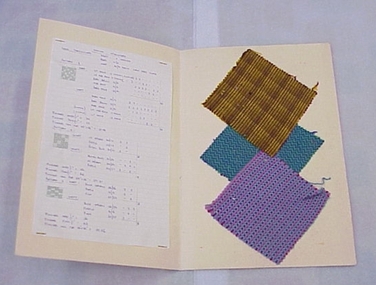
Folder, Pattern
... ...Weaving...Textile Production Weaving Textile Production Weaving GEOFF ROBINSON (pencil) WOOLLEN UPHOLSTERY (ink) Folder, Pattern ...Folder containing pattern and samples of three woollen upholstery designs: "WOOLLEN UPHOLSTERY" pattern sheet with 3 cloth samples (yellow/brown, green/blue, pink/blue).GEOFF ROBINSON (pencil) WOOLLEN UPHOLSTERY (ink)textile production weaving, textile production, weaving -
 National Wool Museum
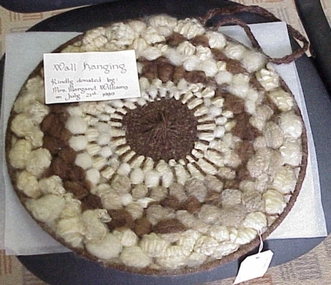
Wall Hanging
... Weaving...Brother of the donor made this item. Weaving Williams Mrs Margaret Mary Wall hanging Kindly donated by Margaret Williams on July 21st. 1989 Wall Hanging ...10-12 years old (at 1989). Brother of the donor made this item.Wall hanging Kindly donated by Margaret Williams on July 21st. 1989weaving, williams, mrs margaret mary -
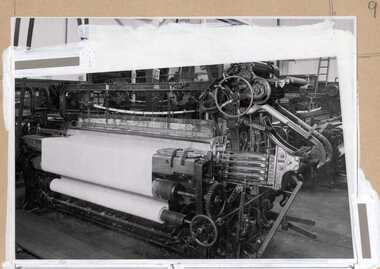 National Wool Museum
Photograph
... ...Weaving...Part of a series of photos depicting the various operations within a textile mill, all of which have been edited for publication. Weaving Textile Mills - operation Weaving Textile Mills - operation Photograph ...Depicts a Hollingworth Dobcross 1929 loom within a mill, c.1950s. Part of a series of photos depicting the various operations within a textile mill, all of which have been edited for publication.weaving textile mills - operation, weaving, textile mills - operation -
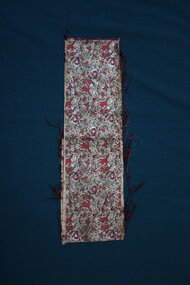 Embroiderers Guild, Victoria
Textile - Woven Strip of Damascus Brocade
... Weaving...Damascus brocade Weaving Silk Metal thread Strip of silk and metal thread damask woven fabric of buff, red and black. ...? Damascus brocadeStrip of silk and metal thread damask woven fabric of buff, red and black. Depicts hunting or war with men on horseback and others on foot, using bows and arrows, and lances. There are dogs and men blowing long horns. There are flowering plants on the ground, but the pattern repeat doesn't show an animal being hunted.weaving, silk, metal thread -
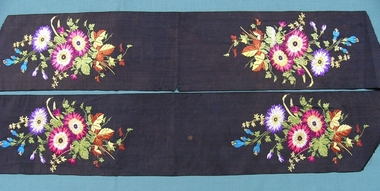 Embroiderers Guild, Victoria
Textile - 19th C Black Taffeta Ribbons with Embroidered Floral Motifs
... Weaving...Weaving Ribbons Early 20th Century Two pieces of black taffeta silk ribbon embroidered with floral motifs. ...Two pieces of black taffeta silk ribbon embroidered with floral motifs.weaving, ribbons, early 20th century -
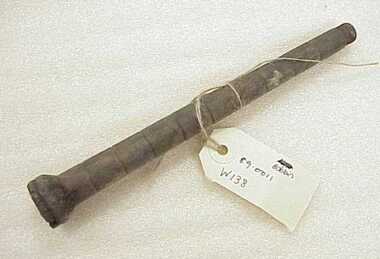 National Wool Museum
Bobbin
... ...Weaving...Used on a pre-war mule spinner. Handicrafts Weaving Handicrafts Weaving Bobbin ...Used on a pre-war mule spinner.handicrafts weaving, handicrafts, weaving -
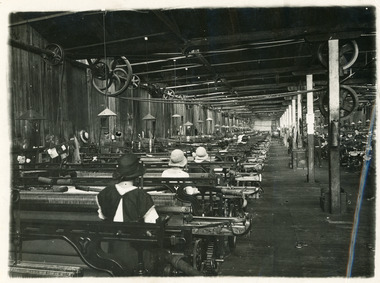 National Wool Museum
Photograph
... weaving...Depicts looms within a mill, c.1930s. weaving textile mills staff textile mills - staff Photograph Photograph ...Depicts looms within a mill, c.1930s.weaving, textile mills staff, textile mills - staff -
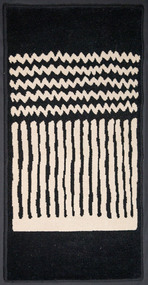 National Wool Museum
Rug
... weaving...On the afternoon of 28/4/1988 Queen Elizabeth was presented with a similiar rug but latex backed and labelled. weaving national wool museum axminster Rug was made on National Wool Museum Brunton Axminster Gripper Loom by Brintons Carpets Geelong staff prior to the visit of Queen Elizabeth. ...Rug was made on National Wool Museum Brinton Axminster Gripper Loom by Brintons Carpets Geelong staff prior to the visit of Queen Elizabeth. On the afternoon of 28/4/1988 Queen Elizabeth was presented with a similiar rug but latex backed and labelled.Rug was made on National Wool Museum Brunton Axminster Gripper Loom by Brintons Carpets Geelong staff prior to the visit of Queen Elizabeth. Detail of rug made on National Wool Museum Brunton Axminster Gripper Loom by Brintons Carpets Geelong staff prior to the visit of Queen Elizabeth II. Label on rug made on National Wool Museum Brunton Axminster Gripper Loom by Brintons Carpets Geelong staff prior to the visit of Queen Elizabeth II. Label for rug made on National Wool Museum Brunton Axminster Gripper Loom by Brintons Carpets Geelong staff prior to the visit of Queen Elizabeth II.weaving, national wool museum, axminster -
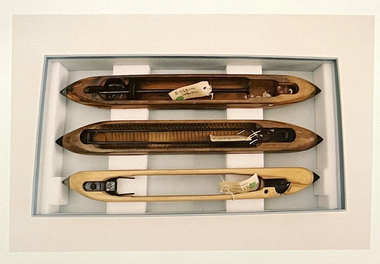 National Wool Museum
Tool - Loom Shuttles
... weaving...Loom shuttles from the Gordon Wool Department. weaving loom shuttle Wool Three long wooden shuttles with metal tips. ...Loom shuttles from the Gordon Wool Department.Three long wooden shuttles with metal tips.weaving, loom shuttle, wool -
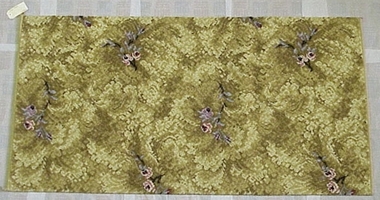 National Wool Museum
Sample, Carpet
... Weaving...Part of ten piece collection originally presented to the Queensland Museum by Mr Doug Glanville. Weaving Brintons Pty Ltd (Geelong) Carpet Brintons Geelong 46/8526 10 Belmont 82 Belmont Axminster pattern no. 46/8562, made by Brintons Geelong. ...Belmont Axminster pattern no. 46/8562, made by Brintons Geelong. Part of ten piece collection originally presented to the Queensland Museum by Mr Doug Glanville.Belmont Axminster pattern no. 46/8562, made by Brintons Geelong. Belmont Axminster pattern no. 46/8562, made by Brintons Geelong.Brintons Geelong 46/8526 10 Belmont 82weaving, brintons pty ltd (geelong), carpet -
 National Wool Museum
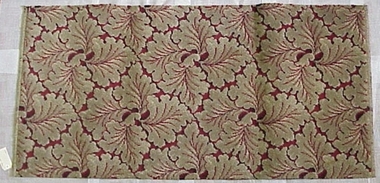
Sample, Carpet
... Weaving...Part of a ten piece collection originally donated to the Queensland Museum by Mr Doug Glanville. Weaving Brintons Ltd (UK) Carpet Brintons Conda - 6 Heavy Axminster carpet sample from Brintons Kidderminster England, from a Wilton loom circa 1930. ...Heavy Axminster carpet sample from Brintons Kidderminster England, from a Wilton loom circa 1930. Part of a ten piece collection originally donated to the Queensland Museum by Mr Doug Glanville.Heavy Axminster carpet sample from Brintons Kidderminster England, from a Wilton loom circa 1930. Heavy Axminster carpet sample from Brintons Kidderminster England, from a Wilton loom circa 1930.Brintons Conda - 6weaving, brintons ltd (uk), carpet -
 National Wool Museum
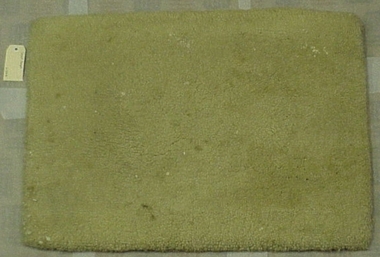
Sample, Carpet
... Weaving...Part of a ten piece collection originally presented to the Queensland Museum by Mr Doug Glanville. Weaving Brintons Pty Ltd (Geelong) Carpet (Brintons Brisbane) G4498 Natural JF Expo Loom 22 Dye 4 30 8 J.J. ...Heavy Aminster produced for the Australian Wool Board pavilion at Expo Japan in 1970 by Brintons, Geelong. This piece is believed to have had 600,000 pairs of feet walk over it. Part of a ten piece collection originally presented to the Queensland Museum by Mr Doug Glanville.Heavy Aminster produced for the Australian Wool Board pavilion at Expo Japan in 1970 by Brintons, Geelong. Heavy Aminster produced for the Australian Wool Board pavilion at Expo Japan in 1970 by Brintons, Geelong.(Brintons Brisbane) G4498 Natural JF Expo Loom 22 Dye 4 30 8 J.J. Expo Osaka Japan '70 82weaving, brintons pty ltd (geelong), carpet -
 National Wool Museum
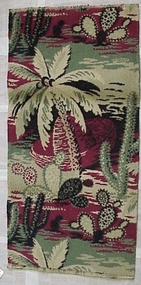
Sample, Carpet
... Weaving...Part of the ten piece collection originally presented to the Queensland Museum by Mr Doug Glanville. Weaving Blackwood Norton Carpet 581/6/1486 5 Pattern no 581/61486 Wilton made by Blackwood Morten Kilmarnoch Scotland. ...Pattern no 581/61486 Wilton made by Blackwood Morten Kilmarnoch Scotland. Part of the ten piece collection originally presented to the Queensland Museum by Mr Doug Glanville.Pattern no 581/61486 Wilton made by Blackwood Morten Kilmarnoch Scotland. Pattern no 581/61486 Wilton made by Blackwood Morten Kilmarnoch Scotland. Pattern no 581/61486 Wilton made by Blackwood Morten Kilmarnoch Scotland.581/6/1486 5weaving, blackwood norton, carpet -
 National Wool Museum
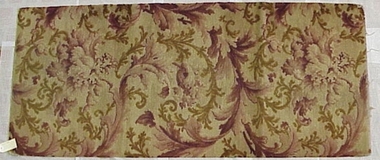
Sample, Carpet
... Weaving...Part of ten piece collection originally presented to the Queensland Museum by Mr Doug Glanville. Weaving John Crossley and Sons Carpet Sultana worsted wool Axminster linen back manfd. 1893 4 27" body carpet J.C & Sons Ltd Halifax England Sultana worsted Axminster 27" carpet body sample made by John Crossley & Sons Ltd. ...Sultana worsted Axminster 27" carpet body sample made by John Crossley & Sons Ltd. Related to border sample 88.0047 (old registration number). Part of ten piece collection originally presented to the Queensland Museum by Mr Doug Glanville.Sultana worsted Axminster 27" carpet body sample made by John Crossley & Sons Ltd. Sultana worsted Axminster 27" carpet body sample made by John Crossley & Sons Ltd.Sultana worsted wool Axminster linen back manfd. 1893 4 27" body carpet J.C & Sons Ltd Halifax Englandweaving, john crossley and sons, carpet -
 National Wool Museum
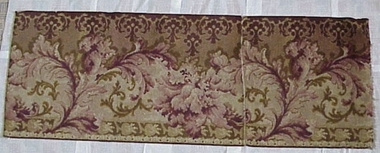
Sample, Carpet
... Weaving...Part of the ten piece collection originally presented to the Queensland Museum by Mr Doug Glanville. Weaving John Crossley and Sons Carpet Sultana worsted 3 1' 10 1/2" 5/8 Border Carpet Sultana worsted Axminster border made by John Crossley & Sons, Dean Clough Mills, Halifax, England. ...Sultana worsted Axminster border made by John Crossley & Sons, Dean Clough Mills, Halifax, England. The border framed the edge to stripe of object 88.0048 (old registration number), laid to fill floor space. Part of the ten piece collection originally presented to the Queensland Museum by Mr Doug Glanville.Sultana worsted Axminster border made by John Crossley & Sons, Dean Clough Mills, Halifax, England. Sultana worsted Axminster border made by John Crossley & Sons, Dean Clough Mills, Halifax, England.Sultana worsted 3 1' 10 1/2" 5/8 Border Carpetweaving, john crossley and sons, carpet -
 National Wool Museum
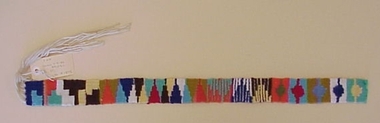
Braid
... ...Weaving...Braid woven in 1977 on an inkle loom. Handicrafts Weaving Weaving Looms Braid ...Braid woven in 1977 on an inkle loom.handicrafts, weaving, weaving looms -
 Tatura Irrigation & Wartime Camps Museum
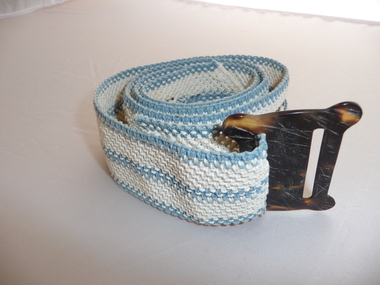
Macrame Belt, 1940
... ...weaving...Camp 13, Murchison tatura handcrafts weaving Light Blue & White Macrame Belst with Tortoiseshell Buckle. ...Made by Internee . Camp 13, MurchisonLight Blue & White Macrame Belst with Tortoiseshell Buckle.tatura, handcrafts, weaving
