
Showing 2777 items matching "newspapers - melbourne"
-
 Geelong RSL Sub Branch
Badge - Air Force Association, 20th Century
... Melbourne in 1919, by Mr H V Leckie. The Association was formed after Mr Leckie put an advertisement in the newspaper asking for interested former members of the Air Force Corps to meet him....Melbourne in 1919, by Mr H V Leckie. The Association was formed after Mr Leckie put an advertisement in the newspaper asking for interested former members of the Air Force Corps to meet him. ...The Air Force Association was formed in Melbourne in 1919, by Mr H V Leckie. The Association was formed after Mr Leckie put an advertisement in the newspaper asking for interested former members of the Air Force Corps to meet him.This badge with the number 97277 on the reverse has belonged to a member of the Air Force AssociationA round shape with wings through the middle of the badge, Crown on the top of the badge, the centre is the Air Force red, white and blue. This badge has a pale blue across the bottom, Air Force Association.On the reverse of the badge Number 97277, K G Luke Melb.air force association,, 1919, raaf association, h v leckie -
 Glenelg Shire Council Cultural Collection
Newspaper - Newspaper cutting - Advertisement for England-Melbourne air-race and Johnnie Walker, 1934
... Newspaper cutting - Advertisement for England-Melbourne air-race and Johnnie Walker...Newspaper Newspaper cutting - Advertisement for England-Melbourne air-race and Johnnie Walker ...Found in pages of William Marshall's bible (3756), Isaiah XXXNewspaper advertisement. -
 Orbost & District Historical Society
Poster - Royal Agricultural Show of Victoria 1929, THE AUSTRALASIAN, 1929
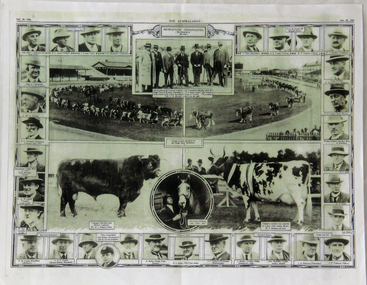
... newspaper in 1929 as a promotion for the Royal Agricultural Show of Victoria. With its many photos and captions, it is an excellent reference document. It depicts Showground Personalities from all over Victoria, and members of the Council of the Royal Agricultural Society of Victoria, Melbourne Show Promotion of 1929. ...newspaper in 1929 as a promotion for the Royal Agricultural Show of Victoria. With its many photos and captions, it is an excellent reference document. It depicts Showground Personalities from all over Victoria, and members of the Council of the Royal Agricultural Society of Victoria, Melbourne Show Promotion of 1929. ...This poster was printed by THE AUSTRALASIAN newspaper in 1929 as a promotion for the Royal Agricultural Show of Victoria. With its many photos and captions, it is an excellent reference document. It depicts Showground Personalities from all over Victoria, and members of the Council of the Royal Agricultural Society of Victoria, Melbourne Show Promotion of 1929. Local Gippsland people shown and identified in captions are: P C Nixon (Orbost), J Trewin (Sale), A E Trewin (Orbost), and H P Cameron (Orbost).This poster is significant because it represents a poster/promotion from 1929 of the Royal Agricultural Show of Victoria, and also shows images of representatives from throughout the State, including from the Orbost/Bairnsdale areas.A rectangular sheet of paper with multiple photographs which show people and cows and horses associated with Royal Agricultural Show of Victoria. All of the photos have captions, and the date Sept. 29, 1929 is printed at the top left and top right corners of the poster. In the top centre is THE AUSTRALASIAN. Multiple captions to photos. Sept. 29, 1929 is printed on top left and top right corners of poster. THE AUSTRALASIAN is printed at the centre top. agriculture, royal agricultural show of victoria, trewin, cameron, nixon -
 Orbost & District Historical Society
match box and matches, 1950's
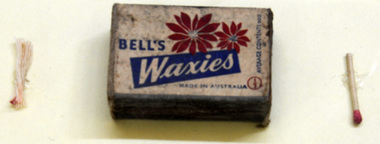
... A photo of the Orbost contingent returning to Spencer Street Station Melbourne was taken by The Leader newspaper. ...A photo of the Orbost contingent returning to Spencer Street Station Melbourne was taken by The Leader newspaper. matches smoking-accessories bell wax-matches Bell's Waxies Made in Australia Average Contents 100 1/2 A box for Bell's Waxies. ...This box and matches were owned by Lindsay Thomson and purchased by him for use at a scout jamboree - Senior Scout Venture which was held on Fraser Island, north of Brisbane in January (1-7), 1951. (Matches were not officially allowed to be taken by the scouts onto the island.) It was for Scouts over 15 years of age who had reached the first-class standard. The jamboree was extended by one week because of a suspected case of poliomyelitis. A photo of the Orbost contingent returning to Spencer Street Station Melbourne was taken by The Leader newspaper. A box for Bell's Waxies. It is a rectangular shape coloured red, white and blue. The waxed matches are made of fine twisted cotton threads. The contents are in a sliding tray. There are some matches inside. The box has been glued onto paper with some cotton threads on the left and a complete match on the right.Bell's Waxies Made in Australia Average Contents 100 1/2matches smoking-accessories bell wax-matches -
 Orbost & District Historical Society
newspaper, Sept 9 1919
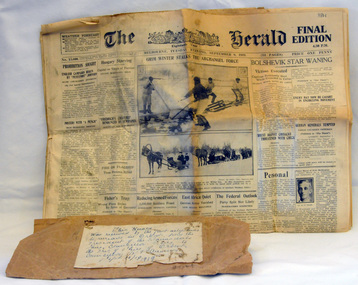
... newspaper document herald-melbourne first-aeroplane-orbost peace-loan...There is a plaque commemorating the oversubscription to the peace loan by the Shire of Orbost by 1919. newspaper document herald-melbourne first-aeroplane-orbost peace-loan A yellowed Herald newspaper from September 9 1919. ...This newspaper was sent by the Shire President Cr F. Deery from Bairnsdale to P.C. Cameron, Orbost Shire President. It was sent on the first aeroplane to arrive in Orbost. The Commonwealth plane in the charge of Lieut. Oakes landed in Mr McPhee's paddock at Newmerella. It left for Sale on the same day.The purpose of the plane's visit was to raise subscriptions towards the WW1 peace loan. There is a plaque commemorating the oversubscription to the peace loan by the Shire of Orbost by 1919.A yellowed Herald newspaper from September 9 1919. It has the brown paper packaging in which it was sent. It is tied with string.newspaper document herald-melbourne first-aeroplane-orbost peace-loan -
 Orbost & District Historical Society
collection of newspaper articles, 1970's - 2000
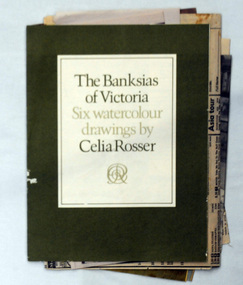
... Melbourne in 1965, and included three watercolours of Banksia species. Two years later she published Wildflowers of Victoria. Celia Elizabeth Rosser (born 1930) is a renowned Australian botanical illustrator, best known for having published The Banksias, a three-volume series of monographs containing watercolour paintings of every Banksia species. She began painting Australian wildflowers early in her artistic career. She first began painting Banksias after seeing a Banksia serrata near her home in Orbost, Victoria. A collection of newspaper ...The folder has been made especially for this collection of articles .The label is from a box of limited edition signed watercolour drawings by ROSSER, Celia. THE BANKSIAS OF VICTORIA. Six Watercolour Drawings. Born Celia Elizabeth Prince in 1930, Celia Rosser began painting Australian wildflowers early in her artistic career. She first began painting Banksias after seeing a Banksia serrata near her home in Orbost, Victoria. She lived in Orbost in the 1960's( her husband had been posted to Orbost High School) where she painted and drew native flowers , in particular, banksias. Her first exhibition was at Leveson Gallery in Melbourne in 1965, and included three watercolours of Banksia species. Two years later she published Wildflowers of Victoria.Celia Elizabeth Rosser (born 1930) is a renowned Australian botanical illustrator, best known for having published The Banksias, a three-volume series of monographs containing watercolour paintings of every Banksia species. She began painting Australian wildflowers early in her artistic career. She first began painting Banksias after seeing a Banksia serrata near her home in Orbost, Victoria.A collection of newspaper and magazines articles pertaining to Celia Rosser. There are six newspaper and magazine articles inside a a folder labelled "The Banksias of Victoria Six Watercolour Drawings by Celia Rosser". The articles are from The Australian Women's Weekly, The Sun, The Sunday Herald and The Herald Sun. -
 Ringwood and District Historical Society
Photograph, Twenty photographs of Ringwood in frames, 1990
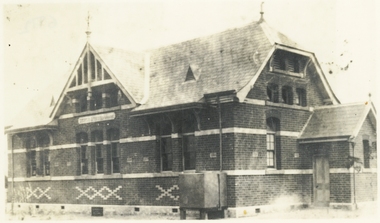
... Photo 1 (7009a) - Former "Ringwood Mail" newspaper office, Adelaide Street, 1955, looking along laneway to west. Lane between Bamford's Timber Yard, corner Warrandyte Rd. and Maroondah Highway, and went to Melbourne St, later called Civic Place. ...Returned to RDHS from Federation Estate Art Gallery Photo 1 (7009a) - Former "Ringwood Mail" newspaper office, Adelaide Street, 1955, looking along laneway to west. Lane between Bamford's Timber Yard, corner Warrandyte Rd. and Maroondah Highway, and went to Melbourne St, later called Civic Place. ...Returned to RDHS from Federation Estate Art GalleryPhoto 1 (7009a) - Former "Ringwood Mail" newspaper office, Adelaide Street, 1955, looking along laneway to west. Lane between Bamford's Timber Yard, corner Warrandyte Rd. and Maroondah Highway, and went to Melbourne St, later called Civic Place. Other buildings were Ham's Billiard Saloon, the two-story Renong Chambers, bottom left Jack Orr's clothes hoists and bottom right Horman & Woolhouse plumbers. All demolished for the building of Eastland in the 1960s. The photo shown is a typical example but may not be in the collection. -
 Ringwood and District Historical Society
Newspaper - Clippings, Local Newspaper Mergers and Readership Demographics in Ringwood/Maroondah - 1995-1998
... newspaper is now called the Maroondah Mail." ... 4. The Mail 22 July 1997 - The typical resident by Patrick Carlyon. "... some of the conclusions from the 1996 census released last week by the Australian Bureau of Statistics." ... 5. The Mail 2 December 1997 - Snapshot of Maroondah by Lynne Kinsey. "... This snapshot of Maroondah's population was revealed in Victoria in Fact, a Department of Infrasctructure report on the first release of 1996 Census data." ... 6. The Mail 21 April 1998 - How Maroondah Fits Into The Picture. "... a report based on 1996 Census data ... of 31 metropolitan Melbourne...newspaper is now called the Maroondah Mail." ... 4. The Mail 22 July 1997 - The typical resident by Patrick Carlyon. "... some of the conclusions from the 1996 census released last week by the Australian Bureau of Statistics." ... 5. The Mail 2 December 1997 - Snapshot of Maroondah by Lynne Kinsey. "... This snapshot of Maroondah's population was revealed in Victoria in Fact, a Department of Infrasctructure report on the first release of 1996 Census data." ... 6. The Mail 21 April 1998 - How Maroondah Fits Into The Picture. "... a report based on 1996 Census data ... of 31 metropolitan Melbourne ...Collection of seven newspaper articles glued to paper backing.1. The Mail 30 May 1995 - The Mail kept them informed - "The impact of the war (WWII) on the Ringwood and Croydon communities is reflected in the war-time editions of the Mail." ... 2. The Mail 3 October 1995 - Award - "Former Ringwood/Croydon Mail photographer Michelle Kelcey received a third place in the cadet section of the 1995 Hurley Awards." (The Hurley Awards acknowledge the work of suburban and regional newspaper photographers throughout Australia.) 3. The Mail 21 May 1996 - We're Maroondah now. "... Ringwood-Croydon Mail has changed names ... your Leader newspaper is now called the Maroondah Mail." ... 4. The Mail 22 July 1997 - The typical resident by Patrick Carlyon. "... some of the conclusions from the 1996 census released last week by the Australian Bureau of Statistics." ... 5. The Mail 2 December 1997 - Snapshot of Maroondah by Lynne Kinsey. "... This snapshot of Maroondah's population was revealed in Victoria in Fact, a Department of Infrasctructure report on the first release of 1996 Census data." ... 6. The Mail 21 April 1998 - How Maroondah Fits Into The Picture. "... a report based on 1996 Census data ... of 31 metropolitan Melbourne municipalities, including Maroondah." ... 7. Maroondah Post 25 January 1995 - Maroondah Post - a new name. "... From today the Maroondah Post will service all of the new City of Maroondah ..." (following merge of Croydon Post and Ringwood Post). -
 Ringwood and District Historical Society
Document, Packet: Agriculture. Decline or Orcharding in the Metropolitan Area of Melbourne 1920-1939 (John Fraser); Cutting 1998
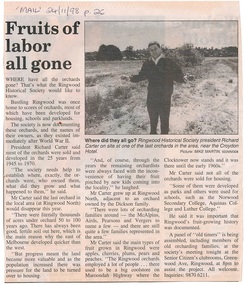
... Thesis by John Fraser- "The decline of orcharding in the metropolitan area of Melbourne, 1920-1939." . Newspaper cutting from the 'Mail' 24/11/98 titled "Fruits of labor all gone", with a photo of Richard Carter, then President of Ringwood Historical Society, on site at one of the last orchards in the area near the Croydon Hotel. . ...Thesis by John Fraser- "The decline of orcharding in the metropolitan area of Melbourne, 1920-1939." . Newspaper cutting from the 'Mail' 24/11/98 titled "Fruits of labor all gone", with a photo of Richard Carter, then President of Ringwood Historical Society, on site at one of the last orchards in the area near the Croydon Hotel. . ...Packet. Thesis;; 'Thank You' card and note from John Fraser to Ellie Pullen.;; Article from 'Mail' 25-Nov-1998 with photo of Richard Carter. +Additional Keywords: Fraser, JOhn / Pullin, Ellie / Carter, RichardPacket includes the following: . Thesis by John Fraser- "The decline of orcharding in the metropolitan area of Melbourne, 1920-1939." . Newspaper cutting from the 'Mail' 24/11/98 titled "Fruits of labor all gone", with a photo of Richard Carter, then President of Ringwood Historical Society, on site at one of the last orchards in the area near the Croydon Hotel. . Thank You card from John Fraser to Ellie Pullen. -
 Ringwood and District Historical Society
Newspaper - Newspaper Cutting, The Box Hill Reporter clipping, 1922 - Ringwood articles, 7-Feb-22
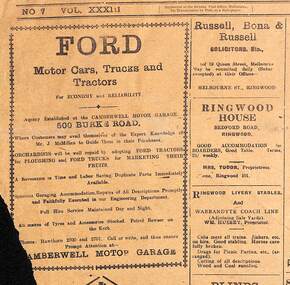
... Newspaper fragment "The Reporter" No.7 Vol XXXIII Feb 7, 1922 - including Russell, Bona & Russell, Solicitors, Melbourne Street, Ringwood; Ringwood House Accommodation - Mrs Tudor, Proprietress; Ringwood Livery Stables and Warrandyte Coach Line - Wm. ...Newspaper fragment "The Reporter" No.7 Vol XXXIII Feb 7, 1922 - including Russell, Bona & Russell, Solicitors, Melbourne Street, Ringwood; Ringwood House Accommodation - Mrs Tudor, Proprietress; Ringwood Livery Stables and Warrandyte Coach Line - Wm. ...Newspaper fragment "The Reporter" No.7 Vol XXXIII Feb 7, 1922 - including Russell, Bona & Russell, Solicitors, Melbourne Street, Ringwood; Ringwood House Accommodation - Mrs Tudor, Proprietress; Ringwood Livery Stables and Warrandyte Coach Line - Wm. Hussey, Proprietor; Menace of Fires - worst outbreak in Mr. Kent's property on the Warrandyte Road; After Fifty Years - golden wedding of Mr and Mrs. Milne, late of Ringwood; Prizes at Ringwood Show; Wood Chop Contests at Ringwood Show. -
 Orbost & District Historical Society
black and white photograph, C1914
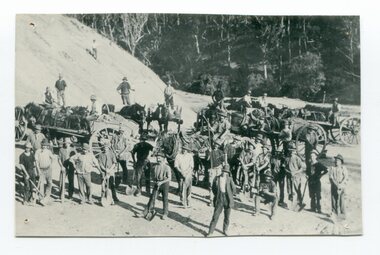
... In the newspaper, The Hobart Mercury on Saturday March 1914, There was this report: "EXPLOSION OF BLASTING CHARGE. THREE MEN KILLED. MELBOURNE...In the newspaper, The Hobart Mercury on Saturday March 1914, There was this report: "EXPLOSION OF BLASTING CHARGE. THREE MEN KILLED. MELBOURNE ...This photograph shows men working in the gravel pit at Newmerella just outside Orbost. Not long after this photograph was taken an accidental explosion killed three workers. In the newspaper, The Hobart Mercury on Saturday March 1914, There was this report: "EXPLOSION OF BLASTING CHARGE. THREE MEN KILLED. MELBOURNE, March 13 A fatal accident occurred this after- noon on the railway construction works at Hagen's Cutting, about two miles from Orbost, three men being killed. The victims were John Carroll, contractor, his son, Peter Carroll, and John Sullivan, a navvy. The gang had just finished work, and the three stayed behind to draw a blasting charge, which had missed fire yesterday. J. Carroll was using a pick, and it is presumed that the tool struck a percussion cap, and fired the charge. He and Sullivan were killed instantly, Carroll being literally blown to pieces. Fragments of his body and garments were recovered from the surrounding bush, and the main portion of the trunk, with leg attached, was hurled a distance of 200 yards. Peter Car roll was terribly- injured, and he died before medical aid arrived. ' This is a pictorial record of construction workers associated with the Orbost - Bairnsdale railway. This item is associated with the history of the Orbost-Bairnsdale railway line and therefore reflects the role that the rail line played in the social and economic history of Orbost. The Bairnsdale-Orbost railway was opened in 1916 to serve the agricultural and timber industry. Because of the decline in traffic and heavy operating costs, the line was finally closed in August, 1987. A black / white photograph of a large group of men with horses and wagons. Most are holding tools - picks, spades and shovels. Some of the wagons are loaded with soil.railway-construction east-gippsland-railway orbost-railway quarry-gravel-newmerella -
 Ringwood and District Historical Society
Newspaper, Scrapbook Clipping, Library Collection, Ringwood, Victoria, `
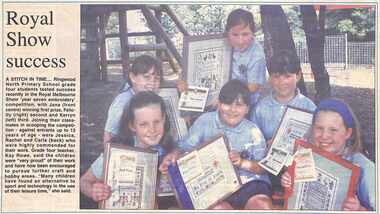
... ` ` ` Ringwood North Primary School grade four students tasted success recently in the Royal Melbourne Show "year seven embroidery" competition, with Jana (Front Centre) winning first prize, Felicity (right) second, and Kerryn (left) third. Newspaper ...``Newspaper clipping from "The Post", 16-10-96 P1 Ringwood North Primary School grade four students tasted success recently in the Royal Melbourne Show "year seven embroidery" competition, with Jana (Front Centre) winning first prize, Felicity (right) second, and Kerryn (left) third.` -
 Ringwood and District Historical Society
Newspaper, Scrapbook Clipping, Library Collection, Ringwood, Victoria
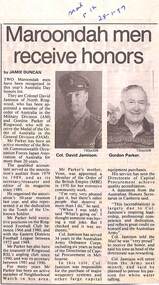
... Melbourne. Both men are very proud to receive their awards. Newspaper Clipping from "The Mail", 28-1-97. ...Newspaper Clipping from "The Mail", 28-1-97. P12 "Maroondah men receive honours"'. Two Maroondah men have been recognised in this year's Australia Day honours' list. They are Colonel David Jamison of North Ringwood, who has been appointed a member of the Order of Australia in the Military Division (AM), and Gordon Parker of Ringwood, who will receive the Order of Australia in the General Division. Mr Parker has been an active member of the British Commonwealth Occupation Forces Japan Association of Australia for more than 20 years. Col. Jamison has served 34 years in the Australian Army Ordnance Corps including six years as head of Capital Procurement in Melbourne. Both men are very proud to receive their awards. -
 Ringwood and District Historical Society
Newspaper, Scrapbook Clipping, Library Collection, Ringwood, Victoria
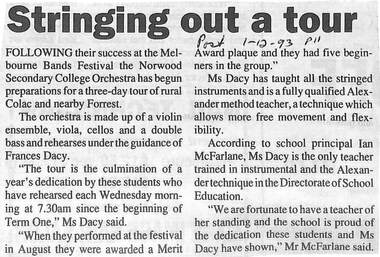
... Following their success at the Melbourne Bands Festival the Norwood Secondary College Orchestra has begun preparations for a three day tour of rural Colac and nearby Forrest.The band plays under the guidance of Frances Dacy. Newspaper ...Newspaper Clipping from "The Post", 1-12-1993 P 11 "Stringing out a tour"Following their success at the Melbourne Bands Festival the Norwood Secondary College Orchestra has begun preparations for a three day tour of rural Colac and nearby Forrest.The band plays under the guidance of Frances Dacy. -
 Ringwood and District Historical Society
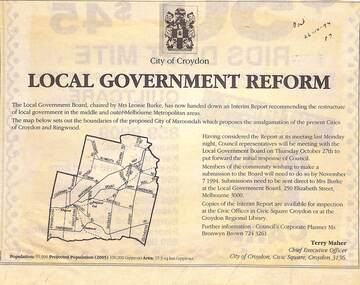
Newspaper, Scrapbook Clipping, Library Collection, Ringwood, Victoria
... The Local Government Board, chaired by Mrs Leonie Burke, has now handed down an Interim Report recommending the restructure of local government in the middle and outer Melbourne Metropolitan areas. Newspaper Clipping from the "Post", 26-10-1994. ...Newspaper Clipping from the "Post", 26-10-1994. P7. Local Government Reform. City of Croydon.The Local Government Board, chaired by Mrs Leonie Burke, has now handed down an Interim Report recommending the restructure of local government in the middle and outer Melbourne Metropolitan areas. -
 Ringwood and District Historical Society
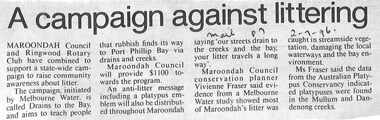
Newspaper, Scrapbook Clipping, Library Collection, Ringwood, Victoria
... The campaign, initiated by Melbourne Water is called Drains to the Bay and aims to teach people that rubbish finds its way to Port Phillip Bay via drains and creeks. Newspaper ...Newspaper clipping from "The Mail", 2-7-96, P 7Maroondah Council and Ringwood Rotary Club have combined to support a state-wide campaign to raise community awareness about litter. The campaign, initiated by Melbourne Water is called Drains to the Bay and aims to teach people that rubbish finds its way to Port Phillip Bay via drains and creeks. -
 Ringwood and District Historical Society
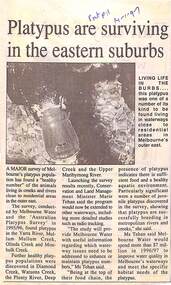
Newspaper, Scrapbook Clipping, Library Collection, Ringwood, Victoria
... Conservation and Land Management Minister, Marie Tehan, was present at the launching of the survey results, and spoke in detail about the results and the future planning and financial aid for the health of the Melbourne waterways. Newspaper Clipping from "The Post", 14 January 1997, Page 11, "Platypus are surviving in the eastern suburbs"'. ...Newspaper Clipping from "The Post", 14 January 1997, Page 11, "Platypus are surviving in the eastern suburbs"'.A major survey of Melbourne's platypus population has found a "healthy number" of the animals living in creeks and rivers close to residential area in the outer east. Conservation and Land Management Minister, Marie Tehan, was present at the launching of the survey results, and spoke in detail about the results and the future planning and financial aid for the health of the Melbourne waterways. -
 Orbost & District Historical Society
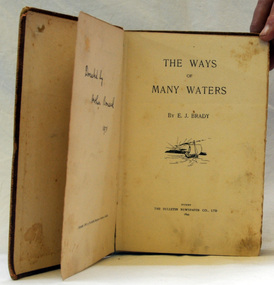
book, The Ways of Many Waters, 1899
... Brady was originally published by the Bulletin Newspaper Company (Sydney) in 1899,Later it was reprinted by Thomas C. Lothian (Melbourne) in 1909, and by the Standard Publishing Company (Melbourne) in 1913.] ...Brady was originally published by the Bulletin Newspaper Company (Sydney) in 1899,Later it was reprinted by Thomas C. Lothian (Melbourne) in 1909, and by the Standard Publishing Company (Melbourne) in 1913.] ...This book of poetry by E. J. Brady was originally published by the Bulletin Newspaper Company (Sydney) in 1899,Later it was reprinted by Thomas C. Lothian (Melbourne) in 1909, and by the Standard Publishing Company (Melbourne) in 1913.] E. J. Brady was an Australian poet. He was born at Carcoar, New South Wales, and was educated both in the United States and Sydney. He worked as a wharf clerk, a farmer, and journalist, and edited both rural and city newspapers This book is culturally important as Edwin James Brady represented the Bulletin school of the 1890s. The Bulletin was very popular with rural bush workers and selectors and became known as ‘the bushman’s bible’. It encouraged contributions of poetry, short stories and cartoons from its readerswho included miners, shearers and timber-workers from all over Australia. Some of this content was high quality and many of Australia’s important writers had their start with The Bulletin which became know as the ‘Bulletin School’ of literature.A small 155 pp fabric covered brown book with a very faded picture of a boat sailing toward a sunset on the front cover.poetry literature brady-edwin-james the-ways-of-the-waters -
 Orbost & District Historical Society
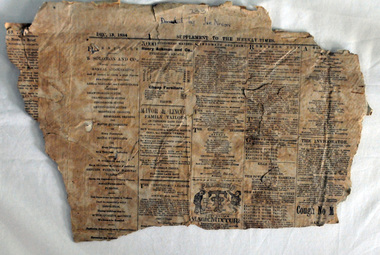
newspaper, December 13 1884
... This piece of newspaper had been used as wallpaper lining. The Weekly Times was first published on September 11, 1869, by a group of Melbourne businessmen who owned the now-defunct Daily Telegraph, with the stated aim to be a “journal of literature, sport, agriculture, science and politics”. ...This piece of newspaper had been used as wallpaper lining. The Weekly Times was first published on September 11, 1869, by a group of Melbourne businessmen who owned the now-defunct Daily Telegraph, with the stated aim to be a “journal of literature, sport, agriculture, science and politics”. ...This piece of newspaper had been used as wallpaper lining. The Weekly Times was first published on September 11, 1869, by a group of Melbourne businessmen who owned the now-defunct Daily Telegraph, with the stated aim to be a “journal of literature, sport, agriculture, science and politics”. It is Australia’s oldest rural newspaper, and is known far and wide as the Bible of the Bush. (ref Weekly Times web-site)This is a useful research tool.A section of newspaper from the Weekly Times of 1884. there is also a photocopy of the item.newspaper weekly-times -
 Ringwood and District Historical Society
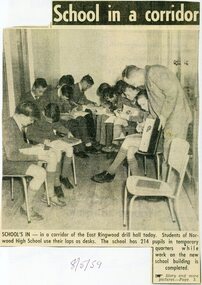
Newspaper - Clippings, Melbourne Herald 8th May, 1959 - Norwood High School, Ringwood, Victoria
... Melbourne Herald 8th May, 1959 - Norwood High School, Ringwood, Victoria. Newspaper Clippings ...Norwood High School started the school year in multiple temporary premises while the new school was being erected in Byron Street, eventually opening mid 1959.Temporary alternative classroom accommodation report with photographs.Altogether, 214 pupils of the school work in what teachers say are impossible conditions in the East Ringwood drill hall, the Anglican Church Hall, and (East Ringwood) football pavilion. -
 Flagstaff Hill Maritime Museum and Village
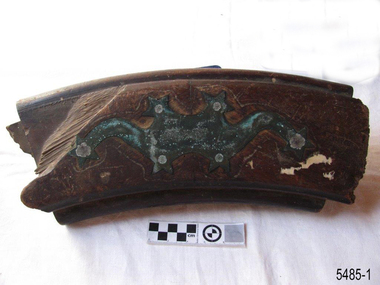
Functional object - Ship's Wheel, 1871 or earlier
... newspaper reports on a court case in Stawell, Victoria, noting a man who was caught 2 months later selling tobacco from the wreckage of Eric the Red. Some of the silverware is still treasured by descendants of Mr Mackenzie who was given these items by officials for his help in securing the cargo. The gifts included silver coffee and tea pots, half a dozen silver serviette rings and two sewing machines. The wreck and cargo were sold to a Melbourne...newspaper reports on a court case in Stawell, Victoria, noting a man who was caught 2 months later selling tobacco from the wreckage of Eric the Red. Some of the silverware is still treasured by descendants of Mr Mackenzie who was given these items by officials for his help in securing the cargo. The gifts included silver coffee and tea pots, half a dozen silver serviette rings and two sewing machines. The wreck and cargo were sold to a Melbourne ...The ship building company E. & A. Sewall, from Bath, Maine, USA, built many ships that had wheels with the same decorative, starburst pattern on them as this particular wheel segment, including the Eric the Red. The wheel was manufactured by their local Bath foundry, Geo. Moulton & Co. and sold to the Sewall yard for $100, according to the construction accounts of the vessel. Eric the Red was a wooden, three masted clipper ship. She had 1,580 tons register and was the largest full-rigged ship built at Bath, Maine, USA in 1871. She was built and registered by Arthur Sewall, later to become the partnership E. & A. Sewall, and was the 51st ship built by this company. The annually-published List of Merchant Vessels of the U.S. shows that Bath was still the home port of Eric the Red in 1880. The vessel was named after the Viking discoverer, Eric the Red, who was the first European to reach the shores of North America (in 980AD). The ship Eric the Red at first traded in coal between America and Britain, and later traded in guano nitrates from South America. In 1879 she was re-metalled and was in first class condition. On 10th June 1880 (some records say 12th June) Eric the Red departed New York for Melbourne and then Sydney. She had been commissioned by American trade representatives to carry a special cargo of 500 exhibits (1400 tons) - about a quarter to a third of America’s total exhibits - from America for the U.S.A. pavilion at Melbourne’s first International Exhibition. The exhibits included furniture, ironmongery, wines, chemicals, dental and surgical instruments, paper, cages, bronze lamp trimmings, axles, stamped ware, astronomical and time globes, samples of corn and the choicest of leaf tobacco. Other general cargo included merchandise such as cases of kerosene and turpentine, brooms, Bristol's Sarsaparilla, Wheeler and Wilson sewing machines, Wheeler’s thresher machine, axe handles and tools, cases of silver plate, toys, pianos and organs, carriages and Yankee notions. The Eric the Red left New York under the command of Captain Z. Allen (or some records say Captain Jacques Allen) and 24 other crew including the owner’s son third mate Ned Sewall. There were 2 saloon passengers also. On 4th September 1880 the ship had been sailing for an uneventful 85 days and the voyage was almost at its end. Eric the Red approached Cape Otway in a moderate north-west wind and hazy and overcast atmosphere. Around 1:30am Captain Allen sighted the Cape Otway light and was keeping the ship 5-6 miles offshore to stay clear of the hazardous Otway Reef. However he had badly misjudged his position. The ship hit the Otway Reef about 2 miles out to sea, south west of the Cape Otway light station. Captain Allen ordered the wheel to be put ‘hard up’ thinking that she might float off the reef. A heavy sea knocked the man away from the wheel, broke the wheel ropes and carried away the rudder. The sea swamped the lifeboats, the mizzenmast fell, with all of its rigging, then the mainmast fell and the ship broke in two. Some said that the passenger Vaughan, who was travelling for his health and not very strong, was washed overboard and never seen again. The ship started breaking up. The forward house came adrift with three of the crew on it as well as a longboat, which the men succeeded in launching and keeping afloat by continually bailing with their sea boots. The captain, the third mate (the owner’s son) and others clung to the mizzenmast in the sea. Then the owner’s son was washed away off the mast. Within 10 minutes the rest of the ship was in pieces, completely wrecked, with cargo and wreckage floating in the sea. The captain encouraged the second mate to swim with him to the deckhouse where there were other crew but the second mate wouldn’t go with him. Eventually the Captain made it to the deckhouse and the men pulled him up. At about 4:30am the group of men on the deckhouse saw the lights of a steamer and called for help. At the same time they noticed the second mate and the other man had drifted nearby, still on the spur, and pulled them both onto the wreck. The coastal steamer Dawn was returning to Warrnambool from Melbourne, its sailing time different to its usual schedule. Cries were heard coming from out of the darkness. Captain Jones sent out two life boats, and fired off rockets and blue lights to illuminate the area. They picked up the three survivors who were in the long boat from Eric the Red. Two men were picked up out of the water, one being the owner’s son who was clinging to floating kerosene boxes. At daylight the Dawn then rescued the 18 men from the floating portion of the deckhouse, which had drifted about 4 miles from where they’d struck the reef. Shortly after the rescue the deckhouse drifted onto breakers and was thrown onto rocks at Point Franklin, about 2 miles east of Cape Otway. Captain Jones had signalled to Cape Otway lighthouse the number of the Eric the Red and later signalled that there was a wreck at Otway Reef but there was no response from the lighthouse. The captain and crew of the Dawn spent several more hours searching unsuccessfully for more survivors, even going back as far as Apollo Bay. On board the Dawn the exhausted men received care and attention to their needs and wants, including much needed clothing. Captain Allen was amongst the 23 battered and injured men who were rescued and later taken to Warrnambool for care. Warrnambool’s mayor and town clerk offered them all hospitality, the three badly injured men going to the hospital and others to the Olive Branch Hotel, then on to Melbourne. Captain Allen’s leg injury prevented him from going ashore so he and three other men travelled on the Dawn to Portland. They were met by the mayor who also treated them all with great kindness. Captain Allen took the train back to Melbourne then returned to America. Those saved were Captain Z. Allen (or Jacques Allen), J. Darcy chief mate, James F. Lawrence second mate, Ned Sewall third mate and owner’s son, John French the cook, C. Nelson sail maker, Clarence W. New passenger, and the able seamen Dickenson, J. Black, Denis White, C. Herbert, C. Thompson, A. Brooks, D. Wilson, J. Ellis, Q. Thompson, C. Newman, W. Paul, J. Davis, M. Horenleng, J. Ogduff, T. W. Drew, R. Richardson. Four men had lost their lives; three of them were crew (Gus Dahlgreen ship’s carpenter, H. Ackman steward, who drowned in his cabin, and George Silver seaman) and one a passenger (J. B. Vaughan). The body of one of them had been found washed up at Cape Otway and was later buried in the lighthouse cemetery; another body was seen on an inaccessible ledge. Twelve months later the second mate James F. Lawrence, from Nova Scotia, passed away in the Warrnambool district; an obituary was displayed in the local paper. The captain and crew of the Dawn were recognised by the United States Government in July 1881 for their humane efforts and bravery, being thanked and presented with substantial monetary rewards, medals and gifts. Neither the ship, nor its cargo, was insured. The ship was worth about £15,000 and the cargo was reportedly worth £40,000; only about £2,000 worth had been recovered. Cargo and wreckage washed up at Apollo Bay, Peterborough, Port Campbell, Western Port and according to some reports, even as far away as the beaches of New Zealand. The day after the wreck the government steam ship Pharos was sent from Queenscliff to clear the shipping lanes of debris that could be a danger to ships. The large midship deckhouse of the ship was found floating in a calm sea near Henty Reef. Items such as an American chair, a ladder and a nest of boxes were all on top of the deckhouse. As it was so large and could cause danger to passing ships, Captain Payne had the deckhouse towed towards the shore just beyond Apollo Bay. Between Apollo Bay and Blanket Bay the captain and crew of Pharos collected Wheeler and Wilson sewing machines, nests of boxes, bottles of Bristol’s sarsaparilla, pieces of common American chairs, axe handles, a Wheelers’ Patent thresher and a sailor’s trunk with the words “A. James” on the front. A ship’s flag-board bearing the words “Eric the Red” was found on the deckhouse; finally those on board the Pharos had the name of the wrecked vessel. During this operation Pharos came across the government steamer Victoria and also a steamer S.S. Otway, both of which were picking up flotsam and wreckage. A whole side of the hull and three large pieces of the other side of the hull, with some of the copper sheathing stripped off, had floated on to Point Franklin. Some of the vessels yards and portions of her masts were on shore. The pieces of canvas attached to the yards and masts confirmed that the vessel had been under sail. The beach there was piled with debris several feet high. There were many cases of Diamond Oil kerosene, labelled R. W. Cameron and Company, New York. There were also many large planks of red pine, portions of a small white boat and a large, well-used oar. Other items found ashore included sewing machines (some consigned to ‘Long and Co.”) and notions, axe and scythe handles, hay forks, wooden pegs, rolls of wire (some branded “T.S” and Co, Melbourne”), kegs of nails branded “A.T. and Co.” from the factory of A. Field and Son, Taunton, Massachusetts, croquet balls and mallets, buggy fittings, rat traps, perfumery, cutlery and Douay Bibles, clocks, bicycles, chairs, a fly wheel, a cooking stove, timber, boxes, pianos, organs and a ladder. (Wooden clothes pegs drifted in for many years). There seemed to be no personal luggage or clothing. The Pharos encountered a long line, about one and a half miles, of floating wreckage about 10 miles off land, south east of Cape Otway, and in some places about 40 feet wide. It seemed that more than half of it was from Eric the Red. The ship’s crew rescued 3 cases that were for the Melbourne Exhibition and other items from amongst the debris. There were also chairs, doors, musical instruments, washing boards, nests of trunks and fly catchers floating in the sea. Most of the goods were saturated and smelt of kerosene. A section of the hull lies buried in the sand at Parker River Beach. An anchor with chain is embedded in the rocks east of Point Franklin and a second anchor, thought to be from Eric the Red, is on display at the Cape Otway light station. (There is a photograph of a life belt on the verandah of Rivernook Guest House in Princetown with the words “ERIC THE RED / BOSTON”. This is rather a mystery as the ship was registered in Bath, Maine, USA.) Parts of the ship are on display at Bimbi Park Caravan Park and at Apollo Bay Museum. Flagstaff Hill Maritime Village also has part of the helm (steering wheel), a carved wooden sword (said to be the only remaining portion of the ship’s figurehead; further research is currently being carried out), a door, a metal rod, samples of wood and a medal for bravery. Much of the wreckage was recovered by the local residents before police and other authorities arrived at the scene. Looters went to great effort to salvage goods, being lowered down the high cliff faces to areas with little or no beach to collect items from the wreckage, their mates above watching out for dangerous waves. A Tasmanian newspaper reports on a court case in Stawell, Victoria, noting a man who was caught 2 months later selling tobacco from the wreckage of Eric the Red. Some of the silverware is still treasured by descendants of Mr Mackenzie who was given these items by officials for his help in securing the cargo. The gifts included silver coffee and tea pots, half a dozen silver serviette rings and two sewing machines. The wreck and cargo were sold to a Melbourne man who salvaged a quantity of high quality tobacco and dental and surgical instruments. Timbers from the ship were salvaged and used in the construction of houses and sheds around Apollo Bay, including a guest house, Milford House (since burnt down in bushfires), which had furniture, fittings and timber on the dining room floor from the ship. A 39.7 foot long trading ketch, the Apollo, was also built from its timbers by Mr Burgess in 1883 and subsequently used in Tasmanian waters. It was the first attempt at ship building in Apollo bay. In 1881 a red light was installed about 300 feet above sea level at the base of the Cape Otway lighthouse to warn ships when they were too close to shore; It would not be visible unless a ship came within 3 miles from it. This has proved to be an effective warning. The State Library of Victoria has a lithograph in its collection depicting the steamer Dawn and the shipwrecked men, titled. "Wreck of the ship Eric the Red, Cape Otway: rescue of the crew by the Dawn". “The Eric the Red is historically significant as one of Victoria's major 19th century shipwrecks. (Heritage Victoria Eric the Red; HV ID 239) The wreck led to the provision of an additional warning light placed below the Cape Otway lighthouse to alert mariners to the location of Otway Reef. The site is archaeologically significant for its remains of a large and varied cargo and ship's fittings being scattered over a wide area. The site is recreationally and aesthetically significant as it is one of the few sites along this coast where tourists can visit identifiable remains of a large wooden shipwreck, and for its location set against the background of Cape Otway, Bass Strait, and the Cape Otway lighthouse.“ (Victorian Heritage Database Registration Number S239, Official Number 8745 USA) Segment of a ship's wheel, or helm, from the wreck of the sailing ship Eric the Red. The wheel part is an arc shape from the outer rim of the wheel and is made up of three layers of timber. The centre layer is a dark, dense timber and is wider than the two outer layers, which are less dense and lighter in colour. The wheel segment has a vertically symmetrical, decorative copper plate inlaid on the front. The plate has a starburst pattern; six stars decorate it, each at a point where there is a metal fitting going through the three layers of timber to the rear side of the wheel. On the rear each of the six fittings has an individual copper star around it. The edges of the helm are rounded and bevelled, polished to a shine in a dark stain. Around each of the stars, front and back, the wood is a lighter colour, as though the metal in that area being polished frequently. The length of the segment suggests that it has probably come from a wheel or helm that had ten spokes. (Ref: F.H.M.M. 16th March 1994, 239.6.610.3.7. Artefact Reg No ER/1.)flagstaff hill, warrnambool, shipwrecked-coast, flagstaff-hill, flagstaff-hill-maritime-museum, maritime-museum, shipwreck-coast, flagstaff-hill-maritime-village, ship's-wheel, eric-the-red, helm, shei's wheel, ship's steering wheel -
 Flagstaff Hill Maritime Museum and Village
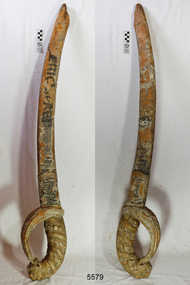
Decorative object - Sword, 1871 or earlier
... newspaper reports on a court case in Stawell, Victoria, noting a man who was caught 2 months later selling tobacco from the wreckage of Eric the Red. Some of the silverware is still treasured by descendants of Mr Mackenzie who was given these items by officials for his help in securing the cargo. The gifts included silver coffee and tea pots, half a dozen silver serviette rings and two sewing machines. The wreck and cargo were sold to a Melbourne...newspaper reports on a court case in Stawell, Victoria, noting a man who was caught 2 months later selling tobacco from the wreckage of Eric the Red. Some of the silverware is still treasured by descendants of Mr Mackenzie who was given these items by officials for his help in securing the cargo. The gifts included silver coffee and tea pots, half a dozen silver serviette rings and two sewing machines. The wreck and cargo were sold to a Melbourne ...This wooden sword is said to “possibly be the only remaining part of the figurehead from the sailing ship Eric the Red.” It was previously part of the collection of the old Warrnambool Museum and the entry in its inventory says “Wooden sword, portion of the figurehead, held by “Eric the Red” at the bow.” A large part of the ship’s hull was found on the rocks and a figurehead may have been attached or washed up on the shore. The shipping records for E. & A. Sewall, the builders, owners and managers of Eric the Red, are now preserved in the Maine Maritime Museum. There is no photograph on record of Eric the Red but photographs of other ships built around that time by the same company show that these did not have figureheads, and there is no record found of a figurehead for Eric the Red being ordered or paid for. Further research is being carried out. The ship building company E. & A. Sewall, from Bath, Maine, USA, built Eric the Red, a wooden, three masted clipper ship. She had 1,580 tons register and was the largest full-rigged ship built at Bath, Maine, USA in 1871. She was built and registered by Arthur Sewall, later to become the partnership E. & A. Sewall, and was the 51st ship built by this company. The annually-published List of Merchant Vessels of the U.S. shows that Bath was still the home port of Eric the Red in 1880. The vessel was named after the Viking discoverer, Eric the Red, who was the first European to reach the shores of North America (in 980AD). The ship Eric the Red at first traded in coal between America and Britain, and later traded in guano nitrates from South America. In 1879 she was re-metalled and was in first class condition. On 10th June 1880 (some records say 12th June) Eric the Red departed New York for Melbourne and then Sydney. She had been commissioned by American trade representatives to carry a special cargo of 500 exhibits (1400 tons) - about a quarter to a third of America’s total exhibits - from America for the U.S.A. pavilion at Melbourne’s first International Exhibition. The exhibits included furniture, ironmongery, wines, chemicals, dental and surgical instruments, paper, cages, bronze lamp trimmings, axles, stamped ware, astronomical and time globes, samples of corn and the choicest of leaf tobacco. Other general cargo included merchandise such as cases of kerosene and turpentine, brooms, Bristol's Sarsaparilla, Wheeler and Wilson sewing machines, Wheeler’s thresher machine, axe handles and tools, cases of silver plate, toys, pianos and organs, carriages and Yankee notions. The Eric the Red left New York under the command of Captain Z. Allen (or some records say Captain Jacques Allen) and 24 other crew including the owner’s son third mate Ned Sewall. There were 2 saloon passengers also. On 4th September 1880 the ship had been sailing for an uneventful 85 days and the voyage was almost at its end. Eric the Red approached Cape Otway in a moderate north-west wind and hazy and overcast atmosphere. Around 1:30am Captain Allen sighted the Cape Otway light and was keeping the ship 5-6 miles offshore to stay clear of the hazardous Otway Reef. However he had badly misjudged his position. The ship hit the Otway Reef about 2 miles out to sea, south west of the Cape Otway light station. Captain Allen ordered the wheel to be put ‘hard up’ thinking that she might float off the reef. A heavy sea knocked the man away from the wheel, broke the wheel ropes and carried away the rudder. The sea swamped the lifeboats, the mizzenmast fell, with all of its rigging, then the mainmast fell and the ship broke in two. Some said that the passenger Vaughan, who was travelling for his health and not very strong, was washed overboard and never seen again. The ship started breaking up. The forward house came adrift with three of the crew on it as well as a longboat, which the men succeeded in launching and keeping afloat by continually bailing with their sea boots. The captain, the third mate (the owner’s son) and others clung to the mizzenmast in the sea. Then the owner’s son was washed away off the mast. Within 10 minutes the rest of the ship was in pieces, completely wrecked, with cargo and wreckage floating in the sea. The captain encouraged the second mate to swim with him to the deckhouse where there were other crew but the second mate wouldn’t go with him. Eventually the Captain made it to the deckhouse and the men pulled him up. At about 4:30am the group of men on the deckhouse saw the lights of a steamer and called for help. At the same time they noticed the second mate and the other man had drifted nearby, still on the spur, and pulled them both onto the wreck. The coastal steamer Dawn was returning to Warrnambool from Melbourne, its sailing time different to its usual schedule. Cries were heard coming from out of the darkness. Captain Jones sent out two life boats, and fired off rockets and blue lights to illuminate the area. They picked up the three survivors who were in the long boat from Eric the Red. Two men were picked up out of the water, one being the owner’s son who was clinging to floating kerosene boxes. At daylight the Dawn then rescued the 18 men from the floating portion of the deckhouse, which had drifted about 4 miles from where they’d struck the reef. Shortly after the rescue the deckhouse drifted onto breakers and was thrown onto rocks at Point Franklin, about 2 miles east of Cape Otway. Captain Jones had signalled to Cape Otway lighthouse the number of the Eric the Red and later signalled that there was a wreck at Otway Reef but there was no response from the lighthouse. The captain and crew of the Dawn spent several more hours searching unsuccessfully for more survivors, even going back as far as Apollo Bay. On board the Dawn the exhausted men received care and attention to their needs and wants, including much needed clothing. Captain Allen was amongst the 23 battered and injured men who were rescued and later taken to Warrnambool for care. Warrnambool’s mayor and town clerk offered them all hospitality, the three badly injured men going to the hospital and others to the Olive Branch Hotel, then on to Melbourne. Captain Allen’s leg injury prevented him from going ashore so he and three other men travelled on the Dawn to Portland. They were met by the mayor who also treated them all with great kindness. Captain Allen took the train back to Melbourne then returned to America. Those saved were Captain Z. Allen (or Jacques Allen), J. Darcy chief mate, James F. Lawrence second mate, Ned Sewall third mate and owner’s son, John French the cook, C. Nelson sail maker, Clarence W. New passenger, and the able seamen Dickenson, J. Black, Denis White, C. Herbert, C. Thompson, A. Brooks, D. Wilson, J. Ellis, Q. Thompson, C. Newman, W. Paul, J. Davis, M. Horenleng, J. Ogduff, T. W. Drew, R. Richardson. Four men had lost their lives; three of them were crew (Gus Dahlgreen ship’s carpenter, H. Ackman steward, who drowned in his cabin, and George Silver seaman) and one a passenger (J. B. Vaughan). The body of one of them had been found washed up at Cape Otway and was later buried in the lighthouse cemetery; another body was seen on an inaccessible ledge. Twelve months later the second mate James F. Lawrence, from Nova Scotia, passed away in the Warrnambool district; an obituary was displayed in the local paper. The captain and crew of the Dawn were recognised by the United States Government in July 1881 for their humane efforts and bravery, being thanked and presented with substantial monetary rewards, medals and gifts. Neither the ship, nor its cargo, was insured. The ship was worth about £15,000 and the cargo was reportedly worth £40,000; only about £2,000 worth had been recovered. Cargo and wreckage washed up at Apollo Bay, Peterborough, Port Campbell, Western Port and according to some reports, even as far away as the beaches of New Zealand. The day after the wreck the government steam ship Pharos was sent from Queenscliff to clear the shipping lanes of debris that could be a danger to ships. The large midship deckhouse of the ship was found floating in a calm sea near Henty Reef. Items such as an American chair, a ladder and a nest of boxes were all on top of the deckhouse. As it was so large and could cause danger to passing ships, Captain Payne had the deckhouse towed towards the shore just beyond Apollo Bay. Between Apollo Bay and Blanket Bay the captain and crew of Pharos collected Wheeler and Wilson sewing machines, nests of boxes, bottles of Bristol’s sarsaparilla, pieces of common American chairs, axe handles, a Wheelers’ Patent thresher and a sailor’s trunk with the words “A. James” on the front. A ship’s flag-board bearing the words “Eric the Red” was found on the deckhouse; finally those on board the Pharos had the name of the wrecked vessel. During this operation Pharos came across the government steamer Victoria and also a steamer S.S. Otway, both of which were picking up flotsam and wreckage. A whole side of the hull and three large pieces of the other side of the hull, with some of the copper sheathing stripped off, had floated on to Point Franklin. Some of the vessels yards and portions of her masts were on shore. The pieces of canvas attached to the yards and masts confirmed that the vessel had been under sail. The beach there was piled with debris several feet high. There were many cases of Diamond Oil kerosene, labelled R. W. Cameron and Company, New York. There were also many large planks of red pine, portions of a small white boat and a large, well-used oar. Other items found ashore included sewing machines (some consigned to ‘Long and Co.”) and notions, axe and scythe handles, hay forks, wooden pegs, rolls of wire (some branded “T.S” and Co, Melbourne”), kegs of nails branded “A.T. and Co.” from the factory of A. Field and Son, Taunton, Massachusetts, croquet balls and mallets, buggy fittings, rat traps, perfumery, cutlery and Douay Bibles, clocks, bicycles, chairs, a fly wheel, a cooking stove, timber, boxes, pianos, organs and a ladder. (Wooden clothes pegs drifted in for many years). There seemed to be no personal luggage or clothing. The Pharos encountered a long line, about one and a half miles, of floating wreckage about 10 miles off land, south east of Cape Otway, and in some places about 40 feet wide. It seemed that more than half of it was from Eric the Red. The ship’s crew rescued 3 cases that were for the Melbourne Exhibition and other items from amongst the debris. There were also chairs, doors, musical instruments, washing boards, nests of trunks and fly catchers floating in the sea. Most of the goods were saturated and smelt of kerosene. A section of the hull lies buried in the sand at Parker River Beach. An anchor with chain is embedded in the rocks east of Point Franklin and a second anchor, thought to be from Eric the Red, is on display at the Cape Otway light station. (There is a photograph of a life belt on the verandah of Rivernook Guest House in Princetown with the words “ERIC THE RED / BOSTON”. This is rather a mystery as the ship was registered in Bath, Maine, USA.) Parts of the ship are on display at Bimbi Park Caravan Park and at Apollo Bay Museum. Flagstaff Hill Maritime Village also has part of the helm (steering wheel), a carved wooden sword (said to be the only remaining portion of the ship’s figurehead; further research is currently being carried out), a door, a metal rod, samples of wood and a medal for bravery. Much of the wreckage was recovered by the local residents before police and other authorities arrived at the scene. Looters went to great effort to salvage goods, being lowered down the high cliff faces to areas with little or no beach to collect items from the wreckage, their mates above watching out for dangerous waves. A Tasmanian newspaper reports on a court case in Stawell, Victoria, noting a man who was caught 2 months later selling tobacco from the wreckage of Eric the Red. Some of the silverware is still treasured by descendants of Mr Mackenzie who was given these items by officials for his help in securing the cargo. The gifts included silver coffee and tea pots, half a dozen silver serviette rings and two sewing machines. The wreck and cargo were sold to a Melbourne man who salvaged a quantity of high quality tobacco and dental and surgical instruments. Timbers from the ship were salvaged and used in the construction of houses and sheds around Apollo Bay, including a guest house, Milford House (since burnt down in bushfires), which had furniture, fittings and timber on the dining room floor from the ship. A 39.7 foot long trading ketch, the Apollo, was also built from its timbers by Mr Burgess in 1883 and subsequently used in Tasmanian waters. It was the first attempt at ship building in Apollo bay. In 1881 a red light was installed about 300 feet above sea level at the base of the Cape Otway lighthouse to warn ships when they were too close to shore; It would not be visible unless a ship came within 3 miles from it. This has proved to be an effective warning. The State Library of Victoria has a lithograph in its collection depicting the steamer Dawn and the shipwrecked men, titled. "Wreck of the ship Eric the Red, Cape Otway: rescue of the crew by the Dawn".The Eric the Red is historically significant as one of Victoria's major 19th century shipwrecks. (Heritage Victoria Eric the Red; HV ID 239) The wreck led to the provision of an additional warning light placed below the Cape Otway lighthouse to alert mariners to the location of Otway Reef. The site is archaeologically significant for its remains of a large and varied cargo and ship's fittings being scattered over a wide area. The site is recreationally and aesthetically significant as it is one of the few sites along this coast where tourists can visit identifiable remains of a large wooden shipwreck, and for its location set against the background of Cape Otway, Bass Strait, and the Cape Otway lighthouse. (Victorian Heritage Database Registration Number S239, Official Number 8745 USA)This carved wooden sword, recovered from the Eric the Red, is possibly the only portion of the figurehead recovered after the wreck. There are spirals carved from the base of the handle to the top of the sword. The hilt of the sword is a lion’s head holding its tail in its mouth, the tail forming the handle. The blade of the sword has engraved patterns on it. Tiny particles of gold leaf and dark blue paint fragments can be seen between the carving marks. There are remnants of yellowish-orange and crimson paint on the handle. At some time after the sword was salvaged the name of the ship was hand painted on the blade in black paint. The tip of the sword has broken or split and the remaining part is charcoal in appearance. On both the tip and the base of the handle are parts made where the sword could have been joined onto the figurehead There is a white coating over some areas of the sword, similar to white lead putty used in traditional shipbuilding. The words “ERIC the RED” have been hand painted on the blade of the sword in black paint sometime after it was salvaged.flagstaff hill, flagstaff hill maritime museum and village, warrnambool, maritime museum, maritime village, great ocean road, shipwreck coast, sword, wooden sword, eric the red, carved sword, figurehead, snake head on sword -
 Flagstaff Hill Maritime Museum and Village
Wood sample, 1855
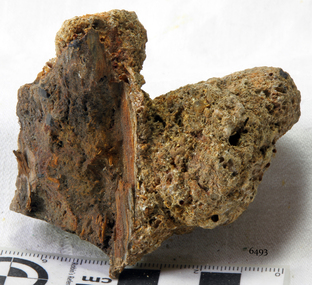
... Melbourne to Hawthorn. She also carried a cow for fresh milk, pens for fowls and pigs, 90,000 gallons of water for washing and drinking. It also carried 17,000 letters and 31,800 newspapers...Melbourne to Hawthorn. She also carried a cow for fresh milk, pens for fowls and pigs, 90,000 gallons of water for washing and drinking. It also carried 17,000 letters and 31,800 newspapers ...The artefact is a piece of ship’s timber from the wreck-site of the SCHOMBERG, a vessel which collided with the Peterborough reef on her maiden voyage in December 1855. This small wooden remnant of the disaster has been concreted on one side by the accrual of marine sediment while submerged. The build-up of sediment over the remains of the vessel is typical of the site as a whole. This artefact illustrates the reclaiming power of the ocean and the gradual disappearance of timber constructed vessels that have come to grief along this coastline (for example, the THISTLE in 1837, and the CHILDREN in 1838). The SCHOMBERG was a 2,000 ton clipper ship, specifically designed for the Australian immigration trade (back-loading wool for Britain’s mills), and constructed in Hall’s shipyard in Aberdeen, Scotland. She was owned by the Black Ball Line and launched in 1855. Alexander Hall & Son were renowned builders of sleek and fast 1,000 ton clippers for the China trade (opium in, tea out) and were keen to show they could also outclass the big North American ships built by Donald Mackay. Consequently the SCHOMBERG was ‘overbuilt’. Her hull featured five ‘skins’ of Scotch Larch and Pitch Pine overlaying each other in a diagonal pattern against a stout frame of British Oak. Oak has been favoured by builders of wooden ships for centuries. Its close, dense grain made it harder to work, but also gave it great strength and durability. In addition, the lateral spread of its branches supplied a natural curvature for the ribs of a vessel’s hull, as well as providing the small corner or curved pieces (‘knees’ and ‘elbows’) that fit them together. The shape and texture of this wood sample suggests a dense hardwood like Oak. The timber has been cut off at one end since its recovery from the sea, exposing a smooth and almost shiny surface. Seasoned English Oak has a similar light brown colour and tight grained finish. At the launch the SCHOMBERG’s 34 year old master, Captain ‘Bully’ Forbes, had promised Melbourne in 60 days, "with or without the help of God." James Nicol Forbes was born in Aberdeen in 1821 and rose to fame with his record-breaking voyages on the famous Black Ball Line ships; MARCO POLO and LIGHTNING. In 1852 in the MARCO POLO he made the record passage from London to Melbourne in 68 days. There were 53 deaths on the voyage but the great news was of the record passage by the master. In 1954 Captain Forbes took the clipper LIGHTNING to Melbourne in 76 days and back in 63 days, this was never beaten by a sailing ship. He often drove his crew and ship to breaking point to beat his own records. He cared little for the comfort of the passengers. On this, the SCHOMBERG’s maiden voyage, he was going to break records. SCHOMBERG departed Liverpool on her maiden voyage on 6 October 1855 flying the sign “Sixty Days to Melbourne”. She departed with 430 passengers and 3000 tons cargo including iron rails and equipment intended to build the Melbourne to Geelong Railway and a bridge over the Yarra from Melbourne to Hawthorn. She also carried a cow for fresh milk, pens for fowls and pigs, 90,000 gallons of water for washing and drinking. It also carried 17,000 letters and 31,800 newspapers. The ship and cargo was insured for $300,000, a fortune for the time. The winds were poor as she sailed across the equator, slowing SCHOMBERG’s journey considerably. Land was first sighted on Christmas Day, at Cape Bridgewater near Portland, and Captain Forbes followed the coastline towards Melbourne. Forbes was said to be playing cards when called by the Third Mate Henry Keen, who reported land about 3 miles off, Due in large part to the captain's regarding a card game as more important than his ship, it eventually ran aground on a sand spit near Curdie's Inlet (about 56 km west of Cape Otway) on 26 December 1855, 78 days after leaving Liverpool. The sand spit and the currents were not marked on Forbes’s map. Overnight, the crew launched a lifeboat to find a safe place to land the ship’s passengers. The scouting party returned to SCHOMBERG and advised Forbes that it was best to wait until morning because the rough seas could easily overturn the small lifeboats. The ship’s Chief Officer spotted SS QUEEN at dawn and signalled the steamer. The master of the SS QUEEN approached the stranded vessel and all of SCHOMBERG’s passengers and crew were able to disembark safely. The SCHOMBERG was lost and with her, Forbes’ reputation. The Black Ball Line’s Melbourne agent sent a steamer to retrieve the passengers’ baggage from the SCHOMBERG. Other steamers helped unload her cargo until the weather changed and prevented the salvage teams from accessing the ship. Later one plunderer found a case of Wellington boots, but alas, all were for the left foot! Local merchants Manifold & Bostock bought the wreck and cargo, but did not attempt to salvage the cargo still on board the ship. They eventually sold it on to a Melbourne businessman and two seafarers. In 1864 after two of the men drowned when they tried to reach SCHOMBERG, salvage efforts were abandoned. Parts of the SCHOMBERG were washed ashore on the south island of New Zealand in 1870, nearly 15 years after the wreck. The wreck now lies in almost 9 metres of water. Although the woodwork is mostly disintegrated the shape of the ship can still be seen due to the remaining railway irons, girders and the ship’s frame. A variety of goods and materials can be seen scattered about nearby. Flagstaff Hill holds many items salvaged from the SCHOMBERG including a ciborium (in which a diamond ring was concealed), communion set, ship fittings and equipment, personal effects, a lithograph, tickets and photograph from the SCHOMBERG. One of the SCHOMBERG bells is in the Warrnambool Library. The SCHOMBERG collection as a whole is of historical and archaeological significance at a State level, listed on the Victorian Heritage Register VHR S612. Flagstaff Hill’s collection of artefacts from the SCHOMBERG is significant for its association with the Victorian Heritage Registered shipwreck. The collection is primarily significant because of the relationship between the objects, as together they have a high potential to interpret the story of the SCHOMBERG. The SCHOMBERG collection is archaeologically significant as the remains of an international passenger ship. The shipwreck collection is historically significant for representing aspects of Victoria’s shipping history and its potential to interpret sub-theme 1.5 of Victoria’s Framework of Historical Themes (living with natural processes). The collection is also historically significant for its association with the shipwreck and the ship, which was designed to be fastest and most luxurious of its day. The SCHOMBERG collection meets the following criteria for assessment: Criterion A: Importance to the course, or pattern, of Victoria’s cultural history. Criterion B: Possession of uncommon, rare or endangered aspects of Victoria’s cultural history. Criterion C: Potential to yield information that will contribute to an understanding of Victoria’s cultural history. A piece of wood, concreted in sediment, from the wreck of the SCHOMBERG (1855). The limestone accretion includes sand, shell grit and marine worm casings. The exposed surface of the wood is broken and worn smooth along the grain. One end of the timber has been cut or sawn off across the grain, presenting a smooth and shiny surface.flagstaff hill, warrnambool, shipwrecked-coast, flagstaff-hill, flagstaff-hill-maritime-museum, maritime-museum, shipwreck-coast, flagstaff-hill-maritime-village, wood segment, schomberg, shipwreck timber, alexander hall and son, limestone concretion, oak-framed hull -
 Flagstaff Hill Maritime Museum and Village
Furniture - Door, 1871 or earlier
... newspaper reports on a court case in Stawell, Victoria, noting a man who was caught 2 months later selling tobacco from the wreckage of Eric the Red. Some of the silverware is still treasured by descendants of Mr Mackenzie who was given these items by officials for his help in securing the cargo. The gifts included silver coffee and tea pots, half a dozen silver serviette rings and two sewing machines. The wreck and cargo were sold to a Melbourne...newspaper reports on a court case in Stawell, Victoria, noting a man who was caught 2 months later selling tobacco from the wreckage of Eric the Red. Some of the silverware is still treasured by descendants of Mr Mackenzie who was given these items by officials for his help in securing the cargo. The gifts included silver coffee and tea pots, half a dozen silver serviette rings and two sewing machines. The wreck and cargo were sold to a Melbourne ...The wooden door was salvaged from the wreck of the sailing ship Eric the Red, which was a wooden, three masted clipper ship. Eric the Red was the largest full-rigged ship built at Bath, Maine, USA in 1871, having had a 1,580 tons register. She was built and registered by Arthur Sewall, later to become the partnership E. & A. Sewall, the 51st ship built by this company. The annually-published List of Merchant Vessels of the U.S. shows Bath was still the home port of Eric the Red in 1880. The vessel was named after the Viking discoverer, Eric the Red, who was the first European to reach the shores of North America (in 980AD). The ship Eric the Red at first traded in coal between America and Britain, and later traded in guano nitrates from South America. In 1879 she was re-metalled and was in first class condition. On 10th June 1880 (some records say 12th June) Eric the Red departed New York for Melbourne and then Sydney. She had been commissioned by American trade representatives to carry a special cargo of 500 exhibits (1400 tons) – about a quarter to a third of America’s total exhibits - from America for the U.S.A. pavilion at Melbourne’s first International Exhibition. The exhibits included furniture, ironmongery, wines, chemicals, dental and surgical instruments, paper, cages, bronze lamp trimmings, axles, stamped ware, astronomical and time globes, samples of corn and the choicest of leaf tobacco. Other general cargo included merchandise such as cases of kerosene and turpentine, brooms, Bristol's Sarsaparilla, Wheeler and Wilson sewing machines, Wheeler’s thresher machine, axe handles and tools, cases of silver plate, toys, pianos and organs, carriages and Yankee notions. The Eric the Red left New York under the command of Captain Z. Allen (or some records say Captain Jacques Allen) and 24 other crew including the owner’s son third mate Ned Sewall. There were 2 saloon passengers also. The ship had been sailing for an uneventful 85 days and the voyage was almost at its end. On 4th September 1880 the Eric the Red approached Cape Otway with a moderate north-west wind and hazy and overcast atmosphere. Around 1:30am Captain Allen sighted the Cape Otway light and was keeping the ship 5-6 miles offshore to stay clear of the hazardous Otway Reef. However he had badly misjudged his position. The ship hit the Otway Reef about 2 miles out to sea, south west of the Cape Otway light station. He ordered the wheel to be put ‘hard up’ thinking that she might float off the reef. A heavy sea knocked the man away from the wheel, broke the wheel ropes and carried away the rudder. The sea swamped the lifeboats. The mizzenmast fell, with all of its rigging, then the mainmast also fell and the ship broke in two. Some said that the passenger Vaughan, who was travelling for his health and not very strong, was washed overboard and never seen again. The ship started breaking up. The forward house came adrift with three of the crew on it as well as a longboat, which the men succeeded in launching and keeping afloat by continually bailing with their sea boots. The captain, the third mate (the owner’s son) and others clung to the mizzenmast in the sea. Then the owner’s son was washed away off the mast. Within 10 minutes the rest of the ship was in pieces, completely wrecked, with cargo and wreckage floating in the sea. The captain encouraged the second mate to swim with him to the deckhouse where there were other crew but the second mate wouldn’t go with him. Eventually the Captain made it to the deckhouse and the men pulled him up. At about 4:30am the group of men on the deckhouse saw the lights of a steamer and called for help. At the same time they noticed the second mate and the other man had drifted nearby, still on the spur, and pulled them both onto the wreck. The coastal steamer Dawn was returning to Warrnambool from Melbourne, its sailing time different to its usual schedule. Captain Jones sent out two life boats, and fired off rockets and blue lights to illuminate the area. They picked up the three survivors who were in the long boat from Eric the Red. Two men were picked up out of the water, one being the owner’s son who was clinging to floating kerosene boxes. At daylight the Dawn then rescued the 18 men from the floating portion of the deckhouse, which had drifted about 4 miles from where they’d struck the reef. Shortly after the rescue the deckhouse drifted onto breakers and was thrown onto rocks at Point Franklin, about 2 miles east of Cape Otway. Captain Jones had signalled to Cape Otway lighthouse the number of the Eric the Red and later signalled that there was a wreck at Otway Reef but there was no response from the lighthouse. The captain and crew of the Dawn spent several more hours searching unsuccessfully for more survivors, even going back as far as Apollo Bay. On board the Dawn the exhausted men received care and attention to their needs and wants, including much needed clothing. Captain Allen was amongst the 23 battered and injured men who were rescued and later taken to Warrnambool for care. Warrnambool’s mayor and town clerk offered them all hospitality, the three badly injured men going to the hospital for care and others to the Olive Branch Hotel, then on to Melbourne. Captain Allen’s leg injury prevented him from going ashore so he and three other men travelled on the Dawn to Portland. They were met by the mayor who also treated them all with great kindness. Captain Allen took the train back to Melbourne then returned to America. Those saved were Captain Z. Allen (or Jacques Allen), J. Darcy chief mate, James F. Lawrence second mate, Ned Sewall third mate and owner’s son, John French the cook, C. Nelson sail maker, Clarence W. New passenger, and the able seamen Dickenson, J. Black, Denis White, C. Herbert, C. Thompson, A. Brooks, D. Wilson, J. Ellis, Q. Thompson, C. Newman, W. Paul, J. Davis, M. Horenleng, J. Ogduff, T. W. Drew, R. Richardson. Four men had lost their lives; three of them were crew (Gus Dahlgreen ship’s carpenter, H. Ackman steward, who drowned in his cabin, and George Silver seaman) and one a passenger (J. B. Vaughan). The body of one of them had been found washed up at Cape Otway and was later buried in the lighthouse cemetery; another body was seen on an inaccessible ledge. Twelve months later the second mate James F. Lawrence, from Nova Scotia, passed away in the Warrnambool district; an obituary was displayed in the local paper. The captain and crew of the Dawn were recognised by the United States Government in July 1881 for their humane efforts, being thanked and presented with substantial monetary rewards, medals and gifts. Neither the ship, nor its cargo, was insured. The ship was worth about £15,000 and the cargo was reportedly worth £40,000; only about £2,000 worth had been recovered. Cargo and wreckage washed up at Apollo Bay, Peterborough, Port Campbell, Western Port and according to some reports, even as far away as the beaches of New Zealand. The day after the wreck the government steam ship Pharos was sent from Queenscliff to clear the shipping lanes of debris that could be a danger to ships. The large midship deckhouse of the ship was found floating in a calm sea near Henty Reef. Items such as an American chair, a ladder and a nest of boxes were all on top of the deckhouse. As it was so large and could cause danger to passing ships, Captain Payne had the deckhouse towed towards the shore just beyond Apollo Bay. Between Apollo Bay and Blanket Bay the captain and crew of Pharos collected Wheeler and Wilson sewing machines, nests of boxes, bottles of Bristol’s sarsaparilla, pieces of common American chairs, axe handles, a Wheelers’ Patent thresher and a sailor’s trunk with the words “A. James” on the front. A ship’s flag-board bearing the words “Eric the Red” was found on the deckhouse; finally those on board the Pharos had the name of the wrecked vessel. During this operation Pharos came across the government steamer Victoria and also a steamer S.S. Otway, both of which were picking up flotsam and wreckage. A whole side of the hull and three large pieces of the other side of the hull, with some of the copper sheathing stripped off, had floated on to Point Franklin. Some of the vessels yards and portions of her masts were on shore. The pieces of canvas attached to the yards and masts confirmed that the vessel had been under sail. The beach there was piled with debris several feet high. There were many cases of Diamond Oil kerosene, labelled R. W. Cameron and Company, New York. There were also many large planks of red pine, portions of a small white boat and a large, well-used oar. Other items found ashore included sewing machines (some consigned to ‘Long and Co.”) and notions, axe and scythe handles, hay forks, wooden pegs, rolls of wire (some branded “T.S” and Co, Melbourne”), kegs of nails branded “A.T. and Co.” from the factory of A. Field and Son, Taunton, Massachusetts, croquet balls and mallets, buggy fittings, rat traps, perfumery, cutlery and Douay Bibles, clocks, bicycles, chairs, a fly wheel, a cooking stove, timber, boxes, pianos, organs and a ladder. (Wooden clothes pegs drifted in for many years). There seemed to be no personal luggage or clothing. The Pharos encountered a long line, about one and a half miles, of floating wreckage about 10 miles off land, south east of Cape Otway, and in some places about 40 feet wide. It seemed that more than half of it was from Eric the Red. The ship’s crew rescued 3 cases that were for the Melbourne Exhibition and other items from amongst the debris. There were also chairs, doors, musical instruments, washing boards, nests of trunks and fly catchers floating in the sea. Most of the goods were saturated and smelt of kerosene. A section of the hull lies buried in the sand at Parker River Beach. An anchor with chain is embedded in the rocks east of Point Franklin and a second anchor, thought to be from Eric the Red, is on display at the Cape Otway light station. (There is a photograph of a life belt on the verandah of Rivernook Guest House in Princetown with the words “ERIC THE RED / BOSTON”. This is rather a mystery as the ship was registered in Bath, Maine, USA.) Parts of the ship are on display at Bimbi Park Caravan Park and at Apollo Bay Museum. Flagstaff Hill Maritime Village also has part of the helm (steering wheel), a carved wooden sword (said to be the only remaining portion of the ship’s figurehead; further research is currently being carried out), a door, a metal rod and samples of wood. Much of the wreckage was recovered by the local residents before police and other authorities arrived at the scene. Looters went to great effort to salvage goods, being lowered down the high cliff faces to areas with little or no beach to collect items from the wreckage, their mates above watching out for dangerous waves. A Tasmanian newspaper reports on a court case in Stawell, Victoria, noting a man who was caught 2 months later selling tobacco from the wreckage of Eric the Red. Some of the silverware is still treasured by descendants of Mr Mackenzie who was given these items by officials for his help in securing the cargo. The gifts included silver coffee and tea pots, half a dozen silver serviette rings and two sewing machines. The wreck and cargo were sold to a Melbourne man who salvaged a quantity of high quality tobacco and dental and surgical instruments. Timbers from the ship were salvaged and used in the construction of houses and sheds around Apollo Bay, including a guest house, Milford House (since burnt down in bushfires), which had furniture, fittings and timber on the dining room floor from the ship. A 39.7 foot long trading ketch, the Apollo, was also built from its timbers by Mr Burgess in 1883 and subsequently used in Tasmanian waters. It was the first attempt at ship building in Apollo bay. In 1881 a red light was installed about 300 feet above sea level at the base of the Cape Otway lighthouse to warn ships when they were too close to shore; It would not be visible unless a ship came within 3 miles from it. This has proved to be an effective warning. The State Library of Victoria has a lithograph in its collection depicting the steamer Dawn and the shipwrecked men, titled. "Wreck of the ship Eric the Red, Cape Otway: rescue of the crew by the Dawn". “The Eric the Red is historically significant as one of Victoria's major 19th century shipwrecks. (Heritage Victoria Eric the Red; HV ID 239) The wreck led to the provision of an additional warning light placed below the Cape Otway lighthouse to alert mariners to the location of Otway Reef. The site is archaeologically significant for its remains of a large and varied cargo and ship's fittings being scattered over a wide area. The site is recreationally and aesthetically significant as it is one of the few sites along this coast where tourists can visit identifiable remains of a large wooden shipwreck, and for its location set against the background of Cape Otway, Bass Strait, and the Cape Otway lighthouse.“ (Victorian Heritage Database Registration Number S239, Official Number 8745 USA) Door from the wreck of the ship Eric the Red. The wooden singular rectangular door includes three insert panel sections. The top section is square shaped and is missing its panel or glass. The centre timber panel is about a third of the height of the top panel and the bottom timber panel is approximately equal in height to the total height of the two upper panels. The door fastenings include both a metal door latch and traditional door bolt. They are both attached to the front right hand side of the door. The bolt is just below the top panel, and the door latch is in approximately the centre of that side. The door latch has a round mark where a handle could have been attached. The wood of the door has scraping marks in a semi-circle around the door latch where the latch has swung around on its one remaining fastening and grazed the surface. There is a metal hinge at the top section of the door on the opposite side to the latch. The painted surface has been scraped back to expose the wood. The door is shorter than the average height of a person. On the reverse of the door there are lines on the panels, just inside their edges, is what appears to be pencil. The door is not aligned straight but is skew to centre.warrnambool, flagstaff hill, flagstaff hill maritime village, maritime museum, shipwreck coast, great ocean road, shipwreck artefact, eric the red, jaques allen, sewall, 1880, melbourne exhibition 1880, cape otway, otway reef, victorian shipwreck, bass strait, eric-the-red, door -
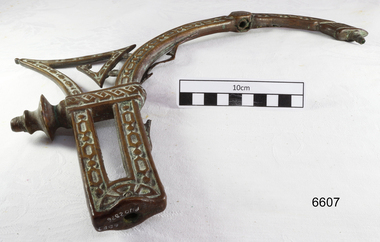 Flagstaff Hill Maritime Museum and Village
Functional object - Light Bracket, Before 1878
... newspaper, flushed with civic pride. The 1850s Gold Rush promoted a similar attitude of confidence and affluence in the Colony of Victoria. In 1855 Melbourne...newspaper, flushed with civic pride. The 1850s Gold Rush promoted a similar attitude of confidence and affluence in the Colony of Victoria. In 1855 Melbourne ...This pressed brass artefact is a highly decorative side bracket for distancing a gas lamp flame from the internal wall of a building. It is hollow and made of light gauge metal, with an innovative aesthetic design, but no internal piping to transport gas. It was recovered from the wreck of the LOCH ARD. There are similar artefacts in the Flagstaff Hill collection. The LOCH ARD left Gravesend (London) on 2 March 1878, bound for Melbourne, with a crew of 37, 17 passengers, and a diverse and valuable cargo of manufactured goods, luxury items, and refined metal. Some of the cargo was destined for display at Melbourne’s first International Exhibition in 1880. At 3 am, 1 June 1878, the ship was wrecked against the high limestone cliffs of Mutton Bird Island on Victoria’s south west coast near Port Campbell. Only two people survived the disaster — Tom Pearce, a male crew member, and Eva Carmichael, a female passenger. The cargo proved too difficult to salvage in the vessel’s exposed condition and was largely written off. The manifest of goods in the LOCH ARD’s holds included “Fittings gas (4 cases)”. The gas lighting of streets, public buildings, and the dwellings of wealthier private citizens was already well-advanced in the cities and major towns of the Australian colonies. In 1841 Sydney was the first to be gas-lit with 23 street lamps, 106 hotel lamps, and 200 private residences connected to the Darlinghurst “gasometer” by an underground network of metal pipes. “The dim days of oil and tallow are gone by!” pronounced one newspaper, flushed with civic pride. The 1850s Gold Rush promoted a similar attitude of confidence and affluence in the Colony of Victoria. In 1855 Melbourne was connected to its own system of subterranean gas pipes despite the same high rates of 25 shillings per 1000 cubic feet being charged, (reduced to 15 shillings in 1865 with cheaper sources of coal). By1858 Kyneton had its own gasworks to light the town (fuelled by eucalyptus leaves) and Geelong followed suit in 1860. Had the LOCH ARD reached its intended destination in 1878, it is probable that the 4 cases of brass gas light fittings on board would have found a ready market.The LOCH ARD shipwreck is of State significance — Victorian Heritage Register S417. The gas light bracket is an example of lamp fittings and plumbing from the late 19th century.A pressed brass lighting bracket recovered from the wreck of the LOCH ARD. It would be used for attaching, but simultaneously offsetting, a gas nozzle to a wall. Highly decorative in an unusually ‘modern’ or ‘art-deco’ style, with sweeping curves dissected by angular geometric pattern, and supporting a short, vertical bar with a gas nozzle on top. It is constructed of light gauge metal, with splitting along seams, and some delicate tracery is missing. Outer surface has been polished, removing sediment, but greenish oxidation remains in dents and joins. warrnambool, shipwreck coast, flagstaff hill, shipwrecked coast, flagstaff hill maritime village, flagstaff hill maritime museum, shipwreck artefact, maritime museum, gas lamps, gas lighting, gas works, brass fittings, gas pipes, loch ard, 1878 shipwreck, victorian affluence, colonial gas lighting -
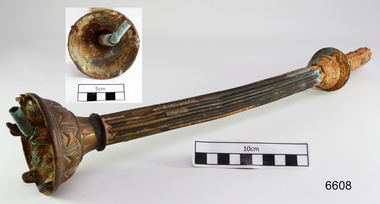 Flagstaff Hill Maritime Museum and Village
Functional object - Gas Fitting, Before 1878
... newspaper, flushed with civic pride. The 1850s Gold Rush promoted a similar attitude of confidence and affluence in the Colony of Victoria. In 1855 Melbourne...newspaper, flushed with civic pride. The 1850s Gold Rush promoted a similar attitude of confidence and affluence in the Colony of Victoria. In 1855 Melbourne ...The artefact is a short cross-section of part of a functional part of a brass fitting that suspended a gas lamp, providing structural support, and internally, supplying the gas for its ignition. It combines elegant design with the elements required for safe and efficient delivery of gas. It was recovered from the LOCH ARD shipwreck site. There are similar artefacts in the Flagstaff Hill collection. The LOCH ARD left Gravesend (London) on 2 March 1878, bound for Melbourne, with a crew of 37, 17 passengers, and a diverse and valuable cargo of manufactured goods, luxury items, and refined metal. Some of the cargo was intended for Melbourne’s first International Exhibition to be held in 1880. At 3 am, 1 June 1878, the ship was wrecked against the high limestone cliffs of Mutton Bird Island on Victoria’s south west coast near Port Campbell. Only two people survived the disaster — Tom Pearce, a male crew member, and Eva Carmichael, a female passenger. The cargo proved too difficult to salvage in the vessel’s exposed condition and was largely written off. The manifest of goods in the LOCH ARD’s holds included “Fittings gas (4 cases)”. The gas lighting of streets, public buildings, and the dwellings of wealthier private citizens, was already well advanced in the cities and major towns of the Australian colonies. In 1841 Sydney was the first to be gas lit with 23 street lamps, 106 hotel lamps, and 200 private residences connected to the Darlinghurst “gasometer” by an underground network of metal pipes. “The dim days of oil and tallow are gone by!” pronounced one newspaper, flushed with civic pride. The 1850s Gold Rush promoted a similar attitude of confidence and affluence in the Colony of Victoria. In 1855 Melbourne was connected to its own system of subterranean gas pipes despite the same high rates of 25 shillings per 1000 cubic feet being charged, (reduced to 15 shillings in 1865 with cheaper sources of coal). By1858 Kyneton had its own gasworks to light the town (fuelled by eucalyptus leaves) and Geelong followed suit in 1860. Had the LOCH ARD reached its intended destination in 1878, it is probable that the 4 cases of brass gas light fittings on board would have found a ready market.The gas fitting is significant for its association with the LOCH ARD shipwreck, which is of State significance and is listed on the Victorian Heritage Register S417. The fitting is an example of a late 19th-century plumbing and light fitting.A pressed brass gas light fitting, recovered from the wreck of the LOCH ARD. The elegant and functional fitting extends from an ornate 8cm diameter ceiling flange, and comprises two short lengths of fluted column pipe with a brass joiner that are severed (cut off) at the end. Within this decorative outer layer of 3cm diameter is a full length brass tube liner, which is in turn protecting a narrow 0.75cm copper gas pipe that also runs full length. The artefact is generally unrestored with reddish/cream sandstone concretion, but is in good condition.warrnambool, shipwreck coast, flagstaff hill, shipwrecked coast, flagstaff hill maritime village, flagstaff hill maritime museum, shipwreck artefact, maritime museum, gas lamps, gas lighting, gas works, brass fittings, gas pipes, loch ard, 1878 shipwreck, victorian affluence, colonial gas lighting -
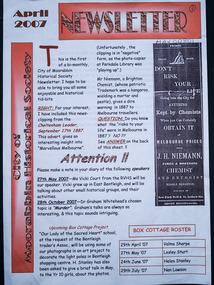 City of Moorabbin Historical Society (Operating the Box Cottage Museum)
Newsletter - City of Moorabbin Historical Society Apr 2007, April 2007 1st Issue, April 2007
... melbourne...moorabbin...brighton...cheltenham...ormond...bentleigh...cheltenham leader newspaper...The Newslletter is an important record of the activities of CMHS city of moorabbin historical society sheehy tom a le page e a stretton j a clark doug stanley helen court vicki whitehead graham neimann j a chemists pharmacy druggists melbourne moorabbin brighton cheltenham ormond bentleigh cheltenham leader newspaper sharpe valma sturt lesley lawson nan featherstone guy the colonial child box cottage museum battlers tamed a sandbelt moorabbin roads board steel plateway market gardeners pioneers early settlers moorabbin shire CITY of MOORABBIN HISTORICAL SOCIETY / APRIL 2007 NEWSLETTER A4 paper printed both sides x1 This is the first of the bi-monthly, City of Moorabbin Historical Society Newsletter produced by Society member and Secretary, Mrs Helen Stanley in April 2007. ...The City of Moorabbin Historical Society was formed c 1960 by a group of Moorabbin area residents who were concerned that the history of the area should be preserved. The approaching Centenary of the area as a Municipality in 1962 , - formation of the Moorabbin Roads Board 1862, - encouraged interest in the ‘History of Moorabbin’ and the Mayor Doug Clark was persuaded to call a public meeting for the formation of an Historical Society. Thirty citizens attended this meeting in November 1960 at which Mr Latham , Royal Historical Association, encouraged them to do so. Mr Tom .A. Sheehy, Author of ‘Battlers tamed a Sandbelt - Moorabbin 50 years a City ‘, moved for the formation of the ‘City of Moorabbin Historical Society’, and was seconded by Councillor E A Le Page. A vote was taken among attendees and Mr Tom A Sheehy was elected Foundation President, Cr E A Le Page Vice President, Mr J A Stretton Secretary and they and the other members “ began a programme of research in order to have reliable information available in time for the Centenary.” p148 Following a call for donations of items of Historical interest, the residents of the City of Moorabbin donated a wide variety of artefacts, photographs, household goods, farm machinery, letters, documents, clothing, and personal effects which have been carefully preserved by succeeding CMHS members and are displayed at Box Cottage Museum. Helen Stanley has produced a bi-monthly Newsletter, 2007 - 2013, for the members of the City of Moorabbin Historical Society that contains well researched interesting historical items, notification of upcoming events, current advice from Royal Australian Historical Society , Museums Australia Victoria and activities of Local Historical Societies. The Newslletter is an important record of the activities of CMHSA4 paper printed both sides x1 This is the first of the bi-monthly, City of Moorabbin Historical Society Newsletter produced by Society member and Secretary, Mrs Helen Stanley in April 2007. An introductory paragraph is followed by notification of upcoming meeting in May 27th 2007 at which Ms Vicki Court, RVHS, will talk about small historical groups and on 28th October 2007 Dr Graham Whitehead, City of Kingston Historian, will discuss ‘Murder’ in Moorabbin Shire. A photocopy of an advertisement, in the ‘Cheltenham Leader’ September 17th 1887, by Chemist J.H.Niemann , of Middle Brighton.. On the reverse side of the Newsletter Helen provides quotes from a Box Cottage Museum library book “ The Colonial Child” describing ‘larrikins’ in the streets of Melbourne c1880 and the damage to roadways caused by the heavily laden horse-drawn lorries. A roster of members is given for attendance at Box Cottage monthly open daysCITY of MOORABBIN HISTORICAL SOCIETY / APRIL 2007 NEWSLETTERcity of moorabbin historical society, sheehy tom a, le page e a, stretton j a, clark doug, stanley helen, court vicki, whitehead graham, neimann j a, chemists, pharmacy, druggists, melbourne, moorabbin, brighton, cheltenham, ormond, bentleigh, cheltenham leader newspaper, sharpe valma, sturt lesley, lawson nan, featherstone guy, the colonial child, box cottage museum, battlers tamed a sandbelt, moorabbin roads board, steel plateway, market gardeners, pioneers, early settlers, moorabbin shire -
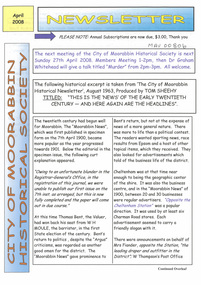 City of Moorabbin Historical Society (Operating the Box Cottage Museum)
Newsletter, City of Moorabbin Historical Society Apr 2008, April 2008
... melbourne...moorabbin...brighton...chelsea...cheltenham...ormond...bentleigh...market gardeners...pioneers...early settlers...moorabbin shire...sheehy tom...whitehead dr graham...box cottage museum...highett...bent thomas...moorabbin news cheltenham...epsom race course cheltenham...victoria...fletcher n...fiander mrs....puttick george...moorabbin co-operative society ltd....hay h....freeman j.w....montanjees m....royal oak hotel...rose m.a....matthews j.t....hewett h....cope and dow builders...market gardeners and fruit-growers association...proudman e.w....benjamin m.e....edwards t.a....solicitors...pharmacy...butchers...bootmakers...bakers...hairdressers...barbers...house painters...grocers...publicans...drapers...craftsmen...members of parliament...valuers...moule w.h....argus newspaper...Tom Sheehy, past President of CMHS, was an Historian and Author of ‘Battlers Tamed the Sandbelt’. city of moorabbin historical society stanley helen melbourne moorabbin brighton chelsea cheltenham ormond bentleigh market gardeners pioneers early settlers moorabbin shire sheehy tom whitehead dr graham box cottage museum highett bent thomas moorabbin news cheltenham epsom race course cheltenham victoria fletcher n fiander mrs. puttick george moorabbin co-operative society ltd. hay h. freeman j.w. montanjees m. royal oak hotel rose m.a. matthews j.t. hewett h. cope and dow builders market gardeners and fruit-growers association proudman e.w. benjamin m.e. edwards t.a. solicitors pharmacy butchers bootmakers bakers hairdressers barbers house painters grocers publicans drapers craftsmen members of parliament valuers moule w.h. argus newspaper coachbuilders cheltenham railway station victoria thompson w. post office CITY of MOORABBIN HISTORICAL SOCIETY / APRIL 2008 NEWSLETTER A4 paper printed both sides x1. ...The City of Moorabbin Historical Society was formed c 1960 by a group of Moorabbin residents who were concerned that the history of the area should be preserved. A good response to a call for items related to the historical area of Moorabbin Shire brought donations of a wide variety of artefacts which are now preserved by the current members of CMHS at Box Cottage Museum . Helen Stanley, Secretary of CMHS, began producing a Newsletter for members in April 2007 to provide current information and well researched items of historical interest.Helen Stanley has produced a bi-monthly Newsletter, 2007 - 2013, for the members of the City of Moorabbin Historical Society that contains well researched interesting historical items, notification of upcoming events, current advice from Royal Australian Historical Society , Museums Australia Victoria and activities of Local Historical Societies. The Newsletter is an important record of the activities of the CMHS. Tom Sheehy, past President of CMHS, was an Historian and Author of ‘Battlers Tamed the Sandbelt’. A4 paper printed both sides x1. Issue 6 of the bi-monthly, City of Moorabbin Historical Society Newsletter produced by Society member and Secretary, Mrs Helen Stanley in April 2008. Notice of Dr G Whitehead talk , titled ‘Murder” on April 27th and Subscription fees due. Another excerpt from the CMHS August 1963,, by Tom Sheehy, President, ‘This is the News of the early twentieth century…’.The ‘Moorabbin News “ began in April 1900. Tommy Bent was elected to State Parliament, horse races at Epsom Course Cheltenham, and the development of Cheltenham as many businesses set up ‘opposite the Station’. ‘The Mechanics Institute and Temperance Hall and the Exchange Hotel faced one another in defiance’ CITY of MOORABBIN HISTORICAL SOCIETY / APRIL 2008 NEWSLETTERcity of moorabbin historical society, stanley helen, melbourne, moorabbin, brighton, chelsea, cheltenham, ormond, bentleigh, market gardeners, pioneers, early settlers, moorabbin shire, sheehy tom, whitehead dr graham, box cottage museum, highett, bent thomas, moorabbin news cheltenham, epsom race course cheltenham, victoria, fletcher n, fiander mrs., puttick george, moorabbin co-operative society ltd., hay h., freeman j.w., montanjees m., royal oak hotel, rose m.a., matthews j.t., hewett h., cope and dow builders, market gardeners and fruit-growers association, proudman e.w., benjamin m.e., edwards t.a., solicitors, pharmacy, butchers, bootmakers, bakers, hairdressers, barbers, house painters, grocers, publicans, drapers, craftsmen, members of parliament, valuers, moule w.h., argus newspaper, coachbuilders, cheltenham railway station victoria, thompson w., post office -
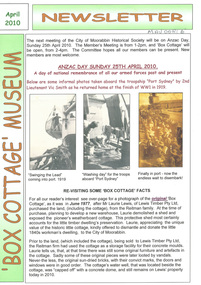 City of Moorabbin Historical Society (Operating the Box Cottage Museum)
Newsletter, City of Moorabbin Historical Society Apr 2010 pdf, April 2010
... The Newsletter is an important record of the activities of the CMHS Local newspaper reports about the ‘discovery’ of Box Cottage’ 1977 city of moorabbin historical society stanley helen lewis laurie lewis grace lewis timber pty. ltd. melbourne moorabbin cheltenham ormond bentleigh market gardeners pioneers early settlers moorabbin shire box cottage museum smith vic ss port sydney world war one 1914 – 1918 soldiers aif reitman j. box john box william dendy henry bullock drays moorabbin roads board 1862 dendy’s special survey 1841 mclean n box henry joyce park ormond city of moorabbin CITY of MOORABBIN HISTORICAL SOCIETY / APRIL 2010 NEWSLETTER 3 x A4 paper printed on 1 side Issue 16 of the bi-monthly, City of Moorabbin Historical Society Newsletter produced by Society member and Secretary, Mrs Helen Stanley in April 2010.. ...The City of Moorabbin Historical Society was formed c 1960 by a group of Moorabbin residents who were concerned that the history of the area should be preserved. A good response to a call for items related to the historical area of Moorabbin Shire brought donations of a wide variety of artefacts which are now preserved by the current members of CMHS at Box Cottage Museum . Helen Stanley, Secretary of CMHS, began producing a Newsletter for members in April 2007 to provide current information and well researched items of historical interest. Helen Stanley has produced a bi-monthly Newsletter, 2007 - 2013, for the members of the City of Moorabbin Historical Society that contains well researched interesting historical items, notification of upcoming events, current advice from Royal Australian Historical Society , Museums Australia Victoria and activities of Local Historical Societies. The Newsletter is an important record of the activities of the CMHS Local newspaper reports about the ‘discovery’ of Box Cottage’ 1977 3 x A4 paper printed on 1 side Issue 16 of the bi-monthly, City of Moorabbin Historical Society Newsletter produced by Society member and Secretary, Mrs Helen Stanley in April 2010.. Notice for the meeting on Anzac Day, Sunday 25th , 3 photocopied photographs taken by 2nd Lieutenant Vic Smith aboard the troopship “Port Sydney” coming home from WW1 in 1919. An article ‘Re-visiting some ‘Box Cottage’ Facts recounts the discovery of the ‘Cottage’ in a shed on the property purchased by Mr Laurie Lewis from the Reitman family in 1977. Thankfully Mr Lewis appreciated such a find and donated it to the City of Moorabbin, and together it was dismantled and re-constructed in Joyce Park, Ormond in 1988 – 100 yards from the original site. Excerpts from 3 articles in ‘The Moorabbin Standard’ and ‘Chadstone Progress’ Newspapers 1977 describing the newly discovered early settler cottage on the Lewis Timber Pty Ltd property in Jasper Road, Ormond. A photocopied photograph of the ‘Box Cottage’ June 1977 when used as a storage facility. CITY of MOORABBIN HISTORICAL SOCIETY / APRIL 2010 NEWSLETTERcity of moorabbin historical society, stanley helen, lewis laurie, lewis grace, lewis timber pty. ltd., melbourne, moorabbin, cheltenham, ormond, bentleigh, market gardeners, pioneers, early settlers, moorabbin shire, box cottage museum, smith vic, ss port sydney, world war one 1914 – 1918, soldiers, aif, reitman j., box john, box william, dendy henry, bullock drays, moorabbin roads board 1862, dendy’s special survey 1841, mclean n, box henry, joyce park ormond, city of moorabbin -
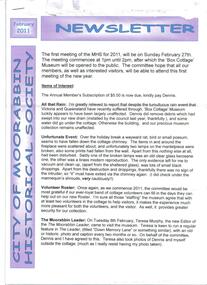 City of Moorabbin Historical Society (Operating the Box Cottage Museum)
Newsletter, City of Moorabbin Historical Society Feb 2011, February 2011
... melbourne...moorabbin...brighton...cheltenham...ormond...bentleigh...mckinnon...market gardeners...pioneers...early settlers...moorabbin shire...box cottage museum...city of moorabbin...box william...glen eira historical society...the moorabbin leader newspaper...The puzzle around the naming of the suburb McKinnon tells the story of Daniel, Donald and Laughlin MacKinnon. city of moorabbin historical society stanley helen mackinnon daniel mackinnon donald mackinnon laughlin melbourne moorabbin brighton cheltenham ormond bentleigh mckinnon market gardeners pioneers early settlers moorabbin shire box cottage museum city of moorabbin box william glen eira historical society the moorabbin leader newspaper murphy teresa the argus newspaper CITY of MOORABBIN HISTORICAL SOCIETY / FEBRUARY 2011 NEWSLETTER 5 x A4 paper printed on 1 side Issue 20 of the bi-monthly, City of Moorabbin Historical Society Newsletter produced by Society member and Secretary, Mrs Helen Stanley in February 2011. ...The City of Moorabbin Historical Society was formed c 1960 by a group of Moorabbin residents who were concerned that the history of the area should be preserved. A good response to a call for items related to the historical area of Moorabbin Shire brought donations of a wide variety of artefacts which are now preserved by the current members of CMHS at Box Cottage Museum . Helen Stanley, Secretary of CMHS, began producing a Newsletter for members in April 2007 to provide current information and well researched items of historical interestHelen Stanley has produced a bi-monthly Newsletter, 2007 - 2013, for the members of the City of Moorabbin Historical Society that contains well researched interesting historical items, notification of upcoming events, current advice from Royal Australian Historical Society , Museums Australia Victoria and activities of Local Historical Societies. The Newsletter is an important record of the activities of the CMHS and this month Celebrates the 50th Anniversary of CMHS. The puzzle around the naming of the suburb McKinnon tells the story of Daniel, Donald and Laughlin MacKinnon. 5 x A4 paper printed on 1 side Issue 20 of the bi-monthly, City of Moorabbin Historical Society Newsletter produced by Society member and Secretary, Mrs Helen Stanley in February 2011. Notice for meeting February 27th and the Subscription $5 is due. Despite the recent heavy rain the Cottage and grounds were unaffected, however an possum / rat appears to have entered the Cottage via the Chimney and caused the breakage of 2 glass kerosene lamps that were on the mantelpiece and lots of droppings before escaping. Teresa Murphy, editor of ‘The Moorabbin Leader’ Newspaper, visited Box Cottage and discussed a proposed regular feature ‘Down Memory Lane’. Volunteers are requested for Open Days, and are reminded of the Visitors’ Book, Children’s Treasure Hunt Cards and the Volunteer Hours Record. Accompanying it is the Story of Daniel MacKinnon b Glasgow arrived Port Phillip 1839 died 1889, his son Donald MacKinnon b 1859 Terang, Victoria – 1932 and Laughlan MacKinnon b1817 Isle of Skye -1888 no relation to eitherCITY of MOORABBIN HISTORICAL SOCIETY / FEBRUARY 2011 NEWSLETTER city of moorabbin historical society, stanley helen, mackinnon daniel, mackinnon donald, mackinnon laughlin, melbourne, moorabbin, brighton, cheltenham, ormond, bentleigh, mckinnon, market gardeners, pioneers, early settlers, moorabbin shire, box cottage museum, city of moorabbin, box william, glen eira historical society, the moorabbin leader newspaper, murphy teresa, the argus newspaper
