
Showing 3573 items matching "japanese"
-
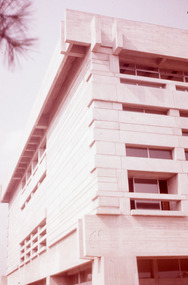 Robin Boyd Foundation
Slide, Robin Boyd, 1961
... Robin Boyd wrote two books on Japanese architects and architecture - “Kenzo Tange” published by George Braziller in 1962 and “New Directions in Japanese Architecture” published by Studio Vista in 1968. ...Kurashiki Town Hall (1960), Kurashiki, Japan. (Architect: Kenzo Tange.)...Robin Boyd wrote two books on Japanese architects and architecture - “Kenzo Tange” published by George Braziller in 1962 and “New Directions in Japanese Architecture” published by Studio Vista in 1968. ...Robin Boyd wrote two books on Japanese architects and architecture - “Kenzo Tange” published by George Braziller in 1962 and “New Directions in Japanese Architecture” published by Studio Vista in 1968. During the 1960s he travelled several times to Japan to research these books and as part of his role as Exhibits Architect for the Australian Pavilion at Expo ‘70 in Osaka.Colour slide in a mount. Kurashiki Town Hall (1960), Kurashiki, Japan. (Architect: Kenzo Tange.)Made in Australia / Inscribed 21 / Encircled 28 (Handwritten)slide, robin boyd -
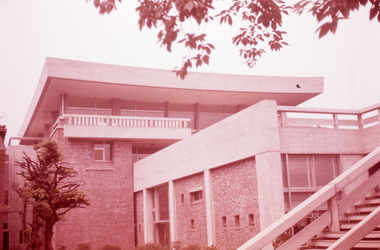 Robin Boyd Foundation
Slide, Robin Boyd, 1961
... Japan...Robin Boyd wrote two books on Japanese architects and architecture - “Kenzo Tange” published by George Braziller in 1962 and “New Directions in Japanese Architecture” published by Studio Vista in 1968. ...Rikkyo University Library, 1960, Tokyo, Japan. (Architect: Kenzo Tange.)...Robin Boyd wrote two books on Japanese architects and architecture - “Kenzo Tange” published by George Braziller in 1962 and “New Directions in Japanese Architecture” published by Studio Vista in 1968. ...Robin Boyd wrote two books on Japanese architects and architecture - “Kenzo Tange” published by George Braziller in 1962 and “New Directions in Japanese Architecture” published by Studio Vista in 1968. During the 1960s he travelled several times to Japan to research these books and as part of his role as Exhibits Architect for the Australian Pavilion at Expo ‘70 in Osaka.Colour slide in a mount. Rikkyo University Library, 1960, Tokyo, Japan. (Architect: Kenzo Tange.)Made in Australia / 11 / 7 (Handwritten)japan, slide -
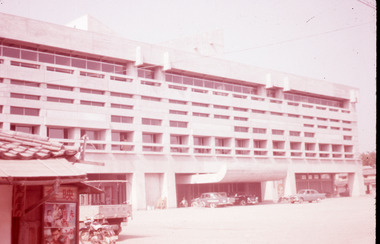 Robin Boyd Foundation
Slide, Robin Boyd, 1961
... Japan...Robin Boyd wrote two books on Japanese architects and architecture - “Kenzo Tange” published by George Braziller in 1962 and “New Directions in Japanese Architecture” published by Studio Vista in 1968. ...Kurashiki Town Hall (1960), Kurashiki, Japan. (Architect: Kenzo Tange.)...Japan slide Made in Australia / 20 Colour slide in a mount. ...Robin Boyd wrote two books on Japanese architects and architecture - “Kenzo Tange” published by George Braziller in 1962 and “New Directions in Japanese Architecture” published by Studio Vista in 1968. During the 1960s he travelled several times to Japan to research these books and as part of his role as Exhibits Architect for the Australian Pavilion at Expo ‘70 in Osaka.Colour slide in a mount. Kurashiki Town Hall (1960), Kurashiki, Japan. (Architect: Kenzo Tange.)Made in Australia / 20japan, slide -
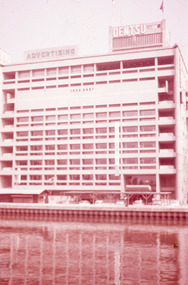 Robin Boyd Foundation
Slide, Robin Boyd, 1961
... Japan...Robin Boyd wrote two books on Japanese architects and architecture - “Kenzo Tange” published by George Braziller in 1962 and “New Directions in Japanese Architecture” published by Studio Vista in 1968. ...Dentsu Osaka Branch, Osaka, Japan, 1960. (Architect: Kenzo Tange.)...Robin Boyd wrote two books on Japanese architects and architecture - “Kenzo Tange” published by George Braziller in 1962 and “New Directions in Japanese Architecture” published by Studio Vista in 1968. ...Robin Boyd wrote two books on Japanese architects and architecture - “Kenzo Tange” published by George Braziller in 1962 and “New Directions in Japanese Architecture” published by Studio Vista in 1968. During the 1960s he travelled several times to Japan to research these books and as part of his role as Exhibits Architect for the Australian Pavilion at Expo ‘70 in Osaka.Colour slide in a mount. Dentsu Osaka Branch, Osaka, Japan, 1960. (Architect: Kenzo Tange.)Made in Australia / 6 / 8 (Handwritten)japan, slide -
 Bendigo Military Museum
Banner - BCOF BANNERS, FRAMED, c1946 - Frame 2022
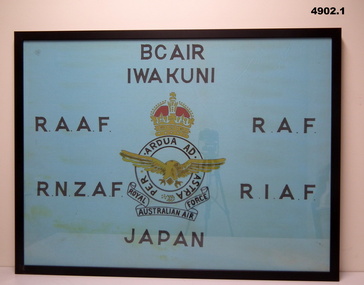
... ...Japan..."I.W.A. KUNI" - City in Japan. 2. " B.C.O.F." - Japan 1946-48. British Commonwealth Occupation Forces (Japan)....SHIPS/ B.C.O.F./ AUSTRALIA - JAPAN/1946-1948"..."I.W.A. KUNI" - City in Japan. 2. " B.C.O.F." - Japan 1946-48. British Commonwealth Occupation Forces (Japan). ...1. "I.W.A. KUNI" - City in Japan. 2. " B.C.O.F." - Japan 1946-48. British Commonwealth Occupation Forces (Japan).1. Banner - framed cotton fabric, light blue background with screen printing in black colour letters and centre unit insignia black, yellow and red colours. 2. Banner - framed cotton fabric, white background with screen printing in black colour letters and centre unit insignia red, yellow and blue colours. 1. & 2. Frames - timber, black colour paint, glass front, timber housing.Screen printing - black ink. 1. "BCAIR/IWA KUNI/ R.A.A.F./R.A.F./ R.N.2.A.F./R.I.A.F./JAPAN " Unit insignia 'ROYAL AUSTRALIAN AIR FORCE' 2. " R.A.N./H.M.A. SHIPS/ B.C.O.F./ AUSTRALIA - JAPAN/1946-1948"military, ww2, japan, banners -
 Tatura Irrigation & Wartime Camps Museum
Book, Unwanted Aliens, 1996
... Written as a record of japanese Internees in Australia during WW2...Photograph of a group of Japanese on the cover. English text...Photograph of a group of Japanese on the cover. English text Unwanted Aliens Book ...Written as a record of japanese Internees in Australia during WW2Black and white soft covered book. Photograph of a group of Japanese on the cover. English textjapenese internees in ww2, camp 4 -
4th/19th Prince of Wales's Light Horse Regiment Unit History Room
Booklet, Sands & McDougall Pty Ltd, Tropical Warfare (Aust), 1945
... ...Japanese...Soft covered booklet providing junior commanders with practical methods of fighting the Japanese in the tropics - covering subjects such as vegetation, hygiene & sanitation, tactics and jungle craft etc...World War 2 jungle training Japanese Pamphlet No 2 1945 Soft covered booklet providing junior commanders with practical methods of fighting the Japanese in the tropics - covering subjects such as vegetation, hygiene & sanitation, tactics and jungle craft etc Tropical Warfare (Aust) Booklet Sands & McDougall Pty Ltd ...Soft covered booklet providing junior commanders with practical methods of fighting the Japanese in the tropics - covering subjects such as vegetation, hygiene & sanitation, tactics and jungle craft etcPamphlet No 2 1945world war 2, jungle training, japanese -
 Seaworks Maritime Museum
Plaque
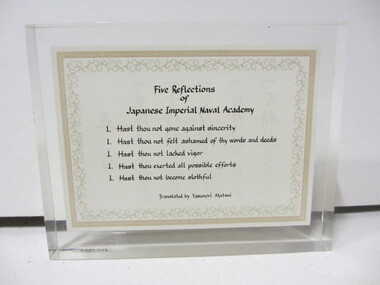
... clear block with paper inside with Japanese writing on one side and English translation on reverse ..."Five Reflections/ of / Japanese Imperial Naval Academy / 1. Hast thou not gone against sincerity / 1. ..."Five Reflections/ of / Japanese Imperial Naval Academy / 1. Hast thou not gone against sincerity / 1. ...clear block with paper inside with Japanese writing on one side and English translation on reverse "Five Reflections/ of / Japanese Imperial Naval Academy / 1. Hast thou not gone against sincerity / 1. Hast thou not felt ashamed by thy words and deeds/ 1. Hast thou not lacked in vigor / 1. Hast thou exerted all possible efforts / 1. Hast thou not become slothful/ translated by Yasunori Matsui" Reverse side has same text in japanese "PMA 0233" -
 Bendigo Military Museum
Souvenir - CHRISTMAS CARD, JAPANESE, BCOF ERA, Unknown
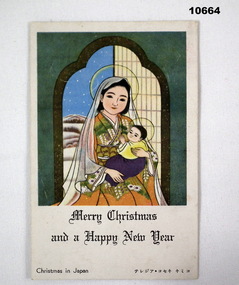
... ...Japan...Christmas and New Year card collected by Alva Bennetts during her BCOF deployment (1947-1949) in Japan. Part of the Bennetts collection. See Cat No. 9726P for details of service for Alva Marie Bennetts (VFX128835)....Illustration features a Madonna and child with Japanese features. Black text below illustration is in both English and Japanese....Japan...Souvenir CHRISTMAS CARD, JAPANESE, BCOF ERA ...Christmas and New Year card collected by Alva Bennetts during her BCOF deployment (1947-1949) in Japan. Part of the Bennetts collection. See Cat No. 9726P for details of service for Alva Marie Bennetts (VFX128835).Single sided Christmas Card with colour illustration. Illustration features a Madonna and child with Japanese features. Black text below illustration is in both English and Japanese.souvenir, alva bennetts, bennetts collection, bcof, japan, christmas -
 Robin Boyd Foundation
Slide, Robin Boyd, 1961
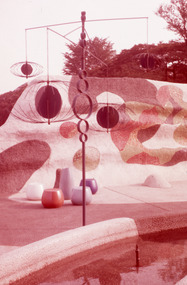
... Robin Boyd wrote two books on Japanese architects and architecture - “Kenzo Tange” published by George Braziller in 1962 and “New Directions in Japanese Architecture” published by Studio Vista in 1968. ...Garden at Sogetsu Artistic Center, Tokyo, Japan. (Architect: Isamu Noguchi.). ...Robin Boyd wrote two books on Japanese architects and architecture - “Kenzo Tange” published by George Braziller in 1962 and “New Directions in Japanese Architecture” published by Studio Vista in 1968. ...The Sogetsu Artistic Center was designed by Kenzo Tange. Robin Boyd wrote two books on Japanese architects and architecture - “Kenzo Tange” published by George Braziller in 1962 and “New Directions in Japanese Architecture” published by Studio Vista in 1968. During the 1960s he travelled several times to Japan to research these books and as part of his role as Exhibits Architect for the Australian Pavilion at Expo ‘70 in Osaka. Colour slide in a mount. Garden at Sogetsu Artistic Center, Tokyo, Japan. (Architect: Isamu Noguchi.). Made in Australia / 17 / 1tokyo, slide -
Tatura Irrigation & Wartime Camps Museum
Picture - Silk, 1940's
... A crayon drawing done by a Japanese POW...Beige coloured parachute silk on which is drawn and coloured a Japanese lady dressed in a pink kimono, holding a mauve and pink umbrella. ...A crayon drawing done by a Japanese POW picture silk print wallace i camp 4 tatura ww2 camp 4 illustrations prints Beige coloured parachute silk on which is drawn and coloured a Japanese lady dressed in a pink kimono, holding a mauve and pink umbrella. ...A crayon drawing done by a Japanese POWBeige coloured parachute silk on which is drawn and coloured a Japanese lady dressed in a pink kimono, holding a mauve and pink umbrella. A snow covered mountain on the left and a weeping tree and light on the right. Japanese characters bottom right, grasses bottom leftpicture, silk print, wallace i, camp 4, tatura, ww2 camp 4, illustrations, prints -
 Dandenong/Cranbourne RSL Sub Branch
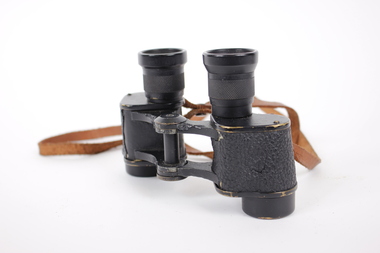
Equipment - Japanese Officer Binoculars, c.1938- 1944
... Japanese...These Binoculars appear to belong to a Japanese Officer in WWII....Japan...These Binoculars appear to belong to a Japanese Officer in WWII. Japanese Binoculars WW11 "6X9.3" on right hand side of binocularsNo 89385 J.ES" Black small binoculars with brown leather strap Equipment Japanese Officer Binoculars ...These Binoculars appear to belong to a Japanese Officer in WWII.Black small binoculars with brown leather strap"6X9.3" on right hand side of binocularsNo 89385 J.ES"japanese, binoculars ww11 -
 Robin Boyd Foundation
Slide, Robin Boyd, 1961
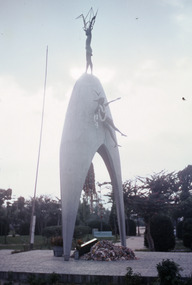
... Robin Boyd wrote two books on Japanese architects and architecture - “Kenzo Tange” published by George Braziller in 1962 and “New Directions in Japanese Architecture” published by Studio Vista in 1968. ...Children's Peace Monument, Hiroshima, Japan. (Architects: Kazuo Kikuchi and Kiyoshi Ikebe.)...Robin Boyd wrote two books on Japanese architects and architecture - “Kenzo Tange” published by George Braziller in 1962 and “New Directions in Japanese Architecture” published by Studio Vista in 1968. ...Robin Boyd wrote two books on Japanese architects and architecture - “Kenzo Tange” published by George Braziller in 1962 and “New Directions in Japanese Architecture” published by Studio Vista in 1968. During the 1960s he travelled several times to Japan to research these books and as part of his role as Exhibits Architect for the Australian Pavilion at Expo ‘70 in Osaka.Colour slide in a mount. Children's Peace Monument, Hiroshima, Japan. (Architects: Kazuo Kikuchi and Kiyoshi Ikebe.)13slide, robin boyd -
 Robin Boyd Foundation
Slide, Robin Boyd, 1961
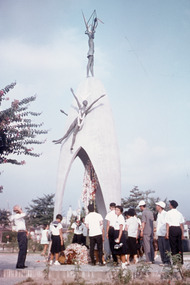
... Japan...Robin Boyd wrote two books on Japanese architects and architecture - “Kenzo Tange” published by George Braziller in 1962 and “New Directions in Japanese Architecture” published by Studio Vista in 1968. ...Children's Peace Monument, Hiroshima, Japan. (Architects: Kazuo Kikuchi and Kiyoshi Ikebe.)...Japan slide 9 / 12 (Handwritten) Colour slide in a mount. ...Robin Boyd wrote two books on Japanese architects and architecture - “Kenzo Tange” published by George Braziller in 1962 and “New Directions in Japanese Architecture” published by Studio Vista in 1968. During the 1960s he travelled several times to Japan to research these books and as part of his role as Exhibits Architect for the Australian Pavilion at Expo ‘70 in Osaka.Colour slide in a mount. Children's Peace Monument, Hiroshima, Japan. (Architects: Kazuo Kikuchi and Kiyoshi Ikebe.)9 / 12 (Handwritten)japan, slide -
 Robin Boyd Foundation
Slide, Robin Boyd, 1961
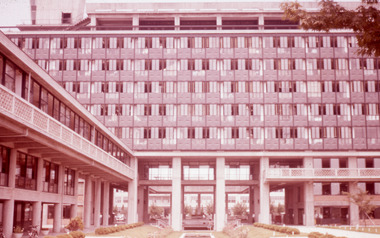
... ...japan...Robin Boyd wrote two books on Japanese architects and architecture - “Kenzo Tange” published by George Braziller in 1962 and “New Directions in Japanese Architecture” published by Studio Vista in 1968. ...Okayama Prefectural Government Building, Okayama, Japan, 1957 (Architect: Kunio Maekawa.)...Robin Boyd wrote two books on Japanese architects and architecture - “Kenzo Tange” published by George Braziller in 1962 and “New Directions in Japanese Architecture” published by Studio Vista in 1968. ...Robin Boyd wrote two books on Japanese architects and architecture - “Kenzo Tange” published by George Braziller in 1962 and “New Directions in Japanese Architecture” published by Studio Vista in 1968. During the 1960s he travelled several times to Japan to research these books and as part of his role as Exhibits Architect for the Australian Pavilion at Expo ‘70 in Osaka. Colour slide in a mount. Okayama Prefectural Government Building, Okayama, Japan, 1957 (Architect: Kunio Maekawa.)Made in Australia / 3 (Handwritten) robin boyd, slide, japan -
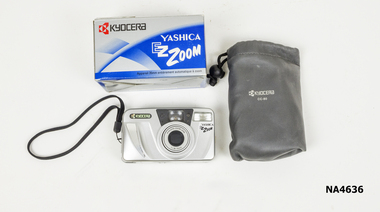 Whitehorse Historical Society Inc.
Equipment - Camera, circa. 2000
... Serial No. 310415 made in China by Kyocera Corp. Japan CE Grey vinyl pouch - Kyocera CC80 as printed on pouch. ...Kyocera Corp. Japan 310415 CE...Serial No. 310415 made in China by Kyocera Corp. Japan CE Grey vinyl pouch - Kyocera CC80 as printed on pouch. ...Judith Fry's son gave this camera to Judith as a birthday gift. He acquired it through school when he was teaching media studies at Rowville Secondary College. Judith was a past president of the Whitehorse Historical Society.Silver coloured Yashica E2 zoom camera by Kyocera as new with film still enclosed, zoom lens f 3.8 - 70mm. Serial No. 310415 made in China by Kyocera Corp. Japan CE Grey vinyl pouch - Kyocera CC80 as printed on pouch. Camera cardboard box - Kyocera - Yashica E2 200m zoom on box.Kyocera Corp. Japan 310415 CEphotography, cameras -
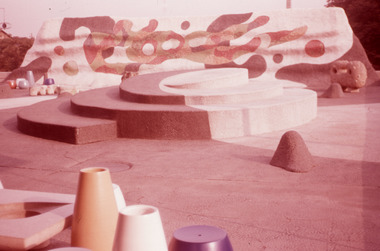 Robin Boyd Foundation
Slide, Robin Boyd, 1961
... Robin Boyd wrote two books on Japanese architects and architecture - “Kenzo Tange” published by George Braziller in 1962 and “New Directions in Japanese Architecture” published by Studio Vista in 1968. ...Garden at Sogetsu Art Center (1958), Tokyo, Japan...Robin Boyd wrote two books on Japanese architects and architecture - “Kenzo Tange” published by George Braziller in 1962 and “New Directions in Japanese Architecture” published by Studio Vista in 1968. ...Robin Boyd wrote two books on Japanese architects and architecture - “Kenzo Tange” published by George Braziller in 1962 and “New Directions in Japanese Architecture” published by Studio Vista in 1968. During the 1960s he travelled several times to Japan to research these books and as part of his role as Exhibits Architect for the Australian Pavilion at Expo ‘70 in Osaka. The Sogetsu Art Center (1958) was also known as the Sogetsu Hall and Office. Boyd called it the Sogetsu Art Center in his book “Kenzo Tange”, where it is extensively illustrated (Plates 77-82).Colour slide in a mount. Garden at Sogetsu Art Center (1958), Tokyo, JapanMade in Australia / 16tokyo, slide -
Tatura Irrigation & Wartime Camps Museum
Photo album
... Japanese internees...Red cover with oval to display photo.. In this case 5 Japanese parents and 7 youngsters standing in front of a hut....Japanese internees japanese internees WW2 internees POW's Red cover with oval to display photo.. ...Japanese interneesRed cover with oval to display photo.. In this case 5 Japanese parents and 7 youngsters standing in front of a hut.WW2 internees POW'sjapanese internees -
Tatura Irrigation & Wartime Camps Museum
Book, Christine Piper, After Darkness, 2014
... Fiction, Japanese doctor working in Broome, sent to Camp Loveday as an internee...Colourful cover, depicting Japanese lanterns floating in ocean....Colourful cover, depicting Japanese lanterns floating in ocean. After Darkness Book Christine Piper Aiien & Unwin ...Fiction, Japanese doctor working in Broome, sent to Camp Loveday as an interneeRectangular shape, 295 pages. Colourful cover, depicting Japanese lanterns floating in ocean.Winner, The Australian/Vogel's Literary Award. A "thank you" entry from the authoress Christine Piper, to "Bill" for his help in researching and being shown the remnants of the internment camp that she and Jim Sullivan were able to view. fiction, internment camp loveday, world war ii -
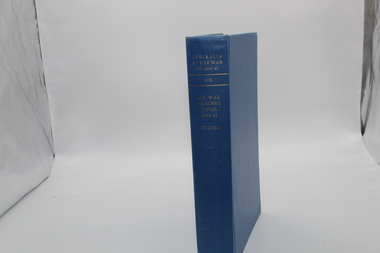 Lara RSL Sub Branch
Book, Australia in the War of 1939-1945 - Air War Against Japan 1943-1945 AIR Author George Odgers, First Published in 1957
... Australia in the War of 1939-1945 - Air War Against Japan 1943-1945 AIR Author George Odgers ......japan...The history of the Royal Australian Air Force in WWII beginning with the first offensive against Japan and ends with the return of the RAAF to Australia after the surrender of the Japanese Forces....Australia in the War of 1939-1945 - Air War Against Japan 1943-1945 AIR Maps, Illustrations, Photographs, ...The history of the Royal Australian Air Force in WWII beginning with the first offensive against Japan and ends with the return of the RAAF to Australia after the surrender of the Japanese Forces. raaf 1943-1945 japan pacific war phillipines burma minelaying mindoro catalinas anti-submarine tarakan labuan rabaul new guinea Australian War Memorial Australia in the War of 1939-1945 - Air War Against Japan 1943-1945 AIR Maps, Illustrations, Photographs, Australia in the War of 1939-1945 - Air War Against Japan 1943-1945 AIR Author George Odgers Book ...The history of the Royal Australian Air Force in WWII beginning with the first offensive against Japan and ends with the return of the RAAF to Australia after the surrender of the Japanese Forces.Australia in the War of 1939-1945 - Air War Against Japan 1943-1945 AIR Maps, Illustrations, Photographs, Australian War Memorialraaf, 1943-1945, japan, pacific war, phillipines, burma, minelaying, mindoro, catalinas, anti-submarine, tarakan, labuan, rabaul, new guinea -
 8th/13th Victorian Mounted Rifles Regimental Collection
Weapon - Japanese sword
... Japan...Swords were a common item of equipment of Japanese officers and soldiers in WWII. ...Japanese Samuari Sword with 70mm hand guard with wooden handle wrapped with red and white and brown tape - blade length 700mm. ...Common souvenir brought back by returning servicemen from the Southwest Pacific area following the Japanese surrender. Weapon Japanese sword ...Swords were a common item of equipment of Japanese officers and soldiers in WWII. Representative of souvenirs brought back following the end of WWII.Japanese Samuari Sword with 70mm hand guard with wooden handle wrapped with red and white and brown tape - blade length 700mm. Common souvenir brought back by returning servicemen from the Southwest Pacific area following the Japanese surrender.japan, samurai, sword, wwii, world war two -
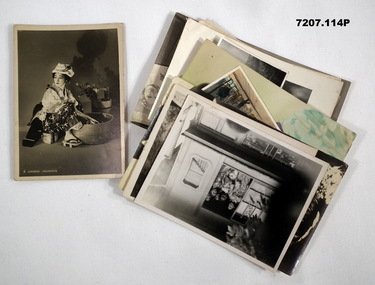 Bendigo Military Museum
Photograph - PHOTOGRAPHS, BCOF, JAPAN, pre WW2 to 1947
... ...Japan...All photos are of general views, buildings, people, children and Japanese daily life. Four have inscriptions on. ...On front, "A Japanese Housewife". On rear, " Gisha Kure" "Dance hall girls" "Women and children Kure"...Photograph PHOTOGRAPHS, BCOF, JAPAN ...Items in the collection re Clarence Shearing, refer Cat No 7089.16P for his service details.Photographs B & W, colour various sizes, 4 are colour enhanced. All photos are of general views, buildings, people, children and Japanese daily life. Four have inscriptions on. On front, "A Japanese Housewife". On rear, " Gisha Kure" "Dance hall girls" "Women and children Kure"photographs, bcof, japan -
 Robin Boyd Foundation
Slide, Robin Boyd, 1961
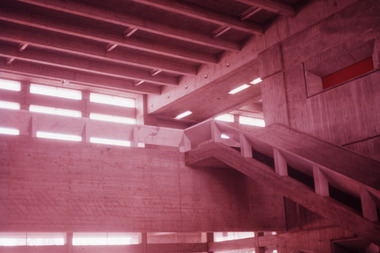
... Robin Boyd wrote two books on Japanese architects and architecture - “Kenzo Tange” published by George Braziller in 1962 and “New Directions in Japanese Architecture” published by Studio Vista in 1968. ...Interior staircase of Kurashiki Town Hall (1960), Kurashiki, Japan. (Architect: Kenzo Tange.)...Robin Boyd wrote two books on Japanese architects and architecture - “Kenzo Tange” published by George Braziller in 1962 and “New Directions in Japanese Architecture” published by Studio Vista in 1968. ...Robin Boyd wrote two books on Japanese architects and architecture - “Kenzo Tange” published by George Braziller in 1962 and “New Directions in Japanese Architecture” published by Studio Vista in 1968. During the 1960s he travelled several times to Japan to research these books and as part of his role as Exhibits Architect for the Australian Pavilion at Expo ‘70 in Osaka.Colour slide in a mount. Interior staircase of Kurashiki Town Hall (1960), Kurashiki, Japan. (Architect: Kenzo Tange.)Made in Australia / Inscribed 19 / Encircled 29 (Handwritten)japan research trip, slide -
 Robin Boyd Foundation
Slide, Robin Boyd, 1961
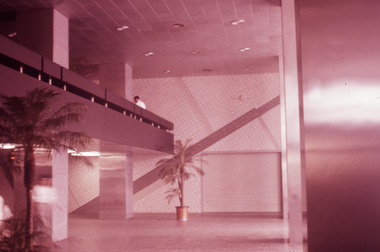
... ...japan...Robin Boyd wrote two books on Japanese architects and architecture - “Kenzo Tange” published by George Braziller in 1962 and “New Directions in Japanese Architecture” published by Studio Vista in 1968. ...Interior, Okayama Prefectural Government Building, Okayama, Japan, 1957 (Architect: Kunio Maekawa.) ...Robin Boyd wrote two books on Japanese architects and architecture - “Kenzo Tange” published by George Braziller in 1962 and “New Directions in Japanese Architecture” published by Studio Vista in 1968. ...Robin Boyd wrote two books on Japanese architects and architecture - “Kenzo Tange” published by George Braziller in 1962 and “New Directions in Japanese Architecture” published by Studio Vista in 1968. During the 1960s he travelled several times to Japan to research these books and as part of his role as Exhibits Architect for the Australian Pavilion at Expo ‘70 in Osaka. Colour slide in a mount. Interior, Okayama Prefectural Government Building, Okayama, Japan, 1957 (Architect: Kunio Maekawa.) Made in Australia / Inscribed 9slide, robin boyd, japan -
 Robin Boyd Foundation
Slide, Robin Boyd, 1961
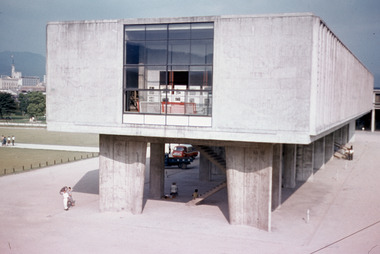
... Japan...Robin Boyd wrote two books on Japanese architects and architecture - “Kenzo Tange” published by George Braziller in 1962 and “New Directions in Japanese Architecture” published by Studio Vista in 1968. ...Hiroshima Peace Memorial Museum 1951-3, Hiroshima, Japan. (Architect: Kenzo Tange.)...Japan slide 3 Colour slide in a mount. Hiroshima Peace Memorial Museum 1951-3, Hiroshima, Japan. ...Robin Boyd wrote two books on Japanese architects and architecture - “Kenzo Tange” published by George Braziller in 1962 and “New Directions in Japanese Architecture” published by Studio Vista in 1968. During the 1960s he travelled several times to Japan to research these books and as part of his role as Exhibits Architect for the Australian Pavilion at Expo ‘70 in Osaka.Colour slide in a mount. Hiroshima Peace Memorial Museum 1951-3, Hiroshima, Japan. (Architect: Kenzo Tange.)3japan, slide -
 Robin Boyd Foundation
Slide, Robin Boyd, 1961
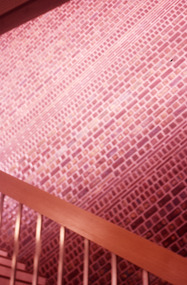
... Robin Boyd wrote two books on Japanese architects and architecture - “Kenzo Tange” published by George Braziller in 1962 and “New Directions in Japanese Architecture” published by Studio Vista in 1968. ...Interior (staircase and tiled walls), Okayama Prefectural Government Building, Okayama, Japan, 1957....Robin Boyd wrote two books on Japanese architects and architecture - “Kenzo Tange” published by George Braziller in 1962 and “New Directions in Japanese Architecture” published by Studio Vista in 1968. ...Robin Boyd wrote two books on Japanese architects and architecture - “Kenzo Tange” published by George Braziller in 1962 and “New Directions in Japanese Architecture” published by Studio Vista in 1968. During the 1960s he travelled several times to Japan to research these books and as part of his role as Exhibits Architect for the Australian Pavilion at Expo ‘70 in Osaka. Colour slide in a mount. Interior (staircase and tiled walls), Okayama Prefectural Government Building, Okayama, Japan, 1957.Made in Australia / Inscribed 9slide, robin boyd, unknownjapan61 -
 Robin Boyd Foundation
Slide, Robin Boyd, 1961
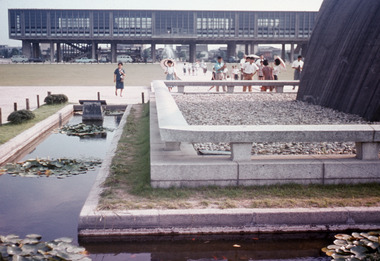
... Robin Boyd wrote two books on Japanese architects and architecture - “Kenzo Tange” published by George Braziller in 1962 and “New Directions in Japanese Architecture” published by Studio Vista in 1968. ...Hiroshima Peace Memorial Museum 1951-3, Hiroshima, Japan. (Architect: Kenzo Tange.)...Japan research trip slide 7 Colour slide in a mount. ...Robin Boyd wrote two books on Japanese architects and architecture - “Kenzo Tange” published by George Braziller in 1962 and “New Directions in Japanese Architecture” published by Studio Vista in 1968. During the 1960s he travelled several times to Japan to research these books and as part of his role as Exhibits Architect for the Australian Pavilion at Expo ‘70 in Osaka.Colour slide in a mount. Hiroshima Peace Memorial Museum 1951-3, Hiroshima, Japan. (Architect: Kenzo Tange.)7japan research trip, slide -
 Robin Boyd Foundation
Slide, Robin Boyd, 1961
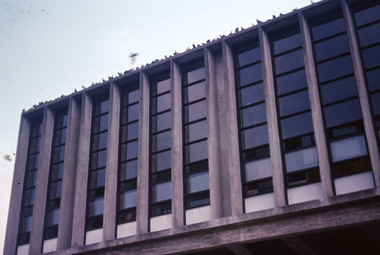
... Japan...Robin Boyd wrote two books on Japanese architects and architecture - “Kenzo Tange” published by George Braziller in 1962 and “New Directions in Japanese Architecture” published by Studio Vista in 1968. ...Hiroshima Peace Memorial Museum 1951-3, Hiroshima, Japan. (Architect: Kenzo Tange.)...Robin Boyd wrote two books on Japanese architects and architecture - “Kenzo Tange” published by George Braziller in 1962 and “New Directions in Japanese Architecture” published by Studio Vista in 1968. ...Robin Boyd wrote two books on Japanese architects and architecture - “Kenzo Tange” published by George Braziller in 1962 and “New Directions in Japanese Architecture” published by Studio Vista in 1968. During the 1960s he travelled several times to Japan to research these books and as part of his role as Exhibits Architect for the Australian Pavilion at Expo ‘70 in Osaka.Colour slide in a mount. Hiroshima Peace Memorial Museum 1951-3, Hiroshima, Japan. (Architect: Kenzo Tange.)12 / B (Handwritten) / Encircled 11 (Handwritten)japan, slide -
 Robin Boyd Foundation
Slide, Robin Boyd, 1961
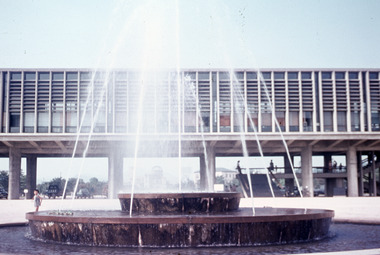
... Robin Boyd wrote two books on Japanese architects and architecture - “Kenzo Tange” published by George Braziller in 1962 and “New Directions in Japanese Architecture” published by Studio Vista in 1968. ...Hiroshima Peace Memorial Museum 1951-3, Hiroshima, Japan. (Architect: Kenzo Tange.)...Japan research trip slide 5 Colour slide in a mount. ...Robin Boyd wrote two books on Japanese architects and architecture - “Kenzo Tange” published by George Braziller in 1962 and “New Directions in Japanese Architecture” published by Studio Vista in 1968. During the 1960s he travelled several times to Japan to research these books and as part of his role as Exhibits Architect for the Australian Pavilion at Expo ‘70 in Osaka.Colour slide in a mount. Hiroshima Peace Memorial Museum 1951-3, Hiroshima, Japan. (Architect: Kenzo Tange.)5japan research trip, slide -
 Robin Boyd Foundation
Slide, Robin Boyd, 1961
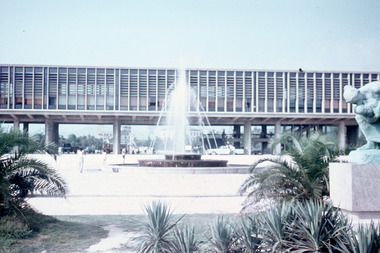
... Robin Boyd wrote two books on Japanese architects and architecture - “Kenzo Tange” published by George Braziller in 1962 and “New Directions in Japanese Architecture” published by Studio Vista in 1968. ...Hiroshima Peace Memorial Museum 1951-3, Hiroshima, Japan. (Architect: Kenzo Tange.)...Japan research trip slide 4 Colour slide in a mount. ...Robin Boyd wrote two books on Japanese architects and architecture - “Kenzo Tange” published by George Braziller in 1962 and “New Directions in Japanese Architecture” published by Studio Vista in 1968. During the 1960s he travelled several times to Japan to research these books and as part of his role as Exhibits Architect for the Australian Pavilion at Expo ‘70 in Osaka.Colour slide in a mount. Hiroshima Peace Memorial Museum 1951-3, Hiroshima, Japan. (Architect: Kenzo Tange.)4japan research trip, slide
