
Showing 700 items matching "spoke"
-
 Ballarat Heritage Services
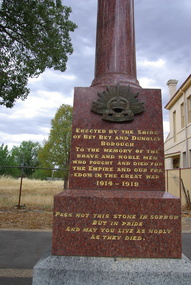
Photograph - War Memorial, Lisa Gervasoni, Dunolly War Memorial, 2025, 1921
... Groves and Pennington and local clergymen also spoke. The school children sang O God, Our Help in Ages Past, and a bugler sounded the Last Post after the unveiling. ...Groves and Pennington and local clergymen also spoke. The school children sang O God, Our Help in Ages Past, and a bugler sounded the Last Post after the unveiling. ...The Dunolly World War One Memorial Pillar, located in front of the Town Hall on Broadway Street, and was unveiled on November 18th 1921. The pillar is topped by an urn and rests on a square concrete plinth, which lists the names ninety-four locals who died serving during the First World War. On Friday afternoon the Premier, accompanied by Messrs. Pennington and Groves, M's.L.A., visited Dunolly, and unveiled a soldiers' memorial — a polished granite column on a square base, erected by the residents at a cost of £300. It bears the names of 94 district soldiers who were killed in action. The Premier, who is a native of Dunolly, referred to his early associations with the town and district. Speaking of the valiant service rendered by the Australian soldiers in the great war, he paid a tribute to those who enlisted from the country districts. He was not one of those who would withhold national memorials to the fallen because provision had not been made for all who had returned. It was right and proper to have these memorials as silent reminders of the great sacrifice made by the many as a lasting tribute to their memory. Messrs. Groves and Pennington and local clergymen also spoke. The school children sang O God, Our Help in Ages Past, and a bugler sounded the Last Post after the unveiling. The shire president entertained the visitors and committee at dinner. The Age (Melbourne), 19 November 1921. Colour photograph of the Dunolly War Memorial. Front Inscription "Erected by the Shire of Bet Bet and Dunolly Borough To the memory of the brave and noble men who fought and died for the Empire and our freedom in the Great War 1914 - 1918. Pass not this stone in sorrow but in pride, and may you live as nobly as they died." "Private L. Polinelli has written several letters to his mother at Dunolly, dated from from Tel el Kebir from January 13th till the 22nd. He had written every day or two, and this example, is a very fine one. He explains why there was an interval some weeks during which he sent no letters. This was just before the evacuation of Gallipoli, and no-one was permitted to send letters at such a critical time, as there were fears that carefully arranged plans might leak out in some way. Gallipoli had been evacuated on the 19th December, which happened to be Private Polinelli's 24th birthday, and he has cause, he says, to remember that birthday particularly, when this important movement, in which he participated, was so success-fully carried out. He was in the best of health. They had been on Lemnos Island for two weeks after leaving Galilipoli, and while there they got billeted and numerous gifts from Australia, which gave great delight. He (Private Polinelli) had got a big mail - 35 letters and a number of parcels. Both Norman Watson and himself were feeling well, although they had a pretty rough time at the front, but they were feeling better every day. Further letters speak of the arrival in Egypt and the Australian being encamped at Tel el Kebir, 40 miles from Cairo. He states that W. Lyndon had returned from England and was with them. He (W. Lyndon) looks splendid and had had a splendid time in England and Scotland. He saw Jack Lewis in England, and thinks he was to return to Australia. Reference is made to the Rev. Father Goidanich who was with their brigade, and who had been wounded at the front, but was all right again. Father Goidanich is well-known in this district. The letters were written in good spirits and many references were made to friends in Dunolly and district. A friend in Dunolly has received a letter from Private L. Polinelli, which is dated February 3rd, and written 'from the Arabian Desert.' This covers a vast extent of country, so that there is no use in speculating as to the locality, and portions of the letter which possibly would have given some indication have bean 'censored.' Private Polinelli wrote that Norman Watson and Himself were in the best of health and have stook the life well. They are right out of civilisation at time of writing. He referred to their Dtsojourns at Lemoos Island, where Christmas was spent, and where the billies and puddings assisted much in their enjoyment. But they were glad to leave Lemnos Island. After being in camp at Tel el E-bir for two weeks they were sent to where they were at the time of writing, all being in good xxxx and the open country suiting them well. He speaks with admiration of the desert work done by the camels so very largely used. The censoring was very strict so that he could not give much news. After alluding to the return to splendid health of W. Lyndon from England, he says he saw a lot of others from round Dunolly on returning to Egypt, including Tom Fishlock, R. Johnson, and J. Taylor, and some others from Betley, and all looked well. He had also seen Erie Williamson a few times, and he looked splendid. He concludes with remembrances to friends, and from himself and Norman Watson to the Loyal Prince Alfred Lodge." (Dunolly and Betbetshire Express and County of Gladstone Advertiser, Tue 14 Mar 1916) "SOLDIER'S LETTERS PRIVATE L. POLINELLI A friend in Dunolly has received another interesting letter from Private L Polinelli, son of Mrs J Davis, South Dunolly. It is from "Somewhere in France," and is dated July 23rd. He remarks with regret that a good deal of the soldiers' mail from Australia went down in the Arabia, and then goes on to say:- "Norman is back here with us again now and looking well. He had a splendid time over in England after he was able to get out of bed. It was two years on the 18th of this month (January) since Norman and I enlisted, and we celebrated the occasion by having a bit of an evening out. I am very pleased that he is back; we spend most of our time together. We are at present out of the line having a spell in a village, so we are not having a bad time just now but we will soon be going into the trenches again. I met Wally Bell a few days ago; they were going into the line to relieve our brigade. We did not have time to have a long talk. He looks rather thin, but he was always that way. He is feeling well, and wishes to be remembered to his friends in Dunolly. I also met C. Game the same day; he looked well but, as he was also going into the line, we could not have much of a talk J. Hughes and C. Atherton are also over here now; I often see them. W. Lyndon and T. Miles are well ; I was speaking to them yesterday. We are having very bad weather over here now ; it is either raining or snowing every day. The snow was about a fool deep a few days ago. When the rain comes after it, it makes things muddy, The mud is very bad over here; it takes us all our time to struggle through it in places. We will all be very glad when the winter is over. I was over in England on furlough last month, and had a splendid time. The people over there do all they can to give us a good time. I had several invitations to visit different people, and those that we did visit gave us a splendid time. At the place where I was staying they always had a guide waiting of a morning to show us any place of interest that we wanted to see. There was also always a supply of free tickets to the different theatres if we wanted them ; so you see that they go to some expense to give ns a good time. When they know yon are from France you are sure of a hearty welcome. was up in Scotland, and spent five days in Edinburgh. It is a very pretty place, especially when it is seen from Edinburgh Castle, which is on a high bill overlooking the place. We veil through the Castle; also Holyrood Palace. There are a lot of interesting things to be seen in the two places connected with the history of Scotland. It was snowing very heavily while v« were in Scotland, and we bad some fine snowballing with the Scotch people. I greatly enjoyed the trip to Scotland. It would take a very long time to see all round London. I saw a lot of the old historical places there, which were very interesting. The fogs are very bad in London. I had an experience of a London fog one day; it was the heaviest they experienced for a number of years. We could only see a few yards ahead of us. Nearly everyone carried torches; it looked very funny. . . . There are nearly always as many women drinking in the bars as men; it struck me as being very strange, a bit different to what we are used to in Australia, a trip through some parts of London is a real eye-opener to us. It is interesting to watch the traffic in some of the business parts of London it moves along in one big mass. It is a wonder that a lot more accidents do not happen. I saw Australia House, where the High Commissioner has his office, in the Strand. It is not yet finished. It looks a very fine place, and when completed will be 'some' place. Both Norman and I are well, and send remembrances to friends." (Since this letter was written we have had the sad news of the death from wounds of Privates Atherton and Hughes, and that Sergeant Miles and Corporal Norman Watson have been wounded.) (Dunolly and Betbetshire Express and County of Gladstone Advertiser , Friday 13 April 1917, page 2) "Private L Polinelli, from some of whose previous letters we have published interesting extracts, has written to a friend in Dunolly, the letter being from France, and dated April 28th. Private Polinelli says among other things, "I am pleased to say that, Norman (Watson), Les (Anderson) and myself are in the best of health. We now have been in France some time. It is a terrible place for rain ; It has been raining all the time we have been here. It has also been very cold, snowing at times, but it is starting to "fine up" now, and the last few days have been splendid. I hope it keeps like that for a while, as it makes things very miserable in the trenches when it is so wet. We get a few days spell out of the trenches every now and again; so things are not as bad here as they were at Gallipoli. It is not so lively here so far as it was over there either. I am sorry to say that Jack Sanderson, who had been Will Lyndon's mate since they joined the forces, got killed during a bombardment last night. He was terribly knocked about with a shell. I saw W. Lyndon to-day and he was telling me all about it. He seemed terribly cut up over it, and so am I, as I was with Jack a lot over at Gallipoli after Will got sent away sick. He was always bright and cheerful, always had a smile up whenever I met him. I feel very sad about it. We will do all we can to make the Germans pay for it. You will most likely know him, as be used to live in Dunolly before going to Bendigo. Will Lyndon had a narrow escape also, as he was not very far from where the shell burst. He escaped with a bit of a shock, otherwise he is in the best of health. We have a good time among the French people when we are out of the trenches. They do all they can to make us feel at home. I am getting quite expert at speaking French. They smile at us a treat trying to speak French, but we generally make ourselves understood and have a good time among them. It is very rarely we see a young Frenchman, they being all away fighting. The women do all the work on the farms themselves, and deserve every credit for it. . . . I was sorry to hear about the death of Nurse M'Mahon; she was a grand old nurse. I heard that her daughter Nelly was nurse in a hospital on Lemnos Island, and when we were there I went to two of the hospitals to try to see her, but she did not happen to be at either, and I had no time to visit any of the others, so I did not see her. I was also sorry to hear about Mrs Rokahr, as she has left so many little ones behind. (Reference is made to other happenings in Dunolly.) So far I am pleased to say Norman and I have had the luck not to have had a day's illness; I think we are very fortunate, as such a lot get sent to the hospital ill. We are also lucky to have escaped the bullets and shells so far. I hope that luck sticks to us. I am sorry that, owing to the censorship, I cannot give you any interesting news of our trip over to France and the places we have seen. I will have to keep that till I get back to Dunolly again. . . . I have just heard that the battalion that Teddy Game is in has arrived, so I am going to look him up first chance I get." (The letter concludes with remembrances to members of the Lodge and other friends.) (Dunolly and Betbetshire Express and County of Gladstone Advertiser, Tuesday 13 June 1916, page 3) "PRIVATE L POLINELLI Another very interesting letter has been received by a friend in Dunolly from Private L. Polinelli, from France dated May 4th, 1916- Private Polinelli says-" I was glad that you got the letter I wrote from the Arabian Desert. The Censor must have crossed a good deal of it out. They seem to cross out a lot more than is really necessary. We left out there all of a sudden, and in a very short while found ourselves over here. It does not take them very long to make a move. I was saying in the last letter that I was going to try and find " Teddy " Game. I met him a few days ago and had a good yarn with him; he looks real well. I also met S. Prew, and "Ted" Smyth and his son Ernie. They all looked splendid, and are in the same battalion. "Ted" Smyth sticks to it well, and looks better than he ever looked. They will be under fire for the first time in a few days. S. Prew was hit in the landing at Gallipoli, but be is quite well now. W. Smythe, who is in our brigade is well ; I see him very often. " Les " Peart is not with us now; he has joined a Pioneer battalion, and I have not seen him since he joined it. I gave all the Dunolly boys your best wishes and they all wish to be remembered to you— also the same remembrance from Dave Millar, who used to play football for Dunolly from Moliagul. He is in our battalion, having come over with reinforcements. I see him every day and he wished to be remembered to you. A brother of Mr A. J. Williamson, manager of the Bank of Victoria, Dunolly, is also in this battalion. He is a great friend of mine ; we often have a talk about Dunolly. He was not well a little while ago, having to go into a hospital, but is all right again and is back with me. Eric Williamson, son of Mr A. J. Williamson is over here ; Norman (Watson) saw him a few days ago and said he looked well. Norman has been a corporal for some time. I was also offered stripes lately, but preferred to remain a private. There is a lot of worry and running about when you are an N.C.O., so I think I will remain as I am. ... So football is about done this season. I don't think they should cut it right out. I suppose some of them have to stay at home, so they ought to have some amusement. I would very much like to have a game, but I think I would just about forget how to play now. It is very amusing for us to read some of the soldiers letters in the Australian papers. . . l told you in the last letter about xxx young "Jack "Sanderson ; I was terribly sorry about him." Private Polinelli mentions in a letter to his sister in Dunolly that he happened to be beach at Gallipoli where the late Lord Kitchener was xxxxx addressed the' soldiers and' xxxxxx to them the message from the King. Private Polinelli states that he was very proud to have been one of those addressed by the great man. He and Norman Watson have never been a day out of the lines since arriving first in Egypt. It is intended to grant special leave to all those who have been kept so close to their posts xxx three months, and they are looking forward to this relaxation with keen anticipation, hoping to visit England and Scotland. (Dunolly and Betbetshire Express and County of Gladstone Advertiser, Tue 27 Jun 1916) "SOLDIER'S LETTERS. CORPORAL L. POLINELLI. Two letters have been received by Mrs J. Davis, South Dunolly, from her son, Corporal L. Polinelli, both written subsequent to the time when he was wounded, as reported when word was received at the time. Corporal Polinelli writes from No. 12 General Hospital, Rouen, France, and his first letter is dated 7th May. He stated that he was in hospital, he having been wounded in the arm and shoulder on 3rd May. He continued— " It is not a bad wound, and will not take long to heal up, as it is a clean wound. I was very lucky to get out of the fight alive, as I was buried by a shell explosion about an hour before I was wounded. It was very rough, and the noise of all the shells was terrible. Four men were killed by the same shell that wounded me, so I was fortunate. I am feeling a bit " shook up," and my head is aching from the concussion of the shells, but after a few days' spell in bed here I will be feeling just the thing again. So you need not worry about me ; a week or two will see me quite right again. We are having very nice warm weather just now-pleasant change after all the bad weather we have had." The second letter is dated May 12, Corporal Polinelli saying— "I am getting along splendidly ; the wound is healing up fast, so it will not be very long before I am quite right. The doc-tor, the other day said it would be better not to take the piece of shell out of my shoulder yet, and that it would not interfere with me in any way ; so perhaps l will always carry it about with me. He feared lest taking it out at that time would interfere with an artery. Rouen, where the hospital is, is a very pretty city. They give us leave to visit all the places when we are well enough. It is a nice spell here, away from the firing line. We have nothing to trouble us at all, so I will soon be just the thing again. When I got buried by a shell it shook me up a good deal. I felt it far more than the wound I got after; but it has not done me any harm, as I feel hardly any effects now. My good luck sticks to me in getting out of it so lightly. I hope you are not worrying at all about me, as I am all right. We are having beautiful weather over here— sunny days just like the Australian spring. . . . The sisters in the hospital are very nice, and treat us well. They have a lot of work to do, as a good few men have been wounded lately. I would have liked to have been sent over to England, but they are not sending many over there now. They treat as many as they can in France on account of attacks on hospital ships. I would have been able to have a good time with Norman (Watson) had l got over. He was just about all right when I heard from him last." Corporal Polinelli sends kind remembrances to friends." (Dunolly and Betbetshire Express and County of Gladstone Advertiser, Friday 6 July 1917, page 2) "SOLDIERS' LETTERS. CORPORAL L. POLINELLI. The following letter, dated from London on December 27; has been received by a friend in Dunolly from Corporal L. Polinelli (son of Mrs J. Davis, South Donolly), who, at the time of writing, after long and hard service at the front, was on furlough in England. After an introduction he says:— I am having a very good time. I went over to Ireland for five days, spending the most of the time in Dublin. I like the place very much. War appearances are not so conspicuous in Ireland as in England. The hotels are open all day, and a good meal can be obtained anywhere, which is more than can be got in England. The war seems to be making things very bad in England. It is very hard to get a good meal in London ; everything is so restricted. The only way to get a good meal is to go into two places. The people have to line up outside the shops for hours to get sugar, tea, and butter, and then they sometimes fail to get any. So many of our boats getting sunk is the cause of it. If things continue to go on in this way I am afraid that there is a very hard time in store for the people in England. Several people that I have spoken to say that they are just beginning to feel the pinch now. I was in London while an air raid was on a few days ago; it caused a lot of excitement among the people. Ten were killed and 70 wounded in the raid. I was about half a mile from where the bombs fell, so I was pretty right. I thought I had left the war behind in France, but it seems to be on over here at times also. I spent Christmas day with a family at Grantham, a town between London and Newcastle; they were very nice people. I had a very enjoyable time with them. I went to a dance in the evening and enjoyed it very much. It was a bit strange for a start, as it is the first dance I have been to since Norman and I had the send off at Dunolly in January, 1915. They do the dances a bit different over here to what they are done in Australia, and that made it worse still. I went through Guinness's Brewery while I was in Dublin. It is a wonderful place, and covers 55 acres of ground. I got a great surprise when I was starting on my leave in France. We were taken to the station we had to start from in a motor lorry, and who should the driver of the lorry be but Syd. Richards (son of Mr W. Richards, South Dunolly), who used to work at the Post Office in Dunolly. I rode on the front with him, so we had a good yarn. I did not know that be had joined, so was surprised to see him. He has grown a lot since I saw him last, and is looking well. Norman and Bill Lyndon were both well when I left France. We had been having a good spell near Messines, in Flanders, but they will be in the trenches by now. We have been round about Ypres for this last four months, and had some pretty rough times there. dunolly, dunolly war memorial, l. polinelli, bet bet, world war one, world war two, j. deledio, b. battilana, c. fitzgerald, f.s. kendall, j.h. hogan, p. zampatti, louisa davis, louisa gervasoni, bill lyndon, norman lyndon, sydney lindsay -
 City of Greater Bendigo - Civic Collection
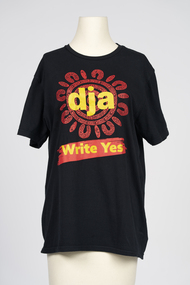
Textile - Referendum T shirt, Yes, 2023
... Cr Margaret O’Rourke introduced the motion and spoke at length about the importance for Council to adopt the recommendation. ...Cr Margaret O’Rourke introduced the motion and spoke at length about the importance for Council to adopt the recommendation. ...On the 14th of October 2023, Australians were asked to vote on a proposal to change the wording in the constitution 'To recognise the First Peoples of Australia by establishing an Aboriginal and Torres Strait Islander Voice.’ Only 39.9 per cent of legal votes were in favour of this change, and there was not a majority in any of the six Australian States (there was a majority, however, in the Australian Capital Territory). On the 26th June, 2023 Councillors with the The City of Greater Bendigo discussed their position on The Voice to Parliament and decided to support the Yes campaign while pledging to provide information on both sides of the debate to residents. Cr Margaret O’Rourke introduced the motion and spoke at length about the importance for Council to adopt the recommendation. 'Recognising the Aboriginal and Torres Strait Islander voice in the constitution ensures that Indigenous Australians have a direct and meaningful role in shaping policies and laws that impact them'. Several Councillor's voiced their concern over whether the City could formally support one side of the debate, while seeking to provide neutral information saying that it did not pass the commonsense test. This t shirt was worn by Jess Bridgfoot Director of the Bendigo Art Gallery at an event to support the referendum campaign and Linda Burney's visit to Bendigo on the 23rd September 2023. Linda Burney who was at that time Minister for Indigenous Australians addressed the crowd at this event which took place adjacent to the Bendigo sign at Rosalind Park. Black cotton tee shirt with "dja" printed in yellow in centre over a red indigenous circular design. "Write Yes" is printed in yellow on red below. city of greater bendigo reconcilliation, dja dja wurrung -
 Port Melbourne Historical & Preservation Society
Film - Video Recording - Digital, I Wish I Had Been There, 28 Jul 2020
... Digital video recording of PMHPS meeting held via Zoom on 28 July 2020. Eight members spoke on the theme “I Wish I Had Been There …” Margaret BRIDE wishes she had there when Wilbraham LIARDET had ridden up and down Bay Street proclaiming the separation of Victoria from New South Wales. ...Margaret BRIDE Wilbraham Frederick Evelyn LIARDET WFE LIARDET Separation John MAY Port Melbourne Football Club Williamstown Football Club Sue LEONG Knight's Transport David RADCLIFFE HMS Hood HMS Repulse Beris CAMPBELL Archibald (Arch) TODD Gary SMART Local Government - Municipal District of Sandridge Court House Helen BARRY Lex JOHNSTON Coburg Football Club Celebrations Fetes and Exhibitions Digital video recording of PMHPS meeting held via Zoom on 28 July 2020. Eight members spoke on the theme “I Wish I Had Been There …” Margaret BRIDE wishes she had there when Wilbraham LIARDET had ridden up and down Bay Street proclaiming the separation of Victoria from New South Wales. ...The Port Melbourne Historical and Preservation made history on the 28 July 2020 when, because of the COVID-19 pandemic, we hosted our first meeting via Zoom.Digital video recording of PMHPS meeting held via Zoom on 28 July 2020. Eight members spoke on the theme “I Wish I Had Been There …” Margaret BRIDE wishes she had there when Wilbraham LIARDET had ridden up and down Bay Street proclaiming the separation of Victoria from New South Wales. John MAY wishes he was there in 1937 when Port Melbourne and Williamstown Football Clubs swapped players. Sue LEONG wishes she was there in July, 1901 in front of the building where she now lives but previously was a stables and carrier’s business. David RADCLIFFE wishes he was there in March, 1924 when the HMS Hood and the HMS Repulse arrived in Port Melbourne. Beris CAMPBELL wishes she was there in 1974 at Arch TODD's Mayoral Ball at Port Melbourne Town Hall. Garry SMART wishes he was there for the Sandridge Council meeting held at the newly built court house on 23 August 1860. Helen BARRY wishes she was there at the Graham Street railway gates where her grandfather proposed to her grandmother. Lex JOHNSON wishes he was there on the last Saturday in August, 1946 when Port Melbourne took on Coburg at North Port Oval.margaret bride, wilbraham frederick evelyn liardet, wfe liardet, separation, john may, port melbourne football club, williamstown football club, sue leong, knight's transport, david radcliffe, hms hood, hms repulse, beris campbell, archibald (arch) todd, gary smart, local government - municipal district of sandridge, court house, helen barry, lex johnston, coburg football club, celebrations fetes and exhibitions -
 National Wool Museum
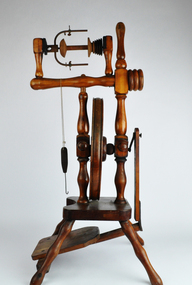
Tool - Spinning Wheel, c.1980
... The wheel has 8 small spokes which meet a thick outside rim. The outside rim has four golden disc weights on the bottom edge, to aid in the turning of the wheel. ...The wheel has 8 small spokes which meet a thick outside rim. The outside rim has four golden disc weights on the bottom edge, to aid in the turning of the wheel. ...This spinning wheel originates from New Zealand; however, it has no distinguishing features relating to its creator such as an inscription, so its exact maker is not known. Gill Stange remembers buying the wheel on Bridge Road in Richmond, approximately 30 years ago. Gill had joined her local Spinners and Weavers Guild after the Ash Wednesday bushfires of 1983. She was a then resident of Mount Macedon and lost everything in the fires. Moving to Melbourne to get away from the scene of much pain, Gill was also in need of a new hobby to help occupy her mind. That is when spinning and weaving entered her life. The local Spinners and Weavers Guild was a great support network for her and with their recommendation, she purchased her own spinning wheel. Her passion was started, and the wheel was to become a treasured item in Gill’s home. She had several spinning wheels within her possession over the years, however, this wheel was her first and always her favourite. When the time came for Gill to downsize, there was simply no longer room for her spinning wheel. This is when she decided to donate the wheel to the National Wool Museum. Gill remembers one highlight was weaving a tablecloth from a traditional German design. It took her two years to complete, with Gill spinning all the wool herself on this wheel. The tablecloth won the first prize in the Melbourne Show in 1987. Gill also used the wheel to teach programs to school children on how to spin and knit wool. She would take the easily transported little wheel, and its accompanying seat, with her to schools. Its small size enabled her to teach children to knit and spin, bringing others the joy that spinning had brought her. Not just limited to schools, Gill also taught programs with the wheel here at the National Wool Museum. It is a fitting home for the wheel, which Gill donated to the National Wool Museum in 2021.Dark varnished wood in a Castle style spinning wheel. The wheel has 8 small spokes which meet a thick outside rim. The outside rim has four golden disc weights on the bottom edge, to aid in the turning of the wheel. The spinning wheel has four legs of turned wood giving a sculptural form, a design pattern which is continued throughout. The wheel has a single medium sized foot pedal. This pedal is well worn with varnish missing from years of use. The wheel is completed with its accompanying chair. Made of the same dark varnished wood, its legs are also of turned wood, continuing the design pattern and uniting the two objects. The chair is very simple outside of the legs, with a medium size base and a thin backrest ending in a rounded head. The chair’s varnish is also starting to fade from years of use. The chair is small, designed to keep the spinning wheel operator at the appropriate height when spinning on the equally small and compact Castle style spinning wheel. Additional parts were donated with the Spinning Wheel. - 3 x Lazy Kates - Spare Maiden. - 450mm Niddy Noddy - Steel teeth brushspinning wool, spinning wheel, ash wednesday, mount macedon, textile production -
 Flagstaff Hill Maritime Museum and Village
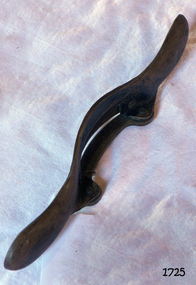
Tool - Spokeshave, Sides & Skinner, First half of the 20th century
... A spokeshave is a hand tool used to shape and smooth woods in woodworking jobs such as making cart wheel spokes, chair legs, paddles, bows, and arrows. ...A spokeshave is a hand tool used to shape and smooth woods in woodworking jobs such as making cart wheel spokes, chair legs, paddles, bows, and arrows. ...A spokeshave is a hand tool used to shape and smooth woods in woodworking jobs such as making cart wheel spokes, chair legs, paddles, bows, and arrows. The tool consists of a blade fixed into the body of the tool, which has a handle for each hand. Historically, a spokeshave was made with a wooden body and metal cutting blade. With industrialization metal bodies displaced wood in mass-produced tools. Being a small tool, spokeshaves are not suited to working large surfaces. The name spokeshave dates back to at least the 16th century, though the early history of the tool is not well documented. The name spokeshave reflects the early use of the tool by wheelwrights. The first spokeshaves were made of wood usually beech with steel blades, before being largely superseded by the development of metal-bodied spokeshaves in the latter half of the 19th century, though many woodworkers still use wooden spokeshaves. Due to their widespread use and versatility vintage wooden spokeshaves remain commonly available and relatively low in price. Spokeshaves consist of a blade or iron secured to the body or stock of the tool, which has two handles one for each hand. The bottom surface of the tool is called the sole. The blade can be removed for sharpening, and adjusted to vary the depth of the cut. An early design consisted of a metal blade with a pair of tangs to which the wooden handles were attached, as with a draw knife. Unlike a draw knife, but like a plane, spokeshaves typically have a sole plate that fixes the angle of the blade relative to the surface being worked. There are a wide variety of different types of spokeshave, suited to different trades and applications. A now vintage tool made by an Australian manufacture in NSW who specialised in making pruning shears, hacksaw frames and heel shaves under the Erskin brand name. This tool is now sought after by collectors even though it was probably made in the first quarter of the 20th century. It gives a snapshot of how carpenters work with wood by hand showcasing their craftsmanship. Hollow face Spokeshave, metal body with black enamel finish. Erskin stamped on frontflagstaff hill, warrnambool, flagstaff-hill, flagstaff-hill-maritime-museum, maritime-museum, shipwreck-coast, flagstaff-hill-maritime-village, spokeshave, cabinet makers tools, wood working, cutting tool, shaping tool -
 Ballarat and District Irish Association
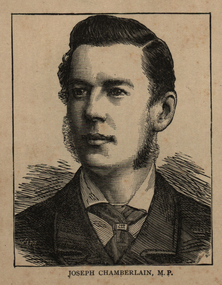
Image, Joseph Chamberlain, 1864
... Chamberlain often spoke about education in parliament. (Wikipedia)...Chamberlain often spoke about education in parliament. (Wikipedia) Ballarat Irish Chamberlain Joseph Chamberlain Image of a man called Joseph Chamberlain. ...Joseph Chamberlain was was an important businessman and a politician. He worked to improve education, and cities. He was a Member of Parliament from 1876 to 1914, and Colonial Secretary (controlling British colonies) from 1895 to 1903. His son Austen won the Nobel Peace Prize and another son Neville was Prime Minister from 1937 to 1940. (Wikipedia) Chamberlain was a Unitarian, a Christian who believes Christ was an example of the way to live life, but was not divine (not a part of God). Unitarians try to work to help society. There were many problems in Birmingham after the industrial revolution, and many men were not allowed to vote. In 1868 Chamberlain helped a liberal man to become the Member of Parliament for Birmingham. In 1869, he started a group working for free primary education for all children. In November 1869, he became a member of Birmingham City Council. There he worked for cheaper land prices for rural (countryside) workers, and became very popular. In 1873 he became the Mayor of Birmingham. He bought the gas companies and water companies for the city, so people were able to have clean and safe water. He made parks, roads, schools museums and built new houses for poor people. In June 1876 he became the Member of Parliament (MP) for Birmingham. In parliament he worked to unite radical M.P.s (MPs that wanted change) against the Whig party who were in power. His work helped William Ewart Gladstone to become Prime Minister in 1880. Chamberlain often spoke about education in parliament. (Wikipedia)Image of a man called Joseph Chamberlain.ballarat irish, chamberlain, joseph chamberlain -
 Ballarat Heritage Services
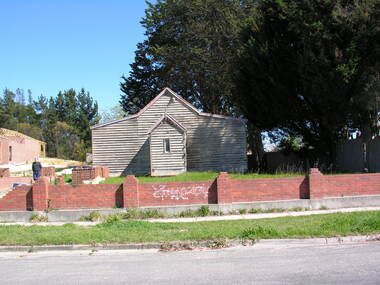
Photograph - church, Former Joseph Street Paton Memorial Presbyterian Church, Canadian, 2008, 26 /04/2008
... The Mayor (Cr Levy) spoke in terms of praise of the lads who had enlisted to fight for right against might and the tyranny of Prussian militarism. ...The Mayor (Cr Levy) spoke in terms of praise of the lads who had enlisted to fight for right against might and the tyranny of Prussian militarism. ...The Jubilee of this church was held in 1933. "Paton Memorial Presbyterian Church. BALLARAT, Sunday Jubilee celebrations of the Paton Memorial Presbyterian Church were well attended in the week end. A basket picnic on Saturday at Eureka Stockade reserve was followed at night by a social gathering, at which a birthday cake was cut by Mrs. Amor, a foundation member. On Sunday special services were led by Rev. J. A. Moscript, assisted by the young men of St. John's Church. The church was originally founded, by the late Mrs. J. P. Murray to mission to the needs of the busy mining community which existed in Canadian in early years." (The Age, 06 November 1933.) PATON MEMORIAL CHURCH - An interesting tree-planting ceremony was performed in the grounds of the Paton Memorial Church on Saturday lost. Trees were put in by the scholars of the Sunday school to commemorate the enlistment of all the boys who had in any way been connected with the church. Sunday school, and Young Men's Club. The Mayor (Cr Levy) spoke in terms of praise of the lads who had enlisted to fight for right against might and the tyranny of Prussian militarism. The Hon. R. McGregor MLA., and the Revs. A. H. Moore and W. Rowlands were among those present. on also Mesdames J. P. Murray and McGowan, two of the founders of the church. During the afternoon Cr Levy planted a tree in honor of Mrs Murray. Afternoon tea was served by the ladies of the congregation. (The Age, 06 November 1933.) This church was in the middle of a Chinese neighbourhood, and the 1800s the leprosarium was in the vicinity. This bhurch was demolished not long after this photo was taken. Colour photograph of a weatherboard church in Joseph Street, Canadian. In 1937 this church was under the control of St. John's Peel-street, Ballarat. Members of the congregation: * Mrs. Amor - A foundation member. * Thomas Clarke and Isabella Clarke (formerly Ross) lived next door and according to family members "had a lot to do with the church". * Mrs McGowan - a founder of the church * Mrs. J. P. Murray founded the church to mission to the needs of the busy mining community which existed in Canadian in early years. joseph street ballarat, joseph street canadian, former joseph street paton memorial presbyterian church, ballarat, church, weatherboard church, presbyterian church, paton memorial church, clayton hill, claytons hill, leprosarium, chinese -
 Eltham District Historical Society Inc
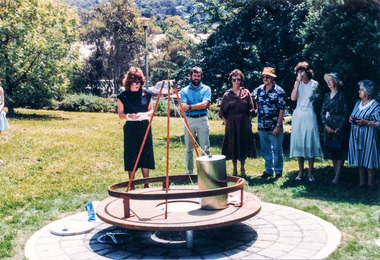
Photograph, Time Capsule Ceremony, 10 November 1985, 10/11/1985
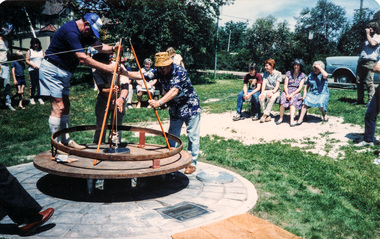
... A clamp placed on the naff (hub) and screwed down tightly kept the spokes at a constant angle as the tyre cooled. ...A clamp placed on the naff (hub) and screwed down tightly kept the spokes at a constant angle as the tyre cooled. ...On Sunday, 10 November 1985 a time capsule was lowered into a monument installed near the corner of Main Road and Pitt Street in Eltham, within the gardens at the front of what is now the Eltham Community and Reception Centre. This monument commemorates Victoria’s 150th anniversary and the former location of the Eltham Town Centre, which existed along this section of Main Road, then known as Maria Street. Beneath the site is a time capsule to be opened in the year 2035. A plaque was also erected at this site in October 1987 to commemorate the Shire of Eltham Historical Society’s 20th anniversary. The main feature of this monument is a ‘tyring disc’, a blacksmith’s implement that was found on this site. This consists of a large iron disc that was used as a platform for fitting iron tyres (like the one shown on top of the platform) to wooden-spoked cart wheels. The local blacksmith and wheelwright worked together to assemble the wheel, which was clamped to the platform placed close to the fire. The red-hot iron hoop, previously forged to the correct size, was lifted with tongs by the blacksmith over the outside of the rim, then hammered down amid flames from the scorching timber. The wheelwright drenched the tyre with cold water as soon as it was in position. A clamp placed on the naff (hub) and screwed down tightly kept the spokes at a constant angle as the tyre cooled. An even pressure from the contracting tyre tightened the joints at each end of the spokes and formed a vice-like grip, which would last for the life of the wheel. [from EDHS Newsletter No. 45, November 1985:] TIME CAPSULE CEREMONY: Our 150th Anniversary Monument is now under construction in the gardens in front of the Eltham Community Centre. Further details of the project are given under a separate heading below and this item deals with the proposed ceremony. We propose to formally lower the time capsule into its container underneath the monument as part of the Eltham Community Festival. All members are invited to attend the ceremony at 2.00 p.m. on Sunday, 10th November. Come earlier with a picnic lunch if you like. Local people and firms who have contributed money or services for the monument will also be invited. As part of the Festival programme the public are welcome to attend. This is one of the most significant projects the Society has undertaken and members' participation in its finalization would be most gratifying to the organizing committee. 150TH ANNIVERSARY PROJECTS: We have concentrated our efforts on finishing the monument and time capsule project within the 150th year and have found it necessary to abandon the historical tour project. We have applied to the State 150th Committee to transfer the funds allocated for the tour to construction of the monument. The historical tour project will be continued at a later date and photos of historic houses in the area, taken by Doug Orford, will be available for use in an associated display. At the time of writing, the monument construction is on schedule for the ceremony on 10th November. The concrete base has been completed and the main feature of the monument, which is an old tyring plate or disc, will be lifted into place in the next week. The final ceremony will involve lowering the sealed time capsule into place, bolting down its container lid and then concreting over the lid. The capsule will contain mainly items relating to present day Eltham and its people and is to be opened in the year 2035, a video film made by Joh Ebeli and also details of families and organizations who have contributed to construction of the monument. It is proposed to place the items in the capsule on 5th November and any items members think could be included may be submitted up to that date. The Society has received an excellent response from local people, firms and organizations by way of assistance with this project. Graham Beyer, who originated the project, has arranged many of the donations. He and his firm, Package Handling Equipment, have donated the time capsule itself and have carried out fabrication of sections of the monument. The design of the monument was adapted by Graham Beyer from drawings by Joh Ebeli. Charmac Industries has donated the container for the time capsule and a cast gun metal name plate for the monument. BMG Concrete has donated concrete for the base which was constructed by Caridi Construction Company. Northbourne Garden Supplies has donated materials for the paving around the monument. Robert Becker from Eltham Apex directed construction of the paving by Society members. Terry Hutchinson has agreed to donate the use of his crane to lift the tyring disc into place. Financial contributions have been made by the Eltham Chamber of Commerce and the Rotary Club of Eltham. We are grateful to all who have helped, and members' support for firms who have donated their services would be an appropriate recognition. It is planned to print "Time Capsule Certificates" which can be held by organizations or passed on to descendants by individuals. The certificates will indicate an interest in the contents of the capsule when it is opened in fifty years. Certificates will be distributed to Society members and those who have contributed to the project.Nine colour photographsactivities, 1985, time capsule, eltham, eltham festival -
 Eltham District Historical Society Inc
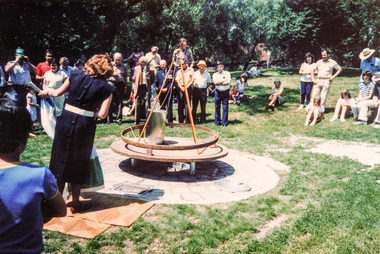
Photograph, Time Capsule Ceremony, 10 November 1985, 10/11/1985
... A clamp placed on the naff (hub) and screwed down tightly kept the spokes at a constant angle as the tyre cooled. ...A clamp placed on the naff (hub) and screwed down tightly kept the spokes at a constant angle as the tyre cooled. ...On Sunday, 10 November 1985 a time capsule was lowered into a monument installed near the corner of Main Road and Pitt Street in Eltham, within the gardens at the front of what is now the Eltham Community and Reception Centre. This monument commemorates Victoria’s 150th anniversary and the former location of the Eltham Town Centre, which existed along this section of Main Road, then known as Maria Street. Beneath the site is a time capsule to be opened in the year 2035. A plaque was also erected at this site in October 1987 to commemorate the Shire of Eltham Historical Society’s 20th anniversary. The main feature of this monument is a ‘tyring disc’, a blacksmith’s implement that was found on this site. This consists of a large iron disc that was used as a platform for fitting iron tyres (like the one shown on top of the platform) to wooden-spoked cart wheels. The local blacksmith and wheelwright worked together to assemble the wheel, which was clamped to the platform placed close to the fire. The red-hot iron hoop, previously forged to the correct size, was lifted with tongs by the blacksmith over the outside of the rim, then hammered down amid flames from the scorching timber. The wheelwright drenched the tyre with cold water as soon as it was in position. A clamp placed on the naff (hub) and screwed down tightly kept the spokes at a constant angle as the tyre cooled. An even pressure from the contracting tyre tightened the joints at each end of the spokes and formed a vice-like grip, which would last for the life of the wheel. [from EDHS Newsletter No. 45, November 1985:] TIME CAPSULE CEREMONY: Our 150th Anniversary Monument is now under construction in the gardens in front of the Eltham Community Centre. Further details of the project are given under a separate heading below and this item deals with the proposed ceremony. We propose to formally lower the time capsule into its container underneath the monument as part of the Eltham Community Festival. All members are invited to attend the ceremony at 2.00 p.m. on Sunday, 10th November. Come earlier with a picnic lunch if you like. Local people and firms who have contributed money or services for the monument will also be invited. As part of the Festival programme the public are welcome to attend. This is one of the most significant projects the Society has undertaken and members' participation in its finalization would be most gratifying to the organizing committee. 150TH ANNIVERSARY PROJECTS: We have concentrated our efforts on finishing the monument and time capsule project within the 150th year and have found it necessary to abandon the historical tour project. We have applied to the State 150th Committee to transfer the funds allocated for the tour to construction of the monument. The historical tour project will be continued at a later date and photos of historic houses in the area, taken by Doug Orford, will be available for use in an associated display. At the time of writing, the monument construction is on schedule for the ceremony on 10th November. The concrete base has been completed and the main feature of the monument, which is an old tyring plate or disc, will be lifted into place in the next week. The final ceremony will involve lowering the sealed time capsule into place, bolting down its container lid and then concreting over the lid. The capsule will contain mainly items relating to present day Eltham and its people and is to be opened in the year 2035, a video film made by Joh Ebeli and also details of families and organizations who have contributed to construction of the monument. It is proposed to place the items in the capsule on 5th November and any items members think could be included may be submitted up to that date. The Society has received an excellent response from local people, firms and organizations by way of assistance with this project. Graham Beyer, who originated the project, has arranged many of the donations. He and his firm, Package Handling Equipment, have donated the time capsule itself and have carried out fabrication of sections of the monument. The design of the monument was adapted by Graham Beyer from drawings by Joh Ebeli. Charmac Industries has donated the container for the time capsule and a cast gun metal name plate for the monument. BMG Concrete has donated concrete for the base which was constructed by Caridi Construction Company. Northbourne Garden Supplies has donated materials for the paving around the monument. Robert Becker from Eltham Apex directed construction of the paving by Society members. Terry Hutchinson has agreed to donate the use of his crane to lift the tyring disc into place. Financial contributions have been made by the Eltham Chamber of Commerce and the Rotary Club of Eltham. We are grateful to all who have helped, and members' support for firms who have donated their services would be an appropriate recognition. It is planned to print "Time Capsule Certificates" which can be held by organizations or passed on to descendants by individuals. The certificates will indicate an interest in the contents of the capsule when it is opened in fifty years. Certificates will be distributed to Society members and those who have contributed to the project.Two colour photographsactivities, 1985, time capsule, eltham, eltham festival -
 Eltham District Historical Society Inc
Photograph, Sinking the capsule, Graham Beyer on left and Joh Ebeli, Time Capsule Ceremony, 10 November, 1985, 10/11/1985
... A clamp placed on the naff (hub) and screwed down tightly kept the spokes at a constant angle as the tyre cooled. ...A clamp placed on the naff (hub) and screwed down tightly kept the spokes at a constant angle as the tyre cooled. ...On Sunday, 10 November 1985 a time capsule was lowered into a monument installed near the corner of Main Road and Pitt Street in Eltham, within the gardens at the front of what is now the Eltham Community and Reception Centre. This monument commemorates Victoria’s 150th anniversary and the former location of the Eltham Town Centre, which existed along this section of Main Road, then known as Maria Street. Beneath the site is a time capsule to be opened in the year 2035. A plaque was also erected at this site in October 1987 to commemorate the Shire of Eltham Historical Society’s 20th anniversary. The main feature of this monument is a ‘tyring disc’, a blacksmith’s implement that was found on this site. This consists of a large iron disc that was used as a platform for fitting iron tyres (like the one shown on top of the platform) to wooden-spoked cart wheels. The local blacksmith and wheelwright worked together to assemble the wheel, which was clamped to the platform placed close to the fire. The red-hot iron hoop, previously forged to the correct size, was lifted with tongs by the blacksmith over the outside of the rim, then hammered down amid flames from the scorching timber. The wheelwright drenched the tyre with cold water as soon as it was in position. A clamp placed on the naff (hub) and screwed down tightly kept the spokes at a constant angle as the tyre cooled. An even pressure from the contracting tyre tightened the joints at each end of the spokes and formed a vice-like grip, which would last for the life of the wheel. [from EDHS Newsletter No. 45, November 1985:] TIME CAPSULE CEREMONY: Our 150th Anniversary Monument is now under construction in the gardens in front of the Eltham Community Centre. Further details of the project are given under a separate heading below and this item deals with the proposed ceremony. We propose to formally lower the time capsule into its container underneath the monument as part of the Eltham Community Festival. All members are invited to attend the ceremony at 2.00 p.m. on Sunday, 10th November. Come earlier with a picnic lunch if you like. Local people and firms who have contributed money or services for the monument will also be invited. As part of the Festival programme the public are welcome to attend. This is one of the most significant projects the Society has undertaken and members' participation in its finalization would be most gratifying to the organizing committee. 150TH ANNIVERSARY PROJECTS: We have concentrated our efforts on finishing the monument and time capsule project within the 150th year and have found it necessary to abandon the historical tour project. We have applied to the State 150th Committee to transfer the funds allocated for the tour to construction of the monument. The historical tour project will be continued at a later date and photos of historic houses in the area, taken by Doug Orford, will be available for use in an associated display. At the time of writing, the monument construction is on schedule for the ceremony on 10th November. The concrete base has been completed and the main feature of the monument, which is an old tyring plate or disc, will be lifted into place in the next week. The final ceremony will involve lowering the sealed time capsule into place, bolting down its container lid and then concreting over the lid. The capsule will contain mainly items relating to present day Eltham and its people and is to be opened in the year 2035, a video film made by Joh Ebeli and also details of families and organizations who have contributed to construction of the monument. It is proposed to place the items in the capsule on 5th November and any items members think could be included may be submitted up to that date. The Society has received an excellent response from local people, firms and organizations by way of assistance with this project. Graham Beyer, who originated the project, has arranged many of the donations. He and his firm, Package Handling Equipment, have donated the time capsule itself and have carried out fabrication of sections of the monument. The design of the monument was adapted by Graham Beyer from drawings by Joh Ebeli. Charmac Industries has donated the container for the time capsule and a cast gun metal name plate for the monument. BMG Concrete has donated concrete for the base which was constructed by Caridi Construction Company. Northbourne Garden Supplies has donated materials for the paving around the monument. Robert Becker from Eltham Apex directed construction of the paving by Society members. Terry Hutchinson has agreed to donate the use of his crane to lift the tyring disc into place. Financial contributions have been made by the Eltham Chamber of Commerce and the Rotary Club of Eltham. We are grateful to all who have helped, and members' support for firms who have donated their services would be an appropriate recognition. It is planned to print "Time Capsule Certificates" which can be held by organizations or passed on to descendants by individuals. The certificates will indicate an interest in the contents of the capsule when it is opened in fifty years. Certificates will be distributed to Society members and those who have contributed to the project.Colour photographactivities, 1985, time capsule, eltham, eltham festival -
 Ringwood and District Historical Society
Article, Maroondah High School - Opening of new Community Centre March 5 1980 by Sir Zelman Cowen
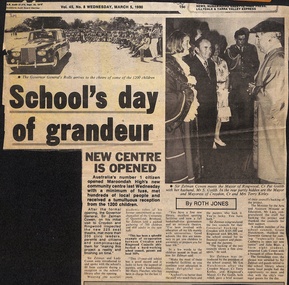
... He inspected the newly completed 225-seat hall, met staff and students, and spoke with local government representatives. ...He inspected the newly completed 225-seat hall, met staff and students, and spoke with local government representatives. ...The article, “School’s day of grandeur – New centre is opened” (written by Roth Jones), reports on the official opening of Maroondah High School’s new community centre on Wednesday, March 5, 1980. The event was led by Sir Zelman Cowen, the Governor-General of Australia, who visited both Croydon and Ringwood as part of the occasion. Sir Zelman Cowen arrived in a Rolls-Royce, greeted by enthusiastic cheers from approximately 1,200 children. He inspected the newly completed 225-seat hall, met staff and students, and spoke with local government representatives. The dignitaries named in the article include: - Sir Zelman Cowen – Governor-General of Australia - Cr Pat Gotlib – Mayor of Ringwood - Mr. S. Gotlib - Cr Terry Kinley – Mayor of Croydon - Mrs Terry Kinley – Mayoress of Croydon - Mr Les Hutchinson - president of the School Council - Mr Lacy - Minister for the Arts and Assistant Minister for Education - Grant Hutchinson, student member of the School Council, who thanked teh Governor-General - Julie Blair - Form 8 student - who "presented Lady Cowen with a bouquet of yellow flowers". The article highlights the significance of the new community centre for Maroondah High School and the excitement surrounding the Governor-General’s visit. (Summary by Co-Pilot 1/8/2026). Photo Caption: Sir Zelman Cohen meets the Mayor of Ringwood Cr Pat Gotlib with her husband, Mr. S Gotlib. In teh rear partly hiddne are the Mayor and Mayoress of Croydon, Cr and Mrs Terry Kirley. -
 Bendigo Historical Society Inc.
Clothing - MAGGIE BARBER COLLECTION: BLOUSE, Late 1870's - 1880's
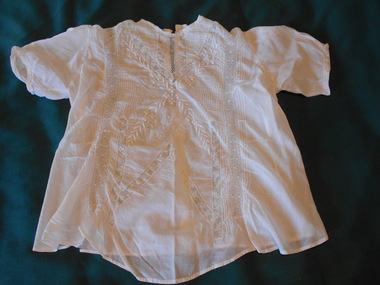
... A 1.5 cm deep 'stand-up' collar, spoke-stitched to the garment, as are the sleeves and shoulder seams. ...A 1.5 cm deep 'stand-up' collar, spoke-stitched to the garment, as are the sleeves and shoulder seams. ...Clothing. A concealed full length back opening reveals five tiny covered buttons, 7 mm in diameter and five hand-stitched button holes. This opening is bordered by two groups of five very fine pin tucks with a 3 cm spacing between the two groups. The blouse is made from very fine Swiss lawn cotton fabric, and is very soft to the feel. The front has a broad panel thirty cm wide of exquisite pintucks, crochet, lace and embroidery. The embroidery is white on white, and features flowers and leaves in a curved pattern. A crochet panel below the high neckline is 4 cm x 10 cms and is peaked at the lower edge. This is bordered by 1.5 cm wide cotton lace, and horizontal pintucks. Two panels, one on either side of three pintucks, 1.5 cm panel of lace, and then the central panel of embroidery, pintucks, lace, and crochet. Five pintucks, 1.5 cm panel of lace and five more pintucks run the length of the short sleeves. Sleeves are puffed, and gathered at the shoulder, and at the 1.5 cm deep cuff, which is also pintucked. A 1.5 cm deep 'stand-up' collar, spoke-stitched to the garment, as are the sleeves and shoulder seams. Front hemline is curved. Back hemline is straight.costume, female, a full length back opening blouse -
 Flagstaff Hill Maritime Museum and Village
Letter
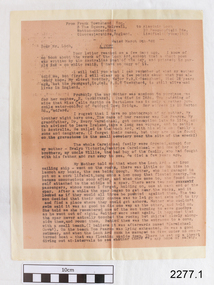
... Tom Pearce was, I think, an apprentice. She spoke of him sometimes as a ‘cabin boy’. From his photograph, he was a fine, handsome young man. ...Tom Pearce was, I think, an apprentice. She spoke of him sometimes as a ‘cabin boy’. From his photograph, he was a fine, handsome young man. ...This letter was written to Alisdair Loch, 10 Beaconsfield Parade, Lindfield (Sydney) NSW, from Frank Townshend Esq., 3 The Square, Holywell, Wotton-under-Edge, Gloucestershire, England. Its author is a son of Eva Carmichael/Townshend, sole female survivor of the LOCH ARD shipwreck in 1878. It tells of Eva’s struggle in the sea after the LOCH ARD hit the rocks, and of her rescue by the only other survivor, young seaman Tom Pearce. It also relates her return to a privileged life in Ireland, her subsequent marriage to another member of the Anglo-Irish ascendancy, and her three sons. In some places the letter seems in historical error, which is not surprising given the dates involved and the time that elapsed between them (Eva shipwrecked 1878, Son’s birth 1887, Eva’s death 1934, Son’s letter 1962). The writer makes clear he is relying on his memory of what his mother had told him, and he is usually forthright in declaring those things he cannot remember, or remembers indistinctly. An interesting paragraph in the letter answers the contemporary newspaper speculation about a possible romance between the two survivors: “She [his mother, Eva Carmichael] received many proposals of marriage, perhaps a dozen, including one from Tom Pearce. Tom Pearce was, I think, an apprentice. She spoke of him sometimes as a ‘cabin boy’. From his photograph, he was a fine, handsome young man. The reason she declined his offer of marriage was largely the fruit of class distinction, I think; class prejudice being very strong in Ireland, in those days.” The LOCH ARD shipwreck is of State significance ― Victorian Heritage Number S417Typed copy of a letter from Frank Townshend, LOCH ARD survivor Eva Carmichael’s son in England, to Alasdair Loch, Sydney NSW. It is dated 8 March 1962 and consists of four pages. flagstaff hill, warrnambool, shipwrecked-coast, flagstaff-hill, flagstaff-hill-maritime-museum, maritime-museum, shipwreck-coast, flagstaff-hill-maritime-village, letter, frank townshend, eva carmichael, loch ard, alasdair loch, tom pearce -
 Flagstaff Hill Maritime Museum and Village
Equipment - Ship's Wheel, 1840
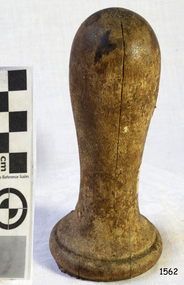
... This wooden spoke handle is from the wheel of the sailing ship “Success”, a former immigrant ship and later a convict hulk at Melbourne. ...This wooden spoke handle is from the wheel of the sailing ship “Success”, a former immigrant ship and later a convict hulk at Melbourne. ...This wooden spoke handle is from the wheel of the sailing ship “Success”, a former immigrant ship and later a convict hulk at Melbourne. The sailing ship “Success” was a teakwood vessel built in Natmoo (Natmaw), Tenasserim, Burma (now Myanmar) in 1840 for Cockerell & Co., Calcutta. Over its lifetime of 106 years, it was used to trade in the Indian subcontinent, to transport free emigrants to Australia, as a prison hulk in the Port of Melbourne for both hardened criminals, and later for women and boys, as a storage vessel for ammunition, a reformatory, and as a floating museum sent around the world to tell the tale of the convict era. During the time “Success” was used as a museum, pamphlets were distributed to paying customers advertising erroneously, that the “Success” was the oldest ship in the world. The “Success” sank and was re-floated twice: the first in Sydney in 1885, the second in the USA in 1918, before it was finally burned and sank on July 4, 1946 in Lake Erie, near Sandusky, Ohio, in 1946. Although the “Success” was home to prisoners while berthed in the Port of Melbourne, it was not used as convict transport. There has been speculation that Ned Kelly’s infamous armour was displayed on the “Success”, but this cannot be verified. Another link to Ned Kelly is Henry Johnson, an Irish prisoner on the vessel Success, who was implicated in the murder of the ship’s warder. and later, Johnson was supposedly a bushranger with Ned Kelly. It is also rumoured that Ned Kelly’s father John was a passenger on the Success, but this is also unverified. There are over 16 other ships named “Success”, although one in particular causes some confusion when researching “Success” in Australia. This other ship – the “HMS Success” - was a 28 gun frigate built in1823, which was broken up in 1849. It also sailed to Australia.Thiswooden ship's wheel handle was once part of the ship’s wheel of the sailing ship “Success” , which was, built in Burma in 1840. The “Success” is connected to the history of Australia because she was used as a merchant ship to transport immigrants to Australia, and was also used as a prison ship in Melbourne, a storage vessel, and as a floating “convict” museum, which travelled the world. Ship's wheel handle. Hndle from the wheel of sailing ship, the “Success”. The shaped handle is domed at one end, becoming narrower towards the other end, then flattened out into a beveled circle. The handle has an inscription written in pencil."Success"flagstaff hill maritime museum, maritime museum, sailing ship success, ship's wheel spoke, ship's steering wheel, prison ship, prison hulks, convict ship, spoke handle, ship's wheel, navigation equipment, steering wheel -
 Uniting Church Archives - Synod of Victoria
Card - Methodist Order of Knights, Annual Registration card
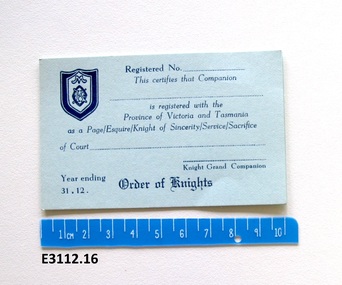
... Alex Bray was a Sunday School teacher and spoke to his class of the Knights of the Round Table. ...Alex Bray was a Sunday School teacher and spoke to his class of the Knights of the Round Table. ...The Methodist Order of Knights was the official youth organisation of the Methodist Church of Australasia. It originated in Hurstville, NSW, on the 4th October 1914 by the then Mr and later Rev Alex Bray. Alex Bray was a Sunday School teacher and spoke to his class of the Knights of the Round Table. In 1917 the Order of Knights was officially recognised by the Sunday School Dept of the NSW Methodist Conference. Courts spread thoroughout Australia. In 1927 the High Court of NSW called for designs for a badge and in 1929 the General Conference of the Methodist Church of Australasia recognised the Order as an approved Organisation. In 1938 the Senior Section was organised into Degrees of Sincerity, Service and Sacrifice; the Junior Section into Pages' Degree with advancement to Esquire. In 1954 the Junior Section was reorganised into two groups: Pages 8 to 11 years and Esquires 12 to 15 years. The Knight's Motto: "Live Pure, Speak True, Right Wrong, Follow Christ the King, else wherefore born?" Courts of the Order: General Conference Department of the Christian Education - General Court - Provincial High Court - District Court - Local Court - Senior Court - Intermediate Court - Junior Court . Regalia: All members of the Intermediate and Senior Courts wore regalia consisting of a cloth shield superimposed by a cross of light and dark blue ribbons, and supported by a cloth collar. Esquire and Degree of Sincerity regalia: White collar and white shield. Degree of Service regalia: Green collar and shield. Degree of Sacrifice: Scarlet collar and shield. District Court regalia: Blue collar and gold shield. High Court regalia: Gold collar and purple sheild. General Court regalia: Purple collar and shield. Officers of the local courts wore their symbols as part of their regalia. E3112.16.1 & E3112.16.2 Blank pale blue annual registration cards with navy blue text. The card has a MOK symbol on the top left corner. methodist order of knights -
 Uniting Church Archives - Synod of Victoria
Document - Methodist Order of Knights, The Vigil postal template
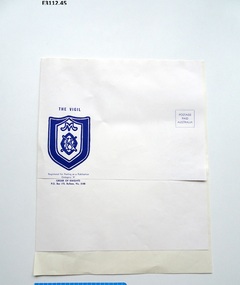
... Alex Bray was a Sunday School teacher and spoke to his class of the Knights of the Round Table. ...Alex Bray was a Sunday School teacher and spoke to his class of the Knights of the Round Table. ...The Methodist Order of Knights was the official youth organisation of the Methodist Church of Australasia. It originated in Hurstville, NSW, on the 4th October 1914 by the then Mr and later Rev Alex Bray. Alex Bray was a Sunday School teacher and spoke to his class of the Knights of the Round Table. In 1917 the Order of Knights was officially recognised by the Sunday School Dept of the NSW Methodist Conference. Courts spread thoroughout Australia. In 1927 the High Court of NSW called for designs for a badge and in 1929 the General Conference of the Methodist Church of Australasia recognised the Order as an approved Organisation. In 1938 the Senior Section was organised into Degrees of Sincerity, Service and Sacrifice; the Junior Section into Pages' Degree with advancement to Esquire. In 1954 the Junior Section was reorganised into two groups: Pages 8 to 11 years and Esquires 12 to 15 years. The Knight's Motto: "Live Pure, Speak True, Right Wrong, Follow Christ the King, else wherefore born?" Courts of the Order: General Conference Department of the Christian Education - General Court - Provincial High Court - District Court - Local Court - Senior Court - Intermediate Court - Junior Court . Regalia: All members of the Intermediate and Senior Courts wore regalia consisting of a cloth shield superimposed by a cross of light and dark blue ribbons, and supported by a cloth collar. Esquire and Degree of Sincerity regalia: White collar and white shield. Degree of Service regalia: Green collar and shield. Degree of Sacrifice: Scarlet collar and shield. District Court regalia: Blue collar and gold shield. High Court regalia: Gold collar and purple sheild. General Court regalia: Purple collar and shield. Officers of the local courts wore their symbols as part of their regalia.Template for a mailing wrapper fro The Vigil with the MOK symbol and Order Of Knights postal address P.O.Box 173, Bulleen, Vic 3105.methodist order of knights, the vigil -
 Uniting Church Archives - Synod of Victoria
Document - Order of Knights Vic/Tas, Questionnaire
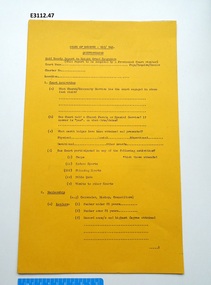
... Alex Bray was a Sunday School teacher and spoke to his class of the Knights of the Round Table. ...Alex Bray was a Sunday School teacher and spoke to his class of the Knights of the Round Table. ...The Methodist Order of Knights was the official youth organisation of the Methodist Church of Australasia. It originated in Hurstville, NSW, on the 4th October 1914 by the then Mr and later Rev Alex Bray. Alex Bray was a Sunday School teacher and spoke to his class of the Knights of the Round Table. In 1917 the Order of Knights was officially recognised by the Sunday School Dept of the NSW Methodist Conference. Courts spread thoroughout Australia. In 1927 the High Court of NSW called for designs for a badge and in 1929 the General Conference of the Methodist Church of Australasia recognised the Order as an approved Organisation. In 1938 the Senior Section was organised into Degrees of Sincerity, Service and Sacrifice; the Junior Section into Pages' Degree with advancement to Esquire. In 1954 the Junior Section was reorganised into two groups: Pages 8 to 11 years and Esquires 12 to 15 years. The Knight's Motto: "Live Pure, Speak True, Right Wrong, Follow Christ the King, else wherefore born?" Courts of the Order: General Conference Department of the Christian Education - General Court - Provincial High Court - District Court - Local Court - Senior Court - Intermediate Court - Junior Court . Regalia: All members of the Intermediate and Senior Courts wore regalia consisting of a cloth shield superimposed by a cross of light and dark blue ribbons, and supported by a cloth collar. Esquire and Degree of Sincerity regalia: White collar and white shield. Degree of Service regalia: Green collar and shield. Degree of Sacrifice: Scarlet collar and shield. District Court regalia: Blue collar and gold shield. High Court regalia: Gold collar and purple sheild. General Court regalia: Purple collar and shield. Officers of the local courts wore their symbols as part of their regalia.Blank questionnaire form printed on both sides of gold paper. The questionnaire is the half yearly Order of Knights Vic/Tas report to Knight Grand Companion. There are three questionnaires which are printed on both sides.methodist order of knights -
 Uniting Church Archives - Synod of Victoria
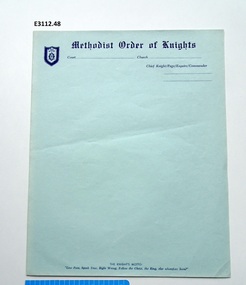
Document - Methodist Order of Knights, Methodist Order of Knights letterhead writing paper
... Alex Bray was a Sunday School teacher and spoke to his class of the Knights of the Round Table. ...Alex Bray was a Sunday School teacher and spoke to his class of the Knights of the Round Table. ...The Methodist Order of Knights was the official youth organisation of the Methodist Church of Australasia. It originated in Hurstville, NSW, on the 4th October 1914 by the then Mr and later Rev Alex Bray. Alex Bray was a Sunday School teacher and spoke to his class of the Knights of the Round Table. In 1917 the Order of Knights was officially recognised by the Sunday School Dept of the NSW Methodist Conference. Courts spread thoroughout Australia. In 1927 the High Court of NSW called for designs for a badge and in 1929 the General Conference of the Methodist Church of Australasia recognised the Order as an approved Organisation. In 1938 the Senior Section was organised into Degrees of Sincerity, Service and Sacrifice; the Junior Section into Pages' Degree with advancement to Esquire. In 1954 the Junior Section was reorganised into two groups: Pages 8 to 11 years and Esquires 12 to 15 years. The Knight's Motto: "Live Pure, Speak True, Right Wrong, Follow Christ the King, else wherefore born?" Courts of the Order: General Conference Department of the Christian Education - General Court - Provincial High Court - District Court - Local Court - Senior Court - Intermediate Court - Junior Court . Regalia: All members of the Intermediate and Senior Courts wore regalia consisting of a cloth shield superimposed by a cross of light and dark blue ribbons, and supported by a cloth collar. Esquire and Degree of Sincerity regalia: White collar and white shield. Degree of Service regalia: Green collar and shield. Degree of Sacrifice: Scarlet collar and shield. District Court regalia: Blue collar and gold shield. High Court regalia: Gold collar and purple sheild. General Court regalia: Purple collar and shield. Officers of the local courts wore their symbols as part of their regalia.Pale blue letterhead Methodist Order of Knights lightweight notepaper. The paper has the Knight's Motto printed at the bottom. There are eight sheets of this letterhead.methodist order of knights -
 Uniting Church Archives - Synod of Victoria
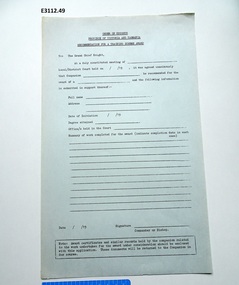
Document - Methodist Order of Knights Province of Victoria and Tasmania, Recommendation for a training scheme award
... Alex Bray was a Sunday School teacher and spoke to his class of the Knights of the Round Table. ...Alex Bray was a Sunday School teacher and spoke to his class of the Knights of the Round Table. ...The Methodist Order of Knights was the official youth organisation of the Methodist Church of Australasia. It originated in Hurstville, NSW, on the 4th October 1914 by the then Mr and later Rev Alex Bray. Alex Bray was a Sunday School teacher and spoke to his class of the Knights of the Round Table. In 1917 the Order of Knights was officially recognised by the Sunday School Dept of the NSW Methodist Conference. Courts spread thoroughout Australia. In 1927 the High Court of NSW called for designs for a badge and in 1929 the General Conference of the Methodist Church of Australasia recognised the Order as an approved Organisation. In 1938 the Senior Section was organised into Degrees of Sincerity, Service and Sacrifice; the Junior Section into Pages' Degree with advancement to Esquire. In 1954 the Junior Section was reorganised into two groups: Pages 8 to 11 years and Esquires 12 to 15 years. The Knight's Motto: "Live Pure, Speak True, Right Wrong, Follow Christ the King, else wherefore born?" Courts of the Order: General Conference Department of the Christian Education - General Court - Provincial High Court - District Court - Local Court - Senior Court - Intermediate Court - Junior Court . Regalia: All members of the Intermediate and Senior Courts wore regalia consisting of a cloth shield superimposed by a cross of light and dark blue ribbons, and supported by a cloth collar. Esquire and Degree of Sincerity regalia: White collar and white shield. Degree of Service regalia: Green collar and shield. Degree of Sacrifice: Scarlet collar and shield. District Court regalia: Blue collar and gold shield. High Court regalia: Gold collar and purple sheild. General Court regalia: Purple collar and shield. Officers of the local courts wore their symbols as part of their regalia.Order of Knights Province of Victoria and Tasmania recommendation for a training scheme award form. To the Grand Chief Knight.. Typed form, six copies.methodist order of knights -
 Uniting Church Archives - Synod of Victoria
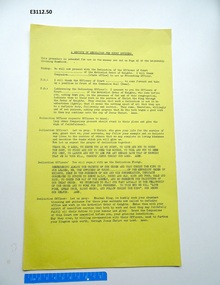
Document - Methodist Order of Knights, A Service of Dedication for Court Officers
... Alex Bray was a Sunday School teacher and spoke to his class of the Knights of the Round Table. ...Alex Bray was a Sunday School teacher and spoke to his class of the Knights of the Round Table. ...The Methodist Order of Knights was the official youth organisation of the Methodist Church of Australasia. It originated in Hurstville, NSW, on the 4th October 1914 by the then Mr and later Rev Alex Bray. Alex Bray was a Sunday School teacher and spoke to his class of the Knights of the Round Table. In 1917 the Order of Knights was officially recognised by the Sunday School Dept of the NSW Methodist Conference. Courts spread thoroughout Australia. In 1927 the High Court of NSW called for designs for a badge and in 1929 the General Conference of the Methodist Church of Australasia recognised the Order as an approved Organisation. In 1938 the Senior Section was organised into Degrees of Sincerity, Service and Sacrifice; the Junior Section into Pages' Degree with advancement to Esquire. In 1954 the Junior Section was reorganised into two groups: Pages 8 to 11 years and Esquires 12 to 15 years. The Knight's Motto: "Live Pure, Speak True, Right Wrong, Follow Christ the King, else wherefore born?" Courts of the Order: General Conference Department of the Christian Education - General Court - Provincial High Court - District Court - Local Court - Senior Court - Intermediate Court - Junior Court . Regalia: All members of the Intermediate and Senior Courts wore regalia consisting of a cloth shield superimposed by a cross of light and dark blue ribbons, and supported by a cloth collar. Esquire and Degree of Sincerity regalia: White collar and white shield. Degree of Service regalia: Green collar and shield. Degree of Sacrifice: Scarlet collar and shield. District Court regalia: Blue collar and gold shield. High Court regalia: Gold collar and purple sheild. General Court regalia: Purple collar and shield. Officers of the local courts wore their symbols as part of their regalia.A Service of Dedication for Court Officers document. Yellow paper with typed text on one side. Four copies.methodist order of knights -
 Uniting Church Archives - Synod of Victoria
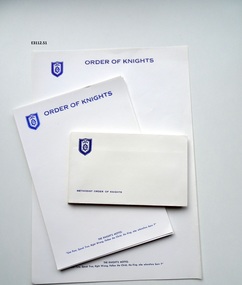
Document - Methodist Order of Knights, Letterhead writing paper and envelopes
... Alex Bray was a Sunday School teacher and spoke to his class of the Knights of the Round Table. ...Alex Bray was a Sunday School teacher and spoke to his class of the Knights of the Round Table. ...The Methodist Order of Knights was the official youth organisation of the Methodist Church of Australasia. It originated in Hurstville, NSW, on the 4th October 1914 by the then Mr and later Rev Alex Bray. Alex Bray was a Sunday School teacher and spoke to his class of the Knights of the Round Table. In 1917 the Order of Knights was officially recognised by the Sunday School Dept of the NSW Methodist Conference. Courts spread thoroughout Australia. In 1927 the High Court of NSW called for designs for a badge and in 1929 the General Conference of the Methodist Church of Australasia recognised the Order as an approved Organisation. In 1938 the Senior Section was organised into Degrees of Sincerity, Service and Sacrifice; the Junior Section into Pages' Degree with advancement to Esquire. In 1954 the Junior Section was reorganised into two groups: Pages 8 to 11 years and Esquires 12 to 15 years. The Knight's Motto: "Live Pure, Speak True, Right Wrong, Follow Christ the King, else wherefore born?" Courts of the Order: General Conference Department of the Christian Education - General Court - Provincial High Court - District Court - Local Court - Senior Court - Intermediate Court - Junior Court . Regalia: All members of the Intermediate and Senior Courts wore regalia consisting of a cloth shield superimposed by a cross of light and dark blue ribbons, and supported by a cloth collar. Esquire and Degree of Sincerity regalia: White collar and white shield. Degree of Service regalia: Green collar and shield. Degree of Sacrifice: Scarlet collar and shield. District Court regalia: Blue collar and gold shield. High Court regalia: Gold collar and purple sheild. General Court regalia: Purple collar and shield. Officers of the local courts wore their symbols as part of their regalia.White letterhead Methodist Order of Knights notepaper in two sizes: E3112.51.1 & E3112.51.2. The paper has the Knight's Motto printed at the bottom of the page. E3112.51.1 - two sheets. E3112.51.2 seventeen sheets. E3112.51.3 ten small envelopes.methodist order of knights -
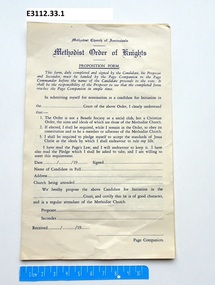 Uniting Church Archives - Synod of Victoria
Document - Form, Methodist Order of Knights: Petition for elevation to Christian Knighthood
... Alex Bray was a Sunday School teacher and spoke to his class of the Knights of the Round Table. ...Alex Bray was a Sunday School teacher and spoke to his class of the Knights of the Round Table. ...The Methodist Order of Knights was the official youth organisation of the Methodist Church of Australasia. It originated in Hurstville, NSW, on the 4th October 1914 by the then Mr and later Rev Alex Bray. Alex Bray was a Sunday School teacher and spoke to his class of the Knights of the Round Table. In 1917 the Order of Knights was officially recognised by the Sunday School Dept of the NSW Methodist Conference. Courts spread thoroughout Australia. In 1927 the High Court of NSW called for designs for a badge and in 1929 the General Conference of the Methodist Church of Australasia recognised the Order as an approved Organisation. In 1938 the Senior Section was organised into Degrees of Sincerity, Service and Sacrifice; the Junior Section into Pages' Degree with advancement to Esquire. In 1954 the Junior Section was reorganised into two groups: Pages 8 to 11 years and Esquires 12 to 15 years. The Knight's Motto: "Live Pure, Speak True, Right Wrong, Follow Christ the King, else wherefore born?" Courts of the Order: General Conference Department of the Christian Education - General Court - Provincial High Court - District Court - Local Court - Senior Court - Intermediate Court - Junior Court . Regalia: All members of the Intermediate and Senior Courts wore regalia consisting of a cloth shield superimposed by a cross of light and dark blue ribbons, and supported by a cloth collar. Esquire and Degree of Sincerity regalia: White collar and white shield. Degree of Service regalia: Green collar and shield. Degree of Sacrifice: Scarlet collar and shield. District Court regalia: Blue collar and gold shield. High Court regalia: Gold collar and purple sheild. General Court regalia: Purple collar and shield. Officers of the local courts wore their symbols as part of their regalia.Blank forms in two sizes: E3112.33.1 (three forms) and E3112.2 (two forms). Methodist Church of Australasia Methodist Order of Knights: Petition for Elevation to Christian Knighthood forms. The forms are addressed to the Bishop of the Court who after he had endorsed and recommended the candidate forwarded it on the the Grand Chief Knight for final approval. methodist order of knights -
 Uniting Church Archives - Synod of Victoria
Article - Envelope, Welcome to Melbourne
... Alex Bray was a Sunday School teacher and spoke to his class of the Knights of the Round Table. ...Alex Bray was a Sunday School teacher and spoke to his class of the Knights of the Round Table. ...The Methodist Order of Knights was the official youth organisation of the Methodist Church of Australasia. It originated in Hurstville, NSW, on the 4th October 1914 by the then Mr and later Rev Alex Bray. Alex Bray was a Sunday School teacher and spoke to his class of the Knights of the Round Table. In 1917 the Order of Knights was officially recognised by the Sunday School Dept of the NSW Methodist Conference. Courts spread thoroughout Australia. In 1927 the High Court of NSW called for designs for a badge and in 1929 the General Conference of the Methodist Church of Australasia recognised the Order as an approved Organisation. In 1938 the Senior Section was organised into Degrees of Sincerity, Service and Sacrifice; the Junior Section into Pages' Degree with advancement to Esquire. In 1954 the Junior Section was reorganised into two groups: Pages 8 to 11 years and Esquires 12 to 15 years. The Knight's Motto: "Live Pure, Speak True, Right Wrong, Follow Christ the King, else wherefore born?" Courts of the Order: General Conference Department of the Christian Education - General Court - Provincial High Court - District Court - Local Court - Senior Court - Intermediate Court - Junior Court . Regalia: All members of the Intermediate and Senior Courts wore regalia consisting of a cloth shield superimposed by a cross of light and dark blue ribbons, and supported by a cloth collar. Esquire and Degree of Sincerity regalia: White collar and white shield. Degree of Service regalia: Green collar and shield. Degree of Sacrifice: Scarlet collar and shield. District Court regalia: Blue collar and gold shield. High Court regalia: Gold collar and purple sheild. General Court regalia: Purple collar and shield. Officers of the local courts wore their symbols as part of their regalia.Buff envelope with the Methodist Girls' Comradeship and Methodist Order of Knights symbols and the words "WELCOME TO MELBOURNE"methodist order of knights, methodist girls' comradeship -
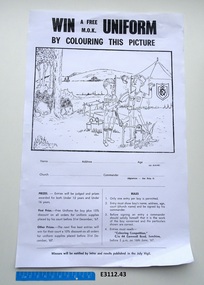 Uniting Church Archives - Synod of Victoria
Document - Methodist Order of Knights, Win a free MOK uniform by colouring this picture
... Alex Bray was a Sunday School teacher and spoke to his class of the Knights of the Round Table. ...Alex Bray was a Sunday School teacher and spoke to his class of the Knights of the Round Table. ...The Methodist Order of Knights was the official youth organisation of the Methodist Church of Australasia. It originated in Hurstville, NSW, on the 4th October 1914 by the then Mr and later Rev Alex Bray. Alex Bray was a Sunday School teacher and spoke to his class of the Knights of the Round Table. In 1917 the Order of Knights was officially recognised by the Sunday School Dept of the NSW Methodist Conference. Courts spread thoroughout Australia. In 1927 the High Court of NSW called for designs for a badge and in 1929 the General Conference of the Methodist Church of Australasia recognised the Order as an approved Organisation. In 1938 the Senior Section was organised into Degrees of Sincerity, Service and Sacrifice; the Junior Section into Pages' Degree with advancement to Esquire. In 1954 the Junior Section was reorganised into two groups: Pages 8 to 11 years and Esquires 12 to 15 years. The Knight's Motto: "Live Pure, Speak True, Right Wrong, Follow Christ the King, else wherefore born?" Courts of the Order: General Conference Department of the Christian Education - General Court - Provincial High Court - District Court - Local Court - Senior Court - Intermediate Court - Junior Court . Regalia: All members of the Intermediate and Senior Courts wore regalia consisting of a cloth shield superimposed by a cross of light and dark blue ribbons, and supported by a cloth collar. Esquire and Degree of Sincerity regalia: White collar and white shield. Degree of Service regalia: Green collar and shield. Degree of Sacrifice: Scarlet collar and shield. District Court regalia: Blue collar and gold shield. High Court regalia: Gold collar and purple sheild. General Court regalia: Purple collar and shield. Officers of the local courts wore their symbols as part of their regalia.Colouring in competition to be submitted to "Colouring Competition c/o 44 Cornwall Road, Sunshine before 5 p.m. on 16th June, '67"methodist order of knights -
 Uniting Church Archives - Synod of Victoria
Document - Provincial High Court of Victoria and Tasmania Methodist Order of Knights, 1964 Golden Jubilee letterhead
... Alex Bray was a Sunday School teacher and spoke to his class of the Knights of the Round Table. ...Alex Bray was a Sunday School teacher and spoke to his class of the Knights of the Round Table. ...The Methodist Order of Knights was the official youth organisation of the Methodist Church of Australasia. It originated in Hurstville, NSW, on the 4th October 1914 by the then Mr and later Rev Alex Bray. Alex Bray was a Sunday School teacher and spoke to his class of the Knights of the Round Table. In 1917 the Order of Knights was officially recognised by the Sunday School Dept of the NSW Methodist Conference. Courts spread thoroughout Australia. In 1927 the High Court of NSW called for designs for a badge and in 1929 the General Conference of the Methodist Church of Australasia recognised the Order as an approved Organisation. In 1938 the Senior Section was organised into Degrees of Sincerity, Service and Sacrifice; the Junior Section into Pages' Degree with advancement to Esquire. In 1954 the Junior Section was reorganised into two groups: Pages 8 to 11 years and Esquires 12 to 15 years. The Knight's Motto: "Live Pure, Speak True, Right Wrong, Follow Christ the King, else wherefore born?" Courts of the Order: General Conference Department of the Christian Education - General Court - Provincial High Court - District Court - Local Court - Senior Court - Intermediate Court - Junior Court . Regalia: All members of the Intermediate and Senior Courts wore regalia consisting of a cloth shield superimposed by a cross of light and dark blue ribbons, and supported by a cloth collar. Esquire and Degree of Sincerity regalia: White collar and white shield. Degree of Service regalia: Green collar and shield. Degree of Sacrifice: Scarlet collar and shield. District Court regalia: Blue collar and gold shield. High Court regalia: Gold collar and purple sheild. General Court regalia: Purple collar and shield. Officers of the local courts wore their symbols as part of their regalia.White letterhead Provincial High Court of Victoria and Tasmania Methodist Order of Knights lightweight notepaper (two sheets). The paper has the Knight's Motto printed on the top and "1964 Golden Jubilee" printed in gold down the side.methodist order of knights -
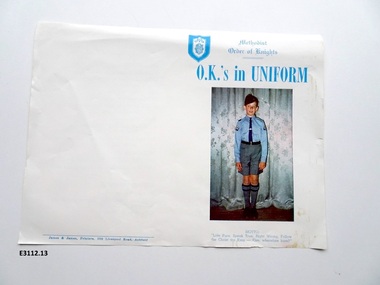 Uniting Church Archives - Synod of Victoria
Pamphlet - Uniform pamphlet, Methodist Order of Knights O.K.'s in Uniform
... Alex Bray was a Sunday School teacher and spoke to his class of the Knights of the Round Table. ...Alex Bray was a Sunday School teacher and spoke to his class of the Knights of the Round Table. ...The Methodist Order of Knights was the official youth organisation of the Methodist Church of Australasia. It originated in Hurstville, NSW, on the 4th October 1914 by the then Mr and later Rev Alex Bray. Alex Bray was a Sunday School teacher and spoke to his class of the Knights of the Round Table. In 1917 the Order of Knights was officially recognised by the Sunday School Dept of the NSW Methodist Conference. Courts spread thoroughout Australia. In 1927 the High Court of NSW called for designs for a badge and in 1929 the General Conference of the Methodist Church of Australasia recognised the Order as an approved Organisation. In 1938 the Senior Section was organised into Degrees of Sincerity, Service and Sacrifice; the Junior Section into Pages' Degree with advancement to Esquire. In 1954 the Junior Section was reorganised into two groups: Pages 8 to 11 years and Esquires 12 to 15 years. The Knight's Motto: "Live Pure, Speak True, Right Wrong, Follow Christ the King, else wherefore born?" Courts of the Order: General Conference Department of the Christian Education - General Court - Provincial High Court - District Court - Local Court - Senior Court - Intermediate Court - Junior Court . Regalia: All members of the Intermediate and Senior Courts wore regalia consisting of a cloth shield superimposed by a cross of light and dark blue ribbons, and supported by a cloth collar. Esquire and Degree of Sincerity regalia: White collar and white shield. Degree of Service regalia: Green collar and shield. Degree of Sacrifice: Scarlet collar and shield. District Court regalia: Blue collar and gold shield. High Court regalia: Gold collar and purple sheild. General Court regalia: Purple collar and shield. Officers of the local courts wore their symbols as part of their regalia. E3112.13.1 and E3112.13.2: Coloured pamphlet with information and details of the Methodist Order of Knights Uniform requirements. The pamphlet has a photograph of a MOK boy in his Dress Uniform."O.K.'s in UNIFORM"methodist order of knights -
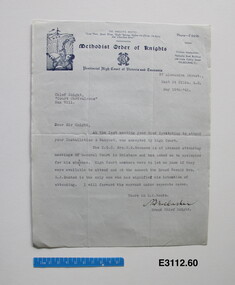 Uniting Church Archives - Synod of Victoria
Letter - Methodist Order of Knights High Court of Victoria and Tasmania, Interstate Rally 1946-47 letter
... Alex Bray was a Sunday School teacher and spoke to his class of the Knights of the Round Table. ...Alex Bray was a Sunday School teacher and spoke to his class of the Knights of the Round Table. ...The Methodist Order of Knights was the official youth organisation of the Methodist Church of Australasia. It originated in Hurstville, NSW, on the 4th October 1914 by the then Mr and later Rev Alex Bray. Alex Bray was a Sunday School teacher and spoke to his class of the Knights of the Round Table. In 1917 the Order of Knights was officially recognised by the Sunday School Dept of the NSW Methodist Conference. Courts spread thoroughout Australia. In 1927 the High Court of NSW called for designs for a badge and in 1929 the General Conference of the Methodist Church of Australasia recognised the Order as an approved Organisation. In 1938 the Senior Section was organised into Degrees of Sincerity, Service and Sacrifice; the Junior Section into Pages' Degree with advancement to Esquire. In 1954 the Junior Section was reorganised into two groups: Pages 8 to 11 years and Esquires 12 to 15 years. The Knight's Motto: "Live Pure, Speak True, Right Wrong, Follow Christ the King, else wherefore born?" Courts of the Order: General Conference Department of the Christian Education - General Court - Provincial High Court - District Court - Local Court - Senior Court - Intermediate Court - Junior Court . Regalia: All members of the Intermediate and Senior Courts wore regalia consisting of a cloth shield superimposed by a cross of light and dark blue ribbons, and supported by a cloth collar. Esquire and Degree of Sincerity regalia: White collar and white shield. Degree of Service regalia: Green collar and shield. Degree of Sacrifice: Scarlet collar and shield. District Court regalia: Blue collar and gold shield. High Court regalia: Gold collar and purple sheild. General Court regalia: Purple collar and shield. Officers of the local courts wore their symbols as part of their regalia.E3112.60.1 - E3112.60.3: Methodist Order of Knights High Court of Victoria and Tasmania letter from L. E. King, General Organiser of the MOK Interstate Rally, Melbourne 1946-47 asking for accommodation venues for interstate visitors. methodist order of knights interstate rally melbourne1946-47 -
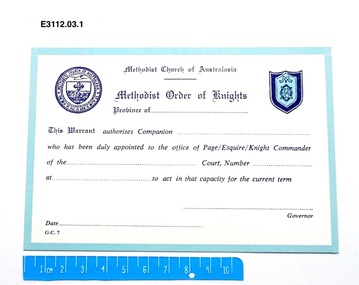 Uniting Church Archives - Synod of Victoria
Certificate - Methodist Order of Knights, Warrant
... Alex Bray was a Sunday School teacher and spoke to his class of the Knights of the Round Table. ...Alex Bray was a Sunday School teacher and spoke to his class of the Knights of the Round Table. ...The Methodist Order of Knights was the official youth organisation of the Methodist Church of Australasia. It originated in Hurstville, NSW, on the 4th October 1914 by the then Mr and later Rev Alex Bray. Alex Bray was a Sunday School teacher and spoke to his class of the Knights of the Round Table. In 1917 the Order of Knights was officially recognised by the Sunday School Dept of the NSW Methodist Conference. Courts spread thoroughout Australia. In 1927 the High Court of NSW called for designs for a badge and in 1929 the General Conference of the Methodist Church of Australasia recognised the Order as an approved Organisation. In 1938 the Senior Section was organised into Degrees of Sincerity, Service and Sacrifice; the Junior Section into Pages' Degree with advancement to Esquire. In 1954 the Junior Section was reorganised into two groups: Pages 8 to 11 years and Esquires 12 to 15 years. The Knight's Motto: "Live Pure, Speak True, Right Wrong, Follow Christ the King, else wherefore born?" Courts of the Order: General Conference Department of the Christian Education - General Court - Provincial High Court - District Court - Local Court - Senior Court - Intermediate Court - Junior Court . Regalia: All members of the Intermediate and Senior Courts wore regalia consisting of a cloth shield superimposed by a cross of light and dark blue ribbons, and supported by a cloth collar. Esquire and Degree of Sincerity regalia: White collar and white shield. Degree of Service regalia: Green collar and shield. Degree of Sacrifice: Scarlet collar and shield. District Court regalia: Blue collar and gold shield. High Court regalia: Gold collar and purple sheild. General Court regalia: Purple collar and shield. Officers of the local courts wore their symbols as part of their regalia.E3112.03.1 and E3112.03.2 Blank Companion warrant with emblems of the Methodist Church of Australasia and Methodist Order of Knights. The certificate has light blue edging. The card has the code G.C.7. E3112.03.3 Methodist Church of Australasia Victoria and Tasmania Conference Warrant card for Companion Page W Slingo of Belgrave Junior Court of the Mountains, 1964. E3112.03.4 Methodist Church of Australasia Victoria and Tasmania Conference Warrant card for Companion Esquire W Slingo.E3112.03.3 "Companion W. Slingo" "Belgrave Junior Court of the Mountains" "Bruce Collins" "10/4/64". E3112.03.4 "W.Slingo" "Belgrave Junior Court of the Mountains" "Brierson" "4/3/66".methodist order of knights, belgrave junior court of the mountains -
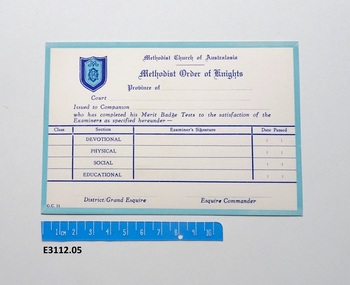 Uniting Church Archives - Synod of Victoria
Certificate - Methodist Order of Knights, Merit Badge Tests
... Alex Bray was a Sunday School teacher and spoke to his class of the Knights of the Round Table. ...Alex Bray was a Sunday School teacher and spoke to his class of the Knights of the Round Table. ...The Methodist Order of Knights was the official youth organisation of the Methodist Church of Australasia. It originated in Hurstville, NSW, on the 4th October 1914 by the then Mr and later Rev Alex Bray. Alex Bray was a Sunday School teacher and spoke to his class of the Knights of the Round Table. In 1917 the Order of Knights was officially recognised by the Sunday School Dept of the NSW Methodist Conference. Courts spread thoroughout Australia. In 1927 the High Court of NSW called for designs for a badge and in 1929 the General Conference of the Methodist Church of Australasia recognised the Order as an approved Organisation. In 1938 the Senior Section was organised into Degrees of Sincerity, Service and Sacrifice; the Junior Section into Pages' Degree with advancement to Esquire. In 1954 the Junior Section was reorganised into two groups: Pages 8 to 11 years and Esquires 12 to 15 years. The Knight's Motto: "Live Pure, Speak True, Right Wrong, Follow Christ the King, else wherefore born?" Courts of the Order: General Conference Department of the Christian Education - General Court - Provincial High Court - District Court - Local Court - Senior Court - Intermediate Court - Junior Court . Regalia: All members of the Intermediate and Senior Courts wore regalia consisting of a cloth shield superimposed by a cross of light and dark blue ribbons, and supported by a cloth collar. Esquire and Degree of Sincerity regalia: White collar and white shield. Degree of Service regalia: Green collar and shield. Degree of Sacrifice: Scarlet collar and shield. District Court regalia: Blue collar and gold shield. High Court regalia: Gold collar and purple sheild. General Court regalia: Purple collar and shield. Officers of the local courts wore their symbols as part of their regalia. E3112.05.1 - E3112.05.2: Three card certificates with the emblem of the Methodist Order of Knights. The certificate has light blue edging. The card has the code G.C. 11.methodist order of knights -
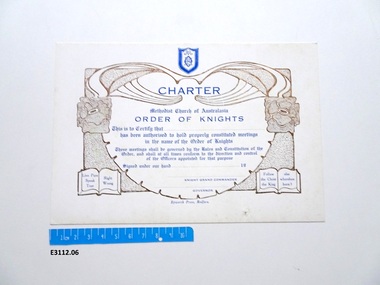 Uniting Church Archives - Synod of Victoria
Certificate - Order of Knights, Epworth Press, Charter
... Alex Bray was a Sunday School teacher and spoke to his class of the Knights of the Round Table. ...Alex Bray was a Sunday School teacher and spoke to his class of the Knights of the Round Table. ...The Methodist Order of Knights was the official youth organisation of the Methodist Church of Australasia. It originated in Hurstville, NSW, on the 4th October 1914 by the then Mr and later Rev Alex Bray. Alex Bray was a Sunday School teacher and spoke to his class of the Knights of the Round Table. In 1917 the Order of Knights was officially recognised by the Sunday School Dept of the NSW Methodist Conference. Courts spread thoroughout Australia. In 1927 the High Court of NSW called for designs for a badge and in 1929 the General Conference of the Methodist Church of Australasia recognised the Order as an approved Organisation. In 1938 the Senior Section was organised into Degrees of Sincerity, Service and Sacrifice; the Junior Section into Pages' Degree with advancement to Esquire. In 1954 the Junior Section was reorganised into two groups: Pages 8 to 11 years and Esquires 12 to 15 years. The Knight's Motto: "Live Pure, Speak True, Right Wrong, Follow Christ the King, else wherefore born?" Courts of the Order: General Conference Department of the Christian Education - General Court - Provincial High Court - District Court - Local Court - Senior Court - Intermediate Court - Junior Court . Regalia: All members of the Intermediate and Senior Courts wore regalia consisting of a cloth shield superimposed by a cross of light and dark blue ribbons, and supported by a cloth collar. Esquire and Degree of Sincerity regalia: White collar and white shield. Degree of Service regalia: Green collar and shield. Degree of Sacrifice: Scarlet collar and shield. District Court regalia: Blue collar and gold shield. High Court regalia: Gold collar and purple sheild. General Court regalia: Purple collar and shield. Officers of the local courts wore their symbols as part of their regalia. E3112.06.1 - E3112.06.3: Three card Methodist Church of Australasia Order of Knights Charter certificates. The card has the MOK symbol and a decorated border. methodist order of knights
