
Showing 5673 items matching " the king"
-
 Kerang Historical Society & Museum
Artwork, other - Royal Family picture
... King George V & Queen Elizabeth (Queen Mother)...King George V & Queen Elizabeth (Queen Mother) Artwork, other Royal Family picture ...King George V & Queen Elizabeth (Queen Mother) -
Warrnambool RSL Sub Branch
Photograph - Men Who Served for King and Country
... Men Who Served for King and Country...Men Who Served for King and Country...Warrnambool and District men who served for King and Country...In the centre is an inscription with 2 Australian Flags Men Who Served for King and Country Photograph Men Who Served for King and Country ...Large frame in dark wood with photos of of soldiers. In the centre is an inscription with 2 Australian FlagsWarrnambool and District men who served for King and Country -
Warrnambool RSL Sub Branch
Photograph - Warrnambool & District Men who served for King and Country 1914-1918
... Warrnambool & District Men who served for King and Country 1914-1918...Warrnambool & District Men who served for King and Country 1914-1918...Warrnambool and Districe men who served for the King and country....Warrnambool & District Men who served for King and Country 1914-1918 Photograph Warrnambool & District Men who served for King and Country 1914-1918 ...Large frame with dark wood frame. many photos if local servicemen. wording in the centre on a blue backgroung.Warrnambool and Districe men who served for the King and country. -
 Flagstaff Hill Maritime Museum and Village
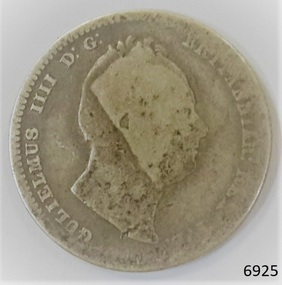
Currency - Coin, 1835
... ...king william iv currency...The obverse side of the coin’s inscription translation is “William IV by the Grace of God, King of the British territories, Defender of the Faith”. ...Silver coin, round. Obverse; King William IV bare head, looking right. Reverse; crown above denomination, surrounded by wreath, year below wreath. ...The obverse side of the coin’s inscription translation is “William IV by the Grace of God, King of the British territories, Defender of the Faith”. ...This Great Britain shilling is dated 1835. There were over 3 million of these coins minted during the reign of King William IV, 1830-1837. British coins such as this one shilling were in circulation in the colony of Australia until 1910, when the Commonwealth of Australia began producing its own coinage. This coin was minted by the Royal Mint at Royal Mint Court, in Little Tower Hill, London, England. Coins for circulation in the Kingdom of England, Great Britain and most of the British Empire were produced here until the 1960’s when the Royal Mint shifted location to Wales. The obverse side of the coin’s inscription translation is “William IV by the Grace of God, King of the British territories, Defender of the Faith”. The engraver of the obverse image was William Wyon. The reverse side’s inscription on the coin is translated " King of The British territories, Defender of the Faith” The engraver of the reverse image was Jean Baptiste Merlen. AUSTRALIAN CURRENCY The early settlers of Australia brought their own currency with them so a wide variety of coins, tokens and even ‘promissory’ notes (often called IOU’s) were used in the exchange of goods and services. In 1813 40,000 silver Spanish dollars, purchased by the English government, were delivered to Sydney to help resolve the currency problem reported by Governor Macquarie. The coins were converted for use by punching a hole in the centre of the coin. Both the outer ring, called the holey dollar, and the punched out ‘hole’, called the dump, were then used as the official currency. The holey dollars hold the place of being the first distinctively Australian coins. In 1825 the British Government passed the Sterling Silver Currency Act, making the British Pound the only legal form of currency in the Australian colonies. Not enough British currency was imported into the colony so other forms of currency were still used. In the mid 1800’s Australia entered the Gold Rush period when many made their fortunes. Gold was used for trading, often shaped into ingots, stamped with their weight and purity, and one pound tokens. In 1852 the Adelaide Assay Office, without British approval, made Australia’s first gold coin to meet the need for currency in South Australia after the Gold Rush began. In 1855 the official Australian Mint opened in Sydney, operating as a branch of the Royal Mint in London, and the gold was turned into coins called ‘sovereigns’. Other branches also opened in Melbourne and Perth. Up to the time of Australia becoming a federation in 1901 its currency included British copper and silver coins, Australian gold sovereigns, locally minted copper trade tokens, private banknotes, New South Wales and Queensland government treasury notes and Queensland government banknotes. After Federation the Australian government began to overwrite privately issued notes and prepared for the introduction of its own currency. In 1910 a National Australian Currency was formed, based on the British currency of ‘pounds, shillings and pence’ and the first Commonwealth coining was produced. In 1966, on February 14th, Australia changed over to the decimal currency system of dollars and cents. Australia did not have its own currency in the colonial times. Settlers brought money from other countries and they also traded goods such as grain when currency was scarce. For a long time there was no standardised value for the different currencies. In 1825 British currency became the only official currency in the colony of Australia and coins such as this silver shilling were imported into Australia to replace the mixture of foreign currency. Australia became a Federated nation on 1st January 1901. In 1910 National Australian Currency was formed and Australia produced its own currency, based on the British ‘pounds, shillings and pence’. The British currency was no longer valid. This silver shilling is of national significance as it represents the British currency used in Australia from 1825-1910. Coin, Great Britain shilling. 1835. Silver coin, round. Obverse; King William IV bare head, looking right. Reverse; crown above denomination, surrounded by wreath, year below wreath. Inscription on both sides.Obverse “GULIELMUS IIII D : G : BRITANNIAR : REX F : D :” Reverse “ONE SHILLING” and “1835” flagstaff hill, warrnambool, shipwrecked coast, flagstaff hill maritime museum, maritime museum, shipwreck coast, flagstaff hill maritime village, great ocean road, coin, currency, money, legal tender, australian currency history, royal mint, great britain shilling 1835, king william iv currency, colonial australia currency, william wyon, jean baptiste merlen, numismatics -
 Flagstaff Hill Maritime Museum and Village
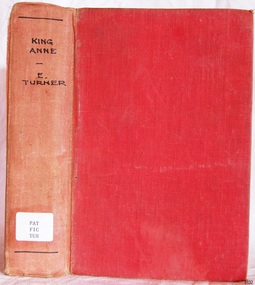
Book, King Anne
... King Anne......king anne...King Anne Author: Ethel Turner Publisher: Ward Lock & Co Date: 1921...The Warrnambool Mechanics' Institute’s publication collection is of both local and state significance. warrnambool shipwrecked-coast flagstaff-hill flagstaff-hill-maritime-museum maritime-museum shipwreck-coast flagstaff-hill-maritime-village shipwrecked-artefact book pattison collection warrnambool library warrnambool mechanics’ institute ralph eric pattison corangamite regional library service warrnambool city librarian mechanics’ institute library victorian library board warrnambool books and records warrnambool children’s library great ocean road king anne ethel turner Label on spine cover with typed text PAT FIC TUR Pastedown front endpaper has sticker from Warrnambool Children’s Library covered by a sticker from Corangamite Regional Library Service Insider front loose endpaper has a stamp from Warrnambool Mechanics Institute King Anne Author: Ethel Turner Publisher: Ward Lock & Co Date: 1921 King Anne Book ...This item is from the ‘Pattison Collection’, a collection of books and records that was originally owned by the Warrnambool Mechanics’ Institute, which was founded in Warrnambool in 1853. By 1886 the Warrnambool Mechanics’ Institute (WMI) had grown to have a Library, Museum and Fine Arts Gallery, with a collection of “… choice productions of art, and valuable specimens in almost every branch and many wonderful national curiosities are now to be seen there, including historic relics of the town and district.” It later included a School of Design. Although it was very well patronised, the lack of financial support led the WMI in 1911 to ask the City Council to take it over. In 1935 Ralph Pattison was appointed as City Librarian to establish and organise the Warrnambool Library as it was then called. When the WMI building was pulled down in 1963 a new civic building was erected on the site and the new Warrnambool Library, on behalf of the City Council, took over all the holdings of the WMI. At this time some of the items were separated and identified as the ‘Pattison Collection’, named after Ralph Pattison. Eventually the components of the WMI were distributed from the Warrnambool Library to various places, including the Art Gallery, Historical Society and Flagstaff Hill. Later some were even distributed to other regional branches of Corangamite Regional Library and passed to and fro. It is difficult now to trace just where all of the items have ended up. The books at Flagstaff Hill Maritime Village generally display stamps and markings from Pattison as well as a variety of other institutions including the Mechanics’ Institute itself. RALPH ERIC PATTISON Ralph Eric Pattison was born in Rockhampton, Queensland, in 1891. He married Maude Swan from Warrnambool in 1920 and they set up home in Warrnambool. In 1935 Pattison accepted a position as City Librarian for the Warrnambool City Council. His huge challenge was to make a functional library within two rooms of the Mechanics’ Institute. He tirelessly cleaned, cleared and sorted a disarrayed collection of old books, jars of preserved specimens and other items reserved for exhibition in the city’s museum. He developed and updated the library with a wide variety of books for all tastes, including reference books for students; a difficult task to fulfil during the years following the Depression. He converted all of the lower area of the building into a library, reference room and reading room for members and the public. The books were sorted and stored using a cataloguing and card index system that he had developed himself. He also prepared the upper floor of the building and established the Art Gallery and later the Museum, a place to exhibit the many old relics that had been stored for years for this purpose. One of the treasures he found was a beautiful ancient clock, which he repaired, restored and enjoyed using in his office during the years of his service there. Ralph Pattison was described as “a meticulous gentleman whose punctuality, floorless courtesy and distinctive neat dress were hallmarks of his character, and ‘his’ clock controlled his daily routine, and his opening and closing of the library’s large heavy doors to the minute.” Pattison took leave during 1942 to 1945 to serve in the Royal Australian Navy, Volunteer Reserve as Lieutenant. A few years later he converted one of the Museum’s rooms into a Children’s Library, stocking it with suitable books for the younger generation. This was an instant success. In the 1950’s he had the honour of being appointed to the Victorian Library Board and received more inspiration from the monthly conferences in Melbourne. He was sadly retired in 1959 after over 23 years of service, due to the fact that he had gone over the working age of council officers. However he continued to take a very keen interest in the continual development of the Library until his death in 1969. WARRNAMBOOL'S MECHANICS' INSTITUTE Warrnambool's Mechanics' Institute (or Institution as it was sometimes called) was one of the earliest in Victoria. On 17th October 1853 a meeting was held where it was resolved to request the Lieutenant Governor of the Colony to grant land for the erection of a Mechanics' Institutes building. A committee was formed at the meeting and Richard Osburne chaired the first meeting of this committee. The land on the North West corner of Banyan and Merri Streets was granted but there were no funds to erect the building. The Formal Rights of the Warrnambool Mechanics' Institute's encompassed its aims and these were officially adopted in1859; "This Institution has for its object the diffusion of literary, scientific, and other useful knowledge amongst its members, excluding all controversial subjects, religious or political. These objects are sought to be obtained by means of a circulating library, a reading room, the establishment of classes, debates, and the occasional delivery of lectures on natural and experimental philosophy, mechanics, astronomy, chemistry, natural history, literature, and the useful and ornamental arts, particularly those which have a more immediate reference to the colony." The Warrnambool Mechanics' Institute opened its first reading room in November1884 in the National School building at the corner of Banyan and Timor Streets. The Institute was funded by member subscription, payable on a quarterly, half yearly or yearly basis. Samuel Hannaford, the Manager of the Warrnambool Bank of Australasia, was the first Honorary Secretary of the Mechanics' Institutes, and an early President and Vice-President. He also gave several of the early lectures in the Reading Room. Another early Secretary, Librarian and lecturer was Marmaduke Fisher, the teacher at the National School. Lecture topics included The Poets and Poetry of Ireland', 'The Birth and Development of the Earth', 'The Vertebrae - with Remarks on the pleasures resulting from the study of Natural History' and 'Architecture'. In 1856 the Reading Room was moved to James Hider's shop in Timor Street, and by 1864 it was located in the bookshop of Davies and Read. In the 1860's the Mechanics' Institute struggled as membership waned but in 1866, after a series of fund raising efforts, the committee was able to purchase land in Liebig Street, on a site then called Market Square, between the weighbridge and the fire station. A Mechanics' Institute building was opened at this site in August 1871. The following year four more rooms were added to the main Reading Room and in 1873 the Artisan School of Design was incorporated into the Institute. The same year Joseph Archibald established a Museum; however it deteriorated when he was transferred to Bendigo in 1877. In 1880, with Archibald's return to Warrnambool, the Museum was re-established, and in 1885 a new building was built at the back of the Institute to accommodate the re-created School of Design, the Art Gallery and the Museum. In 1887 the Museum section was moved to the former court house in Timor Street (for some time the walls of the building formed part of the TAFE cafeteria but all is now demolished)). In 1911 the Museum was transferred back to the original building and the management of the Mechanics' Institute was handed over to the Warrnambool City Council. The Museum and Art Gallery became one and housed many fine works of art, and the Library continued to grow. The building was well patronised, with records showing that at the beginning of the 20th century there were between 500 and 800 visitors. During World War One the monthly figures were in the thousands, with 3,400 people visiting in January 1915. The Museum was a much loved Institution in Warrnambool until the contents of the Museum and Art Gallery were removed to make room for the Warrnambool City Council Engineers' Department. The contents were stored but many of the items were scattered or lost. When the original building was demolished the site became occupied by the Civic Centre, which included the new City Library. (The library was temporarily located in the old Palais building in Koroit Street.) In the process of reorganisation the Collection was distributed amongst the community groups: -The new City Library took some of the historic books and some important documents, historic photographs and newspapers. -The Art Gallery kept the 19th Century art collection and some of the artefacts from the museum. -The Historic Society has some items -The State Museum has some items -Some items were destroyed -Flagstaff Hill Maritime Village has old newspapers, Government Gazettes, most of the Mechanics' Institute Library, ledgers and documents connected to the Mechanics' Institute Library, some framed and unframed art works and some photographs. The Warrnambool Mechanics' Institute Library book collection is deemed to be of great importance because it is one of the few collections in an almost intact state, and many of the books are now very rare and of great value. Ethel Mary Turner Ethel Turner (25th January 1872 – 8th April 1958) was an English-born Australian novelist and children's literature writer. She was born Ethel Mary Burwell in Doncaster in England. Her father died when she was two, leaving her mother Sarah Jane Burwell with two daughters (Ethel and Lillian). A year later, Ethel’s mother married Henry Turner, who was 20 years older and had six children of his own. Sarah Jane and Henry had a daughter, Rose. Henry Turner died suddenly, leaving Sarah Jane with nine children and little income. In 1879 Sarah Jane moved to Australia with Ethel, Lillian, and Rose; within the next two years she married Charles Cope and gave birth to his son Rex. Ethel Turner was educated at Paddington, New South Wales Public School and Sydney Girls High School she was one of the school's original thirty-seven pupils. Ethel started her writing career at eighteen, founding the Parthenon, a journal for young people, with her sister Lillian. Writing as “Dame Durden”, she wrote children's columns for the Illustrated Sydney News and later for the Australian Town and Country Journal. In 1891 the family moved to Woodlands, a large house in Lindfield, now Killara, which was then out in the country. Woodlands still stands today in Werona Avenue and is where she wrote “Seven Little Australians”. In 1896 Ethel married Herbert Curlewis, a lawyer. After living in Mosman, they built their own house overlooking Middle Harbour. The house, Avenel, is where Ethel Turner spent the rest of her years. She survived her daughter Jean Curlewis, who died of tuberculosis, by 28 years. Jean was also a writer of children's books, although not as popular as her mother. Jean's works include “The Ship That Never Set Sail”, “Drowning Maze”, and “Beach Beyond (1923)”. Her son Adrian, was a Barrister, Captain in WW2 and a Changi and Thai-Burma Railway POW and later a Judge. Ethel Turner died at Mosman on 8 April 1958 at 85. She is buried at Macquarie Park Her best-known work is her first novel, Seven Little Australians (1894), which is widely considered a classic of Australian children's literature and was an instant hit both in Australia and overseas. It is about a family of seven children growing up in Australia. The book, together with its sequels “The Family at Misrule” (1895) and “Little Mother Meg” (1902) that deal with the lives of the Wolcott family, particularly with its seven mischievous children in 1880s Australia. A companion to "Seven Little Australians", “Judy and Punch” was published in 1928. Like her stepfather, the character of Captain Woollcott was a widower with six children. The book was made into a feature film in Australia in 1939 and a UK television series in 1953. A 10-episode television series was made in 1973 by the Australian Broadcasting Corporation. Turner published a number of other books for children, short stories and poems. “Three Little Maids” (1900) is a strongly autobiographical novel about her family's migration from England to Sydney, Australia. Turner wrote more than forty novels. Some were about the mischievous Wolcott’s. Others were serialized, like her books on "the Cub", and some were stand-alone. The children she wrote about were all adventurous and independent. They frequently got themselves into sticky situations and got themselves out of them with very little to no adult help. Turner was awarded a number of prestigious literary awards and could be considered one of Australia's best-loved authors. She is listed on The Australian Women's Register. The Ethel Turner Prize for Young People's Literature is given annually under the auspices of the New South Wales Premier's Literary Awards. Ref Ethel Mary Turner, Biography: https://en.wikipedia.org/wiki/Ethel_Turner The Pattison Collection, along with other items at Flagstaff Hill Maritime Village, was originally part of the Warrnambool Mechanics' Institute’s collection. The Warrnambool Mechanics’ Institute Collection is primarily significant in its totality, rather than for the individual objects it contains. Its contents are highly representative of the development of Mechanics' Institute libraries across Australia, particularly Victoria. A diversity of publications and themes has been amassed, and these provide clues to our understanding of the nature of and changes in the reading habits of Victorians from the 1850s to the middle of the 20th century. The collection also highlights the Warrnambool community’s commitment to the Mechanics’ Institute, reading, literacy and learning in the regions, and proves that access to knowledge was not impeded by distance. These items help to provide a more complete picture of our community’s ideals and aspirations. The Warrnambool Mechanics Institute book collection has historical and social significance for its strong association with the Mechanics Institute movement and the important role it played in the intellectual, cultural and social development of people throughout the latter part of the nineteenth century and the early twentieth century. The collection of books is a rare example of an early lending library and its significance is enhanced by the survival of an original collection of many volumes. The Warrnambool Mechanics' Institute’s publication collection is of both local and state significance. King Anne Author: Ethel Turner Publisher: Ward Lock & Co Date: 1921Label on spine cover with typed text PAT FIC TUR Pastedown front endpaper has sticker from Warrnambool Children’s Library covered by a sticker from Corangamite Regional Library Service Insider front loose endpaper has a stamp from Warrnambool Mechanics Institutewarrnambool, shipwrecked-coast, flagstaff-hill, flagstaff-hill-maritime-museum, maritime-museum, shipwreck-coast, flagstaff-hill-maritime-village, shipwrecked-artefact, book, pattison collection, warrnambool library, warrnambool mechanics’ institute, ralph eric pattison, corangamite regional library service, warrnambool city librarian, mechanics’ institute library, victorian library board, warrnambool books and records, warrnambool children’s library, great ocean road, king anne, ethel turner -
 Bendigo Historical Society Inc.
Document - ANCIENT ORDER OF FORESTERS NO. 3770 COLLECTION: CORRESPONDENCE
... ... Court King of the Forest...On his list of Court King of the Forest....On his list of Court King of the Forest. Document ANCIENT ORDER OF FORESTERS NO. 3770 COLLECTION: CORRESPONDENCE ...Note from H. L. Atkinson accepting ? On his list of Court King of the Forest.societies, aof, correspondence, ancient order of foresters no. 3770 collection - correspondence, court king of the forest, h atkinson -
 Running Rabbits Military Museum operated by the Upwey Belgrave RSL Sub Branch
Silver Jubilee Booklet
... King George V and Queen Mary-May 6th 1910 to May 6th 1935....Ephemera King George V and Queen Mary-May 6th 1910 to May 6th 1935. ...King George V and Queen Mary-May 6th 1910 to May 6th 1935.ephemera -
 Buninyong & District Historical Society
Photograph - Colour photo, lunch crowd, Botanic Gardens, Buninyong Gold King Festival, 1982, Lunch crowd, Botanic Gardens, Buninyong Gold King Festival, 1982
... Colour photo, lunch crowd, Botanic Gardens, Buninyong Gold King Festival, 1982, ...Lunch crowd, Botanic Gardens, Buninyong Gold King Festival, 1982....Gold King Festival...Colour photo, Lunch crowd, Botanic Gardens, Buninyong Gold King Festival, 1982...Events Gold King Festival De Soza Park Luncheon Colour photo, Lunch crowd, Botanic Gardens, Buninyong Gold King Festival, 1982 Lunch crowd, Botanic Gardens, Buninyong Gold King Festival, 1982. ...EventsColour photo, Lunch crowd, Botanic Gardens, Buninyong Gold King Festival, 1982gold king festival, de soza park, luncheon -
Port Melbourne Historical & Preservation Society
Certificate - King's Silver Jubilee Medal, May 1935
... Photocopy of the certificate accompanying the King's Silver Jubilee medal, dated 6 May 1935...industry - manufacturing business and traders - soaps/candles memorials and presentations kitchen a j j kitchen & sons pty ltd sir alexander hore-ruthven Photocopy of the certificate accompanying the King's Silver Jubilee medal, dated 6 May 1935 Certificate King's Silver Jubilee Medal ...Photocopy of the certificate accompanying the King's Silver Jubilee medal, dated 6 May 1935industry - manufacturing, business and traders - soaps/candles, memorials and presentations, kitchen a j, j kitchen & sons pty ltd, sir alexander hore-ruthven -
Port Melbourne Historical & Preservation Society
Audio - Theatres in Port Melbourne, Ross King, 22 Sep 2008
... Theatres in Port Melbourne, Ross King......Ross King...Ross King from Cinema and Theatre Historical Society discussing theatres in Port Melbourne....Audio Theatres in Port Melbourne, Ross King ...Ross King from Cinema and Theatre Historical Society discussing theatres in Port Melbourne.Duration 01:04:22built environment - recreational facilities, arts and entertainment - film/cinema, cinema and theatre historical society, ross king -
 Stawell Historical Society Inc
Book, Dr. Ian Clark, Vol 1. A History of the Djabwurrung, 1836-1901, 2016
... Purple card cover with B/W photograph of King William Mt Cole Tribe...Purple card cover with B/W photograph of King William Mt Cole Tribe Vol 1. A History of the Djabwurrung, 1836-1901 Book Dr. ...This is the first volume of a three-part series on the history of the Djabwururrung Aboriginal People of western VictoriaPurple card cover with B/W photograph of King William Mt Cole TribeVertically on Left: Dr Ian D. Calrk 'We are all of one blood' - A History of the Djabwurrung Aboriginal People of Western Victoria, 1836-1901 Across teh Bottom: Vol 1 A History of the Djaburrung, 1836 -1901.stawell aboriginal -
Clunes Museum
Poster - SOUVENIR POSTERS
... ILLUSTRATED LONDON NEWS SPECIAL PANORAMA EDITION - CORONATION OF KING GEORGE AND QUEEN ANNE...LOCAL HISTORY POSTERS EVENTS AND CELEBRATIONS CORONATIONS ILLUSTRATED LONDON NEWS SPECIAL PANORAMA EDITION - CORONATION OF KING GEORGE AND QUEEN ANNE Poster SOUVENIR POSTERS ...ILLUSTRATED LONDON NEWS SPECIAL PANORAMA EDITION - CORONATION OF KING GEORGE AND QUEEN ANNElocal history, posters, events and celebrations, coronations -
Lakes Entrance Historical Society
Map - Nungurner to Lakes Entrance, Dept of Lands and Survey
... Shows Bumberrah, Lake King, Nungurner, Boole Poole. Reeves River, Township of Colquhoun...Waterways Township Settlement Shows Bumberrah, Lake King, Nungurner, Boole Poole. Reeves River, Township of Colquhoun Map Nungurner to Lakes Entrance Dept of Lands and Survey ...Shows Bumberrah, Lake King, Nungurner, Boole Poole. Reeves River, Township of Colquhounwaterways, township, settlement -
 Lakes Entrance Historical Society
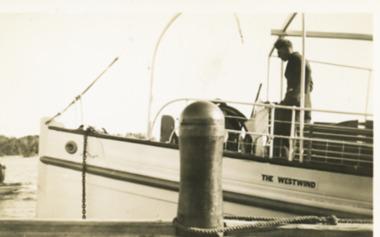
Photograph - MV Westwind, 1940 c
... Black and white photographs of M V Westwind at wharf Lakes Entrance and on Lake King...Waterways Wharfs Boats and Boating Black and white photographs of M V Westwind at wharf Lakes Entrance and on Lake King Photograph MV Westwind ...Black and white photographs of M V Westwind at wharf Lakes Entrance and on Lake Kingwaterways, wharfs, boats and boating -
 Moorabbin Air Museum
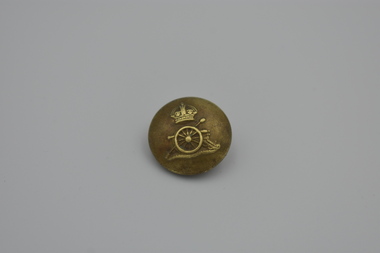
Uniform (item) - Military Uniform Button, Royal Artillery, with King's Crown (Tudor Crown) 12mm Dia
... Military Uniform Button, Royal Artillery, with King's Crown (Tudor Crown) 12mm Dia....Manufactured by Smith& Wright Ltd Birmingham Military Uniform Button, Royal Artillery, with King's Crown (Tudor Crown) 12mm Dia. Military Uniform Button, Royal Artillery, with King's Crown (Tudor Crown) 12mm Dia. ...Manufactured by Smith& Wright Ltd Birmingham -
 City of Greater Geelong
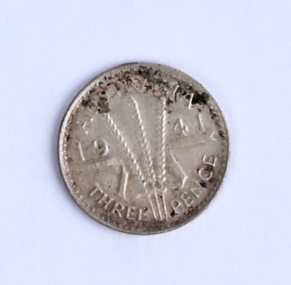
Coin - Three Pence, Melbourne Mint, 1941
... Silver coin featuring King George VI on the front and three stalks of wheat on the back....Miller Coin Three Pence Melbourne Mint AUSTRALIA / 1941 / THREE PENCE / Silver coin featuring King George VI on the front and three stalks of wheat on the back. ...This 1941 three pence coin was found stuck between the base plate and horse number #10 during restoration works on 29th June 1997. The Steampacket Place Development Board, a joint team formed by the Victorian State Government and the City of Greater Geelong undertook the $30 million revitalisation of the entire Geelong Waterfront from 1995 to 2000. As part of the revitalisation, in August 1996, the Steampacket Place Development Board purchased an unrestored Armitage-Herschell portable steam-driven carousel to restore and locate as a major feature on the revitalised waterfront. The Carousel was manufactured around 1892 by the Armitage-Herschell company of New York. The Carousel operated on the Mordialloc Pier from the 1920s to the 1950s. Twenty-four of the 36 horses are original, and believed to be rare examples hand-carved by the American master, Charles Dare. Each horse took 300 hours to restore, with intricate carving, coating, filling, sanding, smoothing, painting and varnishing.Silver coin featuring King George VI on the front and three stalks of wheat on the back.AUSTRALIA / 1941 / THREE PENCE /carnival, merry go-round, horses, carousel, geelong, restoration, ephemera, miller, rides, mordialloc, j. j. miller, coin, three pence, melbourne mint -
Whitehorse Historical Society Inc.
Article, Crowning Glory for Performer, 2014
... Blackburn North's Bianca Baykara chosen to perform in 'The King and I' in Brisbane and Melbourne(photo)....Blackburn North's Bianca Baykara chosen to perform in 'The King and I' in Brisbane and Melbourne(photo). ...Blackburn North's Bianca Baykara chosen to perform in 'The King and I' in Brisbane and Melbourne(photo).Blackburn North's Bianca Baykara chosen to perform in 'The King and I' in Brisbane and Melbourne(photo).Blackburn North's Bianca Baykara chosen to perform in 'The King and I' in Brisbane and Melbourne(photo).baykara, bianca, princess theatre melbourne -
 Tennis Australia
Book, 1974
... Book: 'BILLIE JEAN KING: THE LADY OF THE COURT'. Hardcover. Materials: Ink, Paper, Cardboard...Tennis Book: 'BILLIE JEAN KING: THE LADY OF THE COURT'. Hardcover. Materials: Ink, Paper, Cardboard Book ...Book: 'BILLIE JEAN KING: THE LADY OF THE COURT'. Hardcover. Materials: Ink, Paper, Cardboardtennis -
 Tarnagulla History Archive
Photograph, Commercial Road, Tarnagulla, early 1990s
... A colour photograph depicting Commercial Road, near King Street in Tarnagulla. Original photograph. ...A colour photograph depicting Commercial Road, near King Street in Tarnagulla. Original photograph. ...Donald Clark Collection. A colour photograph depicting Commercial Road, near King Street in Tarnagulla. Original photograph. -
 Rutherglen Historical Society
Photograph - Image, 1920 (Approximate)
... lake king...Photograph of Lake King in Rutherglen Park. Sepia Toned, mounted on dark grey cardboard ...lake king rutherglen Photograph of Lake King in Rutherglen Park. ...Photograph of Lake King in Rutherglen Park. Sepia Toned, mounted on dark grey cardboard lake king, rutherglen -
4th/19th Prince of Wales's Light Horse Regiment Unit History Room
Medal, King George VI Coronation Medal
... King George VI Coronation Medal...The King George VI Coronation Medal was a commemorative medal made to celebrate the coronation of King George VI and Queen Elizabeth. ...Featured on the obverse are the conjoined effigies of King George VI and Queen Elizabeth, crowned and robed, facing left. ...The King George VI Coronation Medal was a commemorative medal made to celebrate the coronation of King George VI and Queen Elizabeth. ...The King George VI Coronation Medal was a commemorative medal made to celebrate the coronation of King George VI and Queen Elizabeth. For Coronation and Jubilee medals, the practice up until 1977 was that United Kingdom authorities decided on a total number to be produced, then allocated a proportion to each of the Commonwealth countries and Crown dependencies and possessions. The award of the medals was then at the discretion of the local government authority, who were free to decide who got a medal and why. A total of 90,279 medals were issued, including 6,887 to Australians 10,089 to CanadiansObject is a miniature. Description of full size medal: A circular, silver medal, 1.25 inches in diameter. Featured on the obverse are the conjoined effigies of King George VI and Queen Elizabeth, crowned and robed, facing left. The rim is not raised on this medal and there is no legend. The Royal Cypher GRI appears on the reverse, surmounted by a large crown, with the inscription CROWNED / 12 May 1937 below the Royal Cypher in tow lines. Around the rim of the medal is the inscription: GEORGE VI QVEEN ELIZABETH (a V in Queen rather than a U). The garter-blue ribbon is 1.25 inches (32 mm) wide; with a narrow (0.25 inch) band consisting of three equal widths of white, red, and white, at each edge.nil -
 Wodonga & District Historical Society Inc
Certificate - World War II Volunteer Air Observers Corps Certificate of Appreciation, Royal Australian Air Force, 1945
... The design includes 2 aircraft and a man and woman positioned between with the Union Jack and the Australian flag in the top section above the Royal Australian Air Force insignia and the words "For King and Country" Dark cream columns with a pale blue surround frame the details on the certificate. 3 one Years service stickers are attached at the bottom above the insignia of the Volunteer Air Observers Corps....For King and Empire Presented to Mrs H. Penfold by the ROYAL AUSTRALIAN AIR FORCE As a record and in appreciation of patriotic response to the call of country by serving in the VOLUNTEER AIR OBSERVERS CORPS This 20th day of September 1945 signed G. ...Volunteer Air Observers Corps VAOC Civilians in WW2 Hamilton-Smith Collection For King and Empire Presented to Mrs H. Penfold by the ROYAL AUSTRALIAN AIR FORCE As a record and in appreciation of patriotic response to the call of country by serving in the VOLUNTEER AIR OBSERVERS CORPS This 20th day of September 1945 signed G. ...The Volunteer Air Observers Corps (VAOC) was a civil defence formed on 31st December 1941 as part of the Royal Australian Air Force (RAAF) support during World War II. The VAOC rapidly developed observation posts manned by men and women all over Australia, the main purpose being to identify and report any aircraft movement to an RAAF regional base. During the early days of 1942 the posts were manned 24 hours a day, gradually relaxing as the threat to Australia lessened. All members were continually trained in aircraft identification and provided an invaluable service to the RAAF. The VAOC was disbanded in April 1946. During its operation over 2,600 observations posts were maintained and approximately 25,000 personnel served. These certificates were presented to Mrs. H (Hazel) Penfold and Mr. A. R. (Alexander Rex) Penfold in recognition of 3 years of service during this period. Hazel was the daughter of Mark Ellwood and Rosina Mary Smale and the older sister of Grace, wife of John Hamilton-Smith. The family of Grace and John Hamilton-Smith have donated many items to the Wodonga & District Historical Society. This item commemorates one of the important roles played by civilians on a local, state and national level during WW2 and is attached to a local Wodonga family.2 coloured certificates on cream paper. The design includes 2 aircraft and a man and woman positioned between with the Union Jack and the Australian flag in the top section above the Royal Australian Air Force insignia and the words "For King and Country" Dark cream columns with a pale blue surround frame the details on the certificate. 3 one Years service stickers are attached at the bottom above the insignia of the Volunteer Air Observers Corps.For King and Empire Presented to Mrs H. Penfold by the ROYAL AUSTRALIAN AIR FORCE As a record and in appreciation of patriotic response to the call of country by serving in the VOLUNTEER AIR OBSERVERS CORPS This 20th day of September 1945 signed G. Jones Air Vice Marshall Chief of Air Staff signed ? Unit Commanding Officer volunteer air observers corps, vaoc, civilians in ww2, hamilton-smith collection -
 Lara RSL Sub Branch
Newspaper - U. K. Evening Mail Newspaper Dated 8/5.1945 - V E Day - Victorious Londoners Call For Their king and Queen, U. K. Evening Mail Newspaper Dated 8/5.1945
... Evening Mail Newspaper Dated 8/5.1945 - V E Day - Victorious Londoners Call For Their king and Queen... V E Day - Victorious Londoners Call For Their king and Queen...V E Day - Victorious Londoners Call For Their king and Queen u. k. evening mail newspaper dated 8/5.1945 V E Day - Victorious Londoners Call For Their king and Queen U. ...V E Day - Victorious Londoners Call For Their king and QueenU. K. Evening Mail Newspaper Dated 8/5.1945 V E Day - Victorious Londoners Call For Their king and Queenu. k. evening mail newspaper dated 8/5.1945 -
 Ringwood and District Historical Society
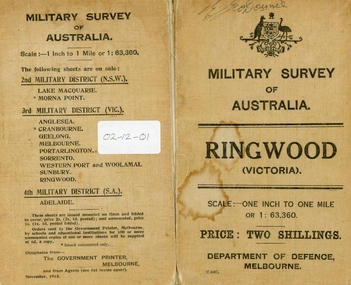
Map, Commonwealth Department of Defence, Military Survey map of Ringwood, 1916, Jun-16
... L.Hutchins, 16 King's Rd. Marysville 3779. Received by postpak...Map prepared by Commonwealth Section Imperial General Staff given to Ringwood Historical Society L.Hutchins, 16 King's Rd. Marysville 3779. Received by postpak Military Survey map of Ringwood +Additional Keywords: Hutchins,L Military Survey map of Ringwood, 1916 Map Commonwealth Department of Defence ...Map prepared by Commonwealth Section Imperial General Staff given to Ringwood Historical SocietyMilitary Survey map of Ringwood +Additional Keywords: Hutchins,LL.Hutchins, 16 King's Rd. Marysville 3779. Received by postpak -
 Bendigo Military Museum
Photograph - PHOTOGRAPH WW1, C.1914 - 1918
... On front of card, “For King and Country”, on rear of photo, “To Sarah from Will”....Photographs WW1 On front of card, “For King and Country”, on rear of photo, “To Sarah from Will”. ...The names of the two soldiers is unknown at this time.Photograph and card, photo B & W showing one soldier standing and one sitting, both holding crops, rear is studio background showing tents. The card has two colour crossed flags with text under. on rear of the photo is text in black pen, both set behind gold coloured card.On front of card, “For King and Country”, on rear of photo, “To Sarah from Will”.photographs, ww1 -
 4th/19th Prince of Wales's Light Horse Regiment Unit History Room
Weapon - Bayonet, Sword bayonet and scabbard. Pattern 1907 for SMLE .303 Rifle 43 cm blade
... WILKINSON, King's Crown, 1007, 11, 18, Inspection stamps...Type of equipment used by the Regiment bayonet 303 WILKINSON, King's Crown, 1007, 11, 18, Inspection stamps Sword bayonet and scabbard, Pattern 1907 for SMLE .303" Rifle, 43 cm blade Sword bayonet and scabbard. ...Type of equipment used by the RegimentSword bayonet and scabbard, Pattern 1907 for SMLE .303" Rifle, 43 cm bladeWILKINSON, King's Crown, 1007, 11, 18, Inspection stampsbayonet, 303 -
 Bendigo Historical Society Inc.
Photograph - UNKNOWN FAMILY COLLECTION: PHOTOGRAPH
... William F.Bond, Landscape Photo Artist, King St.West Bendigo....William F.Bond, Landscape Photo Artist, King St.West Bendigo. Photograph - black and white - Portrait of looks like mum and 2 girls and 2 boys standing outside the front of their home. ...Photograph - black and white - Portrait of looks like mum and 2 girls and 2 boys standing outside the front of their home. The home is weatherboard, chimney, grape vine on front verandah.William F.Bond, Landscape Photo Artist, King St.West Bendigo.person, family, family, unknown family. woman and 4 children. -
 Bendigo Military Museum
Badge - SERVICES RENDERED WW1
... Inscribed "For King and Empire". "Services Rendered" GRI inscription in middle....Silver War Badge WW1 Invalidity Inscribed "For King and Empire". "Services Rendered" GRI inscription in middle. ...Silver War Badge issued where service personnel had been given an 'Honourable Discharge' due to wounds or sickness from Military Service in WW1.Silver War badge with GRI in middle and unique No on the back and inscription around the rim. Clip on the back for pin which is missing.Inscribed "For King and Empire". "Services Rendered" GRI inscription in middle.silver war badge, ww1, invalidity -
 Warrnambool and District Historical Society Inc.
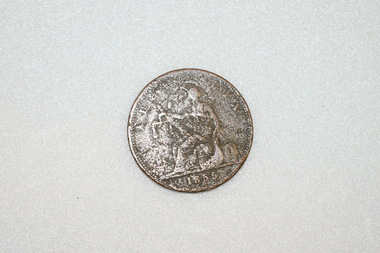
Token, A Toogood Merchant King & Pitt St Sydney 1855, 1855
... A Toogood Merchant King & Pitt St Sydney 1855... AUSTRALIA I855 A TOOGOOD MERCHANT PITT AND KING ST SYDNEY ...This token is of minor interest as an example of a New South Wales token penny. token pennies warrnambool AUSTRALIA I855 A TOOGOOD MERCHANT PITT AND KING ST SYDNEY Circular copper coloured token. ...This is a token to the value of a penny. It was issued by Alfred Toogood who had an hotel in Sydney called The Rainbow Tavern. Many shop keepers and merchants in Australia in the 1850s issued tokens because of the shortage of British pennies. Tokens could only be used in the business premises of the person whose name was on the token. Warrnambool in the 1850s had two businesses issuing tokens, one was issued by William Bateman who had a general store in Banyan Street. The other was William Jamieson who had a hardware store in Liebig Street. Nineteenth century tokens today are highly collectable items.This token is of minor interest as an example of a New South Wales token penny.Circular copper coloured token. The obverse features an image of a female representative of the scales of justice. he reverse features the details of the person issuing the token AUSTRALIA I855 A TOOGOOD MERCHANT PITT AND KING ST SYDNEY token pennies, warrnambool
