
Showing 876 items matching "a hay"
-
 Stawell Historical Society Inc
Photograph, Photo Collection Claude Smith & Eileen Coppin
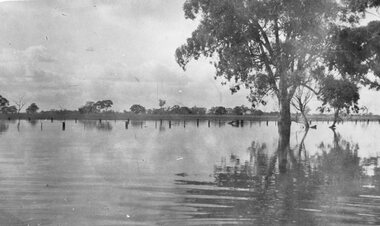
... Several people in background. 1923 -57 5 draught horses abreast, pulling a farm implement with a man by the implement. -58 2 hay stacks shaped with high pitch A man and a fence in the foreground -59 Huge log of wood on a 4 wooden wheeled carrier -60 4 people standing on the spillover on the Little Wimmera -61 car with a woman driver, holding a young child. ...Several people in background. 1923 -57 5 draught horses abreast, pulling a farm implement with a man by the implement. -58 2 hay stacks shaped with high pitch A man and a fence in the foreground -59 Huge log of wood on a 4 wooden wheeled carrier -60 4 people standing on the spillover on the Little Wimmera -61 car with a woman driver, holding a young child. ...Black and White Photographic Collection of Various Sizes 7235 Piles of Wheat Baggs -1 Family Group in garden -2 David George & Thomas -3 Arch Maher (front) and George Baylie Carting Wool from PinGrove, around 1915. Page 6 Book Warranook to Wal Wal -4 Home manufactured Tractor Wheel -5 Three ladies 1920’s -6 Picnic -7 Two Girls -8 Sheering Shed -9 Farmhouse with garden -10 Group of men possibly football team -11 Farmhouse -12 War Memorial Stawell with Weigh Bridge and Coffee Palace -13 Car crossing creek -14 Gathering at Wal Wal school -15 Accommodation on wheels -16 4 people standing around a car Perhaps changing a wheel -17 Team of 7 horses drawing a buggy of bagged wheat- -18 Flooded Mt William Creek with shed involvement -19 Group of men dressed in football clothes 2 umpires dressed in white on the R -20 4 people playing tennis -21 Man dressed in a suit and hat teeing off a golf shot -22 a man, a woman and a child near a steam driven timber mill -23 suited men watching a tractor ploughing -24 a weatherboard building on elevated stumps, possibly just been placed there -25 2 coated men pushing a bogged open tourer car -26 a tractor pulling a plough with suited men on both -27 large pile of bagged grain at a railway siding -28 2 women dressed in long clothing -29 a woman and a boy on a veranda -30 a smiling formally dressed woman holding a box -31 probable small weir in a dry river bed -32 Man in army uniform with 1920s tourer car with roof up -33 Man on platform of railway siding He is holding a hoop -34 studio photo of young girl -35 Large pile of bagged wheat at a railway siding -36 Half of a house on a bridge -37 Hatted woman on a horse -38 large group of formally dressed people outside Wal Wal school -39 1930s utility with 2 boys on bumper bar Headlights blacked out in early 1940s -40 2 men with a 4 wheeled horse drawn vehicle. Thatched farm sheds in the background -41 flood scene, Glenorchy -42 Wimmera river in flood Glenorchy -43 Pleasant Creek Hospital with old car on left c.1920 -44 2 women, a man and a boy playing tennis Callawadda 1925 -45 “A lesson in cow cockying”. A boy watching 2 women milking a cow. 1925 -46 A group of men, women and 2 children at a working bee. -47 Wedding group with best man and maid of honour and 2 children carrying flowers. Front of car with streamers -48 wedding couple with best man and matron of honour and 2 flower girls. 2 cars to the left. 1925 -49 Group of school children in national costumes -50 Tractor, harvester , 2 man and some upright bags of crop. -51 2 men harvesting with a tractor pulling a harvester -52 5 bags of cereal with a man, tractor and harvesting in the background. -53 3 wheeled horse drawn vehicle with a woman on the cart -54 Derailed train carriage , still upright. Adelaide Express 1923 -55 wheels of over turned railway carriage Several people in background 1923 -56 close up of train carriage wheel and bogey. Several people in background. 1923 -57 5 draught horses abreast, pulling a farm implement with a man by the implement. -58 2 hay stacks shaped with high pitch A man and a fence in the foreground -59 Huge log of wood on a 4 wooden wheeled carrier -60 4 people standing on the spillover on the Little Wimmera -61 car with a woman driver, holding a young child. A boy standing nearby -62 3 men and 2 women sitting at Glenorchy tennis -63 4 horses with a farm implement -64 3 men, a horse and boxes on the left -65 5 people at a tennis party -66 4 tennis players at Glenorchy 1925 -67 group of men dressed in white, women in white with white bonnets standing around a seated man and woman -68 veranda in front of a country home with lattice on a side of the house -69 front of a house with a family of 5 on the veranda -70 a couple standing in front of Wal Wal school, nearing completion Various - -
 Stawell Historical Society Inc
Photograph, Photo Collection Claude Smith & Eileen Coppin
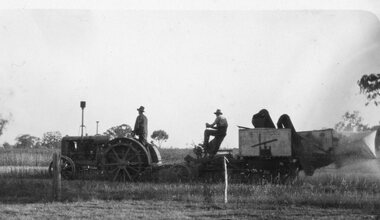
... Several people in background. 1923 -57 5 draught horses abreast, pulling a farm implement with a man by the implement. -58 2 hay stacks shaped with high pitch A man and a fence in the foreground -59 Huge log of wood on a 4 wooden wheeled carrier -60 4 people standing on the spillover on the Little Wimmera -61 car with a woman driver, holding a young child. ...Several people in background. 1923 -57 5 draught horses abreast, pulling a farm implement with a man by the implement. -58 2 hay stacks shaped with high pitch A man and a fence in the foreground -59 Huge log of wood on a 4 wooden wheeled carrier -60 4 people standing on the spillover on the Little Wimmera -61 car with a woman driver, holding a young child. ...Black and White Photographic Collection of Various Sizes 7235 Piles of Wheat Baggs -1 Family Group in garden -2 David George & Thomas -3 Arch Maher (front) and George Baylie Carting Wool from PinGrove, around 1915. Page 6 Book Warranook to Wal Wal -4 Home manufactured Tractor Wheel -5 Three ladies 1920’s -6 Picnic -7 Two Girls -8 Sheering Shed -9 Farmhouse with garden -10 Group of men possibly football team -11 Farmhouse -12 War Memorial Stawell with Weigh Bridge and Coffee Palace -13 Car crossing creek -14 Gathering at Wal Wal school -15 Accommodation on wheels -16 4 people standing around a car Perhaps changing a wheel -17 Team of 7 horses drawing a buggy of bagged wheat- -18 Flooded Mt William Creek with shed involvement -19 Group of men dressed in football clothes 2 umpires dressed in white on the R -20 4 people playing tennis -21 Man dressed in a suit and hat teeing off a golf shot -22 a man, a woman and a child near a steam driven timber mill -23 suited men watching a tractor ploughing -24 a weatherboard building on elevated stumps, possibly just been placed there -25 2 coated men pushing a bogged open tourer car -26 a tractor pulling a plough with suited men on both -27 large pile of bagged grain at a railway siding -28 2 women dressed in long clothing -29 a woman and a boy on a veranda -30 a smiling formally dressed woman holding a box -31 probable small weir in a dry river bed -32 Man in army uniform with 1920s tourer car with roof up -33 Man on platform of railway siding He is holding a hoop -34 studio photo of young girl -35 Large pile of bagged wheat at a railway siding -36 Half of a house on a bridge -37 Hatted woman on a horse -38 large group of formally dressed people outside Wal Wal school -39 1930s utility with 2 boys on bumper bar Headlights blacked out in early 1940s -40 2 men with a 4 wheeled horse drawn vehicle. Thatched farm sheds in the background -41 flood scene, Glenorchy -42 Wimmera river in flood Glenorchy -43 Pleasant Creek Hospital with old car on left c.1920 -44 2 women, a man and a boy playing tennis Callawadda 1925 -45 “A lesson in cow cockying”. A boy watching 2 women milking a cow. 1925 -46 A group of men, women and 2 children at a working bee. -47 Wedding group with best man and maid of honour and 2 children carrying flowers. Front of car with streamers -48 wedding couple with best man and matron of honour and 2 flower girls. 2 cars to the left. 1925 -49 Group of school children in national costumes -50 Tractor, harvester , 2 man and some upright bags of crop. -51 2 men harvesting with a tractor pulling a harvester -52 5 bags of cereal with a man, tractor and harvesting in the background. -53 3 wheeled horse drawn vehicle with a woman on the cart -54 Derailed train carriage , still upright. Adelaide Express 1923 -55 wheels of over turned railway carriage Several people in background 1923 -56 close up of train carriage wheel and bogey. Several people in background. 1923 -57 5 draught horses abreast, pulling a farm implement with a man by the implement. -58 2 hay stacks shaped with high pitch A man and a fence in the foreground -59 Huge log of wood on a 4 wooden wheeled carrier -60 4 people standing on the spillover on the Little Wimmera -61 car with a woman driver, holding a young child. A boy standing nearby -62 3 men and 2 women sitting at Glenorchy tennis -63 4 horses with a farm implement -64 3 men, a horse and boxes on the left -65 5 people at a tennis party -66 4 tennis players at Glenorchy 1925 -67 group of men dressed in white, women in white with white bonnets standing around a seated man and woman -68 veranda in front of a country home with lattice on a side of the house -69 front of a house with a family of 5 on the veranda -70 a couple standing in front of Wal Wal school, nearing completion Various - -
 Stawell Historical Society Inc
Photograph, Photo Collection Claude Smith & Eileen Coppin
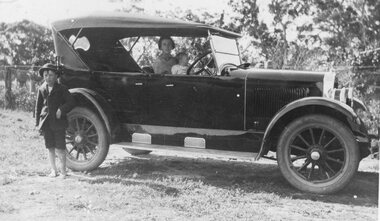
... Several people in background. 1923 -57 5 draught horses abreast, pulling a farm implement with a man by the implement. -58 2 hay stacks shaped with high pitch A man and a fence in the foreground -59 Huge log of wood on a 4 wooden wheeled carrier -60 4 people standing on the spillover on the Little Wimmera -61 car with a woman driver, holding a young child. ...Several people in background. 1923 -57 5 draught horses abreast, pulling a farm implement with a man by the implement. -58 2 hay stacks shaped with high pitch A man and a fence in the foreground -59 Huge log of wood on a 4 wooden wheeled carrier -60 4 people standing on the spillover on the Little Wimmera -61 car with a woman driver, holding a young child. ...Black and White Photographic Collection of Various Sizes 7235 Piles of Wheat Baggs -1 Family Group in garden -2 David George & Thomas -3 Arch Maher (front) and George Baylie Carting Wool from PinGrove, around 1915. Page 6 Book Warranook to Wal Wal -4 Home manufactured Tractor Wheel -5 Three ladies 1920’s -6 Picnic -7 Two Girls -8 Sheering Shed -9 Farmhouse with garden -10 Group of men possibly football team -11 Farmhouse -12 War Memorial Stawell with Weigh Bridge and Coffee Palace -13 Car crossing creek -14 Gathering at Wal Wal school -15 Accommodation on wheels -16 4 people standing around a car Perhaps changing a wheel -17 Team of 7 horses drawing a buggy of bagged wheat- -18 Flooded Mt William Creek with shed involvement -19 Group of men dressed in football clothes 2 umpires dressed in white on the R -20 4 people playing tennis -21 Man dressed in a suit and hat teeing off a golf shot -22 a man, a woman and a child near a steam driven timber mill -23 suited men watching a tractor ploughing -24 a weatherboard building on elevated stumps, possibly just been placed there -25 2 coated men pushing a bogged open tourer car -26 a tractor pulling a plough with suited men on both -27 large pile of bagged grain at a railway siding -28 2 women dressed in long clothing -29 a woman and a boy on a veranda -30 a smiling formally dressed woman holding a box -31 probable small weir in a dry river bed -32 Man in army uniform with 1920s tourer car with roof up -33 Man on platform of railway siding He is holding a hoop -34 studio photo of young girl -35 Large pile of bagged wheat at a railway siding -36 Half of a house on a bridge -37 Hatted woman on a horse -38 large group of formally dressed people outside Wal Wal school -39 1930s utility with 2 boys on bumper bar Headlights blacked out in early 1940s -40 2 men with a 4 wheeled horse drawn vehicle. Thatched farm sheds in the background -41 flood scene, Glenorchy -42 Wimmera river in flood Glenorchy -43 Pleasant Creek Hospital with old car on left c.1920 -44 2 women, a man and a boy playing tennis Callawadda 1925 -45 “A lesson in cow cockying”. A boy watching 2 women milking a cow. 1925 -46 A group of men, women and 2 children at a working bee. -47 Wedding group with best man and maid of honour and 2 children carrying flowers. Front of car with streamers -48 wedding couple with best man and matron of honour and 2 flower girls. 2 cars to the left. 1925 -49 Group of school children in national costumes -50 Tractor, harvester , 2 man and some upright bags of crop. -51 2 men harvesting with a tractor pulling a harvester -52 5 bags of cereal with a man, tractor and harvesting in the background. -53 3 wheeled horse drawn vehicle with a woman on the cart -54 Derailed train carriage , still upright. Adelaide Express 1923 -55 wheels of over turned railway carriage Several people in background 1923 -56 close up of train carriage wheel and bogey. Several people in background. 1923 -57 5 draught horses abreast, pulling a farm implement with a man by the implement. -58 2 hay stacks shaped with high pitch A man and a fence in the foreground -59 Huge log of wood on a 4 wooden wheeled carrier -60 4 people standing on the spillover on the Little Wimmera -61 car with a woman driver, holding a young child. A boy standing nearby -62 3 men and 2 women sitting at Glenorchy tennis -63 4 horses with a farm implement -64 3 men, a horse and boxes on the left -65 5 people at a tennis party -66 4 tennis players at Glenorchy 1925 -67 group of men dressed in white, women in white with white bonnets standing around a seated man and woman -68 veranda in front of a country home with lattice on a side of the house -69 front of a house with a family of 5 on the veranda -70 a couple standing in front of Wal Wal school, nearing completion Various - -
 Stawell Historical Society Inc
Photograph, Photo Collection Claude Smith & Eileen Coppin
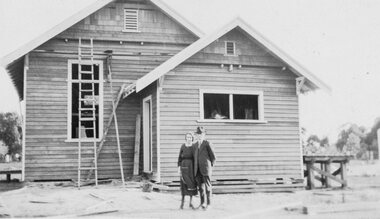
... Several people in background. 1923 -57 5 draught horses abreast, pulling a farm implement with a man by the implement. -58 2 hay stacks shaped with high pitch A man and a fence in the foreground -59 Huge log of wood on a 4 wooden wheeled carrier -60 4 people standing on the spillover on the Little Wimmera -61 car with a woman driver, holding a young child. ...Several people in background. 1923 -57 5 draught horses abreast, pulling a farm implement with a man by the implement. -58 2 hay stacks shaped with high pitch A man and a fence in the foreground -59 Huge log of wood on a 4 wooden wheeled carrier -60 4 people standing on the spillover on the Little Wimmera -61 car with a woman driver, holding a young child. ...Black and White Photographic Collection of Various Sizes 7235 Piles of Wheat Baggs -1 Family Group in garden -2 David George & Thomas -3 Arch Maher (front) and George Baylie Carting Wool from PinGrove, around 1915. Page 6 Book Warranook to Wal Wal -4 Home manufactured Tractor Wheel -5 Three ladies 1920’s -6 Picnic -7 Two Girls -8 Sheering Shed -9 Farmhouse with garden -10 Group of men possibly football team -11 Farmhouse -12 War Memorial Stawell with Weigh Bridge and Coffee Palace -13 Car crossing creek -14 Gathering at Wal Wal school -15 Accommodation on wheels -16 4 people standing around a car Perhaps changing a wheel -17 Team of 7 horses drawing a buggy of bagged wheat- -18 Flooded Mt William Creek with shed involvement -19 Group of men dressed in football clothes 2 umpires dressed in white on the R -20 4 people playing tennis -21 Man dressed in a suit and hat teeing off a golf shot -22 a man, a woman and a child near a steam driven timber mill -23 suited men watching a tractor ploughing -24 a weatherboard building on elevated stumps, possibly just been placed there -25 2 coated men pushing a bogged open tourer car -26 a tractor pulling a plough with suited men on both -27 large pile of bagged grain at a railway siding -28 2 women dressed in long clothing -29 a woman and a boy on a veranda -30 a smiling formally dressed woman holding a box -31 probable small weir in a dry river bed -32 Man in army uniform with 1920s tourer car with roof up -33 Man on platform of railway siding He is holding a hoop -34 studio photo of young girl -35 Large pile of bagged wheat at a railway siding -36 Half of a house on a bridge -37 Hatted woman on a horse -38 large group of formally dressed people outside Wal Wal school -39 1930s utility with 2 boys on bumper bar Headlights blacked out in early 1940s -40 2 men with a 4 wheeled horse drawn vehicle. Thatched farm sheds in the background -41 flood scene, Glenorchy -42 Wimmera river in flood Glenorchy -43 Pleasant Creek Hospital with old car on left c.1920 -44 2 women, a man and a boy playing tennis Callawadda 1925 -45 “A lesson in cow cockying”. A boy watching 2 women milking a cow. 1925 -46 A group of men, women and 2 children at a working bee. -47 Wedding group with best man and maid of honour and 2 children carrying flowers. Front of car with streamers -48 wedding couple with best man and matron of honour and 2 flower girls. 2 cars to the left. 1925 -49 Group of school children in national costumes -50 Tractor, harvester , 2 man and some upright bags of crop. -51 2 men harvesting with a tractor pulling a harvester -52 5 bags of cereal with a man, tractor and harvesting in the background. -53 3 wheeled horse drawn vehicle with a woman on the cart -54 Derailed train carriage , still upright. Adelaide Express 1923 -55 wheels of over turned railway carriage Several people in background 1923 -56 close up of train carriage wheel and bogey. Several people in background. 1923 -57 5 draught horses abreast, pulling a farm implement with a man by the implement. -58 2 hay stacks shaped with high pitch A man and a fence in the foreground -59 Huge log of wood on a 4 wooden wheeled carrier -60 4 people standing on the spillover on the Little Wimmera -61 car with a woman driver, holding a young child. A boy standing nearby -62 3 men and 2 women sitting at Glenorchy tennis -63 4 horses with a farm implement -64 3 men, a horse and boxes on the left -65 5 people at a tennis party -66 4 tennis players at Glenorchy 1925 -67 group of men dressed in white, women in white with white bonnets standing around a seated man and woman -68 veranda in front of a country home with lattice on a side of the house -69 front of a house with a family of 5 on the veranda -70 a couple standing in front of Wal Wal school, nearing completion Various - -
 Flagstaff Hill Maritime Museum and Village
Photograph - Vessel S. S. Casino in Lady Bay Warrnambool, 1920's - 1930's
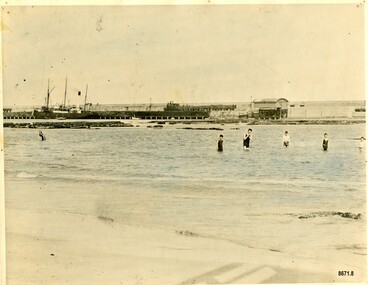
... Sautau and Sons, who had a hay and corn store and shipping agency on the corner of Liebig and Koroit Streets in Warrnambool. ) The S.S. ...Sautau and Sons, who had a hay and corn store and shipping agency on the corner of Liebig and Koroit Streets in Warrnambool. ) The S.S. ...This photograph was one of ten photographs donated to Flagstaff Hill Maritime Museum and Village by Fred Trewartha. Frederick John Fox Trewartha (Fred) was a well-known Warrnambool businessman. He was born in Beeac near Geelong in 1920 and came to Warrnambool with his family as a very young child. He was apprenticed to his father John, as a saddler and later opened his own shop on Raglan Parade. He then moved into working with tarpaulins and canvases for the trucking industry. Fred was keenly interested in photography (and was a member of the Warrnambool Cine Club), yachting and boat building. He kept his yacht moored at Port Fairy for many years and participated in sailing events locally and interstate. He also built boats with his sons. He had the opportunity to meet many older sailors and it's thought this photo (and others in the set) may have been given to him by one of these men. Fred Trewartha died in 2016 in Warrnambool. Warrnambool by the 1920's and 1930's had become a popular holiday destination with visitors arriving by steamer and train. It was during these decades that a "Surf Bathers Association" began in Warrnambool in response to the growing popularity of local sea bathing. They worked with the local council to develop a "Beach Improvement Fund" and a comprehensive plan of "Beach Improvement" which included erecting and maintaining beach boxes, building a kiosk, improving paths and roads to the beach, planting marram grass on the sand dunes, building new enclosures for vehicles and horses and generally making the beach more attractive for visitors and townspeople. The 1930's was also an era when free "Herald" Learn-to-Swim classes were being held throughout Victoria. In 1931 it was reported in "The Age" newspaper that "over the past week in Warrnambool, 250 pupils had passed through the hands of the local life saving club swimming instructors". The Port of Warrnambool - In the early years the Port of Warrnambool was a busy port. Steamships and sailing ships were frequent visitors to the port. Steam navigation companies were plentiful, carrying passengers and freighting cargo such as coal, timber, food, livestock, furniture, hardware and haberdashery between Melbourne and the ports along the southwest coast of Victoria, including Warrnambool. The carts would take their loads into the township for distribution. The Breakwater was built (using 32 ton blocks of concrete) between 1874 and 1890 to provide ships with greater protection from the Southern Ocean. The Lifeboat and Rocket House - The coastline of South West Victoria has had over 600 shipwrecks and many lost lives; even in Warrnambool’s Lady Bay there were around 16 known shipwrecks between 1850 and 1905, with eight lives lost. In 1859 the first Government-built lifeboat arrived at Warrnambool Harbour and a shed was soon built to house it, followed in 1864 by a rocket house to safely store the Rocket Rescue equipment. In 1878 the buildings were moved to the Breakwater area, and in 1910 the new Lifeboat Warrnambool arrived with its ‘self-righting’ design. For almost one hundred years the lifeboat and rocket crews, mostly local volunteers, trained regularly to maintain and improve their skills, summoned when needed by alarms, gunshots, ringing bells and foghorns. Some became local heroes but all served an important role. By the end of the 1950s the lifeboat and rescue equipment had become obsolete. The S.S. Casino was a passenger and freight steamer built in Dundee, Scotland, in 1882 for the Newcastle and Hunter River Steam Navigation Company of N.S.W. She weighed 425 tons gross with a length of 160.4 feet, beam of 24.1 feet and a depth of 10.2 feet. She had saloon accommodation for 35 people, a fore cabin for 25 more people, and she carried 300 tons of cargo. While on her delivery journey on May 30th 1882, the S.S. Casino called in at the Port of Warrnambool for coal, narrowly escaping going ashore in gale force winds due to the quick action of the pilot. At that time, still at anchor, she impressed the directors of the Belfast and Koroit Steam Navigation Company so much that they bought her immediately; she was ideal for trade along the West Coast of Victoria. (The Belfast and Koroit Steam Navigation Company was first managed by Messers. Saltau and Osburne and after the passing of Mr. Osburne, by produce merchants Messers H. Sautau and Sons, who had a hay and corn store and shipping agency on the corner of Liebig and Koroit Streets in Warrnambool. ) The S.S. Casino became “the most famous steamer to operate in Victorian waters along the West Coast” by author Jack Loney. Captain Boyd was her first Master, followed by Captain Chapman, who stayed with her from 1890 until 1924. Captain W. Robertson followed for a short term, and then Captain Middleton then took command from 1925 - 1932. An article published on Monday 11th June 1932 in The Sun News Pictorial (Melbourne) giving a detailed history of S. S. Casino said "owned by Port Fairy interests, she was an integral part of the town's development ... for a long time, her arrival in Port Fairy was an event, the townspeople going down to the wharf to see her come in". It also said "Except when the weather was bad, the Casino hugged the coast on her trips and passengers obtained wonderful views of the sandstone terraces and caves. A little time ago every member of her regular crew except one, was a Scotsman." The S.S. Casino had several mishaps during her life. One was on 3rd January 1898 when she collided with the S.S. Flinders in Apollo Bay with minor damage. Another was on 24th October 1924 when she grounded on a reef at Point Hawdon near Grey River and most of her cargo (of Christmas goods) had to be dumped into the sea. Then in February 1929 she was ‘holed’ when she struck a submerged object as she entered Lady Bay, Warrnambool. In the years following the turn of the century, the S.S. Casino remained the only regular trader with normal passenger accommodation along the West Coast. From 1882 she had made at least 2,500 voyages on the one run. On the morning of 10th July 1932, after attempting to berth at Apollo Bay jetty in heavy seas, Captain Middleton decided to take her out into the bay and wait until the seas abated. It was not realised that the anchor used to steady her as she manoeuvred to her berth had pierced her hull. She put about and headed for the beach but sank. Captain Middleton and nine others lost their lives; nine people were rescued including the two female passengers. Captain Middleton had been in charge of the S.S. Casino for seven years. He was the first ship’s Master to lose his life in a shipwreck in the West Coast trade. In June 1932, the directors of the Belfast and Koroit Steam Navigation Company had proposed to celebrate the completion of fifty years of trading by the steamer Casino in August, but tragically the Casino was wrecked only one month later (and "was only one month off completing its fifty years of valuable service between Melbourne and Portland.") Flagstaff Hill’s collection has a photograph of a portrait of Captain Chapman, a ship model of the S.S. Casino that shows both forms of power under which she sailed, steam and sail. The ship is painted green and flies three flags. The inscription across the case of the ship model, incorrectly dated, tells the sad story of the wreck of the ship and the loss of lives on July 10th 1932 at Apollo Bay. A print in the Collection shows S.S. Casino underway in the heavy sea off Point Lonsdale, another two photographs show her at the Port of Warrnambool, leaving from the Breakwater in Lady Bay and another identifies the S.S. Casino as a ship from the Belfast and Koroit Steam Navigation Company. (Belfast is the original name for the township of Port Fairy).This photograph is significant because of its association with the coastal trader S.S. Casino and its significance to trade along Victoria's West Coast in the late 19th and early 20th centuries. The wreck of the S.S. Casino is considered an important part of Victorian and Australian cultural heritage and as such has been declared and protected as an Historic Shipwreck under State and Commonwealth Law in the Commonwealth Historic Shipwrecks Act (1976). It is also significant as it shows the early years of tourism in Warrnambool and the important role the beach played in the lives of residents and visitors.A black and white photograph (with colour tinting) showing Lady Bay in Warrnambool with the Breakwater in the background. The S. S. Casino is moored at the Breakwater and the lifeboat shed and a coal train can be seen on the Breakwater. Six swimmers are standing in the water. On the back of the photograph are the donor's name and telephone number (written in black biro) and the name of the S. S. Casino and its tonnage written in blue ink. A blurred number has been stamped on plus a "M' written in pencil.Donor's name, address and phone number / "S. S. Casino" / "500 TONS" / "REG" "- - - 09 " (blurred numbers) / "M"warrnambool, great ocean road, shipwreck coast, lady bay, breakwater, fred trewartha, frederick john fox trewartha, surf bathers association, sea bathing, swimming, warrnambool beach, beach improvement fund, port of warrnambool, steamships, lifeboat house, rocket house, lifeboat crew, s. s. casino, belfast and koroit steam navigation company, saltau and osburne, captain middleton, apollo bay, apollo bay shipwreck -
 Bendigo Historical Society Inc.
Document - LA TROBE UNIVERSITY BENDIGO COLLECTION: BENDIGO TEACHERS' COLLEGE GRADUATION CEREMONY
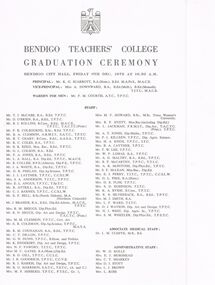
... Fullarton, Garry R. Hay Brendan J. Tinkler and Judith A. Twiss. ...Fullarton, Garry R. Hay Brendan J. Tinkler and Judith A. Twiss. ...A white document titled "Bendigo Teachers' College Graduation Ceremony". Bendigo City Hall, Friday 8th Dec. 1972 at 10.30 A.M. Principal: Mr. K.G. Scarrott. Vice-Principal: Miss A. Downward. Warden for Men: Mr. F. M. Courtis. Below this is a list of the staff teaching in that year - Mr. T. J. McCabe, Mr. D. O'Brien, Mr. B. I. Rollins, Mr. F. R. Colbourne, Mr. B. A. Clemson, Mr. B. T. Geary, Mr. K. C. Coles, Mr. B. R. Red, Mr. G. L. Colson, Mr. F. A. Jones, Mr. L. A. Hall, Mr. R. Colliss, Mr. J. A. White, Mr. D. R. Phelan, Mr. J. J. Layther, Mrs. S. A. Anderson, Mrs. E. L. Angus, Mr. R. Attrill, Mr. C. J. Barnes, Mr. E. F. Bell, Mr. J. Brasier, Mrs. R. M. Briggs, Mr. R. N. Bruce, Mrs. M. M. Clemson, Mr. E. R. Coleman, Mr. R. M. Counahan, Mr. C. T. Dillon, Mr. G. N. Dunn, Mr. K. Endersby, Mrs. N. F. Fawdry, Miss M. C. Gates, Mr. B. D. Gill, Mr. J. R. Goodrich, Mr. R. J. Harris, Mr. . G. Harrison, Mrs. M. P. Hibberd, Miss M. F. Howard, Mrs. B. P. Hyett, Mr. L. Jackman, Mr. A. T. Jones, Mr. P. L. Kileen, Mrs. H. A. Knox, Mrs. B. A. Layther, Mr. T. W. Lee, Mr. W. P. Lomas, Mr. A. D. Maltby, Mr. B. F. McCarthy, Mr. A. R. McIntosh, Mt. S. F. McLean, Mrs. E. I. Perry, Mrs. D. E. Plim, Mrs. S. D. Robinson, Mr. K. A. Ryrie, Mr. R. B. Silverback, Mrs. M. J. Smith, Mrs. L. F. Ward, Mr. D. J. Watson, Mr. N. J. West, Mrs, S. M. Wheeler. Associate Medical Staff: Dr. L. M. Cleeve. Administrative Staff: Mr. W. D. Kolle, Mrs. E. J. Morshead, Mrs. C. T. Sharkey, Miss D. J. Stott, Mrs. L. J. Brown Mrs. L. Ross. On the inside page is the "Significance of the Ceremony" and words to "The College Anthem". The following page contains the "Order of the Ceremony". The back page lists the students who have received their teaching degrees. Diploma of Teaching (Primary) 1970 -1972 - Jeffrey R. Amos, Ann M. Babington, Heather C. Barlow, Glenda L. Blake, Marilyn J. Brinkley, Denise M. Broom, Linda D. Bryant, Margaret M. Cale, Pauline F. Casey, Glenys Chessells, Mrs. Clare M. Clancy, Elizabeth A, Clancy, Carol A. Coleman, Shirley J. Cooper, Elizabeth A. Dellar, Judith M. Ennor, Sandra J. Ferguson, Janice L. Finn, Angela M. Finnigan, Rae Fisher, Elaine T. Flight, Jacqueline P. A. Frost, Judith Gearon, Cheryl J. Godwill, Glenys D. Grose, Jennifer M. Haire, Mrs. Helen A. Harrington, Mrs. Rosalie J. Harvey, Marie T. Hayes, Wendy E. J. Hearps, Geraldine P. Henery, Darryl F. Higgins, Deidre C. Higgs, Cheryl D. Hobbs, Geoffrey K. Holland, Colin G. James, Margaret J. Kendall, Elinor V. Kennedy, Noeline A. Kerrins, Susan M. Kiss, Shane B. Landy, Margo E. Laughlin, Ian J. Leslie, Christine L. Letcher, Graeme R. Lloyd, Jenny Louey, Kathleen M. McCormack, Denise E. McGrath, Wayne McGrath, Paul D. McKenna, Maureen K. McKnight, Wendy C. Mackowski, Shirley P. Mangan, Philipa M. Marchbank, Margery J. Metelmann, Jane Miller, Glenda M. Minns, Geoffrey R. Neville, Catherine T. O'Brien, Heather D. O'Connell, Maureen T. O'Connor, Denis J. O'Connor, Wendy A. Parry, Mrs. Patricia M. Perry, Lynden L. Pinder, Margaret M. Plowman, Robert R. Quigg, Darrell J. Robinson, Carol A. Robson, Anne M. Rogan, Judith A. Satori, Geoffrey C. Slade, Judith E. Tedcastle, Alison J. Teitz, Robyn N. Thompson, Kaye F. Thurlow, Leonie K. Turner, June L. Weaver, Leonie Whalen, Deborah L. Williamson, Karen L. Wilson, John E. Windridge, Andre Wisniowski, Julie A. Witham, Glenda J. Wood, Gail D. Woolcock, Margaret Wright, Heather O. Wright and Elizabeth J. Yardy. Trained Primary Teacher's Certificate 1971 - 1972 - Margaret P. Anstey, Heather J. Avard, John H. Bakker, Wilermina Boers, Robyn J. Boundy, Gayle L. Catton, Judith Clancy, Anthony Dalton, Judith Downey, Patricia A. Geraughty, Mary E. Herrick, Ruth E. Hopkins, Deborah J. Hunter, Kristina M. Hussey, Graeme F. Keith, Mrs. Elizabeth King, Elizabeth J. King, Merilyn L. McGuinness, Robyn G. Moyle, Lynn D. Olsen, Rosemary Petschack, Margaret Pump Joan B. Ryan, Arina W. Serno, Judith A. Sheard, Mrs.c Christine M. Turner, Maree Valli, Lynette M. Wadeson, Wendy H. White and Trevor J. Wilcox. External Studies Trained Primary Teacher's Certificate - Susan Cody, Julie R. Crawford, Jennifer M. Crowe, Margaret A. Fullarton, Garry R. Hay Brendan J. Tinkler and Judith A. Twiss. External Studies Diploma of Teaching Diploma of Teaching (Primary) - Mrs. Laurel Astle, Brian R. Fitzgerald, Brendan C. L'Huillier, Elizabeth A. Petshack, Margaret A. Petzke, Elizabeth A. Wadelton, Ronald W. M. White and Mary A. Wright. Pianist: Barbara Hyett and Organist Michael Bottomleybendigo, education, bendigo teachers' college graduatio, la trobe university bendigo collection, collection, bendigo teachers' college, bendigo, education, teaching, teachers, students, graduation, bendigo teachers' college graduation, graduands, graduates, tertiary education, book, bendigo teachers' college students, bendigo teachers' college staff -
 Ballarat Tramway Museum
Magazine, Melbourne and Metropolitan Tramways Board (MMTB), "Tramway Topics" - M&MTB, 1947 and 1948
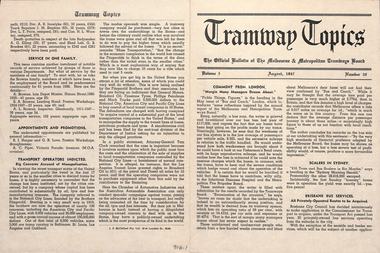
... No profit - no sharing (Kansas City), Just why - prices and fares in the US, MMTB staff needs from 5 day week, Section fares in the US, trams at L5,500 each (Sheffield), The unfinished dance (Perth and Hay St.), Thanks from Bristol, Interest in Melbourne trams (letters to the Board), Adelaide's Deficit, Fares up in Sydney and Adelaide, Moscow transport, No trolleybuses thankyou in Belgium, thanks to the Traffic staff, the Late Inspector Boardman, 24,000 irregularities (passengers), Sth London trams, Melbourne's trams amazing, Winnipeg's transport Growth and Standing passengers - London. 918.9 - 59 - July 1948 - 4 pages - The Red Light - RACV and red lights on trams, A request from Argentina,, where our SW6's are, the last 5c fare (New York), Work in the Fog, Traffic headaches in the US, Brisbane's Streamlined tram, Safety glass, Now for La Trobe St. ...No profit - no sharing (Kansas City), Just why - prices and fares in the US, MMTB staff needs from 5 day week, Section fares in the US, trams at L5,500 each (Sheffield), The unfinished dance (Perth and Hay St.), Thanks from Bristol, Interest in Melbourne trams (letters to the Board), Adelaide's Deficit, Fares up in Sydney and Adelaide, Moscow transport, No trolleybuses thankyou in Belgium, thanks to the Traffic staff, the Late Inspector Boardman, 24,000 irregularities (passengers), Sth London trams, Melbourne's trams amazing, Winnipeg's transport Growth and Standing passengers - London. 918.9 - 59 - July 1948 - 4 pages - The Red Light - RACV and red lights on trams, A request from Argentina,, where our SW6's are, the last 5c fare (New York), Work in the Fog, Traffic headaches in the US, Brisbane's Streamlined tram, Safety glass, Now for La Trobe St. ...16 issues of the, "Tramway Topics" - "The Official Bulletin of The Melbourne & Metropolitan Tramways Board", issues 50, 51, 53 to 61, issued between August 1947 and October 1948. All printed on cream coloured paper. Headings of significance are listed below. Common items were; Retiring and Death Gratuities, Appointments and Promotions, long service records. 918.1 - 50 - August 1947 - 4 pages - Comment from London, Scalers in Sydney, Brisbane Services, PAYE to go, Newcastle wants to own the trams, Diesels in favour, Fares in London and Melbourne, Something like a deficit, a remarkable record (substations), Work of Testing Department, Accidents are Expensive, and Transport Operations Indicted (National City Lines - USA) 918.2 - 51 - Sept. 1947 - 4 pages - Our SW6 tram, Transport in the US, Conductresses again, How bus costs have risen, Footscray Extensions, Of Course you are good (drivers and driving), How Fares Go, 40-Hour week. 918.3 - 53 - November 1947 - 4 pages - No increase in fares, an unusually interesting tram (Glasgow), alcohol and driving do not mix, pedestrian crossing case, how wages have increased, Russia prefers trams, Sydney's "Honesty" joke, Higher Fares wanted, Tramcars as hearses, an editor on Trolley buses, buses lead - but at a cost (Leicester), the Non paying passenger (Sydney) 918.4 - 54 - December 1947 - 4 pages - Christmas 1947 (Chairman's notes on the future), New Stockholm tram, according to use and wont - Birmingham, Trams in the USA, Board re-appointed, Buses few, so coaches are hired (London), transport from Footscray, "Philadelphians must have the best" - so they are given trams!, The Merri Creek Bridge and appreciations. 918.5 - 55 - March 1948 - 4 pages - That 4/- doubts arising over the 5-day week, Buses carried pick-a-back, Sydney to lose L500,000 this year, Trolleybuses, Rapid transit with PCC trams, another compliment (rosters in Perth), the bill for it all (Melbourne tram strike), an Extraordinary award (Washington DC), Prison tram's last load (Sydney), Douglas horse trams, Lord Ashfield, Glasgow's all night buses. 918.6 -56 - April 1948 - 4 pages - The Board's ambassadors (MMTB Conductors), Brisbane's bus routes, Another deficit in sight (Liverpool UK), Poor Paris, The resilient wheel, the 5-day week rosters, a subway and its costs (Detroit), PCC's in Belgium, South London Trams. 918.7 -57 -May 1948 - 4 pages - Spread of Hours Payment - 5 day week, weak breaks, Buses multiply - losses expand (Manchester UK), Static Electricity, L750,000 deficit in Sydney, praise for conductresses, no purchase by Newcastle, a loss at Adelaide, Transport in Switzerland, Denmark's giant bus, new trams for Glasgow, Grants for sports, single deckers out of favour (UK buses), Transport by Water (London). 918.8 - 58 - June 1948 - 8 pages - Stirring up strife (Melb.) No profit - no sharing (Kansas City), Just why - prices and fares in the US, MMTB staff needs from 5 day week, Section fares in the US, trams at L5,500 each (Sheffield), The unfinished dance (Perth and Hay St.), Thanks from Bristol, Interest in Melbourne trams (letters to the Board), Adelaide's Deficit, Fares up in Sydney and Adelaide, Moscow transport, No trolleybuses thankyou in Belgium, thanks to the Traffic staff, the Late Inspector Boardman, 24,000 irregularities (passengers), Sth London trams, Melbourne's trams amazing, Winnipeg's transport Growth and Standing passengers - London. 918.9 - 59 - July 1948 - 4 pages - The Red Light - RACV and red lights on trams, A request from Argentina,, where our SW6's are, the last 5c fare (New York), Work in the Fog, Traffic headaches in the US, Brisbane's Streamlined tram, Safety glass, Now for La Trobe St. The Tramways Band (South St.), Transport Losses in Sydney. 918.10 - 60 - August 1948 - 4 pages - from Pretoria (Comments on Melbourne), Buses with sliding Doors (OPS1), PCC trams, trams of the future (Glasgow), new trams in Rome, Clearing up the Parking Problem (Sacramento), Fantastic figures - world tram car figures - anti tram, Trainer Drivers, the railway trams and disaster to Liverpool trams, Monte Video trams purchased. 918.11 - 61 - September 1948 - 4 pages - The Year's Work (Melbourne), How Absurd (transport management), items from Britain, Tramway Band News, Food from Melbourne (to Scotland floods), London's Extraordinary traffic, New trams for The Hague, who are the road hogs, the La Trobe St. extension, out clothing factory, Preston Workshops, Toil on the tracks, how the money comes in (fares distribution). 918.12 - 62 - October 1948 - 4 pages - Melbourne's tram fares, Bourke St., Sydney's Street Transport, Scientist or Baker (London), Trolleybuses out of favour, London's poor bus fleet, tram and bus fares, The band at Wattle Park, Madras tramway deal, 121 decide for 6000 (Sydney Sunday trams), Preston workshops, A Engineer's tribute, Was the Street Quiz on trams faked? (The Sun). 918.3 - No. 31 - September 1945 - Year in review - trams more reliable than buses, loss on buses to munitions and Fisherman's bend, ticket checking, Hawthorn clothing factory SW6 trams construction, news from cities in Europe, sub-stations. 918.14 - 64 - September 1949 - higher operating expenses and revenue, school children behaviour, headway recording system - communication issues, golf at Wattle Park, Mr Bell lives in Riversdale Rd. 918.15 - 67 - December 1949 - Record Payment to Consolidated Revenue, payment to MFB etc, flat fares, Latrobe St extension - delayed, fare concessions - who pays, 918.16 - 68 - January 1950 - Bourke St conversion - Risson looking for an early start, fitting of radios to MMTB vehicles, Resilient wheels 918.4 - on top edge in pencil is "Mr Russell", and 918.10 ditto.trams, tramways, mmtb, melbourne, tramways -
 Melton City Libraries
Newspaper, Melton East end shopping, 1992
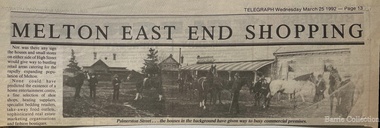
... Hotels were four in number, Minns’s, Mrs Hay licencee, now Mac’s, Golden Fleece – Sheblers. ...Hotels were four in number, Minns’s, Mrs Hay licencee, now Mac’s, Golden Fleece – Sheblers. ...TOM COLLINS–from the reel to reel tape recording at Melton 1969 In the years between 1890 and to about 1913 Melton was a quiet little hamlet alongside the Toolern Creek, once called the Pennyroyal Creek, 24 miles from Melbourne on the Ballarat Road. There was a fair amount of woodland left around it, mostly grey and yellow box with sheoak, and golden wattle, which in spring time made a rather attractive setting. Most of the premises were in the main or High Street, with its line of elm and pepper trees on each side. Unitt, McKenzie and Henry streets each contained only a few dwellings. Hotels were four in number, Minns’s, Mrs Hay licencee, now Mac’s, Golden Fleece – Sheblers. The Royal or Ryan’s as it was then called, later Graham had the licence, and the Raglan - Kilpatricks had the licence and afterwards Tom Manning. This was situated about where Mr K. Young had his residence. There was a store attached to the hotel until about 1900. Both the Royal and the Raglan were delicensed, later on the Royal being converted to a green grocery and a boarding house, the Raglan was demolished. The Royal green grocery and boarding house was kept by E Carew and after he retired, E Radford. The Post and Telegraph Office was on the opposite side of the street to the Raglan Hotel about two doors west of the Shire Hall and was kept by Mrs Ferris and Lady Farmer until her retirement, when it was carried on by Miss Lottie Ross. A store was attached to the Post Office and was sometimes used as a store and at one time housed the National Bank. There were two full time banks at Melton, the other being the Commercial which built premises about 1904 and on the corner of High and Smith Streets, which it still occupies. Mr G Egan was the manager of the Commercial and Mr Stradling and later Mr Lee of the National. However as business was not thought good enough they reverted to a part time branch operated from Bacchus Marsh. Grocer shops were Chalmers, with a news agency and drapery now Arnolds, Jongebloeds had the bakery. Mr Fox also a produce merchant, was where Melton Real Estate is now, it was later occupied by Buchanans, Atleys, and Mrs Ross. Not long after the War Mrs Ross built the Post Office, since demolished where Miss Lottie Ross was the Post Mistress and later built the store which she conducted. It was later turned into a factory and in now the barbers shop. McNichols was just west of the Minns Hotel. He travelled as far a Ballan weekly, buying calves and dairy produce for sale in Melbourne. Afterwards he sold the business and bought Minns Hotel and changing the name to Macs. Blacksmiths were three in number. Blackwoods – later James Byrnes next door to Jongebloeds. Alex Cameron who learnt his trade with Blackwoods had his shop about the rear of where Ken Youngs Garage is now he later moved to the north west corner of High and Alexander Street. He was also the Registrar of Birth and Deaths and Electoral Registrar. After his retirement he was weighbridge keeper at Melton South. Two of his sons were engaged in the carpentry trade, but both died at an early age. Whittingtons shop was a few doors east of the Mechanics Hall and it was later occupied by Gordon Macdonald who did business there until about eight years ago. The butchers of the period were George Graham, that is where Mandy Lees hairdressing establishment is now. Euan MacDonald had premises later occupied by Whittingtons blacksmith shop. Later shifting next door. He left here about 1901, he slaughtererd animals at a slaughter house right where Chas Jones now resides, it had previously been a slaughter house and butcher shop of that site. George Spring also operated as a butcher for two or three years about the 1900 or so. Ted Simpsons shop was where John Kontek now has his Estate Agency, he used it as an branch shop from Bacchus Marsh bringing meat from there by a two horse lorry. Jimmy Butler the manager was well known and loved, his son was later a steeplechase jockey. The Court House and Police Station would be built sometime before 1900. The Constables at the time were McGuire, later Wade, Riely and McKenzie after that Robert Wilson and Seinfort were here, they were a bit later on. The Mechanics Hall was first opened by Ryan of the Royal Hotel who sold it to the Hall Committee. It was on Unitt Street and it was moved by McLellans the house shifters from Unitt Street to its present site. Bluestone premises formerly occupied by the bootmaker Carew, were later demolished and replaced by the brick frontage to the Hall. Keith Orensini [?] the local bricklayer built brick portion to the Hall. In the cottage adjoining the Hall a Frenchman named Baudin, had a boot repairing business.This cottage was the later residence of J Hill, a local carpenter and builder from whom I learnt my trade. Granny Watts was the well known local nurse and operated the Mid-Wifery Hospital in Yuille Street on the Sherwin Street corner. Mrs Nissen was on the opposite side of Yuille Street a short distance nearer the township. She conducted the laundry. Carew had a greengrocers shop next door to the Post Office in the High Street for some time before transferring to the Royal Hotel site. He also bought [?] calves for killing. W Cecil was a tank maker and also had a produce round, he lived on Pyke and Sherwin Street. Later Gus Shebler, builder and carpenter engaged in tank making being well known for good workmanship. Shebler was very energetic in forming the Gun Club which met for a good number of years where the golf course now has its headquarters. Of the four churches only three are in use, Christ Church, Scots and St Dominics. The Methodist closed down but later transferred to Melton South. Monthly stock sales were held at the yards in Unitt Street at Minns Hotel by McPhail Auctioneers, later held by McCarthur and McLeod. After the Council built the pound and sale yards they transferred sales to these premises, but lack of patronage caused them to be abandoned. A familiar sight in the district was blind Bob Nixon, who lived in a tumbled down cottage in Centenary Road near W Coburns, being led by his dog down the road to Melton, that is Palmerston street, to the Post Office, butcher and baker for his supplies and then back home. He was able to do his own cooking and other chores. Sundays he would come down Raleighs Road to the back of the church and tie his dog to a tree. Someone, mostly one of the boys would guide him into the church and out again after the service, when the dog would lead him home again. State School 430, a two roomed bluestone building it was the only school in the district, none at Melton South. The nearest would be Rockbank and Toolern Vale. Scholars had a fair distance to walk in most cases. The teachers were Mr T Lang Headmaster. I put a query here, Miss Winters, I’m not certain of the name, Mrs Skinner and Miss Silke as Assistant Teachers. Miss Augusta Cecil and Miss Maud Lang were Junior teachers. One boy who attended the school about the turn of the century was Hector Fraser who resided with his parents in Keilor Road, where Jim Gillespie now lives. He was an excellent gun shot and at the age of about 17 years his father took him to France or Monaco where he won the Gran Prix for pigeon shooting and became the champion boy shot of the world. However he died there from pneumonia. He shot under the name of “Parvo”. The Melbourne Hunt Club used to meet in Keilor Road north side just east of the Toolern Creek on what was originally Pykes Run. This was also the place where the races were held and the Sports Meetings. Dave Murphy, employed at Clarke’s Rockbank Station usually provided the fox which he liberated for the Club. Greyhound coursing was usually held on Moylans property Mt Kororoit, or Mt Misery as it was known then. Later it was held at Melton Park, Mr Matt Carberry was the judge and Percy Cook the slipper. Early in the 1900’s the Recreation Park was created and the Caledonian and the ANA sports meetings were held there, they were annual events. L Paterson from Melton South was a successful competitor in all the cycling events as a young man. He later in life became the Deputy Chief Officer of the Metropolitan Fire Brigade. The present Chief Officer of the Fire Brigade is John Paterson, nephew of his, and spent his early life in Exford where his father was manager of the Exford Estate. Notes Tom Collins was born c 1895. He lived on the south side of the Ballarat Road near the intersection of Keilor Road.Historical image of Palmerston Street in Meltonlocal architecture, landscapes of significance -
 Sunshine and District Historical Society Incorporated
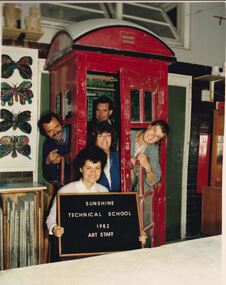
Photograph - Sunshine Technical School 1982 Class Photograpths, Sunshine Technical school
... 3474.01 - Sunshine Technical School 1982 Art Staff 3474.02 - Sunshine Technical School 1982 Pre Employment Group Front Row L2R Sylva Torcello Susan Justine Jackie Bullen Karen Powell Barbara Pedzich Sharon Justine 2nd Row L2R Anne Whitford Pam Miller Jeanetter McCurry Kalimee Chichine Leisa Fitzroy Teacher David Crebbin Principal Mr D R Boyd 3474.03 - Sunshine Technical School 1982 Year 07 7CF Boys Girls Names Front Row L2R Joanne Layton Gina Budulica Paul Douglas Sandra Dean Mario Benzel Deborah Stuttard tracey Shields 2nd Row L2R Kevin Grizti Glen Newman Frank Cumbo Jamie Havard Andrew McLean 3rd Row L2R Paul Marciniak Raymond Dean Ricky Tilley Craig Dunstan Brian Attard Teacher C Parnell Principal Mr D R Boyd 3474.04 - Sunshine Technical School 1982 Year 07 7DR Boys Girls Names Front Row L2R Pola Blackley Jeffery Best Kylie Pigot Jill McCarthy Sharon McCarthy Phillip John Kerryn Towart 2nd Row L2R Mathew Noble Scott McDonald Alan Kirk Stuart Rae Craig OMeara Robert Curmi Gavin Mitchell 3rd Row L2R Steven Brincat Darren Peterson Lance Moyle Craig Gaston George Galea Teacher Mr D Rathbone Principal Mr D R Boyd 3474.05 - Sunshine Technical School 1982 Year 07 7EM Boys Girls Names Front Row L2R Beverley Keeping Marjonco Serouski Tracy Lawson Jill Crick Tina Carney Joseph Grima Debbie Rouse 2nd Row L2R Ross Spatare Darryl Wilson Phillip Diacono Brett Lowe Nebojsa Matejic Kragg Thomson 3rd Row L2R Darren Woodall Mark Hurren Stephen Vohar Sam Cassar Stephen Edwards Teacher Mr Menegol Principal Mr D R Boyd 3474.06 - Sunshine Technical School 1982 Year 07 7LI Boys Girls Names Front Row L2R Melinda Mazzuchelli Annette Cockburn Alan Zahra Lynda Grima Rifat Altay Feryal Abdullah Jodie Herrick 2nd Row L2R Harry Kiparoglou Craig Pfeiffer Aaron Meyer Brian OShea James Wofe Terry Chester 3rd Row L2R Michael Owen Wayne Dawson Robert Kutniewski Phillip Rowlandson Peter Spiteri Teachers Leanne Iversen Chris Lambropoulos Principal Mr D R Boyd 3474.07 - Sunshine Technical School 1982 Year 07 7MB Boys Girls Names Front Row L2R Samir Cuturic Tony Piacquadio Matthew Ritchie Frank Zammit Tim Positti Wayne Peterson Sean Lemon 2nd Row L2R charmayne Barnes Mark Gowans Tanya Hobbs Michelle Dixon Jenny Cox Steven Fejes Gail Bouchaud 3rd Row L2R John Robinson James Graham Andrew Camanzi Paul Vella Richard Paterson Mark Nash Teacher Ms M Bawden Principal Mr D R Boyd 3474.08 - Sunshine Technical School 1982 Year 07 7MW Boys Girls Names Front Row L2R Maria Disisto Cheryl Ryan Wendy McCarthy Sermet Mustafa Florrie Nothnagel Charmaine Ford Carol Patridge 2nd Row L2R Brett Smit6h david Hay Phillip Harrison Twani Mifsud Troy Bloom Denis Sposisto Nader Latif shaun Lindsay 3rd Row L2R Graham Anderson Adam Masuglia Andrew Smith Lorrie Ciapara Frankie Long Teacher Merrin Willaton Principal Mr D R Borg 3474.09 - Sunshine Technical School 1982 Year 07 7SC Boys Girls Names Front Row L2R Franklin Armeni Paul Fishlock Craig Mason Steven Calleja Alex Lodice Michael Lord Joseph Pirotta 2nd Row L2R Paul Dial Simon Doggett Warren Lovell Ian Cilis Joe Inguanti 3rd Row L2R Cam Tu Ly Tracey Tatlow Lydia Psomiadis Kerry Finco Kerry Ogston Teacher Sue Coxsedge Principal Mr D R Boyd 3474.10 - Sunshine Technical School 1982 Year 07 7TB Boys Girls Names Front Row L2R Stewart Cole Kandiray Djemal Scott McEwan Steven Grima Michael Smith Garry Edwards Farren Wootten 2nd Row L2R Andrew Ryan Dean MacDonald Noel Borg Bradley Nixon David Bennett 3rd Row L2R Linda Hyett Jodi Bindless Julie Zoppi Karen Meehan Teacher T Blunt Principal Mr D R Boyd 3474.11 - Sunshine Technical School 1982 Year 07 7MZ Boys Girls Names Front Row L2R Karen Baldacchino Sharon Calleja Shane Dyson Joanne Bascombe Pat OShea Samantha Brown Kristine Layton 2nd Row L2R Troy Sutherland David Treller Mart Young Tom Panatiogiou John Brain Sam Grech 3rd Row L2R Jason Croft Mark Adams Brenan Webb Teacher M Fepeda Principal Mr D R Boyd 3474.12 - Sunshine Technical School 1982 Year 07 7RA Boys Girls Names Front Row L2R Joseph Vella Andrew Buttigieg Kalman Toth Gavin Hussell Gregory Baird Shane McDougall Steven Baker 2nd Row L2R John ODonnell Gavin Fischer Jamie Moore Kevin Williams Dale Weedon Wayne Spencer Dean Alexiou 3rd Row L2R cherie Hickey Fiona Nagle Julie Johnson Nicole Smith Sharon Redfern Teacher Mr R Amos Principal Mr D R Boyd 3474.13 - Sunshine Technical School 1982 Year 10 10A1 Boys Girls Names Front Row L2R Camvan Ly Wedny Dyke Tracey Dunmall Sharyn Hobbs Michelle Spiteri Carolyn Young Second Row L2R Peter Layton David Hay Andrew Hill Aaron Meehan Darren OFlattery Colin Smith Third Row L2R Darren Broughton Mark Fieldew Greg Simsons Teacher Mr R Merrigan Principal Mr D R Boyd 3474.14 - Sunshine Technical School 1982 Year 10 10A2 Boys Girls Names Front Row L2R Michael Spencer Teena Sutherland George Nrojevack Michelle Dawsey Don Bennett Gail Hogan John Keating Second Row Thoung Si Phu Leanne Barley Brendan Arnott Kevin Callanan Michelle Woodhouse Steven OConnell Third Row L2R Andrew Sheilds Paul Weiser Darren Appleby Teacher Alice Becker Principal Mr D R Boyd 3474.15 - Sunshine Technical School 1982 Year 10 10B Boys Girls Names Front Row L2R Anita Plunkett Gracie Distante Susan Carney Karen Baird diane Mercieca Michelle Harberger Jennifer Kelling Second Row L2R Christine Hibbert Derek Bartolo Debbie Bretheryon Leslie Gray Debbie Dean Raymond Smith Noelene Gay Teachers Mrs T Elliott Mr I Bowker Principal Mr D R Boyd 3474.16 - Sunshine Technical School 1982 Year 10 10G Boys Girls Names Front Row L2R Kim Wilson Ann Horn Kerry Plant Robyn Baker Colleen Sammut Barbara Cziepiez Frances Avellino Geraldine Littler Roselen Staker Second Row Peter Haynes Wayne Mills Helen Robertson Karen Lovell Leigh Plunkett Pam Busuttil Alan Borg Third Row L2R Darren Charman Darren Scarlett Jamie Sampson Michael Camanzi Gordon Simpson Preston Round Teachers John Lyon Alison Davidson Principal Mr D R Boyd 3474.17 - Sunshine Technical School 1982 Year 11 11A Boys Girls Names Front Row L2R Cam Hoa Ly Janine Strainer Dean Sewell Wayne Moyle Debbie Chisholm Jenny Borg Second Row L2R Craig Parry Darren Allen John Shields Stephen Fogarty Peter Jankulovski Peter Myer Teacher Mr B Robins Principal Mr D R Boyd 3474.18 - Sunshine Technical School 1982 Year 11 11B Boys Girls Names Front Row L2R Henry Farrugia Maree Johnson Joanne Oates Rachel Lumsden Sharon Dodemaide Helen Nichol Maria Rosso Second Row L2R Leanne McGrath Wayne Finco Julie Meyers Dean Ciantar Sharon Darcy Third Row L2R Irene Myles Jude Callanan Cheryle Barnes Teachers Sheryl Robertson Dave Crebbin Principal Mr D R Boyd 3474.19 - Sunshine Technical School 1982 Year 11 11B2 Boys Names Front Row L2R Jimmie Theodosiou Steven Candon Anthony Roper Mark Osborn Joe Busuttil Michael Mifsud Second Row L2R George Halkias George Orzechowski Raafat Tawadros Eddie Zawora Michael Paris Third Row L2R Alex Theodossiou Darren Athorn Robert Day Teacher N Graham Principal Mr D R Borg 3474.20 - Sunshine Technical School 1982 Year 11 11G1 Boys Girls Names Front Row L2R Maryanne Gauchi Dianne Woodal Carmen Caruana Luigi Didio Karen McIlwane Jane Spiteri Alison Moiler Second Row L2R Jason Stafford Vivki Parker Darryl Soenser Lyn Mercieca Darren Alldis Third Row L2R Zlatho Tjrsvski Brett Lovegrove Slabode Nedellovski Teacher R Shelton Principal Mr D R Borg 3474.21 - Sunshine Technical School 1982 Year 11 11E1 Boys Names Front Row L2R Jack Taip Pete Muscat Steven Toth Mark Sampson Edwin Scicluna Silvo Zammit Second Row L2R Lee Marshall Shefki Shefki Raymond Peck tony Ebejer Arto Multanen Teacher Mr A Halfyde Principal Mr D R Boyd 3474.22 - Sunshine Technical School 1982 Year 11 11G2 Boys Girls Names Front Row L2R Jenny Hall Darren Frisch Zeynep Amur Linda Farrugia Paul Holliday Bev Harrison Second Row Iztok Sorl Jeffrey Chesters Barry Dodemaide Gary Dodemaide Albert Borg Teacher Sandra Roberts Principal Mr D R Borg 3474.23 - Sunshine Technical School 1982 Year 11 11W Boys Names Front Row L2R William Keating John Tanti Mark Johnson Mario Baldachino Darren McMahon Jin Phillipa George Deb Second Row L2R Roger Schembri Nick Germanus Craig McGregor Emad Salib Allan Borg Paul Mifsud Third Row L2R Drago Doslov Stuart Carlisle Frank Belkov Principal Mr D R Boyd...Sunshine Technical School Technical School Class Photographs 3474.01 - Sunshine Technical School 1982 Art Staff 3474.02 - Sunshine Technical School 1982 Pre Employment Group Front Row L2R Sylva Torcello Susan Justine Jackie Bullen Karen Powell Barbara Pedzich Sharon Justine 2nd Row L2R Anne Whitford Pam Miller Jeanetter McCurry Kalimee Chichine Leisa Fitzroy Teacher David Crebbin Principal Mr D R Boyd 3474.03 - Sunshine Technical School 1982 Year 07 7CF Boys Girls Names Front Row L2R Joanne Layton Gina Budulica Paul Douglas Sandra Dean Mario Benzel Deborah Stuttard tracey Shields 2nd Row L2R Kevin Grizti Glen Newman Frank Cumbo Jamie Havard Andrew McLean 3rd Row L2R Paul Marciniak Raymond Dean Ricky Tilley Craig Dunstan Brian Attard Teacher C Parnell Principal Mr D R Boyd 3474.04 - Sunshine Technical School 1982 Year 07 7DR Boys Girls Names Front Row L2R Pola Blackley Jeffery Best Kylie Pigot Jill McCarthy Sharon McCarthy Phillip John Kerryn Towart 2nd Row L2R Mathew Noble Scott McDonald Alan Kirk Stuart Rae Craig OMeara Robert Curmi Gavin Mitchell 3rd Row L2R Steven Brincat Darren Peterson Lance Moyle Craig Gaston George Galea Teacher Mr D Rathbone Principal Mr D R Boyd 3474.05 - Sunshine Technical School 1982 Year 07 7EM Boys Girls Names Front Row L2R Beverley Keeping Marjonco Serouski Tracy Lawson Jill Crick Tina Carney Joseph Grima Debbie Rouse 2nd Row L2R Ross Spatare Darryl Wilson Phillip Diacono Brett Lowe Nebojsa Matejic Kragg Thomson 3rd Row L2R Darren Woodall Mark Hurren Stephen Vohar Sam Cassar Stephen Edwards Teacher Mr Menegol Principal Mr D R Boyd 3474.06 - Sunshine Technical School 1982 Year 07 7LI Boys Girls Names Front Row L2R Melinda Mazzuchelli Annette Cockburn Alan Zahra Lynda Grima Rifat Altay Feryal Abdullah Jodie Herrick 2nd Row L2R Harry Kiparoglou Craig Pfeiffer Aaron Meyer Brian OShea James Wofe Terry Chester 3rd Row L2R Michael Owen Wayne Dawson Robert Kutniewski Phillip Rowlandson Peter Spiteri Teachers Leanne Iversen Chris Lambropoulos Principal Mr D R Boyd 3474.07 - Sunshine Technical School 1982 Year 07 7MB Boys Girls Names Front Row L2R Samir Cuturic Tony Piacquadio Matthew Ritchie Frank Zammit Tim Positti Wayne Peterson Sean Lemon 2nd Row L2R charmayne Barnes Mark Gowans Tanya Hobbs Michelle Dixon Jenny Cox Steven Fejes Gail Bouchaud 3rd Row L2R John Robinson James Graham Andrew Camanzi Paul Vella Richard Paterson Mark Nash Teacher Ms M Bawden Principal Mr D R Boyd 3474.08 - Sunshine Technical School 1982 Year 07 7MW Boys Girls Names Front Row L2R Maria Disisto Cheryl Ryan Wendy McCarthy Sermet Mustafa Florrie Nothnagel Charmaine Ford Carol Patridge 2nd Row L2R Brett Smit6h david Hay Phillip Harrison Twani Mifsud Troy Bloom Denis Sposisto Nader Latif shaun Lindsay 3rd Row L2R Graham Anderson Adam Masuglia Andrew Smith Lorrie Ciapara Frankie Long Teacher Merrin Willaton Principal Mr D R Borg 3474.09 - Sunshine Technical School 1982 Year 07 7SC Boys Girls Names Front Row L2R Franklin Armeni Paul Fishlock Craig Mason Steven Calleja Alex Lodice Michael Lord Joseph Pirotta 2nd Row L2R Paul Dial Simon Doggett Warren Lovell Ian Cilis Joe Inguanti 3rd Row L2R Cam Tu Ly Tracey Tatlow Lydia Psomiadis Kerry Finco Kerry Ogston Teacher Sue Coxsedge Principal Mr D R Boyd 3474.10 - Sunshine Technical School 1982 Year 07 7TB Boys Girls Names Front Row L2R Stewart Cole Kandiray Djemal Scott McEwan Steven Grima Michael Smith Garry Edwards Farren Wootten 2nd Row L2R Andrew Ryan Dean MacDonald Noel Borg Bradley Nixon David Bennett 3rd Row L2R Linda Hyett Jodi Bindless Julie Zoppi Karen Meehan Teacher T Blunt Principal Mr D R Boyd 3474.11 - Sunshine Technical School 1982 Year 07 7MZ Boys Girls Names Front Row L2R Karen Baldacchino Sharon Calleja Shane Dyson Joanne Bascombe Pat OShea Samantha Brown Kristine Layton 2nd Row L2R Troy Sutherland David Treller Mart Young Tom Panatiogiou John Brain Sam Grech 3rd Row L2R Jason Croft Mark Adams Brenan Webb Teacher M Fepeda Principal Mr D R Boyd 3474.12 - Sunshine Technical School 1982 Year 07 7RA Boys Girls Names Front Row L2R Joseph Vella Andrew Buttigieg Kalman Toth Gavin Hussell Gregory Baird Shane McDougall Steven Baker 2nd Row L2R John ODonnell Gavin Fischer Jamie Moore Kevin Williams Dale Weedon Wayne Spencer Dean Alexiou 3rd Row L2R cherie Hickey Fiona Nagle Julie Johnson Nicole Smith Sharon Redfern Teacher Mr R Amos Principal Mr D R Boyd 3474.13 - Sunshine Technical School 1982 Year 10 10A1 Boys Girls Names Front Row L2R Camvan Ly Wedny Dyke Tracey Dunmall Sharyn Hobbs Michelle Spiteri Carolyn Young Second Row L2R Peter Layton David Hay Andrew Hill Aaron Meehan Darren OFlattery Colin Smith Third Row L2R Darren Broughton Mark Fieldew Greg Simsons Teacher Mr R Merrigan Principal Mr D R Boyd 3474.14 - Sunshine Technical School 1982 Year 10 10A2 Boys Girls Names Front Row L2R Michael Spencer Teena Sutherland George Nrojevack Michelle Dawsey Don Bennett Gail Hogan John Keating Second Row Thoung Si Phu Leanne Barley Brendan Arnott Kevin Callanan Michelle Woodhouse Steven OConnell Third Row L2R Andrew Sheilds Paul Weiser Darren Appleby Teacher Alice Becker Principal Mr D R Boyd 3474.15 - Sunshine Technical School 1982 Year 10 10B Boys Girls Names Front Row L2R Anita Plunkett Gracie Distante Susan Carney Karen Baird diane Mercieca Michelle Harberger Jennifer Kelling Second Row L2R Christine Hibbert Derek Bartolo Debbie Bretheryon Leslie Gray Debbie Dean Raymond Smith Noelene Gay Teachers Mrs T Elliott Mr I Bowker Principal Mr D R Boyd 3474.16 - Sunshine Technical School 1982 Year 10 10G Boys Girls Names Front Row L2R Kim Wilson Ann Horn Kerry Plant Robyn Baker Colleen Sammut Barbara Cziepiez Frances Avellino Geraldine Littler Roselen Staker Second Row Peter Haynes Wayne Mills Helen Robertson Karen Lovell Leigh Plunkett Pam Busuttil Alan Borg Third Row L2R Darren Charman Darren Scarlett Jamie Sampson Michael Camanzi Gordon Simpson Preston Round Teachers John Lyon Alison Davidson Principal Mr D R Boyd 3474.17 - Sunshine Technical School 1982 Year 11 11A Boys Girls Names Front Row L2R Cam Hoa Ly Janine Strainer Dean Sewell Wayne Moyle Debbie Chisholm Jenny Borg Second Row L2R Craig Parry Darren Allen John Shields Stephen Fogarty Peter Jankulovski Peter Myer Teacher Mr B Robins Principal Mr D R Boyd 3474.18 - Sunshine Technical School 1982 Year 11 11B Boys Girls Names Front Row L2R Henry Farrugia Maree Johnson Joanne Oates Rachel Lumsden Sharon Dodemaide Helen Nichol Maria Rosso Second Row L2R Leanne McGrath Wayne Finco Julie Meyers Dean Ciantar Sharon Darcy Third Row L2R Irene Myles Jude Callanan Cheryle Barnes Teachers Sheryl Robertson Dave Crebbin Principal Mr D R Boyd 3474.19 - Sunshine Technical School 1982 Year 11 11B2 Boys Names Front Row L2R Jimmie Theodosiou Steven Candon Anthony Roper Mark Osborn Joe Busuttil Michael Mifsud Second Row L2R George Halkias George Orzechowski Raafat Tawadros Eddie Zawora Michael Paris Third Row L2R Alex Theodossiou Darren Athorn Robert Day Teacher N Graham Principal Mr D R Borg 3474.20 - Sunshine Technical School 1982 Year 11 11G1 Boys Girls Names Front Row L2R Maryanne Gauchi Dianne Woodal Carmen Caruana Luigi Didio Karen McIlwane Jane Spiteri Alison Moiler Second Row L2R Jason Stafford Vivki Parker Darryl Soenser Lyn Mercieca Darren Alldis Third Row L2R Zlatho Tjrsvski Brett Lovegrove Slabode Nedellovski Teacher R Shelton Principal Mr D R Borg 3474.21 - Sunshine Technical School 1982 Year 11 11E1 Boys Names Front Row L2R Jack Taip Pete Muscat Steven Toth Mark Sampson Edwin Scicluna Silvo Zammit Second Row L2R Lee Marshall Shefki Shefki Raymond Peck tony Ebejer Arto Multanen Teacher Mr A Halfyde Principal Mr D R Boyd 3474.22 - Sunshine Technical School 1982 Year 11 11G2 Boys Girls Names Front Row L2R Jenny Hall Darren Frisch Zeynep Amur Linda Farrugia Paul Holliday Bev Harrison Second Row Iztok Sorl Jeffrey Chesters Barry Dodemaide Gary Dodemaide Albert Borg Teacher Sandra Roberts Principal Mr D R Borg 3474.23 - Sunshine Technical School 1982 Year 11 11W Boys Names Front Row L2R William Keating John Tanti Mark Johnson Mario Baldachino Darren McMahon Jin Phillipa George Deb Second Row L2R Roger Schembri Nick Germanus Craig McGregor Emad Salib Allan Borg Paul Mifsud Third Row L2R Drago Doslov Stuart Carlisle Frank Belkov Principal Mr D R Boyd 2 Folders with a collection of 23 coloured photographs of years 7 to 11 students for the year 1982 Each photograph had a typed listing of the students their form and teacher attached to it Photograph Sunshine Technical School 1982 Class Photograpths Sunshine Technical school Fotek School Portraits ...3474.01 - Sunshine Technical School 1982 Art Staff 3474.02 - Sunshine Technical School 1982 Pre Employment Group Front Row L2R Sylva Torcello Susan Justine Jackie Bullen Karen Powell Barbara Pedzich Sharon Justine 2nd Row L2R Anne Whitford Pam Miller Jeanetter McCurry Kalimee Chichine Leisa Fitzroy Teacher David Crebbin Principal Mr D R Boyd 3474.03 - Sunshine Technical School 1982 Year 07 7CF Boys Girls Names Front Row L2R Joanne Layton Gina Budulica Paul Douglas Sandra Dean Mario Benzel Deborah Stuttard tracey Shields 2nd Row L2R Kevin Grizti Glen Newman Frank Cumbo Jamie Havard Andrew McLean 3rd Row L2R Paul Marciniak Raymond Dean Ricky Tilley Craig Dunstan Brian Attard Teacher C Parnell Principal Mr D R Boyd 3474.04 - Sunshine Technical School 1982 Year 07 7DR Boys Girls Names Front Row L2R Pola Blackley Jeffery Best Kylie Pigot Jill McCarthy Sharon McCarthy Phillip John Kerryn Towart 2nd Row L2R Mathew Noble Scott McDonald Alan Kirk Stuart Rae Craig OMeara Robert Curmi Gavin Mitchell 3rd Row L2R Steven Brincat Darren Peterson Lance Moyle Craig Gaston George Galea Teacher Mr D Rathbone Principal Mr D R Boyd 3474.05 - Sunshine Technical School 1982 Year 07 7EM Boys Girls Names Front Row L2R Beverley Keeping Marjonco Serouski Tracy Lawson Jill Crick Tina Carney Joseph Grima Debbie Rouse 2nd Row L2R Ross Spatare Darryl Wilson Phillip Diacono Brett Lowe Nebojsa Matejic Kragg Thomson 3rd Row L2R Darren Woodall Mark Hurren Stephen Vohar Sam Cassar Stephen Edwards Teacher Mr Menegol Principal Mr D R Boyd 3474.06 - Sunshine Technical School 1982 Year 07 7LI Boys Girls Names Front Row L2R Melinda Mazzuchelli Annette Cockburn Alan Zahra Lynda Grima Rifat Altay Feryal Abdullah Jodie Herrick 2nd Row L2R Harry Kiparoglou Craig Pfeiffer Aaron Meyer Brian OShea James Wofe Terry Chester 3rd Row L2R Michael Owen Wayne Dawson Robert Kutniewski Phillip Rowlandson Peter Spiteri Teachers Leanne Iversen Chris Lambropoulos Principal Mr D R Boyd 3474.07 - Sunshine Technical School 1982 Year 07 7MB Boys Girls Names Front Row L2R Samir Cuturic Tony Piacquadio Matthew Ritchie Frank Zammit Tim Positti Wayne Peterson Sean Lemon 2nd Row L2R charmayne Barnes Mark Gowans Tanya Hobbs Michelle Dixon Jenny Cox Steven Fejes Gail Bouchaud 3rd Row L2R John Robinson James Graham Andrew Camanzi Paul Vella Richard Paterson Mark Nash Teacher Ms M Bawden Principal Mr D R Boyd 3474.08 - Sunshine Technical School 1982 Year 07 7MW Boys Girls Names Front Row L2R Maria Disisto Cheryl Ryan Wendy McCarthy Sermet Mustafa Florrie Nothnagel Charmaine Ford Carol Patridge 2nd Row L2R Brett Smit6h david Hay Phillip Harrison Twani Mifsud Troy Bloom Denis Sposisto Nader Latif shaun Lindsay 3rd Row L2R Graham Anderson Adam Masuglia Andrew Smith Lorrie Ciapara Frankie Long Teacher Merrin Willaton Principal Mr D R Borg 3474.09 - Sunshine Technical School 1982 Year 07 7SC Boys Girls Names Front Row L2R Franklin Armeni Paul Fishlock Craig Mason Steven Calleja Alex Lodice Michael Lord Joseph Pirotta 2nd Row L2R Paul Dial Simon Doggett Warren Lovell Ian Cilis Joe Inguanti 3rd Row L2R Cam Tu Ly Tracey Tatlow Lydia Psomiadis Kerry Finco Kerry Ogston Teacher Sue Coxsedge Principal Mr D R Boyd 3474.10 - Sunshine Technical School 1982 Year 07 7TB Boys Girls Names Front Row L2R Stewart Cole Kandiray Djemal Scott McEwan Steven Grima Michael Smith Garry Edwards Farren Wootten 2nd Row L2R Andrew Ryan Dean MacDonald Noel Borg Bradley Nixon David Bennett 3rd Row L2R Linda Hyett Jodi Bindless Julie Zoppi Karen Meehan Teacher T Blunt Principal Mr D R Boyd 3474.11 - Sunshine Technical School 1982 Year 07 7MZ Boys Girls Names Front Row L2R Karen Baldacchino Sharon Calleja Shane Dyson Joanne Bascombe Pat OShea Samantha Brown Kristine Layton 2nd Row L2R Troy Sutherland David Treller Mart Young Tom Panatiogiou John Brain Sam Grech 3rd Row L2R Jason Croft Mark Adams Brenan Webb Teacher M Fepeda Principal Mr D R Boyd 3474.12 - Sunshine Technical School 1982 Year 07 7RA Boys Girls Names Front Row L2R Joseph Vella Andrew Buttigieg Kalman Toth Gavin Hussell Gregory Baird Shane McDougall Steven Baker 2nd Row L2R John ODonnell Gavin Fischer Jamie Moore Kevin Williams Dale Weedon Wayne Spencer Dean Alexiou 3rd Row L2R cherie Hickey Fiona Nagle Julie Johnson Nicole Smith Sharon Redfern Teacher Mr R Amos Principal Mr D R Boyd 3474.13 - Sunshine Technical School 1982 Year 10 10A1 Boys Girls Names Front Row L2R Camvan Ly Wedny Dyke Tracey Dunmall Sharyn Hobbs Michelle Spiteri Carolyn Young Second Row L2R Peter Layton David Hay Andrew Hill Aaron Meehan Darren OFlattery Colin Smith Third Row L2R Darren Broughton Mark Fieldew Greg Simsons Teacher Mr R Merrigan Principal Mr D R Boyd 3474.14 - Sunshine Technical School 1982 Year 10 10A2 Boys Girls Names Front Row L2R Michael Spencer Teena Sutherland George Nrojevack Michelle Dawsey Don Bennett Gail Hogan John Keating Second Row Thoung Si Phu Leanne Barley Brendan Arnott Kevin Callanan Michelle Woodhouse Steven OConnell Third Row L2R Andrew Sheilds Paul Weiser Darren Appleby Teacher Alice Becker Principal Mr D R Boyd 3474.15 - Sunshine Technical School 1982 Year 10 10B Boys Girls Names Front Row L2R Anita Plunkett Gracie Distante Susan Carney Karen Baird diane Mercieca Michelle Harberger Jennifer Kelling Second Row L2R Christine Hibbert Derek Bartolo Debbie Bretheryon Leslie Gray Debbie Dean Raymond Smith Noelene Gay Teachers Mrs T Elliott Mr I Bowker Principal Mr D R Boyd 3474.16 - Sunshine Technical School 1982 Year 10 10G Boys Girls Names Front Row L2R Kim Wilson Ann Horn Kerry Plant Robyn Baker Colleen Sammut Barbara Cziepiez Frances Avellino Geraldine Littler Roselen Staker Second Row Peter Haynes Wayne Mills Helen Robertson Karen Lovell Leigh Plunkett Pam Busuttil Alan Borg Third Row L2R Darren Charman Darren Scarlett Jamie Sampson Michael Camanzi Gordon Simpson Preston Round Teachers John Lyon Alison Davidson Principal Mr D R Boyd 3474.17 - Sunshine Technical School 1982 Year 11 11A Boys Girls Names Front Row L2R Cam Hoa Ly Janine Strainer Dean Sewell Wayne Moyle Debbie Chisholm Jenny Borg Second Row L2R Craig Parry Darren Allen John Shields Stephen Fogarty Peter Jankulovski Peter Myer Teacher Mr B Robins Principal Mr D R Boyd 3474.18 - Sunshine Technical School 1982 Year 11 11B Boys Girls Names Front Row L2R Henry Farrugia Maree Johnson Joanne Oates Rachel Lumsden Sharon Dodemaide Helen Nichol Maria Rosso Second Row L2R Leanne McGrath Wayne Finco Julie Meyers Dean Ciantar Sharon Darcy Third Row L2R Irene Myles Jude Callanan Cheryle Barnes Teachers Sheryl Robertson Dave Crebbin Principal Mr D R Boyd 3474.19 - Sunshine Technical School 1982 Year 11 11B2 Boys Names Front Row L2R Jimmie Theodosiou Steven Candon Anthony Roper Mark Osborn Joe Busuttil Michael Mifsud Second Row L2R George Halkias George Orzechowski Raafat Tawadros Eddie Zawora Michael Paris Third Row L2R Alex Theodossiou Darren Athorn Robert Day Teacher N Graham Principal Mr D R Borg 3474.20 - Sunshine Technical School 1982 Year 11 11G1 Boys Girls Names Front Row L2R Maryanne Gauchi Dianne Woodal Carmen Caruana Luigi Didio Karen McIlwane Jane Spiteri Alison Moiler Second Row L2R Jason Stafford Vivki Parker Darryl Soenser Lyn Mercieca Darren Alldis Third Row L2R Zlatho Tjrsvski Brett Lovegrove Slabode Nedellovski Teacher R Shelton Principal Mr D R Borg 3474.21 - Sunshine Technical School 1982 Year 11 11E1 Boys Names Front Row L2R Jack Taip Pete Muscat Steven Toth Mark Sampson Edwin Scicluna Silvo Zammit Second Row L2R Lee Marshall Shefki Shefki Raymond Peck tony Ebejer Arto Multanen Teacher Mr A Halfyde Principal Mr D R Boyd 3474.22 - Sunshine Technical School 1982 Year 11 11G2 Boys Girls Names Front Row L2R Jenny Hall Darren Frisch Zeynep Amur Linda Farrugia Paul Holliday Bev Harrison Second Row Iztok Sorl Jeffrey Chesters Barry Dodemaide Gary Dodemaide Albert Borg Teacher Sandra Roberts Principal Mr D R Borg 3474.23 - Sunshine Technical School 1982 Year 11 11W Boys Names Front Row L2R William Keating John Tanti Mark Johnson Mario Baldachino Darren McMahon Jin Phillipa George Deb Second Row L2R Roger Schembri Nick Germanus Craig McGregor Emad Salib Allan Borg Paul Mifsud Third Row L2R Drago Doslov Stuart Carlisle Frank Belkov Principal Mr D R Boydsunshine technical school, technical school, class photographs -
 Flagstaff Hill Maritime Museum and Village
Functional object - Ship's Wheel, 1871 or earlier
... Other items found ashore included sewing machines (some consigned to ‘Long and Co.”) and notions, axe and scythe handles, hay forks, wooden pegs, rolls of wire (some branded “T.S” and Co, Melbourne”), kegs of nails branded “A.T. and Co.” from the factory of A. ...Other items found ashore included sewing machines (some consigned to ‘Long and Co.”) and notions, axe and scythe handles, hay forks, wooden pegs, rolls of wire (some branded “T.S” and Co, Melbourne”), kegs of nails branded “A.T. and Co.” from the factory of A. ...The ship building company E. & A. Sewall, from Bath, Maine, USA, built many ships that had wheels with the same decorative, starburst pattern on them as this particular wheel segment, including the Eric the Red. The wheel was manufactured by their local Bath foundry, Geo. Moulton & Co. and sold to the Sewall yard for $100, according to the construction accounts of the vessel. Eric the Red was a wooden, three masted clipper ship. She had 1,580 tons register and was the largest full-rigged ship built at Bath, Maine, USA in 1871. She was built and registered by Arthur Sewall, later to become the partnership E. & A. Sewall, and was the 51st ship built by this company. The annually-published List of Merchant Vessels of the U.S. shows that Bath was still the home port of Eric the Red in 1880. The vessel was named after the Viking discoverer, Eric the Red, who was the first European to reach the shores of North America (in 980AD). The ship Eric the Red at first traded in coal between America and Britain, and later traded in guano nitrates from South America. In 1879 she was re-metalled and was in first class condition. On 10th June 1880 (some records say 12th June) Eric the Red departed New York for Melbourne and then Sydney. She had been commissioned by American trade representatives to carry a special cargo of 500 exhibits (1400 tons) - about a quarter to a third of America’s total exhibits - from America for the U.S.A. pavilion at Melbourne’s first International Exhibition. The exhibits included furniture, ironmongery, wines, chemicals, dental and surgical instruments, paper, cages, bronze lamp trimmings, axles, stamped ware, astronomical and time globes, samples of corn and the choicest of leaf tobacco. Other general cargo included merchandise such as cases of kerosene and turpentine, brooms, Bristol's Sarsaparilla, Wheeler and Wilson sewing machines, Wheeler’s thresher machine, axe handles and tools, cases of silver plate, toys, pianos and organs, carriages and Yankee notions. The Eric the Red left New York under the command of Captain Z. Allen (or some records say Captain Jacques Allen) and 24 other crew including the owner’s son third mate Ned Sewall. There were 2 saloon passengers also. On 4th September 1880 the ship had been sailing for an uneventful 85 days and the voyage was almost at its end. Eric the Red approached Cape Otway in a moderate north-west wind and hazy and overcast atmosphere. Around 1:30am Captain Allen sighted the Cape Otway light and was keeping the ship 5-6 miles offshore to stay clear of the hazardous Otway Reef. However he had badly misjudged his position. The ship hit the Otway Reef about 2 miles out to sea, south west of the Cape Otway light station. Captain Allen ordered the wheel to be put ‘hard up’ thinking that she might float off the reef. A heavy sea knocked the man away from the wheel, broke the wheel ropes and carried away the rudder. The sea swamped the lifeboats, the mizzenmast fell, with all of its rigging, then the mainmast fell and the ship broke in two. Some said that the passenger Vaughan, who was travelling for his health and not very strong, was washed overboard and never seen again. The ship started breaking up. The forward house came adrift with three of the crew on it as well as a longboat, which the men succeeded in launching and keeping afloat by continually bailing with their sea boots. The captain, the third mate (the owner’s son) and others clung to the mizzenmast in the sea. Then the owner’s son was washed away off the mast. Within 10 minutes the rest of the ship was in pieces, completely wrecked, with cargo and wreckage floating in the sea. The captain encouraged the second mate to swim with him to the deckhouse where there were other crew but the second mate wouldn’t go with him. Eventually the Captain made it to the deckhouse and the men pulled him up. At about 4:30am the group of men on the deckhouse saw the lights of a steamer and called for help. At the same time they noticed the second mate and the other man had drifted nearby, still on the spur, and pulled them both onto the wreck. The coastal steamer Dawn was returning to Warrnambool from Melbourne, its sailing time different to its usual schedule. Cries were heard coming from out of the darkness. Captain Jones sent out two life boats, and fired off rockets and blue lights to illuminate the area. They picked up the three survivors who were in the long boat from Eric the Red. Two men were picked up out of the water, one being the owner’s son who was clinging to floating kerosene boxes. At daylight the Dawn then rescued the 18 men from the floating portion of the deckhouse, which had drifted about 4 miles from where they’d struck the reef. Shortly after the rescue the deckhouse drifted onto breakers and was thrown onto rocks at Point Franklin, about 2 miles east of Cape Otway. Captain Jones had signalled to Cape Otway lighthouse the number of the Eric the Red and later signalled that there was a wreck at Otway Reef but there was no response from the lighthouse. The captain and crew of the Dawn spent several more hours searching unsuccessfully for more survivors, even going back as far as Apollo Bay. On board the Dawn the exhausted men received care and attention to their needs and wants, including much needed clothing. Captain Allen was amongst the 23 battered and injured men who were rescued and later taken to Warrnambool for care. Warrnambool’s mayor and town clerk offered them all hospitality, the three badly injured men going to the hospital and others to the Olive Branch Hotel, then on to Melbourne. Captain Allen’s leg injury prevented him from going ashore so he and three other men travelled on the Dawn to Portland. They were met by the mayor who also treated them all with great kindness. Captain Allen took the train back to Melbourne then returned to America. Those saved were Captain Z. Allen (or Jacques Allen), J. Darcy chief mate, James F. Lawrence second mate, Ned Sewall third mate and owner’s son, John French the cook, C. Nelson sail maker, Clarence W. New passenger, and the able seamen Dickenson, J. Black, Denis White, C. Herbert, C. Thompson, A. Brooks, D. Wilson, J. Ellis, Q. Thompson, C. Newman, W. Paul, J. Davis, M. Horenleng, J. Ogduff, T. W. Drew, R. Richardson. Four men had lost their lives; three of them were crew (Gus Dahlgreen ship’s carpenter, H. Ackman steward, who drowned in his cabin, and George Silver seaman) and one a passenger (J. B. Vaughan). The body of one of them had been found washed up at Cape Otway and was later buried in the lighthouse cemetery; another body was seen on an inaccessible ledge. Twelve months later the second mate James F. Lawrence, from Nova Scotia, passed away in the Warrnambool district; an obituary was displayed in the local paper. The captain and crew of the Dawn were recognised by the United States Government in July 1881 for their humane efforts and bravery, being thanked and presented with substantial monetary rewards, medals and gifts. Neither the ship, nor its cargo, was insured. The ship was worth about £15,000 and the cargo was reportedly worth £40,000; only about £2,000 worth had been recovered. Cargo and wreckage washed up at Apollo Bay, Peterborough, Port Campbell, Western Port and according to some reports, even as far away as the beaches of New Zealand. The day after the wreck the government steam ship Pharos was sent from Queenscliff to clear the shipping lanes of debris that could be a danger to ships. The large midship deckhouse of the ship was found floating in a calm sea near Henty Reef. Items such as an American chair, a ladder and a nest of boxes were all on top of the deckhouse. As it was so large and could cause danger to passing ships, Captain Payne had the deckhouse towed towards the shore just beyond Apollo Bay. Between Apollo Bay and Blanket Bay the captain and crew of Pharos collected Wheeler and Wilson sewing machines, nests of boxes, bottles of Bristol’s sarsaparilla, pieces of common American chairs, axe handles, a Wheelers’ Patent thresher and a sailor’s trunk with the words “A. James” on the front. A ship’s flag-board bearing the words “Eric the Red” was found on the deckhouse; finally those on board the Pharos had the name of the wrecked vessel. During this operation Pharos came across the government steamer Victoria and also a steamer S.S. Otway, both of which were picking up flotsam and wreckage. A whole side of the hull and three large pieces of the other side of the hull, with some of the copper sheathing stripped off, had floated on to Point Franklin. Some of the vessels yards and portions of her masts were on shore. The pieces of canvas attached to the yards and masts confirmed that the vessel had been under sail. The beach there was piled with debris several feet high. There were many cases of Diamond Oil kerosene, labelled R. W. Cameron and Company, New York. There were also many large planks of red pine, portions of a small white boat and a large, well-used oar. Other items found ashore included sewing machines (some consigned to ‘Long and Co.”) and notions, axe and scythe handles, hay forks, wooden pegs, rolls of wire (some branded “T.S” and Co, Melbourne”), kegs of nails branded “A.T. and Co.” from the factory of A. Field and Son, Taunton, Massachusetts, croquet balls and mallets, buggy fittings, rat traps, perfumery, cutlery and Douay Bibles, clocks, bicycles, chairs, a fly wheel, a cooking stove, timber, boxes, pianos, organs and a ladder. (Wooden clothes pegs drifted in for many years). There seemed to be no personal luggage or clothing. The Pharos encountered a long line, about one and a half miles, of floating wreckage about 10 miles off land, south east of Cape Otway, and in some places about 40 feet wide. It seemed that more than half of it was from Eric the Red. The ship’s crew rescued 3 cases that were for the Melbourne Exhibition and other items from amongst the debris. There were also chairs, doors, musical instruments, washing boards, nests of trunks and fly catchers floating in the sea. Most of the goods were saturated and smelt of kerosene. A section of the hull lies buried in the sand at Parker River Beach. An anchor with chain is embedded in the rocks east of Point Franklin and a second anchor, thought to be from Eric the Red, is on display at the Cape Otway light station. (There is a photograph of a life belt on the verandah of Rivernook Guest House in Princetown with the words “ERIC THE RED / BOSTON”. This is rather a mystery as the ship was registered in Bath, Maine, USA.) Parts of the ship are on display at Bimbi Park Caravan Park and at Apollo Bay Museum. Flagstaff Hill Maritime Village also has part of the helm (steering wheel), a carved wooden sword (said to be the only remaining portion of the ship’s figurehead; further research is currently being carried out), a door, a metal rod, samples of wood and a medal for bravery. Much of the wreckage was recovered by the local residents before police and other authorities arrived at the scene. Looters went to great effort to salvage goods, being lowered down the high cliff faces to areas with little or no beach to collect items from the wreckage, their mates above watching out for dangerous waves. A Tasmanian newspaper reports on a court case in Stawell, Victoria, noting a man who was caught 2 months later selling tobacco from the wreckage of Eric the Red. Some of the silverware is still treasured by descendants of Mr Mackenzie who was given these items by officials for his help in securing the cargo. The gifts included silver coffee and tea pots, half a dozen silver serviette rings and two sewing machines. The wreck and cargo were sold to a Melbourne man who salvaged a quantity of high quality tobacco and dental and surgical instruments. Timbers from the ship were salvaged and used in the construction of houses and sheds around Apollo Bay, including a guest house, Milford House (since burnt down in bushfires), which had furniture, fittings and timber on the dining room floor from the ship. A 39.7 foot long trading ketch, the Apollo, was also built from its timbers by Mr Burgess in 1883 and subsequently used in Tasmanian waters. It was the first attempt at ship building in Apollo bay. In 1881 a red light was installed about 300 feet above sea level at the base of the Cape Otway lighthouse to warn ships when they were too close to shore; It would not be visible unless a ship came within 3 miles from it. This has proved to be an effective warning. The State Library of Victoria has a lithograph in its collection depicting the steamer Dawn and the shipwrecked men, titled. "Wreck of the ship Eric the Red, Cape Otway: rescue of the crew by the Dawn". “The Eric the Red is historically significant as one of Victoria's major 19th century shipwrecks. (Heritage Victoria Eric the Red; HV ID 239) The wreck led to the provision of an additional warning light placed below the Cape Otway lighthouse to alert mariners to the location of Otway Reef. The site is archaeologically significant for its remains of a large and varied cargo and ship's fittings being scattered over a wide area. The site is recreationally and aesthetically significant as it is one of the few sites along this coast where tourists can visit identifiable remains of a large wooden shipwreck, and for its location set against the background of Cape Otway, Bass Strait, and the Cape Otway lighthouse.“ (Victorian Heritage Database Registration Number S239, Official Number 8745 USA) Segment of a ship's wheel, or helm, from the wreck of the sailing ship Eric the Red. The wheel part is an arc shape from the outer rim of the wheel and is made up of three layers of timber. The centre layer is a dark, dense timber and is wider than the two outer layers, which are less dense and lighter in colour. The wheel segment has a vertically symmetrical, decorative copper plate inlaid on the front. The plate has a starburst pattern; six stars decorate it, each at a point where there is a metal fitting going through the three layers of timber to the rear side of the wheel. On the rear each of the six fittings has an individual copper star around it. The edges of the helm are rounded and bevelled, polished to a shine in a dark stain. Around each of the stars, front and back, the wood is a lighter colour, as though the metal in that area being polished frequently. The length of the segment suggests that it has probably come from a wheel or helm that had ten spokes. (Ref: F.H.M.M. 16th March 1994, 239.6.610.3.7. Artefact Reg No ER/1.)flagstaff hill, warrnambool, shipwrecked-coast, flagstaff-hill, flagstaff-hill-maritime-museum, maritime-museum, shipwreck-coast, flagstaff-hill-maritime-village, ship's-wheel, eric-the-red, helm, shei's wheel, ship's steering wheel -
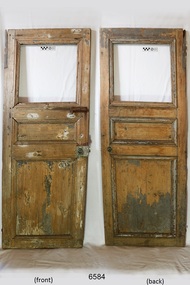 Flagstaff Hill Maritime Museum and Village
Furniture - Door, 1871 or earlier
... Other items found ashore included sewing machines (some consigned to ‘Long and Co.”) and notions, axe and scythe handles, hay forks, wooden pegs, rolls of wire (some branded “T.S” and Co, Melbourne”), kegs of nails branded “A.T. and Co.” from the factory of A. ...Other items found ashore included sewing machines (some consigned to ‘Long and Co.”) and notions, axe and scythe handles, hay forks, wooden pegs, rolls of wire (some branded “T.S” and Co, Melbourne”), kegs of nails branded “A.T. and Co.” from the factory of A. ...The wooden door was salvaged from the wreck of the sailing ship Eric the Red, which was a wooden, three masted clipper ship. Eric the Red was the largest full-rigged ship built at Bath, Maine, USA in 1871, having had a 1,580 tons register. She was built and registered by Arthur Sewall, later to become the partnership E. & A. Sewall, the 51st ship built by this company. The annually-published List of Merchant Vessels of the U.S. shows Bath was still the home port of Eric the Red in 1880. The vessel was named after the Viking discoverer, Eric the Red, who was the first European to reach the shores of North America (in 980AD). The ship Eric the Red at first traded in coal between America and Britain, and later traded in guano nitrates from South America. In 1879 she was re-metalled and was in first class condition. On 10th June 1880 (some records say 12th June) Eric the Red departed New York for Melbourne and then Sydney. She had been commissioned by American trade representatives to carry a special cargo of 500 exhibits (1400 tons) – about a quarter to a third of America’s total exhibits - from America for the U.S.A. pavilion at Melbourne’s first International Exhibition. The exhibits included furniture, ironmongery, wines, chemicals, dental and surgical instruments, paper, cages, bronze lamp trimmings, axles, stamped ware, astronomical and time globes, samples of corn and the choicest of leaf tobacco. Other general cargo included merchandise such as cases of kerosene and turpentine, brooms, Bristol's Sarsaparilla, Wheeler and Wilson sewing machines, Wheeler’s thresher machine, axe handles and tools, cases of silver plate, toys, pianos and organs, carriages and Yankee notions. The Eric the Red left New York under the command of Captain Z. Allen (or some records say Captain Jacques Allen) and 24 other crew including the owner’s son third mate Ned Sewall. There were 2 saloon passengers also. The ship had been sailing for an uneventful 85 days and the voyage was almost at its end. On 4th September 1880 the Eric the Red approached Cape Otway with a moderate north-west wind and hazy and overcast atmosphere. Around 1:30am Captain Allen sighted the Cape Otway light and was keeping the ship 5-6 miles offshore to stay clear of the hazardous Otway Reef. However he had badly misjudged his position. The ship hit the Otway Reef about 2 miles out to sea, south west of the Cape Otway light station. He ordered the wheel to be put ‘hard up’ thinking that she might float off the reef. A heavy sea knocked the man away from the wheel, broke the wheel ropes and carried away the rudder. The sea swamped the lifeboats. The mizzenmast fell, with all of its rigging, then the mainmast also fell and the ship broke in two. Some said that the passenger Vaughan, who was travelling for his health and not very strong, was washed overboard and never seen again. The ship started breaking up. The forward house came adrift with three of the crew on it as well as a longboat, which the men succeeded in launching and keeping afloat by continually bailing with their sea boots. The captain, the third mate (the owner’s son) and others clung to the mizzenmast in the sea. Then the owner’s son was washed away off the mast. Within 10 minutes the rest of the ship was in pieces, completely wrecked, with cargo and wreckage floating in the sea. The captain encouraged the second mate to swim with him to the deckhouse where there were other crew but the second mate wouldn’t go with him. Eventually the Captain made it to the deckhouse and the men pulled him up. At about 4:30am the group of men on the deckhouse saw the lights of a steamer and called for help. At the same time they noticed the second mate and the other man had drifted nearby, still on the spur, and pulled them both onto the wreck. The coastal steamer Dawn was returning to Warrnambool from Melbourne, its sailing time different to its usual schedule. Captain Jones sent out two life boats, and fired off rockets and blue lights to illuminate the area. They picked up the three survivors who were in the long boat from Eric the Red. Two men were picked up out of the water, one being the owner’s son who was clinging to floating kerosene boxes. At daylight the Dawn then rescued the 18 men from the floating portion of the deckhouse, which had drifted about 4 miles from where they’d struck the reef. Shortly after the rescue the deckhouse drifted onto breakers and was thrown onto rocks at Point Franklin, about 2 miles east of Cape Otway. Captain Jones had signalled to Cape Otway lighthouse the number of the Eric the Red and later signalled that there was a wreck at Otway Reef but there was no response from the lighthouse. The captain and crew of the Dawn spent several more hours searching unsuccessfully for more survivors, even going back as far as Apollo Bay. On board the Dawn the exhausted men received care and attention to their needs and wants, including much needed clothing. Captain Allen was amongst the 23 battered and injured men who were rescued and later taken to Warrnambool for care. Warrnambool’s mayor and town clerk offered them all hospitality, the three badly injured men going to the hospital for care and others to the Olive Branch Hotel, then on to Melbourne. Captain Allen’s leg injury prevented him from going ashore so he and three other men travelled on the Dawn to Portland. They were met by the mayor who also treated them all with great kindness. Captain Allen took the train back to Melbourne then returned to America. Those saved were Captain Z. Allen (or Jacques Allen), J. Darcy chief mate, James F. Lawrence second mate, Ned Sewall third mate and owner’s son, John French the cook, C. Nelson sail maker, Clarence W. New passenger, and the able seamen Dickenson, J. Black, Denis White, C. Herbert, C. Thompson, A. Brooks, D. Wilson, J. Ellis, Q. Thompson, C. Newman, W. Paul, J. Davis, M. Horenleng, J. Ogduff, T. W. Drew, R. Richardson. Four men had lost their lives; three of them were crew (Gus Dahlgreen ship’s carpenter, H. Ackman steward, who drowned in his cabin, and George Silver seaman) and one a passenger (J. B. Vaughan). The body of one of them had been found washed up at Cape Otway and was later buried in the lighthouse cemetery; another body was seen on an inaccessible ledge. Twelve months later the second mate James F. Lawrence, from Nova Scotia, passed away in the Warrnambool district; an obituary was displayed in the local paper. The captain and crew of the Dawn were recognised by the United States Government in July 1881 for their humane efforts, being thanked and presented with substantial monetary rewards, medals and gifts. Neither the ship, nor its cargo, was insured. The ship was worth about £15,000 and the cargo was reportedly worth £40,000; only about £2,000 worth had been recovered. Cargo and wreckage washed up at Apollo Bay, Peterborough, Port Campbell, Western Port and according to some reports, even as far away as the beaches of New Zealand. The day after the wreck the government steam ship Pharos was sent from Queenscliff to clear the shipping lanes of debris that could be a danger to ships. The large midship deckhouse of the ship was found floating in a calm sea near Henty Reef. Items such as an American chair, a ladder and a nest of boxes were all on top of the deckhouse. As it was so large and could cause danger to passing ships, Captain Payne had the deckhouse towed towards the shore just beyond Apollo Bay. Between Apollo Bay and Blanket Bay the captain and crew of Pharos collected Wheeler and Wilson sewing machines, nests of boxes, bottles of Bristol’s sarsaparilla, pieces of common American chairs, axe handles, a Wheelers’ Patent thresher and a sailor’s trunk with the words “A. James” on the front. A ship’s flag-board bearing the words “Eric the Red” was found on the deckhouse; finally those on board the Pharos had the name of the wrecked vessel. During this operation Pharos came across the government steamer Victoria and also a steamer S.S. Otway, both of which were picking up flotsam and wreckage. A whole side of the hull and three large pieces of the other side of the hull, with some of the copper sheathing stripped off, had floated on to Point Franklin. Some of the vessels yards and portions of her masts were on shore. The pieces of canvas attached to the yards and masts confirmed that the vessel had been under sail. The beach there was piled with debris several feet high. There were many cases of Diamond Oil kerosene, labelled R. W. Cameron and Company, New York. There were also many large planks of red pine, portions of a small white boat and a large, well-used oar. Other items found ashore included sewing machines (some consigned to ‘Long and Co.”) and notions, axe and scythe handles, hay forks, wooden pegs, rolls of wire (some branded “T.S” and Co, Melbourne”), kegs of nails branded “A.T. and Co.” from the factory of A. Field and Son, Taunton, Massachusetts, croquet balls and mallets, buggy fittings, rat traps, perfumery, cutlery and Douay Bibles, clocks, bicycles, chairs, a fly wheel, a cooking stove, timber, boxes, pianos, organs and a ladder. (Wooden clothes pegs drifted in for many years). There seemed to be no personal luggage or clothing. The Pharos encountered a long line, about one and a half miles, of floating wreckage about 10 miles off land, south east of Cape Otway, and in some places about 40 feet wide. It seemed that more than half of it was from Eric the Red. The ship’s crew rescued 3 cases that were for the Melbourne Exhibition and other items from amongst the debris. There were also chairs, doors, musical instruments, washing boards, nests of trunks and fly catchers floating in the sea. Most of the goods were saturated and smelt of kerosene. A section of the hull lies buried in the sand at Parker River Beach. An anchor with chain is embedded in the rocks east of Point Franklin and a second anchor, thought to be from Eric the Red, is on display at the Cape Otway light station. (There is a photograph of a life belt on the verandah of Rivernook Guest House in Princetown with the words “ERIC THE RED / BOSTON”. This is rather a mystery as the ship was registered in Bath, Maine, USA.) Parts of the ship are on display at Bimbi Park Caravan Park and at Apollo Bay Museum. Flagstaff Hill Maritime Village also has part of the helm (steering wheel), a carved wooden sword (said to be the only remaining portion of the ship’s figurehead; further research is currently being carried out), a door, a metal rod and samples of wood. Much of the wreckage was recovered by the local residents before police and other authorities arrived at the scene. Looters went to great effort to salvage goods, being lowered down the high cliff faces to areas with little or no beach to collect items from the wreckage, their mates above watching out for dangerous waves. A Tasmanian newspaper reports on a court case in Stawell, Victoria, noting a man who was caught 2 months later selling tobacco from the wreckage of Eric the Red. Some of the silverware is still treasured by descendants of Mr Mackenzie who was given these items by officials for his help in securing the cargo. The gifts included silver coffee and tea pots, half a dozen silver serviette rings and two sewing machines. The wreck and cargo were sold to a Melbourne man who salvaged a quantity of high quality tobacco and dental and surgical instruments. Timbers from the ship were salvaged and used in the construction of houses and sheds around Apollo Bay, including a guest house, Milford House (since burnt down in bushfires), which had furniture, fittings and timber on the dining room floor from the ship. A 39.7 foot long trading ketch, the Apollo, was also built from its timbers by Mr Burgess in 1883 and subsequently used in Tasmanian waters. It was the first attempt at ship building in Apollo bay. In 1881 a red light was installed about 300 feet above sea level at the base of the Cape Otway lighthouse to warn ships when they were too close to shore; It would not be visible unless a ship came within 3 miles from it. This has proved to be an effective warning. The State Library of Victoria has a lithograph in its collection depicting the steamer Dawn and the shipwrecked men, titled. "Wreck of the ship Eric the Red, Cape Otway: rescue of the crew by the Dawn". “The Eric the Red is historically significant as one of Victoria's major 19th century shipwrecks. (Heritage Victoria Eric the Red; HV ID 239) The wreck led to the provision of an additional warning light placed below the Cape Otway lighthouse to alert mariners to the location of Otway Reef. The site is archaeologically significant for its remains of a large and varied cargo and ship's fittings being scattered over a wide area. The site is recreationally and aesthetically significant as it is one of the few sites along this coast where tourists can visit identifiable remains of a large wooden shipwreck, and for its location set against the background of Cape Otway, Bass Strait, and the Cape Otway lighthouse.“ (Victorian Heritage Database Registration Number S239, Official Number 8745 USA) Door from the wreck of the ship Eric the Red. The wooden singular rectangular door includes three insert panel sections. The top section is square shaped and is missing its panel or glass. The centre timber panel is about a third of the height of the top panel and the bottom timber panel is approximately equal in height to the total height of the two upper panels. The door fastenings include both a metal door latch and traditional door bolt. They are both attached to the front right hand side of the door. The bolt is just below the top panel, and the door latch is in approximately the centre of that side. The door latch has a round mark where a handle could have been attached. The wood of the door has scraping marks in a semi-circle around the door latch where the latch has swung around on its one remaining fastening and grazed the surface. There is a metal hinge at the top section of the door on the opposite side to the latch. The painted surface has been scraped back to expose the wood. The door is shorter than the average height of a person. On the reverse of the door there are lines on the panels, just inside their edges, is what appears to be pencil. The door is not aligned straight but is skew to centre.warrnambool, flagstaff hill, flagstaff hill maritime village, maritime museum, shipwreck coast, great ocean road, shipwreck artefact, eric the red, jaques allen, sewall, 1880, melbourne exhibition 1880, cape otway, otway reef, victorian shipwreck, bass strait, eric-the-red, door -
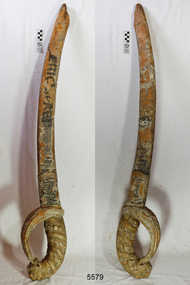 Flagstaff Hill Maritime Museum and Village
Decorative object - Sword, 1871 or earlier
... Other items found ashore included sewing machines (some consigned to ‘Long and Co.”) and notions, axe and scythe handles, hay forks, wooden pegs, rolls of wire (some branded “T.S” and Co, Melbourne”), kegs of nails branded “A.T. and Co.” from the factory of A. ...Other items found ashore included sewing machines (some consigned to ‘Long and Co.”) and notions, axe and scythe handles, hay forks, wooden pegs, rolls of wire (some branded “T.S” and Co, Melbourne”), kegs of nails branded “A.T. and Co.” from the factory of A. ...This wooden sword is said to “possibly be the only remaining part of the figurehead from the sailing ship Eric the Red.” It was previously part of the collection of the old Warrnambool Museum and the entry in its inventory says “Wooden sword, portion of the figurehead, held by “Eric the Red” at the bow.” A large part of the ship’s hull was found on the rocks and a figurehead may have been attached or washed up on the shore. The shipping records for E. & A. Sewall, the builders, owners and managers of Eric the Red, are now preserved in the Maine Maritime Museum. There is no photograph on record of Eric the Red but photographs of other ships built around that time by the same company show that these did not have figureheads, and there is no record found of a figurehead for Eric the Red being ordered or paid for. Further research is being carried out. The ship building company E. & A. Sewall, from Bath, Maine, USA, built Eric the Red, a wooden, three masted clipper ship. She had 1,580 tons register and was the largest full-rigged ship built at Bath, Maine, USA in 1871. She was built and registered by Arthur Sewall, later to become the partnership E. & A. Sewall, and was the 51st ship built by this company. The annually-published List of Merchant Vessels of the U.S. shows that Bath was still the home port of Eric the Red in 1880. The vessel was named after the Viking discoverer, Eric the Red, who was the first European to reach the shores of North America (in 980AD). The ship Eric the Red at first traded in coal between America and Britain, and later traded in guano nitrates from South America. In 1879 she was re-metalled and was in first class condition. On 10th June 1880 (some records say 12th June) Eric the Red departed New York for Melbourne and then Sydney. She had been commissioned by American trade representatives to carry a special cargo of 500 exhibits (1400 tons) - about a quarter to a third of America’s total exhibits - from America for the U.S.A. pavilion at Melbourne’s first International Exhibition. The exhibits included furniture, ironmongery, wines, chemicals, dental and surgical instruments, paper, cages, bronze lamp trimmings, axles, stamped ware, astronomical and time globes, samples of corn and the choicest of leaf tobacco. Other general cargo included merchandise such as cases of kerosene and turpentine, brooms, Bristol's Sarsaparilla, Wheeler and Wilson sewing machines, Wheeler’s thresher machine, axe handles and tools, cases of silver plate, toys, pianos and organs, carriages and Yankee notions. The Eric the Red left New York under the command of Captain Z. Allen (or some records say Captain Jacques Allen) and 24 other crew including the owner’s son third mate Ned Sewall. There were 2 saloon passengers also. On 4th September 1880 the ship had been sailing for an uneventful 85 days and the voyage was almost at its end. Eric the Red approached Cape Otway in a moderate north-west wind and hazy and overcast atmosphere. Around 1:30am Captain Allen sighted the Cape Otway light and was keeping the ship 5-6 miles offshore to stay clear of the hazardous Otway Reef. However he had badly misjudged his position. The ship hit the Otway Reef about 2 miles out to sea, south west of the Cape Otway light station. Captain Allen ordered the wheel to be put ‘hard up’ thinking that she might float off the reef. A heavy sea knocked the man away from the wheel, broke the wheel ropes and carried away the rudder. The sea swamped the lifeboats, the mizzenmast fell, with all of its rigging, then the mainmast fell and the ship broke in two. Some said that the passenger Vaughan, who was travelling for his health and not very strong, was washed overboard and never seen again. The ship started breaking up. The forward house came adrift with three of the crew on it as well as a longboat, which the men succeeded in launching and keeping afloat by continually bailing with their sea boots. The captain, the third mate (the owner’s son) and others clung to the mizzenmast in the sea. Then the owner’s son was washed away off the mast. Within 10 minutes the rest of the ship was in pieces, completely wrecked, with cargo and wreckage floating in the sea. The captain encouraged the second mate to swim with him to the deckhouse where there were other crew but the second mate wouldn’t go with him. Eventually the Captain made it to the deckhouse and the men pulled him up. At about 4:30am the group of men on the deckhouse saw the lights of a steamer and called for help. At the same time they noticed the second mate and the other man had drifted nearby, still on the spur, and pulled them both onto the wreck. The coastal steamer Dawn was returning to Warrnambool from Melbourne, its sailing time different to its usual schedule. Cries were heard coming from out of the darkness. Captain Jones sent out two life boats, and fired off rockets and blue lights to illuminate the area. They picked up the three survivors who were in the long boat from Eric the Red. Two men were picked up out of the water, one being the owner’s son who was clinging to floating kerosene boxes. At daylight the Dawn then rescued the 18 men from the floating portion of the deckhouse, which had drifted about 4 miles from where they’d struck the reef. Shortly after the rescue the deckhouse drifted onto breakers and was thrown onto rocks at Point Franklin, about 2 miles east of Cape Otway. Captain Jones had signalled to Cape Otway lighthouse the number of the Eric the Red and later signalled that there was a wreck at Otway Reef but there was no response from the lighthouse. The captain and crew of the Dawn spent several more hours searching unsuccessfully for more survivors, even going back as far as Apollo Bay. On board the Dawn the exhausted men received care and attention to their needs and wants, including much needed clothing. Captain Allen was amongst the 23 battered and injured men who were rescued and later taken to Warrnambool for care. Warrnambool’s mayor and town clerk offered them all hospitality, the three badly injured men going to the hospital and others to the Olive Branch Hotel, then on to Melbourne. Captain Allen’s leg injury prevented him from going ashore so he and three other men travelled on the Dawn to Portland. They were met by the mayor who also treated them all with great kindness. Captain Allen took the train back to Melbourne then returned to America. Those saved were Captain Z. Allen (or Jacques Allen), J. Darcy chief mate, James F. Lawrence second mate, Ned Sewall third mate and owner’s son, John French the cook, C. Nelson sail maker, Clarence W. New passenger, and the able seamen Dickenson, J. Black, Denis White, C. Herbert, C. Thompson, A. Brooks, D. Wilson, J. Ellis, Q. Thompson, C. Newman, W. Paul, J. Davis, M. Horenleng, J. Ogduff, T. W. Drew, R. Richardson. Four men had lost their lives; three of them were crew (Gus Dahlgreen ship’s carpenter, H. Ackman steward, who drowned in his cabin, and George Silver seaman) and one a passenger (J. B. Vaughan). The body of one of them had been found washed up at Cape Otway and was later buried in the lighthouse cemetery; another body was seen on an inaccessible ledge. Twelve months later the second mate James F. Lawrence, from Nova Scotia, passed away in the Warrnambool district; an obituary was displayed in the local paper. The captain and crew of the Dawn were recognised by the United States Government in July 1881 for their humane efforts and bravery, being thanked and presented with substantial monetary rewards, medals and gifts. Neither the ship, nor its cargo, was insured. The ship was worth about £15,000 and the cargo was reportedly worth £40,000; only about £2,000 worth had been recovered. Cargo and wreckage washed up at Apollo Bay, Peterborough, Port Campbell, Western Port and according to some reports, even as far away as the beaches of New Zealand. The day after the wreck the government steam ship Pharos was sent from Queenscliff to clear the shipping lanes of debris that could be a danger to ships. The large midship deckhouse of the ship was found floating in a calm sea near Henty Reef. Items such as an American chair, a ladder and a nest of boxes were all on top of the deckhouse. As it was so large and could cause danger to passing ships, Captain Payne had the deckhouse towed towards the shore just beyond Apollo Bay. Between Apollo Bay and Blanket Bay the captain and crew of Pharos collected Wheeler and Wilson sewing machines, nests of boxes, bottles of Bristol’s sarsaparilla, pieces of common American chairs, axe handles, a Wheelers’ Patent thresher and a sailor’s trunk with the words “A. James” on the front. A ship’s flag-board bearing the words “Eric the Red” was found on the deckhouse; finally those on board the Pharos had the name of the wrecked vessel. During this operation Pharos came across the government steamer Victoria and also a steamer S.S. Otway, both of which were picking up flotsam and wreckage. A whole side of the hull and three large pieces of the other side of the hull, with some of the copper sheathing stripped off, had floated on to Point Franklin. Some of the vessels yards and portions of her masts were on shore. The pieces of canvas attached to the yards and masts confirmed that the vessel had been under sail. The beach there was piled with debris several feet high. There were many cases of Diamond Oil kerosene, labelled R. W. Cameron and Company, New York. There were also many large planks of red pine, portions of a small white boat and a large, well-used oar. Other items found ashore included sewing machines (some consigned to ‘Long and Co.”) and notions, axe and scythe handles, hay forks, wooden pegs, rolls of wire (some branded “T.S” and Co, Melbourne”), kegs of nails branded “A.T. and Co.” from the factory of A. Field and Son, Taunton, Massachusetts, croquet balls and mallets, buggy fittings, rat traps, perfumery, cutlery and Douay Bibles, clocks, bicycles, chairs, a fly wheel, a cooking stove, timber, boxes, pianos, organs and a ladder. (Wooden clothes pegs drifted in for many years). There seemed to be no personal luggage or clothing. The Pharos encountered a long line, about one and a half miles, of floating wreckage about 10 miles off land, south east of Cape Otway, and in some places about 40 feet wide. It seemed that more than half of it was from Eric the Red. The ship’s crew rescued 3 cases that were for the Melbourne Exhibition and other items from amongst the debris. There were also chairs, doors, musical instruments, washing boards, nests of trunks and fly catchers floating in the sea. Most of the goods were saturated and smelt of kerosene. A section of the hull lies buried in the sand at Parker River Beach. An anchor with chain is embedded in the rocks east of Point Franklin and a second anchor, thought to be from Eric the Red, is on display at the Cape Otway light station. (There is a photograph of a life belt on the verandah of Rivernook Guest House in Princetown with the words “ERIC THE RED / BOSTON”. This is rather a mystery as the ship was registered in Bath, Maine, USA.) Parts of the ship are on display at Bimbi Park Caravan Park and at Apollo Bay Museum. Flagstaff Hill Maritime Village also has part of the helm (steering wheel), a carved wooden sword (said to be the only remaining portion of the ship’s figurehead; further research is currently being carried out), a door, a metal rod, samples of wood and a medal for bravery. Much of the wreckage was recovered by the local residents before police and other authorities arrived at the scene. Looters went to great effort to salvage goods, being lowered down the high cliff faces to areas with little or no beach to collect items from the wreckage, their mates above watching out for dangerous waves. A Tasmanian newspaper reports on a court case in Stawell, Victoria, noting a man who was caught 2 months later selling tobacco from the wreckage of Eric the Red. Some of the silverware is still treasured by descendants of Mr Mackenzie who was given these items by officials for his help in securing the cargo. The gifts included silver coffee and tea pots, half a dozen silver serviette rings and two sewing machines. The wreck and cargo were sold to a Melbourne man who salvaged a quantity of high quality tobacco and dental and surgical instruments. Timbers from the ship were salvaged and used in the construction of houses and sheds around Apollo Bay, including a guest house, Milford House (since burnt down in bushfires), which had furniture, fittings and timber on the dining room floor from the ship. A 39.7 foot long trading ketch, the Apollo, was also built from its timbers by Mr Burgess in 1883 and subsequently used in Tasmanian waters. It was the first attempt at ship building in Apollo bay. In 1881 a red light was installed about 300 feet above sea level at the base of the Cape Otway lighthouse to warn ships when they were too close to shore; It would not be visible unless a ship came within 3 miles from it. This has proved to be an effective warning. The State Library of Victoria has a lithograph in its collection depicting the steamer Dawn and the shipwrecked men, titled. "Wreck of the ship Eric the Red, Cape Otway: rescue of the crew by the Dawn".The Eric the Red is historically significant as one of Victoria's major 19th century shipwrecks. (Heritage Victoria Eric the Red; HV ID 239) The wreck led to the provision of an additional warning light placed below the Cape Otway lighthouse to alert mariners to the location of Otway Reef. The site is archaeologically significant for its remains of a large and varied cargo and ship's fittings being scattered over a wide area. The site is recreationally and aesthetically significant as it is one of the few sites along this coast where tourists can visit identifiable remains of a large wooden shipwreck, and for its location set against the background of Cape Otway, Bass Strait, and the Cape Otway lighthouse. (Victorian Heritage Database Registration Number S239, Official Number 8745 USA)This carved wooden sword, recovered from the Eric the Red, is possibly the only portion of the figurehead recovered after the wreck. There are spirals carved from the base of the handle to the top of the sword. The hilt of the sword is a lion’s head holding its tail in its mouth, the tail forming the handle. The blade of the sword has engraved patterns on it. Tiny particles of gold leaf and dark blue paint fragments can be seen between the carving marks. There are remnants of yellowish-orange and crimson paint on the handle. At some time after the sword was salvaged the name of the ship was hand painted on the blade in black paint. The tip of the sword has broken or split and the remaining part is charcoal in appearance. On both the tip and the base of the handle are parts made where the sword could have been joined onto the figurehead There is a white coating over some areas of the sword, similar to white lead putty used in traditional shipbuilding. The words “ERIC the RED” have been hand painted on the blade of the sword in black paint sometime after it was salvaged.flagstaff hill, flagstaff hill maritime museum and village, warrnambool, maritime museum, maritime village, great ocean road, shipwreck coast, sword, wooden sword, eric the red, carved sword, figurehead, snake head on sword -
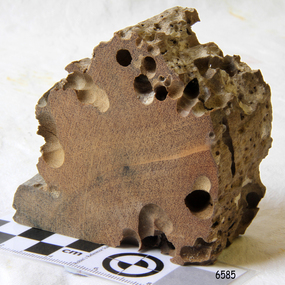 Flagstaff Hill Maritime Museum and Village
Wood Sample, about 1871
... Other items found ashore included sewing machines (some consigned to ‘Long and Co.”) and notions, axe and scythe handles, hay forks, wooden pegs, rolls of wire (some branded “T.S” and Co, Melbourne”), kegs of nails branded “A.T. and Co.” from the factory of A. ...Other items found ashore included sewing machines (some consigned to ‘Long and Co.”) and notions, axe and scythe handles, hay forks, wooden pegs, rolls of wire (some branded “T.S” and Co, Melbourne”), kegs of nails branded “A.T. and Co.” from the factory of A. ...This piece of timber from the ship Eric the Red has been eaten through by the marine animals called Teredo Worms, sometimes called sea worms or ‘termites of the sea’. The worms bore holes into wood that is immersed in sea water and bacteria inside the worms digest the wood. Shipbuilders tried to prevent this problem by using coatings of tar, wax, lead or pitch. In the 18th and 19th centuries the outside of their ships were sheathed in copper or a combination of copper and zinc (called Muntz metal) and would be re-metalled periodically to ensure the sheathing would remain effective. In more recent times the ships are protected with a toxic coating. The American ship Eric the Red was a wooden, three masted clipper ship. She had 1,580 tons register and was the largest full-rigged ship built at Bath, Maine, USA in 1871. She was built and registered by Arthur Sewall, later to become the partnership E. & A. Sewall, the 51st ship built by this company. The annually-published List of Merchant Vessels of the U.S. shows Bath was still the home port of Eric the Red in 1880. The vessel was named after the Viking discoverer, Eric ‘the Red-haired’ Thorvaldsson , who was the first European to reach the shores of North America (in 980AD). The ship Eric the Red at first traded in coal between America and Britain, and later traded in guano nitrates from South America. In 1879 she was re-metalled and was in first class condition. On 10th June 1880 (some records say 12th June) Eric the Red departed New York for Melbourne and then Sydney. She had been commissioned by American trade representatives to carry a special cargo of 500 exhibits (1400 tons) – about a quarter to a third of America’s total exhibits - for the U.S.A. pavilion at Melbourne’s first International Exhibition. The exhibits included furniture, ironmongery, wines, chemicals, dental and surgical instruments, paper, cages, bronze lamp trimmings, axles, stamped ware, astronomical and time globes, samples of corn and the choicest of leaf tobacco. Other general cargo included merchandise such as cases of kerosene and turpentine, brooms, Bristol's Sarsaparilla, Wheeler and Wilson sewing machines, Wheeler’s thresher machine, axe handles and tools, cases of silver plate, toys, pianos and organs, carriages and Yankee notions. The Eric the Red left New York under the command of Captain Zaccheus Allen (or some records say Captain Jacques Allen) and 24 other crew including the owner’s son third mate Ned Sewall. There were also 2 saloon passengers on board. The ship had been sailing for an uneventful 85 days and the voyage was almost at its end. As Eric the Red approached Cape Otway there was a moderate north-west wind and hazy and overcast atmosphere. On 4th September 1880 at about 1:30am Captain Allen sighted the Cape Otway light and was keeping the ship 5-6 miles offshore to stay clear of the hazardous Otway Reef. However he had badly misjudged his position. The ship hit the Otway Reef about 2 miles out to sea, south west of the Cape Otway light station. Captain Allen ordered the wheel to be put ‘hard up’ thinking that she might float off the reef. The sea knocked the helmsman away from the wheel, broke the wheel ropes and carried away the rudder. The lifeboats were swamped, the mizzenmast fell, with all of its rigging, then the mainmast also fell and the ship broke in two. Some said that the passenger Vaughan, who was travelling for his health and not very strong, was washed overboard and never seen again. The ship started breaking up. The forward house came adrift with three of the crew on it as well as a longboat, which the men succeeded in launching and keeping afloat by continually bailing with their sea boots. The captain, the third mate (the owner’s son) and others clung to the mizzenmast in the sea. Then the owner’s son was washed away off the mast. Within 10 minutes the rest of the ship was in pieces, completely wrecked, with cargo and wreckage floating in the sea. The captain encouraged the second mate to swim with him to the deckhouse where there were other crew but the second mate wouldn’t go with him. Eventually the Captain made it to the deckhouse and the men pulled him up. At about 4:30am the group of men on the deckhouse saw the lights of a steamer and called for help. At the same time they noticed the second mate and the other man had drifted nearby, still on the spur, and pulled them both onto the wreck. The coastal steamer SS Dawn was returning to Warrnambool from Melbourne, its sailing time different to its usual schedule. She was built in 1876 and bought by the Portland and Belfast Steam Navigation Co. in 1877. At the time of this journey she was commanded by Captain Jones, and was sailing between Melbourne and Portland via Warrnambool. The provedore of the Dawn, Benjamin Lear, heard cries of distress coming through the portholes of the saloon. He gave the alarm and the engines were stopped. Cries could be heard clearly, coming from the land. Captain Jones sent out crew in two boats, and fired off rockets and blue lights to illuminate the area. They picked up the three survivors who were in the long boat from Eric the Red. Two men were picked up out of the water, one being the owner’s son who was clinging to floating kerosene boxes. At daylight the Dawn then rescued the 18 men from the floating portion of the deckhouse, which had drifted about 4 miles from where they’d struck the reef. Shortly after the rescue the deckhouse drifted onto breakers and was thrown onto rocks at Point Franklin, about 2 miles east of Cape Otway. Captain Jones had signalled to Cape Otway lighthouse the number of the Eric the Red and later signalled that there was a wreck at Otway Reef but there was no response from the lighthouse. The captain and crew of the Dawn spent several more hours searching unsuccessfully for more survivors, even going back as far as Apollo Bay. On board the Dawn the exhausted men received care and attention to their needs and wants, including much needed clothing. Captain Allen was amongst the 23 battered and injured men who were rescued and later taken to Warrnambool for care. Warrnambool’s mayor and town clerk offered them all hospitality, the three badly injured men going to the hospital for care and others to the Olive Branch Hotel, then on to Melbourne. Captain Allen’s leg injury prevented him from going ashore so he and three other men travelled on the Dawn to Portland. They were met by the mayor who also treated them all with great kindness. Captain Allen took the train back to Melbourne then returned to America. Those saved were Captain Zaccheus Allen (or Jacques Allen), J. Darcy chief mate, James F. Lawrence second mate, Ned Sewall third mate and owner’s son, John French the cook, C. Nelson sail maker, Clarence W. New passenger, and the able seamen Dickenson, J. Black, Denis White, C. Herbert, C. Thompson, A. Brooks, D. Wilson, J. Ellis, Q. Thompson, C. Newman, W. Paul, J. Davis, M. Horenleng, J. Ogduff, T. W. Drew, R. Richardson. Four men had lost their lives; three of them were crew (Gus Dahlgreen ship’s carpenter, H. Ackman steward, who drowned in his cabin, and George Silver seaman) and one a passenger (J. B. Vaughan). The body of one of them had been found washed up at Cape Otway and was later buried in the lighthouse cemetery; another body was seen on an inaccessible ledge. Twelve months later the second mate James F. Lawrence, from Nova Scotia, passed away in the Warrnambool district; an obituary was displayed in the local paper. Neither the ship, nor its cargo, was insured. The ship was worth about £15,000 and the cargo was reportedly worth £40,000; only about £2,000 worth had been recovered. Cargo and wreckage washed up at Apollo Bay, Peterborough, Port Campbell, Western Port and according to some reports, even as far away as the beaches of New Zealand. The day after the wreck the government steam ship Pharos was sent from Queenscliff to clear the shipping lanes of debris that could be a danger to ships. The large midship deckhouse of the ship was found floating in a calm sea near Henty Reef. Items such as an American chair, a ladder and a nest of boxes were all on top of the deckhouse. As it was so large and could cause danger to passing ships, Captain Payne had the deckhouse towed towards the shore just beyond Apollo Bay. Between Apollo Bay and Blanket Bay the captain and crew of Pharos collected Wheeler and Wilson sewing machines, nests of boxes, bottles of Bristol’s sarsaparilla, pieces of common American chairs, axe handles, a Wheelers’ Patent thresher and a sailor’s trunk with the words “A. James” on the front. A ship’s flag-board bearing the words “Eric the Red” was found on the deckhouse; finally those on board the Pharos had the name of the wrecked vessel. During this operation Pharos came across the government steamer Victoria and also a steamer S.S. Otway, both of which were picking up flotsam and wreckage. A whole side of the hull and three large pieces of the other side of the hull, with some of the copper sheathing stripped off, had floated on to Point Franklin. Some of the vessels yards and portions of her masts were on shore. The pieces of canvas attached to the yards and masts confirmed that the vessel had been under sail. The beach there was piled with debris several feet high. There were many cases of Diamond Oil kerosene, labelled R. W. Cameron and Company, New York. There were also many large planks of red pine, portions of a small white boat and a large, well-used oar. Other items found ashore included sewing machines (some consigned to ‘Long and Co.”) and notions, axe and scythe handles, hay forks, wooden pegs, rolls of wire (some branded “T.S” and Co, Melbourne”), kegs of nails branded “A.T. and Co.” from the factory of A. Field and Son, Taunton, Massachusetts, croquet balls and mallets, buggy fittings, rat traps, perfumery, cutlery and Douay Bibles, clocks, bicycles, chairs, a fly wheel, a cooking stove, timber, boxes, pianos, organs and a ladder. (Wooden clothes pegs drifted in for many years). There seemed to be no personal luggage or clothing. The Pharos encountered a long line, about one and a half miles, of floating wreckage about 10 miles off land, south east of Cape Otway, and in some places about 40 feet wide. It seemed that more than half of it was from Eric the Red. The ship’s crew rescued 3 cases that were for the Melbourne Exhibition and other items from amongst the debris. There were also chairs, doors, musical instruments, washing boards, nests of trunks and fly catchers floating in the sea. Most of the goods were saturated and smelt of kerosene. A section of the hull lies buried in the sand at Parker River Beach. An anchor with chain is embedded in the rocks east of Point Franklin and a second anchor, thought to be from Eric the Red, is on display at the Cape Otway light station. (There is a photograph of a life belt on the verandah of Rivernook Guest House in Princetown with the words “ERIC THE RED / BOSTON”. This is rather a mystery as the ship was registered in Bath, Maine, USA.) Parts of the ship are on display at Bimbi Park Caravan Park and at Apollo Bay Museum. Flagstaff Hill Maritime Village also has part of the helm (steering wheel), a carved wooden sword (said to be the only remaining portion of the ship’s figurehead; further research is currently being carried out), a door, a metal rod, several samples of wood and a medal for bravery, awarded to Nelson Johnson, a crew member of the S.S. Dawn by the U.S. President, for the rescue of the crew. Much of the wreckage was recovered by the local residents before police and other authorities arrived at the scene. Looters went to great effort to salvage goods, being lowered down the high cliff faces to areas with little or no beach to collect items from the wreckage, their mates above watching out for dangerous waves. A Tasmanian newspaper reports on a court case in Stawell, Victoria, noting a man who was caught 2 months later selling tobacco from the wreckage of Eric the Red. Some of the silverware is still treasured by descendants of Mr Mackenzie who was given these items by officials for his help in securing the cargo. The gifts included silver coffee and tea pots, half a dozen silver serviette rings and two sewing machines. A Mr G.W. Black has in his possession a medal and a purse that were awarded to his father, another Dawn crew member who was part of the rescue team. The medal is inscribed and named “To John Black ….” (from “Shipwrecks” by Margaret E. Mackenzie, 3rd edition, published 1964). The wreck and cargo were sold to a Melbourne man who salvaged a quantity of high quality tobacco and dental and surgical instruments. Timbers from the ship were salvaged and used in the construction of houses and sheds around Apollo Bay, including a guest house, Milford House (since burnt down in bushfires), which had furniture, fittings and timber on the dining room floor from the ship. A 39.7 foot long trading ketch, the Apollo, was also built from its timbers by Mr Burgess in 1883 and subsequently used in Tasmanian waters. It was the first attempt at ship building in Apollo bay. In 1881 a red light was installed about 300 feet above sea level at the base of the Cape Otway lighthouse to warn ships when they were too close to shore; It would not be visible unless a ship came within 3 miles from it. This has proved to be an effective warning. Nelson Johnson, recipient of the medal for bravery, married Elizabeth Howard in 1881 and they had 10 children. They lived in South Melbourne, Victoria. Nelson died in 1922 in Fitzroy Victoria, age 66. In 1895 the owners of the S.S. Dawn, the Portland and Belfast Steam Navigation Co., wound up and sold out to the Belfast Company who took over the Dawn for one year before selling her to Howard Smith. She was condemned and sunk in Suva in 1928. The State Library of Victoria has a lithograph in its collection depicting the steamer Dawn and the shipwrecked men, titled. "Wreck of the ship Eric the Red, Cape Otway: rescue of the crew by the Dawn".The wood (timber) sample is listed on the Collections Australia Database, Heritage Victoria, number 239 00010 A “The Eric the Red is historically significant as one of Victoria's major 19th century shipwrecks. (Heritage Victoria Eric the Red; HV ID 239) The wreck led to the provision of an additional warning light placed below the Cape Otway lighthouse to alert mariners to the location of Otway Reef. The site is archaeologically significant for its remains of a large and varied cargo and ship's fittings being scattered over a wide area. The site is recreationally and aesthetically significant as it is one of the few sites along this coast where tourists can visit identifiable remains of a large wooden shipwreck, and for its location set against the background of Cape Otway, Bass Strait, and the Cape Otway lighthouse.“ (Victorian Heritage Database Registration Number S239, Official Number 8745 USA) Wood sample from the wreck of the ship Eric the Red. Triangular shaped, full of sea worm (Teredo worm) holes. The wood is dark in colour and is very light in weight.flagstaff hill, warrnambool, shipwrecked-coast, flagstaff-hill, flagstaff-hill-maritime-museum, maritime-museum, shipwreck-coast, flagstaff-hill-maritime-village, shipwreck-artefact, eric-the-red, zaccheus-allen, sewall, 1880, melbourne-exhibition, cape-otway, otway-reef, wood-sample, s.s.-dawn -
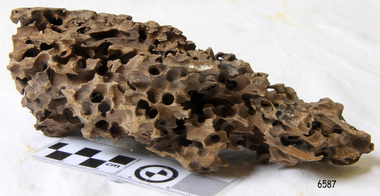 Flagstaff Hill Maritime Museum and Village
Wood Sample, About 1871
... Other items found ashore included sewing machines (some consigned to ‘Long and Co.”) and notions, axe and scythe handles, hay forks, wooden pegs, rolls of wire (some branded “T.S” and Co, Melbourne”), kegs of nails branded “A.T. and Co.” from the factory of A. ...Other items found ashore included sewing machines (some consigned to ‘Long and Co.”) and notions, axe and scythe handles, hay forks, wooden pegs, rolls of wire (some branded “T.S” and Co, Melbourne”), kegs of nails branded “A.T. and Co.” from the factory of A. ...This piece of timber from the ship Eric the Red has been eaten through by the marine animals called Teredo Worms, sometimes called sea worms or ‘termites of the sea’. The worms bore holes into wood that is immersed in sea water and bacteria inside the worms digest the wood. Shipbuilders tried to prevent this problem by using coatings of tar, wax, lead or pitch. In the 18th and 19th centuries the outside of their ships were sheathed in copper or a combination of copper and zinc (called Muntz metal) and would be re-metalled periodically to ensure the sheathing would remain effective. In more recent times the ships are protected with a toxic coating. The American ship Eric the Red was a wooden, three masted clipper ship. She had 1,580 tons register and was the largest full-rigged ship built at Bath, Maine, USA in 1871. She was built and registered by Arthur Sewall, later to become the partnership E. & A. Sewall, the 51st ship built by this company. The annually-published List of Merchant Vessels of the U.S. shows Bath was still the home port of Eric the Red in 1880. The vessel was named after the Viking discoverer, Eric ‘the Red-haired’ Thorvaldsson , who was the first European to reach the shores of North America (in 980AD). The ship Eric the Red at first traded in coal between America and Britain, and later traded in guano nitrates from South America. In 1879 she was re-metalled and was in first class condition. On 10th June 1880 (some records say 12th June) Eric the Red departed New York for Melbourne and then Sydney. She had been commissioned by American trade representatives to carry a special cargo of 500 exhibits (1400 tons) – about a quarter to a third of America’s total exhibits - for the U.S.A. pavilion at Melbourne’s first International Exhibition. The exhibits included furniture, ironmongery, wines, chemicals, dental and surgical instruments, paper, cages, bronze lamp trimmings, axles, stamped ware, astronomical and time globes, samples of corn and the choicest of leaf tobacco. Other general cargo included merchandise such as cases of kerosene and turpentine, brooms, Bristol's Sarsaparilla, Wheeler and Wilson sewing machines, Wheeler’s thresher machine, axe handles and tools, cases of silver plate, toys, pianos and organs, carriages and Yankee notions. The Eric the Red left New York under the command of Captain Zaccheus Allen (or some records say Captain Jacques Allen) and 24 other crew including the owner’s son third mate Ned Sewall. There were also 2 saloon passengers on board. The ship had been sailing for an uneventful 85 days and the voyage was almost at its end. As Eric the Red approached Cape Otway there was a moderate north-west wind and hazy and overcast atmosphere. On 4th September 1880 at about 1:30am Captain Allen sighted the Cape Otway light and was keeping the ship 5-6 miles offshore to stay clear of the hazardous Otway Reef. However he had badly misjudged his position. The ship hit the Otway Reef about 2 miles out to sea, south west of the Cape Otway light station. Captain Allen ordered the wheel to be put ‘hard up’ thinking that she might float off the reef. The sea knocked the helmsman away from the wheel, broke the wheel ropes and carried away the rudder. The lifeboats were swamped, the mizzenmast fell, with all of its rigging, then the mainmast also fell and the ship broke in two. Some said that the passenger Vaughan, who was travelling for his health and not very strong, was washed overboard and never seen again. The ship started breaking up. The forward house came adrift with three of the crew on it as well as a longboat, which the men succeeded in launching and keeping afloat by continually bailing with their sea boots. The captain, the third mate (the owner’s son) and others clung to the mizzenmast in the sea. Then the owner’s son was washed away off the mast. Within 10 minutes the rest of the ship was in pieces, completely wrecked, with cargo and wreckage floating in the sea. The captain encouraged the second mate to swim with him to the deckhouse where there were other crew but the second mate wouldn’t go with him. Eventually the Captain made it to the deckhouse and the men pulled him up. At about 4:30am the group of men on the deckhouse saw the lights of a steamer and called for help. At the same time they noticed the second mate and the other man had drifted nearby, still on the spur, and pulled them both onto the wreck. The coastal steamer SS Dawn was returning to Warrnambool from Melbourne, its sailing time different to its usual schedule. She was built in 1876 and bought by the Portland and Belfast Steam Navigation Co. in 1877. At the time of this journey she was commanded by Captain Jones, and was sailing between Melbourne and Portland via Warrnambool. The provedore of the Dawn, Benjamin Lear, heard cries of distress coming through the portholes of the saloon. He gave the alarm and the engines were stopped. Cries could be heard clearly, coming from the land. Captain Jones sent out crew in two boats, and fired off rockets and blue lights to illuminate the area. They picked up the three survivors who were in the long boat from Eric the Red. Two men were picked up out of the water, one being the owner’s son who was clinging to floating kerosene boxes. At daylight the Dawn then rescued the 18 men from the floating portion of the deckhouse, which had drifted about 4 miles from where they’d struck the reef. Shortly after the rescue the deckhouse drifted onto breakers and was thrown onto rocks at Point Franklin, about 2 miles east of Cape Otway. Captain Jones had signalled to Cape Otway lighthouse the number of the Eric the Red and later signalled that there was a wreck at Otway Reef but there was no response from the lighthouse. The captain and crew of the Dawn spent several more hours searching unsuccessfully for more survivors, even going back as far as Apollo Bay. On board the Dawn the exhausted men received care and attention to their needs and wants, including much needed clothing. Captain Allen was amongst the 23 battered and injured men who were rescued and later taken to Warrnambool for care. Warrnambool’s mayor and town clerk offered them all hospitality, the three badly injured men going to the hospital for care and others to the Olive Branch Hotel, then on to Melbourne. Captain Allen’s leg injury prevented him from going ashore so he and three other men travelled on the Dawn to Portland. They were met by the mayor who also treated them all with great kindness. Captain Allen took the train back to Melbourne then returned to America. Those saved were Captain Zaccheus Allen (or Jacques Allen), J. Darcy chief mate, James F. Lawrence second mate, Ned Sewall third mate and owner’s son, John French the cook, C. Nelson sail maker, Clarence W. New passenger, and the able seamen Dickenson, J. Black, Denis White, C. Herbert, C. Thompson, A. Brooks, D. Wilson, J. Ellis, Q. Thompson, C. Newman, W. Paul, J. Davis, M. Horenleng, J. Ogduff, T. W. Drew, R. Richardson. Four men had lost their lives; three of them were crew (Gus Dahlgreen ship’s carpenter, H. Ackman steward, who drowned in his cabin, and George Silver seaman) and one a passenger (J. B. Vaughan). The body of one of them had been found washed up at Cape Otway and was later buried in the lighthouse cemetery; another body was seen on an inaccessible ledge. Twelve months later the second mate James F. Lawrence, from Nova Scotia, passed away in the Warrnambool district; an obituary was displayed in the local paper. Neither the ship, nor its cargo, was insured. The ship was worth about £15,000 and the cargo was reportedly worth £40,000; only about £2,000 worth had been recovered. Cargo and wreckage washed up at Apollo Bay, Peterborough, Port Campbell, Western Port and according to some reports, even as far away as the beaches of New Zealand. The day after the wreck the government steam ship Pharos was sent from Queenscliff to clear the shipping lanes of debris that could be a danger to ships. The large midship deckhouse of the ship was found floating in a calm sea near Henty Reef. Items such as an American chair, a ladder and a nest of boxes were all on top of the deckhouse. As it was so large and could cause danger to passing ships, Captain Payne had the deckhouse towed towards the shore just beyond Apollo Bay. Between Apollo Bay and Blanket Bay the captain and crew of Pharos collected Wheeler and Wilson sewing machines, nests of boxes, bottles of Bristol’s sarsaparilla, pieces of common American chairs, axe handles, a Wheelers’ Patent thresher and a sailor’s trunk with the words “A. James” on the front. A ship’s flag-board bearing the words “Eric the Red” was found on the deckhouse; finally those on board the Pharos had the name of the wrecked vessel. During this operation Pharos came across the government steamer Victoria and also a steamer S.S. Otway, both of which were picking up flotsam and wreckage. A whole side of the hull and three large pieces of the other side of the hull, with some of the copper sheathing stripped off, had floated on to Point Franklin. Some of the vessels yards and portions of her masts were on shore. The pieces of canvas attached to the yards and masts confirmed that the vessel had been under sail. The beach there was piled with debris several feet high. There were many cases of Diamond Oil kerosene, labelled R. W. Cameron and Company, New York. There were also many large planks of red pine, portions of a small white boat and a large, well-used oar. Other items found ashore included sewing machines (some consigned to ‘Long and Co.”) and notions, axe and scythe handles, hay forks, wooden pegs, rolls of wire (some branded “T.S” and Co, Melbourne”), kegs of nails branded “A.T. and Co.” from the factory of A. Field and Son, Taunton, Massachusetts, croquet balls and mallets, buggy fittings, rat traps, perfumery, cutlery and Douay Bibles, clocks, bicycles, chairs, a fly wheel, a cooking stove, timber, boxes, pianos, organs and a ladder. (Wooden clothes pegs drifted in for many years). There seemed to be no personal luggage or clothing. The Pharos encountered a long line, about one and a half miles, of floating wreckage about 10 miles off land, south east of Cape Otway, and in some places about 40 feet wide. It seemed that more than half of it was from Eric the Red. The ship’s crew rescued 3 cases that were for the Melbourne Exhibition and other items from amongst the debris. There were also chairs, doors, musical instruments, washing boards, nests of trunks and fly catchers floating in the sea. Most of the goods were saturated and smelt of kerosene. A section of the hull lies buried in the sand at Parker River Beach. An anchor with chain is embedded in the rocks east of Point Franklin and a second anchor, thought to be from Eric the Red, is on display at the Cape Otway light station. (There is a photograph of a life belt on the verandah of Rivernook Guest House in Princetown with the words “ERIC THE RED / BOSTON”. This is rather a mystery as the ship was registered in Bath, Maine, USA.) Parts of the ship are on display at Bimbi Park Caravan Park and at Apollo Bay Museum. Flagstaff Hill Maritime Village also has part of the helm (steering wheel), a carved wooden sword (said to be the only remaining portion of the ship’s figurehead; further research is currently being carried out), a door, a metal rod, several samples of wood and a medal for bravery, awarded to Nelson Johnson, a crew member of the S.S. Dawn by the U.S. President, for the rescue of the crew. Much of the wreckage was recovered by the local residents before police and other authorities arrived at the scene. Looters went to great effort to salvage goods, being lowered down the high cliff faces to areas with little or no beach to collect items from the wreckage, their mates above watching out for dangerous waves. A Tasmanian newspaper reports on a court case in Stawell, Victoria, noting a man who was caught 2 months later selling tobacco from the wreckage of Eric the Red. Some of the silverware is still treasured by descendants of Mr Mackenzie who was given these items by officials for his help in securing the cargo. The gifts included silver coffee and tea pots, half a dozen silver serviette rings and two sewing machines. A Mr G.W. Black has in his possession a medal and a purse that were awarded to his father, another Dawn crew member who was part of the rescue team. The medal is inscribed and named “To John Black ….” (from “Shipwrecks” by Margaret E. Mackenzie, 3rd edition, published 1964). The wreck and cargo were sold to a Melbourne man who salvaged a quantity of high quality tobacco and dental and surgical instruments. Timbers from the ship were salvaged and used in the construction of houses and sheds around Apollo Bay, including a guest house, Milford House (since burnt down in bushfires), which had furniture, fittings and timber on the dining room floor from the ship. A 39.7 foot long trading ketch, the Apollo, was also built from its timbers by Mr Burgess in 1883 and subsequently used in Tasmanian waters. It was the first attempt at ship building in Apollo bay. In 1881 a red light was installed about 300 feet above sea level at the base of the Cape Otway lighthouse to warn ships when they were too close to shore; It would not be visible unless a ship came within 3 miles from it. This has proved to be an effective warning. Nelson Johnson, recipient of the medal for bravery, married Elizabeth Howard in 1881 and they had 10 children. They lived in South Melbourne, Victoria. Nelson died in 1922 in Fitzroy Victoria, age 66. In 1895 the owners of the S.S. Dawn, the Portland and Belfast Steam Navigation Co., wound up and sold out to the Belfast Company who took over the Dawn for one year before selling her to Howard Smith. She was condemned and sunk in Suva in 1928. The State Library of Victoria has a lithograph in its collection depicting the steamer Dawn and the shipwrecked men, titled. "Wreck of the ship Eric the Red, Cape Otway: rescue of the crew by the Dawn".The wood (timber) sample is listed on the Collections Australia Database, Heritage Victoria, number 239 00010 A “The Eric the Red is historically significant as one of Victoria's major 19th century shipwrecks. (Heritage Victoria Eric the Red; HV ID 239) The wreck led to the provision of an additional warning light placed below the Cape Otway lighthouse to alert mariners to the location of Otway Reef. The site is archaeologically significant for its remains of a large and varied cargo and ship's fittings being scattered over a wide area. The site is recreationally and aesthetically significant as it is one of the few sites along this coast where tourists can visit identifiable remains of a large wooden shipwreck, and for its location set against the background of Cape Otway, Bass Strait, and the Cape Otway lighthouse.“ (Victorian Heritage Database Registration Number S239, Official Number 8745 USA) Wood sample from the wreck of the ship Eric the Red. Oblong shaped, full of sea worm (Teredo worm) holes. The wood is dark in colour and is very light in weight. flagstaff hill, warrnambool, shipwrecked-coast, flagstaff-hill, flagstaff-hill-maritime-museum, maritime-museum, shipwreck-coast, flagstaff-hill-maritime-village, shipwreck-artefact, eric-the-red, zaccheus-allen, sewall, 1880, melbourne-exhibition, cape-otway, otway-reef, wood-sample, s.s.-dawn -
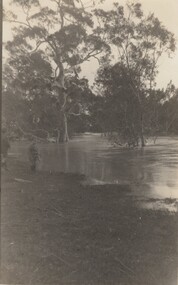 Stawell Historical Society Inc
Photograph, Whitehall Property Greens Creek
... Hutchings muscovy ducks, hay shed and trees along the river in the background. 58a. ...Hutchings muscovy ducks, hay shed and trees along the river in the background. 58a. ...Hutchings family 1. Wimmera River in flood below Whitehall running a banker c. 1920. Ted & Col Hutchings in foreground. 2. Wimmera River in flood looking downstream. No date but possibly same time as no. 1. from same place. 3. Looking over the Wimmera River to Island paddock towards Greens Creek 4. Wimmera River half a banker at Whitehall 5. Wimmera River in flood upstream from carpenter's shop looking towards engine house at Whitehall 5a. Wimmera River in flood. Left to right - blacksmith shop and carpenters' shop. 5b. Taken from the same spot with Emily & Ada Hole, E G (Ted) & Col Hutchings. Blacksmith shop & carpenters' shop, Whitehall. 5c. Wimmera River upstream from the carpenters' shop. Foreground is possibly Belladonna lilies which were all over the river bank in 1992. Whitehall. 5d. Looking downstream towards the loose boxes, Whitehall. 5e. Blacksmiths' shop and carpenters' shop from the pumping station. Wimmera River, Whitehall. 6. Wimmera River in flood at Whitehall. 7. Wimmera River half a banker in front of old hut at Whitehall. 8. Wimmera River Emily Hayes, Edward G (Ted) Hutchings & Colin J Hutchings. 9. Morrl-Morrl - Greens Creek Road opposite back paddock. Whitehall. Black Ford in distance. c. 1919 10. Whitehall woolshed north east aspect, Drive to the right of photo 11. Whitehall woolshed - north east aspect showing the drive to the right 11a. Whitehall woolshed - north aspect 11b. Same tree near woolshed 11c. Same tree again in centre, other trees came up after the 23 flood. Woolshed to the right out of photo. 12. Whitehall woolshed - south aspect, sheep entrance end 13. Whitehall. left to right, Stackyard, stables in the centre and the Wimmera River behind following the trees. 14. Whitehall horse paddock c. 1920. left to right, Machinery shed, stable in the centre. Homestead to the right in distance. There is no windmill. 15. Load of wool from Whitehall woolshed to right. 16. Whitehall c. 1920 before the windmill. left to right, garage and mens' hut. Wimmera river runs along the tree line. 16a. Stables, garage and mens' hut after the construction of the windmill. River behind. 17. Whitehall c. 1922. Note windmill addition. Garage to left, Mens' Hut to right. Jack Donnelly & Edward G (Ted) Hutchings with pet lambs. River behind trees. 18. Whitehall gardens. Summer house to the right, pine tree lined drive in the centre background. Ted & Col Hutchings on the lawn. C. 1920 19. Edward G. (Ted) & Colin J. Hutchings in Whitehall garden. Wimmera River in the background. The building behind the fence is the carpenters' shop which the family lived in while house was rebuilt after fire 15 Jan 1877 20. Whitehall c. 1920. left to right, cattle yard, killing house, Wimmera river behind the fence, and the loose box on the right. Black Orpington chooks in foreground. 21. Bay window (original blinds) in the master bedroom. Whitehall 20 Sep 1992 22. Master bedroom (original wallpaper) Joyce & Col Hutchings, Moyu, Ben & Rebecca Roe 20 Sep 1992 23. Col & Ted's bedroom (original) Marble mantlepiece had been removed. Whitehall. 20 Sep 1992 24. Whitehall kitchen. Large yellow meat oven to left of stove, bread oven far left, extreme right is oven where milk heated to skim cream. Chimney was a central one shared with meat oven. Bread oven chimney separate. 20 Sep 1992 25. Whitehall dairy, made of natural stone with dried brick corners. Entrance behind creeper which is over trellis. 20 Sep 1992. This building still remains in 1 Jun 2023 26. Inside charcoal lined meat cellar. Bottom right is concrete vat for pickling meat in brine. Top of brickwork slightly above ground level. Whitehall 20 Sep 1992 27. Fire foreground was stable flooring which was to left of photo. Machinery shed (thatch roof). 4 posts far left remains of cowshed. Large post in centre foreground is the gate post of corral. River to right. 20 Sep 1992 28. Whitehall machinery shed. Posts on far right are cow shed. Over the river is the island paddock. Wimmera river runs behind machinery shed. 20 Sep 1992 29. Posts of 10 sided corral. Killing house by side of gum tree in centre of photo on far side of corral. To left is one of the bales of the cowshed. Whitehall. 20 Sep 1992 29a. Similar photo in the 1920's. To the right is horsebreaking corral, then cow shed, loose box, haystacks and stable on left. Whitehall. 30. Dining room fire place put in the open fire of the mens' hut, only the chimney remains. To the left is the drive & river. Rebecca Roe, Col Hutchings granddaughter. 20 Sep 1992 30a. Looking down the Whitehall Drive. Mens' Hut (Jack Donnelly in doorway) and garage far left. 1920's 30b. The Drive, Whitehall taken from in front of the mens' hut. Wimmera River on the left. Gum tree on left still there 20 Sep 1992. 30c. Reverse from 30a. Whitehall drive from the front gate looking towards the mens' hut and garage. c. 1926 30d. Curly Donohue leaving for Warracknabeal. Ex mail contractor Omeo to Bright Victoria. C. 1926 30e. Looking down the drive towards front gate. Mens' hut on the right, river on the left. 31. Whitehall from the side. Building in centre behind David is separater room. 2 roomed hut to left of separater room and remains of mens' hut chimney. Photo 16 taken from similar spot. 20 Sep 1992 32. Benjamin Roe (Col Hutchings grandson) in the Carpenters' shop. The family lived in this building after the fire in the 1870's. Whitehall 20 Sep 1992 33. Ford across the Wimmera River at Whitehall (River abt. 5 feet higher than normal) 20 Sep 1992 33a. Wimmera River, Whitehall 34. Site of old bridge before Col Hutchings time. Tree in foreground to right still has bolt from bridge work protuding. A large post was in the centre of photo to make equal distance. 20 Sep 1992 35. Entrance to the old ford. Colin J Hutchings & his daughter, Moyu Roe. Wimmera River, Whitehall 20 Sep 1992 36. Summer house at Whitehall 20 Sep 1992 looking down to the orchard, dark green trees in distance old fruit trees. 36a. Edward & Colin Hutchings in front of the Summer house, Whitehall c. 1921 36b. Summer house looking towards front gate. Whitehall. 36c. Grey thrush in nest box which can be seen in previous photo with summer house in the background. Whitehall. 36d. Summer house from the orchard side. Whitehall. 37a. South side of Whitehall. First window Edith Sutherland's room, 2nd window, Ted & Col's room, bay window master bedroom 38. Taken in middle of front path looking towards front gate. Edith Sutherland in garden. Date palm in centre, cotton palm to left. Whitehall c. 1920's 38a. Garden at Whitehall taken from near the cotton palm. 39. Whitehall 20 Sep 1992 Bay window-master bed, small window to r. of bay-Colin Hutchings born in, front door, window to right-dining room, round the corner- drawing room, window on right, spare bed, verandah on left is spare bed. 39a. Whitehall c. 1920's Date palm on the right. 39b. Win, Colin T & Colin J Hutchings. Date palm in background. Whitehall 1943 39c. Edward George, Colin Thomas, Elizabeth Ambler & Colin James Hutchings wearing RAAF uniform. Date Palm in background. Whitehall c. 1943 39c. Front garden of Whitehall looking from the front right side of the house towards the drive & Wimmera River. Date palm on right, cotton palm on left 20 Sep 1992 40. Taken from bottom left corner of front garden looking towards the summer house. Cotton palm on right. River to the left. 41. Elizabeth A Hutchings beside master bedroom window. Whitehall c. 1920 42. Whitehall (photo of a painting by Wallace) owned by Colin T Hutchings 1982. 42a. Whitehall painting by Wallace after restoration now owned by Nick Hutchings 2021 42b. Whitehall c. 1923 42c. Taken from the side garden looking towards the right side of house. Front door is to the left out of photo. The cotton palm is to the left. c. 1923 43. Signpost showing Whitehall 20 Sep 1992, All ground up to the tree line behind the signpost was Whitehall property. 44. Colin T. Hutchings age 9 mths. Mar 1943 Whitehall 45. Colin James, Elizabeth Ambler & Edward George Hutchings. Front garden by the date palm, Whitehall c. 1939-40 45a. Colin James, Edward George, Edward Thomas Hutchings & E. Winifred May & Barney (dog) Whitehall. c. 1939-40. 45b. Colin James & Colin Thomas Hutchings during drought & World War ll c. 1944-45 in front of cotton palm, date palm to right. 46. Garden at Whitehall. Jack Donnelly on the hand mower. Cotton palm on left, date palm behind Jack and roof of carpenters shop to right. 47. Colin J Hutchings on tractor, E. Tom Hutchings behind. Whitehall, c. 1933 48. Jack Donnelly (Tad) & Colin J. Hutchings. Cotton palm to right. Whitehall c. 1917-18 49. Edward G (Ted) & Colin J Hutchings with cockatoo outside the dairy in rear garden. Whitehall c. 1923 50. Taken from the windmill looking across the roof of the mens' hut to the garden, orchard and drive in Winter time. House is behind the trees to right, Wimmera River to the left out of picture. Whitehall. 50a. Not labelled by Col Hutchings. It is an aerial shot looking towards the house in the trees & seems to be taken from the top of a tree...on the river side. 51. E. Tom Hutchings & George Chambers dam sinking. Whitehall. 51a. Tom Hutchings & George Chambers dam sinking. Whitehall. 51b. E. Tom Hutchings dam sinking. 52. Emily Hayes & Ada Hole (sisters) with Tom, Col & Ted Hutchings at the woolshed. 53. E T (Tom) Hutchings on reaper & binder. Whitehall. 54. Orchard looking towards the house. Carpenters' shop and river on the right. Whitehall. 54a. Orchard looking from the house, dark trees in background form part of the drive. 55. Grasshopper plague, Christmas Day 1933. Whitehall 56. Frost on the front lawn, Whitehall. 57. Little red hen & chicks with the river in the background 58. Edward (Ted) G. Hutchings muscovy ducks, hay shed and trees along the river in the background. 58a. Edward (Ted) G Hutchings muscovy ducks. 59. Swimming in the Wimmera River, either Ted or Col Hutchings in the foreground. 60. Looking towards the fowl house and pigsty, Whitehall. 61. Snake on the path, Whitehall. c. 1923 61a. E. Tom Hutchings killing a snake, Whitehall. c. 1923 61b. E. Tom Hutchings killing a snake, Whitehall. c. 1923 62. Notice of clearing sale, Stawell News & Pleasant Creek Chronicle on 5 Apr 1916 where the stock & whole of the household furniture was to be sold by James Hutchings widow. 63. Back to Greens Creek 7 Jun 1987 Colin J Hutchings left and Belle Kindred centre looking at photo 64. Back to Greens Creek 7 Jun 1987 Colin J Hutchings centre, Graham Stewart holding photograph on the right. 65. Colin J Hutchings & Bill Walker. Back to Greens Creek 7 Jun 1987 66. Colin J Hutchings delivering a speech before the plaque unveiling. Back to Greens Creek 7 Jun 1987 67. Graeme Williamson & Colin J Hutchings (2 'old boys') Greens Creek School Site 7 Jun 1987 68. Graeme Williamson talking to Moyu Roe (Hutchings) in background is May Williamson. Back to Greens Creek 7 Jun 1987 69. Greens Creek SS, Edward (Ted) & Colin J Hutchings attended. 70. Original students of first Greens Creek School 7 Jun 1987 Back row left 1. Kindred 3. Colin J Hutchings 4,5,6 not known 7. Graeme Williamson Sitting left 1. Not an original 2,3,4, not known 5. Belle Kindred 71. Terrier at Greens Creek State School 72. The new school students Back to Greens Creek 7 Jun 1987. Perry twins standing in centre and the teacher kneeling front left. 73. Will Rees water colour 1925 signature 74. Will Rees water colour 1925 75. Shearing at Kirkellar. Allen Simpson's 76. Back to Greens Creek 7 Jun 1987 Colin J Hutchings left and Belle Kindred centre looking at photo 77. Back to Greens Creek 7 Jun 1987 Colin J Hutchings centre, Graham Stewart holding photograph on the right. 78. Colin J Hutchings & Bill Walker. Back to Greens Creek 7 Jun 1987 79. Colin J Hutchings delivering a speech before the plaque unveiling. Back to Greens Creek 7 Jun 1987 80. Graeme Williamson & Colin J Hutchings (2 'old boys') Greens Creek School Site 7 Jun 1987 81. Graeme Williamson talking to Moyu Roe (Hutchings) in background is May Williamson. Back to Greens Creek 7 Jun 1987 82. Greens Creek SS, Edward (Ted) & Colin J Hutchings attended. 83. Original students of first Greens Creek School 7 Jun 1987 Back row left 1. Kindred 3. Colin J Hutchings 4,5,6 not known 7. Graeme Williamson Sitting left 1. Not an original 2,3,4, not known 5. Belle Kindred 84. Shearing at Kirkellar. Allen Simpson's 85. Terrier at Greens Creek State School 86. The new school students Back to Greens Creek 7 Jun 1987. Perry twins standing in centre and the teacher kneeling front left. Digital Copy of Parish Maps Kara Karahomestead -
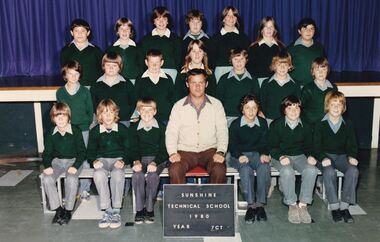 Sunshine and District Historical Society Incorporated
Photograph - Sunshine Technical School 1980 Class Photograpths, Sunshine Technical school
... 3472.01 - Sunshine Technical School 1980 Year 07 7CT Boys Girls Names 3rd Row L2R John Aquilina Kristine Johnson Jenny Farrugia Trevor Lawson Joanne Knight Denise Day Marco Miceli 2nd Row L2R Anthony Senior Fergus OBrien Gary Raymond Robyn King Leslie McLellan Paul Baker Matthew Owens 3rd Row L2R Jamie Sloman Graham Bradford Paul Barrett Daniel Duane Con Karasaridis Gary Buttigieg Graham Cunningham Absent Darren Possiter 3472.02 - Sunshine Technical School 1980 Year 07 7MB Boys Girls Names 4th Row L2R Sean English Michael Farrugia Michael Babies Andrew Rushin 3rd Row L2R Christ Christofi Zahile Abdullah Robert Watters Joe Magri Joanne Young Anthony Axiak 2nd Row L2R Steven McIlwaine Adriane May Stephen Wasteney 1st Row L2R Vicky Alexander Tony Zammit Darren Portelli Bruno Zorzi 3472.03 - Sunshine Technical School 1980 Year 07 7WL Boys Girls Names 4th Row L2R Peter Nemoambis Joskun Aziz Mirian Vick John Kipardolou Shayne Price 3rd Row L2R Tracey Lindsey Peter Merrifield Lisa Blake Paul Chesters Sharon Miller Damien De Raste Donna Spence 1st Row L2R Terry Vierros Darren Kelling Richard Baldachinno |David Beveridge Peter Bojoco David Farrar Alan Mifsud Darren Kendall 3472.04 - Sunshine Technical School 1980 Year 07 7BJ Boys Girls Names 4th Row L2R Greg Maston Walter Michetti Joseph Bartolo Gary Finco Dean Arnott Craig Hahn 3rd Row L2R Terry Crameri Maryanne Falzon Cathy Kupper Jason Mylonas Kim McKenzie Karen McGregor Stephen Caruana 2nd Row L2R Michael Saliba Charles Azzopardi John Tsotras Brigitte Jung Trevor Day Richard Catania Lewis Fournair 3472.05 - Sunshine Technical School 1980 Year 07 7TB Boys Girls Names 4th Row L2R Robert Couzens Craig Nixon Brett Henderson Gary Dewar Mark Crampton 3rd Row L2R Angela Borg Rocky Fama Joanne Howard Lisa Verkys Darryl Thomas Michelle Meyers 2nd Row L2R Colin robertson robert Ferguson Glenn Paten Mr Blunt David azzopardi Evangelos Dib Steven Troy 3472.06 - Sunshine Technical School 1980 Year 07 7PMC Boys Girls Names 3rd Row L2R Steven Petterson Darren Rossiter Greg Coombs John Morgan Robert Oakley Andrew Rushin 2nd Row L2R Stephen Iokoric Evelyn Dpwsey Joanne Brown John Ruzai Donna Goodwin Linda Gnixti Robert Wilson 1st Row L2R Paul Parkhill Troy Eley Gordon Walker Richard Gardona Brett knight Peter Biether 3472.07 - Sunshine Technical School 1980 Year 07 7PL Boys Girls Names 4th Row L2R Unknown Jacqueline Benzely Unknown Lisa Doderaide Judy Budlica 3rd Row L2R Chris Cianter David Rodda James Dean Darren Thomson David Rowlandson Shane Brooking Michael Koutsofta Gino Martuccio 2nd Row L2R Glen Pill Peter Grixti Chris Micallef Jason Moody Steven Barrow Nick Mariotis 3472.08 - Sunshine Technical School 1980 Year 07 7MP Boys Girls Names 4th Row L2R Bradley Vella Joseph Thomaidis Doris Mifsud Johnny Kolesidis Andrew Caruana 3rd Row Sandra Hughson Ross Jones Maurice Passano Robert Chard Graeme Stephens Craig Hibbert Stacey Moran 2nd Row L2R Lupco Stevoski Adam Caines Robert Braybrook Mike Patterson Giavanni Disisto Trevor Portelli Christopher Went Absent Noel Griffiths 3472.09 - Sunshine Technical School 1980 Year 07 7KC Boys Girls Names 3rd Row L2R Jim Carney Michael Achter Zoran Doslov Boris Josipavic Alan Snow Steven Vella 2nd Row L2R Glen Smith John Spiteri Tina Rudall Nancy Cugliari Carole Green Christopher Cuajar Jamie Bentley 1st Row L2R Steven Bertram Tony Catania Kevin Hay Kerryn Castles Joe Xuereb Alan Thurlow Ian Bagleri Absent Rodney Yerman Sharon Kingsland 3472.10 - Sunshine Technical School 1980 Year 11 11A Boys Girls Names 3rd Row L2R Ross Baker Alex Brunacci George Borg Deborah Systema Terry Coombs Reno Elms Ross Yassine 2nd Row L2R Tony Buttigieg Jim Ritchie Jack Durkovski Julie Reid Rosemaree Chisholm Wayne Pfeiffer Dean Eden Jones Bill Vankulovski 1st Row L2R Andrew Francese Michael Turner Craig Appleby B Robins Andrew Pettifer Gary Mullan Charles Pagano 3472.11 - Sunshine Technical School 1980 Year 11 11B Boys Girls Names 2nd Row L2R Joanne Maginriessi Suze Ciciulla Sezey Mustafa Robert Kiparoglau Marie Francese Victor Mifsud Antonia Brunacci 1st Row L2R Mary Ann Sant Zuhal Djemal Debbie OBrien A Becher Sharon Long Karyn Ward Syvlia Buttigieg Absent Julie Howe 3472.12 - Sunshine Technical School 1980 Year 11 11E1 Boys Names 3rd Row L2R Michael Farrugia Mark Gledhill Ray Davies Glen Grundy andrew Smellie 2nd Row L2R Louis Stellini James Le Toille Leon Dunn Lee Mallia Shane Stafford Cengiz Ramadin Steven Azzopardi 1st Row L2R Phillip Camenzuli Michael Crampton Tony Falzon Ray Tester Paul Azzopardi Ian Drinkwater Wayne Athorn 3472.13 - Sunshine Technical School 1980 Year 11 11E2 Boys Names 2nd Row L2R Frank Sammut Unknown Gerald Molik Joe Buttigieg Wayne Bruce Charlie Micallef Peter Febraio 1st Row L2R Martin Xuereb David Speranza Steven Dimask Charlie Gauci George Janbouvski Mark Stafford Phillip Camilleri 3472.14 - Sunshine Technical School 1980 Year 11 11G Boys Girls Names 3th Row L2R Chris Laskowski Osman Memisevic Charles Major Joe Caruana 2nd Row L2R Shirley Barbara Linda Cartledge Lina Calvo Helen Tanner Tania Lauterbach Margaret Luck Rosemany Ayton 1st Row L2R Mary Anne Vella Linda Scoble Glenda Maloney Lynn Whitehead Kerry Dyke Lyn Mactagggart Cathy Frost Absent Phillip Ollington Steven Minter Paul Hill Linda Cobby 3472.15 - Sunshine Technical School 1980 Year 11 11W Boys Names 3rd Row L2R Charlie Mifsud Howard Smith Jeff Arnott Robert Karaoglandis Fred Cataldo James Gray 2nd Row L2R David Baird Mark Hopkins Charlie Phillip Mifsud Grant Parker Gerry OConnor Gavin Ryan Greg Doll 1st Row L2R Sam Vella Ersan Halil Anthony Borg John Smith David Montebello Anthony Bell Darren Bricknell 3472.16 - Sunshine Technical School 1980 Staff 4th Row L2R D Hinks GS Smith B Webster A Crick N Simons B Robins A Lecky S Robertson Peter Gerard D Duane D Peck R Merrigan T Dib F Ware 3rd Row L2R R Latrobe W Edmunds R Ames G Smith A Penssarit F Siberer A Perd J Knox 2nd Row L2R M Garnett F Yassine J Vella T Giaburatgis S Hutchinson A Gillespie J Smith P Quarrell D Kellend T Halfbyde G Usbnery Unknown D Dalle A Kulyk Unknown R Smith J Camillieri 1st Row L2R J Elliott L Cormack A Davidson J Fyfe S Egan A Becker B Jung K Castles D Ingram S Newbery M Burke F Davis C Taylor M Bauden G Miller...Sunshine Technical School Technical School Class Photographs 3472.01 - Sunshine Technical School 1980 Year 07 7CT Boys Girls Names 3rd Row L2R John Aquilina Kristine Johnson Jenny Farrugia Trevor Lawson Joanne Knight Denise Day Marco Miceli 2nd Row L2R Anthony Senior Fergus OBrien Gary Raymond Robyn King Leslie McLellan Paul Baker Matthew Owens 3rd Row L2R Jamie Sloman Graham Bradford Paul Barrett Daniel Duane Con Karasaridis Gary Buttigieg Graham Cunningham Absent Darren Possiter 3472.02 - Sunshine Technical School 1980 Year 07 7MB Boys Girls Names 4th Row L2R Sean English Michael Farrugia Michael Babies Andrew Rushin 3rd Row L2R Christ Christofi Zahile Abdullah Robert Watters Joe Magri Joanne Young Anthony Axiak 2nd Row L2R Steven McIlwaine Adriane May Stephen Wasteney 1st Row L2R Vicky Alexander Tony Zammit Darren Portelli Bruno Zorzi 3472.03 - Sunshine Technical School 1980 Year 07 7WL Boys Girls Names 4th Row L2R Peter Nemoambis Joskun Aziz Mirian Vick John Kipardolou Shayne Price 3rd Row L2R Tracey Lindsey Peter Merrifield Lisa Blake Paul Chesters Sharon Miller Damien De Raste Donna Spence 1st Row L2R Terry Vierros Darren Kelling Richard Baldachinno |David Beveridge Peter Bojoco David Farrar Alan Mifsud Darren Kendall 3472.04 - Sunshine Technical School 1980 Year 07 7BJ Boys Girls Names 4th Row L2R Greg Maston Walter Michetti Joseph Bartolo Gary Finco Dean Arnott Craig Hahn 3rd Row L2R Terry Crameri Maryanne Falzon Cathy Kupper Jason Mylonas Kim McKenzie Karen McGregor Stephen Caruana 2nd Row L2R Michael Saliba Charles Azzopardi John Tsotras Brigitte Jung Trevor Day Richard Catania Lewis Fournair 3472.05 - Sunshine Technical School 1980 Year 07 7TB Boys Girls Names 4th Row L2R Robert Couzens Craig Nixon Brett Henderson Gary Dewar Mark Crampton 3rd Row L2R Angela Borg Rocky Fama Joanne Howard Lisa Verkys Darryl Thomas Michelle Meyers 2nd Row L2R Colin robertson robert Ferguson Glenn Paten Mr Blunt David azzopardi Evangelos Dib Steven Troy 3472.06 - Sunshine Technical School 1980 Year 07 7PMC Boys Girls Names 3rd Row L2R Steven Petterson Darren Rossiter Greg Coombs John Morgan Robert Oakley Andrew Rushin 2nd Row L2R Stephen Iokoric Evelyn Dpwsey Joanne Brown John Ruzai Donna Goodwin Linda Gnixti Robert Wilson 1st Row L2R Paul Parkhill Troy Eley Gordon Walker Richard Gardona Brett knight Peter Biether 3472.07 - Sunshine Technical School 1980 Year 07 7PL Boys Girls Names 4th Row L2R Unknown Jacqueline Benzely Unknown Lisa Doderaide Judy Budlica 3rd Row L2R Chris Cianter David Rodda James Dean Darren Thomson David Rowlandson Shane Brooking Michael Koutsofta Gino Martuccio 2nd Row L2R Glen Pill Peter Grixti Chris Micallef Jason Moody Steven Barrow Nick Mariotis 3472.08 - Sunshine Technical School 1980 Year 07 7MP Boys Girls Names 4th Row L2R Bradley Vella Joseph Thomaidis Doris Mifsud Johnny Kolesidis Andrew Caruana 3rd Row Sandra Hughson Ross Jones Maurice Passano Robert Chard Graeme Stephens Craig Hibbert Stacey Moran 2nd Row L2R Lupco Stevoski Adam Caines Robert Braybrook Mike Patterson Giavanni Disisto Trevor Portelli Christopher Went Absent Noel Griffiths 3472.09 - Sunshine Technical School 1980 Year 07 7KC Boys Girls Names 3rd Row L2R Jim Carney Michael Achter Zoran Doslov Boris Josipavic Alan Snow Steven Vella 2nd Row L2R Glen Smith John Spiteri Tina Rudall Nancy Cugliari Carole Green Christopher Cuajar Jamie Bentley 1st Row L2R Steven Bertram Tony Catania Kevin Hay Kerryn Castles Joe Xuereb Alan Thurlow Ian Bagleri Absent Rodney Yerman Sharon Kingsland 3472.10 - Sunshine Technical School 1980 Year 11 11A Boys Girls Names 3rd Row L2R Ross Baker Alex Brunacci George Borg Deborah Systema Terry Coombs Reno Elms Ross Yassine 2nd Row L2R Tony Buttigieg Jim Ritchie Jack Durkovski Julie Reid Rosemaree Chisholm Wayne Pfeiffer Dean Eden Jones Bill Vankulovski 1st Row L2R Andrew Francese Michael Turner Craig Appleby B Robins Andrew Pettifer Gary Mullan Charles Pagano 3472.11 - Sunshine Technical School 1980 Year 11 11B Boys Girls Names 2nd Row L2R Joanne Maginriessi Suze Ciciulla Sezey Mustafa Robert Kiparoglau Marie Francese Victor Mifsud Antonia Brunacci 1st Row L2R Mary Ann Sant Zuhal Djemal Debbie OBrien A Becher Sharon Long Karyn Ward Syvlia Buttigieg Absent Julie Howe 3472.12 - Sunshine Technical School 1980 Year 11 11E1 Boys Names 3rd Row L2R Michael Farrugia Mark Gledhill Ray Davies Glen Grundy andrew Smellie 2nd Row L2R Louis Stellini James Le Toille Leon Dunn Lee Mallia Shane Stafford Cengiz Ramadin Steven Azzopardi 1st Row L2R Phillip Camenzuli Michael Crampton Tony Falzon Ray Tester Paul Azzopardi Ian Drinkwater Wayne Athorn 3472.13 - Sunshine Technical School 1980 Year 11 11E2 Boys Names 2nd Row L2R Frank Sammut Unknown Gerald Molik Joe Buttigieg Wayne Bruce Charlie Micallef Peter Febraio 1st Row L2R Martin Xuereb David Speranza Steven Dimask Charlie Gauci George Janbouvski Mark Stafford Phillip Camilleri 3472.14 - Sunshine Technical School 1980 Year 11 11G Boys Girls Names 3th Row L2R Chris Laskowski Osman Memisevic Charles Major Joe Caruana 2nd Row L2R Shirley Barbara Linda Cartledge Lina Calvo Helen Tanner Tania Lauterbach Margaret Luck Rosemany Ayton 1st Row L2R Mary Anne Vella Linda Scoble Glenda Maloney Lynn Whitehead Kerry Dyke Lyn Mactagggart Cathy Frost Absent Phillip Ollington Steven Minter Paul Hill Linda Cobby 3472.15 - Sunshine Technical School 1980 Year 11 11W Boys Names 3rd Row L2R Charlie Mifsud Howard Smith Jeff Arnott Robert Karaoglandis Fred Cataldo James Gray 2nd Row L2R David Baird Mark Hopkins Charlie Phillip Mifsud Grant Parker Gerry OConnor Gavin Ryan Greg Doll 1st Row L2R Sam Vella Ersan Halil Anthony Borg John Smith David Montebello Anthony Bell Darren Bricknell 3472.16 - Sunshine Technical School 1980 Staff 4th Row L2R D Hinks GS Smith B Webster A Crick N Simons B Robins A Lecky S Robertson Peter Gerard D Duane D Peck R Merrigan T Dib F Ware 3rd Row L2R R Latrobe W Edmunds R Ames G Smith A Penssarit F Siberer A Perd J Knox 2nd Row L2R M Garnett F Yassine J Vella T Giaburatgis S Hutchinson A Gillespie J Smith P Quarrell D Kellend T Halfbyde G Usbnery Unknown D Dalle A Kulyk Unknown R Smith J Camillieri 1st Row L2R J Elliott L Cormack A Davidson J Fyfe S Egan A Becker B Jung K Castles D Ingram S Newbery M Burke F Davis C Taylor M Bauden G Miller A collection of 16 coloured photographs of year 10 11 and 12 students for the year 1980 Each photograph had a typed listing of the students, their form and teacher attached to it 19/8/2025 MISSING YEAR 8 9 10 12 Photograph Sunshine Technical School 1980 Class Photograpths Sunshine Technical school Fotek School Portraits ...3472.01 - Sunshine Technical School 1980 Year 07 7CT Boys Girls Names 3rd Row L2R John Aquilina Kristine Johnson Jenny Farrugia Trevor Lawson Joanne Knight Denise Day Marco Miceli 2nd Row L2R Anthony Senior Fergus OBrien Gary Raymond Robyn King Leslie McLellan Paul Baker Matthew Owens 3rd Row L2R Jamie Sloman Graham Bradford Paul Barrett Daniel Duane Con Karasaridis Gary Buttigieg Graham Cunningham Absent Darren Possiter 3472.02 - Sunshine Technical School 1980 Year 07 7MB Boys Girls Names 4th Row L2R Sean English Michael Farrugia Michael Babies Andrew Rushin 3rd Row L2R Christ Christofi Zahile Abdullah Robert Watters Joe Magri Joanne Young Anthony Axiak 2nd Row L2R Steven McIlwaine Adriane May Stephen Wasteney 1st Row L2R Vicky Alexander Tony Zammit Darren Portelli Bruno Zorzi 3472.03 - Sunshine Technical School 1980 Year 07 7WL Boys Girls Names 4th Row L2R Peter Nemoambis Joskun Aziz Mirian Vick John Kipardolou Shayne Price 3rd Row L2R Tracey Lindsey Peter Merrifield Lisa Blake Paul Chesters Sharon Miller Damien De Raste Donna Spence 1st Row L2R Terry Vierros Darren Kelling Richard Baldachinno |David Beveridge Peter Bojoco David Farrar Alan Mifsud Darren Kendall 3472.04 - Sunshine Technical School 1980 Year 07 7BJ Boys Girls Names 4th Row L2R Greg Maston Walter Michetti Joseph Bartolo Gary Finco Dean Arnott Craig Hahn 3rd Row L2R Terry Crameri Maryanne Falzon Cathy Kupper Jason Mylonas Kim McKenzie Karen McGregor Stephen Caruana 2nd Row L2R Michael Saliba Charles Azzopardi John Tsotras Brigitte Jung Trevor Day Richard Catania Lewis Fournair 3472.05 - Sunshine Technical School 1980 Year 07 7TB Boys Girls Names 4th Row L2R Robert Couzens Craig Nixon Brett Henderson Gary Dewar Mark Crampton 3rd Row L2R Angela Borg Rocky Fama Joanne Howard Lisa Verkys Darryl Thomas Michelle Meyers 2nd Row L2R Colin robertson robert Ferguson Glenn Paten Mr Blunt David azzopardi Evangelos Dib Steven Troy 3472.06 - Sunshine Technical School 1980 Year 07 7PMC Boys Girls Names 3rd Row L2R Steven Petterson Darren Rossiter Greg Coombs John Morgan Robert Oakley Andrew Rushin 2nd Row L2R Stephen Iokoric Evelyn Dpwsey Joanne Brown John Ruzai Donna Goodwin Linda Gnixti Robert Wilson 1st Row L2R Paul Parkhill Troy Eley Gordon Walker Richard Gardona Brett knight Peter Biether 3472.07 - Sunshine Technical School 1980 Year 07 7PL Boys Girls Names 4th Row L2R Unknown Jacqueline Benzely Unknown Lisa Doderaide Judy Budlica 3rd Row L2R Chris Cianter David Rodda James Dean Darren Thomson David Rowlandson Shane Brooking Michael Koutsofta Gino Martuccio 2nd Row L2R Glen Pill Peter Grixti Chris Micallef Jason Moody Steven Barrow Nick Mariotis 3472.08 - Sunshine Technical School 1980 Year 07 7MP Boys Girls Names 4th Row L2R Bradley Vella Joseph Thomaidis Doris Mifsud Johnny Kolesidis Andrew Caruana 3rd Row Sandra Hughson Ross Jones Maurice Passano Robert Chard Graeme Stephens Craig Hibbert Stacey Moran 2nd Row L2R Lupco Stevoski Adam Caines Robert Braybrook Mike Patterson Giavanni Disisto Trevor Portelli Christopher Went Absent Noel Griffiths 3472.09 - Sunshine Technical School 1980 Year 07 7KC Boys Girls Names 3rd Row L2R Jim Carney Michael Achter Zoran Doslov Boris Josipavic Alan Snow Steven Vella 2nd Row L2R Glen Smith John Spiteri Tina Rudall Nancy Cugliari Carole Green Christopher Cuajar Jamie Bentley 1st Row L2R Steven Bertram Tony Catania Kevin Hay Kerryn Castles Joe Xuereb Alan Thurlow Ian Bagleri Absent Rodney Yerman Sharon Kingsland 3472.10 - Sunshine Technical School 1980 Year 11 11A Boys Girls Names 3rd Row L2R Ross Baker Alex Brunacci George Borg Deborah Systema Terry Coombs Reno Elms Ross Yassine 2nd Row L2R Tony Buttigieg Jim Ritchie Jack Durkovski Julie Reid Rosemaree Chisholm Wayne Pfeiffer Dean Eden Jones Bill Vankulovski 1st Row L2R Andrew Francese Michael Turner Craig Appleby B Robins Andrew Pettifer Gary Mullan Charles Pagano 3472.11 - Sunshine Technical School 1980 Year 11 11B Boys Girls Names 2nd Row L2R Joanne Maginriessi Suze Ciciulla Sezey Mustafa Robert Kiparoglau Marie Francese Victor Mifsud Antonia Brunacci 1st Row L2R Mary Ann Sant Zuhal Djemal Debbie OBrien A Becher Sharon Long Karyn Ward Syvlia Buttigieg Absent Julie Howe 3472.12 - Sunshine Technical School 1980 Year 11 11E1 Boys Names 3rd Row L2R Michael Farrugia Mark Gledhill Ray Davies Glen Grundy andrew Smellie 2nd Row L2R Louis Stellini James Le Toille Leon Dunn Lee Mallia Shane Stafford Cengiz Ramadin Steven Azzopardi 1st Row L2R Phillip Camenzuli Michael Crampton Tony Falzon Ray Tester Paul Azzopardi Ian Drinkwater Wayne Athorn 3472.13 - Sunshine Technical School 1980 Year 11 11E2 Boys Names 2nd Row L2R Frank Sammut Unknown Gerald Molik Joe Buttigieg Wayne Bruce Charlie Micallef Peter Febraio 1st Row L2R Martin Xuereb David Speranza Steven Dimask Charlie Gauci George Janbouvski Mark Stafford Phillip Camilleri 3472.14 - Sunshine Technical School 1980 Year 11 11G Boys Girls Names 3th Row L2R Chris Laskowski Osman Memisevic Charles Major Joe Caruana 2nd Row L2R Shirley Barbara Linda Cartledge Lina Calvo Helen Tanner Tania Lauterbach Margaret Luck Rosemany Ayton 1st Row L2R Mary Anne Vella Linda Scoble Glenda Maloney Lynn Whitehead Kerry Dyke Lyn Mactagggart Cathy Frost Absent Phillip Ollington Steven Minter Paul Hill Linda Cobby 3472.15 - Sunshine Technical School 1980 Year 11 11W Boys Names 3rd Row L2R Charlie Mifsud Howard Smith Jeff Arnott Robert Karaoglandis Fred Cataldo James Gray 2nd Row L2R David Baird Mark Hopkins Charlie Phillip Mifsud Grant Parker Gerry OConnor Gavin Ryan Greg Doll 1st Row L2R Sam Vella Ersan Halil Anthony Borg John Smith David Montebello Anthony Bell Darren Bricknell 3472.16 - Sunshine Technical School 1980 Staff 4th Row L2R D Hinks GS Smith B Webster A Crick N Simons B Robins A Lecky S Robertson Peter Gerard D Duane D Peck R Merrigan T Dib F Ware 3rd Row L2R R Latrobe W Edmunds R Ames G Smith A Penssarit F Siberer A Perd J Knox 2nd Row L2R M Garnett F Yassine J Vella T Giaburatgis S Hutchinson A Gillespie J Smith P Quarrell D Kellend T Halfbyde G Usbnery Unknown D Dalle A Kulyk Unknown R Smith J Camillieri 1st Row L2R J Elliott L Cormack A Davidson J Fyfe S Egan A Becker B Jung K Castles D Ingram S Newbery M Burke F Davis C Taylor M Bauden G Millersunshine technical school, technical school, class photographs -
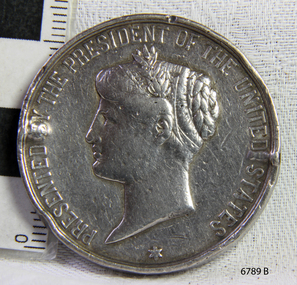 Flagstaff Hill Maritime Museum and Village
Award - Medal, Nelson Johnson, November 1880
... Other items found ashore included sewing machines (some consigned to ‘Long and Co.”) and notions, axe and scythe handles, hay forks, wooden pegs, rolls of wire (some branded “T.S” and Co, Melbourne”), kegs of nails branded “A.T. and Co.” from the factory of A. ...Other items found ashore included sewing machines (some consigned to ‘Long and Co.”) and notions, axe and scythe handles, hay forks, wooden pegs, rolls of wire (some branded “T.S” and Co, Melbourne”), kegs of nails branded “A.T. and Co.” from the factory of A. ...This medal for bravery, for rescue of the crew from the shipwreck “Eric the Red” on 4th September 1880, was awarded to one of the crew of the steamer S.S. Dawn by the President of the United States in July 1881. The medal is engraved with the name “Nelson Johnson” (the anglicised version of his Swedish name Neils Frederick Yohnson). It was donated to Flagstaff Hill Maritime Village in 2013 by Nelson’s granddaughter. Nelson had migrated from Sweden to Sydney in 1879. The next year in 1880, aged 24, he was a seaman on the steamship Dawn and involved in the rescue of the survivors of the Eric the Red. Nelson Johnson was a crew member of the S.S. Dawn and was one of the rescue team in the dinghy in the early morning of September 4th 1880. Medals were awarded to the Captain and crew of the S.S. Dawn by the President of the United States, through the Consul-general (Mr Oliver M. Spencer), in July 1881 “ … in recognition of their humane efforts in rescuing the 23 survivors of the American built wooden sailing ship, the Eric the Red, on 4th September 1880.” The men were also presented with substantial monetary rewards and gifts. The city of Warrnambool’s care of the survivors was also mentioned by the President at the presentation, saying that “the city hosted and supported the crew ‘most graciously’. Previously, a week after the shipwreck, the Australian Government had also conveyed its thanks to the Captain and crew of the S.S. Dawn “Captain Griffith Jones, S.S. Dawn, The Hon. Mr Clark desires that the thanks of the Government should be conveyed to you for the prompt, persevering and seamanlike qualities displayed by you, your officers and crew in saving the number of lives you did on the occasion referred to. The hon. The Commissioner has also been pleased to award you a souvenir in commemoration of the occasion, and a sum of 65 pounds to be awarded to your officers and crew according to annexed scale. I am, &c, W Collins Rees, for and in the absence of the Chief Harbour Master.” The Awards are as follows: - Crew of DAWN'S lifeboat-Chief Officer, Mr G. Peat, 15 pounds; boat's crew-G. Sterge, A.B., 5 pounds; T. Hammond, A.B., 5 pounds; J. Black, A.B., 5 pounds; H. Edwards, A.B., 5 pounds. Dinghy's Crew-Second Officer, Mr Christie, 10 pounds; boat's crew -F. Lafer, A.B., 5 pounds; W. Johnstone, A.B., 5 pounds; Mr Lear, provedore, 5 pounds; Mr Dove, purser, 5 pounds. Captain Jones receives a piece of plate. (from “Wreck of the ship Eric the Red” by Jack Loney) The medal’s history, according to the Editor of ‘E-Sylum’ (the newsletter of The Numismatic Bibliomania Society “… appears to be an example of an 1880 State Department medal, catalogued as LS-3 (page 322 of R. W. Julian's book, Medals of the United States Mint: The First Century 1792-1892). The reverse is mostly blank for engraving, surrounded by a thin wreath. It was designed by George Morgan, chief engraver for the Philadelphia Mint, and struck in gold, silver and bronze. The one pictured here (in The Standard newspaper, 2nd July 2013) appears to be silver.” The following is an account of the events which led to the awarding of this medal. The American ship Eric the Red was a wooden, three-masted clipper ship. She had 1,580 tons register and was the largest full-rigged ship built at Bath, Maine, USA in 1871. She was built and registered by Arthur Sewall, later to become the partnership E. & A. Sewall, the 51st ship built by this company. The annually-published List of Merchant Vessels of the U.S. shows Bath was still the home port of Eric the Red in 1880. The vessel was named after the Viking discoverer, Eric ‘the Red-haired’ Thorvaldsson, who was the first European to reach the shores of North America (in 980AD). The ship Eric the Red at first traded in coal between America and Britain, and later traded in guano nitrates from South America. In 1879 she was re-metalled and was in first-class condition. On 10th June 1880 (some records say 12th June) Eric the Red departed New York for Melbourne and then Sydney. She had been commissioned by American trade representatives to carry a special cargo of 500 exhibits (1400 tons) – about a quarter to a third of America’s total exhibits - for the U.S.A. pavilion at Melbourne’s first International Exhibition. The exhibits included furniture, ironmongery, wines, chemicals, dental and surgical instruments, paper, cages, bronze lamp trimmings, axles, stamped ware, astronomical and time globes, samples of corn and the choicest of leaf tobacco. Other general cargo included merchandise such as cases of kerosene and turpentine, brooms, Bristol's Sarsaparilla, Wheeler and Wilson sewing machines, Wheeler’s thresher machine, axe handles and tools, cases of silver plate, toys, pianos and organs, carriages and Yankee notions. The Eric the Red left New York under the command of Captain Zaccheus Allen (or some records say Captain Jacques Allen) and 24 other crew including the owner’s son third mate Ned Sewall. There were also 2 saloon passengers on board. The ship had been sailing for an uneventful 85 days and the voyage was almost at its end. As Eric the Red approached Cape Otway there was a moderate north-west wind and a hazy and overcast atmosphere. On 4th September 1880 at about 1:30 am Captain Allen sighted the Cape Otway light and was keeping the ship 5-6 miles offshore to stay clear of the hazardous Otway Reef. However, he had badly misjudged his position. The ship hit the Otway Reef about 2 miles out to sea, southwest of the Cape Otway light station. Captain Allen ordered the wheel to be put ‘hard up’ thinking that she might float off the reef. The sea knocked the helmsman away from the wheel, broke the wheel ropes and carried away the rudder. The lifeboats were swamped, the mizzenmast fell, with all of its riggings, then the mainmast also fell and the ship broke in two. Some said that the passenger Vaughan, who was travelling for his health and not very strong, was washed overboard and never seen again. The ship started breaking up. The forward house came adrift with three of the crew on it as well as a longboat, which the men succeeded in launching and keeping afloat by continually bailing with their sea boots. The captain, the third mate (the owner’s son) and others clung to the mizzenmast in the sea. Then the owner’s son was washed away off the mast. Within 10 minutes the rest of the ship was in pieces, completely wrecked, with cargo and wreckage floating in the sea. The captain encouraged the second mate to swim with him to the deckhouse where there were other crew but the second mate wouldn’t go with him. Eventually, the Captain made it to the deckhouse and the men pulled him up. At about 4:30 am the group of men on the deckhouse saw the lights of a steamer and called for help. At the same time, they noticed the second mate and the other man had drifted nearby, still on the spur, and pulled them both onto the wreck. The coastal steamer SS Dawn was returning to Warrnambool from Melbourne, and its sailing time was different to its usual schedule. She was built in 1876 and bought by the Portland and Belfast Steam Navigation Co. in 1877. At the time of this journey, she was commanded by Captain Jones and was sailing between Melbourne and Portland via Warrnambool. The provedore the Dawn, Benjamin Lear, heard cries of distress coming through the portholes of the saloon. He gave the alarm and the engines were stopped. Cries could be heard clearly, coming from the land. Captain Jones sent out crew in two boats and fired off rockets and blue lights to illuminate the area. They picked up the three survivors who were in the long boat from Eric the Red. Two men were picked up out of the water, one being the owner’s son who was clinging to floating kerosene boxes. At daylight, the Dawn then rescued the 18 men from the floating portion of the deckhouse, which had drifted about 4 miles from where they’d struck the reef. Shortly after the rescue the deckhouse drifted onto breakers and was thrown onto rocks at Point Franklin, about 2 miles east of Cape Otway. Captain Jones had signalled to Cape Otway lighthouse the number of the Eric the Red and later signalled that there was a wreck at Otway Reef but there was no response from the lighthouse. The captain and crew of the Dawn spent several more hours searching unsuccessfully for more survivors, even going back as far as Apollo Bay. On board the Dawn the exhausted men received care and attention to their needs and wants, including much-needed clothing. Captain Allen was amongst the 23 battered and injured men who were rescued and later taken to Warrnambool for care. Warrnambool’s mayor and town clerk offered them all hospitality, the three badly injured men going to the hospital for care and others to the Olive Branch Hotel, then on to Melbourne. Captain Allen’s leg injury prevented him from going ashore so he and three other men travelled on the Dawn to Portland. They were met by the mayor who also treated them all with great kindness. Captain Allen took the train back to Melbourne then returned to America. Those saved were Captain Zaccheus Allen (or Jacques Allen), J. Darcy chief mate, James F. Lawrence second mate, Ned Sewall third mate and owner’s son, John French the cook, C. Nelson sail maker, Clarence W. New passenger, and able seamen Dickenson, J. Black, Denis White, C. Herbert, C. Thompson, A. Brooks, D. Wilson, J. Ellis, Q. Thompson, C. Newman, W. Paul, J. Davis, M. Horenleng, J. Ogduff, T. W. Drew, R. Richardson. Four men had lost their lives; three of them were crew (Gus Dahlgreen ship’s carpenter, H. Ackman steward, who drowned in his cabin, and George Silver seaman) and one a passenger (J. B. Vaughan). The body of one of them had been found washed up at Cape Otway and was later buried in the lighthouse cemetery; another body was seen on an inaccessible ledge. Twelve months later the second mate James F. Lawrence, from Nova Scotia passed away in the Warrnambool district; an obituary was displayed in the local paper. Neither the ship nor its cargo was insured. The ship was worth about £15,000 and the cargo was reportedly worth £40,000; only about £2,000 worth had been recovered. Cargo and wreckage washed up at Apollo Bay, Peterborough, Port Campbell, Western Port and according to some reports, even as far away as the beaches of New Zealand. The day after the wreck the government steamship Pharos was sent from Queenscliff to clear the shipping lanes of debris that could be a danger to ships. The large midship deckhouse of the ship was found floating in a calm sea near Henty Reef. Items such as an American chair, a ladder and a nest of boxes were all on top of the deckhouse. As it was so large and could cause danger to passing ships, Captain Payne had the deckhouse towed towards the shore just beyond Apollo Bay. Between Apollo Bay and Blanket Bay, the captain and crew of Pharos collected Wheeler and Wilson sewing machines, nests of boxes, bottles of Bristol’s sarsaparilla, pieces of common American chairs, axe handles, a Wheelers’ Patent thresher and a sailor’s trunk with the words “A. James” on the front. A ship’s flag-board bearing the words “Eric the Red” was found on the deckhouse; finally, those on board the Pharos had the name of the wrecked vessel. During this operation, Pharos came across the government steamer Victoria and also a steamer S.S. Otway, both of which were picking up flotsam and wreckage. A whole side of the hull and three large pieces of the other side of the hull, with some of the copper sheathing stripped off, had floated onto Point Franklin. Some of the vessels' yards and portions of her masts were on shore. The pieces of canvas attached to the yards and masts confirmed that the vessel had been under sail. The beach there was piled with debris several feet high. There were many cases of Diamond Oil kerosene, labelled R. W. Cameron and Company, New York. There were also many large planks of red pine, portions of a small white boat and a large, well-used oar. Other items found ashore included sewing machines (some consigned to ‘Long and Co.”) and notions, axe and scythe handles, hay forks, wooden pegs, rolls of wire (some branded “T.S” and Co, Melbourne”), kegs of nails branded “A.T. and Co.” from the factory of A. Field and Son, Taunton, Massachusetts, croquet balls and mallets, buggy fittings, rat traps, perfumery, cutlery and Douay Bibles, clocks, bicycles, chairs, a fly wheel, a cooking stove, timber, boxes, pianos, organs and a ladder. (Wooden clothes pegs drifted in for many years). There seemed to be no personal luggage or clothing. The Pharos encountered a long line, about one and a half miles, of f locating wreckage about 10 miles off land, southeast of Cape Otway, and in some places about 40 feet wide. It seemed that more than half of it was from Eric the Red. The ship’s crew rescued 3 cases that were for the Melbourne Exhibition and other items from amongst the debris. There were also chairs, doors, musical instruments, washing boards, nests of trunks and flycatchers floating in the sea. Most of the goods were saturated and smelt of kerosene. A section of the hull lies buried in the sand at Parker River Beach. An anchor with a chain is embedded in the rocks east of Point Franklin and a second anchor, thought to be from Eric the Red, is on display at the Cape Otway light station. (There is a photograph of a life belt on the verandah of Rivernook Guest House in Princetown with the words “ERIC THE RED / BOSTON”. This is rather a mystery as the ship was registered in Bath, Maine, USA.) Parts of the ship are on display at Bimbi Park Caravan Park and at Apollo Bay Museum. Flagstaff Hill Maritime Village also has part of the helm (steering wheel), a carved wooden sword (said to be the only remaining portion of the ship’s figurehead; further research is currently being carried out), a door, a metal rod, samples of wood and this medal awarded for the rescue of the crew. Much of the wreckage was recovered by the local residents before police and other authorities arrived at the scene. Looters went to great effort to salvage goods, being lowered down the high cliff faces to areas with little or no beach to collect items from the wreckage, their mates above watching out for dangerous waves. A Tasmanian newspaper reports on a court case in Stawell, Victoria, noting a man who was caught 2 months later selling tobacco from the wreckage of Eric the Red. Some of the silverware is still treasured by descendants of Mr Mackenzie who was given these items by officials for his help in securing the cargo. The gifts included silver coffee and teapots, half a dozen silver serviette rings and two sewing machines. A Mr G.W. Black has in his possession a medal and a purse that was awarded to his father, another Dawn crew member who was part of the rescue team. The medal is similarly inscribed and named “To John Black ….” (from “Shipwrecks” by Margaret E. Mackenzie, 3rd edition, published 1964). The wreck and cargo were sold to a Melbourne man who salvaged a quantity of high-quality tobacco and dental and surgical instruments. Timbers from the ship were salvaged and used in the construction of houses and shed around Apollo Bay, including a guest house, Milford House (since burnt down in bushfires), which had furniture, fittings and timber on the dining room floor from the ship. A 39.7-foot-long trading ketch, the Apollo, was also built from its timbers by Mr Burgess in 1883 and subsequently used in Tasmanian waters. It was the first attempt at shipbuilding in Apollo Bay. In 1881 a red light was installed about 300 feet above sea level at the base of the Cape Otway lighthouse to warn ships when they were too close to shore; It would not be visible unless a ship came within 3 miles from it. This has proved to be an effective warning. Nelson Johnson married Elizabeth Howard in 1881 and they had 10 children, the father of the medal’s donor being the youngest. They lived in 13 Tichbourne Place, South Melbourne, Victoria. Nelson died in 1922 in Fitzroy Victoria, age 66. In 1895 the owners of the S.S. Dawn, the Portland and Belfast Steam Navigation Co., wound up and sold out to the Belfast Company who took over the Dawn for one year before selling her to Howard Smith. She was condemned and sunk in Suva in 1928. The State Library of Victoria has a lithograph in its collection depicting the steamer Dawn and the shipwrecked men, titled. "Wreck of the ship Eric the Red, Cape Otway: rescue of the crew by the Dawn". The medal for bravery is associated with the ship the “The Eric the Red which is historically significant as one of Victoria's major 19th century shipwrecks. (Heritage Victoria Eric the Red; HV ID 239) The wreck led to the provision of an additional warning light placed below the Cape Otway lighthouse to alert mariners to the location of Otway Reef. The site is archaeologically significant for its remains of a large and varied cargo and ship's fittings being scattered over a wide area. The site is recreationally and aesthetically significant as it is one of the few sites along this coast where tourists can visit identifiable remains of a large wooden shipwreck, and for its location set against the background of Cape Otway, Bass Strait, and the Cape Otway lighthouse.“ (Victorian Heritage Database Registration Number S239, Official Number 8745 USA) This medal was awarded to Nelson Johnson by the U.S. President for bravery in the rescue of the Eric the Red crew. The obverse of the round, solid silver medal has an inscription around the rim. In the centre of the medal is the head of Liberty to the left, hair in a bun, with a sprig of leaves in the top left of a band around her head. There is a 6-pointed star below the portrait, between the start and end of the inscription. There are two raised areas on the rim, horizontally opposite each other, from the edge to just below the lettering and coinciding with the holes drilled in the edge. Slightly right of the top is a round indentation in the rim. The reverse has a wreath of leaves as a border, joined at the bottom by a ribbon bow. In the centre of the medal is an inscription, decorated with 3-pronged design and dots. The edge is plain with 2 small, rough and uneven holes horizontally opposite to each other, as though they had been used for mounting the medal at some stage. The medal has a matte finish on both sides and is slightly pitted and scratched.“PRESENTED BY THE PRESIDENT OF THE UNITED STATES” around the perimeter of the obverse of the medal. “TO / Nelson Johnson, / seaman of the British, / str “Dawn”, for bravery, / at risk of life, / in / rescuing the crew of / the American Ship / “Eric the Red.” “M” on obverse, truncation of the portraitwarrnambool, flagstaff hill, flagstaff hill maritime village, maritime museum, shipwreck coast, great ocean road, shipwreck artefact, eric the red, zaccheus allen, sewall, 1880, melbourne exhibition, cape otway, otway reef, victorian shipwreck, medal, nelson johnson, neils frederick yohnson, s.s. dawn, george morgan, hero -
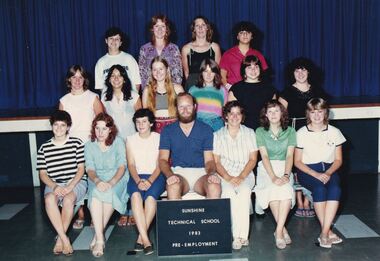 Sunshine and District Historical Society Incorporated
Photograph - Sunshine Technical School 1983 Class Photograpths, Sunshine Technical school
... 3475.01 - Sunshine Technical School 1983 Pre Employment Names Front Row L2R Marcella Panozzo Susan Galea Margaret Muscat Elsie Godressi Diane Bottrell Kelly Munro Second Row L2R Denise Carlile Elizabeth Micallef Christine Venohr Kim Argus Leanne Razzouk Kathy Walker Third Row L2R Kathy Dejong amanda Anderson Wendy Litchfield frances Origlia Teacher Mr D Crebbin Principal Mr D R Boyd 3475.02 - Sunshine Technical School 1983 Year 07 7BL Boys Girls Names Front Row L2R Monica Locke Donna Smith Deborah Holland Dianne Barnes Amanda Weeks Mandy Mitchell Kathy Ruzeu Second Row L2R John Mercieca Craig Sanders Peter Herrewyn Gavin Ward David Scheurer Dennis Callus Third Row L2R Tim Kennedy Peter Karamoutsos Tracey McLennan Tracey Wardley Pasquale Zaffina Chris Kennedy Teachers Mr G Bath Ms A Langdon Principal Mr D R Borg 3475.03 - Sunshine Technical School 1983 Year 07 7CR Boys Names Front Row L2R Jason Kniese John Mason Russell Arandt Glen Johnson Greg McPhan Paul Weekes Second Row L2R John Hogan Dean Dyson Shane Emery Frank DAgostino Darren Kelly Paul Fry Darren Paton Darren Fowler Third Row L2R Joseph Demicoli Peter Herliczka Dean Grech Lockman Yehya Adriano Iodice Teacher Ms S Roberts Principal Mr D R Boyd 3475.04 - Sunshine Technical School 1983 Year 07 7DR Boys Names Front Row L2R Brett Paten Brian Patmore David McIlwaine David Drake Sammy Farrugia Graeme Bascombe Second Row L2R Ivan Gill Craig Tatlow Gorden Hennessy Francis Bavage Mark Doley Peter Elkington Peter Voutsas Mark Day Third Day L2R Carmelo Russo Steven Caruana Ray Wadge Paul Kruse Peter Hall Darren Spiteri Teacher Mr D Rathbone Principal Mr D R Boyd 3475.05 - Sunshine Technical School 1983 Year 07 7GW Boys Girls Names Front Row L2R Sheree Tippet Georgina Falzon Karen Jones Kim Goldsworthy Rosemary Zammit Sharon Crameri Nadine Clarke Second Row L2R Steven Grech Norman Borg Angela Pillar Karen Ogle Julie Suffold Wayne Evans Brett Hussell Third Row L2R Geoff Fieldew Anthony Delaney Colin Hill Ray Gatt Michael Dalli Mark Moore Teachers Mrs C Walker Mr P Gerrard Principal Mr D R Boyd 3475.06 - Sunshine Technical School 1983 Year 07 7LW Boys Girls Names Front Row L2R Karlene Pill Vicki Trittruf Mary Ristevski Kim Lawson Nyrell Saffron Kathleen Abela Second Row L2R Anthony Adams Philip Skorsis Sharon Quaadgras Karen Ward Nicole Dean Paul Smith Mehmet Kahriman Third Row Joseph Logludice Paul Higgins colin McDonagh Paul Muir Christian Noble Ricky Hay Teachers Ms Lindy Whie Mr K Whitney Principal Mr D R Boyd 3475.07 - Sunshine Technical School 1983 Year 07 7MB Boys Girls Names Front Row L2R Lisa Steele Sharon ONeill Nadine Melwish Jennifer Allan Jenny Kitchenham Trudi Manning Second Row L2R Greg Lachima Mark Kutniewski Kelly White Danny Dial David Adgard Sandra Ford Travis Ratray Raman Jaygello Third Row Glenn Chubb Lindsey Butler Bcaire Tyne Marc Sirrett Morris Morcellot Teacher Mr B Webster Principal Mr D R Boyd 3475.08 - Sunshine Technical School 1983 Year 07 7MI Boys Girls Names Front Row L2R Angela Smith Christine Eudey Karen Falkai Carmen Hill Lorraine Bates Tanya Wofe Georgina Adams Second Row L2R Scott Dyer Brendon Pringle Lillian Micallef Mark Alleblas Matthew Holliday Gail Bentley Charlie Vella Stephen Guy Third Row L2R Daryl Smith Vladimir Begovic Brendan Price Joey Farkas Anthony Bettin Teachers Mrs Iversen Mr Merrigan Principal Mr D R Borg 3475.09 - Sunshine Technical School 1983 Year 07 7MW Boys Girls Names Front Row L2R Nardeen Miles Michelle Neffernan Sharon Ogle Donna OShea Kerry Saxton Meagan Clark Second Row L2R Dennis Keenan David Pipczak Joe Farrugia Anthony Manson Houssein Romadan Brian Tanti Jodi Kelly Third Row L2R Wayne Curnack Noel Brockdorff Fawzi Girgis Steven Vella Scott Spence Teacher Ms M Willaton Principal Mr D R Boyd 3475.10 - Sunshine Technical School 1983 Year 07 7MZ Boys Girls Names Front Row L2R Tricia Sylvester Lisa Chadwick Jeannie Calvitto Belinda Cameron Bernadette Smith Samantha Knight Joanne Steers Second Row L2R John Shelley Valentino Elbourzati Deidre Bell Michael Asciak Shane Marsh Third Row L2R Mark Barnard Wayne Barrie Stephen Yerman Pat Marzico David Henderson Principal Mr D R Boyd 3475.11 - Sunshine Technical School 1983 Year 07 7TB Boys Names Front Row L2R Gary Mifsud Frank Abela Aaron Prigmore Stephen Verkys Keith Byrne Mark Logan Second Row L2R David Maddern Greg Berry Pascoe Romano scott Hurley Mathew Stafford Kenan Yuksel Third Row L2R Jason Martland Andrew Graham Michael Clark Sam Portelli David Daicos Eric Hurt Teacher Mr T Blunt Principal Mr D R Boyd 3475.12 - Sunshine Technical School 1983 Year 07 7SE Boys Girls Names Front Row L2R Rosa Caruana Tammy Crawford Marika Keleman Michelle Arends Lina Vella Carol Semmens Second Row L2R Justin Martin Bekim Alija Kelly Furphy Lisa Carter Tanya Nagle Glen Newman Steven Spiteri Third Row L2R Joe Pace Sam Potiriadis John Green Darren Campbell Troy Wilson Teacher Ms S Egan Principal Mr D R Boyd 3475.13 - Sunshine Technical School 1983 Year 10 10BE Boys Girls Names Front Row L2R Evelyn Dowsey Sharon Miller Sonia Fletcher Joanne Knight Angela Borg Maryanne Falzon Second Row L2R Peter Butler Carole Green Donna Goodwin Melissa Nash Joanne Young Lisa Verkys Joanne Brown Steven Bertram Third Row L2R Michael Saliba Craig Hibbert Walter Michetti Joe Xuereb Stephen Caruana Teacher Mr I Bowker Principal Mr D R Boyd 3475.14 - Sunshine Technical School 1983 Year 11 11AB Boys Girls Names Front Row L2R Don Bennet Robert Carabott Thoung Phu Si Kervin Callanan George Hrvojevic Steven Phillips Second Row L2R Colin Smith Com Vanly Tracey Whichello Leanne Barley Annette Lydiate Teena Sutherland Peter Layton Third Row L2R Brandon Arnott Darren Broughton Mark Fieldew Andrew Shields Darren Appleby Steven OConnell Teacher Ms A Becker Principal Mr D R Boyd 3475.15 - Sunshine Technical School 1983 Year 11 11GW Boys Names Front Row L2R Mario Azzopardi Silvano Ciciulla Goran Geogevski Raymond Hynes Aldo Giarruso Peter Gusman Jeff Scott Second Row L2R Paul Busuttil Richard Suffold Ross OShea Darren Scarlett Darren Charman John Hili Lawrence Cauchi Principal Mr D R Borg 3475.16 - Sunshine Technical School 1983 Year 11 11PH Boys Girls Names Front Row L2R Kim Wilson Frances Avellino Colleen Sammut Sharyn Hobbs Robyn Baker Barbara Czepiel Roselen Staker Second Row L2R Alan Borg Michelle Spiteri Debbie Dean Karen Lovell Helen Robertson Wayne Mills Third Row L2R Peter Haynes Michael Camanzi Andrew Hill Aaron Meehan Darren OFlaherty Teachers Mr P Howe Ms C Caruana Principal Mr D R Boyd 3475.17 - Sunshine Technical School 1983 Year 11 11SH Boys Names Front Row L2R Steven Borg Geoffery Manicolo Martin Bezzina David Bugeja Brian Cauchi Nick Sammut Second Row L2R Paul Athanasiadis Edward Cauchi Daryl Young Ross Pocock Edwin Cassar Laurie Dalli Third Row L2R David Vella Chris Liontis Sean Forbes Nick Kotevska Tony Ebejer Teacher Mr S Hutchinson Principal Mr D R Boyd 3475.18 - Sunshine Technical School 1983 Year 11 11SR Boys Girls Names Front Row L2R Anita Plunkett Joanne Gordon Mary Barrow Sue Carney Kathryn Hyland Gracie Disante Second Row L2R Michaela Johnson Sharon Browne Debbie Bretherton Elizabeth Leich Karen Baird Noelene Gay Third Row L2R Ann Horn Michael Spence Les Gray Derek Bartolo Leisa Tittruf Teacher Ms S Robertson Principal Mr D R Boyd 3475.19 - Sunshine Technical School 1983 Year 11 11TH Boys Names Front Row L2R Steven Zara Allen McDonald Kevin ONeill Terry Doll Mehmet Aziz Mario Mifsud Dean Shears Second Row David Tedesco Stephen Deward Brendon Mayze Paul Debrincat Chris Letic Craig Callaghan Jamie Sampson Principal Mr D R Borg...Sunshine Technical School Technical School Class Photographs 3475.01 - Sunshine Technical School 1983 Pre Employment Names Front Row L2R Marcella Panozzo Susan Galea Margaret Muscat Elsie Godressi Diane Bottrell Kelly Munro Second Row L2R Denise Carlile Elizabeth Micallef Christine Venohr Kim Argus Leanne Razzouk Kathy Walker Third Row L2R Kathy Dejong amanda Anderson Wendy Litchfield frances Origlia Teacher Mr D Crebbin Principal Mr D R Boyd 3475.02 - Sunshine Technical School 1983 Year 07 7BL Boys Girls Names Front Row L2R Monica Locke Donna Smith Deborah Holland Dianne Barnes Amanda Weeks Mandy Mitchell Kathy Ruzeu Second Row L2R John Mercieca Craig Sanders Peter Herrewyn Gavin Ward David Scheurer Dennis Callus Third Row L2R Tim Kennedy Peter Karamoutsos Tracey McLennan Tracey Wardley Pasquale Zaffina Chris Kennedy Teachers Mr G Bath Ms A Langdon Principal Mr D R Borg 3475.03 - Sunshine Technical School 1983 Year 07 7CR Boys Names Front Row L2R Jason Kniese John Mason Russell Arandt Glen Johnson Greg McPhan Paul Weekes Second Row L2R John Hogan Dean Dyson Shane Emery Frank DAgostino Darren Kelly Paul Fry Darren Paton Darren Fowler Third Row L2R Joseph Demicoli Peter Herliczka Dean Grech Lockman Yehya Adriano Iodice Teacher Ms S Roberts Principal Mr D R Boyd 3475.04 - Sunshine Technical School 1983 Year 07 7DR Boys Names Front Row L2R Brett Paten Brian Patmore David McIlwaine David Drake Sammy Farrugia Graeme Bascombe Second Row L2R Ivan Gill Craig Tatlow Gorden Hennessy Francis Bavage Mark Doley Peter Elkington Peter Voutsas Mark Day Third Day L2R Carmelo Russo Steven Caruana Ray Wadge Paul Kruse Peter Hall Darren Spiteri Teacher Mr D Rathbone Principal Mr D R Boyd 3475.05 - Sunshine Technical School 1983 Year 07 7GW Boys Girls Names Front Row L2R Sheree Tippet Georgina Falzon Karen Jones Kim Goldsworthy Rosemary Zammit Sharon Crameri Nadine Clarke Second Row L2R Steven Grech Norman Borg Angela Pillar Karen Ogle Julie Suffold Wayne Evans Brett Hussell Third Row L2R Geoff Fieldew Anthony Delaney Colin Hill Ray Gatt Michael Dalli Mark Moore Teachers Mrs C Walker Mr P Gerrard Principal Mr D R Boyd 3475.06 - Sunshine Technical School 1983 Year 07 7LW Boys Girls Names Front Row L2R Karlene Pill Vicki Trittruf Mary Ristevski Kim Lawson Nyrell Saffron Kathleen Abela Second Row L2R Anthony Adams Philip Skorsis Sharon Quaadgras Karen Ward Nicole Dean Paul Smith Mehmet Kahriman Third Row Joseph Logludice Paul Higgins colin McDonagh Paul Muir Christian Noble Ricky Hay Teachers Ms Lindy Whie Mr K Whitney Principal Mr D R Boyd 3475.07 - Sunshine Technical School 1983 Year 07 7MB Boys Girls Names Front Row L2R Lisa Steele Sharon ONeill Nadine Melwish Jennifer Allan Jenny Kitchenham Trudi Manning Second Row L2R Greg Lachima Mark Kutniewski Kelly White Danny Dial David Adgard Sandra Ford Travis Ratray Raman Jaygello Third Row Glenn Chubb Lindsey Butler Bcaire Tyne Marc Sirrett Morris Morcellot Teacher Mr B Webster Principal Mr D R Boyd 3475.08 - Sunshine Technical School 1983 Year 07 7MI Boys Girls Names Front Row L2R Angela Smith Christine Eudey Karen Falkai Carmen Hill Lorraine Bates Tanya Wofe Georgina Adams Second Row L2R Scott Dyer Brendon Pringle Lillian Micallef Mark Alleblas Matthew Holliday Gail Bentley Charlie Vella Stephen Guy Third Row L2R Daryl Smith Vladimir Begovic Brendan Price Joey Farkas Anthony Bettin Teachers Mrs Iversen Mr Merrigan Principal Mr D R Borg 3475.09 - Sunshine Technical School 1983 Year 07 7MW Boys Girls Names Front Row L2R Nardeen Miles Michelle Neffernan Sharon Ogle Donna OShea Kerry Saxton Meagan Clark Second Row L2R Dennis Keenan David Pipczak Joe Farrugia Anthony Manson Houssein Romadan Brian Tanti Jodi Kelly Third Row L2R Wayne Curnack Noel Brockdorff Fawzi Girgis Steven Vella Scott Spence Teacher Ms M Willaton Principal Mr D R Boyd 3475.10 - Sunshine Technical School 1983 Year 07 7MZ Boys Girls Names Front Row L2R Tricia Sylvester Lisa Chadwick Jeannie Calvitto Belinda Cameron Bernadette Smith Samantha Knight Joanne Steers Second Row L2R John Shelley Valentino Elbourzati Deidre Bell Michael Asciak Shane Marsh Third Row L2R Mark Barnard Wayne Barrie Stephen Yerman Pat Marzico David Henderson Principal Mr D R Boyd 3475.11 - Sunshine Technical School 1983 Year 07 7TB Boys Names Front Row L2R Gary Mifsud Frank Abela Aaron Prigmore Stephen Verkys Keith Byrne Mark Logan Second Row L2R David Maddern Greg Berry Pascoe Romano scott Hurley Mathew Stafford Kenan Yuksel Third Row L2R Jason Martland Andrew Graham Michael Clark Sam Portelli David Daicos Eric Hurt Teacher Mr T Blunt Principal Mr D R Boyd 3475.12 - Sunshine Technical School 1983 Year 07 7SE Boys Girls Names Front Row L2R Rosa Caruana Tammy Crawford Marika Keleman Michelle Arends Lina Vella Carol Semmens Second Row L2R Justin Martin Bekim Alija Kelly Furphy Lisa Carter Tanya Nagle Glen Newman Steven Spiteri Third Row L2R Joe Pace Sam Potiriadis John Green Darren Campbell Troy Wilson Teacher Ms S Egan Principal Mr D R Boyd 3475.13 - Sunshine Technical School 1983 Year 10 10BE Boys Girls Names Front Row L2R Evelyn Dowsey Sharon Miller Sonia Fletcher Joanne Knight Angela Borg Maryanne Falzon Second Row L2R Peter Butler Carole Green Donna Goodwin Melissa Nash Joanne Young Lisa Verkys Joanne Brown Steven Bertram Third Row L2R Michael Saliba Craig Hibbert Walter Michetti Joe Xuereb Stephen Caruana Teacher Mr I Bowker Principal Mr D R Boyd 3475.14 - Sunshine Technical School 1983 Year 11 11AB Boys Girls Names Front Row L2R Don Bennet Robert Carabott Thoung Phu Si Kervin Callanan George Hrvojevic Steven Phillips Second Row L2R Colin Smith Com Vanly Tracey Whichello Leanne Barley Annette Lydiate Teena Sutherland Peter Layton Third Row L2R Brandon Arnott Darren Broughton Mark Fieldew Andrew Shields Darren Appleby Steven OConnell Teacher Ms A Becker Principal Mr D R Boyd 3475.15 - Sunshine Technical School 1983 Year 11 11GW Boys Names Front Row L2R Mario Azzopardi Silvano Ciciulla Goran Geogevski Raymond Hynes Aldo Giarruso Peter Gusman Jeff Scott Second Row L2R Paul Busuttil Richard Suffold Ross OShea Darren Scarlett Darren Charman John Hili Lawrence Cauchi Principal Mr D R Borg 3475.16 - Sunshine Technical School 1983 Year 11 11PH Boys Girls Names Front Row L2R Kim Wilson Frances Avellino Colleen Sammut Sharyn Hobbs Robyn Baker Barbara Czepiel Roselen Staker Second Row L2R Alan Borg Michelle Spiteri Debbie Dean Karen Lovell Helen Robertson Wayne Mills Third Row L2R Peter Haynes Michael Camanzi Andrew Hill Aaron Meehan Darren OFlaherty Teachers Mr P Howe Ms C Caruana Principal Mr D R Boyd 3475.17 - Sunshine Technical School 1983 Year 11 11SH Boys Names Front Row L2R Steven Borg Geoffery Manicolo Martin Bezzina David Bugeja Brian Cauchi Nick Sammut Second Row L2R Paul Athanasiadis Edward Cauchi Daryl Young Ross Pocock Edwin Cassar Laurie Dalli Third Row L2R David Vella Chris Liontis Sean Forbes Nick Kotevska Tony Ebejer Teacher Mr S Hutchinson Principal Mr D R Boyd 3475.18 - Sunshine Technical School 1983 Year 11 11SR Boys Girls Names Front Row L2R Anita Plunkett Joanne Gordon Mary Barrow Sue Carney Kathryn Hyland Gracie Disante Second Row L2R Michaela Johnson Sharon Browne Debbie Bretherton Elizabeth Leich Karen Baird Noelene Gay Third Row L2R Ann Horn Michael Spence Les Gray Derek Bartolo Leisa Tittruf Teacher Ms S Robertson Principal Mr D R Boyd 3475.19 - Sunshine Technical School 1983 Year 11 11TH Boys Names Front Row L2R Steven Zara Allen McDonald Kevin ONeill Terry Doll Mehmet Aziz Mario Mifsud Dean Shears Second Row David Tedesco Stephen Deward Brendon Mayze Paul Debrincat Chris Letic Craig Callaghan Jamie Sampson Principal Mr D R Borg A collection of 19 coloured photographs of years 7 8 9 10 and 11 for 1983 Each photograph had a typed listing of the students their form and teacher attached to it MISSING YEARS 8 9 Photograph Sunshine Technical School 1983 Class Photograpths Sunshine Technical school Fotek School Portraits ...3475.01 - Sunshine Technical School 1983 Pre Employment Names Front Row L2R Marcella Panozzo Susan Galea Margaret Muscat Elsie Godressi Diane Bottrell Kelly Munro Second Row L2R Denise Carlile Elizabeth Micallef Christine Venohr Kim Argus Leanne Razzouk Kathy Walker Third Row L2R Kathy Dejong amanda Anderson Wendy Litchfield frances Origlia Teacher Mr D Crebbin Principal Mr D R Boyd 3475.02 - Sunshine Technical School 1983 Year 07 7BL Boys Girls Names Front Row L2R Monica Locke Donna Smith Deborah Holland Dianne Barnes Amanda Weeks Mandy Mitchell Kathy Ruzeu Second Row L2R John Mercieca Craig Sanders Peter Herrewyn Gavin Ward David Scheurer Dennis Callus Third Row L2R Tim Kennedy Peter Karamoutsos Tracey McLennan Tracey Wardley Pasquale Zaffina Chris Kennedy Teachers Mr G Bath Ms A Langdon Principal Mr D R Borg 3475.03 - Sunshine Technical School 1983 Year 07 7CR Boys Names Front Row L2R Jason Kniese John Mason Russell Arandt Glen Johnson Greg McPhan Paul Weekes Second Row L2R John Hogan Dean Dyson Shane Emery Frank DAgostino Darren Kelly Paul Fry Darren Paton Darren Fowler Third Row L2R Joseph Demicoli Peter Herliczka Dean Grech Lockman Yehya Adriano Iodice Teacher Ms S Roberts Principal Mr D R Boyd 3475.04 - Sunshine Technical School 1983 Year 07 7DR Boys Names Front Row L2R Brett Paten Brian Patmore David McIlwaine David Drake Sammy Farrugia Graeme Bascombe Second Row L2R Ivan Gill Craig Tatlow Gorden Hennessy Francis Bavage Mark Doley Peter Elkington Peter Voutsas Mark Day Third Day L2R Carmelo Russo Steven Caruana Ray Wadge Paul Kruse Peter Hall Darren Spiteri Teacher Mr D Rathbone Principal Mr D R Boyd 3475.05 - Sunshine Technical School 1983 Year 07 7GW Boys Girls Names Front Row L2R Sheree Tippet Georgina Falzon Karen Jones Kim Goldsworthy Rosemary Zammit Sharon Crameri Nadine Clarke Second Row L2R Steven Grech Norman Borg Angela Pillar Karen Ogle Julie Suffold Wayne Evans Brett Hussell Third Row L2R Geoff Fieldew Anthony Delaney Colin Hill Ray Gatt Michael Dalli Mark Moore Teachers Mrs C Walker Mr P Gerrard Principal Mr D R Boyd 3475.06 - Sunshine Technical School 1983 Year 07 7LW Boys Girls Names Front Row L2R Karlene Pill Vicki Trittruf Mary Ristevski Kim Lawson Nyrell Saffron Kathleen Abela Second Row L2R Anthony Adams Philip Skorsis Sharon Quaadgras Karen Ward Nicole Dean Paul Smith Mehmet Kahriman Third Row Joseph Logludice Paul Higgins colin McDonagh Paul Muir Christian Noble Ricky Hay Teachers Ms Lindy Whie Mr K Whitney Principal Mr D R Boyd 3475.07 - Sunshine Technical School 1983 Year 07 7MB Boys Girls Names Front Row L2R Lisa Steele Sharon ONeill Nadine Melwish Jennifer Allan Jenny Kitchenham Trudi Manning Second Row L2R Greg Lachima Mark Kutniewski Kelly White Danny Dial David Adgard Sandra Ford Travis Ratray Raman Jaygello Third Row Glenn Chubb Lindsey Butler Bcaire Tyne Marc Sirrett Morris Morcellot Teacher Mr B Webster Principal Mr D R Boyd 3475.08 - Sunshine Technical School 1983 Year 07 7MI Boys Girls Names Front Row L2R Angela Smith Christine Eudey Karen Falkai Carmen Hill Lorraine Bates Tanya Wofe Georgina Adams Second Row L2R Scott Dyer Brendon Pringle Lillian Micallef Mark Alleblas Matthew Holliday Gail Bentley Charlie Vella Stephen Guy Third Row L2R Daryl Smith Vladimir Begovic Brendan Price Joey Farkas Anthony Bettin Teachers Mrs Iversen Mr Merrigan Principal Mr D R Borg 3475.09 - Sunshine Technical School 1983 Year 07 7MW Boys Girls Names Front Row L2R Nardeen Miles Michelle Neffernan Sharon Ogle Donna OShea Kerry Saxton Meagan Clark Second Row L2R Dennis Keenan David Pipczak Joe Farrugia Anthony Manson Houssein Romadan Brian Tanti Jodi Kelly Third Row L2R Wayne Curnack Noel Brockdorff Fawzi Girgis Steven Vella Scott Spence Teacher Ms M Willaton Principal Mr D R Boyd 3475.10 - Sunshine Technical School 1983 Year 07 7MZ Boys Girls Names Front Row L2R Tricia Sylvester Lisa Chadwick Jeannie Calvitto Belinda Cameron Bernadette Smith Samantha Knight Joanne Steers Second Row L2R John Shelley Valentino Elbourzati Deidre Bell Michael Asciak Shane Marsh Third Row L2R Mark Barnard Wayne Barrie Stephen Yerman Pat Marzico David Henderson Principal Mr D R Boyd 3475.11 - Sunshine Technical School 1983 Year 07 7TB Boys Names Front Row L2R Gary Mifsud Frank Abela Aaron Prigmore Stephen Verkys Keith Byrne Mark Logan Second Row L2R David Maddern Greg Berry Pascoe Romano scott Hurley Mathew Stafford Kenan Yuksel Third Row L2R Jason Martland Andrew Graham Michael Clark Sam Portelli David Daicos Eric Hurt Teacher Mr T Blunt Principal Mr D R Boyd 3475.12 - Sunshine Technical School 1983 Year 07 7SE Boys Girls Names Front Row L2R Rosa Caruana Tammy Crawford Marika Keleman Michelle Arends Lina Vella Carol Semmens Second Row L2R Justin Martin Bekim Alija Kelly Furphy Lisa Carter Tanya Nagle Glen Newman Steven Spiteri Third Row L2R Joe Pace Sam Potiriadis John Green Darren Campbell Troy Wilson Teacher Ms S Egan Principal Mr D R Boyd 3475.13 - Sunshine Technical School 1983 Year 10 10BE Boys Girls Names Front Row L2R Evelyn Dowsey Sharon Miller Sonia Fletcher Joanne Knight Angela Borg Maryanne Falzon Second Row L2R Peter Butler Carole Green Donna Goodwin Melissa Nash Joanne Young Lisa Verkys Joanne Brown Steven Bertram Third Row L2R Michael Saliba Craig Hibbert Walter Michetti Joe Xuereb Stephen Caruana Teacher Mr I Bowker Principal Mr D R Boyd 3475.14 - Sunshine Technical School 1983 Year 11 11AB Boys Girls Names Front Row L2R Don Bennet Robert Carabott Thoung Phu Si Kervin Callanan George Hrvojevic Steven Phillips Second Row L2R Colin Smith Com Vanly Tracey Whichello Leanne Barley Annette Lydiate Teena Sutherland Peter Layton Third Row L2R Brandon Arnott Darren Broughton Mark Fieldew Andrew Shields Darren Appleby Steven OConnell Teacher Ms A Becker Principal Mr D R Boyd 3475.15 - Sunshine Technical School 1983 Year 11 11GW Boys Names Front Row L2R Mario Azzopardi Silvano Ciciulla Goran Geogevski Raymond Hynes Aldo Giarruso Peter Gusman Jeff Scott Second Row L2R Paul Busuttil Richard Suffold Ross OShea Darren Scarlett Darren Charman John Hili Lawrence Cauchi Principal Mr D R Borg 3475.16 - Sunshine Technical School 1983 Year 11 11PH Boys Girls Names Front Row L2R Kim Wilson Frances Avellino Colleen Sammut Sharyn Hobbs Robyn Baker Barbara Czepiel Roselen Staker Second Row L2R Alan Borg Michelle Spiteri Debbie Dean Karen Lovell Helen Robertson Wayne Mills Third Row L2R Peter Haynes Michael Camanzi Andrew Hill Aaron Meehan Darren OFlaherty Teachers Mr P Howe Ms C Caruana Principal Mr D R Boyd 3475.17 - Sunshine Technical School 1983 Year 11 11SH Boys Names Front Row L2R Steven Borg Geoffery Manicolo Martin Bezzina David Bugeja Brian Cauchi Nick Sammut Second Row L2R Paul Athanasiadis Edward Cauchi Daryl Young Ross Pocock Edwin Cassar Laurie Dalli Third Row L2R David Vella Chris Liontis Sean Forbes Nick Kotevska Tony Ebejer Teacher Mr S Hutchinson Principal Mr D R Boyd 3475.18 - Sunshine Technical School 1983 Year 11 11SR Boys Girls Names Front Row L2R Anita Plunkett Joanne Gordon Mary Barrow Sue Carney Kathryn Hyland Gracie Disante Second Row L2R Michaela Johnson Sharon Browne Debbie Bretherton Elizabeth Leich Karen Baird Noelene Gay Third Row L2R Ann Horn Michael Spence Les Gray Derek Bartolo Leisa Tittruf Teacher Ms S Robertson Principal Mr D R Boyd 3475.19 - Sunshine Technical School 1983 Year 11 11TH Boys Names Front Row L2R Steven Zara Allen McDonald Kevin ONeill Terry Doll Mehmet Aziz Mario Mifsud Dean Shears Second Row David Tedesco Stephen Deward Brendon Mayze Paul Debrincat Chris Letic Craig Callaghan Jamie Sampson Principal Mr D R Borgsunshine technical school, technical school, class photographs -
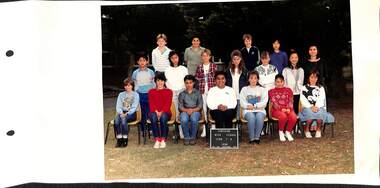 Sunshine and District Historical Society Incorporated
Photograph - Sunshine High School Class Photographs 1988, 1988
... Angela Santic, Melissa Ashley, Tony Koumis, Mitchell Brajic, Leanne Kingston, Mado Mickovski Front Row (L-R) - Simon Parsons, Neil Brown, Anna Luu, Enzo Arena, Tam Houng, Mark Gillespie, Hay Vi Absent - Mr. Greg Luscombe (Teacher) 5847.06 - Sunshine High School Student Photos 1988 Year 8C.jpg 5847.06 - Sunshine High School Student Photos 1988 Year 8C Names.jpg 3rd Row (L-R) - Erin Bidey, Shane Gillies, Lorraine Formosa, Maryann Bajada, Stoja Zuizdalo, Elizabeth Formosa, Scott Blizzard 2nd Row (L-R) - Melissa Wainwright, Frances Thewma, Janelle Myers, Tommy Sarkezi, Stella Katopoulos, Walid Hafda, Jodie Wilson. ...Angela Santic, Melissa Ashley, Tony Koumis, Mitchell Brajic, Leanne Kingston, Mado Mickovski Front Row (L-R) - Simon Parsons, Neil Brown, Anna Luu, Enzo Arena, Tam Houng, Mark Gillespie, Hay Vi Absent - Mr. Greg Luscombe (Teacher) 5847.06 - Sunshine High School Student Photos 1988 Year 8C.jpg 5847.06 - Sunshine High School Student Photos 1988 Year 8C Names.jpg 3rd Row (L-R) - Erin Bidey, Shane Gillies, Lorraine Formosa, Maryann Bajada, Stoja Zuizdalo, Elizabeth Formosa, Scott Blizzard 2nd Row (L-R) - Melissa Wainwright, Frances Thewma, Janelle Myers, Tommy Sarkezi, Stella Katopoulos, Walid Hafda, Jodie Wilson. ...5847.01 - Sunshine High School Student Photos 1988 Year 7A.jpg 5847.01 - Sunshine High School Student Photos 1988 Year 7A Names.jpg 3rd Row (L-R) - Sodik Suljovic, Michael Bajada, Ashley Saunders, Jennifer Tran 2nd Row (L-R) - Thanh Hoang, Phiona Tran, Luke Coman, Danielle Matina, Rachel Laver, Ms. Antoinette Galea (Teacher) Front Row (L-R) - Tanya Clark, Sharon Azzopardi, Frank Loschiavo, Michael Hobashi, Tammy Baldwin, Melisa Arena, Kerry Ager 5847.02 - Sunshine High School Student Photos 1988 Year 7B.jpg 5847.02 - Sunshine High School Student Photos 1988 Year 7B Names.jpg 2nd Row (L-R) - Wasim Hafda, Jim Katsantonis, Donna Sultana, Melinda Critch, James Cassar, Nicholas Costa, Alison Furlong, Ms. Sia Simatas (Teacher) Front Row (L-R) - Akin Hussein, Tina Bernard, Tammy Jungbaver, Michelle Colin, Rada Nyon, Raymond Debrincat 5847.03 - Sunshine High School Student Photos 1988 Year 7C.jpg 5847.03 - Sunshine High School Student Photos 1988 Year 7C Names.jpg 3rd Row (L-R) - Heap Lay Ma, Carmelo Todaro, Tanya Clark, Eleonora Fejes 2nd Row (L-R) - Jackling Stojovski, Aleksandar Tasevski, Radosiar Ararpovic, Sandy Gunther, Michelle Ruzic, Sonija Halilaj, Ms. Lyn Chatham (Teacher) Front Row (L-R) - Sertap Coskun, Shannon Duff, Pam Huseyin, Helena Feschuk, Vesna Georgievski, Magda Giagia, Nick Mitrovic 5847.04 - Sunshine High School Student Photos 1988 Year 8A.jpg 5847.04 - Sunshine High School Student Photos 1988 Year 8A Names.jpg 3rd Row (L-R) - Andrew Dutkovic, Antoinette Micalleff, Jodie Bernard, Briuney Boase, Maria Magavero, Robert Critch, Joseanne Vella 2nd Row (L-R) - Debbie McNab, Lora Jovanovic, Michael Collier, Vincent Smart, Leah Birch, Tim Jones, Ms. Anne White (Teacher) Front Row (L-R) - Sanija Halilaj, Maria Nesci, Carlo Argetto, Zoki Causovski, Jenny Panlock, Elaine James, Rosa Ferretto 5847.05 - Sunshine High School Student Photos 1988 Year 8B Names.jpg 5847.05 - Sunshine High School Student Photos 1988 Year 8B.jpg 3rd Row (L-R) - Maryanne Tran, Jody Whitcher, Richard Sibun, Keti Markovski, Carolyn Buttigieg, Le Ly 2nd Row (L-R) - Kathy Spehar, Darren Frazer. Angela Santic, Melissa Ashley, Tony Koumis, Mitchell Brajic, Leanne Kingston, Mado Mickovski Front Row (L-R) - Simon Parsons, Neil Brown, Anna Luu, Enzo Arena, Tam Houng, Mark Gillespie, Hay Vi Absent - Mr. Greg Luscombe (Teacher) 5847.06 - Sunshine High School Student Photos 1988 Year 8C.jpg 5847.06 - Sunshine High School Student Photos 1988 Year 8C Names.jpg 3rd Row (L-R) - Erin Bidey, Shane Gillies, Lorraine Formosa, Maryann Bajada, Stoja Zuizdalo, Elizabeth Formosa, Scott Blizzard 2nd Row (L-R) - Melissa Wainwright, Frances Thewma, Janelle Myers, Tommy Sarkezi, Stella Katopoulos, Walid Hafda, Jodie Wilson. Mr. Glen Hayes (Teacher) Front Row (L-R) - Robert Marinkovic, Svetlana Risteska, Patrick Robertson, Brett Hereward, Trung Hang, Ram Halilaj, Vicki Emmett 5847.07 - Sunshine High School Student Photos 1988 Year 9B.jpg 5847.07 - Sunshine High School Student Photos 1988 Year 9B Names.jpg 3rd Row (L-R) - Alex Sorgiovanni, Shane Burley, Shirley Aquilina, Sandra Bilic, Olia Ahmed 2nd Row (L-R) - Trudy Durden, Nerav Ramadan, Allyson Sammut, Tam Nguyen, Cindy Camilleri, Susan Galea, Susan Zammit, Tammy Smith Front Row (L-R) - Edin Garibovic, Bernadette Smith, Peter Mavric, Doug Stojandvski, Chris Stenta, Kristine Doyle, Sam Murawczuk Absent - J. Stratford (Teacher) 5847.08 - Sunshine High School Student Photos 1988 Year 9C.jpg 5847.08 - Sunshine High School Student Photos 1988 Year 9C Names.jpg 3rd Row (L-R) - Joe Matina, Jodie Bantz, Mathew Gunther, Daniella Carpintari, Mario Monteleone, Susan Condon, Craig Rowe, Mr. P. McKenzie (Teacher) 2nd Row (L-R) - Peter Francalanza, Francine Gaffiero, Kylie Ferguson, Silvana Naumovska, Melissa Stork, ?, Jasmin Castillo, Phedna Tran Front Row (L-R) - Tracy Cairnes, Kathy Tonkovic, lee Grech, Robert Causonski, Zlatko Obic, Jane Schrape, Doris Psaila 5847.09 - Sunshine High School Student Photos 1988 Year 9L.jpg 5847.09 - Sunshine High School Student Photos 1988 Year 9L Names.jpg 3rd Row (L-R) - Anthony Arena, Darren Allen, Jodie Hastings, Rachael Doyle, Dean Kendrick, Shane Mirabito, Anna Carrarina 2nd Row (L-R) - Ms. J. Brown (Teacher), Paul Pouwelse, Christian Frazer, Phillip Azzopardi, Michael Buttigieg, Pania Williams Front Row (L-R) - Nerissa Kennedy, John Tsatalios, Paul Potra, Peter O'Brien, Hoa Luu, Nick Kaisantonis, Melissa Smith 5847.10 - Sunshine High School Student Photos 1988 Year 10A.jpg 5847.10 - Sunshine High School Student Photos 1988 Year 10A Names.jpg 3rd Row (L-R) - Donna Brown, Lisa Barr, Lisa Musoneci, Carolyn Knight, Tania Malloy 2nd Row (L-R) - Erika Garcic, George Boudoloh, Elissa Miller, Glenn Grima, Jason Attard, Frank Kompar Front Row (L-R) - Michael Gunther, dean Jesensek, Tony Nesci, Mark Matusan, Alex Simic, Michael Wilby, Angelo Scalise 5847.11 - Sunshine High School Student Photos 1988 Year 10B.jpg 5847.11 - Sunshine High School Student Photos 1988 Year 10B Names.jpg 3rd Row (L-R) - Lily-Jane Cassar, Nadine Patten, Patricia Pedeco, Juliet Pace, Jason Mifsud, Peter Panegi 2nd Row (L-R) - Joanne Cassar, Zuki Klajcin, Michelle Buttigieg, Leslie Thwaites, Lynette Spiteri, Sandra Cauchi Front Row (L-R) - Suzi Bilic, Stephen Bochenek, Helder Matias, Daniel Allen, Leslie Wilson, Zlate Markarski, Claudio Monteleone 5847.12 - Sunshine High School Student Photos 1988 Year 10C.jpg 5847.12 - Sunshine High School Student Photos 1988 Year 10C Names.jpg 3rd Row (L-R) - Sue Forti, Leisel Huntly, Clancy Nienartowicz 2nd Row (L-R) - Tracey Fuston, Belinda Frazer, Martin Pouwelse, Andrew Danks, Ashleigh Myers, Rady Nuon Front Row (L-R) - Ahmed Mesto, Michael Gregory, Richard Smith, Gavin Preston, Sharon Blackneym Karl Hill, Sue-Ellen Mutimer 5847.13 - Sunshine High School Student Photos 1988 Year 10D.jpg 5847.13 - Sunshine High School Student Photos 1988 Year 10D Names.jpg 3rd Row (L-R) - Miryana Lasic, Mark borg, Suzanne Kieryczuk, Sharyl Barif, Mark Mezzarilla, Michael Pastere, Helen Tabone 2nd Row (L-R) - Steven Spehar, Darren Blizzard, Debbie Doyle, Eunice Torgut, Brooke Grima, Jason Foley Front Row (L-R) - Alan Alisic, Chris Prodanis, Joanne Gillnespey, Tom Kourtessiz, John Murawczuk, Tony Magavero, Angelo Cassar 5847.14 - Sunshine High School Student Photos 1988 Year 11A.jpg 5847.14 - Sunshine High School Student Photos 1988 Year 11A Names.jpg 3rd Row (L-R) - Diane Brodel, Vesna Mrsic, Slavica Lasic, Allison Maynard, Wayne Cox, Kathleen Wilson 2nd Row (L-R) - Tracey M. Cassar, Nicole Schulza, Kylie Gillies, Julie Emmet, Rocky Senese, Jackie Bajada Front Row (L-R) - Pauline Camilleri, Gerald Smith, Jodie Kelly, Paul Nevelinski, Grant Stork, Sharon Quaadgras, Joanne Mallach 5847.15 - Sunshine High School Student Photos 1988 Year 11B.jpg 5847.15 - Sunshine High School Student Photos 1988 Year 11B Names.jpg 3rd Row (L-R) - Jenny Merinigton, Syne Jordan, Kellie Edwards, Kristina Bozinov, Betty Carter 2nd Row (L-R) - Julie Frank, Pina Sorgiovani, Shelley Danks, Rachel Keane, Giuliana Stradella, Val Causovska, Helen Sergakis Front Row (L-R) - Craig Durden, Amette Thompson, Darren Hildebrand, Julie Barnes, Con Antonakis, Michelle Brookshaw, David Pettifer 5847.16 - Sunshine High School Student Photos 1988 Year 11C.jpg 5847.16 - Sunshine High School Student Photos 1988 Year 11C Names.jpg 3rd Row (L-R) - Jenny Carew, Phyllis Pace, Joanna Lazarenko, Jocelyn Castillo 2nd Row (L-R) - Richard Ozadczuk, Marina Mainelli, Charles Spiteri, Sarah Stemmer, Leanne Allen, Margaret Mizzi Front Row (L-R) - Julie Granger, Joanne Hereward, Paul Carrarini, Andrea Allen, Per Thomson, Michael Glancevski, Kelly ? 5847.17 - Sunshine High School Student Photos 1988 Year 11D.jpg 5847.17 - Sunshine High School Student Photos 1988 Year 11D Names.jpg 3rd Row (L-R) - Barbarella Duffy, Esther Debrincat, Naria Todaro, Tanya Thwaites 2nd Row (L-R) - Nicole Malloy, Fiona Vella, Maria Todaro, Tracey Cassar, Skye Parsons, Than Tran Front Row (L-R) - Carolyn Bernat, Nga Phung, Naren Ung, Tracey Evans, Kally Stavrianakis, Helen Georgeallis, Dai Tran 5847.18 - Sunshine High School Student Photos 1988 Year 12 H.S.C..jpg 5847.18 - Sunshine High School Student Photos 1988 Year 12 H.S.C. Names.jpg 4th Row- (L-R) - Sue Micallef, Hiep Nguyen, Christina Prisc, Helen Kotopoutis, Yolanda Wilson, Louise Refalo, Rebecca Solda, Michelle Bernard 3rd Row (L-R) - Chi Long Tran, Maria Prodaris, Emmanuel Kopsaftis, Gae Mitreski, Ian Mavric, Domenic ? (TTS), Danni Taleski 2nd Row (L-R) - Julie Brown (Teacher), Annita Ware (Co-Ordinator), Ho Tran, Pietro Georgious, Warren Williams (SNTS), Jason Dunham (SNTS), Partelis Mellissa, Arpad Fejes, Andrew Dinh, Chris Christoforou, Peter McKenzie (Teacher) Front Row (L-R) - Stephano Salomon (TTS), Grant Delaney, Tomasz Szafraniec, Peter Kirko, Jamie Parsons, Robert (SNTS), Jason Loverick (TTS) Sitting on Ground - Doreen Mercieca, Lisa Bywaters, Kerryn Wilby Absent - Joe Scalise 5847.19 - Sunshine High School Student Photos 1988 Years 11A-D.jpg No Names 5847.20 - Sunshine High School Student Photos 1988 Staff.jpg 5847.20 - Sunshine High School Student Photos 1988 Staff Names.jpg 4th Row- (L-R) - Antinette Galea, Lyn Chatham, Hilary Burr, Sevinch Mehmet, Val Davies, Loretta Brick, Chrstine Sandars, Dot Matser 3rd Row (L-R) - Gavin McDonald, Chris Bassios, Roger Blackman, Glen Hayes, Gus Napoli, Bill Wringe, Peter McKenzie 2nd Row (L-R) - Peter Harrison, Anne White, Peter Crow, Sophie Alamanas, David Howes, Brian Gunn, Sarah Ginsbourg, Anusha Santhiapillai, Sherry Gale, Sia Simatos, Annita Ware Front Row (L-R) - Rose Johnson, Robyn Barr, Yadranja Maric, Martin Enright, Julie Borwn, Patricia Pozzebon, Cathy Damonsunshine high school, sunshine north, student photograph -
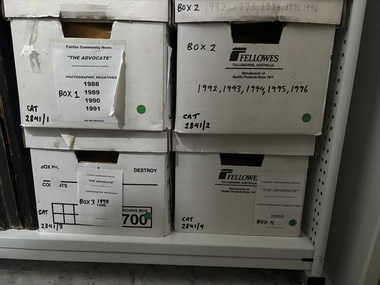 Sunshine and District Historical Society Incorporated
Photograph - Sunshine Advocate Negative Collection
... Base Tour 285.2 Chrisy Dennis, Author Of Development Book About Keilor - Melton Areas 286.1 Rod Hay Bike Rider 286.2 Class Of 1991 Grade 6 Head Shots Sunshine North Primary School 287.1 St. ...Base Tour 285.2 Chrisy Dennis, Author Of Development Book About Keilor - Melton Areas 286.1 Rod Hay Bike Rider 286.2 Class Of 1991 Grade 6 Head Shots Sunshine North Primary School 287.1 St. ...Negative collection donated to SD&HS by the Fairfax Community News Paper Group incorporating Northwestern Suburbs.Sunshine Advocate Negative Years|1988|1989|1900|1992|1993|1994|1995|1998|1999|2000 Envelope No Subject 1.1 Braybrook Tenants - Don McKay & Jan White 1.2 St. Albans Pool Summer Pictures 2.1 First Baby Born Wanda Maffi 2.2 Albion Primary School Garden Won Award 3.1 Opening Of Keilor Downs Shopping Centre By Mayor Of Keilor 3.2 Sunshine Swimming Pool 4.1 Soccer Camp Winners 4.2 McKay's Australia Factory 5.1 Soccer Xmas Picnic 5.2 Ukranian Students - Simone Cymbalak & Victoria Dutka 6.1 Joe Camelleri & Dust On His House 6.2 Rhonda Martin In Drain 7.1 Kids At Sunshine Pool & St. Albans Pool Summer Pictures 7.2 Dancers At Sunshine High School 7.3 Go-Carts 8.1 Scrub Fire Abercain Crt Deer Park Residents 8.2 Tai Kwon Do Boys 9 Flag To Exchange Students 10.1 Trainer Family Home 10.2 Pam Chabury Burnt House 11.1 Boral Quarry 11.2 Flower Shop 12.1 Samantha Sieradzki Exchange Student 12.2 Dorrie & Ron Huchison 50th Wedding Anniversary 13.1 John Handley 13.2 Staff Of Ultra Tune Ballarat Rd Sunshine 14.1 Vandalism To St. Albans Shops 14.2 Kate Young - VCE Graduate 15.1 Stan Cash St. Albans Store 15.2 Cr. Ciro Lombardi With Overgrown Concrete Drain Kings Park Area Gillespie Rd St. Albans 16.1 Alice & Fred Madden Home 16.2 Mr & Mrs Bob Peel 50th Wedding Anniversary 17.1 Florence Southgate Home 17.2 Industrial Accident South Rd Braybrook 18.1 School Leavers 18.2 Bowls Club Committee St. Albans Bowls Club Kings Park Reserve St. Albans 19.1 Mr Ypung & Mr Wisnieski - Peerless Factory 19.2 Sunshine Traders Dean Olarenshaw & Bob James 20.1 Andrew Doyle Bowls Player 20.2 Jeff Unger 21.1 Joe, Vimce & Marion Fagone - Pipe Makers Park 21.2 Greg Eade 22.1 Avondale Heights Scrub Fire 22.2 Basketballer Dave Stuart and Chirstopher & Robert Catania 23.1 Pauline McIntyre 23.2 McKay's Factory Gates 23.3 Five Ways Birthday Shirly & Mark Maroney 24.1 Jack Honey 24.2 Kay Setches Opens New Occasional Care Scheme Westvale Community Centre Kings Rd 25.1 Real Estate 25.2 Tony Knarth & Chris White For Neighbourhood Watch 26.1 Taylors Lakes Hotel 26.2 St. Albans Meadows School 27 Keilor Downs Secondary College 28.1 Steven Kling Of St. Albans Essendon Town Clerk & Youngest Town Clerk Of Melbourne 28.2 Lady With 1954 Membership Ticket To Footscray Football Games Premiership Year 29.1 Mr Wally Pichner 32 Years Of Service At Post Office St. Albans 29.2 Kids Holiday Program 30 Mr Wency Garrata Who Has Set Up Assoication Of Filopino Professionals In Western Suburbs 31.1 Joe Kanati - Refused To Be Allowed To Sell Travel MET Tickets By Met 31.2 Ian Baker 32.1 Mrs Parsons & Garnett St Sunshine 32.2 Peter Inkstler Old Sunshine Footballer 33.1 Derelict House Kosky St Sunshine 33.2 Mr Roberts & His Pumpkins 34.1 Ian Mill & Marie 34.2 Preps At School Albion North Primary School 34.3 Don Gray, Son Of Caretaker Of Gardens Years Ago, H.V. McKay Gardens Anderson St Sunshine 35 Dr. O'Gallagher Dental Unit Sunshine Hospital Sunshine 35.1 Tom Fox 35.2 Women Whose Course Has Been Cancelled By Western Institute After Admission 36.1 Mr. W. Peeler 36.2 Chris' Friends Talmage St Albion 37.1 Housing Tenants Protest 37.2 Les Twentyman 38.1 Marie Rice Shows Us The Rats 38.2 Pilkingtons Ballarat Rd - Bruce Harding & John Brezovel 39.1 Sister Marie Boulee Of St. Albans Going To Nigeria 39.2 Alan Griffiths Sacred Heart Primary School 40.1 Mrs Winifred Honey 40.2 House Fire Almond St Brooklyn 41.1 Dracula Advertising SolarLight & Skylights 41.2 Jenny Bradley At Keilor Park Athletics Track 42.1 Kellie Sutton 42.2 Lambada Dancers Claudia Karati Marie Mill Centre Sunshine 43.1 Michael Wood - Owner Of Shopping Centre, Crowd & K-Mart 43.2 Fred & His Hired Cars 44.1 Jack Roberts & Jack Sheridan 44.2 Piero At Alfrieda House Receptions Alfrieda St, St. Albans 45.1 Catherine Bishop & Keilor Ensemble 45.2 Principal, Deputy Principal & Kids St. Alban Meadows Primary School 46.1 Tina Miller 46.2 Asbestos House In Braybrook 47.1 Greek Church Service & Procession 47.2 Gerald Pemberton 47.3 Bridge Afton St & The Boulevard Maribyrnong 48.1 Jesse Boyce 48.2 Manager & Staff Leaving Sunshine Plaza 48.3 Don McKay & Peter Westmore At Old Massey Ferguson Factory 49.1 K'im Lyndon - Councillor Elect 49.2 Angela Disco HSC Examines 49.3 Nan Lumbers Tuck Shop 50.1 H & K Trendy 50.2 St. John's Church Deer Park 51.1 Joan Carstairs 51.2 George & Janet Tourlotos In Laneway 52.1 Unveiling Of Speeding Sign Along South Road 52.2 100 Years Old Sunshine Primary School Hampshire Rd Sunshine 53.1 Kids & Video Games 53.2 Sunshine Tip & Smell Seeping Over Residential Area 53.3 Trish Alexander Western Youth Support Unit Ascot Vale 54.1 Lanburner - Licencee Of Only Hotel In Taylor Lakes 54.2 Eril Pasula St. Albans Quality Shoes 55.1 Shop Managers Of Chas Wilks Jewellers 55.2 Robyn Gillis & Itay Peddle Hipfrog Deer Park College 56.1 Bill Button Who Spent Hours Cleaning Block Arcoss Road 56.2 Lady Nelson Childcare Nicole Huggard & Joe Debono 57.1 Wally Webb Who Recently Retired From Keilor City Council 57.2 St. Albans Secondary College An Lieu & Anh Hoai Hoang 58.1 Rosemary Drake - Social Worker St. Albans Migrant Resource Centre 58.2 Burton Cresent Oval Circus 59 Ardeer South Primary School Zafer Salih & Danielle Sparke 59.1 Norm Anstee Leaves Massey Ferguson 60.1 Mr & Mrs Waddell 50th Annivesary 60.2 Care For Kids Program St Sunshine East Primary School 61.1 Altona Babminton Luke Talbot & Bert Talbot 61.2 Argyle Florist 11 Devonshire Rd Sunshine 62.1 Long Que Of Muns & Kids Expecting For Baby Immunizations 62.2 Lourdes Thomas Lollypop Lady 63.1 Fred & Paul Pointer 63.2 Alex Tzoras Furniture Supermarket 64.1 Jun White At Suspension St Site 64.2 Tony Fox (Fox Parts) 65.1 Bernard Rielly Re: Met Ticket Selling Locations Incorrect 65.2 St. Albans Leisure Centre (Aerobics) Staff 66.1 Gavin Watt's With Cricket Video & Book 66.2 George Popodolo (Abbott & Dean) 67.1 Senior Citizens Moving Into Building Station Rd Deer Park 67.2 John Castle 68.1 Kerry Saunders Supporting Sportswoman Calendar 68.2 Trevor Redman 69.1 Cr. Rhonda Martin At Intersection Where A Crossing Is Needed 69.2 Dr. John Lawrie & New OP6 Machine For X-Rays In Your Mouth 23 Victoria Cres St. Albans 70.1 New Kindergarten Taylors Lakes 70.2 Class Of 1991 Shots Of Grade 6 Kids Ardeer Primary School 71.1 Head Shots Of Grade 6 Kids St. Albans North Primary School 71.2 Braybrook Primary School Doug Hawkins 72.1 Mrs Gina Valastro & Daughter Amanda For Baby Picture Contest 72.2 Bill Barnett Old Guy 73.1 Head Shots Of Grade 6 Kids Deer Park Primary School 73.2 Class Of 1991 Taylors Lakes Primary School 74.1 Joan Kirner Renaming School 74.2 Victoria Square Shops Cnr Elaine St & East Esplanade, St. Albans 75.1 Highest Pass Rate Amongst HSC Students Last Year - They Are Visting Kealba High School 75.2 Younsters Trying to Cross The Road, Cnr Grantham Pde & Main Rd West, St. Albans 76.1 Jean & Rob Robertson Who Support The Homeless 76.2 Rev. Thick Nhu Dinh, A Monk 77.1 3 Artists At The Hunt Club 77.2 "Feast Of St. Pauls", St. Pauls Church 200 Glengala Rd Sunshine West 78.1 Bad Condition Of St. John's Building Fraser St 78.2 Colin Clowes St. Albans Telephone Exchange 79.1 New Registrar Lather Hall Essendon 79.2 Telephone Exchanged Victoria St, St. Albans 80.1 Bridge Being Built 80.2 Bernard Reilly In Bus Stop No Longer Used Grieve Pde Brooklyn 81.1 Indoor Cricket 81.2 The Power House Talmage St Albion 82.1 Executive Director Head Of Nursing & A Patient 82.2 Dr. Anton Kafta 83.1 Rubblish Along Taylors Rd St. Albans 83.2 Senior Cizitens Enjoying Lunch Deer Park Shopping Centre 84.1 R.A.C.V. With Steve Watkins 84.2 Opening Of Cermaic Area Hunt Club Deer Park 85.1 Twins 85.2 Ashley St Tottenham 86.1 Soccer Melbourne Croatian V's Sydney Croatian 86.2 People Complaining About Noise 87.1 Soccer George Cross V's Sydney Croation 87.2 Kealba Playgroup At Animal Farm 88.1 Grant At Cameron Action 88.2 Stolen Seat Susan & Timothy Lutze 89.1 Wemer Schloemer 89.2 George Seitz Creek Clean Up Taylors Lakes 90.1 Majestic Video Inside Shot 90.2 Austpost Jerry Katz & Owner Of Newsagency George Nappi 21 Northumberland Rd Sunshine North 91.1 Massive Pumpkin & It's Owner 91.2 Re-Union For Tottenham Primary School 92.1 Mark Wilson & Piece Of Berlin Wall 92.2 Street Scene St. Albans Ballarat Rd 93.1 Displays Of Products & Salespeople Highpoint Shopping Centre 93.2 Ron Doerre - Video Enthusiast 94.1 Fr. Nicholas Of Greek Orthodox 94.2 Student Forum Sunshine Technical School Graham Street 95.1 Ex U.S.A. Basketballer Presented With Mazda 121 95.2 Run Down House Street Watch Series Tyler St Sunshine 96.1 Ralph Willis At I.C.I. Yarraville 96.2 Swim Carnival Sunshine Pool 97.1 R.A.A.F. Tottenham Wal T. Brennele & Al I. Brezinseak 97.2 Street Watch Hargreaves Cres 98.1 Wally Mazurak At Sunshine Court 98.2 Street Watch Fraser St Sunshine 99.1 Maribyrnong Medical Centre - Nancy Cain & First Babies Born 99.2 Street Watch Mr Turnball 100.1 Construction Sign May 32nd Ballarat Rd Footscray 100.2 Garbo Collection 101.1 R.A.A.F. Coral Holliday & Rodger Barnett 101.2 SRC On The Multi Complex Campus Sunshine Secondary College South Rd Braybrook 102.1 Paul Guyett Stancash Warehouse 102.2 Jack & June Jones 50th Wedding Anniversary 103.1 Anna Hercon & Her Tomatoe 103.2 Jamieson St Reserve 104.1 Robbed Ladies 104.1 Bernard Reilly Ten Pin Bowling Centre Car Park 105.1 Pizza Shop Fire 105.2 St. Albans East Primary School Maribyrnong River Clean Up 106.1 Sunshine Plaza Ada 106.1 Sunshine School Shots 107.1 Nancy Curtis Maribyrnong River 107.2 Wilton Harris 100 Years Old With Sunshine Mayor Bernard Reilly 108.1 Houses & Cars 108.2 St. Albans Post Office Peter Burrows 109 Eugene Didenkowski Pharmacy St. Albans 110.1 Georgina Liabos 110.2 Sunshine Technical School Arron, Tony & Justin 111.1 Adam Kaczanowski 111.2 Tottenham Primary School "Three Sided Football" 112.1 Plan Of Shops 112.2 Red Cross Isobal Caithrens 113 Street Watch Thomson St Sunshine 114.1 Councillors 114.2 St. Albans Primary School Science Display Alan Williams 115.1 Plane 115.2 Polish Club 116.1 Eric Goss 116.2 Brenda James At The Build The Wes Rally 117.1 Don McKay Mayor 117.2 Stevensville Primary School Huong Duons & John Calder 118 Fun City Go-Karts 119 Illegal Car Sales Neale Rd Deer Park 120 Keilor Scouts Mathew Norton & Stan Lucien 121 Albion North Primary School Brett & Maree Brocklesby 122 Jan De Gabrial Football Coach 123 Mrs Whitlow & Her 2 Kids Albion Community House Selwyn St 124 Steve Bound & Staff At Supermarket - Rambow 125.1 Jack Culpin Federal Candidate St. Albans Railway Station 125.2 Cr. Rhonda Martin & Junior Council Kids 126.1 Deer Park Blast 126.2 Nursery Rhymes Dress Up Day Deer Park North Primary School 127.1 Cathy Brown & Brenda James 127.2 Cr. Charles Skidmore At His Waste Collection Business 4 - 12 Salisbury St Sunshine North 128.1 Students At Western Institute 128.2 Maurice & Jennry Boase Sunshine Tolty Base 129.1 St. Albans South Primary School Kids 129.2 Opening Of New Extension To R.S.L. Club Rooms 16 Hoffmans Rd East Keilor 130.1 Sunshine South Primary School Kids 130.2 Aerial View Intersection Of Briggs St, Arthur St & Alfrieda St, St. Albans 131.1 John Kontek & Graeme Toomey 131.2 Street Watch Willaton St, St. Albans 132.1 Eden's Gardens Multicultural Celebrations 132.2 State Of Fire Station Hampshire Rd Sunshine 133.1 Norm & Joan Wale 133.2 Easter Bonnett Parade Deer Park Primary School 134.1 Dukes 50 Years Wedding 134.2 Trees Ripped Out Dundalt St Sunshine 135.1 Hot Rod Club Members 135.2 Energy Park Sunshine 136 Isabel McKay 137.1 Don McKay & Wally At The Peerless Factory 137.2 Apex Club Up 9 Metres Tower Keilor Shopping Centre 138.1 Cheque From R.A.A.F. 138.2 Lenthon Family Acting Family 139 Pile Of Concrete St. Albans Square 140 Christine Lashowski Outside Keilor Hotel 141 Huge Oversized Zucchinis Owned By Mrs Eve Tandy 142.1 Winners Of National Maths Competition 142.2 Centernary Fire Truck 143.1 Rene Carstain Nee Drinkwater 143.2 Mudford Family 144.1 Highpoint Shopping Centre Car Park Robin Raniera 144.2 Streetwatch Cnr Methera St & Euroa Ave Sunshine 145.1 Launching Of Book By Prue McGoldrick By Barry Jones 145.2 Tubemakers St. Albans Rd 146.1 Claire Brennan Dee Dunn 146.2 Val Moore On Old Bridge Arundel Rd 147.1 R.A.A.F. & Cubby House At Furlong Park School For Deaf 147.2 Tony Salvucci & Staff At Tasman Meats Butchers Milleara Mall Shopping Centre 148.1 Children's Art Display 148.2 Baby Boom At Hospital Mums & Babies Sunshine Hospital Furlong Rd 149.1 Eric Maxwell 149.2 India Restaurant 149.3 Keilor Basketball Stadium 150.1 Stenson Rd Named After Mrs Emma Hall & Mrs S.T. Honey 150.2 Girls At Avondale Secondary College 150.3 Class Of 1991 Moville Primary School 151.1 Cake Being Cut R.A.A.F. Base Tottenham 151.2 Kids & Principal Keilor Downs College 151.3 Street Watch Cutts St 152.1 Frank Micalef 152.2 Sunshine Activity Unit Sarah Gallagher 153.1 Braybrook Hotel 153.2 Tom Diele 153.3 Sunshine Christian School Jane Harper & Adrianna Sueno 154.1 Old Boys Football Footscray V's Collingwood 154.2 Roadworks O'Hean St, St. Albans 154.3 Overnewton College Christopher Blake & Douglas Blake 155.1 Michelle Lee & Others 155.2 Margaret Marks 155.3 Earthmoving Equipment On Building Site Robinsons Rd Deer Park 156.1 Huseyon Ramadan Volleyball 156.2 Louise Chircop & Others 156.3 Kevin & Bill Burke 156.4 Hotel & Manager Glengala Rd Sunshine 157.1 Eric Lund Western Insitute 157.2 Brayden Sinnamon & "T" Model Ford Bath Car 157.3 Mrdas Ballarat Rd Sunshine 158.1 Pete The Clown At West Sunshine Community Centre 158.2 Caroline Hogg & Children Services Expo 158.3 Plumbers Hardware 159.1 Constable Steve Reidy & Senior Constable Jim Panpoulos & Dope Plants 159.2 Oldies Dancing For Senior Citizens Week 160.1 Roland de Gabrielle 160.2 Chinese Restaurant 160.3 Keilor Historical Society 161.1 Fernando Ianni 161.2 St. Albans South Primary School Ashtons Circus 161.3 Past & Present Students & Teacher Putting A History Of The School Together Tottenham Community Secondary College Churchill Ave 162.1 Rita Nugara 162.2 Lithuania Medical Student 162.3 Rosemary Szirom & Maureen Kavanagh Under Gaslights Keilor Hotel 163.1 George Mullenger Deer Park Engineering 163.2 Nick Pino At Intersection & Petrol Station 163.3 Market Plumbing & Hardware 164.1 Sharon Auld - Competition Winner 164.1 Minister For Transport Tim Kennan Opening Ginifer Railway Station 164.2 Sunshine Tips 165.1 Graham Bonar & Wool Bales 165.2 Multicultural Dress & Food Day 165.3 Forrest St Contaminated Soil Site 166.1 Croatian Soccer Club 166.2 Ignaz Martinv At Arshria House 166.3 Hotel Installing New Bottle Shop Kealba Hotel 167.1 Peter Gordon Chatting To Kids 167.2 Outside Of Building Greek Orthodox Church 167.3 Launch Of "Good Shopping" Tour Sunshine Safeway 168.1 Andy Kratsis Used Car Lot 168.2 Henry Frithof Keilor Points Out A Sand Excarvation 168.3 Flicker's Employees St. Albans Rd & Gilmour Rd St. Albans 169.1 Teacher Strike 169.2 Intersection Being Built Sunshine Ave Taylors Lakes 169.3 Leyla Karahan & Baby Efra 29a Alfrieda St, St. Albans 170.1 Comalco Winner Michael Demjancuk Barkly Bottle & Recycling 170.2 Historial Homestead With Patricia Sydenham Park Golf Course 170.3 Bernard Reilly & Intersection Leading To Nowhere Interection Ballarat Rd & Station St 171.1 Winner Of Garden Competition Antoinette Ventresca 171.2 Veronica Larsen 171.3 Street Watch Lane In Between Houses Craigavon Crt Deer Park 172.1 Des Mitchell Retiring After 24 Years At Council 172.2 Kids Being Moved Out Of Portable Classrooms Deer Park North Primary School 172.3 New Bus Manufacturing Plant 173.1 Maths Winner Shawn Hindmarsh 173.2 Steve Trimcevslci In Zokky's Leather Shop 173.3 Nescell Factory Cnr Margrave St & West Esplanade St. Albans 174.1 Kids Decorating Walls Around Avondale High School 174.2 Kids Peace Conference 174.3 Street Watch Mernda St Pipe To Creek Sunshine 175.1 Teddy Bears Picnic For Kealba Play Group 175.2 Ascot Vale Primary Kids 175.3 Remy Sarmiento Philipino Protester 176.1 Art Token Around Presentation Niddrie Libary 176.2 Susan Pearce & John Scott With Trees 176.3 Maria Clak & Rick Vankeulen & Kids 177.1 Miss Teenager Entrant Kylie Bailey 177.2 Highpoint Fashion Parade 177.3 Peter Forbs & Michael Iacuone 178.1 Melissa Fanugia Miss Teenager Entrant 178.2 St. Albans Primary School Anzac Day With Wreath Laying Elena Krisonis 178.3 Colin & Elizabeth Paterson 50th Wedding Anniversary 179.1 St. Albans Mens' Nappy Changing Competition Grant Eadie 179.2 Premier & Arch Bishop Of Australia and Melbourne Opening Greek Church McKechnie St. Albans 180.1 Bowls Premiership Flag Sunshine R.S.L. 180.2 Jutia Scholz With Castle 180.3 Bill Chapman 181.1 Gesa Lindemann 181.2 Funeral Of Arthur Street Sacred Heart Catholic Church St. Albans 182.1 Works Going On At Railway Tracks 182.2 Noel Mumford 182.3 Black Soil Street Watch Ballarat Rd Near Hunt Club Deer Park 183.1 Mable McArdle 183.2 Sr. Marie Kehoe RSM 183.3 Jan White & Rubblish Dumped On Land Perry St, St. Albans Laneway 184.1 Matthew Brookshaw 184.2 Kylie Roberts (Selected In State Swin Team) 184.3 Keilor 30th Anniversity Carnival 185.1 Peter Ryan 185.2 Presentation Of Plaques By Mayor 185.3 Mother Mary Moshovakif & Snatched Vicki (Baby) 84 Atheldene Drive St. Albans 186.1 John Stevens - John St & Murray Stevens - Murray St 186.2 St. Pauls Primary School Visiting Keilor Council Chambers 186.3 8 Indonesian Bureaucrats Visiting St. Albans Secondary College 187.1 Police & Anti Drug Kit Deer Park North Primary School 187.2 Sugar Gilders Organ Pipes Calder Highway 187.3 Local People Spaldings McIntyre Rd Sunshine 188.1 Romanian Students Studing At School 188.2 3 Sergents & Easter Eggs R.A.A.F. Base Tottenham 188.3 Phyllis Restall & Twins Club 189.1 Jim Huseyin 189.2 Bill Jessop With Mayor Don McKay 74 Devonshire Rd Sunshine 189.3 Salvos Homeless People Program Launch 42 Devonshire Rd Sunshine 190.1 Kids In Fancy Dress 190.2 Joe Borrell 190.3 "B" Grade Champion Cricket Team Sunshine Cricket Club 191.1 Cars Being Sold On Vacant Land 191.2 Werner Schlomerers Store - Damien Gahan 191.3 Marie Fenech At Bad Footpath St. Albans 192.1 Model Of New Church 192.2 Sunshine Mayor & Children 192.3 Street Watch Shoping Centre St. Albans Ralph Fiovino 193.1 15 Cyclists With Sponsorship From Police Blue Light Disco 193.2 Demostration Over Public Housing Auctions Maidstone 194.1 K-Mart Manager & Staff 194.2 Petitioners For Bus Route Keilor Downs 194.3 100th Birthday Celebrations Sunshine Primary School 195.1 Launch Of Video By Kay Steches 195.2 Peter Williams 195.3 Sunshine Primary School 100th Birthday Tanya Simouska 196.1 Teachers & Students On Victorian Bike Ride 196.2 Keilor Downs Shopping Centre 196.3 Brimbank Park Heart Paths Project Marianne Khail & Michelle Fincke 197.1 English Poet John Keats 197.2 Toy Donation 197.3 Copy Of Negatives Of Dan Cauaghan 198.1 Sunshine Kindergarten Police Hanging Over Safety Certificates 198.2 Chas Wilks Jewellery 198.3 Trevor Thom Lufthansa Pilot 199.1 Bernard Smith & Birds 199.2 Grant Eadie 199.3 Street Watch Taylors Rd St. Albans 200.1 Kings Park High School Fire 200.2 Western Smallgoods 208 - 210 McIntyre Rd Sunshine 200.3 Geoff Parker Builder 201.1 Gary Niward Cyclist 201.2 Winners Of Easter Competition 201.3 Dandenong V's Adelaide Soccer Match 201.4 Resurrection Primary School Family Fun Day 202.1 200 Descendents Of Mary Davies Who Arrived In Keilor 150 Years Ago 202.2 Western Region Games Softball 202.3 Ian Carpenter & Andrew Georgion 202.4 Opening Of St. Albans Shopping Centre 202.5 Street Watch Westwood Way Sunshine 203.1 Col Martin 203.2 Kids In Xmas Train Ride 203.3 Frank Pringle & War Memorial Plaques Sydenham Road 203.4 Louise Scibierras & Footpath Street Watch 4 Leslie St, St. Albans 204.1 Exxon - R.A.A.F. Police Dog & Dentist 204.2 Andra Anderson - New Centre Management 204.3 Margaret & Her Collection Of Spoons 204.5 Albion Primary School M.S. Read-A-Thon Emma Christopoulos And Herve Tran 205.1 New Ring Road For The West 205.2 Hertford Rd House Fire 205.3 Industrial / Residential Dispute 205.4 St. Albans Police Station Joan Kirner 206.1 Maribyrnong High School Kids In 5kM Run 206.2 Sarah Lock & James Nardella 206.3 Keilor Reserves Sell Off 206.4 Anne Battersby Ex-Smoker 207.1 Edward Fraser - Activist 207.2 St. Albans Railway Station 207.3 Cr. Lindsay Graham Sunshine Hospital 208.1 Wally O'Brien & Others At I.C.I. 208.2 Peter Rengey 208.3 St. Albans Shops - Footpath Tables 208.4 Veli Fikret Going To Thailand 209.1 Ope Shenouda From Egypt 209.2 Hung Pham & Others 209.3 Dr. Karmen Mifsud, Ian Baker & Alex Adrianopoulos 209.4 Surveying People Sunshine Shopping Centre 210.1 Trestle Bridge 210.2 Vern & Joyce Bolt 210.3 Lelias Karasaridis B.H.P. Lysaght's Steel Service Centre 210.4 Manager & Items M.Y.M. Furiture & Buildings 77 Wright St Sunshine 211.1 Manager Ashley Reed & Mum Mary Read Deer Park Shopping Centre 211.2 Eden's Garden 211.3 Melbourne Crostia V's Adelaide Hellas 211.4 Sunshine George Cross Players Coaching Clinic Our Ladys Primary School 212.1 House Fire Deer Park 212.2 Switching On Traffic Lights Cnr Arthur St & Taylors Rd St. Albans 213 George Doukas Next To Fire Station Avondale Heights 214.1 Youth Festival Albanvale 214.2 David Davies An Artist From UK Restoring Statues Our Ladys Catholic Church 215.1 Open Day West Sunshine Community Centre 215.2 Mathew Vlek Asthmatil 215.3 Balloon Launch Of Prayers By Kids 848 Ballarat Rd 216 Lawn Mower Crew 217.1 "Jump Off" Day For National Heart Week 217.2 "Queen Victoria" Visiting Sunshine Nursing Home 218.1 Bradmill Phil Stoneham 218.2 Ardeer Primary School Education Week 219.1 Helen Of The Newsagency 219.2 Helmut Dominko Music Teacher 220.1 Ardeer Suspension St Lead Site 220.2 Viney - Sarcl Elna Sewing Centre 221.1 Dr. A. Bartone 221.2 Street Watch Tasman St Deer Park 222.1 House Of Happinesss Oldies Club 222.2 Sunshine Furniture Discounts 105 Anderson Rd Sunshine 223.1 Chirs Hatzis D.J. For BRRR 223.2 Organ Pipes Stevenson Primary School Trevor Covacci 224.1 Glenn O'Hara Pro Extra & Fireman 224.2 Furlong Park School - Jump For Heart Mong Hang Tien & Kylie Livermoore 225.1 Dorothy Brown & Her Cats 225.2 Terry & Sam Muscat 226.1 Mob Of Anti-Grease Mums & Citizens 52 Lois St, St. Albans 226.2 Deer Park Primary School John Forrester 227.1 Mothers Screaming About The Play "Grease" 227.2 Eileen At Relax & Trim 218 Main Rd East St. Albans 228.1 Garbage Truck With Lost Load Cnr Ashley St & Churchill Ave 228.2 Foto Kat 177 Main Rd West St. Albans 229.1 Port Melbourne Player Presenting Jumpers To Local Footy Side Resurrection Primary School 229.2 Ian Baker At Electrical Transformer Building Talmage St Albion 230.1 Kealba Secondary College Students Planting Trees 230.2 Ian Baker & Allan Griffiths 231.1 Lawrence & His Scrap Books 231.2 Sunshine North Secondary College Nicole Nicholson & Kristylee Britton 232.1 Kids Head Shots Kealba Primary School 232.2 Frank & Maria Micallef 233.1 Head Shots Of People Commenting On Hours Of Leisure Centre 233.2 Factory Feature Sunshine Cabinet Works 234.1 Andy The Swaggy Kids Holy Eucharist Primary School 234.2 Footpaths For Street Watch Braybrook 235.1 Alex Adrianopoulos & Chrisy Dennis Sarcred Heart Presbytery St. Albans 235.2 Braybrook Bus Shelter Andrew Bourrillon & Michelle Spiteri 236.1 John Darling Flour Mills 236.2 Arlene Andrewarthur Miss Sunshine 1956 237 Friends Of Dead Go-Kart Racer David Henry & Gavin Kingston 238 Deer Park Primary School Kyte Flying 239 Keilor Downs Shopping Centre Prep Kids From Mary MacKiller Primary School 240 Jamieson Park Secondary College 241 Sunshine Plaza Boomerang Making 242 Gibson Family Down Symdrome Week 243 I.C.I. Recycling Factory Feature 244 Paul Galoford Danger Spot 245 Peter Black City Manager For Keilor 246 Winner Of Competition Allan Ross Motors 247 Wyalong St House 248 Street Watch Bence Jones Keilor Downs 249 Tottenham Primary School Ivan Potama & Marcelino Moreno 250 Julie Anne Farrugia Working On Car 251 Richard Tedesco Fiemenco Giutarists 252 Keilor S.E.S. 253 Stenson Rd Crowd Of Angry Residents 254 Buses For Handicap People Supply By W.R.C. 255 Danny Frawley Presenting Football Jumpers Tottenham North Primary School 256 East Sunshine Primary School Circus Performance 257 Beth Drayton Retired School Teacher 258 Connie Oisano At Her Warrens West Leisure Disposal Store 237 Hampshire Rd 259 Principal Alan McNaughton Kings Park Secondary College 260 Sunshine Food Co-op Bert Tangey 261 John Galloway Baseball Coach 262 Father Joe Micallef & Mr Peter Furniss St. Paul's Parish Centre 263 Rev. Father Robert Cannon & Augustine's Church 264 Swinbourne Travelling Science Show Visiting School St. Albans Secondary College 265 Food Co-op Hansen Reserve Airport West 266 Brett Hill Turning 21 Telecom Australia Taylors Rd St. Albans 267 Zena Koope 267 Mayday 224 McIntyre Rd Sunshine 268 Harley Sweets 6 City Place Sunshine 269 Lindsay Hodge - Royal Victorian Association Of Judges 270 Time Zone 265 Hampshire Rd Sunshine 271 Kids Clean-up For World Enviroment Day Marian College 272 Penleigh College Keilor 273.1 Cr. Bernard Rielly Greening St. Albans 273.2 Street Watch Anne Dawson 274.1 Design Institute & Students Marian College 274.2 Sunshine Nursing Home Greta Winton & Heather Powell 274.3 Tasman Meats Sunshine Plaza 275.1 People In Low Cost Housing East Keilor 275.2 Jenny Patriki Of Himshes Hairdressing 276.1 Opening Youth Expo Highpoint 276.2 K.W. Hales Real Estate 277.1 Staff Of News Agencies Sunshine Plaza 277.2 Staff Photo Big Fields Fruit & Veg Sunshine Plaza 278.1 Oil Painting Of Flour Silos In Council Chamber 278.2 Bernard Reilly TAB Sunshine Hampshire Rd 279.1 Class Of 90 Head Shots Maidstone Primary School 279.2 Class Of 1991 Grade 6 Head Shots Deer Park North Primary School 280.1 Tony Of Ray White 280.2 Aboriginal Activities Glengala Primary School 281.1 Blackhawk Copper Tottenham R.A.A.F. Base 281.2 Aldo Roberto 282.1 Read-A-Thon For Kids Albion Primary School 282.2 Tom Walsh 283.1 Cat Competition Meryle Frame 283.2 Year 11 Drama Students Marian College 284.1 Mr & Mrs Saltmarsh 284.2 Palm Tree St. Albans Square 285.1 R.A.A.F. Base Tour 285.2 Chrisy Dennis, Author Of Development Book About Keilor - Melton Areas 286.1 Rod Hay Bike Rider 286.2 Class Of 1991 Grade 6 Head Shots Sunshine North Primary School 287.1 St. Pauls Primary School Niel O'Keefe & Kids 287.2 Mrs Esne Barr 288.1 Ruby Bukousky 288.2 Americo Costa Of Westgate Upholster 289.1 Pile Of Vandalised Play Equipment 289.2 Deer Park Central Tasman Meats 290 Deer Park Central Woods Florist 290.1 Helen & Charlie Aquilina 291.1 Tottenham North Primary School & Footscray Football Player Steven Kolniuk & Kids 291.2 Deer Park Central Gym Wah 292.1 Kids Jumping Rope For Money Raising Fund 292.2 Suspension St House Damage 293.1 Gerd Muller & Washing Powder 293.2 Joe Caruso Sunshine Travel 294.1 Mark Petvnka 294.2 Kim Wong Asian Pearl Restaurant 295.1 Cracked Footpaths Around St. Albans 295.2 W.L. Allen Foundary 3 Hulett St Sunshine 296.1 Deb Ball 296.2 Pieter Schoten Of Sunshine Plumbing 297.1 Sunshine Tip Fire 297.2 Matt Wilson - Local Person Former Railway Switch House Talmage St Albion 298 Students With Water Saving Posters Catholic Regional College St. Albans 299.1 Janina Rynkiewicz Movelle Primary School 299.2 Dane McManus Ginifer Railway Station 300.1 A Write In Day With The Kids St. Albans Primary School 300.2 Tony Van Deurzen Dutch Club 301.1 Tony Elias - Student At Melbourne Uni & Writer 301.2 Bob Sercombe Keilor Fire Station 302.1 Footpaths With Cracks St. Albans 302.2 Margot Tyrrell Of Book Council With Kids Holy Eucharist School 303.1 Erection Of Bridge Ceremony & Residents Complaining 303.2 Bernard Reilly On Ardeer Railway Station 304.1 Spastic Centre 304.2 Transport Visits The School St. Albans Meadows School 305.1 Ciro Lombardi 305.2 Row Over Use Of Hall Castley Hall 306.1 Lee-Anne Reidy & First Aid Doll 306.2 John Hyett Council Candidate 307.1 David White & Westlink Bridge Opening 307.2 Clothing 219 Hampshire Rd Sunshine 308.1 Sunshine Hospital - Cameron Brennan & Twin Babies 308.2 Dr. Graeme Thompson Who Grew Up In Sunshine 309.1 Tidy Town Winner - Arthur Quinton & Rhonda Martin 309.2 James Burns Angry About Sunshine Council 310.1 Rina Lauriola 310.2 Attard Family Comforts Daughter After Family Cat Is Shot 311.1 Annisa Groves & Science Awards 311.2 Boxing Lester Ellis V's Attila Fogas & Tony Miller V's Ken Carter 312.1 Old Homestead Keilor 312.2 Deer Park Central BB's Deli 313.1 Funeral Of Arthur Lovelock 313.2 Deer Park North Primary School Lorraine Wilson & Kids 314.1 Jim Sheridan & Livia La Rocca 314.2 Melissa Vella (Artist) Marian College 315.1 Palm Tree On Compericus Way Keilor 315.2 Street Watch Forrest St No Trees 316.1 Sunshine Plaza Manager - Geoff Flower 316.2 Baby Contest Nicole Best & Jessica Collins 317.1 Sunshine Heights Primary School - Peter Jankuluuski & Ellen Kockou 317.2 Deer Park Bazaar 318.1 Ossie & Hanna Belmore 318.2 Street Watch Burgoyne Lane Williamstown 319.1 St. Albans Co-Op 319.2 Monica Fresco & Home She Rents 320.1 Marian College Melisa Reardon & Samantha Holroyd 320.2 Tottenham Secondary College Girls Living In Fear 321.1 Ohla Terlecka & Stegania Kowalyk Authors Of "Australia We Salute You" 321.2 Govener McCaughey At Sunshine 321.3 John Kontek Real Estate 322.1 R.A.A.F. Announcement Of Housing Scheme 322.2 Announement Of Extension To School St. Albans East Secondary College 322.3 Spaldings Play By Students From Marian College 323.1 Deer Park Primary School 323.2 Class Of 1991 Calder Rise Primary School 324.1 Class Of 1990 Kids Keilor Primary School 324.2 Skipping For Heart Week Calder Rise Primary School 325.1 Michael Turner (Werribee Press) Accepts Cheque Of $15,000 From 3GL General Manager Nick Scott 325.2 Winning Sporting Team 325.3 Cornwall Rd Park Rubblish 326.1 Man On Forklift 326.2 Tottenham Primary School - Tennis Oz 327.1 Rod Can - Boxer - Presents Certificate To The Kids Tottenham North Primary School 327.2 Brothel Cramer Ave 328.1 Tina Miller At Re-Development Site 328.2 Sunshine Candidates Alfred Zahra, George Parnis & Sam Muscat 329.1 Pete The Clown & Kids Deer Park Hall Station Rd 329.2 Debra Bevridge Speed Roller Skater 330.1 Blown Up Boat Footscray 330.2 Artistic Studios Deer Park 331.1 Cr. Sam Ortisi 331.2 Unfinished Shopping Complex St. Albans 332.1 Chris Papas In His Barber Shop St. Albans 332.2 New Youth Centre Sunshine 333.1 Top 40 Estate - John Coghlan 333.3 Spoils Gift Shop Maree Aquilina 334.1 Judy Mason & Trish Smith 334.2 Margaret Johnstone & Joyce Arnold 335.1 Adrian Czernieki 335.2 Anglican Christ Church Keilor 336.1 Ian Patience & Matthew Breen - Basketball Players Who Work For The Council 336.2 Old Wooden Bridge Arundel Rd Peter Somerville 337.1 Indonsian & Aussie Defence Altaches On Tour 337.2 Basketballer From NBL Keilor Downs Plaza K-Mart 338.1 Inan Baker Presenting Flags Deer Park Senior Citizen Club 338.2 Nino Napoli - Former Student Of Sunshine High School 339.1 Bigbrother Mark Boyd 26 & Little Brother Dan Thomas 10 339.2 Adam Ramadan 340.1 Matthew Breen & Family 340.2 Street Watch McIntyre Rd Sunshine 341.1 Chimney Blown Up Explosive Factory Deer Park 341.2 Maribyrnong Valley 342.1 Eleanor Robinson & Christine Anderson With Leadlight 342.2 Play Daisy Pulls It Off Chris Gale 343.1 Cr. Andrea Surace & Alex Top 343.2 Les Twentyman 344.1 Keilor Council Candidate Tina Millar 344.2 Paul Wamright & Rosy Jolic 345.1 Tina Millar With Trees 345.2 Council & Private Vehicles Parked In Street 346.1 Bad Footpaths In Keilor 346.2 New Principal Sunshine Secondary College Graham Lee 347.1 Dance Students & Graffity Artists 347.2 Parking Meters & Action Group 348.1 Oliver Twist Kids Overnewton College 348.2 Surverying Customers Bilo & Jewell Supermarkets 349.1 Peter Bortelli 349.2 Pancake Kids 350.1 Michael Salmon & Kids Keilor Downs Primary School 350.2 Peter Tselikis & Bees 351.1 Alma & Frank Hallinane 351.2 Julie Murphy Keilor Council 352.1 St. Alban High School Sports Day 352.2 Surverying Shoppers Milleara Shopping Centre 353.1 Wilcox Family Living In Poverty 353.2 Class Of 1991 Millerara Primary School 354.2 Carmen Muscat Street Watch Falcon Walk Kings Park 355.1 Matthew Caruana & Simon Madden Sunshine Hospital 355.2 Volleyball Champions Milleara Primary School 356 Staff Photograth Deer Park Community Info Centre 356 Tree Planting 357 St. Albans Band Practice 358.1 Pat Sheridan 358.2 Elna Sewing Center 359.1 Paul Jefferies - Won $21,000 On Sale Of Centuary 359.2 St. Albans Chickens 360.1 Maltese Prime Minister Eddie Fenech - Adams 360.2 Joan Carstairs & Highlights Of St. Albans 361.1 Class Of 1990 Keilor Heights Primary School 361.2 Mr. Emil Lenc Of St. Albans Student Of The Year Footscray Insitute 362.1 Three Kids Who Represented Victoria Keilor Heights Primary School 362.2 Market Plumbing Staff Picture 363.1 Marie Mill Centre 363.2 Ivan Pogaic & Bike Shop 364.1 Maltese Prime Ministers Visit To Sunshine & St. Albans 364.2 Period Costumes Keilor Down Secondary College 365.1 Sgt Sam Halim Going To Gluf War 365.2 Photo Of Sign & Trees H.V. McKay Memorial Gardens Anderson Rd Sunshine 366.1 John Kontek At Sunshine Court House 366.2 Story Time For Children Children's Book Week 367.1 John Garrity - Upholsterer 367.2 Learner Drivers Program Launched By Barry Scott Avondale Heights Seconardy College 368.1 Vietnamese Adults Learning English 368.2 All Tab 2/5 Sara Grove Tottenham 369.1 Keilor Historic Society & Local Pub 369.2 Shops Hampshire Rd Sunshine 370.1 Max Walker Signing Copies Of His New Book 370.2 Sunshine Secondary College Launch Of New College Joan Kirner 371.1 R.A.A.F. Base Graduation Parade 371.2 Street Watch Mansfield St Sunshine 372.1 Romsey House - Jane Alley 372.2 Kids In Newpaper Production Group 373.1 St. Albans Secondary College Table Tennis Team 373.2 Children's Voolc Week Fancy Dress St. Albans East Primary School 374.1 St. Albans Secondary College What's In Space - Tasna Propadalo & Patrice Smith 374.2 New School Under Construction Monmia Primary School 375.1 St. Albans Secondary College - Helen Nguyen 375.2 George & Marjorie Caithness 50th Wedding Anniversary 376.1 Class Of 1990 Sunshine Primary School Hampshire Rd 376.2 Benradette Smith St. Paul's School Sunshine Ave Kealba 377.1 Peace Orgainiser TTFM Studios South Melbourne 377.2 Mary Brian, Went To School At St. Albans Primary School Years Ago 378 Doreen Gibson & Daughter Tracey 379.1 Dress Rehersal Sunshine North Secondary College 379.2 Copies 380 Dorothy Costa - Keilor's New Mayor 381.1 Play Rehersal Kings Park Secondary College 381.2 Street Watch Road Conditions St. Albans Rd & Gilmour Rd St. Albans 382.1 Flickers Fabric Dye Works St. Albans Rd & Gilmour Rd 382.2 Staff Picture At Graeme Toomey Retirement 383.1 Hamish Bell - A Student From the 1940's St. Albans Primary School 383.2 Ian Patience 384.1 Murie Butterworth - John Kontek 384.2 Debbie Flintoff - King Visiting St. Theresa Primary School Albion 384.3 Overnewton College Christine Northfield 385.1 Josie Huart - Widow Of Ex-Keilor Councillor 385.2 St. Albans Secondary College Nathalie Abela, Carlos Mora & Simone Wilson 386.1 Barry Jones Being Given A Petition Deer Park Shopping Centre 386.2 Glengala Primary School Kids Group Shot 387.1 Rhonda Martin Plastic Bottle Recycling 387.2 Bobby Pritchard Janitor St. Albans South Primary School 388.1 Vic Parsons 388.2 Street Watch Suspension St 389.1 Deer Park North Primary School Pupils Performing A Melodrama 389.2 Marian College Textile Students Julie Sultana & Linda Naselli 390.1 Joyce Arnold Under Street Sign Of Mayo St 390.2 Science Jali Hoysted 391.1 Kids Radio Production Braybrook Secondary College 391.2 Michale & Antonietta Palmobo 50th Anniversary 392.1 Mirage Plane R.A.A.F. Base Tottenham 392.2 Damanged Power Lines Street Watch 393.1 Literacy Rep Giving Out Books To Mothers - Sunshine Hospital Furlong Rd 393.2 Group Of Women Exhibiting Work At The Hunt Club Soon 394.1 Dr. Teunis Kwac & Ardeer Lead Site 394.2 Lad John, Saved A Man From A Gas Filled Home 395.1 Desktop Disaster Exercise Keilor 395.2 Sonay Bekcioglu Of John's Hair Design 396.1 Underwater Hockey Kids 396.2 Copies 397.1 Anne Witten - Winner Of Competition Braybrook Primary School 397.2 Rock Eisteddfod Rehersals "On The Beach" Essendon Grammer School 398 Henry Shapiro 21 White St Maribyrnong 399.1 Kids, Mutant Turtles & Animals (Real Ones) 399.2 Borrell Street Residents Protest 400.1 Play - "Guys & Dolls" Christ Of King Primary School St. Albans 400.2 Ian Baker & Locals Clening Graffiti Off Wall 401.1 Alex Antenopolois & Frield At Boarding Home 401.2 Vox Pop About New Car Park No Fence 402 Ian Baker At Old Railway Building Albion Transformer Site Talmage St Albion 403.1 New Sunshine Councillors Irene Shad, george Panis & Geoff White 403.2 Harry Vnger - One Time Dunrea Boy 404.1 Handicraft Shop Lis Collins 404.2 Dr. Marko Veselica 405.1 No Street Light Cr. Andrea Surace 405.2 Croatian Catholic Centre Fitzgerald Rd Sunshine 406.1 Fraespoulos Family Ex St. Albans Primary School Student 406.2 Burnt Out Building Foster St Airport West 407.1 Equal Driving School 407.2 Louis Schembri 408.1 Visiting Japanese Footy Players 408.2 Teunis Kurak 409.1 Smart Food Program 409.2 Class of 1990 Head Shots Albion Primary School 410.1 Play Called "Germs" By Kids 410.2 Class Of 1990 Head Shots Milliara Primary School 411 Minis Pizza Room And Kids 412.1 Harry Sommers Illegal Factory 412.2 Peter The Clown At Kealba Play Group 413.1 Liberal Candidate George Korytsky 413.2 Val Kuc Of WWKVC Watchmakers 414.1 Phan Van Giuong 414.2 Carek Walter 415.1 Sunshine High School June Martin 415.2 Clare Brennan & Dog Shandy 416.1 Street Watch Moama St Sunshine 416.2 Defence Minister Opening House 417.1 Youghon And His Paintings 417.2 Tottenham R.A.A.F. Base Geoff Phillips & Captain Colin Smith 418.1 Windows Of The West Avondale Primary School Steven Ladiges 418.2 Shane Greenman Cake Maker 419 Robin Green Celebrity Station Assistant Ginifer Railway Station 420.1 Champion Badminton And Table Tennis 420.2 Pearl Ewart & Her Prize Presentations 421.1 Krid Popczyk And Partners Assembling A Book On History Of Polish People 421.2 Wally O'Brien, Cycling Champion 422.1 Vox Pop About Medicare $3.50 Charge 422.2 Vic Swim Holiday Program Sunshine Swimming Pool 423.1 Rock Eisteddford Group 423.2 Bob Sercombe With Rock Etseddford Maners St. Columba's School 424.1 Alan Patten & Rex White Looking Over Extensions 424.2 Mrs McRob 425.1 Street Watch Darrach Dr Keilor Downs 425.2 Elizabeth Hayden & Daughter Pat Pemberton At Hayden St Street Sign 426.1 St. Albans Primary School 426.1 Victor Izwed, New Sunshine Council Planning Officer 427.1 St. Albans North Primary School 427.2 Robert & Minnie Pow Who Have Delivered The Sunshine Advocate For The Past 13 Years 428.1 Margaret Underwood Past Student Of Sunshine High School 428.2 Barry Harvey And Ladies' Loo 429.1 Class Of 1991 429.2 St. Albans Square 430.1 Mayor Of Keilor & Governor's Wife Mrs McCaughry 430.2 Vic Swim Graduates At Maidstone 431.1 Street Watch Orama Child Care Centre 431.2 Mary Ivanovski St. Albans Primary School 432.1 St. Augustine's Keilor 432.2 Brendan Condon - Rain Forest Profestor 433.1 Frank MicAllef & Mark Styxx 433.2 Kids At Play 434 Quarry Berkshire Rd & Duke St 435.1 Movelle Primary School Skipping Demonstrations 435.2 Sam & Andrew Mahoney 436.1 Jamieson Park Secondary College Andrew Gordon, Jason Sammut - Sax Players 436.2 Foster Parents & Children 437.1 Windows Of The West Keilor Downs Primary School Shane Pace & Oanh Huynh 437.2 Open Day Sunshine Fire Station 438.1 Dorrie & Ernie Lane 60th Wedding Anniversary 438.2 The St. Albans Santa Eugene 439.1 Windows Of The West St. John College Domonic Pinto 439.2 Guichan Erbas 440.1 Windows Of The West St. Theresas Carla Cabbera & Phuons Vu 440.2 People In Business 441.1 Statewide Sewing Kathy Kassan 441.2 Werner Schloemer 442.1 Street Watch Roberts St Sunshine 442.2 Jock Pollock - Keilor MFB 443.1 Sunshine North Secondary College Soccer Clinic Trish Triplet & Nicole Bajada 443.2 Jack Migdalek St. Albans East Primary School 444 Ian Baker & Mike McDonald 445.1 Sharon Fernandz Champion Classical Tap Dancer 445.2 Brian O'Laughlin 446.1 Mrs Behr 446.2 Spase Velanouski 447.1 Chew Wilks Jewellers Anna Maria Moscati 447.2 Le Crystal Natural Rock 447.3 John Little 448.1 Adam McCarthy Rock Eistenford 448.2 Sunshine Football Club Feature 448.3 Rob Vingerhoets 449.1 Michael Guirgi Rap Singer 449.2 Andrew Nuske Sunshine Indoor Sports Centre 449.3 Charlie Booth 450.1 Bob Philp 450.2 Construction & Opening Of New Playing Fields Ardeer High School 450.3 Sue Jennison 451.1 Bernard Reily 451.2 Keilor Ladies Bowls Team 451.3 She Oaks Estate St. Albans 452.1 Jamieson Park Secondary College Gold Medal Weight Lifters 452.2 Eric Lund Western Insitute 452.3 Etseddford Rock & Roll Competition 453.1 Eddie Corsaletti Street Watch 453.2 New School Building St. Albans High School 453.3 How Consul Rick Hewson 454.1 Wayside Opp Shop June Hardy 454.2 Snakes In School Picture Of Lab Assistant Keilor Downs Post Primary School 454.3 Wedding Peterson Family 455.1 Street Watch Enderby St Braybrook 455.2 Kealba Playgroup Easter Party 455.3 Quadraplegic Rugby 456.1 George Caruk 456.2 Bill & Gladys Bailey 60th Wedding Anniversay 456.3 Joyce Austin - Scaloppinis Restaurant 457.1 Frank Petruzzelli & Peter Caluzzi PC Accounting Services 457.2 Primary School Sports 457.3 Kids Who Have Organised A Fund-Drive For Salvation Army - Braybrook Primary School 458.1 Tree Lopping Pty Ltd Justin 458.2 Children Crossing Railway Line East Esplanade St. Albans 458.3 Kodokan Judo 459.1 Peter Micallef & Bob Razilia Western Suburbs Taxis 459.2 Gisella & Franco Cozzo 459.3 St. Albans Primary School - Benjamin Morcillo 460.1 Michael Robinson 460.2 Sunshine Christian School 460.3 Dieu Tan Photographic Award 461.1 Neil Branch 461.2 Bert Guileri Organ Pipes State Park Keilor 461.3 Maths Champions - Minh Mai, Zoran Dinev, Dat Dinh & David Zahra 462.1 Richard Maxwell Plastic Surgeon 462.2 Peter Portelli Sunshine Councillor Main Rd East Intersection 462.3 Deer Park Shopping Centre Trolley Race 463.1 Massey Ferguson Site 463.2 Cr. Charlie Apap Keilor Taylors Rd Intersection 463.3 Jamieson Park Secondard College Fuel Efficent Car - Brian Lawrence & Melissa Kovalevil 464.1 Ms. Read Athon Kids 464.2 Mark Briggs - Young Endevour Crew Member 464.3 Organ Pipes Park (Bird Week) Jonathon Dawson, Ieisha Redenbach & Arlene Sachon 465.1 Sketches Of Nursing Home 465.2 Deer Park Community Cente 465.3 Deer Park Shopping Centre 11th Birthday & 50 School Kids 466.1 Street Watch Oak Crt Braybrook 466.2 Main Rd East Footpath St. Albans 466.3 Mt. Cottrell Motorcross - Peter Barr 467.1 Kids & Teaches Protesting At Music Room Being Taken Away St. Albans East Primary School 467.2 Kids & Go Karts 467.3 Mike Feehan 468.1 Maidstone Tennants Union Presentation 468.2 Cnr Hampshire Rd & Ballarat Rd Sunshine 468.3 Elsa Blahut 469.1 Peter Calvzzi & Frank Fetruzzelli 469.2 Jeff Kennett & Peter Portelli 469.3 Ashley Reid & Trolley Race Winner 470.1 Safeway With Horses 470.2 "Girls In Science" (Science 23) Ardeer High School 470.3 Sunshine Sizzlers 471.1 Mother Of God Church Blanch St Ardeer 471.2 Pastor Greg Mitchell "The Potters House Church" 471.3 Kids Australian Day Sunshine Christian School 472.1 Tagged Litter Being Launched By Melbourne Water Board 472.2 Keith Broadbeat Oberon St, St. Albans 472.3 Vic Weaver 473.1 Fred Sciberras Street Watch 473.2 Arundel Rd Bridge Development 473.3 Shop Woners 474.1 Laurie Wheelahan 474.2 John & Sylvia Sheen 474.3 Grant Eadie 475.1 St. Albans Primary School Indonesian's Quang Pham 475.2 Fanny Dress Day Ardeer High School 475.3 Students Artists & Mural Maribyrnong High School 476.1 Golfer Philip Jones 476.2 Debbie Majiacz New Actress For Western Theatre 476.3 Vince & Rose Stella "Vince's Fruit Martket" 477.1 Deer Park Shopping Centre - Local Kids 477.2 St. Albans Roman Catholic Church Maltese March 477.3 Photographed A Segment Of A Report 478.1 Toni Marzel & Her Birs 478.2 Ardeer High School New Oval "Turning The Earth" 478.3 Ashley Reed & Friends 479.1 New Buddhist Community Centre 479.2 St. Pauls Kealba Easter Play 479.3 Bruce McAvennie Of Channel & 480 Les Smith 480.1 Artist With T-Shirt Design For Triple RRR Mary Thmoidis 480.2 Burn Out Cars & Caravan 481.1 Sunshine Council's & Engineer At Site Of New Area 481.2 Bert Guileri & Ivanhoe St St. Albans 481.3 Sunshine Council 482.1 The Animus Trash Band 482.2 Mr & Mrs Maxwell 50th Wedding Anniversay 482.3 Tony Chandler 483.1 Debra Beveridge Speed Skater 483.2 Bert Guileri & Calder - Holdens Rd Railway Station 483.3 Cr. Rhonda Martin & Jack Sheridan 484.1 John Kozarovstci & Peter James Doing Gardening Work For Old & Disable People 484.2 Cooee March 484.3 New Shopping Centre Site Avondale Heights 485.1 Shop Owners 485.2 Organ Pipes State Park & Bert Guileri 485.3 Pupils Launching Recycling Program Keilor Downs Primary School 486.1 Head Shots Sunshine Croation Soccer Team 486.2 Southern Cross Express 486.3 Cars In The Maribyrnong 487.1 Tree Planting 487.2 Roman Catholic Primary School King Park 487.3 Keilor Village Shopping Centre 488.1 Street Watch Metherill St 488.2 Tify Town Awards 489.1 Nazarena & Josephine Galea 50th Wedding Anniversary 489.2 Church St Keilor 489.3 Kealba Play Group Kids 490.1 Street Watch Lindsay Baum 490.2 Bert Guileri Meals On Wheels Kitchen 490.3 Class Of 1990 Sunshine Heights Primary School 491.1 Street Watch Jane Taffigiannakis 491.2 Rees & Toppy Williams 50th Wedding Anniversary 491.3 Pictures Of Shopping Centres Keilor Downs & Taylors Lakes 492.1 Tony Abouzeid Milk Bar 492.2 Godfathers Pizza 492.3 Sunshine Shopping Centre 493.1 Street Watch Robert Condy 493.2 Alby Hass Kick Boxer 493.3 Class Of 1990 St. Albans Primary SChool 494.1 Wally O'Brien & Aboriginal Cave 494.2 Veronica Tremble 494.3 Bernard Kemp & Richard De Gabrvielle 495.1 Baby Farm Matthew Lonsdale 495.2 Borel Quarry Duke St 495.3 Body Builders 496.1 Street Watch Ballarat Rd Sunshine 496.2 Leon Zerata Overgrown Pumpkins 496.3 Opening Of Amazing Hair 497.1 Iveta Klano Paper Dikivera 497.2 Sunshine Shopping Centre 497.3 Talking To People In Shops About Smoking Alfrieda St, St. Albans 498.1 Sunshine Plaza Alan Clark & Kathy Szremko 498.2 Sunshine MFB New Snorkel 498.3 Kielle Colver & Eda Irfan 88 Hall St Sunshine West 499.1 Corner Of Minerva Cres & Darracq Dr - Bad Footpath 499.2 Sunshine Community Theatre Vandalism 499.3 Coles / Fosseys Brian Lewis - Butcher & Bernie Karavla - Butcher 500.1 Street Watch - Dead Trees, Trees In Power Lines, Trees Over Footpaths 500.2 Ray Dodd - Keilor Hotel Feature 500.3 Head Shots Of Shop Owners Sunshine Shops 501.1 Sunshine Ladies Club 501.2 Hotrod Show 501.3 Wreath On Road Doherty's Rd Laverton 502.1 Mary & Martin Cullen Paper Deliveries 502.2 John Cain Opening Keilor Downs Post Primary School 502.3 Ted Flynn 6 Holehouse St Sunshine 503.1 Bill Reeves 503.2 Deer Park Shopping Centre Mothers Rooms 503.3 Simon Of Mr Fashions Hampshire Rd Sunshine 504.1 100 Year Old Celebrations For Church Of England 504.2 Ardeer Railway Station 504.3 Peter Cavan - Project Development Officer Western Institute St. Albans 505.1 Staff at Templation Boutique 505.2 St. Albans High School - Head Shots Of Students - Re Educations Systems 505.3 Marie Turner & Ker Dogs 137 Ballarat Rd Maidstone 506.1 Sportsco Staff 506.2 Lake Stanley Gardens Development Launch At Sunshine Townhall 506.3 Lady & Tramp Promotion - People & Kids 507.1 Kathy Thompson Won A Cladded House 507.2 Mrs Jan Beathy And Family 507.3 Bob Bartlett & Damaged Loos St. Albans 508.1 Young Soccer Players Who were Severely Injured In Soccer Games In Qld 508.2 Minister For Education - Caroline Hogg & Bob Sercombe 508.3 Mark Roberts Concrete Recycling 509.1 Joe Malla 509.2 Land For Sale Doherty Rd 509.3 Eva Mikesic & Her Photos Avondale Heights 510.1 Kontek Heads 510.2 Dead Set Straight 510.3 Tade Krolo - Young Boxer 2 Everton Crt St. Albans 511.1 Janelle Barr 511.2 Don Carville 31 Vincent Ave St. Albans 512.1 Melbourne Fire Bridage Open Day 512.2 Frank Imbesi - Tennis Player 512.3 Sunshine Primary School Ian Baker & Troy Young 513.1 Friends Of Kororoit Creek Receiving Cheque 513.2 A.D. Shirtmaker Suffolk Rd Sunshine - Fire 513.3 New Primary School "MacKellar" & New Principal George Murdoch Yeats Drive Sydenham 514.1 Youth Group To Help Young Kids Out Of Boredom 514.2 Deer Park Railway Station 514.3 Staff Management Of Sunshine Plaza 515.1 Visiting Play To School 515.2 Sunshine VFA Footy Team 515.3 Bernard Reilly On Bridge Station Rd Deer Park 516.1 Street Watch Eastcote Street 516.2 Mrs Petrynivk And Family 516.3 Shacks Of Green Shop 32 Sunshine Plaza 517.1 Aerobic (Water) For Over 50's 517.2 Dot Campell Sunshine Health Service For Youth 517.3 "Don't Dump It" Big M Campaign I.C.I. Ballarat Rd Gate 3 518.1 John Brumpton 518.2 Sean Lavin Deer Park Hotel 518.3 John Kontek & Auction Reid St Deer Park 519.1 Stan Branch 519.2 Evans, Rigg & Vella 519.3 Dean Tabone, Aged 16, Meets Alan Griffiths MP 60 Ford Ave Sunshine North 520.1 Avondale Secondary College - College Closure Street Survey 520.2 Avondale Heights Poor Road 520.3 Natalie Bruzzese 1 Gidgee Crt Kealba 521.1 Brendan Coyne - Principal 521.2 St. Albans High School 40hr Famine 521.3 David Leydon & A Tiger Snake 94 Beatty Ave Glenroy 522.1 John Kontek - Real Estate 522.2 Ardeer High School Play Rehersal 522.3 Keilor Play Group & Santa 523.1 Athalie Comp 523.2 Margaret Mahoney 523.3 Christmas Front Cover Keilor / St. Albans Avocate 524.1 Paul Dingley (Lewis & Condello) 524.2 St. Albans Primary School 524.3 Mary McKillop Fate David Zahra & Zoran Gorgiouski 525.1 Gus Napolo & Others 525.2 Cr. Don McKay At Car Park 525.3 George Kapitan Apprentice Of The Year 526.1 Cyril Anderson 526.2 Linda Harvey - ZZAZZ Saxaphone Player 526.3 Sunshine Play Group & Santa 527.1 Sunshine Margaret Traders 527.2 Mr & Mrs Blake 60th Wedding Anniversay 527.3 Steam Train Trip To Bacchus Marsh 528.1 Bill Reeves At Untidy Banks Of Taylors Creek 528.2 Train With Sunbury Sign 528.3 Burns Victim Sarah Hoiwell & Mum Karen 529.1 Colin Faulkner 529.2 Cr. Nick Pino 529.3 Lorraine Scott Keilor Heights Secondary College Principal 530.1 Junior Victorian Of The Year Natalie Kokoi 530.2 John Mortingjo With Horse 530.3 St. Albans Cop Shop Con Stuart Brown 531.1 Lorna Cooksley 531.2 John Mortingjo At Site For New St. Albans Library 531.3 Xmas Pagent Glengala Playgroup Maria Evanglou 532.1 Joan Carstain 532.2 Bernard Reilly Deer Park Swimming Pool 532.3 Colin Weir & Wife Cathy 95 President Rd St. Albans 533.1 Artist Kids 533.2 Cr. Bert - Overland Reserve 533.3 Award Winners Tottenham Secondary College 534.1 Bruno Tassoni 534.2 Maribyrnong Valley 534.3 Zora Kostovska & Neighbours 8 Dowling St St. Albans / Keilor 535.1 Mercy Hospice 535.2 Jamie Guppy 535.3 Graffitti Kid Aaron Radic 536.1 Keilor Downs Secondary College - Visiting Chinese Teachers 536.2 T.A.B. Winner And New Uniforms 536.3 Rev. Father Norman Gray & Church Avondale Heights 537.1 Thaunice - Davis & Son Alfred 537.2 Arundel Rd Bridge 537.3 Inspector Michael Moloney 538.1 Bern Jewellers 538.2 V.F.A. Sunshine V's Werribee (50th Birthday Sunshine Football Club) 538.3 Rev. Michael Stuth 539.1 Jim Hoskin Good Neighbor 539.2 Keilor Heights Primary School 25th Birthday 539.3 Sunshine St Party 540.1 School Garderning Team 540.2 Sunshine High School 540.3 George & Isabella Smitty 541.1 Barbara Jones - St. Albans Post Office 541.2 Sir Frederick Wiltshire - Wiltshire Files 50th Anniversary 541.3 St. Albans Youth Centre John Kirner 542.1 Eddie Camilleri - Killer Footpath 542.2 John Larocca 542.3 Irene Whellym & Lew Sollu 543.1 Milly Mimitrijevic Who Collected The Most Barcodes From Dairy Products 543.2 Housing Commission Flats 543.3 M.S. Centre Annual Fete St. Albans 544.1 Herb Hollingsworth & others 544.2 School Holiday Pictures 544.3 Traders Agro About Shop Being Built In Middle Of Footpaths 344 Main Rd West St. Albans 545.1 Ecio Simonetti 545.2 Broken Hydrant 545.3 Group Of Ex-I.C.I. Employees 546.1 Trader of the Week - Dario's 546.2 School Holiday Pictures 546.3 Rev. Ian Corlett At Sunshine Church Of Christ 81 Hampshire Rd Sunshine 547.1 Parking Meters Robert Clements 547.2 Sunshine Street Procession 547.3 Rhonda Martin Main Rd West Arcade 548.1 Breandon - Farther Trip to Africa 548.2 Schenemann 549.1 Braybrook Primary School Languages 549.2 Maureen Egan Speaking At Food Co-Op Meeting 549.3 Inerviews Of Massey Ferguson Factory With Mayor Don McKay & Geoff Flower - Sunshine Plaza Manager 550.1 Elsie Ebling - 17 Years Service 550.2 Parks & Gardens Staff Keilor Council 550.3 Tidy Towns Awards R.A.A.F. Base Tottenham 551.1 Thompson Wedding 551.2 Belinda Bright Miss Junior Victoria 551.3 Ex-Keilor Gift Runner 552.1 Alan Brown Being Shown Around Sunshine & St. Albans 552.2 Home Auction John Kontek's House 552.3 St. Albans V's Albion Grand Final 553.1 Andra Anderson 553.2 Bernard Rielly Diamond Ave Reserve 554.1 Keilor Downs Secondary College Orchestra 554.2 Melbourne Underground 555.1 Seven Labradoodle Puppies Visiting for Guide Dogs Association 555.2 Truck Accident Bizana St & Sunshine Rd 556.1 Kids Working On Art For Artshow in 2 Weeks 556.2 Cr. Bert Gaubero & Rev. Ian Smith Traffic Problems 557.1 Maria Harrington & Kids on Broken Footpath Streetwatch 557.2 Dale Constable Leader Of Calwell Young Labor Group 558.1 Des Barnard Trader of the Weel 558.2 Thompson St Reserve Group Of People Save Our River 559.1 Ancho, Propellor & Gun Launched In The Gardens 559.2 Doyle St Reserve 560.1 Sunshine Tech Copies 560.2 Tom Stark Council Candidate 561.1 John Holt & Jeanette Howard 561.2 Jack Sherdedon & Keilor Parking Officer 562.1 Navauliono Ravai, A Rubgy Champ Who Is Going Overseas To Represent Australia 562.2 Cr. Charlie Apap 563.1 Street Watch Cnr Tilburn Rd & Station Rd Deer Park 563.2 Cars Being Sold On Vacant Land 564.1 Children With Copies Of Books They Wrote & Published 564.2 Bernard Rielly 565.1 Displosals St. Albans 565.2 Judo Champion 566.1 Community Centre Andrew McCutcheon & Dorothy Costa 566.2 Overnewton Community College 567.1 Brinbank Park Cross Country Race 567.2 Street Carnival Clowns 568.1 Rate Collector Jack Pedifer 568.2 Moira Kelly 569.1 Melissa Vella State Athletics Champ 569.2 Karen Barter & Dog 570.1 St. Albans Secondary College School Cycling Team Mark Micaulef 570.2 Punk Day 571.1 Avondale Secondary College Farwell School Camp Pinic 571.2 Play Promo Dracula Spectacular 572.1 Joanne Mooney 572.2 Football Sunshine V's ? 573.1 John Henry Hamptons Menswear 573.2 Sports Theatre Group 574.1 E.T. Doherty John Aarons 574.2 Mature Age Student Wendy Gray 575.1 "Cindy Rella Wishes" Judie Justin, Juile Ryan, Katherine Lehtonen 575.2 Deteriation Of Sydenham 576.1 Nelson Cox & His Tree Stump 576.2 Sunshine City Band 60th Birthday 577.1 Kids Who Won Prizes In The Keilor Arts Show 577.2 Sassella Park 578.1 Finnish Ambassador Visiting Factory Valmet - Boustead Pty Ltd 578.2 Nidrie Bed Shop 579.1 Geoff Vnger 579.2 Deer Park Primary School Tracel Beaurex 580.1 Trader Of The Week - Sue Mitchell, Yesterday Fashions 580.2 Dine Out Scalloanis 581.1 Street Watch Gertrude St West Side Sunshine 581.2 Sunshine Medibank Private 582.1 Tom Fraser Reserch Lab 582.2 Albion Railway Station (Former Site) Memorial Cain 583.1 Glengala Hotel 583.2 Launching Of N.S.F. New Grounds 584.1 Senator Rod Kemp & Local Candiadate Stephen Carter Around St. Albans 584.2 House Fire 585.1 Japanese Truckcare 585.2 Duke St Rubblish Dump 586.1 Street Watch Power St St. Albans Between Grace St & Eddie St 586.2 Veronica Eastwood Headshot 587.1 majestic Vedio Staff 587.2 Mr Card Winner Of Passive Smoking Case 588.1 Fire 588.2 Cr. Veronica Eastwood Planting Trees 589.1 Grade 5 & 6 Cross Age Tutoring Painting Mural 589.2 Mrs Azzoparddi 590.1 Belle de Jour 590.2 Deer Park Primary School Kids Bandaging 591.1 Dorothy Costa Keilor Major Throwing Waste Into Compose 591.2 Mileage Marathon Vehicle 592.1 Mark Howe 592.2 Jeff Kennet 593.1 Entire School Population For 10th Anniversary 593.2 Ardeer Feature 594.1 Mrs & Mrs Celia Harmony Housing 594.2 Wrestlers Sunshine 595.1 Fun City Go-Karts 595.2 Motorcycle Exhibition 596.1 St. Albans East Primary School - Adivije Iljazi 596.2 Achterberg 50th Anniversary 597.1 Hippery Hop Baby Shop - Michele & Christine Royal 597.2 Albi Haass Kick Boxer 598.1 Staff At Shop 598.2 Quit Van Deer Park High School 599.1 Auon Ladies 599.2 Y.M.C.A. Old Time Dancing 600.1 Chris Evans 600.2 Charlie Apap T-Shirt 601.1 Copies 601.2 Language Program 602.1 Messy Parks 602.2 Jack Hatton With Tomato Bush 603.1 W.L. Allen Foundary Wins Top Award Terry Barnett & Employees 603.2 Sharon Daley Advocate Competition Winner 604.1 Vox Pops About Expanding Highpoint 604.2 Vic Life Saving Championships 604.3 Sun Cres Roadworks 605.1 Street Watch Junice Smith & Remains Of Footpaths 605.2 Joe Harper & P.R.A. 605.3 Croation Walk 606.1 Tongan Children Performing To School 606.2 Kids Playing Violins 606.3 Sunshine Ladies Benevolent Society 60th Birthday 607.1 George & May Trickey 50th Wedding Anniversary 607.2 Easter Bunny 607.3 Everybody Exhibition Nanaye Cain 608.1 Toy Library Lisa Babic 608.2 Family Pinic With Easter Bunny 608.3 Albanvale Primary School Music Hour 609.1 St. Albans East Primary School Band 609.2 MacKellar Primary School 609.3 Easter Hat Parade 610.1 Ben Lawry & Alexander Myers 610.2 Easter Parade & Bunning 610.3 Ivy Taylor 611.1 Violin & Cello Students Giving Performance 611.2 Financial Seminar Barry Jones & Vic Parsons 611.3 St. Albans Catholic College Soccer Team 611.4 Claude Sanacki 612.1 Enclosure Of Russians Ducks & Duckings To Keep Customers Occupied 612.2 Outside Of Building 612.3 Cr. Pino - New Keilor Mayor 613.1 Manager Laurie Woods 613.2 Kids Releasing Helium Balloons For Easter 613.3 Croation Singers 614.1 John Gabriel & St. Albans Hall 614.2 Herman Mouthan - Traffic Engineer With Altona Council 614.3 All Star Sports Stop 615.1 Bruno Rabensteiner 615.2 Organisers Of Tourist Book 615.3 Home Furnishers 616.1 Street Watch Tony Knalith 616.2 Neville Foord & His HG Ute & Trophy For Winning Nationals Street Car Championships 616.3 Soccer - Intermediate St. Albans V's Bell Park Tech 617.1 Santa & Andy Moffitt Crystal Arnold 617.2 Fire At The Warren Family Home Blackshaws Rd 617.3 Sunshine Womens' Cricket Club 60th Birthday 618.1 Our Ladies Church 50th Anniversary 618.2 St.Albans Special School & Tidy Towns 619.1 Braybrook First Street Festival 619.2 Lynn Kosky, Bruce Mildenhall with Edna Seelaf 619.3 Taylors Lakes Cricket Pitch 620.1 Jennifer From B.M. Cers 620.2 The Upper Storey Is Going To Be Reused For A Cinema 620.3 St. Johns Ambulance Funeral 621.1 Mrs Selkirk Celbrating Her 90th Birthday 621.2 Assumptionday March 621.3 Kerbrook Abbattoir 621.4 Rubblish Bins 4 Feet 6 Inches High 621.5 Dorris Rhodes & Sister Ethel Cole Reunited After 37 Years 622.1 Old Pictures Along Walls & Sqd Leader Tom Buckham 622.2 Duro Perica 622.3 Deer Park High School Book Week 622.4 Cory & Brendan Coghlan 623.1 Sonya Wictshire Young Citizen Of The Year 623.2 Rhonda Stone & Car 623.3 Albanvale Primary School Fete 624.1 Long Grass Snake / Fire Hazard 624.2 Sign "No Boating, Bank Fishing Only" 624.3 Sunshine Library Bookweek 625.1 Former Sunshine High Student - Zbigniew Andrzejewski 625.2 Ruby Daramarana - Young Achiever 625.3 Sunshine Traders car Park 626.1 People Building New Grand Stand 626.2 Simon Zdraveski Along Dynon Rd Steel Hit His Car 626.3 Maidstone Primary School Architect In Residence Peter Scully 627.1 Tom Roper 627.2 John Ciciubla Karate Champion 627.3 Spring St Homicide 628 Ex-Sunshine High Student - Wendy Lyle 629.1 St. Albans Christmas Festival Parade 629.2 Punter To Punter Gary Adams 630 Vic Roads Ducks With Child 631.1 Street Watch - Samatha Salamon 631.2 Head Shot Of Students Myrniong Primary School 632.1 Peter Charalambous 632.2 Mrs Jeanette Nelson With Son Brex 633 Taylors Lake Recreation Club 633 Head Shot Of Students Exford Primary School 634.1 Deer Park State Relay Championships Five Little Athletics 634.2 94 Year Old Charlie Stainer 635.1 Deer Park Central Somlia With Kids 635.2 Football V.F.L. Richmond V's Footscray 636.1 "Gear It" 636.2 Sunshine V's Brunswick At Football 637 Lebanese Family Used To Live In This House & They Wreaked It & Continue To Return 638 Rev. Dr. John Roffey 639 School Principal Jun Silver & Kids 640 Ray & Margaret Fleet On Yacht 641 Mrs Tucke & Son John 643 Buses & Trucks Turning The Corner With Great Difficulty 644 Dennis Twentyman & St. Albans High School Students In Aircraft 645 Brian Mitchell, Director Of The Association 646 Childcare Workers Strikes Have Caused Teachers To Bring Their Children To Class 647 Display For National Park Care Day 648 Bus Accident 649 Nat DePalma Truck Pointer 650 Ken Hook 651 New VFA President John Grieve - Dept Principal 652 Flooding 653 Kids & Principal Brian Rogers & Award 655 Geneivve Searle & Others 656 Allison Durbin & Sister Poatill 657 Flooding Dynon Rd / Francis St 658.2 Bill Noonan, Street Named After Him 659 Cracks In Walls Of Carlton St House 699 Lesley Bergin 700 Radio 3AR - 3LO Transmitting Tower 701 Lew Stafrace 702 Pet Parade 703 Deer Park North Pet Parade 704 Submariners Group 705 The Sunshine Marching Club 706 North Sunshine Kinder 25 Years Celebrations 707 St. Peter Chanel School Fete 708 Ardeer Festival 709 Jack Freeland Art Exhibition 710 Donald Duck 711 Tea Gardens & Colonial 712 Kids & Lorraine Wilson Deer Park North Primary School 713 Sunshine Laddies Cricket Team (Past & Present) 714 People In Empty Swimming Pool 715 Croquet 716 Cyrpress President's Wife 717 Craft Day 718 21st Birthday Of Deer Park Elderly Citizens Club 719 Kids Dress Up 720 Kids & Elderly People 721 Dancers & Cooking 722 People, Street Survey 723 Orchids & Tym Barlow 724 Chris Evans At Keilor Park Depot 725 Rate Notice, Sunshine Councillors McKay & Rielly 726 Vietnamese Brush Painting 727 Parachuting Santa 728 Dr. Jim Cairns Opening The Hunt Club 729 David Cunningham Drawing Lions Club Raffle 730 Sunshine Pool & Lady With Bucket 731 Mayor Ian Mill 732 Kids & Animals 733 Deer Park Shopping Centre Management 734 Cardinal Joseph Glemp 735 Deer Park Shopping Centre 736 Bristol Paint Shop 737 Rowny Azzopardi Epilespsy Suffera 745 Ada Scrivener 749 Elderly Citizens 775 Alessandra Porusasco 776 Motor Bikes In Deer Park 777 Flora St Query 778 Bernard Reilly 779 Keilor Mayor At Keilor Golf Club 780 Dog Under Car 781 Kate Young BHP Science Prize 790 Gail Gardener "Energetiks" 832 Pauline Cassar 833 3 Kids McDougall Dixon & Stebbing 834 Jackie Schembri 835 Dominic Schrippa 836 Junior Council 837 Bob Sibson & Windmill 838 Hammer Thrower Mark Sirett 839 Mrs Christine Moore, Rubbish Dumped Behind Her House, A Breeding Ground For Snakes - She has Been Bitten 840 Exchange Student Visiting Australia 841 Dress Circle 842 Camera Equipment For Advertising 843 Peter Portelli 844 Goth Annie Of Benevolent Society 845 Elsie Brown, Mayor Of Keilor Cr. Sam Ortisi & Adele Broan 846 Harry Mokes & Family 847 Geoff Guy Highpoint Shopping Centre Hoyts Cinema 848 "Boat Race" St. John College Braybrook 849 Soccer Just V's Makedomic 850 Soccer Croatia V's George Cross 851 Senior Constable Trevor Jury Talking To School Kids 852 MYM Furniture Advertising 853 MSK Furniture Advertising 854 Alex Andionopoulos Standing In Location Of Future Traffic Lights On Traffic Hazard Corner McIntyre Rd Sunshine North 855 Electoral Officer With Student Rep Council 856 Arundel Rd Holes In Road 857 Skateboard Kids (Group Shot) 858 Phillip Nelson Ardeer Church 859 Kids Reading In Bed 860 First Aid Graduates & Craft Ladies 861 A Banner Celebrating Palm Sunday 862 Doreen (Rentals Manageress) 863 Alf Zarah & Corey Bisset 864 Kids In Swim Carnival For Various Schools 865 Asbestos In Houses Around Braybrook Area 866 Cricket Champs - Michael McKenzie & Hung Phan 867 Gaye Nicol 868 Advertising - John Easton 869 George Mencl 870 Easter Hat Parade Sunshine North Primary School 872 Evelyn Alperstein - Sunshine Plaza Promotions Manager With Mike Williamson & Terry Wallace 873 Wally O'Brien Deer Park Resident 874 Arthur Lovelock 875 Mun & Kids In Salvo - Emergency Housing 876 Kids On Bus - Micheal & Mathew Gelder 877 People Taking Part In Heart Screening 878 Playback Theater C/O At St. Albans Technical School 879 Rhonda Martin & Co 880 Murder House Eymard St Deer Park 881 Jan Jones 882 Street Survey Head Shots 883 Lonie Treacy - 8 Year Old, One Of The 1st Girl In Australia To Be Accepted By Cubs 884 Macedonian Dance Group 885 Gaye Nicol 886 Speeding Traffic St. Albans Rd 887 Cops - Steve Gibb, Peter Egan & Peter Payne 889.1 Peter & Sam Kontek 889.2 Mr Geoff Land - Fleet Manager Has Won Fleet Manager Of The Year 890.1 Wally Mazurek 890.2 Black Prince Restaurant 891.1 Harry Spies & Others 891.2 Tenants Group In Western Suburbs Are Combining 892.1 Bernard Rielly 892.2 Elizabeth McKinnon 893.1 I.C.I. Nitrocellulose Plant Deer Park 893.2 Val Thompson & Robert Fordham 894.1 Female Firefighters - Karen Rautenbacher & Renee Pizzecco 894.2 3AW Fun Run 895 Fashion Parade 896 Sunshine Council Cambers (Protestors) 897 Det. Sgt. Mark Chambers 898 A Heart Week Play For Students 899 Glenda Kueng & Lynette Flowers 900 Residents Of St. Albans Angry About Car Park To Be Built On Their Houses 901 Jukie Harison, People Organising Gardening At School 902 Skillshare Project 903 Rose Grower Ross 904 Kids In Class St. Albans High School 905 Sr. Maree 906 Bernard Reily & Deer Park Residents Want A Pool For Deer Park Area 907 Mavis Dickie 908 Bruce Cook & John Tarulli 909 Plumbing & Hardware 910 Meeting Michael Wood For Details Of Shoping Centre Being Built 911 Adele Gasa Complaining Over Rubblish In Vacant Land 912 Stan Protheroe & Russell Tillbrook 913 Albert Zammit & Traffic 914 St. Albans Hotel Auction 916 Tidy Street Winner Joe Kruszynski & Lyn Bartlett 917 Tim Walsh 918 Majorie Tant Of 2 Perth Ave Albion Was Hurst When A Truck Ran Into A Met Bus She Was On 919 Moslan Prayers & Fete Memet Balkel 920 Queen Scouts Chris & Alan Dash 921 George Seitz & Gesa Lindemann 922 Kathy Kriechhammer & Cat Disease 923 Kath Potter Eviction 924 Detective Sgt Ken Riches & Stolen Goods 925 Ernest & Elsie Pinn 50th Anniversary 926 Migrant Woman's English Class 927 Sunshine Advocate Staff Pinic Footscray & Werribee 928 Edward & Daryl Dowens 929 Deer Park North Primary School Grandparents Day For Preps 930 Hod Rod Show With Evelyn 931 Music Group Jenny Aguirre 932 Corna Portaro & Cat 933 School Play Marika Tomic St. Albans High School 934 Launch Of Balloons Footscray Players Attending Resurrection Primary School 935 Ruth Davron 936 People Protesting Against Closure Of Street 937 Jack Stevens In Street Scene - Industrial & Residential 938 Aerobics Class St. Albans Leisure Centre 939 Soccer Melbourne Croatia V's Apia 940 Maltese Mother's Day Lunch 941 Barry Plant Team Photo 942 Eastwords Team Photo 943 Launch Of Newstart Projects 944 Ian Baker At Old Railway Building Albion Transformer Site Talmage St Albion 945 Clare Brennan 946 Lorna Cameron For Promotion Reading The Advocate 947 Lena Campbell Turned 100 948 J.B. Falcone Head Shots 949 Clare Brennan 950 Greg Brown Architech At Rialto 951 Anne Matthews Newport Railway Station 952 Science Show By St. Albans High School Teachers For Kids 953 John Kontek And The Sunshine Advocate 954 Dream Café Band Amusing The Students & New Computer In Library Western Insitute St. Albans 955 Headshots & Teamshots St. Albans Leisure Centre 956 Minister Of Transport To Launch Westrip Report / Street Kids Living 957 Sunshine West High School Vollyball Team 958 Deer Park Primary School Police In Training Doug Whiteford 959 Mr Greach At Evergreen Reserve 960 Sunshine Primary School McCourt Suffolk Oval 961 Nick Pino At Intersection & Petrol Station Taylors Rd & St. Albans Rd 962 Mrs Nell Rout & Neighbourhood Watch Meeting 963 Graeme Richards & Family With Milk Van 964 Citizenship Ceremony 965 Marion Martin - Sassella Park 967 Roc Kirby Village Roadshow 968 Charlie Theuma 969 Sunshine Golf Club Junior Golf Day Phillip Johns 970 Hazel Harwood 971 3LO Transmitter Russell Rolls 972 Dr Theophanous 973 Rev. Stewart Young & Family 974 Ashley Hotel Big Car Demolisher 975 Presentation Of Outdoor / Indoor Toys To Kids By Rotary 976 Homes Being Built On Ex-Factory Site Forrest St Ardeer 977 Peter Boyle & Phillip Johns 978 Church Withers St Sunshine 979 Phillipines National Day 980 Key Heyde & Kids On Public Transport 981 Dan Ganachan 982 Lorna Cameron At St. Albans Youth Centre 983 Marion Martin 984 Marie Schrden & Johanna Schrden At St. Albans With Children 985 Public Meeting Cr. Phillip Nelson 986 Collen Azzopardi 987 Alan Davidson 988 Power Walkers - Ellen Self At Brimbank Park Keilor 989 Marion Martin 990 Lisa Copeland Water Polo 991 Shannon O'Reilly Will Be Competing In Interstate Cricket Competitions 992 Middle Footscray Railway Station Underpass, Landlocked Terrace Houses 993 Ingrid & Her Chiner Dolls 994 Susan Pearce & Joe Watkins 995 Deer Park High School - Cassandra Phillips, Sandra Turndull & Haley Flower 996 St. Albans Health Centre Tracie Fynnell & Les Rooth 997 Vicki Brewster At Anglers Hotel 998 Deer Park Primary School Oldies & Kids Ellen Gelder 999 Westend Market 1000 Marion Martin 3541 Albanvale Youth Group - Hayden Marshall 1.1 First Babys For The New Year 1.2 Hot Shots Hair St. Albans 1.3 Tree Cutting Vlas Gergis 2.1 Street Watch - St. Albans 2.2 Placements Maribyrnong Secondary College 2.3 Tony Gigacz 3.1 George Caval 3.2 R. Matthews 3.3 Boats 4.1 Sam Merhi 4.2 Raining School Holidays - Johnny & Marcus Kasab 4.3 Susan Jennison 4.4 Tasman Meats Competition 5.1 Office Of Aelx Andrianopoulos 5.2 Major Cormbardi 5.3 Acid Thrown On Dog 6.1 Corna Vagg 6.2 Keilor Farm 6.3 Dick Howden 7.1 Richard Evans Stilts Walker 7.2 Essendon Mazda 7.3 Peter Wheelahan 8.1 Steve Marriot Sunshine Council 8.2 Moral Masonary Deer Park 8.3 Croatian Arts Group & Teachers Boundary Rd North Melbourne 9.1 Bill Reeves 9.2 Sunshine Fire Bridage - Chris Evans 9.3 William & Mavis Hunter 50th Wedding Anniversray 1 Erica Ave St. Albans 10.1 Nevis Mallon & Jan Peric 10.2 Chisholm College 10.3 John Brumby & Alan Griffiths Of ALP Milleara Mall East Keilor 11.1 Charlie Stefani & Harold Fister 11.2 Kealba Playgroup 11.3 Captain James Storen In Grass Too High For Fire Season Sydenham C.F.A. Sydenham Rd 12.1 Tom Hampton 40 Glenside Ave Avondale Heights 12.2 Acupunture Victoria Uni St. Albans 12.3 Karen Stevens Of Child Care Team New Centre Community Hub Sydenham 13.1 Panya Williams 13.2 Our Ladys Primary School - Kids Singing Anthem 13.3 St. Albans Parking 14.1 Sandy Johnson & Snakes 14.2 Rap Dancing - Kate Armstrong Avondale Heightd YMCA 14.3 First Born Baby For Victoria This Year - Jessica John & Lisa Webb, Sara & Andrew 15.1 Narelle Reilly & Pets 15.2 Keilor Auction 15.3 People In Sun At Sunshine Pool 16.1 Warren Wherrett 16.2 John Kontek 16.3 Rosemary Barbara - First Female Marriage Celebrant 2 Wildwood Crt Albanvale 17.1 Gabriel Nicol & Award 17.2 Yvonne Twaites - Fifth Generation Family 123 Station Rd Deer Park 17.3 People Swimming In Hot Weather St. Albans Leisure Centre 18.1 Kevin Baker & Paddocks 18.2 Cengiz Tervan - Kebab House 8 East Esplanade St. Albans 18.3 Doulta-Galla Province Candiate John Brumby, Luba Taleuslea & Natalie (Daughter) 12 Months Old Can't Use Buses St. Albans Railway Station 19.1 Laura Agius & Her Milk Bar 19.2 Keilor Gymnastic Club Kindergarten Classes St. Albans 19.3 Lloyd McCallum - Postie For 30 Years Sunshine Post Office & Area 20.1 Robert Mate Mate 20.2 Trader Of The Week - Graeme Baulch Sunshine 20.3 Street Watch - Katherine Chlewicki & Neighbouring Horse Touble 40 Albert Cres St. Albans 21.1 Car Winners - John & John Harris 21.2 Deer Park Community Centre At War With Sunshine Council Deer Park Shopping Centre 21.3 Suzanne Jordan & Son Luke 7 Weeks In Flea Infested House At Flat 3/28 Carlton St Braybrook 22.1 Edward Fraser - Citizen Of The Year 55 Station Ave St. Albans 22.2 Craig Parry - Golf 22.3 Tammie Rainbow 4th Generation Hair Fashion 23.1 Ener Sherifali & Very Broken Footpath 16 Rason Crt Keilor Downs 23.2 Kicked Out Of Home Of 40 Years 23.3 Teaching With Computers Monmia Primary School Keilor Downs 24.1 Hanh Van Ma Century 21 Real Estate 99 Main Rd West St. Albans 24.2 BBQ At Sunshine Flats 24.3 Trader Of The Week - Blinds Salesman Ballarat Rd Sunshine 25.1 Vox Pop - On "What Does Australian Day Mean To You?" 25.2 Maidstone Police Station Ballarat Rd Maidstone 25.3 Melbourne Water St. Albans 26.1 Australian Day Honours Award Handed Out 26.2 Chinese New Year Christ The King Primary School 27.1 Copies For A Chris Evans Job 27.2 After School Program 28.1 Peter Portelli & Friends Of Maltese Community Sunshine Project For Former Railway Building Talmage St Albion 28.2 Murray Black 29.1 Stephen Jones 29.2 Maribyrnong River - Dolphin 29.3 Principal Frank Devlin & Deputy Prinicpal Ray Reid St. Albans East Primary School Station Ave St. Albans 30.1 Fire Along Highway Ballarat Rd Deer Park 30.2 Vietnamese Soccer Team 30.3 U/19 Footscray Football 30.4 New Principal Les Mayes PhD Jamieson Park Secondary College 31.1 Bingo The Clown At His Daughter's 6th Birthday Renee 6 Kurung Drive Kings Park 31.2 Street Name Desire 31.3 Copies Of "Guns N Roses" Pictures 32.1 St. Georges Coptic Orthodox Parish Celebrates Christmas St. John Church Miles Street Deer Park 32.2 Fish & Chip Shop Deer Park 32.3 School Bus - St. Albans 33.1 Alex Andrianopoulos Unit 6/47 Alfried St, St. Albans 33.2 St. Albans Leisure Centre Taylors Rd Fire - Workers On Roof 33.3 Top 10% In School 34.1 Co-ordinator Nejla Kerry Remzi And Members Of Local Turkish Women's Group 12 East Esplanade St. Albans 34.2 Geoff Saxton - New Courier Service 34.3 School Bus - Braybrook 35.1 John Cassar At Intersection Where His Daughter Was Injured At Cnr Tilburn Rd & Station Rd Deer Park 35.2 Maltese Church Parade Mullbank Drive St. Albans 35.3 Back To Maribyrnong - Anglers Hotel 36.1 Deer Park Football Ground - I.C.I. Sponsorship 36.2 Alan Griffith 37.1 Dancers Angela Frost & Kathleen Nicholls 37.2 Natalie Bruzzese - Australian Junior Soccer Player 37.3 Sunshine Art Shop 38.1 Aboriginal Festival 38.2 Ambulance Officers - Peter Oliver & Peter Watson 38.3 50 Years Wedding 39.1 $10,000 Prize To Jeanette Cassar From National Australia Bank & Sunshine Council 39.2 Baseball 39.3 Sunshine Chicken Shop 40.1 Trader Of The Week - Anna Babic Hotbread Kitchen 251 Hampshire Rd Sunshine 40.2 Klaus Buehlen - Milk Bar Owner Rubbish Outside His Shop 57A Theodore St. Albans 40.3 Westvale Community Centre Kings Park 41.1 Anne-Marie Fitzpatrick, Alistair Bloom, Patricia Jensen, Elena Fergra & Maureen Bursiew Monmia Primary School Keilor Downs 41.2 Car Rally 42.1 Geoff Loft & Irons 42.2 Sunshine Fire Station 42.3 Back To Maribyrnong - Maidstone 43.1 Dr. Peter Dunn 43.2 Darren Piaientini - Testimonial AG Panels 199 Roberts Rd Airport West 43.3 Final For Pixifoto Most Appealing Baby & Toddler 44.1 Mark Kivaclvic Car Racer 44.2 Joe & Polly Wedge - 50th Wedding Anniversary 44.3 St. Johns Ambulance Volunteers 21 Stenson Rd St. Albans 45.1 Monmia Primary School Keilor Downs 45.2 Western Discounters 45.3 St. Pauls Primary School New Crossing Kealba 46.1 Sunshine Secondary College - Kids First Day Back 46.2 Champion Baby Deer Park 46.3 St. Albans Community Health Centre 47.1 Len Goninon Good Neighbour Braybrook 47.2 Prince Charles 47.3 Albion North Primary School Movie Making Day North Sunshine 48.1 Steve Asher 48.2 Christ The King Primary School - Chinese Dragon 48.3 Arthur Morris Gardens St. Albans East Primary School 49.1 Six Students Will Be Featured Every 3 Months Sunshine Secondary College Graham St Sunshine 49.2 Essendon Mazda 49.3 Womens Education Centre Students At Computers 50.1 Feature On Asians At College Braybrook Secondary College Ballarat Rd Braybrook 50.2 Kids Go To Japan World Championships 50.3 Jamieson Park Secondary College Solar Car 51.1 Michael From Kontek 51.2 Marcel Nigli - Nigli's Eurasion Café Main Rd West St. Albans 52.1 John Kontek & Staff At His Office Hampshire Rd Sunshine 52.2 Native Grassland St. Albans 52.3 Avon Lady Judith Herd Giving School Sunscreen Parks Ardeer Campus Of Sunshine Secondary College 53.1 Kacey Stevens 9 Wins Bike In Raffle From Lou Vasctio Owner Of Shoe Xstore 6 Alfrideda St, St. Albans 53.2 "Pockets Billards Club" World Kick-boxers 53.3 Merve Frost & Sons St. Albans Secondary College Main Rd East St. Albans 54.1 European Unisex Frank Calidonna 89 Glengala Rd Sunshine West 54.2 Norn Price - Country Singer 1 Kirk St Ascot Vale 54.3 Keilor Cemetery - Cemetery Workers 55.1 Uniform Branch Boys Excited About Their New Police Station 55.2 Rasile Tiles 55.3 St. Albans Police Station $36,000 Property Haul 56.1 Stuart Homer Principal St. Albans Secondary College Main Rd East St. Albans 56.2 Robyn Rochford 56.3 Vision Craft - Jean's Pot Plant 57.1 Street Watch - Rose St Braybrook 57.2 Sewing Group Ladies Sacred Heart Church Winifred St, St. Albans 57.3 Jane Ormila Just Returned From Trip On Ship To Somalia 24 Lyons St Maidstone 58.1 Peter Papadakis Protest Over Parkland Collenso Reserve Sunshine 58.2 Sunshine Cabinets 58.3 New Playground Equipment Monmia Primary Schools Keilor Downs 59.1 Joseph Gilberto Of St. Albans Pharmacy 320 Main Rd East St. Albans 59.2 Sunshine East Primary School - Clowns Performing 59.3 Trader Of The Week - Helga Swiss Butchers Shop 204 Main Rd East St. Albans 60.1 Street Watch - Cnr Christie St & Burnside St Deer Park 60.2 Sydenham C.F.A. Members 60.3 Grade 3's Being Ashed By The Parish Priest St. Pauls Primary School 230 Sunshine Ave Kealba 61.1 Street Watch - Vacant Block 49 Station Rd Deer Park 61.2 Car Prize - Steve Wallis (Essendon Mazda) Keilor Downs Shopping Centre 61.3 Rev. Joe Dang (Deacon) Who Will Be A Priest On 3rd March Holy Eucharist Presbytery 1A Oleander Dr St. Albans 62.1 Greg Kryrs 62.2 Over 40's Program 62.3 Head Shots - Kontek Sunshine 63.1 Martie Bell 63.2 Bernard Reilly St. Albans Transport System 63.3 Kinder Farmer Keilor Downs 63.4 Sophie Kiparoglon Owner Sharam Hair & Beautt 64.1 Stan Lavin Deer Park Hotel 64.2 St. Albans Hume & Hovel Memorial 64.3 Picture Of Building Self Bros Supermarket 18 East Esplanade St. Albans 65.1 Mural Sunvale Primary School 65.2 Chisholm College Softball Team 65.3 Nicholas Giorgiadis Youth Business Initiative 1 Mossfield Mews Tullamarie 66.1 Pay Axiak 66.2 Triplets Turn Two 66.3 Marie Bucak Century 21 Westend 99 Main Rd West St. Albans 67.2 Ardeer South Primary School - Kids Community Group 67.3 Sharons Spiteri & Sophie Kiparoglon 233 Hampshire Rd Sunshine 68.1 Erica Loone - Lead Site Suspension St Ardeer 68.2 Grand Prix Race Sunshine 68.3 Cars - Sunshine Hyundai Ballarat Rd 69.1 Joe Roda Hair Design 69.2 Sunshine Hair Saloon Staff Pictures 69.3 Cars - Essendon Mazda 169 Keilor Rd Essendon 70.1 Street Watch - Main Rd East St. Albans 70.2 Rize Electronics Sunshine 70.3 Cars - Mike Thomas Essendon Nissan 71.1 St. Phillips Big Band 71.2 Suns Irrisations 71.3 Parole Officer Donna Ascher 72.1 Barry O'Donohue 72.2 Croatia Soccer Club 72.3 Trees In Power Lines Butler St St. Albans 73.1 Michael Balhus & Runners 73.2 Denese Jones - Volunteer Worker Youth Resource Centre Taylors Rd Keilor 73.3 Karen French - Girl Guide 74.1 Olive & Sel Murray 74.2 Deer Park Playgroup Easter Bonnett Parade Sassella Park Station Rd Deer Park 74.3 Bendigo Building Society - Michelle 75.1 Mrs Gilbert 75.2 Public Housing Group Goes To Canberra 6 Commercial St Maidstone 75.3 Gladys Rainer 90 Year Old 76.1 Bernadette Smith 76.2 Go-Kart 1st & 2nd Prize Winners Bret Anderson & Roby Caruti 32 McIntosh St Sunshine 76.3 John Bellamy - Builder 3 Otway Palce Keilor 77.1 John & Kerryn Voletine Renage 77.2 Croatia Soccer Team 77.3 Street Watch - Peter Papas 48 Rutherglen Way Taylors Lakes 78.1 Sunshine Karate Centre Parents Learning Luke, Jeremy & Olga Bond 78.2 Elderly Citizens Fesitval Sunshine 78.3 St. Albans Police Station Bycycles Presentations 79.1 "Elemental As Anything" Koulla Demertzidis 79.2 Steven & Lucy Mecchi - Car Through House 121 Tamar Drive Deer Park 79.3 Baby Show - Deer Park Shopping Centre 80.1 Job Watch 80.2 Kontek Heads - Rein Oziline 80.3 Keilor Hotel - Children's House & Kitchens 81.1 St. Albans Square 81.2 Camec Promo 81.3 Fallshaw Wheels & Casters North Sunshine 82.1 Cut Price Del St. Albans - Sandra Zammit 82.2 Adrian Dororo 82.3 Rehersal Shots For "The Crucible" Play Sunshine Community Play Station Rd Deer Park 83.1 Mehmet Dirakoric 83.2 Peter Black 83.3 Trader Of The Week - Lynn Buehler Milk Bar 57A Theodore St, St. Albans North 84.1 Dead Birds Sunshine 84.2 Vox Pop - People's Opinions On Massey Ferguson Site Use Sun Cres Sunshine 85.1 Un-emptied Rubbish Bins St. Albans 85.2 Hanna Instrument 85.3 Missing Animals Story Narelle Savage & Daughter Rhiannon & Neighbour Cathy Hutchenson 5 Drummartin St Albion 86.1 Lyn Holland & IVF Triplets Royal Women's Hospital 86.2 Amando 86.3 Hairdresser Sheree Krajinovic & Class - Sunshine Community Centre Kermeen St West Sunshine 87.1 Chisholm College Golf Kids Brett Thornton 87.2 Baseball 87.3 Ciro Lombardi & Locals On New Equipment Tennyson Ave Delahey 88.1 Street Watch - Bart Pannuzzo St. Albans 88.2 Katie Miscevic 88.3 Deer Park Bowling Club 89.1 John Pino & His Killer Tomatoes 89.2 Our Lady's Primary School Dancing 89.3 Dame Joan Patterson 90.1 Allen Saylav Rally Car 90.2 Florist Keilor Downs 91.1 Brooklyn Tip Jones Rd 91.2 CMS Security Solutuins - Terry Coleman 91.3 Union Boss - Mr Lou Di Gregorio & Family East Keilor 92.1 Sunshine Festival Carmel Rides (1 Of 3) 92.2 Sunshine Festival Carmel Rides (3 Of 3) 92.3 Andrew Blobel Dianasamrzija 26 Alfreida St, St. Albans 93.1 Street Watch - La Costa Family Home Cavendish Drive Deer Park 93.2 City Of Sunshine 93.3 Young Girl Saves Kids In House Fire 66 Churchill Ave Braybrook 94.1 Tony Zidarich - St. Albans Police Station 94.2 Vandalism St. Albans 94.3 Colin Bugeja - Delta Clothes Hoist 61 Arthur St, St. Albans 95.1 Dress Rehersal "My Three Angels" Sunshine Community Theatre 95.2 Di Pack Deer Park 95.3 Kerrie Morton - Kerrie's Hair Design 1 Crosslee Crt Deer Park 96.1 Gayle - Deer Park Shopping Centre 96.2 Amanda Pufek 2 1/2 In Front Of Gary Christie Hair Saloon 44 Alfrieda St. St. Albans 97.1 Feature On School - St. Theresa's Primary School Albion 97.2 "Keilor Fesitval" Cliff Harvey Lagoon Reserve Keilor 98.1 Manican Of The Year St. Albans 98.2 Phillip Kass imatis & His Beautiful Car 99.2 Opening Of Duty Free Shop St. Albans 99.2 Street Watch - Helen Robinson & Long Bushes East Esplanade St. Albans 100.1 Street Watch - Maryann Pantallfresco & Drain St. Albans 100.2 Indoor Rock Climbing 101.1 Alfred & Dororthy Stark 50th Wedding Anniversary 33 Hampshire Rd Sunshine 101.2 Shooter St. Albans 102.1 Deanne Smith Of Deer Park Who Won A Scholorship St. Albans Campus Of VUT Joan Kirner Building 102.2 Sunshine Hair Dresser 102.3 U/16 Disco Kemal Belric 103.1 Marianne Micalleff & Dog On Pathway 295 Main Rd East St. Albans 103.2 Sunshine Secondary College Radio School 104.1 Jackson Special School Mulhall St, St. Albans 104.2 Graeme Wlrm Deer Park 105.1 Marie Bell Roxannes Fashions Hampshire Rd Sunshine 105.2 Brian O'Dea New Principal St. Albans East Primary School 106.1 Marre Aquilina, Carmel Robson & Cybil - Spoils Deer Park Shopping Centre 106.2 Basketball New YCW Building With Sunshine Mayor & Two Basketball Players Lily St Braybrook 107.1 Kids Taking Part In School's Page Feature Maribyrnong Secondary College 107.2 Trader Of The Week - Melaine Rowe Suffolk Rd Sunshine 108.1 Kally Hitas & Tammie Rainbow - Fourth Generation Hair Salon 3 Dickson St Sunshine 109.1 Libby McIroy & Louise Kay - 55 Devonshire Rd Sunshine 109.2 Kozas Hair 110.1 Marriage Guidance Jill Parris & Jenny Booth - 1st Floor 1C Clarke St Sunshine 110.2 Susan - Tango Café St. Albans 111.1 St. Albans Secondary College International Women's Day 111.2 Sunshine East Primary School Victorian state Opera Performs For Children 112.1 Kealba Secondary College Swimming Carnival 112.2 Greek Festival West Sunshine 113.1 Kealba Community Centre Travelling Farm 113.2 Jeff O'Donell Youth Centre Maidstone 114.1 West Sunshine Community Centre - Young Tennis Players 114.2 West Sunshine Community Centre - Young Tennis Players (Clipped Negatives) 114.3 Woolstore Maribyrnong 115.1 Rita Cascun With Father Angelo Casun & 2 1/2 Kilo Patatoes 75 Warwick Rd North Sunshine 115.2 Book - Education In 1890 Braybrook 116 Sunshine Auction 117.1 KSB Ajax Pumps Opening By Jeff Kennett 117.2 Gym Equipment Youth Centre Deer Park 118.1 Kaylene Micallef's 1985 Corvette 2 Avondale Ave St. Albans 118.2 Keilor, Dead Men Do Tell Tales - New Book 119.1 Year 11 Pupils Of St. Albans Secondary Collee Talk Science To Grade 6 Kids Of Holy Eucharist Primary School Oleander Drive St. Albans 119.2 Roundabout Taylors Rd St. Albans - Taken In Cherry Picker 120.1 Job Start - Head Shots 120.2 J & S Air Conditioning Staff Picture 120.3 John Kontek & Staff Portraits Kontek Office Hampshire Rd Sunshine 121.1 Don McKay 121.2 Kings Park Secondary College Classical Guitar Ensemble Goldsmith Ave Delahey 121.3 Trader Of The Week - Geoff Humphreys Pizza Haven Victoria Square St. Albans 122.1 Gustave Lozeris & His House 122.2 R.A.C.V. Phone Sunshine 122.3 Deaf Students Who Attend Secondary Deaf Facility Cnr Glengala Rd & Allison St Ardeer 123.1 Street Watch - Jenny Trainor 123.2 100 Years Old 123.3 Teachers Stop Work To Picket School Because Of Education Cuts Albanvale Primary School Diamond Ave & Dover St 124.1 Ken Wright - St. Albans Rail Gates 124.2 60th Wedding Anniversary 124.3 Bingo The Clown / Magician With Kids From Play Group Albanvale Residents House Diamond Ave Reserve 125.1 Carmelo Nigidd - Big Tomatos 125.2 North Melbourne Giants 125.3 Award Winning 14 Month Old Ryan Grant & Dad Trevor 5 Balmoral Close St. Albans West 126.1 Trader Of The Week - Jim Haddad 126.2 Lamborghini Diablo Racing Car Sunshine Autobarn 493 Ballarat Rd Sunshine 126.3 Dave Formosa 25 And His Torana 5000 L3 1977 Model 20 Roberts Cresent West Sunshine 127.1 Steve Heffernan Youth Worker 127.2 Groovy Cuts St. Albans 127.3 Students Who Took Park In School Page 2 Feature Braybrook Secondary College 128.1 New Apostolic Church For Sale Maidstone 128.2 Allenby Park Estate 128.3 Wedding Anniversary Samuel & Nora Jane Hill 27 Errington Rd St. Albans 129.1 Principal Allen McNaughton & Model Of New $5 Million Campus Kings Park Secondary College 129.2 St. Albans House Fire 129.3 Traffic Chaos Through Road Works In Monash St, South Rd & Hampshire Rd Sunshine 130.1 People Donating Memorabilia, Etc To National Library St. Albans Library Alfreida St, St. Albans 130.2 Grandmothers Day 130.3 Oscar Snr, Oscar Jun & Anthony Celebrate Birthdays With Traditional St. Albans Then To A Park In Green Gully 131.1 Big Fields Fruit & Vegie Sunshine Plaza Hampshire Rd Sunshine 131.2 Disable Basketballers 131.3 Street Watch - St. Albans 132.1 Trader Of The Week - Classique Styles 117 Durham Rd Sunshine 132.2 Maltese Minister 132.3 Ferrets 133.1 Keilor Council Employees In Picket Lines At Keilor Council Depot Keilor Park Drive 133.2 Buddist Community Hall Sunshine 133.3 Sydenham Primary School AV Jenning Real Estate Table Presentation 134.1 Tasman Meats Sunshine Plaza 134.2 Midas (Trader) 134.3 Deer Park Toddlers Playgroup Children With Easter Bunny 135.1 Burn Off At I.C.I. Station Rd Deer Park 135.2 New Book - "Blood On Whose Hands" 135.3 Chubby Checker Twisting Away 136.1 Trader Of The Week - Angelo Ambelas Stanley Boby Works 188 Duke St Sunshine 136.2 BBQ Supermarket 136.3 Deer Park Primary School Easter Games 137.1 Eady & John Giblin 60th Wedding Anniversay Christ The King Hall Churchill Ave Braybrook 137.2 Raquel Stevens 3AW Radio Bank St South Melbourne 137.3 St. Albans Home Entertainment Centre 138.1 Spot On Panels 4 Charles St, St. Albans 138.2 Diane Attard -Attard Mobile World Communication 253 City Rd South Melbourne 138.3 Freeway / Traffic Intersection Keilor 139.1 Spot On Panels 285 Sunshine Rd Sunshine 139.2 Books Our Lady's Sunshine 139.3 C.J's Café St. Albans 140.1 Bins With Advestisments Sun Cresent Sunshine 140.2 "Dead Men Do Tell Tales" Launch Of New Book St. Albans Historical Society 140.3 Chernobil Victim - Valentin Family 20 Pridham St Maidstone 141.1 Trader Of The Week - Luca Tonelli St. Albans Glass 49 West Esplanade St. Albans 141.2 Delahey New Community Centre Copperfield Drive Delahey - Opening By Minister Of Planning Rob Maclellan 141.3 Deer Park Primary School Students & Grandparents 142.1 Trader Of The Week - Dean Kennedy Belle de Jour Shop 19 Deer Park Shopping Centre 142.2 John Kuehn - Visting Professor From Indiana Taylors Lakes Secondary College 142.3 Betty Jones Newport Prep Photo 143.1 Jeff Kennett Being Shouted At By Locals 29 Alfreida St, St. Albans 143.2 Bradley Munari - Wins Bike For Safety Riding Deer Park West Primary School 143.3 Opening Of New Premises New Post Office Cnr Elaine St & Victoria Cres St. Albans 144.1 Ray O'Shannessy At Home 46 Walmer Ave St. Albans 144.2 Daud - History Film Of Sunshine 144.3 Craig Mackle & His Paving 17 Buckland Ave Keilor 145.1 First Day Back At School Sunshine Primary School 145.2 Keilor Downs Playgroup 145.3 Brad Ayton, Saved A Truck Driver After He Had Been Robbed Mother Of God School 67 Blanche St Ardeer 146.1 Photograph Whole School Monmia Primary School 146.2 Essendon Mazda 146.3 Soccer Club Sunshine 147.1 4 Babies Born On 29th Feb With Mums Western Hospital Sunshine 147.2 Fire St. Albans 147.3 Highpoint Shopping Centre Cinema Queues & Major "D" Silver Bullet 148.1 Afternoon Tea With Residents Hargreaves Cres Braybrook 148.2 Theo Wersching & Others 148.3 Dancing - Senior Citizens Westend Complex 47 McIntyre Rd North Sunshine 149.1 Various Job Seekers Sunshine CES Withers St Sunshine 149.2 Alison Feenstra 149.3 Lilly Pufek - Dynamic Haur Studio 44 Alfrieda St, St. Albans 150.1 Keith Ashton Around River 72 The Esplanade Maribyrnong 150.2 Majestic Videos 14 East Esplanade St. Albans 150.3 Dr. Edgar Gatt Malta George Cross 79 Brees Rd East Keilor 151.1 Joan Kirner & Bob Sercombe Meet Italians Halian Community Of Keilor 21 Slater Pde East Keilor 151.2 Nhan Nguyen Albion Primary School 152.1 Trader Of The Week - Joe Bebic Shop 1/120 Main Rd East St. Albans 152.2 Refugees - Bosnican, Sebian & Croations Tottenham Language Centre 152.3 Bus Terminal Alfrieda St, St. Albans 153.1 Keilor Mayor Dorothy Costa & State Member George Seitz Cnr Ruth St & West Esplanade St. Albans 153.2 Maribyrnong Living Museum Of The West Talking Book 153.3 Nell Layton & Kitty Seymour - Former Amunition Factory Workers 12 Winston St Maidstone 154.1 Taylors Lakes Secondary College - Dorothy Costa 154.2 Portrait Of Mrs Hall 90 Years 154.3 Samuel Hood With Medals 71 Camperdown Ave Sunshine North 155.1 Jack Freeland & His Paintings 181 Furlong Rd St. Albans 155.2 Catholic Regional College 155.3 Baby Show - Deer Park Shopping Centre 156.1 Lynda Fry & Her Cat - Sunshine Cat Club 156.2 St. Albans Fire 156.3 "Fix Up The West" Project To Improve Life For Commission Flat Dwelers 6 Commercial St Maidstone 157.1 Trader Of The Week - Blindstyle 308 Ballarat Rd Sunshine 157.2 Exotic Fruits St. Albans 157.3 Keilor Council Chambers - St. Albans East Primary School Child Dress-up 158.1 Five Generations Of The Dalyymple Family 67 Hudderfield Rd Deer Park 158.2 Eddie Rollason 158.3 Resurrention Primary School Gum Rd St. Albans Annual Feast Day 159.1 Cons Frank Fierro & Arthur Tyril Patient Western General Hospital 159.2 Fire In Gym 159.3 Playgroup Awareness Land Sales Office 3 Packard St Keilor Downs 160.1 Bruno Danno Braybrook Hotel Ballarat Rd 160.2 Dr. Patrick Aldysius O'Brien 34 Victoria Cres St. Albans 161.1 Fergus Dean RIE Fairbairn Rd Sunshine 161.2 Sunshine Secondary College School Renovations 161.3 Braybrook Tip - Illegally Dumped Rubbish 162.1 Pierce D'Eia - Alfreida House Reception 162.2 One Year Birthday Festival Supermarket 162.3 New Family Planning Clinic Moire Muldoon & Dr. Anne Myers 152 Churchill Ave Braybrook 163.1 Anglican Parish Op Shop 163.2 Simon Atkins Maidstone Primary School 163.3 Awareness Week For Playgroups Warrs Rd Maribyrnong Kindergarten 164.1 Street Watch - Sharon Walker 85 Tarella Drive Keilor Downs 164.2 Author - John Marsden 164.3 Young Womens Group Sassella Park Deer Park 165.1 Store Manager - Alex Evangelidis & Kerry Kirkham 146 Ashley St Maidstone 165.2 St. Albans Youth Club 165.3 Arundel Farm - Ted Cockran 166.1 Con The Fruiterer - Alan Griffith 166.2 House Fire 228 Taylors Rd St. Albans 166.3 Bernard Reilly - Wic Weaver Plantation Save The Trees Station Rd Deer Park 167.1 Geoff Loft & Traffic Lights 167.2 Kontek - Charlie Griksoy 168.1 Overnewton College - Dr. Keith Rayner 168.2 Jason Geary, Ex Student Talks To Kids About Drama Kealba Secondary College Driscolls Rd Kealba 169.1 Cheryl & The Guy In The Car Boot 169.2 Catrabilia St. Albans 169.3 Lauren Welgus - Miss Victoria Quest Entrant Flat 12/5 King Edward Ave Sunshine 170.1 Maidstone Pool - Lindsay Claughton 170.2 Maltese Community Hall Sunshine 170.3 Resurrection Parish Centre 51 Gum Rd St. Albans 171.1 Street Watch - Couch St Sunshine 171.2 Trader Of The Week - Lee Trickey Shiatsu Therapy 171.3 Monmia Primary School New School Building 172.1 Trader Of The Week - Ismail 172.2 Aerobics Champs Spotswood Primary School 172.3 St. Albans North Infant Welfare Centre Playgroup Open Day Fox St, St. Albans 172.4 Kids Learning About Stamps 173.1 Australian Croquet Championships Sunshine Croquet Club Standford St Sunshine 173.2 Felcity Braing Outreach Centre 173.3 Deer Park Primary School - School Of The Future 174.1 Libby Mcllroy at Sunshine Physiotheraphy 55 Devonshire Rd Sunshine 174.2 Lester Ellis 174.3 Champion Horse Raised In Keilor 175.1 All Sales Reps Photographed Kontek Office Sunshine 175.2 Sunshine Fire Station 175.3 Resurrection Theatre Company "Cinderella Baby" 176.1 John Ure & His 800 Tonne Crane 176.2 Models Graduation From Course Marinbyrnong Community Centre 176.3 G.S.T. Protest Rally & March Sunshine 177.1 Julie Milicevic Of St. Albans Raised Money For Croatia Relief 177.2 Margaret Peterson WRB-FM Sunshine 177.3 David Nugara & Cr. Ian Hicks 178.1 Jim Gaylor 4 Benjamin St Sunshine 178.2 Sunshine Little Theatre Deer Park 178.3 Dick Howden & Wife 50th Wedding Anniversary 179.1 Murray Stevens Oldest Continuing Advestiser DLG Stevens Real Estate St. Albans 179.2 Pam Graham 179.3 Car Accident Ardeer 180.1 Kealba Playgroup - Aaron West 180.2 St. Pauls Secondary College Marketing D/C Holders 180.3 Making New Garden For Student Village Footscray 181.1 Alf Leckie 181.2 Y.C.W. Sunshine 181.3 Southern Sons Highpoint Shopping Centre 182.1 Mrs Christine Brvenik & Son Kim & Daughter Gabrille With Two Dogs "Boss" & "Shep" 182.2 St. Albans Football Club - Five Players With Over Two Hundred Games 182.3 Ju Jutsu (Judo) Students Going To Japan 183.1 Sydenham College Re-Union 183.2 New Young Band Red Cloud 183.3 Jan Liddicut Writing Book On Her Aunt 184.1 Mark Blair & Tzu Pei Chachen With AusRoc Deer Park Ravehall Test Facility 184.2 Trader Of The Week - Mick Pap 11 City Place Sunshine 184.3 Future Kids Computer Learning Centre Rwanda Appeal Day 184.4 Street Watch - Mr Borg Footpath St. Albans 185.1 Gary Trainor & Residentts Protest 185.2 Old Cinema Projectionist - Alan Windley 1 Donnelly Crt Kealba 185.3 T2 Industries Site - Steven Diomides 185.4 Mr Pisani - Kings Park Footpaths 186.1 Alison Abernethy With Mrs Vera Naylor 186.2 Deer Park Motors 784 Ballarat Rd Deer Park 186.3 Sunshine Golf Club 186.4 Trader Of The Week - Greg Nicholas Eat More Meats 282 Hampshire Rd Sunshine 187.1 Fergus Dean & Yuksel Kernal - New Real Estate 136 Durham Rd Sunshine 187.2 Vox Pop - Prison In Deer Park 187.3 Our Ladys Basketball - Warick Giddey & Nicholas Hayes 188.1 Kids Who Wrote Page 2 School Swimming Championships Chisholm College Braybrook 188.2 Frank Camilleri 188.3 George George - Sunshine Council 189.1 Trader Of The Week - Louise Stevic 71 Alfrieda St, St. Albans 189.2 Eloise Southby - Under 21 Netballer 189.3 Arundel Farm Auction 190.1 Easter Egg Competition Deer Park Central Shopping Centre Neale & Station Rd Deer Park 190.2 Barry Shorten 190.3 Mackellar Primary School - Poetry Competition 191.1 Ernest & Doris Nicholls 50th Anniversary 191.2 Rubbish Bins Maribyrnonf 191.3 Deer Park Shopping Centre - Presentation Primary School Winner 192.1 Joan Carstairs - Keilor Cemetery 192.2 Trader Of The Week - Jenny Carter Centreway East Keilor 192.3 The Manchester Shop - Minnie Duligall 31 Beachley St Sunshine 193.1 Albert & Elvie Sexton 50th Anniversary 15 McClean St Sunshine 193.2 Trader Of The Week - R.M. News & Gifts Taylors Lakes 193.3 St. Johns College Students Collecting Water Samples Brimbank Park Keilor 194.1 Albanvale Primary School - Winners Of The Deer Park Shopping Centre Easter Bonnett Parade 194.2 Deer Park Primary School 120th Anniversay 194.3 Susan Cappelleri & Tina Leonard - Hair Care Centre 21A Devonshire Rd Sunshine 195.1 Leo's Club - Todd Darmanin & Others 195.2 Trader Of The Week - Tony Avondale Height 195.3 Mark Saliba & Tony Borg - Warehouse Sales 262 Hampshire Rd Sunshine 196.1 Trevor & Flo Fleming Maidstone 196.2 Linden Thompson 196.3 Trader Of The Week - Bob James CSC Estate Agency 29A Sun Cres Sunshine 197.1 Elderly Citizens Street March 197.2 Asbestos Westend Market McIntyre Rd Sunshine North 197.3 Trader Of The Week - Louise Zammit 59A Theodore St, St. Albans 198.1 Jack & Berryl Rolfe & Their New Unit Maidstone 198.2 Lynee Petkov - Playground 198.3 Ciro Lombardi On Garden Bed Padley Park Oberon Ave St. Albans 199.1 St. Albans Secondary College Page Two Kids 199.2 Sunshine Y.C.W. Sports 199.3 Tony & Joe Arduca With Their Invention OF An Aluminium Bottle Top 11 Hawthorn Ave North Sunshine 200.1 St. Albans East Primary School Science Show - Kristy Eyles 200.2 Marilyn Jones - Joey Leader 200.3 Sillce & Kerry Complain About Roadworks Flower Shop Dickson St Sunshine 201.1 Mark Raye & Fat Boy Harley 201.2 Green Gully Safety Centre - John Hodges 201.3 Street Watch - Offending Tree In Front Of House 45 Ruth St, St. Albans 202.1 Jasmine Bird & Her Cats 202.2 Westvale Community Centre St. Albans West 202.3 Head Shots - John Kontek Keilor 203.1 Street Watch - Morris St Sunshine 203.2 Paul - Actor 203.3 Sunshine Council Installing Two Palm Trees Around Gates To Errington Reserve 204.1 Mike Crechko 204.2 Trader Of The Week - Judy Blum 68 Kings Rd St. Alband 205.1 Lorna & Laurie Taylor Diamond Anniversary 205.2 Annette Woodward 205.3 Student Village Williamson Rd Maribyrnong 206.1 Deer Park Secondary College Billingham Rd "Marler Plan" For Deer Park 206.2 Creek Church Henry St, St. Albans 206.3 Malouf Industries 410 Francis St Brooklyn 207.1 Braybrook Secondary College 353 Ballarat Rd - Kids Who Made Passionate Speech About Unemployment 207.2 Creek Church McKechrie St, St. Albans 207.3 Police Award - Constable Trevor Poulton & Russell Brown St. Albans Police Station Main Rd West St. Albas 208.1 John Rowlinson 208.2 Metro College Of TAFE Open Day Panel Beating 208.3 Yasna Dusel - New Social Worker Migrant Resource Centre 209.1 Kids & Clowns - Liam Castellas & Alisha Currie 209.2 Play Aquarius Deer Park Secondary College 209.3 Street Watch - Connie Cilia 8 Bletchley Place St. Albans East 210.1 Mr Music Man 210.2 Vic Weaver Funeral 210.3 Jinny Hwang Movelle Primary School 211.1 School Boys Who Copped a $100 Fine For Jumping A Fence Sydenham Railway Station 211.2 Taylors Lakes Skipping 211.3 St. Albans East State School - Three Teachers Retiring 212.1 Ben Zeglinski 42 Oberon Ave St. Albans 212.2 Brett Anderson - Hockey Player Kings Park Secondary College 212.3 Sunshine Caravan Park Wright St Sunshine 213.1 Davidson Family Netball Team 213.2 Garbage Group 213.3 Western Ring Road - Thiess Company 214.1 Louise Amati Lookinf For A Job 214.2 Overnewton House 214.3 Italian - Australian Social Club - CES Unemployed Feeding Senior Citizens 215.1 Trader Of The Week - Jow Barbar 215.2 Kym Lurden - Book Week Our Lady's School 215.3 Bill Reeves - Arundel Rd Bridge 216.1 Soon To Be Finished Road Near Home Taylors Rd Near Theodore St, St. Albans 216.2 Sunshine Plaza Construction Progress 216.3 Penliegh & Essendon Grammer - Science Students 217.1 Trader Of The Week - Sam Lepore Kealba Hotel St. Albans East 217.2 Gabriel Warina - Job Club St. Albans 217.3 Members Of School Parents Club Upset Over State Cut To Education St. Albans East Primary School Lester Ave St. Albans 218.1 Trader Of The Week - Nives Rinvento Australian Lighting Ballarat Rd Sunshine 218.2 Belinda Schille - Model 218.3 Crafts In School Hall To Show Kids St. Albans Primary School 219.1 Howard Kingham Lodge New Hydrotherpy Pool Braybrook 219.2 Countey Fair Promotion Horseshoe Bend Farm Keilor 219.3 R.A.A.F. Parade - Rights To The City Of Sunshine Hampshire Rd Sunshine 220.1 Ken Cunningham BP Food-Plus 311 Main Rd East St. Albans 220.2 Trader Of The Week - Manju Agrawal 220.3 Avondale Heights Primary School - Opening Of Rainforest & Garden 221.1 John Manly Solo Gospel Singer With Family 7 West Esplanade St. Albans 221.2 Nellie & Albert Donnie 50th Wedding Anniversary 221.3 Bev & Dean Soleimani - Mom & Me Clothes For Nursing Mothers 11 Rutherglen Way Taylors Lakes 222.1 Sunshine Plaza Centre "Days Of Sunshine" Lost Dogs 222.2 Cheryl Hilderbrandt Keilor Mayor 222.3 Sunshine Christian School - Three Students Skipping 223.1 "Relax n Trim" Eileen Moran 218A Main Rd East St. Albans 223.2 Trader Of The Week - Avondale Heights 223.3 Truck Stuck Under Ashley St Bridge 224.1 Unemployed Students St. Albans Sqaure 224.2 Street Light Sunshine 224.3 Frank Peronace Of Warrens Western Leisure 237 Hampshire Rd Sunshine 225.1 Street Watch - Martha Melwiski 36 Cornhill St, St. Albans 225.2 Father Joe Micallef 225.3 Trader Of The Week - Teresa Cuzzupe & Nicole Corona Skylords Travel Shop 4 The Arcade 323 Main Rd East St. Albans 226.1 Sunshine Library McCracken Street Diamonte's Mini Circus 226.2 Des - Bashing Victim 226.3 Western Seafoods - Gordon & Raewin Ross 244 Hampshire Rd Sunshine 227.1 D'Agostino Deer Park Florist Burnside St Deer Park 227.2 Patients Western Hospital Sunshine 227.3 Christ The King Parish Students To See Pope 20 Margaret Cres Braybrook 228.1 Web King Age 90 With Family Sunshine Presbyterian Church Hall Anderson Rd Sunshine 228.2 Our Lady's Primary School Rwanda Appeal 228.3 Kirchners Family - Ray, Margaret, Cecil & Peter Military Rd Avondale Heights Newsagency 229.1 Community Health Nurse & Patient With Child Who Suffers From Asthma St. Albans Community Health Centre 229.2 Japanese Exchange Students Keilor Downs Secondary College 229.3 Daryl Johnson - Sitting On Street With Sign "Work Wanted" Wright St Sunshine 230.1 Nance & Cyril Humphreys 50th Wedding Anniversary 55 Duke St Sunshine 230.2 Japanese Festival Monmia Primary School 230.3 Reid Family - House Fire 231.1 Westend Market Florative Receptions Sunshine Senior Citizens Dance & Afternoon Tea 231.2 Wolfram Steinice Roundabout St. Albans South 231.3 Anne Tanian - Principal With 35 Years In Education Sunshine East Primary School Duke St Sunshine 232.1 Jamieson Park Secondary College School's Award Winner 232.2 Hjunior 10 Pin Bowls Sunshine 232.3 Traffic Lights - Main Rd East & Collins St, St. Albans 233.1 Allan Tonkin - Vietnam Veteran 197 Gillespie Rd St. Albans 233.2 St. Peters Little Athletics 233.3 Deer Park Club $3 Meals Ballarat Rd Deer Park 234.1 Vic Roads Donated A Trailer Full Of Bike Helments & Bikes Sunshine East Primary School Duke St Sunshine 234.2 Ken & Ben Johnson 234.3 Two Classes At Community Centre 152 Churchhill Ave Braybrook 235.1 Cow Lost - Found By Ranger Randich Forrest St Sunshine 235.2 Town Hall (St. Albans Public Hall) Sell Off 235.3 Hue Nguyen 235.4 Trader Of The Week - Phil McLaughin Sizzler Cnr Hampshire Rd & Ballarat Rd Sunshine 236.1 Trader Of The Week - Deer Park Dog Service 821 Ballarat Rd Deer Park 236.2 Alex Spiteri Rat Catcher 236.3 Plans For Hampshire Rd & Devonshire Rd Sunshine 237.1 Mary-Ann, Michael & Daniel Batinovic - Run Over By Car Main Rd East St. Albans 237.2 Cooper, Cameron & Hepburn Youth Club Veranda 237.3 Self's Supermarket Now Festival Cnr East Esplanade & Victoria Cres St. Albans 238.1 Old People Raised Money, Bought 20 Trees, Planted Them & Had Them Stolen 41 Thomson St Maidstone Private Nursing Home 238.2 Red Nose Day Glengala Park Primary School 238.3 Sight Of Accident Last Night Anderson Rd Railway Crossing 239.1 Picture Of Building Pilkington ACI Site 234 Ballarat Rd Braybrook 239.2 Stephen Dix 239.3 Akika Miyashica - Japanese Teacher St. John Roman Catholic School Churchill Ave Braybrook 240.1 Trader Of The Week - Joseph Veg & Lee Grandja 55 Alfrieda St St. Albans 240.2 Rwanda Poster Maidstone Primary School 240.3 Sunvale Primary School Neil St Sunshine - Asthma Checks At School 241.1 Lilija Martin St. Albans Library 241.2 Clannotes Reunion Sunshine Sizzle 241.3 New Trees - Station Rd Deer Park 242.1 Graeme Bausch Craftland 14 City Place Sunshine 242.2 Jane & Joe Baldacchino Day St Sunshine 242.3 Stevensville Primary School - Aerobics Champions 243.1 Alan Griffiths (MP), Noel Oliver & Tom Triplett Of St. Albans Bowls Club Kings Park Reserve St. Albans 243.2 Elia (Lee) Aloizas T.O.T.W. Taylors Lakes 243.3 Sculptor - Castley Hall Sunshine West 244.1 Nicole Piotrowski - Champion Runner (Athletics) 244.2 Anne Casey Conservation Officer Brimbank Park 244.3 Jenny Markakis Shy Looks Hair Salon 327 Main Rd East St. Albans 245.1 Pedestrian Tunnel Sunshine Railway Station 245.2 Jamieson Park Secondary College 245.3 Firemen Cutting Car With Jaws Of Life For Local Kids Sunshine Fire Station McIntyre Rd Sunshine North 246.1 Opening Of The Connection Youth Centre Sassella Park Deer Park 246.2 Cheryl Hilderbrandt Keilor Mayor 246.3 Kevin Muscut 247.1 Mary-Anne Robertson Fleming & Husband 247.2 Marie Bell 247.3 New Play Sunshine Theatre Group 248.1 Custo Family With Triplets Sunshine Hospital 248.2 Kings Park Secondary College Media Class 248.3 Koori Gardeners On Special Gardening Program Pipemakers Park Maribyrnong 249.1 "The Model 200 School" Florentine Receptions Westend Market McIntyre Rd Sunshine North 249.2 Victoria Squire 90th Birthday 249.3 Dorothea & Walter Greenwoods 60th Wedding Anniversary 73 Madden St Maidstone 250.1 Victorian University Of Techology St. Albans - Acupuncture 250.2 Deer Park North Primary School Sports Day 250.3 Maribyrnong Community Centre Randall St Ballroom Dances 251.1 R.S.L. Raleigh Rd Maribyrnong - Diggers 251.2 Henry St Sunshine Mural 251.3 Mrs Milfrid - Train Crossing Victim 252.1 Gina Ciccone (Nurse) - South Dynon Container Terminal 252.2 Richard Liddicut 252.3 Sunshine Secondary College - Koori Dancers 253.1 Trader Of The Week - Allan Taylor Arabin Plaza Keilor 253.2 Annette Woodward - Gold Medal Winner At The Commonwealth Games 253.3 Youth Circus For Local Kids Braybrook Youth Centre Churchill Ave Braybrook 254.1 Arabin St Keilor Shops Survey 254.2 Jane Pacall With Her Embroderies Outreach Community Centre Williamstown 254.3 Malta's Prime Minister Dr. Tabone & Wife 255.1 St. Pauls Church Glengala Rd West Sunshine 255.2 Zambias Youth Choir Baptist Church Newport 255.3 Art Show Of Works Of Parents & Teachers Maribyrnong Secondary College 256.1 Braybrook Secondary College - Kerri Conway 256.2 Bill Reeves Principal & Kids For Opening Of School Monmia Primary School Keilor Downs 257.1 Boral Factory Closing Down Duke St 257.2 Clothing Bin Maidstone 257.3 Trader Of The Week - Paul & Chris Nicolaou & Michelle Stewart Fish & Chip Shop 56 Kings Rd St. Albans West 258.1 Don McKay Funeral 258.2 School Fire Kealba Secondary College 258.3 Deer Park Video Razz & Frank D'Agostino 1 Burnside St Deer Park 259.1 Freestone Transport Tullamarine - Paul Freestone 259.2 Bruno & Chass Deer Park Primary School 259.3 Craig Buckland - Lakes Real Estate Suite 5 Medical Centre Cnr Sunshine Ave & Keilor - Melton Rd Taylors Lakes 260.1 Trees Removed Hilma St Sunshine 260.2 Mrs Sculz 260.3 Les & Nonie Holland 50th Wedding Anniversay 7 Gerona St Keilor 261.1 Trader Of The Week - Patrick Macsany 57 Mayne St West Sunshine 261.2 Op Shop St. Albans - Federenko 261.3 Maria & Giovanni Di Gregorio 50th Wedding Anniversay Unit 2 / 2 North Rd Avondale Heights 262.1 Mother's Day Babies Western Hospital Sunshine 262.2 Cubby House Winner 262.3 Sue Phelan - Keilor Ballet School 263.1 Street Watch - Bert Thompson 36 Moyangul Drive Keilor East 263.2 Mr & Mrs Psaila 263.3 Women Wrestlers Going To Norway 264.1 Trader Of The Week - Eileen Moran "Relax N Trim" St. Albans 264.2 Sunshine Plaza Clocktower 264.3 New Pacific Festival Supermarket 265.1 Car Crash Cnr Rosamond Rd & Ballarat Rd Maidstone 265.2 St. Albans Secondary College Year 12 Pupils With Steve Moneghetti Champion Runner Of Australia 266.1 Neil Pope Minister Of Education Visits Schools - Kealba, Keilor, Taylors Lakes & Monmia 266.2 Cat Exhibition Sunshine Plaza 266.3 Demonstration & Opening By Mayor & Alan Griffins Green Gully Traffic Safty Centre 267.1 Mark Gatt 267.2 Striking Students VUT St. Albans 267.3 Dobson Kindergarten Burns St Maidstone - Mothers Who Could Be Affected By Cuts In State Funding 268.1 Dick Howden 268.2 Sgt Andrew Hunting Keilor Downs Police Station 268.3 Trader Of The Week - Joan & Phil Barkly "Your Memories" Room 14 / 266 Hampshire Rd Sunshine 269.1 Joseph Cini - Retired Teacher Of The Maltese Language 35 Erica Ave St. Albans 269.2 Turkish Protest Against Cricket Played At Their Soccer Ground 269.3 Soccer Team At School Who Cannot Play Anymore Due To Cuts In Education System - Deer Park Secondary College Billingham Rd Deer Park 270.1 Trader Of The Week - Charlie Eres & Steve Biewer Taylors Lakes Shopping Centre 270.2 Melbourne Show - Kids At Show Ground, On Rides, Etc 270.3 Colin Crawford - Mr Muffler Ballarat Rd Braybrook 271.1 John Whitmore Principal Sunshine Heights Primary School 271.2 Consultative Committee Keilor Downs Police Station 271.3 Domestic Violence Story With 3 Women 9 Canterbury St Deer Park 272.1 Costume Parade Deer Park 272.2 Jim Ioannov Shopping Spree Sunshine Bunnings 272.3 Fire In House - Kaven Wallace & Sons Troy & Cory Saved From Burning To Death By Bob Harrison 139 Mitchell St Maidstone 273.1 Aussie Bake Off 273.2 Young Parliamentarians Parliament House Spring St Melbourne 273.3 Kids Kit By Other Kids Ann Johnson & Daughter Kelly, Michael Moore & Daughter Kristen 1/32 Carlton Crt Braybrook 274.1 Trader Of The Week - Dean Kennedy Belle de Jour Deer Park Shopping Centre 274.2 Dean Wright Aerobics Champion 274.3 Terry Hitch 274.4 Tree Planting Sunshine 275.1 Sunshine Heights Primary School Education Weekplays 275.2 Rick Diamond 275.3 John Mahoney - Sunshine Baseball Club 276.1 New Studio Buildings St. Albans 276.2 RMIT 276.3 Keilor Secondary College Librarary Opening By John Brumby M.L.C. 277.1 Music Student 277.2 Jack Millman Deer Park Senior Citizens 277.3 Him / She Hairdressers 255 Hampshire Rd Sunshine 278.1 Gallery Exhibition Kealba 278.2 Kids At Ren & Stumpy 278.3 Kevin Bowler Shows A House He Thinks Needs Preserving By Hertiage 1 Moffat St Avondale Heights 279.1 Jobtrain 279.2 McDonalds Protestors 279.3 Display For Fire Displays Over School Holidsays Sunshine Fire Station McIntyre Rd North Sunshine 280.1 Senior Citizens Visit School 280.2 Jail Rally 280.3 Movelle Primary School Kids In Fun Run 281.1 Deer Park Secondary College - Professor Colin Hocking 281.2 Jean Boles 281.3 Kerry Cornell 17 Competes In Theatrical Tap Championshiprs 1 Locharn Crt Kealba 282.1 Roger Shepherd - Principal Jamieson Park Secondary College 282.2 Shakey Bill Tattoo St. Albans 282.3 Community View At Supermarket Pacifics Festival / IGA 18 East Esplanade St. Albans 283.1 St. Albans Heights Primary School - School Concert 283.2 Cliff & Newborn Goat Horseshoe Bend Farm 283.3 Copy Of Photo Of Class Of 1963 From Maidstone Primary School 284.1 St. Albans South Primary School "Build, Make And Do" 284.2 Horseshoe Bend Farm 284.3 Katherine Mitchell Heading To Singapore To Compete In Cross Country Run Jamieson Park Secondary College 285.1 Ardeer Secondary College Education Week 285.2 Girls Gymnastics Keilor 285.3 Five Businesses For People In Business Main Rd East, Main Rd West & Alfrieda St, St. Albans 286.1 Festival Supermarket Hampstead Rd - Ernie & Mario 286.2 Welfare Worker - Mr Hearisize 286.3 Braybrook Secondary College - Steve Monaghetti Marathon Runner 287.1 Castle Hall Opening 287.2 Michelle Finco 287.3 Water Bill Shock - Lyn Quick & Denice Shaw 108 Churchill Ave Braybrook 288.1 Sunshine Theatre Co. Play "Don’t Just Lie There, Say Something" 288.2 Sunshine Swim Centre - John Boomsma (Manager) 288.3 Westvale Community Centre - Beryl Burrows 289.1 Opening Of St. Albans Orthodox Church 289.2 Keilor Primary School - Kids With New Equipment 289.3 Van The Ho - New Extractors For Car 3 Roussac Crt North Sunshine 290.1 Janine Kreltszheim Wholistic Healing Centre 34 Nottingham St Sunshine 290.2 Western Hospital Sunshine - Fire Bridage Presenting Smoke Detectors 290.3 Sunshine Baseball Club - John Mahony 291.1 St. Peter Chanel School And Jump Rope Kids 848 Ballarat Rd Deer Park 291.2 Maureen Cullen & Husband St. Albans Community Health Centre 291.3 New Library - Jenny Lawrence 292.1 Trader Of The Week - Lou Abascal 471 Ballarat Rd Sunshine 292.2 Frank Flauney 292.3 BBQ Fire Sunshine 293.1 Sharon Jones - ANZ Bank Taylors Lakes 293.2 Trader Of The Week - Bill Abdallah Keilor Village Take Away 696 Old Calder Highway 293.3 Market Plumbing 13 Market St Sunshine 294.1 Geylan Koyu Work Experience Student Sunshine Police Station Sun Cres 294.2 Mary McKillop Primary School Traffic Lights Campaign 294.3 Cathy's Fair Affair 287A Glengala Rd Sunshine West 295.1 Dr. Jack Rodgozinski - Dentist 295.2 Cooking Class Taylors Lakes Secondary College 295.3 Captain Snooze Ballarat Rd Braybrook 296.1 Mr Pozzebon - Rubbish Tip Whitehall St Sunshine North 296.2 Westland Furniture 300 Ballarat Rd Braybrook 296.3 Maribyrnong Festival Pipemakers Park 297.1 Winner Of Trip To Rome Deer Park Shopping Centre 297.2 Art Class Chisholm College Maidstone 297.3 Mehry's Fruit & Veg 23 Sun Cres Sunshine 298.1 Kids Using The Life Education Van - Our Ladys Primary School Monash St Sunshine 298.2 Dear Venus Sunshine Theatre 298.3 Eatmore Meats 282 Hampshire Rd Sunshine 299.1 Kids Planting Trees From St. Albans Meadows Primary School Grantham Pde St. Albans 299.2 Michelle Stott 299.3 Kontek Head Shots Main Rd East St. Albans 300.1 Ian Baker Meeting Macedonians Scout Hall Percy St St. Albans 300.2 Keilor Shops 300.3 Nursing Mothers Assoication Having Afternoon Tea To Mark Thie 30th Annivesary 3 Ikara Close St. Albans 301.1 Nick Gerkis Complaining About The Wait List At The Western Hospital 16 Fox St, St. Albans 301.2 Jets Over Houses 302.1 Launch Of "Frog Watch" For World Enviroment Day Pipemakers Park Van Ness Ave Maribyrnong 302.2 Unisex Salon St. Albans 302.3 Fire Bridage Disaster Exercise Poole St Deer Park 303.1 Trader Of The Week - Sean Lavin Deer Park Hotel 303.2 Mayor Marion Martin At Launch Of New Complex For Sunshine Council 303.3 "Me And My Girl" Gregory Keyes Princess Theatre Melbourne 304.1 Demolishing Of Peoples Homes 2/93 Hargraves Cres Braybrook 304.2 Cat Club - Lyn Fry & Friends 82 Ballarat Rd Sunshine 304.3 Bernie Brown - Browns Rd Keilor 305.1 Cr. Bill Reeves - New Traffic Lights Centre Way East Keilor 305.2 Jessie Hodgson - Broken Slide 305.3 Ring Rd St. Albans Road Works 305.4 "Don't Worry Be Happy" Barbara, Pam & Judy Maribyrnong Community Centre 306.1 Michael Bower At Harry Black's Scottish Butcher Shop 41 Perth Ave Albion 306.2 Skinner Reserve - New Coaches At Their New Ground 306.3 McMullon - TAB Perth Ave Albion 307.1 Old Man (Bill) Sunshine Shops 307.2 Trader Of The Week - Lind Heatherton Of Cut Label Shop 32 Sunshine Plaza Sunshine 307.3 Charlie Farrugia & David Calleja (Architect) - Green Gully Soccer Club Green Gully Reserve Rd Keilor Downs 308.1 Deer Park Secondary College School Page 308.2 Marco Babic New Rep Kontek Hampshire Rd Sunshine 308.3 Garage - Derelict Possible New McDonald's Site Cnr St. Albans Rd & Princess St, St. Albans 309.1 Warrick Giddey Of Melbourne Tigers Basketball Team With Kids Our Lady's Primary School Monash St Sunshine 309.2 Anna McKenzie In Search Of Relatives She May Have Unit 2/9 Victoria Rd Sydenham 309.3 Western Region Games Parsons Reserve Sunshine 310.1 Trader Of The Week - Adriana Pino 310.2 Senior Sergeant Paul Pepperlcamp New Police Station Keilor Downs 310.3 Circus Protest Sunshine 311.1 Vietnamese Budhhist Temple 177 Morris St Sunshine 311.2 Peter Giemsa Of Giemsa Auto 54 Birchwood Blvd Deer Park 311.3 Buddist Braybrook 312.1 Student Orchestra Playing Overnewtown Castle Keilor 312.2 Japanese Exchange Students Keilor Downs Secondary College 312.3 Catholic Regional College Sydenham 313.1 Marie Gatt 313.2 Trader Of The Week - Florian Burtscher Roofing Engineer 2 Borrell St Keilor 313.3 Jamieson Park Secondary College St. Albans West - Public Speaking Competition 314.1 Western Suburbs Motorbike Riders Association 314.2 The Launch Of the St. Albans Urban Design Master Plan Sweet Life Cake Shop St. Albans Town Square 314.3 MacKellar Primary School Veats Dr Delahay - Kit The Fire Dog 315.1 Michael Mitchel Collecting Coles Receipts 315.2 Veda Curtis - Model For Myer Highpoint Shopping Centre Maribyrnong 315.3 Garry Baggot St. Albans 316.1 Donut Eating Competition Deer Park Shopping Centre 316.2 Ethyl Richardson - Silver Medalist Transplant Games 68 Rosehill Rd East Keilor 316.3 Ren & Stimpy Keilor Downs Plaza 317.1 Wedding Anniversary 317.2 Haircutting Lessons at Centre Kermeen St West Sunshine 317.3 Starlab Deer Park Library 318.1 Avondale Heights Primary School - Parliamentary Set-up At School 318.2 Barry Plant Real Estate - Warren Herbert & Helen Kichakov 23 East Esplanade St. Albans 318.3 The Miltons - 50th Anniversary Deer Park 319.1 Met Ticket Refuse To Sell 319.2 Lloyd McAllum The Postie With Terrible Letter Boxes Sunshine Post Office & Coach St Sunshine 319.3 Neighborhood Watch Award - Len Goninon & Alan King 5 Harry St Maidstone 320.1 Mark Talbone MA Kitchens Market Rd Sunshine 320.2 Jeff Kennett Auctions 1st Bales Of Wool At Victorian Wool Centre 691 Geelong Rd Brooklyn 320.3 Strike - South Corp Rheem Picketing On Behalf Of 80 On Strike 77 Bunnet St North Sunshine 321.1 Trader Of The Week - Lance Russell 4 Suffolk St 321.2 Economic Students In Competition Chisholm College Churchill Ave Braybrook 321.3 John Stevens & Staff - Western Distributors 234 McIntyre Rd North Sunshine 322.1 Hue Hjuyeri St. Albans Migrant Resource Centre 322.2 Tom Smith - 90 Years Old Sizzler Reatraurant Sunshine 322.3 Trader Of The Week - Michael Psaila Main Rd Motors St. Albans 323.1 Fairnbain Rd Kindergarten Garage Sales 323.2 Henry Thompson Hynh& Girlfriends 8 Thompson St Maidstone 323.3 VCE Students English Exam Jamieson Park Secondary College 324.1 Albert & Joy Sayer 50th Anniversary 125 Ballarat Rd 324.2 Braybrook Secondary College Youth Band Cherry Cresent Kindergarten 325.1 Albanvale Primary School Kids At Science Expo Doing Different Things FIT Ballarat Rd Footscray 325.2 Japanese Exchange Students Marian College Sunshine 325.3 Father O'Reilly St. Albans 326.1 Trout Fishing Sunshine Swimming Pool 326.2 Trader Of The Week - Joe D'Angelo Max's Fruit Supply Melton Market Fruit & Vegies 326.3 Maria & Lewis Surfrace 40 Years Of Marriage 6/39 Warrds Rd Maribyrnong 327.1 Buddist Temple Church Service Sunshine 327.2 Trader Of The Week - Tim Newman Big Apple Sight & Sound CD & Record Shop Main St Bacchus Marsh 327.3 Val Heanes - Val-Tas Woolshop 20 Devonshire Rd Sunshine 328.1 Spaghetti Easting Competition Deer Park Shopping Centre 328.2 Local People On "Nightrider Bus" From 3.30am From Swanston St City To St. Albans 328.3 Thomas Family - Just Returned From Rwanda 2A Mernda St Sunshine 329.1 Footscray Western Oval School Footie Clinic 329.2 Trader Of The Week - Troy Kantzidis Shop 13 Troy's Hair Shop Keilor Downs Shopping Centre 329.3 Kennedy's In Billy Cart St. Albans 330.1 Justices Of Peace - New Justices Sunshine Courts 330.2 Val Noble - Peace Campaigner & Ex-Catholic Priest Building 8 Room 125 VUT St. Albans Campus 330.3 Ray Dodd - Keilor Hotel Old Calder Highway Keilor 331.1 Spalding Factory Closing 331.2 Pine Factory 77 Webber Pde East Keilor 331.3 Aerial Shots Cnr Sunshine Avenue & Odessa Ave Keilor Downs 332.1 Trees Removed From Streets - Cause Ill Health Deer Park 332.2 Huntsman Chemicals Backs Bulldogs Care For Kids North Sunshine Primary School Suffolk St Sunshine North 332.3 St. Albans Meadows Primary School Laurel St. St. Albans Technology Day "Marble Roll" 333.1 Mayday Car Accessories 224 McIntyre Rd Sunshine North 333.2 Gerry Aqunio & Business People Complaining About Parking City Place Sunshine 333.3 Mackellar Primary School Goldsmith Ave Delahey CSIRO Science Day 334.1 Chisholm College Cross Country Runners 204 Churchill Ave Braybrook 334.2 Joseph & His Amazing Technicolor Dreamcoat Rehersals Christ The King Primary School Braybrook 334.3 George & Pearl Tinkier 50th Wedding Anniversary 31 Wilkinson Rd Sunshine 335.1 Don & May Puli - Local Character 72 Alfreida St St. Albans 335.2 Brother Joe Bouchard On His Trumphet Chisholm College 335.3 St. Pauls Kindergarten Glengala Rd Sunshine West To Close 336.1 Maribyrnong Secondary College River St Student Journalalist 336.2 Limousine Hire 9 Prendergast Ave East Keilor 336.3 Fay Mechan - History Feature Our Ladys Church Monash St Sunshine 337.1 St. Albans Leisure Centre - Governer McGarvie With Local Youths Taylors Rd St. Albans 337.2 Paul Ferraro Stepensville Primary School 337.3 Taylors Lodge Nursing Home 2 Copernius Way Keilor Downs - Primary School Concert 338.1 Archbishop Frances Little - 40th Anniversary Of The Church's Fire Christ The King School Churchill Ave Braybrook 338.2 Stephen Thorpe St. Albans Sqaure 338.3 Sunshine Primary School Hampshire Rd - Champion Junior Athletes John Taufa & Steven Paki 339.1 Schoolboys Football Grand Finald Strathmore V's Sunshine Secondary College 339.2 Graeme & BBQ Showroom 75 Webber Parade East Keilor 339.3 Arts Awards Catholic Regional College North Keilor 340.1 Marian College Book Presentation Glengala Rd Sunshine West 340.2 St. Albans Primary School Singers For Folkfest Deer Park Shopping Centre 340.3 Mackellar Primary School Goldsmith Ave Delahey Fuel Economy Trek 341.1 Mr & Mrs Borrell 50th Wedding Anniversary 12 Borrell St Keilor 341.2 Dean Riolils & Matthew Turner Aged 16 - Aborginal Footy Start Western Oval Footscray 341.3 Deer Park Primary School Ballarat Rd Drama Performance 342.1 Trader Of The Week - Keilor Interiors Audrey Eaton & Beverley Ellis 698 Old Calder Highway Keilor 342.2 Trader Of The Week -Luigi Nardella Willshine Cleaning 342.3 Kings Park Secondary College Soccer Players Louie Acevski & Mohommed Elkesh 343.1 Students Presenting Cheque $212 To Youth Worker & Councillor Sunshine Council Offices 343.2 Stephen Lucas 11 Prendergast Ave East Keilor 343.3 Dominique Langdon Winner Of "Name The Baby Kid Competition" Horseshoe Bend Farm Keilor 344.1 Jack Connor 50 Years Service Extruded Metela 344.2 Dorothy Carlton Kinder "Balloon Blow-Up" 47 Furlong Rd North Sunshine 344.3 Damien Digby Avondale Heights 345.1 Youngs Real Estate Staff Picture 2 Parakeet Crt Taylors Lakes 345.2 Video Ezy - John Dyer & Parnee Fletcher 25 Devonshire Rd Sunshine 345.3 Maribyrnong Community Centre Randall St - Aventure Platgroup Actice Adults Class 346.1 Alan Griffiths & Bob Jane In Race Cars Tunderdome Calder Highway Sydenham 346.2 Jamieson Park Secondary College Band Deer Park Shopping Centre 346.3 Various Traders - Victoria Square St. Albans 346.4 Ardeer Primary School Suspression St - New Equipment 347.1 Indoor Shots 16 Perth Ave Albion 347.2 Ellios Vivarelli & Tom Blazic - Home Furniture Webber Pde East Keilor 347.3 Deer Park Primary School Ballarat Rd - Cash A Cans With Kids 348.1 Trader Of The Week - O'Donnell Highway Inn 608 Ballarat Rd Ardeer 348.2 Annette Charlie & Joanne - Photo Classics Sunshine Plaza 348.3 Ken Myles Sunshine 349.1 Bob Sercombe & Kids At Photocopier 7 - 9 Wallis Mall Niddrie 349.2 Gus Velardo & Hector Carini - Tile Shed 81 Webber Pde East Keilor 349.3 Opening Of New Police Station By Pat McNamara Police Minister 349.4 Robert Papageorge Albion 350.1 Joyce Apap & Ann Mitchell - Legal Consultants For St. Albans 147 Main Rd West St. Albans 350.2 Accident Blackspot For Kids From Nearby Primary School Kings Rd Kings Park 350.3 Old Police Station St. Albans - Residents Complain About Increase In Crime Main Rd West St. Albans 350.4 Frank Gathercole Sunshine 351.1 Bob Crossman - Orchide Winner Highpoint Shopping Centre 351.2 Aerobics Class Keilor Downs Secondary College 351.3 Sandra Turner Taylors Lakes 352.1 Shot Of Street Templewood Cres Avondale Height 352.2 Sunshine Theatre Co. Rehersals Deer Park 352.3 Stav Anagasovro - Thallasmarmia Suffer 353.1 George Kostrevski St. Albans 353.2 Crio Lombardi Sunshine 353.3 Circus Clowns Keilor 354.1 Maribyrnong Sociel Singles 354.2 Rock Eisteddtod Cast Jamieson Park Secondary College 354.3 Stevensonville Primary School Kings Rd St. Albans With Laptops Solar Car Team 355.1 Robin Hood Charity Sunshine 355.2 Drumming Lessons For Children Maribyrnong Community Centre 355.3 Sacred Hearts Primary School Winifred St St. Albans New Library 356.1 Sunshine Advocate 356.2 Staff Shot - Japanese Truck Care 356.3 Werner Scholofmer - Red Cross Worker 132 Wright St Sunshine 357.1 Maria Fennet 357.2 St. Albans Secondary College Community Mural 357.3 Wayne Smith & George Aleksiv - Hoyts Cinema Highpoint Shopping Centre 358.1 Pam Egan 358.2 Jamieson Park Secondary College School Play "Time And Time Again" 358.3 Ray & Jamien Russell With Pigeons West Sunshine 359.1 Keilor Ensemble 359.2 Monica Terbos Grantham Heighborhood House 359.3 Dummy On Billboard Sunshine 360.1 David Francis - Trees Cut Down Illegally St. Albans 360.2 Noel Brown Who Coached Joe Misiti 360.3 Theatre Sports Winners Kealba Secondary College 360.4 Music Band - Hayley Boys St. Albans 361.1 Super House Unsold - 21 Riverside Ave Keilor 361.2 Tottenham North Primary School - Book Week 361.3 Deer Park Club - New I.C.I. Netball Courts Deer Park 362.1 Tractor Stolen From "Village Builders" - Richard Miles Deer Park 362.2 The Hunt Club Scultures - Juan & Rafik 362.3 Deer Park Central Kids Club 363.1 "Taylor Lodge" Nursing Home $1 Million Worth Of Renovations Keilor Downs 363.2 Toy R Us Highpoint Shopping Centre 363.3 Trader - Herbert Eckhardt St. Albans 364.1 Highpoint Shopping Centre Nintanda Championships 364.2 Kindergarten Protest - Keilor Football Ground Keilor 364.3 E.E. Long St. Albans M.S. Unit - Residents Being Sent Home 365.1 Headshots Of Residents & Traders Concerning Their Desire To Swap Keilor For Essendon Council Keilor Rd Niddrie 365.2 The Switch House 27 Talmage St Albion - Men Working On Building 365.3 Sunshine Cricket Club - Peter Maeatas (Batter) & Matt Biskupski (Bowler) 366.1 Bugs Bunny Visiting Myer Toy Department Highpoing Shopping Centre 366.2 Trader Of The Week - John Galea 366.3 Keilor Shire Hall St. Albans Rotary Club Art Show - Lou Gionfridda 367.1 Bill West In Playground Hoffmans Place Niddrie 367.2 Sunshine Secondary College - Student Journalists 367.3 Shakira & Ramona Lever St. Albans 368.1 Trader Of The Week - Chris Lane 368.2 Tutoring College St. Albans 368.3 Lois & Frank Sullivan Tullamarine 369.1 Gas Explosion On Towed Car Keilor Rd Niddrie 369.2 Dante Foix McDonalds Deer Park 369.3 Polish Dancers Braybrook 370.1 Peter Southall Aged 22 Intellectually Disable Had Car Accident Arm Swelled Not Hospital Help 38 Shepherd St Braybrook 370.2 Sunshine Secondary College Play "Frustrated Neighbours" 370.3 Chilean Dances Braybrook 371.1 Trader Of The Week - Graeme Wurm 104 Station Rd Deer Park 371.2 "Smith Family" Open Of Welfare Centre 52 Sun Cres Sunshine 371.3 Country & Western Feature Maidstone 372.1 Scout Hall Percy St, St. Albans - Appaling Conditions 372.2 Bishop Of Tonga Maidstone 373.1 Charlie Eres - Infested Lot Opposite House 29 Willy Ave Keilor Downs 373.2 Wilma Farrow Alias Mary Dodd Delahey Keilor 374.1 "Chevey" The Dog With His Training Wheels & Edith Barr 374.2 Sunshine Community Theatre Deer Park 375.1 Keilor Village Hair Ebru, Braun & Jodie 17 Arabin St Keilor 375.2 Sam Leule Christmas Trees Deer Park 376.1 Poker Machines Bruno D'Annd Braybrook Hotel 376.2 Deer Park Street Parade 377.1 Street Watch - Glengala Rd Sunshine West 377.2 Western Hospital Sunshine - Joint Speech Pathology & Occupational Therapy 378 Our Lady's Primary School Monash St - Year Of The Family Quilt 379.1 Trader Of The Week - Frank Petruzzelu 16 Withers St Sunshine 379.2 Keilor Interiors Hand Painted Christmas Cards 698A Old Calder Highway Keilor Village 380.1 Highpoint Shopping Centre - The Jetsons 380.2 Brother Mark Hilton Chisholm College 204 Chruchill Ave Braybrook 381.1 Morris Family - Who's House Was Burned Down 85 Fox St, St. Albans 381.2 Sunshine Paint Shop 142 McIntyre Rd Sunshine North - Staff Pictures 382.1 Wanda Johnson - Retiring Cashier Sunshine Swimming Pool 382.2 Mary Cassar's Chalk Drawings On Her House 262 Glengala Rd West Sunshine 383.1 Trader Of The Week - Sunshine West 383.2 Silver's Circus Taylors Rd Keilor Downs 384.1 John Kontek St. Albans 384.2 Allan Border Maidstone 385.1 New Paving Stones Hertford Rd & Alice St Sunshine 385.2 Father Thomas Abdelmalek In His New Church 79 Henry St St. Albans 386.1 Travis Barry - Deer Park Scout Member Since 1977 - 38 President Rd St. Albans 386.2 Sugargum Dog Centre 20 Boronia Drive Sydenham 387.1 MCC Office 45A Alfrieda St, St. Albans 387.2 Judy Adams Pre-School Teacher Leaving School Kealba Kindergarten St. Albans 388.1 Monmia Primary School - Dorothy Costa & Bill Reeves 388.2 Santa Highpoint Shopping Centre 389.1 Kit & Alex Crump 50th Wedding Anniversary 30 Ford Ave Sunshine North 389.2 Colin & Jean Larcombe 50th Wedding Anniversary 27 Maxwell St Ardeer 390.1 Class Of 1992 Grade 6 - Mary MacKillop Primary School 390.2 Kids Painting Shop AJS Milkbar King Edward Ave Albion 391.1 I.C.I. Australian Explosives Factory - Burning Of Houses Deer Park 391.2 Kick-Boxing 51A Main Rd West St. Albans 392.1 Kevin Falloon 392.2 Govenor Richard McGarvie Talking To Kinds In Pinball Bar Sun Cres Sunshine 393.1 Henrkit Swieboda - Muddy Footpath Keilor Downs 393.2 Santa Keilor Downs Shopping Centre 394 Olympics 395 Unemployment Forum 396.1 Marcus Ramon 396.2 Peter McLoughlin 397 Enterpise Centre Sunshine Council 398 Crossing - Sunshine 399 Page 2 Sunshine College Ardeer 400 Spoils Staff Deer Park 401 Gary Honey & Steve McPherson Maidstone 402 Barry Plunkett Deer Park 403 Ruth Badenhope St. Albans 404 Claire Breman - New Councillor 405 "Spiders & Chamber Music" New Play Station Rd Deer Park 406 Overnewton Play "Cheaper By The Dozen" 407 Patricia Walch - Young Football Player 3 Arthur St, St. Albans 408 Taylors Lakes College 409 Alan Griffiths St. Albans West 410 Ron & Pat Mercieca St. Albans 411 St. Albans Railway Station Gates - Bill Baxter Opposition Spokesman On Roads 412 Braybrook Secondary College - Winners Of School Band Competition 413 Braybrook Hotel Pokie Machines Cobb & Co, Etc 414 New Supermarket - Nick & Danka Hycenko 125 South Rd Braybrook 415 Chisholm College - Students Win Computer Competition 416 Cat Show Sunshine 417.1 Dress Rehersal St. Albans 417.2 Joseph Sciberras & Bao Quach St. Albans Secondary College Main Rd East St. Albans 418 Trader Of The Week - Nick Christopher St. Albans Chicken Centre 53 Main Rd West St. Albans 419 Stephen Carter - Liberal For Keilor Door Knocking 420 Street Watch - Tramline Disappearing Into Dirt Cnr Williamson Rd & Rosamond Rd Maidstone 421 Sunshine Secondary College Students Who Wrote Page 2 Cnr Glengala Rd & Allsion St Ardeer 422 Trader Of The Week - Raz & Frank D'Agostino Deer Park Florist Burnside St Deer Park 423 St. Albans Hotel Australia College Of Travel & Hospitality McKechnie St, St. Albans 424 Sunshine Secondary College "Melbourne Giants" Basketball Team 425 St. Albans South Primary School The Whole School Group Picture 426 Keilor Downs Community Centre - Aged Bosnians 427 St. Bernadettes Primary School Police Band North Sunshine 428 Polish Dancers St. Albans 429 Benrard Reilly At Deer Park Railway Station Near Station Rd Deer Park 430 Ian Baker, Bruce Midenhall, Tom Roper - Lots Of Pollies Digging Dirt On New Building Site 460 Ballarat Rd Sunshine 431 Ciro Lombadi & Gus Ingram Keilor Cemetery 432 St. Albans Football Club Re-Union 433 City Cycles - Police Get New Bikes Senior Sgt O'Shannossy 434 Colleen Farriucia - Head Lice 44 Presidents Rd St. Albans 435 Taylors Lakes College - Won Major Prizes 436 Kororoit Creek - Ian Baker Cheque Presentation Buckingham Reserve Sunshine West 437 Grace olivieri - Franciann Ladies Wear 10 The Centreway East Keilor 438 Sod Turning - Maureen Lyster New Nursing Home Burnside St Deer Park 439 Keilor Cemetery - Angela Evans 440 Sunshine Secondary College - Two New Spectrometers Machines 441 Plane Fokker F27 Arrives At Compus Of Broadmeadows College Avondale Heights 442 Rev. Stan Caple 443 Highpoint Kindergarten "Red Noses" Rosamond Rd Maidstone 444 Kirstin - Author Of Books & Poems 445 Trader Of The Week - Julie McCarron National Pride Cleaning Products Cnr Third Ave & Market Rd Sunshine 446 Gerry Acquero, Martin Yeates & Robert At New Bus Stop 19 Sun Cres Sunshine 447 Sunshine Vietnamese Buddist Youth Group Receives A Donation From Lucia Kokoski Hampshire Rd Sunshine 448 Maria Kretiuk 449 "Green Hair" Productions Braybrook 450 Computer School Keilor Downs 451 Mentally Disable Cleaners West Sunshine 452 Lice Crisis Keilor 453 Phillip Tandaram St. Albans 454 Sunshine Trader - Peter Gore 455 Frances Eder Kealba 456 Trader Of The Week - Ebru Caki Hair & Beauty Shack Arabin St Keilor 457 Kealba Secondary College Students In Musical 458 St. Albans Secondary College - Punch & Judy 459 Shop Has Been Bombed During The Night 1 - 3 Princess St, St. Albans 460 Kids Taking Part In Page 2 Feature 65 - 75 Churchill Ave Braybrook 461 Trader Of The Week - Bill Dawson & Brad McLean Complete Car Care 29 St. Albans Rd 462 Deer Park Central Shopping Centre School Committee 463 Yooralla Kids At Kindergarten For Award With Kay Setches Milleara Gardens Park Drive East Keilor 464 Danny Del Re & Mother Maria 10 Bianci Crt Keilor Downs 465 Adult Migrant Education Centre Last Day In Old Building 31 Alfrieda St, St. Albans 466 Johanne Dujic & Grandson Phillip 9 Months Old - No Where To Change The kid Town Sqaure Near Alfrieda St, St, Albans 467 Dallas Bladen Last 12 For The Appentice Of The Yeat 41 McFarlane St East Keilor 468 Youngs Real Estate - Sam Mezzatesta, Charles Grixti & Josephine Hunter Medical & Professional Centre Cnr Keilor Rd & Keilor - Melton Rd & Sunshine Ave Taylors Lakes 469 Australian Gomeboy Championships Highpoint 470 Protest About Keilor Cemetery 471 Popular Chinese Section & Library Highpoint Library Rosamond Rd Maribyrnong 472.1 Vox Pop - Sunshine Plaza & Hampshire Rd Sunshine 472.2 Rick Olanrenshaw & Others Essendon Football Ground 473.1 Cindy Muse & Rollar Blades 12 Hyde St Deer Park 473.2 Trader Of The Week - Seaford Shop Sunshine Plaza 473.3 St. Albans Old Post Office 474.1 Pretty Pictures Of St. Albans & Keilor 474.2 Solar Car & Anjelko Duvnjak Jamieson Park Secondary College 475.1 Gary Hunter With Kangaroo For Cooking Sunshine Pipemakers Park 475.2 Pretty Pictures Of Sunshine 475.3 Soil Moisture Test Students Jamieson Park Secondary College 476.1 Ivan Filiposki & Svetlana & Baby Daniela Flat 3 / 218 Biggs St, St. Albans 476.2 Rachelle Bord - Soccer Star Keilor Downs Secondary College 477.1 Streetscape Picture Ballarat Rd Maidstone 477.2 Frank Costa - FGDM Trailers North Sunshine 478.1 Bowling Green R.S.L. Sunshine - Vandels Wreck Greens 478.2 John Tanner & Tony Cook Tullamarine 479.1 Raymond Cilia - Turkey Breeder 11 Mark St, St. Albans 479.2 Sunshine Feature - Sunshine Traders 480.1 New Road Works - Deer Park 480.2 Mick Turner Footscray 481.1 Australian Womens Book Review - VUT St. Albans Campus 481.2 Volleyball Squad - Resurrection Primary School 482.1 Stan Cash's Cowboy & Indian Cnr Ashley St & Ballarat Rd Maidstone 482.2 Flooding From Soccer Ground 53 Eddie St, St. Albans - Mila Ninovic 483.1 Hong Young Chinese Restaurant 66 Alfrieda St, St. Albans - Linda & William Lim 483.2 Betty King - Croche For Melbourne Show 5 Harry St Maidstone 484.1 Trader Of The Week - Neil Wilson Sunshine Plaza 484.2 Jack Meyers - Young Actor For "Shadow Hands" Greentree Drama School 484.3 Balloon Protest Sunshine TAFE 485.1 Ray Borner - Olympic Basketballer 18 Guildfoerd Cres Keilor Downs 485.2 Fashion Parade Deer Park Shopping Centre 486.1 Trader Of The Week - Reno Cichello 486.2 Dickson St Sunshine Overpass 487.1 Hong Lok Restaurant Shop 10 The Esplanade - Lucy Quan 487.2 Football Clinic Overland Primary School 488.1 Traders Angry About New Bus Terminal Sun Cres Sunshine 488.2 St. Albans Soccer Club New Lights 489.1 Keilor Library Matthews Ave Niddrie - Childrens Art Competition 489.2 St. Albans South Primary School - Council Holiday Program 490.1 Cat (Sooty) Caught In Rabbit Trap 211 Hall St Ardeer 490.2 Babies - Western Hospital Literacy Day 491.1 Hong Kong Paradise 44 Arthur St, St. Albans 491.2 Joan Kirner - School Art Exhibition Point Gellibrant Bayview St Williamstown 491.3 Mary Mackillop Primary School Balloon Release 492.1 Jack & Paul Neagle - Tattslotto Agency 358 Keilor Rd Niddrie 492.2 Bill Nicol & Plants Spotswood 493.1 Comedian Mark Mitchell & Children At Release Of New Child Restraint Seat Britex Derby St Sunshine 493.2 Bob Clark & Studebaker Car Newport 494.1 David Wallis - Market Gardener Browns Rd Keilor 494.2 Premiers On Parade Werribee 495.1 Bruno Battaglia - Market Gardener Arundel Rd Keilor 495.2 Lowes Pharmacy Werribee 496.1 John Milburn - Market Gardener Milburn Rd Keilor 496.2 Angela Merlino - Little Darlings Shop Werribee 497.1 St. Albans Secondary College Main Rd East School Play "Green Hair" 497.2 Joanne Paulson Werribee 498.1 Jim Gillespie Secondary Of Keilor Pigeon & Homing Club 46 Deutscher St Avondale Heights 498.2 Maureen Jackson Werribee 499.1 Paul Mirabella - Italian Kitchen Importer Tullamarine 499.2 Benjamin Furlong & Family - Chilis Mexican Restaurant 500.1 Trader Of The Week - Frank Perez 69 Alfrieda St, St. Albana 500.2 Migrant Centre St. Albans 501.1 Vox Pop - Deer Park Central Shopping Centre 501.2 Deer Park Shopping Centre Animal Farm 502.1 Trader Of The Week - Charlie Azzopardi Deer Park Fly Screens 11 Wildwood Crt St. Albans 502.2 Peter Brown Clown West Sunshine 503.1 Krstle Halton Aged 10 Fire Chief For A Day & Others Sunshine Fire Station McIntyre Rd Sunshine North 503.2 Kratsis 50th Wedding Anniversay 504.1 Vox Pop - House Of Hamppiness Senior Citizens Club 21 Yardley St Maidstone 504.2 Soccer - Melbourne Croatia V's Sydney Croatia Sunshine Football Ground Somers Rd North Sunshine 505.1 Vox Pop - St. Albans 505.2 Sunshine Community Theatre Station Rd Deer Park 506.1 Warren Nicholls - Finance Department Sunshine Council 506.2 Roland Broheska - Ring Road Bridge (Whitten Bridge) Keilor 507.1 Braybrook Hotel "Lets Get the West Working" 507.2 School Play - Sunshine Secondary College 508.1 Trevor Smith - Rubblsh Removals 4 Barnes Cres West Sunshine 508.2 New By-Pass Sunshine 509.1 Andraos Family - Milk Bar Winners 15 Suffolk Rd Sunshine North 509.2 Michael & Carmel Hewett 510.1 St. Albans Square Celebrations 510.2 School Page - Keilor Downs 511.1 Tiger Snake - Theresa Ross 70 Rockbank Rd Ardeer 511.2 Kubis Auction Deer Park 512.1 Louis Pregun - Mr Pockets Snooker Café 21 Devonshire Rd Sunshine 512.2 Police & EPA Blitz South Rd Braybrook 513.1 Leo & Eileen Henderson Renew Wedding Vows On 50th Anniversary 74 Devonshire Rd Sunshine 513.2 Service Tyres Sunshine 514.1 Graeme Jeffs - GT's Café 56 Alfrieda St, St. Albans 514.2 Hi Tech Sunshine 515.1 200 Plus People - Ex Members Of Gym Gone Into Receivership Ascot Vale Leisure Centre Epsom Rd Ascot Vale 515.2 Car Care Centre St. Albans 516.1 Nursing Mothers Keilor Community Centre 516.2 Jamieson Park Secondary College - Solar Cars 517.1 Alan Lee Sunshine 517.2 Stevensville Primary School St. Albans West - New School Flag & Logo 518.1 Fashion Parade Deer Park Shopping Centre 518.2 St. Albans Secondary College - Ethnic National Costumes 519.1 Vox Pop - St. Albans 519.2 Soccer St. Albans 520.1 Vox Pop - Sunshine 520.2 Fire Week 521.1 Police Band With Local Kids Tottenham Primary School Sunshine Rd Tottenham 521.1 Fiecy 50th Wedding Anniversay Maidstone 522.1 Sunshine Theatre 522.2 Trader Of The Week - Sunshine 523.1 Noel Shell Saves Dog "Frocius" 51 Clayton St Sunshine 523.2 Molly Accadia & bruno - North Towing 524.1 Monsignor Hilton - Catholic Regional College 524.2 Robert Matic St. Albans East Primary School 525.1 St. Albans Community Youth Centre Tea Ladies, Vogo & Painting Tee Shirts 525.2 VUT Picket Line St. Albans 526.1 St. Albans Tucker Bag Supermarket 35 Conrad St, St. Albans 526.2 TAB Highpoint 527.1 Soccer Runner-Up Team Chisholm College Braybrook 527.2 Stephaine Michael Sunshine 528.1 Road Works Cnr Biggs St & Arthur St, St. Albans 528.2 Tom Ulovac St. Albans 529.1 Kally Hitas - 4th Generation Hair Fashion 3 Dickson St Sunshine 529.2 Steven & Chriskustura - Robert Anthony Motors 530.1 Matthew Bourke - Runner (Athletics) 49 Welwyn Pde Deer Park 530.2 Kylie Freeman Sunshine 531.1 Albion Primary School Adelaide St Albion - School Gardens Award 531.2 Kontek Heads Sunshine 532.1 Luis Arevedo - RACV Manager 282 Hampshire Rd Sunshine 532.2 School Closure Sunshine 533.1 Almario Setia - "Job Search" 1/82 Rockbank Rd Ardeer 533.2 James Gleeson - Head Professor Of VUT St. Albans 534.1 Kontek Reps - Hampshire Rd Sunshine 534.2 Des Johnson - Photographer Of Creeks, Etc 5/27 Poole St Deer Park 535.1 Kally Hitas - 4th Generation Hair Fashion 3 Dickson St Sunshine 535.2 School Art Show Maidstone 536.1 Frankies Pizza 54 Stradbroke Drive St. Albans 536.2 Fashion Parade "Hats" - Highpoint Shopping Centre 537.1 Taylors Lakes Shopping Centre - New Plans 537.2 St. Albans East Primary School Fire Education 538.1 John Klemenchich Who Fell At His Sunshine Flat Essendon Hospital 538.2 Lady Nelson Way Childcare Centre 539.1 Gilbert Martin Secretary Of Brooklyn Ratepayers Association Nicholson St Brunswick 539.2 School Page - Taylors Lakes 540.1 Self's Supermarket Final Closure 18 East Esplandade St. Albans 540.2 Pupperts Ardeer Primary School 541.1 Bill Reeve Principal With Kids Monmia Primary School Copernicus Way Keilor Downs 541.2 Guide Dog & Kids Deer Park 542.1 Trader Of The Week - Trudy Burke 44 Walmer Ave St. Albans 542.2 Bike Education Program St. Albans 543.1 Tony Mom - St. Albans Longest Serving Electrical Contractors 93 Alfrieda St, St. Albans 543.2 Bakery - Win Victorian Bakery Award 95 Glengala Rd West Sunshine 544.1 Principal Christine Anderson & Noel Giacometh - Kings Park Secondary College Goldsmith Ave Delahey 544.2 Trader Of The Week - Jim & Maire Glan Vill 4 Mills St Sunshine 545.1 Eva Enders & Gabrielle Rohlje - Artist The Hunt Club 775 Ballarat Rd Deer Park 545.2 Liza Hall - Quagfire & Hagg Emporium Nelson Place Williamstown 546.1 Feature On Noth Stores & Managers - Safeway At Deer Park & St. Albans 546.2 Padley Reserve St. Albans - Neil Whamitt & Locals 547.1 Trader Of The Week - Hing So 203 Hampshire Rd Sunshine 547.2 St. Albans Bus Stop 548.1 Copies For Chris 548.2 Jim Poulter Sunshine 549.1 Students & Staff On A Fun Run Deer Park Secondary College Billingham Rd 549.2 Santus Claus Myer Highpoint City 550.1 Students Who Took Part In Page 2 Write Ups Marian College Glengala Rd West Sunshine 550.2 Kids At Bus Stop Sunshine 551.1 Double Wedding Phillip & Trudy Watts & Mark & Sharon Grima Our Lady's Church Sunshine 551.2 Mobil Computer Donation Altona Police Station 552.1 50th Birthday Of Niddrie Shopping Centre 552.2 Melbourne Tigers Team Manager & Rokie Albert Park Basketball Centre 553.1 Students In Rehersal For Circus Performance For Braybrook Street Festival Braybrook Youth Centre 553.2 Laura Vasjuta Study For Exams St. Albans 554.1 Students Mandy Kwot & Art Teacher Wahba Italal For Art Shows River St Maribyrnong 554.2 St. Albans Library - Token Winners 555.1 Theresa Ross - Boxer Breeder 555.2 Biswader Mitra VDE Student Braybrook Secondary College 556.1 Japanese Truck Care 25 Wright St Sunshine 556.2 Dipah Sanshui St. Albans 557.1 Deer Park Secondary College Billingham Rd Deer Park - Page 2 School Feature 557.2 Junge Book Poster Sunshine 558.1 Vox Pop - Sunshine & St. Albans 558.2 Michael Hazel Long Jumper (Athletics) Sunshine 559.1 Greening Sunshine Training Centre Opening 86 Berkshire Rd Sunshine North 559.2 Italian Day St. Albans 560.1 Shane Pavey (Widower) With Daughters 1/1 Novara Parade St. Albans 560.2 Performing Arts Maribyrnong 561.1 Anne Cummins (Poet) 1/36 Adelaide St, St. Albans 561.2 Trader - St. Albans 562.1 St. Albans Post Office Crowds Outside Waiting For Buses 562.2 Highpoint Shopping Centre Father Christmas Arrives By Chopper 563.1 Opening Of 13 Display Homes Keilor Gateway Estate Dundee Way Sydenham 563.2 Neighbourhood Watch Prizes Ardeer 564.1 Glen Condon With Moterh Sandra 412 Main Rd West St. Albans 564.2 Kinder St. Albans 565.1 Enviromental Children & Friends Cranwell Park Braybrook 565.2 Deer Park Primary School 566.1 Tania Baldacchino (Jobsearch) 42 Links St West Sunshine 566.2 School Page - Kings Park 567.1 Malcolm Kennard - Star Of "Secret" Handprint Highpoint Shopping Centre 567.2 Russian Families St. Albans 568.1 Western Ring Rd Gets Close To Maribyrnong 568.2 Rubbish On Footpath Kings Park 569.1 F.E. Lowe MS Resident Home & Their Textile Mural VUT St. Albans Joan Kirner Building 569.2 Fenech Twins 570.1 Kids & Painted Umbrella Jackson Special School Mulhall Drive St. Albans 570.2 Surgery Keilor 571.1 Trader Of The Week - Fresh Fish Shop Keilor Downs Shopping Centre 571.2 Successful Students St. Albans 572 Catherine Young Leaving A Child Care Centre Sunshne Hall 573.1 Peter Spase - Soccer Champion St. Albans Secondary College 573.2 Pickett Line Sunshine 574.1 Vox Pop - Around Sunshine & St. Albans 574.2 Toy World Tullamarine 575.1 11 People On Great Victorian Bike Ride From St. Albans Secondary College 575.2 Duty Free Shop St. Albans 576.1 Western Suburbs Pre-School Kids On Trip To Bacchus Marsh For Day On Steam Train At Deer Park Railway Station 576.2 Food Promotions St. Albans 577.1 Kids With Apples For Coles Promotion Fairbairn Rd Sunshine West 577.2 Kevin Jess Aged 71 & Grandson Stephen Fowler Is Bowling Champ Sunshine VRI Bowling Club 577.3 Florist St. Albans 578.1 Vox Pop - Head Shots Around Williamstown, Footscray & Altona Gate Shopping Centre 578.2 Jesus & Mary St. Albans 579.1 Headshots Kontek Main Rd East St. Albans 579.2 St. Albans Sports Club 580.1 Michael Nineciv - Kontek 308 Main Rd East St. Albans 580.2 Michaels Sunshine 581.1 Julie Carlin & Leo Gauriel - Barnacle Bills Milleara Mall East Keilor 581.2 Rhys Thomas Kealba 582.1 Harry Kotsinadelis Winning Fresh Fish Shop Milleara Mall East Keilor 582.2 Science Students St. Albans 583.1 Daniel Brvenik - Wife & Child Killed In House Fire Gets Yoys & Donations For Christmas 583.2 Hospitaly Course Sunshine 584.1 Auction St. Albans 584.2 Milk Bar Fire West Sunshine 585.1 Pauline Grace Braybrook 585.2 Christ The King Primary School Riley St Braybrook - Big Brother Big Sister Program 586.1 Brimbank Farm Keilor 586.2 Gordon & Frances Pippett House Fire 11 Burnewang St Albion 587.1 Santa Claus St. Albans 587.2 Morava Deli Deer Park Shopping Centre 588.1 Santa Claus Albion 588.2 Opening Of St. Albans Bowling Green 589.1 Deer Park Shopping Centre Parade 589.2 Best Picture Award St. Albans 590.1 Mr & Mrs Quarrier 50th Wedding Anniversary 590.2 S. Facey - Artist Keilor 591.1 New Look Restaurant Each Tuesday Evening McDonald Ballarat Rd Braybrook 591.2 School Fitness Keilor 592.1 Annual Carols By Candle Light Monmia Primary School Keilor Downs 592.2 Sister Bernaden 9 Years Sunshine 593.1 Robert Pawlish Looking For Owner Of Racing Trophy He Found 45 Appian Drive Deer Park 593.2 Xmas Party Sunshine 594.1 Jewellers Hampshire Rd Sunshine 594.2 Christmas Promotion St. Albans Post Office 595 Snakes In West Sunshine 596 Police Display Sunshine 597 Sunvale Primary School Neil St Sunshine - Making Xmas Donations For Sunshine Council 598 Xmas Promotions Church St Sunshine 599 F/Dean Real Estate Sunshine 600 Tree Of Hope Deer Park 601 School Closing Maribyrnong 602 Sairo Zahrf Sunshine 603 Sadie Jinks Braybrook 604 Syme Photo Of The Year Keilor Downs 605 Cardabilia St. Albans 606 Big Bins (Sunshine) 607 Deer Park Residents Against Soccer Oval 608 Sunshine Australians Of The Year 609 Peter & Andrew Fight Fires 610 Hair Saloon Sunshine 611 Hardware St. Albans 612 Kontek Real Estate Sunshine 613 Sunshine Fire Station 614 Highpoint City Maribyrnong 615 Jim From Parkville Football Club 616 Street Watch - St. Albans 617 Essendon Mazda 617 Baby Ducks Williamstown North Primary School 618 Modelling 620 Connections Youth Centre Deer Park 621 Swimming - Five Children At Keilor Leisure Centre Taylors Lakes Rd 622 Keilor Downs Playgroup 623 Citizenship 624 Keilor Heights Primary School 625 Farnbach Burnham Sunshine 626.1 Joan Bell Seventh Ave North Altona 626.2 Take Away Sunshine Station 627 60th Anniversary Yarraville 628 Wally Conron 629 Footscray Park 630 Footscray Swimming Centre 631 Book Shop Williamstown 632 New Footscray Library 633 Dancer With Family 636.1 Underground Night Club - Photo Winner 636.2 Williamstown Holy Trinity Anglican Church - Renewing The Marriage Vows 637 Eddie Welsh Citizen Of The Year 31 Anzac Cres Williamstown 638 Bill Miller - Musician 639 Buttercup Factory Yarraville 640 Cecilia Caftery & Bec Ryrie 641 Hatch Cricket Game 642 Kinn Beatson - New Manager Of The Brisbane Bears 643 Demonstration Altona Civic Centre 644 Lloyd Drayton - Retiring Tailor 80 Charles St Yarraville 645 Syme - West 646 Tennnis Tournament - Manela Rosza & Koren Anderson 647 Westgate Traffic Altona 649 Australia Day - Altona West Primary School 650 Dorothy Lee - Altona Citizen Of The Year 57 Ross St North Altona 651 First Day At School - Altona West Primary School 652 Jason Duff - Young Australian Citizen Of The Year 653 Health & Fitness Altona 690 Football Finals F.D.L. Altona V's Kingsville 691 Tony De Fazio Hobson Bay (Note no date on evelope) 1.1 Bill McDonnell Has Cancer 1.2 John Zitta 3 Rabbits At Sunshine Fire Station 3 Cr. Charlie Apap 4 Christ Konstanlenidis - Cricket Stat 5 Ben Ciach - Wicket Keeper 6 Johnny Cvetanoski - Soccer 7 Anglican Christ Church Keilor - Garvin Family Fight Over Sons Grave 8 Solmaz Seyclali 9 SA Grow Native Plants Push - V.U.T. St. Albans 10 SAE Risk Land Fill Taylors Creek Keilor 11 Rasil Tiu Of St. Albans 12 Michael Staedlec Of Deer Park 13 Clair Brachmanis Of Avondale Heights 14 David Simonovski Of Taylors Lakes 15 Michael Tucci Of Keilor Downs 16 Ellie Kyrigon Of Ardeer 17 Payl & Angela Biewer 60th Wedding Anniversary 18.1 Amey & Albert Russell 50th Wedding Anniversary 18.2 Bob Sercombe MP Sydenham Transmitting Station 19 Dianne & Matthew Morrisby Car Accident At Sydenham Roundabout 20 Cr. Sam David 21 International Year Of The Eldery Ardeer Nursing Home 22 Steve Scopelianos With His Lettuces 23 Bruce Lamcashive 24 "Rain" Greugh 25 Jeff O'Donnell Of DRAC & SAFE 26 Speeds Shoes Brimbank Shopping Centre 27.1 Sisters With Babies 27.2 Bernard Reilly 28 "Hundu Temple" Hundu Community Cultural Centre St. Albans 29.1 Vietnamese Lunar New Year Preparation 29.2 "Pavers" Patricia Beuhler & Jayden 5 On Cnr Taylors Rd & Arthur St, St. Albans 30.1 St. Pauls Multcultural Banner 30.2 Steve Tilburn Keilor Gift Winner 1998 31.1 Australia Day 31.2 Loreta Mankcli Citizen Of The Yeat 32.1 Keilor Golf Course Proposal Of Driving Range 32.2 Brimbank Community Centre Deer Park 33.1 Les Smith Stockpile Furlong Rd Railway Line 33.2 Girl Guides 34.1 Vietnamese Lunar New Year 34.2 Natalie Smith Leprosy Worker 35.1 Concrete Truck Tips Over Cnr Biggs St & Sunshine Ave 35.2 Sportstar Ben Ciach - Wicketkeeper 36.1 Youth Club Presidents - Brian Hill & Jon Reader 36.2 Keilor Pony Club 37.1 Rob Knowles Sunshine Hospital 37.2 Students Painting Poles 38.1 Vox Pop - St. Albans 38.2 Debra Beveridge Speed Skater 39.1 Julie French 39.2 George Auana 40.1 Clean Up Australia Day - James Galea & Jeff Brenner 40.2 Mark Antnowicz St. Albans Ruckman 41.1 Illegal Fill Keilor 41.2 Sunshine V's Werribee Subdistrict Cricket 42 Thea Dukic 43 Cameron Gavaghan 44 Les Belles Flowers Florist St. Albans 45 Sunshine City V's Footscray / Yarraville Lawn Bowls 46 Les Tarxzon 47 Carnation Sewers 48 Joel Magpayo 49 Greg Selman 50 Borris Josipovic 51 Sports Program St. Albans Primary School 52 Norah Wentworth 53 Nick Aggeletos - Cucumbers 54 Brian Hill - Fire Lecturer 55 John Conolan - Inspector 57 Autobarn Competition Winners 58 John Darling Flour Mills 59 Janet Harley Reads Water Meter 60 Japan Visit - Robyn Stevens 62 Chinese New Year St. Albans 63 Catia Sicari 64 Albion North Primary School First Day For Preppies 65 The Rebels Motoscycle Club & Hot Rod Show 66 Anna Piotravski 67 Chris MacGregor 68 Farnbach Burnham Staff 69 Brimbank College Celebrations 71 Supagas St. Albans 73 Craig Wells 74 Lisa Dick At Sunshine Hospital 75 Amanda Bewley 76 Dance Party Promo 78 St. Albans V's Hoppers Crossing Lawn Bowls 79 Kitts The Firedog At Sunshine Hospital 80 Huntsman Chemical Plant - Safety 81 Glenda Goodyear 82 Day In The Life Of A Tenant 83 Tony Hallam Working On New Skate Park Spotswood 84 Cr. Sam David 85 Ukraine Cyclist - Igor Pornoy & Michael Bovesta 86 Malcolm Thomas 88 Des Barnard 89 Bershire Car Sales Ballarat Rd 90 Brimbank Festival 1999 91 International Womens Day Celebrations At Taylors Lakes Secondary College 92 Vox Pop - Community Pokie Machines 93 Errington Reserve St. Albans 94 Sunshine TAFE Fire 95 Eric Bartza 96 Fran Gore 97 Lisa Taylor 98 Harry Karl & Goran Trogrlic 99 Cardiac Rehab Program 100 Cr. Brooke Gujinovic 101.1 Bells Real Estate Auction 19 Hertford Rd Sunshine 101.2 Brooke Glyinovic 102 Vox Pop - Smell At Pridhams 103 Sunshine Garden Supplies 104 Sunshine Hospital - Bakers Delight 105 Smoke Over Western Ring Road St. Albans 106 Blood Bank Sunshine Secondary College 108 Christopher Abela, Victoria Abela & Carmen Abela 109 Belinda Miggiani & Melissa Ashman 110 Keith McGovan 111 Lewis Stafrace 112 New Playground St. Albans South Primary School 113 David Connolly 114 Brian Fox - Lane 115 Artist Thea Duke With Her Vandalised Mural 116 Dominic Vcceelini 117 Jason Krainski 118 Heather Burns - Hospital Petition 119 Sonja Cranston 120 Vox Pop - Sydenham Railway Station 121 Nicholls Funeral Procession Keilor 122 Voc Pop - Sunshine 123 Salvation Army Red Shield Volunteers 124 Home Show 125 Story Time Keilor Village Branch Library 126 Jessica Goldsworthy Anti Gaming 127 Vollyball Teams St. Albans Secondary College 128 Champion Boxers 129 Fr. Francis - Orthodox Church 130 Linedancing 131 Cheed Flego 132 Can Drive At Catholic Regional College 134 St. Meadows Primary School 135 Tennis Clinic For Psychiatrically Disable 136 Jenk Behic Kickboxer 137 Deer Park North Primary School Face Painting 138 Xmas Picnic Head Shots 139 Neighbourhood Watch Keilor 140 Brimbank College Sport 141 Marian College Sports Day 142 Leanne & Cherie Cooper 143 Vox Pop - Hospital System 144 Lola Anderson Bons Trees 145 Peter Daglish 146 Circus Scaelli 147 Neighbourhood Watch Police Constable Neil Couvie 148 Pridhams Peerless Holdings Laverton North 149 Judy & Frank Taro 150 Jason Summers 151 Australian Ten Pin Open Championships 152 Don Nandoueerie 153 R.S.L. Sunshine ANZAC Service 154 Sareed St. Albans Library Cooking 155 Vietnamese & Chinese Dancers 156 Fiji Volunteer Sydney Ellis 157 Internet Access & Training Program 158 Emergency Relief 159 Anzac Day Braybrook Secondary College 160 John McPherson 161 St. Railways & Sydenham Railway Crossings 162 Rehersal Of Vietnamese Paly 163 Teresa Salerno & Dog Portrait Rocky 164 Stolen Dog - Kim James 165 Duke St Neighbourhood House - Dale Pobega 166 Jeremy Bugetic Sunshine 167 Glengala Pizza Glengala Rd 168 St. Pauls Parish Glengala Rd Fire Sunshine 169 Tracy Mitchell Sports Start 170 Sunshine Hospital Raffle 171 Sunshine Cricket 2 Generations 172 John McPherson Rates Crossings 173 Vox Pop - Contaminated Soil 174 Grant Dimitrijevic 175 Catholic Regional College Ballons 176 Kirstie Tran - Dun Fringle Festival Awards 177 Essendon Quilters At Sunshine Hospital 178 AZZ Commuric At Sunshine Plaza 179 Prision New Program 180 Dr. Netla Duggan, Dr. Maree White & Dr. Vladimir Vixex 181 "Opening Space" Carolyn Chisholm School Michael Canturi, Vivian Trang & Pluc Tu 182 Tennages March Brimbank Council 183 Ex-Cops Flemington Racecourse John Brennan (Cardigan) & Peter Egan (Blue Shirt) 184 Brian Gaskett 185 Spider Eating 186 George Pace 187 Time Capsule Brimbank Secondary College 188 Planting At Green Gully By St. Pauls Primary School 189 George Smith Is 90 Years Old 190 Jake & Molly Wilson 191 Phil Barkley At Hampshire Rd Shops 192 Immuniz Van At Brimbank Park Central 193 Fay Chapple 194 Bristol Unit Project St. Albans Primary School 195 Sunshine Youth Housing Group Eviction 266 Hampshire Rd Sunshine 196 Squatters In Wood St Laverton 197 Wyndvale V's Sunshine Football Kinder Smith Reserve 198 Milburns Garden Keilor 199 McKay Memorial 200 Sherrie Sinabia Wrestler 201 St. Albans V's Spotswood Football Kings Park Reserve St. Albans 202 Buddhist Festival Preparation 202 Dancing Group 203 Pent House Model At Hampshire Rd Newsagent 204 Keilor Downs Kinder Measurement Day 205 Sports Star - Shane Fordham 206 Croatia Dress 207 Overnewton Anglican Community College 208 Sam Muscat 209 Aborginal Site Abercairn Crt Deer Park 210 Sunshine Western Hospital Buildings 211 Kings Park Secondary College 212 Vox Pop - Brimbank Council 213 "E" Team At Melcania 214 Incomplete Police & Court Complex 215 Picker Outside Berkley Factory 216 Joanne Fench Complaining About Dust From Sunshine Quarry 217 Opening Of New Resin Plant At Azzco Nobel 218 Rhodda Johnson Funeral 219 Wayne Bocuhard Packing For His 400th Games 220 Sydenham Kinder Foundation Day 221 Sunshine Chiropratic Sunshine 222 Camp Quality Puppet Show St. Peter Channel Primary School Deer Park 223 Alex Rulla DJ 224 Brimbank College 225 Ashton Circus Deer Park 226 Bill Llapiton 227.1 Katie Miller Going To Parliament 227.2 Glen Dodd Sports Star Braybrook 228 Edward Patrecic Ginifer Station St. Albans 229 Ray Hill To Have Head Shaved 230 Keilor Primary School Oz Biggest Cuppa 231 Vietnamese Dances From St. Albans East Primary School 232 Vox Pop - Sunshine Railway Station 233 Sam Muscat 65 - 67 Sydney St Fire Escape (Darlings Flour Mills) 234 Minister For Roads Mr. Geoff Craige Sunshine Rd 235 Sunshine Swimming Pool Closure 236 Dean Blasclke, Vic Baslt, Steve Monkhorst & Andrew Rawtt 237 Marie Napoli Sports Start 238 Recociliation Week Sunshine Communty Services 239 Pontiaki Estia 240 Overnewton College Corbett & Best Science Students 241 Sunshine West Community Centre Kinder Gym 242 Grech 60th Wedding 243 Possible Fees For Ardeer Railway Station Car Park 244 First Aid At Sunshine West Community Centre 245 Barry Fletcher 246 Boys Class Kings Park Secondary College 247 Merv Ashton - Ashton Circus 248 Paul Borg - Artist 249 Sports At Emmaus School 250 Italian Day At Stephensville Primary School 251 Basket Ball 252 Syd Smale 253.1 49 Wright St Sunshine - Fire 253.2 George & Phyllis McCann 50th Wedding Anniversary 254 West Sunshine Education Presentation 255 Bakers Delight 256 New Footy Jumpers At Sunshine Primary School 257 Lolipop Men At Sydenham Railway Crossing 258 Matthew Csles Sports Start 259 Laura Breenan & Arthut Singers 260 New Footy Jumpers & Boots For Jackson Special School 261 Winter Fire Safety At Sunshine Fire Station 262 Constitutional Convention At Sunshine Secondary College 263 Indoor Soccer St. Albans Secondary College 265 Volcanic Rock Sydenham 266 Launch Of Maribyrnong Catchment Action Program 267 New Sports Ground Kings Park 268 Frank Webb St. Albans Bowls Club 269 Sunshine Chislom College Art Entry 270 Bob Philip 271.1 Mad Hatters Tea Party Western Gate Kinder 271.2 Ben Power Sports Star 272 Bus Painting - Senior Constable Jon Readee 273 Vietnamese Trained Teacher - Dinlt Hiang 274 Official Launch "Cairnlea" 275 Kontek Heads 277.1 Pharmacy At Sunshine Hospital 277.2 Chantel Zamm's Water Slide 278 Bob Hayes & Lindsay Smith 279 Conservation Award Presented To Marilyn Duncan 280 Green Gully President (Charlie) 281 June Walsh Sports Star 282 Fire Safety John Cannon 283 Tabarine Making 284 School Holiday Fun North Sunshine Primary School 285 Mr Kennett Turning Up To Opening Of Body Works 286 Blu Tio - Ian Sinlciar & Jackie 287 Vox Pop - Sunshine 288 Ezee Tennis West Sunshine Community Centre 289 Miss Tara Caine - Girl Friend / Bone Bell Model Semi Finalist 290 St. Albans Business Group 291 Musical Bans Angel Hip Hop North Melbourne 292 Horseshoe Bend Children's Farm 293 Albanvale Football Club Announcing Sponsorship 294 Bernard Reilly Deer Park 295 Parkside V's Sunshine Epsom Rd 296 Ben Stafrace 297 Cheryl Bonazia Rail Scare Albion 298 Kane - Keilor Park 299 Chinese Tantric Budhist Meditation Centre 300 Construction Work On Cnr Hampshire Rd & Devonshire Rd Sunshine 301 Sports Chiro Clinic - Kellie At Clinic 302 St. Albans Hotel Sports Bar Ads 303 Plaster Painting Sunshine Market Place 304 Council Truck 305 Cadets On Parade Kealba Secondary College 306 Centrelink 307 Sunshine East Primary School 308 Lloyd McCallum - Postie 309 Frank & Angela Borg Married 50 Years 310 Ben Apap - Karate 311 Marion Mortimer 312 Albion Primary School Rock Eisteford 313 AGL Depot 208 Hall St Sportswood 314 Focus St. Albans 315 Dumped Waste Ardeer 316 Bulldogs Visit Sunshine West Primary School 317 Macedonian Senior Citizen 318 James Jones Taxation Business 319 Joy Pollard And Nursing Mothers 320 Sunshine North Secondary College 321 Youth Forum - Marian College 322 Ardeer South Primary School, Dinjarra Primary School & Gilson College 323 Senad Dizdauevic Sports Start 324 David Callesa & Brian Parmanin 326 Jusitsu Keilor Park 327 Joy Pollard & Jytte Randel Keilor Golf Club 328 Shop Traffic Protest 329 Bob Sercombe (MP) & Brian O'Loughlin 330 Renee Biewer 331 Centrelink Staff 332 Andrews Theoponous Politician 333 Retravision 334 Christ The King School 335 Sunshine House 336 Cr. Charlie Apap 337 St. Albans Signs 338 Vicar Retiring - Fred Dearnaley 339.1 Bill Sheaham - Umpire 339.2 St. Albans House Fire 340 Fire Safety 341 Keilor Primary School 342 Mark Waugh 343 Fishing Club 344 Wedge Park V's Stevensville Primary School 345 Icecream Day Stevenson Primary School 346 Brooklyn V's Wyndhamvale Football 347 Lauren Farugia Sports Start 348.1 Students & Footballers St. Bernards Primany School 348.2 Natalie Suleyman & New Truck Brimbank Council Depot 349 Radio Show - Doug Hawkins 350 David Glen & Sam David 351 Peter Rautensachee - Wood Contractor 352 Car On Nature Strip Sunshine 353 Zac McCauley & Dennis O'Dowd Altona East Primary School 354 Jon Reader, Scott Widdicombe & Sam David 355 Church Rebuilding St. Bernadettes 356 Kontek Signs Main Rd West & Station Rd 357 Cr. Apap & Cr. Muscat At Brimbank Central 358 Catholic Regional College Youth Rock Band 359 Coco's Hair Advert 360 Keep Australia Beautiful Metro Women's Correctional Centre 361 Tiffanny's 362 Chris Grant At UN Mobiles Sunshine 363 Youths - Woif & Wilson Get Jobs At Bunnings In Sunshine 364 Alister Smart 365 Joe Biskic 366 Jane Stack - Smith, Engineer At Oricia 367 Kids Drug Programme St. Albans Primary School 368 Peter & Sophie Dimitriadis & Atharsia 371 Jake Visel Overnewton College 372 Sunshine Model Railway Club - Neville Filer 373 Art Programe Sunshine East Primary School 374 Street Bus 375 Brimbank Youth Festival 376 Soccer Green Gully V's St. Albans 377 Police Helicopter Kealba Secondary College 378 Dennis Parker Crime Stoppers Sward 380 Operation Newstart Cooking Classes 381 Kelsey Taylor With Flower 382 Doeu Dell Byce 383 Australian - Greek Tavern Day 384 Braybrook College 385 Albion North Primary School Art Show 386 Tony Marino 387 Ukrainian Cultural Day Mother Of God Primary School 388 Art Display Overnewton Gatehouse 389 Monika Markovski Classical Guitarist 390 Phillip Graham St. Albans VUT 391 Senior Magistrate Greg Levine 392 Simon Gerada Ping Pong 393 Bob Taylor 394 Shane Azzopardi 395 Sunshine R.S.L. Vietram Day Dupuy & Rikard 396 Siezure Of Marijuana At Sunshine Police Station Constable Dancey 397 Veli Fikret & John Kontek Headshot 398 Jack Sheridan Brimbank Park 399 Sunshine Court Complex Opening 400 Braybrook College Volleyball 401 Sunshine Secondary College Education Week Dancing Classes 402 Kris Leber 403 Darren Hamilton Scott At Blond On Blond 404 Vox Pop - St. Albans 405 Girls Playing Football 406 Caroline Chisholm College Artwork 407 Calder Rise Primary School CSIRO Science 408 Turkish Childcare Centre 409 Mr & Mrs Fisher Fathers' Day 410 Sunshine Croquest Club 411 Cecilia Turns 102 412 Father Stewart St. Marks Church Sunshine 413 Rocky Horror Picture Show Brimbank Secondary College 414 Japanese Exchange Students St. Albans 415 Nel Dewin Pencil Case VUT 416 Maurice Oppedisocanci 417 George Maciel 418 Aaron Kellett 419 Dr. Sophie Nottle 420 Mario Portelli 421 Recycling Award Presentation City Of Brimbank 422 Marian Girls College Piazza 423 Dominic Boland - Community Visitors Program 424 Piglet 425 Soccer President - Tony Karlusic (Melbourne Knights Football Club) 426 Candiates Bonfield Reserve Keilor 427 Vox Pop - Sunshine 428 Laverton Secondary College - Simon Higgins 429 Labour Voter David Palmer 430 Rock Eistesford Kealba Secondary College 431 Rebecca Pace & Ben Davidson Sunshine North Secondary College 432 Truck Rolled Over Cnr Geelong Rd & Somerville Rd Footscray West 433 Gary, Luke & Tanara Fisher 434 Squash - Mark Price With School Kids St. Albans East Primary School 435 Ian Baker Around St. Albans 436 Jane Stevens 437 Lucy Jensen 438 Western Hospital Masseuers 439 Don Kirham Christmas Gift 440 Daniel Avano, Casey Peden & Nicole Merciesa Kings Park Secondary College 441 Maucin Simons - Photographer 442 Sally Balfort - Aid Award 443 Cr. Karen Roberts 444 Sunshine Little Athletics Club Highpoint 445 Michael Salmon Author 446 Mark Parsons Swinging Voter Gazzas Auto Dismantlers 447 APM Auto Repairs 448 Yoga - Robyn Stephens 449 Literacy Week Kings Park Secondary College 450 Head Shot Karen Said Stockdale & Leggo 451 True Value Hardward St. Albans 452 Anne Stratton MS Suffer Who Was Robbed 453 Coco's Hair Advert 454 Archie Fussilto Keilor Downs College 455 Watergardens Kings Park Secondary College 456 Robert Harvey At Don Smallgoods 457 Glennys Jadeson - New Family Law Regintrar 458 Sale Of Braybrook Clothing Manufacturer Duke St 459 Pergon Loaded With Newpapers 460 Jeanne Deoki Psthotic 461 Mathew Bridda & Raymond Creristo Keilor Downs Secondary College 462 Meagan Thornton - Indoor Soccer 463.1 Sunshine Primary School Literacy Week 463.2 Sunshine Secondary College Leadership Program Students 464.1 Maltese Cultural Centre 464.2 Kontek Staff Shots - Ted Anderson, Patrick Luong, Luong Truong & Nicholas Sujica 465.1 Chris Milne - Author At St. Albans Primary School 465.2 Prize Winning Garden At St. Albans South Primary School 466.1 Female Kickboxer 466.2 Leonards Chicken 467.1 Frances Chiarezza & Leadlight Door 467.2 Salvation Army Orica & Westcare Giving Mini Bus 468.1 Keilor Downs Secondary College Literacy Week 468.2 Badminton Boys Champions 469.1 Million Development & Sunshine Hospital 469.2 Brimbank Amcal Phamacy 470.1 Hunt Club Community Arts Centre Painting 470.2 Paul Cachia Ambulance Cadet 471.1 Saverier Rocca Keilor Primary School 471.2 Watergardens Pets 472.1 Stock & Leggo Head Shots 472.2 Joanne Falzon 473.1 S & L Head Shots 473.2 Mental Heath Drama Week Gilmore College Sunshine 474 Brendan Middling 475.1 Kontek Heads Shots 475.2 Royal Australian Navy Band At Horseshoe Bend Farm 476 Jenaya, Health & Brook Ellis Holy Eucharist School 477 Ian Baker Electorate Office 478.1 Turkish - Cypriot Elderly Womens Group 478.2 K-Mart Winning Kids 479.1 Operation Newstart Williamstown 479.2 Deer Park Primary School 480.1 Flags Half Mask Brodie Guyinovic 480.2 Bike Accident - Carol Barnes 481.1 John Barriet - Skate Park Keilor Downs 481.2 Dorothy Price 482.1 Albion North Primary School Art Show 482.2 Dr. Winsor Choi 483 Craig Rosince Parkinsons Sufferer 484.1 Movelle Primary School Ecorecycle Awards 484.2 Haregu Sebratu Cargill Processing 485.1 Ames Centre Literacy St. Albans 485.2 Keilor Primary School Exhibition Week 486.1 Dog - St. Albans 486.2 Caravan For Homeless Kids At Sunshine 487.1 TAB Charity Collector St. Albans 487.2 South Sunshine Kinder Parents And Children Working On New Outdoor Yard 488.1 Brain Injured - Brian Manhalt Part Of Art Project At Hunt Club 488.2 Peter Kelly & Belinda Roxter Nurse Awards 489.1 Eagles V's Panthers Baseball 489.2 "Cancer Feature" Barbara & Clint Edwards 490.1 Vox Pop Week 40 490.2 Car Accident Police Pursuit 491.1 Declaration Of The Poll - Languiller, McGeary & Nardella 491.2 North Sunshine Kinder 25 Years Celebrations 492.1 Frank Smith At Sunshine Bowls 492.2 MFB Burning Off Weeds And Grass 493.1 Footy Game By Special Needs Adults 493.2 Rays Cycles 494.1 St. Pauls Church Sunshine 494.2 Ron Edwards & Walter "Wally" Peeler Memorian Sunshine R.S.L. 495.1 Unity Care Sunshine Mission - Mr Barry Mitchell & Jessica Holdsworthy 495.2 Nelida Paciocco & Rebe Luciew Overnewton Gatehouse 496.1 Luke Holford 496.2 Ted Allen With Trains 497.1 Catherine Carnovale Diabetic 497.2 Our Ladies Primary School 498.1 St. Albans Little Athletics 498.2 Jacqui Carvana Fashion Student 499.1 Stroke Victim Suzanna Hill & Husband Doug At Western Hospital 499.2 Lindsay Fox 500.1 Face Painting Holy Euchist Primary School 500.2 Mayland Doggett 501.1 Kids Playing Earth Ball Keilor Downs Primary School 501.2 Scene From Prince Alis Grand Ball Brimbank College 502.1 Backgammon Kids Brimbank Secondary College 503 Fire Demostration Calder Park 504.1 Toxic Tablet Cairnlea Estate 504.2 Rememberance Day Ceremony At Brimbank Council Offices 505.1 Foster Grandparents 505.2 Sunshine Historical Society 506.1 Ray Harrington & Justin Who's Dog Died From Snakebite 506.2 Sunshine Hospital - New Family Birthing Unit 507.1 Albanvale Community Centre Car Park With Skid Marks 507.2 Holy Eucharist Parish 508.1 Ohsohs Tae Kwondo 508.2 Bryce Stevens - Immunisation 509.1 Calder Race Track Children's Day 509.2 Andrew Johnson - Athlete 510.1 Fire At Kealba Community Centre McShane Drive Kealba 510.2 St. Albans Secondary College 511.1 Residents Angry Denleigh Crt Keilor 511.2 Colin Johanseen Spinal Awareness Week 512.1 Meeghan Blue Ribbon Day 512.2 Sunshine City Club 513.1 Chris Evans Head Shot 513.2 Victor Bray - Race Car Dragster 514.1 Les Crotis 50th Wedding 514.2 German Club 515.1 Martess Borg Breast Feeding 515.2 Plaque Unveiling Transport Minster Sunshine Railway Station 516.1 Stony Creek Project 516.2 Marian College Kids Painting Flower Boxes 517.1 Apostolic Catholic - Tony Knautz 517.2 Jamie Hancix Archery Competition 518.1 Westling - Farshad, Parzad, Tarash, Ali Ahdo & Sam Parker 518.2 Jacqueine Lowe - Artist 519.1 Soccer Melbourne Knights V's Brisbane 519.2 Sunshine Secondary College Best Lotle Teacher 520.1 Names In Horseshoe Bend Brimbank Park 520.2 Bishop Tony Knauth Keilor Downs 521.1 Melinda Wills Bonnie Babies Foundation 521.2 Owusu Kojo Braybrook / Dinjerra Primary School 522.1 Horseshoe Bend 522.2 Kealba Community Kids 523.1 Alice Austin 523.2 Valentina Kugmcenovski 524.1 Pig Giant Crystals - Jennifer 524.2 Kings Park Secondary School 525.1 Ray Barry Wrestler 525.2 Westvale Christian Centre 526.1 Sunshine Quilters 526.2 Brimbank College Art Show 527.1 Vicky Triandafyllekoules 527.2 Sunshine Primary School Julie Troeth 528.1 Lisa Lawler & Brenda McCormick Saches 528.2 Sunshine City Club Staff Shot 529.1 Beverly Isaac (Artist) 529.2 Kings Park Secondary College Artwork 530.1 Dr. David Cunnington - Asthma Registrar 530.2 Italian Day Ardeer Primary School 531.1 Exchange Students Japan 531.2 Jim Stynes At Brimbank Secondary College 532.1 Mirrcred Images Art Exhibution - Samirr 532.2 Wally O'Brien Clean Up Deer Park Medical Centre 533.1 Ross Heathcote Taylors Lakes 533.2 Play Performance Sunshine Secondary College 534.1 Sunshine North Primary School Football Clinic - Paul Hudson 534.2 Sam Muscat & Clark Gross 535.1 Doreen Foster, Margaret Hedley & Sheryl Willet 535.2 David Vidojevic St. Albans Public Hall 536.1 Feet 536.2 Team Building Exercise St. Albans Secondary College 537.1 Church Of Christ Sunshine 537.2 Adele Camilleri Taylors Lakes 538.1 Lions Fundraising Sunshine Bunnings 538.2 Adele Camilleri Taylors Lakes 539.1 St. Albans Youth Club - Mural 539.2 Cooperation Exercises St. Albans Secondary College 540.1 Radio - Gospel Radio 540.2 Deer Park Primary School Italian Festival 541.1 Advertising - Kontek Head Shots 541.2 Greenwood Management 542.1 Elysia Aguis 542.2 Vox Pop - Braybrook 543.1 Martha Arms - Toy Library 543.2 Save Kororoit Creek 544.1 Melbourne Knights Soccer Players 544.2 Sunshine Youth Housing 545.1 Basketball - Cecil Ezuns Caroline Chisholm College 545.2 Grahame Rogers 546.1 Taylors Lakes Secondary College 546.2 Betty McGuire 547.1 Kealba Secondary College 547.2 Maketing Brimbank Central Xmas Parade 548.1 Human Rights VUT St. Albans 548.2 Sue Stanley 549.1 Dogs Maidstone 549.2 Sunshine Secondary College Rehersal Student Awards 550.1 Car Smash Cnr Annesly St & Ballarat Rd Braybrook 550.2 Learning Road Safety Keilor 551.1 Gang Feature Needles & Graffitti Sunshine 551.2 Boccia 551.3 St. Albans Leisure Centre Empty Pool 552.1 Soccer Team St. Albans Secondary College 552.2 Braced Pole North Sunshine 553.1 Write To Publish St. Albans VUT 553.2 Disable People At Sunshine Megaplex 554.1 Halloween Fancy Dress Esmerelda 554.2 St. Albans Traders 555.1 Music Brimbank College 555.2 30th Regional Cadet Unit Of Australian Freedom Of The City 556.1 Mr Ord & Motorbike St. John Ambulance Kealba 556.2 Emma McLean Kindgergarden 557 Aerobics Caroline Chisholm College 558.1 Sunshine Secondary College Mural 558.2 Dragon At St. Albans Primary School 559.1 Sunshine Pool - Two Girls 559.2 Radio St Maidstone & 3LO Transmitter Hut 560.1 Sub District Cricket 2nds Sunshine V's Preston 560.2 John McArdle 561.1 Easy Gourmet Foods Taste Testing 561.2 Computer Students Sunshine Campus 562.1 Quaratine Talk Ardeer South 562.2 Mr Leon S. Samuels Artist Commercial Hotel 563.1 Rohan Smith & Mike Bourke 563.2 Vox Pop - Sunshine 564.1 Paul Scenini 564.2 Roland McDonald Laverton Commonwealth Bank 565.1 Science Students Overnewton College 565.2 Marian College Piazza 566.1 School For The Deaf Bike Education 566.2 Conlcumer Packaging - Tony Pagne 567 Shops At Hampshire Rd Owners Protest 568.1 Oplunium Real Estate - Trung Nguyen 568.2 Artist Joel Magpayo 569.1 Frank & Thea Strazir 569.2 Nazarine Church Keilor Downs 570.1 Ray Dodd Keilor Village 570.2 Chisholm College 571.1 Door Knock In Denton Ave - Stockpipe 571.2 Talent Discovery Quest Winners 572.1 Kiss Family 572.2 Jessie Wallace At Keilor Primary School 573.1 Sunshine East Primary School Choir At Sunshine Market Place 573.2 Harvester Customer Service Centre Sunshin 574.1 St. Albans Secondary College Top VCE Students 574.2 Republicians Jack & Brooke 575 Sunshine Language Centre 576.1 Bruce Ruxton Sunshine R.S.L. 576.2 St. Albans South Primary School Gardening Award 577.1 Chris Beasley & Jo Mannion 577.2 Western World Deer Park 578.1 Glenn Buijs 578.2 Kelly Bassingthwaighte 579.1 Elizabeth Drozd & Libby McKinnon 579.2 Luke Bond Sunshine Secondary College 580.1 St. Albans Ambulance 580.2 Sharon Grima 581.2 Mural At Sunshine Hosptial 581.2 Kristina Vukovic 582.1 Centrelink Strike 582.2 Teabag Ladies 583.1 Anthony Sensevick - Toxic Soil Keilor 583.2 Mathew Wilson Darice King 584.1 Joe Azzopadie 584.2 Clean-up Deer Park West Primary School 585.1 Margaret Wincheater 585.2 Jacqualine Lang Art Exhibution 586.1 Autie Pro "Bluey One" Drag Cars Deer Park 586.2 Fire At Szabo Household Ardeer 587.1 Vox Pop - Trains 587.2 Brad & Nathan Johnson 588.1 Cr. Jack Brislout Sunshine 588.2 Sleep Week 589.1 Proposed Skate Park For Keilor Downs 589.2 Sonia Reid 590.1 Eammaus Primary School Students At Seniors Lunch 590.2 Keilor Tree Planting 591 Adrian Sposato Under 16 Soccer Player 592 Nation Play Aqainst Racisum 593 Reverard Corkauserharn & Youth Group Presbyterian Church 595 Bronwyn Bishop At Home For Aged Grreks 596 Fire At Rebels Motor Cycle Club Cnr Faribairn Rd & Somerville Rd 597 H.V. McKay Development 598 Emma Forham 599 Sunshine Hospital Murial 600 Easy Timor Day VUT St. Albans 601 Dr. Creek Wesleyan Minister Devonshire Rd Sunshine 602 Promo For Living Springs Baptist Church Youth Fun Day 603 Launch Of Wishing Tree Keilor Downs Kmart 604 St. Albans Secondary College VCE Exam 605 Bruce Ruxton Visits Keilor Primary School 606 Alex Andrianopoulos State Parliament Speaker 607 Peter Deverux Principal Sydenham Primary School 608 Sunshine V's Altona Cricket Match 609 Pictures Of Eclipse Flour Mill For Rate Card 610 Salvation Army Promo Of Xmas CD 611 Reptile Show Ardeer South Primary School 614 Maltese Kids West Sunshine Community Centre 615 Bill Mooney - Artist 616 Playgroup With Brimbank Mayor Brooke Gujinovic 617 Joe Misiti (Footballer) & Emmuel (Trainer) 618 Sydney Railway Crossing 619 Church Shot 620 Vox Pop - About Brimbank Council 621 Belly Cast By Margaret Buni & Susanne Parsons 622 Credit Cards 623 Sam's Market 624 Ralph Phillips At Sunshine Baptist Church 625 Nola Flynn 626 Vox Pop - Sunshine 627 3 Characters In Costume Brimbank Central Secondary College 628 Features - Taylors Lakes, St. Albans, Ardeer, Sunshine & Keilor Downs 629 John Bolton "Shadow & Light" 630 National Trust Home Demolished 5 Watt St Sunshine 631 Western Hospital New Textbook Launch 632 Les Tarczon In Kings Park 633 Vandals Damaged Furniture At Excel Craft 634 Joe & Mary Parkinson - Dart Players 635 Dr. Ross & Robert Payne - Vets 636 Richard & Tina Diaz & Baby 637 Mr Lydsay Parson Caroline Chisholm College 638 Amanda Berry Hockey 639 Ivy & Neil Hunt East Keilor 641 Nhan Nguyen 642 Doris Perkins Close Slave 642 Pastor York Keilor Downs 643 Overnewton College Final Year Students 644 Ivy Del Sunshine 645 Kings Rd Underpass 646 Bruce Ruxton & Telmon Languiller 647 Art Classes Taylors Lakes 648 Rednose Trophy 649 Ashley Tobacco Control Agency 650 Soccer Camp Kealba Secondary College 651 Paraclish Café Deer Park 653 Jasmine Holdsworth 654 Hat Promotions St. Albans 655 Cork Recyling Girl Guides Jade 656 George & Gloria Hale 50th Wedding Anniversary 657 Bradey Britton & Grant Baley Jackson School 658 Malcolm & Chris (Musicians) 660 Victorian U/16 Softball Stars 661 Albion Primary School Science Program 662 City Water & Bialcrow 628 Normanby Ave Sunshine 663 Optimin Real Estate Mary Jane Vella 664 Beds On Collins No 1 Collins St, St. Albans & Ivan Kelic Melbourne Knights Star 665 Phuong Tang Going To Japan 666 Eezy Tennis Sunshine West 667 Optimeun Real Estate Head Shots 668 Our Ladys Church 46 Ballarat Rd Maidstone 669 Norma & Jack Taylor 9 Stevedore St 670 White Diamonds School Of Singing 671 Millenium Candle Fr. Carrucan Holy Eucharist Church 672 Rachel Walker Pharmacist 673 Teacher Anna Pawlowicz Leaving Holy Eucharist Primary School 674 Taylors Lakes Leisure Centre 676 Cameron Bunney 677 People Gardening Garden Biz Brimbank 678 Wilmont Ave / Kings Rd Extension St. Albans 679 Batavia Furniture 680 Western Hospital Sign 681 Picture Of Suburbia 682 Holy Eucharist Primary School Choir 684 Rosa Hage - ALI St. Albans 685 Time Capsule St. Albans 686 Traffic St. Albans & Footscray 687 Trainee From Bulldogs Training Centre At St. Bernadettes 688 Line Dancing Lone Start Taylors Lakes 689 Tup Marks, Ozan Begit & Marilyn Lopez Sunshine Secondary College 691 Abandoned Farm House Main Rd West St. Albans 692 Face For New Year Nicole Janiutsos 693 Aged Care Centre At Sunshine Hospital 694 Shadow Health Minister Jenny Macklin 695 Sunshine Community Centre Playground 1078 Energy Park Sunshine 1079 Brass Band At Kingham Lodge 1080 Frank - Centrelink International Day People With A Disabilty 1081 Marian College 1082 Brimbank City Council Car Pound 1083 SES Volunteers Keilor Downs 1084 Tennis For The Disable West Community Centre 1085 Play Of Oz St. Albans Community Centre 1086 Roslyn's Cards & Gifts 1087 St. Albans Senior Citizens Centre 1088 Caroline Chisholm College 1089 Traffic School At Green Gully With Kids From Kealba Kinder 1090 Michael Miconiatis 1091 Spook Block Paddock Needs Clearing Keilor 1092 Nic Baker & Liz Tavernea 1093 Tony Barber & Teresa Vee 1094 Catholic College St. Albans 1095 State Of Faith - Stuart Nicholls 1096 New Classmrooms St. Albans North Primary School 1097 School Bond At Sunshine Secondary College 1098 Melbourne Knights Keilor Gift 1099 Fire Festival Vic Uni St. Albans 2000 Kealba - Pokies 2001 Bocco At Italia Australia Social Club 2002 Duthcommitz Council 2003 Doug Chappel 1 Australian Day - MRC St. Albans 2 State Of Faith - Macedonia Church Sydenham 3 Elwyn Davies Western Hospitals 5 4 Sets Of Twins 6 Francene Zagra Theatre Course 7 Community Hub Kinder 8 Overnewton Castle Overnewton Rd 9 Max Bowman 10 Traffic Congestion 28 Gumtree Close St. Albans 11 Kontek Staff Shots - John Abraham & Christine Michael 12 Vox Pop - St. Albans Secondary College Techology 13 2000 Baby Phuc Ngnyen Sunshine 14 Disability Day St. Albans Leisure Centre 15 Floral Tribute To Dead Teenager Kathlyn Meilak 16 Powder Mill Building Deer Park 17 Vox Pop - Taskforce Advice 18 Lowther Hall Sports Centre Keilor 19 Vicky Ratkaj Teacher 20 Head Shot Nick Tean Homeland Real Estate 21 Denise & Colin Kennedy Overnewton Winery Keilor 22 Luna Festival St. Albans 23 Shieley & John McArdle Deer Park 24 Christmas Day At Macedonian Church Sydenham 25 Westgate Real Estate Martin Tomek 26 Adam Vella 27 Tom & Maria Diete 50th Wedding Anniversay 28 Rev. Father Synesios Frangos St. Albans 29 Bowls Deer Park V's Altona 30 Blue Chip Tuning 31 Desi MacFarlane - Artist 32 Fire In House Sydney St Albion 33 Sydenham Railway Crossing Signals 34 Australia Cities St. Albans 35 Lost Dog Found Albion 36 Graduate Nurse At Western Hospital 37 Cardiolgy Western Hospital 38 Rundown House Main Rd West St. Albans 39 Cooling Of Ice Box Sunshine 40 Dog & Robyn 42 Red Cross Class Braybrook High School 43 Tony Rulfs Council Pound Keilor 44 Nurse Shortage - Jayne & Amy Sunshine Hospital 45 Lung Transplat - Chantel 46 Angie Mai 47 Triplets Paul & Christopher Victoria Overnewton Primary School 48 Sunshine Police Gym - Lester Ellis 49 Clean Up Oz Sunshine 50 Skate Park Keilor Downs 51 Resurrection Theatre Social St. Albans 52 Kristina Kalaitzisiz 53 Vox Pop - Deer Park 54 Yoga - Living Colur Studio 55 "Olympic Torch" - Barry Kelly 56 Frances & Joe 50th Wedding Anniversary 57 Order Of Australian Receipients 59.1 Cr. Van Seer Scheer 59.2 I.C.I. Houses In Deer Park May Be Listed As Heritage 60 Senator Hill At Halon Bank 61 Saskate 62 Rev. Dean Eland 64 Computer Science Braybrook Secondary College 65 Mr & Mrs Probst 50th Wedding Anniversary 66 Buddy School Program St. Albans East Primary School 67 Sister Antia-Marie Neumann St. Albans 68 Keilor Gift 69 Darren Pace Keilor Downs Secondary College 70 Candy The Clown With Hanna & Sara Sunshine Hospital 71 Rabbits On Show With Kids St. Albans Community Centre 72 Patricia Edwards 73 Ballroom Dancing Cricket & Ezee Tennis Sunshine Community Centre 74 Mrs Ellen Berry Deer Park 75 CPR Training Sunshine 76 St. Albans Football Club - Womens Footballer 77 New School Braybrook Primary School 78 Gang Problems Sunshine 79 Jniryd Jinks Braybrook Primary School 80 Bill & Cathy Pop 50th Wedding Anniversay 81 Josephine Ann Mouney West Sunshine 82 Basketball Lessons Sunshine Community Centre 83 Deer Park Tennis Club 84 Smelly St. Albans John Polotzek 85 Keilor Cemetery Keilor 86 Robbed Club X Store Front St. Albans 87 Pole On Fire St. Albans 88 Alpine School "Justin Madden" Braybrook Secondary School 89 Multiple Births Horseshoe Bend Farm Keilor 90 Michael & Ondine Adey - Taekwondo 91 Police Band At Keilor Primary School 92 Japanese Tea Ceremony Footscray City College 93 Customer's Car & Simon Gouchi 94 Singers James Redfern & Caroline Gonhier 95 Kids Program Community Centre West Sunshine 96 Overcrowded Pool Outside Pools Empty Sunshine Pool 97 Digi Home Entertainment St. Albans 98 Mary McKillop At Brimbanl Council Chambers 99 Danny Fitzgerald & Judy O'Donnel At Brimbank Council Meeting 100 974 FM New Show With Lyn Goodall 101 Working Group To Fix Problems In City Of Maribyrnong 102 Pelaco Workers Protest Meeting Braybrook Community Centre 103 Sunshine East Primary School 50th Birthday 104 Wharf Arts Williamstown 105 Vlado Trpcevski 106 Promo For Brimbank Festival 107 New Bowling Green St. Albans East 110 ISIS Eygptian Goddess 111 Olympic Torch Holder - Tony Misfud Albanvale Football Club 112 Protest - Closure Of Swimming Pool 113 Sports Star - Natalie Mifsud 114 Kontek Single Head Shots St. Albans 115 Councillors 116 Westend Market 117 Kontek Staff Picture Taylors Lakes 118 Kontek Staff Shots 119 Kontek Staff Group Shot St. Albans 120 Vox Pop - "Valentines Day" Sunshine Mall 121 Sunshine Community Centre Holiday Program 122 Kontek Real Estate 123 Kontek Sunshine Group 124 Bill Tucker & Damaged Tree 125 Thalsari New Hostel Wing 126 Jason Summers Green Gully Reserve 127 Scott Braini On Mobile 128 Unwelcome Housing Development Near Quang Monastery 129 St. Bernadettes Primary School Puppets 130 Desi Potiriasis Found Picture 131 Batavia Importers Sunshine 132 Joanne Newman Wales 133 Braybrook Autowreakers 134 Lester Ellis (Boxer) & Peter Beardsley (Melbourne Knights Player) At Sunshine Police Gym Sun Cres Sunshine 135 Road Safety - Stevensville Primary School 136 Cricket Sunshine V's Airport West 137 Lucas Recruitment 138 Business Profile Sunshine Roller Shutters 2 Malcolm Crt Kealba 139 Sunshine Secondary College Pariliment House 140 Lynee Betts - Cairnlea Estate 141 Roy McMillan & Greyhound 142 Adam Bery - Sports Star 143 Nelly Cybulski 144 Softball Australia V's Finland 145 William Murinf, Ian Ponter & Tim Archibald Western Wheels Car Yard 62 Ballarat Rd Maidstone 146 Batavia Importers Sunshine 147 Keilor Gift 148.1 Pat Todd Dressed For St. Pats Day 148.2 Overnewton College Technolgy Day 149 Lou's Shoes St. Albans 150 Garden Show 151 Grandma Janice Reid & Tamara Moss Aged 6 St. Albans East Primary School 152 Minnie Gersucy With Daughters Myra & Joan St. Bernadettes Nursing Home Sunshine North 153 Stereo 974 Presents Kris Withers With New Bike 154.1 Used Cars Berkshire Rd, Churchill Ave & Ballarat Rd 154.2 Judith Leverberger - Artist 155.2 Syd Ellis Ballarat Rd 155.2 Peter Graham R.M.I.T. Lecturer 156.1 Inscribed Property Keilor Police Station 156.2 Kay Darveniza At Stony Creek Lae St West Footscay 157.1 Sophia Meas, Masiba Imero, Marta Ninuenic, Jalentina Nur & Theresa Kozar St. Albans AMES Office 157.2 Flexi Personel Neville St Laverton 158.1 Digo Home Entertainment Product Shots Main Rd St. Albans 158.2 Beach Goers In Heatwave Altona Beach 159.1 Abbott & Dean Real Estate Head Shots Keilor Rd 159.2 Anti Bullying Launch 160.1 Rabbit Control Program Keilor 160.2 Fire Station Cardiac Arrest Victims 161.1 Kealba Secondary College 161.2 Denise Dripdale 161.3 Belinda Musco - Artist 162.1 BMX Sports Star - Dylan Murnane 162.2 Staff Pictures - Jas Stephens Estate 163.1 Natasha Wolf & Gabrielle Keating 163.2 Rohenna Young - Footballer 164.1 Sunshine Fire Station Kinder Visit 164.2 Williamstown Film Festival 165.1 State Of Faith Lieutenant Nicole Craddock 165.2 Football Bulldogs V's Fremantle 166 Cr. Dat 167.1 Jacqui Anile Dump Site Williamstown 167.2 "Its A Dad Thing" 168.1 Chief Nurse Western Hospital 168.2 Alison Beer With Baby 169.1 Shirley Bunton St. Albans 169.2 Discover Chiropractic Hampshire Rd Sunshine 169.3 New School Plans Dinjarra Primary School 170.1 Marian College Athletics 170.2 Luis Geraldes 171.1 Worm Farm Christian Curringham 171.2 Table Tennis 4 Senior Citizens Braybrook Community Centre 172.1 Archbishop Pell Catholic Regional College 172.2 Western Nursing Home Commercial Rd Footscray 173.1 Commonwalth Bank Glengala Rd & McIntyre Rd Closure Protest 173.2 I.C.A. Products 174 Angus Walsh & Memorial Site 175.1 Brimbank Fashion 175.2 Soldiers Return From East Timor To Williams R.A.A.F. Base Laverton 176 Waste Recycling Hoppers Crossing 177.1 Bashed Victim Ervins Apinis Western Hospital Footscray 177.2 March In Williamstown To Celebrate Sailing Competition 178.1 Ian Whelan With Stolen Booze Sunshine Police Station 178.2 "The Ready Group" Simon Salmon & Ryan Brown 179.1 WREDO - Barbara McLune 179.2 Fels Park Victory Yarraville 180.1 Hunt Club Astrology Sural Palmer 180.2 Bulldog's V's Fremantle Practice Match Western Oval Footscray 181.1 West Sunshine Community Centre Exy Tennis & Funding Grant 181.2 Sacred Heart Missions 182.1 Diabetes Trail Taylors Lakes Primary School 182.2 Nautical World Williamstown 183.1 Sunshine Special Development School 183.2 Women In Power Launch Mary Delahunty 184.1 Pool Competition Jeromy Aged 14 & Jacob Aged 13 184.2 Devonshire Rea Osborne House 54 Osborne St Williamston 185.1 Ray Baery Olympic Torch Carrier Deer Park 185.2 Maclean Reserve New Playground 186.1 Keilor Primary School Easter Bonnets 186.2 Aldrill Fire Training Altona Complex Fire Training 187.1 Keilor Cemetery Mausoleum 187.2 Jim Howard & Patricia Stewart - Actors 188.1 Cheap Petrol Deer Park 188.2 Ted Allsop - Olympian Walker 189.1 Charlie Apap & Land 189.2 Pamela Dennis Stanlake Special Centre 190.1 Laverton Community Bank Hobsons Bay Mayor Carl Marsid 190.2 Women's Elliot Regatta Royal Yacht Club Williamstown 191.1 Peter Taylor Photo Competition Laverton 191.2 Cathy Stanswiski 192.1 Nicola Roxon St. Albans 192.2 EPA Checks - Footscray 193.1 Football Devils V's Cobras Robert Bruce Reserve Deer Park 193.2 Bill Harrocks New BBQ 194 Immigration Museum 195.1 Little Girl On Ride Sunshine Shopping Centre 195.2 Joan Williams 196.1 Joseph McNamara ANZAC Writing Competition 196.2 Footscray City Secondary College 197.1 Sunshine Mercy Hospital 197.2 Sports Star - Dean Malthouse 198 Pamela & Chickens 199.1 Angela Bliss 199.2 Keilor Leo's Youth Group 200.1 Jane Kelly - Aerobics Star 200.2 Back To Basics 201.1 Sports Star - Samantha Gagovska 201.2 Wedding Reunion At Jack's Mazagine ADI Footscray 202 Giodana (George) 203 Jemma Mead And Generation "Q" At Keilor Downs Youth Centre 204.1 Julia Gillard At Protest At Commonwealth Bank East Sunshine 204.2 Bill Rodgers & Elrshial Rodgers 205.1 Telmo Languiller Sunshine Hospital 205.2 Willis St Kindergarten 206.1 Grass Fire Deer Park 206.2 Bulldogs Football 207.1 Jane Edmanson St Bunnings In Sunshine 207.2 Laverton Community Centre Has Reopened 208.1 Vincent Pulis (Artist) Good Friday Procession St. Albans 208.2 Western Hospital Cardiac Patients 209.1 Mayor Apap & Bandicoat Billy 209.2 Mr & Mrs Weedon 60th Wedding Anniversary 210.1 Protest Veitnamese Anti Government 210.2 Stockdale & Leggo Staff 211.1 Keilor Primary School 211.2 Qenos Art Show 212.1 Hunt Club Youth Drama 212.2 Charity Bins Pictures 213.1 Red Cross Youth Connect Unit 213.2 Workers Protest - Rakic 214.1 Ozan Beyit 214.2 Barry Michael - Former World Champion Boxer 215.1 Sunshine College New Science Block 215.2 Farzad Tarash - Sports Star 216 Cricket Grand Final Williamstown Cricket Team 217.1 Gino Dyed His Hair In Essendon Colors 217.2 St Mary's Fete 97 Railway St North Altona 218.1 Manrina Mohamed 218.2 Williamstown V's Werrivee VFL Match 219.1 Sunshine Hospital Breast Screening Clinic 219.2 Altona Festival 220.1 Smoke Deer Park Burn Off 220.2 Anna Murray Fair Trading Nicholson St Footscray 221.1 Grass Fire Cnr Ballarat Rd & Station Rd Deer Park 221.2 Planeterium Music 222.1 Brimbank Secondary College Science Week 222.2 Cannon Re-Enactment Williamstown 223.1 Western Hospital Cardiac Rehab 223.2 Birthday Celeb Western Region Health 224 U/14 Basketball Premiership - Western Eagles 225.1 Brimbank Support Services Activities Day 225.2 Williamstown High School Swim Team 226 Kaye Frankcoh Psychologist Williamstown 227.1 Maria Cois & Baby Joseph 227.2 Patrick Casey - Mural 228.1 Sports Star - Cathy Tyers 228.2 Shed At Melons St Religious 229.1 Spastic Society 229.2 Musicians From Yarraville 230.1 Sri Lanka Budslist Society 230.2 Gary Clark Lawyer & Mark Stone 231.1 Kitchen Sunshine Community Centre 231.2 Rex Swann & Ray Dowling Probus 232.1 Nick Hatzoglou 232.2 New Mayor Of Footscray Gerard White 233.1 Donald Spry 233.2 Williamstown Festival 234.1 Soccer Sunshine Community Centre 234.2 Lisa Burry 235 Dr. Bogusha 236.1 Ballroom Dancing Sunshine Community Centre 236.2 Y2K Job Training 237.1 Warren Smellie New Sunshine Golf Manager 237.2 Smashed Fence Ron Dicks 238.1 Shannon McFerrin - Sports Star St. Albans Football Club 238.2 Newport Epilation Centre 239.1 Cheque Presentation For New Wheelchair Delco Hardware 239.2 Launch Of Child Protection Policy Altona Council 240.1 Social Club Opening McKenhnie St, St. Albans 240.2 Promo For Parenting Exhibution Maribyrnong Community Centre 241.1 Sunshine Swin & Leisure Centre 241.2 Car Accident Rosamond Rd Maidstone 242 St. Bernards College Later Quality Festival 243 Taiso Kick Boxing 244 Science Centre Sunshine College West Junior Campus 245 Keilor Primary School Internet Kids 246 New Soccer Club Green Gully Soccer Club 247 Erin Gough Archery U/13 - Sports Star 248 Jeffery Howard 249 VUT Work Cover St. Albans 250 Lionel Nicholas Calligraphy 251 Beth Argyle Anti Cancer Tea Day 252 Football Parkside V's Braybrook 253 State League Soccer Sunshine George Cross V's Essendson 254 Ross Stewart - Fly Fishing Action 255 Football Wyndham V's St. Albans 256 Sunshine Commercial Association Bruno Tassone 257 Nicole Strickland Salvation Army Sunshine 258 Vic Bash 2000 Sunshine Lamb Company 259 Rev. Lindsay Smith New Sydenham Church 260 Patient Rehab With Animals Sunshine Hospital 261 Red Cross Youth Development Program St. Albans Secondary College 262 Vandalism At Glenmaggie Reserve 263 Jackson Special School Planting Trees 264 Robert McCoid Sunshine R.S.L. 265 Vox Pop - Sunshine 266 Eldery People At Gym ISIS Primary Care 267 Jeffrey Smith Talyors Lakes Scout Hall 268 Education Week Albion North Primary School 269 Care For Kids Program Sunshine North Primary School 270 John Scida - Sports Star 271 George Carter Is 90 Years Old 272 St. Albans East Primary School Dancers 273 Melbourne Knights 274 Soccer St. George Cross V's Westside 276 Jan De Gabrielle Football Coach 277 John Brenan New Principal Overnewton College 278 Sunshine Ten Pin Bolwing 279 Rubbished Left For Ages In Deer Park 280 Brimbank Council Flying Aboriginal Fag 281 Koori Tom Slater & Telmo Languiller 285 Sunshine R.S.L. 286 Keilor Primary School Bonfield Park 288 The Wax Spot Sunshine 290 Stepping Stone Childcare St. Albans 291 Maro Cultural Centre St. Albans 292 Peter Garrett At VUT St. Albans 293 Rock Eistedford At Overnewton College 294 Golasmith Secondary College Delahey 295 Auburn Rd North Sunshine 296 Art Classes - Nelinda Paciocco 297 "Celas" Dancers Chilean 298 Sunshine Hospital Back Attack Program 299 Ralene Boyle Anti Cancer Council 300 Peter Bachelor Minister For Transport 301 City West Water 302 Brimbank College Rock Dress-up 303 Sunshine Pool 304 Des Johnson - Aboriginal Artefacts 306 Richard Maroney - Javelin Thrower 307 Ali Abdo Olympic Wrestler 309 Eliza Biddle - Photographer 310 100 Years Ambulance Parade Swanston St Melbourne 312 Centre Management Watergardens 313 Sunshine Feature Storey 314 Skills Link West Launch 315 Carol Johnson 316 Brimbank College Literacy Classes 317 Pinball Machines At Brimbank Christian Church 318 The Vlcek Family 319 New Bowls Surface At Sunshine Bowls Club 320 God Squad's David Fuller 322 Councillors Guidice & Suleyman 323 Pictures Outside Sydenham / Hillside Primary School 324 Mural Painting Overnewton College 325 "Peter Pan" Resurrection Primary School St. Albans 326 GST Feature 327 Sunshine Taxation Services - Wolly Borkut 328 Frank McCarthy - Brooklyn Springs 329 Operation Newstart Graduation 330 Peter Adamson Fireman Retires Sunshine 331 Stuart Walton - Sunshine Police Officer In Training At Youth Gym Sun Cres Sunshine 332 Keith Grant - New Kontek Staff Member 333 Olympic Torch Bearers Preparing At Sunshine 334 Sunshine Greek Orthodox Church 335 Simon Gerada & His Mother Laura 336 Outer Western Disabilities Services Association 337 New Nurse St. Albans Secondary College 338 Italian Sunshine Secondary College 339 Tai-Chi Braybrook 340 Sunshine Historical Society Albert Drayton 341 Steve Bracks At Belandra Having At BBQ 343 Pictures On Ballarat Rd For Olympic Torch Relay 344 Triplets Danielle Christie 345 George Biggs 346 Domestic Violence 347.1 Achievement Australia Company - Tarik Ahmet 347.2 Anti Drug Rally Footscray 348 Jessica Diep - Butterfly Logo Competition 349 United Weighing Braybrook 350 Burnt House Where Man Died Berksire Rd 351 Sisters In Birthing Centre Sunshine Hospital 352 Sunshine R.S.L. Pokies 354 Fire Festival Project St. Albans VUT 355 Kylie Clark & Family 356 Lady Nelson Childcare Centre Keilor Downs 357 Smith Family Sunshine 358 Heinz - Watties Hamper Community Fund Keilor Downs 359 Timbo & Bedder Sydenham McDonald 360 Kim Collins - Entertainer 361 Neighhood Watch 362 Katie Williams - Sports Star Athletics 363 Keilor Library 25th Birthday 364 Refresher Course - Aggressive Incidents Western Hospital 365 Brimbank Youth Festival 366 Unmotorised Scooter Falkner Cycles Watergardens 367 Vox Pop - Sunshine 368 Brimbank Special 370 Pictures For Story About What City Of Brimbank Spends It Yealy Budget On 371.1 Sunshine Heights Primary School Premiership Talk 371.2 Daniela Markovic Of Job Co. 372.1 Mark Patterson Bulldogs CEO At Omega Bar In Sunshine 372.2 Dennis Napthine At Footscray YMCA 373 Montclere Antiques 15 Mackay St Yarraville 374.1 Donna Smith Make A Wish Cyclist 374.2 St Mary's Catholic Church 97 Railway St North Altona 375.1 Water Dispute Anthony Senserrick Keilor 375.2 Fishing At Altona 376.1 Steve Douglas - Sports Star 376.2 Soccer Laverton V's Williamstoen 377.1 Overnewtown Castle 377.2 Residents Of Park Cres Unhappy With Proposed Redevelopment Park Cres Williamstown 378.1 Opometrist Dr. Laima Brazianis & Patient Nancy Weston 378.2 Playgroup Month Trafalgar Tots Playgroup 379.1 Paul & Carmen Mallis 50th Wedding Anniversay 379.2 New Ward Opens Williamstown Hospital 380.1 Soccer - Green Gully V's Bentleigh 380.2 Dr. Peter Crossley Williamstown Hospital 381.1 Western Health - Chair Rennis Witham, CEO George Shaw & Katrina Witham & Baby 381.2 Catherine Sceirs & Luci Dalley - Footscray Railway Station 382.1 Chris Dorgan Taylors Lakes 382.2 Josh Springall - Williamstown High School 383.1 Wayside Op Shop 383.2 Water Quality Testing Newport Primary School 384.1 Good Shepherd Financial Services 384.2 Grassland Grocery Footscray 385.1 Father John Oryan West Sunshine 385.2 Viv. Hide & Skin Laverton 386.1 Albion Primary School Eisteford Preparation 386.2 Lolly Pop Ladies Spotswood Primary School 387.1 Ted Allan Model Trains Sunshine 387.2 Freight Services Footscray 388 Salvation Army Stores 389.1 Andres Apostolos Greek Church West Sunshine 389.2 Western Outreach Footscray 390.1 Olympic Torch Bearers Deer Park Hotel 390.2 St Mary's Parish 391.1 Loose Telephone Cables near Corner Main Rd & Collins St, St. Albans 391.2 Voluteer Awareness Program Western Hospital 392.1 Fronditha VUT Nurse 392.2 Variety Club VicBash 2000 - David Marshall 393.1 West Footscray Primary School Responsible Pet Ownership 393.2 Teddy Bear Picnic 393.3 Animal Quarantine Spotswood 393.4 Brimbank Secondary Collge Eistedfold 394.1 Kidney Donor & Recipient Mirko & Marko Goljanin 394.2 Arbor Week - Bruce Comben Reserve Altona Meadows 395.1 Kim Coventry Under 16 Tennis Champions - Sports Star 395.2 Vox Pop - Where Should The Swim Pool Go 396.1 "English Week" Andrea Theodoror Brimbank College 396.2 Altona Neighood House Home Food Cooking & Tasting 397.1 Paul Kell 397.2 Parade Pharmacy Wrap Staff Photos 44 Douglas Pde Williamstown 398 Andres Puig Ardeer Railway Station 399.1 Caroline Chisholm College Students Going To Italy 399.2 Nicola Roxon At Footscray Community Arts Centre 400.1 Missing Person Sunshine Police 400.2 Top VCE Artist Works At Science Works 401.1 People Skating Sunshine Roller Skating 401.2 Altona Library Storytime 402 Caroline Chisholm Students Relax Before Exams 403.1 Olympic Relay Banner By Art Artists Caroline Chisholm College 403.2 Charlie Camilleri - St. Pauls Parish Display 404.1 Vox Pop - Highpoint About Youth & Divorce 404.2 Williamstown Hospital Book Boxes 405.1 Neil Park (Dentist) 405.2 Lost Diggers Plaque West Footscray 406.1 Vox Pop - Braybrook About Youth Fashions 406.2 Christine Pistofian 407.1 Brien Priest Lions Club & Hailey 407.2 Friends Of Truganina Swamp 408 Aust Cutting Systems 409.1 Keilor Youth Accommodation Group 409.2 Kieran Crowley Williamstown Beach 410.1 Studi Envi Hair Salon & Brimbanl Christian Church 410.2 Jason Sheridan Williamstown Football Oval 411.1 Justin Madden Deer Park Primary School 411.2 Masons Hall At Williamstown - Steve Margeson 412.1 Japanese Exchange Students Caroline Chisholm College 412.2 Laverton Commnity Bank 413.1 Save Koala Day At Bunnings Sunshine 413.2 Good Samarition Award - Muriel Love 414 Sustainable House 17 Scott St Seddon 415.1 Ted Whitten Statue & Ted's Picture Spread 415.2 Australia Biggest Breakfast Morning Tea 415.3 City West Water New Enviroment Strategy 416 Mark Heintz Fairfax Fellowships Graduate 417.1 Taperstry Exhibition Royal Melbourne Hospital 417.2 Visitors From China Williamstown North Primary School 418.1 Italain Act Sunshine Secondary College 418.2 TNT Truck Protest 419.1 Frank D'Alterio - Sports Star 419.2 Yr 10 Science Students With Display Model Laverton Secondary College 420.1 Telstra Poles 420.2 Preschool Foundation Day Robina Scott Kindergarten 105 Ferguson St Williamstown 421.1 Mrs Cross Upset About Footpath Conditions 421.2 Performance Company "Staying There" Footscray Community Arts Centre 422.1 Vox Pop - Footscray 422.2 Maribyrnong Mayor Gerard White Maribyrnong Townhall 423.1 Sunshine Secondary College Italian Carnival 423.2 Amanda Hardy Altona Badminton Centre 424.1 Street Of Sunshine Predicted House Boom 424.2 Greencorp At Stony Creek Hyde St Yarraville 425.1 Powder Puffs Bowling Sunshine 425.2 Pupils Dancing Tarantella Mackellar Primary School 426.1 Simon Skazic Keilor Park Soccer Player 426.2 Cross Shaped Mobile Phone Transponder St. Marys Catholic Church 97 Railway St Altona 427 Mid West Area Mental Health Services 428 Shane Pace & Mother - Sports Star 429 Todd Paeglitis Police Academy Graduate 430 Kealba Secondary College Battle Of The Bonds 431 Cath Shimmin Rosamond Special School 432 Bert & Noreen Craddock 60th Wedding Anniversay 433 Horseshoe Bend Farm Promo For "Country Fair" 434 Tree Vandalism James Galea & Local Residents Collenso Park Sunshine West 435 Greek Community Of Keilor Cheque Presentation 436 Youth Week 437 Crane Topple 438 New Ambulance Service Deer ParK 439 Police Station Sunshine 440 Proposed Water Pump Paul Aquiline Cairnlea 441 Western Hospital Better Health Internet Facility 442 Albert Proud - Sports Star 443 Western Hospital Physiotherapy Project 444 Goran Petrovski - Soccer Player 445 Calder Park 446 Glen Orden V's Sunshine 447 Filopino Community Council Cheque Presentation 448 Aaron Galea St. Albans 449 Jackson Special School Recycling Award 450 Christine Laskowski - Author "Keilor Primary School History" 451 Ultimate Health Care Highpoint 452 Helen Karagiozakis Sciene Student 453 Dadnce Siline - Dog Mauling 454 Sunshine Skate Centre Noise Problem 455 Youth Celebration Of The West St. Albans Secondary College 456.1 Port Colts V's St. Albans Football 456.2 Morman Missionaries From Mostly USA Tree Planting For City Of Brimbank 457 Laura Skinner Sunshine Kick Boxer 459 Wizard Of Oz Braybrook Secondary College 460 Adel De Crescenzo 461 Friends Of Kororoit Creek 462 Billy Pisani Hillside 463 Jenny Harrington 464 Sunshine Pool & Council 465 Michael Mascia Big W Sunshine 466 Soccer Player - Goran Petrovski 467.1 Overnewtown College James Kwiecinski & Dominis Mollica 467.2 St. Albans Secondary College "Fame The Musical" 468 Michael Salmon Author St. Albans Primary School 469 Albion - Broadmeadows Railway Bridge Black Spot 470 Italian Day North Sunshine Primary School 471 Horseshoe Bend Park Tales Of Enchantment Promo 472 Millenium Birth Certificate Codie Dimech 473 Jeanne Taylor 474.1 Torch Bearer 146 to 152 Olympic Flame Sunshine 474.2 Torch Bearer 102 to 105 Olympic Flame Bacchus Marsh 474.3 Torch Bearer 135 to 145 Olympic Flame Burnside 474.4 Torch Bearer 107 to 113 Olympic Flame Bacchus Marsh & Melton 474.5 Torch Bearer 127 to 134 Olympic Flame Melton & Burnside sunshine advocate -
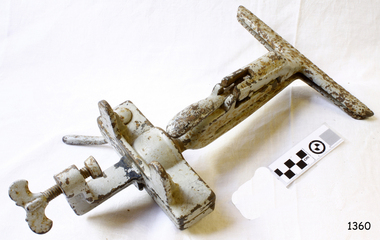 Flagstaff Hill Maritime Museum and Village
Tool - Bench Saw Vice, Henry Disston & Sons, 1910 -1925
... The subject item is significant as it was made at a time when the company was in its hay day. flagstaff hill warrnambool flagstaff-hill flagstaff-hill-maritime-museum maritime-museum shipwreck-coast flagstaff-hill-maritime-village Saw Clamp Henry Disston & Sons Saw Sharpening Tool Accessories Wood Saws Made by Henry Disston & Co. ...The subject item is a saw blade sharpening clamp that attaches to a bench allowing the operator to sharpen the teeth on a saw with a file while keeping the saw blade in an upright position. Henry Disston (1819–1878) began his career as an American saw maker in Philadelphia. He emigrated from England in 1833 and started making saws and squares in 1840. In 1850, he founded the company that would become the largest saw maker in the world the ”Keystone Saw Works” on the Delaware River. Some five years later, Disston built a furnace possibly the first melting plant for steel in America and began producing the first crucible saw steel ever made in the United States. While his competitors were buying good steel from Britain, he was making his own, to his specification, for his own needs. Disston subsequently constructed a special rolling mill exclusively for saw blades. Over the following decade, the Disston company continued to grow, even while dedicating itself to the Union Army's war effort. In 1865, when his son Hamilton Disston rejoined the business after serving in the Civil War, Disston changed the company's name to Henry Disston & Son. Henry Disston and his sons set the standards for American saw makers, both in terms of producing high-quality saws and developing innovative manufacturing techniques. Disston also started making files in 1865. In September 1872, Henry Disston and two other men dug a part of the foundation for what was to become the largest saw manufacturing facility in the world: Disston Saw Works. This was in the Tacony section of Philadelphia. Having previously moved his expanding business from near Second and Market Streets to Front and Laurel Streets, Disston sought to establish his business away from this cramped area. It took over 25 years to move the entire facility to Tacony. This Philadelphia neighborhood seems to have been the only company town in the United States established within an existing city. At its peak of operations, Disston Saw Works employed 8,000 people and the factory covered 300 acres. The company, known as Henry Disston and Sons, Inc by the early 20th century, cast the first crucible steel in the nation from an electric furnace in 1906. The firm's Armour plate building near Princeton Avenue and Milnor Street contributed tremendously to the World War II effort. But the company's innovation and industriousness would not last forever. In 1955, with mounting cash-flow problems and waning interest on the family's part to run the firm, Henry Disston and Sons were sold to the H.K. Porter Company of Pittsburgh. Porter's Disston Division was sold in 1978 and became the Henry Disston Division of Sandvik Saw of Sweden. This division was then sold in 1984 to R.A.F. Industries of Philadelphia and became known as Disston Precision Incorporated, a maker of specialized flat steel products. In 2013, R.A.F. Industries sold Disston Precision Inc. in a private sale. Although the company has ceased making Disston handsaws, the Disston brand name still exists in this firm. A significant American company that pioneered the making of high-quality steel and saws along with other tools and accessories. The subject item is significant as it was made at a time when the company was in its hay day. Adjustable Ball & Socket Saw Sharpening vice, cast iron, with clamp to attach to a workbench. Made by Henry Disston & Co. No 1 painted greyflagstaff hill, warrnambool, flagstaff-hill, flagstaff-hill-maritime-museum, maritime-museum, shipwreck-coast, flagstaff-hill-maritime-village, saw clamp, henry disston & sons, saw sharpening, tool accessories, wood saws -
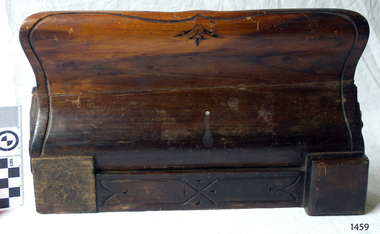 Flagstaff Hill Maritime Museum and Village
Decorative object - Pen Tray, David Hay, circa 1847
... David Hay...Decorative object Pen Tray David Hay James Gardiner Caught ...This pen tray is handmade from some of the timbers from the wreck of the schooner Enterprise. It was originally donated to the former Warrnambool Museum and Art Gallery and transferred to Flagstaff Hill Maritime Museum and Village when it was first established. The paper tag with the pen tray was inscribed "SWINBURNE". It is likely to be a reference to Charles Grant Swinburen, Mr Chas (Charles) Grant Swinburne (1864-1934), married Susan Jane Granter (1867-19 June 1935) in 1891. They were both Warrnambool residents. Swinburne was a prominent member of the Toc H. Progress Association and several other local clubs and societies. He died after a painful illness. Swinburne's wife, Susan, was the daughter of Joseph (1832-1879) and Ann Granter (nee Holley). Her father had arrived in Melbourne on the ship Marco Polo in February 1856. In 1868, he was a shareholder of the Warrnambool Steam Packet Co., His portrait is among those recognised on the historic Warrnambool Pioneers Board. The inscription on the rear of the pen holder was added at a later date. It incorrectly states that the vessel "was the first boat up the river Yarra with Fawkner", confusing this Warrnambool wreck "Enterprise" with Fawkner's vessel "Enterprize" (sometimes written "Enterprise"). THE “ENTERPRISE” 1847-1850 The wooden, two-masted schooner Enterprise was built in New Zealand in 1847 and registered in Melbourne, Australia. The Enterprise carried cargoes of agricultural produce and other commodities for trade between the ports of the Colony. On September 14, 1850, the Enterprise was at anchor in Lady Bay under its Master, James Gardiner Caughtt, loaded with a cargo of wheat and potatoes. A strong south-easterly wind caused the vessel to drag on its only anchor, and the rudder was lost. The gale-force wind blew it sideways, and it became grounded. A local indigenous man, Buckawall, braved the rough sea to take a line from the shore to the Enterprise. All five members of the crew were able to make it safely to land. The Enterprise was wrecked. The Enterprise wreck was in an area called Tramway Jetty in Lady Bay. Since then, the area became the location of the Lady Bay Hotel, and now, in 2019, it is in the grounds of the Deep Blue Apartments. In fact, with the constantly changing coastline through built-up sand, the wreck site is now apparently under the No. 2 Caravan Park on Pertobe Road, perhaps 150 metres from the high tide. Its location was found by Ian McKiggan (leader of the various searches in the 1980s for the legendary Mahogany Ship). DIFFERENTIATING the New Zealand Schooner “Enterprise” from John Fawkner’s “Enterprize“ Dr Murray Johns, Melbourne, says in his article The Mahogany Ship Story “… As I documented in 1985, the Warrnambool wreck was of an entirely different ship, also called Enterprize [with the spelling ‘Enterprise’], but built in New Zealand in 1847. Fawkner’s ship had already been sold to Captain Sullivan in 1845 and was wrecked on the Richmond Pier in northern New South Wales early in 1847. “ The pen tray is significant for its association with the wreck of the Enterprise, which is listed on the Victorian Heritage Database, VHR S238. The Enterprise is of significance as a New Zealand-built but Australian-owned coastal trader. The wreck was also significant for its association with the indigenous hero Buckawall, who saved the lives of the five crew on board. The pen tray is an example of the use of timbers salvaged from shipwrecks along the coast.Decorative pen tray; handmade and carved from timber from the vessel "Enterprise", 1847-1850. The tray is made from several pieces of wood and has a concave surface. The engraving includes a border, motifs, and decorative scrolls on the sides. The inscription on the rear was written in script. A paper tag marked 'Swinburne' was with the board."Swinburne", "from the vessel Enterprise" Writing on the back of the pen tray: "Made from / wreck of / "Enterprise" first boat / up river Yarra with / Fawkner later wrecked / at Warrnambool Vic"flagstaff hill, warrnambool, shipwrecked-coast, flagstaff-hill, flagstaff-hill-maritime-museum, maritime-museum, shipwreck-coast, flagstaff-hill-maritime-village, wood carving, carving, carving craft, 1850 wreck, john watson, james gardiner caught, tramway jetty, lady bay, rescue line, ian mckiggan, vhr s238, relic, buckawall, schooner, enterprise, coastal trader, new zealand, indigenous rescue, indigenous hero, pen holder, pen tray, wood souvenir, enterprise s ouvenir -
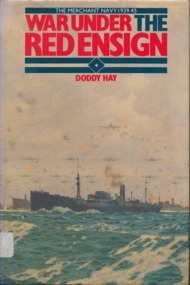 Mission to Seafarers Victoria
Book, Hay Doddy, War Under the Red Ensign, 1982
... Hay Doddy...ww2 red ensign merchant navy War Under the Red Ensign Book Hay Doddy ...non-fictionww2, red ensign, merchant navy -
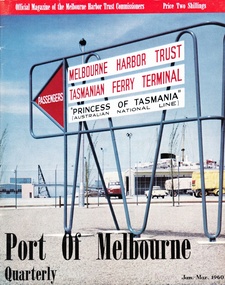 Greensborough Historical Society
Article - Article, Journal, Melbourne Harbor Trust, "The Word is Progress": by Robin Hay, 1960_03
... "The Word is Progress": by Robin Hay......Robin Hay..."The Word is Progress": by Robin Hay Article Article, Journal Melbourne Harbor Trust Robin Hay ...The opening of Reid's Lightweight Aggregate Pty Ltd ( a subsidiary of Reid's Quarries Ltd) in Greensborough, circa 1960. Explains the method of manufacture and uses of shalite in building industry. Reid's later became Albion Reid before being taken over by Boral. The shalite quarry, now closed, was on the site now called Blue Lake in Yellow Gum Park, Plenty.7 photocopied pages, text and colour and black nd white illustrations.reids quarries, shalite, aggregate, yellow gum park, plenty -
 Federation University Historical Collection
Magazine, Ballarat School of Mines Students' Magazine, 1898-1901, 1898-1901
... ...hay, a.l....e.m. weston robert brough smyth mcdougall, bruce charles burbury harrie wood graham j. hopwood emil gutheil daniel walker thomas hart thomas stephen hart m. hacker schnitzler, f.a. ditchfield, l.h alfred e.c. kerr charles harvey campbell joseph bryant campbell & ferguson gilbert j. dawburn irving, g.b. kerr, a.e.c. john walter sutherland william robertson herbert l. krause alfred mica smith binh pham crosbie, d. jack ditchburn, j. james hiscock alfred johnston reid, j.a. kidd, john james bonwick james, j.p overall, d e.h salmon gaynor marquand williams, w.w. williams, william deane, c.m. vincent, tom phillips, g.e. hart, d.w. jarnail suingh rowlands, e. ferdinand m. krause, easterby, f.l parsons, r.g. partington, j.r. vial, s.b. meadows, h atkins, arthur john braisted burdekin w.h. corbould ditchburn, john hill, john otto e. jager mcpherson, g.t nicholls, c thom, j.m. crafter, stewart john brittain peter lalor hardy - commissioner thomas bath alf johnston charles campbell nash, llewellyn watson, m.a gardener, eddie adamson, s.g alford, l.c allen, r.j arthur, d.w.b. burge, a. willia, cairncross cooper, i maurice osric copland maurice copland dickinson, s. doepel dunstan, john loveday dunstan eeles, terri flegeltaub, israel fletcher, a fyrar, peter kerr grant w.kerr green, gary betty harris harris, c.m. hay, a.l. hearn hill, martin james, david johnston, alfred g kilner, marion kingston, thomas lewin, f.c.k. lilburne, arthur m linahan, colin macready, w.h major birlefco markwald, henry mccaffrey mcfarlane, kaye mciver, s.k mellins, b morton, felicity w. kenneth moss ken moss nash, c.w. nash, neville nickolls, berkeley osborne, percy philp, e. playford, william reid, e roberts, gordon ross, f.c. royce, phillip sawyer, basil stewart, r.c. todhunter, i vaisey, a. vincent, john vinden, sue wakley, cecil watt, james westcott, lewis charles w. whyte, vial, s browning ballarat school of mines students in coolgardie and kalgoorlie coolgardie kalgoorlie claude maitland a.l. hay a.s. lilburne latham watson arthur kildahl thomas copeland f.a. moss w.a. hearman cardoc james alexander fraser e.o. watt g.m. roberts j.j. dunstan h.v. moss j.a. hill, john dunstan c.m. harris, william h. corbould j.w. sutherland ballarat photographic club ballarat field naturalists club ballarat field club and science society photography geology excursions last chance mine tasmania gold mine beaconsfield, tasmania rand south africa mount lyell ballarat school of mines student excursion to mount lyell h.l. krause ferdinand krause krause hardie's hill hardie's hill excursion lal lal lal lal excursion lal lal geology excursion smythesdale smythesdale excursion soudan south african miners south star mines wynne and tregurtha battery ananconda copper mining arizona copper mining boiler plates british guinea butte copper smelter daylesford geology camp daylesford excursion diehl process electric power house ballarat electric pumps geelong rope factory gympie golden horseshoe estate c johnstone jack nichol c. macgennis alec saunders alfred g. johnstone graeme jolly william purdie john mann maxwell l gaunt sale school of mines Freiberg School of Mines Schools of mines railway locomotive Bound copies of the Ballarat School of Mines Students' Magazine, 1898-1901 Vol 1, No. 1, September 1898 * News and Notes (Ballarat School of Mines Museum, J.F. ...Bound copies of the Ballarat School of Mines Students' Magazine, 1898-1901 Vol 1, No. 1, September 1898 * News and Notes (Ballarat School of Mines Museum, J.F. Usher, New British Pharmacopoeia, excursion to Bendigo) * History of the Ballarat School of Mines * Current Topics (Federation, Gladstone, Anglo-American Alliance) * Of Custom * Discovery of Coolgardie * Mining Notes(Clunes, Pitfield, Birthday Mine, Western Australia, Transvaal, Mt Bischoff, Rand Drill Co.) * From the Journals * The Societies - (Student Association, Ballarat Field Club and Science Society, Ballarat Photographic Club) * Original Poetry * Sports * Students' Association Committee Meetings * On the Increase of Temperature of the Earth With Increased Depth Vol 1, No. 2, October 1898 * Notes about some of the Past Students (E.M. Weston, J.A. Porter, H.R. Sleeman, G.E. Sander, B.C.T. Solley, T. Rhys, C. Burbury, D. McDougal, J. Matsen) * Excursion to Daylesford, p.3 * History of the Ballarat School of Mines (continued) * The Soudan * Greater Melbourne * Image of J. Hopkinson, electrical engineer killed ascending the Alps * What is Science * Mining Notes (Pitfield Plains, Victoria United G.M.Co., Lithgow, Avoca, great Cobar, Mt Whycheproof) * Student's Association (women's franchise) * Sports Vol 2, No. 1, March 1899 * News and Notes * History of the Ballarat School of Mines (continued) * Notes of Victorian Geology, 1. Granites, by Thomas S. Hart * Sir William Crookes * Summaries and Notes from the Mining Journals * Students' Association * Sports * The Bush Assayer * Solubility of Gold-Silver Alloys in Potassium Cyanide * Correspondence Vol 2, No. 2, April 1899 * News and Notes (Smythesdale Excursion, New Buildings, A.S. Coyte, R.J. Allan) * History of the Ballarat School of Mines (Continued) * The New Students (J. Owen, A. Clayton Morrisby, A.S. Atkin, J. Alexander Reid, Alfred G. Johnston, L. Lowe, F.H. Dalton, W.M. Robertson, A. Hacke, H.L. Giles, W. Martin, E. Walshe, H.L. Krause, R. Sawyer) * Berringa by Oh'E Jay * Summaries and Notes from the Mining Journals * Mount Magnet to Victoria - A Long Bicycle Trip * 1898 Examination returns * Sports Vol 2, No. 3, May 1899 * Technical Education and the Proposed Affiliation of the Schools of Mines with the Melbourne University. * Laying of the Foundation Stone of the New Classrooms (now Administration Building). Alexander J. Peacock * News and Notes (Past Students - A.S. Lilburn, J.W. Sutherland, J. Richardson, E. Prendergast, J. Wallace, J. Kidd, J. Lake, Mathew Thompson), Coolgardie Exhibition. * Trip to Lal Lal * Students' Association * Summaries and Notes from the Mining Journals * Professor Henry Louis on Mining Education * Corrections Used in Chaining by C.W. Adams * The Black Horse Cyanide Plant * Sports * Completed List of 1898 Examinations Vol 2, No. 4, June 1899 * News and Notes * The Education Problem by D.N. McLean * A Few Hints on Histological Technique by Emil Gutheil * Summaries and Notes from the Mining Journals * Students' Association * A Visit to the Skipton Caves (Mount Widdern, Ormand Hill, volcano, Emu Creek, Mount Kinross, Mount Elephant, Mount Vite Vite, Mount Kinross, Mount Hamiston) * Mount Magnet To Victoria (cont) * The New Engines at the Ballarat Woollen Mills - includes image of the Compound 700 H.P. Engines constructed for the Ballarat Woollen Mills by Austral Otis Company and consulting engineers Monash and Anderson. * Sports * Original Poetry * Correspondence Vol 2, No. 5, July 1899 * News and Notes (E. Byron Moore, Visit to Britannia Gold Mine, J. Bryant, Visit to Last Chance Mine) * A Few Hints on Histological Technique (cont) by Emil Gutheil * Summaries and Notes from the Mining Journals * Professor Alfred Mica Smith (includes image) * Notes on Victorian Geology Part 2 The Trappean Rocks, by Thomas Hart * Origin of Diamonds * Hydraulic Mining by A.E.C. Kerr * Volcanoes by F.G. Bonney * Analytical Chemistry Notes by Daniel Walker * Some Things Out To Do * Sports * Correspondence Vol 2, No. 6, August 1899 *Summaries and notes from the Mining Journals * Some Regulations of the Academy of Mines at Freiberg * A visit to Mt Lyell Smelters * Professor Gilbert J. Dawbarn (includes image) * Air compressor and Transmission of Power by Compressed air by A.E.C. Kerr * Chemistry Notes by Daniel Walker * Mineralogical Notes, Ballarat by Thomas S. Hart * Kalgurli Gold Mines, W.A. * OUr New Lab Vol 2., No 7, September 1899 * Summaries and Notes from the Mining Journals * Some recent Steam Plants at Bendigo by Gilbert Dawbarn * Professor Thomas Stephen Hart (includes image) * Students Association * Notes on Victorian Geology by Thomas Hart * Centrifugal Pumps * A New Chum's Experience by E.M. Weston Vol 2., No 8, October 1899 * The institute of Chemistry Examinations * A New Method of Qualitative Chemical Analysis by Emil Gutheil * Steam Engine Valves and Valve-Gears by Gilbert Dawbarn * Daniel Walker (includes image) * Notes on Victorian Geology by Thomas Hart * Cyaniding Cripple Creek Tellurides (Metallic Extraction Company) * Notes on Two Ballarat Gravel Pumping Plants, G.A. Wilberforce (Eureka Jennings Co and Yarrowee Sluicing Co) * History of the School of Mines (concluded) Vol 3., No 1, March 1900 * A Journey from Natal to Mashomaland with the British Police * A Plea for Research * New Caledonia by C.A.M. Deane * Notes of Victorian Geology - Lower Palaeoroic Rocks by Thomas Hart * Mt Bischoff Mine and Mill * Summaries and Notes from the Mining Journals * Things we Eat and Drink * Farewell to A.S. Coyte Vol 3., No 1, March 1900 * Mining Education * Model Locomotive made by the apprentices of the Phoenix Foundry, p2 * Glimpses of Rhodesian Police Camp Life * New Caledonia (continued) * Summaries from the Mining and Engineering Journals * Boot and Saddle Vol 3., No 3, May 1900 * A Students' Common Room * Geological Excursion to Hardie's Hill * Notes on Victorian Geology by Thomas Hart * The Planet Venus by John Brittain * Summaries and Notes from the Australian Mining Standard * The Assay Ton * Zeehan Smelters * Electrical Notes by Ohe Jay * Trop of the Cricket Club to Stawell * Students' Association * Solid Hydrogen Vol 3., No 4, June 1900 * The Minister of Mines on Mining Education (Minister A.R. Outtrim) * Lal Lal Geology Trip (Thomas Hart) * Rifle Club now defunct, pg 3 * A Contribution to the Mining Geology of Kalgoorlie, W.A. by Ferdinand Krause (includes cross sections) (Wood's Point, Rand, Johannesburg, South Africa, Gaffney's Creek, Walhalla, Shady Creek, Sago Hill at Cardigan, Bunbury) * Summaries and Notes from the Australian Mining Standard (Buninyong Estate Mine) * Monthly Progress Reports of the Geological Survey * Electrical Notes by John M Sutherland (Telagraphone, phonograph, telephone receiver) * Students' Theatre Party (Gordon Todd, Ohe Jaeger, C.S. Wakley) * Opening of the New Buildings - Ministerial Speeches (Outtrim, W.H. Irvine, New Mining Laboratory, Old Chemistry Building, Battery, Model Mine) * Students' Association * Relief of Mafeking * A Critic Criticised * Things We Eat and Drink by Ohe Jay - Oatmeal, Coffee and Cocoa. Vol 3., No 5, July 1900 * Research * Adelaide Varsity Students at Ballarat * The Manchester-Liverpool Mono Railway * Students Association * *A Contribution to the Mining Geology of Kalgoorlie, W.A. by Ferdinand Krause (continued) (includes cross-sections) * Motive Power, address by Charles A. Parsons * Summaries and Notes from the Australian Mining Standard * Sugar Manufacturing by Sugna * Great Creswick Hydraulic Sluicing Plant (THomas Hart, Ballarat School of Mines Mining Class visit) * Reminiscences of a Students Life in Germany * Football - Ballarat School of Mines v Geelong Grammar School (Australian Rules Football) Vol 3., No 6, August 1900 * Cheap Mine Management * Library * Bendigo School of Mines, pg 3 * Notes on Ore Dressing by T, Vincent, Manager The Zeehan (Tas) Silver-Lead Mines Ltd) * Motive Power * Notes on Broken Hill - Its Mines and Minerals by J. Williams * The Concert * Summaries and Notes from the Australian Mining Standard * The Dandy Duke's Dreadful Demise * The Road Race Vol 3., No 7, September 1900 * Michaelmas Excursion (Melbourne University, Prof Kernot, Applied Mechanics) * Injury to School Property * Return of E. Ditchburn (Boer War) * Mt William Gold-Field visit, pg 3 * The Stoping of Wide Lodes by J.V. Lake (includes cross sections) * Summaries of Notes from the Australian Mining Standard * Notes on Broken Hill Part 2- Its Mines and Minerals by W.J. Williams * Motive Power from the Waves * Electrical Notes * Some Account of Italian Mining (Sarinia, Sicily, Peidmont, Lombardia) by Candido Maglione * Students Association * Should Women Have the Vote by Frank Bessemeres * The School Theatre Parly * Past Students * Poetry * Football * Surveying Rules Vol 3., No 8, October 1900 * Ballarat School of Mines Associateship * An Engineering Laboratory * Students' Practical Work * Notes on Broken Hill Part 3 by W.J. Williams * The Lake View Consols by F.S. Earp - Battery Treatment of Sulpo-Telluride Ore * Neglected Mineral Fields - Eurowie and Warrata * A Glimpse Ahead * News and Notes * A.W. G. McPherson, Boer War * Students Association * Ballarat School of Mines Melbourne Excursion to the Government Electric Lighting Station, Austral-Otis Co, Working Mens College * Ballarat School of Mines Concert in Aid of Soldiers Statue Balance Sheet * Football * Cricket Vol 3., No 8b, November 1900 * Position of the Ballarat School of Mines with Regards to Mining Education * Age Limit * Entrance Examination * Presentation t0 Professor Alfred Mica Smith * Image of a Group of Old Ballarat School of Mines Students in Coolgardie and Kalgoorlie. * Students Association Vol 4., No 1, March 1901 * Espirit De Corps * A few Notes on the Testing of Explosives * Round About Inverell, NSW by F. and J. Mawl * On the Choice of Drawing Instruments * Summaries and Notes From the Technical Journals * Annual Examinations 1900 * New Students * Sporting Notes * The Vale of Coolgardie Mine, Bonnievale, W.A. by G. Stephen Hart * News and Notes (Kerr Grant, C.L. Nash, R. Gordon Todd, Vial) * Editorial Notices Vol 4., No 2, Second Term 1901 * The Metallurgical Treatment of Sulpho-Telluride Ores by L.W. Grayson * Some Metallurgical Difficulties of Aluminium * Diehl's Sulphide Process by A.E. C. Kerr * A Californian Gold Mine by A.E. C. Kerr * New Express Locomotives for the Victorian Government (Phoenix Foundry) * An Excursion to Geelong (Electric Light and Traction Company of Australia) * The Linkenback Table for our New Mining Laboratory (Humboldt Company of Colgne) * Death of Thomas Bath * The Late Alfred G. Johnson (Boer War) * An Introduction to Natural Science by Emil Gutheil * The First Annual School Sports Meeting * Concert in Aid of Magazine Funds * The Men That Made the Concert (C.E. Denniston, W.H. Chandler, Mr White, William Litte Jnr, Marriott, Giles McCracken) * Sports * News and Notes Vol 4., No 2, Third Term 1901 * Bagging-Up - A Sketch * Concentration of Difficult Silver-Lead Ores * Estimation of Chlorine, Bromine and Iodine by D. Runting * Summaries of Notes from teh technical Journals * Notes on the Use and Care of Platinum Ware Common Sense * The Machinery at the Tasmania Gold Mine, Beaconsfield, Tasmania * Mining at Walhalla - The Long Tunnel Mine * Past Students * Mapping our of Agricultural Areas, etc, In Dense Vine Lands, North Queensland by R.A. Suter * News and Notes * Concert Balance Sheet e.m. weston, robert brough smyth, mcdougall, bruce, charles burbury, harrie wood, graham j. hopwood, emil gutheil, daniel walker, thomas hart, thomas stephen hart, m. hacker, schnitzler, f.a., ditchfield, l.h, alfred e.c. kerr, charles harvey, campbell, joseph bryant, campbell & ferguson, gilbert j. dawburn, irving, g.b., kerr, a.e.c., john walter sutherland, william robertson, herbert l. krause, alfred mica smith, binh pham, crosbie, d. jack, ditchburn, j., james hiscock, alfred johnston, reid, j.a., kidd, john, james bonwick, james, j.p, overall, d, e.h salmon, gaynor marquand, williams, w.w., williams, william, deane, c.m., vincent, tom, phillips, g.e., hart, d.w., jarnail suingh, rowlands, e., ferdinand m. krause,, easterby, f.l, parsons, r.g., partington, j.r., vial, s.b., meadows, h, atkins, arthur, john braisted burdekin, w.h. corbould, ditchburn, john, hill, john, otto e. jager, mcpherson, g.t, nicholls, c, thom, j.m., crafter, stewart, john brittain, peter lalor, hardy - commissioner, thomas bath, alf johnston, charles campbell, nash, llewellyn, watson, m.a, gardener, eddie, adamson, s.g, alford, l.c, allen, r.j, arthur, d.w.b., burge, a., willia, cairncross, cooper, i, maurice osric copland, maurice copland, dickinson, s., doepel, dunstan, john, loveday dunstan, eeles, terri, flegeltaub, israel, fletcher, a, fyrar, peter, kerr grant, w.kerr, green, gary, betty harris, harris, c.m., hay, a.l., hearn, hill, martin, james, david, johnston, alfred g, kilner, marion, kingston, thomas, lewin, f.c.k., lilburne, arthur m, linahan, colin, macready, w.h, major birlefco, markwald, henry, mccaffrey, mcfarlane, kaye, mciver, s.k, mellins, b, morton, felicity, w. kenneth moss, ken moss, nash, c.w., nash, neville, nickolls, berkeley, osborne, percy, philp, e., playford, william, reid, e, roberts, gordon, ross, f.c., royce, phillip, sawyer, basil, stewart, r.c., todhunter, i, vaisey, a., vincent, john, vinden, sue, wakley, cecil, watt, james, westcott, lewis, charles w. whyte,, vial, s browning, ballarat school of mines students in coolgardie and kalgoorlie, coolgardie, kalgoorlie, claude maitland, a.l. hay, a.s. lilburne, latham watson, arthur kildahl, thomas copeland, f.a. moss, w.a. hearman, cardoc james, alexander fraser, e.o. watt, g.m. roberts, j.j. dunstan, h.v. moss, j.a. hill,, john dunstan, c.m. harris, william h. corbould, j.w. sutherland, ballarat photographic club, ballarat field naturalists club, ballarat field club and science society, photography, geology, excursions, last chance mine, tasmania gold mine, beaconsfield, tasmania, rand, south africa, mount lyell, ballarat school of mines student excursion to mount lyell, h.l. krause, ferdinand krause, krause, hardie's hill, hardie's hill excursion, lal lal, lal lal excursion, lal lal geology excursion, smythesdale, smythesdale excursion, soudan, south african miners, south star mines, wynne and tregurtha battery, ananconda copper mining, arizona copper mining, boiler plates, british guinea, butte copper smelter, daylesford geology camp, daylesford excursion, diehl process, electric power house ballarat, electric pumps, geelong rope factory, gympie, golden horseshoe estate, c johnstone, jack nichol, c. macgennis, alec saunders, alfred g. johnstone, graeme jolly, william purdie, john mann, maxwell l gaunt, sale school of mines, freiberg school of mines, schools of mines, railway locomotive -
 Federation University Historical Collection
Magazine - Booklet, Baxter & Stubbs, Printers and Bookbinders, Ballarat School of Mines Students' Magazine, 1919, 1919
... ...N. Hay...McLean R. S. Dale N. Hay D. G. McGrath F. M. Larkin R. Fleming W. ...Editorial Staff, Boys' Association Committee, Girls' Association Committee, Sports Committee, Editorial, Items of interest, Fumes from the Lab, Answers to correspondents, Arts & Crafts gossip, Echoes of the Past, Broken Hill, Sport, Shun Military Notes - S.M.B. Roll of Honour, The Junior Techs, Trade notes. In memoriam, Arthur A. Gribble,Gray soft covered magazine.Signed by Harold Jolly, 1919.ballarat school of mines, magazine, r. d. campbell, a. bowman, a. leask., arthur a. gribble, c. nicholls, t. k. jebb, r. cutter, c. a. schache, r. d. campbell, miss mclean, a. e. williams, miss hauser, d. hull, r. d. campbell, a. bowman, g. r. mclean, r. s. dale, n. hay, d. g. mcgrath, f. m. larkin, r. fleming, w. p. o'halloran, d. miller, w. shattock, h. g. wakeling, c. nicholls, a. leask, lal lal deposits, cadets -
Federation University Historical Collection
Booklet, Baxter & Stubbs, Printers and Bookbinders, Ballarat School of Mines Students' Magazine, 1921, 1921
... ...noel hay...Editorial, Fumes from the Lab, Answers to correspondents, Trip to Mt Feathertop and Mt Buffalo, Trade Topics, Excursion to Melbourne, Melbourne Electric Railways, Arts & Crafts gossip, Bush camp, Manuals, Echoes of the Past, Past Students', Sport, Shun Military notes, The Junior Techs. ballarat school of mines magazine alumni a. f. heseltine, h. v. lawson frank tate ponsonby may carew-smyth donald clark j. h. betheros william f. gates g. munro r. l. whitla a. w. middleditch d. whitehead j. ellsworth, h. a. maddison d.r. evans v. gilchrist h. jolly p. a. trompf percy trompf noel hay elsie j. mckissock j. r. pound c. h. beanland e. j. t. tippett, h. a. maddison j. ellsworth w. j. paterson trades plumbing ironmonger Elsie McKissock noel hay Ballarat SChool of Mines Football Team Ballarat SChool of Mines Cricket Team noel hay c. finlayson a. elder ballarat junior technical school w.j. peterson Green soft covered magazine. ...Editorial, Fumes from the Lab, Answers to correspondents, Trip to Mt Feathertop and Mt Buffalo, Trade Topics, Excursion to Melbourne, Melbourne Electric Railways, Arts & Crafts gossip, Bush camp, Manuals, Echoes of the Past, Past Students', Sport, Shun Military notes, The Junior Techs. Green soft covered magazine. Articles include: New Principal A.F. Heseltine, Chemistry and Engineers (by J.R. Pound), Mt Feathertio and Mt Buffalo excursion, Trade topics, Plumbing, A Frequency Changer, Excursion to Melbourne, Moorabool Excursion, Military Notes, The New Junior Technical School Images include: A.F. Heseltine, Magazine Committee, football caricucatures, frequency changer, Ballarat School of Mines Football Team, Ballarat School of Mines Cricket Team, Ballarat School of Mines Athletics Team, Ballarat Junior Techncal School Athletics Teamballarat school of mines, magazine, alumni, a. f. heseltine,, h. v. lawson, frank tate, ponsonby may carew-smyth, donald clark, j. h. betheros, william f. gates, g. munro, r. l. whitla, a. w. middleditch, d. whitehead, j. ellsworth,, h. a. maddison, d.r. evans, v. gilchrist, h. jolly, p. a. trompf, percy trompf, noel hay, elsie j. mckissock, j. r. pound, c. h. beanland, e. j. t. tippett,, h. a. maddison, j. ellsworth, w. j. paterson, trades, plumbing, ironmonger, elsie mckissock, noel hay, ballarat school of mines football team, ballarat school of mines cricket team, noel hay, c. finlayson, a. elder, ballarat junior technical school, w.j. peterson -
Federation University Historical Collection
Booklet, Ballarat School of Mines Student's Magazine, First Term, 1903, 1903
... ...archie hay...Dirge, Students' Association annual meeting, News and notes, New students, Past students, The annual sports, Cricket, Football, Answers to correspondents, Editorial notes. ballarat school of mines students' magazine bill cairncross lew westcott kerr grant oliver jager j. e. o'dwyer h. j. saw j. l. vetter t. lennon c. king a. c. officer j. glasgow p. davies w. figgis j. f. anderson r. e. cowles d. l. thomas s. g. turrell w. hicks c. j. reid w mccready n. s. stuckey l. mitchell d. t. thomas e. h. best h. owen h. eklund j. judd alex fraser w. brokenshire syd adamson arthur coyte h. couturier archie hay w. brinsden w. herman d. deane h. leggo w. white w. meldrum f. dalton j. hill p. e. marmion w. parramore d. ryan a. l. n. walters t. uthwatt v. a. nicol a. f. gillespie f. c. futter h. alston j. philbin d. t. elder r. c. mccracken Pale brown booklet of 20 pages Ballarat School of Mines Student's Magazine, First Term, 1903 Booklet Berry Anderson & Co. ...Table of contents: Editorial, The analysis of Portland cement, Copper smelting in Western America, Notes of travel in Central Africa, Aboriginal research, The conservation of matter, A bit of Australian history, Trip to Ascot, S.M.B. Dirge, Students' Association annual meeting, News and notes, New students, Past students, The annual sports, Cricket, Football, Answers to correspondents, Editorial notes.Pale brown booklet of 20 pagesballarat school of mines, students' magazine, bill cairncross, lew westcott, kerr grant, oliver jager, j. e. o'dwyer, h. j. saw, j. l. vetter, t. lennon, c. king, a. c. officer, j. glasgow, p. davies, w. figgis, j. f. anderson, r. e. cowles, d. l. thomas, s. g. turrell, w. hicks, c. j. reid, w mccready, n. s. stuckey, l. mitchell, d. t. thomas, e. h. best, h. owen, h. eklund, j. judd, alex fraser, w. brokenshire, syd adamson, arthur coyte, h. couturier, archie hay, w. brinsden, w. herman, d. deane, h. leggo, w. white, w. meldrum, f. dalton, j. hill, p. e. marmion, w. parramore, d. ryan, a. l. n. walters, t. uthwatt, v. a. nicol, a. f. gillespie, f. c. futter, h. alston, j. philbin, d. t. elder, r. c. mccracken -
 Federation University Historical Collection
Booklet, The Ballarat School of Mines and Industries, Prospectus A, Science and Engineering, 1921, 1921
... ...n hay...Boys could leave their primary school at 13 years of age and enter the Ballarat Junior Technical School, free of charge for 12 months. ballarat school of mines ballarat junior technical school scholarship winners studentship winners a f heseltine prof mica smith j r pound h r murphy g cornell m larkin h yates n hay l r archibald r w richards e j mcconnon t r gordon n g king l horne l g leroux h goldsmith h gronn t wasley j m sutherland r wilson On Front "Office Copy Only" 1921 Brown / grey soft covered booklet with Ballarat School of Mines crest. .1) Ballarat School of Mines Prospectus A: Science and Engineering. ...Boys could leave their primary school at 13 years of age and enter the Ballarat Junior Technical School, free of charge for 12 months. Brown / grey soft covered booklet with Ballarat School of Mines crest. .1) Ballarat School of Mines Prospectus A: Science and Engineering. On Front "Office Copy Only" 1921ballarat school of mines, ballarat junior technical school, scholarship winners, studentship winners, a f heseltine, prof mica smith, j r pound, h r murphy, g cornell, m larkin, h yates, n hay, l r archibald, r w richards, e j mcconnon, t r gordon, n g king, l horne, l g leroux, h goldsmith, h gronn, t wasley, j m sutherland, r wilson -
Marysville & District Historical Society
THE TRIANGLE NEWS-VOL 1 NO 21-DECEMBER 10 1976
... ...hay for sale...marysville victoria australia wirreanda financial success district forester transferred rubbish letter of appreciation bowls swimming club christmas greetings new year's eve ball first aid chiropody service senior citizens narbethong sports ground committee primary schools' concerts rainfall christmas trees for sale cricket fire brigade high school uniforms hay for sale summer workshop THE TRIANGLE NEWS-VOL 1 NO 21-DECEMBER 10 1976 ...marysville, victoria, australia, wirreanda, financial success, district forester transferred, rubbish, letter of appreciation, bowls, swimming club, christmas greetings, new year's eve ball, first aid, chiropody service, senior citizens, narbethong sports ground committee, primary schools' concerts, rainfall, christmas trees for sale, cricket, fire brigade, high school uniforms, hay for sale, summer workshop
