
Showing 6357 items matching "genealogy-pieper-german"
-
 Running Rabbits Military Museum operated by the Upwey Belgrave RSL Sub Branch
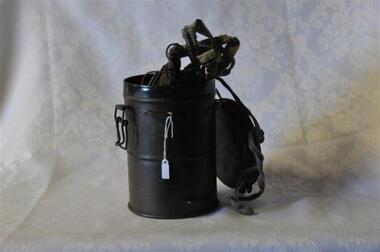
Gas Mask Container
... German...Equipment WW1 Army German Gas Mask Container ...Germanequipment, ww1, army -
 Running Rabbits Military Museum operated by the Upwey Belgrave RSL Sub Branch
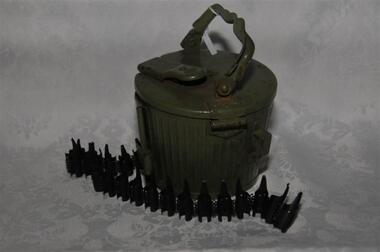
Drum Magazine
... German...Ammunition WW2 Army German Drum Magazine ...Germanammunition, ww2, army -
 Ballarat RSL Sub-Branch Inc.
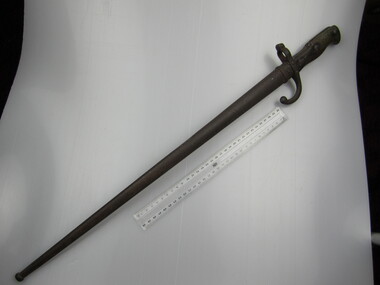
Bayonet & Scabbard
... German...First World War (WW1) 1914 - 1918 Weapons Ballarat RSL Ballarat German Bayonet & Scabbard ...Germanfirst world war (ww1), 1914 - 1918, weapons, ballarat rsl, ballarat -
 Bendigo Military Museum
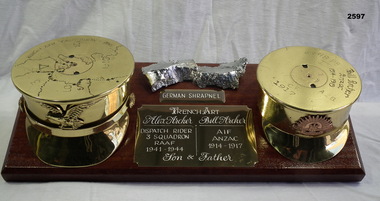
Memorabilia - TRENCH ART, WW1, WW2, Post 1945 (estimated); Made in WWI and WWII and assembled upon return
... Above the centre plaque is a piece of German shrapnel chrome plated ...Map - "North Africa, 1940", on left hand side, "18-Pounder, 1917, Bill Archer-Anzac, 1914-1919", on right hand side, "German shrapnel"...Above the centre plaque is a piece of German shrapnel chrome plated Memorabilia TRENCH ART, WW1, WW2. ...William John ARCHER (Bill) No 321 (born Castlemaine, enlisted Castlemaine) in B Coy 21st Batt AIF on 18.1.15. Embarked for Eygpt 8.5.15. Hospital 9.9.15 with Influenza. Hospital 24.11.15 with Gastric Enteritis. Hospital 2.1.16 with Otitis Media. Transfers to the 57th Batt and embarks for France. Hospital with Trench Fever 4.10.16. Promoted to Cpl 28.4.17. Hospital 19.3.18 with Scabies. WIA 18.4.18 GSW's to chest and leg severe. Discharged from the AIF medically unfit 9.1.19. Alexander William ARCHER No 40637 (born Castlemaine, enlisted Melbourne) in the RAAF on 16.5.41 age 18 years 8 months. He wanted to be a Mess Steward and was taken in as he had worked in similar work line. He then has 5 postings before embarking for Egypt on 2.4.1942 and was posted to No 3 SQD RAAF on 20.5.1942. Re mustered as a Motor Cyclist he became a Dispatch Rider on 8.9.1942 between the RAAF and the Army. Alex served in the Middle East and Italy with 3 SQD. He embarked from Egypt diagnosed with Kyphosis and Scoliosis on 5.2.1944. In Australia he was re mustered as Office Orderly on 6.7.1944 and then discharged from the RAAF on 2.10.1944 Medically Unfit. Wooden base with brass shells either end resembling Officers caps,one being WWI, the other WWII, both inscribed. Centre plaque inscribed Alex Archer and Bill Archer, father and son. Above the centre plaque is a piece of German shrapnel chrome plated Map - "North Africa, 1940", on left hand side, "18-Pounder, 1917, Bill Archer-Anzac, 1914-1919", on right hand side, "German shrapnel"handcrafts - trench art, metal craft- brassware, arms - ammunition, military history - souvenirs -
 Wodonga & District Historical Society Inc
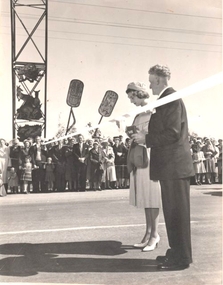
Functional object - Scissors - Princess Alexandra opens Pollard Archway, Wodonga
... The scissors are engraved with the maker's mark for GIESEN & FORSTHOFF/ SOLINGEN GERMANY...The Official Opening by Her Royal Highness Princess Alexandra of Kent 0f the Cr C F Pollard MBE Archway Wodonga 16th Sept 1959 On Scissors: GIESEN & FORSTHOFF/ SOLINGEN GERMANY TIMOR SOLINGEN...The Official Opening by Her Royal Highness Princess Alexandra of Kent 0f the Cr C F Pollard MBE Archway Wodonga 16th Sept 1959 On Scissors: GIESEN & FORSTHOFF/ SOLINGEN GERMANY TIMOR SOLINGEN A pair of scissors in a red box. ...In 1959 Princess Alexandra of Kent visited Australia as the representative of Queen Elizabeth II for the Queensland Centenary Celebrations. Her six week visit began with her arrival in Canberra on 14th August 14 and she departed from Canberra on 26th September. Time spent in Australia included 3 weeks in Queensland. Her Royal Highness' visits to New South Wales and Victoria were comparatively brief and informal. In New South Wales she made two country visits including to Albury and a night spent at Bungowannah Park near Jindera. Her visit to Victoria began in Wodonga where she officially opened the Pollard Archway over the Causeway. She received an enthusiastic welcome as she approached the Archway accompanied by a motorcycle escort. As Princess Alexander stepped forward to take the scissors from a red plush case, her Lady-in- Waiting, Lady Moyra Hamilton, tugged at the Princess' sleeve, whispered and gave her a coin. The Princess handed the coin a halfpenny to the Wodonga Shire President, Cr J. S. Hore, saying: "I must give you this, otherwise it might be unlucky." (The halfpenny "gift" stems from an old English superstition that a "sharp" gift such as a knife or scissors must be dulled with copper or else a friendship will be lost. After cutting the ribbon and declaring the Pollard Arch, named in honour of Councillor Charles Pollard M.B.E. she was presented with a bouquet by 10-year old Leslie McLeod. Princess Alexandra led by a pipe band was driven along the Hume Highway and High Street which were lined by thousands of people including school children. After a short trip along High Street and Elgin Street to the Railway Station she departed from protocol to speak to the many children who had crossed the barricade. Princess Alexandra then boarded the Royal Train for her journey to Melbourne.This item is significant because it represents the visit to Wodonga of Princess Alexandra in 1959.A pair of scissors in a red box. The bottom of the box is lined with red cloth and the lid is lined with white silk bearing the trademark "Jewelcrest". The scissors are engraved with the maker's mark for GIESEN & FORSTHOFF/ SOLINGEN GERMANYOn top of Box. The Official Opening by Her Royal Highness Princess Alexandra of Kent 0f the Cr C F Pollard MBE Archway Wodonga 16th Sept 1959 On Scissors: GIESEN & FORSTHOFF/ SOLINGEN GERMANY TIMOR SOLINGENprincess alexandra, pollard arch -
 Tatura Irrigation & Wartime Camps Museum
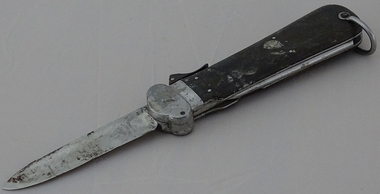
Sidearm - German, 1940's
... Formerly part of German paratroopers equipment/arms in WW2...German paratroopers sidearm resembling large pocket knife with blade and retractable spike. ...Germany...Thumb guide towards unprotected blade. Sidearm - German ...Possession of POW at Camp13, Murchison. Formerly part of German paratroopers equipment/arms in WW2German paratroopers sidearm resembling large pocket knife with blade and retractable spike. Wood covereed metal shaft/handle riveted. Metal ring attached at spike end. Thumb guide towards unprotected blade.SMF Solingen Rostfreiarms, edged, weapons -
 Tatura Irrigation & Wartime Camps Museum
Document, "Gerhard Ernst Neumann Briefe Ohne Datum", October1943 on
... Neumann came from Germany to take a position as lecturer at Sydney University c.1937, until interned in 1939. ...Light cardboard covers secured by green string, containing paper pages with typed entries, in German. Scrap book made and bound in Camp 1 with type written copies of letters written, in German from 17th. ...Light cardboard covers secured by green string, containing paper pages with typed entries, in German. Scrap book made and bound in Camp 1 with type written copies of letters written, in German from 17th. ...Made in Camp 1, Tatura to containing copies of letters written by Dr. Neumann to his wife in Bendigo, Dr. Neumann came from Germany to take a position as lecturer at Sydney University c.1937, until interned in 1939. This item remained in the possession of his daughter Ingrid until she brought it and presented to the Museum.Light cardboard covers secured by green string, containing paper pages with typed entries, in German. Scrap book made and bound in Camp 1 with type written copies of letters written, in German from 17th. October 1943, by Dr. Neumann to his wife during his internment in Camp 1, Tatura.Gerhard.Erst Neumann, Briefe Ohne Datum..camp 1 tatura, dr gerhard neumann, documents, letters -
Tatura Irrigation & Wartime Camps Museum
Document, "Gerhard Ernst Neumann Briefe Ohne Datum", October1943 on
... Neumann came from Germany to take a position as lecturer at Sydney University c.1937, until interned in 1939. ...Light cardboard covers secured by green string, containing paper pages with typed entries, in German. Scrap book made and bound in Camp 1 with type written copies of letters written, in German from 17th. ...Light cardboard covers secured by green string, containing paper pages with typed entries, in German. Scrap book made and bound in Camp 1 with type written copies of letters written, in German from 17th. ...Made in Camp 1, Tatura to containing copies of letters written by Dr. Neumann to his wife in Bendigo, Dr. Neumann came from Germany to take a position as lecturer at Sydney University c.1937, until interned in 1939. This item remained in the possession of his daughter Ingrid until she brought it and presented to the Museum.Light cardboard covers secured by green string, containing paper pages with typed entries, in German. Scrap book made and bound in Camp 1 with type written copies of letters written, in German from 17th. October 1943, by Dr. Neumann to his wife during his internment in Camp 1, Tatura.Gerhard.Erst Neumann, Briefe Ohne Datum..camp 1 tatura, dr gerhard neumann, documents, letters -
 Bendigo Historical Society Inc.
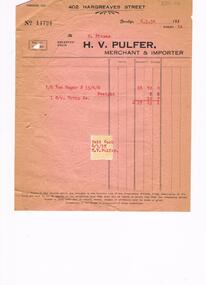
Document - PIEPER COLLECTION: INVOICE H.V. PULFER
... Pale tan invoice 14724 issued by H.V. pulfer, merchant and importer, Bendigo to Mr. C. Pieper, on 6.3.34. Invoice for 1/2 ton sugar and (?) ...syrup. Document PIEPER COLLECTION: INVOICE H.V. PULFER ...Pale tan invoice 14724 issued by H.V. pulfer, merchant and importer, Bendigo to Mr. C. Pieper, on 6.3.34. Invoice for 1/2 ton sugar and (?) syrup.bendigo, business, h.v. pulfer -
 Bendigo Historical Society Inc.
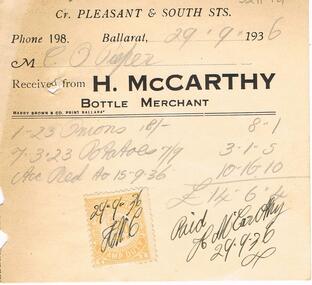
Document - PIEPER COLLECTION: INVOICE H. MCCARTHY BOTTLE MERCHANT
... McCarthy, bottle merchant, Pleasant and South Sts, Ballarat. to Mr. C.O. Pieper, on 29.9.36, for onions and potatoes. ...McCarthy, bottle merchant, Pleasant and South Sts, Ballarat. to Mr. C.O. Pieper, on 29.9.36, for onions and potatoes. ...Invoice issued by H. McCarthy, bottle merchant, Pleasant and South Sts, Ballarat. to Mr. C.O. Pieper, on 29.9.36, for onions and potatoes. Receipt attached on bottom of invoice.business, retail, h. mccarthy bottlemerchant -
 Montmorency–Eltham RSL Sub Branch
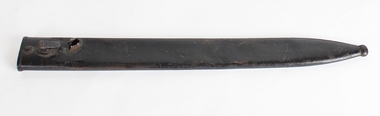
Weapon - Scabbard for German Bayonet, WWI Scabbard
... WW1 German steel scabbard for the 1898 German Bayonet. ...GERMANY...No inscriptions WW1 German steel scabbard for the 1898 German Bayonet. ...WW1 German steel scabbard for the 1898 German Bayonet. Painted blackNo inscriptions -
 Melbourne Tram Museum
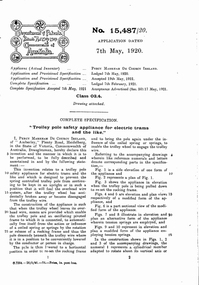
Document - Patent Applications - Trolley Pole safety appliance, Percy Ireland, 1920
... He was successful in gaining a patent in a number of countries including the UK, France, Germany, Canada, the USA, and New Zealand. ...Set of digital patent documents for Australia, USA, UK, France, Germany and Canada. ...He was successful in gaining a patent in a number of countries including the UK, France, Germany, Canada, the USA, and New Zealand. The associated documents show the differences in making patent applications in various countries. ...Percy Markham Ireland (1893-1976), a tramway rolling stock engineer with the MMTB and a Military engineer applied in 1920 for a patent for a "Trolley Pole safety appliance for electric trams and the like". He was successful in gaining a patent in a number of countries including the UK, France, Germany, Canada, the USA, and New Zealand. The associated documents show the differences in making patent applications in various countries. From research undertaken by the Museum it appears that while his patent applications were successful, his invention was never actually implemented on tramcars in Melbourne". Collected by Noelle Jones as research for an article in the March 2023 issue of the Museum's magazine Bellcord, giving details of Mr Ireland's tramway and military career. He retired as the MMTB Rolling Stock Engineer in 1958 after 44 years of service.Yields information about patents applied for by Percy Ireland in different countries.Set of digital patent documents for Australia, USA, UK, France, Germany and Canada. tramways, patents, trolley poles, percy ireland, safety devices -
 Orbost & District Historical Society
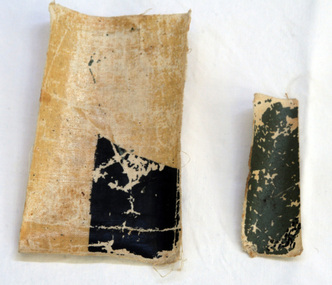
war souvenir
... These pieces of canvas are from a German plane brought down by an allied fighter. ...Two small pieces of canvas from a German plane brought down by another fighter. ...These pieces of canvas are from a German plane brought down by an allied fighter. ...These pieces of canvas are from a German plane brought down by an allied fighter. The pilot was shot through the head. It was given to Mary Gilbert by Alex P. Cameron to be donated to the museum.This item is a reminder of the personal stories of WW1.Two small pieces of canvas from a German plane brought down by another fighter. It is part of a black cross on the plane. There is hand-written information written on the back of both pieces.souvenir ww1 -
 Bendigo Historical Society Inc.
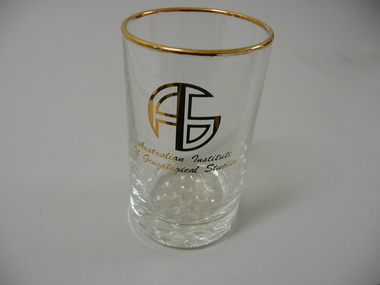
Souvenir - 2 SOUVENIR GLASSES AUSTRALIAN INSTITUTE OF GENEALOGICAL STUDIES
... 2 Souvenir Glasses for the Australian Institute of Genealogical Studies, tumbler style with dimpled bottom, gold rim and gold lettering....ORGANIZATION Institution genealogical studies 2 Souvenir Glasses for the Australian Institute of Genealogical Studies, tumbler style with dimpled bottom, gold rim and gold lettering. ...2 Souvenir Glasses for the Australian Institute of Genealogical Studies, tumbler style with dimpled bottom, gold rim and gold lettering.organization, institution, genealogical studies -
 National Wool Museum
Photograph
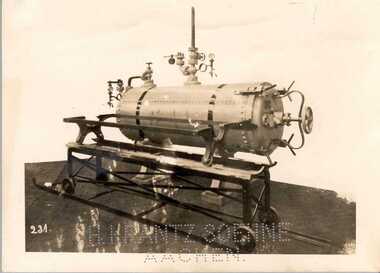
... Krantz Soehne (manufacturers of finishing machinery) of Aachen, Germany. It was sent to Arthur Heaton & Co. ...Krantz Soehne (manufacturers of finishing machinery) of Aachen, Germany. Decatizing is the process of forcing steam through wool....Krantz Soehne (manufacturers of finishing machinery) of Aachen, Germany. It was sent to Arthur Heaton & Co. ...Photograph of a Kettle Decatizing apparatus, as produced by H. Krantz Soehne (manufacturers of finishing machinery) of Aachen, Germany. It was sent to Arthur Heaton & Co. Ltd as part of a price quotation. Decatizing is the process of forcing steam through wool.Photograph, 1931, of a Kettle Decatizing apparatus, as produced by H. Krantz Soehne (manufacturers of finishing machinery) of Aachen, Germany. Decatizing is the process of forcing steam through wool.H. KRANTZ SOEHNE / AACHEN. 231.textile machinery textile finishing, h. krantz s?? arthur heaton and co. ltd, decatizing, textile machinery, textile finishing -
 Flagstaff Hill Maritime Museum and Village
Instrument - Chronometer or Marine Clock
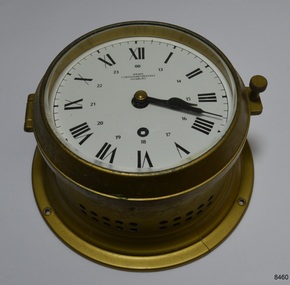
... In 1905 the business Chronometerwerke GmbH was formed in Frankfurt, Germany, to supply the country with high-quality mechanical chronometers and ship clocks for their maritime trade, making the country independent of other international suppliers such as those in England. ..."Made in Germany" and "WEMPE / CHRONOMETERWERKE / HAMBURG"...The maker is significant as part of a German government initiative to be self-sufficient in the production of good quality marine technology. ...This chronometer was made around 1936 and has been on display at Flagstaff Hill for over 40 years as part of the exhibit of the ‘Reginald M’, an Australian-built, 19ss, coastal trader vessel. A chronometer is an accurate mechanical instrument used for measuring time. It is constructed carefully to remain stable even under the changing conditions of seafaring life such as temperature, humidity and air pressure. The Master or Navigator of a ship could use the chronometer and the positions of celestial bodies to calculate the ship’s latitude at sea. In 1905 the business Chronometerwerke GmbH was formed in Frankfurt, Germany, to supply the country with high-quality mechanical chronometers and ship clocks for their maritime trade, making the country independent of other international suppliers such as those in England. In 1938 the firm was renamed Wempe Chronometerwerke. The business continues today. Its products now include its well-known chronometers, battery-powered ship clocks, ship’s bell clocks, barometers, barographs, thermometers, hygrometers, comfort meters to measure temperature and humidity, and wristwatches. The company also performs chronometer testing facilities for the State’s Weights and Measures office. The article written by Givi in July 2022 “The Basics of Marine Meteorology – a Guide for Seafarers” refers to the weather’s signs and patterns being repeated over and over, and the recording of these observations helps forecasters predict changes in the weather. The chronometer is an example of a mechanical navigational marine instrument in use in the early to the mid-20th century. The maker is significant as part of a German government initiative to be self-sufficient in the production of good quality marine technology. This chronometer is significant as part of the exhibit, the Australian-built vessel, 1922 coastal trader ‘Reginald M’, listed on the Australian Register of Historic Vessels and on display for over 40 years.Marine chronometer or marine clock, brass case, glass cover, Roman numerals, 24-hour numbers beside them. Two black hands, a keyhole for winding and ventilation holes in the side. The base has a collar with four machined mounting holes. Inscriptions are on the clock’s face."Made in Germany" and "WEMPE / CHRONOMETERWERKE / HAMBURG"flagstaff hill, flagstaff hill maritime museum and village, warrnambool, maritime museum, maritime village, great ocean road, shipwreck coast, marine meteorology, horology, chronometer, marine technology, latitude, marine navigation, mechanical instrument, scientific instrument, ship clock, chromometerwerke gmbh, wempe chronometerwerke, marine clock -
 Montmorency–Eltham RSL Sub Branch
Equipment - Gas Mask
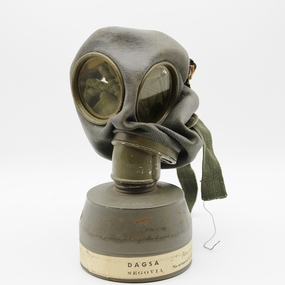
... This item and it’s associated canister (Cat.No. 0096.2) are of a style typical of German WW2 gas masks but the use of vinyl instead of rubber and the Spanish manufacture suggests post WW2 manufacture. ...German WW2-style full-face mask with single attached filter. ...This item and it’s associated canister (Cat.No. 0096.2) are of a style typical of German WW2 gas masks but the use of vinyl instead of rubber and the Spanish manufacture suggests post WW2 manufacture. gas mask “DAGSA” and DAGSA logo on top surface of filter canister. ...This item and it’s associated canister (Cat.No. 0096.2) are of a style typical of German WW2 gas masks but the use of vinyl instead of rubber and the Spanish manufacture suggests post WW2 manufacture. German WW2-style full-face mask with single attached filter. Seven point harness. Separate lens. Olive green. Metal, vinyl, glass, leather, cotton webbing. “DAGSA” and DAGSA logo on top surface of filter canister. On white tape around filter canister - “Dreager - Blanco” plus 20630 (ink stamp), “DAGSA. SEGOVIA” “Filtro. polivalente para mascara de guerra” (transl: Multipurpose filter for war mask) “No arrancad la tapa protectora haste el instance de su utilizacion” (transl: do not tear off the protective cap until the moment of use) gas mask -
 Victorian Interpretive Projects Inc.
Photograph - colour, Clare Kathleen Gervasoni, Port at Hamburg, Germany, 2005, 27/02/2005
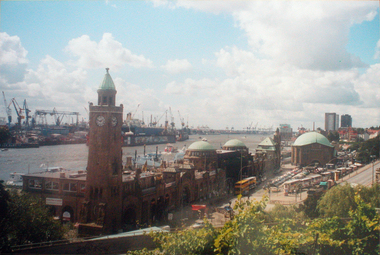
... Port at Hamburg, Germany, 2005......germany...A large building with tower and domes built beside water at Hamburg, Germany, It is the port building. It is named Germany's "Gateway to the World" and is the largest port in Germany. ...Hamburg, Germany...It is named Germany's "Gateway to the World" and is the largest port in Germany. ...The port at Hamburg was an important immigration point. A large building with tower and domes built beside water at Hamburg, Germany, It is the port building. It is named Germany's "Gateway to the World" and is the largest port in Germany. hamburg, port, germany, sea, ships, immigration -
 Flagstaff Hill Maritime Museum and Village
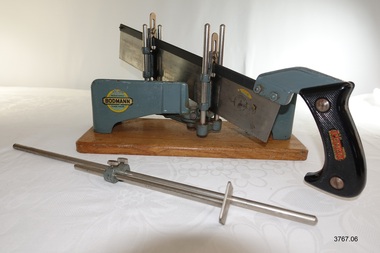
Tool - Mitre Saw Set, 1930-1955's
... ABOUT the BRAND NAME ON THE SAW - BODMANN and CO, Germany In 1927 the Brisbane Courier Mail described Bodmann and Co of Reinscheid, Germany as "manufacturers of guaranteed tools and hardware. ...The mitre saw is labelled with the trademark of Bodmann, Germany, and stamped with the model number 348. ...On saw - Remnant of logo on blade “ULMIA Schutz OTT Marke” with image of a church-like tall building, and 2x , "BEST QUALITY / BODMANN / MADE IN GERMANY” ...ABOUT the BRAND NAME ON THE SAW - BODMANN and CO, Germany In 1927 the Brisbane Courier Mail described Bodmann and Co of Reinscheid, Germany as "manufacturers of guaranteed tools and hardware. ...This Bodmann mitre saw set was used in the making of components for the ship model Sovereign of the Seas. It is part of a collection of objects used by Jim Williams, maker of fine ship models from about 1930-1955. Most of the components for the models, as well as many of the tools, were handmade by Jim Williams. Jim’s family has donated the ship model “Sovereign of the Seas” and many tools, accessories and documents used in the making of this and other ship models have been donated to Flagstaff Hill Maritime Village. ABOUT the BRAND NAME ON THE SAW - BODMANN and CO, Germany In 1927 the Brisbane Courier Mail described Bodmann and Co of Reinscheid, Germany as "manufacturers of guaranteed tools and hardware. It appears that at least the saw has been re-badges and sold by Bodmann because (1) there are remnants of a label on the saw blade similar in shape to the Bodmann label on the mitre set (2) the removed label reveals the name and logo of "ULMIA Schutz OTT Marke" (3) one of the "Bodmann" labels on the saw handle has been applied in a crooked manner, almost leaving off the last "N". ULMIA is a German manufacturer of high quality woodworking tools. A drawing of a very similar mitre bset with saw can be seen on the ULMIA website. In 2002 the long established company ANKE of Swabian Alb, Germany (makers of cut timber, workbenches and countertops) bought out the name and trademark rights of ULMIA. HISTORY OF SOVEREIGN OF THE SEA (brief) Ship model of HMS Sovereign of the Seas, scale model of 17th Century English war ship, was handmade and carved from plans, enclosed in airtight glass case. All components of that model, including even the smallest pulleys, were hand crafted using tools designed and made by Jim. Outstanding details include functional rigging and moving cannons. Please see our record 3732 of the mode Sovereign of the Seas for further details of the ship and the Jim Williams. This mitre saw set is connected with the hobby and skill of ship model making that has been crafted as a leisure activity for many generations. The hobby is often chosen by serving and retired mariners who appreciate the connection with maritime history. This mitre saw set was used by local Warrnambool man, Jim Williams, who was employed at Cramond and Dickson clothing store, and then at Fletcher Jones menswear for 27 years. It was used in making components for the model of the historic ship, the Sovereign of the Seas. The Sovereign of the Seas was a historic 17th century English war ship with important maritime heritage. Bodmann Mitre Saw set model 348, comprising metal, adjustable mitre saw on timber stand, and metal hand saw with Bakelite handle. The mitre saw is labelled with the trademark of Bodmann, Germany, and stamped with the model number 348. The saw has Bodmann trademark badges on each side of the handle; the text on one of these badges is not quite aligned. The saw blade has remnants of a label under which the stamped logo of ULMIA Schutz OTT Marke is clearly visible. Saw is fitted with two metal guides that slide onto vertical posts on the mitre saw. Metal measuring guide holds the wood job to the correct length. Saw has a protective brown paper wrapper. This mitre saw set is part of a collection of tools and accessories once used by Jim Williams, maker of a series of ship models 1930-1955 including “HMS Sovereign of the Seas”.On mitre saw- 2x logos "REGISTERED / BODMANN / TRADE MARK" and embedded stamp “348”. On saw - Remnant of logo on blade “ULMIA Schutz OTT Marke” with image of a church-like tall building, and 2x , "BEST QUALITY / BODMANN / MADE IN GERMANY” flagstaff hill, warrnambool, flagstaff hill maritime museum, maritime museum, shipwreck coast, flagstaff hill maritime village, great ocean road, jim williams, james bernard williams, ship model hobby, ship model tools, ship model making equipment, ship model making accessories, wood working tool, model making tool, mitre box set, mitre saw, bodmann and co reinscheid, germany, ulna ott of of swabian alb, germany, anke of swabian alb, germany, sovereign of the sea, ship model, hobby, ship model tool, mitre saw set -
 The 5th/6th Battalion Royal Victoria Regiment Historical Collection
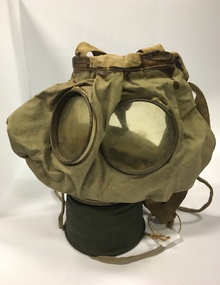
Equipment - Field Equipment, WWI Gas Mask, c.1916-1918
... ...german...Used by German Soldiers to protect against chemical weapons ...WWI German Gas Mask made of Tan rubberised canvas, with metal canister and cellophane eyes. ...Germany...Used by German Soldiers to protect against chemical weapons ww1 german gas mask Wark VC Club Hand written text on head straps - indescribable. ...Used by German Soldiers to protect against chemical weapons WWI German Gas Mask made of Tan rubberised canvas, with metal canister and cellophane eyes. Elastic straps for the wearer to fit to head and a long cotton strap to wear around neck when mask is not in use. Hand written text on head straps.Hand written text on head straps - indescribable. ww1, german, gas mask, wark vc club -
Bendigo Military Museum
Photograph - PHOTOGRAPH, B & W, C.1942
... ...German...The photo shows Joe Battilana VX47314 carrying a wounded Bill Jeffers VX52782, Refer Cat No 147 for Jeffers service details, refer Cat No 2463P re details on the German Soldier....Original photograph B & W rectangular shape showing a Australian soldier carrying piggy back style another soldier, a German soldier is walking with them carrying some of their equipment....The photo shows Joe Battilana VX47314 carrying a wounded Bill Jeffers VX52782, Refer Cat No 147 for Jeffers service details, refer Cat No 2463P re details on the German Soldier. Photographs German wounded Original photograph B & W rectangular shape showing a Australian soldier carrying piggy back style another soldier, a German soldier is walking with them carrying some of their equipment. ...The photo shows Joe Battilana VX47314 carrying a wounded Bill Jeffers VX52782, Refer Cat No 147 for Jeffers service details, refer Cat No 2463P re details on the German Soldier.Original photograph B & W rectangular shape showing a Australian soldier carrying piggy back style another soldier, a German soldier is walking with them carrying some of their equipment.photographs, german, wounded -
 Whitehorse Historical Society Inc.
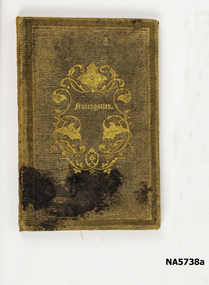
Book - Fraven-Garten (Woman's garden), 1857
... ...German...Language - German. Donated by Elizabeth Anderson (sister of Rosemary Tanner) who probably inherited it from her grandmother - Dorothea Kruse who lived in Schwerkolt Cottage, but never spoke English!...Small brown book - front cover stained Hard cover Gold colour title - Fravengarten and floral design Written in German - Fraven -Garten Van Herrmann Hamburg 1857...Hamburg, Germany...Book German Woman's garden Fravengarten- Floral Small brown book - front cover stained Hard cover Gold colour title - Fravengarten and floral design Written in German - Fraven -Garten Van Herrmann Hamburg 1857 Book Fraven-Garten (Woman's garden) ...Language - German. Donated by Elizabeth Anderson (sister of Rosemary Tanner) who probably inherited it from her grandmother - Dorothea Kruse who lived in Schwerkolt Cottage, but never spoke English!Small brown book - front cover stained Hard cover Gold colour title - Fravengarten and floral design Written in German - Fraven -Garten Van Herrmann Hamburg 1857Fravengarten- Floralbook, german, woman's garden -
Tatura Irrigation & Wartime Camps Museum
Document, "Die Klosterbruder oder Die Gestorte Liebesfrunde", Mar-40
... Neumann came from Germany to take a position as lecturer at Sydney University c.1937, until interned in 1939. ...Light cardboard covers with pages secured by blue tape, containing paper pages typed in German which was made and illustrated in Camp 1....Neumann came from Germany to take a position as lecturer at Sydney University c.1937, until interned in 1939. ...Made in Camp 1, Tatura containing list of cast and roles in a theatre production written by Dr. Neumann in Camp 1. Dr. Neumann came from Germany to take a position as lecturer at Sydney University c.1937, until interned in 1939. This item remained in the possession of his daughter Ingrid until she brought it and presented to the Museum.Light cardboard covers with pages secured by blue tape, containing paper pages typed in German which was made and illustrated in Camp 1.Lustspiel in Acht Szenen von Gerhard. Neumann, Gesschrieben Im Internierungslager Tatura Marz 1940.camp 1, tatura, theatre production, camp 1 tatura, dr gerhard neumann, documents, drama -
 Bendigo Historical Society Inc.
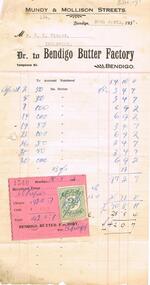
Document - PIEPER COLLECTION: INVOICE BENDIGO BUTTER FACTORY
... Invoice134 issued by Bendigo Butter Factory, Bendigo on 30th April, 1937, to Mr. C.O. Pieper, Inglewood, for supply of butter in 50 lb lots. ...Receipt 1540 attached. Document PIEPER COLLECTION: INVOICE BENDIGO BUTTER FACTORY ...Invoice134 issued by Bendigo Butter Factory, Bendigo on 30th April, 1937, to Mr. C.O. Pieper, Inglewood, for supply of butter in 50 lb lots. Receipt 1540 attached.bendigo, business, bendigo butter factory -
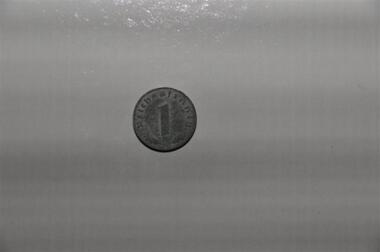 Running Rabbits Military Museum operated by the Upwey Belgrave RSL Sub Branch
Coin
... German Reichphennig...Miscellaneous WW2 German Reichphennig Coin ...German Reichphennigmiscellaneous, ww2 -
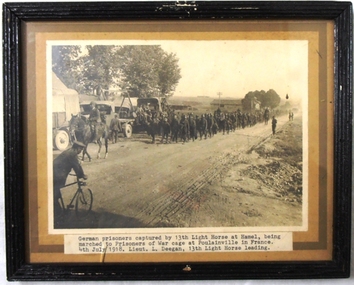 8th/13th Victorian Mounted Rifles Regimental Collection
Photograph - 13th ALH WWI, 1918
... Framed black and white photograph showing long column of German prisoners-of-war led by mounted Australian officer and flanked by mounted Australian soldiers passing along a village road. ...German prisoners captured by 13th Light Horse at Hamel being marched to Prisoner of War cage at Poulainville in France, 4th July 1918. ...Framed black and white photograph showing long column of German prisoners-of-war led by mounted Australian officer and flanked by mounted Australian soldiers passing along a village road. ...The 13th Light Horse was the Corps Cavalry of the Australian Corps. One role of the Corps Cavalry was the escort of prisoners-of-war from the front line to POW compounds in the rear area. Lieutenant Leslie Deegan was a 36 year-old Company secretary of Melbourne with service in the Boer War when he enrolled in the 13th Light Horse AIF. He embarked as Squadron sergeant-major of C Squadron of the regiment and was later commissioned as a lieutenant.Rare photograph of Australian Light Horse escorting prisoners-of-war in large numbers in France during WWI. Officer named has connection to other items in collection.Framed black and white photograph showing long column of German prisoners-of-war led by mounted Australian officer and flanked by mounted Australian soldiers passing along a village road. Several onlookers, one on bicycle. light wooden frame painted black.German prisoners captured by 13th Light Horse at Hamel being marched to Prisoner of War cage at Poulainville in France, 4th July 1918. Lieut. L Deegan 13th Light Horse leading.13th light horse, hamel, deegan leslie lieutenant, prisoner-of-war -
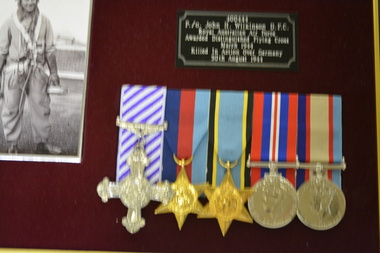 Wangaratta RSL Sub Branch
Medal - Framed Photograph with Medals, J.H.Wilkinson DFC
... Pilot Officer Wilkinson 400444 was seconded from the RAAF to the RAF flying missions over Germany. His gallantry earned him the Distinguished Flying Cross in March 1944 for numerous successful missions over Germany. ...Wilkinson DFC Awarded Distinguished Flying Cross March 1944 Killed in Action over Germany August 1944...Pilot Officer Wilkinson 400444 was seconded from the RAAF to the RAF flying missions over Germany. His gallantry earned him the Distinguished Flying Cross in March 1944 for numerous successful missions over Germany. ...Pilot Officer Wilkinson 400444 was seconded from the RAAF to the RAF flying missions over Germany. His gallantry earned him the Distinguished Flying Cross in March 1944 for numerous successful missions over Germany. He was Killed in Action on 30th of August 1944.Brown timber frame containing 5 metal medals, photograph of Airman, flying patch and plague on red felt backgroundBronze Plaque: Service Number 400444 P.,O. John W. Wilkinson DFC Awarded Distinguished Flying Cross March 1944 Killed in Action over Germany August 1944j h wilkinson, raaf, dfc -
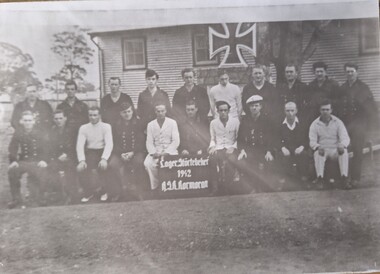 Tatura Irrigation & Wartime Camps Museum
Photograph, Kormoran Crew
... Some of the H S K Kormoran crew were house in camp 13. The German cross is a memorial to their fallen comrades....Between the hut and the men is a large German cross on a stone plymth. A sign is being held by the 5th and 6th men from the left....Some of the H S K Kormoran crew were house in camp 13. The German cross is a memorial to their fallen comrades. ...Some of the H S K Kormoran crew were house in camp 13. The German cross is a memorial to their fallen comrades.Black and white photograph of 10 men standing and 10 men seated in front of a hut. Between the hut and the men is a large German cross on a stone plymth. A sign is being held by the 5th and 6th men from the left.Sign: Lager Hortebeker 1942 H S A Kormoranh s k kormoran, camp 13, german memorial, erich falk -
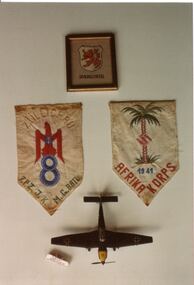 Tatura Irrigation & Wartime Camps Museum
Banner, Afrika Korps Banner, 1941
... He was chosen to be one of the Australian Army officers who escorted the German POW's back to Germany in January 1947. ...Swastika has been left outlined in pencil but not embroidered, probably so as not to create trouble by displaying the now banned swastika: Banner 2 has red stylised German eagle over the number 8. Also in picture is a model of an aeroplane and a framed coat of arms with Braunschweig (a place in north west Germany otherwise known as Brunswick)....He was chosen to be one of the Australian Army officers who escorted the German POW's back to Germany in January 1947. ...Captain Robert Ure Bain was Adjutant to Lt. Col. Bush, POW Group Commandant from 1942 - 1947. He was chosen to be one of the Australian Army officers who escorted the German POW's back to Germany in January 1947. A German POW and former member of the Afrika Korps made the item and donated it to Robert.Afrika Korps banners, embroidered, one piece of material. Large hemmed square of white/ cream cotton material embroidered with two unfinished Afrika Korps banners. Line drawn around both, to indicate edge/cutting point/unfinished embroidery point. The photograph show banner 1 which has a palm tree & swastika (emblem of the Afrika Korps). Swastika has been left outlined in pencil but not embroidered, probably so as not to create trouble by displaying the now banned swastika: Banner 2 has red stylised German eagle over the number 8. Also in picture is a model of an aeroplane and a framed coat of arms with Braunschweig (a place in north west Germany otherwise known as Brunswick).Banner 1: Afrika Korps (pink lettering); 1941 (light blue lettering). Banner 2: Zullighau (brown/gold lettering); 4. KOMP / M. G. BATL. (green lettering). (Number 4 company of the Machine Gun Battalion); framed coat of arms "Braunschweig"afrika korps, internment camps, camp 13, garrison, military, handcrafts, embroidery, captain robert bain, german pow's -
Lakes Entrance Historical Society
Book, Gray, Ian, Valuing Our Veterans Gathering Australia'sWar Memories, 2000
... Techniques to help schools, historical societies and genealogical groups to make contact with war veterans to collect and record their stories. ...Military History Techniques to help schools, historical societies and genealogical groups to make contact with war veterans to collect and record their stories. ...Techniques to help schools, historical societies and genealogical groups to make contact with war veterans to collect and record their stories. Contains photographs.military history
