
Showing 3014 items matching "bell-cote"
-
 Ballarat Tramway Museum
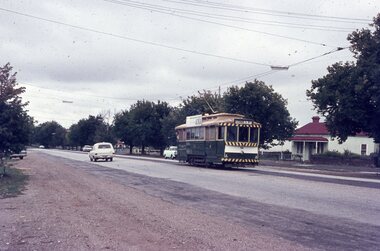
Slide - SECV Ballarat tram 32 at Bell St, Graeme Cleak, 5-4-1969
... Photo shows SECV Ballarat No. 32 northbound in Drummond St South at Bell St with the destination of Lydiard St Nth. ...In ink "No. 32 Bell St 5-4-69, EK12"...Tramways tramcars Drummond St Sth Bell St tram 32 In ink "No. 32 Bell St 5-4-69, EK12" Colour slide - AGFA Cardboard mount with handwritten notes. ...Photo shows SECV Ballarat No. 32 northbound in Drummond St South at Bell St with the destination of Lydiard St Nth. A man is holding his arm out of the rear door - conductor? The tram has a roof advert for ANA Mutual fund.Yields information about Ballarat tram services and tram 32 in 1969.Colour slide - AGFA Cardboard mount with handwritten notes.In ink "No. 32 Bell St 5-4-69, EK12"tramways, tramcars, drummond st sth, bell st, tram 32 -
 Australian National Surfing Museum
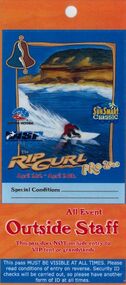
Surf Contest Pass, 2000 Bells Beach Competition Pass, 01/03/2000
... This event access pass was issued to staff, vendors and community volunteers at the 2000 Rip Curl Pro at Bells Beach....Event management logos on the front. Indigenous Bell artwork by Torquay artist/surfer Glenn Romanis....Indigenous Bell artwork by Torquay artist/surfer Glenn Romanis. 2000 Rip Curl Pro Access Pass. ...This event access pass was issued to staff, vendors and community volunteers at the 2000 Rip Curl Pro at Bells Beach.The access pass is typical of the pass issued each year to the staff and workers at the longest running surfing contest in the world. The pass features unique Indigenous artwork by Torquay artist/surfer Glenn Romanis2000 Rip Curl Pro Access Pass. Full colour laminated access pass (Outside Staff) for the 2000 Rip Curl Pro and Sunsmart Classic. The pass features cover art by Indigenous artist Glenn Romanis and event management logos. The pass also features a site map on the back and access information.Event management logos on the front. Indigenous Bell artwork by Torquay artist/surfer Glenn Romanis.bells beach, rip curl, glenn romanis, surfing victoria, 2000 rip curl pro -
 Lakes Entrance Historical Society
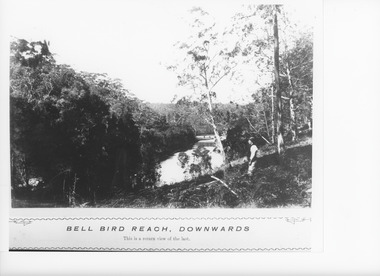
Photograph - Bell Bird Reach, Lake Tyers Victoria c1880, Caire, Nicholas John
... Bell Bird Reach,downwards. This is a return view of the last....Black and white photograph of Bell Bird Reach in Lake Tyers. It shows the lake from the downward slope, surrounded by thick vegetation Lake Tyers Victoria...Bell Bird Reach,downwards. This is a return view of the last. ...Bell Bird Reach,downwards. This is a return view of the last.Black and white photograph of Bell Bird Reach in Lake Tyers. It shows the lake from the downward slope, surrounded by thick vegetation Lake Tyers VictoriaBellbird Reach Downwardswaterways, topography -
 Bendigo Military Museum
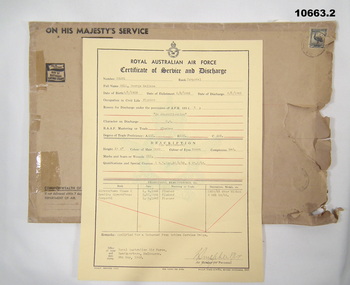
Administrative record - CERTIFICATE OF DISCHARGE, RAAF, 9 May 1946
... George Wallace Bell No. 53081 (Born England, enlisted Melbourne). ...Bell, 16 Thomas Street, Mitcham, Vic."...George Wallace Bell No. 53081 (Born England, enlisted Melbourne). ...George Wallace Bell No. 53081 (Born England, enlisted Melbourne). Age 33 on 2/4/1942 & was Discharged 8/3/1946. His overseas service is listed as 16/2/1943 to 13/9/1944 and then 15/3/1945 to 22/2/1946. Service areas were Milne Bay, Kiriwina, Lae, Aitape, Solomon Islands, Labuan. Discharged with the rank of Corporal in 4th Airfield Construction Sqd. His civilian service was a Plumber and maintained that through his War service.1. Yellow certificate A4 size. Form information in blue type with inserted data in black type. Headed Royal Australian Air Force. Data includes No, Rank, Dates of service, Physical description, Qualifications and Service history and Sign off from Authority. 2. Brown stamp and addressed envelope.“53081 - Corporal - BELL GeorgeWallace” "On Her Majesty's Service" Addressed to "Mr G.W. Bell, 16 Thomas Street, Mitcham, Vic."raaf, cert of discharge, admin record -
 Warrnambool and District Historical Society Inc.
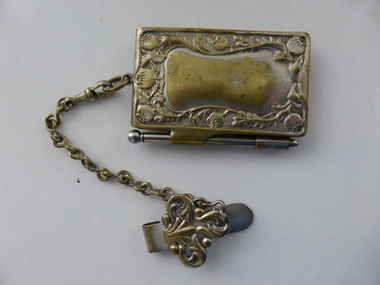
Artefact, Silver plate note pad, Early 20th century
... This note-pad and holder perhaps belonged to Jessie Bell whose name is written on the first page. ...First Page: ‘Jessie A. Bell, Warrumyea, Wangoom, Warrnambool’ ...This note-pad and holder perhaps belonged to Jessie Bell whose name is written on the first page. ...This note-pad and holder perhaps belonged to Jessie Bell whose name is written on the first page. There are several entries on the pages and the dates range from 1908 to 1929. The entries include references to a Banquet for Mr J. Duffus, Purnim, 1912, Jack Ross’ Wedding Party, Dennington, 1912, R.J. Jones’ Dance, Woolshed, 1928 and Leila Jenkins’ 21st Birthday Party, 1928. This notebook and holder is of interest because it is an example of the type of appointment book used by the more affluent in the early 20th century. This is a heavily-embossed silver note-pad holder with a hinged lid on the front and clips at the side to hold a pencil. The writing material inside the pencil is missing. The back of the holder has a blank space in the middle where a name can be inscribed. At the top of the holder is a ring, holding a chain with an ornamented clip at the end. This enables the holder and pad to be hooked over a belt or lapel. Inside the holder are fifty paper pages on which to write appointments or notes. The pages are gilt-paged. The paper contains several notes handwritten in pencil re dances, parties etc. First Page: ‘Jessie A. Bell, Warrumyea, Wangoom, Warrnambool’ jessie bell, appointment book, warrnambool history -
 Hume City Civic Collection
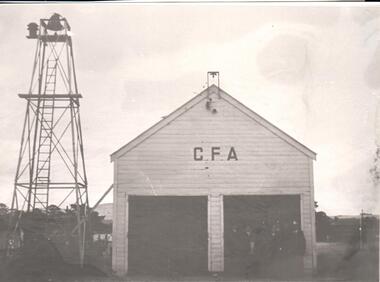
Photograph
... The wooden structure was the home of the Country Fire Authority and the bell tower was used to raise the alarm for fires....A black and white photograph of a weatherboard fire station next to a metal tower with a bell on top and a ladder leaning against it....The wooden structure was the home of the Country Fire Authority and the bell tower was used to raise the alarm for fires. sunbury fire brigade country fire authority bell towers fire stations evans street sunbury george evans collection A black and white photograph of a weatherboard fire station next to a metal tower with a bell on top and a ladder leaning against it. ...This photograph was taken in Evans Street, Sunbury near Sunbury Square. The wooden structure was the home of the Country Fire Authority and the bell tower was used to raise the alarm for fires.A black and white photograph of a weatherboard fire station next to a metal tower with a bell on top and a ladder leaning against it.sunbury fire brigade, country fire authority, bell towers, fire stations, evans street, sunbury, george evans collection -
 Phillip Island and District Historical Society Inc.
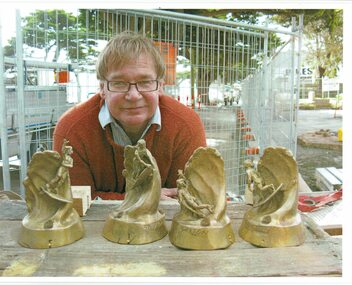
Photograph, Harmony Bells
... The Harmony Bells were created by internationally renowned artist Dr Anton Hasell. ...Anton Hasell with the individual scultured cast tops of the brass bells. The other is a typed explanation of the meaning of the bells....The Harmony Bells were created by internationally renowned artist Dr Anton Hasell. ...The Harmony Bells were created by internationally renowned artist Dr Anton Hasell. Originally installed in 2012 at the Phillip Island Cultural Centre, costing $60,000, they weigh about 100 kilograms each. These unique sculptures were unfortunately stolen, only to be miraculously recovered from a ship in 2021, where they were destined for scrap metal. They had been stripped of their gold and adornments. They have been restored and were reinstalled at Berninneet in 2024.Historical2 laminated A4 sheets. One is a coloured photograph of Dr. Anton Hasell with the individual scultured cast tops of the brass bells. The other is a typed explanation of the meaning of the bells.sculpture, harmony bells, dr. anton hasell, berninneet -
 Bendigo Military Museum
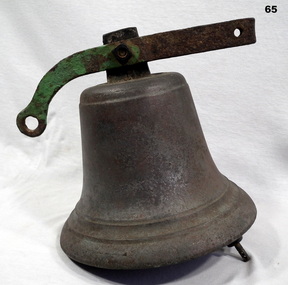
Tool - SHIPS BELL, c.1900
... This bell was apparently salvaged from a Freighter by Syd Storrie a Merchany Navy Sailor. ...Ship's bell, rough cast bronze? Clapper is rough cast steel. ...This bell was apparently salvaged from a Freighter by Syd Storrie a Merchany Navy Sailor. ...This bell was apparently salvaged from a Freighter by Syd Storrie a Merchany Navy Sailor. The Freighter had been torpedoed by a German Submarine in WW1.Ship's bell, rough cast bronze? Clapper is rough cast steel. There is an old steel mounting bracket at the top, painted green. maritime technology, ship relics, military history - navy, ships fittings, souvenirs -
 Wodonga & District Historical Society Inc
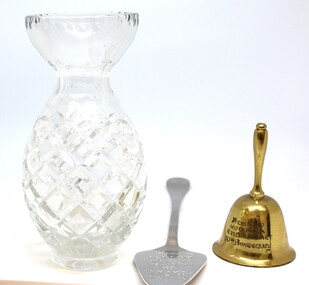
Award - Royal Victoria Institute for the Blind, Wodonga Auxiliary Service Awards
... The 3 items in this display - bell, crystal vase and cake server- were presented to the Wodonga Auxiliary of the Royal Victorian Institute for the Blind (RVIB) marking 50, 60 and 70 years of service respectively. ...They include a crystal vase, a gold bell and a silver cake server. 18/10 is stamped on the reverse of the cake slicer. ...On the bell: 'Presented to Wodonga R.V.I.B. Auxiliary 50th Anniversary" Around the middle of the vase: 'Presented to RVIB Wodonga Auxiliary 60th Anniversary, 1992" On the cake server: "Presented to RVIB Wodonga Auxiliary for 70 years service March 1932 to March 2002" On back of cake server:" 18/10 and initials FK inside 2 circles....They include a crystal vase, a gold bell and a silver cake server. 18/10 is stamped on the reverse of the cake slicer. ...The 3 items in this display - bell, crystal vase and cake server- were presented to the Wodonga Auxiliary of the Royal Victorian Institute for the Blind (RVIB) marking 50, 60 and 70 years of service respectively. This auxiliary was formed in March 1932 with K.D. Watson as the Inaugural President. Its purpose was to raise funds to assist blind and visually impaired people across the state of Victoria. The volunteers over 70 years spent countless hours door knocking in the annual fundraiser, and selling raffle tickets at street stalls. As the City of Wodonga expanded the areas to be door-knocked increased, creating a challenge for the mainly elderly members of the Auxiliary. Eventually it closed down in 2002 when the RVIB amalgamated with Vision Australia. The longest serving member of the Auxiliary was Mrs. Jean Burbidge.These items have local and state significance as they represent the work carried out by a local group of volunteers to support an important state wide institution.3 awards received by the RVIB Wodonga Auxiliary for recognition of their service. They include a crystal vase, a gold bell and a silver cake server. 18/10 is stamped on the reverse of the cake slicer. This relates to the percentage of chrome and nickel within the steel.On the bell: 'Presented to Wodonga R.V.I.B. Auxiliary 50th Anniversary" Around the middle of the vase: 'Presented to RVIB Wodonga Auxiliary 60th Anniversary, 1992" On the cake server: "Presented to RVIB Wodonga Auxiliary for 70 years service March 1932 to March 2002" On back of cake server:" 18/10 and initials FK inside 2 circles.royal victorian institute for the blind, rvib wodonga auxiliary -
 Flagstaff Hill Maritime Museum and Village
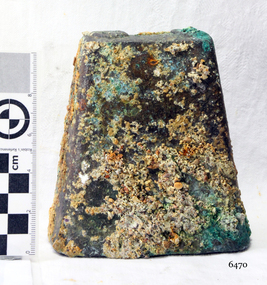
Functional object - Cow Bell, Circa 1878
... The artefact is a brass cow bell recovered from the 1878 shipwreck of the LOCH ARD near Port Campbell. ...Brass cow bell, flat-top pyramid shape, rectangular head, shoulders flare out to a rectangular mouth. ...The artefact is a brass cow bell recovered from the 1878 shipwreck of the LOCH ARD near Port Campbell. ...The artefact is a brass cow bell recovered from the 1878 shipwreck of the LOCH ARD near Port Campbell. It was raised by Flagstaff Hill divers in 1973 and is in storage at the Maritime Village. The LOCH ARD was constructed on the Clyde in 1873 for the prestigious Loch Line of colonial clipper ships, designed for the Australian run. She sailed from England on 1 March 1878 carrying 37 crew, 17 passengers and a diverse general cargo ranging from luxury items to bulk railway iron. On 1 June 1878, emerging from fog and hearing too late the sound of breakers against the tall limestone cliffs, the vessel struck the southern foot of Mutton Bird Island and sank in 23 metres of water. Of the fifty-four people on board only two survived, one young male crewman, Tom Pearce, and one young female passenger, Eva Carmichael. A century later, despite the pounding seas and the efforts of looters, the wreck site continued to provide ample evidence of the extraordinary range of goods being imported into the Colony of Victoria in the post-Gold Rush era. Flagstaff Hill divers in the 1970s reported finds of “Bottles of champagne, window panes, rolls of zinc, barrels of cement, iron rails, clocks, lead shot, corrugated iron, lead, marble, salad oil bottles, ink bottles, copper wire, gin bottles, rolls of carpet, floor tiles, copper rivets, gas light fittings, pocket knives, toys, crystal chandeliers, beer mugs, cutlery, candles sticks, wick scissors, cow bells, and sauce bottles.” From this array of objects on the ocean floor emerged the humble brass cow bell. Cow bells were common to colonial agriculture and transport, used wherever animals were turned out to graze overnight and had to be rounded up again next morning. Bells were fastened around the necks of household milking cows, domestic goats, bullock teams, horse teams, and camel teams, to help find them in the pre-dawn light. Station shepherds and cattle drovers also used them to warn of any disturbances to their flocks and herds overnight. The bells were a necessary item in a largely unfenced continent. So important, that Anthony Mongon began making his pot-bells at Yackandandah from 1861, August Menneke produced the “Wagga Pot” from 1867, and Samuel Jones started manufacturing his distinctively shaped “Condamine Bell” in 1868. However, these deeply resonant Australian bells were made from iron — Mongon and Jones were blacksmiths who simply beat old pitsaw blades into shape. Few genuinely brass cow bells were made here, the vast majority being imported from Britain where the industry of brass founding was already well established. (Some bells were also imported from the United States, but these too were nearly all of iron). This bell is historically significant as typical of a cow bell used by farmers and herdsmen in Colonial Victoria. Its significance is increased by being one of a collection of artefact recovered by the Flagstaff Hill Divers from the wreck of the Loch Ard in the early 1970s. Items that come from several wrecks along Victoria's coast have also been recovered for Flagstaff Hill Maritime Village’s museum collection under Government permit, illustrating this item’s level of historical value. The cow bell is also significant for being part of Flagstaff Hill’s collection of artefacts from LOCH ARD, which is significant for being one of the largest collections of artefacts from this shipwreck in Victoria. It is significant for its association with the shipwreck, which is on the Victorian Heritage Register (VHR S417). The collection is significant because of the relationship between the objects, as together they have a high potential to interpret the story of the LOCH ARD. The LOCH ARD collection is archaeologically significant as the remains of a large international passenger and cargo ship. The LOCH ARD collection is historically significant for representing aspects of Victoria’s shipping history and its potential to interpret sub-theme 1.5 of Victoria’s Framework of Historical Themes (living with natural processes). The collection is also historically significant for its association with the LOCH ARD, which was one of the worst and best known shipwrecks in Victoria’s history. Brass cow bell, flat-top pyramid shape, rectangular head, shoulders flare out to a rectangular mouth. The hanging yoke is missing. Noneflagstaff hill, warrnambool, shipwrecked-coast, flagstaff-hill, flagstaff-hill-maritime-museum, maritime-museum, shipwreck-coast, flagstaff-hill-maritime-village, loch ard, cowbell, great ocean road, loch line, captain gibbs, eva carmichael, tom pearce, glenample station, mutton bird island, loch ard gorge, cow bell, brass cow bell, shipwreck artefact, flagstaff hill divers, horse bell, bell smith, vintage bell, farmer, shepherd, drover, stock bell, brass bell -
 Flagstaff Hill Maritime Museum and Village
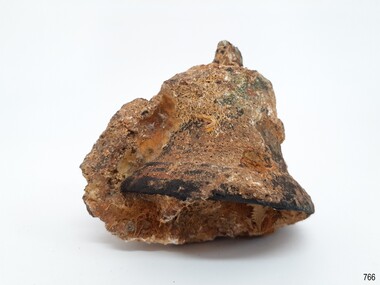
Functional object - Service Bell, 1855
... ...bell...This service bell was recovered from the wreck of the ship Schomberg. ...Bell; small service bell, brass, with heavy encrustation. ...This service bell was recovered from the wreck of the ship Schomberg. ...This service bell was recovered from the wreck of the ship Schomberg. The Schomberg was a large three-masted full-ship rigged wooden ship built in 1855 by Alexander Hall and Co in Aberdeen, Scotland for James Baines' famous Black Ball Line at £43,103. The vessel was 288 feet (88 meters) in length, with a beam of 45 feet (14 meters), a depth of 29.5 feet (8.99 meters) of 2,284 tons. The mainmast was 210 feet (64 meters) high and she carried 3.3 acres of sail. The vessel was constructed with three skins. One planked fore and aft, and two diagonally planked, fastened together with screw-threaded trunnels (wooden rails). The Schomberg is one of only three clipper wrecks in Victorian waters that operated the England to Australia run. While the other two, Empress of the Sea and Lightning, were built by the famous American shipbuilder, Donald Mac Kay. Schomberg was an attempt to build a faster ship than Mac Kay and a vessel fast enough to break the sailing record to Australia. The Schomberg sailed on her maiden voyage from Liverpool on 6 October 1855, under the command of Captain James Forbes, on its maiden voyage to Australia with a general cargo, jewellery, spirits, machinery, and 2,000 tons of iron rails and equipment intended to build the Melbourne to Geelong Railway and a bridge over the Yarra from Melbourne to Hawthorn. She also carried a cow for fresh milk, pens for fowls and pigs, plus 90,000 gallons of water for washing and drinking. She also carried 17,000 letters and 31,800 newspapers. There were approximately 473 passengers and a crew of 105. It was hoped that Schomberg would make Melbourne in sixty days, setting a record for the voyage, but light winds at the equator dashed those expectations. The ship sighted Moonlight Head in south west Victoria on Christmas Day but through a deadly combination of wind, currents and unmarked sand spits, the vessel gently ran aground on 26 December 1855 on a spit that juts into Newfield Bay, just east of Curdies Inlet, and the present town of Peterborough. Fortunately, the SS Queen was nearby and managed to save all passengers and crew. The steamers Keera and Maitland were dispatched to salvage the passenger's baggage and the more valuable cargo. Other salvage attempts were made, but deteriorating weather made the work impossible, and within two weeks the Schomberg's hull was broken up and the vessel abandoned. The wrecking of the Schomberg caused quite the public stir particularly in light of the fact the vessel was supposed to be, the most perfect clipper ship ever built. Captain Forbes was charged in the Supreme Court under suspicion that he was playing cards with two female passengers below decks when his ship ran aground. Despite a protest meeting, two inquiries and the court proceedings, he was found not guilty and cleared of all charges. In 1975, divers from Flagstaff Hill, including Peter Ronald, found an ornate communion set at the wreck. The set comprised a jug, two chalices, a plate and a lid. The lid did not fit any of the other objects and in 1978 a piece of the lid broke off, revealing a glint of gold. As museum staff carefully examined the lid and removed marine growth, they found a diamond ring, which is currently on display in the Great Circle Gallery at the Flagstaff Hill Maritime museum that also displays ship fittings and equipment, personal effects. Most of the artefacts were salvaged from the wreck by Peter Ronald, former director of Flagstaff Hill.The Schomberg has historical significance as one of the first luxurious ships built to bring emigrants to Australia to cash in on the gold rush era. And is included on the Victorian Heritage Register (VHR S612). The collection of Schomberg artefacts held at Flagstaff Hill Museum is primarily significant because of the relationship between these recovered items having a high potential to interpret the story of the Schomberg and its foundering during a storm. The shipwreck is of additional historically significance for representing aspects of Victoria’s shipping history and for its association with the first passenger ship, which was designed not only to be the fastest and most luxurious of its day but foundered on its maiden voyage to Australia.Bell; small service bell, brass, with heavy encrustation. Bell has a square loop at the top. The bell was recovered from the wreck of the Schomberg.Nonewarrnambool, flagstaff-hill, flagstaff-hill-maritime-museum, shipwreck-coast, flagstaff-hill-maritime-village, schomberg, shipwrecked-artefact, clipper ship, black ball line, 1855 shipwreck, aberdeen clipper ship, captain forbes, peterborough shipwreck, ss queen, bell, service bell -
 Royal Australian and New Zealand College of Obstetricians & Gynaecologists (RANZCOG)
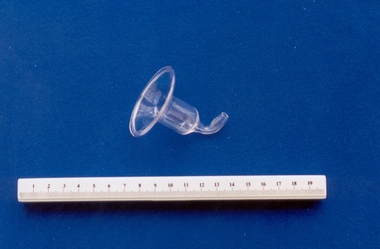
Glass nipple shield associated with midwife Mary Howlett, c. 1866 - 1920
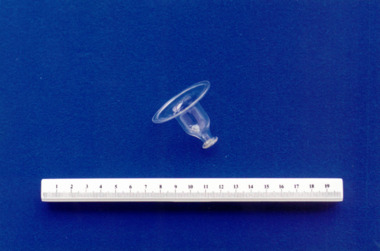
... They varied in shape from a bell to a flatter, cap shaped appliance. With the application of the nipple shield, the baby was able to take milk from the breast without giving added trauma to the nipples. ...Shape resembles that of a bell....Shape resembles that of a bell. Glass nipple shield associated with midwife Mary Howlett, c. 1866 - 1920 ...A rubber teat would be attached to the top of this nipple shield for breast feeding. From 1801 onwards, nipple shields were available in a variety of materials, such as pewter, horn, bone, ivory, wood, glass and silver. They varied in shape from a bell to a flatter, cap shaped appliance. With the application of the nipple shield, the baby was able to take milk from the breast without giving added trauma to the nipples. In the ante partum period the nipple shield could be worn to assist in drawing out flat nipples; or, as it was known during this period, for the formation of "new nipples". (Fildes, Valerie. 'Breasts, Bottles & Babies - A History of Infant Feeding', 1986) Mary Howlett (1840-1922) began practising as a country midwife in 1866 in the western district of Victoria. She qualified as a 'ladies monthly nurse' in 1887 and continued to practise as a nurse and midwife until 1920. She began her six months training at the Melbourne Lying-In Hospital. She was known by many as 'Auntie', and her career spanned more than 50 years. Mrs Howlett's midwifery box and contents were given to Dr Frank Forster, and he donated them to the museum collection in 1993. Glass nipple shield. Shape resembles that of a bell.infant feeding, midwifery -
 Royal Australian and New Zealand College of Obstetricians & Gynaecologists (RANZCOG)
Glass nipple shield associated with midwife Mary Howlett, c. 1866 - 1920
... They varied in shape from a bell to a flatter, cap shaped appliance. With the application of the nipple shield, the baby was able to take milk from the breast without giving added trauma to the nipples. ...Shape resembles that of a bell....Shape resembles that of a bell. Glass nipple shield associated with midwife Mary Howlett, c. 1866 - 1920 ...A rubber teat would be attached to the top of this nipple shield for breast feeding. From 1801 onwards, nipple shields were available in a variety of materials, such as pewter, horn, bone, ivory, wood, glass and silver. They varied in shape from a bell to a flatter, cap shaped appliance. With the application of the nipple shield, the baby was able to take milk from the breast without giving added trauma to the nipples. In the ante partum period the nipple shield could be worn to assist in drawing out flat nipples; or, as it was known during this period, in the formation of "new nipples". (Fildes, Valerie. 'Breasts, Bottles & Babies - A History of Infant Feeding', 1986) Mary Howlett (1840-1922) began practising as a country midwife in 1866 in the western district of Victoria. She qualified as a 'ladies monthly nurse' in 1887 and continued to practise as a nurse and midwife until 1920. She began her six months training at the Melbourne Lying-In Hospital. She was known by many as 'Auntie', and her career spanned more than 50 years. Mrs Howlett's midwifery box and contents were given to Dr Frank Forster, and he donated them to the museum collection in 1993.Glass nipple shield. Shape resembles that of a bell.midwifery, infant feeding -
 Australian National Surfing Museum
Newspaper Article, Slater Gives Up Trophy
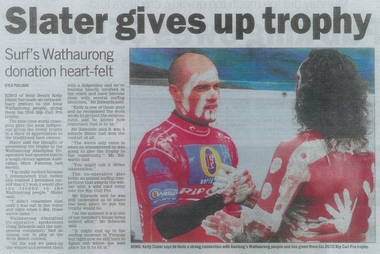
... World surfing champion Kelly Slater won a record 4th Bells Beach Surfing Contest in April 2010. ...Includes colour photograph of Kelly Slater being 'painted up' by Aboriginal dancer at Bells Beach....World surfing champion Kelly Slater won a record 4th Bells Beach Surfing Contest in April 2010. ...World surfing champion Kelly Slater won a record 4th Bells Beach Surfing Contest in April 2010. He promptly donated his Bell trophy to the Aboriginal people of Geelong and the Surf Coast in appreciation of their support over the years.National and international significance from a sporting and cultural reconciliation perspective. Only two surfers have won 4 Bells contests. Slater's donation of his 4th Bell to the local Indigenous community is a rare act of reconciliation and personal generosity.Feature newspaper article by Kyle Pollard in the Geeelong Advertiser on 6th May 2010. Includes colour photograph of Kelly Slater being 'painted up' by Aboriginal dancer at Bells Beach.bells beach, kelly slater, reconciliation, 2010 rip curl pro, wathaurong aboriginal cooperative, bells trophy -
 4th/19th Prince of Wales's Light Horse Regiment Unit History Room
Framed Photograph, WW1 - 4th Australian Light Horse Regiment 1914-1918, c 1916
... Framed b&w photo of 5 members of 4th Australian Light Horse Regiment, namely Harry McCurrie, Charles Bell, Tichson, Fenton denny...Caption: WW1 - 4th Australian Light Horse Regiment 1914-1919 Rear L-R Harry McCurrie Charles Bell Seated L-R Tichson Fenton Denny...Caption: WW1 - 4th Australian Light Horse Regiment 1914-1919 Rear L-R Harry McCurrie Charles Bell Seated L-R Tichson Fenton Denny Framed b&w photo of 5 members of 4th Australian Light Horse Regiment, namely Harry McCurrie, Charles Bell, Tichson, Fenton denny WW1 - 4th Australian Light Horse Regiment 1914-1918 Framed Photograph ...Framed b&w photo of 5 members of 4th Australian Light Horse Regiment, namely Harry McCurrie, Charles Bell, Tichson, Fenton dennyCaption: WW1 - 4th Australian Light Horse Regiment 1914-1919 Rear L-R Harry McCurrie Charles Bell Seated L-R Tichson Fenton Denny -
 Lakes Entrance Historical Society
Photograph - Netherby ships bell at Swan Reach school 1999
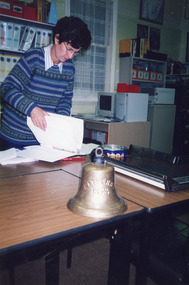
... The bell came from the ship Netherby, which was wrecked on King Island. ...Colour photograph of the Swan Reach school bell, showing the imprint 'Netherby 1858' shows teacher Lyn Wilkinson. ...The bell came from the ship Netherby, which was wrecked on King Island. ...The bell came from the ship Netherby, which was wrecked on King Island. The full story of the bell's journey from King Island is unclear, but assumption is that Roadknight family may have transferred it from their property in the Western District to Gippsland. It was common practice for the Master of shipwrecked vessel to acknowledge assistance by donating a significant relic to the persons who gave extraordinary aid in the crisis, as Mr Roadknight had done.Colour photograph of the Swan Reach school bell, showing the imprint 'Netherby 1858' shows teacher Lyn Wilkinson. Swan Reach Victoriaschools, shipwrecks, local history -
 Uniting Church Archives - Synod of Victoria
Photograph, Undated c.1960s
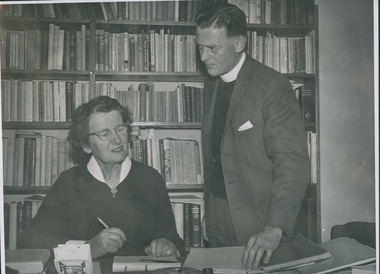
... Rev Albert Bell was ordained in 1956 at Poowong. Served 1961 Bentleigh East; 1966 Australian Inland Mission. ...B & W photo of Deaconess Jess Metherell seated at a desk with Reverend Albert Bell standing beside her....Rev Albert Bell was ordained in 1956 at Poowong. Served 1961 Bentleigh East; 1966 Australian Inland Mission. ...Rev Albert Bell was ordained in 1956 at Poowong. Served 1961 Bentleigh East; 1966 Australian Inland Mission. Principal St. Phillip's College Alice Springs; 1971 Chaplain Geelong College; 1973 retired.B & W photo of Deaconess Jess Metherell seated at a desk with Reverend Albert Bell standing beside her. "Hamilton Aikin 162 Russell Street Melbourne."deaconess, minister, rev. albert bell, methodist, jess metherell -
 Uniting Church Archives - Synod of Victoria
Photograph, Undated c.1960s
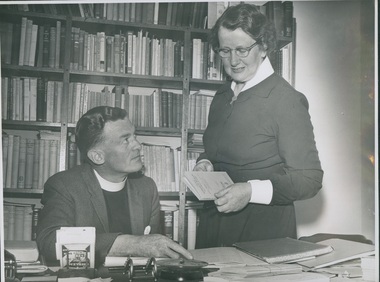
... Rev Albert Bell was ordained in 1956 at Poowong. Served 1961 Bentleigh East; 1966 Australian Inland Mission. ...B & W photo of Rev. Albert Bell seated at a desk with Deaconess Jess Metherell standing beside him....Rev Albert Bell was ordained in 1956 at Poowong. Served 1961 Bentleigh East; 1966 Australian Inland Mission. ...Rev Albert Bell was ordained in 1956 at Poowong. Served 1961 Bentleigh East; 1966 Australian Inland Mission. Principal St. Phillip's College Alice Springs; 1971 Chaplain Geelong College; 1973 retired.B & W photo of Rev. Albert Bell seated at a desk with Deaconess Jess Metherell standing beside him. "Hamilton Aikin 162 Russell Street Melbourne."deaconess, minister, jess metherall, presbyterian, rev albert bell -
 Melbourne Tram Museum
Photograph - Black and White - Coburg Horse Tram - Northern Tramway Co
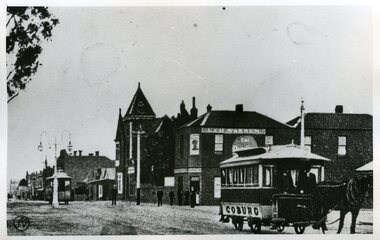
... Photo shows one of the Northern Tramway Co. horse trams at the corner of Bell St and Sydney Road, Coburg. Has the premises of L&H Warren (Bakers) in the background along with street lights and other buildings. ...Photograph - Black and White - Northern tramway Co Coburg Horse Tram - Corner of Sydney Road and Bell St....Tramways trams horse trams Sydney Road Bell St Northern Tramway Co Coburg horse tramway Coburg Warren Baker Grocer Photograph - Black and White - Northern tramway Co Coburg Horse Tram - Corner of Sydney Road and Bell St. ...Photo shows one of the Northern Tramway Co. horse trams at the corner of Bell St and Sydney Road, Coburg. Has the premises of L&H Warren (Bakers) in the background along with street lights and other buildings. Yields information about the Northern Tramway Co Coburg trams.Photograph - Black and White - Northern tramway Co Coburg Horse Tram - Corner of Sydney Road and Bell St.tramways, trams, horse trams, sydney road, bell st, northern tramway co, coburg horse tramway, coburg, warren baker grocer -
 Royal Australian and New Zealand College of Obstetricians & Gynaecologists (RANZCOG)
Printers block featuring image of the back of the Blair-Bell Medal, c. 1961, 1961
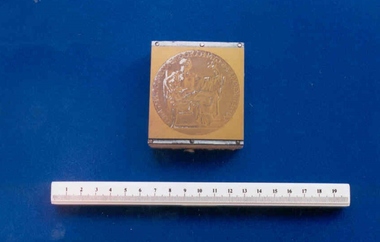
... Browne, winner of the Blair-Bell Medal, 28/10/60. Also used in obituary of Professor Browne....The image is the official verso medal image of the Blair-Bell medal, depicting a mother and child in Greco-Roman dress. ...Printers block featuring image of the back of the Blair-Bell Medal, c. 1961 ...The Blair-Bell medal was awarded quinquennially for the advancement of science in gynaecology or obstetrics or both in the preceding five years. The image on this block was used in an article, "The Blair-Bell Award" in the Australian & New Zealand Journal O + G [1961]1:77 featuring Prof. F.J. Browne, winner of the Blair-Bell Medal, 28/10/60. Also used in obituary of Professor Browne.Metal printer's plate attached to a wooden block. The image is the official verso medal image of the Blair-Bell medal, depicting a mother and child in Greco-Roman dress. The black of the block is covered in cream paper.blair-bell award, browne fj, printing -
 Sunbury Family History and Heritage Society Inc.
Photograph, Bulla Primary School, Polly Woodside Excursion, c1990s
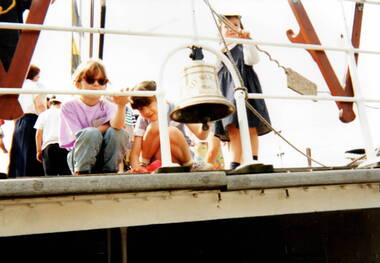
... They are looking at the ship's bell which according to the information on its side was cast in 1885. ...A non-digital coloured photograph of three little girls crouched down on the deck of a ship and looking at the bell....They are looking at the ship's bell which according to the information on its side was cast in 1885. ...The three girls, from Bulla Primary School, were on a school excursion to the sailing ship, Polly Woodside, which was moored along the south bank of the Yarra River in Melbourne. They are looking at the ship's bell which according to the information on its side was cast in 1885. On this excursion the children were introduced to aspects of sea travel in a bygone era.A non-digital coloured photograph of three little girls crouched down on the deck of a ship and looking at the bell.polly woodside, school excursions, sailing ships, bulla primary school -
Victorian Maritime Centre
Bell - Bronze
... The souvenir metal Bronze Bell was purchased sometime during a cruise by an unknown person. ...A bronze bell with ships anchor for handle. Has an enamel emblem embedded thereon....Bell - Bronze ...The souvenir metal Bronze Bell was purchased sometime during a cruise by an unknown person. It is part of a cruise liner collection by D. Benson and Family over a period of years. D. Benson sold part of the collection to the V.M.C who purchased the remaining part. It is a great source of information to visitors to the V.M.C. At the time of ocean liner holiday cruising, many people purchased these souvenirs to keep or give away as gifts.A bronze bell with ships anchor for handle. Has an enamel emblem embedded thereon.S.S Himalaya emblem with blue, white, yellow and red coloured flag in centre.merchant souvenir, s.s himalaya -
 Anglesea and District Historical Society
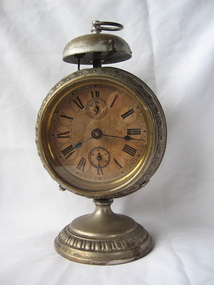
Alarm clock, circa 1900
... ...bell...Clock was used by the Bell family of Bellbrae....Pewter alarm clock on stand, bell on top, roman numerals on clock face. ...Clock was used by the Bell family of Bellbrae. clock bell alarm Pewter alarm clock on stand, bell on top, roman numerals on clock face. ...Clock was used by the Bell family of Bellbrae.Pewter alarm clock on stand, bell on top, roman numerals on clock face. Small alarm dial and small temperature dial. Stamped pattern on case. Case holding face has been resoldered to base.clock, bell, alarm -
Whitehorse Historical Society Inc.
Article, They'll take the high road, 1994
... ...Bell... Band President - Ian Bell said sheer hard work has raised $160,000 to fund the trip....Band President - Ian Bell said sheer hard work has raised $160,000 to fund the trip....Band President - Ian Bell said sheer hard work has raised $160,000 to fund the trip. ...Nunawading Highland Pipe Band are to compete in the world championships in Scotland.Nunawading Highland Pipe Band are to compete in the world championships in Scotland. Band President - Ian Bell said sheer hard work has raised $160,000 to fund the trip.Nunawading Highland Pipe Band are to compete in the world championships in Scotland. city of nunawading highland pipe band, ardense, karolyn, wanless, chris, carter, denise, bowles, mark, cliff, renee, bell, ian -
 Australian National Surfing Museum
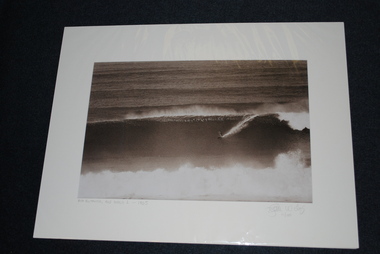
Photograph, John Witzig, Bob McTavish photograph Bells Beach 1 1965, 18/04/1965
... This photo, part 1 of a 2 photo sequence taken by John Witzig, is of of Bob McTavish riding a very large waves (15'+) at Bells Beach on Easter Sunday (April 18th) 1965. ...Part 1 of a 2 photo sequence taken by John Witzig of Bob McTavish riding a very big wave at Bells Beach. Photo is titled 'Bob McTavish Big Bells 1 - 1965', and signed and numbered by John Witzig (11/100). ...The wave featured in this photograph is considered one of the largest ridden waves ever documented at Bells Beach. bells beach john witzig bob mctavish easter sunday 1965 bells beach surfing classic Signed by John Witzig. ...This photo, part 1 of a 2 photo sequence taken by John Witzig, is of of Bob McTavish riding a very large waves (15'+) at Bells Beach on Easter Sunday (April 18th) 1965. This wave is thought to be the same one described by McTavish in his book as one of the biggest, most powerful waves he had ridden, almost resulting in his drowning after being washed down past the next headland at winki pop. Bells, Easter, 1965 is considered one of the biggest days that this break has been surfed. The surfer in the photograph, Bob McTavish would go on to become one of the most influential surfer/shapers in Australian during the next decade.The extremely large waves experienced by surfers at Bells Beach on Easter Sunday 1965 is part of surfing folklore. The wave featured in this photograph is considered one of the largest ridden waves ever documented at Bells Beach.Large black and white (sepia toned) photo. Part 1 of a 2 photo sequence taken by John Witzig of Bob McTavish riding a very big wave at Bells Beach. Photo is titled 'Bob McTavish Big Bells 1 - 1965', and signed and numbered by John Witzig (11/100). Signed by John Witzig. Numbered 11 / 100bells beach, john witzig, bob mctavish, easter sunday 1965, bells beach surfing classic -
Port Melbourne Historical & Preservation Society
Photograph - Fire bell, Swallow & Ariell factory, c.1880
... Bell moved from Swallow & Ariell after 1890; given to St Albans Anglican in Coburg 1930, then transferred to St Oswalds in Pascoe Vale in 1960. ...Photograph of Swallow & Ariell's factory fire bell, used by a supplementary Brigade operating from the factory 1880 to 1890. ...Refer to 2032.02 for history. Photograph Fire bell, Swallow & Ariell factory ...Bell moved from Swallow & Ariell after 1890; given to St Albans Anglican in Coburg 1930, then transferred to St Oswalds in Pascoe Vale in 1960. Now in Eastern Hill Fire Museum.Photograph of Swallow & Ariell's factory fire bell, used by a supplementary Brigade operating from the factory 1880 to 1890. Refer to 2032.02 for history.fire and fire services, swallow & ariell ltd -
 Port of Echuca
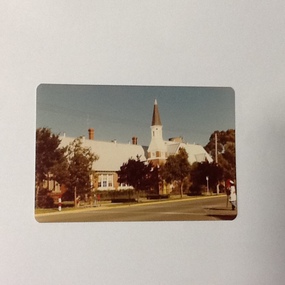
Colour Photograph, Approx.1979
... The front section of this building including 8 classrooms, the headmaster's office and the bell tower were destroyed by fire 27 February 1890. ...Colour photograph (post-card size) of Echuca Primary School, 208, showing the eastern facade including the bell tower, taken from the eastern side of High street. ...The front section of this building including 8 classrooms, the headmaster's office and the bell tower were destroyed by fire 27 February 1890. ...This building opened on 19 October 1874. The front section of this building including 8 classrooms, the headmaster's office and the bell tower were destroyed by fire 27 February 1890. "The burnt section of the school was rebuilt along the lines of the original building and today the red brick facade and bell tower are a feature of the Hare Strett skyline" (Echuca Stetchbook, Blyth, I, 1978, p.32.Henry Hopwood, founder of Echuca, saw the need to establish a national school to educate the children of Echuca. The first National School opened in October 1858 in a framed tent. Construction of the first brick school house began in 1859 on the site of the original Post Office in Hare street. Later the site changed to the southern end of Hare street and this building was opened 19 October 1874. The school stayed here until a new school was built on the old Echuca Technical School site.Colour photograph (post-card size) of Echuca Primary School, 208, showing the eastern facade including the bell tower, taken from the eastern side of High street. Printed on the reverse:"this paper manufactured by Kodak"echuca-primary schools, echuca-historical buildings -
 Bendigo Historical Society Inc.
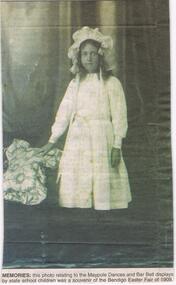
Newspaper - JENNY FOLEY COLLECTION: MEMORIES
... The Maypole Dancers were students of Miss Downs. The Bar Bell display of physical exercises using hand-held bar bells was by students of Miss Andrews. ...Memories: this photo relating to the Maypole Dances and Bar Bell displays by state school children was a souvenir of the Bendigo Easter Fair of 1909. ...The Maypole Dancers were students of Miss Downs. The Bar Bell display of physical exercises using hand-held bar bells was by students of Miss Andrews. ...The Maypole Dancers were students of Miss Downs. The Bar Bell display of physical exercises using hand-held bar bells was by students of Miss Andrews. Both groups performed at many functions throughout the year.Bendigo Advertiser '' The way we were'' from Monday, February 18, 2002. Memories: this photo relating to the Maypole Dances and Bar Bell displays by state school children was a souvenir of the Bendigo Easter Fair of 1909. The clip is in a folder.newspaper, bendigo advertiser, the way we were -
 Whitehorse Historical Society Inc.
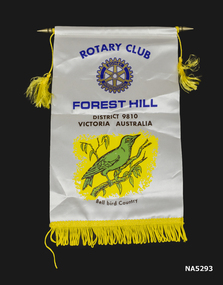
Banner - Rotary Club Forest Hill District 9810 Victoria Australia - Bell Bird Country
... Rotary Club - Forest Hill, Bell Bird Country...Picture of green bird on branch with yellow background "Bell Bird Country". Yellow fringe on bottom....Picture of green bird on branch with yellow background "Bell Bird Country". Yellow fringe on bottom. ...Rotary Club - Forest Hill, Bell Bird CountryOblong cream banner gold fringe on bottom with rod on top. Rotary Club, Forest Hill District 9810 Victoria Australia. Picture of green bird on branch with yellow background "Bell Bird Country". Yellow fringe on bottom.As aboverotary club, banner, forest hill -
 Melbourne Legacy
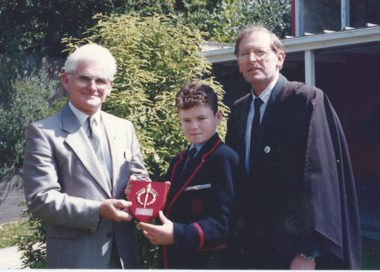
Photograph - Fundraising, Brighton Grammar Fundraising, 1991
... L/ Sullivan is also seen speaking at a school assembly and standing by a tree that had been planted in honour of Legatee Tom Bell in 1989 (see item 01538). The label explains the link to Brighton Grammar Junior School was fostered by the late L/ Tom Bell, although not a past pupil he endeared himself to the school that on his death shortly after the 1989 badge appeal the students planted a tree in his honour at a special memorial service. ...Typed on the pink paper label explained the link to the tree planted to honour Tom Bell....L/ Sullivan is also seen speaking at a school assembly and standing by a tree that had been planted in honour of Legatee Tom Bell in 1989 (see item 01538). The label explains the link to Brighton Grammar Junior School was fostered by the late L/ Tom Bell, although not a past pupil he endeared himself to the school that on his death shortly after the 1989 badge appeal the students planted a tree in his honour at a special memorial service. ...A photo of President Sullivan at Brighton Grammar Junior School presenting a boy, Troy Robinson, with a plaque with the Legacy torch emblem alongside the Junior School Master, Mr Peter Toms. L/ Sullivan is also seen speaking at a school assembly and standing by a tree that had been planted in honour of Legatee Tom Bell in 1989 (see item 01538). The label explains the link to Brighton Grammar Junior School was fostered by the late L/ Tom Bell, although not a past pupil he endeared himself to the school that on his death shortly after the 1989 badge appeal the students planted a tree in his honour at a special memorial service. For many years the boys from Brighton Grammar Junior School raised money from the sale of Legacy badges and the President would present them with a plaque of appreciation. Between 1991and 1995 the boys have raised in excess of $16,000. Photos were in a scrapbook of photos spanning 1983 to 1991. A record of Brighton Grammar School fundraising for Legacy.Colour photo x 4 of boys at Brighton Grammar with President Sullivan and a pink paper label.Typed on the pink paper label explained the link to the tree planted to honour Tom Bell.fundraising, john sullivan, brighton grammar
