
Showing 1607 items matching "australian archives"
-
 Ruyton Girls' School
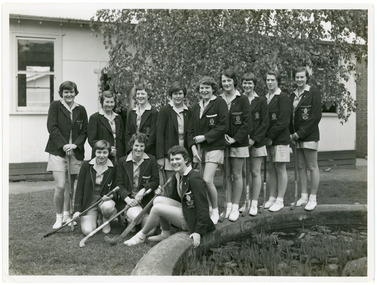
Photograph, Ruyton Girls' School, 1951
... Australia Medal for service to community health as a physiotherapist. She was also the recipient of the 2022 Victorian Senior Achiever Award at Parliament House. Helen passed away in July 2023 at age 88. The record's significance is further enhanced by its strong provenance, having been produced by Ruyton Girls' School and donated to the Archives by a familial connection. ...The photograph depicts 12 young women students who were part of the 1951 Ruyton Girls' School hockey team. The students are all dressed in light coloured shorts with a collared, buttoned blouse, wool blazers, white socks and white sneakers. Three girls are kneeling in the front row, and nine are standing up in the back row. All of the students are holding their own hockey stick. The photograph was taken on School grounds, next to a pond which is no longer in existence at Ruyton. The idea of field hockey for female players was brought to Victoria by two sisters, Lillian and Margaret Irving, who had first seen girls playing it during their travels in England in 1902. By 1903, the Irving sisters were joint headmistresses of Lauriston, a school they had founded two years earlier. Both had deep connections to Ruyton Girls' School through their time as teachers at the older school during the 1880s-1890s. For Lilian Irving, this had included seven years as Ruyton's co-Principal with Miss Eliza Bromby from 1888-1895. With these links it was only natural that Ruyton students would join Lauriston to try out the new game. On a vacant block on the corner of Mercer and Malvern Roads, students from Ruyton and Lauriston Girls' Schools had assembled to play Victoria’s first ever inter-school hockey match for girls. Some students from Melbourne Girls' Grammar School came along to watch the spectacle and assess the new game's potential. Hockey quickly caught on, and friendly games were soon being played amongst a number of Melbourne's girls' schools. An Association was formed in 1905, and the rules formalised. These included arrangements around the competition fixture and the length of games (35 minutes for each half). In celebration of their joint role in bringing field hockey to Victorian school girls, Ruyton and Lauriston have met for friendly re-enactment matches in 2003 and 2018. The photograph also illustrates the shift in hockey uniform and apparatus. In the early 1920s, Ruyton established instructions for playing attire: "skirts must be eight inches off the ground. No white petticoats...", and importantly, least any team get an unfair advantage, "hard-rimmed hats and hatpins must not be worn during play." Ruyton appears to have taken the latter instruction to heart, and adopted the soft tam o’shanter hat as seen in surviving photographs of early teams. The tam o’shanter may have been removed for play, but the blouse and long skirt had to be put up with. According to Lilian Irving they had "a horrid habit of parting company", and she was delighted to see the transition to a more comfortable tunic in later years. Another change she observed was the hockey stick itself, which originally were all of "uniform thickness from handle to head, about the thickness of a stout walking stick" and so very different from the hockey sticks that are used today.The record has strong historic significance as it depicts a former notable student, Helen Gordon (maiden name Cole), pictured third from the right in the front row. Helen started at Little Ruyton in Prep 1940 and finished Year 12 in 1952 as School Captain, Bromby Captain, Form Captain for Matric, Tennis Captain, Hockey Captain, Swimming Vice Captain, and an award for Best All-Round Girl. She also played baseball for Victoria. After finishing school, Helen went on to graduate from the University of Melbourne as a physiotherapist in 1956. Her first position at age 19 involved setting up clinics with the Victorian Health Department Poliomyelitis Rural division. Helen’s strong ties to Ruyton continued when she held the position of President of the Old Ruytonians’ Association from the start of 1966 to the end of 1967. In 2019, Helen received an Order of Australia Medal for service to community health as a physiotherapist. She was also the recipient of the 2022 Victorian Senior Achiever Award at Parliament House. Helen passed away in July 2023 at age 88. The record's significance is further enhanced by its strong provenance, having been produced by Ruyton Girls' School and donated to the Archives by a familial connection.Black and white rectangular photograph printed on matte photographic paper.Reverse: Felicity Jacobs / Ann Dickinson / RGS011/1951/0002 /ruyton girls' school, ruyton, hockey, sport, school sport, field hockey, kew, melbourne, girls school, students, school uniform -
 Ruyton Girls' School
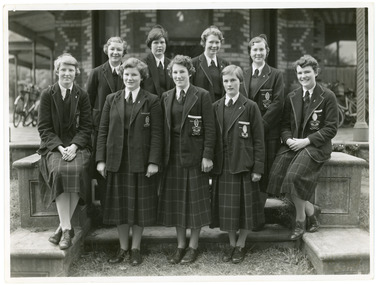
Photograph, Ruyton Girls' School, 1951
... Australia Medal for service to community health as a physiotherapist. She was also the recipient of the 2022 Victorian Senior Achiever Award at Parliament House. Helen passed away in July 2023 at age 88. The record's significance is further enhanced by its strong provenance, having been produced by Ruyton Girls' School and donated to the Archives by a familial connection. ...Depicted are nine Ruyton Girls' School prefects for the 1951 school year. The image is a formal school portrait taken outdoors on school grounds outside of Henty House (formerly Tarring). In the background, we can see three bicycles with cane baskets. The students are all dressed in knee-length check skirts, a dark jumper, light-coloured collared button-up blouse with a dark tie, wool blazers, and dark coloured shoes. Four girls are standing in the back row, and five are positioned in the front row. Students in the back row have been identified from left to right as M. Murray, B. Addison, T. Abson and H. Cole; in the front row, from left to right we can see S. Backhouse, J. Wigg (Vice Captain), F. Jacobs (Captain), E. Duff, and A. Dickinson. The same photograph appears in the Ruytonian 1951. Student leadership commenced at Ruyton Girls' School in 1906 with the introduction of the prefect system. Prefects had numerous responsibilities—gate duty, grounds duty, classroom marking, assembly door watch, uniform monitoring, and even supervising student detention. In 1947, a dedicated Prefects Room was erected on the east side of the Ruyton Girls' School Assembly Room in Henty House. The prefects system was revised in 1968 with a new leadership structure: there would be a permanent School Captain, Vice Captain and School Sports Captain; six permanent prefects would be elected, and the rest of the Matriculation class would form committees. These included Library, Social Services, S.C.M., Editorial, and Music. In this way, it was thought "that each Matric girl would have a certain amount of responsibility." With this revised structure came a brand new Prefects' Study, located in a former classroom next to the Domestic Science building. Each prefect was allocated one book locker, one clothing locker, "a small share in the heater", plus a new shared lounge. The prefect system was updated again in 1974. All sixth formers would become prefects, or "school officials." This saw the sixth form divided into two halves: one group would be prefects for the first half of the year, then the second group would take the reigns in the latter half of the year. In October 2023, Ruyton announced a new collaborative leadership structure for captains, prefects and house leaders, which would see two students in each leadership role.The record has strong historic significance as it depicts a former notable student, Helen Gordon (maiden name Cole), pictured third from the right in the front row. Helen started at Little Ruyton in Prep 1940 and finished Year 12 in 1952 as School Captain, Bromby Captain, Form Captain for Matric, Tennis Captain, Hockey Captain, Swimming Vice Captain, and an award for Best All-Round Girl. She also played baseball for Victoria. After finishing school, Helen went on to graduate from the University of Melbourne as a physiotherapist in 1956. Her first position at age 19 involved setting up clinics with the Victorian Health Department Poliomyelitis Rural division. Helen’s strong ties to Ruyton continued when she held the position of President of the Old Ruytonians’ Association from the start of 1966 to the end of 1967. In 2019, Helen received an Order of Australia Medal for service to community health as a physiotherapist. She was also the recipient of the 2022 Victorian Senior Achiever Award at Parliament House. Helen passed away in July 2023 at age 88. The record's significance is further enhanced by its strong provenance, having been produced by Ruyton Girls' School and donated to the Archives by a familial connection.Black and white rectangular photograph printed on matte photographic paper.Reverse: Felicity Jacobs / Judi Olsen / Ann Dickinson / Bev. Addison / RGS011/1951/0004 /ruyton girls' school, ruyton, students, school, senior school, girls school, kew, melbourne, school uniform, prefects, photograph, henry henty, henty house, marion henty, tarring -
 Victorian Aboriginal Corporation for Languages
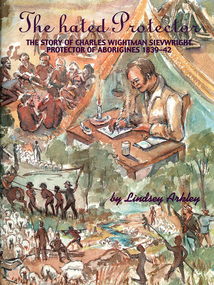
Book, Lindsey Arkley, The hated protector : the story of Charles Wightman Sievwright, protector of Aborigines 1839-42, 2000
... Australian history, particularly in the years of first contact between British settlers and the Aborigines. More broadly, it should also appeal to anyone interested a story of one man's battle against overwhelming odds, where the price of failure was numerous deaths. It is a story of hatred, prejudice, courage, determination, and hope. In telling Sievwright's story, Lindsey Arkley draws largely on original archival...Australian history, particularly in the years of first contact between British settlers and the Aborigines. More broadly, it should also appeal to anyone interested a story of one man's battle against overwhelming odds, where the price of failure was numerous deaths. It is a story of hatred, prejudice, courage, determination, and hope. In telling Sievwright's story, Lindsey Arkley draws largely on original archival ..."The hated Protector" tells for the first time the real story behind the extraordinary experiences of Charles Sievwright, Assistant Aboriginal Protector from 1839-42 in what was then part of the British colony of New South Wales, but is now the Western District of the Australian state of Victoria. Sievwright, an Edinburgh-born former British army officer, lived in the bush with his young family as he tried to save the Aborigines of the District from extinction. In doing so, he would isolate himself from the rest of his fellow whites. The hated Protector tells of this process. The book should appeal to anyone interested in British colonial and Australian history, particularly in the years of first contact between British settlers and the Aborigines. More broadly, it should also appeal to anyone interested a story of one man's battle against overwhelming odds, where the price of failure was numerous deaths. It is a story of hatred, prejudice, courage, determination, and hope. In telling Sievwright's story, Lindsey Arkley draws largely on original archival material, including official reports, journals and letters, found in Melbourne, Sydney, Hobart, Edinburgh and London. Most has never before been published. The archival material is supplemented by contemporary newspaper accounts, and some oral history. Full notes are given to all sources, and the book is indexed and lavishly illustrated with drawings by Joan Bognuda, as well as about 80 paintings and samples of documents. Contents: 1. In the bush 2. "Equal and indiscriminate justice" 3. "A few doses of lead" 4. "A curse to the land" 5. "The most unpopular man" 6. Retaliation 7. A hostage debate 8. Hallucinations 9. A mass escape 10. Possessors of the soil 11. Move to Keilambete 12. Bureaucratic 13. "A hideous pandemonium" 14. Divine visitations 15. Pay backs 16. Explanations 17. A squatter on trial 18. Claptrap and deceit 19. The black cap - 20. To Mt Rouse 21. "The impending evil" 22. In the balance 23. An arrest at Mt Rouse 24. A fair moral name 25. Roger's trial 16. Intensified evidence 27. A declaration of war 28. Mr Cold Morning 29. Holding ranks 30. To rags 31. Fightback 32. Return to London 33. The inquiry 34. Judgement 35. And what remains.maps, document reproductions, b&w photographs, colour photographs, b&w illustrationscharles wightman sievwright, racial policies, british colonial history, race relations, victorian history -
 Victorian Aboriginal Corporation for Languages
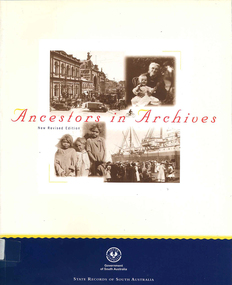
Book, State Records of South Australia, Ancestors in archives : a guide for family historians to South Australia's government archives, 2000
... : a guide for family historians to South Australia's government archives Book State Records of South Australia ...A user friendly reference tool for historians - particularly family historians. Over 750 different series of records are described in a straightforward manner to guide users through this extensive collection.charts, b&w photographsgenealogy, state records of south australia, family history, south australian history -
 Victorian Aboriginal Corporation for Languages
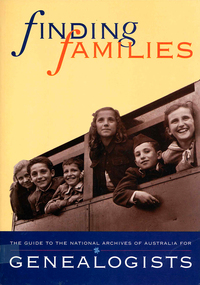
Book, Finding families : the guide to the National Archives of Australia for genealogists, 1998
... Finding families : the guide to the National Archives of Australia for genealogists Book Margaret Chambers ...The focus of this publication is on the range of records of most value to genealogists, those in which essential details of former lives are held. Exploring official records reveals the facts of these lives: of where and when and how men and women served their nation in wartime; or settled in a new country; or were employed on public projects; or were educated or assisted through Commonwealth government agencies.b&w photographs, copies of records, chartsgenealogy, local history, national archives of australia -
 Victorian Aboriginal Corporation for Languages
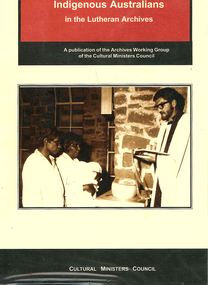
Book, Lutheran Church of Australia, A guide to records of Indigenous Australians in the Lutheran Archives, Adelaide, SA, 1999
... A guide to records of Indigenous Australians in the Lutheran Archives, Adelaide, SA. Book Lutheran Church of Australia ...A valuable resource in assisting Indigenous Australians to locate information from records, from 10 Lutheran Missions in SA, NT, Qld, held in Adelaide.tableslutheran church, lutheran archives, south australia, genealogy, northern territory, queensland -
 Victorian Aboriginal Corporation for Languages
Book, Records of national cultural significance : Indigenous Australians ; a report of the Archives Working Group of the Cultural Ministers Council, 1997
... archives archives directories historical sources b&w photographs Records of national cultural significance : Indigenous Australians ; a report of the Archives Working Group of the Cultural Ministers Council Book Stuartfield House Consulting Group ...b&w photographsarchives, archives directories, historical sources -
 Victorian Aboriginal Corporation for Languages
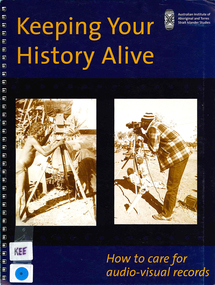
Book, Australian Institute of Aboriginal and Torres Strait Islander Studies Archives and Production Program, Keeping your history alive : how to care for audio-visual records : a guide for Aboriginal and Torres Strait Islander communities in the collection, care and handling of archival materials, 2001
... Keeping your history alive : how to care for audio-visual records : a guide for Aboriginal and Torres Strait Islander communities in the collection, care and handling of archival materials Book Australian Institute of Aboriginal and Torres Strait Islander Studies Archives and Production Program ...For those wanting to create a collection or to maintain an existing collection, this manual offers practical advice and explanations about audio-visual materials and their preservation.colour photographs, sample letters and documentsarchival materials, audio visual materials management, collection management -
 Robin Boyd Foundation
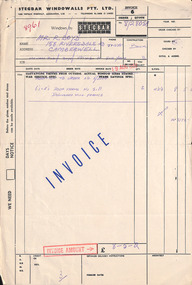
Document - Invoice, Stegbar Windowwalls Pty Ltd, 19.08.1958
... Australia from the 1950s to the 1970s. Boyd also designed the factory and showrooms for Stegbar Limited. The Walsh Street Archive...Australia from the 1950s to the 1970s. Boyd also designed the factory and showrooms for Stegbar Limited. The Walsh Street Archive ...Two invoices to Robin Boyd for the windowalls and additional door frames at 290 Walsh Street. The three windowwall items are drawn with specifications. In 1952-53, Robin Boyd designed the Stegbar ‘Windowall’ - a prefabricated, structural framing/glazing system - to create a wall of windows. These ‘Windowalls’ were used extensively in domestic architecture across Australia from the 1950s to the 1970s. Boyd also designed the factory and showrooms for Stegbar Limited. The Walsh Street Archive holds exterior and interior perspectives of the building. Two foolscap pages. stegbar, windowall, ohm2022, ohm2022_35 -
 Robin Boyd Foundation
Certificate, Honours and Awards, 1988
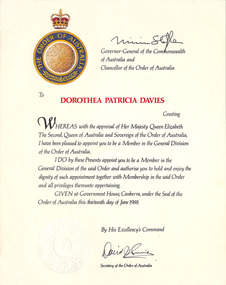
... As Penleigh Boyd wrote in his obituary to his mother: "In 1988, Patricia was appointed a Member of the Order of Australia for her service to opera involving many years of voluntary work on the Board of the Australian Opera - work which she greatly enjoyed involving travel, music and meeting many interesting and entertaining people. She was also a Life Member and former President of the National Gallery of Victoria Women's Association." The Walsh Street Archive...As Penleigh Boyd wrote in his obituary to his mother: "In 1988, Patricia was appointed a Member of the Order of Australia for her service to opera involving many years of voluntary work on the Board of the Australian Opera - work which she greatly enjoyed involving travel, music and meeting many interesting and entertaining people. She was also a Life Member and former President of the National Gallery of Victoria Women's Association." The Walsh Street Archive ...As Penleigh Boyd wrote in his obituary to his mother: "In 1988, Patricia was appointed a Member of the Order of Australia for her service to opera involving many years of voluntary work on the Board of the Australian Opera - work which she greatly enjoyed involving travel, music and meeting many interesting and entertaining people. She was also a Life Member and former President of the National Gallery of Victoria Women's Association." The Walsh Street Archive also holds the medal associated with this honour (item F126).Certificate on a presentation board with 4 corners holding it in place, contained in a envelope with Mrs Dorothea Patricia Davies, AM.The Order of Australia (Signed) Ninian Stephen Governor-General of Commonwealth of Australia and Chancellor of the Order of Australia. To Dorothea Patricia Davies Greeting. Whereas with the approval of Her Majesty Queen Elizabeth The second, Queen of Australia and Sovereign of the Order of Australia, I have been pleased to appoint you to be a Member in the General Division of the Order of Australia. I do by these Presents appoint you to be a Member in the General Division of the said Order and authorise you to hold and enjoy the dignity of such appointment together with Membership in the said Order and all privileges thereunto appertaining. Given at Government House, Canberra, under the seal of the Order of Australia this thirteenth day of June 1988. By His excellency's Command. (Signed) David I Smith Secretary of the Order of Australia. -
 Robin Boyd Foundation
Film, 1970
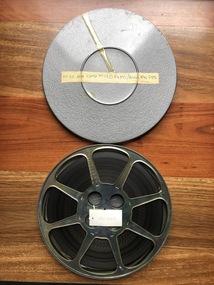
... Expo 70 Jack Johnson Tommy Burns Melbourne Cup Spencer Baldwin early australian film robin boyd 16mm black and white silent film inside a circular metal canister with lid. Duration-39:33 minutes. Head out - Loose archival ...This film is a curated collection of iconic early Australian films. There are three sequences. The first sequence consists of a segment of 1908 boxing match between Jack Johnson and Tommy Burns at Sydney Stadium, 1906 Hawthorn street scenes, and a 1909 VFL Football final. The second sequence consists of 1896 Melbourne Cup, 1906 Sydney street scenes and Baldwin Spencer footage of Australian indigenous ceremonial dance. The third sequence consists of a bush ranger scene from "Robbery Under Arms" (1920), a great escape scene from "The Sentimental Bloke" (1919) and Sydney Harbour boat chase from "Let George Do It" (1938). These sequences are repeated several times. These would have been selected by Robin Boyd for screening at the Australian Pavilion at Expo 70 in Osaka, where Robin Boyd was Exhibitions Architect. 16mm black and white silent film inside a circular metal canister with lid. Duration-39:33 minutes. Head out - Loose archival wind placed in archival film storage container.expo 70, jack johnson, tommy burns, melbourne cup, spencer baldwin, early australian film, robin boyd -
 RMIT Design Archives
Work on paper - Newsletters, Fashion-Able, 1984
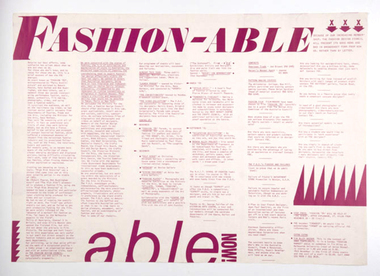
... Australia Newsletter describes the role, purpose and motivation of the FDC. It also lists the programme of events for November 1984 - September 1985 and includes minutes of the General Meeting held 16th June 1984. The newsletter was designed by graphic designer, Robert Pearce. The FDC ceased operation in 1983, and its archive... of some 1,500 artefacts is held at the RMIT Design Archives. fashion design australian fashion graphic design The Fashion Design Council of Australia Newsletter. ...The Fashion Design Council (FDC) was founded by Robert Buckingham, Kate Durham and Robert Pearce in 1983. This issue of the Fashion Design Council of Australia Newsletter describes the role, purpose and motivation of the FDC. It also lists the programme of events for November 1984 - September 1985 and includes minutes of the General Meeting held 16th June 1984. The newsletter was designed by graphic designer, Robert Pearce. The FDC ceased operation in 1983, and its archive of some 1,500 artefacts is held at the RMIT Design Archives.The Fashion Design Council of Australia Newsletter. It describes the role, purpose and motivation of the Fashion Design Council. It also lists the programme of events for November 1984 - September 1985 and incudes minutes of the General Meeting held 16th June 1984.fashion design, australian fashion, graphic design -
 RMIT Design Archives
Textile - Textile Design Sample
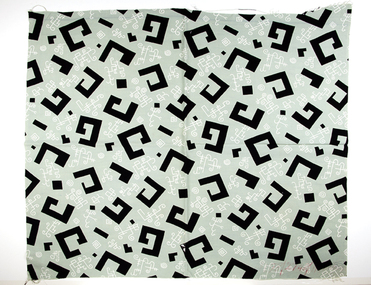
... Ann Carew, 2017 The textile design has aesthetic significance as an example of the early Australian work of noted emigre artist, designer and filmmaker, Stanislaus Ostoja-Kotkowski, and it has historical significance for its association with the Prestige's Textile Design Studio, and the studio's art director, Gerhard Herbst. emigre polish design textile design rmit design archives Small sample of pale green rayon fabric with a bold, repeating geometric pattern printed in black and white. ...The Polish born artist, designer and filmmaker, Stanislaus Ostoja-Kotkowski (1922-1944), who arrived in Melbourne in 1949 on the 'Fairsea', a ship carrying displaced persons from Europe and the Baltic States. He sought employment in architectural and design practices, and also enrolled in classes at the National Gallery School. From 1952 until 1953 Ostoja-Kotkowski had a brief, but productive, period working as a designer in the Prestige Fabric Design Studio in Melbourne. Ann Carew, 2017The textile design has aesthetic significance as an example of the early Australian work of noted emigre artist, designer and filmmaker, Stanislaus Ostoja-Kotkowski, and it has historical significance for its association with the Prestige's Textile Design Studio, and the studio's art director, Gerhard Herbst. Small sample of pale green rayon fabric with a bold, repeating geometric pattern printed in black and white.emigre, polish, design, textile design, rmit design archives -
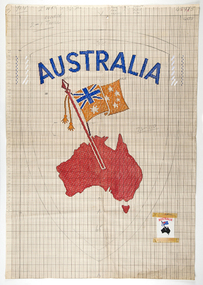 RMIT Design Archives
Mixed media - Drawings, Design for clothing label featuring map of Australia
... Cash's first began manufacturing name tags, woven badges and woven labels in Australia in 1913, and since then countless Cash's labels have been sewn onto school and club jumpers. Textile Design RMIT Design Archives Point paper design featuring map and flag. ...Cash's first began manufacturing name tags, woven badges and woven labels in Australia in 1913, and since then countless Cash's labels have been sewn onto school and club jumpers. Point paper design featuring map and flag. Corresponding clothing label attachedtextile design, rmit design archives -
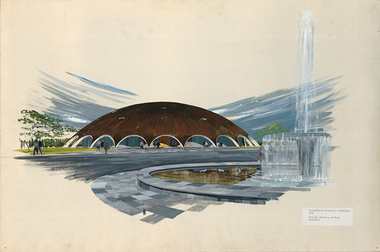 RMIT Design Archives
Work on paper - Paintings, Academy of Science, Canberra
... Australian science and promote international scientific engagement. Paul Wallace, a well-known Melbourne renderer, drew this perspective of the proposed design, possibly for the competition submission, in 1956. science canberra Architecture RMIT Design Archives design Printed text on attached sticker, 'ACADEMY OF SCIENCE, CANBERRA / 1958 / Grounds, Romberg and Boyd, / Architects'. ...The Shine Dome is one of seven projects that the Royal Australian Institute of Architects has nominated to the World Register of Significant Twentieth Century Architecture. In 1956 six architects were invited to submit plans for the Academy of Science's new building in Canberra and the Academy's building design committee selected Grounds Romberg and Boyd's proposal designed by Roy Grounds. It features a shallow arcaded concrete dome, sheeted in copper and was one of a number of domed buildings that appeared around this time internationally, expressing the optimism of the post-war years. It perfectly reflected the Academy's ambition to champion excellence in Australian science and promote international scientific engagement. Paul Wallace, a well-known Melbourne renderer, drew this perspective of the proposed design, possibly for the competition submission, in 1956.Coloured perspective of the Academy of Science buiding in Canberra.Printed text on attached sticker, 'ACADEMY OF SCIENCE, CANBERRA / 1958 / Grounds, Romberg and Boyd, / Architects'. Printed centre on verso, 'ACADEMY OF SCIENCE CANBERRA GROUND, ROMBERG AND BOYD ARCHITECTS 340 ALBERT STE., MELBOURNE C2'.science, canberra, architecture, rmit design archives, design -
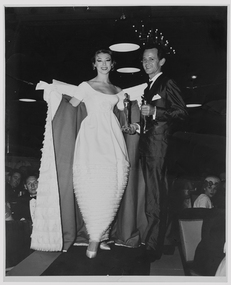 RMIT Design Archives
Photograph - Photographs, Photograph featuring Hall Ludlow and Diane Masters modelling Gown of the Year, 1959
... Archives. She has been and remains a key figure in Melbourne and Australian fashion. ...Archives. She has been and remains a key figure in Melbourne and Australian fashion. ...The Gown of the Year Program was a gala event in Melbourne's cultural calendar. Australia's supermodels of the day, such as Diane Masters (pictured), Bambi Shmith, and Betty Jackson modelled clothes by Melbourne's leading designers, Hall Ludlow, Le Louvre, and others. Diane Masters has played a seminal role in contributing to the Design Archives through her personal and professional fashion archive, her role in the Hall Ludlow collection and archive, the Laurie Carew collection, and her generosity in gifting items from the Frederick Romberg archive to the RMIT Design Archives. She has been and remains a key figure in Melbourne and Australian fashion. Suzanne Davies, 2017Black and white photograph features fashion designer Hall Ludlow (right), holding his trophies for winning the 1959 Gown of the Year at the Menzies Hotel, Melbourne. Model Diane Masters (right) is wearing the winning gown: a pale full length gown with short sleeves, scoop neck, and ruffled skirt. The matching coat also features small ruffled down its length.Verso: Stamped in black ink, bottom right: 'Photographed by/ ATHOL SHMITH/ F.R.P.S . . F.R.S.A/ 125 COLLINS STREET, MELBOURNE/ TELEPHONE MF 5[illegible]4australian fashion, fashion design, mid-century modern -
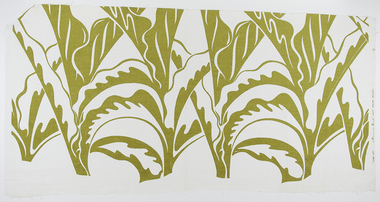 RMIT Design Archives
Textile lengths, Canna leaf
... Australian Flora...RMIT Design Archives...Textile Australian Flora RMIT Design Archives Printed on selvedge 'CANNA LEAF' a "Frances Burke" UNIT COLOUR DESIGN' Single colour screenprint, white fabric with chartreuse coloured print of positive large format design featuring large stylised canna leaf motif. ...Dr. Frances Mary Burke (1907 - 1994) was a textile designer and printer, businesswoman, artist and Australian design advocate and retailer. Burke’s modern abstract textile designs incorporated motifs and colours inspired by Australian Indigenous art, Pacific Island cultures, Australian flora and fauna, English gardens, and the sea and its wildlife. Following Burke’s death in 1994, her life-long companion Miss Fabie Chamberlain donated the contents of Burke’s studio to RMIT University.Single colour screenprint, white fabric with chartreuse coloured print of positive large format design featuring large stylised canna leaf motif.Printed on selvedge 'CANNA LEAF' a "Frances Burke" UNIT COLOUR DESIGN'textile, australian flora, rmit design archives -
 RMIT Design Archives
Photographs
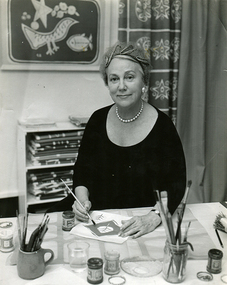
... Australian Textile Designer'. The photograph contains interesting contradictions: Burke, wearing a cocktail hat whilst painting, was never a housewife, nor did she have children. Gladys Hain, editor of the magazine, exhorted women who did have children to get busy, start businesses and contribute to the economy! The image highlights Burke's ability to attract publicity and demonstrates her acute understanding of the power of PR and marketing. Burke established her textile business in 1937, developing it between the wars in a very challenging marketplace by capitalising on opportunities as they presented. Robyn Oswald-Jacobs, 2017 Textile Design Studio RMIT Design Archives ...This photograph was reproduced on the cover of the magazine 'Housewife, Home and Family', in October, 1960 with the heading, 'Miss Frances Burke, Brilliant Australian Textile Designer'. The photograph contains interesting contradictions: Burke, wearing a cocktail hat whilst painting, was never a housewife, nor did she have children. Gladys Hain, editor of the magazine, exhorted women who did have children to get busy, start businesses and contribute to the economy! The image highlights Burke's ability to attract publicity and demonstrates her acute understanding of the power of PR and marketing. Burke established her textile business in 1937, developing it between the wars in a very challenging marketplace by capitalising on opportunities as they presented. Robyn Oswald-Jacobs, 2017Photograph featuring Frances Burke painting at desktextile design, studio, rmit design archives -
 RMIT Design Archives
Photograph - Photographs
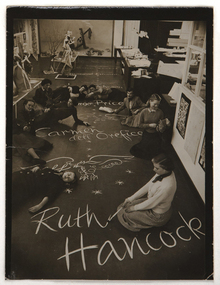
... It highlights the role that Myer Melbourne played in promoting the Textile Design Industry and Australian Fashion to the United States of America. carmen dell' orefice prestige textile studio ruth hancock margaret edwards fashion rmit design archives models usa USA MODELS / VISITING AUSTRALIA Black and white photograph of 8 models from the US, laying on the floor of the Prestige Studios. ...This photograph commemorates a visit by American Fashion Models to Prestige Textile Studio in July 1950. Melbourne’s Myer Emporium in conjunction with Neiman Marcus, Dallas, Texas presented the first American Fashion Parades in Australia in July 1950. Ruth Hancock, the leading model and buyer for Neiman Marcus, directed the Parades, and the eighteen year old modelling prodigy, Carmen dell’ Orefice, described by Cecil Beaton as ‘the world’s most beautiful woman’ was one of the stars of the runway. In a bid to encourage a market for Australian textiles in the United States, the models visited textile manufacturers and design studios in Melbourne, such as Yarra Falls Mills and Prestige Studios, one of Melbourne’s premier textile design studio. Ann Carew, 2020This photograph is historically significant for its association with Prestige Textile Studio, and it's association with the Australian Textile Industry. It highlights the role that Myer Melbourne played in promoting the Textile Design Industry and Australian Fashion to the United States of America.Black and white photograph of 8 models from the US, laying on the floor of the Prestige Studios. Names of the various models have been drawn on the floor from the foreground to the background of the photo, with eagles and stars in between each name.Models pictured include Ruth Hancock, Carmen Dell'Orefice, and Margaret Edwards.USA MODELS / VISITING AUSTRALIA carmen dell' orefice, prestige textile studio, ruth hancock, margaret edwards, fashion, rmit design archives, models, usa -
 RMIT Design Archives
Blueprints, Single Bed
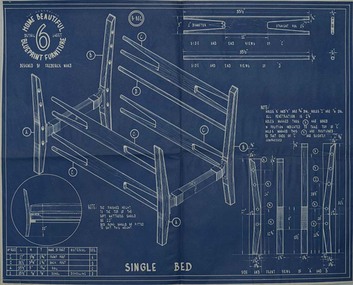
... At a time of austerity and shortages, Blueprint patters helped Australians furnish their modest homes with modern furniture they had made themselves. Nanette Carter, 2017 Furniture Patterns DIY RMIT Design Archives Fred Ward, Detail sheet for 'Home Beautiful Blueprint Furniture' No. 6, includes technical drawings and instructions, 1950-1951 Single Bed Blueprints Ward, Fred ...After his experience in designing moderately priced furniture in the 1930s and managing the construction of aircraft by an inexperienced workforce during World War II, designer Frederick Ward developed Patterncraft paper patterns. They were available by mail order through Australian Home Beautiful from 1947. For those with rudimentary skills Ward developed Timber-pack kits of components ready to glue and assemble. Blueprint, his subsequent project for the mass-market was launched in 1951. At a time of austerity and shortages, Blueprint patters helped Australians furnish their modest homes with modern furniture they had made themselves. Nanette Carter, 2017Fred Ward, Detail sheet for 'Home Beautiful Blueprint Furniture' No. 6, includes technical drawings and instructions, 1950-1951furniture, patterns, diy, rmit design archives -
 RMIT Design Archives
Record sleeve, The Pines of Rome - Respighi
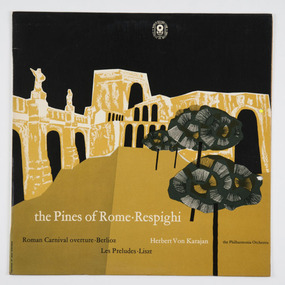
... It is regarded now as one of most representative collection of Australian designers’ work of its period, and highlights the years of transition from ‘commercial art’ to ‘graphic design’. The album cover was donated to the Archive...It is regarded now as one of most representative collection of Australian designers’ work of its period, and highlights the years of transition from ‘commercial art’ to ‘graphic design’. The album cover was donated to the Archive ...Max Robinson (1934-2018) designed this record sleeve for the World Record Club in 1961. Robinson studied for a year at the Melbourne Technical College (RMIT University), and in his early career worked for Peter Clemenger and the graphic designer, Max Forbes. He produced a number of striking record covers for the World Record Club in the late 1950s and early 1960s. Robinson’s work is familiar to many Australians – he designed the new $10 note in 1993, which featured Banjo Paterson and Dame Mary Gilmore. The World Record Club’s operated in Melbourne from 1957 until 1976; it was a mail order service, and its art director, Geoff Digby commissioned young designers and artist to design the record sleeves. It is regarded now as one of most representative collection of Australian designers’ work of its period, and highlights the years of transition from ‘commercial art’ to ‘graphic design’. The album cover was donated to the Archive by the World Record Club’s art director, Geoff Digby. Ann Carew, 2020This record sleeve is historically significant for its association with Max Robinson, who was inducted into the Australian Graphic Design Association’s (AGDA) Hall of Fame in recognition for his work as graphic artist, but also his tireless advocacy for graphic design in Australia. It is aesthetically significant as an early example of the design work of Max Robinson. It is historically significant for its association with the World Record Club, an organisation that produced a representative collection of Australian graphic designers’ work from 1957 until 1976. the Pines of Rome . Respighi / Roman Carnival overture . Berlioz / Herbert Von Karajan / the Philharmonia Orchestra / Les Preludes . Lisztworld record club, max robinson, rmit university, rmit design archives, geoff digby, record sleeve design, graphic design -
 RMIT Design Archives
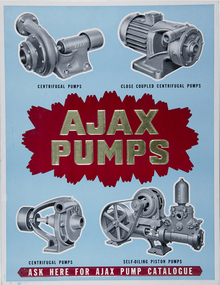
Advertising signs, Ajax Pumps
... One of Australia’s most acclaimed printmakers, Grahame King originally trained as a commercial artist in the mid-1930s. The Design Archives...One of Australia’s most acclaimed printmakers, Grahame King originally trained as a commercial artist in the mid-1930s. The Design Archives ...One of Australia’s most acclaimed printmakers, Grahame King originally trained as a commercial artist in the mid-1930s. The Design Archives holds a collection of embossed advertising showcards designed by King in the 1950s which reveal examples of graphic design and typography in post-war Melbourne. The showcards were used by iconic companies for advertising and promotion on shop counters and in window displays and were produced by Firestone Embossed Showcards. Megan Atkins, 2017 Sign shows centrifugal pumps, close coupled centrifugal pumps and self-oiling piston pumps.Printed text bottom left on verso, Firestone embossed showcards PTY. LTDshowcards, advertising, graphic design, commercial art, artist -
 RMIT Design Archives
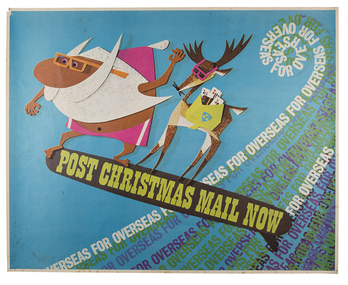
Posters, Post Christmas Mail Now For Overseas
... Ann Carew, 2017 Australia Post Christmas RMIT Design Archives Post Christmas Mail Now For Overseas Posters Whittenbury, John ...In the days before television advertising and the WWW, commercial artists such as John Whittenbury designed posters, railway billboards and trade exhibitions advertising products and services to the masses. Whittenbury’s series of quirky Christmas mail posters for the Post Masters General Office, now known as Australia Post, were displayed in post offices across Australia. He had a wealth of experience in the field, having worked as an illustrator, graphic designer, cartoonist, and mechanical draftsman for the RAAF in Laverton and then Victoria Barracks, and also taking out a qualification in Advertising Art from RMIT in 1961, prior to joining the PMG. Ann Carew, 2017 australia post, christmas, rmit design archives -
 RMIT Design Archives
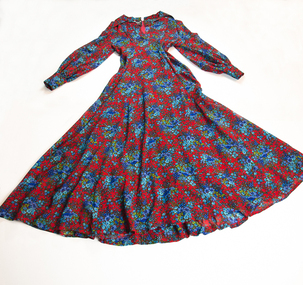
Textile - Woman's dress, Norma Tullo, Garment Designer, Shirley Lyle, Textile Designer, Woman's Dress
... During this period the Australian Wool Industry strove to promote wool, and to develop light woollen fabrics to compete with new synthetic fibres such as rayon. The garment is historically significant for the use of a merino wool showcasing its versatility for dress fabrics. wool rmit design archives rmit university woman's dress textile design australian fashion Inscribed, black label on back neck left of zip, 'TULLO/IN/PEPPINELLA/AUSTRALIA MERINO WOOL'; Inscribed, white satin label on back neck right of zip, 'DRY CLEAN ONLY'; Inscribed, white satin label underneath above label, 'SIZE 12/To Fit Bust 34"/To Fit Waist Full length woman's dress with full skirt and long sleeves, collared with open neck and pleat work on bodice. ...This light woollen evening dress is made from Peppinella, a new fabric Norma Tullo introduced into her range in 1973. The fabric was used exclusively by Tullo, and came from the wool of Peppin Merino (first introduced into Australia in 1858 by the Peppin brothers). According to the papers of the day Tullo’s 1973 winter collection featured ‘St. Trinian’s styles to garments dripping lace, in bold plain colours to floral prints.” Shirley Lyle designed the floral fabric. Norma Tullo (1935-2019) was one of the leading fashion designers of her time, establishing her label in 1956. After establishing a business the Old Metropole Arcade in Melbourne in 1956, with three sewing machines, Tullo's ready to wear fashions for young women became sought after, and her business flourished. In 1966 the Japanese department store chain Isetan Co Ltd began to mass-produce her garments for their stores across Japan. Tullo closed her label in 1977, and later worked for Fletcher Jones. Ann Carew, 2020The dress is historically significant as a dress designed by Norma Tullo, a leading fashion designer of the 1960s and 1970s. During this period the Australian Wool Industry strove to promote wool, and to develop light woollen fabrics to compete with new synthetic fibres such as rayon. The garment is historically significant for the use of a merino wool showcasing its versatility for dress fabrics. Full length woman's dress with full skirt and long sleeves, collared with open neck and pleat work on bodice. Material is predominately red with a repeated pattern featuring posie of blue and mauve flowers.Inscribed, black label on back neck left of zip, 'TULLO/IN/PEPPINELLA/AUSTRALIA MERINO WOOL'; Inscribed, white satin label on back neck right of zip, 'DRY CLEAN ONLY'; Inscribed, white satin label underneath above label, 'SIZE 12/To Fit Bust 34"/To Fit Waistwool, rmit design archives, rmit university, woman's dress, textile design, australian fashion -
 Robin Boyd Foundation
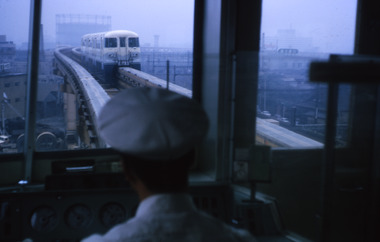
Slide, Robin Boyd, 1965
... During the 1960s he travelled several times to Japan to research these books and as part of his role as Exhibits Architect for the Australian Pavilion at Expo ‘70 in Osaka. The Walsh Street Archive has Boyd's handwritten manuscript 'Tokyo from the Monorail', published as ‘Modern Japan on a Concrete Beam’ in 'The Australian' 31/07/1965 (see item D001)....During the 1960s he travelled several times to Japan to research these books and as part of his role as Exhibits Architect for the Australian Pavilion at Expo ‘70 in Osaka. The Walsh Street Archive has Boyd's handwritten manuscript 'Tokyo from the Monorail', published as ‘Modern Japan on a Concrete Beam’ in 'The Australian' 31/07/1965 (see item D001). ...Robin Boyd wrote two books on Japanese architects and architecture - “Kenzo Tange” published by George Braziller in 1962 and “New Directions in Japanese Architecture” published by Studio Vista in 1968. During the 1960s he travelled several times to Japan to research these books and as part of his role as Exhibits Architect for the Australian Pavilion at Expo ‘70 in Osaka. The Walsh Street Archive has Boyd's handwritten manuscript 'Tokyo from the Monorail', published as ‘Modern Japan on a Concrete Beam’ in 'The Australian' 31/07/1965 (see item D001).Colour slide in a mount. The Tokyo Monorail, 1964, Tokyo, JapanMade in Australia / 14 / JUL 65M / Montreal Expo (Handwritten)tokyo, robin boyd, slide -
 National Wool Museum
Archive - Notebook, Kathryn Knitwear, 1947-1953
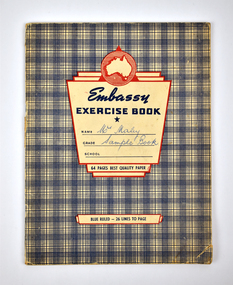
... The centre of the front cover has a trapezoidal label that provides space for handwritten labels, and features a map of Australia inside a red circle, as well as the manufacturers branding. The 64 internal pages are printed with blue lines as a writing guide. Archive ...Kathryn Knitwear, founded by Robert Blake, manufactured high quality children’s knitwear in Melbourne from the 1940s – 1980s. Robert Blake began manufacturing children’s knitwear in his bedroom in Strathmore using a hand powered machine in the late 1940s. The operation moved to Ascot Vale and Essendon, before eventually establishing a factory in Moonee Ponds in the early 1950s. The business continued to expand, necessitating a move to a new factory in Broadmeadows. By 1962, the Broadmeadows factory was producing an average of 20,000 garments per month, which increased to 24,000 by 1964. Robert Blake’s Son, Brendan recalls that “The Kathryn brand was famous around Australia, anywhere children needed to keep warm and dress smartly. It also won a number of wool fashion awards”, including the 1969 Wool Awards, which was held by the Australian Wool Bureau and published in Women’s Weekly. The Kathryn range was designed for durability, comfort and care, without sacrificing style. They used patterning techniques that increase stretchiness, comfort and fit, as well as integrating decorative elements into the fabric to prevent them from being bulky, uncomfortable or tight. Making longevity of style a priority, Brendan Blake remembers that “there was one particular garment that was in the range for at least thirty years”. He also recalls “In the past, when women have found out that I was associated with Kathryn Knitwear, they would often relate to me the story of a garment they had purchased or received as a gift and, when their child had grown out of it, they would hand it on to another child. Several ladies have told me of purchasing garments for their daughters’ glory box, or saving a particular garment after their daughter had grown out of it. Brendan Blake: “At the peak of their operation they employed approximately two hundred people, mainly women and girls. A family would often seek to send their daughter to work in this company because they knew they would be looked after and safe. One lady wrote to me telling me that working at the Moonee Ponds Factory prior to getting married was the happiest time of her life.” In 1963, workers at the Kathryn factory earned £13 per week, which was 8 shillings and 8 pence higher than the minimum weekly wage for female workers in the textile manufacturing industry (£12 11s 4d). By 1970, the Kathryn Knitwear brand expanded from children’s knitwear into womenswear under the brand name ‘Lady Kathryn’, and for boys and men under ‘Robert Blake’. Continuing to diversify their distribution, they also began exporting ‘Kathryn’ garments to New Zealand, the Pacific Islands, and Japan. ‘Kathryn Knitwear’ was well-known for their early adoption of modern materials and techniques that had broad appeal to their customer base. This is shown in their early use of the acrylic fibre ‘Orlon’ in the 50s and 60s and ‘Superwash’ wool in the 1970s. Many of Kathryn Knitwear’s styles, particularly those that were long running staples of the brand, were available in both wool and Orlon to suit the consumer’s preference. Far from the humble origins of one man in his bedroom with a hand-cranked machine; at its closure in 1980, the Broadmeadows factory of ‘Kathryn’ housed more than 100 machines, including 53 sewing machines and 45 knitting machines. Robert Blake was “a passionate advocate for wool and Australian Made” throughout his whole life. A strong thread that ties through the lifespan of Robert Blake and Kathryn Knitwear is a balance between adopting new innovations without sacrificing the core values of durability, comfort, care and style that had made the brand so well known. Their legacy forms an integral part of both Australian social and manufacturing history. The ‘Embassy’ brand was a house brand of Coles stores from 1929-1994, and manufactured a wide variety of household goods. The manufacture of this specific style of notebook can be dated to between 1947 and 1953.Notebook with handwritten instructions, formulas and sketches detailing patterns for samples. ‘Embassy’ exercise book cover is printed with a blue checked pattern on a background that was originally likely white, but appears cream due to discolouration. The centre of the front cover has a trapezoidal label that provides space for handwritten labels, and features a map of Australia inside a red circle, as well as the manufacturers branding. The 64 internal pages are printed with blue lines as a writing guide.[Obverse] Embassy EXERCISE BOOK NAME [handwritten] Mrs Maley GRADE [handwritten] Sample Book SCHOOL 64 PAGES BEST QUALITY PAPER BLUE RULED – 26 LINES TO PAGE [sample of internal pages] [left page] Notes: 34” = 3 garments out of 40” Length 32” = 3 “ “ “ 38 “ “ 30” = 28” = Cut together (26” = 4 garments “ “ 33” “ (24 = 4 garments “ “ 33” length Blue 36” Red 36 ½“ Green 36” Royal 35 ½” [right page] Design Esquire (Width 35 ½ - 36) Size 34” Width Yardage Size 32” Width Yardage Sample cotton 90 ribs for 28” Size 28” (sample size) Width cut to 20 ½ (double) Yardage 34 ½“ for 2 garm. Size 26” Width Yardage Size 24” Width Yardagebusiness, business history, manufacturing, knitting machine, fashion textile production, business archives, manufacturing documents, embassy brand, coles -
 National Wool Museum
Archive - Notebook, Kathryn Knitwear, c.1962
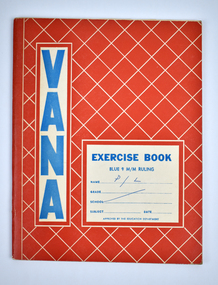
... Australian social and manufacturing history. Business Business history Manufacturing Knitting Machine Fashion Textile Production Business Archives Manufacturing Documents VANA [Obverse] VANA EXERCISE BOOK BLUE 9M/M RULING NAME [handwritten] P/L GRADE SCHOOL SUBJECT DATE APPROVED BY THE EDUCATION DEPARTMENT Notebook with handwritten tables and figures recording data about production and sales of Kathryn Knitwear from 1962-1963. ...Kathryn Knitwear, founded by Robert Blake, manufactured high quality children’s knitwear in Melbourne from the 1940s – 1980s. Robert Blake began manufacturing children’s knitwear in his bedroom in Strathmore using a hand powered machine in the late 1940s. The operation moved to Ascot Vale and Essendon, before eventually establishing a factory in Moonee Ponds in the early 1950s. The business continued to expand, necessitating a move to a new factory in Broadmeadows. By 1962, the Broadmeadows factory was producing an average of 20,000 garments per month, which increased to 24,000 by 1964. Robert Blake’s Son, Brendan recalls that “The Kathryn brand was famous around Australia, anywhere children needed to keep warm and dress smartly. It also won a number of wool fashion awards”, including the 1969 Wool Awards, which was held by the Australian Wool Bureau and published in Women’s Weekly. The Kathryn range was designed for durability, comfort and care, without sacrificing style. They used patterning techniques that increase stretchiness, comfort and fit, as well as integrating decorative elements into the fabric to prevent them from being bulky, uncomfortable or tight. Making longevity of style a priority, Brendan Blake remembers that “there was one particular garment that was in the range for at least thirty years”. He also recalls “In the past, when women have found out that I was associated with Kathryn Knitwear, they would often relate to me the story of a garment they had purchased or received as a gift and, when their child had grown out of it, they would hand it on to another child. Several ladies have told me of purchasing garments for their daughters’ glory box, or saving a particular garment after their daughter had grown out of it. Brendan Blake: “At the peak of their operation they employed approximately two hundred people, mainly women and girls. A family would often seek to send their daughter to work in this company because they knew they would be looked after and safe. One lady wrote to me telling me that working at the Moonee Ponds Factory prior to getting married was the happiest time of her life.” In 1963, workers at the Kathryn factory earned £13 per week, which was 8 shillings and 8 pence higher than the minimum weekly wage for female workers in the textile manufacturing industry (£12 11s 4d). By 1970, the Kathryn Knitwear brand expanded from children’s knitwear into womenswear under the brand name ‘Lady Kathryn’, and for boys and men under ‘Robert Blake’. Continuing to diversify their distribution, they also began exporting ‘Kathryn’ garments to New Zealand, the Pacific Islands, and Japan. ‘Kathryn Knitwear’ was well-known for their early adoption of modern materials and techniques that had broad appeal to their customer base. This is shown in their early use of the acrylic fibre ‘Orlon’ in the 50s and 60s and ‘Superwash’ wool in the 1970s. Many of Kathryn Knitwear’s styles, particularly those that were long running staples of the brand, were available in both wool and Orlon to suit the consumer’s preference. Far from the humble origins of one man in his bedroom with a hand-cranked machine; at its closure in 1980, the Broadmeadows factory of ‘Kathryn’ housed more than 100 machines, including 53 sewing machines and 45 knitting machines. Robert Blake was “a passionate advocate for wool and Australian Made” throughout his whole life. A strong thread that ties through the lifespan of Robert Blake and Kathryn Knitwear is a balance between adopting new innovations without sacrificing the core values of durability, comfort, care and style that had made the brand so well known. Their legacy forms an integral part of both Australian social and manufacturing history.Notebook with handwritten tables and figures recording data about production and sales of Kathryn Knitwear from 1962-1963. ‘VANA’ exercise book cover is printed with a white square check on the diagonal, on a red background. Large blue block letters spelling VANA appear in a white rectangle down the lefthand side. A White rectangle blue lettering provides space for handwritten labels, handwritten inside it is P/L on the top line.The internal pages are printed with blue lines as a writing guide, and contain handwritten notes and tables in red and blue ink.[Obverse] VANA EXERCISE BOOK BLUE 9M/M RULING NAME [handwritten] P/L GRADE SCHOOL SUBJECT DATE APPROVED BY THE EDUCATION DEPARTMENTbusiness, business history, manufacturing, knitting machine, fashion textile production, business archives, manufacturing documents, vana -
 National Wool Museum
Archive - Price List, Kathryn Knitwear, 1972
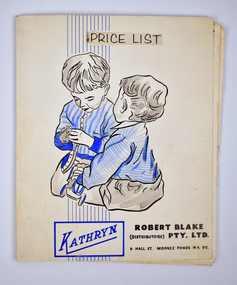
... Australian social and manufacturing history. Business Business history Manufacturing Knitting Machine Fashion Textile Production Business Archives Manufacturing Documents Children's Knitwear Children's clothing [Obverse] PRICE LIST KATHRYN ROBERT BLAKE (DISTRIBUTORS) PTY. ...Kathryn Knitwear, founded by Robert Blake, manufactured high quality children’s knitwear in Melbourne from the 1940s – 1980s. Robert Blake began manufacturing children’s knitwear in his bedroom in Strathmore using a hand powered machine in the late 1940s. The operation moved to Ascot Vale and Essendon, before eventually establishing a factory in Moonee Ponds in the early 1950s. The business continued to expand, necessitating a move to a new factory in Broadmeadows. By 1962, the Broadmeadows factory was producing an average of 20,000 garments per month, which increased to 24,000 by 1964. Robert Blake’s Son, Brendan recalls that “The Kathryn brand was famous around Australia, anywhere children needed to keep warm and dress smartly. It also won a number of wool fashion awards”, including the 1969 Wool Awards, which was held by the Australian Wool Bureau and published in Women’s Weekly. The Kathryn range was designed for durability, comfort and care, without sacrificing style. They used patterning techniques that increase stretchiness, comfort and fit, as well as integrating decorative elements into the fabric to prevent them from being bulky, uncomfortable or tight. Making longevity of style a priority, Brendan Blake remembers that “there was one particular garment that was in the range for at least thirty years”. He also recalls “In the past, when women have found out that I was associated with Kathryn Knitwear, they would often relate to me the story of a garment they had purchased or received as a gift and, when their child had grown out of it, they would hand it on to another child. Several ladies have told me of purchasing garments for their daughters’ glory box, or saving a particular garment after their daughter had grown out of it. Brendan Blake: “At the peak of their operation they employed approximately two hundred people, mainly women and girls. A family would often seek to send their daughter to work in this company because they knew they would be looked after and safe. One lady wrote to me telling me that working at the Moonee Ponds Factory prior to getting married was the happiest time of her life.” In 1963, workers at the Kathryn factory earned £13 per week, which was 8 shillings and 8 pence higher than the minimum weekly wage for female workers in the textile manufacturing industry (£12 11s 4d). By 1970, the Kathryn Knitwear brand expanded from children’s knitwear into womenswear under the brand name ‘Lady Kathryn’, and for boys and men under ‘Robert Blake’. Continuing to diversify their distribution, they also began exporting ‘Kathryn’ garments to New Zealand, the Pacific Islands, and Japan. ‘Kathryn Knitwear’ was well-known for their early adoption of modern materials and techniques that had broad appeal to their customer base. This is shown in their early use of the acrylic fibre ‘Orlon’ in the 50s and 60s and ‘Superwash’ wool in the 1970s. Many of Kathryn Knitwear’s styles, particularly those that were long running staples of the brand, were available in both wool and Orlon to suit the consumer’s preference. Far from the humble origins of one man in his bedroom with a hand-cranked machine; at its closure in 1980, the Broadmeadows factory of ‘Kathryn’ housed more than 100 machines, including 53 sewing machines and 45 knitting machines. Robert Blake was “a passionate advocate for wool and Australian Made” throughout his whole life. A strong thread that ties through the lifespan of Robert Blake and Kathryn Knitwear is a balance between adopting new innovations without sacrificing the core values of durability, comfort, care and style that had made the brand so well known. Their legacy forms an integral part of both Australian social and manufacturing history.8 page booklet containing price list for winter 1972. Hand-drawn illustration on front of booklet depicts two young boys in striped jumpers in shades of blue and brown. Internal pages of booklet contain a table in landscape orientation printed in black ink containing Style number, description, pricing for given sizes, and available colours. It has “Mr Robert” handwritten in blue ink in the top right corner and is annotated in red ink.[Obverse] PRICE LIST KATHRYN ROBERT BLAKE (DISTRIBUTORS) PTY. LTD business, business history, manufacturing, knitting machine, fashion textile production, business archives, manufacturing documents, children's knitwear, children's clothing -
 National Wool Museum
Drawing - Illustration, Kathryn Knitwear, c.1961-1972
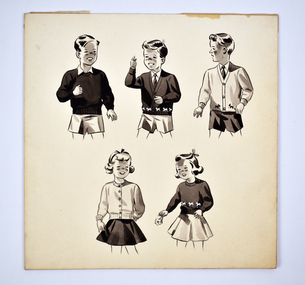
... Australian social and manufacturing history. Business Business history Manufacturing Knitting Machine Fashion Textile Production Business Archives Manufacturing Documents Textile Industry - history Wool Marketing Wool Marketing Fashion Textile Industry Original illustration artwork on cream matboard/card inked in shades of grey and black. ...Kathryn Knitwear, founded by Robert Blake, manufactured high quality children’s knitwear in Melbourne from the 1940s – 1980s. Robert Blake began manufacturing children’s knitwear in his bedroom in Strathmore using a hand powered machine in the late 1940s. The operation moved to Ascot Vale and Essendon, before eventually establishing a factory in Moonee Ponds in the early 1950s. The business continued to expand, necessitating a move to a new factory in Broadmeadows. By 1962, the Broadmeadows factory was producing an average of 20,000 garments per month, which increased to 24,000 by 1964. Robert Blake’s Son, Brendan recalls that “The Kathryn brand was famous around Australia, anywhere children needed to keep warm and dress smartly. It also won a number of wool fashion awards”, including the 1969 Wool Awards, which was held by the Australian Wool Bureau and published in Women’s Weekly. The Kathryn range was designed for durability, comfort and care, without sacrificing style. They used patterning techniques that increase stretchiness, comfort and fit, as well as integrating decorative elements into the fabric to prevent them from being bulky, uncomfortable or tight. Making longevity of style a priority, Brendan Blake remembers that “there was one particular garment that was in the range for at least thirty years”. He also recalls “In the past, when women have found out that I was associated with Kathryn Knitwear, they would often relate to me the story of a garment they had purchased or received as a gift and, when their child had grown out of it, they would hand it on to another child. Several ladies have told me of purchasing garments for their daughters’ glory box, or saving a particular garment after their daughter had grown out of it. Brendan Blake: “At the peak of their operation they employed approximately two hundred people, mainly women and girls. A family would often seek to send their daughter to work in this company because they knew they would be looked after and safe. One lady wrote to me telling me that working at the Moonee Ponds Factory prior to getting married was the happiest time of her life.” In 1963, workers at the Kathryn factory earned £13 per week, which was 8 shillings and 8 pence higher than the minimum weekly wage for female workers in the textile manufacturing industry (£12 11s 4d). By 1970, the Kathryn Knitwear brand expanded from children’s knitwear into womenswear under the brand name ‘Lady Kathryn’, and for boys and men under ‘Robert Blake’. Continuing to diversify their distribution, they also began exporting ‘Kathryn’ garments to New Zealand, the Pacific Islands, and Japan. ‘Kathryn Knitwear’ was well-known for their early adoption of modern materials and techniques that had broad appeal to their customer base. This is shown in their early use of the acrylic fibre ‘Orlon’ in the 50s and 60s and ‘Superwash’ wool in the 1970s. Many of Kathryn Knitwear’s styles, particularly those that were long running staples of the brand, were available in both wool and Orlon to suit the consumer’s preference. Far from the humble origins of one man in his bedroom with a hand-cranked machine; at its closure in 1980, the Broadmeadows factory of ‘Kathryn’ housed more than 100 machines, including 53 sewing machines and 45 knitting machines. Robert Blake was “a passionate advocate for wool and Australian Made” throughout his whole life. A strong thread that ties through the lifespan of Robert Blake and Kathryn Knitwear is a balance between adopting new innovations without sacrificing the core values of durability, comfort, care and style that had made the brand so well known. Their legacy forms an integral part of both Australian social and manufacturing history.Original illustration artwork on cream matboard/card inked in shades of grey and black. Used for marketing. Depicts Five figures of children in iconic Kathryn knitwear styles. The boy on the top left wears a dark crew neck jumper over a pale collared short with shorts. The two other boys on the top row (at centre and right) are depicted in very similar outfits, though the shades of their clothing differ. They are both shown in v-neck cardigans with three buttons and a colourwork animal motif at the hem over a pale suit with a dark tie. The figure at the centre has a dark cardigan and pale shorts, while the figure at the right has a light cardigan and dark shorts. The two figures on the bottom row are both girls wearing flared skirts with bows in their hair. They both wear crewnecks, the figure on the left wears a pale cardigan with six buttons down the front, while the right wears a dark jumper with two buttons on the shoulder and an animal motif at the hem. The jumper on the girl on the right is the same style as NWM-08893. There is tape still affixed to the back of the boardbusiness, business history, manufacturing, knitting machine, fashion textile production, business archives, manufacturing documents, textile industry - history wool marketing, wool marketing fashion textile industry -
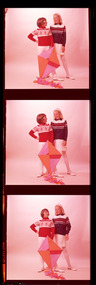 National Wool Museum
Slide - Marketing Portraits, c.1970-1980
... Australian social and manufacturing history. Business Business history Manufacturing Knitting Machine Fashion Textile Production Business Archives Manufacturing Documents Textile Industry - history Wool Marketing Wool Marketing Fashion Textile Industry Children's Knitwear Children's clothing Knitwear Marketing A strip of three medium format colour transparencies. ...Kathryn Knitwear, founded by Robert Blake, manufactured high quality children’s knitwear in Melbourne from the 1940s – 1980s. Robert Blake began manufacturing children’s knitwear in his bedroom in Strathmore using a hand powered machine in the late 1940s. The operation moved to Ascot Vale and Essendon, before eventually establishing a factory in Moonee Ponds in the early 1950s. The business continued to expand, necessitating a move to a new factory in Broadmeadows. By 1962, the Broadmeadows factory was producing an average of 20,000 garments per month, which increased to 24,000 by 1964. Robert Blake’s Son, Brendan recalls that “The Kathryn brand was famous around Australia, anywhere children needed to keep warm and dress smartly. It also won a number of wool fashion awards”, including the 1969 Wool Awards, which was held by the Australian Wool Bureau and published in Women’s Weekly. The Kathryn range was designed for durability, comfort and care, without sacrificing style. They used patterning techniques that increase stretchiness, comfort and fit, as well as integrating decorative elements into the fabric to prevent them from being bulky, uncomfortable or tight. Making longevity of style a priority, Brendan Blake remembers that “there was one particular garment that was in the range for at least thirty years”. He also recalls “In the past, when women have found out that I was associated with Kathryn Knitwear, they would often relate to me the story of a garment they had purchased or received as a gift and, when their child had grown out of it, they would hand it on to another child. Several ladies have told me of purchasing garments for their daughters’ glory box, or saving a particular garment after their daughter had grown out of it. Brendan Blake: “At the peak of their operation they employed approximately two hundred people, mainly women and girls. A family would often seek to send their daughter to work in this company because they knew they would be looked after and safe. One lady wrote to me telling me that working at the Moonee Ponds Factory prior to getting married was the happiest time of her life.” In 1963, workers at the Kathryn factory earned £13 per week, which was 8 shillings and 8 pence higher than the minimum weekly wage for female workers in the textile manufacturing industry (£12 11s 4d). By 1970, the Kathryn Knitwear brand expanded from children’s knitwear into womenswear under the brand name ‘Lady Kathryn’, and for boys and men under ‘Robert Blake’. Continuing to diversify their distribution, they also began exporting ‘Kathryn’ garments to New Zealand, the Pacific Islands, and Japan. ‘Kathryn Knitwear’ was well-known for their early adoption of modern materials and techniques that had broad appeal to their customer base. This is shown in their early use of the acrylic fibre ‘Orlon’ in the 50s and 60s and ‘Superwash’ wool in the 1970s. Many of Kathryn Knitwear’s styles, particularly those that were long running staples of the brand, were available in both wool and Orlon to suit the consumer’s preference. Far from the humble origins of one man in his bedroom with a hand-cranked machine; at its closure in 1980, the Broadmeadows factory of ‘Kathryn’ housed more than 100 machines, including 53 sewing machines and 45 knitting machines. Robert Blake was “a passionate advocate for wool and Australian Made” throughout his whole life. A strong thread that ties through the lifespan of Robert Blake and Kathryn Knitwear is a balance between adopting new innovations without sacrificing the core values of durability, comfort, care and style that had made the brand so well known. Their legacy forms an integral part of both Australian social and manufacturing history.A strip of three medium format colour transparencies. Images are from of a promotional shoot for Kathryn knitwear and feature two children wearing patterned jumpers with an orange and pink kite. Figure on left wears a red turtleneck jumper with a geometric Nordic pattern of diamonds, primarily in white with a dark accent colour. Figure on right wears a cardigan with a shirt-style collar, which is predominantly navy and has a white yoke and geometric Nordic print in red, navy and white. There is a staple in the bottom left-hand corner, and damage along the bottom edge where a staple was removed.business, business history, manufacturing, knitting machine, fashion textile production, business archives, manufacturing documents, textile industry - history wool marketing, wool marketing fashion textile industry, children's knitwear, children's clothing, knitwear marketing
