
Showing 1657 items matching " first national"
-
 Federation University Art Collection
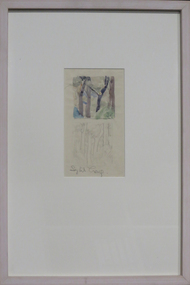
Drawing - Artwork, [Tree Study] by Sybil Craig
... National Gallery School, Melbourne, gave Craig a sound training for her popular flower and portrait studies. However, her association with leading modernists between the wars led her to pursue her art in a deliberately experimental and spontaneous way. Sybil Craig was the third woman appointed by the Australian War Memorial as an official war artist. She was the first...National Gallery School, Melbourne, gave Craig a sound training for her popular flower and portrait studies. However, her association with leading modernists between the wars led her to pursue her art in a deliberately experimental and spontaneous way. Sybil Craig was the third woman appointed by the Australian War Memorial as an official war artist. She was the first ...Sybil CRAIG (18 November 1901-09 September 1989) Born London, England Arrived Australia 1902 The National Gallery School, Melbourne, gave Craig a sound training for her popular flower and portrait studies. However, her association with leading modernists between the wars led her to pursue her art in a deliberately experimental and spontaneous way. Sybil Craig was the third woman appointed by the Australian War Memorial as an official war artist. She was the first woman to paint women working in the munitions’ factories. The Castlemaine Art Gallery & Historical Museum, held the first retrospective exhibition of Sybil Craig's in 2006. The exhibition highlighted her wonderful use of colour and design in a diverse range of media, techniques and subject matter. This item is part of the Federation University Art Collection. The Art Collection features over 2000 works and was listed as a 'Ballarat Treasure' in 2007.Framed pencil and watercolour sketchart, artwork, sybil craig, craig, available, pencil drawing, watercolour -
 Federation University Art Collection
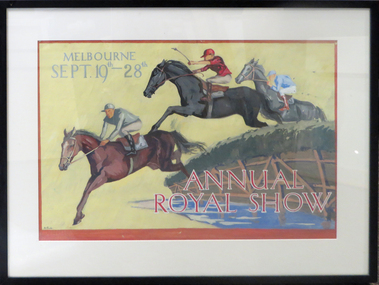
Painting - Gouache, 'Annual Royal Show' by Nornie Gude, c1935
... She studied at Ballarat for five years before progressing to Melbourne’s National Gallery of Victoria School. Nornie Gude won many art competitions, including first prize at the 1936 Melbourne Royal Agricultural Show for still life drawing, and in 1941 became the first woman to win the National Gallery Students Travelling Scholarship. ...She studied at Ballarat for five years before progressing to Melbourne’s National Gallery of Victoria School. Nornie Gude won many art competitions, including first prize at the 1936 Melbourne Royal Agricultural Show for still life drawing, and in 1941 became the first woman to win the National Gallery Students Travelling Scholarship. ...From 1931 to 1936 Nornie Gude attended the Ballarat Technical Art School, a division of the Ballarat School of Mines. She was accepted into the School at the age of 15 because she was so advanced in painting. She studied at Ballarat for five years before progressing to Melbourne’s National Gallery of Victoria School. Nornie Gude won many art competitions, including first prize at the 1936 Melbourne Royal Agricultural Show for still life drawing, and in 1941 became the first woman to win the National Gallery Students Travelling Scholarship. As an artist Nornie Gude held no theories and was once heard to say, “You spend your first 20 years learning technique and the next 20 years losing it”. This item is part of the Federation University Art Collection. The Art Collection features over 1000 works and was listed as a 'Ballarat Treasure' in 2007.Framed painting showing two horses jumping over a fence.art, artwork, gude, royal melbourne show, poster, available, horses, animals, alumni, nornie gude -
 Federation University Art Collection
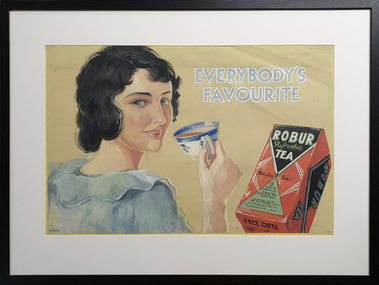
Painting, 'Everybody's Favourite', by Nornie Gude, c1935
... She studied at Ballarat Technical Art School, for five years before progressing to Melbourne’s National Gallery of Victoria Art School. Nornie Gude won many art competitions, including first prize at the 1936 Melbourne Royal Agricultural Show for still life drawing, and in 1941 became the first woman to win the National Gallery Students Travelling Scholarship. ...She studied at Ballarat Technical Art School, for five years before progressing to Melbourne’s National Gallery of Victoria Art School. Nornie Gude won many art competitions, including first prize at the 1936 Melbourne Royal Agricultural Show for still life drawing, and in 1941 became the first woman to win the National Gallery Students Travelling Scholarship. ...Eleanor (Nornie) GUDE (1915- 2002) From 1931 to 1936 Nornie Gude attended the Ballarat Technical Art School, a division of the Ballarat School of Mines. She was accepted into the School at the age of 15 because she was so advanced in painting. She studied at Ballarat Technical Art School, for five years before progressing to Melbourne’s National Gallery of Victoria Art School. Nornie Gude won many art competitions, including first prize at the 1936 Melbourne Royal Agricultural Show for still life drawing, and in 1941 became the first woman to win the National Gallery Students Travelling Scholarship. As an artist Nornie Gude held no theories and was once heard to say, “You spend your first 20 years learning technique and the next 20 years losing it”. This item is part of the Federation University Art Collection. The Art Collection features over 1000 works and was listed as a 'Ballarat Treasure' in 2007.Framed gouache by Nornie Gude. LLS signed "N.Gude"art, artwork, nornie gude, tea, available, poster, ballarat technical art school, alumni, portrait, robur tea -
 Federation University Art Collection
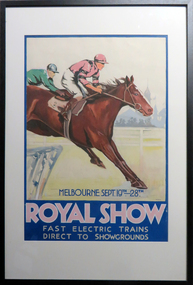
Painting - Gouache, 'Melbourne Royal Show' by Nornie Gude, c1935
... She studied at Ballarat for five years before progressing to Melbourne’s National Gallery of Victoria School. Nornie Gude won many art competitions, including first prize at the 1936 Melbourne Royal Agricultural Show for still life drawing, and in 1941 became the first woman to win the National Gallery Students Travelling Scholarship. ...She studied at Ballarat for five years before progressing to Melbourne’s National Gallery of Victoria School. Nornie Gude won many art competitions, including first prize at the 1936 Melbourne Royal Agricultural Show for still life drawing, and in 1941 became the first woman to win the National Gallery Students Travelling Scholarship. ...Nornie GUDE From 1931 to 1936 Nornie Gude attended the Ballarat Technical Art School, a division of the Ballarat School of Mines. She was accepted into the School at the age of 15 Nornie Gude because she was so advanced in painting. She studied at Ballarat for five years before progressing to Melbourne’s National Gallery of Victoria School. Nornie Gude won many art competitions, including first prize at the 1936 Melbourne Royal Agricultural Show for still life drawing, and in 1941 became the first woman to win the National Gallery Students Travelling Scholarship. As an artist Nornie Gude held no theories and was once heard to say, “You spend your first 20 years learning technique and the next 20 years losing it”. This item is part of the Federation University Art Collection. The Art Collection features over 1000 works and was listed as a 'Ballarat Treasure' in 2007.Framed original poster advertising the Show, and featuring a horse and rider. art, artwork, nornie gude, gude, royal melbourne show, balllarat technical art school, poster, horse, available, alumni -
![Drawing - Pencil on Paper, [Group of sketches] by Sybil Craig, 1935](/media/collectors/530576742162ef0fa09a2288/items/534748169821f420f8c0373d/item-media/5eff422b21ea6712bcf90559/item-fit-380x285.jpg?cb=6) Federation University Art Collection
Federation University Art CollectionDrawing - Pencil on Paper, [Group of sketches] by Sybil Craig, 1935
... National Gallery of Victoria Art School. She also underook private classes with George Bellfor several months where individual expression was encouraged, and she became associated with a group of Modernist artists including Sam Atyeo. In 1945 Sybil Craig became the third woman to be appointed as an official war artist. Based in Melbourne she worked for fourth months at the Commonwealth Ordinance Factory at Maribyrnong, becoming the first...National Gallery of Victoria Art School. She also underook private classes with George Bellfor several months where individual expression was encouraged, and she became associated with a group of Modernist artists including Sam Atyeo. In 1945 Sybil Craig became the third woman to be appointed as an official war artist. Based in Melbourne she worked for fourth months at the Commonwealth Ordinance Factory at Maribyrnong, becoming the first ...Sybil CRAIG (18/11/1901-09/09/1989) Born London, England Arrived Melbourne 1902 Died Melbourne, Victoria Sybil Frances Craig was a student of John Shirlow in 1920 who introduced her to French avant-garde artists such as Matisse and Gauguin. In 1924 she studied at the National Gallery of Victoria Art School. She also underook private classes with George Bellfor several months where individual expression was encouraged, and she became associated with a group of Modernist artists including Sam Atyeo. In 1945 Sybil Craig became the third woman to be appointed as an official war artist. Based in Melbourne she worked for fourth months at the Commonwealth Ordinance Factory at Maribyrnong, becoming the first female artist to paint women working in the munitions factories. In her work Craig was attracted to many changing ideas and continued to explore line, rhythm, colour, simplicity and design. This item is part of the Federation University Art Collection. The Art Collection features over 2000 works and was listed as a 'Ballarat Treasure' in 2007.Framed pencil sketch.art, artwork, sybil craig, australian war artist, kitchen -
 Federation University Art Collection
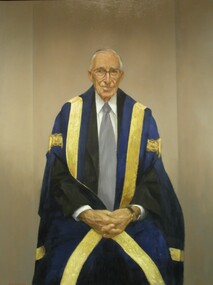
Painting - Artwork - Painting, 'Professor Emeritus David Caro' by Rick Amor, 2000
... National Gallery School, Melbourne from 1966 to 1968. Amor has held over 60 solo exhibitions, and has worked in Barcelona, New York and London. In 1999 Rick Amor became the first...National Gallery School, Melbourne from 1966 to 1968. Amor has held over 60 solo exhibitions, and has worked in Barcelona, New York and London. In 1999 Rick Amor became the first ...Rick AMOR (1948- ) Born Frankston, Victoria After completing a Certificate of Art at the Caulfield Institute of Art in 1865 Rick Amor studied at the National Gallery School, Melbourne from 1966 to 1968. Amor has held over 60 solo exhibitions, and has worked in Barcelona, New York and London. In 1999 Rick Amor became the first official Australian war artist since the Vietnam War. He was appointed by the Australian War Memorial to document the devastated land in East Timor, and the reconstruction efforts of peacekeepers. Professor David Caro OAM was Chancellor of the University of Ballarat for two terms, between 1998 and 2004. His contributions to academia and science have recognised on a national and international global scale. His appointments include Officer in the Order of the British Empire (OBE) and Officer in the Order of Australia (AO). This item is part of the Federation University Art Collection. The Art Collection features over 2000 works and was listed as a 'Ballarat Treasure' in 2007. ContemporaryFramed portrait of Professor Emeritus David Caro, University of Ballarat (later Federation University Australia)art, artwork, rick amor, amor, chancellor, david caro, caro, academic portrait, portrait, oil, oil on linen, commissioned, academic regalia -
 Federation University Art Collection
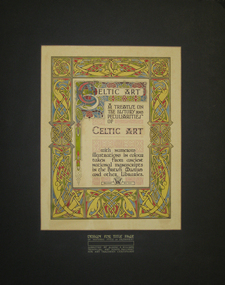
Painting, Williams, Albert E, 'Celtic Art Design' by Albert E. Williams, 1936
... first candidate achieved the certificate’s exhaustive requirements. This item is part of the Federation University Art Collection. The Art Collection features over 2000 works and was listed as a 'Ballarat Treasure' in 2007. art artwork Albert E. Williams celtic art Ballarat Technical Art School Art Teacher's Certificate illumination title page design "Design for Title Page, in Historic Style of Ornament." "Submitted by Albert E. Williams, Technical Art School, Ballarat, for Art Teacher's Certificate" "Celtic Art. A treatise on the history and peculiarities of Celtic Art with numerous illustrations in colour taken from ancient national ...Albert E. WILLIAMS (1899-1986) Born Victoria, Australia Albert Edward Williams was among the first to undertake the five-year, Technical Art Teacher’s Certificate (TATC) at the Ballarat Technical Art School in 1915, with work placement at the Ballarat Lithographic company. Williams taught for several years before he was selected to undertake further teacher training at the Working Men’s College, Melbourne, in 1926. He returned to teach at Ballarat in 1928, facilitating many student activities, while pursuing the arduous Art Teacher’s Certificate. From its inception in 1914, it was 30 years before the first candidate achieved the certificate’s exhaustive requirements. This item is part of the Federation University Art Collection. The Art Collection features over 2000 works and was listed as a 'Ballarat Treasure' in 2007.Mounted original illuminated artwork in Celtic style"Design for Title Page, in Historic Style of Ornament." "Submitted by Albert E. Williams, Technical Art School, Ballarat, for Art Teacher's Certificate" "Celtic Art. A treatise on the history and peculiarities of Celtic Art with numerous illustrations in colour taken from ancient national manuscripts in the British Museum and other libraries." "Ballarat A.D. 1936". Monogram of AW forms part of the artwork.art, artwork, albert e. williams, celtic art, ballarat technical art school, art teacher's certificate, illumination, title page, design -
 Federation University Art Collection
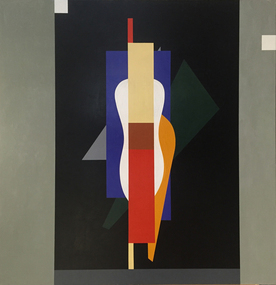
Oil & acrylic on linen, 'Guitar 2003' by Robert Jacks, 2006
... His first solo exhibition was held to great acclaim in 1966 and in 1968 his work was included in the landmark exhibition, The Field, at the National Gallery of Victoria. ...His first solo exhibition was held to great acclaim in 1966 and in 1968 his work was included in the landmark exhibition, The Field, at the National Gallery of Victoria. ...Robert JACKS (1943-2014) Jacks studied sculpture at Prahran Technical College from 1958–1960 and painting at RMIT in 1961–62. His first solo exhibition was held to great acclaim in 1966 and in 1968 his work was included in the landmark exhibition, The Field, at the National Gallery of Victoria. Beginning in 1968, Jacks spent ten years living and working in Canada and the United States. It was during this period that his unique visual language matured, incorporating influences from the major exponents of contemporary abstraction, minimalism and conceptual practice. In 2001 the Bendigo Art Gallery established the Robert Jacks Drawing Prize. In 2006, he was named an Officer of the Order of Australia (AO) This item is part of the Federation University Art Collection. The Art Collection features over 2000 works and was listed as a 'Ballarat Treasure' in 2007.art, artwork, robert jacks, the field, abstraction, contemporary art -
 Federation University Art Collection
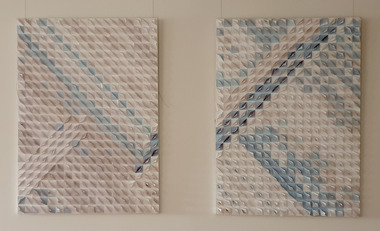
Mixed media, 'Line of Sight' by Debbie Lloyd, 2007
... During her time at the University Debbie exhibited in many group exhibitions and her work was selected for the National Graduates Show at PICA in Western Australia. Debbie’s first solo exhibition was held at Space22 in Ballarat, towards the end of 2010. ...During her time at the University Debbie exhibited in many group exhibitions and her work was selected for the National Graduates Show at PICA in Western Australia. Debbie’s first solo exhibition was held at Space22 in Ballarat, towards the end of 2010. ...Debbie LLOYD Debbie Lloyd returned to study in 2005 completing a Bachelor of Fine Arts (Visual Arts) degree at the University of Ballarat (now Federation University) in 2007, with honours the following year. She returned to the university as Artist in Residence in 2009. During her time at the University Debbie exhibited in many group exhibitions and her work was selected for the National Graduates Show at PICA in Western Australia. Debbie’s first solo exhibition was held at Space22 in Ballarat, towards the end of 2010. This item is part of the Federation University Art Collection. The Art Collection features over 1000 works and was listed as a 'Ballarat Treasure' in 2007.Two artworks featuring a third dimension created with folded paper. Artist's Statement: "My artwork explores the visual experience that can be achieved using black and white, lineal patterns or by creating illusion and surface movement through the simple manipulation and repetition of forms. In these works I have used everyday objects, and shapes, repeated, reconfigured and recontextualised to provide the viewer with visual challenges that slow down and complicate the reading of the work. In the words of a former lecturer of mine, who kindly delivered the opening speech at one of my exhibitions – There is in Debbie’s work a belief in the transcendental power of repetition, a tribute in many respects to the fact that human kind is defined by nothing more noble and uplifting than its ability and obligation to persist." (http://100thgallery.com/gallery/debbie-lloyd/, accessed 08 May 2018) art, artwork, debbie lloyd, available, recycling, envelopes -
 Federation University Art Collection
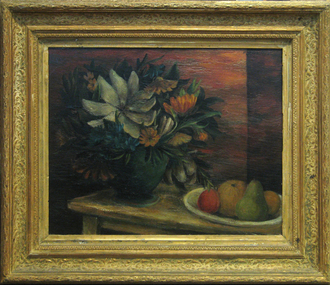
Painting - Oil, et al, [The Green Vase] by David Strachan, c1948
... (Barry Pearce, 'Strachan, David Edgar (1919–1970)', Australian Dictionary of Biography, National Centre of Biography, Australian National University, http://adb.anu.edu.au/biography/strachan-david-edgar-11786/text21083, published first in hardcopy 2002, accessed online 6 January 2016.) ...(Barry Pearce, 'Strachan, David Edgar (1919–1970)', Australian Dictionary of Biography, National Centre of Biography, Australian National University, http://adb.anu.edu.au/biography/strachan-david-edgar-11786/text21083, published first in hardcopy 2002, accessed online 6 January 2016.) ...David STRACHAN (1919–1970) Born 25 June 1919 at Salisbury, Wiltshire, England Arrived 1920 Adelaide, Australia: 1921 Creswick, Victoria David Strachan attended Creswick State School and Geelong Church of England Grammar school. By the age of 16 he wanted to be an artist. Accompanying his mother to London in 1936, he enrolled at the Slade School of Fine Art, where he met Godfrey Miller. In 1937 he attended the Académie de la Grande Chaumière, Paris, and painted at Cassis on the Mediterranean Sea. He returned to Australia in April 1938 and studied at the George Bell School, Melbourne. He had a growing interest in classicism blended with a fascination for the dream-state which was reinforced in his work after he moved to Sydney in 1941. There he was befriended by Jean Bellette and her husband Paul Haefliger, who were to be driving forces behind the Sydney Art Group (founded 1945). He lived on the top floor of the Haefligers' house at Double Bay, and together the three artists drew from models whom the Haefligers hired. In this period Strachan painted and exhibited some of his most poetic works—mainly figurative and landscape subjects, and still-lifes of haunting beauty. His flowers, bowls of fruit, birds, and angelic figures glimmered out of the darkness as things not of this world, evoked faintly, like mythological personages in a gently spoken narrative. He 'spent an erratic war' painting camouflage at Bankstown aerodrome with other artists, among them (Sir) William Dobell, and dancing minor roles with Hélène Kirsova's ballet company. In 1948 Strachan settled in Paris. His paintings, included by Peter Bellew in an exhibition at the Musée National d'Art Moderne, had been well-received by French critics two years earlier. In 1950 he began tentative experiments in etching. These led to the formation of the Stramur-Presse, a business venture which published etchings and lithographs of leading French and English artists. His most important project was a series of twenty-two colour etchings illustrating Alister Kershaw's book of poems, Accent & Hazard (Paris, 1951). Strachan continued to exhibit in Australia and maintained a lively social life with Australian friends. From Paris, he went for weekend painting trips with Moya Dyring in her car and, after 1957, visited the Haefligers on Majorca. He lived in London in 1955-57. His paintings became progressively less soft in effect, his palette brightened, and his forms, especially the still-lifes, became spikier. In the late 1950s his attention drifted towards the study of Hindu philosophers and Jungian psychology. For most of 1957-58 he was enrolled at the C. G. Jung-Institut, Zürich, Switzerland. In 1959 he worked in Silvio Daneo's silkworm factory at Bricherasio, Italy. In May 1960 Strachan returned to Sydney. He lived at Woolloomooloo before buying a house at Paddington in 1963. Over the ensuing years he involved himself energetically with the art scene, exhibiting, teaching (1960-65) at East Sydney Technical College, fund-raising for memorials for Thea Proctor and Dyring, and as the last president (1965) of the Society of Artists. His paintings were out of harmony with the prevailing fashion for abstraction, but he won the Wynne prize for landscape painting in 1961 and 1964 (shared). Perhaps the most moving works of Strachan's last ten years were the mining landscapes, including those he painted near Hill End, leading up to his vast canvas, 'Lewers Freehold Mine'. This was a history picture, depicting the mine as it might have appeared in 1874. He presented it to the Creswick Historical Museum in 1970 in memory of his father. (Barry Pearce, 'Strachan, David Edgar (1919–1970)', Australian Dictionary of Biography, National Centre of Biography, Australian National University, http://adb.anu.edu.au/biography/strachan-david-edgar-11786/text21083, published first in hardcopy 2002, accessed online 6 January 2016.) This item is part of the Federation University Art Collection. The Art Collection features over 1000 works and was listed as a 'Ballarat Treasure' in 2007.Framed still lifefeaturing fruit and flowers.art, artwork, strachan, david strachan, still life, flowers, flora, available -
 Vision Australia
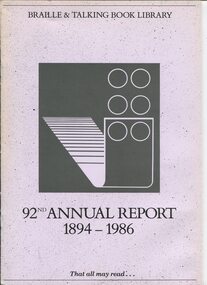
Administrative record - Text, Braille and Talking Book Library 92nd Annual Report 1894-1986: that all may read, 1986
... Items also included are: naming the computer which will store the book catalogue for the library 'Tilly', RVIB declared a public library and Minister for the Arts has determined for services to rationalise with the Chairman and Vice-Chairman meeting their counterparts with meetings ongoing, first time borrowers asked to nominate their choice of winning title for Braille Book of the Year, with the literary panel of Stephen Murray-Smith, Joyce Nicholson and Barrett Reid making a short list from which borrowers voted, first time presentation held in the afternoon (with increased attendence) and inaugural Narrator's Award (The Bathurst in honour of former President Hector Bathurst) to Eirene Pappas, Hector Bathurst to receive OAM, Jan Smark Nilsson appointed to National Advisory Committee on Library Services to People with Disabilities and Australia Post approval to change cassette mailing pouches....Items also included are: naming the computer which will store the book catalogue for the library 'Tilly', RVIB declared a public library and Minister for the Arts has determined for services to rationalise with the Chairman and Vice-Chairman meeting their counterparts with meetings ongoing, first time borrowers asked to nominate their choice of winning title for Braille Book of the Year, with the literary panel of Stephen Murray-Smith, Joyce Nicholson and Barrett Reid making a short list from which borrowers voted, first time presentation held in the afternoon (with increased attendence) and inaugural Narrator's Award (The Bathurst in honour of former President Hector Bathurst) to Eirene Pappas, Hector Bathurst to receive OAM, Jan Smark Nilsson appointed to National Advisory Committee on Library Services to People with Disabilities and Australia Post approval to change cassette mailing pouches. ...Annual report of the Braille & Talking Book Library including Minutes of the AGM, Board of Director's Report, President's report and financial statements. Items also included are: naming the computer which will store the book catalogue for the library 'Tilly', RVIB declared a public library and Minister for the Arts has determined for services to rationalise with the Chairman and Vice-Chairman meeting their counterparts with meetings ongoing, first time borrowers asked to nominate their choice of winning title for Braille Book of the Year, with the literary panel of Stephen Murray-Smith, Joyce Nicholson and Barrett Reid making a short list from which borrowers voted, first time presentation held in the afternoon (with increased attendence) and inaugural Narrator's Award (The Bathurst in honour of former President Hector Bathurst) to Eirene Pappas, Hector Bathurst to receive OAM, Jan Smark Nilsson appointed to National Advisory Committee on Library Services to People with Disabilities and Australia Post approval to change cassette mailing pouches.1 volume of text and illustrationsannual report, braille and talking book library, john cockayne, peter walsh, jan smark, betty roland, book of the year, matcham skipper, stephen murray-smith -
 Vision Australia
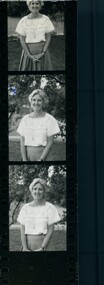
Photograph - Image, Diana Jones - black and white prints, 1980s
... A Vision Information hotline, audiology services and the National Centre for Ageing and Sensory Loss were established, the Braille and Talking Book libraries was incorporated into the Association and the Charlie Bradley Cricket Pavilion opened at Kooyong. In 1990 Diana Jones became a member of the first...A Vision Information hotline, audiology services and the National Centre for Ageing and Sensory Loss were established, the Braille and Talking Book libraries was incorporated into the Association and the Charlie Bradley Cricket Pavilion opened at Kooyong. In 1990 Diana Jones became a member of the first ...Diana Jones (1939-2009) was President of the Association for the Blind from 1985 until 1992. In her 8 years as President a great deal was accomplished. New centres were opened or extended throughout Victoria and the Metropolitan area, volunteer services expanded and the Vision Resource Centre at Kooyong was built into which 3RPH radio was relocated. A Vision Information hotline, audiology services and the National Centre for Ageing and Sensory Loss were established, the Braille and Talking Book libraries was incorporated into the Association and the Charlie Bradley Cricket Pavilion opened at Kooyong. In 1990 Diana Jones became a member of the first Board of Directors of the newly incorporated Association for the Blind Ltd which ushered in a new era, requiring strict observance of financial and accounting methods in order to ensure continued Government funding. Mrs Jones was highly regarded by clients, volunteers and staff as a capable hard-working leader. Her services to the Association and over many years to the wider community, were recognised in her appointment as a Member of the Order of Australia in the 1993 Queen's Birthday Honours. In these images she is standing outside Brighton (?) wearing a pleated skirt, a white top with banding on the short sleeve edges, across the neckline and mid-chest with a zig zag pattern between the lines. She has on thick hoop earrings and a long chain with a pendant possibly shaped like a genie bottle.Portrait of Diana Jones in various sizesdiana jones, association for the blind -
 Vision Australia
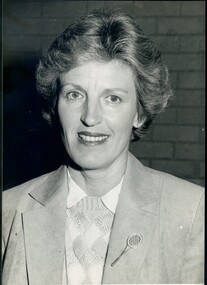
Photograph - Image, Diana Jones with tennis pin, 1985
... A Vision Information hotline, audiology services and the National Centre for Ageing and Sensory Loss were established, the Braille and Talking Book libraries was incorporated into the Association and the Charlie Bradley Cricket Pavilion opened at Kooyong. In 1990 Diana Jones became a member of the first...A Vision Information hotline, audiology services and the National Centre for Ageing and Sensory Loss were established, the Braille and Talking Book libraries was incorporated into the Association and the Charlie Bradley Cricket Pavilion opened at Kooyong. In 1990 Diana Jones became a member of the first ...Diana Jones (1939-2009) was President of the Association for the Blind from 1985 until 1992. In her 8 years as President a great deal was accomplished. New centres were opened or extended throughout Victoria and the Metropolitan area, volunteer services expanded and the Vision Resource Centre at Kooyong was built into which 3RPH radio was relocated. A Vision Information hotline, audiology services and the National Centre for Ageing and Sensory Loss were established, the Braille and Talking Book libraries was incorporated into the Association and the Charlie Bradley Cricket Pavilion opened at Kooyong. In 1990 Diana Jones became a member of the first Board of Directors of the newly incorporated Association for the Blind Ltd which ushered in a new era, requiring strict observance of financial and accounting methods in order to ensure continued Government funding. Mrs Jones was highly regarded by clients, volunteers and staff as a capable hard-working leader. Her services to the Association and over many years to the wider community, were recognised in her appointment as a Member of the Order of Australia in the 1993 Queen's Birthday Honours. In this image she stands inside, with a brick wall behind her, wearing a suede jacket, diamond pattern jumper, white shirt and a jewelled tennis racquet pin on her lapel.Diana Jones wearing a jacket, diamond patterned jumper and tennis racquet pin on her lapel1404.2 and 1404.3 on backdiana jones, association for the blind -
 Vision Australia
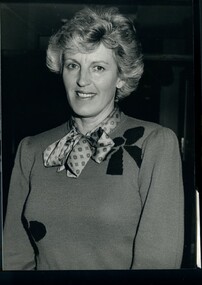
Photograph - Image, General Committee President Diana Jones, 1986
... A Vision Information hotline, audiology services and the National Centre for Ageing and Sensory Loss were established, the Braille and Talking Book libraries was incorporated into the Association and the Charlie Bradley Cricket Pavilion opened at Kooyong. In 1990 Diana Jones became a member of the first...A Vision Information hotline, audiology services and the National Centre for Ageing and Sensory Loss were established, the Braille and Talking Book libraries was incorporated into the Association and the Charlie Bradley Cricket Pavilion opened at Kooyong. In 1990 Diana Jones became a member of the first ...Diana Jones (1939-2009) was President of the Association for the Blind from 1985 until 1992. In her 8 years as President a great deal was accomplished. New centres were opened or extended throughout Victoria and the Metropolitan area, volunteer services expanded and the Vision Resource Centre at Kooyong was built into which 3RPH radio was relocated. A Vision Information hotline, audiology services and the National Centre for Ageing and Sensory Loss were established, the Braille and Talking Book libraries was incorporated into the Association and the Charlie Bradley Cricket Pavilion opened at Kooyong. In 1990 Diana Jones became a member of the first Board of Directors of the newly incorporated Association for the Blind Ltd which ushered in a new era, requiring strict observance of financial and accounting methods in order to ensure continued Government funding. Mrs Jones was highly regarded by clients, volunteers and staff as a capable hard-working leader. Her services to the Association and over many years to the wider community, were recognised in her appointment as a Member of the Order of Australia in the 1993 Queen's Birthday Honours. In this image she stands inside, wearing a knit jumper with bow ties and a patterned blouse with tied neckline.Diana Jones wearing a knit jumper with bows, and patterned blouse with tied necklineGeneral Committee President Diana Jones 1404.5diana jones, association for the blind -
 Vision Australia
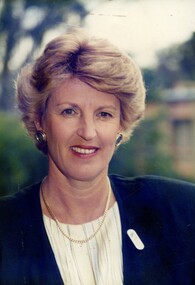
Photograph - Image, Diana Jones in blue suit, 1989
... A Vision Information hotline, audiology services and the National Centre for Ageing and Sensory Loss were established, the Braille and Talking Book libraries was incorporated into the Association and the Charlie Bradley Cricket Pavilion opened at Kooyong. In 1990 Diana Jones became a member of the first...A Vision Information hotline, audiology services and the National Centre for Ageing and Sensory Loss were established, the Braille and Talking Book libraries was incorporated into the Association and the Charlie Bradley Cricket Pavilion opened at Kooyong. In 1990 Diana Jones became a member of the first ...Diana Jones (1939-2009) was President of the Association for the Blind from 1985 until 1992. In her 8 years as President a great deal was accomplished. New centres were opened or extended throughout Victoria and the Metropolitan area, volunteer services expanded and the Vision Resource Centre at Kooyong was built into which 3RPH radio was relocated. A Vision Information hotline, audiology services and the National Centre for Ageing and Sensory Loss were established, the Braille and Talking Book libraries was incorporated into the Association and the Charlie Bradley Cricket Pavilion opened at Kooyong. In 1990 Diana Jones became a member of the first Board of Directors of the newly incorporated Association for the Blind Ltd which ushered in a new era, requiring strict observance of financial and accounting methods in order to ensure continued Government funding. Mrs Jones was highly regarded by clients, volunteers and staff as a capable hard-working leader. Her services to the Association and over many years to the wider community, were recognised in her appointment as a Member of the Order of Australia in the 1993 Queen's Birthday Honours. In this image she wears a blue jacket, striped blouse, gold curb chain necklace, round earrings and elongated oval badgeDiana Jones ina blue jacket, striped blouse, gold curb chain necklace, round earrings and elongated oval badgeP1405.2 1 Diana Jonesdiana jones, association for the blind -
 Vision Australia
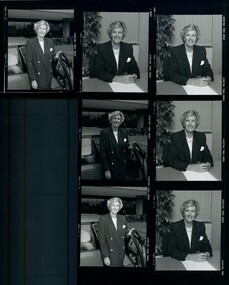
Photograph - Image, Diana Jones at her desk and getting out of her car, 4/7/1991
... A Vision Information hotline, audiology services and the National Centre for Ageing and Sensory Loss were established, the Braille and Talking Book libraries was incorporated into the Association and the Charlie Bradley Cricket Pavilion opened at Kooyong. In 1990 Diana Jones became a member of the first...A Vision Information hotline, audiology services and the National Centre for Ageing and Sensory Loss were established, the Braille and Talking Book libraries was incorporated into the Association and the Charlie Bradley Cricket Pavilion opened at Kooyong. In 1990 Diana Jones became a member of the first ...Diana Jones (1939-2009) was President of the Association for the Blind from 1985 until 1992. In her 8 years as President a great deal was accomplished. New centres were opened or extended throughout Victoria and the Metropolitan area, volunteer services expanded and the Vision Resource Centre at Kooyong was built into which 3RPH radio was relocated. A Vision Information hotline, audiology services and the National Centre for Ageing and Sensory Loss were established, the Braille and Talking Book libraries was incorporated into the Association and the Charlie Bradley Cricket Pavilion opened at Kooyong. In 1990 Diana Jones became a member of the first Board of Directors of the newly incorporated Association for the Blind Ltd which ushered in a new era, requiring strict observance of financial and accounting methods in order to ensure continued Government funding. Mrs Jones was highly regarded by clients, volunteers and staff as a capable hard-working leader. Her services to the Association and over many years to the wider community, were recognised in her appointment as a Member of the Order of Australia in the 1993 Queen's Birthday Honours. In these images she wears a pinstripe, double breasted jacket, patterned blouse, gold curb chain necklace and round earrings. As well as a proof sheet, the album also contains transparencies of the same photo shoot (not scanned).Diana Jones in a pinstripe, double breasted jacket, patterned blouse, gold curb chain necklace and round earringsDi Jones 4/7/91diana jones, association for the blind -
 Federation University Art Collection
Artwork, other - Artwork, 'Reconciliation' by Shanaya Sheridan and Josh Muir, 2018
... National Gallery of Victoria and was commissioned as a major project artist by White Night. Shanaya Sheridan, is a proud Yorta Yorta, Dja Dja Wurrung and Boon Wurrung woman who has resided in Ballarat for 20 years, after living in Horsham, Shepparton and Melbourne. Growing up and watching her Elders, and their style of artworks, Shanaya is influenced by a traditional style of Aboriginal art, mixing it up with contemporary colours. This reconciliation piece is Shanaya’s first...National Gallery of Victoria and was commissioned as a major project artist by White Night. Shanaya Sheridan, is a proud Yorta Yorta, Dja Dja Wurrung and Boon Wurrung woman who has resided in Ballarat for 20 years, after living in Horsham, Shepparton and Melbourne. Growing up and watching her Elders, and their style of artworks, Shanaya is influenced by a traditional style of Aboriginal art, mixing it up with contemporary colours. This reconciliation piece is Shanaya’s first ...This artwork was created in collaboration by Shanaya Sheridan and Josh Muir in 2018. Josh Muir was a proud Yorta Yorta, Gunditjmara and Barkinji man, who holds his culture close to his heart as it gives him a voice and great sense of identity. Josh is a Ballarat-based multimedia artist. In 2015 Josh was the recipient of the Telstra National Indigenous and Torres Strait Islander Art Award – Youth Award and the Hutchinson Scholarship, through which he undertook a 12-month residency at the Victorian College of the Arts in Melbourne. Muir's work has been acquired by the Koorie Heritage Trust, The National Gallery of Australia, the Museum and Art Gallery of the Northern Territory, the National Gallery of Victoria and was commissioned as a major project artist by White Night. Shanaya Sheridan, is a proud Yorta Yorta, Dja Dja Wurrung and Boon Wurrung woman who has resided in Ballarat for 20 years, after living in Horsham, Shepparton and Melbourne. Growing up and watching her Elders, and their style of artworks, Shanaya is influenced by a traditional style of Aboriginal art, mixing it up with contemporary colours. This reconciliation piece is Shanaya’s first commission. Artists' Statement: '“This painting represents reconciliation across all lands, from the skies down to the waters including the mountains, grass and sand. The hands represent people of all cultures reaching for a brighter future, and the men and women in talks of how reconciliation can be achieved. Last but not least, the footprints represent our Aboriginal and Torres Strait Islander ancestors that have fought for reconciliation before us and their steps/progress towards reconciliation.' Digital prints of this artwork on aluminum are displayed at Federation University Australia campuses at Mt Helen, Gippsland (Churchill), Berwick, Brisbane and Horsham.reconciliation, josh muir, shanaya sheridan, aboriginal, reconciliation action plan -
 Federation University Art Collection
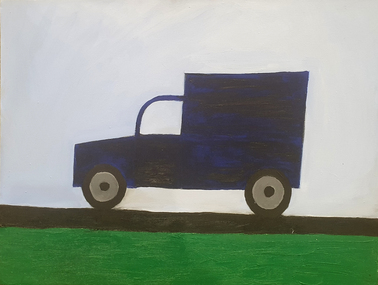
Painting, Robert Jenyns, 'Deux Cheveux' by Robert Jenyns, 2008
... Producing sculptures, prints, drawings, and paintings he has participated in many of Australia's most significant art exhibitions including the first Biennale of Sydney (1973), the 1973, 1975 and 1978 Mildura Sculpture Triennials, the 1981 Australian Perspecta, the 2nd Australian Sculpture Biennale, and the 1990 Sculpture Triennial. Humour and subtle satire is a focus of his work. Jenyns was a finalist in the 2006 Helen Lempriere National...Producing sculptures, prints, drawings, and paintings he has participated in many of Australia's most significant art exhibitions including the first Biennale of Sydney (1973), the 1973, 1975 and 1978 Mildura Sculpture Triennials, the 1981 Australian Perspecta, the 2nd Australian Sculpture Biennale, and the 1990 Sculpture Triennial. Humour and subtle satire is a focus of his work. Jenyns was a finalist in the 2006 Helen Lempriere National ...Robert JENYNS (1944- 16/11/2015) Born Melbourne, Victoria Bob Jenyns' career spanned over four decades. Producing sculptures, prints, drawings, and paintings he has participated in many of Australia's most significant art exhibitions including the first Biennale of Sydney (1973), the 1973, 1975 and 1978 Mildura Sculpture Triennials, the 1981 Australian Perspecta, the 2nd Australian Sculpture Biennale, and the 1990 Sculpture Triennial. Humour and subtle satire is a focus of his work. Jenyns was a finalist in the 2006 Helen Lempriere National Sculpture Award, and in 2007 won the award with his work Pont de l'archeveche. At the age of 16 Jenyns studyied advertising art at the Caulfield Institute of Technology. He then studied fine art with artist/teachers including Ken Scarlett, Kenneth Jack and Fred Cress, and night life drawing classes at the National Gallery schools under John Brack. After graduating the 20 year old Jenyns taught sculpture and carving at Aspendale Technical School (Melbourne). Two years later he moved to Daylesford and where he taught art until 1978, having received teaching qualifications from Hawthorn Teachers College in 1972. From 1979 Jenyns was based in Tasmania, initially lecturing in sculpture at the Tasmanian School of Art and later serving as head of the sculpture department until 2005. Gift of the Jenyns Family, 2021Painting of a blue truck painted onto stretched canvas.truck, bob jenyns, robert jenyns, available, transport -
![Painting, Robert Jenyns, [Red Truck] by Bob Jenyns, c2008](/media/collectors/530576742162ef0fa09a2288/items/61836a34b24512e106e33c2d/item-media/61a780702c0ca648f18322b4/item-fit-380x285.jpg?cb=6) Federation University Art Collection
Federation University Art CollectionPainting, Robert Jenyns, [Red Truck] by Bob Jenyns, c2008
... Producing sculptures, prints, drawings, and paintings hee has participated in many of Australia's most significant art exhibitions including the first Biennale of Sydney (1973), the 1973, 1975 and 1978 Mildura Sculpture Triennials, the 1981 Australian Perspecta, the 2nd Australian Sculpture Biennale, and the 1990 Sculpture Triennial. Jenyns was a finalist in the 2006 Helen Lempriere National...Producing sculptures, prints, drawings, and paintings hee has participated in many of Australia's most significant art exhibitions including the first Biennale of Sydney (1973), the 1973, 1975 and 1978 Mildura Sculpture Triennials, the 1981 Australian Perspecta, the 2nd Australian Sculpture Biennale, and the 1990 Sculpture Triennial. Jenyns was a finalist in the 2006 Helen Lempriere National ...Robert JENYNS (1944 - 16/11/2015) Born Melbourne, Victoria Bob Jenyns' career spanned over four decades. Producing sculptures, prints, drawings, and paintings hee has participated in many of Australia's most significant art exhibitions including the first Biennale of Sydney (1973), the 1973, 1975 and 1978 Mildura Sculpture Triennials, the 1981 Australian Perspecta, the 2nd Australian Sculpture Biennale, and the 1990 Sculpture Triennial. Jenyns was a finalist in the 2006 Helen Lempriere National Sculpture Award, and in 2007 won the award with his work Pont de l'archeveche. At the age of 16 Jenyns studyied advertising art at the Caulfield Institute of Technology. He then studied fine art with artist/teachers including Ken Scarlett, Kenneth Jack and Fred Cress, and night life drawing classes at the National Gallery schools under John Brack. After graduating the 20 year old Jenyns taught sculpture and carving at Aspendale Technical School (Melbourne). Two years later he moved to Daylesford and where he taught art until 1978, having received teaching qualifications from Hawthorn Teachers College in 1972. From 1979 Jenyns was based in Tasmania, initially lecturing in sculpture at the Tasmanian School of Art and later serving as head of the sculpture department until 2005. Gift of the Jenyns family, 2021Painting of a red truck painted onto a stretched canvas.truck, bob jenyns, robert jenyns, transport, available -
 Federation University Art Collection
Poster, Posters for Exhibitions by Bob Jenyns, c1972-2010
... Producing sculptures, prints, drawings, and paintings hee has participated in many of Australia's most significant art exhibitions including the first Biennale of Sydney (1973), the 1973, 1975 and 1978 Mildura Sculpture Triennials, the 1981 Australian Perspecta, the 2nd Australian Sculpture Biennale, and the 1990 Sculpture Triennial. Jenyns was a finalist in the 2006 Helen Lempriere National...Producing sculptures, prints, drawings, and paintings hee has participated in many of Australia's most significant art exhibitions including the first Biennale of Sydney (1973), the 1973, 1975 and 1978 Mildura Sculpture Triennials, the 1981 Australian Perspecta, the 2nd Australian Sculpture Biennale, and the 1990 Sculpture Triennial. Jenyns was a finalist in the 2006 Helen Lempriere National ...Robert Stanley (Bob) Jenyns JENYNS (1944- 16/11/2015) Born Melbourne, Victoria Bob Jenyns' was a prolific artist whose career spanned over four decades. Producing sculptures, prints, drawings, and paintings hee has participated in many of Australia's most significant art exhibitions including the first Biennale of Sydney (1973), the 1973, 1975 and 1978 Mildura Sculpture Triennials, the 1981 Australian Perspecta, the 2nd Australian Sculpture Biennale, and the 1990 Sculpture Triennial. Jenyns was a finalist in the 2006 Helen Lempriere National Sculpture Award, and in 2007 won the award with his work Pont de l'archeveche.Six posters by artist Bob Jenyns promoting his exhibitions ar Chapman Powell Street Gallery. .1 The Prickle Show, 1988 .2 The Tasmania Show, 2010 .3 The China Show, 1980 .4 The Sculpture Show, 1984 .5 La Banque de L'image, 1993 .6 The Tit & Toe Showbob jenyns, poster, tit & toe show, chapman powell street gallery, la banque de l'image, watters gallery, robert jenyns -
 Lilydale RSL Sub Branch
Coin, 24 July 2000
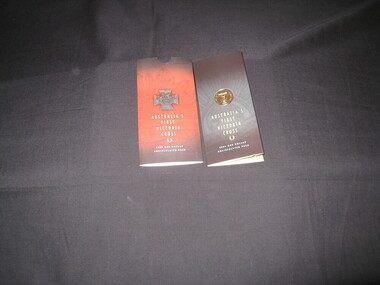
... . $1 coin issued to commemorate the action one hundred years previously that resulted in the award of Australia's first Victoria Cross (VC), to Captain Neville Howse, the only medic to receive a VC. Coin The National Mint ...$1 coin issued to commemorate the action one hundred years previously that resulted in the award of Australia's first Victoria Cross (VC), to Captain Neville Howse, the only medic to receive a VC. Captain Neville Howse's name and the date of his action are struck on either side of the coin next to the image of the Victoria Cross. The names of all Victoria Cross recipients to date of issue of the coin are listed on the presentation pack. -
 Lilydale RSL Sub Branch
Work on paper - Stamps - First Date of issue on envelope
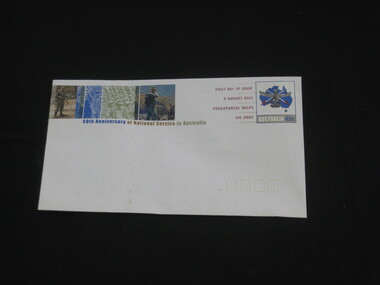
... National Service in Australia. Stamp is Map of Australia superimposed with Australia Defence Force Logo. First ...First Day of issue stamp affixed to white envelope 50th Anniversary of National Service in Australia. Stamp is Map of Australia superimposed with Australia Defence Force Logo. -
Glen Eira City Council History and Heritage Collection
Document (Item) - Newspaper (digital), Caulfield Contact
... first stage of nepean highway widening...minister approved re-subdivision...council spills...exciting development of caulfield park...profiles councillor max blair...councillor brian rudzki...tram shelter classified by national...Includes references to the following: Children's Neighbourhood Centre Caulfield; Fire destroyed Caulfield Park Bowling Club; Naming of Harleston Park; Home Handyman Service; Profiles Councillors Peter Baitz, Ron Walters; Carnegie-Glenhuntly Football Club formed Council drops approval of rail crossings over Neerim and Glenhuntly Roads; Profiles Councillor Alwyn Samuel, Glen Richards; First stage of Nepean Highway widening; Minister approved re-subdivision; Council spills; Exciting development of Caulfield Park; Profiles Councillor Max Blair, Councillor Brian Rudzki; Tram shelter classified by National Trust...Includes references to the following: Children's Neighbourhood Centre Caulfield; Fire destroyed Caulfield Park Bowling Club; Naming of Harleston Park; Home Handyman Service; Profiles Councillors Peter Baitz, Ron Walters; Carnegie-Glenhuntly Football Club formed Council drops approval of rail crossings over Neerim and Glenhuntly Roads; Profiles Councillor Alwyn Samuel, Glen Richards; First stage of Nepean Highway widening; Minister approved re-subdivision; Council spills; Exciting development of Caulfield Park; Profiles Councillor Max Blair, Councillor Brian Rudzki; Tram shelter classified by National Trust city of caulfield caulfield glen eira city of glen eira caulfield contact children's neighbourhood centre caulfield fire destroyed caulfield park bowling club naming of harleston park home handyman service profiles councillors peter baitz ron walters carnegie-glenhuntly football club formed council drops approval of rail crossings over neerim and glenhuntly roads profiles councillor alwyn samuel glen richards first stage of nepean highway widening minister approved re-subdivision council spills exciting development of caulfield park profiles councillor max blair councillor brian rudzki tram shelter classified by national trust Digital scanned copies of Caulfield Contact from 1977 includes 9 editions from Vol. 2, no. 3 (Feb 23, 1977)-v. 3 no. 5 (December 7, 1977) Caulfield Contact Document Newspaper (digital) ...The Caulfield Contact was the official newspaper of the City of Caulfield from 1976-1994. The City of Caulfield was the Municipal Council for an area of the South Eastern suburbs of Melbourne, including Brighton East, Carnegie, Caulfield, Elsternwick, Gardenvale, Glen Huntly, McKinnon, Murrumbeena, Ormond and St Kilda East. Following Amalgamation of City of Caulfield and parts of the City of Moorabbin in 1994, the Caulfield Contact was followed by the Glen Eira News. Includes references to the following: Children's Neighbourhood Centre Caulfield; Fire destroyed Caulfield Park Bowling Club; Naming of Harleston Park; Home Handyman Service; Profiles Councillors Peter Baitz, Ron Walters; Carnegie-Glenhuntly Football Club formed Council drops approval of rail crossings over Neerim and Glenhuntly Roads; Profiles Councillor Alwyn Samuel, Glen Richards; First stage of Nepean Highway widening; Minister approved re-subdivision; Council spills; Exciting development of Caulfield Park; Profiles Councillor Max Blair, Councillor Brian Rudzki; Tram shelter classified by National Trustcity of caulfield, caulfield, glen eira, city of glen eira, caulfield contact, children's neighbourhood centre caulfield, fire destroyed caulfield park bowling club, naming of harleston park, home handyman service, profiles councillors peter baitz, ron walters, carnegie-glenhuntly football club formed, council drops approval of rail crossings over neerim and glenhuntly roads, profiles councillor alwyn samuel, glen richards, first stage of nepean highway widening, minister approved re-subdivision, council spills, exciting development of caulfield park, profiles councillor max blair, councillor brian rudzki, tram shelter classified by national trust -
 Kew Historical Society Inc
Photograph - Digital Photograph, Robert Baker, 31 Miller Grove (Kew), 07/08/2017
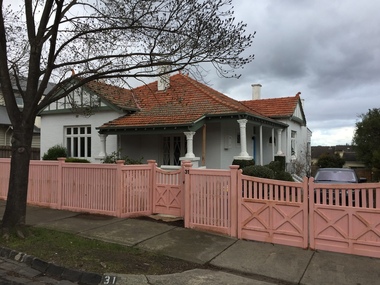
... Photograph of 31 Miller Grove, a house once owned and lived in by two nationally significant Australian women: firstly Marie Dalley (first female Mayor of Kew), and secondly the sculptor Leopoldine Mimovich....Photograph taken to accompany a newsletter article 31 miller grove - kew (vic) cr. marie dalley leopoldine mimovich Photograph of 31 Miller Grove, a house once owned and lived in by two nationally significant Australian women: firstly Marie Dalley (first female Mayor of Kew), and secondly the sculptor Leopoldine Mimovich. 31 Miller Grove (Kew) Photograph Digital Photograph Robert Baker ...Photograph taken to accompany a newsletter articlePhotograph of 31 Miller Grove, a house once owned and lived in by two nationally significant Australian women: firstly Marie Dalley (first female Mayor of Kew), and secondly the sculptor Leopoldine Mimovich.31 miller grove - kew (vic), cr. marie dalley, leopoldine mimovich -
 Old Colonists' Association of Ballarat Inc.
Photograph - Image, John Robson
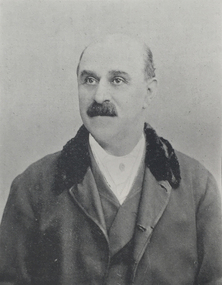
... first reached Ballarat, Mr Robson joined in the search for gold, but not being strong enough for this rough work, he turned his attention to carpentering. This he did not care much about, and in 1858 he was appointed a teacher in St. Paul's Day School, Ballarat, but in the following year he relinquished this position and became exchange clerk in the local branch of the National...first reached Ballarat, Mr Robson joined in the search for gold, but not being strong enough for this rough work, he turned his attention to carpentering. This he did not care much about, and in 1858 he was appointed a teacher in St. Paul's Day School, Ballarat, but in the following year he relinquished this position and became exchange clerk in the local branch of the National ...John Robson was born at Newcastle, Northumberland, England, the son of Mathew Robson and Hannah Sproat. Hesailed to Australia on the "Arabian", landing at Port Phillip in 1854. Obituary DEATH OF MR. JOHN ROBSON ANOTHER PIONEER GONE. AN EXTREMELY VERSATILE MAN. General regret was expressed at the death yesterday morning at Miss Garnett's private hospital, of Mr John Robson, musician and and elocutonist and one of Ballarat's oldest, best known and most respected citizens. Mr Robson had been sitting for a few weeks, and his medical adviser, diagnosed his complaint as appendicitis, which afflicted, him in such a severe form that an operation was deemed to be absolutely necessary. He was removed to Miss Garnett's private hospital, and about a week ago he was operated upon. Mr Robson, being a man of robust constitution, stood the shock of the operation well, and he was making good headway towards recovery when the spell of hot weather set in, and caused exhaustion. Heart failure followed, and exhaustion the attention of his medical adviser, and the careful nursing he received, the end came peacefully at the time stated above. Mr John Robson was born at Newcastle, Northumberland, England, in , and he was therefore 72 years of age. Mr Robson's father, who was a contractor, had much to do with the building of the City of Newcastle. After passing through minor schools, Mr John Robson entered the academy of Professor Ross, and soon rose to a foremost position in the classes. When his studies were completed he was apprenticed to an architect and for a time studied the technique of this important branch of his father's calling. His adaptability for the work was great, and hopes were entertained that he would rise to a high position in the profession. Then came glowing reports of the wonderful Australian gold discoveries. Mr Robson’s father decided to migrate to these parts, and he sent a son to prepare the way. Believing that tools and timber might not be procured in Australia. Mr Robson, senr, constructed a portable wooden residence, which was shipped in pieces on the White Star liner Arabian which brought the family over. In 1854 Mr John Robson, who was then nearly 17 years of age, landed at Port Phillip, and with the other members of the family came on to Ballarat, which place he made his home to the end. When he first reached Ballarat, Mr Robson joined in the search for gold, but not being strong enough for this rough work, he turned his attention to carpentering. This he did not care much about, and in 1858 he was appointed a teacher in St. Paul's Day School, Ballarat, but in the following year he relinquished this position and became exchange clerk in the local branch of the National Bank. Being adapted to this quickly made himself acquainted with the details of a banker’s profession, and his rise was rapid. In the year 1871, about 12 years after he joined the bank, he was appointed manager, and for four years occupied that position with conspicuous success. He was connected with the National Bank for eighteen years, and in 1875 he entered business on his own account. With his brother, Mr Wm. Robson, he erected red-gum sawmills at Gunbower, on the River Murray. Subsequently he was offered the management of the Australian and European Bank in mills. In 1886, he accepted the position and held it until the bank was absorbed by the Commercial Bank of Australia. For a time he lived privately, still, how ever, holding his interest in the saw mills. In 1886, he accepted, the position of manager of the Ballarat branch of the Mercantile Bank of Australia. This bank was closed in 1892, and Mr Robson retired, altogether from commercial circles. In the meantime his brother died, and the saw-mills were sold. Mr Robson held a very important position in music, in fact he for many years was looked upon as the leading musician in Ballarat, he being master of quite a variety of instruments. In 1864. he was appointed conductor of the old Harmonic Society in this city, and subsequently conductor of the Ballarat Liedertafel. Under his leadership this society attained a high state of efficiency, which has since been well-maintained. Many years ago Mr Robson formed an operatic company from amongst Ballarat residents, and such beautiful operas as “Lucrezia Borgia' "Lucia di Lammermoor," “Ernani,' La Sonnambula,” and others were successfully rendered. As an elocutionist, Mr Robson attained much prominence, he being recognised as one of the most capable teachers in Ballarat. He was president of the one-time Ballarat Shakespearian Dramatic Club, which under his direction, from time to time produced Shakespeare’s masterpieces. In this, too, he took the chief characters, the roles of Macbeth, Othello, Hamlet, and Shylock, all being powerfully represented by him. For some years prior to his demise Mr Robson, acted as a teacher of music, and elocution, and many of his pupils, competed with great success at the Ballarat and other competitions. Some years ago he acted as adjudicator at the South street competitions, when he gave every satisfaction, and his services were frequently secured to judge at competitions in other parts of the State and in other states of the Commonwealth. At the Ballarat band contests every year, he was a conspicuous figure, and he always acted as leader of the massed bands, by whom his appearance was always enthusiastically greeted. In his younger days he took a keen interest in several forms of sport, was a successful oarsman, one of the best amateur boxers of his weight and as a billiard player was able to hold his own with professionals. 'Mr Robson was an earnest adherent of the Church of England, and in social and other organisations he from time to time held important positions. As a Anglican churchman, he was widely respected, being the official principal and lay Canon of the Cathedral, a member of the Bishops Council, and a prominent member of St. Paul's Church, Ballarat East. He was also a prominent member of the Masonic order. and was a Past Grand Junior Warden of the Grand Lodge of Freemasons of Victoria, an office which he filled with the greatest credit. He was also a member of the Old Colonists' Association and the Mechanics' Institute, was at one time vice-president of the Art Gallery was once a member of the School of Mines Council, and was many years ago made a Justice of the Pence. On many occasions he was asked to stand for Parliament, as a representative of Ballarat and on one occasion he consented to do so, but subsequently retired without going to the poll in favor of the late Mr Daniel Brophy. He was also often pressed to stand for both the Ballarat East and City Councils, but he declined to allow himself to be nominated. Mr Robson was an active gentleman, and a brilliant conversationalist. His courtesy, high mental and moral endowments, and warm open-heartedness, made him a most interesting and congenial companion. During his long residence in Ballarat, which city he declined to sever his connected with, he was well known and much courted, and was looked up on as one of the most prominent citizens, and his loss will be very severely felt. Some years ago a portrait of Mr Robson, in full Masonic regalia, was painted by he late Mr Stanton Bowman, and was presented by Mr Robson to the citizens, and it was hung in the City Hall, where it is always admired by visitors. The late Mr John Robson never married, and with his brother, James, lived for many years in Eureka street, Ballarat. The two brothers were nearly always together, and as they walked the streets with arms linked, they were frequently referred to as the Siamese twins. The only Australian relative of the late Mr John Robson is his brother. Mr James Robson, who hardly left the bedside during John's illness, and to him the blow has been a very severe one. In his bereavement he will have the heartfelt sympathy not only of the whole of the residents of Ballarat, but of people in all parts of the State. When the news of Mr Robson’s death became known the flags were flown at half-mast at the City and Town Halls, and the Old Colonists’ Hall, out of respect to the memory of the deceased. The interment will take place at the Old Cemetery this afternoon. The cortege will leave “Rothbury," Eureka street, Mr Robson’s late residence, at 3 o'clock, for St. Paul’s Church, where there will be a short service conducted by the vicar, the Rev T. A. Colebrook. (Ballarat Star, January 1910)Photographic portrait of John Robson, member of the Old Colonists' Association of Ballarat.john robson, old colonists' association of ballarat, old colonists' club -
 Kew Historical Society Inc
Postcard, Housen's Richmond Hotel | Portland
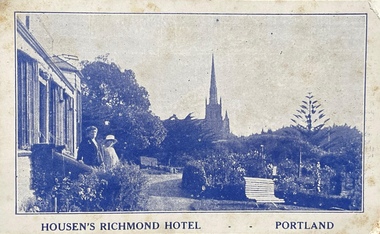
... nationally significant collection of costumes belonging to three generations of Henty women. henty family Richmond Hotel -- Portland (Vic.) Stephen Henty Edward Henty Richmond Henty Henty houses -- Victoria portland postcards Printed reverse: "THE RICHMOND is the most historical building in the State. On the site of today's building Edward Henty, the founder of permanent settlement in Victoria, commenced his first ...Many of the Henty's of the Western District of Victoria also owned houses in Kew, Victoria. Stephen Henty, referred to on the reverse of the postcard, lived while a member of the Vitoria Parliament at 'Findon' in Kew. Kew Historical Society also holds a nationally significant collection of costumes belonging to three generations of Henty women.Monochrome, blue tinted 'real photo' postcard of Housen's Richmond Hotel, Portland. Two women stand on the steps of the hotel at left, with the rose garden in front of them. Behind them is a church spire. The hotel and its significance is outlined in two columns of blue coloured text on the reverse.Printed reverse: "THE RICHMOND is the most historical building in the State. On the site of today's building Edward Henty, the founder of permanent settlement in Victoria, commenced his first house February 19, 1835, finishing the work in two months. He had landed in Portland on Nov. 19th, 1834, and turned the first plough furrows in Victoria where the Hotel now stands on the 26th of the following month. It was also here that Major Mitchell ended his explorations from Sydney, meeting the Hentys on August 29th, 1836. In December of the same year Mrs S. G. Henty joined her husband, their son Richmond, the first male white child in Portland, being born in the Henty cottage. The present Richmond Hotel was built in 1840, and became the home of Stephen Henty until his departure from Portland in 1869. Though Edward Henty's first house was demolished in 1840, to make room for the new surveyed town streets, part of his wool store remains in the Hotel grounds, and is used as a wood shed. This is about the oldest building in the State : in it was held the first christening service in Portland on September 26th, 1841. On the site of the Richmond Hotel all the early visiting celebrities were entertained - Mitchell, Wedge, La Trobe, Fyans, Sir John Franklin, Capt. Stokes, etc. No other hostelry in Victoria can give you the historical atmosphere of the RICHMOND. / THE ORIGINAL HOME OF THE HENTYS."henty family, richmond hotel -- portland (vic.), stephen henty, edward henty, richmond henty, henty houses -- victoria, portland, postcards -
 Kew Historical Society Inc
Textile - Australian Exhibition of Women's Work, Emily Davies, c.1907
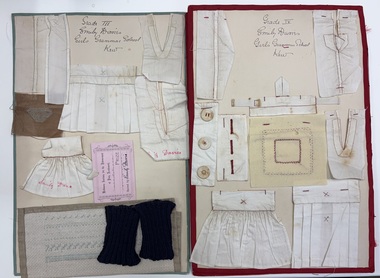
... The first Australian Exhibition of Women's Work was a national exhibition held over thirty-nine days in 1907 in Melbourne, and in the seventh year of the country's Federation. ...The first Australian Exhibition of Women's Work was a national exhibition held over thirty-nine days in 1907 in Melbourne, and in the seventh year of the country's Federation. ...The first Australian Exhibition of Women's Work was a national exhibition held over thirty-nine days in 1907 in Melbourne, and in the seventh year of the country's Federation. The exhibition was a celebration of the creativity and productivity of women in the manual and fine arts. It was visited by over 250,000 people who saw 16,000 exhibits by women from around Australia in competition for prizes, and 3,000 (non-competitive) entries from the rest of the world. It was one of the largest women's exhibitions ever mounted. The exhibition opened on 23 October and closed on 30 November at the Royal Exhibition Building.A prize-winning collection of early 20th century embroideries created by Emily Muriel Grace Davies, the daughter of the Mayor of Richmond. Most of the embroideries were created while Emily was a student of Baldur Grammar in Kew. Baldur Grammar was founded in 1897 and was located at 17-19 Denmark Street. emily davies, baldur grammar school, plain sewing competitions, schools -- materials technology, knitting, australian exhibition of women's work -
 Kew Historical Society Inc
Document - Invitation To Meet their Royal Highnesses, the Duke and Duchess of Cornwall & York, Commonwealth of Australia, 1901
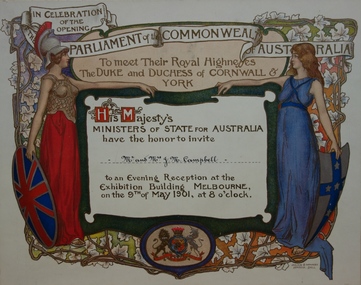
... First Parliament of the Commonwealth of Australia : An open directory of the guests invited to Melbourne, May 9th 1901' lists invitees from each Australian State. Mr & Mrs. J. M. Campbell are on this list, and recoded as residing at "Ramornie" 40 Pakington Street, Kew. The document design has artistic and aesthetic merit. While it is not rare, it is representative of the kinds of formal designs used for the Australian Commonwealth celebrations at the time of Federation, and is in excellent condition. Such items as this invitation have local, state and national ...The commemorative booklet 'Our Invited Guests for the Opening of the First Parliament of the Commonwealth of Australia : An open directory of the guests invited to Melbourne, May 9th 1901' lists invitees from each Australian State. Mr & Mrs. J. M. Campbell are on this list, and recoded as residing at "Ramornie" 40 Pakington Street, Kew.The document design has artistic and aesthetic merit. While it is not rare, it is representative of the kinds of formal designs used for the Australian Commonwealth celebrations at the time of Federation, and is in excellent condition. Such items as this invitation have local, state and national historic significance as mementoes of a key moment in Australia's history. Locally, the invitation is part of a group of Federation-related items issued to James Maitland Campbell (and his wife). Campbell was three times mayor of Kew in the second half of the 19th Century and the owner of Ramornie in Pakington Street, one of the significant extant mansions in Kew.An invitation on card to Mr. & Mrs J. M. Campbell to attend an evening reception at the Exhibition Building, Melbourne, on 9 May 1901, to meet the Duke and Duchess of Cornwall as part of the celebrations of the opening of the first Federal Parliament. A figure of Britannia, in red dress and mailed vest holding a shield like the Union Jack, is on the left of the invitation; she reaches out her hand towards a younger female figure, representing Australia, who is dressed in blue and holds a shield which is white with a blue cross decorated with stars. The writing is on a scroll in the centre of the certificate, and there is a border of vines and vine leaves. The royal crest is at the base of the certificate.Printed on a banner across the top: 'IN CELEBRATION / OF THE / OPENING / PARLIAMENT of the COMMONWEALTH / OF AUSTRALIA' Printed below the banner: 'To meet Their Royal Highness / the DUKE and DUCHESS of CORNWALL & / YORK / His Majesty's / MINISTERS OF STATE FOR AUSTRALIA / have the honor to invite / [handwritten] Mr. & Mrs J. M. Campbell / to an Evening Reception at the / Exhibition Building MELBOURNE, / on the 9th of May 1901, at 8 o'clock'.federation -- australia -- 1901, parliament -- australia, invitations -- 1901 -
 Kew Historical Society Inc
Document - Invitation to a ‘Conversazione’ in the Exhibition Building, George Austin, 1901
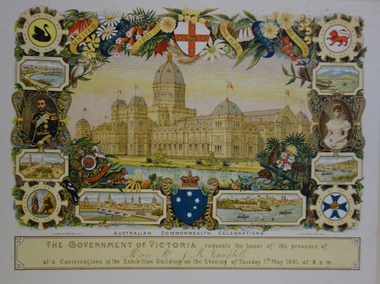
... national historic significance as mementoes of a key moment in Australia's history. Locally, the invitation is part of a group of Federation-related items issued to James Maitland Campbell (and his wife). Campbell was three times mayor of Kew in the second half of the 19th Century and the owner of Ramornie in Pakington Street, one of the significant extant mansions in Kew. sands & mcdougall ltd documents - invitations first commonwealth parliament 1901 james maitland campbell (1847-1930) ramornie ramornie - pakington street Printed: UNITED AUSTRALIA 1901 / ONE FLAG / ONE HOPE / ONE DESTINY; AUSTRALIAN COMMONWEALTH CELEBRATIONS / THE GOVERNMENT OF VICTORIA requests the honour of the presence of / / at a Conversazione in the Exhibition Building on the Evening of Tuesday 7th May 1901 at 8 P.M. ...A report in the Ballarat Star on 8 May 1901 recorded that: "THE CONVERSAZIONE. A GREAT SUCCESS. The conversazion given by the Government of Victoria at the Exhibition was very largely patronised. the guests includ ing the Prime Minister and a goodly proportion of the distinguished personages now in Melbourne. A programme of high-class music was gone through, and refreshments were served during the evening. Australian wines were very prominent."The document design has artistic and aesthetic merit. While it is not rare, it is representative of the kinds of formal designs used for the Australian Commonwealth celebrations at the time of Federation, and is in excellent condition. Such items as this invitation have local, state and national historic significance as mementoes of a key moment in Australia's history. Locally, the invitation is part of a group of Federation-related items issued to James Maitland Campbell (and his wife). Campbell was three times mayor of Kew in the second half of the 19th Century and the owner of Ramornie in Pakington Street, one of the significant extant mansions in Kew.Colour lithograph mounted on card to an evening event, a conversazione, held in the Exhibition Building on the evening of Tuesday 7th May 1901, as part of the Australian Commonwealth Celebrations. The recipients of the invitation were Mr and Mrs James Maitland Campbell of Kew. The Government of Victoria hosted the event. The invitation shows an etching of the Exhibition Building, surrounded by an ornate border of heraldic shields, portraits of the Duke and Duchess, views of Perth, Adelaide, Melbourne, Sydney, Brisbane and Hobart, and native flora (including wattle, waratah, pink heath, Sturt’s desert pea, and flannel flower), and native fauna (kookaburra, possum, lyre bird, cockatoo and koala). The royal crest ‘Dieu et mon droit’ and the Australian crest, ‘Advance Australia’ are also included.Printed: UNITED AUSTRALIA 1901 / ONE FLAG / ONE HOPE / ONE DESTINY; AUSTRALIAN COMMONWEALTH CELEBRATIONS / THE GOVERNMENT OF VICTORIA requests the honour of the presence of / / at a Conversazione in the Exhibition Building on the Evening of Tuesday 7th May 1901 at 8 P.M. Handwritten: Mr & Mrs J. M. Campbell.sands & mcdougall ltd, documents - invitations, first commonwealth parliament 1901, james maitland campbell (1847-1930), ramornie, ramornie - pakington street -
 Kew Historical Society Inc
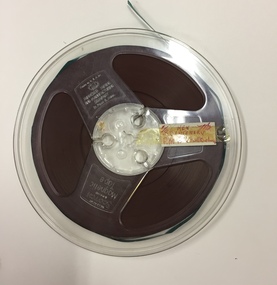
Audio - City of Kew Centenary: The Right Hon RG Menzies & Cr WHS Dickinson, William Dickinson, 1960
... first Kew Council was established. This reel-to-reel tape, now digitised, is both rare (ie unique) and historically significant. While the recording clearly has local significance, it is also of national and international significance due to the content of the Prime Minister's address. ...Kew, in Melbourne, Victoria, was declared a Borough in 1859, following which the first Council was elected in 1860. Kew became a Town in 1910, and a City in 1921. It was amalgamated into a new City of Boroondara in 1994. The centenary celebrations of 1860 marked 100 since the first Kew Council was established.This reel-to-reel tape, now digitised, is both rare (ie unique) and historically significant. While the recording clearly has local significance, it is also of national and international significance due to the content of the Prime Minister's address. The focus of his speech is the nature of Australian democracy and its strengths, deriving from universal suffrage and the acceptance of democratic values by the Australian population, gained through historic participation in democracy at local, state and federal levels. RG Menzies mounts a strong case for each level of government having value in the development of Australian democracy. He also describes the emerging democracies of Africa in the period following decolonisation, and suggests that the success of these countries is dependent on democratic institutions not being imposed from above by colonial powers. City of Kew Centenary 1860-1960 Speeches by The Hon RG Menzies, MHR for Kew, and Cr WHS Dickinson, Mayor of Kew. Recorded on 13th December 1960 at the Kew City Hall 34 minutes 29 seconds From the archives of the Kew Historical Society Inc Copyright Kew Historical Society Inc Timings 00.14-17.00 The Right Hon RG Menzies MHR 17.07-32.33 Cr. WHS Dickinson 32.38-33.10 The Right Hon RG Menzies MHR 33.30-33.50 Cr. WHS Dickinson 33.51-34.25 Song - 'For He's a Jolly Good Fellow'Label on original boxcity of kew, centenary of kew 1860-1960, robert gordon menzies, william henry shorey dickinson, bill burrell, mayors of kew, town clerks of kew, australian prime ministers, australian democracy, democracy
