
Showing 1657 items matching " first national"
-
 Mt Dandenong & District Historical Society Inc.
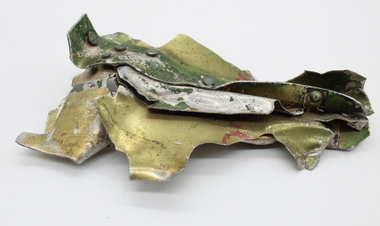
Object, Kyeema Wreckage Fragment, Pre 1938
... first officer, an air hostess, and a cadet pilot who operated the radio during the flight. The victims were :— THE CREW. CAPTAIN A. C. D. WEBB, 32, pilot, married, of Essendon, Victoria. JUNIOR CAPTAIN ALAN J. STEEN, 25, pilot, married, of Essendon North, Victoria. ELVA JONES, 27, air hostess, single, of Toorak, Victoria. PHILIP D. PRING, about 20, cadet pilot attached to Australian National...first officer, an air hostess, and a cadet pilot who operated the radio during the flight. The victims were :— THE CREW. CAPTAIN A. C. D. WEBB, 32, pilot, married, of Essendon, Victoria. JUNIOR CAPTAIN ALAN J. STEEN, 25, pilot, married, of Essendon North, Victoria. ELVA JONES, 27, air hostess, single, of Toorak, Victoria. PHILIP D. PRING, about 20, cadet pilot attached to Australian National ...The Kyeema airline crash took place on 25 October 1938 when the Australian National Airways Douglas DC-2 Kyeema, tail number VH-UYC, flying from Adelaide to Melbourne, commenced final approach to Essendon Airport through heavy fog and crashed into the western slopes of Mount Dandenong, killing all 18 on board instantly. There is strong evidence that the pilots were becoming unsure of their position. According to Macarthur Job's book, Disaster in the Dandenongs, the radio operator had requested the controller at Essendon give them a radio bearing. Essendon had acknowledged and told them to leave their transmitter on, but the signal stopped and no further contact was made. It is thought that this is the moment that Kyeema hit the mountain. There were 18 people on board the DC-2: 14 passengers, the captain, the first officer, an air hostess, and a cadet pilot who operated the radio during the flight. The victims were :— THE CREW. CAPTAIN A. C. D. WEBB, 32, pilot, married, of Essendon, Victoria. JUNIOR CAPTAIN ALAN J. STEEN, 25, pilot, married, of Essendon North, Victoria. ELVA JONES, 27, air hostess, single, of Toorak, Victoria. PHILIP D. PRING, about 20, cadet pilot attached to Australian National Airways' Aeronautics School, Sydney. PASSENGERS. CHARLES ALLAN SEYMOUR HAWKER, M.P., 44, single, of Adelaide. LEONARD SYDNEY ABRAHAMS, K.C., 51, married, barrister, of Sydney. SIDNEY HILL SMITH, 41, married, managing director of S. Smith and Son, of Yalumba, South Australia. ALFRED CECIL GAIN, 42, married, barrister, of Sydney. GORDON H. GODDARD, 30, single, accountant, of North Sydney. LANCELOT WILLIAM SHIRLEY, 27, single, solicitor, of Manly. JAMES IAN MASSIE, 25, single, solicitor, of Sydney. VAUGHAN PATE, 42, refrigeration cabinet manufacturer, married, of Unley, South Australia. THOMAS M. HARDY, 48, married, head of the firm of Thomas Hardy and Sons, vignerons, of Seacliff, South Australia. GEORGE WILLIAM LING, 72, of Kingswood, South Australia, former building inspector of the Municipal Tramways Trust, Adelaide. LOUIS HUGO GRAMP, 43, married, managing director of G. Gramp and Sons, Ltd., vignerons, Rowlands (sic) Flat, South Australia. Mrs. ELIZABETH MARY SCHRADER, 69, widow, of Adelaide. Mr. and Mrs. HANS L. GLOE, of Perth.Small section of the Kyeema DC-2 fuselage made up of 5 pieces of piece of twisted and torn aluminium riveted together. Marking can be seen in red but is indistinct. Aluminium has gold, silver and green colouring.kyeema, a webb, j steen, elva jones, philip pring, charles hawker, leonard abrahams, sidney hill smith, alfred gain, gordon goddard, lancelot shirley, james massie, vaughan pate, thomas hardy, george ling, hugo gramp, elizabeth schrader, mr hans gloe, mrs gloe -
 Ballarat Heritage Services
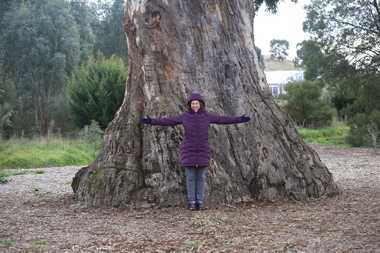
Photograph - Photograph - Colour, Clare Gervasoni, Ann Gervasoni at the Guildford Big Tree, 2017, 16/07/2017
... The Big Tree is listed a a tree of State significance on the National Trust's Register of Significant Trees of Victoria for its outstanding size, curious fusion of branches, as an outstanding example of the species and as an important landmark. big tree guidlford river red gum A photographs of Guildford's Big Tree - a River Red Gum (Eucalyptus camaldulensis). The tre-es is believed to be one of the largest examples of the species in Victoria, and has been recorded as having a height of 30 metre, a canopy spread of 34 metres, and a trunk circumference of 9.35 metres. The tree was already an ancient giant when white settlers first ...The Big Tree is listed a a tree of State significance on the National Trust's Register of Significant Trees of Victoria for its outstanding size, curious fusion of branches, as an outstanding example of the species and as an important landmark.A photographs of Guildford's Big Tree - a River Red Gum (Eucalyptus camaldulensis). The tre-es is believed to be one of the largest examples of the species in Victoria, and has been recorded as having a height of 30 metre, a canopy spread of 34 metres, and a trunk circumference of 9.35 metres. The tree was already an ancient giant when white settlers first arrived in the 1840s. On Saturday evening, February 28th 2015, just as dusk was falling, Guildford was hit hard by tornado-like winds, felling the big cottonwood tree down by the river, and tearing limbs from the iconic Big Tree, reducing it by an estimated one third. The debris has been cleared since then and the tree seems to have survived its ordeal, though its size is certainly diminished.big tree, guidlford, river red gum -
 Ballarat Heritage Services
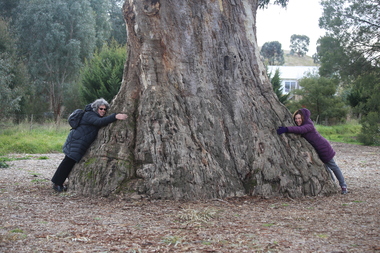
Photograph - Photograph - Colour, Clare Gervasoni, Clare Gervasoni and Ann Gervasoni at the Guildford Big Tree, 2017, 16/07/2017
... The Big Tree is listed a a tree of State significance on the National Trust's Register of Significant Trees of Victoria for its outstanding size, curious fusion of branches, as an outstanding example of the species and as an important landmark. big tree guidlford river red gum A photographs of Guildford's Big Tree - a River Red Gum (Eucalyptus camaldulensis). The tre-es is believed to be one of the largest examples of the species in Victoria, and has been recorded as having a height of 30 metre, a canopy spread of 34 metres, and a trunk circumference of 9.35 metres. The tree was already an ancient giant when white settlers first ...The Big Tree is listed a a tree of State significance on the National Trust's Register of Significant Trees of Victoria for its outstanding size, curious fusion of branches, as an outstanding example of the species and as an important landmark.A photographs of Guildford's Big Tree - a River Red Gum (Eucalyptus camaldulensis). The tre-es is believed to be one of the largest examples of the species in Victoria, and has been recorded as having a height of 30 metre, a canopy spread of 34 metres, and a trunk circumference of 9.35 metres. The tree was already an ancient giant when white settlers first arrived in the 1840s. On Saturday evening, February 28th 2015, just as dusk was falling, Guildford was hit hard by tornado-like winds, felling the big cottonwood tree down by the river, and tearing limbs from the iconic Big Tree, reducing it by an estimated one third. The debris has been cleared since then and the tree seems to have survived its ordeal, though its size is certainly diminished.big tree, guidlford, river red gum -
 Ballarat Heritage Services
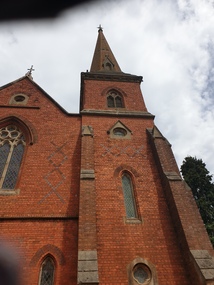
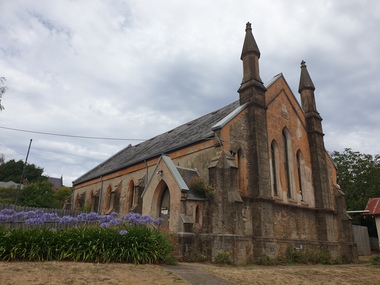
Photograph - Church, Clare Gervasoni, Daylesford Uniting Church, 2023, 04/03/2023
... first service was held in the new church on 10 December 1865. It is of interest for its brick broach spire, diapered brick façade and spacious interior with aisles separated from the nave by slender columns. The church organ was installed and built in 1888 by William Anderson and boasts an impressive 724 pipes, many of which are decorated with Christian symbols. This organ is a rare example of Anderson’s work and is his only instrument in Western Victoria. It is classified by the National...first service was held in the new church on 10 December 1865. It is of interest for its brick broach spire, diapered brick façade and spacious interior with aisles separated from the nave by slender columns. The church organ was installed and built in 1888 by William Anderson and boasts an impressive 724 pipes, many of which are decorated with Christian symbols. This organ is a rare example of Anderson’s work and is his only instrument in Western Victoria. It is classified by the National ...The Daylesford Uniting Church (formerly Wesleyan /Methodist Church) was built in 1865, replacing an earlier Wesleyan Chapel built in 1861 which is still on site and known as the Sunday School (2024). The foundaton stone for the newer, current church was laid on 12 June 1865, designed by Architects Crouch and Wilson the structure was built in early English Gothic style. The first service was held in the new church on 10 December 1865. It is of interest for its brick broach spire, diapered brick façade and spacious interior with aisles separated from the nave by slender columns. The church organ was installed and built in 1888 by William Anderson and boasts an impressive 724 pipes, many of which are decorated with Christian symbols. This organ is a rare example of Anderson’s work and is his only instrument in Western Victoria. It is classified by the National Trust of Australia (Victoria) as being of state significance. The organ was renpvated in 1979-80 by Leighton Turner. It has 2 manuals, 14 speaking stops, 3 couplers, tracker action, Gt: 8.8 divided.8.4.4.2-2/3.2. Sw: 8.8.4.2.8. Ped: 16. In the 1880s the decline in mining led to the congregation considering ways to reduce debt. Rent was received from pew hire as well as organ concerts and annual fairs. By the end of the 19th century the church had settled into a pattern of steady parish life. The 1950s and 1960s were really the glory days of the church with an active Sunday School, tennis clubs and vibrant social activity as well as many worshippers at Sunday services. The final service was held at the church on 21 April 2024.A redbrick church on stone foundation in Daylesforddaylesford uniting church, daylesford methodist church, daylesford, john mitchell uniting church, daylesford wesleyan church, crouch and wilson, daylesford uniting sunday school -
 Ballarat Heritage Services
Photograph - Church, Clare Gervasoni, Former Daylesford Wesleyan Chapel, 2023, 04/03/2023
... first service was held in the new church on 10 December 1865. It is of interest for its brick broach spire, diapered brick façade and spacious interior with aisles separated from the nave by slender columns. The church organ was installed and built in 1888 by William Anderson and boasts an impressive 724 pipes, many of which are decorated with Christian symbols. This organ is a rare example of Anderson’s work and is his only instrument in Western Victoria. It is classified by the National...first service was held in the new church on 10 December 1865. It is of interest for its brick broach spire, diapered brick façade and spacious interior with aisles separated from the nave by slender columns. The church organ was installed and built in 1888 by William Anderson and boasts an impressive 724 pipes, many of which are decorated with Christian symbols. This organ is a rare example of Anderson’s work and is his only instrument in Western Victoria. It is classified by the National ...The Daylesford Uniting Church (formerly Wesleyan /Methodist Church) was built in 1865, replacing an earlier Wesleyan Chapel built in 1861 which is still on site and known as the Sunday School (2024). The foundaton stone for the newer, current church was laid on 12 June 1865, designed by Architects Crouch and Wilson the structure was built in early English Gothic style. The first service was held in the new church on 10 December 1865. It is of interest for its brick broach spire, diapered brick façade and spacious interior with aisles separated from the nave by slender columns. The church organ was installed and built in 1888 by William Anderson and boasts an impressive 724 pipes, many of which are decorated with Christian symbols. This organ is a rare example of Anderson’s work and is his only instrument in Western Victoria. It is classified by the National Trust of Australia (Victoria) as being of state significance. The organ was renpvated in 1979-80 by Leighton Turner. It has 2 manuals, 14 speaking stops, 3 couplers, tracker action, Gt: 8.8 divided.8.4.4.2-2/3.2. Sw: 8.8.4.2.8. Ped: 16. In the 1880s the decline in mining led to the congregation considering ways to reduce debt. Rent was received from pew hire as well as organ concerts and annual fairs. By the end of the 19th century the church had settled into a pattern of steady parish life. The 1950s and 1960s were really the glory days of the church with an active Sunday School, tennis clubs and vibrant social activity as well as many worshippers at Sunday services. The final service was held at the church on 21 April 2024.A stone church in Daylesford. Originally built at the Daylesford Wesleyan Chapel, it was later used as the Daylesford Uniting Church Sunday School. daylesford uniting church, daylesford methodist church, daylesford, john mitchell uniting church, daylesford wesleyan church, daylesford uniting sunday school -
 Ballarat Heritage Services
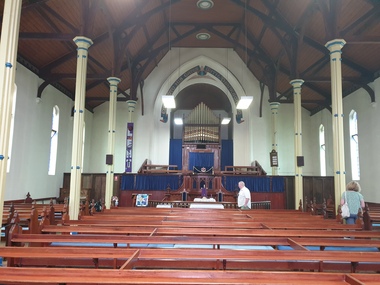
Photograph - Church, Clare Gervasoni, Daylesford Uniting Church Interior, 2023, 04/03/2023
... first service was held in the new church on 10 December 1865. It is of interest for its brick broach spire, diapered brick façade and spacious interior with aisles separated from the nave by slender columns. The church organ was installed and built in 1888 by William Anderson and boasts an impressive 724 pipes, many of which are decorated with Christian symbols. This organ is a rare example of Anderson’s work and is his only instrument in Western Victoria. It is classified by the National...first service was held in the new church on 10 December 1865. It is of interest for its brick broach spire, diapered brick façade and spacious interior with aisles separated from the nave by slender columns. The church organ was installed and built in 1888 by William Anderson and boasts an impressive 724 pipes, many of which are decorated with Christian symbols. This organ is a rare example of Anderson’s work and is his only instrument in Western Victoria. It is classified by the National ...The Daylesford Uniting Church (formerly Wesleyan /Methodist Church) was built in 1865, replacing an earlier Wesleyan Chapel built in 1861 which is still on site and known as the Sunday School (2024). The foundaton stone for the newer, current church was laid on 12 June 1865, designed by Architects Crouch and Wilson the structure was built in early English Gothic style. The first service was held in the new church on 10 December 1865. It is of interest for its brick broach spire, diapered brick façade and spacious interior with aisles separated from the nave by slender columns. The church organ was installed and built in 1888 by William Anderson and boasts an impressive 724 pipes, many of which are decorated with Christian symbols. This organ is a rare example of Anderson’s work and is his only instrument in Western Victoria. It is classified by the National Trust of Australia (Victoria) as being of state significance. The organ was renpvated in 1979-80 by Leighton Turner. It has 2 manuals, 14 speaking stops, 3 couplers, tracker action, Gt: 8.8 divided.8.4.4.2-2/3.2. Sw: 8.8.4.2.8. Ped: 16. In the 1880s the decline in mining led to the congregation considering ways to reduce debt. Rent was received from pew hire as well as organ concerts and annual fairs. By the end of the 19th century the church had settled into a pattern of steady parish life. The 1950s and 1960s were really the glory days of the church with an active Sunday School, tennis clubs and vibrant social activity as well as many worshippers at Sunday services. The final service was held at the church on 21 April 2024.A redbrick church on stone foundation in Daylesforddaylesford uniting church, daylesford methodist church, daylesford, john mitchell uniting church, daylesford wesleyan church, crouch and wilson, daylesford uniting sunday school -
 Ballarat Heritage Services
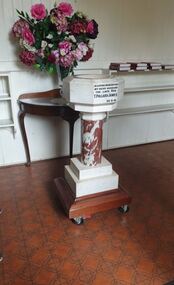
Photograph - Church, Clare Gervasoni, Daylesford Uniting Church Baptisimal Font, 2023, 04/03/2023
... first service was held in the new church on 10 December 1865. It is of interest for its brick broach spire, diapered brick façade and spacious interior with aisles separated from the nave by slender columns. The church organ was installed and built in 1888 by William Anderson and boasts an impressive 724 pipes, many of which are decorated with Christian symbols. This organ is a rare example of Anderson’s work and is his only instrument in Western Victoria. It is classified by the National...first service was held in the new church on 10 December 1865. It is of interest for its brick broach spire, diapered brick façade and spacious interior with aisles separated from the nave by slender columns. The church organ was installed and built in 1888 by William Anderson and boasts an impressive 724 pipes, many of which are decorated with Christian symbols. This organ is a rare example of Anderson’s work and is his only instrument in Western Victoria. It is classified by the National ...The Daylesford Uniting Church (formerly Wesleyan /Methodist Church) was built in 1865, replacing an earlier Wesleyan Chapel built in 1861 which is still on site and known as the Sunday School (2024). The foundaton stone for the newer, current church was laid on 12 June 1865, designed by Architects Crouch and Wilson the structure was built in early English Gothic style. The first service was held in the new church on 10 December 1865. It is of interest for its brick broach spire, diapered brick façade and spacious interior with aisles separated from the nave by slender columns. The church organ was installed and built in 1888 by William Anderson and boasts an impressive 724 pipes, many of which are decorated with Christian symbols. This organ is a rare example of Anderson’s work and is his only instrument in Western Victoria. It is classified by the National Trust of Australia (Victoria) as being of state significance. The organ was renpvated in 1979-80 by Leighton Turner. It has 2 manuals, 14 speaking stops, 3 couplers, tracker action, Gt: 8.8 divided.8.4.4.2-2/3.2. Sw: 8.8.4.2.8. Ped: 16. In the 1880s the decline in mining led to the congregation considering ways to reduce debt. Rent was received from pew hire as well as organ concerts and annual fairs. By the end of the 19th century the church had settled into a pattern of steady parish life. The 1950s and 1960s were really the glory days of the church with an active Sunday School, tennis clubs and vibrant social activity as well as many worshippers at Sunday services. The final service was held at the church on 21 April 2024.A marble baptisimal font in Daylesford Uniting Church.In loving memory of my dear husband The late Rev. T. Pollard James 28.9.41daylesford uniting church, daylesford methodist church, daylesford, john mitchell uniting church, daylesford wesleyan church, daylesford uniting sunday school, baptisimal font, t. pollard james -
 Ballarat Heritage Services
Photograph - Church, Clare Gervasoni, Daylesford Uniting Church John Mitchell Memorial Hall, 2023, 04/03/2023
... first service was held in the new church on 10 December 1865. It is of interest for its brick broach spire, diapered brick façade and spacious interior with aisles separated from the nave by slender columns. The church organ was installed and built in 1888 by William Anderson and boasts an impressive 724 pipes, many of which are decorated with Christian symbols. This organ is a rare example of Anderson’s work and is his only instrument in Western Victoria. It is classified by the National...first service was held in the new church on 10 December 1865. It is of interest for its brick broach spire, diapered brick façade and spacious interior with aisles separated from the nave by slender columns. The church organ was installed and built in 1888 by William Anderson and boasts an impressive 724 pipes, many of which are decorated with Christian symbols. This organ is a rare example of Anderson’s work and is his only instrument in Western Victoria. It is classified by the National ...The Daylesford Uniting Church (formerly Wesleyan /Methodist Church) was built in 1865, replacing an earlier Wesleyan Chapel built in 1861 which is still on site and known as the Sunday School (2024). The foundaton stone for the newer, current church was laid on 12 June 1865, designed by Architects Crouch and Wilson the structure was built in early English Gothic style. The first service was held in the new church on 10 December 1865. It is of interest for its brick broach spire, diapered brick façade and spacious interior with aisles separated from the nave by slender columns. The church organ was installed and built in 1888 by William Anderson and boasts an impressive 724 pipes, many of which are decorated with Christian symbols. This organ is a rare example of Anderson’s work and is his only instrument in Western Victoria. It is classified by the National Trust of Australia (Victoria) as being of state significance. The organ was renpvated in 1979-80 by Leighton Turner. It has 2 manuals, 14 speaking stops, 3 couplers, tracker action, Gt: 8.8 divided.8.4.4.2-2/3.2. Sw: 8.8.4.2.8. Ped: 16. In the 1880s the decline in mining led to the congregation considering ways to reduce debt. Rent was received from pew hire as well as organ concerts and annual fairs. By the end of the 19th century the church had settled into a pattern of steady parish life. The 1950s and 1960s were really the glory days of the church with an active Sunday School, tennis clubs and vibrant social activity as well as many worshippers at Sunday services. The final service was held at the church on 21 April 2024.A small hall in the grounds of Daylesford Uniting Church. John Mitchell was a teacher and superintendent from September 1861 to 1921. The hall was still in existence in August 2024.John Mitchell Memorial Hall 1931daylesford uniting church, daylesford methodist church, daylesford, john mitchell uniting church, daylesford wesleyan church, daylesford uniting sunday school, john mitchell -
 Ballarat Heritage Services
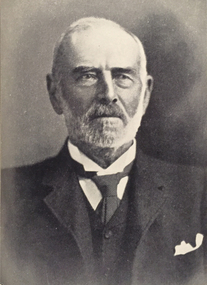
Photograph - Image, David Syme, 1934
... Sayers, 'Syme, David (1827–1908)', Australian Dictionary of Biography, National Centre of Biography, Australian National University, http://adb.anu.edu.au/biography/syme-david-4679/text7741, published first in hardcopy 1976, accessed online 25 August 2019...Sayers, 'Syme, David (1827–1908)', Australian Dictionary of Biography, National Centre of Biography, Australian National University, http://adb.anu.edu.au/biography/syme-david-4679/text7741, published first in hardcopy 1976, accessed online 25 August 2019._ david syme portrait the age journalist Reproducation of a image of David Syme. ...David Syme (1827-1908) was a newspaper proprietor who was born on 2 October 1827 at North Berwick, Scotland. Early in 1851, he went via Cape Horn to California seeking gold. By mid-1852 he was in Melbourne, and in the next three years prospected with some success on Ballarat, Bendigo, Castlemaine and Beechworth diggings. In 1855 he lost a possible fortune at Egerton near Ballarat when a promising claim was jumped. Ebenezer Syme bought the insolvent Melbourne Age for £2000, and invited David Syme to take up a share. In September 1856 Syme put up some cash and his contracting business to obtain a half-share. He helped to manage the paper but returned to contracting late in 1857. When Ebenezer retired in 1859 Syme reluctantly returned to the business, and on Ebenezer's death next year he began his fifty-year career as publisher and editor of the Age. (C. E. Sayers, 'Syme, David (1827–1908)', Australian Dictionary of Biography, National Centre of Biography, Australian National University, http://adb.anu.edu.au/biography/syme-david-4679/text7741, published first in hardcopy 1976, accessed online 25 August 2019._Reproducation of a image of David Syme.david syme, portrait, the age, journalist -
 Ballarat Heritage Services
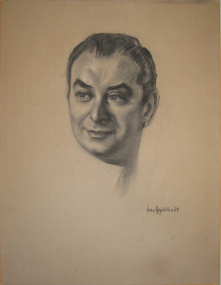
Drawing - Artwork - Painting, Portrait by Jean Appletom
... With the outbreak of war she returned to Australia, thereafter teaching at high schools in the ACT and NSW and at the Julian Ashton and National Art Schools in Sydney. The first of her thirteen solo exhibitions was held at Sydney’s Macquarie Galleries in 1940. ...With the outbreak of war she returned to Australia, thereafter teaching at high schools in the ACT and NSW and at the Julian Ashton and National Art Schools in Sydney. The first of her thirteen solo exhibitions was held at Sydney’s Macquarie Galleries in 1940. ...Jean APPLETON (1911-2003) Jean Appleton was a painter and craftworker who studied at East Sydney Technical College and at the Westminster School, London. After seeing French sculptor Maillol's work 'The Cyclist' she was inspired to try sculpture and consequently studied under Eric Schilsky in London. With the outbreak of war she returned to Australia, thereafter teaching at high schools in the ACT and NSW and at the Julian Ashton and National Art Schools in Sydney. The first of her thirteen solo exhibitions was held at Sydney’s Macquarie Galleries in 1940. Resident in England from 1969 to 1981, she continued to teach intermittently into the late 1970s. After a difficult first marriage to artist Eric Wilson, who died, she married painter Tom Green and they settled in Moss Vale. Though her work is now represented in major state and regional collections, Appleton was like many women artists of her generation in that recognition of her work came late in life: she was in her eighties when a public gallery first presented a retrospective exhibition of her art. (https://www.portrait.gov.au/portraits/2013.92/self-portrait, accessed 15 September 2019) Jean Appleton won the inaugural Portia Geach Memorial Award in 1965 with this work. She dies in 2003.A sketched portrait of a man's head by Jean Apppleton. It may be Jean Appleton's first husband, Eric Wilson. drawing, portrait, jean appleton -
 Ballarat Heritage Services
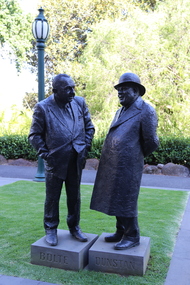
Photograph - Colour, Statue of Sir Rupert James Hamer, AC, KCMG, ED, 2016, 21/02/2016
... National Party of Australia), Dunstan was the 33rd Premier of Victoria. His term as Premier was the second-longest in the state's history, behind Sir Henry Bolte. Dunstan, who was Premier from 2 April 1935 to 14 September 1943 and again from 18 September 1943 to 2 October 1945, was the first Premier of Victoria to hold that office as a position in its own right, and not just an additional duty taken up by the Treasurer, Attorney General, or Chief Secretary. ...National Party of Australia), Dunstan was the 33rd Premier of Victoria. His term as Premier was the second-longest in the state's history, behind Sir Henry Bolte. Dunstan, who was Premier from 2 April 1935 to 14 September 1943 and again from 18 September 1943 to 2 October 1945, was the first Premier of Victoria to hold that office as a position in its own right, and not just an additional duty taken up by the Treasurer, Attorney General, or Chief Secretary. ...Sir Albert Arthur Dunstan, KCMG was an Australian politician. A member of the Country Party (now National Party of Australia), Dunstan was the 33rd Premier of Victoria. His term as Premier was the second-longest in the state's history, behind Sir Henry Bolte. Dunstan, who was Premier from 2 April 1935 to 14 September 1943 and again from 18 September 1943 to 2 October 1945, was the first Premier of Victoria to hold that office as a position in its own right, and not just an additional duty taken up by the Treasurer, Attorney General, or Chief Secretary. Sir Henry BoltePrint Page Print this page 15-November-2018[Diane Watson] 15-November-2018[Diane Watson] 15-November-2018[Diane Watson] 21-November-201615-November-2018 [Diane Watson]21-November-201615-November-2018[Diane Watson]15-November-2018[Diane Watson]21-November-2016 Photographs supplied by Sandra Brown / Diane Watson A statue commemorates the former Premier of Victoria, Sir Henry Bolte for his services to Victoria and Ballarat. In the 1955 elections an almost unknown sheep farmer from the bush, Henry Bolte, became premier. His long, uninterrupted Liberal rule was a seminal period in Victoria`s history, not least for the unprecedented development of the hitherto languishing state and the political stability that his election in 1955 delivered. There was a chaotic political culture in Victoria before Bolte was elected. It was effectively a national joke with one minority government in 1943 lasting just five days and another in 1952 lasting only four.Statue of Henry Bolte and Sir Allbert Dunstantreasury gardens, statue, henry bolte, albert dunstan, premier -
 Ballarat Heritage Services
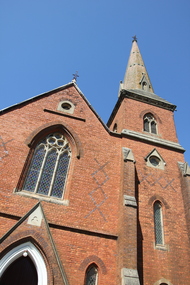
Photograph - Church, Clare Gervasoni, Daylesford Uniting Church, 18/10/2015
... first service was held in the new church on 10 December 1865. It is of interest for its brick broach spire, diapered brick façade and spacious interior with aisles separated from the nave by slender columns. The church organ was installed and built in 1888 by William Anderson and boasts an impressive 724 pipes, many of which are decorated with Christian symbols. This organ is a rare example of Anderson’s work and is his only instrument in Western Victoria. It is classified by the National...first service was held in the new church on 10 December 1865. It is of interest for its brick broach spire, diapered brick façade and spacious interior with aisles separated from the nave by slender columns. The church organ was installed and built in 1888 by William Anderson and boasts an impressive 724 pipes, many of which are decorated with Christian symbols. This organ is a rare example of Anderson’s work and is his only instrument in Western Victoria. It is classified by the National ...The Daylesford Uniting Church (formerly Wesleyan /Methodist Church) was built in 1865, replacing an earlier Wesleyan Chapel built in 1861 which is still on site and known as the Sunday School (2024). The foundaton stone for the newer, current church was laid on 12 June 1865, designed by Architects Crouch and Wilson the structure was built in early English Gothic style. The first service was held in the new church on 10 December 1865. It is of interest for its brick broach spire, diapered brick façade and spacious interior with aisles separated from the nave by slender columns. The church organ was installed and built in 1888 by William Anderson and boasts an impressive 724 pipes, many of which are decorated with Christian symbols. This organ is a rare example of Anderson’s work and is his only instrument in Western Victoria. It is classified by the National Trust of Australia (Victoria) as being of state significance. The organ was renpvated in 1979-80 by Leighton Turner. It has 2 manuals, 14 speaking stops, 3 couplers, tracker action, Gt: 8.8 divided.8.4.4.2-2/3.2. Sw: 8.8.4.2.8. Ped: 16. In the 1880s the decline in mining led to the congregation considering ways to reduce debt. Rent was received from pew hire as well as organ concerts and annual fairs. By the end of the 19th century the church had settled into a pattern of steady parish life. The 1950s and 1960s were really the glory days of the church with an active Sunday School, tennis clubs and vibrant social activity as well as many worshippers at Sunday services. The final service was held at the church on 21 April 2024.A redbrick church on stone foundation in Daylesforddaylesford uniting church, daylesford methodist church, daylesford, john mitchell uniting church, daylesford wesleyan church, crouch and wilson, daylesford uniting sunday school -
 Ballarat Heritage Services
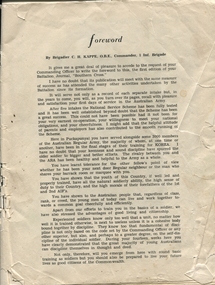
Journal, Southern Cross: Journal of the First Infantry Brigade, Puckapunyal, 1952 or after
... battalion puckapunyal kinnane, alec a company b company h company army national service No cover and no date. 40 pages of yellowing and torn paper with printing. Southern Cross: Journal of the First Infantry Brigade, Puckapunyal Journal ...40 pages of yellowing and torn paper with printing. No cover and no date.battalion, puckapunyal, kinnane, alec, a company, b company, h company, army, national service -
 Ballarat Heritage Services
Digital Photograph, Dorothy Wickham, The Cast Courts, 2016, 09/2016
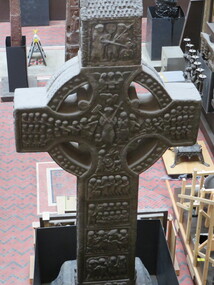
... first glimpse of Mont Blanc, creating one of those 'impressions that can scarcely be effaced'. Since then, these two enormous rooms and the reproductions they contain have continued to impress and inspire visitors to the Museum. For centuries, antiquarian interest in world architecture and sculpture led to reproductions – or copies – being made of outstanding national...first glimpse of Mont Blanc, creating one of those 'impressions that can scarcely be effaced'. Since then, these two enormous rooms and the reproductions they contain have continued to impress and inspire visitors to the Museum. For centuries, antiquarian interest in world architecture and sculpture led to reproductions – or copies – being made of outstanding national ...This ornate cross sits at the right hand side of View of Trajan's column, Cast Courts, Room 46a, The West Court, Victoria and Albert Museum, London. Cast Courts: "When the Architectural Courts – or Cast Courts as they are now known – opened in 1873, The Builder magazine compared the experience of seeing them to a first glimpse of Mont Blanc, creating one of those 'impressions that can scarcely be effaced'. Since then, these two enormous rooms and the reproductions they contain have continued to impress and inspire visitors to the Museum. For centuries, antiquarian interest in world architecture and sculpture led to reproductions – or copies – being made of outstanding national monuments and notable sculptures. When the Museum was founded, it collected and displayed reproductions of great art and architecture from across the world in order to offer objects for study and tell a complete story of the history of art and design. Casts are made by placing several plaster moulds upon the surface of the original structure. Once hardened and removed, the moulds are then enclosed in an outer casing, the interior coated with a separating agent and the wet plaster poured in. When set, the pieces are then assembled and the joints and surfaces finished off, to make a complete reproduction of the original work. The finished product – as well as being a formidable technical achievement in its own right – enables admirers to study faithful reproductions of important monuments and works of art." Ref: https://www.vam.ac.uk/articles/history-of-the-cast-courtslondon, victoria and albert museum, cast courts -
 Ballarat Heritage Services
Photograph - Photograph - Colour, Clare Gervasoni, Big Tree, Guildford, Victoria, 2017, 16/07/2017
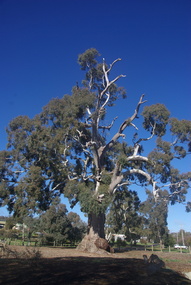
... The Big Tree is listed a a tree of State significance on the National Trust's Register of Significant Trees of Victoria for its outstanding size, curious fusion of branches, as an outstanding example of the species and as an important landmark. big tree guidlford river red gum A number of colour photographs of Guildford's Big Tree - a River Red Gum (Eucalyptus camaldulensis). The tres is believed to be one of the largest examples of the species in Victoria, and has been recorded as having a height of 30 metre, a canopy spread of 34 metres, and a trunk circumference of 9.35 metres. The tree was already an ancient giant when white settlers first ...The Big Tree is listed a a tree of State significance on the National Trust's Register of Significant Trees of Victoria for its outstanding size, curious fusion of branches, as an outstanding example of the species and as an important landmark.A number of colour photographs of Guildford's Big Tree - a River Red Gum (Eucalyptus camaldulensis). The tres is believed to be one of the largest examples of the species in Victoria, and has been recorded as having a height of 30 metre, a canopy spread of 34 metres, and a trunk circumference of 9.35 metres. The tree was already an ancient giant when white settlers first arrived in the 1840s. On Saturday evening, February 28th 2015, just as dusk was falling, Guildford was hit hard by tornado-like winds, felling the big cottonwood tree down by the river, and tearing limbs from the iconic Big Tree, reducing it by an estimated one third. The debris has been cleared since then and the tree seems to have survived its ordeal, though its size is certainly diminished.big tree, guidlford, river red gum -
Whitehorse Historical Society Inc.
Newspaper - Article, Bird study wins local a national prize, 28/10/1992
... Article from Nunawading Post re Martin Short of Blackburn South winning first prize in the 1992 National Earthworm Awards....Short Martin Awards Bellbirds Article from Nunawading Post re Martin Short of Blackburn South winning first prize in the 1992 National Earthworm Awards. Bird study wins local a national prize Newspaper Article ...Article from Nunawading Post re Martin Short of Blackburn South winning first prize in the 1992 National Earthworm Awards.short, martin, awards, bellbirds -
Whitehorse Historical Society Inc.
Article, History off the sheep's back, 22/02/1989 12:00:00 AM
... She established the National Wool Museum in Geelong, the Children's Museum in the Museum of Victoria. Was first female vice-master of Ormond College....She established the National Wool Museum in Geelong, the Children's Museum in the Museum of Victoria. Was first female vice-master of Ormond College....She established the National Wool Museum in Geelong, the Children's Museum in the Museum of Victoria. Was first female vice-master of Ormond College. ...A graduate degree in Chinese enabled Mrs Faggetter to work for 2 years in China teaching English to Chinese scientists.A graduate degree in Chinese enabled Mrs Faggetter to work for 2 years in China teaching English to Chinese scientists. She established the National Wool Museum in Geelong, the Children's Museum in the Museum of Victoria. Was first female vice-master of Ormond College.A graduate degree in Chinese enabled Mrs Faggetter to work for 2 years in China teaching English to Chinese scientists. museums, faggetter, rachel, australian wool museum, geelong, ormond college, cuttler, bob, children's museum -
 Geelong Football Club
Ross Faulkner Football signed by Doug Wade & Wayne Closter
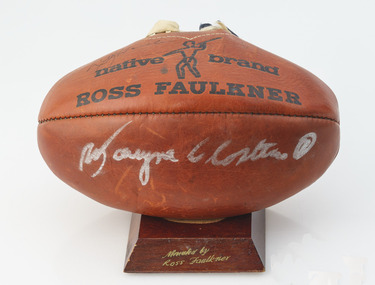
... first season as a listed player, he was selected in the Reserve Grade 1963 Premiership team. A favorable impression of his ability was created in his debut. He was opposed by Melbourne's Frank 'Bluey' Adams on a wing and out-pointed him convincingly. Initially he played many fine matches as a wingman. Later he moved into the centre where his good form continued. Features of his play were strong marking, good control and excellent kicking. He became one of the greatest ever exponents of kicking ambidextrously, and it became difficult to judge which was his natural kicking foot. National...first season as a listed player, he was selected in the Reserve Grade 1963 Premiership team. A favorable impression of his ability was created in his debut. He was opposed by Melbourne's Frank 'Bluey' Adams on a wing and out-pointed him convincingly. Initially he played many fine matches as a wingman. Later he moved into the centre where his good form continued. Features of his play were strong marking, good control and excellent kicking. He became one of the greatest ever exponents of kicking ambidextrously, and it became difficult to judge which was his natural kicking foot. National ...Doug ‘Pudden’ Wade Born: 16/10/1941 From: Horsham Height: 188cm Weight: 92kg Natural kicking foot: Right Guernsey number: 23 First senior match for Geelong: Round 1, 1961 v Collingwood at Kardinia Park Regarded by many as Geelong’s greatest ever full-forward, his greatest attributes were determination, fast leading, strong marking and prodigious kicking. Often he was able to score goals with 70-metre torpedo punts. Occasionally he scored from drop-kicks. When in top form he was a most inspiring player. If opponents tried to upset his game with niggling tactics he displayed a fiery aspect of his nature, which kept spectators ‘interested’. He played the forward role like an aggressive defender. Probably his most outstanding performance was a 13-goal effort at the Lake Oval in heavy conditions in 1967. A severe knee injury suffered in an interstate match in 1964 restricted his performances for about two seasons. In his time at Geelong he seemed to perform better as the seasons rolled on. He played in North Melb’s Premiership-winning team in 1975, twelve years after the same achievement with the Cats. Total Brownlow Medal votes for Geelong: 34 Premiership team selection: 1963 Night/Pre-Season Premiership team selection: 1961 Captain: 22 matches (1971-72) Club Best & Fairest: 1969 Fifth in club B&F count: 1961 Sixth in club B&F count: 1962 (equal), 1967, 1971 Seventh in club B&F count: 1964, 1972 Tenth in club B&F count: 1966, 1968 Club leading goalscorer: 1961 (51 gls), 1962 (68 gls), 1963 (48 gls), 1964 (41 gls), 1966 (52 gls), 1967 (96 gls), 1968 (64 gls), 1969 (127 gls), 1970 (74 gls), 1971 (94 gls), 1972 (90 gls) Competition leading goalscorer: 1962, 1967, 1969 Instances of seven goals or more in a match for Geelong: 35 Australian Football Hall of Fame inductee (2000) GFC Team of the 20th Century selection (full forward) GFC Hall of Fame inductee (1996) GFC Hall of Fame Legend GFC Life Membership (1968) Career span for Geelong: 1961-72 Total matches for Geelong: Premiership 208, Night/Pre-Season Series 4, Interstate 7 Total goals for Geelong: Premiership 834, Night/Pre-Season Series 11, Interstate 31 Finals matches for Geelong: 12 Finals goals for Geelong: 46 Last senior match for Geelong: Round 22, 1972 v North Melb at Kardinia Park Transferred to North Melb in 1973 Wayne Closter Born: 26/02/1945 From: Darley Height: 180cm Weight: 81kg Natural kicking foot: Right Guernsey number: 1 First senior match: Round 1, 1964 v Melbourne at the MCG In his first season as a listed player, he was selected in the Reserve Grade 1963 Premiership team. A favorable impression of his ability was created in his debut. He was opposed by Melbourne's Frank 'Bluey' Adams on a wing and out-pointed him convincingly. Initially he played many fine matches as a wingman. Later he moved into the centre where his good form continued. Features of his play were strong marking, good control and excellent kicking. He became one of the greatest ever exponents of kicking ambidextrously, and it became difficult to judge which was his natural kicking foot. National Service training obligations during a number of seasons deprived him of the chance of playing 200 matches and to represent Victoria, however the AFL acknowledged his contribution by inducting him into the 200 club during 2007. From 1977 until 1979 he coached the Reserves before spending 10 seasons as a 3GL/K-Rock football commentator. Total Brownlow Medal votes: 29 Captain: 1 match (Round 9, 1974 v South Melb at Kardinia Park) Fourth in club B&F count: 1967, 1971 (equal) Fifth in club B&F count: 1966 Sixth in club B&F count: 1964, 1968, 1972 Eighth in club B&F count: 1970, 1974 Ninth in club B&F count: 1973 GFC Hall of Fame inductee (2002) GFC Life Membership (1971) Career span: 1964-75 Total matches: Premiership 191, Night/Pre-Season Series 2 Total goals: Premiership 72, Night/Pre-Season Series 0 Finals matches: 8 Finals goals: 1 Last senior match: Round 22, 1975 v Fitzroy at Waverley Park Information provided by Col Hutchinson Geelong Cats HistorianRed, slightly deflated Ross Faulkner football. In black on one side of the white laces states - MATCH/Native Brand/ ROSS FAULKNER - with a symbol of figure, and is repeated on the other side states - the football is on a small wooden stand stained dark brown with the text engraved donated by Ross Faulkner - The Football a large player signature on one side in white texta it is believed to be Wayne Closter. There is a signature in pen above the text native on one side of the football by Doug Wade. The football has blue and white ribbons threaded through the laces.Signature Doug Wade and Wayne Closter doug wade, wayne closter, ross faulkner, football, gfc, geelong football club, vietnam war -
 Dandenong/Cranbourne RSL Sub Branch
Badge - 9 x badges, Unknown
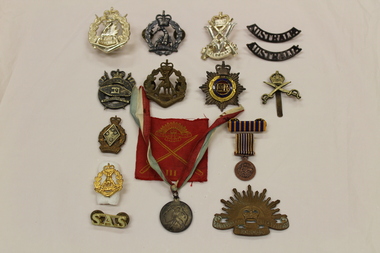
... Various War heritage from different wars and Army Units. 1# Resolute. 2# Victoria. 3# Vigilant. 4# Duty First. 5# Australia Parutas. 6# Royal Australian Army Service Corps. 7# Rising Sun. 8# Royal Australian Regiment 'Duty First'. 9# 'WRAAC' Hat- Badge. 1# 2 x shoulder insignia 'Australia'. 2# Bar and medal - 'National Medal for Service'. 3# 1 x Special Air Service Regiment Shoulder insignia. 4# 1 x red patch 'A.I.F. crossed swords. 5# Crossed swords over crown. 6# Victory Medal 1945. ...Various War heritage from different wars and Army Units.1# 2 x shoulder insignia 'Australia'. 2# Bar and medal - 'National Medal for Service'. 3# 1 x Special Air Service Regiment Shoulder insignia. 4# 1 x red patch 'A.I.F. crossed swords. 5# Crossed swords over crown. 6# Victory Medal 1945.1# Resolute. 2# Victoria. 3# Vigilant. 4# Duty First. 5# Australia Parutas. 6# Royal Australian Army Service Corps. 7# Rising Sun. 8# Royal Australian Regiment 'Duty First'. 9# 'WRAAC' Hat- Badge. -
Unions Ballarat
John Howard: Prime Minister (Don Woodward), Barnett, David et al, 1997
... first year holding the office of Prime Minister. Howard was Prime Minister (Liberal Party) from 1996-2007. During his term of office, Howard introduced the Workchoices legislation, Higher Education Workplace Regulation Requirements and the ABCC which were all targeted at diminishing the powers of the union movement. He was defeated by Kevin Rudd (ALP) in 2007 and lost his seat to Maxine McKew at the same election. Political biography - John Howard. BTLC Ballarat Trades Hall ballarat trades and labour council Howard, John Prime Ministers - Australia Politics and government Biography Workchoices Liberal Party Australia coalition government national ...A biography of John Howard's political career written in his first year holding the office of Prime Minister. Howard was Prime Minister (Liberal Party) from 1996-2007. During his term of office, Howard introduced the Workchoices legislation, Higher Education Workplace Regulation Requirements and the ABCC which were all targeted at diminishing the powers of the union movement. He was defeated by Kevin Rudd (ALP) in 2007 and lost his seat to Maxine McKew at the same election.Political biography - John Howard.Book; 806 pages. Dustjacket: colour photograph of John Howard; black and white lettering; authors' names and title. Cover: blue background; gold lettering; authors' names and title.btlc, ballarat trades hall, ballarat trades and labour council, howard, john, prime ministers - australia, politics and government, biography, workchoices, liberal party australia, coalition government, national party, parliament - australia -
 Ballarat Heritage Services
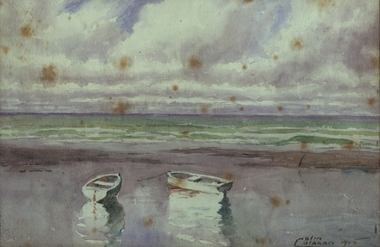
Painting - Artwork - painting, Colin Colahan, 'The Mouth of the Carrum Creek' by Colin Colahan, 1915
... Colin COLAHAN (1897-1987) Born Australia Colin Colahan was a student of Max Meldrum, and was one of the first tonalist painters to have his work purchased by the National Gallery of Victoria. ...Colin COLAHAN (1897-1987) Born Australia Colin Colahan was a student of Max Meldrum, and was one of the first tonalist painters to have his work purchased by the National Gallery of Victoria. ...Colin COLAHAN (1897-1987) Born Australia Colin Colahan was a student of Max Meldrum, and was one of the first tonalist painters to have his work purchased by the National Gallery of Victoria. He contributed cartoons to 'The Bulletin'. Colahan was working in Paris in the 1920s and had a studio in Mont Martre. He returned to Melbourne by 1927. He next lived and worked in London in 1936 for the next 22 years. During World War Two his house in Chelsea was bombed and everything destroyed. Some photographs donated to Xavier College, his alma mater, are the only evidence of the destroyed work. Cola ham was an Australian War Artist after 1942, with over 90 of his works held by the Australian War Memorial. He moved permanently to Itsly in 1958. Images of a framed watercolour by Colin Colahan. Signed lr "Colin Colahan 1915"colin colahan, watercolour, boats, coast, beach -
 Ballarat Heritage Services
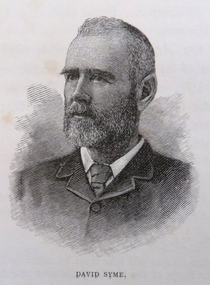
Photograph - Image, David Syme
... Sayers, 'Syme, David (1827–1908)', Australian Dictionary of Biography, National Centre of Biography, Australian National University, http://adb.anu.edu.au/biography/syme-david-4679/text7741, published first in hardcopy 1976, accessed online 25 August 2019...Sayers, 'Syme, David (1827–1908)', Australian Dictionary of Biography, National Centre of Biography, Australian National University, http://adb.anu.edu.au/biography/syme-david-4679/text7741, published first in hardcopy 1976, accessed online 25 August 2019._ david syme portrait the age journalist Reproducation of a image of David Syme. ...David Syme (1827-1908) was a newspaper proprietor who was born on 2 October 1827 at North Berwick, Scotland. Early in 1851, he went via Cape Horn to California seeking gold. By mid-1852 he was in Melbourne, and in the next three years prospected with some success on Ballarat, Bendigo, Castlemaine and Beechworth diggings. In 1855 he lost a possible fortune at Egerton near Ballarat when a promising claim was jumped. Ebenezer Syme bought the insolvent Melbourne Age for £2000, and invited David Syme to take up a share. In September 1856 Syme put up some cash and his contracting business to obtain a half-share. He helped to manage the paper but returned to contracting late in 1857. When Ebenezer retired in 1859 Syme reluctantly returned to the business, and on Ebenezer's death next year he began his fifty-year career as publisher and editor of the Age. (C. E. Sayers, 'Syme, David (1827–1908)', Australian Dictionary of Biography, National Centre of Biography, Australian National University, http://adb.anu.edu.au/biography/syme-david-4679/text7741, published first in hardcopy 1976, accessed online 25 August 2019._Reproducation of a image of David Syme.david syme, portrait, the age, journalist -
Whitehorse Historical Society Inc.
Newspaper - Article, White Knight of Theatre in the East, 24/02/1999
... first professional theatre season at Whitehorse Centre in Nunawading. The 20th anniversary revival of David Williamson's 'The Department' will make Whitehorse its only Melbourne stop on its national tour. ...first professional theatre season at Whitehorse Centre in Nunawading. The 20th anniversary revival of David Williamson's 'The Department' will make Whitehorse its only Melbourne stop on its national tour. ...After the closure of the Alexander Theatre at Monash University last year Whitehorse Council decided to stage shows that would otherwise pass Melbourne by. It has launched its own first professional theatre season at Whitehorse Centre in Nunawading. The 20th anniversary revival of David Williamson's 'The Department' will make Whitehorse its only Melbourne stop on its national tour. The season commences on 16 April 1999 and finishes on 18 September. Whitehorse Centre co-ordinator is Kevin O'Loghlin.whitehorse centre, o'loghlin, kevin, buckingham, helen, williamson, david, drama -
 Whitehorse Historical Society Inc.
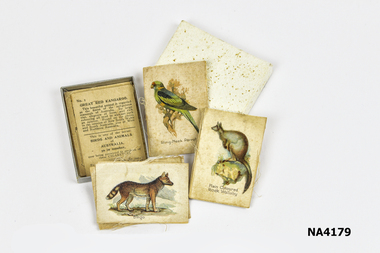
Memorabilia - Box - Cigarette silks, 1911 - 1917
... |On the Australian scene the first local manufacturer who issued cards seems to have been The National Cigarette Company of Australia Proprietary Limited, whose 'Tally Ho' packets contained cards from a series of thirteen featuring the touring 'English Cricket Team 1897-8' Of the few Australian manufacturers who issued cards, only two companies issued more the two sets. ...These type of cigarette silks were included in WD & HO Wills cigarette packets to induce women in particular to take up smoking.|The Word 'Cartophilic?|It is believed that this unusual word was coined in the 1920s by Col. Bagnall, an Englishman, who was the father of the hobby of cigarette card and trade card collecting. It is thought to be a combination of a Latin word, 'carto' meaning 'card and the Greek word 'philic', meaning 'love'.- lover of cards. The term originally related to the collection of the two types mentioned, however, our Society has included postcards in the range of items collected by our members.|The Cigarette Card|The cigarette card began its evolution in the United States of America, in the early 1880s as a plain piece of cardboard used by tobacconists to protect the cigarettes which were sold in that era, not in packets, but loosely. A purchaser would buy his cigarettes then wrap them in paper around the small piece of cardboard, which acted as a stiffener. In fact, for many decades, cigarette cards were known as 'stiffeners' in the USA.|The card depicting 'The Marquis of Lome' is reputed to be the first known cigarette card issued. This is thought to have been in 1879. It did not take long for an enterprising entrepreneur to recognise the advertising potential of the cigarette card, and, very soon, the cards began displaying popular images, often in sets. This had the effect of youngsters, wishing to complete their sets, harassing their fathers to buy a specific brand of cigarettes. The kids who collected cards in the days when they were being issued in the cigarette packets, would hang around outside the local tobacconist's shop, pestering the men who had just bought a packet of cigarette, with the cry: 'can I have the cig can mister?'|It is a proven fact that, here in Australia during the 1930s, at least one set had one card deliberately withheld and issued very sparingly. This card is No. 86 (Mrs Jack Crawford) in the Carreras 'Turf Personality Series'. Thus, in a set of reasonably easy cards to get, this one card is a constant source of frustration for the collector, and as such, commands a premium when it comes to price. It is not hard to imagine the young collector nagging his to Dad to keep buying 'Turf' cigarettes to enable him to finish the set.|From small beginnings the cigarette card soon gave rise to a booming industry in itself. Artists and writers were|employed to produce the cards, which were miniature works of art and served as little encyclopaedia's for the children of the day. By the 1930s cards were being issued in the countless millions. It has been stated, in one book on the history of cards; that 450 million sets of a series produced and issued by the prolific issuer of cards in the United Kingdom, WD & HO Wills. As each set contained 50 cards you would need a calculator with a very long result window to see the answer to how many cards of that series were in circulation.|Australia's involvement would appear to have its beginnings with the English and American firms who shipped their tobacco products here and the cards of American Tobacco Company (ATC) are found in great numbers in early Australian collections; many featuring Australian subjects, e.g. 'Australian Parliament a 1901 issue. Earlier U.S. sets depicting Australians included Goodwin & Co's, so called. 'Australian Series' with cricketers and Australian Rules footballers who were on the sporting scene during the 1880s. The caption of one of theses cards reads:|'W.Hannysee. Captain Port Melbourne Football Club' which enables us to pinpoint the year of issue to either 1889 or 1890.|On the Australian scene the first local manufacturer who issued cards seems to have been The National Cigarette Company of Australia Proprietary Limited, whose 'Tally Ho' packets contained cards from a series of thirteen featuring the touring 'English Cricket Team 1897-8' Of the few Australian manufacturers who issued cards, only two companies issued more the two sets.|Undoubtedly the cards issued by the Melbourne firm Sniders & Abrahams (later Sniders & Abrahams Pty Ltd) are the 'jewels in the crown' of Australian card issues. They issued some thirty-three series, with numerous sub-series and allied issues such as metal badges, metal football shields, celluloid flags etc., which ensured that the hobbyist had a vast range from which to collect. Sporting themes – football, cricket, horse racing – dominate, indicating the Australians' love of sport and the outdoors was as strong in those earlier times as it is today. Military, animals and birds themes were also to the fore, with a touch of culture being provided by 'Shakespeare', 'Dickens', actresses and even classical 'Statuary'. Humour was not forgotten with 'Cartoons and Caricatures', 'Naval and Cricket (double meaning) Terms' and the 'Jokes' series. Art and history were covered by the artist, S.T. Gill's 'Views of Victoria in 1857' while the stereoscopic 'Views of the World' expanded the collectors' knowledge of the world as a whole.|The Sniders & Abrahams series began in 1904 and by 1919 the company was in decline and was eventually taken over by G.G. Goode & Co. Ltd. This company produced one set only, the highly collectable 'Prominent Cricketer Series' issued in 1924. During the early to mid-1920s, J.J. Schuh Tobacco Pty Ltd issued eight series, again containing the popular subjects of sport and war. At least two provincial tobacconists, Lentens of Bendigo and Baillies of Warrnambool, issued private football series. The last series of cards issued by a truly Australian firm was Dudgeon & Arnell's '1934 Australian Cricket Team'.|The Australian market was not neglected by the English companies with WD & HO Wills, Godfrey Phillips and Ogdens all making their contributions. By far the most active issuer was the long-established company Wills, whose 'Cricketers' of 1901 heralded the flood of Australian series, which continued into the mid-thirties.|The onset of the 1939-45 World War sounded the death knell of the cigarette card and very few post-war issues were made, certainly not here in Australia.|The Trade Card|The Trade Card is a non-tobacco item used by manufacturers to promote and advertise their products, in the same way that cigarette cards were. It is uncertain exactly when they were first produced, but in the USA, non-collectable cards were issued by firms in the early 1800s. These were more akin to a latter day 'business card'. It was not until the 1850s, when coloured and pictorial cards were issued to advertise and promote products that the Trade Card|became a collectable item. Many beautiful lithographic cards were produced in this early era and they are very mu sought after by collectors. By the 1870s the issues of Trade Cards became more prolific and it is from this era that more cards are seen.|Again, it is difficult to pinpoint the exact date of the first Australian Trade Card and it may be that the highly collectable and extremely rare 'American Candy Co's' - 'Pure Caramels' Australian Rules football card, issued i 1891, is the earliest series. This confectionery firm was located in Fitzroy, a Melbourne suburb. To date only two subjects have been seen.|Another early set was 'Flags', issued by F.H.Fauldings & Co. It featured testimonials of seven English cricketers who toured Australia with the 1894/5 Test team. Fauldings was an Adelaide based firm which manufactured medicinal toiletries, soaps and oils, using the distinctly Australian eucalyptus oil. During the 20th century a multitude of Australian businesses issued trade cards, with confectionery manufacturers such as Hoadleys, Allens, Sweetacres and Australian Licorice producing the majority of them. Again sporting themes dominated with the ever popular Aussie Rules football cards being the most numerous. Cricket issues ran a close second.|Apart from sporting cards, almost every subject imaginable was covered by the Trade Card, making it the most diverse and interesting branch of cartophilly. In contrast to the Cigarette Card, which had its demise prior to the Second World War, the Trade Card is still alive and well.|We all are aware of the long running 'Birds of Australasia' series put out by Tuck-fields Tea and 1 doubt if there is a kitchen drawer in Australia that has not got one or two of these informative and attractive cards floating about in it. These cards were first produced in the early 1960s and are still being inserted in that company's packets of tea. Such is also the case with Sanitarium Health Foods, manufacturers of the well known Weetbix, who began issuing cards, with a wide range of subjects, in the early 1940s and continue to do so.|The 1940s and 1950s saw the two breakfast food giants, Kornies and Weeties dominating the card scene. Kornies footballers were in production fora decade from 1948 to 1959. Four years later in 1963, we saw the start of four decades of Scanlens bubble-gum card issues, both football and cricket. In the mid 1990s, with the end of the Scanlens/Stimorol cards, the Trading Card came on the scene. These cards do not fit under the umbrella of the Trade Card, having been produced and marketed purely as a 'collectable' with no connection whatsoever to any product, which of course is necessary for an item to be classified as a Trade Card.|The earliest British postcard was issued in 1870 and was designed to send short messages; the stamp was printed on the card, therefore it did not require an envelope. It was considered by many to be lowering the postal standards because the texts were no longer private. However the cards were a great success as on the first day of issue in 1870, half a million passed through the London postal centre.|The first illustrated postcards are said to be those introduced by a French stationer in 1870. He realized that French troops fighting in the Franco-Prussian War needed to be able to send short messages to their families and designed a 'postcard' to suit the purpose. As many of the soldiers were illiterate they decorated their cards with sketches of their many activities at the front rather than writing; thus creating a picture postcard. Private enterprise soon saw the great financial possibilities of this new easy and attractive way of communication by post; also sending a postcard cost less than postage for letters. It was correctly assumed that postcards were likely to overtake letter writing in many instances.|Between 1875 and 1882 every state in Australia introduced official postcards, N.S.W. first and Tasmania last. Each state produced a simple type of postcard with a pre printed stamp allied to that state. The stamp side stated 'The Address Only To Be Written On This Side'; the reverse side sometimes carried a simple illustration or decoration with space fora short message, each state extolling their own state's virtues. In 1901, with the advent of Federation, the new Government became responsible for all postal services in Australia and produced postcards for sale in every state. With several mail deliveries each day in most towns, postcards were used for many purposes. One 1906 postcard, with an illustration of fruit, was sent from Mrs X in the morning to her greengrocer ordering her fruit and vegetables to be delivered that afternoon. Another lady asks her charlady to 'come this afternoon'.|Australian private enterprise also began selling pictorial postcards, most companies using the very experienced German printing works who were the worlds best in the field of lithography and fine detailed colour-printing. Many of these beautiful German cards still exist today, 100 years later. Australia did have a few fine printers but they were in the minority. Black and white postcards printed in Australia in the early 1900s were often of good quality e.g. postcards printed by 'The Bulletin', illustrating the works of 'The Bulletins' top artists.|Between c1903-09 The Melbourne company Osboldstone and Atkins etc. printed coloured reproductions of 46 J.A. Turner bush/rural life paintings, which were generally of good quality and became hugely popular and still sought after today. Like thousands of homes in Europe, Britain and U.S.A., many Australia homes had albums of cherished postcards, which were given pride of place for visitors to see and enjoy.|Postcard collecting remained popular but was changing with the times. About 1912 the Australian photographer George Rose of Melbourne began to produce topographical B/W real photographic postcards covering most of Australia and other photographers began to do likewise. These cards soon found their way into collections as well.|WWI and the horrors of war suddenly changed the world; postcards were still in great demand but the subject matter was far more serious. Thousands of postcards from the trenches in European war zones arrived in Australia to be included in family albums. Propaganda and recruitment messages were produced to encourage enlistment. Australian postcard producers began to create cards decorated with gum leaves, boomerangs, wattle etc., which were designed for sending to Australian troops serving overseas. Very few 'pretty' cards were available, as access to the Gentian printing works was no longer possible and exporting of postcards from Britain was very limited. By the end of WWI people had other more serious problems to contend with and the avid postcard collecting hobby declined, fold greetings took over and topographical photographic postcards became a small but steady income for the producers and newsagents etc. in every town.|Fortunately many of these old postcards still exist and are avidly collected by a new generation or postcard collectors. The Australian Cartophilic Society Inc. is one of four postcard/cigarette card organizations in Australia. They are, N.S.W. Post Card Collectors Society; Queensland Card Collectors' Society Inc. and West Australian Card Collectors|Society, and across the Tasman there is a New Zealand Postcard Society.|References:|Picture Postcards of the Golden Age A Collector's Guide by Toni & Valmai Holt. Picture Postcards in Australia 1898 - 1920 by David CookBox of Cigarette Silks ( 10 ) depicting animal motifs, which were placed in cigarette packets as an incentive for women in particular to smoke.|WD & HO Wills|Produced 1911 - 1917personal effects, smoking accessories, recreations, collections -
![George Lewis, Mayor [of Kew] 1863](/media/collectors/550653872162f11fb04854aa/items/5922822bd0cef20e04ba0882/item-media/5c1960f321ea6c0dacf37803/item-fit-380x285.jpg?cb=6) Kew Historical Society Inc
Kew Historical Society IncPhotograph, J E Barnes, George Lewis, Mayor [of Kew] 1863, c.1906
... A Significance Assessment in 2018, funded by the National Library of Australia confirmed the historic, and often artistic significance of the series. mayors of kew (vic) cr. george lewis Kew (Vic.) — municipal collection George Lewis / Mayor 1863 Framed portrait of Cr. George Lewis, third Chairmen and later first ...Kew achieved independence from the Boroondara Roads Board in 1860. As a new municipality, its first three leaders were designated as chairmen. On becoming a borough in 1863, its leaders were identified as mayors. The earliest photographs date from ca.1906, when the Town of Kew commissioned the noted local photographer Josiah E Barnes to produce standardised portraits of former mayors to be displayed in the Mayoral Chamber of the Town Hall. The collection also includes photographs by other well-known photographic studios such as Burlington Studios, Melba – Melbourne, Stuart Tompkins, Spencer Shier and Talma & Co. The majority of mounts identify the photographer. Eighty photographs are housed in their original frames.This portrait is one of a series of mounted and framed photographic portraits of mayors and town clerks of the former Borough, Town and City of Kew. The portraits were transferred by the City of Kew to the Kew Historical Society in March 1989. A Significance Assessment in 2018, funded by the National Library of Australia confirmed the historic, and often artistic significance of the series.Framed portrait of Cr. George Lewis, third Chairmen and later first Mayor of Kew. The mounting and framing of the photograph follows a typical layout or style in that each is framed in dark wood, glazed, and laid down on an inscribed board. The inscription identifies the name of the mayor and the year/s that he/she served.George Lewis / Mayor 1863 mayors of kew (vic), cr. george lewis, kew (vic.) — municipal collection -
 Heidelberg Theatre Company Inc..
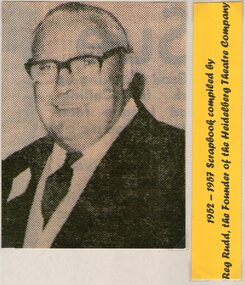
Photos and various articles, General Memorabilia
... It is understood the Heidelberg National Theatre folded in the late 1950s 6_1952 articles2 - Cuttings, including articles advertising first meeting of the City of Heidelberg Repertory Group on the 1st February, 6_1952 articles7 - Article reporting on AGM held in February, 1953 with Cr F. ...It is understood the Heidelberg National Theatre folded in the late 1950s 6_1952 articles2 - Cuttings, including articles advertising first meeting of the City of Heidelberg Repertory Group on the 1st February, 6_1952 articles7 - Article reporting on AGM held in February, 1953 with Cr F. ...2_1952 - 1. Reg Rudd founded the City of Heidelberg Repertory Group. It was a breakaway group from the Heidelberg National Theatre, which is believed to have been active in the district from the 1930s. It is understood the Heidelberg National Theatre folded in the late 1950s 6_1952 articles2 - Cuttings, including articles advertising first meeting of the City of Heidelberg Repertory Group on the 1st February, 6_1952 articles7 - Article reporting on AGM held in February, 1953 with Cr F. Boyd presiding, when comprehensive reports were read by Mr Reg Rudd, the director, the financial report was presented by Mr Mel Morgan. Photocopies of original articles from Theatrecraft and other unidentified newspapers1952, htc general memorabilia -
 Kew Historical Society Inc
Photograph - Lalla Rookh : 41 Fellows Street, Progress Press, 1978
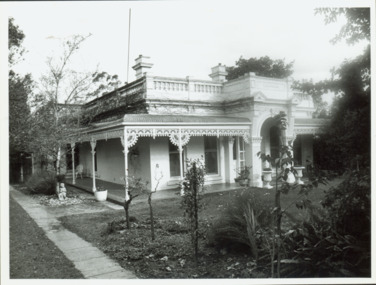
... The National Trust (Victoria) citation on the Heritage Victoria Database describes Lalla Rookh as charming and rare example of a substantial domestic building from the depths of the depression of the 1890s. It was Classified by the Trust on 22/04/1971. The first...The National Trust (Victoria) citation on the Heritage Victoria Database describes Lalla Rookh as charming and rare example of a substantial domestic building from the depths of the depression of the 1890s. It was Classified by the Trust on 22/04/1971. The first ...The National Trust (Victoria) citation on the Heritage Victoria Database describes Lalla Rookh as charming and rare example of a substantial domestic building from the depths of the depression of the 1890s. It was Classified by the Trust on 22/04/1971. The first Kew Urban Conservation Study established that the house was built in 1897 for John Duncan, civil servant. By 1910 William Robert Frayne, chemist, had purchased the property. When the building was listed by the National Estate the building was described as: '... Single-storied, the symmetrical, stuccoed house features a central porch with an arched opening and pedimented consoles and a bull-nose verandah which returns down both sides and is constructed with cast iron columns and friezes. A balustraded parapet crowns the main walls of the house. The encaustic tiled verandah is distinctive.'"Lalla Rookh", 41 Fellows Street, Kew, is of architectural interest as a representative example of a villa house of the period and also forms pan of the townscape of Kew. In a late version of Boom Style Classicism, the basically modest and conventionally planned house is proportioned to emphasise the porch and heavy balustrade, contrasting with the verandah and plain wall surfaces. The parapet may have had urns originally. The encaustic tiled verandah is of note. ... Of local significance.'Photographic print positive of the facade of Lalla Rookh at 41 Fellows Street, Kew.lalla rookh, houses -- fellows street -- kew (vic.), boom style architecture, architecture -- melbourne -- 1890s -
 Kew Historical Society Inc
Book, Stories They Tell : A history of Kew through objects, 2022
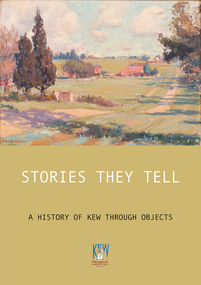
... first century. These stories use as their starting point artworks, texts and artefacts from the nationally significant collection of the Kew Historical Society. ...'Stories They Tell : A history of Kew through objects' explores diverse narratives from European settlement to the first decades of the twenty-first century. These stories use as their starting point artworks, texts and artefacts from the nationally significant collection of the Kew Historical Society. Limited to 100 copies.117 pp : illustrated : Appendices Chapters: Preface / Robert Baker p4. The collection / Robert Baker p5. Cartwheel penny / Robert Baker p6. Creek and old watering stage / David White p10. John Carson: Mayor 1863–4 1 / Julie King p4. Wedding dress / Suzanne McWha p18. Back to Kew 1875 / Judith Scurfield p22. Barnard’s clock / Margaret Robinson p26. Denbigh quilt / Suzanne McWha p28. Fragments of art decoration / Robert Baker p32. Mr Richardson’s sock / Felicity Renowden p36. Kew Volunteer Fire Brigade / David White p38. Kew Where We Live / Judith Scurfield p42. [MMBW} Detail Plan No. 1580 / Judith Scurfield p46. Adeney Avenue / Suzanne McWha p50. Young Workers’ Patriotic Guild / Margaret Robinson p54. Roll of Honor [Thomas Rand] / Robert Baker p56. Alice Anderson in her tourer / Felicity Renowden p60. Kew War Memorial / David White p62. Beaded dance dress / Suzanne McWha p 66. The great flood of 1934 / Desley Reid p68. Depression-era toolbox / Robert Baker p72. War Savings Street / Julie King p74. Kew Public L.ibrary / Suzanne McWha p78. Signature supper cloth / Desley Reid p82. View from the garden of Rockingham / Desley Reid p86. Cr Marie Dalley / Felicity Renowden p90. Centenary of Kew / Robert Baker p94. Doris Dickinson’s gown / Julie King p98. [Model Dairy] Milk bottles / Robert Baker p100. Kew Civic Centre / David White p102. Bicentennial tapestries / Margaret Robinson p106. Crest of the City of Kew / Desley Reid p110. Town Crier [outfit] / Desley Reid p112. Acknowledgements p114. List of works p115.non-fiction'Stories They Tell : A history of Kew through objects' explores diverse narratives from European settlement to the first decades of the twenty-first century. These stories use as their starting point artworks, texts and artefacts from the nationally significant collection of the Kew Historical Society. Limited to 100 copies.collection -- kew historical society, museum catalogues, henty family, cartwheel pennies, kew lunatic asylum, patchwork quilts, john carson, george bouchier richardson, gb richardson, coombs family, james dannock, back to kew 1875, francis barnard, denbigh family, cullis hill & co, ordsall, southesk, kew volunteer fire brigade, jfc farquhar, henry kellett, mmbw detail plan 1580, william nicholls anderson, young workers patriotic guild, roll of honor -- town of kew, alice anderson, kew war memorial, flapper dresses, fairfield bridge, chandler highway bridge, warren trestrail, furniture -- 1930s, war savings streets, kew library, children's libraries, voluntary aid detachments - kew (vic.), rockingham, james govett, centenary of kew, mayoresses -- kew (vic.), model dairy -- kew (vic.), doris dickinson, crests -- city of kew (vic.), town criers -- kew (vic.), joy stewart, australian bicentennial -- kew (vic.), kew civic centre, ak lines mcfarlane marshall, adeney avenue -- kew, wwi -
 Kew Historical Society Inc
Award, Boroondara Rifle Club Spoon Competition : 800, 900 yds won by J S Penrose 1905, 1905
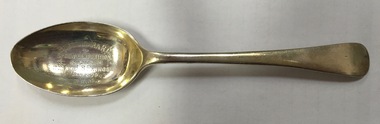
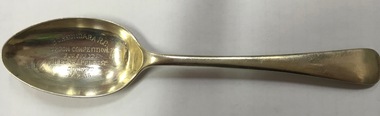
... National Trust (Victoria). At the time, the trophies were believed to have been awarded to J.S. Penrose for victories in events held by the Boroondara R.C. [Rifle Club] in 1905 and 1906. The Boroondara Rifle Club was a separate entity to the Kew and Hawthorn Rifle Clubs. The first...National Trust (Victoria). At the time, the trophies were believed to have been awarded to J.S. Penrose for victories in events held by the Boroondara R.C. [Rifle Club] in 1905 and 1906. The Boroondara Rifle Club was a separate entity to the Kew and Hawthorn Rifle Clubs. The first ...In 2000, three silver trophy spoons were donated to the Kew Historical Society by the National Trust (Victoria). At the time, the trophies were believed to have been awarded to J.S. Penrose for victories in events held by the Boroondara R.C. [Rifle Club] in 1905 and 1906. The Boroondara Rifle Club was a separate entity to the Kew and Hawthorn Rifle Clubs. The first reference to the Club on Trove is on 11 April 1900, when the Club was established and the committee elected. It is recorded that: “the adjourned meeting in connection with the Boroondara Rifle Club was held in the shire hall on Monday evening; Mr. A. J. Smith, J.P., in the chair. It was decided that the name of the club should be the Boroondara Rifle Club, and that it should embrace the whole shire, with butts at some convenient and accessible spot. A number of additional members were sworn in, making the total enrolled to date about 70. The following gentlemen were elected as office bearers: — President, Sir Frederick Sargood. M.L.C.: vice-presidents, Messrs. Wm. Knox, M.L.C.; F. Madden, M.L.A., and A. J. Smith (president of the shire); hon. captain, Mr. John Mc Whae (chairman of the Stock Exchange) ; committee. Messrs. T. W. Gaggin, J. B. Gilfillan, Cr. Lewis. Cr. Rooks and Cr. Beckett; hon. treasurer. Mr. G. A. Darling; hon. secretary, Mr. A. J. .Macarthur”.The last recorded meeting of the Rifle Club was in 1916, at “Adam’s Hall, upper Hawthorn” when a new committee was elected. Silver trophy spoon awarded to J.S. Penrose by the Boroondara Rifle Club for a victory in the Spoon Competition.Boroondara R.C. / Spoon Competition / 800, 900 yds /won by J.S. Penrose. Score 70 / 21-10-05boroondara rifle club, silver trophies -
 Kew Historical Society Inc
Award, Boroondara Rifle Club Spoon Competition : 200, 300 yds won by J S Penrose 1906, 11/02/1906
... National Trust (Victoria). At the time, the spoons were believed to have been awarded to J.S. Penrose for victories in events held by the Boroondara R.C. [Rifle Club] in 1905 and 1906. The Boroondara Rifle Club was a separate entity to the Kew and Hawthorn Rifle Clubs. The first...National Trust (Victoria). At the time, the spoons were believed to have been awarded to J.S. Penrose for victories in events held by the Boroondara R.C. [Rifle Club] in 1905 and 1906. The Boroondara Rifle Club was a separate entity to the Kew and Hawthorn Rifle Clubs. The first ...In 2000, three silver trophy spoons were donated to the Kew Historical Society by the National Trust (Victoria). At the time, the spoons were believed to have been awarded to J.S. Penrose for victories in events held by the Boroondara R.C. [Rifle Club] in 1905 and 1906. The Boroondara Rifle Club was a separate entity to the Kew and Hawthorn Rifle Clubs. The first reference to the Club on Trove is on 11 April 1900, when the Club was established and the committee elected. It is recorded that: “the adjourned meeting in connection with the Boroondara Rifle Club was held in the shire hall on Monday evening; Mr. A. J. Smith, J.P., in the chair. It was decided that the name of the club should be the Boroondara Rifle Club, and that it should embrace the whole shire, with butts at some convenient and accessible spot. A number of additional members were sworn in, making the total enrolled to date about 70. The following gentlemen were elected as office bearers: — President, Sir Frederick Sargood. M.L.C.: vice-presidents, Messrs. Wm. Knox, M.L.C.; F. Madden, M.L.A., and A. J. Smith (president of the shire); hon. captain, Mr. John McWhae (chairman of the Stock Exchange) ; committee. Messrs. T. W. Gaggin, J. B. Gilfillan, Cr. Lewis. Cr. Rooks and Cr. Beckett; hon. treasurer. Mr. G. A. Darling; hon. secretary, Mr. A. J. Macarthur”. The last recorded meeting of the Rifle Club was in 1916, at “Adam’s Hall, upper Hawthorn” when a new committee was elected. Engraved silver trophy spoon awarded to S.J Penrose by the Boroondara Rifle Club for a victory in the Spoon Competition of 1906Boroondara Rifle Club / Spoon Competition / 200, 300 yds / Won by S.J. Penrose / 11-2-06boroondara rifle club, j.s. penrose, sport, shooting, trophy, a. j. smith, frederick sargood, william knox, f. madden, a. j. smith, john mcwhae, t. w. gaggin, j. b. gilfillan, lewis, rooks, beckett; g. a. darling; a. j. macarthur
